1
RUNNING HEAD: THE SOCIAL PROVISIONS SCALE AND BI-FACTOR-ESEM
Construct Validity of the Social Provisions Scale: A Bifactor Exploratory Structural Equation Modeling Approach
Harsha N. Perera
University of Southern Queensland Author Note
Harsha N. Perera, School of Linguistics, Adult and Specialist Education, University of Southern Queensland, Toowoomba, Australia.
Correspondence regarding this article should be addressed to Harsha Perera, School of Linguistics, Adult and Specialist Education, University of Southern Queensland, Toowoomba,
Australia. Email: [email protected]
Please cite as follows: Perera, H. N (2015). Construct validity of the social provisions scale: A bifactor exploratory structural equation modeling approach. Assessment (online first). doi: 10.1177/1073191115589344
2 Abstract
Extant theory posits well-differentiated dimensions of perceived social support (PSS) as measured using the Social Provisions Scale (SPS). However, evidence is inconsistent with this multidimensionality perspective, with SPS factor correlations near unity and higher between-factor than within-between-factor item correlations. This article reports on research investigating the internal structure, gender invariance, and predictive validity of SPS scores. The analyses are conducted in a novel bi-factor exploratory structural equation modeling (ESEM) framework, which is designed to account for presumed psychometric multidimensionality in SPS items due to (a) their fallibility as pure indicators of the constructs they are purported to measure and (b) the coexistence of general and specific factors. Based on 376 item responses, evidence was obtained for a bi-factor-ESEM representation of the SPS data. In addition, support was found for the invariance of item thresholds and the latent mean invariance of six of the seven SPS factors in the retained solution. Only mean levels of Social Integration were found to differ by gender, with men scoring higher than women. Finally, evidence was obtained for the predictive validity of SPS scores with respect to loneliness and psychological well-being. Quite apart from yielding evidence validating the SPS, this research demonstrates the utility of bi-factor ESEM for
psychological assessment.
3
The Social Provisions Scale (SPS; Cutrona & Russell, 1987) is one of the most widely used measures of perceived social support (PSS) in the psychological literature. This instrument comprises 24 items designed to measure individual differences in the perception of the six social provisions proposed by Weiss (1974). The measure has been used with diverse samples, such as public school teachers (Russell, Altmaier, & Van Velzen, 1987), college students (Cutrona, 1982), therapists (Dunkle & Friedlander, 1996), and spouses of cancer patients (Baron, Cutrona, Hicklin, Russell, & Lubaroff, 1990). Furthermore, the measure has received psychometric support with respect to its reliability and predictive and convergent validity (Cutrona & Russell, 1987). Despite its prevalence in the scientific literature and seemingly robust psychometric properties, there remain concerns about the validity of the SPS. One concern is the appropriate internal structure of item data obtained from the measure (Mancini & Blieszner, 1992). A second, related, concern is the discriminant validity of the factors that constitute the SPS
4
invariance of item thresholds. Finally, the validity of scores generated from the final SPS model for predicting loneliness and psychological wellbeing (PWB) is investigated.
Theoretical Background
The SPS is predicated on Weiss’s (1974) theory of the function of social relationships.
According to this theory, there are six basic functions derived from social relationships:
attachment; social integration; reliable alliance; guidance; reassurance of worth; and opportunity for nurturance. Attachment refers to the provision of emotional support typically found in
relationships with intimate partners, family, and close friends. Social integration refers to a sense of belonging to a group that shares common interests. Guidance involves the provision of advice or information from trustworthy social partners. Reliable alliance refers to the assurance that social relationships can be relied on for the provision of tangible aid. Reassurance of worth is the recognition of the individual’s competence and skills by others. Finally, opportunity for
nurturance involves a sense that the individual is responsible for the care of others. These six dimensions of social support proposed by Weiss are reflected in most other major theoretical models of social support (e.g., Cobb, 1979; Cohen & Wills, 1985).
5
operationalizing the construct from Weiss’s perspective. Although the SPS is intended to be a multidimensional measure of PSS in line with this theory, extant factor analytic evidence is unclear about the best structural representation of SPS data (Cutrona & Russell, 1987; Mancini & Blieszner, 1992).
Latent Structure
There have been surprisingly few studies of the structural validity of SPS scores. Seemingly consistent with Weiss’s (1974) theory, Cutrona and Russell (1987) reported that a correlated six-factor CFA model provided an acceptable fit to the SPS data. However, the factor intercorrelations were substantial (Mean [M] = .761, range = .549–.990). In another CFA test of the SPS, Mancini and Blieszner (1992) found support for a four-factor oblique latent structure for the SPS item data, with the Attachment, Reliable Alliance, and Guidance factors collapsed into a general “Intimacy” factor because of higher between than within construct item
correlations. In this solution, factor intercorrelations were also substantial, ranging from .550 to .940 (M = .737). Taken together, these findings call into question the discriminant validity of the factors and the multidimensional perspective underlying the SPS. The sizeable SPS factor correlations have also been shown to result in multicollinearity in regression models (Russell et al., 1984), which may lead to erroneous inferences about the predictive validity of the SPS factors (Marsh, Dowson, Pietsch, & Walker, 2004). High between-construct item correlations and strong factor inter-correlations suggest the possibility of a general factor underlying
responses to the SPS items, primarily indexed by Attachment, Reliable Alliance, and Guidance items.
6
presence of some common cause. Although Weiss’s (1974) theory posits a multidimensional representation of social support, the current scoring key for the SPS, in which researchers are instructed that a total score may be computed by summing scores for all items, implies a unidimensional structure (Cutrona & Russell, 1987). This unidimensional model assumes that there is only one common source of variation—i.e., latent PSS—in the SPS items. Another alternative model is a higher-order measurement structure with a global PSS factor at the apex of the hierarchy and the specific social provisions at the first-order level. The rationale for this specification is that the specific support functions measured by the SPS share sufficient common variation to assume some underlying common cause, namely global PSS. This higher order structure has been shown to provide an acceptable fit to SPS data in a previous CFA analysis (Cutrona & Russell, 1987).
A final alternative structure for the SPS data is a bi-factor model in which the covariance among SPS item data is attributable to two chief sources: (a) a general PSS factor that accounts for the common variation shared by all items and (b) specific social provisions factors that account for additional common variance among item clusters over and above the general factor. This bi-factor specification is in line with Cutrona and Russell’s (1987) observation that the SPS measures both specific components of PSS as well as an overall sense of support. The bi-factor structure also reflects the view that people possess a general sense of support quite apart from their expectations for specific provisions from finite relationships (Davis, Morris, & Kraus, 1998). It may be that an individual believes that others are generally supportive even though a specific provision (e.g., guidance from an instructor) is not perceived as available (Pierce,
7
substantive interest, the bi-factor model is the only straightforward analytic approach to test general and specific factor effects on relevant outcomes ( Chen, West, & Sousa, 2006). Psychometric Multidimensionality due to Item Fallibility
An important consideration in examining the structural validity of data from
multidimensional inventories is the suitability of the independent clusters model of CFA (ICM-CFA) typically used to analyze these data. For multidimensional scale data, the ICM-CFA structure may be too restrictive because items often tap more than one dimension (Perera, 2015). Although the bi-factor CFA model can account for item multidimensionality due to the co-existence of general and specific factors underlying an item (Morin et al., 2015), psychometric multidimensionality may also be a function of the fallibility of items as pure indicators of the constructs they arepurported to measure (Marsh, Morin, Parker, & Kaur, 2014). Thus, these items are likely to have at least small-to moderate and substantively important cross-loadings. The constraint of true cross-loadings to zero in the ICM-CFA may result in not only model-data misfit as error is propagated by model misspecification but also inflated factor correlations (Perera, 2015). Such misspecification may lead to erroneous inferences about the discriminant validity of factors, the tenability of higher-order representations, and even structural regression relationships to the extent that multicollinearity is present (Marsh et al., 2014). As the SPS is a multidimensional inventory of 24 dimensionally complex items (Mancini & Blieszner, 1992), and has been shown to produce highly correlated factors (Cutrona & Russell, 1987), the ICM-CFA structure may not be an entirely appropriate analytic model for examining the latent structure underlying its data.
8
inasmuch as (a) all target and non-target loadings are freely estimated (conditional on the imposition of minimal identifying restrictions; see Morin, Marsh, & Nagengast, 2013) and (b) factors can be rotated (Asparouhov & Muthén, 2009). Accordingly, ESEM provides a much less restrictive framework for the examination of factorial structures that can adequately account for the factorial complexity of items due to their fallibility. Previous applications of ESEM to multidimensional data have demonstrated advantages of this analytic approach over the ICM-CFA in terms of both model fit and parameter estimation (Perera, McIlveen, Burton, & Corser, 2015; see Marsh et al., 2014 for a review). Given the known factorial complexity of the SPS items (Mancini & Blieszner, 1992), ESEM may be an especially useful analytic tool for investigating the internal structure of the data.
Gender Differences in Social Support
Although results concerning gender differences in PSS are not definitive (Matud, Ibáñez, Bethencourt, Marrero, & Carballeira, 2003), some gender effects on PSS, as measured by the SPS, have been observed. For instance, Cutrona and Russell (1987) reported that women perceive greater levels of specific support provisions as well as general perceptions of the availability of support. These gender differences have been attributed to the different
socialization experiences of women and men, including the divergent communal and agentic social roles of women and men, respectively (Flaherty & Richman, 1989; Matud et al., 2003; Olson & Shultz, 1994). In the present study, latent mean differences across gender in PSS are examined based on the retained measurement structure in a multiple-indicator-multiple-causes (MIMIC) framework. In addition, we extend this assessment of mean differences to an
9
a necessary condition for valid interpretations of mean difference and has seldom been investigated in the context of evaluating gender differences in PSS as measured by the SPS. Predictive Validity
Loneliness. There is evidence that higher PSS is associated with lower loneliness in incoming college samples (Cutrona, 1982; Friedlander et al., 2007). Theoretically, the experience of loneliness may be expected to arise when desired or expected levels of social provisions, based on existing social needs, are perceived as unavailable or deficient (Marangoni & Ickes, 1989). The criterion of loneliness may be especially applicable to incoming students as they adjust to the college transition. Across the transition, individuals are exposed to numerous normative academic and socio-emotional stressors, such as academic overload and making new friends (Credé & Niehorster, 2012), which may increase needs for social provisions. To the extent that basic interpersonal needs underlie desired forms of social relationships, students’
expected levels of social provisions may be particularly high as they adjust to the transition. Following from this, the experience of feelings of loneliness may be precipitated when social provisions are perceived as unavailable to meet social needs.
10
satisfying the basic interpersonal need to have one’s worth recognized, which may be especially important when transitioning to a new academic environment. However, extant findings
concerning loneliness may be obfuscated by the presence of multicollinearity in regression models (DiTommaso & Spinner, 1997).
PWB. There is also evidence that PSS fosters PWB (Cohen & Wills, 1985; Davis et al., 1998), including in college samples (Friedlander, Reid, Shupak, & Cribbie, 2007).The finding of a positive relationship has been attributed to the stress-buffering role of social support. This account proposes that stress will have potentially pathogenic effects on individuals’ PWB to the
extent that they possess little social support or perceptions thereof, whereas stressor effects will be attenuated or diminished for those with strong social support systems (Cohen & Wills, 1985). Of the six SPS dimensions, reassurance of worth has shown the strongest and most consistent associations with PWB (Constable & Russell, 1986; Russell et al.,1987), which is not surprising as it involves the perception that one is valued by others. This provision may be particularly important for the present sample of incoming undergraduates. It may be that providing individuals with a sense that their competence is valued by others in a novel and competitive academic environment guards against the potentially negative effects of academic stressors on PWB (Mallinckrodt & Bennett, 1992). Results are less clear for the remaining specific
provisions. For example, although Quimby and O’Brien (2006) found that attachment was
11 The Present Investigation
The aims of the present study are three-fold. First, the expected correlated factors representation of the SPS data is tested against plausible unidimensional, higher-order, and bifactor representations using both CFA and ESEM approaches. Next, DIF and latent mean differences in the SPS factor(s) across gender are examined. Finally, scores from the retained measurement structure are tested for predictive validity with respect to loneliness and PWB
Method
Participants and Procedure
Participants were 376 freshmen enrolled in a metropolitan university in eastern Australia. The mean age of participants was 17.847 (SD = 0.879), and 63.6% (n = 239) of the sample was female. Students were recruited as part of a larger study on the adaptation experiences of undergraduates to college. Participation required the completion of online batteries of
questionnaires at three points across the first semester, of which two time points are relevant to the present study. Social support data were collected during the fifth week of an 18 week semester; loneliness and PWB data were collected four weeks thereafter at mid-semester. Measures
PSS. PSS was measured using the SPS. The SPS (Cutrona & Russell, 1987) is a 24-item self-report inventory, rated on a 4-point Likert-type scale, ranging from 1 (strongly disagree) to 4 (strongly agree). The scale measures the extent to which respondents perceive their social
12
(α = .641), Reliable Alliance (α = .775), Guidance (α = .831), and Opportunity for Nurturance (α
= .710) subscales were uniformly acceptable given the limited subscale lengths.
Loneliness. Loneliness was measured using the UCLA Loneliness Scale-8 (Hays & DiMatteo, 1987). The ULS-8 is an eight-item self-report inventory, rated on a 4-point Likert-type scale ranging from 1 (never) to 4 (always). This short-form adaptation of Russell, Peplau, and Cutrona’s (1980) revised UCLA Loneliness Scale is designed to measure subjective feelings of
loneliness. In the present sample, the internal consistency for the scale score was acceptable (α = .882).
PWB. PWB was measured using the Short Warwick-Edinburgh Mental Well-Being
Scale (SWEMWBS) (Stewart-Brown et al., 2009). The SWEMWBS is a 7-item self-report inventory designed to appraise affective-emotional, cognitive-evaluative, and optimal
functioning aspects of well-being. Respondents rate the extent of their psychological functioning over the previous fortnight using a five-point Likert-type scale ranging from 1 (none of the time) to 5 (all of the time). In the present sample, the internal consistency for the scale score was acceptable (α = .848).
Statistical Analysis
Analyses were conducted in three phases in line with the aims of the study. In the first phase, CFA and ESEM analyses of SPS data were conducted to test the absolute and relative fit of the correlated traits, unidimensional, higher-order, and bi-factor SPS models. For the
13
specified to load onto a general PSS factor as well as one of the six specific provision factors representing conceptually cohesive residual specify in items after partialling out the general factor. Null relations among the general and specific factors were specified. For the correlated-traits ESEM, higher-order ESEM, and bi-factor ESEM models, the same pattern of target item factor loadings and factor relations was specified as per their CFA analogues. However, ESEM solutions were rotated using the target rotation procedure, with all cross-loadings “targeted” to be approximately zero but not constrained to zero (Asparouhov & Muthén, 2009). For the higher-order ESEM, as current implementations of ESEM in software programs do not allow for the specification of higher-order models, the ESEM-within-CFA (EwC) approach was used to test the higher-order ESEM model (Morin et al., 2013; Perera, 2013).
14
involved the examination of the predictive validity of SPS scores with respect to loneliness and PWB based on the retained SPS model in a general SEM framework.
Statistical analyses were conducted using Mplus 7.3 (Muthén & Muthén, 1998–2014). All CFA and ESEM solutions were estimated using diagonal weighted least squares with a mean-and-variance adjusted test statistic, operationalized as the WLSMV estimator in Mplus, under theta parameterization. A holistic approach to model fit assessment was used, comprising an evaluation of fit indices, parameters estimates, and alternative models. As the χ2 can be oversensitive to even minor model misspecifications given moderately large samples and contains a restrictive hypothesis test (i.e., exact fit), three approximate fit indices were considered: Comparative fit index (CFI) and Tucker-Lewis Index (TLI), > .900 and .950 for acceptable and excellent fit, respectively; and RMSEA, < .050 and .080 for close and reasonable fit, respectively (Marsh, Hau, & Wen, 2004). For nested model comparisons, because the
adjusted χ2 difference (MD χ2) test appropriate for the WLSMV estimator also tends to be sensitive to even trivial differences in moderately large samples, changes in the CFI (ΔCFI) and RMSEA (ΔRMSEA) were primarily used. A decrease in the CFI and increase in RMSEA of less
than .01 and .015, respectively, are suggestive of support for a more restrictive model (Chen, 2007; Cheung & Rensvold, 2002).
Results
Diagnostics
15
thresholds. Across the SPS data, there was very little missingness (< 1.0%). This pattern of missingness was found to be non-systematic, χ2 (205) = 174.157, p = .942 (Little, 1988). For the UCLA-8 and SWEMWBS data, there was a moderate amount of missingness due primarily to participant attrition (13.8%–14.4%). This pattern of missingness, including the SPS data, was also found to be non-systematic, χ2 (720) = 680.371, p = .852 (Little, 1988). Accordingly, pairwise present methods that draw on the full information that is available—the default under WLSMV in Mplus when no covariates are included—were used to manage missing data (Asparouhov & Muthén, 2010). Sample estimates of thresholds and polychoric correlations for the 39 observed variables can be found in Supplemental Appendix A. Estimates of polychoric correlations for the 24 SPS items as a function of gender can found in Supplemental Appendix B. Internal Structure
16
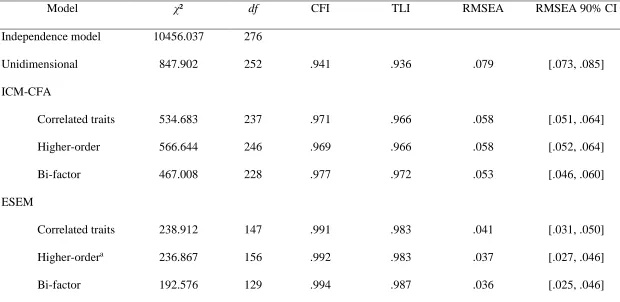
INSERT TABLE 1 ABOUT HERE
There were notable differences in parameter estimates between the CFA and ESEM solutions for the correlated-traits models. Correlated-traits CFA factor loadings (M = .751) were stronger than corresponding ESEM target loadings (M = .510). Further, ICM-CFA factor
correlations (M = .786) were appreciably stronger than ESEM estimates (M = .420). For instance, the near-perfect correlation between Reliable Alliance and Guidance (r = .967) in the CFA solution was substantially lower in the ESEM solution (r = .217). Notably, 10 of the 15 estimated factor correlations in the CFA solution exceeded .800 with three over .900. These substantial correlations call into question the discriminant validity of the factors and the
multidimensional perspective underlying the SPS. Given the superior fit of the ESEM models to the sample data, and the systematically lower factor correlations obtained in these less restrictive solutions, the ESEM structures were retained as the preferred models for further analysis. Indeed, Marsh et al. (2009) recommend that ESEM models should be retained when factor correlations are appreciably reduced relative to ICM-CFA.
The correlated-traits, higher-order, and bi-factor ESEM models were compared to determine the best-fitting and most theoretically-informative solution. The three models showed uniformly excellent fits to the data and could not be distinguished based on model fit alone (see Table1).1 Although the correlated-traits ESEM solution yielded factor correlations that are
1Although the SPS items were correctly modeled as ordered polytomous variables under WLSMV estimation, the
factor solutions were also estimated under robust maximum likelihood, operationalized as the MLR estimator in Mplus, to obtain information criteria, which may be informative for model selection. The evaluation centered on three criteria, namely the Akaike Information Criterion (AIC), Bayesian Information Criteria (BIC), and the Sample- Adjusted Bayesian Information Criterion (SaBIC). Lower values of these information criteria are indicative of better model fit in a model selection framework. Consistent with the practical fit indices, the AIC and SaBIC suggested better fit of the ESEM models than the CFA model. On the contrary, the BIC was suggestive of better fit of the CFA models. However, the BIC is known to favor models with too few parameters (West, Taylor, & Wu, 2012). For the comparison of ESEM structures, the AIC favored the bi-factor ESEM model. Contrariwise, the SaBIC favored the higher-order model. This is consistent with the evaluation of changes in practical fit indices that show no
17
consistent with the multidimensionality perspective underlying the SPS, across the Attachment, Reliable Alliance, and Guidance factors, there were six instances of target loadings less than the magnitude of concomitant cross-loadings on at least one of the other two factors (see
Supplemental Appendix C). This pattern of loadings is suggestive of the presence of a general support factor, primarily loaded by Attachment, Reliable Alliance, and Guidance items.
Of the three well-fitting models, the higher-order ESEM structure should be preferred on the basis of parsimony. However, relying on the parsimony criterion is not always the best solution. Indeed, from a substantive standpoint, the higher-order-ESEM solution is unappealing because the second-order loading of Reliable Alliance on the global factor was near-zero (γ = .098) due to the complex item-factor relations involving Reliable Alliance in the loading matrix. The bi-factor ESEM may better accommodate these complex relations.
The bi-factor ESEM provided a marginally better fit to the data than the higher-order ESEM and correlated-traits ESEM models. The parameter estimates from this solution are shown in Table 2. The general support factor was well-defined in this solution with largely moderate to strong item loadings (|λ| = .154–.862, M = .668). In general, Attachment, Reliable Alliance, and
Guidance item loadings on the general factor were stronger (|λ| = .652–.862, M = .778) than
loadings for Reassurance of Worth, Social Integration, and Opportunity for Nurturance (|λ| =
.154–.787, M = .559). Beyond the general factor, target loadings on the specific factors (|λ| =
.011–.681, M = .322) were systematically larger than non-target loadings (|λ| = .001–.325, M =
.076). However, target loadings on the Attachment, Reliable Alliance, and Guidance specific
18
factors were generally small (|λ| = .011–.562, M = .205), indicating the presence of only little
residual specificity after accounting for general support. On the contrary, the Reassurance of Worth, Social Integration, and Opportunity for Nurturance specific factors were well-defined with generally moderate target loadings (|λ| = .147–.681, M = .438). It should be noted, however,
that across the Attachment, Reliable Alliance, and Guidance specific factors there was at least one substantive (> .25) target loadings on each factor, indicating that this residual content specificity in the SPS model should be controlled. Based on the (a) marginally superior fit of the bi-factor-ESEM, (b) well-defined general factor and specific Reassurance of Worth, Social Integration, and Opportunity for Nurturance factors, (c) less well-defined but, nevertheless, distinguishable Attachment, Reliable Alliance, and Guidance specific factors, and (d) strength of target specific factor loadings relative to non-target loadings, the bi-factor-ESEM was retained and used in subsequent tests of gender invariance and predictive validity.
INSERT TABLE 2 ABOUT HERE Gender Differences
Mean differences in the SPS factors across gender were examined with bi-factor-ESEM MIMIC models. The test of the saturated MIMIC model resulted in an excellent fit to the data, χ2 (129) =194.449, p < .001, RMSEA = .037 (95% CI = .026, .047), CFI = .994, TLI = .985. The threshold-invariant MIMIC model also provided an excellent fit to the data, χ2 (146) = 215.314, p < .001, RMSEA = .036 (95% CI = .025, .045), CFI = .993, TLI = .986, and, notably, no
appreciable decrement in fit relative to the saturated model, MD χ2 (17) = 25.119, p > .05, ΔRMSEA = –.001, ΔCFI = –.001, ΔTLI = +.001. This indicates that the effects of gender are
19
that men were higher than women on this specific provision. However, no significant gender differences were found for general support (γ = 0.131, p > .05), Attachment (γ = –0.200, p > .05), Reliable Alliance (γ = –0.241, p > .05), Reassurance of Worth (γ = 0.210, p > .05), Guidance (γ = 0.077, p > .05), and Opportunity for Nurturance (γ = –0.016, p > .05).
Predictive Validity
A general SEM model was specified to test the predictive validity of SPS scores. The model included the general factor and six specific provision factors as per the retained bi-factor-ESEM as well as a separate set of bi-factor-ESEM loneliness and PWB factors indicated by the ULS-8 and SWEMWBS items. The ESEM specification for the loneliness and PWB data was
considered appropriate as current conceptualizations of PWB (e.g., Ryff, 1989) include positive relations as a core component of optimal functioning. Similarly, SWEMWBS items tapping positive relations may be expected to load on the loneliness factor. For the indicators of loneliness and PWB, two correlated residuals were specified reflecting presumed
intradimensional local dependence generated by potential method effects emerging from highly-similar item phrasings (i.e., “I feel left out” 8 item 4], “I feel isolation from others” [ULS-8 item5]; “I’ve been feeling useful” [SWEMWBS item 2], “I’ve been feeling optimistic about the future” [SWEMWBS item 1]). For the structural relations, direct paths from the support
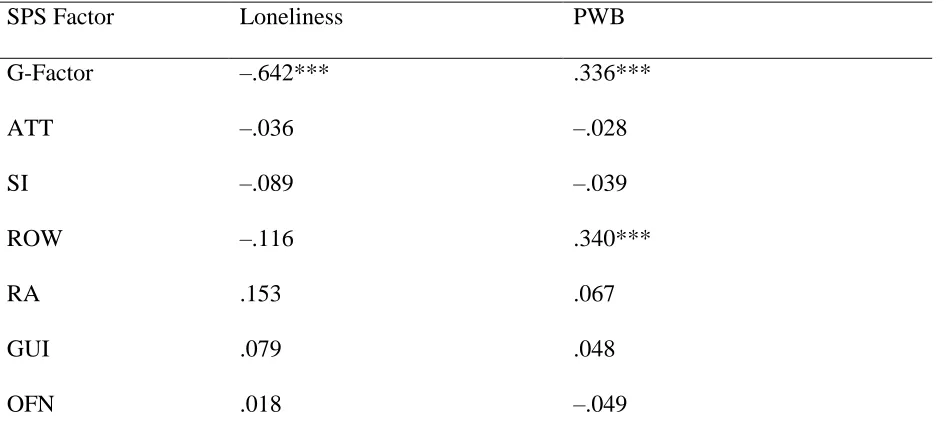
factors to loneliness and PWB were specified. A test of this model resulted in an excellent fit to the sample data, χ2 (549) = 740.312, p < .001, RMSEA = .030 (95% CI = .025, .036), CFI = .986, TLI = .981. As shown in Table 3, only General Support was a noteworthy and statistically
20
General Support and Reassurance of Worth were found to be moderate and statistically
significant positive predictors. The remaining factors were virtually unrelated to this criterion. INSERT TABLE 3 ABOUT HERE
Discussion
The present study has been concerned with examining the construct validity of SPS data. Specifically, the study investigated the latent structure, gender mean invariance, and predictive validity of SPS responses in a novel bi-factor-ESEM framework. Accordingly, this study extends previous psychometric analyses of the SPS by applying a novel analytic method to SPS data that accounts for their psychometric multidimensionality due to item fallibility and the co-existence of general and specific constructs (Morin et al., 2015). The findings of this investigation show that SPS data are best represented by a bi-factor structure with a general support factor and six specific provision factors with varying degrees of residual specificity. Furthermore, evidence was obtained for the gender invariance of SPS item thresholds and six of the seven factor means. Only mean levels of Social Integration were found to vary across gender. Finally, evidence was acquired for the predictive validity of SPS scores with respect to both loneliness and PWB. Taken together, the present research contributes to not only the advancement of the measurement and theory of PSS but also the broader methodological literature on approaches to accounting for psychometric multidimensionality in psychological item data.
21
(Morin et al., 2013). Thus, ESEM may provide a better analytic approximation to psychological item data that are seldom ever truly unidimensional, and, if permitted to do so, will oftentimes load on more than one construct (Hopwood & Donellan, 2010). Aside from better model fit alone, ESEM yields important advantages over the ICM-CFA in parameter estimation (Perera, 2015). In the correlated-traits ESEM model, estimated factor correlations were substantially lower than those obtained in the corresponding ICM-CFA model and thus seemingly much more in line with the multidimensionality perspective that underlies the SPS (Cutrona & Russell, 1987). Indeed, where an ESEM solution provides an appreciably better fit to that data than the ICM-CFA and yields substantially lower factor correlations relative to the ICM-CFA, the ESEM model should be preferred (Perera, 2015).
Although the correlated-traits ESEM model provided an excellent fit to the data and yielded estimates of factor correlations that are consistent with Weiss’s (1974)
multidimensionality perspective, evidence was obtained for construct-relevant
multidimensionality in the solution attributable to the co-existence of general and specific factors underlying the items, which a correlated-traits-ESEM model cannot sufficiently accommodate. Across the Attachment, Reliable Alliance, and Guidance factors there were instances of target loadings less than the magnitude of corresponding cross-loadings on at least one of the other two factors. This finding of high cross-loadings converges with the results of Mancini and Blieszner (1992) who found greater between-factor than within-factor item correlations across these factors. In Mancini and Blieszner’s (1992) study, these three factors were collapsed to form an “Intimacy” factor loaded by all 12-items on the basis of the ostensible violation of simple
22
useful. Taken together, this pattern of loadings is suggestive of the co-existence of (a) a general support factor primarily loaded by Attachment, Reliable Alliance, and Guidance items and to a lesser extent Social Integration, Reassurance of Worth, and Opportunity for Nurturance items and (b) at least partially defined specific provisions factors that may possess some content specificity.
Construct-relevant item psychometric multidimensionality due to the presence of general and specific factors may be sufficiently accounted for by a bi-factor solution. In the present study, the retained bi-factor ESEM model provided an excellent fit to the sample data and resulted in theoretically defensible parameters. In this solution, the general factor was well-defined with 23 of the 24 general factor loadings exceeding .350. This is remarkable considering the SPS items were intended to measure distinct dimensions of PSS. This bifactor solution is consistent with the theoretical view that people possess a global sense of support in addition to expectations for, and perceptions of, specific provisions obtained from finite relationships (Cutrona & Russell, 1987; Davis et al., 1998; Pierce et al., 1990). For example, following a natural disaster, a person may perceive the provision of tangible assistance via receipt of
government food stamps. However, this may not constitute part of the person’s broader schema of general perceptions of support. Likewise, an incoming college student may perceive their worth is reassured by a professor in attaining a high assignment grade, quite apart from feeling generally supported. Notwithstanding the theoretical defensibility of the bi-factor model, the specific Attachment, Reliable Alliance, and Guidance factors were only weakly defined, with generally low-to-moderate, and in some cases near-zero, specific-factor loadings. The finding of only partially defined factors raises the possibility of another alternative model in which
23
structure reflects the view that people may not sufficiently discriminate across these support functions, particularly where these support provisions are derived from a common source (e.g., parents; Mancini & Blieszner, 1992). Instead, it may be that these basic functions constitute the core of people’s general perceptions of support. Future researchers would do well to test this
alternative structure.
Even after controlling for the general factor, specific factor cross-loadings remained in the bi-factor-ESEM. In general, these cross-loadings (|λ| = .001–.325, M = .076) were smaller in
magnitude relative to those observed in the correlated-traits-ESEM (|λ| = .001–.498, M = .136).
This is because any true general factor underlying all items is expressed via (inflated) cross-loadings in solutions that do not explicitly model the general factor (Morin et al., 2015). However, the cross-loadings were, at times, substantively meaningful. For example, Item four (“there are people who depend on me for help”)—an indicator of Opportunity for Nurturance— cross-loaded non-trivially on Attachment, which may reflect the reciprocity of care that is crucial to strong emotional bonds. Similarly, Item one (“there are people I can depend on to help me if I really need it”) and Item 13 (“I have relationships where my competence and skills are
recognized”), which are designed to primarily index Reliable Alliance and Reassurance of
Worth, respectively, had non-trivial cross-loadings on Attachment. This may reflect the possibility that tangible and esteem support serve an emotional support function to the degree that they signal caring behaviors (Schaefer, Coyne, & Lazarus, 1981). Several other
24
Taken together, the results of the present investigation contribute to a nascent literature on the use of bi-factor-ESEM as an integrative framework for the theoretically-informed modeling of two sources of construct-relevant psychometric multidimensionality that may be present in multifactorial instruments (Morin et al., 2015). The first source concerns the co-existence of general and specific factors underlying item data, which may be sufficiently
accounted for by a bi-factor model. The second source concerns the fallibility of items as purely unidimensional indicators of the constructs they are purported to measure. This psychometric multidimensionality due to item fallibility may be accounted for by ESEM. Where both sources of psychometric multidimensionality are expected to be present, a bi-factor-ESEM may be the most appropriate analytic model (Morin et al., 2015).
Despite these apparent benefits of bi-factor-ESEM, the finding of several non-trivial and substantively meaningful non-target loadings raises the possibility that these parameters may have been specified a priori based on theoretical expectations in a more parsimonious CFA model. Indeed, Booth and Hughes (2014) note that the a priori specification of theoretically plausible cross-loadings should be preferred to the unrestrictive ESEM specification of all possible cross-loadings. According to Perera (2015), this preference is for at least two reasons: (a) tests of non-target loadings specified a priori on the basis of a substantive rationale, which are subsequently supported by the data, yield stronger evidence for the parameter by virtue of their hypothetico-deductive logic; (b) the a priori specification of only theoretically defensible non-target loadings minimizes the estimation of atheoretical parameters, which may reflect sampling idiosyncrasies alone, towards preserving scientific parsimony.
25
estimation. This suggests that a CFA with minimal theoretically-defensible cross-loadings may be a more acceptable analytic structure (Booth & Hughes, 2014). However, in complex
multidimensional instruments with several conceptually-related dimensions, such as the SPS, the a priori identification of all plausible cross-loadings reflecting multidimensionality due to item fallibility may be an unrealistic ideal. Perera (2015) notes the analytic potential of ESEM with target rotation in these circumstances. Given expected psychometric multidimensionality due to item fallibility, it is possible with target rotation in ESEM to advance hypotheses about the pattern of non-zero and approximately zero loadings in a confirmatory fashion, but permit cross-loadings targeted to zero to deviate from zero should this specification be unsuitable (Morin et al., 2015). Cross-loadings targeted to zero that show appreciable deviation from zero may then become the focus of later scrutiny for theoretical defensibility and replication (Perera, 2015), perhaps in a complex CFA framework that is informed by prior ESEM results.
Latent Mean Invariance
The present study yielded evidence for the gender invariance of (a) SPS item thresholds, (b) the general SPS factor mean, and (c) five of the six specific support factor means. Although the focus of the present invariance tests were on evaluating latent mean differences across gender, the MIMIC models were extended to investigate the invariance of indicator thresholds, which is necessary for valid interpretations of mean differences. Support was found for a bi-factor ESEM MIMIC model in which paths from gender to the bi-factor indicators were constrained to zero. This result is indicative of item threshold invariance or the absence of monotonic DIF across gender in the SPS. The retained threshold-invariant MIMIC model yielded support for the gender equivalence of factor means for General Support, Attachment, Reliable Alliance,
26
Integration were found to vary as a function of gender, such that men perceived higher levels of the provision than women. Notably, these gender differences in Social Integration were found, partialling out the influence of the general factor. This result converges with evidence showing that men have larger social networks than women (Fuhrer, Stansfeld, Chemali, and Shipley, 1999), and is somewhat consistent with the theoretical view espousing the agentic social role of men (Matud et al., 2003). It may be that the differences in Social Integration reflect men’s general preference for broad network support (i.e., belonging to a group that shares common interests and recreational activities) (Belle, 1989), rather than more emotion-based and expressive support functions, which may satisfy the basic need for belonging but foster the maintenance of autonomy and self-reliance that are central to men’s socialization experiences (Matud et al., 2003).
Predictive Validity
well-27
being in college students (e.g., Brissette, Carver, & Scheier, 2002; Davis et al., 1998). The findings from this research also replicate previous data indicating that reassurance of worth is the only appreciable predictor of PWB of the six specific provisions (Constable & Russell, 1986), and extend these data by showing that this effect is independent of the general support factor. This finding may reflect the possibility that across the college transition—the focal context of the present investigation—where students’ sense of self-worth is particularly vulnerable to the deleterious effects of academic and social stressors (Friedlander et al., 2007), perceptions that others acknowledge their skills and abilities, quite apart from a general sense of being supported, may be integral to maintaining PWB.
Limitations and Future Directions
Notwithstanding these advances in the measurement and theory of PSS, the study
reported herein has several limitations that serve to guide the appropriate interpretation of results and future research. The sample size in this study, though not small by current standards, limited the findings in two ways. First, cross-tabulations revealed several empty cells, leading to the collapsing of the lower categories of the SPS response scale to enhance the WLSMV estimation process. Thus, it is not clear whether the findings obtained would generalize to the original four-point scale. Second, the small sample for males precluded the assessment of latent mean
28
well to examine the replicability of the present findings in a larger sample that permits retention of the original SPS item response format and multiple-group structured means modeling.
Another limitation of this study concerns the criteria used for model fit evaluation, selection, and comparison. Although model fit was assessed in line with current
recommendations, it is not known whether these guidelines are appropriate for ESEM. Likewise, it is not entirely clear whether the criteria used to compare nested models based on changes in approximate fit indices, which were derived in the context of multiple-population CFA models for continuous data (Cheung & Rensvold, 2002, Chen, 2007), generalize to ESEM models for polytomous data under WLSMV estimation. What is clear is that further simulation and empirical work is required before these criteria for evaluating fit can be used with greater
confidence. Until the time, it important to heed the recommendation of Marsh et al. (2010) to use a holistic approach to model assessment, including an evaluation of fit indices, parameter
estimates, and alternative models.
29
individual’s stable view or outlook on the general supportiveness of the social environment
(Davis et al., 1998; Sarason, Sarason, & Shearin , 1986). On the contrary, provision-specific perceptions of support may be more bound to current relationships and, accordingly, less stable as relationships change. Bi-factor ESEM provides an elegant framework for the examination of temporal stability that can accommodate tests of longitudinal measurement invariance required to examine construct-level stability effects over time.
A third important direction for future research on the construct validity of SPS scores is to explore theoretically-relevant outcomes of the specific factors. Although the specific factors generally had little validity for predicting loneliness and PWB in the present study, it is plausible that, for some outcomes, the specific factors may yield greater predictive validity and even relations in the opposite direction relative to the general factor. For instance, the social
integration that one perceives as a result of involvement in, say, a sporting team, quite apart from their global sense of being supported, may be more important in the prediction of social
30
outcomes (e.g., general wellness), the global support factor may possess superior predictive power given its conceptual breadth.
The issue of the validity of the general versus specific factors represented in the final bi-factor model has important implications for approaches to scoring the SPS. Indeed, the retention of a bi-factor structure necessarily complicates the scoring of the SPS, at least in terms of the computation of observed scores. This is because dominant approaches to computing observed scores, namely the total and individual score approaches (Chen et al., 2012), cannot easily accommodate the partitioning of item variance into the general and specific factor components implied by the bi-factor model. Take, for instance, the computation of a total score. Some
investigators may justify calculating a total SPS score, as the sum or average of all 24 SPS items, on the basis of the finding that the general support factor was relatively well-defined in the present investigation. This total score would, however, confound the variance associated with the general and specific factors (Brown, Finney, & France, 2011). Similarly, the computation of individual facet or subscale scores, as per, for instance, the SPS scoring key, is conceptually problematic as investigators cannot disentangle the unique contributions of the subscale factors from the contributions of the common component shared by all subscales. Furthermore, where items predominantly reflect the general factor and have weak or near-zero specific-factor
loadings, it may be that subscales are meaningless (Reise, Moore, & Haviland, 2010). This issue of observed score computations is further complicated by the presence of specific-factor cross-loadings due to item fallibility.
Although replication of the latent structure retained in the present study is required before definitive guidelines on scoring or modeling the SPS data are provided, a few tentative
31
research, investigators working with the SPS should use latent variable modeling approaches to explicitly model the bi-factor structure. If interest is predominantly in examining general perceptions of support, unlike the total score approach, the bi-factor model yields a “pure” support factor, partialling out specific-factor variance. This research would, by implication, yield important evidence on the validity of the specific factors and illuminate their conceptual meaning (Chen et al., 2006). For researchers who primarily work with manifest-variable methods, if proceeding with the computation of total SPS scores, it may be prudent to qualify any results by acknowledging the multidimensionality of the SPS data and discussing
implications for reliability and validity occasioned by item score aggregation (Brown et al., 2011).
32 References
Asparouhov, T., & Muthén, B. (2009). Exploratory structural equation modeling. Structural Equation Modeling: A Multidisciplinary Journal, 16, 397-438. doi:
10.1080/10705510903008204
Asparouhov, T., & Muthén, B. (2010). Weighted least squares estimation with missing data. MplusTechnical Appendix, from
http://www.statmodel.com/download/GstrucMissingRevision.pdf
Baron, R. S., Cutrona, C. E., Hicklin, D., Russell, D. W., & Lubaroff, D. M. (1990). Social support and immune function among spouses of cancer patients. Journal of Personality and Social Psychology, 59, 344–352. doi: 10.1037/0022-3514.59.2.344
Belle, D. (1989). Studying children's social networks and social support. In D. Belle (Ed)., Children's social networks and social support (pp 1–14). New York, NY: Wiley Booth, T., & Hughes, D. J. (2014). Exploratory Structural Equation Modeling of Personality
Data. Assessment, 21, 260-271. doi: 10.1177/1073191114528029
Brissette, I., Scheier, M. F., & Carver, C. S. (2002). The role of optimism in social network development, coping, and psychological adjustment during a life transition. Journal of Personality and Social Psychology, 82, 102-111. doi: 10.1037//0022-3514.82.1.102 Brown, A. R., Finney, S. J., & France, M. K. (2011). Using the bifactor model to assess the
dimensionality of the Hong Psychological Reactance Scale.Educational and Psychological Measurement, 71, 170-185. doi: 10.1177/0013164410387378
Chen, F. F. (2007). Sensitivity of Goodness of Fit Indexes to Lack of Measurement Invariance. Structural Equation Modeling: A Multidisciplinary Journal, 14, 464-504. doi:
33
Chen, F. F., Hayes, A., Carver, C. S., Laurenceau, J. P., & Zhang, Z. (2012). Modeling general and specific variance in multifaceted constructs: A comparison of the bifactor model to other approaches. Journal of Personality,80, 219-251. doi:
10.1111/j.1467-6494.2011.00739.x
Chen, F. F., West, S. G., & Sousa, K. H. (2006). A comparison of bifactor and second-order models of quality of life. Multivariate Behavioral Research, 41, 189-225. doi: 10.1207/s15327906mbr4102_5
Cheung, G. W., & Rensvold, R. B. (2002). Evaluating Goodness-of-Fit Indexes for Testing Measurement Invariance. Structural Equation Modeling: A Multidisciplinary Journal, 9, 233-255. doi: 10.1207/s15328007sem0902_5
Cobb, S. (1979). Social support and health through the life course. In M. W. Riley (Ed.), Aging from birth to death: Interdisciplinary perspectives (pp. 93–106). Boulder, CO: Westview Press.
Cohen, S., & Wills, T. A. (1985). Stress, social support, and the buffering hypothesis. Psychological Bulletin, 98, 310–357. doi: 10.1037/0033-2909.98.2.310
Constable, J. F., & Russell, D. W. (1986). The effect of social support and the work environment upon burnout among nurses. Journal of Human Stress, 12, 20-26. doi:
10.1080/0097840X.1986.9936762
34
Cutrona, C. E. (1982). Transition to college: Loneliness and the process of social adjustment. In L. A. Peplau & D. Perlman (Eds.), Loneliness: A sourcebook of current theory, research, and therapy (pp. 291-309). New York, NY: Wiley Interscience.
Cutrona, C. E., & Russell, D. W. (1987). The provisions of social relationships and adaptation to stress. In W. H. Jones, & D. Perlman (Ed.), Advances in personal relationships (Vol. 1, pp. 37-67). Greenwich, CT: JAI Press.
Davis, M. H., Morris, M. M., & Kraus, L. A. (1998). Relationship-specific and global
perceptions of social support: associations with well-being and attachment. Journal of Personality and Social Psychology, 74, 468–481. doi: 10.1037/0022-3514.74.2.468 DiTommaso, E., & Spinner, B. (1997). Social and emotional loneliness: A re-examination of
Weiss' typology of loneliness. Personality and Individual Differences, 22, 417-427. doi: 10.1016/S0191-8869(96)00204-8
Dunkle, J. H., & Friedlander, M. L. (1996). Contribution of therapist experience and personal characteristics to the working alliance. Journal of Counseling Psychology, 43, 456–460. doi: 10.1037/0022-0167.43.4.456
Flaherty, J., & Richman, J. (1989). Gender differences in the perception and utilization of social support: Theoretical perspectives and an empirical test. Social Science & Medicine, 28, 1221-1228. doi: 10.1016/0277-9536(89)90340-7
35
Fuhrer, R., Stansfeld, S. A., Chemali, J., & Shipley, M. J. (1999). Gender, social relations and mental health: Prospective findings from an occupational cohort. Social Science & Medicine, 48, 77-87. doi: 10.1016/S0277-9536(98)00290-1
Hopwood, C. J., & Donnellan, M. B. (2010). How should the internal structure of personality inventories be evaluated? Personality and Social Psychology Review, 14, 332-346. doi: 10.1177/1088868310361240
Larose, S., Guay, F., & Boivin, M. (2002). Attachment, social support, and loneliness in young adulthood: A test of two models. Personality and Social Psychology Bulletin, 28, 684-693. doi: 10.1177/0146167202288012
Little, R. J. A. (1988). A test of Missing Completely at Random for multivariate data with missing values. Journal of the American Statistical Association, 83, 1198-1202. doi: 10.1080/01621459.1988.10478722
Mallinckrodt, B., & Bennett, J. (1992). Social support and the impact of job loss in dislocated blue-collar workers. Journal of Counseling Psychology, 39, 482–489. doi: 10.1037/0022-0167.39.4.482
Mancini, J. A., & Blieszner, R. (1992). Social provisions in adulthood: Concept and measurement in close relationships. Journal of Gerontology, 47, 14–20. doi: 10.1093/geronj/47.1.P14
Marangoni, C., & Ickes, W. (1989). Loneliness: A Theoretical Review with Implications for Measurement. Journal of Social and Personal Relationships, 6, 93-128. doi:
36
Marsh, H. W., Dowson, M., Pietsch, J., & Walker, R. (2004). Why Multicollinearity Matters: A Reexamination of Relations Between Self-Efficacy, Self-Concept, and Achievement. Journal of Educational Psychology, 96, 518-. doi:
Marsh, H. W., Hau, K.-T., & Wen, Z. (2004). In Search of Golden Rules: Comment on
Hypothesis-Testing Approaches to Setting Cutoff Values for Fit Indexes and Dangers in Overgeneralizing Hu and Bentler's (1999) Findings. Structural Equation Modeling: A Multidisciplinary Journal, 11, 320-341. doi: 10.1207/s15328007sem1103_2
Marsh, H. W., Lüdtke, O., Muthén, B., Asparouhov, T., Morin, A. J., Trautwein, U., & Nagengast, B. (2010). A new look at the big five factor structure through exploratory structural equation modeling. Psychological Assessment, 22, 471-491. doi:
10.1037/a0019227
Marsh, H. W., Morin, A. J., Parker, P. D., & Kaur, G. (2014). Exploratory structural equation modeling: an integration of the best features of exploratory and confirmatory factor analysis. Annual Review of Clinical Psychology, 10, 85–110. doi: 10.1146/annurev-clinpsy-032813-153700
Marsh, H. W., Muthén, B., Asparouhov, T., Lüdtke, O., Robitzsch, A., Morin, A. J. S., & Trautwein, U. (2009). Exploratory structural equation modeling, Integrating CFA and EFA: Application to students' evaluations of university teaching. Structural Equation Modeling: A Multidisciplinary Journal, 16, 439-476. doi: 10.1080/10705510903008220 Matud, M. P., Ibáñez, I., Bethencourt, J. M., Marrero, R., & Carballeira, M. (2003). Structural
37
Morin, A. J. S., Arens, A. K., & Marsh, H. W. (2015). A bifactor exploratory structural equation modeling framework for the identification of distinct sources of construct-relevant psychometric multidimensionality. Structural Equation Modeling.
Morin, A., Marsh, H., & Nagengast, B. (2013). Exploratory structural equation modeling. In G. R. Hancock & R. O. Mueller (Eds.), Structural equation modeling: A second course (pp. 395-436). Charlotte, NC: IAP.
Muthén, L. K., & Muthén, B. O. (1998-2014). Mplus user’s guide. Los Angeles, CA Muthén &
Muthén.
Olson, D. A., & Shultz, K. S. (1994). Gender differences in the dimensionality of social support. Journal of Applied Social Psychology, 24, 1221-1232. doi: 10.1111/j.1559-1816.1994.tb00555.x
Perera, H. N. (2015). The internal structure of responses to the Trait Emotional Intelligence Questionnaire Short-Form: An exploratory structural equation modeling approach. Journal of Personality Assessment. doi: 10.1080/00223891.2015.1014042
Perera, H. N., McIlveen, P., Burton, L. J., & Corser, D. M. (2015). Beyond congruence measures for the evaluation of personality factor structure replicability: An exploratory structural equation modeling approach. Personality and Individual Differences. doi:
10.1016/j.paid.2015.01.004
Pierce, G. R., Sarason, I. G., & Sarason, B. R. (1991). General and relationship-based
38
Quimby, J. L., & O'Brien, K. M. (2006). Predictors of well‐being among nontraditional female
students with children. Journal of Counseling & Development, 84, 451-460. doi: 10.1002/j.1556-6678.2006.tb00429.x
Reise, S. P., Moore, T. M., & Haviland, M. G. (2010). Bifactor models and rotations: Exploring the extent to which multidimensional data yield univocal scale scores. Journal of
Personality Assessment, 92, 544-559. doi: 10.1080/00223891.2010.496477
Russell, D. W., Altmaier, E., & Van Velzen, D. (1987). Job-related stress, social support, and burnout among classroom teachers. Journal of Applied Psychology, 72, 269–274. doi: 10.1037/0021-9010.72.2.269
Russell, D. W., Cutrona, C. E., Rose, J., & Yurko, K. (1984). Social and emotional loneliness: an examination of Weiss's typology of loneliness. Journal of Personality and Social
Psychology, 46, 1313–1321. doi: 10.1037/0022-3514.46.6.1313
Russell, D. W., Peplau, L. A., & Cutrona, C. E. (1980). The revised UCLA Loneliness Scale: Concurrent and discriminant validity evidence. Journal of Personality and Social Psychology, 39, 472-480. doi: 10.1037/0022-3514.39.3.472
Sarason, I. G., Sarason, B. R., & Shearin, E. N. (1986). Social support as an individual difference variable: Its stability, origins, and relational aspects. Journal of Personality and Social Psychology, 50, 845–855. doi: 10.1037/0022-3514.50.4.845
Schaefer, C., Coyne, J. C., & Lazarus, R. S. (1981). The health-related functions of social support. Journal of Behavioral Medicine, 4, 381-406. doi: 10.1007/BF00846149 Stewart-Brown, S., Tennant, A., Tennant, R., Platt, S., Parkinson, J., & Weich, S. (2009).
39
(WEMWBS): A Rasch analysis using data from the Scottish Health Education Population Survey. Health and Quality of Life Outcomes, 7, 15–22. doi: 10.1186/1477-7525-7-15 Vaux, A. (1988). Social and Emotional Loneliness The Role of Social and Personal
Characteristics. Personality and Social Psychology Bulletin, 14, 722-734. doi: 10.1177/0146167288144007
Weiss, R. (1974). The provisions of social relationships. . In Z. Rubin (Ed.), Doing unto others (pp. 17–26). Englewood Cliffs, NJ: Prentice Hall.
West, S. G., Taylor, A. B., & Wu, W. (2012). Model fit and model selection in structural
40 Table 1
Model Fit Statistics for the ICM-CFA and ESEM Measurement Structures
Note. N = 376. df = degrees of freedom; CFI = comparative fit index; TLI = Tucker-Lewis index; RMSEA = root-mean-square error of approximation; 90% CI = 90% confidence interval for the RMSEA. a The higher-order ESEM specification was conducted in an EwC framework (see Morin et al., 2013).
Model χ² df CFI TLI RMSEA RMSEA 90% CI
Independence model 10456.037 276
Unidimensional 847.902 252 .941 .936 .079 [.073, .085]
ICM-CFA
Correlated traits 534.683 237 .971 .966 .058 [.051, .064]
Higher-order 566.644 246 .969 .966 .058 [.052, .064]
Bi-factor 467.008 228 .977 .972 .053 [.046, .060]
ESEM
Correlated traits 238.912 147 .991 .983 .041 [.031, .050]
Higher-ordera 236.867 156 .992 .983 .037 [.027, .046]
41 Table 2
Factor Loadings from the BF–ESEM Solution Ite
m
G–Factor ATT SI ROW RA GUI OFN
2 .697 .562 .007 –.040 .107 –.172 .064
11 .777 .325 .064 –.020 –.023 .325 –.004
17 .807 .064 –.038 –.139 –.283 .036 –.008
21 .765 .011 –.215 .028 –.343 –.099 .005
5 .687 .078 .510 .005 –.008 –.061 .040
8 .544 .123 .463 .119 .004 .129 .064
14 .778 –.031 .237 .090 .149 –.001 –.050
22 .787 –.216 .322 .027 .041 –.211 –.066
6 .420 .022 –.039 .407 .058 –.207 .027
9 .493 –.107 .107 .681 .043 .036 –.117
13 .708 .164 .072 .214 –.131 .263 .108
20 .635 –.060 .103 .147 –.104 –.069 .211
1 .652 .190 .107 –.038 .202 .044 –.014
10 .727 .038 .065 .083 .263 .027 –.100
18 .862 –.025 –.049 .011 .219 –.099 –.006
23 .790 –.128 .189 –.072 .096 .001 .028
3 .782 .050 .046 –.021 .294 –.137 –.052
12 .828 .053 −.098 –.007 .038 .288 –.043
42
19 .820 –.088 −.190 –.022 .101 –.031 .002
4 .384 .199 .085 .161 .062 –.063 .568
7 .154 –.002 .001 –.247 –.037 –.040 .606
15 .619 –.010 –.043 .087 –.061 .064 .559
24 .500 –.133 –.014 –.010 –.012 .014 .543
43 Table 3
Standardized Path Coefficients for the Regression of Loneliness and PWB on the SPS factors using the BF-ESEM structure
SPS Factor Loneliness PWB
G-Factor –.642*** .336***
ATT –.036 –.028
SI –.089 –.039
ROW –.116 .340***
RA .153 .067
GUI .079 .048
OFN .018 –.049