R E S E A R C H A R T I C L E
Open Access
Influence of recovery strategies upon
performance and perceptions following
fatiguing exercise: a randomized controlled
trial
Fiona Crowther
1*, Rebecca Sealey
2, Melissa Crowe
3, Andrew Edwards
4and Shona Halson
5Abstract
Background:Despite debate regarding their effectiveness, many different post-exercise recovery strategies are used by athletes. This study compared five post-exercise recovery strategies (cold water immersion, contrast water immersion, active recovery, a combined cold water immersion and active recovery and a control condition) to determine which is most effective for subsequent short-term performance and perceived recovery.
Methods:Thirty-four recreationally active males undertook a simulated team-game fatiguing circuit followed by the above recovery strategies (randomized, 1 per week). Prior to the fatiguing exercise, and at 1, 24 and 48 h post-exercise, perceptual, flexibility and performance measures were assessed.
Results:Contrast water immersion significantly enhanced perceptual recovery 1 h after fatiguing exercise in comparison to active and control recovery strategies. Cold water immersion and the combined recovery produced detrimental jump power performance at 1 h compared to the control and active recovery strategies. No recovery strategy was different to the control at 24 and 48 h for either perceptual or performance variables.
Conclusion:For short term perceptual recovery, contrast water therapy should be implemented and for short-term countermovement power performance an active or control recovery is desirable. At 24 and 48 h, no superior recovery strategy was detected.
Trial registration:Retrospectively registered; ISRCTN14415088; 5/11/2017.
Keywords:Recovery, Sports science, Performance
Background
High performance athletes employ a variety of strategies [1, 2] with the intention of accelerating their recovery [3]. Non-elite levels of athlete have also been shown to undertake a number of different recovery strategies post-exercise [4], potentially to decrease soreness and improve subsequent performance. The efficacy of nu-merous recovery strategies has been explored in scien-tific studies and also in practical sport applications, with some strategies being used without compelling support-ive evidence [3, 5, 6].
Water immersion recovery strategies such as cold water immersion (CWI) and contrast water therapy (CWT) are used by athletes across a range of competi-tion levels [4] to enhance post-exercise recovery [6–8]. Cold water immersion reportedly minimises muscle oedema and provides analgesic effects post-exercise [8]. Contrast water therapy is the alternation between hot and cold water [6] and is reported to decrease lactate ac-cumulation [9], inflammation, oedema, pain and muscle stiffness [6]. The common explanation for CWT effect-iveness is the pumping action of circulating blood, which is caused by alternation between vasodilation and vaso-constriction in response to hot and cold water [6].
A number of reviews are inconclusive as to whether CWI or CWT are effective recovery strategies following * Correspondence:[email protected]
1College of Healthcare Sciences, James Cook University, Townsville, QLD, Australia
Full list of author information is available at the end of the article
exercise and sport [3, 5, 6]. Other recent reviews have shown CWI to reduce delayed onset muscle soreness [10] and fatigue [11]. Alternatively, Bieuzen and col-leagues [2] found CWT to be no better than CWI, warm water immersion, active recovery (ACT) and stretching, although better than passive rest. In addition, Torres and colleagues [12] found CWI, ACT and stretching to be generally not effective or inconsistent in improving muscle soreness or strength.
An ACT recovery is a simple and commonly used technique that involves the completion of low intensity exercise following prior exercise, and has been suggested to increase blood flow and range of motion which may lead to the acceleration in the decrease in interstitial cre-atine kinase [13]. Active recovery may also allow reoxy-genation of blood thorough increased alveolar gas exchange as a consequence of elevated metabolism com-pared to passive recovery strategies. Based on the re-ported effectiveness of CWI and ACT, these two strategies were combined and investigated.
A limited number of studies have investigated the combination of CWI and ACT recovery strategies (COMB), with mixed results [14–16]. This combined recovery has been shown to be effective at removing blood lactate [15, 17], and eliciting positive percep-tions of recovery [17, 18].
The purpose of this unique study is to investigate the effects of five recovery strategies (CWI, CWT, ACT, con-trol (CONT) and COMB) on indicators of performance (repeated sprint ability and repeated countermovement jump) sit and reach flexibility, and perceptual recovery (Daily Analysis of Life Demands of Athletes (DALDA) questionnaire, muscle soreness scale and Total Quality Recovery (TQR) scale) following fatiguing exercise in non-elite athletes. The effects of these five recovery strategies upon performance and perceptual recovery to the authors’ knowledge have not been investigated. The findings from this investigation may provide non-elite team sport athletes and coaches with up-to-date in-formation to assist with informed decision making about their recovery choices. Water immersion strat-egies were hypothesised to be superior to ACT and CONT for performance and perceptual indices of recovery over the 48 h time period.
Methods
Thirty-four recreationally active, uninjured, apparently healthy males voluntarily participated in the study (mean ± SD; age: 27 ± 6 years; height: 180 ± 8 cm; weight: 80 ± 9 kg; VO2max: 43 ± 6 ml/kg/min). All participants
were able to complete the fatiguing exercise, participated in regular aerobic exercise and were not elite athletes. Five participants were unable to complete all scheduled testing sessions, due to external factors unrelated to
testing; however their data were included for complete-ness in quantitative analysis of the completed recovery protocols. Contact sport athletes were excluded from the study due to the potential for muscle damage caused by external sports participation. Participants were instructed to abstain from exercise and alcohol 24 h be-fore the first session until the conclusion of the 48 h post testing session, and to abstain from food 2 h and caffeine 4 h prior to sessions. Exercise diaries were com-pleted throughout the testing period and were analysed to confirm consistency of exercise throughout the testing period and adherence to the research project instructions. Participants were informed of the
proce-dures to be undertaken and provided written
informed consent prior to participation. Ethics ap-proval was granted by the Human Ethics Committee of James Cook University (H5415).
Participants performed two familiarisation sessions. The first session included a standardised, generalised warm up (jog and dynamic exercises), 3 × 20 m maximal sprint runs on a grassed area for the determination of peak speed, and a practice of the repeated sprint ability [19, 20] and countermovement jump tests adapted from Elias and colleagues [19] and King and Duffield [21]. The repeated sprint ability test has a reported coefficient of variation of 2.3%, and total sprint time has a strong correlation to fastest 20 m sprint time (r= 0.66) in re-search conducted using well-trained AFL players on a wooden sprung floor [22]. During the second session
participants completed the generalised warm up
followed by a practice of the sit and reach flexibility test [23], completion of the multi-stage fitness test to assess aerobic capacity [24], practice of the fatiguing exercise and familiarisation with the DALDA scale [25], muscle soreness scale [26] and TQR scale [27]. The five recov-ery protocols were also explained at this time.
numbers that were not whole numbers. A generalised warm up (jog and dynamic exercises) was undertaken prior to completion of the sit and reach test, repeated sprint ability test and the counter-movement jump test. The sit and reach test was performed 3 times, with the best measurement recorded for analysis. Participants undertook the repeated sprint ability test, which in-cluded a maximal 20 m sprint every 30 s with six repeti-tions [19, 20]. The countermovement jump test included five jumps of maximal height on a mat, one jump every 15 s [19, 21], with jump height and power recorded. Sprint and jump performance were measured with the
Swift timing gates and mat (Swift Performance Equip-ment, QLD, Australia).
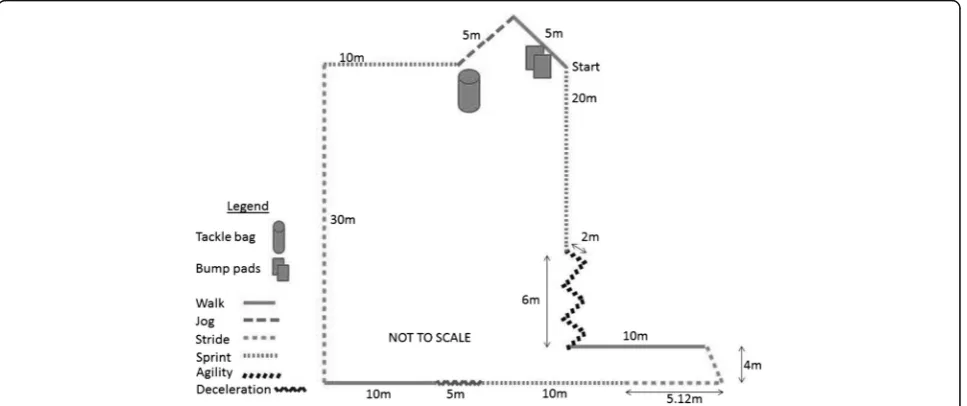
Participants then completed a 3 × 15 min simulated team-game circuit adapted from Singh and colleagues, [28] and Bishop and colleagues, [29] as the fatiguing ex-ercise protocol. The fatiguing exex-ercise involved a circuit undertaken each min which included sprinting, striding, jogging, walking and agility, with bag tackles completed on every fifth rotation [28] and bumps (participants were contacted with bump pads three times on each side of the body as adapted from [28] on the 15th rotation (Fig. 2). After 15 rotations participants rested for five
Testing variables: Perceptual:
• Muscle soreness
• TQR
Flexibility:
• Sit and reach test Performance:
• Repeated sprint ability
• Repeated countermovement jump
Simulated team sport game*
24 hr post game variables; including a duplication of the testing variables upon initial arrival. Exercise
diary completed
Testing variables upon arrival: Urine Body mass DALDA (perceptual)
Assigned randomized recovery
48 hr post game variables including a duplication of the testing variables upon initial arrival. 1 hr post
game variables
Fig. 1Timing of variable assessment during testing days. *HR recorded throughout and RPE at the conclusion
[image:3.595.55.539.88.311.2] [image:3.595.58.542.511.714.2]min before repeating the process two more times. Heart rate was monitored throughout (Polar heart rate moni-tor, Polar Electro Oy, Kempele, Finland) and Borg’s RPE [30] was recorded at the completion of the third round.
Following a ten min rest, participants completed a five min jog at 20% peak speed (adapted from [31]), with peak speed calculated from the maximal sprints in the first familiarisation session. This jog was implemented for practical reasons, as many teams would undertake an active component prior to recovery. Participants then undertook their randomly assigned recovery protocol, CWI, CWT, ACT, COMB or CONT. All recovery proto-cols were undertaken for 14 min. Cold water immersion included being seated in an inflatable bath (iCool Sport, Shenzhen, China), with shoulders immersed at a temperature of 15 °C [31]. Contrast water immersion in-cluded alternating between a cold bath set to 15 °C and a hot bath set to 38 °C (iCool sport, Shenzhen, China), both to shoulder immersion depth [31], with participants instructed to change baths every 1 min. Active recovery included outdoor jogging around a marked and mea-sured grass track at 35% peak speed as adapted from King and Duffield [21] with continual feedback to main-tain the desired speed. The COMB recovery was per-formed as per the cold water immersion protocol with the addition of low intensity cyclic leg movement inside the cold bath. Running was not able to be incorporated into the recovery due to inadequate facilities. Partici-pants’ heart rate was recorded every 10 s and averaged 48 ± 5% of their maximum heart rate. The CONT proto-col involved participants passively sitting on a chair, with as little movement as possible. All recovery protocols and testing procedures were performed outdoors at natural environmental temperatures with no significant difference found over the five sessions for temperature (p= 0.230) (average range over five conditions 22.6 °C -23.9 °C) and humidity (p= 0.955) (average range over five conditions 71.9% - 73.9%).
After each recovery protocol, participants undertook seated rest until 1 h elapsed from completion of the fa-tiguing exercise. Participants then completed the TQR and muscle soreness scale, performed the standardised warm up and completed the sit and reach, repeated sprint ability and countermovement jump tests (approxi-mately 30 min combined). Participants drank water ad libitum throughout the testing day. No food was provided during the 3 h session to allow for better test controllability. The entire duration of the testing session was approximately 3 h.
Participants returned at 24 and 48 h post completion of the fatiguing exercise for the following tests: urine specific gravity, DALDA, muscle soreness scale, TQR; and the same generalised warm up, sit and reach, re-peated sprint ability and counter-movement jump tests.
At the conclusion of all testing participants were asked which recovery strategy they thought was most effective and which was least effective and to give reasons why. Participants were blinded to the results of the perform-ance tests. The entire testing process was repeated each week until participants had completed all five randomly ordered recovery strategies (excluding those who were unable to finish). Participants performed testing at ap-proximately the same time each day.
Statistical analyses
Data were analysed using the Statistical Package for Social Sciences (IBM SPSS Incorporation, Version 22, Chicago, Ill, USA) via two-way (time x recovery) re-peated measures ANOVA and post hoc Tukey HSD tests. Repeated sprint ability and relative average and best power at 1 h post were assessed between weeks for order of effect. Data were presented as means ± standard deviation (SD) with alpha set at 0.05. All results are interaction results unless specified. The following vari-ables were analysed; RPE, average HR, hydration, DALDA scale, muscle soreness, TQR, best sit and reach performance, total repeated sprint time, relative (normalised for mass) average and peak jump power per-formances. The following recovery-related components of the DALDA scale were analysed; muscle pains; need for rest; recovery time; unexplained aches; between session recovery; and swelling. Incomplete data points were accounted for by using the recovery and time specific average.
Results
Order of effect testing indicated no difference for 1 h post repeated sprint ability between the weeks (p= 0.243; week 1 21.8 ± 2.5 s, week 2 21.9 ± 1.3 s, week 3 21.6 ± 1.2 s, week 4 22.2 ± 1.5 s and week 5 22.3 ± 1.5 s). For power measures no differences were found across weeks (relative average p= 0.573 and best p= 0.606 respectively, week 1 15.9 ± 2.2 W/kg and 16.4 ± 2.1 W/kg, week 2 15.8 ± 2.2 W/kg and 16.3 ± 2.2 W/kg, week 3 15.7 ± 2.3 W/kg and 16.2 ± 2.2 W/kg, week 4 15.6 ± 2.2 W/kg and 16.2 ± 2.2 W/kg and week 5 15.6 ± 2.3 W/kg and 16.1 ± 2.3 W/ kg), confirming there is no order of effect or adaptation.
165 ± 8.4 bpm and CONT 165 ± 11.6 bpm. The mean between-trial coefficient of variation for hydration across all sessions was 0.8% (average range over five conditions 1.02–1.03), therefore it is unlikely to im-pact upon results.
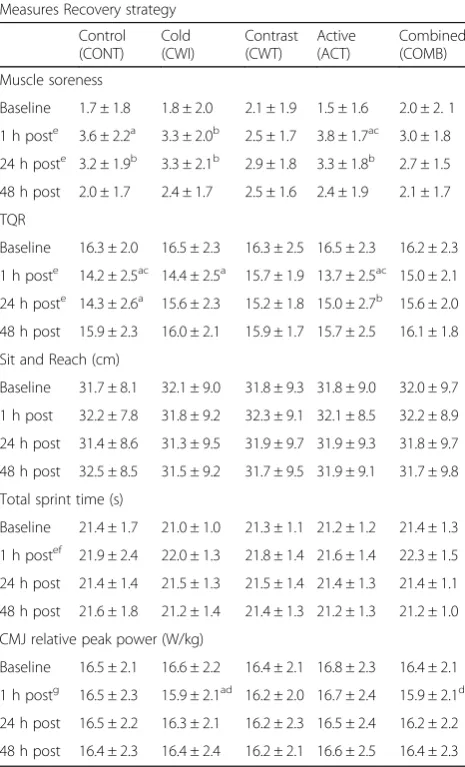
One hour following fatiguing exercise, CWT elicited superior perceptions of recovery (muscle soreness 2.5; TQR 15.7) in comparison to ACT (muscle soreness 3.8; TQR 13.7) and CONT (TQR only 14.2). At 1 h CWI (CMJ relative peak power 15.9; relative average 15.4) and COMB (CMJ relative peak power 15.9; rela-tive average 15.4) recovery strategies showed detri-mental performance results in comparison to ACT (CMJ relative peak power 16.7; relative average 16.1) and CONT (CMJ relative peak power 16.5; relative average 16.0). However, there was no difference be-tween the five recovery strategies at 24 and 48 h for perceptual and performance recovery.
As an overall time effect, the response to the DALDA scale muscle pain was significantly worse at 24 h post-exercise in comparison to 48 h (p< 0.001). Swelling was sig-nificantly greater at 48 h (p= 0.038) compared to 24 h via the DALDA perceptual scale. A main effect of recovery mode was also evident for DALDA item “need for rest” with CWI eliciting less need for rest than CWT (p= 0.022). A significant main effect for time occurred for muscle soreness with scores significantly higher at 1 h and 24 h compared to baseline and 48 h (Table 1). Muscle sore-ness in the CWI and ACT recovery strategies showed no difference to the CONT with significantly higher muscle soreness scores than baseline at 1 h and 24 h (Table 1). At 48 h, ACT showed no difference to CONT with both recovery strategies showing values significantly better than their respective 1 h readings. At 1 h, CWT resulted in less muscle soreness than ACT (Table 1). There was no difference in muscle soreness across time for the CWT and COMB protocols.
The TQR demonstrated a significant main effect for time with recovery rates significantly lower at 1 h and 24 h compared to baseline and 48 h, with TQR rat-ings restored to baseline levels by 48 h (Table 1). The ACT and CWI TQR ratings at 1 h were no different from CONT with significantly decreased ratings from their respective baseline and 48 h values (Table 1). At 24 h ACT and CONT were both still reduced in comparison to baseline and 48 h (CONT only). ACT and CONT were also found to have significantly reduced TQR at 1 h in comparison to CWT. In con-trast, the COMB and CWT protocols did not show significant decreases in TQR as a result of the fa-tiguing exercise across any time points.
No change in sit and reach performance was found across recovery strategies or times (Table 1). Total sprint times were significantly slower at 1 h in comparison to
baseline, 24 h and 48 h (main effect for time) with no interaction or recovery effects evident (Table 1).
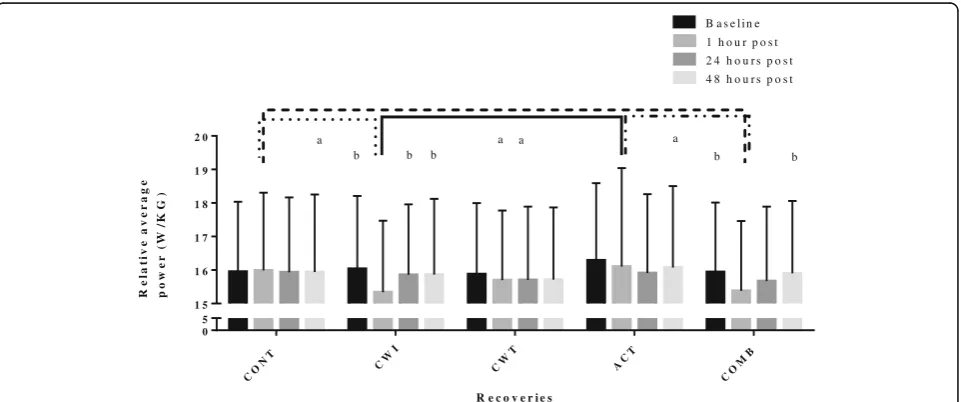
[image:5.595.305.538.123.507.2]A main effect for recovery was found for average and peak power, with ACT found to significantly improve jump performance variables in comparison to COMB and CWT (peak only). A main effect for time occurred for jump power with a significant reduction at 1 h com-pared to baseline (Table 1). Jump power variables at 1 h were significantly reduced compared to other time points for CWI (compared to baseline, 24 h (excluding peak power) and 48 h), and average power after
Table 1Perceptual and performance measures assessed at baseline and 1 h, 24 h and 48 h after fatiguing exercise for each of the different recovery strategies
Measures Recovery strategy
Control (CONT)
Cold (CWI)
Contrast (CWT)
Active (ACT)
Combined (COMB)
Muscle soreness
Baseline 1.7 ± 1.8 1.8 ± 2.0 2.1 ± 1.9 1.5 ± 1.6 2.0 ± 2. 1
1 h poste 3.6 ± 2.2a 3.3 ± 2.0b 2.5 ± 1.7 3.8 ± 1.7ac 3.0 ± 1.8
24 h poste 3.2 ± 1.9b 3.3 ± 2.1b 2.9 ± 1.8 3.3 ± 1.8b 2.7 ± 1.5
48 h post 2.0 ± 1.7 2.4 ± 1.7 2.5 ± 1.6 2.4 ± 1.9 2.1 ± 1.7
TQR
Baseline 16.3 ± 2.0 16.5 ± 2.3 16.3 ± 2.5 16.5 ± 2.3 16.2 ± 2.3
1 h poste 14.2 ± 2.5ac 14.4 ± 2.5a 15.7 ± 1.9 13.7 ± 2.5ac 15.0 ± 2.1
24 h poste 14.3 ± 2.6a 15.6 ± 2.3 15.2 ± 1.8 15.0 ± 2.7b 15.6 ± 2.0
48 h post 15.9 ± 2.3 16.0 ± 2.1 15.9 ± 1.7 15.7 ± 2.5 16.1 ± 1.8
Sit and Reach (cm)
Baseline 31.7 ± 8.1 32.1 ± 9.0 31.8 ± 9.3 31.8 ± 9.0 32.0 ± 9.7
1 h post 32.2 ± 7.8 31.8 ± 9.2 32.3 ± 9.1 32.1 ± 8.5 32.2 ± 8.9
24 h post 31.4 ± 8.6 31.3 ± 9.5 31.9 ± 9.7 31.9 ± 9.3 31.8 ± 9.7
48 h post 32.5 ± 8.5 31.5 ± 9.2 31.7 ± 9.5 31.9 ± 9.1 31.7 ± 9.8
Total sprint time (s)
Baseline 21.4 ± 1.7 21.0 ± 1.0 21.3 ± 1.1 21.2 ± 1.2 21.4 ± 1.3
1 h postef 21.9 ± 2.4 22.0 ± 1.3 21.8 ± 1.4 21.6 ± 1.4 22.3 ± 1.5
24 h post 21.4 ± 1.4 21.5 ± 1.3 21.5 ± 1.4 21.4 ± 1.3 21.4 ± 1.1
48 h post 21.6 ± 1.8 21.2 ± 1.4 21.4 ± 1.3 21.2 ± 1.3 21.2 ± 1.0
CMJ relative peak power (W/kg)
Baseline 16.5 ± 2.1 16.6 ± 2.2 16.4 ± 2.1 16.8 ± 2.3 16.4 ± 2.1
1 h postg 16.5 ± 2.3 15.9 ± 2.1ad 16.2 ± 2.0 16.7 ± 2.4 15.9 ± 2.1d
24 h post 16.5 ± 2.2 16.3 ± 2.1 16.2 ± 2.3 16.5 ± 2.4 16.2 ± 2.2
48 h post 16.4 ± 2.3 16.4 ± 2.4 16.2 ± 2.1 16.6 ± 2.5 16.4 ± 2.3
Interaction effects:aSignificant difference in comparison to respective baseline and 48 h post fatiguing exercise values.b
Significant difference from respective baseline measures.c
Significant difference in comparison to contrast recovery. d
Significant difference in comparison to active and control recovery strategies. Main time effects:eSignificant difference in comparison to baseline and 48 h post fatiguing exercise values.f
Significant difference in comparison to 24 h post fatiguing exercise values.g
COMB (compared to baseline and 48 h) with no effect of time evident for CWT, ACT or CONT (Table 1 and Fig. 3). CWI and COMB resulted in significantly reduced power (average and peak) at 1 h compared to CONT and ACT (Fig. 3).
At the conclusion of all protocols, CWT was rated as the most effective recovery strategy by the most partici-pants (50%), followed by COMB and CWI (29% each). The top response given for why these recovery strategies were favoured was “felt better/good”, with “decrease in muscle soreness” also noted for CWI. Participants rated CWI the least effective recovery strategy (30%) for rea-sons such as “felt bad for the day after”, followed by ACT (26%), with the most common responses of “felt like more exercise”and“felt stiff”.
Discussion
For the first time to the authors’ knowledge, this study compared a variety of post-exercise recovery protocols with differing effects on perceptions of recovery and subsequent performance measured over a 48 h period, to determine if there is a superior recovery strategy for non-elite athletes. The hypothesis that water immersion strategies would be superior to ACT and CONT for per-formance and perceptual recovery over the 48 h was only partially supported with CWT eliciting superior perceptions of recovery 1 h post exercise in comparison to ACT and CONT.
Athletes indicated that the CWT was the most posi-tively perceived perceptual recovery strategy. This is most likely because CWT produced significantly reduced perceptions of muscle soreness and TQR ratings at 1 h in comparison to CONT (TQR only) and ACT. Similar
findings have been reported with CWT producing better perceptual recovery following anaerobic exercise in comparison to ACT and CONT recovery strategies for state-level athletes [32], and CWT producing superior perceptual benefits of recovery in elite netball athletes following a fatiguing netball circuit in comparison to CONT [33]. Another previous study reported reduced perceptions of recovery 48 h post CWT in comparison to COLD [20], although this study utilised elite athletes. Despite the positive TQR and muscle soreness results in the current study, after CWT participants noted a sig-nificantly higher“need for rest”(DALDA) in comparison to CWI. Reasons for this response are not immediately clear. The current study found an improved perceptual rating after CWT which could be due to the vasodilation and vasoconstriction of capillaries which may cause a pumping effect, shunting metabolites out of the muscles and carrying new proteins and enzymes to the muscles [34], which may have assisted with perceived recovery. It is believed from participant feedback that the reason CWT was favoured over all other recovery strategies was due to the inclusion of heat. Participants often noted CWT having a relaxing, therapeutic effect upon the body, which has been supported by other authors [35]. The improved perceptual recovery after CWT may also be partially a“placebo”effect due to the large use of CWT within society and its assumed effectiveness. The therapeutic immediate post-treatment effects of CWT may be the primary factor in the common perception of the effectiveness of this strategy among athletic groups.
In the present study participants rated COMB as the second most effective recovery strategy. A number of previous studies of different populations of athlete
CO
NT CW
I
CW T
AC T
CO MB
0 5 1 5 1 6 1 7 1 8 1 9 2 0
R e c o v e r i e s
B a s e l i n e
1 h o u r p o s t 2 4 h o u r s p o s t
4 8 h o u r s p o s t
R
e
la
t
ive
ave
r
ag
e
po
w
e
r
(
W
/K
G
)
b b
a a a
a
b b b
[image:6.595.59.540.501.702.2]support the positive perceptual findings of a combined ACT and CWI recovery [17, 18]. Mechanisms suggested as to why a COMB protocol is more effective in prevent-ing decreased perceptual recovery than CWI, ACT and CONT include the action of hydrostatic pressure influ-encing an oscillating shift in blood volume due to move-ment of the lower limb [17], which may assist with increasing blood flow and thus greater perceptual bene-fits. Studies have found a combined recovery of ACT and CWI to remove lactate faster than CONT [15, 17] in similar population athletes. Furthermore, a COMB re-covery may cause a reduction in neuron transmission speed within the body, resulting in decreased experi-enced pain [36]. This mechanism might explain the common analgesic effects reported for cold water immersion strategies [37], and may alleviate some sensa-tions associated with tiredness. Christie and colleagues [38] found that volunteers cycling in water in compari-son to the same cycling protocol on land increased cen-tral blood volume and decreased vascular resistance. Furthermore, a COMB strategy may assist to reduce muscle soreness and sensations of fatigue caused by oedema, faster than a land based active recovery [17]. Rapid post-exercise cooling strategies such as COMB, may provide a means to restore homeostasis and reduce intramuscular temperature [39]. The use of COMB after finishing exercise may therefore result in a better per-ception of recovery than other recovery strategies, due to increased hydrostatic pressure and analgesic effects.
In the current investigation CWI caused participants to have significantly less need for rest. In contrast, other per-ceptual measures were shown to be decreased after CWI in comparison to rest, with participants still noting signifi-cantly worse perceptual recordings at 24 h in comparison to baseline. In contrast Ingram and colleagues [40] found CWI to positively influence perceptions of muscle sore-ness at 24 h in comparison to CONT and CWT in similar athletes to those utilised in this study. Bailey and col-leagues [41] also found CWI to significantly reduce muscle soreness ratings at 1, 24 and 48 h in similar ath-letes to those utilised in this study. Cold water immersion also produced significant perceptual benefits in a number of other studies that utilised high performance athletes [20, 42]. As previously stated CWI treatments are consid-ered to be effective for perceptual recovery due to en-hanced lactate removal, hydrostatic pressure and analgesic effects. In the present study, approximately 1 in 3 partici-pants indicated CWI was the least effective, with some participants reporting feeling numb, stiff and sore. This was reported not only immediately after immersion, with one participant specifically stating soreness 1 day post testing. Another participant noted unusual muscle cramps between their 24 and 48 h follow up sessions. These state-ments from participants’ support why they did not
perceive benefit from the CWI protocol. The differences in recovery protocols may have led to the differences in perceptual findings between our study and the perceptual results of other studies. All recovery protocols showing positive perceptual findings after CWI [20, 40, 41] did not implement full body immersion, with most using hip or umbilicus immersion in 10–12 °C water for 10 min com-pared to 14 min shoulder immersion (excluding the head and neck) at 15 °C in the current study.
In the current study ACT was unable to prevent a sig-nificant increase in soreness or a sigsig-nificant reduction in the perception of recovery at 1 and 24 h compared to baseline. At 1 h, the perception of recovery following ACT was also significantly worse than after CWT, as re-ported previously in a similar population of athletes [21]. During an ACT recovery participants are moving and expending energy so it is likely they do not yet feel re-covered at 1 h post fatiguing exercise, the fitness level of the athletes may have also impacted upon their percep-tual recovery after their use of ACT.
In the present study, in contrast to the perceptual re-sults, average jump performance was hindered signifi-cantly at 1 h after CWI and COMB in comparison to CONT, ACT and respective baseline measures. It is likely that 1 h was not sufficient time for the muscles to rewarm, with a large number of participants noting stiff-ness in their legs when testing at 1 h post after the cold water strategies. Crowe and colleagues [43] reasoned that cold water may cause peripheral vasoconstriction and less blood flow to major muscle groups which com-bined with insufficient time for muscles to rewarm, could have attributed to the findings of the current study that indicated decreased power performance at 1 h and overall after water immersion recovery strategies. As in this study, Kinugasa and Kilding [18] found a combined recovery of ACT and CWI did not alter performance measures at 24 h in comparison to CONT and CWT recovery strategies for high performance youth soccer players. Other studies have shown CONT to be superior to CWI for cycling peak power and total work 1 h post-exercise [43] in a similar population of athletes as those in this study and 30 min post-exercise for swim per-formance in well-trained athletes [44].
The current study identified muscle soreness and TQR ratings to be significantly affected at 24 h (main time effects) in comparison to baseline and 48 h, but per-formance was not. Thus, it might be concluded from the findings of the present study that the fatiguing exercise was sufficient to induce perceptual decrements at 1 and 24 h but not performance decrements at 24 and 48 h. King and Duffield [21] also found similar findings with detrimental perceptual differences identified and per-formance unaffected at 24 h post fatiguing exercise in a similar population of athletes as those in this study.
A limitation of the present study is that a simulated team sport game and demands was used not an actual game. The fitness and ability of the participants of the current study is also a potential limitation, as it may not replicate that of high performance contact team sport athletes. As no significant differences were found at 24 and 48 h for performance measures, future research should examine recovery strategies at earlier time points after fatiguing exercise. Limb girths could also be inves-tigated to examine the impact of recovery on swelling and osmotic fluid shifts. By examining swelling, the per-ceptual swelling (DALDA) differences that were found in this study could be investigated.
Conclusion
The present study has identified that there are differ-ences between recovery strategies for short term percep-tual and performance recovery in non-elite athletes. For short term recovery, the present findings suggest that CWT elicited better perceptions of recovery, while the non-water based ACT and CONT strategies elicited bet-ter jump performance outcomes than CWI and COMB at 1 h post for non-elite athletes. Previously identified contributing mechanisms to explain these findings include influences of lactate clearance, stiffness, hydrostatic pres-sure and analgesic effects. It is recommended that future research further investigate these proposed recovery mechanisms for short term recovery from single and mul-tiple bouts of fatiguing exercise in the hope of finding an optimal recovery strategy that can be confidently recom-mended for enhanced sporting performance.
Abbreviations
ACT:Active recovery; COMB: A combined recovery of cold water immersion and active recovery; CONT: Control (passive) recovery; CWI: Cold water immersion; CWT: Contrast water therapy; DALDA: Daily Analysis of Life Demands of Athletes questionnaire; HR: Heart rate; RPE: Rating of perceived exertion; TQR: Total Quality Recovery scale
Acknowledgements
The authors would like to express their sincere gratitude to all the participants of this study and those who assisted with data collection.
Funding
A grant was given by the Australian Government Department of Education, Employment and Workplace relations for the purchase of the iCool pools used for the data collection of this research.
Availability of data and materials
The datasets used and/or analysed during the current study available from the corresponding author on reasonable request.
Authors’contributions
FC, RS, MC, AE and SH contributed to planning of the research protocols. FC performed data collection and analyses. FC wrote the paper, with contribution from RS, MC, AE and SH. FC, RS, MC, AE and SH have read and approved the final manuscript.
Ethics approval and consent to participate
Ethics approval was granted by the Human Ethics Committee James Cook University, (H5415) Australia and the rights of the participant were protected. Participants provided written consent to participate and received an information sheet detailing what the study involved.
Consent for publication Not applicable.
Competing interests
The authors declare that they have no competing interests.
Publisher’s Note
Springer Nature remains neutral with regard to jurisdictional claims in published maps and institutional affiliations.
Author details
1
College of Healthcare Sciences, James Cook University, Townsville, QLD, Australia.2College of Healthcare Sciences, James Cook University, Townsville, QLD, Australia.3Division of Tropical Health and Medicine, James Cook University, Townsville, QLD, Australia.4Sport & Health Sciences, University of St Mark and St John, Plymouth, Devon, UK.5Australian Institute of Sport, Canberra, ACT, Australia.
Received: 7 November 2016 Accepted: 30 November 2017
References
1. Barnett A. Using recovery modalities between training sessions in elite athletes: does it help? Sports Med. 2006;36:781–96.
2. Bieuzen F, Bleakley CM, Costello JT. Contrast water therapy and exercise induced muscle damage: a systematic review and meta-analysis. PLoS One. 2013;8:e62356.
3. Bleakley CM, Davison GW. What is the biochemical and physiological rationale for using cold-water immersion in sports recovery? A systematic review. Br J Sports Med. 2010;44:179–87.
4. Crowther F, Sealey R, Crowe M, Edwards A, Halson S. Team sport athletes’ perceptions and use of recovery strategies: a mixed-methods survey study. BMC Sports Sci Med Rehab. 2017;9:1–10.
5. Cochrane DJ. Alternating hot and cold water immersion for athlete recovery: a review. Phys Ther Sport. 2004;5:26–32.
6. Hing WA, White SG, Bouaaphone A. Contrast therapy- a systematic review. Phys Ther Sport. 2008;9:148–6.
7. Versey NG, Halson SL, Dawson BT. Water immersion recovery for athletes: effect on exercise performance and practical recommendations. Sports Med. 2013;43:1101–30.
8. Wilcock IM, Cronin JB, Hing WA. Physiological response to water immersion: a method for sport recovery? Sports Med. 2006;36:747–65.
9. Coffey V, Leveritt M, Gill N. Effect of recovery modality on 4-hour repeated treadmill running performance and changes in physiological variables. J Sci Med Sport. 2004;7:1–10.
10. Diong J, Kamper, SJ. Cold water immersion (cryotherapy) for preventing muscle soreness after exercise. Br J Sports Med.2013;In Press.
11. Nédélec M, McCall A, Carling C, Legall F, Berthoin S, Dupont G. Recovery in soccer part II: recovery strategies. Sports Med. 2013;43:9–22.
12. Torres R, Ribeiro F, Duarte JA, Cabri JMH. Evidence of the physiotherapeutic interventions used currently after exercise-induced muscle damage: systematic review and meta-analysis. Phys Ther Sport. 2012;13:101–14. 13. Gill ND, Beaven CM, Cook C. Effectiveness of post-match recovery strategies
14. Crampton D, Egana M, Donne B, Warmington SA. Including arm exercise during a cold water immersion recovery better assists restoration of sprint cycling performance. Scand J Med Sci Sports. 2014;24:e290–8.
15. Ferreira JC, Da Silva Carvalh RG, Barroso TM, Szmuchourowski LA, Sledziewski D. Effect of different types of recovery on blood lactate removal after maximum exercise. Pol J Sport Tourism. 2011;18:105–11.
16. Getto CN, Golden G. Comparison of active recovery in water and cold-water immersion after exhaustive exercise. Athl Train Sports Health Care. 2013;5:169–77.
17. Hudson OD, Loy SF, Vincent WJ, Yaspelkis IIIBB. Blood lactate concentration and rated perceived exertion following active recovery in water. Sports medicine, training and. Rehabilitation. 1999;9:41–50.
18. Kinugasa T, Kilding AEA. Comparison of post-match recovery in youth soccer players. J Strength Cond Res. 2009;23:1402–7.
19. Elias GP, Varley MC, Wyckelsma VL, McKenna MJ, Minahan CL, Aughey RJ. Effects of water immersion on posttraining recovery in Australian footballers. Int J Sports Physiol Perform. 2012;7:357–66.
20. Elias GP, Wyckelsma VL, Varley MC, McKenna MJ, Aughey RJ. Effectiveness of water immersion on post-match recovery in elite professional footballers. Int J Sports Physiol Perform. 2013;8:243–53.
21. King M, Duffield R. The effects of recovery interventions on consecutive days of intermittent sprint exercise. J Strength Cond Res. 2009;23:1795–802. 22. Pyne DB, Saunders PO, Montgomery PG, Hewitt AJ, Sheehan K.
Relationships between repeated sprint testing, speed, and endurance. J Strength Cond Res. 2008;22:1633–7.
23. Higgins TR, Climstein M, Cameron M. Evaluation of hydrotherapy, using passive tests and power tests, for recovery across a cyclic week of competitive rugby union. J Strength Cond Res. 2013;27:954–65.
24. Leger LA, Mercier D, Gadoury C, Lambert J. The multi-stage shuttle run test for aerobic fitness. Journal Sports Sci. 1988;6:93–101.
25. Rushall BSA. Tool for measuring stress tolerance in elite athletes. J Appl Sport Psychol. 1990;2:51–66.
26. Pointon M, Duffield R. Cold water immersion recovery after simulated collision sport exercise. Med Sci Sports Exerc. 2012;44:206–16.
27. Kenttä G, Hassmén P. Overtraining and recover: a conceptual model. Sports Med. 1998;26:1–16.
28. Singh TKR, Guelfi KJ, Landers G, Dawson B, Bishop D. Reliability of a contact and non-contact simulated team game circuit. Journal of Sports Science and Medicine. 2010;9:638–42.
29. Bishop D, Spencer M, Duffield R, Lawrence S. The validity of a repeated sprint ability test. J Sci Med Sport. 2001;4:19–29.
30. Borg GAV. Psychophysical basis of perceived exertion. Med Sci Sports Exerc. 1982;14:377–81.
31. Vaile J, Halson S, Gill N, Dawson B. Effect of hydrotherapy on recovery from fatigue. Int J Sports Med. 2008;29:539–44.
32. Sayers MG, Calder AM, Sanders JG. Effect of whole-body contrast-water therapy on recovery from intense exercise of short duration. Eur J Sport Sci. 2011;11:293–302.
33. Juliff LE, Halson SL, Bonetti DL, Versey NG, Driller MW, Peiffer JJ. Influence of contrast shower and water immersion recovery in elite netballers. J Strength Cond Res. 2014;28:2353–8.
34. Algar L. The effects of contrast water therapy on recovery of post muscle function post exercise (unpublished masters dissertation). 2010. University of Limerick, Ireland.
35. Kovacs MS, Baker LB. Recovery interventions and strategies for improved tennis performance. Br J Sports Med. 2014;48:i18–21.
36. Meeusen R, Lievens P. The use of cryotherapy in sports injuries. Sports Med. 1986;3:398–414.
37. Jakeman JR, Macrae R, Eston RA. Single 10-min bout of cold-water immersion therapy after strenuous plyometric exercise has no beneficial effect on recovery from the symptoms of exercise-induced muscle damage. Ergonomics. 2009;52:456–60.
38. Christie JL, Sheldahl LM, Tistani FE, Wann LS, Sager KB, Levandoski SG, Ptacin MJ, Sobocinski KA, Morris RD. Cardiovascular regulation during head-out water immersion exercise. J Appl Physiol. 1990;69:657–64.
39. Myrer JW, Measom G, Fellingham GW. Temperature changes in the human leg during and after two methods of cryotherapy. J Athl Train. 1998;33:25–9.
40. Ingram J, Dawson B, Goodman C, Wallman K, Beilby J. Effect of water immersion methods on post-exercise recovery from simulated team sport exercise. J Sci Med Sport. 2009;12:417–21.
41. Bailey DM, Erith SJ, Griffin PJ, Dowson A, Brewer DS, Gant N, Williams C. Influence of cold-water immersion on indices of muscle damage following prolonged intermittent shuttle running. Journal Sports Sci. 2007;25:1163–70. 42. Ascensãão A, Leite M, Rebelo AN, Magalhääes S, Magalhääes J. Effects of
cold water immersion on the recovery of physical performance and muscle damage following a one-off soccer match. J Sports Sci. 2011;29:217–25. 43. Crowe MJ, O’Connor D, Rudd D. Cold water reduces anaerobic
performance. Int J Sports Med. 2007;28:994–8.
44. Parouty J, Al Haddad H, Quod M, Leprêtre PM, Ahmaidi S, Buchheit M. Effect of cold water immersion on 100-m sprint performance in well-trained swimmers. Eur J Appl Physiol. 2010;109:483–90.
45. Gisolfi C, Robinson S, Turrell ES. Effects of aerobic work performed during recovery from exhausting exercise. J Appl Physiol. 1966;21:1767–72.
• We accept pre-submission inquiries
• Our selector tool helps you to find the most relevant journal
• We provide round the clock customer support
• Convenient online submission
• Thorough peer review
• Inclusion in PubMed and all major indexing services
• Maximum visibility for your research
Submit your manuscript at www.biomedcentral.com/submit