University of Southern Queensland Faculty of Health, Engineering and Sciences
Integration Effectiveness between Engineering Teams on
Complex Defence Programs
A dissertation submitted by
Sam Walker
in fulfilment of the requirements of
ENG4111 and 4112 Research Project
towards the degree of
Bachelor of Engineering (Honours) (Mechanical)
Abstract
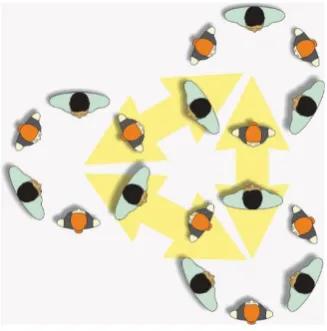
As programs grow in size and complexity, it is necessary to form sub-teams of engineers to break down the work to manageable portions. These teams, referred to in isolation as ‘silos’, typically focus on a specialised technical discipline (software, avionics, electrical, etc.). How well teams combine their work, or horizontally integrate (illustrated in Figure 1 - A birds-eye view of horizontal integration), is a huge contributor to the success of a program, in terms of meeting the customer’s needs, within cost and schedule.
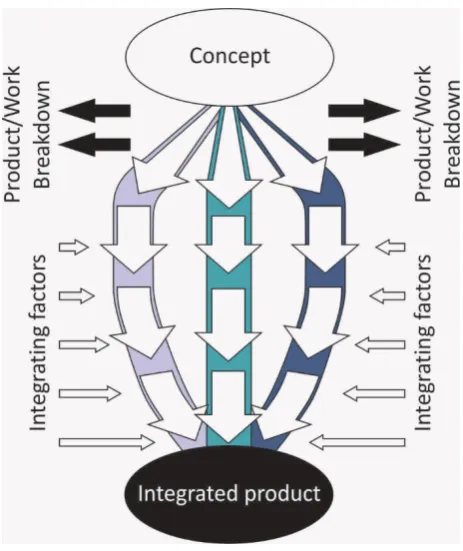
The integration of teams is hugely important for Defence, due to the complexity and size of programs, as well as geographic and political challenges. This drives segregation of engineering efforts, as shown in Figure 2 - Breakdown and re-integration of a system. To realign teams in a common direction, develop an integrated product and achieve a successful program outcome, integrating factors are applied. The identification and evaluation of these integrating factors in Complex Defence Programs emerged as a gap in identified literature, and as such is the focus of my research.
[image:2.595.216.380.563.729.2]The purpose of research into engineering integration is to identify how programs can make the interactions between teams more efficient, in order to deliver the best possible product for Defence. In doing this, I’ve needed to define the value of integrating teams, identify what can be done to integrate teams, and evaluate the efficiency of integration efforts in aligning the direction of sub-teams on a program. This report documents these findings. The research conducted was primarily qualitative, based upon the perspectives of subject program team members. The identification of integrating factors was achieved through a review of Systems Engineering literature, and the observations recorded in interviews. The evaluation of these factors has been subjective, but surveys have been used to quantify results and identify recurring or commonly held perspectives within the industry.
Disclaimer
University of Southern Queensland Faculty of Health, Engineering and Sciences
ENG4111 & ENG4112 Research Project
Limitations of Use
The Council of the University of Southern Queensland, its Faculty of Health, Engineering and Sciences, and the staff of the University of Southern Queensland, do not accept any responsibility for the truth, accuracy or completeness of material contained within or associated with this dissertation.
Persons using all or any part of this material do so at their own risk, and not at the risk of the Council of the University of Southern Queensland, its Faculty of Health, Engineering and Sciences or the staff of the University of Southern Queensland.
Certification
I certify that the ideas, designs and experimental work, results, analyses and conclusions set out in this dissertation are entirely my own effort, except where otherwise indicated and acknowledged.
I further certify that the work is original and has not been previously submitted for assessment in any other course or institution, except where specifically stated.
Sam Walker
Acknowledgements
Contents
Abstract ... i
Disclaimer ... ii
Certification ... iii
Acknowledgements ... iv
Contents ... v
List of Figures ... ix
List of Tables ... x
Acronyms and Abbreviations ... xi
Definitions ... xii
1. Introduction ... 1
1.1 Background ... 1
1.2 Aims ... 2
1.3 Objectives ... 3
1.3.1 Define the value of integrating teams ... 3
1.3.2 Define what can be done to integrate teams ... 3
1.3.3 Evaluate integration efficiency... 3
1.3.4 Propose optimal integration techniques ... 3
1.4 Document overview ... 4
2. Literature review ... 5
2.1 Context definition - Engineering of complex Defence programs ... 5
2.2 Definition of integration ... 9
2.2.1 The silo effect defined ... 9
2.3 The value of integration ... 11
2.3.1 Integration and program success ... 11
2.3.2 Innovation as a product of integration... 12
2.4 Planning factors contributing to program integration ... 13
2.4.1 Program Management ... 14
2.5 Organisational factors contributing to program integration ... 16
2.5.1 Open plan workspaces ... 16
2.5.2 Optimisation of team size ... 17
2.6 Tools and processes contributing to program integration ... 17
2.6.1 Systems engineering ... 17
2.7 Literature shortfalls ... 21
3. Methodologies ... 23
3.1 Literature review ... 23
3.2 Interviews ... 23
3.3 Surveys ... 24
3.4 Analysis ... 25
3.5 Safety ... 26
3.6 Resource requirements ... 27
3.7 Timelines ... 27
4. Findings ... 28
4.1 Defining the value of integration ... 28
4.1.1 Reduction of risk ... 30
4.1.2 Innovation ... 31
4.1.3 Sharing of knowledge to develop engineers ... 32
4.1.4 Cost ... 33
4.1.5 Survey results - Importance of integration values and burdens ... 34
4.1.6 Discussion of survey results – Importance of integration values and burdens 35 4.2 Barriers to Integration ... 36
4.2.1 Psychological barriers ... 37
4.2.2 Perceived need for integration ... 37
4.2.3 Time ... 37
4.2.4 Earned Value Management (EVM)... 38
4.2.6 Lack of awareness of concurrent engineering activities ... 38
4.2.7 Bureaucracy... 38
4.2.8 Location ... 39
4.2.9 Allegiance to product team instead of to program ... 39
4.2.10 Lack of support from management ... 39
4.2.11 Mitigating factors to barriers ... 39
4.2.12 Survey results - Observed prevalence of barriers to integration ... 40
4.2.13 Discussion on survey results - Observed prevalence of barriers to integration 42 4.3 Integrating factors ... 42
4.3.1 Organisational factors ... 44
4.3.2 Planning factors ... 47
4.3.3 Tools and processes ... 50
4.3.4 Survey results - Efficiency of integrating factors ... 51
4.3.5 Discussion on survey results - Efficiency of integrating factors ... 53
4.4 Optimisation of integration ... 53
4.4.1 Measuring integration ... 53
4.4.2 Level and depth of integration ... 54
4.4.3 Effect of level of integration upon risk, innovation, skill building and cost 54 4.4.4 Increasing integration to optimise level of integration ... 57
4.4.5 Restricting integration to optimise level of integration ... 58
5. Conclusion ... 59
5.1 Conclusions ... 59
5.2 Recommendations ... 59
5.3 Further work ... 60
6. References ... 61
7. Annexes ... 67
7.1 Annex A - Project Specification ... 67
7.3 Annex C – Project Specification - Schedule ... 72
7.4 Annex D – Interview Records ... 80
7.4.1 Respondent 1 ... 80
7.4.2 Respondent 2 ... 83
7.4.3 Respondent 3 ... 88
7.4.4 Respondent 4 ... 93
7.4.5 Respondent 5 ... 96
7.4.6 Respondent 6 ... 98
7.4.7 Respondent 7 ... 100
7.4.8 Respondent 8 ... 102
7.5 Annex E – Survey design and records ... 103
7.5.1 Survey Iteration 1 ... 103
7.5.2 Survey Iteration 2 ... 105
List of Figures
Figure 1 - A birds-eye view of horizontal integration ... i
Figure 2 - Breakdown and re-integration of a system ... 2
Figure 3 - Air Warfare Destroyer (CASG, 2014), Hawkei Armoured Vehicle (CASG, 2016), and Wedgetail E-7A (RAAF, 2016) ... 8
Figure 4 - Example of a siloed organisation ... 11
Figure 5 - Relationship between a system, a PBS and a WBS (NASA, 2007) ... 15
Figure 6 - Systems engineering 'Vee' model (Locatelli, et al., 2014) ... 19
Figure 7 – NASA’s systems engineering engine (NASA, 2007) ... 20
Figure 8 - Amount of time spent answering and asking questions against experience ... 33
Figure 9 - Survey results for value added and burdens created by integration ... 34
Figure 10 - Comparison of integration value ratings for engineers and managers ... 35
Figure 11 - Survey results for observed frequency of barriers to integration ... 41
Figure 12 - Comparison of integration barrier occurrence observed by engineers and managers 41 Figure 13 - Example Organisation Structure used in Defence on acquisition programs ... 46
Figure 14 - Typical cost and staffing levels across the project live cycle (PMBOK, 2008) ... 47
Figure 15 - Plan, Do, Check, Act model for team alignment ... 50
Figure 16 - Survey results for effectiveness of integrating factors ... 52
Figure 17 - Comparison of integration factor effectiveness ratings of engineers and managers ... 52
List of Tables
Table 1 - Acronyms and abbreviations ... xi
Table 2 - Glossary of terms ... xiii
Table 3 - Project background statement ... 1
Table 4 - Complex Defence programs ... 8
Table 5- Determinants of program success/efficiency/effectiveness ... 12
Table 6 - Risk matrix ... 26
Table 7 - Personal risk assessment ... 27
Table 8 - Advantages and disadvantages of team integration ... 29
Table 9 - Value of integration as identified through interviews ... 30
Table 10- Barriers to integration identified through interviews ... 37
Table 11 - Mitigating factors to integration barriers ... 40
Table 12- Integration methods identified in Interviews ... 44
Table 13 - Effect of level of integration on risk, innovation, skill building and cost ... 56
Table 14 - Interview record - Respondent 1 ... 82
Table 15 - Interview record - Respondent 2 ... 87
Table 16 - Interview record - Respondent 3 ... 92
Table 17 - Interview summary - Respondent 4 ... 95
Table 18 - Interview summary - Respondent 5 ... 97
Table 19 - Interview summary - Respondent 6 ... 99
Table 20 - Interview summary - Respondent 7 ... 101
Table 21 - Interview summary - Respondent 8 ... 102
Table 22 – First survey design iteration ... 104
Table 23 – Second iteration of survey results on the effectiveness of integrating factors ... 105
Table 24 - Final survey design... 109
Acronyms and Abbreviations
Term Definition
IPT Integrated Product Team
ICCPM International Centre for Complex Project Management NASA National Aeronautics and Space Administration
PBS Product Breakdown Structure
PMBOK Project Management Bodies of Knowledge SEIT Systems Engineering Integration Team
WBS Work Breakdown Structure
Definitions
Term Meaning
Chief Engineer (CENG) The CENG is the leading authority for technical decisions on the program, and provides technical guidance to program Engineers.
Engineering Integration Team
The Systems Engineering Integration Team is a team specifically created to facilitate the integration of products produced by sub teams.
Engineering Manager The engineering manager reports to the Program Manager, and has the responsibility of managing program teams in a functional capacity.
Engineers Engineers carry out the design work within the bounds of the Integrated Product Team area of speciality.
Integration The term integration as used in this report refers to the interaction or collaboration of sub teams within a program. Integration Manager The Program Integration Manager oversees the running of
program, and is responsible for cost and schedule. While the PM is “looks outwards” with their customer focus, the VPM “looks inward”, overseeing the Engineering, Logistics and commercial aspects of a program.
Interface A boundary where, or across which, two or more parts of a program (i.e. sub-teams) interact (Wheatcraft, 2010). IPT Lead The IPT Lead has responsibility to execute a defined portion
of the scope of an engineering program. Product Breakdown
Structure (PBS)
The PBS defines the sub-products used which need to be integrated to give a final product, meeting customer and business needs.
Product team A product team is the technical teams of engineers formed to build a sub product, as defined in the PBS. In complex programs, there are generally multiple teams.
Project The same as a Program, but for a product with a lesser monetary value. Programs use smaller teams, and can be sub-programs or stand alone for lower value products. The term is used interchangeably with Program.
Project Manager The Project Manager of Program Manager is the highest authority on a program, dealing extensively with the customer and reporting to business senior managers.
SEIT Engineers SEIT Engineers have the role of undergoing engineering in areas not covered by the IPTs (specialty engineering), but also creating Engineering manpower for IPTs, which doubles as oversight of IPT engineering by the SEIT.
Senior Engineer Senior Engineers will perform engineering duties, and have authority to review and approve technical decisions on the program, and to provide guidance to other Engineers.
Work Breakdown Structure (WBS)
A WBS defines the work that a program needs to complete, in order to build a product or system which meets the contract requirements. The WBS will generally replicate the PBS, but includes overhead work.
1.
Introduction
1.1
Background
Each year the Australian Department of Defence (DoD) tenders complex programs to private organisations to build the defensive capability of the Australian Defence Force (ADF). Such programs represent significant expenditure for the Government, contributing to $31.9 billion budgeted for defence in 2015-16 (Andrews, 2015). Historically, such programs have regularly been fraught with cost and schedule overruns, and failures to meet the performance requirements sought by the DoD. The factors contributing to such shortfalls are varied, but one such factor that inevitably arises is the level of integration between teams to engineer a coherent solution.
Table 3 - Project background statement summarizes how the need for integration and associated integration methods arises, through four assumptions.
1. In complex programs, work needs to be broken down and allocated to specialised teams.
→ 2. In breaking down work, “siloing” occurs.
→ 3. To counteract the negative effects of “siloing”, companies employ various methods to re- “integrate” teams.
→ 4. Methods of re integrating are implemented with varying levels of success.
Table 3 - Project background statement
Figure 2 - Breakdown and re-integration of a system
This report seeks to evaluate firstly the role of integrating teams in developing Defence systems, and secondly the methods employed to integrate teams on Complex Defence Programs, as defined the fourth assumption on Table 3 - Project background statement, and illustrated in Figure 2 - Breakdown and re-integration of a system.
1.2
Aims
The aim of this project is to define ‘integration’ as it is interpreted by engineering teams working on complex Defence Programs, and to critically evaluate how programs are integrated. More specifically, this project will;
1. Identify why organisations need to integrate;
2. Identify what is done to integrate teams, in terms of organisational structure, behavioural attributes, and project governance;
3. Determine how effective attempts to integrate teams are. The second phase will, based on the above findings;
4. Propose how engineering teams on complex programs can effectively integrate with the wider program.
Methodologies will outline the how original research was carried out to fill the gaps in the existing literature, and Section 4Findings details the findings of this research.
1.3
Objectives
The objectives define the four project aims in more detail.
1.3.1
Define the value of integrating teams
In order to evaluate Integration efforts, it is critical to know what teams are trying to address. It is assumed that in forming ‘Integrated Teams’, managers are trying to overcome a particular obstacle, rather than to simply ensure that teams are working together. The first aim, to identify the need for integrated teams, will involve research into what these obstacles, or barriers, are. It will also involve research into the positive and negative effects of breaking teams up.
The second step in defining the value of integration, is to look at the negative effects of integrating teams, in addition to the benefits. It is expected that teams are broken up to gain efficiencies compared to having a single, large team, and forcing teams to work together will potentially lessen these efficiencies.
1.3.2
Define what can be done to integrate teams
This project will seek to define what programs can do to integrate teams. Integration methods are expected to be directed at encouraging collaboration within and external to teams. This list will become a basis for the evaluation of efficiency of integration methods. The resulting list of integration techniques will be expected to correlate to the specific effects of breaking up teams, to capitalise on the positive, and to mitigate or eliminate the negative.
1.3.3
Evaluate integration efficiency
In determining how effective methods of integration are, the research will look at the perceived gains the various methods of integration can offer a team, from the perspective of engineering team members. A determination of efficiency will be based around the time spent on the interface between individuals and teams, and their perception of whether particular exchanges are value adding, and if so, then how valuable.
1.3.4
Propose optimal integration techniques
as non-value adding, a recommendation would be to remove that interaction from the team’s workload.
1.4
Document overview
2.
Literature review
As part of the investigation of integration effectiveness on complex Defence programs, a literature review was conducted to identify, and critically assess, the value of integration in such programs, as well as the ways people have sought to integrate teams. The integrating factors are broadly grouped into organisational factors, planning factors, and tools and processes.
Much of the literature was based on engineering integration of teams in non-Defence environments, and assessed for applicability to Defence. In order to make this link to the chosen context, a review of the literature on the Australian Defence programs, and the contributors to the success of such programs was conducted.
The primary source of literature was scientific journals, but this was supplemented by a combination of websites, books and online articles. Numerous references were made to publications of the Australian Government for information about Australian Defence programs, NASA Systems Engineering Handbook (NASA, 2007) and the Project Management Bodies of Knowledge Guide (PMBOK, 2008).
2.1
Context definition - Engineering of complex Defence programs
Programs for Defence are often very complex. In order to gain a tactical advantage over potential enemies, Defence, as an industry, is hugely reliant on cutting edge technologies. In gaining this advantage, and to fill holes in Australia’s defence capability, the Government has frequently tendered developmental programs, rather than purchasing Commercial-off-the-shelf (COTS) products. Even programs making use of COTS products can veer into developmental territory, when modified, or when different COTS items are merged into an integrated product. Developmental programs of substantial scale and cost are considered to be complex programs. In recent decades, such programs have experienced high cost and schedule overruns, driven by the need for contractors to propose a fixed price for the development of technologies not yet in existence.
Hayes, et al. (2011) noted that Complex Defence Systems are typically systems of systems. They cite Secretary of Defence Robert Gates saying that "a risk-averse culture, a litigious process, parochial interests, excessive and changing requirements, budget churn and instability, and sometimes adversarial relationships within the Department of Defence and between DoD and other parts of government" have created "unacceptable problems" in acquisition programs for the US. The authors relate this back to program complexity, and note that the problems apply to Australian Defence programs, resulting in the formation of an International Centre for Complex Project Management (ICCPM) in conjunction with the Australian Defence Material Organisation (now the Capability, Acquisition and Sustainment Group). The Centre seeks to address the frequent cost and schedule overruns experienced on complex programs, and has teamed up with the Queensland University of Technology to deliver courses in Complex Program Management. Notable challenges of Complex programs include;
• Misaligned stakeholder views of success, with a common point of conjecture being program and product success, where the value added by a product is not considered in a program’s success criteria (also investigated and supported by Chang, et al. (2013)),
• Political pressure,
• Underestimating technical risk,
• Overly competitive tenders driving underbidding,
• Limitations and restrictions of traditional procurement practices,
• Limitations of traditional tools and techniques to manage cost, schedule and performance,
• Lack of experienced program managers, and
• Scope creep due to immature requirements (Hayes, et al., 2011).
Education (particularly education of Program Managers) is cited as being the key driver in overcoming these challenges, but integration is considered to assist with several issues, in particular, underestimating technical risk, scope creep and misaligned stakeholder views of success.
of a Program. The 2014-15 Major Projects Review (ANAO, 2015) highlights that integration issues occurred in the following areas;
• MRH-90 – Contingency funds applied for integration risks,
• E-7A faced difficulty in integrating a phased array radar and other mission critical elements into an operational system,
• Risk management not integrated with Defence processes,
• Schedule slippage often resulted from difficulties in, and underestimation of system integration, as experienced on the FFG Upgrade, Wedgetail, Air to Air Refuel, ARH Tiger Helicopters and MRH90 Helicopter,
• An integrated Program Management System was being developed at the time, and • A need for Integration of project plans.
Furthermore, lessons learnt from previous audits propose that:
• Integrated Product Teams need to include all major stakeholders and disciplines (engineering, logistics, commercial, test and evaluation, and display development), and
• With the development of complex battle management systems, where all products can communicate with one another, there needs to be great interoperability between systems (ANAO, 2015).
The International Centre for Complex Project Management (ICCPM) webpage (ICCPM, 2016) provides a portal into a number of papers addressing issues faced by complex programs. The ICCPM partners with the Australian Government Department of Defence, QUT, CSIRO, BAE Systems and Thales, so it provides a collection to works relevant to complex Australian Defence programs. In general, however, the papers are poorly referenced and at times unprofessional, leading weight to an assumption that program management on complex programs is more an art than a science.
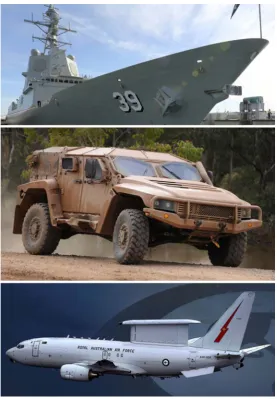
Program Contractor Complexity driven by Air Warfare
Destroyer (SEA 4000 Ph 3)
Raytheon Australia Pty Ltd
Budgeted $8.5 billion rose to $9.3 billion. Development and production of new product, for manufacture in Australia, and heavy modification from plan. In development since 2007 (Kerr, 2014) (CASG, 2014).
Hawkei Armoured Land Vehicle (LAND 121 Ph 4)
Thales Australia
Designed and built in Australia, with several years of development and manufacture. Like AWD, pushes the bounds of Australian manufacturing. Cutting edge technology (CASG, 2016).
Airborne Early Warning and Control (E-7A) (AIR 5077 Ph 5A)
Boeing Defence Australia
[image:22.595.98.501.70.290.2]A highly technical upgrade of several mission and radio systems on the E-7A Wedgetail Airborne Early warning and Control. Both scope of work and cost are large (CASG, 2015).
Table 4 - Complex Defence programs
[image:22.595.159.437.334.734.2]The Defence Capability Acquisition and Sustainment Group (CASG) notes that since 2005, Australian Defence programs have been delivered on average 5% under budget, with 96% of program performance measures being met, and with a 30% schedule slippage (CASG, 2016). The variation between cost and schedule would seem to indicate that the cost associated with schedule slippage is being borne by Defence contractors, rather than the Department of Defence. Furthermore, there has been a move in recent years to the acquisition of Military off the Shelf (MOTS) products rather than developing products in country (ANAO, 2016). Examples include the Boeing P-8 Poseidon, Airbus KC-30 tanker, Boeing EA-18 Growler (Super Hornet variant) and the Lockheed Martin Joint Strike Fighter F-35 (ANAO, 2015). The move away from developmental products means that the Defence capability of Australia uses solutions designed for use by other countries, primarily the US. The remoteness and geographical challenges of Australia are not inputs to the design of these products, so they are unlikely to be a perfect fit for the Australian Defence Force.
2.2
Definition of integration
The term ‘integration’ is used with varying meanings in different contexts. Within Defence and the Aerospace industry, commonly spruiked terms include Integrated Product, and Integrated Team. Whether in reference to a product or team, integration refers to having subcomponents of the product (sub-products) or teams (sub-teams or individuals) working together as a whole (NASA, 2007) (Baiden & Price, 2011). It should be noted that Integration Teams can also refer to a team formed to integrate sub-products into a product. Niemann-Struweg (2014) defined three areas of integration, being Organizational integration, Stakeholder integration and Environmental integration. While all three are very relevant to Complex programs, Organizational and Stakeholder integration will be focused on for the context of integration of engineering teams. The observation is also made that Organizational integration should be achieved before pursuing stakeholder and environmental integration (Niemann-Struweg, 2014).
For the purposes of this report, ‘Integration’ will refer to the extent that teams and individuals in different teams on a program share information. This is supported by the literature of Baiden & Price (2011), who consider that team integration refers to the collaborative alignment of teams with different goals, needs and cultures into a cohesive and mutually supporting unit.
2.2.1
The silo effect defined
a team reaches a large enough head count that it becomes necessary to form teams to address these problems. To do this, those roles are grouped to form a team, based on a relationship of projects. These teams, when working in isolation of other teams, can be considered ‘silos’ (Legacy, et al., 2012).
In grouping individuals in a team, segregation occurs between people who would otherwise have been working together. This is a problem for the following reasons:
• Work can be misdirected to areas not in alignment with project goals
• Teams need to be able to adapt as product requirements change, otherwise sub projects can deviate from what the customer actually wants. Customer requirements are frequently adapted on complex programs, and without stakeholder input to define and accommodate these changes, a program will be ill equipped to deal with such change.
Siloing specifically refers to the ‘vertical integration’ of programs, where teams form their own hierarchical structure, to the exclusion of other ‘silos’ on the program. Information flows from the top down, or bottom up. Typically, the interface through to other teams is through the team manager, so if an engineer on one team requires input from, or requirements for, engineers on other teams, that information needs to be passed up the hierarchy, passed to the opposing manager, then down the hierarchy of the relevant team (Niemann-Struweg, 2014). Clearly, this is inefficient, and the inability for information to flow horizontally can be highly dangerous for a program.
Silo 2 Silo 1
Engineer Coord.
Engineer Team
lead
Manager
Engineer Coord.
Engineer Team
Lead
X
X X
Figure 4 - Example of a siloed organisation
2.3
The value of integration
The value of integration is an integral part of the research conducted. The literature serves to identify the link between program integration and program success. This link is broken down further, and some specific benefits that integration may afford a program are identified. As a benefit, innovation as supported by integration has been heavily research, and is covered in detail. Other benefits (risk reduction and sharing of knowledge) and the disadvantages through cost are not specifically covered in the identified literature, and as such are covered in the Findings section on Defining the value of integration.
2.3.1
Integration and program success
When defining the factors contributing to program success, effectiveness and efficiency, program integration or aspects of program integration emerged as a common thread. Success, effectiveness, and efficiency do have slightly different definitions (refer to Definitions), but it can be assumed that effective and efficient programs have a greater prospect of success. Therefore, factors contributing to the effectiveness or efficiency of a program are assumed to also contribute to a program’s success. Literature review identified that the following integration related aspects can contribute to Program success:
• Stakeholder engagement (Chang, et al., 2013),
• Internal and external stakeholder relationships (Mazur, et al., 2014), and • Cross-functional integration (Frinsdorf, et al., 2014).
Additionally, ‘The Chaos Report’ (Standish Group, 1995) listed the level of user involvement to be one of the most significant factors influencing project success.
clearly follows that if these factors are important for program success, then integration is equally important for program success.
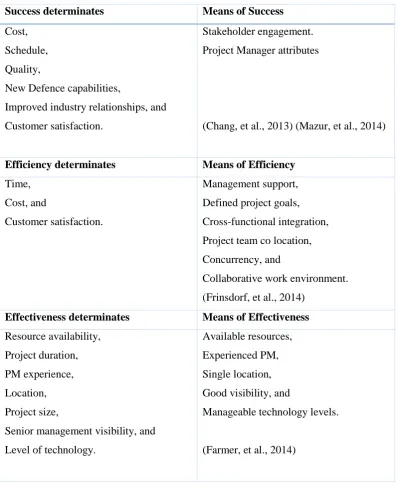
Table 5- Determinants of program success/efficiency/effectiveness links the above contributors to the determinants of program success, efficiency and effectiveness.
Success determinates Means of Success
Cost, Schedule, Quality,
New Defence capabilities,
Improved industry relationships, and Customer satisfaction.
Stakeholder engagement. Project Manager attributes
(Chang, et al., 2013) (Mazur, et al., 2014)
Efficiency determinates Means of Efficiency
Time, Cost, and
Customer satisfaction.
Management support, Defined project goals, Cross-functional integration, Project team co location, Concurrency, and
Collaborative work environment. (Frinsdorf, et al., 2014)
Effectiveness determinates Means of Effectiveness
Resource availability, Project duration, PM experience, Location, Project size,
Senior management visibility, and Level of technology.
Available resources, Experienced PM, Single location, Good visibility, and
Manageable technology levels.
[image:26.595.100.499.160.643.2](Farmer, et al., 2014)
Table 5- Determinants of program success/efficiency/effectiveness
2.3.2
Innovation as a product of integration
communication processes greatly influences product development performance. While their research and cited resources are dated, there are a number of observations that remain relevant. They define communication as the passing of information from one party to another, with the intent of changing the behaviour of the opposing party, and highlight that innovation, which is interpreted as the communication driving innovation, is important in managing uncertainty on projects. They use the notion of “information requirements” to define communication lines between teams, noting that these drive information dependencies between project teams, which in turn drives the need for integration. They interpret integration as intra-project coordination, which is consistent with the definitions used in this report (Livens & Moenaert, 2000).
Ponchek (2016) reviewed research papers into drivers of innovation, and highlights the role of collaboration in the innovation process, noting (at least historically) that most innovation comes from large companies (Ponchek, 2016). Again, cited references are old, and not considered entirely applicable to innovation today, when the internet has enabled the sharing of information as a driver of innovation, without the need to physically interact. The argument can be made that the internet is a form of interaction, but for the purposes of this report, the sharing of information by being made publically available is not a considered means of integration. Modern readers are not considered to be interacting with Shakespeare himself. Ponchek (2016) notes that organisational (inclusive of inter-project) collaboration is not as effective as extra-organisational collaboration (Ponchek, 2016). While not explicitly stated, this is assumed to be because innovation is often a product of two seemingly disconnected bodies of knowledge combining to come up with an “out-of-the-box” solution to an existing problem. Similarly, Chesbrough (2006) and Vanhaverbeke (2006) both reported that the vertical integration, where innovation comes only from internal Research and Development teams, is ineffective a driver of innovation, calling it the “closed model of innovation” (Chesbrough, 2005) (Vanhaverbeke, 2006). The predominant theme from research correlating innovation and integration, is that teams need to be outwards facing in order to innovate, seeking to collaborate across teams, organisations, and industries.
2.4
Planning factors contributing to program integration
management and visibility of defined goals for product teams was identified by Farmer, et al. (Farmer, et al., 2014) as being a significant enabler of aligned work activities.
2.4.1
Program Management
The Project Management Bodies of Knowledge identify Project Integration Management as the first knowledge area in Project Management (Hornstein, 2015). Turkulainen, et al. (2015) also flagged Integration as a fundamental issue in program management, due to efficiency improvements to be gained by sharing information and knowledge across an organisation. They specifically looked at project-to-project and project-to-organisation interfaces. Pitsis, et al. (2014) highlighted the importance of governance in complex projects. Chang, et al. (2013), Mazur, et al. (2014) and Frinsdorf, et al. (2014) highlighted Program Manger attributes as significant influencing factors to the level of cross team integration occurring on a program.
2.4.2
Product breakdown and work breakdown
Due to the complexity of Defence programs, it is generally necessary to form sub teams to engineer a program solution, causing segregation of engineering efforts. Integration is a critical consideration for Program Managers working in on Defence Programs, and one that has a significant impact on the efficiency and resulting success of such Programs. Typically large and complex, the size and scope of Defence Programs usually necessitates the program being managed through a series of teams, each with a clearly defined area of responsibility. The result of this segregation is a need to integrate the various areas of a program, in order to deliver a coherent and cohesive product or service.
While the importance of integrating the various facets of an Engineering plan are well recognised and promoted, how well integration occurs is an area that receives little attention in commercially available research. In a field where ‘Systems Engineering’ is so critical, this is a notable absence, as Systems Engineering focuses in no small part on the verification and validation of an engineered solution.
Engineers, individually and under normal time constraints, are able to design simple structures and systems. When the design becomes more complex, and coupled with a time constraint, more engineers are required to complete the task, and a need for management arises. As complexity increases further still, the numbers of engineers and other roles grow again.
Systems Engineering, Integration and Verification, and Integrated Logistics Support (NASA, 2007).
[image:29.595.197.398.228.607.2]Program management tools or systems are cited by Stoshikj, et al., (2014) as a tool for management of the work breakdown, tracking status, allocating activities and tracking cost and resources. Included in this should be a definition of communication methods, and information distribution tools, as identified by the Project Management Body of Knowledge (PMBOK, 2008).
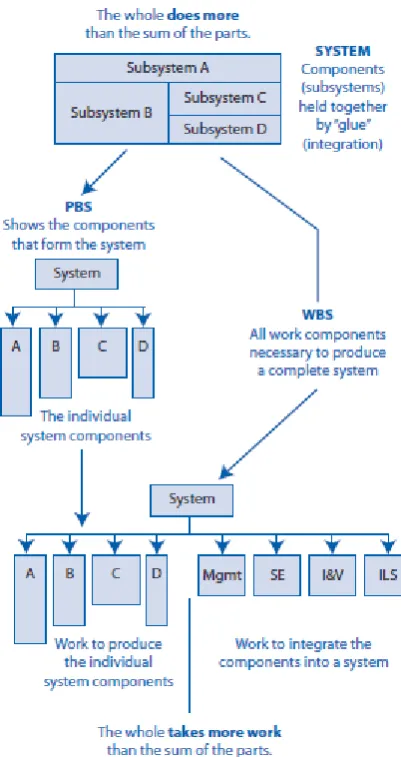
Figure 5 - Relationship between a system, a PBS and a WBS (NASA, 2007)
The NASA Systems Engineering Handbook (NASA, 2007) notably states, in reference to the difference between a Product Breakdown Structure (PBS) Work Breakdown Structure (WBS), that “the whole takes more work than the sum of the parts.
functions of Management, Systems Engineering, Integration and Verification, and Integrated Logistics Support (NASA, 2007).
2.5
Organisational factors contributing to program integration
In an analysis of literature linking program success and program integration, the following integrating factors were identified, but in low levels of detail;
• Project team colocation, • Concurrency, and
• Collaborative work environment (Frinsdorf, et al., 2014).
Additionally, the wealth of information on the merits of open plan workspaces and the optimisation of team size warranted separate sections herein.
2.5.1
Open plan workspaces
The perception of open plan offices highly varied, given the advantages and disadvantages of their use.
Kaufmann-Buhler (2016) discusses advantages and disadvantages of the use of open plan environments, with the advantages being that they;
• Promote equality between workers,
• Promote verbal communication and collaboration (driving high usage in design offices, e.g. architecture),
• Reduce cost through higher space utilisation,
• are adaptable to respond to organisational change, and • give an image of being a progressive organisation.
The downsides of open plan environments include: • A loss of privacy,
• Inability to personalize workspace, • loss of status for managers, • High noise, and
• They cater for verbal communication, not other mediums introduced through modern technologies (Kaufmann-Buhler, 2016).
of by leading technology companies, such as Facebook, Pixar and Google, to move towards open plan offices, citing the higher potential for collaboration (Featherstone, 2015) .
2.5.2
Optimisation of team size
Staats, et al., (2012) noted that that the number of possible linkages within a team is;
𝑁𝑁×𝑁𝑁 −1 2
Using this formula for a team of 15 people, there would be 105 relationships. They proceeded to look at how team size effects the efficiency of larger teams. In a review of existing literature they noted that advantages of larger teams include;
• Labour can be subdivided across more team members, leading to a need to match workers with tasks of interest, and foster task specialization, which improves performance
• Broader base of knowledge and experience, and
• More slack resources which can be deployed if circumstances change.
Three challenges of larger teams were highlighted, being: • A difficulty in coordinating the team, stemming from;
o The time required to keep members informed,
o The threat of miscommunication between team members, and
o The need to re-integrate completed work, requiring additional time and effort, termed coordination neglect (Heath & Staudenmayer, 2000) • A tendency towards less motivation among team members, based on:
o Less effort being put in due to social loafing and free riding, and
o Membership being less satisfying, and
• Conflict, due to more competition between team members.
2.6
Tools and processes contributing to program integration
In addition to planning and organisational factors, the efficient use of tools and processes are considered to be enabling factors for the integration of product teams on programs. Literature on specific tools was not identified, and the primary process identified was systems engineering.
2.6.1
Systems engineering
noted that on the International Space Station program, NASA effectively integrated 5 aerospace agencies from 15 countries, under a Systems Engineering approach. This highlights that Systems Engineering processes and principles definitely have the potential to provide a framework for gauging the effectiveness of interfaces, and resulting integration. Furthermore, they gave a general sense of how systems engineering could be applied, but in insufficient detail as to how to do it.
Systems engineering is, in itself, a methodology of balancing the inputs of different technical disciplines, or teams. As described by Michael Griffin, of NASA;
Systems engineering is the art and science of developing an operable system capable
of meeting requirements within often opposed constraints. Systems engineering is a
holistic, integrative discipline, wherein the contributions of structural engineers,
electrical engineers, mechanism designers, power engineers, human factors engineers,
and many more disciplines are evaluated and balanced, one against another, to
produce a coherent whole that is not dominated by the perspective of a single
discipline. (NASA, 2007)
Conformance to systems engineering framework should ensure that product and work breakdown and allocation is conducted in a logical, consistent way. The specifics of the framework are already well defined in existing literature, including the NASA Systems Engineering Handbook, and will not be looked at as a method of ensuring efficient engineering integration.
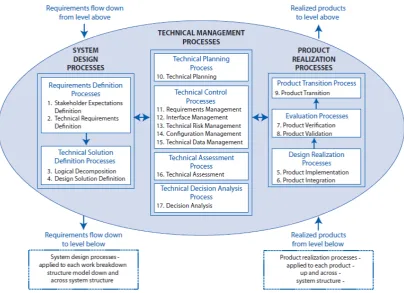
Systems engineering takes a program sequentially through processes for: 1. Requirements Definition
2. Technical Solution Definition 3. Design realization
4. Evaluation
5. Product Transition
Running across these steps are processes conducted as required for Technical Planning, Technical Control, Technical Assessment and Technical Decision Analysis (NASA, 2007). These processes are applied for each sub product on a PBS, as discussed in Product breakdown and work breakdown. The definition processes establish an agreed set of requirements to satisfy stakeholder expectations.
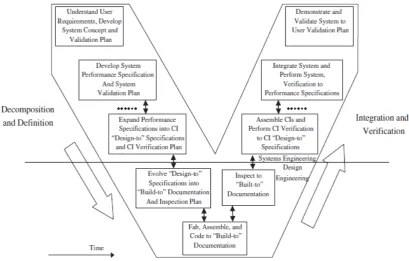
is decomposed (into project teams) and defined, before being integrated and verified against a break down structure. The model identifies general tasks, which together form the methodology which is Systems Engineering.
Figure 6 - Systems engineering 'Vee' model (Locatelli, et al., 2014)
Figure 7 – NASA’s systems engineering engine (NASA, 2007)
2.6.1.1 Interface definition
Interface definition is a significant component of System Engineering, in providing a framework for breaking down a system into a series of interface requirements, which can then be continuously monitored and verified through the course of a program (NASA, 2007). Furthermore, they can be a significant tool in identifying the necessary relationships between engineering teams through which the integration of teams can be optimised. Wheatcraft (2010) recognises that Systems are part of bigger systems, are made up of subsystems and interact with other systems at the same level of architecture. A complex system generally has several layers of systems, and a large number of subsystems. Identifying the interactions, or interfaces, between systems can;
• Identify the boundary of a system,
The systems of interest on this project include the various design and functional teams on a program, such as a Product Design Team. Transferring the above advantages of interface definition to a Product Team could help to;
• Identify the required scope of work for the team, while ensuring that the program has no gaps,
• Identify what help they need from other teams, • Identify what other teams need help from them,
• Identify where a component of the design needs to be compatible with other parts (e.g. Avionics need to be compatible with airframes and mechanical systems) • Identify areas of risk, including where systems are being developed concurrently
and need to maintain compatibility.
As such, it is evident that Interface definition as a process within the systems engineering framework has the potential to aid the integration of teams.
2.7
Literature shortfalls
There are some major shortfalls in the literature identified, with regard to the topic of integration effectiveness. Notable omissions, in summary, include;
• A lack of definition of the value of integration, particularly with regard to the cost and the value of sharing knowledge to build the skill and knowledge levels of engineers,
• The identification of relatively few methods of integrating teams, except within the bounds of Project Management,
• Undue consideration for the effective level or depth of integration, but instead the prevailing assumption is that more integration of teams is always better,
• No demonstrated links between the integration of teams and the effect this has on the delivered product or system, and
• No attempts have been made to measure integration of engineering teams.
The value of integrating teams is not thoroughly defined in any of the identified literature, although individual articles do relate the integration of teams to an increase of innovation on programs, and there are many references to how teams working together can reduce risk for a program. The cost of integrating teams, and the importance of integrating teams to impart knowledge between them are considered poorly documented.
System Engineering Handbook (NASA, 2007) give thorough coverage to the factors considered part of Program Management and Systems Engineering disciplines, but outside of these bounds there are multiple omissions. Examples include the use of a System Engineering Integration Team (SEIT), use of responsibility, authority and accountability (RAA), planned interaction, and the consistent use of tools and processes across engineering teams as drivers of integration.
It is notable that the literature studied proposes how Integration may be increased (Hornstein, 2015) (Pitsis, et al., 2014) (Locatelli, et al., 2014), and therefore improved. The unstated assumption in these articles is that the more integrated a project, the better it will function. This assumption is examined through the use of interviews and surveys. This report proposes that efforts to integrate, when excessive or incorrectly targeted, can be detrimental to a program. As such, rather than to maximise integration on programs, this project will propose how to optimise integration.
No literature was identified which analyses the link between the integration of team, and the integration of Products. It is an unstated assumption in Systems Engineering literature that integration of teams will result in better products, but no identified study has proven this link.
3.
Methodologies
Research was conducted with the aim of defining; • What Integration is and why it is important, • The methods used to integrate programs, and • The effectiveness of these methods.
Three different research methods were used to meet these aims; • Literature review,
• Interviews, and • Survey.
To define the value of integration and methods of integration, both a literature review and interviews were used, with the interviews being conducted of industry practitioners to record their observations and opinions on how integration occurs on complex Defence programs. To evaluate the effectiveness of integrating methods, a survey was employed in addition to the literature review and interviews. Specifics of these methods are contained in the sub sections below.
The interviews and surveys and associated analysis are used to either validate, disprove, clarify or expand on the existing research on why integration is important, and what is done to integrate teams.
Analysis will identify both common trends in the findings of the three research methods, as well as discrepancies between findings. Towards this end, the three research methods were not conducted sequentially. Throughout the course of research, literature was constantly referred to in order to support and validate findings from the interviews.
3.1
Literature review
The Literature review, as presented in section 2, has been used to record relevant findings recorded in existing publications on the value, methods, and effectiveness of methods, of integration.
3.2
Interviews
were not recorded, but summaries of these interviews based on notes taken at the time are included at 7.4Annex D – Interview Records.
The interviewees were chosen very selectively. Rather than seeking to find the common perspectives across a particular program and within a particular company, the interviews seek to identify trends in perspectives of individuals who have worked across a range of Defence programs, for a range of businesses both within and external to Defence. In this way, it is considered that the findings will be more applicable to the engineering of complex Defence programs as a whole.
The structure of the interviews was loosely based around that used by Chang, et al., (2013). The interviews used a common core set of questions, with additional questions based on the known areas of expertise of an individual respondent. The approach to the interviews changed during the course of the research project, from asking many directed questions (as detailed in the interview records for Respondent 1) to asking a few broad, open-ended questions. This approach is intended to allow respondents to move the interview in the direction of the most important aspects of integration, in their view. It is considered that by doing this, any unintentional bias held by the interviewer wouldn’t be reflected in the responses of the interviewee.
By comparison to the survey, the interviews ask broader, more open questions intended to extract opinions and other qualitative data from respondents. The results were used to direct and refine survey questions, and identify trends.
3.3
Surveys
The survey is used to support the findings of the interview, by asking participants to rate, and thereby quantify, some key findings from the interviews. The questions are specifically targeted to quantify the values of integration as applicable to a project, and to quantify the perceived effectiveness of integration methods. In this way, the survey extracts quantitive information from the qualitive findings of the interviews.
The survey design underwent several changes. It shifted from the primary means or rating integration effectiveness, to supporting the findings of the interviews with the addition of more empirical data.
Initially, the intent was to have individuals highlight specific interactions between teams in addition to a frequency of interaction, in order to measure integration, as indicated by frequency of interaction, and the perceived effectiveness of those individual interactions. The resulting survey was very complex, and demanding on the time of respondents. Additionally, it is considered that individual interactions as remembered by individuals are too small a component of the overall integration of teams.
The survey concept evolved from the definition of interfaces between teams, to asking respondents to rate the identified values of integration for importance to their program, and secondly to identified factors contributing to integration of teams against those four values (risk reduction, innovation, knowledge building and cost). Even a simple iteration of this survey using only 10 integration factors would require participants to give 44 ratings, and as such took a significant amount of time. Trials of this survey were ineffective, as the response rate was too low.
The final iteration of the survey is a simplification of the above whereby participants were asked to rate the outcomes of innovation in terms of importance (critical, value adding, negligible value), the barriers in terms of prevalence (often observed, observed infrequently, not observed) and the contributing factors in terms of effectiveness (highly effective, can be effective, not effective).
11 people responded to the survey out of 20 requests. While below the planned number of survey responses, this number was considered sufficient to restrict individual bias, by reflecting an average score for the group of respondents.
3.4
Analysis
Analysis has been conducted to assess the validity of findings from the literature review, interviews and surveys, but also to rate the different findings for applicability to complex Defence programs.
While the findings of interviews and survey reflect the views of individuals and may be subjective, analysis was conducted to reduce bias. Specifically, conflicting findings were analysed to determine (where possible) which perspective has more credibility. Literature was identified throughout the course of the interviews, and used to either verify the findings, or to in-substantiate them.
Simple statistical analysis was conducted on the results of the interviews, by counting repeated occurrences of the same observations across interviews. This was recorded in Table 9 - Value of integration as identified through interviews, Table 10- Barriers to integration identified through interviews, and Table 12- Integration methods identified in Interviews. These trends were presented using bar graphs created in Microsoft Excel. The design of the survey was informed by the findings of the interviews and surveys. The most prevalent identified issues were selected for analysis through the surveys, in addition to other factors which weren’t covered to a great extent by the interviews, but were considered to have more merit than the interviews would suggest.
Further statistical analysis was conducted of the surveys. As noted above, the purpose of the survey was to quantify the effectiveness of integration methods, so averages of the reported numbers could be directly plotted in Microsoft Excel, highlighting the methods of integration that are considered to be the most effective. The standard deviation was identified to determine whether ratings varied greatly.
Finally trends were analysed based on the recurrences factors by a particular role. The comparison of the ratings of engineers and managers demonstrates that the perception of integration of a program varies depending on where the person sits within an organisation structure.
3.5
Safety
Personal risk were assessed based on Table 6 - Risk matrix, and are listed in Table 7 - Personal risk assessment.
Consequence
Low impact
Medium impact
High impact
Catostrophic
Likelihood
of
Occurrence
Very unlikely S1 S2
Unlikely Likely
Almost certain
Risk ID
Risk Description Likelihood Consequence
S1 Exposure to hazards on defence sites
Very unlikely Low impact
S2 Risk of accident while travelling Very unlikely High impact
Table 7 - Personal risk assessment
The above tables illustrate that while remote risks were present, they were at an acceptable level. The risks were mitigated by identifying and following the safety procedures and precautions of Defence or the relevant contracting company.
3.6
Resource requirements
The resource requirements for this project are detailed in 7.2 Annex B – Project Specification – Resources.
3.7
Timelines
4.
Findings
The research conducted into the effectiveness of engineering integration on Defence programs has served to identify the value, barriers to, factors facilitating, and effectiveness of factors for integrating Engineering efforts on complex Defence programs. This section of the report documents the findings in these areas, as perceived by industry practitioners, and recorded through interviews and surveys.
The interviews and surveys were not wide ranging enough to say with confidence that the findings are relevant to all contractors working on Defence capability programs, considering that the interviewees are primarily working for the same company. However, the interviewees have a work history across a range of companies on different projects, with a commonality of always being for a Defence customer, whether Army, Navy or Air Force. The interviewees were chosen selectively, based on having broad experience on Defence programs, and this provides weight towards the findings in this section being relevant to all complex Defence programs in Australia.
4.1
Defining the value of integration
In simple terms, integration is the combining of two or more parts to make a unified whole (Merriam-Webster, 2016). As a word, it can be considered a widely held focus for the defence and aerospace industries. In observed programs, engineering work is conducted under an Engineering and Integration Manager who reports to the Program Manager. The Engineering and Integration Manager directs a Systems Engineering and Integration Team (SEIT) Lead, and Integrated Product Team (IPT) leads including a Support System IPT Lead, who in turn directs an Integrated Logistics Support (ILS) Manager. Each of these teams include Systems Engineers.
The use of “Integration” in the names of teams, of organisations, and of role titles demonstrates the focus on integration that the program has, a trend which is shared throughout programs within the organisation, and also within other Defence and Aerospace programs. The focus on integration is further illustrated by the continued use of these terms in the NASA Systems Engineering Handbook (NASA, 2007). The string ‘integrat*’ is found 583 times in the Handbook, excluding front and back matter instances (NASA, 2007).
between a system, a PBS and a WBS (NASA, 2007) does demonstrate a link, in that the product breakdown directly drives the work breakdown to different teams. The assumption follows, that the integration of sub-systems to form a whole requires those people developing the sub systems to work together. The view that that sub products cannot efficiently be combined to a workable product without teams working together is one held by several people interviewed.
Three overarching advantages of integration were identified, and one overarching disadvantages, as listed in Table 8 - Advantages and disadvantages of team integration.
Advantages of Integration Disadvantages of Integration
1. Reduction of risk 2. Innovation
3. Sharing of knowledge
[image:43.595.100.499.441.756.2]1. Inefficiency through distraction from primary work
Table 8 - Advantages and disadvantages of team integration
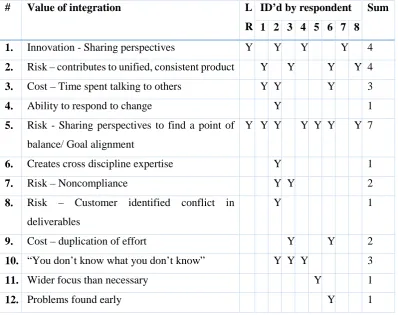
These broad categories were identifying the values of integration identified through literature and interviews. A more comprehensive list is contained in Table 9 - Value of integration as identified through interviews. The table shows where a particular value has been identified through literature review (‘LR’), by an interviewee (‘ID’d by respondent’), and the total number of interviewees identifying a particular value (‘Sum’).
# Value of integration L
R
ID’d by respondent Sum
1 2 3 4 5 6 7 8
1. Innovation - Sharing perspectives Y Y Y Y 4 2. Risk – contributes to unified, consistent product Y Y Y Y 4 3. Cost – Time spent talking to others Y Y Y 3
4. Ability to respond to change Y 1
5. Risk - Sharing perspectives to find a point of balance/ Goal alignment
Y Y Y Y Y Y Y 7
6. Creates cross discipline expertise Y 1
7. Risk – Noncompliance Y Y 2
8. Risk – Customer identified conflict in deliverables
Y 1
9. Cost – duplication of effort Y Y 2
10. “You don’t know what you don’t know” Y Y Y 3
11. Wider focus than necessary Y 1
# Value of integration L
R
ID’d by respondent Sum
1 2 3 4 5 6 7 8
13. Distraction due to high noise from verbal interactions
Y 1
Table 9 - Value of integration as identified through interviews
Risk mitigation through sharing of perspectives was identified in the vast majority of interviews, followed by innovation and the creation of a consistent, unified product.
4.1.1
Reduction of risk
The primary value of integrating engineering teams is the reduction of risk. Reduction of risk in some manner was identified by all interviewees as being the primary reason for integrating teams. It was noted that the higher the level of risk on a program, the greater the need for integration through cross domain input (Interviewee_2, 2016). Management of risk in on Defence programs is an area of focus, due in part to the potential catastrophic effects of product failure, and the use of firm fixed-price contracts tendered by defence. The risks mitigated by integration are multi-faceted.
The first risk is considered to be that teams will proceed in different, and potentially conflicting directions. When this occurs, the result will be wasted effort, in pursuing non value-adding initiatives (Interviewee_4, 2016), or rectifying conflict during the verification and validation (V&V) phase of a program (Interviewee_6, 2016). By way of example, Interviewee 6 (2016) referred to an instance while working on the design of a coal movement system, where one team was responsible for writing a standard for Supervisory control and data acquisition (SCADA) systems used for the remote monitoring and control of conveyor systems through programmable logic controllers (PLCs), for use by all teams programming the SCADA systems. The aim of the standard was to use coding that was easily customisable for ease of use by the operator. Other teams however, while aware of it, opted not to use the standard, instead hard wiring code for ease of input. The result was that the standard and actual coding deviated, and to regain consistency the standard needed to be rewritten to accommodate programming techniques which resulted in a reduction in customisable of the system. In another example, while working for an electronics company, three different teams were observed using their own processes for managing change, resulting in inconsistency between teams (Interviewee_4, 2016).
faulty measuring device, and built to a wrong specification, and resulted in multiple missions to rectify the fault (Pearce, 2012). In this case, integration between design teams and manufacturing and assembly teams may have identified the fault before launch (Interviewee_6, 2016).
Thirdly, there is risk that teams will produce an end product that is not compliant with the contract or required legislation. This can occur when the priorities of teams or individuals take undue precedence over others. Interviewee 5 (2016) highlighted that by putting multiple ideas and perspectives to an open forum, it allows the group to find the middle ground through a solution that balances the priorities of all teams involves. While noncompliance isn’t as catastrophic as product failure, it has the potential to be very damaging to the profit and reputation of a company
Fourthly, a risk of inconsistencies between deliverables is higher when collaboration doesn’t occur between teams. Interviewee 2 (2016) noted that customer reviews frequently focus on identifying conflicting information between deliverables. Such conflicts when identified reflect poorly on a contractor organisation, and can be indicative of the second risk, that the system or product won’t work when put together.
Fifthly, an ever apparent risk on Defence programs is that the contract, and associated system requirements will change. Such changes arise due to evolving technologies, optimisation of the scope of work, and the customer changing requirements. As the customer, Defence personnel frequently receive new postings (ADF Recruitment Centre, 2016), so if a capability program spans more than 5 years, then it is likely that there will be few people remaining on the program for its duration. As such, requirements are prone to change based on the preference of individual customers (Interviewee_7, 2016). Having the ability to quickly between teams through horizontal integration enables teams to respond and manage this change. It is notable that the people are adaptable, but processes are not, so people need to be involved whenever change occurs (Interviewee_2, 2016).
4.1.2
Innovation
Existing research has repeatedly demonstrated that collaboration can increase innovation, as demonstrated in Literature review, Innovation as a product of integration. Existing literature has shown that people have a much better chance of coming up with original ideas, if they are able to combine their perspectives with others. This is the same reason that many companies encourage diversity (Stevens, et al., 2008).
highly developmental, but for the majority of Australian programs, the extent of complexity is integrating existing, rather than developing new technologies. It was noted that for research and development programs, the need for innovation is paramount, but for integrating Commercial-off-the-shelf (COTS) or Military-off-the-shelf (MOTS) products, the importance is negligible (Interviewee_4, 2016). However, innovation is considered useful in finding better ways of conducting engineering activities. It was noted that the prescriptive nature of the Australian Standard for Defence Contracting (ASDEFCON) suite of tendering and contracting templates dictate a need for meeting customer requirements using defined methods, rather than seeking new ways of doing things. Furthermore, a view was noted that the Defence, and the ASDEFCON templates in particular, place the development of deliverables leads design development, instead of design leading documentation (Interviewee_4, 2016) (Interviewee_5, 2016).
In contrast with the perceived lack of importance of innovation amongst interviewees, observed programs do highlight innovation as being important, through Program Charters, and as a company value (Thales Group, 2016) (Boeing, 2016). This is reflective of new ideas being more valuable to a company, as something that can be sold or reused across multiple programs, than valuable to a program, to whom the potential of an idea is primarily in more efficiently satisfying the program Scope of Work.
4.1.3
Sharing of knowledge to develop engineers
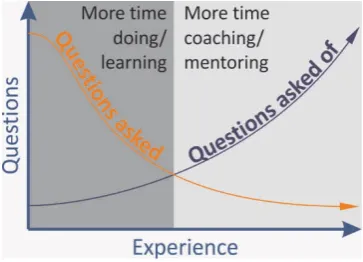
Programs rely heavily on Senior Engineers, not only to not only to develop designs based on an understanding of process, but also to conduct multiple tiers of review on deliverables, to understand what can go wrong and how to mitigate the risk, and to guide others (Engineers Australia, 2012). The required skills are developed over several years of engineering practise, in part through the conduct of engineering activities, but also by interacting with more senior engineers and practitioners, capturing their lessons learnt without having to experience failures firsthand. It is considered having engineers of varying levels of experience collaborating and imparting knowledge, is a significant outcome of the integration of engineering teams (Interviewee_6, 2016).
Sharing knowledge to develop engineers is considered more important to the business than the program. The benefits of developing senior engineers is primarily seen long term and is cumulative, whereas a program will only see short term benefits, given that the acquisition phase of a program will usually only last for a few years. The knowledge of future engineers will sustain the business in years to come (Interviewee_2, 2016).
Contracts, which are always tendered separately by Defence (Interviewee_8, 2016). An example of this is on a defence program for an upgrade of the particular RAAF aircraft, acquisition was conducted by Rockwell, while Hawker de Havilland was awarded the support contract. However, Hawker de Havilland found upon handover that the required information to support the platform was not sufficiently documented, but instead existed only in the heads of Rockwell engineers. Ultimately, Hawker de Havilland walked away from the contract. To fulfil the terms of the support contract, Hawker de Havilland needed to be firmly integrated with the cooperation of Rockwell. Problems based around a lack of documentation are compounded by attrition – when individuals leave a company, the information in their heads goes with them (Interviewee_3, 2016).
4.1.4
Cost
It is considered that many methods and integration, and the associated increase in collaboration, has a cost. The majority of interactions observed between teams under the banner of ‘horizontal integration’ take the form of a person asking for information or