© A Duffy, Department of Design Manufacturing Engineering Management DMEM | November 2012
The Knowledge Nugget:
Professor Alex Duffy’s PhD Supervision Guide
© A Duffy, Department of Design Manufacturing Engineering Management DMEM | November 2012
Special thanks to: Graham Coates
Laura Hay
Raji Tenneti
Wenjuan Wang Ian Whitfield
Written by: Sonia Siska Tiffany Imron
INTRODUCTION
PhD research is a form of learning, engaged with the ultimate purpose of an individual’s intellect and character development. This form of education allows students to make a
significant contribution towards the current state of knowledge, termed here as a ‘knowledge nugget’. This paper has been created to help guide PhD students supervised by Professor Alex Duffy, by collecting the main concepts he normally instructs his learners when pursuing their degrees. It is based on a series of individual interviews with him and four of his current and former PhD students. This paper reflects Professor Duffy’s supervisorial style in the context of
Engineering Design Research. It is organised as follows: In section one several books regarding PhD guidance are reviewed to provide a general background to guide students. Section two presents the professor’s style of supervision and concepts, which include: an analogy of the high-level process underlined in a PhD research project, the challenges the researcher will encounter when undergoing the process and a set of tools Professor Duffy commonly uses during his supervision. Finally, section three provides views from the students’ perspective, particularly of the lessons learnt under his supervision style.
SECTION 1:
PhD Guidelines – How to
survive according to the books
After deciding to pursue a higher degree, general questions commonly arise and need to be answered. As stated by Matthiesen and Binder (2009), future students must settle on“which university, what department and which research field that student want to join” which will be informed by knowledge, skills, abilities and interest. This will also help to decide the discipline and field that could fulfil those goals and finally find a reputable institution that could support the desired field of research. Students who have successfully addressed these questions and secured acceptance with an appropriate institution are ready to start the PhD journey. However, constant efforts are
required to be done in order to survive and bring it to a successful conclusion.
Several authors have published books as guidance for current and prospective PhD students. Overall they describe essential stages that students will undertake, common pitfalls and recommendations on how to successfully complete the PhD process. This first section addresses four essential topics that impact the overall student experience: managing themselves, dealing with the supervisor, working in university and concluding the PhD project.
Managing yourself
Once students enter the doctorate journey, they are entering a testing environment with a relentless challenge. Graves and Varma (1997) differentiate two types of failure;
complete but failed which means that the student finished the thesis but did not succeed in the oral examination, and non-completion
which means that the student did not finish the thesis at all. Failure is not a direct correlation with the individual’s intellect; there are many smart individuals who have failed to complete the journey. Binder and Matthiesen (2009 p.10) declared, “Determination beats brilliance” (Binder and Matthiesen, 2009 p.10) hence
“Developing desirable work habits and attitudes of mind” is much more important than intelligence (Graves and Varma, 1997 p. 8). Additionally, Matthiesen and Binder (2009 p.10) suggested that in order to survive,
“You need to be flexible and constantly develop further, growing with your field as well as the research. It is not only you who changes, as you learn; your goals tend to change too. The quicker you adjust to your new situation and environment, the sooner you can start being productive and it is essential to bring along a good portion of motivation and curiosity, as well as the discipline and initiative to carry out what it requires for the student to achieve their goal and finish the research successfully.”
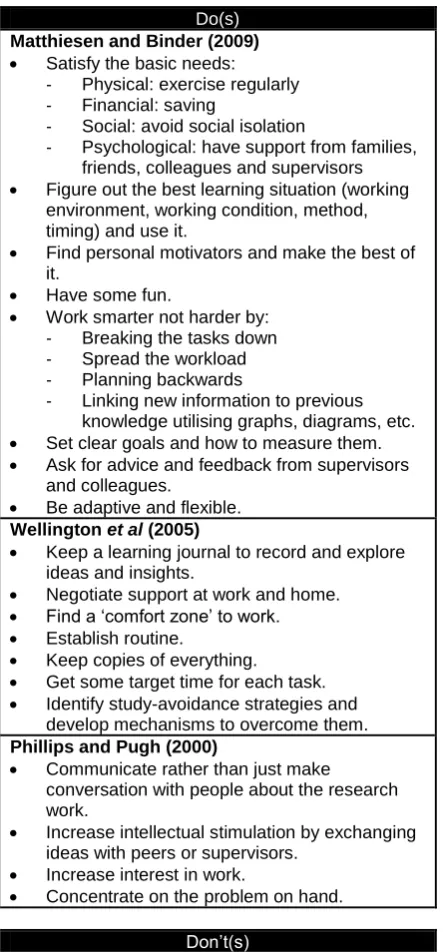
avoided by continuously motivating oneself and always seeking support from family and friends. Support from supervisors and colleagues are also important to help students continue to the end of the journey. A summary of some do(s) and don’t(s) regarding self-management during the PhD process, suggested by various authors, are displayed in the following tables.
Do(s)
Matthiesen and Binder (2009)
Satisfy the basic needs: - Physical: exercise regularly - Financial: saving
- Social: avoid social isolation
- Psychological: have support from families, friends, colleagues and supervisors Figure out the best learning situation (working
environment, working condition, method, timing) and use it.
Find personal motivators and make the best of it.
Have some fun.
Work smarter not harder by: - Breaking the tasks down - Spread the workload - Planning backwards
- Linking new information to previous knowledge utilising graphs, diagrams, etc. Set clear goals and how to measure them. Ask for advice and feedback from supervisors
and colleagues.
Be adaptive and flexible.
Wellington et al (2005)
Keep a learning journal to record and explore ideas and insights.
Negotiate support at work and home. Find a ‘comfort zone’ to work. Establish routine.
Keep copies of everything.
Get some target time for each task. Identify study-avoidance strategies and
develop mechanisms to overcome them.
Phillips and Pugh (2000)
Communicate rather than just make conversation with people about the research work.
Increase intellectual stimulation by exchanging ideas with peers or supervisors.
Increase interest in work.
Concentrate on the problem on hand. Don’t(s)
Matthiesen and Binder (2009)
Let the supervisor set the goals.
Look just at overall feedback on the tasks given by supervisors.
Set the goal to easy.
Get easily distracted and demotivated. Be afraid of failure.
Wellington et al (2005)
Get it perfectly right.
Carry on with the study until feeling very tired.
Keep problems from the supervisors and try to solve it alone.
Phillips and Pugh (2000)
Be too enthusiastic only at the beginning. Ask for supervisor’s approval every time you
want to do something with the research. Get side-tracked.
Let your frustrations deviate you from your work.
Get destroyed by criticism.
Supervision
Every author agreed that the supervisor is an essential element of the PhD process. A supervisor will help students to build their work from a vague idea, sign off assignments and in some cases have the power to decide whether the students will fail or pass (Matthiesen and Binder, 2009). They can be a director, facilitator, advisor, teacher, guide, critic, freedom giver, supporter, friend and manager (Brown and Atkins, 1988 cited by Whitfield, 2006). Since they have substantial influence on the decision making process and the overall exploration journey, building a prosperous relationship with supervisors plays an important role for successful accomplishment of the doctorate quest. However, dealing with a supervisor as a ‘significant other’ on a research journey is one of the most challenging issues in pursuing a doctorate degree (Wellington et al, 2005). Matthiesaen and Binder (2009) referred to factors such as personality, preferences, habits, behaviours and their personal goals; which influences the way people behave and can make interactions more complicated. Supervisors and students also can have different expectations to each other which could trigger a conflict of interest.
Although there are a lot of different types of supervisors, it is important for the student to understand what is expected from them. Once this is revealed, students will be “in a better
position to develop the skills necessary to reduce any communication barriers and sustain the relationship for mutual benefit” (Philips and Pugh, 2000, p.100). It needs to be understood that the supervisor’s expectations will commonly be reflected by their style and the roles they take on.
[image:4.595.67.289.194.671.2]neglect them, but raise the issues in discussion” (Philips and Pugh, 2000).
It is essential for students to be honest and not to feel reluctant in conveying issues to their supervisor because it will help them in assisting students throughout the PhD process.
Another critical point for a healthy student-supervisor relationship is improving verbal and written communication (Matthiesen and Binder, 2009). Students should consider supervisors as a critical friend who can provide advice and support as requested rather than seeing them as a boss (Wellington et al, 2005) and it is also important to find the proper balance between “taking” and “giving” based on both supervisor and student goals and expectations (Matthiesen and Binder, 2009). Commonly supervisors would expect to give advice on:
- Relevant literature.
- Formulation of ideas.
- Proposed plan of work.
- Methods of data collection and analysis.
- Problems occurred during the research.
- Discussion of analysis and conclusion.
- Writing process.
However, a good relationship cannot be built instantly. It requires time and effort to construct a solid bond. Some suggestions that Wellington et al (2005), Matthiesen and Binder (2009), Graves and Varma (1997), Phillips and Pugh (2005) recommended for students to develop a strong connection with supervisors are described in the table below.
How to develop a strong connection with the supervisor ?
Matthiesen and Binder (2009)
Set the basic rules (how to address each other, meeting schedule, frequency, location and format).
Show appreciation.
Have a verbal agreement or an informal contract. Be responsible.
Listen and be open minded. Do not take everything personally.
Wellington et al (2005)
Always write the minutes of meeting. Prepare progress reports.
Provide thesis outline.
Phillips and Pugh (2000)
Be independent.
Schedule regular meetings.
Produce good written words, not just a first draft.
Be honest when reporting progress. Follow the advices that supervisor give. Be excited and have fun with the work.
Graves and Varma (1997)
Keep to agreed schedule. Arrive for supervisions on time. Establish certain routines. Take the initiatives.
Provide an agenda before the meeting. Prepare something to discuss in written form.
With time, students will gradually become more knowledgeable in their research and consequently they will need to constantly educate their supervisor to gain the same level of understanding and allow the supervisor to give their best assistance on the student’s professional development (Philips and Pugh, 2000).
Occasionally, some disagreements will arise during the PhD journey, as everyone is different. When this occurs, there are three options that students can choose from to progress (Matthiesen and Binder, 2009):
1. Try to influence the supervisor’s behaviour. 2. Adapt to the situation and change the
student’s own behaviour. 3. Try to find a new supervisor.
It is difficult to change peoples’ behaviour and
thus more often than not, students will have to
adapt. As for the last option, it is not recommended since it involves an intricate process which will require considerable amount of energy and time. However, if students feel that the relationship is not developing satisfactory and it is not possible to continue, Philips and Pugh (2000) advise to use a third party as mediator in finding a new supervisor. The role of the mediator is to improve communication with the new supervisor and to help the former supervisor to accept the change. The student should be aware that such a change could contribute to
“important consequences for the supervisor’s professional status and self-esteem”.
Student life
Being a PhD student in what might be a completely new university and work environment can be challenging.
Diverse cultures and genders
The dynamics in relationships will affect students as they come from different educational and social backgrounds. Several issues cannot be avoided by students throughout the process. In some cases, gender and culture diversities could create discrimination including racism, sexism, or ageism which can obstruct a students’ journey. For instance, Graves and Varma (1997) stated that in certain universities, women students are likely to be excluded from doctoral studies or overseas students are not sufficiently involved compared to local students. Students must be aware of this particular situation and work hard to overcome it.
Many universities have tried to alleviate this situation by arranging a structured orientation programme. “This enables students to meet each other, the faculty, support staff and to understand the structure of the institution, so that they can engage personally with the institutional culture” said Jagdish Gundara (Graves and Varma, 1997). Such introduction will be useful not only for local students, but mostly for overseas students who are not familiar with the local culture and the institution. It is the student’s responsibility to engage by actively taking part in the university’s program and introducing themselves to the new environment. Additionally, participating in non-university social activities is also helpful to adapt and settle in (Philips and Pugh, 2000). Nevertheless, PhD students should realize that substantial amount of time is needed to become accustomed with a new situation. Hence students must be patient and not allow this issue to affect their work.
Politics
“Politics are part of university life” (Matthiesen and Binder). Politics become an issue when people try to gain too much advantage and sacrifice other people in an unfair way and possibly using non-ethical means. “These unwarranted means can then be used to make people do things they would not otherwise have done, things they either do not want to do
or do not believe they should do” (Matthiesen and Binder, 2009 p.130). What should students do to avoid such a situation? Matthiesen and Binder (2009) suggest the following:
- Take notice of early warning signs (favouritism, things are too good to be true, situations are performed differently than expected or people secede from specific issues).
- Stay neutral.
- Take time to digest and find information if someone offers something.
- Do not let others persuade and influence the decision.
If students are accidently ensnared in a political situation, the best way is try to find a way out at the earliest opportunity. Students should be aware that politics can be distressing things to deal with and could create collateral damage if handled improperly. The student should find support and associate with people who are sincerely interested in their success, and ask for their help and advice. Sometimes, a straightforward conflict is not a good option. Consequently, students could consider compromising and negotiating as mentioned by Matthiesen and Binder (2009 p.139).
“There are ways to be clever about it and play the game, and there are people who are able to use their diplomatic talent to gain some advantage over potential competitors.”
One thing to remember is to be extra cautious and not to put the doctorate degree in a precarious situation as it is the main reason why students are in the university.
End of the PhD journey
At the end of the PhD “journey”, there are two elements of assessment that will determine a student’s success in their doctorate degree; the thesis and viva examination. Students need to prepare themselves and ensure that everything will progress as best as possible. In this stage, the supervisor’s support and students in-depth knowledge regarding their research play a critical role.
Writing thesis
Wolcott (1990 cited by Wellington et al, 2005), writing is a “form of thinking” which goes hand in hand with the writing process. Students often think that they need to exactly write what they think, what they want to write as well as how they are going to organise it before they start writing. However, planning is indeed an essential step before starting to write as it will save time and could structure the way of thinking. One of the ways to make a good plan is by reading a wide range of references, making notes, and putting forward your own ideas and viewpoints (Wellington et al, 2005). Wolcott (1990 cited by Wellington et al, 2005) argued that reading is not necessarily needed before writing, it should be done in parallel and the two activities need to be balanced.
Hartley (1997 cited by Wellington et al, 2005) advised PhD students to follow particular strategies to be a good writer:
1. Make a flexible initial plan that can be adjusted easily.
2. Write one section at a time and it does not have to be in order.
3. Consider the readers when writing. 4. Find a quiet condition to write. 5. Set goals and targets to achieve.
6. Write frequently. It does not have to be a lot but it has to be regular.
7. Read the text out loud.
8. Get colleagues and friends to review the early drafts before going to your supervisor.
As for the writing technique, some tips are given by Hartley (1997 cited by Graves and Varma, 1997):
- Use simple words.
- Avoid over-using abbreviation.
- Vary sentence lengths.
- Use short paragraphs.
- Use active tenses if possible.
-
Avoid negatives to prevent confusion and misunderstanding.The key point in writing a thesis is that students need to establish a certain routine and commit to it (Graves and Varma, 1997). For instance, regularly submit drafts of the thesis sub-sections to the supervisor and ask for their guidance or input rather than give big chunks of drafts once or twice and ask them to review everything. Do not forget to find out the requirements of the institution regarding thesis presentation as it will differ from one to another.
Presenting
After submitting the thesis, it comes to the time where students are required to defend their work in a form called a viva voce. It is held to ensure that “the standard quality amongst
doctorates is the same across universities, students demonstrate their capability to be an independent researcher and the work is original” (Matthiesen and Binder, 2009 p.185). According to them, the examination will generally assess:
1. Understanding of own research.
2. Relationship between the work and other work in the same field.
3. Novelty or contribution of the work.
4. Practical and theoretical implications of the work.
Many PhD students believe that the viva is their worst nightmare. The pressure is high because if students do not do well, everything that they have been working for three years or more will be unacceptable and possibly will need to devote a lot more time afterwards to fix what has been done. Normally, supervisors will not approve the thesis submission if they think that the student is not ready. Therefore, when students are at this stage, it means that they should have made sufficient progress such that they have made an original contribution to knowledge and need to demonstrate it (Matthiesen and Binder, 2009). Whether students will succeed or not during the oral examination will depend on how well-prepared they are.
By understanding the four basic assessment parameters, students are expected to prepare themselves. Matthiesen and Binder (2009) stated that knowing who will be the examiners before finishing writing the thesis is crucial. They argue that it will help students to find more about the examiners work and use it as a reference on their thesis. Professor Duffy on the other hand believes that a thesis should be able to stand on its own right and not be influenced or swayed by a student knowing who the examiners will be.
Talking with people who have experienced
to be advantageous to improve “the ability to talk about the thesis and respond to challenges” (Wellington et al, 2005).
During the examination, students need to show their professionalism by dressing and acting accordingly. Other recommendations are:
1. Be punctual.
There is nothing worse than coming to the examination late. It will destroy the confidence and everything that students have prepared.
2. Take a copy and make notes.
Hold a copy of the dissertation and put important notes for each chapter. It will be easier to refer to any part of the dissertation if needed.
3. Have a pen and notepad.
Take a note when the examiners give comment and feedback, thus they will notice that their effort is taken seriously by the student.
4. Listen and do not interrupt.
Make sure to let the examiners finish their questions and comment.
5. Be calm and confident.
Always answer the questions as calmly as possible.
6. Be honest and communicative.
If students need time to think, do not know the answer or cannot hear the questions clearly, tell the examiners honestly. It will show integrity and they will appreciate it.
To be able to succeed in the oral examination and defending the thesis, it requires “an equal level of oral ability and academic oracy” where both need to be practiced and prepared (Wellington et al, 2005). Always remember that the supervisor is there to help, they will provide good advice on how to survive the test based on their experience guiding previous students.
SECTION 2:
Professor Duffy’s style of
supervision
This section elaborates on the professor’s concepts and tools used though out the PhD research project. The first part of this section provides a brief background to Professor Duffy before going on to outline the main phases of the PhD process, referred to as the “journey”. Features of the “landscape” are then described followed by discussion of important elements of a PhD thesis. Tools to aid supervision are then presented.
Professor Alex Duffy Background For over 22 years, Professor Alex Duffy has successfully supervised 16 PhD graduates, of which three did not require any changes at all to their theses. He currently is the Head of Department of Design Manufacture and Engineering Management (DMEM) at Strathclyde University. Until recently he was Vice Dean of Research for the Faculty of Engineering for three years and before that Director of Research, a post that he held for approximately 13 years. Over a number of years, he has created a significant research profile, being: editor for the Journal of Engineering Design; President of the Design Society; chair, reviewer and member of the advisory panel for numerous engineering design conferences; and he is arguably both an effective researcher and supervisor.
Adapted from Whitfield, 2006
In order to contextualise Professor Duffy’s style, the following key points of his approach are highlighted:
The fundamental objective of a PhD project is not the PhD itself, but the development of the individual.
The PhD is the mechanism that allows the individual to develop - among others - their intellect, character, logic, thoroughness, ability to reason, ability to abstract and specialise, ability to articulate ideas and concepts, writing skills, presentation skills and research skills.
The ultimate role of a supervisor is not to guide the students to obtaining their degree, but to help develop them to the point where they deserve the degree. As a PhD entry requirement, the candidate’s skills and motivation are assessed against particular project standards. The purpose of this unstructured assessment is to inform the supervisor of the candidate’s suitability to undertake a PhD with respect to the planned subject area. Moreover, Professor Duffy believes that what essentially contributes to the successful accomplishment of the research is the individual’s character.
PhD Process
“PhD is likely to be the largest single endeavour a student will undertake over an extended period of time; and where they will often have to face a significant personal challenge” (Duffy, 2012).
Every PhD thesis differs significantly from one-and-other. It is a unique and individual piece of work a researcher will produce through their education. However, the effort behind a PhD, in the context of Engineering Design Research, will essentially involve the same three high-level elements: (1) identifying the problem, (2) determining the solution or results and (3) writing the thesis. The output of this process is the development of the presented knowledge contribution or ‘knowledge nugget’. That is, the goal is to identify, define and articulate the nugget of knowledge that provides a significant contribution to the relevant community.
In order to illustrate these stages to his students, Professor Duffy defined an analogy which closely represents the PhD phases. This analogy is the journey of the individual to ascend a mountain; more particularly the journey from the city of Glasgow to the summit of Ben Lomond, a distinctive mountain in the Scottish Highlands. The journey is described in 3 main stages, generally described in a sequential way, but in reality including some iterative elements, parallelism and interaction between them. The stages are called: (1) going through the fog, (2) traversing the grounds and (3) climbing the mountain.
(1) Going through the fog
The journey begins with the uncomfortable process of going through the unknown. It is like the student is immersed in dense fog, completely unfamiliar with the surroundings. There is an additional problem: there is no map for the journey. The traveller will be uncertain about their current location and will have poor clues of how to reach Ben Lomond. The best way of understanding what there is to model, possibly mental, local maps that describe what is around. This exercise will
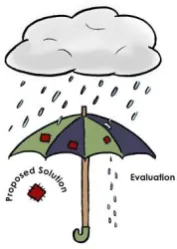
help them slowly clear the fog, providing a degree of knowledge and confidence to continue the journey. The aggregate of local maps will eventually provide greater visibility of the area. With time, this will allow the traveller to reach the summit of the mountain. In a PhD this stage is about defining the “state of the art”, in which the candidate conducts research on the current literature available in the selected domain. The purpose of this activity is to get familiarised with concepts, develop an understanding of what has been researched already and fundamentally identify what is missing (a gap) in the knowledge domain. This gap is defined as a problem that has remained unresolved and that, through research, has the potential to be solved. The state of the art can be further explained and illustrated in Figure 1. Imagine a problem area (or area of study) as a nebulous cloud, which has particular problems (represented by rain) and the umbrella is the previous research which either successfully or partially addresses those problems. Given this, there will likely be gaps identified in our current knowledge and those unresolved problems represent a potential challenge for new researchers. The activity of acknowledging the current situation of a study area is known as defining the state of the art.
Figure 1: State of the art
Complexity of Research
“Research is a wicked problem: you don’t know what you are trying to know. Research is not a search problem but rather an exploration problem. Searching is like when
you’ve lost your keys. You know you own your keys, you know you can find them, and so you are searching for them. You know exactly what you are trying to achieve and exactly what you’re trying to find. Research is an exploration based problem. You don’t know what you are looking for, you don’t know when you will find it, but you know you are trying to discover something. The problem in understanding evolves in a cyclic nature. The problem with the fog is that you don’t know what you are looking for until you start to find things, you start to understand what you are looking for, which helps you understand what you are finding. It is like a spiral of enlightenment, or helix of focus and evolution. But it’s only really when you finish your PhD studies that you truly know what you have achieved and what your knowledge contribution really is.” (Duffy, 2012)
(2) Traversing the grounds.
The student will now have an idea of where Ben Lomond is. Nevertheless to reach it, they will need to wander through unexplored territory. Most probably, they will change and update their “maps”, because, when traversing the terrain, a better understanding of the real obstacles and the challenges is obtained. Traversing the terrain is analogous to conducting the research itself, which includes: investigation, analysis, modelling, experiments, techniques, tests, surveys, questionnaires, etc.; performed to generate an answer to how to tackle the challenge, or in other words, to seek a potential solution for the identified problem/knowledge gap. The researcher will need to determine an answer to fill the knowledge gap and doing so through copious and profound research.
Coming back to the umbrella illustration (Figure 2), this stage is about proposing a tailored solution that will permeate the research challenge. The proposed solution is represented as a patch. The evaluation of the
[image:10.595.375.464.113.238.2]solution is described in the Important elements of a PhD thesis section.
Figure 2: Proposing a solution
(3) Climbing the mountain.
Professor Duffy relates this stage with writing the thesis and ascending with defining the knowledge contribution. It is about documenting all the evidence that supports the knowledge nugget.
However, the researcher might have done some writing prior to finalising the thesis itself (e.g. conference and journal papers, reports, etc.) - “Writing is a mechanism to train the mind and makes people learn how to think”
(Duffy, 2012). If so, then they will clearly have an advantage during their journey against those who didn’t. In this analogy it is described as the activity of ascending whilst traversing the grounds. It is getting to Ben Lomond through a path that leads to a higher level before starting the steep climb up the mountain. Contrary, the travellers which haven’t done any writing will reach the mountain at lower ground.
One of the most important outcomes from
Features in the landscape
When developing a knowledge contribution
there will be no right or wrong direction to take, but the traveller will need to overcome significant challenges along the way.
“There is no such thing as negative knowledge. All knowledge can be a contribution. This is like taking the wrong direction, there is no such thing as taking the wrong direction. There is just easier and more difficult ways of going. ” (Duffy, 2012)
The traveller will encounter, during (1) going through the fog, (2) traversing the grounds and (3) climbing the mountain, different features in the landscape. Some of them quite promising whilst others will require taking risks and facing difficulties.
Cul-de-sac
When going through the fog, the student can encounter a dead end or cul-de-sac. This is where they see or their reading presents no way to move forward. Often they will view this in a negative way as they may have thought there reading was taking them on an avenue that could lead to the summit of Ben Lomond. However, they gain a map of the domain which helps in their understanding and articulation of the field, but they cannot continue the journey in the direction they expected.
Roundabouts
During the fog the student might follow a road which is really just a roundabout. They will go around in a circle, before they realise they are actually back where they started. Again, they will experience greater understanding and develop their (possibly mental) maps of the domain.
Local maps
Some people can share their local map with the student and they may be able to read it, but they won’t have the in-depth understanding of what the map truly means. The traveller can learn from it, but it may not help them in the long run. For example, a supervisor can explain the field or challenges but the student’s mind must be prepared to gain the understanding and insights being passed. Additionally, every person who shares a map will give their own interpretation and presentation of the area.
“A Google map of an area will be different from a survey map, which will be different from a caricature map or a tourist map, but they still all try to show you information of the same domain. What you get from it can be completely different. And even then, you won’t really understand it. Seeing a tourist map with a cathedral isn’t the same as going to the cathedral and really experiencing it.” (Duffy, 2012) Paths and trails
The researcher can find paths and trails which have already been clearly marked on the way. They provide relevant information to the traveller and help them orientate. They will also keep them away from difficulties, and direct them on the right track. Finding a path can be compared to previous research that clearly supports the PhD project and directs the student to the desired findings. It is basically following and understanding previous work that helps transverse the grounds faster by building upon others’ work. This particular literature lessens the student’s confusion and provides focus to work on the subject area.
Rivers
- get the means to cross the river: use a raft or boat such as previous work that can be adopted into the context or find someone who has similar views to help cross it.
- go to a shallow and/or narrow part of the river and wade over: understand the field and elements of it to provide a different interpretation that applies to their research.
Bridges
A bridge helps you cross significant challenges and problems presented in the domain. These bridges have been built by other travellers in the domain. They can be helpful, save time and energy, reduce danger and motivate the individual. It can be compared to key findings in literature that will significantly reduce the effort needed in the PhD project to overcome obstacles. They also can provide a new perspective of the local domain by being able to see further afield when crossing it.
Local hills
The ground won’t be entirely flat; on the contrary it will be characterised with ups and downs, where local hills can be found on the way. Climbing local hills are crucial since, when climbed, they give a new perspective on the landscape. They broaden the traveller’s horizon; it allows them to capture new features of the distant land, and to look back and recognise additional features on the scenery that may have been previously overlooked. Eventually the student, through doing the research, will come across some periods of reflection and understanding, where they will realize that their knowledge of the area improves significantly. Additionally the local hill aids to look back at the problem and research challenge and to actually evaluate the work; in other words ‘look back on the map they have created’. This period of enlightenment is crucial to motivate the individual, generate confidence and enhance their sense of ownership of the PhD work.
Cliffs
The traveller will spend a considerable amount of time exploring the grounds, when they may encounter a cliff which will stop them from progressing along that route. The first reaction upon a cliff is: ‘Oh no! I have to backtrack, this
will ruin my journey!’ This dead end refers to, in the PhD context, the unexpected finding of
getting to know someone has already done very similar or the same work. It is like finding a paper that does exactly what the student was trying to do and has the impact of taking the ground away and their perception of their contribution. This process can be highly demoralising and can severely affect the student’s mental and physical condition. They can feel confused, frustrated and lost. They will feel disappointment when they believe that a great amount of the work they have done won’t be of value. But sometimes when they actually take time to look at the details of the cliff there is a way of transcending it, getting over it and continuing with the journey, and it not being the ‘catastrophe’ they might think. There are some ways to get out of it, depending on the nature of the cliff. They can turn back, go along side and then crossover or they can try to build a bridge. Based on the finding, the student needs to evaluate how dangerous or wide the ravine is in order to find a way out and effectively rectify and put the work in context within the overall map and journey taken. To arrive at a similar place through a different journey can be a contribution in itself.
Swamps
Swamps reflect the drudgery of doing research: reviewing literature, doing the ‘bulk standard basic’ stuff, too many papers, too much information at once, things that just do not work, information that is hard to get, data confidentiality issues, a company is not responding, not knowing the techniques to use, not being able to travel, depending on individuals who are not available, etc. It is just stuff that will come up, that cannot be anticipated and drag the student down. However, the challenge is to persist, push through and keep going; no matter how exhausting the journey is.
Unexpected bad weather
student might feel like giving up, but overcoming these difficulties will develop their character along the process and is often part of the journey
Clouds
Clouds share similar characteristics with the fog, found in the early stages of the journey. But, they differ in the way that clouds are found whilst climbing the mountain. Clouds reflect the confusion and ambiguities in the field or the student and can be clarified (cleared) through writing. Sometimes the researcher will be tangled with concepts and ideas; and they will need to write in order to clarify and deeply understand the work that has been done. “Writing is the thing that truly gives you clarity of thought, because you need to articulate your ideas. Writing and conveying your ideas gives you great insight into what you are really thinking.” (Duffy, 2012) This task will be essential to develop the individual’s knowledge and ownership of the project.
False peaks
A false peak is similar to a local hill, with the main difference that it is not found on ground level but high up on the mountain. A false peak is exceptionally deceiving, because when observing it from the bottom of the mountain it can easily be mistaken for the summit of the mountain, the goal. The student will do the writing, climbing the mountain, aiming and believing they shall finish when they reach the false peak where in fact they are only partially climbing the mountain and may still be a significant distance from the summit. They believe if they reach the false peak they will have finished their research and achieved their objectives. As they ascend and reach the false peak, they realise there is much more work to be done. False peaks raise false hopes, false expectations and time plans. This can happen numerous times, until they actually get to the summit.
Steep slopes
‘Writing can be an arduous, tiring process’. Through steep slopes the traveller will face a treacherous, painful climb; like “sweeting blood” just to move a few centimetres. They don’t go that fast, they don’t go that far and it takes a lot of effort, just to make a little progress. The steep slopes refer to those
periods where it is very tough and difficult to write, making it a hard and slow process.
Plateaus
Traversing the grounds can also happen when you are climbing the mountain. Plateaus are essentially that, where you will need to do considerably more work, meaning more research or further studies in order to get to the place you need to be to continue your writing. In this process the traveller can see exactly what they need to do in order to get to the foot of the next hill.
Sign-posts
A sign post can come from the supervisor, colleagues or a state of the art review; giving some hints or directions. They will tell the student ‘go here, go there, I’ve been here before, over here is this, over there is that, go this direction for this, go that direction for that’. However, it is difficult to trust in sign posts. Sometimes they can be wrong; they might be on a wrong road for an era. Even the supervisor can give a sign post, but the student understanding of it isn’t the same. Unless the student has done the journey, they don’t really understand what it really means.
Boulders and stones
There will be other travellers climbing: researchers, family or friends. Encountering other travellers can be challenging. These people can drop boulders or stones which can harm or scare the traveller on their way up the mountain. People will say or do things, not necessary deliberately, that can set the traveller back. For instance, new research, new work that has been done, or as simple as: ‘Have you finished your PhD yet?’
Experienced travellers
When getting to the summit of the mountain, the traveller will meet with experienced travellers who have made this journey before. These other travellers have their own maps of the journey, and in order to be welcomed, the student will need to prove they deserve to be in this place; doing so by demonstrating and defending their map of the journey. They will be sitting at a desk in front of a cairn1 with a flag on a pole (certificate) behind them, the
1
end goal when reaching the summit. It can be compared to the final examination of the PhD, where the articulation of the knowledge contribution in front of appropriate examiners is required. “Students should be able to defend their work against the best in the domain” (Duffy, 2012). As a result of their examination they may send the student down to come up another route (additional research), or suggest a better alternate route that they should have come or need to cover (re-writing), or re-direct them to cover additional ground at the summit before securing the flag (circle a bit more around the summit through some re-structuring/writing), or for them to proceed climbing the cairn and reaching up for the flag (minor edits). Rarely, they may hand over the certificate there and then (no changes).
Important elements of a PhD
thesis
The PhD thesis includes a number of elements, such as: title, discussion, evaluation
and conclusion. Professor Duffy has identified relevant characteristics that when addressed through writing may enhance the quality of the work.
Title
A title is the most fundamental abstraction of the thesis and as such should highlight the knowledge contribution. Professor Duffy argues that a good title is one that addresses three basic ideas:
1. What is the topic or focus of the contribution?
2. What is the type or nature of contribution?
3. What is the context?
1. Contribution topic/focus:
The topic of the contribution refers to the fundamental concept of study. That is, the focus of investigation.
2. Contribution type/nature:
Difference types of contributions can be made. Any contribution can be considered as declarative, procedural or a combination of both knowledge classifications. Declarative contributions refer to knowledge of which provides a description of the concepts. Procedural contributions refer to the exhibition
of a process or behaviour, whilst combined knowledge is the contribution of both. The nature of the contribution should be clear. For instance: an insight, a method, an approach, a model, a framework, etc., or combinations of these.
3. Context:
The context refers to the area of study where the research was conducted.
To exemplify how to address these three ideas, the following PhD tittles from previous students have been analysed.
1. “A theory of value in design” [Reber, 2011]
2. “The nature of evolutionary artefact and design process knowledge coupling” [Wang, 2008]
3. “An approach, insights and methodology for performance improvement through process activity management”, [Haffey, 2007]
4. “Emotive Implications of Rendering in Conceptual Design” [Tenneti, 2007] 5. “Computational support for operational
design co-ordination” [Coates, 2002]
Topic/focus Type/nature Context
1. “A theory of value in design”
Value Theory Design
2. “The nature of evolutionary artefact and design process knowledge coupling”
Knowledge
coupling Nature
Evolutionary artefact and
design process 3. “An approach, insights and methodology for performance improvement through process activity
management” Activity
management
An approach, insights and methodology
Performance improvement 4. “Emotive Implications of Rendering in
Conceptual Design” Emotive
rendering Implications
Conceptual design 5. “Computational support for
operational design co-ordination” Operational
co-ordination
Computation
Discussion
The discussion section is the main place for the student’s opinion, views and logical deductions. It should include four main elements, flowing from the specific to the more general. Most probably, readers won’t notice the transition from specific to general; it may seem natural to them. ‘It is an explicit structure, but has an implicit broadening for the reader’.
1. Results (outcomes)
2. Methods (tools and techniques) 3. Research methodology 4. Future challenges
Results, methods and research methodology should address respectively: (1) strengths, (2) weaknesses and (3) lessons learnt. Future challenges will include the potential work in the field.
Evaluation
In this section the student should demonstrate how suitable their proposed solution is. Similarly to the umbrella illustration, evaluation refers to assessing: ‘How good is the patch?’
The proposed solution should be evaluated with respect to two different aspects: the practical level (domain problem) and knowledge level (research challenge). And the student should accomplish a logical flow between both evaluations. The criteria used should directly link and align to the issues and challenges raised.
- Domain problem: This evaluation should compare and explain how suitable the proposed solution is with respect to the domain’s unresolved problems. It should explain how fixing this patch will contribute to the challenges and issues within the domain.
- Research challenge: The research challenge is identified through the state of the art and refers to the gaps in the current knowledge. This evaluation is the most relevant, since the patch reflects the
knowledge contribution and should be demonstrated how this solution contributes to gaps in knowledge.
The domain problem can be exemplified by a company that want to do things faster, or do things cheaper or change their production processes. Whereas the research challenge is
the missing knowledge that when developed might contribute to alleviate the company’s concern. The company problem is the trigger or motivator whereas the patch is the
knowledge contribution.
Conclusion
The conclusion is a summary of the work done and is basically the closing section of the thesis. It should contain the key points and aspects raised with respect to aim and objectives. The aim and objectives should reflect the key chapters and the contribution. A reader should be able to read the introduction and conclusion sections of the thesis and gain all the key points being made, in a consistent and coherent manner. The main body should only provide further details and justifications and not something new.
Supervision tools
In this section the most common supervision tools used by Professor Duffy are described.
Personality test
[image:15.595.315.527.571.688.2]The candidate will experience a significant personal development through their studies. In order to measure and understand these changes, Professor Duffy conducts a personality test. Consisting of a personality profile, reflecting Hippocrates four temperaments, this examination provides a snapshot of a candidate’s personality at the early stages of their PhD, which later on, will be compared to one at a late stage of the research.
Figure 3: Personality profile test Vocabulary and semantics
The student needs to have a clear and deep understanding of the specific or technical vocabulary and semantics related to the PhD research. The definition exercise consists of listing and distinctly defining the relevant terms of the topic. This allows the student to clearly
1 Adventurous Adaptable Animated Analytical
2 Persistent Playful Persuasive Peaceful
3 Submissive Self-sacrificing Sociable Strong-willed
4 Considerate Controlled Competitive Convincing
5 Refreshing Respectful Reserved Resourceful
6 Satisfied Sensitive Self-reliant Spirited
7 Planner Patient Positive Promoter
8 Sure Spontaneous Scheduled Shy
9 Orderly Obliging Outspoken Optimistic
10 Friendly Faithful Funny Forceful
11 Daring Delightful Diplomatic Detailed
12 Cheerful Consistent Cultured Confident
13 Idealistic Independent Inoffensive Inspiring
articulate the fundamental meaning of the terms within the focus of research. The exercise will initiate in the early project stages and continue all the way, and should be explicitly included in the PhD thesis.
Standard manuscript comments
[image:16.595.316.525.70.398.2]Based on common pitfalls in research writing, Professor Duffy has structured specific symbols and legends to help evolve the quality of the student writing and provide critical feedback in writing. It is used throughout the project, from the early stages till the point where the researcher is required to comply with the high PhD standards. It highlights consistency, order, logical flow, structure, presentation, vocabulary, repetitions, appropriate use of terms, vagueness and more.
Figure 4: Manuscript comments with description (Appendix I)
Progress Record Sheet
It is a mechanism to manage students’ progress. When filling out the sheet, the student is asked to self-evaluate their progress ranking from unsatisfactory to excellent. The supervisor and student would hopefully agree on the final evaluation but they may record differences of opinion. This exercise allows the student to reflect and think about their own progress and level of achievement and encourages discussion of such with the supervisor. Additionally it is a means for documenting evidence of communication and decisions. A valuable feature of this tool is that it documents the unforeseen issues and problems of importance.
Figure 5: Progress record sheet (Appendix II)
Knowledge map
Also referred to as the ‘treasure map’, this tool helps consolidate the student’s research work and contribution(s). It gives ‘mental clarity’ which will be essential for defending the final work in the viva. Each student has their own way to sketch their mental map. However, the fundamental characteristic is to describe how concepts are interrelated and how they led to the knowledge contribution or ‘treasure’ hidden in the PhD thesis, the knowledge nugget. Generally this mental map can be found in the closing section of the research.
C: Consistency - Maintain consistency in the words that are used. A word may be used that is not consistent with a previous meaning, phrase or word. Consistency must be maintained at all times. When a word is used to have a particular meaning then that word should be consistently used throughout the text to reflect that meaning. Consistency also relates to the order of structural aspects of the manuscript. For example, if a list is made then the items in that list should be discussed in the same order as the list.
O: Order - All bullets or points must have a logic to their order. That logic does not need to be stated in the text but the writer should know what why the list has been ordered the way it has. If there is no distinction within the list order then the list should be ordered alphabetically or numerically.
R: Repetition - Words, phrases, sentences or paragraph parts have been repeated. Repetition should be kept to a minimum and only where absolutely necessary to make or emphasise a particular point. The manuscript should be rationalised in order to reduce repetition. This may require restructuring, re-phrasing or deletion of repetitive parts.
S: Structure - The structure is either poor, inconsistent or needs to be checked. Each section, paragraph, etc. should make a particular point. The writer should clearly understand the key point of say the paragraph or section, ensure that the point isn’t repeated elsewhere and structure the manuscript in a logical manner.
[image:16.595.74.278.272.520.2]Figure 6: Knowledge map (Appendix III) Viva questionnaire
It consists of a series of topic specific and general questions. They are used as a rehearsal and in preparation for the viva examination to help the student practice answering relevant questions but also helps in boosting confidence and prepare them for the examiners’ questions.
Figure 7: Viva questionnaire (Appendix IV)
SECTION 3:
Former and current students’
insights
Interviews were carried out with four PhD students to obtain information regarding Professor Duffy’s supervision style and its influences on the PhD process based on their personal experiences. It was conducted with three of his former students – Graham Coates, Raji Tenneti and Wenjuan Wang – who have successfully reached the summit of the mountain, and one current student, Laura Hay, who is still on the journey and starting to come out of the fog. All of them have different experiences and unique stories to share. Since some of the former students have passed the PhD process over a decade before writing the document, there are some activities that they were not able to recall. However, their testimonials are still considered useful to provide an insight to future PhD students.
The analogy of the journey
[image:17.595.308.524.71.410.2]during the process, particularly in providing a vision on where their research was going. Particularly for Laura Hay who is ending her first year of her PhD journey. Since she went straight from her bachelor degree to a doctorate, she was of the opinion that a doctorate is nothing more than a long project. The analogy that Professor Duffy uses helped her to understand that the PhD is a long journey with various phases. It helps her to visualise what the PhD process is going to be like.
A different case occurred for Wenjuan Wang who graduated in 2008. She mentioned that during the first stage of her PhD process, where she was required to identify the research area, she was relatively slow. The analogy helped to encourage her by showing that one day she will reach the summit of the mountain if she was determined enough and keeps on going.
“When you start to climb the mountain, you don’t know where the top of the mountain is. You cannot see it. But if you keep walking at some point, you will be able to see it and know where it is. Even though I don’t know where to go but I know that I will be there.” (Wenjuan Wang, 2012)
The stages brought some structure of thinking for Tenneti and Coates. Tenneti developed the chapters of her thesis based on the analogy and it aided Coates to establish the links between all the various parts of the work he was doing.
During Coates’s PhD practice, Professor Duffy did not apply the analogy yet. However, Coates recalls similar phases as problem formulation that can be associated with going through the fog, then developing a solution, evaluating and reporting it.
The obstacles
Although major obstacles that every student face during the PhD process differ from one to another, most of them stated that the main difficulty was to define the research area and to decide which research questions they were going to answer. Wang was one of the students who dealt with such a problem. She spent two years before deciding to focus on a particular topic. Similarly, Tenneti needed to read through “a lot” of literature and “went in circles” for a year before she knew what to do for her PhD. They believe that Professor Duffy
was the reason they finally got out from the fog by giving them the tools to find the answer and encourage them.
“He asked me to play a computer game to help solve my problem at that moment.” (Wenjuan Wang, 2012)
Another obstruction that the students met was related to writing the thesis. Coates mentioned that there was considerable re-writing because he had never written on such a scale and the natural process of ensuring the thesis remained a coherent whole as it was being put together. Wang faced a similar problem as English was not her native language.
Professor Duffy’s role in helping his students overcoming their problems was essential. He applied different methods depending on the student’s personality and their personal traits. With his specific style, he supported and helped his students surpassing their issues. For instance, with helping Wang’s writing problem, he meticulously reviewed her work and when helping Hay, with her difficulties to map out the literature, he told her the truth about her personality, and how it affected the process.
“He told me that I was scatty. No one ever told me that before. But that was the greatest thing ever. It helps me to get over the hump because I realised that the reason why I cannot move on, was because I was all over the place. Alex [professor Duffy] put that in my head and it works to make me conciously put an effort to get over it .” (Laura Hay, 2012)
The tools
Various tools were applied during the PhD process. Professor Duffy carefully selects the tools for each student depending on their needs. Even though the functions and roles are different, all of them were proven valuable, based on the student’s experience.
Personality test
everything on the surface and see the general things. She was rather passive and less independent. At the end of the process, she found that her personality characteristics had improved to be better. She is more active, independent and pays more attention to detail when perceiving something.
Vocabulary
The relevant terms were developed to assist the student to familiarise them with the unknown terms. Tenneti mentioned that at the beginning of the PhD, she found several new terms related with her research such as simbiosis, vague modelling, etc. By considering the terms in the field, she searched for the definition with Professor Duffy’s help and at the end, she understood it better.
Standard manuscript comments
Tenneti recalled that Professor Duffy used manuscript symbols when he was reading a chapter. She understands that it was very helpful to help her to understand better. Initially, she did not recognise what the symbols stood for but later on, she felt that it became easy.
Progress record sheet
It was employed to gain an update regarding a student’s tasks. It requires to be filled out and to be reported during regular progress meetings. Wang mentioned that she needed to state the progress percentage of each task and describe if any problems were encountered. In the meeting, the progress sheet would be checked and all problems or issues related with the tasks were discussed. Hay explained that Professor Duffy reviewed the progress sheet in detail to make sure that his student was absolutely confident with her work. Hay personally thinks that this tool made the meeting productive as they knew exactly what they are going to talk over.
Knowledge map
A knowledge map was utilised using Mind Genius software during Tenneti’s PhD journey. She mentioned that the tools helped her to understand what was relatively jumbled in her head. It also helps Professor Duffy to give
feedback easier. She believed that the knowledge mapping was very critical.
“When you start putting it in the paper, it will give you a clear idea, where are you going, what is lacking and what do youneed to do.” (Raji Tenneti, 2012)
Coates utilised diagrams and found it extremely valuable during his PhD process. He describes that essentially, everything is related with structure. By utilising a diagram, he was capable to see that everything fits together, gained a better insight and a clear understanding of how things were related to each other. Coates added that a technical diagram was developed at the beginning of his studies. However, the comprehension of the problem, research, PhD and the structure of the work came after the half-way point of the PhD process.
Viva questionnaire
Neither Coates, Wang or Tenneti could recall the viva questionnaire but they remember that Professor Duffy tried to help them to understand what their knowledge contribution was and whether they would be able to justify themselves regarding their research. Tenneti feels that this question was asked throughout her PhD. This was very useful during the viva voce as it helped her to prepare the answer for such questions. Hay believes that it will take a while to utilise the tools properly. However, she underlined the importance in exploring the tools to understand them faster. She mentioned that it does not really matter if the tools are not used appropriately. At the end, by experience, it will be easy to find the right way to use it.
Synthesis Matrix