The Effect of Initial Grain Size on Formability of AZ31B
Magnesium Alloy during I-ECAP
Michal Gzyl
1,a,
Andrzej Rosochowski
2,b, Lech Olejnik
3,c,
Aleksey Reshetov
1,d1Advanced Forming Research Centre, University of Strathclyde,
85 Inchinnan Drive, Renfrew PA4 9LJ, United Kingdom
2Design, Manufacture and Engineering Management, University of Strathclyde,
James Weir Building, 75 Montrose Street, Glasgow G1 1XJ, United Kingdom
3Institute of Manufacturing Technology, Warsaw University of Technology,
ul. Narbutta 85, 02-524 Warsaw, Poland
a
[email protected], [email protected], [email protected],
d
Keywords: magnesium alloys, equal channel angular pressing, ultrafine grained metals.
Abstract. The goal of this work was to investigate formability of AZ31B magnesium alloy during incremental equal channel angular pressing (I-ECAP). Square billets were processed using different routes of I-ECAP at temperatures varying from 125 °C to 250 °C. The billets were obtained from commercially available coarse-grained, hot-extruded rod and fine-grained, hot-rolled plate. A strong influence of the initial microstructure on processing temperature was reported. Fine-grained samples were successfully processed at 200 °C, while coarse-Fine-grained ones must have been heated up to 250 °C to avoid fracture. A gradual temperature decrease with subsequent passes allowed successful pressing at 150 °C. Processing using various routes of I-ECAP showed that a billet rotation before the last pass had strong influence on mechanical properties. The results of experiments were plotted on the diagram of allowable processing temperature for AZ31B. It was found that the relation between the minimum temperature in I-ECAP and the initial grain size could be described by a logarithmic equation.
Introduction
Equal channel angular pressing (ECAP) [1] is a very effective method of improving strength and ductility of magnesium alloys [2]. In this process, a billet is pressed through a die with two intersecting channels of the same dimensions; usually the angle between the channels ranges from 90° to 135°. The pressing procedure can be repeated, which enables obtaining a very large plastic strain and, as a consequence, a significant grain refinement. Different processing routes can be realised by rotating a billet around its axis between consecutive passes. The most common are routes A, BC and C, which are equivalent to rotation by 0°, 90°and 180°. AZ31 magnesium alloy
subjected to ECAP usually exhibits enhanced room temperature ductility and superplastic properties at temperatures lower than a coarse-grained material [3].
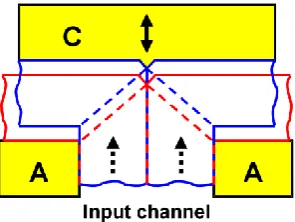
The main drawback of the conventional ECAP is a limitation of the billet's length due to a high force required to press a long bar through the channel. In order to solve this problem, incremental ECAP (I-ECAP) was proposed by Rosochowski and Olejnik [4]. In I-ECAP, the stages of material feeding and plastic deformation are separated, which reduces the feeding force significantly. The tool configuration consists of a punch working in a reciprocating manner and a die feeding the material in incremental steps. As long as the feeding stroke is appropriately small, the subsequent shear zones overlap, giving a uniform strain distribution along the billet. I-ECAP can be used for processing long bars [5], plates [6] and sheets [7].
AZ31, which is the most common magnesium wrought alloy, is usually processed at 250 °C or 200 °C. However, it is possible to reduce this temperature to 150 °C when a very low ram speed is applied [9]. The effects of temperature and strain rate on formability of AZ31B subjected to ECAP were already investigated in [10]. It was shown that the material was very sensitive to variation in strain rate and increasing pressing speed led to fracture by segmentation. The goal of the current research was to investigate the effects of the initial microstructure and process temperature on formability of AZ31B in I-ECAP.
Material
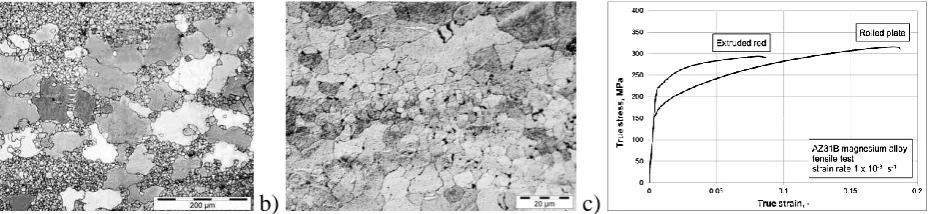
A commercially available AZ31B magnesium alloy was used in the current study. The material was supplied either in the form of extruded round rods with the diameter of 16.8 mm or hot-rolled 20 mm thick plate. The initial microstructure of the rod was heterogeneous with coarse grains (~80 µm) surrounded by colonies of small grains (~10 µm), as shown in Fig. 1a. The microstructural image was taken on the plane along extrusion direction (ED). The occurrence of small grain colonies was attributed to dynamic recrystallization taking place during extrusion at elevated temperatures. Some samples were annealed at 300 °C for 8 hours prior to processing, which resulted in microstructure homogenisation (~60 µm). As shown in Fig. 1b, microstructure of the hot-rolled plate, with the average grain size of ~8 µm, was much finer compared to the rods. However, bands of small grains (~3 µm) were revealed along rolling direction (RD). Tensile tests carried out along ED and RD showed that the room temperature ductility of the plate was twice as high as that of the rod; the stress-strain curves are displayed in Fig. 1c.
[image:2.595.72.539.384.491.2]a) b) c)
Fig. 1. Initial microstructures of extruded rod (a), rolled plate (b) and their mechanical properties (c); extrusion and rolling directions are horizontal.
Experimental procedure
Mechanical testing and microstructural characterization of the as-received materials were conducted prior to processing. Tensile tests were carried out at room temperature with the initial strain rate 1 × 10⁻³ s-1. Instron 5969 testing machine with the maximum load capacity 50 kN was used. Flat specimens, with thickness equal to 2 mm and dimensions of the gauge section 2.5 mm × 14 mm, were cut out along ED and RD using wire electrical discharge machining. Olympus GX51 optical microscope was used to perform microstructural characterization. The sample preparation procedure included grinding, polishing and etching. Samples were ground using SiC paper P1200. Then, they were mechanically polished using polycrystalline suspensions with particle sizes 9 and 1 µm. Colloidal silica was used for the final polishing. Afterwards, specimens were etched using acetic picral in order to reveal grain boundaries. The mean grain size was measured by a linear intercept method.
and peak-to-peak amplitude of 2 mm. The heating of billets was realised by holding them for 15 minutes prior to processing in the preheated die. The die temperature during processing was kept constant within ±2 °C, based on the readings obtained from a thermocouple located near the deformation zone. A silicon-based ceramic phase composite coating was applied on the billet surface prior to lubrication with conventional molybdenum disulphide (MoS2) [12].
Experiments were carried out in order to find the lowest possible processing temperature and investigate the influence of the initial microstructure and temperature on formability of AZ31B magnesium alloy during I-ECAP. Billets were processed
by different routes, A, BC and C, at temperatures varying from 125 °C to 250 °C. Four to six passes
were planned for each experimental variant. However, in some cases, fracture occurred before reaching the intended number of passes. Table 1 shows the experimental plan and the results of conducted experiments.
Table 1. Details of I-ECAP experiments
Sample
no. Material
No.
passes Temperature Route Result Comments
1 Extruded rod 1 200 °C n/a × Damaged
2 Extruded rod (annealed*) 1 200 °C n/a × Damaged
*Annealed 8 hours at 300 °C
3 Extruded rod 4 4 × 250 °C A
4 Extruded rod 4 4 × 250 °C BC
5 Extruded rod 4 4 × 250 °C C
6 Extruded rod 5 5 × 250 °C 4 × BC + A
7 Extruded rod 3 2 × 250 °C + 1 × 200 °C BC × Damaged
8 Extruded rod 3 2 × 250 °C + annealing*
+ 1 × 200 °C BC /×
Minor, random cracks *Annealed 8 hours at 300 °C
9 Extruded rod 6 4 × 250 °C + 2 × 200 °C A
10 Extruded rod 6 4 × 250 °C + 2 × 200 °C BC /× Minor, random cracks
11 Extruded rod 6 4 × 250 °C + 2 × 200 °C C × Damaged
12 Rolled plate 1 175 °C n/a × Damaged, fracture lines along
rolling direction
13 Rolled plate 4 4 × 200 °C C
14 Rolled plate 4 200 °C + 175 °C
+ 150 °C + 150 °C A
15 Rolled plate 4 200 °C + 175 °C
[image:3.595.386.534.73.184.2]+ 150 °C + 125 °C A × Damaged
Results and discussion
I-ECAP of bars machined from the extruded rod. Square bars machined from the hot-extruded rod of AZ31B were subjected to I-ECAP at 200 °C but the obtained billets were completely damaged (sample 1 in Table 1). Therefore, annealing for 8 hours at 300 °C was introduced prior to processing in order to homogenise the microstructure (sample 2). However, the applied heat treatment did not improve formability so
the final result was the same as for the billets without the annealing step (Fig. 3). The processing temperature was increased to 250 °C in the next set of experiments and four passes of I-ECAP were successfully completed using routes A, BC and C, which are referred to in Table
1 as samples 3, 4 and 5, respectively. The influence of the processing route on mechanical properties has been already reported in [12-13].
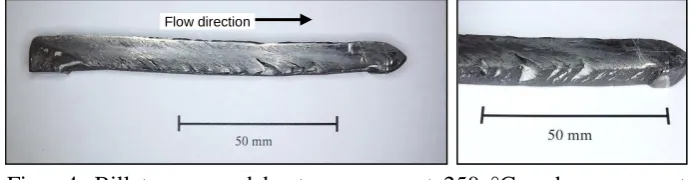
Since a finer microstructure can be produced in magnesium alloys at lower temperatures, further attempts were made to avoid fracture at 200 °C. The idea was based on the gradual temperature decrease with subsequent passes of I-ECAP. Sample 7 was processed by two passes at 250 °C and the third pass was conducted at 200 °C (following route BC), but large cracks were observed on the
billets, as displayed in Fig. 4. Therefore, an additional annealing step (8 hours at 300 °C ) was introduced after two passes of I-ECAP at 250 °C, which should have resulted in a reduction of internal stresses with a concurrent microstructure homogenisation. Although the grain size was probably finer than in the case of sample 2, small cracks were still observed on the billet surface so this processing route was classified as unsuccessful as well.
Samples 9-11 followed 4 passes of I-ECAP at 250 °C to reduce the average grain size to ~6 µm [12]. Then, bars were subjected to another two passes at 200 °C. The obtained results were surprising as billets processed by route A were not fractured while those processed using route BC
exhibited minor cracking in the corner where the material did not fill the exit channel completely. Moreover, some billets subjected to route BC were completely free from
surface cracks even though the same parameters were used. Sample 11, which was pressed by route C, was massively damaged after I-ECAP, as shown in Fig. 5.
The conducted experiments showed that hot-extruded rod of AZ31B can be processed by I-ECAP at 250 °C without fracture occurrence. Temperature reduction to 200 °C was possible only after four passes at 250 °C, which resulted in grain refinement to ~6 µm. Moreover, route A proved to be less prone to fracture than routes BC and C.
Flow direction
Fig. 5. Massively damaged sample 11 after 4 passes at 250 °C and two passes at 200 by route C.
Flow direction
Fig. 3. Sample no. 2 after annealing and I-ECAP at 200 °C.
Flow direction
[image:4.595.124.472.412.502.2] [image:4.595.350.540.602.700.2]I-ECAP of bars machined from the hot-rolled plate. It was shown for the extruded rods that a finer initial microstructure enabled lowering temperature of I-ECAP. Therefore, another set of experiments was conducted using square bars machined
from the hot-rolled plate, which exhibited finer grain structure and greater ductility compared with the hot-extruded rods. The first pass of I-ECAP was conducted at 175 °C, but long fracture lines, shown in Fig. 6, were revealed nearly parallel to the billet axis. They could be arising from the bands of small grains observed in the initial sample along RD. Sample 12 was subjected to four passes of I-ECAP at 200 °C. Route C was chosen for this variant as it has been already shown to be the most prone to fracture. In contrast to the results obtained for sample 11, the processed bars had good surface quality, which proved that finer grain structure enables reducing temperature of I-ECAP.
The gradual temperature decrease approach was used for samples 14 and 15. In the case of sample 14, temperature was reduced by 25 °C in two steps from initial 200 °C to 150 °C; the fourth pass was conducted again at 150 °C to homogenise the microstructure. Route A was chosen as it has been already shown for sample 7 to be the least prone to fracture. As this approach turned out to be successful, further temperature reduction in the last pass was attempted for sample 15 but massive damage was observed at 125 °C. The billets after fourth pass of I-ECAP at 150 °C and 125 °C are shown in Fig. 7.
[image:5.595.356.539.105.225.2]In some cases, fracture was observed only at the beginning or at the end of billet, when a gradual temperature reduction was applied (Fig. 8a). It could be attributed to a low deformation level occurring in those zones during I-ECAP. The FE simulation results, displayed in Figure 8b, showed that plastic strain in the non-deformed regions was less than 0.15. Therefore, the grain size could not be refined significantly in those regions and they acted often as fracture initiation sites. Such end-effects were not revealed when temperature was kept constant for all passes.
Fig. 8. Shear fracture localised at the end of sample (a) and plastic strain field from FE simulation indicating non-deformed zones after I-ECAP (b).
Feeding
Flow direction
a) b)
Flow direction
Fig. 6. Fracture mechanism in rolled sample subjected to I-ECAP at 175 °C.
a) b)
[image:5.595.84.512.389.494.2] [image:5.595.88.507.644.741.2]Shapes of undamaged billets. Apart from the influence of the processing routes on the mechanical properties reported in [12], significant differences in the shapes of billets made of hot-extruded bars and subjected to I-ECAP using
different routes were observed. The material completely filled the exit channel when billets were processed using route A while rotation by 180° and 90° resulted in an incomplete filling of the exit channel and, as a consequence, asymmetrical shapes of the billets (Fig. 9). The height of the billet subjected to route C was 9 mm, compared with 10 mm obtained using route A. An asymmetrical billet shape was also observed for sample 4, which was rotated by 90° around its axis after each pass. Its height was non-uniform along cross-section and was varying from 7.5 to 9 mm. This effect was attributed to the inhomogeneous strain rate sensitivity of the material arising from the non-uniform strain distribution [13].
In order to reduce the asymmetry of a billet processed by route BC (sample 4), the combination
of routes BC and A was used (sample 6). First, the billet was subjected to four passes at 250 °C
using route BC. Tensile tests showed that true strain at fracture was increased from ~0.08 to ~0.23.
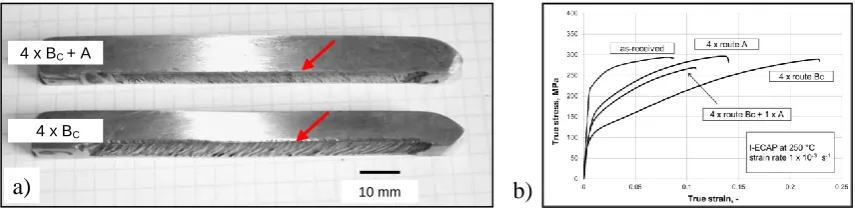
Additional pressing, without any rotation after fourth pass, was conducted at the same temperature. The gap observed in sample 4 was reduced from 2.5 to 0.2 as shown in Fig. 10a. However, true strain at fracture was decreased for sample 6 from ~0.23 to ~0.11. It is apparent from Fig. 10b, that mechanical properties of the sample processed by four passes using route BC with additional pass
without any rotation were very similar to the sample after four passes with route A. It clearly shows that the last rotation has the strongest influence on the mechanical properties of the AZ31B magnesium alloy subjected to I-ECAP.
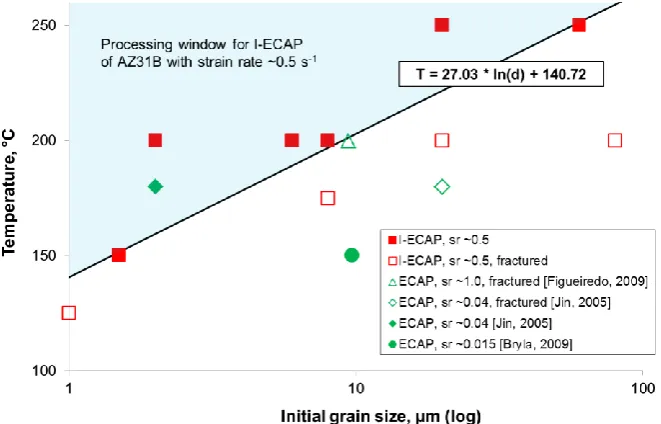
Processing window for I-ECAP of AZ31B. The results of the conducted experiments were plotted on the diagram shown in Fig. 11. It is concluded that the initial grain size should be less than 10 µm to conduct I-ECAP at 200 °C, and temperature should be increased to 250 °C for coarse-grained samples. The lowest temperature of successful I-ECAP in the current study was 150 °C and it was achieved by earlier processing by two passes at 200 °C and one pass at 175 °C. The diagram was used to find a relation between the initial average grain size and the lowest allowable temperature. It was noticed that the best fitting between grain size and temperature can be obtained by using a logarithmic equation expressed as:
( ) , (1)
Surface A Flow direction
Feeding 10 mm
A
BC
[image:6.595.312.539.106.238.2]C
Fig. 9. Billets processed by I-ECAP at 250 °C using different routes. The arrow indicates surface A which is in contact with die A, shown in Fig. 2.
Fig. 10. (a) Billet processed by four passes using route BC (lower) and with one
additional pass without any rotation (upper); arrows indicate the gap between the lower surface of the billets and the die A (as marked in Fig. 2). Tensile strain-stress curves for billets subjected to different sequences of rotations (b).
4 x BC
4 x BC + A
10 mm
[image:6.595.84.512.477.584.2]where: T – allowable temperature in I-ECAP, d – average initial grain size, A,B – empirical coefficients obtained from experiments, which are: A=27.03 and B=140.72.
The curve defined by equation (1) determines the window of allowable processing parameters for I-ECAP with strain rate ~0.5 s-1. The experimental results were compared with data obtained for conventional ECAP [2-3, 9]. Most of the results are consistent with the findings of the current research. However, ECAP with the very low strain rate (~0.015 s-1) was carried out without the occurrence of fracture at temperature as low as 150 °C with the initial grain size ~9.7 µm [9]. It shows that the curve defined by equation (1) could be moved down on the diagram for the strain rates lower than 0.5 s-1.
Fig. 11. Diagram of allowable processing temperature obtained from I-ECAP experiments of AZ31B with strain rate ~0.5 s-1. Experimental results of ECAP derived from literature are plotted for comparison. Filled marks represent successful pressing, while hollow marks indicate fracture. In the chart legend, ‘sr’ is strain rate expressed in s-1, ‘T’ is temperature and ‘d’ is the average grain
size.
Conclusions
The goal of the current work was to investigate formability of AZ31B magnesium alloy during I-ECAP. The strong influence of the initial microstructure on the processing temperature was reported. Fine-grained samples (~8 µm) were successfully pressed at 200 °C, while coarse-grained ones (~60 µm) must have been heated up to 250 °C to avoid fracture. The procedure of gradual temperature decrease allowed conducting of two final passes at 150 °C but further lowering of temperature resulted in fracture of billets.
It was shown that the procedure of gradual temperature decrease required cutting off the ends of billets. FE simulation showed that plastic strains in those zones were much smaller than in the rest of sample. Therefore, the grain size was not refined enough to allow further processing at lower temperature. Fracture was not observed in the investigated zones when temperature was kept constant in all passes of I-ECAP.
Processing by different routes showed that route C is the most prone to fracture, while route A enabled lowering temperature to 150 °C. Distortion of the billet shape was reported for the samples processed by four passes of I-ECAP using route BC. This effect could be significantly suppressed by
[image:7.595.135.466.212.424.2]The results of I-ECAP experiments conducted at temperatures varying from 125 to 250 °C were used to draw a diagram of allowable processing temperature for AZ31B magnesium alloy deformed at a strain rate of 0.5 s-1. It was found that a linear relation between the minimum allowable temperature and the logarithm of the initial grain size existed and that lowering the strain rate would shift that relation towards lower temperatures.
Acknowledgements
Financial support from Carpenter Technology Corporation is kindly acknowledged. Part of this research was supported by the Engineering and Physical Sciences Research Council [grant number EP/G03477X/1].
References
[1] V.M. Segal, V.I. Reznikov, A.E. Drobyshevskiy and V.I. Kopylov, Plastic metal working by simple shear, Russian Metallurgy 1 (1981) 115-123 (Engl. Transl.).
[2] L. Jin, D. Lin, D. Mao, X. Zeng, B. Chen, W. Ding, Microstructure evolution of AZ31 Mg alloy during equal channel angular extrusion, Materials Science and Engineering A 423 (2005) 247-252.
[3] R.B. Figueiredo, T.G. Langdon, Principles of grain refinement and superplastic flow in magnesium alloys processed by ECAP, Materials Science and Engineering A, 501 (2009) 105–14.
[4] A. Rosochowski, L. Olejnik, FEM simulation of incremental shear, in: E. Cueto, F. Chinesta, Proceedings of the 10th International Conference on Material Forming, Esaform 2007, April 18-20, 2007, Zaragoza, Spain, American Institute of Physics 907 (2007) 653-658.
[5] A. Rosochowski, L. Olejnik, Incremental equal channel angular pressing for grain refinement, Materials Science Forum 674 (2011) 19-28.
[6] L. Olejnik, A. Rosochowski, M. Richert, Incremental ECAP of plates, Materials Science Forum, 584-586 (2008) 108-13.
[7] A. Rosochowski, M. Rosochowska, L. Olejnik, B. Verlinden, Incremental equal channel angular pressing of sheets, Steel Research International 81 (2010) 470-73.
[8] M. Gzyl, A. Rosochowski, A. Milenin, L. Olejnik, Modelling microstructure evolution during equal channel angular pressing of magnesium alloys using cellular automata finite element method, Computer Methods in Materials Science 13 (2013) 357-63.
[9] K. Bryla, J. Dutkiewicz, P. Malczewski, Grain refinement in AZ31 alloy processed by equal channel angular pressing, Archives of Materials Science and Engineering 40 (2009) 17-22.
[10] F. Kang, J.T. Wang, Y. Peng, Deformation and fracture during equal channel angular pressing of AZ31 magnesium alloy, Materials Science and Engineering A 487 (2008) 68–73.
[11] A. Rosochowski, L. Olejnik, M. Richert, Double-billet incremental ECAP, Materials Science Forum 584-586 (2008) 139-44.
[12] M. Gzyl, A. Rosochowski, R. Pesci, L. Olejnik, E. Yakushina, P. Wood, Mechanical properties and microstructure of AZ31B magnesium alloy processed by I-ECAP, Metallurgical and Materials Transactions A (2013) DOI: 0.1007/s11661-013-2094-z (in press).