Copyright( 1974 American Society forMicrobiology Printedin U.S.A.
Complementation Analysis
of Simian Virus 40
Mutants
JANICE YANG CHOU ANDROBERT G. MARTIN
Laboratorv ofMolecularBiology,National InstituteofArthritis,Metabolism,andDigestiveDiseases,National
Institutes of Health, Bethesda, Maryland20014
Received for publication 28January 1974
Seventy six new temperature-sensitive mutants of simian virus 40 havebeen isolated. A simple modification of the standard plaquing technique permits complementation analyses tobe performedreadily. By usingthistechnique the
new mutantshave been divided into four complementation groups.
A number oftemperature-sensitive mutants of simian virus 40 (SV40) have been isolated and partially characterized (2, 3, 6, 7, 10-12). Severalyears agowe started an extensivesearch forsuch mutants with the object ofsaturating
the genetic map. We now report the first of a series of studies on 76mutants.
To facilitate the genetic analysis ofsuch an extensive series of mutants, it was first neces-sary to developa
relatively
rapidtechnique
forcomplementation analysis. This paper
de-scribes how a simple modification of the
stan-dard plaquing technique can be used for
com-plementationanalysis, and itappliesthis
modi-ficationto the newSV40 mutants.
MATERIALS AND METHODS
Virus and cells. The virus stock and CV-1 cells
usedhave been described (4).
Media and plaque assay. Cells were grown to
confluence at 37 Conmonolayers in nutrient mixture
F-12 (Schwarz/Mann, Orangeburg, N.Y.) buffered at
pH 7.5 with 50 mM tricine (Calbiochem) and 0.5 g of NaHCO3 perliter, and enriched with 10% fetal calf
serum. For plaque assay at 40 C, this medium was
removed 2 to 4 days prior to adsorption of the virus, replaced with modified Eagle media enriched with 5% fetal calf serum, 3E5 (6), and incubated at 40 C. No adaptation-incubation of the monolayer with 3E5
priortovirusadsorption-of the cells was required for
plaque assay at 34 C. After adsorption at the
appro-priatetemperature for 2 to 4 h the virus suspension
was removed, and 1.2% melted Noble agar in 3E5
medium wasaddedand allowed to gel. The addition of
freshmedium in agar was not required at 34 C but was
required at 3 and 7 days after infection at 40 C.
Neutralred(0.04%) in 1.2% Noble agar was added on
day 13 after infection, and plaques were counted on
day14.
Mutagenesis. Hydroxylamine mutagenesis was
carried out aspreviously described (6). Portions of the
virus-hydroxylamine suspension were removed at
var-ious times, treated with acetone in 3E5 media, and
titered at 34C. Areduction in the titer of 100-fold was
generally achieved in 18 to 24 h. These stocks were
storedat -20 C and used for mutant isolation. Ethyl
methane sulfonate (EMS) mutagenesis was carried
out asfollows. To a fresh solution of 0.2 M EMSin 0.2
M Tris, final pH - 7, an equal volume of virus
suspension was added and incubation carried out at
37C. At varioustimesportions were removed, diluted
1 to 10 into3E5media, and titered. A reduction in the
titer of 10-fold was achieved in 2.5 h. Only one
mutant, 201, wasisolated from an EMS-treated stock
of virus.
Plaques were picked with sterile Pasteur pipettes,
and the agar plug wassuspended in 2 ml of phosphate
buffered saline(6, 11).
Screening for mutants. Tissue culture plates
(Linbro Chemical Co. NewHaven, Conn.) containing
24wells of 16-mm diameter were used. Monolayersof
CV-1 cells were grown to confluence and adapted where necessary as described above. Approximately
0.2 ml of the buffered suspension of the agar plugs
fromdiscrete plaques was added to each well after the
medium hadbeen removed. After adsorption the virus
suspension wasremoved and 1 ml of 3E5medium in
1.2%agarwas added. Identicalplates were prepared
and incubatedat 40and 34C. Theplatesincubated
at 40Cwerefed with0.5ml of3E5medium in agar at
3and7days. Allplates received 0.2 ml of 0.04%
neu-tral red in agar at 13 days. Wells in which the cells
wereextensivelylysed at 34 C but contained few or no
plaques at 40 C were recorded and the corresponding original stocks were then titered accurately at 34 and
40C. Asingle plaque from the plates titered at low
temperature was then picked and used to prepare a
masterstock. Inthis way each mutant master stock
was plaque purified twice. Each master stock was
again titeredat 40and34C, and isolates with greater
than 100x difference intiter at the twotemperatures
weregiven stocknumbers.
Standard complementation. Cells were co-infected for 3 days at 40 C, then lysed by freezing and
thawing, and the number of virions was assayed at
34C (2, 12).
Agar-slant complementation. The 24-well Linbro
plates were also used for complementation analysis.
After the cells hadreached confluence and had been
adapted for 2 to 4days in 3E5medium at 40 C, the
mediumwasremovedand 0.8 ml of 3E5agar medium
wasadded.The plateswere set at a450angle and the
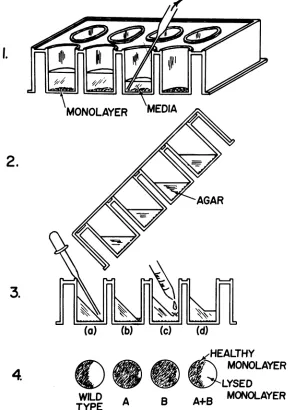
agarwasallowed to gel (see Fig. 1). Next, a few drops
ofthe appropriate stock(s) were added to each well
1101
on November 10, 2019 by guest
http://jvi.asm.org/
CHOU AND MARTIN
and, after 2 to 3 h at 40 C, 0.3 ml of additional agar in
3E5 wasadded. The cells were fed at 3 and 7 days with
0.5ml ofmedium and were stained at 13 days.
RESULTS
Isolation of mutants. Plaque-purified low-multiplicity-passaged virus was incubated with
MONOLAYER
2.
ltR
f
hydroxylamine until the virus titers at 34 C were reduced 100-fold (see Materials and Methods). Approximately 10,000 single plaques were picked and tested for their temperature sensitivity. The 76 temperature-sensitive mu-tants isolated in this manner were further
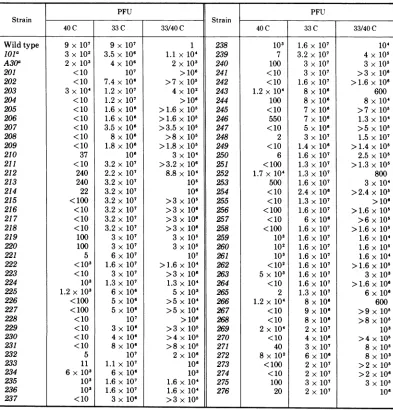
plaque purifiedandthentitered at 34 and 40 C.
HEALTHY
'<
'%,.
GLYSEDWILD
A
B
A+B
MONOLAYER
[image:2.494.112.406.155.565.2]TYPE
FIG. 1. Confluent monolayersareprepared and the media are removed (step 1). Next, media with agarare
added andallowedtogel while the platesare set at a450 angle (step2).Afewdrops of each of thetwovirusesto
betestedareadded(step3a) and allowedtoadsorb (step3b).Additional agar is added(step3c), allowedtogel
(step3d), and theplatesarethenincubatedfor13daysat 40C andstained with neutral red.Typical results for
wild type, a mutant ofthe A andB complementation groups, and the combination are diagrammatically
illustrated. Thereisusuallyasmallarea(less than10%ofthemonolayer) whichislysedinthecontrol wells
containing a single temperature-sensitive mutant either because the cells in that area were destroyed by
exposure toairwhile the agarwassettingand/orbecause the viruses whichhavebeen adsorbedataneffective
MOIof several hundred have resulted incytopathic effectsuponthesecells.Leakymutantswill alsolysemore
than 10%ofthemonolayerandarehenceunsuitableforthis typeof complementationanalysis.
1102 J. VIROL.
on November 10, 2019 by guest
http://jvi.asm.org/
The results are given in
Table
1. A number of these mutantsyield
small or minuteplaques
even at the permissivetemperature.
Complementation analysis by the
agar-slanttechnique.Theconventional complemen-tation assay involves infection of confluent
monolayers at an MOI t 2 with the mutants
individuallyor incombinationfollowed by
incu-bationatthe nonpermissivetemperature.After
42(2) or72 (12)h themonolayers are frozen and
thawed, and the resulting lysatesare titeredat
thepermissive temperature.On the basisofthis
test three classes of
SV40
mutants have been found (2,7, 10, 12).Twoofthe classes, Aand B, complement each other, but neithercomple-ment a mutant, ts*101, previously described
(7). As a
result,
101 had been considered torepresent a
third,
noncomplementing
class of temperature-sensitive mutants. Similar tests havebeenperformedwith some ofthemutants listed in Table 1 (see below), but acomplete
analysis by this method involving a 76 x 76matrix would bea Herculean task.
A
simple technique
forcomplementation
analysis
applicable
to any animal virus wastherefore developed (see Materials and
Methods). Tissue culture
plates
having
manywells per plate are inoculated with sensitive cells. When the cells have reached
confluence,
[image:3.494.41.434.247.657.2]an agarslant covering all butaverysmall area
TABLE 1. Temperature-sensitive mutants of SV40
PFU PFU
Strain [ 40 C 33 C j 33/40 C | 40 C 33 C [ 33/40C
9x 10⁷
3 x 10² 2x 10³ <10
<10
3x 10'
<10 <10 <10 <10 <10 <10 37 <10 240 240 22 <100 <10 <10 <10 100 100 5 <103 <10 103 1.2x 10³ <100 <100 <10 <10 <10 <10 5 11 6x 10³
103
103 <10
9x 10⁷ 3.5x 10⁶ 4x 10⁶ 107 7.4x 101 1.2x 10⁷ 1.2x 10⁷ 1.6 x 10'
1.6 x 10⁶ 3.5x 10' 8 x 10⁶ 1.8x 10⁶
10' 3.2x 10⁷ 2.2x 10⁷
3.2x 10⁷
3.2x 10⁷
3.2x 10⁷
3.2x 10⁷
3.2x 10⁷
3.2x10⁷
3 x 10⁷
3 x 10⁷
6x 10⁷
1.6x 10⁷ 3 x 10⁷ 1.3x 10⁷ 6x 10⁶ 5 x 10⁶
5 x 10⁶
107 3 x 10⁶
4 x 10⁶
8 X 10⁶
107 1.1X 10⁷
6x 10⁶ 1.6 x 10⁷ 1.6x 10⁷ 3x 10⁶
1
1.1x 10'
2x 10²
>106 >7 x 10⁵ 4x 10²
>106
>1.6x 10'
>1.6x 10' >3.5x 10⁵ >8x 10'
>1.8x 10⁵
3x 10⁴
>3.2x 10⁶ 8.8x 10' 105 106 >3x 10⁵ >3x 10⁶ >3 x 10⁶ >3x 10⁶ 3 x 10⁵ 3 x 10⁵
107
>1.6x 10⁴ >3x 10⁶ 1.3x 10⁴
5x 10³ >5 x 10⁴ >5x 10⁴ >106 >3x 10⁵ >4x 10'
>8x 10⁵
2x 10⁶ 106 103 1.6x 10⁴ 1.6x 10' >3x 10⁵
238 239 240 241 242 243 244 245 246 247 248 249 250 251 252 253 254 255 256 257 258 259 260 261 262 263 264 265 266 267 268 269 270 271 272 273 274 275 276 103 7 100 <10 <10 1.2x 10'
100 <10 550 <10 2 <10 6 <100 1.7x 10'
500 <10 <10 <100 <10 <100 103 102 103 <102
5 x 10³
<10 2 1.2x 10⁴
<10 <10
2 x 10'
<10 40
8x 10²
<100 <10 100 20
1.6x 10⁷
3.2x 10⁷
3x 10⁷ 3x 10⁷ 1.6x 10⁷ 8x 10⁶
8x 10⁶
7x 10⁶ 7x 10⁶ 5x 10⁶ 3x 10⁷ 1.4 x 10⁶ 1.6 x 10⁷ 1.3x 10⁷ 1.3x 10⁷ 1.6x 10⁷ 2.4x 10⁶
1.3x 10⁷
1.6x 10⁷
6x 10⁶
1.6x 10⁷
1.6x 10⁷
1.6x 10⁷ 1.6x 10⁷ 1.6x 10⁷ 1.6x 10⁷ 1.6x 10⁷ 1.3x 10⁷
8x 10⁶
9x 10⁶ 8x 10⁶ 2x 10⁷ 4 x 10⁶ 3x 10⁷ 6 x 10⁶ 2x 10⁷ 2x 10⁷ 3x 10⁷ 2 x 10⁷
104 4x 10⁵ 3x 10' >3x10⁶ >1.6 x10⁶ 600 8x10' >7 x 10⁵ 1.3x 10' >5 x 10' 1.5x 10'
>1.4x 10⁵
2.5x 10⁵ >1.3x 10⁵ 800 3x 10⁴ >2.4x 10⁵ >106 >1.6 x10'
>6x 10'
>1.6 x 10' 1.6x 10' 1.6 x 10⁵
1.6x 10⁴ >1.6 x 10⁵ 3x 10³
>1.6x 10⁶ 6x 10⁶ 600
>9x 10'
>8x 10⁵
10'
>4x 10⁵ 8x 10' 8x 10³ >2 x 10' >2x 10⁶ 3x 10⁵
106
aStrain 101 waspreviously isolatedinthis laboratory(6, 7);A30was agift ofPeterTegtmeyer.
Wildtype
iola
A30a 201 202 203 204 205 206 207 208 209 210 211 212 213 214 215 216 217 218 219 220 221 222 223 224 225 226 227 228 229 230 231 232 233 234 235 236 237VOL. 13,1974
on November 10, 2019 by guest
http://jvi.asm.org/
CHOU AND MARTIN
of the wellbottom is allowed to form. The agar serves as a barrier to prevent adsorption of the virus in all but the uncovered area. After
adsorption, additional agar is added and the plates are then incubated atthe nonpermissive temperature and stained in the usual manner. Wild-type virions or two mutants which can
complement at 40 C can grow, starting in the area where adsorption had not been prevented
by the agar slant, and the infection can then
spreadunder the agar by the release of virions to neighboring cells. A uniform healthy monolayer is found for any temperature-sensitive mutant or for any combination of noncomplementing mutants. Wild-type or two complementing
SV40mutants destroy approximately 50 to60%
ofthe monolayers after 13 days incubation at 40C (see Fig. 1). The validity of this test was
confirmed by the use of some
temperature-sen-sitive mutants kindly provided by P.
Tegtmey-er, e.g., tsA mutants, A 7 and A30, do not
complement each other, although each comple-ments B8.Applying this technique to the mu-tantsdescribed in Table 1,the matrix shown in
Table2 was obtained.
These results showthat the mutants fall into
four complementation groups. The mutants of one group (207, 209, 239, 241, 255, and 276) are
unabletoreplicate viral DNA after infection at
the nonpermissive temperature (unpublished
results). These mutants do not complement A7
or A30 but do complement B8. Thus, they
belong to the A complementation group of
Tegtmeyer (10). A second group of mutants
(202, 222, 238, 263, 270, and 275) also unable to
replicate viral DNAat the nonpermissive tem-perature (unpublished results) will henceforth be referredto asgroupD.Itwillbe shown below that the mutant, 101, previously described as
noncomplementing is a member of this group.
The pattern of complementation amongst
late mutants, thosecapableofviralDNA repli-cation at the nonpermissive temperature
(un-published results),
appears to be somewhatmore complex than previously described. Three
groups of mutants can be distinguished: (i) 219, 240, 244, 259, 260, 261; (ii) 201, 204, 205, 212, 213, 215, 218, 220, 221, 227, 228, 231, 232, 233, 237, 242, 246, 253, 262, 264, 265, 267, 269, 271, 273; and (iii) 206, 208, 210, 211, 214, 216, 217, 223, 226, 229, 230, 245, 247, 248, 249, 250, 251, 254, 256, 257, 258, 268, 272, 274. However, the
complementation
by
these three groups isanomalous,the first and second groups
comple-ment each other and the early mutants
nor-mally, but fail to complementthe third group.
Nonetheless, the thirdgroup,
although
incapa-bleof
complementing
otherlate mutants,com-plements normally with early mutants. In a strictly formal sense these results define two complementation groups, B and C. Mutant 219, 240, etc. belong to group C, mutants 201,
204, etc. belong to group B (since B8 comple-ments 219), and mutants 206, 208, etc. belong
to both complementation groups B and C. Pos-sible explanations for the existence of the BC group of mutants are given in the Discussion.
Complementation analysis in
liquid
media.Wepreviously reportedthat mutant 101didnot
complement other mutants by the standard
complementation test. However, this mutant
does complement mutants of the A, B, and C groups bythe new test.
To resolve this discrepancy between the two
complementation techniques more detailed
analyses were undertaken with representative temperature-sensitive mutants. Because
re-peated single-plaque isolates of 101 have
yielded virus stocks which have been too leaky
for reliable analyses, we have, in general,
em-ployed 202 as representative of the D
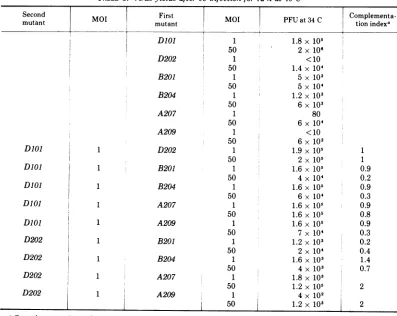
com-plementation group. Tables 3 and 4 again
demonstrate that, when complementation is
assayed at 72hbythe standard
technique.
evenwhen the group A or B partner is
supplied
atmultiplicities of 50 PFU/cell, D202 fails to
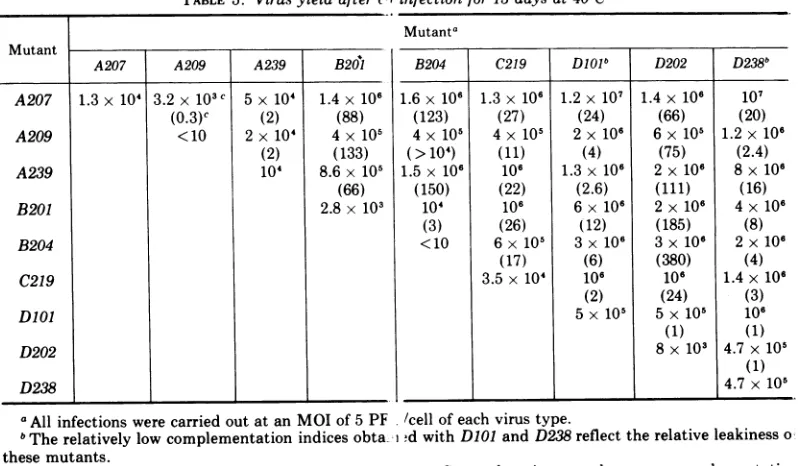
complement. However, when the freezing and
thawing isperformed after 13 daysof co-infec-tion at the nonpermissive temperature (Table
5) D202 complements and with the same pat-tern seen by the agar-slant technique. Similar results have been obtained after 6 days at the
nonpermissive temperature. The results in
Table5 are not theresult ofmultiple cyclesof
replication since the cells were infected at an
MOIofapproximately5PFU/cellsothat
essen-tially all cells were initially infected. Rather,
the results seem to indicate that group D
mutantsexhibit delayedcomplementation.The reason for thisdelayed complementation is not known.
The data in Tables 4 and 5 further corrobo-rate the existence of two late complementation
groups, since C219 complements A, B, and D mutants in the normal assay of both 3 and 13
daysof co-infection.
DISCUSSION
Seventy-six temperature-sensitive SV40 mu-tants have been isolated. Since
approximately
10,000plaqueswere
assayed
theprobability (P)
that
any
straincontains twotemperature-sensi-tivemutations issomewhat less than 1 in 100
(P
= 0.0076). It is therefore not
unlikely
that at least one of the strains described has twotemperature-sensitive mutations (P = 0.44),
1104 J. VIROL.
on November 10, 2019 by guest
http://jvi.asm.org/
VLZ 4-+ + +
t
+++
±SZ + +
99Z +- -+
I 4- +
iiZ + + + 6t,Z+ + + oiz + + +
'-+ + +
OCZ ++ +
6ZZ + + + 9ZZ + + +
EZZ +i + +
LIZ + + 91Z 44+ +
tIZ + +
IIZ + + +
OIZ . . .
90Z+ + +
9o
0
0.
an
c.
+ 4- tT+ + +
+ + + +-4
+ +-+4- + + + 4- +1.- + +
+1+ + +
+4++ + + +
+ 4-4+ + + + + +-+ + t + +4+ + +
++ +1± + +
± + +-+ + +
+ + + - ±
+ + +I+ + +
+ + ++++ +
+ + 4-+ + +
+ + 4-+
+4-+ + +4- + + 1- ± + ++ + + + +.+- + +
fCLZ + 4- + 4- 4- + + 4- + +
ILZ + +.++.+ ++ + +
4-69 . +.+ + + 4 4 4- +
L9Z 4-+ + 4- 4- 4- 4- 4- 4-
4-S9Z '+ 4- + 4- + 4- + 4-4- +
t9z +.+ ++ + +. . 4 4
gz++ + +I+ + + +
99 4-4-4-4- 4-14 +
±4-9tZ +.. . . . .I +
4-~tZ 4-4+ 4-4+ + 4+I+4 -++
LZ + ++-H-4+4+4+4+4+4+ f£Z + 4- 4--4+4++,4++ 4-+
IC
+4-4-
4-4 +++4-1-4 +4-8ZZ 4- 4- 4- 4- 4- 4- 4- 4- 4-++ LZZ
+++±+
+I4-+
+4-IZ + 4- 4- 4- + 4- 4- 4- 4- 4-OZZ 4- 4- 4- 4-
4-+
+ 4- 4-4-SI 4-4- +4-+ 4-444+ +
gIZ ++++ 4- 4- 4- + 4- +
ZIZ ++ ++ 4 4 4 4 4 4
90Z + + +++ ++ ++ +
TOEZ+ 4- + 4 4 + 4 4
4-OZ+ ++ + 4- + . . . . +
4-4 +
4+-4+ +
+ + +
+ + +
t4- 4I
+ + + + t-4-+
+ +
+14-+ 4
414-4- 4- 4-, II
+-+-+l4+ +--+4+- 4-+ 4-+ + 4-+ + + 4-4 4-4 4 4 I-ti 4--44+ --I +I * IIII *I +: : II II sI
+!
iI + +t,++++I+ + + 4-4-4- I
+ + 4 +-+ +
4-+ + + + +
4-4- + 4- + 4-I
+-,+ 4-4 4-+ +I
+ +t,ti++,
+4 4 + + 4- +-I
+ + ++++I
+4 + 4 + +4+
4- 4- + 4-l 4- 4-4I
+j++ + + + +I
+ + I 4 + 4 +.I
4-4-14!-4+-+-+-+ + + + + +-I
+ + I+ + + +i
++ + + + +l
4-4+
4-44-4+-+-4-4-4-4+4+
I , I ' I I I 4 ' I4j 1,-, I !4 I I I I 14-II I
14I +i I I I
+- I
I
I ' I I I I j-I I II4
I I II
4- 1- I f H
+ +
4 +
I4-4-14-I
I t,-I
14t,,I
1t,4-+
4I I
14-4Il 4I '! II II !I iI 14-! !I I ! I I I
I I
II II
+
+ I H
II
II
4-4-4-I
4-H
69Z6Z + + + + + +1+ + + + + +
++ + +++'++++ ++ II
O6Z + + + + ++ + + + + + +
61Z + + ±+ 4- ++++ + 9LZ+ + + + + +T
ItZ++++++
LOZ+ + ++ +
1Z -H II
'LZ11 ZZ
ZOZ
i.
4U-.
'JCw41105
1ol 0 ._ 0 Qh c. 4>) 0. ts co 0 _n C! m _Ion November 10, 2019 by guest
http://jvi.asm.org/
CHOUAND MARTIN
I!IIi I
!;I
II I I I i Il
II iI
IIIII I I
III I!
II
J. VIROL.
II II II II lI
+
+
++
+-+ +.
+-H19Z -!
-tiz + +
otlz + 4i
61 Z _++
9LZ
I6CZ
,66^Z
60LZ +
LOZ +__
~~~C cqr1iF~ c C,4 c cq c
+ +-I
0
o)co
a00
CD
0
a)
O O
0 0c
a6.)
>I o
0
cuo
b D 0
CC;Cu
O ._
a)0 oco
cn
-O
Za)
0~~ o
"Ov Cu
.. o
a)a)a)
1-~ >
S
KY
E
.a) Ex AoQ
00 a
Cu
=:Q. S o w
o
-+
+ +
-H +
I
+ -t
+ + -H
1106
-1
I.)
Cl) CC)
C-) x
C:
CC,
0r
VLZ ZLZ
89Z
ggz
LIZ 9OZ
oigz
16>Z!
Isatz
O£Z gz
1o1Z
I
LIZ
9IZ
soz
LZ ILZ
69Z
L9Z
Ig ggz
tggz Z9Z
L£Z|
L£Z
Czz
I£ IZ
ozz ZIZ OZz 81g
W91 IoZ
0
0._
CU
r-0C
C
U I
SLZ IOLZ
9gz
zzz
zoz
+ -H + 44
on November 10, 2019 by guest
http://jvi.asm.org/
though it is highly unlikely that fourormoreare
doublemutants(P = 0.0028). The frequency of
temperature-sensitive mutants in the unmuta-genized stockwasless than 1 inapproximately 2,000.
Because of the laborious nature ofthe tech-nique, prior complementation analyses were carried out on only a limited number of SV40
mutants (2, 7, 12), and onlytwo
complementa-tiongroups, A andB, were recognized.
Asimple modification of the standard plaque
assay technique permits rapid
complementa-tion analysis of any two viral mutants. The agar-slant assay corroborated the classification of representative mutants isolated by Tegt-meyer and his collaborators (10-12) into two groups. Ofthe 76 new mutants, 67 were suffi-ciently "non leaky" topermit complementation analysis. Of these, six appeared to be in com-plementationgroupA.
The agar-slant technique revealed the
exist-enceofacomplementationgroup, D, composed
ofsixnew mutants similarto 101(7). Although
it was previously reported that 101 does not
complement, the data in Tables 4 and 5
demon-strate that the prior failure to observe
com-plementation is not afunction of the mutation itself, but rather of the length of time required to achieve complementation. That is, group D
mutants of which 101 and 202 are examples
exhibit delayed complementation at the
non-permissivetemperature.
The complementation analyses also estab-lished the existence oftwo"late" complementa-tion groups, B (25 strains) and C (6 strains), as
well as an anomalous class of mutants which behave as ifthey belong to both the B and C complementationgroups.Onepossible
[image:7.494.33.430.327.643.2]explana-tion for the BC group is that all 24 of these strainsaredoublemutants.However,the statis-tical probability of this is minuscule. Another explanation would assume that all of these strains containamutationinonlyoneof the two late cistrons but thatasecondary effect of these particular mutations was to reduce the pool of the other geneproduct. This might occur if, for
TABLE 3. Virus yields after co-infection for 72 h at 40 C
Second is r o PUa 4C
Complementa-mutant MOI mutant MOI PFU at34 tionindexa
D101 1 1.8x 10⁵
50 2x 10⁶
D202 1 <10
50 1.4x 10⁴
B201 1 5 x 10³
50 5x10⁴
B204 1 1.2 x 10³
50 6x 10³
A207 1 80
50 6 x10⁴
A209 1 < 10
50 6x10²
D101 1 D202 1 1.9 x 10⁵ 1
50 2 x 10' 1
D101 1 i B201 1 1.6 x 10⁵ 0.9
50 4 x10⁴ 0.2
DIOI 1 B204 1 1.6 x 10⁵ 0.9
50 6x10⁴ 0.3
D101 1 A207 1 1.6 x 10⁵ 0.9
50 1.6x
10'
0.8D101 1 A209 1 1.6 x 10⁵ 0.9
50 7 x 10⁴ 0.3
D202 1 B201 1 1.2 x 10³ 0.2
50 2x 10⁴ 0.4
D202 1 B204 1 1.6 x 10³ 1.4
50 4 x
103'
0.7D202 1 A207 1 1.8x10³
50 1.2 x 10' 2
D202 1 A209 1 4 x 101
50 1.2x10³ 2
aComplementationindex is defined as the number of PFU obtained after mixed infection divided by the sum
ofthe PFUfound in the singly infected controls.
1107
on November 10, 2019 by guest
http://jvi.asm.org/
CHOU ANlI-) MARTIN
example, the B and C cistrons were normally
translatedinto asingle polypeptide chain which was subsequently cleaved, and if the
tempera-ture-sensitivemutation affected the cleavage. A
somewhat analogousreduction in the pool of an
adjacent cistron occurs in polar mutations of bacteria(5).However,adirect analogy to
bacte-rial aystems is not applicable since
tempera-ture-sensitive mutants harbor missense muta-tions and the latter are not polar in bacterial
systems (5).
[image:8.494.68.260.222.375.2]Another explanation for the BC group as-sumes that the B and Ccistrons correspond to
TABLE 4. Virus yields afterco-infection for 72 h at
40C
Mutanta Mutant
A209 B205 C219 D202
A209 5x10' 9x 10⁶ 4x 10⁶ 4x10'
(450) (100) (6.1)
B205 2x 10⁴ 2.4x 10⁶ 1.4 x10'
(40) (5.4)
C219 4x10' 6x10'
(1.3)
D202 6x 10³
aAll infections were carried out at an MOI of5
PFU/cellofeach virus type.
bNumbersnot inparenthesesarePFUdetermined
at34C; numbersinparenthesesarecomplementation
indices.
the major capsid proteins ofSV40.Some mem-bers of the BCgroup would contain amutation in the B cistron and others would contain one
in the C cistron, their common characteristic being that the virions produced by these
mu-tants would be highly sensitive to disruption at
elevated temperature upon co-infection with other late mutants. Such strains might comple-ment early mutants which provide the normal products of both late cistrons. Such strains, might, nonetheless, fail to complement late
mutants of the heterologous cistron because the
presenceofevensmallamountsof theabnormal
heterologous protein in some capsomeres would make the complemented virions hyper-sensitive to thermal disruption. Virions of the BC group strains are notthemselves invariably
hypersensitive to thermal inactivation (unpub-lished results).
Of the 67 mutantsanalyzed by
complementa-tion tests, 12 (18%) are in "early" functions.
Current estimatesbyphysical mapping of early and late mRNAsuggestthatthe"early" region correspondsto30to40%of thegenome (1, 4, 9). Thus, early mutants appeartobeunder
repre-sented by about afactor of 2 (18% versus 30to 40%) in our mutant collection. This result does not seem surprising in the least. Temperature-sensitive mutants are presumed to result from subtle changes in the ability ofaproteintoform theappropriate tertiary conformation as a
func-tion of temperature. Structural components,
TABLE 5. Virusyield afterct infection for13daysat40C
Mutanta Mutant
A207 A209 A239 B20'1 B204 C219 DiOlb D202 D238h
A207 1.3x 10' 3.2x 10³C 5 x 10' 1.4x 10⁶ 1.6 x10⁶ 1.3 x 10⁶ 1.2x 10⁷ 1.4x 10⁶ 107
(0.3)C (2) (88) (123) (27) (24) (66) (20)
A209 <10 2x10⁴ 4x 10⁵ 4x 10⁵ 4x 10' 2x 10⁶ 6x 10⁵ 1.2x10⁶
(2) (133) (>104) (11) (4) (75) (2.4)
A239 104 8.6x 10' 1.5x 10⁶ 106 1.3x 10⁶ 2x 10⁶ 8x 10⁶
(66) (150) (22) (2.6) (111) (16)
B201 2.8x10³ 104 106 6x 10⁶ 2x 10⁶ 4x 10⁶
(3) (26) (12) (185) (8)
B204 <10 6x 10' 3x 10⁶ 3x 10⁶ 2x 10⁶
(17) (6) (380) (4)
C219 3.5x 10' 106 106 1.4x10⁶
(2) (24) (3)
D101 5x 10⁵ 5x10 106
(1) (1)
D202 8x10³ 4.7x 10'
(1)
D238 I_I___ 4.7 x 10'
aAll infectionswerecarriedout at anMOI of5PF /cellofeachvirustype.
"Therelativelylowcomplementation indices obta d with
DIOI
and D238 reflecttherelative leakinessothesemutants.
cNumbersnotinparentheses arePFU determines t 34C; numbers in
parentheses
arecomplementatior
indices.
1108 J. VIROL
on November 10, 2019 by guest
http://jvi.asm.org/
[image:8.494.71.470.419.652.2]such as capsomeres, which are composed of relatively large numbers of identical subunits would be particularly sensitive to even the smallestconformational changes.
Although the total number of separate
cis-trons within SV40 has not been determined by this study, the fact that eachcomplementation
group now contains at least six representative
mutants makes itunlikely that further mutant collection ofthe type described will reveal any additional cistrons. On a statistical basis it is highly probable that SV40 requires only four cistrons forlytic replication of the virus.
ACKNOWLEDGMENT
We thank Peter Tegtmeyer for providing us with his mutants.
ADDENDUM IN PROOF
Since this paperwassubmittedaC mutantsimilar
tothe ones described in thispaper hasbeen reported,
D. R. Dobbs, M. Rachmeler, and S. Kitt, 1974,
Re-combination between temperature-sensitive mutants
ofSimian Virus 40. Virology 57:161-174.
LITERATURE CITED
1. Khoury, G.,and M. A. Martin. 1972.Comparison of SV40 transcription in vivo and in vitro. Nature N. Biol. 238:4-7.
2. Kimura, G., and R. Dulbecco. 1972. Isolation and
charac-terization of temperature-sensitive mutants of simian virus 40.Virology 49:394-403.
3. Kit, S., S. Tokuno,K. Nakajima, D. Trkula, and D. R. Dubbs. 1970. Temperature-sensitive simian virus 40 mutant defective in a late function. J. Virol. 6:286-294.
4. Lindstrom,D.M., and R. Dulbecco. 1972. Strand orien-tation ofSV40 transcription in productively infected cells. Proc.Nat. Acad. Sci. U.S.A. 69:1517-1520. 5. Martin, R. G. 1969. Control of gene expression, p.
181-216. In H. L. Roman (ed), Annual review of genetics, vol. 3. AnnualReviews, Inc., Palo Alto, Calif. 6. Robb, J. A., and R. G. Martin. 1970. Genetic analysis of
simian virus 40. I. Description of microtitration and replica plating techniques for virus. Virology 41:751-760.
7. Robb,J. A., and R. G. Martin. 1972. Geneticanalysisof simianvirus 40. III.Characterizationof a temperature-sensitive mutantblocked at an early stage of produc-tiveinfection inmonkeycells. J. Virol. 9:956-968. 8. Robb, J. A., P. Tegtmeyer, R. G. Martin, and S. Kit.
1972.Proposal for a uniform nomenclature for simian virus 40 mutants. J. Virol. 9:562-563.
9. Sambrook, J.,P. A. Sharp, and W. Keller. 1972. Tran-scription ofSV40 DNA andhybridization of the sepa-rated strands to RNAextractedfromlytically infected and transformed cells. J. Mol. Biol. 70:57-71. 10. Tegtmeyer, P. 1972. Simian virus 40 deoxyribonucleic
acidsynthesis:theviralreplicon.J. Virol. 10:591-598. 11. Tegtmeyer, P., C. Dohan, and C. Reznikoff. 1970.
Inac-tivating and mutagenic effects ofnitrosoguanidineon simian virus 40. Proc. Nat. Acad. Sci. U.S.A. 66:745-752.
12. Tegtmeyer,P., and H. L.Ozer. 1971. Temperature-sensi-tive mutants of simian virus 40:infection of permissive cells. J. Virol. 8:516-524.