PLEASE SCROLL DOWN FOR ARTICLE
This article was downloaded by: [Gibb, Stephen]
On: 21 September 2010
Access details: Access Details: [subscription number 927157793]
Publisher Taylor & Francis
Informa Ltd Registered in England and Wales Registered Number: 1072954 Registered office: Mortimer House,
37-41 Mortimer Street, London W1T 3JH, UK
Production Planning & Control
Publication details, including instructions for authors and subscription information:
http://www.informaworld.com/smpp/title~content=t713737146
Managerial processes: an operations management perspective towards
dynamic capabilities
Umit S. Bititcia; Fran Ackermannb; Aylin Atesa; John D. Daviesc; Stephen Gibbd; Jillian MacBrydeb;
David Mackaya; Catherine Maguirea; Robert van der Meerb; Farhad Shaftib
a Strathclyde Institute for Operations Management, University of Strathclyde, Glasgow, UK b
Department of Management Science, University of Strathclyde, Glasgow, UK c Department of
Psychology, University of Strathclyde, Glasgow, UK d Department of HRM, University of Strathclyde,
Glasgow, UK
First published on: 21 September 2010
To cite this Article Bititci, Umit S. , Ackermann, Fran , Ates, Aylin , Davies, John D. , Gibb, Stephen , MacBryde, Jillian , Mackay, David , Maguire, Catherine , van der Meer, Robert and Shafti, Farhad(2010) 'Managerial processes: an
operations management perspective towards dynamic capabilities', Production Planning & Control,, First published on: 21 September 2010 (iFirst)
To link to this Article: DOI: 10.1080/09537281003738860 URL: http://dx.doi.org/10.1080/09537281003738860
Full terms and conditions of use: http://www.informaworld.com/terms-and-conditions-of-access.pdf This article may be used for research, teaching and private study purposes. Any substantial or systematic reproduction, re-distribution, re-selling, loan or sub-licensing, systematic supply or distribution in any form to anyone is expressly forbidden.
Managerial processes: an operations management perspective towards dynamic capabilities
Umit S. Bititcia*, Fran Ackermannb
, Aylin Atesa, John D. Daviesc, Stephen Gibbd, Jillian MacBrydeb, David Mackaya, Catherine Maguirea, Robert van der Meerb and Farhad Shaftib
aStrathclyde Institute for Operations Management, University of Strathclyde, Richmond Street, Glasgow, UK; bDepartment of Management Science, University of Strathclyde, Richmond Street, Glasgow, UK;cDepartment of
Psychology, University of Strathclyde, Richmond Street, Glasgow, UK;dDepartment of HRM, University of Strathclyde,
Richmond Street, Glasgow, UK
(Received 17 June 2009; final version received 16 February 2010)
Motivated by the view that the managerial processes underpin the dynamic capabilities of the firm, this article seeks to review the current state of knowledge on managerial processes and propose a research agenda towards a better understanding of managerial processes. A systematic approach to the literature review covering business process and strategic management fields concludes that managerial processes are critical for sustaining and developing competitive advantage, but our understanding as to what they are, their contents and how they function is limited. A definition for managerial processes is proposed and the context within which managerial processes function is identified. An empirically based research agenda, comprising research questions, is outlined that would serve to enhance our understanding of the managerial processes that underpin dynamic capabilities.
Keywords: manage; managerial; management; process; dynamic-capabilities
1. Introduction
For many years, the field of management has been concerned with gaining a better understanding of how organisations perform. This age-old question has been studied and analysed from a number of perspectives, including leadership, strategy, human resources (HR), transformation, change as well as operations. Morgan (2006) in his book entitled Images of Organisation
analyses organisations from a number of perspectives, including organisations as machines, as organisms, as brains, as cultures, as political systems and as psychic prisons. However, he also suggests that ‘an understanding of the process can help us master the strengths and limitations of different view points’ (Morgan 2006, p. xi).
According to Slacket al. (2006, p. 9) ‘all parts of the business manage processes. . .’. Over the years, the field of operations management has developed in such a way that business process management has been recognised and adopted as a core discipline within the field of operations management. In fact, Deming (2000), in developing his system of profound knowl-edge, famously coined the phrase ‘everything is a process’ which underpins the foundations of the theoretical lens applied in this article.
Our interest in managerial processes1 is motivated by the belief that the form and function of these
processes are critical to consistently achieving compet-itive advantage, a point further elaborated in Sections 5 and 6. The term ‘Manage Process’ was first introduced by the CIM-OSA Standards Committee (1989) and was subsequently built upon by Childeet al.
(1994) in an attempt to define a classification and generic architecture for business processes, as depicted in Figure 1.
According to the CIM-OSA Standard (1989) and Childeet al. (1994), business processes may be classi-fied into operate, support and manage processes. This classification is not unique as other authors, such as Davenport (1993), Armisteadet al.(1997) and Garvin (1998) have developed similar classifications for busi-ness processes and their schema are detailed later in this article. Although all these authors use slightly varying terminologies, there appears to be a general agreement concerning the importance of managerial processes. However, and perhaps not surprisingly, there is a degree of confusion with regards to the boundaries, scope, contents and nature of these processes.
Motivated by the notion thatcompetitive advantage is delivered through the capabilities rooted in the operate and support processes but it is the form and function of the managerial processes that determine the organisa-tion’s ability to develop and sustain competitive
*Corresponding author. Email: [email protected]
ISSN 0953–7287 print/ISSN 1366–5871 online ß2010 Taylor & Francis
DOI: 10.1080/09537281003738860 http://www.informaworld.com
advantage in the long term this article has two objectives. First, it seeks to review the current state of knowledge on managerial processes with a view to propose a research agenda that would lead to a better understanding of these processes. Second, it seeks to start a debate amongst the operations management community as to how their expertise and experiences, around business process management, may be engaged to develop a better understanding of managerial processes.
2. Research method
A literature review informed by Tranfield et al.(2003) was adopted for the research into existing work on managerial processes. The review has been undertaken by an academic team with varying backgrounds, including business process management, management science, human resources management (HRM), opera-tions management, strategic management and psychol-ogy – all of whom were participating in the research being reported here. As such, a wide coverage of the area was carried out.
The focus of the literature search was based on the notion thatit is the form and function of the managerial
processes that determine the organisation’s ability to develop and sustain competitive advantage in the long term. Keyword searches were employed to identify articles published between 1990 and 2008 in specific management databases, such as Business Source Premier, Web of Knowledge, Emerald Insight, Management and Organisation Studies and Science Direct. Also, a number of journals were chosen as they attract a large number of papers, very often addressing a broad range of managerial problems from a business process perspective. These include Business Process Management Journal, International Journal of Operations and Production Management, Strategic Management Journal, Academy of Management Review, Academy of Management Journal, Long Range Planning, Journal of Management Studies and
British Journal of Management.
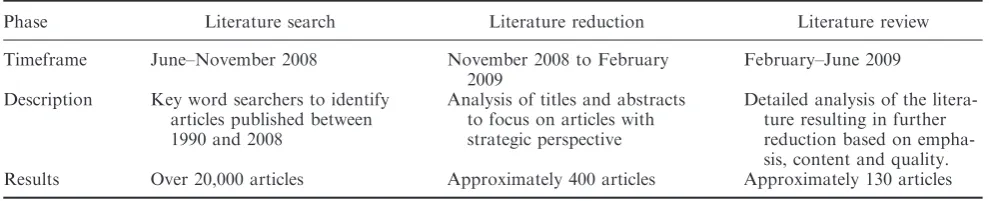
[image:3.609.63.291.416.543.2]Initial keyword searches were performed using terms such as ‘business process’, ‘manage-process’, ‘managerial process’ and ‘management process’. In addition, informed by the literature and the combined knowledge of the academic team, more specific searches were conducted using keywords such as ‘strategy process’, ‘performance management process’ and ‘change process’. These search strings identified over 20,000 articles in total. An initial study of this literature led us to the conclusion that, although a large number of articles do match the search strings as defined above, very few instances were specific to managerial processes as described above. More com-monly, the results returned articles that focused on specific processes, such as ‘maintenance management process’ or ‘how to manage process performance’. Consequently, a further survey of the literature was conducted by narrowing down this search to include only those articles that took a strategic managerial perspective2 rather than a general management or technology perspective (e.g. ICT) and papers that presented conceptual literature review or case studies on the subject of managerial processes as outlined above. The literature search and reduction process described above are outlined in Table 1.
Table 1. Overview of the literature search, reduction and analysis.
Phase Literature search Literature reduction Literature review
Timeframe June–November 2008 November 2008 to February 2009
February–June 2009
Description Key word searchers to identify articles published between 1990 and 2008
Analysis of titles and abstracts to focus on articles with strategic perspective
Detailed analysis of the litera-ture resulting in further reduction based on empha-sis, content and quality. Results Over 20,000 articles Approximately 400 articles Approximately 130 articles
Business process architecture
Operate Processes
Operate processes
•Get Order
•Develop Product
•Fulfil Order
•Support Product
•Get Order
•Develop Product
•Fulfil Order
•Support Product
•Set Direction
•Make Strategy
•Direct Business
•Set Direction
•Formulate Strategy
•Direct Business Manage Processes
Manage processes
•Support IS
•Support Finance
•Support HR
•etc Support Processes
[image:3.609.58.553.611.711.2]Support processes
Figure 1. Business process architecture (based on CIM-OSA (1989) and Childeet al. (1994)).
Even after the initial reduction, the review identi-fied a broad literature base that included literature from areas such as organisational behaviour, change management, organisational learning, HRM, as well as business process, operations and strategic management fields. The challenge was how to draw boundaries around the literature. After some analysis and debate, it was concluded that the strategic management liter-ature – in dealing with how organisations compete, manage their strategies, develop their resources and change in response to external and internal stimuli – provided sufficient coverage of these areas. Thus, strategic management literature was used as a pointer to specific articles that would be pertinent to the focus of this article rather than conducting extensive litera-ture reviews in these areas.
Thus the literature review identified two separate but overlapping bodies of literature that were essen-tially concerned with managerial processes. These are:
. Business process literature – generally con-cerned with issues such as the definition of business processes, different types of business processes, business process modelling and improvement and so on. In this body of literature, how different authors attempted to classify business processes and, specifically, how they defined managerial processes were of particular interest.
. Strategic management literature – generally concerned with how firms manage their strategies to develop and sustain competitive advantage. Of particular interests were how firms compete, how they develop and sustain competitive advantage and how they manage strategy, including how they develop their resources, how they learn and how they change.
In the following sections, we present a pre´cis of the relevant works from these bodies of literature.
3. Business processes literature
Initial analysis of this broad body of literature led us to categorise this literature into a number of areas, such as business process definition and classification; busi-ness process modelling and archetypes; busibusi-ness process management and re-engineering. This categor-isation is used to help present the literature and is not intended as a proposal of how this literature should be categorised. Indeed, there are several articles that are multi-faceted and crossover these categories.
3.1. Business process definition and classification
The notion of business processes that has been around since the early 1980s was first popularised by Hammer (1990) and has since gained widespread acceptance across the academic and practitioner communities alike. Although the literature provides a number of alternate definitions for business processes, almost all of these definitions either explicitly or implicitly agree that a business process is a series of continuous or intermittent cross-functional activities that are naturally connected together with work flowing through these activities for a particular outcome/purpose(Davenport and Short 1990, Davenport 1993, Hammer and Champy 1993, Ould 1995, Bititci and Muir 1997, MacIntosh 1997, Zairi 1997, Malhotra 1998, Linet al.
2002, Slack et al.2006).
What seems to make the business process approach so powerful is that it not only focuses on activities, i.e. what is done or how it is done, it also places a great emphasis on how these activities are interconnected and how work flows through these activities to produce efficient and effective results.
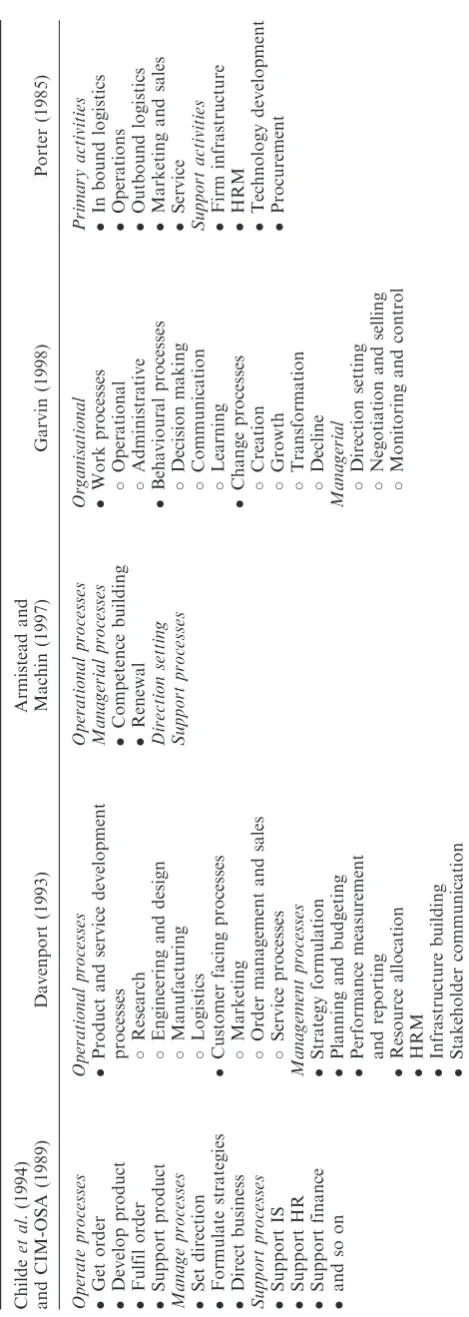
It seems that only a few authors from the business process literature have attempted to classify business processes, as illustrated in Table 2. Moreover, it appears that these classifications are inconsistent whilst also being overlapping. The authors provide varying degrees of insight to the rationale behind their classification, as well as to the inner workings of the processes they have defined. Childeet al.(1994), whilst providing detailed models for operate processes, merely list the management and support processes as examples. Garvin (1998), on the other hand, explains what he means by these processes and gives examples from literature and practice to support his classifica-tion. In contrast, Armistead et al. (1997) refer to the CIM-OSA classification and suggest that manage processes are split into two distinct process categories: managerial processes and direction-setting processes. They justify this by arguing that business excellence models, such as European Foundation for Quality Management (EFQM; Eskildsen et al.2001), separate leadership from policy and strategy process. According to Armisteadet al.(1997), ‘managerial processes are to some extent super-ordinate to the other categories and contain the decision making and communication activities. For example, entrepreneurial, competence building and renewal processes are managerial pro-cesses’. Davenport (1993) also provides a comprehen-sive classification of business processes with a view to providing a greater degree of structure to managerial work. Whilst he recognises the importance of capabil-ities such as leadership and influence building, he
Table 2. Classification of business processes. Childe et al. (1994) and CIM-OSA (1989) Davenport (1993) Armistead and Machin (1997) Garvin (1998) Porter (1985) Operate processes Get order Develop product Fulfil order Support product Manage processes Set direction Formulate strategies Direct business Support processes Support IS Support HR Support finance and so on Operational processes Product and service development processes Research Engineering and design Manufacturing Logistics Customer facing processes Marketing Order management and sales Service processes Management processes Strategy formulation Planning and budgeting Performance measurement and reporting Resource allocation HRM Infrastructure building Stakeholder communication Operational processes Managerial processes Competence building Renewal Direction setting Support processes Organisational Work processes Operational Administrative Behavioural processes Decision making Communication Learning Change processes Creation Growth Transformation Decline Managerial Direction setting Negotiation and selling Monitoring and control Primary activities In bound logistics Operations Outbound logistics Marketing and sales Service Support activities Firm infrastructure HRM Technology development Procurement
[image:5.609.198.433.56.715.2]suggests that they may be outside the realm of business process orientation. Porter (1985) provides a further classification of business activities as primary activities and support activities, which may also be interpreted as processes.
It seems that, whilst all the authors agree on the fundamental content and context of different business processes, there seems to be some confusion over how to classify these processes and what to call them. Furthermore, there seems to be consensus that business processes exist for different purposes. For example, some are customer-facingoperationalprocesses, others are administrative support processes which are also operational but are not customer facing. The group that we are particularly interested in is managerial processesconcerned with the future performance of the organisation, such as setting new directions, formulat-ing and implementformulat-ing strategies, managformulat-ing change and transformations as well as monitoring and control to ensure that progress is made in the intended direction. Thus, the remainder of the literature review has been presented with an accent on our understanding of these managerial processes.
3.2. Business process modelling and archetypes
The business process literature contains a plethora of research on how to model business processes that has led to the development of a range of well-established business process modelling techniques, such as the structured systems analysis and design method – SSADM (Gane and Sarson 1979, Yourdon 1989), integrated definition methodology – IDEF (Mayer
et al. 1994) and strategic options development and analysis – SODA (Rosenhead and Mingers 2001). Researchers and practitioners in this field take the view that to build a complete model of a business process, the process needs to be studied and modelled from a number of perspectives, including functional, informa-tional, resource, organisainforma-tional, decisional and beha-vioural (Bal 1998, Roberts 2004, Caldwell and Platts 2005, Scozzi et al.2005).
A number of researchers have used the above modelling formalisms to develop archetypes for vari-ous business processes. Maull et al.(1995) built upon the CIM-OSA Standard (1989) and developed generic models for operate processes, which include get order, develop product, fulfil order and support product processes. The Supply Chain Council developed a generic business processes model (supply chain opera-tions reference model (SCOR 2007)) for supply chains, comprising plan, source, make, deliver, return and enable processes. O’Donnel and Duffy (2002) have
developed a generic model for the product develop-ment process which is an operate processes. Similarly, Cakar et al. (2003) developed a model of the HRM process which is classified as a support process.
In addition, within the practitioner community there seems to be a prolific number of proprietary generic models for business processes. For example, the SAP ERP system is supported by numerous business process models for different industries (Rickayzen et al. 2006). However, as these systems are primarily concerned with supporting the workflow through operational processes, it is not surprising that the generic processes defined do not include manage-rial processes.
Despite the fact that business process modelling is a mature field, the business process literature contains very few attempts towards defining, modelling and understanding any of the managerial processes. The exceptions include Nokia’s strategy process (Tuomi 1997), British Telecom’s strategic planning process (Armistead et al.1999) and Munive-Hernandez et al. (2004) who developed a generic model of the strategy management process based on a review of the strategy literature. Their justification for taking a business process-based approach to strategy management is that it ensures the consistent generation and commu-nication of strategy throughout an organisation and that the performance of a business strategy can then be measured against a model of initial alignment and effective implementation. Their model is yet to be tested and validated.
3.3. Business process management and re-engineering
This area of research is primarily concerned with the improvement of business process performance, where the words ‘re-engineering’ and ‘management’ are used to describe large-scale radical change and incremental improvement, respectively. This literature (Armistead
et al.1997, 1999, Zairi 1997, Harrington 1998, Lee and Dale 1998, O’Neil and Sohal 1999, Melao and Pidd 2000) almost unanimously agrees on the following steps to improve the performance of a business process, be it radical or incremental: identify and define key business processes; understand these processes by documenting and modelling them; define metrics for these processes; measure and track these metrics; benchmark where appropriate and possible and take corrective action, re-design, re-configure the process to improve performance.
In fact, this approach is also consistent with the modern process improvement techniques such as lean enterprise and six sigma’s DMAIC (define, measure,
analyse, improve and control) approach (Antony 2006). In addition to the more methodical and systematic aspects of business process improvement, the importance of the management of change is also identified as a critical factor for successful business process improvement projects (Davenport 1993, Elzingaet al.1995, DeToro and McCabe 1997).
Even though this literature cites several business process improvement and re-engineering case studies, almost all of these cases seem to focus on operate or support processes such as order fulfilment process, product development process, sales process, load approval process, HR recruitment process, HR appraisal process and so on (Harrington 1998, Lee and Dale 1998, O’Neill and Sohal 1999). Almost no reference is made to how managerial processes have been identified, modelled, measured, benchmarked and improved.
4. Strategic management literature
As with the business process literature, there is a wealth of writing around strategic management. Primarily, this body of literature is generally concerned with how firms manage their strategies to develop and sustain competitive advantage. Initial analysis of the literature identified three specific fields within the strategic management literature as being pertinent to the focus of this article, i.e. managerial processes. The three fields are:
. Resource-based view (RBV) of the firm, particularly concerned with how firms compete
. Dynamic capabilities, particularly concerned with how firms develop and sustain compet-itive advantage and
. Strategy management, concerned with how firms manage their strategies.
4.1. RBV of the firm
The body of literature on the RBV of the firm has been concerned with how organisations develop and sustain competitive advantage by leveraging their resources (Wernerfelt 1984, Prahalad and Hamel 1990, Barney 1991, Amit and Schoemacher 1993, Penrose 1995, Barney et al.2001). In this literature, it is argued that organisations develop tangible and intangible resources over time, some of which may be distinctive (i.e. distinctive competencies) and some may be more difficult to replicate than others, i.e. core competencies (Wernerfelt 1984, Prahalad and Hamel 1990, Amit and Schoemacher 1993).
Moreover, it can be deduced from this literature (both through the examples presented when discussing competencies and capabilities, and through discussion relating to intangible resources) that many of these resources could be organisational resources such as business processes. In a special issue of theJournal of Management on the RBV, Barney et al. (2001) noted three key areas for further examination and research, these include:
. How organisations learn and share knowledge
. How organisations develop and manage alli-ances and relationships
. How organisations innovate
This literature argues that organisations develop and sustain their competitive advantage through learning from their own and others’ experiences, through relationships, networks and co-development (Argyris and Schon 1978, Nonaka 1991, Nonaka and Takeuchi 1995, Quinn et al. 1996, Easterby-Smith and Prieto 2008), and that innovations, be it process, product or business model, arise from the application of learning and knowledge from one context to other contexts (Keogh 1999, McAdam 2000). Thus, the facilitation of organisational learning through the effective manage-ment of knowledge throughout the organisation is seen as a critical competence that enables organisations to develop and sustain competitive advantage (Pettigrew and Whip 1993, Conner and Prahalad 1996, Grant 1996, Nahapiet and Goshal 1998, Davenport and Prusack 1998, Osterloh and Frey 2000).
4.2. Dynamic capabilities
In addition to the debate surrounding the implications of a firm’s stock of resources, the body of literature on dynamic capabilities is of particular interest from a managerial process perspective (Wang and Ahmed 2007). In essence, dynamic capabilities represent organisation’s ability to rapidly and with minimum disruption to extend, integrate, build, modify and reconfigure its resource base that includes tangible, intangible and human resources (Amit and Schoemaker 1993, Teece et al. 1997, Helfat 2003, Helfatet al.2007, Easterby-Smith and Prieto 2008).
However, opinion varies as to what comprises dynamic capabilities or how they are built. For instance, Zollo and Winter’s (2002) structured view of dynamic capabilities is rooted in organisational learning. In contrast, Rindova and Kotha (2001) present an emergent view of dynamic capabilities. Others recognise that dynamic capabilities, per se, are not a direct source of competitive advantage, rather,
they are the organisational and strategic routines (or processes) by which managers alter their resource base (Eisenhardt and Martin 2000, Winter 2003, Teece 2007, Døving and Gooderham 2008, Furrer et al.
2008). In fact, Eisenhardt and Martin (2000) go further and suggest that dynamic capabilities are a set of specific and identifiable business processes such as strategic decision making.
4.3. Strategy management
The strategic management literature contains many debates around what is the strategy (Quinn 1980, Mintzberg et al. 19983, Wright and McMahan 1999) and how strategies should be developed, formulated and implemented (Lindbolm 1959, Chandler 1962, Ansoff 1965, Andrews 1980, Porter 1980, 1996, Johnson et al. 2005). In fact, the literature presents comprehensive reviews of this field (Hoskisson et al.
1999, Bowman et al. 2002, Grant 2008). The purpose of this section is not to extensively review the field but rather to offer an overview from a managerial process lens.
The most widely recognised managerial process, both by practitioners and researchers, appears to be the strategy process, i.e. the process by which strategy is formulated, implemented, reviewed, refreshed and so on. It is widely recognised that the literature on strategy has evolved from the deliberate, through the emergent to the processual school of thought (Pettigrew 1977, Quinn 1980, Johnson et al. 2005). The strength of the processual approach to strategy seems to be in the fact that the strategy process is deliberate whilst the strategy content emerges from this deliberate process.
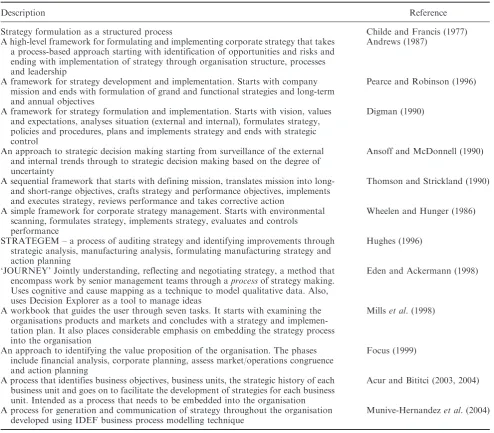
Evidenced by the fact that the literature contains a plethora of models for the strategy processes (Table 3), the strategy management process prevails as a domi-nant managerial process. However, literature also contains process archetypes for other managerial processes such as:
. Change (Lewin 1951, Burnes 2004, Sirkin
et al.2005).
. Performance management (Kaplan and Norton 1992, 1993, Goodman and Lawless 1994, Bititci and Carrie 1998, Neely et al.
2000, Campbell et al.2002).
. Direction setting (Harari 1994, 1995, Collins and Porras 1995, 1996, Nanus 1996, Pearce and Robinson 1996).
. Environmental scanning (Aguilar 1967, Aaker 1983, Costa 1995, Van Wyk 1997, Choo 1998, Liu 1998, Beal 2000, Ngamkroeckjoti and
Johri 2000, Abels 2002, Albright 2004, Day and Schoemaker 2006).
Although these managerial processes are not as prev-alent as the strategy management process, the bound-aries between various processes do not appear to be defined. In most cases, researchers seem to focus on a single process alone, without attempting to understand how one managerial process may interact with others (e.g. how does the strategy process interact with the change process). In fact, a detailed study of these processes reveals so many overlaps between different processes that it is not clear whether a number of interacting managerial processes are being studied or the same process is being studied from different lenses under different names.
5. Discussion – towards understanding managerial processes
The broad body of literature reviewed so far recognises the process-based approach as an important and powerful approach with a certain degree of consensus that business processes exist for different purposes. Some are customer-facing operational processes, some are administrative support processes, which are also operational but are not customer facing, and some are managerial processes concerned with the future per-formance of the organisation underpinning dynamic competencies of organisations as discussed in the strategic management literature.
However, the debate concerning managerial pro-cesses offers fragmented and conflicting views. On the one hand, the business process literature, taking a holistic, but perhaps a mechanistic view (Morgan 2006), debates what these managerial processes could be, but this does not move beyond theoretical discussions and conceptual models. On the other hand, in the strategic management field various researchers have attempted to develop a better under-standing of individual managerial processes using various qualitative, quantitative, theoretical as well as empirical approaches. But these studies seem to focus on a single process at a time without attempting to understand the entire managerial system, i.e. the interaction between various managerial processes and, indeed, with other business processes.
It seems that the dynamic capability theory is converging towards the notion that a firm’s dynamic capabilities are resident in the firm’s managerial processes (Teece et al. 1997, Helfat et al. 2007) that are primarily concerned with the future performance of the organisation. Furthermore, a key function of these managerial processes seems to be to configure
the resources, i.e. operational and support processes, of the organisation in order to ensure that compet-itive advantage and therefore performance is main-tained and indeed enhanced. We would therefore suggest that it is the operational and support processes that deliver competitive advantage here and now (through excellence in products, customer service and productivity) but it is the form and function of the managerial processes that underpin the dynamic cap-abilities of an organisation and thus determine how competitive advantage is sustained and developed in the long term.
Given that strategic management authors have recently called for empirical work to link dynamic
capabilities with performance outcomes (Helfat et al.
[image:9.609.59.554.83.516.2]2007) and that managerial processes are the underlying processes that define dynamic capabilities, there is a clear and compelling reason for further empirical research into managerial processes that studies the entire managerial system as a whole rather than specialised studies that focus on a single process. Furthermore, as suggested by Morgan (2006), an understanding of the managerial processes, i.e. what is done, how and why, would help us develop a better understanding of the strengths and weaknesses of various perspectives adopted when studying how organisations develop and sustain competitive advan-tage and in turn performance.
Table 3. Strategy management processes archetypes.
Description Reference
Strategy formulation as a structured process Childe and Francis (1977) A high-level framework for formulating and implementing corporate strategy that takes
a process-based approach starting with identification of opportunities and risks and ending with implementation of strategy through organisation structure, processes and leadership
Andrews (1987)
A framework for strategy development and implementation. Starts with company mission and ends with formulation of grand and functional strategies and long-term and annual objectives
Pearce and Robinson (1996)
A framework for strategy formulation and implementation. Starts with vision, values and expectations, analyses situation (external and internal), formulates strategy, policies and procedures, plans and implements strategy and ends with strategic control
Digman (1990)
An approach to strategic decision making starting from surveillance of the external and internal trends through to strategic decision making based on the degree of uncertainty
Ansoff and McDonnell (1990)
A sequential framework that starts with defining mission, translates mission into long-and short-range objectives, crafts strategy long-and performance objectives, implements and executes strategy, reviews performance and takes corrective action
Thomson and Strickland (1990)
A simple framework for corporate strategy management. Starts with environmental scanning, formulates strategy, implements strategy, evaluates and controls performance
Wheelen and Hunger (1986)
STRATEGEM – a process of auditing strategy and identifying improvements through strategic analysis, manufacturing analysis, formulating manufacturing strategy and action planning
Hughes (1996)
‘JOURNEY’ Jointly understanding, reflecting and negotiating strategy, a method that encompass work by senior management teams through aprocessof strategy making. Uses cognitive and cause mapping as a technique to model qualitative data. Also, uses Decision Explorer as a tool to manage ideas
Eden and Ackermann (1998)
A workbook that guides the user through seven tasks. It starts with examining the organisations products and markets and concludes with a strategy and implemen-tation plan. It also places considerable emphasis on embedding the strategy process into the organisation
Millset al. (1998)
An approach to identifying the value proposition of the organisation. The phases include financial analysis, corporate planning, assess market/operations congruence and action planning
Focus (1999)
A process that identifies business objectives, business units, the strategic history of each business unit and goes on to facilitate the development of strategies for each business unit. Intended as a process that needs to be embedded into the organisation
Acur and Bititci (2003, 2004)
A process for generation and communication of strategy throughout the organisation developed using IDEF business process modelling technique
Munive-Hernandezet al.(2004)
5.1. Managerial processes – a definition
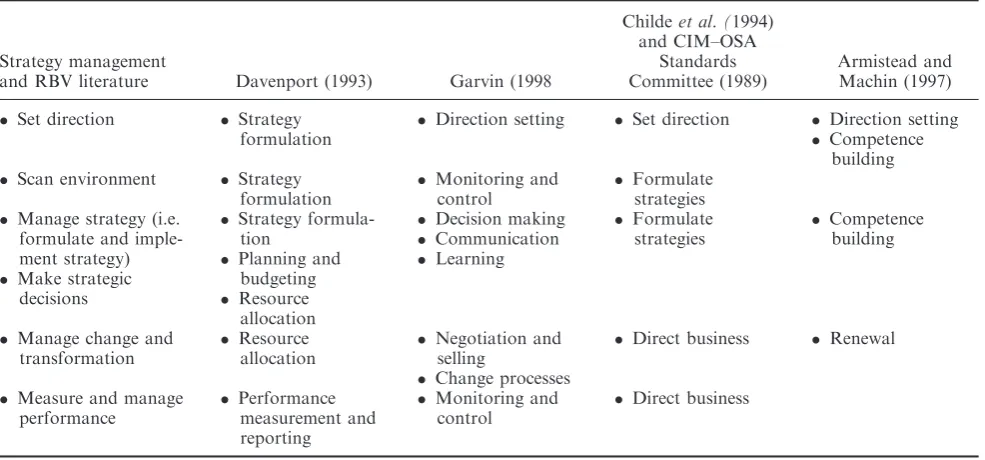
According to Pettigrew (1992), a formalised and common definition is essential to our understanding of the research topic. However, such a definition for managerial processes, which integrates the business process and the strategic management perspectives, does not exist. Table 4 provides a summary of various managerial processes encountered in the literature. It appears that although different terminologies are used to describe managerial processes, there is a relatively high degree of congruence as to what these managerial processes are. Table 4 illustrates how various manage-rial processes, as defined by different authors, map on to each other. For example, Davenport’s (1993) definition of strategy formulation includes direction setting and environmental scanning. Similarly, Garvin’s (1998) decision making, communication and learning processes refer to decisions and communica-tion in relacommunica-tion to strategy, planning, resource alloca-tion as described by Davenport (1993).
We would go further and add that these processes are not mutually exclusive, but they are highly interdependent, informing and governing each other. For example, the output of the set direction process would govern the activities and decisions of other processes, e.g. manage strategy, similarly the output of processes, such as scan environment and manage performance, would inform the activities and deci-sions of other managerial processes e.g. manage change.
Therefore, based on the literature and discussion above, we would propose the following definition: ‘managerial processes are a series of managerial routines that underpin, as an inter-connected manage-rial system, the dynamic capabilities of an organisation by controlling and reconfiguring the organisation’s resource base thus impacting on the organisation’s ability to attain, sustain or enhance competitive advantage in the long term’.
5.2. Managerial processes – the context
Pettigrew (1992) also suggests that a process can truly be understood and studied within its context. Whilst we appreciate that the context of managerial processes would vary from one organisation to other, we also believe, based on the literature, that there are some contextual factors that differentiate managerial pro-cesses from other business propro-cesses.
The literature tentatively suggests that managerial processes have to operate in an environment that is both complex and uncertain (Johnson and Scholes 1999), reflecting Mintzberg’s (1994) assertion that the future is unpredictable and that a deliberate approach to strategy does not work in practice. As such, they have to balance opportunistic and emergent decision making with a clear set of deliberate priorities.
[image:10.609.60.553.85.315.2]According to Ashby’s (1962) law of requisite variety, the greater the complexity and uncertainty, the greater the amount of significant information that Table 4. How different views on managerial processes map on to each other.
Strategy management
and RBV literature Davenport (1993) Garvin (1998
Childeet al. (1994) and CIM–OSA
Standards Committee (1989)
Armistead and Machin (1997)
Set direction Strategy formulation
Direction setting Set direction Direction setting
Competence building
Scan environment Strategy formulation
Monitoring and control
Formulate strategies
Manage strategy (i.e. formulate and imple-ment strategy)
Make strategic decisions
Strategy formula-tion
Planning and budgeting
Resource allocation
Decision making
Communication
Learning
Formulate strategies
Competence building
Manage change and transformation
Resource allocation
Negotiation and selling
Change processes
Direct business Renewal
Measure and manage performance
Performance measurement and reporting
Monitoring and control
Direct business
needs to be processed, suggesting that managerial processes facilitate both corrective and generative learning. Alongside this demand for learning, and indeed complementary to it, is the fact that managerial processes need to manage complexity (rather than reduce it) by integrating different and potentially conflicting and emotional views (Johnson and Scholes 1999) across the organisation, whilst trying to create a workable balance between stability and constant change (Ackermannet al.2005). This suggests that managerial processes are more concurrent than sequential to allow them to deal with these conflicts and emotions in an iterative fashion.
Literature implies that managerial decisions and actions relating to strategy, change, performance, etc., take place as a result of conversations between different players either formally in boardrooms or informally in offices and even in corridors (Mintzberg 1994, Ackermann et al. 2005). Thus, by recognising both the demands to manage the complexity (through structures) along with making sense of the conversa-tions, managerial processes could be argued to be emergent, cognitive and interpretative.
In short, the environment in which managerial processes operate within, in contrast to other business processes, may be characterised as:
. more uncertain
. more complex
. more emergent
. more influenced by emotions
. more concurrent
. more learning focused
. more cognitive and interpretive.
Therefore, we would infer that in order to perform in this environment, collectively, the managerial processes must facilitate organisational learning, dissemination of knowledge, management of relationships, rapid and innovative responses to internal and external changes, opportunities and threats, filtering uncertainty and noise for operational and support processes to enable them to perform in a relatively stable and predictable environment.
Having established that managerial processes have to exist in a complex, unpredictable and emergent environment, it is important to recognise Mintzberg (1978) as he refers to strategy as a ‘sustained pattern in a stream of activity’. As such, this view does not conflict with the notion of business processes. In fact, it is complementary as he suggests that emergence is more about the non-deterministic nature of process execution in practice. Indeed, Mintzberg is cited in Van De Ven (1992) as an exemplar of a process researcher, where he proposes a process model of the phases of
unstructured decision making based on observations in 25 organisations. Relative to the work presented in this article, we would suggest that Mintzberg’s emergent view leads us towards the view that within this highly uncertain and emergent context, the practice of ‘how’ managerial processes are executed would be equally, if not more, significant than an understanding of ‘what’ organisations do in managerial processes. In other words, we would want to understand the activities that comprise the managerial processes as well as how practices are used to execute these activities.
5.3. A research agenda for better understanding managerial processes
In this article, based on our deduction from the literature, we have proposed a definition for manage-rial processes and identified the context within which these managerial processes need to function. We have also highlighted that in order to better understand the managerial processes, we need to explore not only ‘what’ organisations do in these processes, i.e. the activities, but also ‘how’ these activities are conducted, i.e. the managerial practices that shape these activities. However, our understanding of the managerial processes is still constrained by a number of factors. First, specialised studies that focus on a single process fail to explore the interconnected nature of the managerial processes. Indeed, it is not clear from the literature where one process stops and another starts, or even if various managerial processes (such as change, performance and strategy) are different, but interconnected, set of processes or whether they are merely the same managerial system viewed from different theoretical lenses (Pettigrew 1992). Second, any empirical research seems to focus a single process with little evidence of establishing a holistic under-standing of the interconnected managerial system and the role and function of individual managerial pro-cesses within this system. Third, any research con-ducted into managerial processes from an operations management perspective seems to focus on the mech-anistic aspects of the processes. In many cases, exploring the activities that make up the process (e.g. Munive-Hernandez et al. 2004) but not exploring the practices that define ‘how’ these activities are executed, which we believe will be the key to differentiating the high-performing organisations from lower performing organisations. Fourth, as yet we do not begin to understand the factors that shape the practices organisations adopt in executing managerial activities and processes. Based on this review and, to a certain extent, discussions within the research team, we suspect
factors such as organisational context, history, struc-ture and culstruc-ture along with education levels, experi-ences and perceptions of individual managers determine how the managerial processes and activities are practised and how this impacts on sustainability of competitive advantage and performance.
Clearly, there is a need for further research. We believe that this research needs to be multi-disciplinary in nature using the process view as an integrating framework to bring together different functional views, thus resulting in a detailed and more profound understanding of the phenomenon behind managerial processes (Morgan 2006). Multi-disciplinary research would also provide a framework for theoretical trian-gulation to offer a richer picture of multi-dimensional, complex real-world issues. This would also harness the tension between different ontological positions for conceptual clarification as well as extending discipline-based understanding. As Andersen et al. (1999) observe, ‘Organizational scholars seldom come to grips with nonlinear phenomena. . .tending instead to model complex phenomena as if they were linear in order to make them tractable, and tending to model aggregate behaviour as if it is produced by individual entities which all exhibit average behaviour’. Considering the implications of such a view on the impact and applicability of management research outputs to the business community has led to calls for multi-disciplinary approaches to researching com-plex phenomena in the field of management. Hittet al.
(2007) observe that ‘future excellent multilevel research is more likely to be conducted by multidiscipline teams of scholars who are motivated to investigate complex organizational phenomena’ and ‘as the field of man-agement continues to grow, it becomes increasingly important to consider and integrate the developments that are occurring outside of specialty areas and in adjacent disciplines’. Furthermore, it would be valu-able to conduct fine-grained empirical research based on ‘what managers in organisations do’ with a view to analysing the managerial processes, activities and practices with respect to the performance of the organisations over a specific timeframe. This will serve to connect theory with practice by generating complex theory from complex issues.
Given that such research would seek to understand
how managerial processes influence the performance, a qualitative case study-based methodology (Eisenhardt 1989, Eisenhardt and Graebner 2007) would be appropriate, collecting in depth data from a range of organisations. This data can then be analysed using content analysis (Strauss 1987, Davies et al. 2003) to surface ‘what managerial processes and activities are carried out’, to ‘what outcome or purpose’ as well as
‘how they are carried out and why’ against the performance classification of organisations (such as high, medium and low performers).
We believe that, through research of this nature a comprehensive understanding of managerial processes could be developed from a dynamic capabilities perspective that would advance our understanding of:
. The managerial processes as practised in organisations offering further insights into their structure and content, both individually as well as collectively.
. How managerial processes interact with one another as well as with other processes, with work flowing through them, to create an integrated managerial system.
. The temporal characteristics of managerial processes, illustrating how they evolve through time.
. The critical managerial or process features that influence the performance evidenced through organisations consistently achieving above-average performance.
. The features that define the capability of managerial processes and the factors that influences these capabilities leading to the development of maturity models for manage-rial processes and activities either collectively or individually; thus providing practical tools that would facilitate organisational and man-agerial development.
. How managerial processes could be and should be studied, modelled and researched.
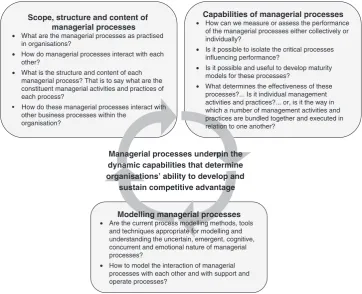
Figure 2 provides an agenda for multi-disciplinary empirically focused research that would lead to a better understanding of managerial processes.
6. Conclusions
Having examined, compared and reflected on the literature, we propose that the notion of managerial processes is indeed an important construct which is of interest to several research communities. In this article, we have identified the need for better understanding of these managerial processes through multi-disciplinary empirical studies. It is mooted that such research conducted collaboratively by a multi-disciplinary team of researchers will indeed make a significant contribu-tion to knowledge and practice by producing insights as to the patterns of activities and practices associated with different levels of performance outcome.
In our view, the key strength of this article also underpins its primary limitations. It appears that
managerial processes cut across a number of manage-ment disciplines. Therefore, from a methodological point of view, in attempting to review the literature it proved difficult to objectively put boundaries around the literature covered. We could have covered a much broader range of literature; however, we felt that this would have made this article a lot longer as well as distracting from the main focus of this article. In terms of content, we could have gone into much greater levels of discussion concerning the relationship between planned, emergent, processual and practice views of strategy and change, and explored how managerial processes interacted with these views in greater detail. We could have explored further the context and content aspects of managerial processes and theorised on their interaction. We could have explored the different views on managerial processes in greater detail and theorised about what these managerial processes may be. Despite these limitations, we believe that extending boundaries of the literature and the content of this article would not have significantly affected our principal messages and conclusions.
What seems to make the business process approach so powerful is that it not only focuses on activities, i.e. what is done or how it is done, it also places great emphasis on how these activities are interconnectedto
produce efficient and effective results. We believe that there is an opportunity to capitalise on this strength at four levels. First, by understanding the constituent activities of each managerial process and understand-ing how they are interconnected to produce effective and efficient results. Second, by understanding how the managerial processes interconnect to form managerial systems of varying efficacy in underpinning organisa-tional capabilities that attain, develop and sustain competitive advantage. Third, by understanding how managerial processes individually and collectively interconnect with other business processes. And finally, by understanding the variables or factors that influence and shape how managerial activities and processes are executed.
We believe that operations management as a disci-pline can make a major contribution towards this research agenda by empirically and theoretically explor-ing managerial processes that underpin the dynamic capabilities from a business process perspective.
Notes
1. Throughout this article, although the term ‘managerial processes’ has been adopted as a synonym to manage processes and management processes, where appropriate
Scope, structure and content of managerial processes
• What are the managerial processes as practised in organisations?
• How do managerial processes interact with each other?
• What is the structure and content of each managerial process? That is to say what are the constituent managerial activities and practices of each process?
other business processes within the organisation?
Capabilities of managerial processes
• How can we measure or assess the performance of the managerial processes either collectively or individually?
• Is it possible to isolate the critical processes influencing performance?
• Is it possible and useful to develop maturity models for these processes?
• What determines the effectiveness of these processes?... Is it individual management activities and practices?... or, is it the way in which a number of management activities and
•
concurrent and emotional nature of managerial processes?
• How to model the interaction of managerial processes with each other and with support and operate processes?
Modelling managerial processes Managerial processes underpin the dynamic capabilities that determine organisations’ ability to develop and
sustain competitive advantage
Are the current process modelling methods, tools
understanding the uncertain, emergent, cognitive,
practices are bundled together and executed in relation to one another?
[image:13.609.123.486.68.362.2]and techniques appropriate for modelling and • How do these managerial processes interact with
Figure 2. A multi-disciplinary empirically focused research agenda.
alternative terms have also been used to reflect the terminology adopted by various authors
2. The term ‘manage’ is an inherently generic term that is intrinsic to all management activities within organisa-tions, whether they are strategic or not. However, in the context of this article (CIM-OSA Standards Committee 1989, Childe et al. 1994) ‘managerial’ processes are within the sphere of strategic management, and there-fore, different from general and operational manage-ment activities.
3. See Mintzberget al.(1998) for a comprehensive discus-sion on the many interpretations of strategy.
Notes on contributors
Umit Bititci, PhD, CEng, FRSA, FIOM, MIET, MCIPS, is the director of the Strathclyde Institute for Operations Management and the pro-fessor of Technology and Enterprise Management at the University of Strathclyde. He has served as the chairman of IFIP WG5.7 specialising in Integrated Production Management and vice chairman of the Institute of Operations Management. Umit is a member of the Scottish Manufacturing Advisory Board. He has over 20 years of academic and industrial experience working with a range companies on business transformation, strategy manage-ment, performance measuremanage-ment, supply chain management and business process improvement projects.
Fran Ackermann is a professor in the Department of Management Science at the Strathclyde Business School. Her research interests span a wide set of areas including managing complex messy problems, strategy making, negotiation and group decision making, management of project risk and disruption and delay analysis. She has written widely with three books, over 20 book chapters and 100þ refereed journal publications. She is currently the director of MBA Policy and is a keen supporter of practice-based learning. Strongly linked with the business world, she has consulted widely (public and private, large and small, nationally and internationally), enabling her to be exposed to a wide range of organisational issues, situations and decision-making styles.
Aylin Ates is an Industrial Engineer and has worked in large companies in the areas of supply chain management and product development. She com-pleted her PhD in strategy manage-ment in manufacturing SMEs. She is currently working at the University of Strathclyde in Glasgow as a research fellow in Operations Management. She has extensive R&D experience
gained through working in two major international projects, funded by major research institutions (EPSRC in the UK and the European Commission FP7 Programme). The focus of her work is in strategy implementation, change manage-ment, SME and supplier development and global value chains.
Professor John Davies is the director of the Centre for Applied Social Psychology at the University of Strathclyde. His interests are two-fold, namely, human factors in high conse-quence industries and public health. With respect to human factors, he has held contracts with Rolls Royce, The MoD, BAE and the civil nuclear industry and was the director of the university’s spin-off company, Human Factors Analysts Ltd., between 2000 and 2006. In terms of public health, he is a board member of NHS Quality Improvement Scotland and a member of the Scottish Government Drug Strategy Delivery Commission.
Dr Stephen Gibbis a senior lecturer in Human Resource Development in the Strathclyde Business School.
Dr Jillian MacBryde is a senior lec-turer in the Department of Management Science at the Strathclyde Business School. Jill’s research in the area of Operations Management focuses mainly on design and manufacturing perfor-mance. Current research is focused around high-value manufacturing and in particular how organisations move into high-value activities. Jill has been instrumental in the formation of The Strathclyde Institute for Operations Management (SIOM), an interdisciplinary, cross-faculty initiative. She is the director of Research for the institute, responsible for setting direction of this research grouping, managing research and consultancy projects, developing and launching a doctoral programme in Operations Management and mentoring researchers.
David Mackayis a research fellow in Design, Manufacture and Engineering Management (DMEM) at the University of Strathclyde and a member of the Strathclyde Institute for Operations Management. David holds an MEng with distinction in Manufacturing Sciences and Engineering from the University of
Strathclyde and has fulfiled production process engineering and management roles for P&G. David’s teaching and research interests are concerned with dynamic capabilities and strategic change in organisations through integrative and integrated approaches such as innovation management.
Catherine Maguire, MEng, Dip. Mgmt is a research fellow at the Strathclyde Institute for Operations Management. She has recently com-pleted a three-year EPSRC-funded project exploring management prac-tices and processes and their relation-ship with company performance. Currently, Catherine’s work is focused on SME competitiveness and she is in the final stages of PhD in the area of organisational transformation in a manufacturing SME context.
Dr. Robert B. van der Meergained his bachelor’s degree in Economics and Business Administration from the University of Amsterdam, his master’s degree in Economics from the London School of Economics and his PhD in Management Science from the University of Strathclyde. His main research interests are in management science, operations management and strategy and the economics of organisation, management and strategy. Robert has worked with companies in a wide range of industries – including electronics, clothing, food and drink, health care, transportation – and with the public sector. He has acted as an independent expert advising the GMB Union.
Farhad Shafti has a BSc and MSc in Industrial Engineering from Iran and a PhD in Management Science from the University of Strathclyde. Farhad’s work is focused on Service Operations Management and (concep-tual) Modelling of Service Systems. His particular research interests within these areas are typology of services, service productivity and performance measurement. Some of Farhad’s resent research projects include leading a research enhancement project on the subject of service science and co-investigator of an EPSRC multi-disciplinary research project on managing the manage-processes.
References
Aaker, D.A., 1983. Organizing a strategic information scanning system. California Management Review, 25 (2), 76. Abels, E., 2002. Hot topics: environmental scanning. Bulletin of the American Society for Information Science and Technology, 28 (3), 16–18.
Ackerman, F., Eden, C., and Brown, I., 2005.The practice of making strategy. London: Sage.
Acur, N. and Bititci, U.S., 2003. Managing strategy through business processes. Production Planning and Control, 14 (4), 309–326.
Acur, N. and Bititci, U.S., 2004. A balanced approach to strategy management. International Journal of Operations and Production Management, 24 (4), 372–387.
Aguilar, F.J., 1967. Scanning the business environment. New York: Macmillan.
Albright, K.S., 2004. Environmental scanning: radar for success. Information Management Journal, 38 (3), 38. Amit, R. and Schoemacher, P., 1993. Strategic assets and
organisational rent. Strategic Management Journal, 14, 33–46.
Anderson, P.,et al., 1999. Applications of complexity theory to organization science. Organization Science, 10 (3), 233–236.
Andrews, K.R., 1980. The concept of corporate strategy. New York: McGraw-Hill.
Andrews, K.R., 1987. The concept of corporate strategy. Homewood, IL: Irwin Edition.
Ansoff, I., 1965.Corporate strategy. New York: McGraw-Hill.
Ansoff, I. and McDonnell, E., 1990. Implanting strategic management. 2nd ed. Englewood Cliffs, NJ: Prentice Hall PTR.
Antony, J., 2006. Six sigma for service processes. Business Process Management Journal, 12 (2), 234–248.
Argyris, C. and Schon, D., 1978.Organisational learning; a theory and action perspective. Reading, MA: Addison-Wesley.
Armistead, C., Machin, S., and Pritchard, J.P., 1997. Implications of business process management on opera-tions management. International Journal of Operations and Production Management, 17 (9), 886–898.
Armistead, C., Pritchard, J.P., and Machin, S., 1999. Strategic business process management for organisational effectiveness. Long Range Planning, 32, 96–106.
Ashby, W.R., 1962. Principles of the self-organizing system,
Paper presented at the Principles of self-organization: transactions of the University of Illinois symposium, London.
Bal, J., 1998. Process analysis tools for process improvement. The TQM Magazine, 10, 342–354.
Barney, J., 1991. Firm resources and sustained competitive advantage. Journal of Management, 17 (1), 99–120. Barney, J., Wright, M., and Ketchen Jr, D.J., 2001. The
resource-based view of the firm: ten years after. Journal of Management, 27 (6), 625–641.
Beal, R.M., 2000. Competing effectively: environmental scanning, competitive strategy, and organizational perfor-mance in small manufacturing firms. Journal of Small Business Management, 38 (1), 27–47.
Bititci, U.S. and Carrie, A.S., 1998. Integrated performance measurement systems: structures and relationships. Swindon, UK: EPSRC, Final Research Report GR/K 48174.
Bititci, U.S. and Muir, D., 1997. Business process definition: a bottom-up approach. International Journal of Operations and Production Management, 17 (4), 365–374.
Bowman, E.H., Singh, H., and Thomas, H., 2002. The domain of strategic management: history and evolution,
In: A. Pettigrew, H. Thomas and R. Whittington, eds.
Handbook of strategy and management. London: Sage, 31–54.
Burnes, B., 2004. Kurt Lewin and the planned approach to change: a re-appraisal. Journal of Management Studies, 41 (6), 977.
Cakar, F., Bititci, U.S., and MacBryde, J., 2003. A business process management approach to human resource man-agement. Business Process Management, 9 (2), 190–207. Caldwell, P. and Platts, K., 2005. How can diagnostic tools
be improved to increase take-up of the recommendation? Paper presented at theSMESME conference, Glasgow. Campbell, D.,et al., 2002. Using the balanced scorecard as a
control system for monitoring and revising corporate strategy.Harvard NOM Research Paper.
Chandler, A., 1962. Strategy and structure: chapters in the History of the American industrial enterprise. Cambridge: MIT Press.
Childe, J. and Francis, A., 1977. Strategy formulation as a structured process. International Studies of Management and Organization, 7 (2), 110–126.
Childe, S.J., Maull, R.S., and Bennett, J., 1994. Frameworks for understanding business process re-engineering. International Journal of Operation and Production Management, 14 (12), 23–34.
Choo, C.W., 1998. Information management for the intelligent organization: the art of scanning the environment. 2nd ed. fully rev. and updated. Medford, NJ: American Society for Information Science by Information Today.
CIM-OSA Standards Committee, 1989.CIM-OSA reference architecture. Arlington, TX: AMICE ESPRIT.
Collins, J.C. and Porras, J.I., 1995. Building a visionary company. California Management Review, 37 (2), 80. Collins, J.C. and Porras, J.I., 1996. Building your company’s
vision. Harvard Business Review, 74 (5), 65.
Conner, K.R. and Prahalad, C.K., 1996. A resource-based theory of the firm: knowledge versus opportunism. Organization Science, 7 (50), 477–501.
Costa, J., 1995. An empirically-based review of the concept of environmental scanning. International Journal of Contemporary Hospitality Management, 7 (7), 4–9. Davenport, T.H., 1993. Process innovation: reengineering
work through information technology. Boston: Harvard Business School Press.
Davenport, T.H. and Prusack, L., 1998.Working Knowledge. Boston: Harvard Business School Press.
Davenport, T.H. and Short, J.E., 1990. The new industrial engineering: information technology and busi-ness process redesign. Sloan Management Review, Summer, 11–26.
Davies, J.B., et al., 2003. Safety management: a qualitative systems approach. London: Taylor and Francis.
Day, G.S. and Schoemaker, P.J.H., 2006. Peripheral vision. Boston: Harvard Business School Press.
Deming, W.E., 2000.The new economics. 2nd ed. Cambridge, MA: MIT Press.
DeToro, I. and MacCabe, T., 1997. How to stay flexible and elude fads. Quality Progress, 30 (3), 55–60.
Digman, L.A., 1990. Strategic management – concepts, decisions, cases. 2nd ed. Homewood, IL: Irwin.
Døving, E. and Gooderham, P.N., 2008. Dynamic capabil-ities as antecedents of the scope of related diversification: the case of small firm accountancy practices. Strategic Management Journal, 29 (8), 841.
Easterby-smith, M. and Prieto, I.M., 2008. Dynamic capabilities and knowledge management: an integrative role for learning?British Journal of Management, 19, 235. Eden, C. and Ackermann, F., 1998. Making strategy: the
journey of strategic management. London: Sage.
Eisenhardt, K.M., 1989. Agency theory: an assessment and review. Academy of management. The Academy of Management Review, 14, 57.
Eisenhardt, K.M. and Graebner, M.E., 2007. Theory building from cases: opportunities and challenges. Academy of Management Journal, 50 (1), 25–32.
Eisenhardt, K.M. and Martin, J.A., 2000. Dynamic capabil-ities: what are they? Strategic Management Journal, 21 (10/11), 1105.
Elzinga, D.J., et al., 1995. Business process management survey and methodology. IEEE Transactions on Engineering Management, 24 (2), 119–128.
Eskildsen, J.K., Kristensen, K., and Juhl, H.J., 2001. The criterion weights of the EFQM model. International Journal of Quality and Reliability Management, 18 (8), 783–795. Focus, 1999.Focus Strategy Management v3b[online]. Sirius
Concepts Limited. Available from: www.sircon.co.uk [Accessed 12 June 2007].
Furrer, O., Thomas, H., and Goussevskaia, A., 2008. The structure and evolution of the strategic management field: a content analysis of 26 years of strategic management research. International Journal of Management Reviews, 10, 1.
Gane, C. and Sarson, T., 1979. Structured systems analysis: tools and techniques. Englewood Cliffs, NJ: Prentice Hall.
Garvin, D.A., 1998. The process of organization and management. Sloan Management Review, 39, 4.
Goodman, R.A. and Lawless, M.W., 1994. Technology and strategy: conceptual models and diagnostics. New York: Oxford University Press.
Grant, R.M., 1996. Toward a knowledge-based theory of the firm. Strategic Management Journal, 17, 109–122. Grant, R.M., 2008.Contemporary strategic analysis. Carlton:
Blackwell Publishing.
Hammer, M., 1990. Reengineering work: don’t automate, obliterate.Harvard Business Review, July/August. Hammer, M. and Champy, J., 1993. Reengineering the
corporation. Vol. 1, London: Collins.
Harari, O., 1994. Beyond ‘‘the vision thing’’. Management Review, 83 (11), 29.