DEPARTMENT OF ECONOMICS
UNIVERSITY OF STRATHCLYDE
GLASGOW
BEYOND
INTERMEDIATES:
THE
ROLE
OF
CONSUMPTION
AND
COMMUTING
IN
THE
CONSTRUCTION
OF
LOCAL
INPUT
‐
OUTPUT
TABLES
B
Y
KRISTINN
HERMANNSSON
N
O
. 13
‐
05
S
TRATHCLYDE
1
Beyond Intermediates: The Role of Consumption and Commuting in the
Construction of Local Input-Output Tables
Dr Kristinn Hermannsson,
Fraser of Allander Institute, Department of Economics,
University of Strathclyde
Abstract
It is a well-established fact in the literature on simulating Input-Output tables that mechanical methods for estimating intermediate trade lead to biased results where cross-hauling is underestimated and Type-I multipliers are overstated. Repeated findings to this effect have led to a primary emphasis on advocating the accurate estimation of intermediate trade flows. This paper reviews previous research and argues for a qualification of the consensus view: When simulating IO tables, construction approaches need to consider spill-over effects driven by wage and consumption flows. In particular, for the case of metropolitan economies, wage and consumption flows are important if accurate Type-II multipliers are to be obtained. This is demonstrated by constructing an interregional Input-Output table, which captures interdependencies between a city and its commuter belt, nested within the wider regional economy. In addition to identifying
interdependencies caused by interregional intermediate purchases, data on sub-regional household incomes and commuter flows are used to identify
interdependencies from wage payments and household consumption. The construction of the table is varied around a range of assumptions on intermediate trade and household consumption to capture the sensitivity of multipliers.
JEL Codes: C67; R12; R15; R23.
2
1
Introduction
Input-Output (IO) tables offer a variety of applications, such as, for impact studies,
key sector analysis, attribution of greenhouse gas emissions and simply as
multisectoral economic accounts. Furthermore, they are frequently used as inputs
into other modelling approaches, such as Social Accounting Matrices (SAMs) and
Computable General Equilibrium (CGE) models. The best IO tables are produced
based on extensive surveying by national/regional statistical agencies or
international bodies. These are often constructed as part of the process of
compiling national accounts and are resource intensive, well beyond the means of
individual research or consultancy projects. Often an Input-Output table is not
available for a desired geographic unit, and hence has to be simulated. In this case
the academic literature favours using hybrid methods, which are attractive to use
as they require much less primary data collection than full-blown surveying, while
retaining significant accuracy (Lahr, 2003). However, for this the bottleneck is
obtaining actual firm or sector level estimates of intermediate sales and/or
purchases and the resources required are still not trivial. Therefore in practice
researchers and consultants often fall back on mechanical methods, using
secondary data sources to spatially disaggregate existing accounts, using Location
Quotients (LQs).
Several authors (e.g. Harris & Liu 1998) have criticised the use of Location
Quotients to construct local Input-Output. Instead, they typically advocate the use
of hybrid approaches. Despite this clear methodological recommendation
3
data-collection is unfortunately not realistic given typical availability of resources1;
therefore it is worth making further attempts to refine the use of location
quotients.
Whereas previous work has emphasised refining the estimation of intermediate
trade, this paper explores the relative importance of wage and consumption flows
across boundaries, as driven by commuting and shopping trips. To examine this
issue an interregional Input-Output table is constructed for Scotland's largest city
Glasgow, its commuter belt and the rest of the regional economy, based on the
official Scottish IO tables. This is carried out using a location quotient approach,
but augmented with a simple use of secondary data to capture interregional wage
and consumption flows. Sensitivity analysis reveals the relative importance of
specifying interregional wage and consumption flows at the metropolitan level.
This is not surprising given the role of service sectors and extent of commuting in
metropolitan economies in high income countries. The results support the existing
consensus on the importance of accurately specifying intermediate trade, but
suggest that accounting for wage and consumption flows can be equally
important when working with Type-II multipliers.
The paper is structured as follows. The next section introduces the literature on
simulating IO tables. The third section describes the Glasgow metropolitan
economy and its interdependencies with the rest of Scotland. The fourth section
explains the construction of the baseline IO table. In the fifth section a sensitivity
analysis is carried out where the table is re-estimated based on a range of
1 With notable exceptions such as the Scottish island economies: Eilean Siar, Shetland and
4
assumptions about intermediate trade and wage and consumption flows. The
sixth section concludes.
2
Previous research
There are a number of hybrid or partial survey approaches available for estimating
Input-Output tables (see Miller & Blair (2009, Chapter 7) for an overview). These
improve the accuracy of the estimates over purely mechanical approaches by
drawing on actual observations to constrain the results. Typically they proceed in
several steps (Lahr, 1993, p. 278). For example, we could start out with a location
quotient based matrix of intermediate transactions for a local economy. To
improve the accuracy of the estimates it would be possible to survey or conduct
case studies of companies in the most important sectors to determine the total of
intermediate sales (row sum) and purchases (column sum). Numerical approaches
could then be applied to adjust the original matrix to conform to these more
accurate control totals. Or as put more generally by Snickars & Weibull (1977)
information about macro states can be used to inform estimates of micro states.
As summarised by Lahr & de Mesnard (2004) there are a range of techniques
available for reconciling partial observations with estimates. Within the context of
Input-Output tables the RAS Technique is probably the most well-known of these
(see Section 7.4 in Miller & Blair (2009)). As Lahr & de Mesnard (2004) point out
these adjustment algorithms fall into broadly two categories: Scaling algorithms,
of which RAS is one, and maximizing algorithms. Prominent examples of the latter
are entropy maximisation principles (Wilson 1970) or Efficient Information
Adding. Snickars & Weibull (1977) discuss the general principle and demonstrate
its application to several spatial-economic problems. The approach is discussed
5
Snickars (1979) demonstrates its application to estimating interregional trade
within Sweden.
Notable past contributions have acknowledged the problem that at the
metropolitan level local economies are strongly interdependent through
commuting and shopping trips (Hewings et al 2001, Jun 1999, 2004, Madden
1985). Therefore, particular care needs to be taken when the boundaries of the
study area cross functional boundaries (Hewings & Parr, 2007). Madden (1985)
clearly lays out the theory for a multiregional metropolitan input-output model
allowing for commuting and shopping trips. Its use is demonstrated for
Nordrein-Westphalia in Germany, but the author does not elaborate on the data sources
used. Hewings et al (2001) set out a theoretical structure for a 4-region
metropolitan input-output model, which they apply to the Chicago economy. The
database is constructed based on LQs in combination with commuting and
shopping matrices. These models offer a number of advanced features. However,
what data collection they involve is not clear and these have yet to be distilled
into simple approaches, which could readily be implemented in practice, for
example by resource constrained policy makers and consultants.
2.1
Location Quotients
The widespread use of the LQ approach for constructing regional Input-Output
tables is primarily driven by pragmatic concerns. Detailed data are seldom
available at the regional level to implement more accurate methods and collecting
the primary data needed is typically beyond the means of the IO-users. Given this
predicament a typical response is to draw on a published input output table
6
estimate a local sub-section of that table. Implicitly by going down that route the
researcher is accepting some rather bold assumptions. For these Harris & Liu
(1998) refer to Norcliffe (1983, pp. 162-163), which identifies the main
assumptions underlying the use of location quotients to identify the export base
in export base models2.
It is clear that for employment to be used as a proxy for output there must be
identical productivity per employee in each region in each industry so that a
region’s share of national employment accurately represents its share of national
production. Furthermore, for similar reasons, there must be identical
consumption per employee. Perhaps most importantly however, so as not to
underestimate interregional trade, there must be no cross-hauling between
regions of products belonging to the same industrial category. Given that these
assumptions rarely hold, a number of authors have attempted firstly to estimate
empirically the extent to which the breakdown of these assumptions will
influence estimates for IO-accounts and secondly to come up with modifications
of the LQ-approaches that might counter some of the inherent biases.
Various LQ methods have been suggested in the literature (Miller & Blair, 2009,
pp. 349-360). In general LQ approaches adjust the national technical coefficient to
take account of the potential for satisfying input needs locally. A regional
Input-Output coefficient is a function of the location quotient and the national Input
Output coefficient:
2 Norcliee identifies 4 main assumptions. However, his fourth assumption is not relevant in
7
(
N)
ij R i RR ij RR
ij
a
LQ
a
a
=
,
Where
a
ijRRis the regional IO technical coefficient, LQiR is the location quotientand
a
ijNis the national technical coefficient3.2.1.1 Simple location quotient (SLQ)
The simple location quotient for sector i in region R is defined as:
= N N
i R R i R i E E E E SLQ
Where EiR and
E
R are employment in sector i in region R and total employmentin region R respectively and EiN and
E
Nare employment in sector i and totalemployment in the nation as a whole.
When the SLQi is greater than one (less than one), it can be inferred that sector i is
more (less) concentrated in region R than in the nation as a whole. Where the
location quotient is less than one the region is perceived to be less able to satisfy
regional demand for its output, and the national coefficients are adjusted
downwards by multiplying them by the location quotient for sector i in region R.
Where the sector is more concentrated in the region than the nation at large
(LQi>1), it is assumed that the regional sector has the same coefficients as the
nation as a whole. Therefore for row i of the regional table:
1
1
≥
<
=
R i R i N ij R i N ij RR ijSLQ
SLQ
if
if
a
SLQ
a
a
8
2.1.2 Cross industry location quotient
A criticism of the simple location quotient is that it does not take into account the
relative size of the sectors engaged in intermediate transactions. The argument
goes that if a sector which is relatively small locally is supplying a sector which is
relatively big, this should imply a need for imports to satisfy intermediate
demand, and vice versa. This is addressed with cross industry location quotients
(CILC). The CILQ for sectors i and j can be defined as:
=
N j R j N i R i R i R i R ijE
E
E
E
SLQ
SLQ
CILQ
Where sector i is assumed to be supplying inputs to sector j. As with the SLQ
national coefficients are not adjusted if ≥ 1 as it is assumed that
intermediate demand can be met within the economy.
2.1.3 Round’s semi-logarithmic Location Quotient (RLQ)
Round (1978, p. 181) surmises that “following the basic notion of the location
quotient, one could reasonably conjecture that the size of trading coefficient may
be ascertained by some function of the relative size of the supplying sector, the
relative size of the purchasing sector, and the overall size of the region relative to
the nation as a whole“. In order to incorporate all three of these measures in a
location quotient, Round (1978) suggested a semilogarithmic quotient, which he
defined as
= / log1 +
2.1.4 Flegg, Webber and Elliot’s Location Quotient (FLQ)
Flegg, Webber and Elliot introduce the FLQ approach (Flegg et al, 1995), which is
subsequently developed in Flegg et al (1997) and Flegg et al (2000). In this
9
region such that =λ, where λ = log1 + E/E , where
0 ≤ # ≤ 1. Then
$%%= $
' () > 1
$' () < 1
The aim is to reduce national coefficients more for smaller regions, under the
general expectation that smaller regions are more import intensive. The main
difficulty with this method is that it requires an ad hoc assumption about the
parameter δ. Initially, Flegg & Webber (1997) propose that an approximate value
for δ=0.3 ”would seem reasonable” (p. 798). However, subsequently efforts have
been extended to select an appropriate parameter through empirical testing.
2.2
Empirical testing of alternative LQ methods
A number of studies have been undertaken to test the accuracy of hybrid and
non-survey methods. See for example: Schaffer & Chu (1969); Smith & Morrison
(1974); Round (1978); Harrigan et al (1980ab); Willis (1987); Harris & Liu (1998);
Tohmo (2004); Stoeckl (2010); and Flegg & Tohmo (2011). The resulting
consensus is that IO-tables constructed using location quotients produce
multipliers that are systematically biased upwards. These tables tend to
underestimate imports and exports and overestimate local intermediate
transactions. This is primarily due to their failure to acknowledge cross-hauling
(Harris & Liu, 1998). Secondly, when Type-II multipliers are used, an accurate
identification of household consumption and labour income is critical for accurate
multipliers (Lahr 1993, Richardson 1985).
Tohmo (2004) summarises the findings of five studies comparing multipliers
10
Morrison (1974), Harrigan et al (1980b), Flegg & Webber (1996) and Harris & Liu
(1997) in addition to his own analysis. This reveals that it does not seem to make
much difference whether the SLQ, CILC or the RLQ formulas are used. These
methods produce multipliers that are on average biased upwards by 12-25%. An
exception to this is the FLQ formula, which is able to recreate on average4 the
multipliers obtained from a surveyed Input-Output table. However, this depends
on identifying the right adjustment parameter, which is not known ex ante but
has to be deduced from comparison with surveyed tables ex post. Flegg & Tohmo
(2011) discuss this issue in detail and test parameter values by simulating IO
tables for 20 Finnish regions of various sizes.
The academic debate on formulating appropriate location quotients is mostly
concerned with finding the most appropriate method to counter the bias of
overestimating regional multipliers (Flegg et al, 1995, Flegg & Webber, 1997,
2000, Brand 1997). However, McCann & Dewhurst (1998) point out that in some
cases, particularly where strong regional specialization occurs, traditional
LQ-approaches can actually underestimate local multipliers by over-estimating
interregional trade. Flegg & Webber (2000) acknowledge this point in principle
but argue that based on empirical testing this does not seem to be a significant
concern in practice. Furthermore, the upward bias to multipliers derived from
LQ-based IO-tables does not seem to be uniform across regions or sectors. For
example Harris & Liu (1998) point out that this bias is more acute for traded
sectors such as manufacturing than for services.
4 Flegg et al (1995, p.548) point out that even if the systematic errors are removed,
11
Previous research has primarily focussed on the role of trade. This is certainly
important, but ex ante it can be expected that the smaller the scale of the
economy being examined, the more pertinent the role of wage and consumption
flows across boundaries. For example, Roberts (2005) demonstrates the relative
importance of households consumption in rural economies and Hewings et al
(2001) demonstrate the relative importance of these effects in their IO-table of
the Chicago Metropolitan Economy.
3
Glasgow City-region and the rest of Scotland
This paper focuses on Glasgow, which is the largest city in Scotland, with a
city-region (comprising Glasgow (GLA) and the rest of Strathclyde (RST)) of
approximately 2.1 million inhabitants5. GLA is a separate administrative unit but is
economically interdependent with the RST and the Rest of Scotland (ROS). The
ROS is identified as a residual, to allow the spatial boundaries of the study to
conform to Scotland. The Strathclyde region is Scotland's largest population and
economic centre, containing 41.7% of its population and 41.1% of total
employment. At its centre is the City of Glasgow, which is linked via an extensive
suburban rail network to the rest of the Strathclyde region. Key economic and
social indicators for these areas are given in Table 1.
Table 1 Key social and economic indicators for each IO-region in 2006.
GLA RST ROS SCO
Population 000's 580,690 1,555,374 2,980,836 5,116,900
5 This is a wide definition of Glasgow city-region encompassing the whole of the former
12
% of total 11% 30% 58% 100%
Employment FTEs 313,535 448,296 1,089,529 1,851,360
% of total 17% 24% 59% 100%
Gross Domestic Household Income Per Capita
£ 11,968 12,975 13,319 13,071
% of
average 92% 99% 102% 100%
Within Strathclyde the main focus is on the Glasgow City Council jurisdiction,
which spans an area of 175 km2 and included 581 thousand inhabitants in 2006.
Roughly 313 thousand full time equivalent jobs are found in Glasgow, which is
approximately 17% of total employment in Scotland. This is a much larger share of
Scotland-wide employment than Glasgow’s population share would suggest – to
the extent that (as is illustrated in Table 2) four out of every ten jobs in the city
are taken by in-commuters, primarily originating from other parts of the
Strathclyde region.
The rest of the Strathclyde region (RST) has somewhat different economic
characteristics than Glasgow (GLA). In terms of population it is approximately 3
times the size of Glasgow. However, there are only 1.4 times as many jobs in RST
as there are in GLA. As is evident from Table 2 the lower job density in the RST
region is explained by significant out-commuting to seek employment in Glasgow
(40% of all those working in Glasgow come from the rest of the Strathclyde
region). Furthermore, households in RST bring significant amounts of consumer
13
Table 2 Origins and destinations of people who travel between Scottish
addresses for work/study (headcount/column %). Own calculations, based on
Fleming (2006, Table 16A, pp. 64-65).
Place of work
GLA RST ROS SCO
R
e
si
d
e
n
ce GLA 246,938 59% 46,677 6% 4,743 0% 298,360 11%
RST 167,322 40% 727,112 93% 16,258 1% 910,694 32%
ROS 5,961 1% 6,335 1% 1,613,211 99% 1,625,507 57%
420,221 100% 780,125 100% 1,634,212 100% 2,834,560 100%
4
Construction of the Input-Output table
The Scottish Input-Output tables for 2006 are disaggregated into three
sub-regions. The process is presented schematically on the next page6. The IO-table
has i intermediate sectors, q final demand sectors and p primary (i.e. value added
categories) sectors. The notation is as follows (small bold cases for vectors and
capital bold cases for matrices):
x = i-vector of outputs
Z = i x i - matrix-of intermediate demand
F = i x q - matrix-of final demand
V = p x i– matrix of primary costs
The superscripts indicate the spatial origin and destination of the matrix elements,
with G representing Glasgow, W the rest of the Strathclyde region and S the rest
of Scotland. The order follows the familiar row/column convention for matrix
elements, for example the matrix ZWG contains the elements for the intermediate
demand rows (origin) of the rest of Strathclyde region (W) and the intermediate
expenditure column of Glasgow (G), which is the destination of the expenditures.
6 The schematics are based on Oosterhaven & Stelder (2007), which provides an accessible
[image:14.595.126.473.145.250.2]14
Figure 1 Single region IO-table for Scotland
For final demand and primary inputs the table is more complicated. The
household consumption category of final demand has a region of origin and a
region of destination. This q1category is represented by the interregional matrices
FGG, FGW, FGS, FWG, FWW, FWS, FSG, FSW and FSS. The q2 final demand categories are not
assigned a spatial origin (from within the interregional IO-accounts), e.g.
government and capital formation (and export) final demand. These matrices are
denoted as FG*, FW*, FS*.
Figure 2 Interregional Input-Output table for three regions (r = 3) ←---i---→ ←----q----→ ← -- i- ---→
Z F → ΣΣΣΣ x
← --p --→ V Σ Σ Σ Σ↓ x
←-q2-→
Z
GGZ
GWZ
GSF
GGF
GWF
GSF
G*Z
WGZ
WWZ
WSF
WGF
WWF
WSF
W*Z
SGZ
SWZ
SSF
SGF
SWF
SSF
S*V
GGV
GWV
GSV
WGV
WWV
WSV
SGV
SWV
SS←
-p2
-→
V
*GV
*WV
*SΣ Σ Σ Σ↓
x
← --i x r --→ ← ---p1 x r ---→ Σ Σ Σ Σ→
x
←---q1 x r---→ [image:15.595.163.441.500.732.2]15
The disaggregation process is carried out at the most disaggregated level
permitted by the Scottish IO tables (126 sectors)7 and occurs in 4 stages:
1. Estimate sector gross output totals
2. Estimate technical coefficients (A-matrices) and intermediate
transactions (Z-matrices)
3. Estimate primary inputs
4. Estimate final demands and balance table
Data on employment by sector and NUTS 3 region are obtained from the 2006
Annual Business Inquiry (ABI) using the NOMIS data portal8. The IO sectors in the
Scottish IO-table refer to specific Standard Industrial Classification (SIC) categories
and therefore employment levels from the ABI can be matched to each IO-sector.
4.1
Step 1: Sector gross output totals for GLA-RST-ROS
To derive gross output totals by industrial sector and sub-region employment is
used to disaggregate output levels from the Scottish input output table:
=
N i
R i N i R i
E
E
x
x
Where xiR refers to output of sector i in region R and xiN refers to output of
sector i in Scotland. Similarly, EiR and EiNdenote employment in sector i in
region r and Scotland, respectively.
7 However, to simplify presentation sectors are aggregated subsequently.
8 The ABI provides headcount numbers of full time and part time workers. To obtain
16
4.2
Step 2: Technical coefficients (A-Matrices) and
intermediate transactions (Z-Matrices)
The share of intermediate purchases sourced locally are estimated using FLQ’s,
based on δ=0.39. Using this method it is possible to estimate the elements in the
diagonal technical coefficient matrices, i.e. the A-matrices where the origin and
destination of demand coincide with the same region (AO=D). These are the: AGG,
AWW, ASS. This leaves the issues of estimating the off-diagonal matrices of
technical coefficients, where the origin and destination of intermediate demand is
not within the same region (AO≠D). In a two region setting this would be
straightforward as the off-diagonal elements are a residual of the national
technological coefficient less the diagonal elements. In a three region setting,
however, the residual between the technical requirements of a sector i, denoted
by the national technical coefficient $' and what it sources of it locally $,-. has
to be divided up between the two other regions 1 and 2, so that $' − $,-.=
∑.-2$,1.. To disaggregate ∑.-2$,1. this residual is divided pro-rata among
the two D regions based on sectoral employment shares of sector i in each of the
regions so that for each region10:
$,1. = 3 4 .
∑.-25.6 7 $ ,1.
.-2
= 3∑ 4.5
.
.-2 6 $ '− $
,-.
9 This is chosen as the central value for δ as this is recommended by Flegg & Webber (1997)
and testing by Flegg & Tohmo (2010) and Bonfiglio (2009) find the best results for intermediate transactions tend to be based on δ values clustered within an interval of 0.2-.03 and 0.25-.0.35, respectively.
10 Another possibility would be to make strict assumptions about the spatial direction of
17
Once all the technical coefficient matrices have been derived they can be
multiplied with the sectoral gross outputs estimated in section 3.3.3.1 to obtain
the ZOD matrices of interregional intermediate transactions.
4.3
Step 3: Sector primary inputs for GLA-RST-ROS
For estimating the primary inputs of industrial sectors in input matrices V*G, V*W
and V*S the firms in the sub-regions are assumed to have the same needs for
inputs as Scottish firms in general, such that:
8 = 8'94
':
Where P stands for primary input of source j (imports, other valued added, etc.)
into sector i, in region R and in Scotland (N) and E stands for employment in sector
i in in region R and Scotland (N).
For one category of primary inputs, the compensation of labour, the spatial origin
is explicitly identified. Drawing on the commuting data presented in Table 2 the
share of commuters in the local labour supply is used as a proxy for the share of
wages flowing to the sub-region where the commuters originate, such that:
8 = 8'94
': 9
∑ 4,
∑ 4:
where ∑ 4,is the aggregate employment in region R by origin O and ∑ 4 is the
aggregate employment in region R. By using these data it is implicitly assumed
that commuters are spread equally across sectors and that commuters get equally
compensated as local workers.
4.4
Step 4: Final demand totals and balancing
Wherever possible, published data are used to identify the level of a particular
18
attributed to each sub-region on a pro rata basis in line with the respective
region’s share of overall employment for the sector in question. Finally the spatial
allocation of exports to the Rest of the UK (RUK) and the Rest of the World (ROW)
is determined as a residual item that also balances the input-output table. A
summary of these methods is provided in the table below.
Table 3 Overview of disaggregation approaches by final demand category.
Total value £m
% of total final demand
Disaggregation
method Data source
Final consumption
expenditure
Households 36,002 28.2% Secondary data ONS GDHI
NPISHs 2,472 1.9%
Pro rata Based on employment share
from ABI
Tourist Exp 1,816 1.4%
Central Government 17,106 13.4%
Secondary data Regional Government
Accounts Hillis (1998)
Local Government 10,662 8.4%
Gross capital formation
GFCF 8,701 6.8%
Pro rata Based on employment share
from ABI
Valuables 36 0.0%
Change in Inventories 184 0.1%
Exports
RUK 33,297 26.1%
Residual
Control total from Scottish IO but spatial dispersion determined as a balancing
item
RoW 17,394 13.6%
127,669 100%
4.4.1 Household demand
Households in the sub-regions are taken to exhibit the same sectoral consumption
pattern as households in Scotland as a whole. However, working within an
interregional framework it is necessary to determine not only the level of
household demand, but also its spatial origins and destinations. To achieve this
19
and destination. The first step is to use employment shares to spatially
disaggregate household demand in Scotland, such that:
;55= ;5'94
4':
where ;55 is Household Final Demand by destination for sector i in region
R, ;5' is the Household Final Demand for sector i in Scotland as a whole
(N), 4 is the FTE employment in sector i in region R and 4' is the FTE
employment in sector i in Scotland as a whole (N).
Aggregate household demand by origin is proxied using data on Gross Domestic
Household Income (GDHI) by NUTS3 sub-regions published by the ONS (ONS, n.d.
b):
;5<= ;5'9=5;
=5;':
where ;5< represents Household Final Demand by origin for sector i in
region R and ;5' is the Household Final Demand in Scotland as a whole (N).
=5; and =5;' represent GDHI in region R and in Scotland as a whole (N).
If assuming no interregional flow of household demand, either of the
disaggregation approaches introduced above could have been used directly.
Under such an approach only the matrices on the diagonal would be used for
household demand, i.e. FGG, FWW and FSS. However, to estimate to what extent
household demand flows between the sub-regions the two estimates HFD(D) and
HFD(O) are used as control totals for the matrix of interregional household final
demand. The sum of each column F*Requals the sum of HFD(D) for each sector i
of a particular sub-region and the sum of each row FR* equals the sum of HFD(O)
20
The next step is to arrange the elements in the interregional household final
demand matrix so as to conform to these control totals. To determine the amount
of interregional flow of household demand for each sector i in each region R I
subtract HFD(O) from HFD(D):
;5 = ;55− ;5<
Determining the interregional flow of household demand between the three
regions for each sector is straightforward, as there are either two regions of origin
but only one destination or only one origin and two destinations. This approach
estimates the net-flow of household consumption between regions. As
information about cross-hauling of household consumption is not available local
Type-II multipliers are likely to be somewhat overstated and conversely
interregional spill over effects understated. However, accounting for the net-flows
is a significant improvement over not assuming any interregional consumption
flows.
Table 4 Household final demand in Scotland. Origin and destination by
sub-region.
HHFD estimated from GDHI data
(HFD(O))
HHFD from employment share (HHFD(D))
HHFD from (to) other regions
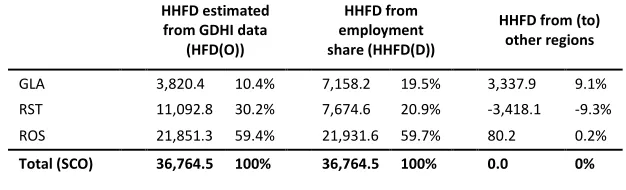
GLA 3,820.4 10.4% 7,158.2 19.5% 3,337.9 9.1%
RST 11,092.8 30.2% 7,674.6 20.9% -3,418.1 -9.3%
ROS 21,851.3 59.4% 21,931.6 59.7% 80.2 0.2%
Total (SCO) 36,764.5 100% 36,764.5 100% 0.0 0%
Table 4 shows this calculation for each region on aggregate. This reveals that
Glasgow is a net-exporter of goods and services that satisfy household final
demand in the rest of the Strathclyde, while the rest of Scotland is largely
[image:21.595.140.453.540.635.2]21
Strathclyde gets spent in Glasgow, suggesting strong spill-over effects in terms of
Type-II multipliers.
4.4.2 Government demand
The disaggregation of government final demand by sub-region draws on regional
government accounts (Hillis, 1998) and public sector employment by sub-region
to construct weights, which in turn are used to disaggregate the local and central
government final demand columns from the Scottish IO-table11.
Table 5 Breakdown of central- and local government expenditures by IO
region.
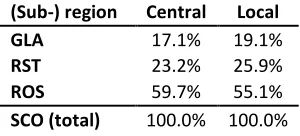
(Sub-) region Central Local
GLA 17.1% 19.1%
RST 23.2% 25.9%
ROS 59.7% 55.1%
SCO (total) 100.0% 100.0%
Table 5 reveals the breakdown of central- and local government expenditures in
each of the 3 IO-regions. Local government expenditures are relatively larger in
GLA and RST, whereas the converse holds for ROS where central government
expenditures are a relatively larger share.
4.4.3 NPISHs, Tourist Demand and Gross Capital Formation
For the disaggregation of NPISHs (Non Profit Institutions Serving Households),
Tourist Demand and the Gross Capital Formation final demand categories a simple
11 The latest year the regional government accounts (Hillis, 1998) refer to is 1998. This was a
[image:22.595.223.373.329.397.2]22
approach is used. It is assume that demand for each sector is proportional to the
share of Scotland-wide employment in that sector found in Glasgow, such that:
=
Ni R i N i R i
E
E
F
F
where is a final demand (of an unspecified category) for sector i in region r, '
is the final demand (of the same category) for sector i in Scotland as a whole
(N), 4 is the FTE employment in sector i in region R and 4' is the FTE
employment in sector i in Scotland as a whole (N).
4.4.4 Exports and balancing
As the 3-region table is a disaggregation of the balanced Scottish IO-table it should
by definition balance if constrained to each sector’s row and column total.
Therefore there is no need to apply an adjustment procedure, as the IO-table
conforms to the accounting identity that column sum must equal row sums. As
there is least information available for spatial distribution of RUK and ROW
exports this is chosen as a balancing row. The starting point in this process is
determining the shares of total exports of a sector that go to the RUK and ROW.
For this it is assumed that the RUK/ROW breakdown of exports at the Scottish
level hold at the sub-regional level. Then the total exports of sector i in region r is
determined as that sector’s estimated gross output, less intermediate demand
and less all the final demands estimated so far (i.e. everything but exports). This
estimate for total exports is then attributed to RUK and ROW exports using the
previously determined weights for RUK and ROW exports for sector i. This
concludes the disaggregation process.
23
Table 6: Type-I and Type-II interregional multipliers in the interregional
GLA-RST-ROS Input-Output table.
Sector
Type-I multiplier Type-II multiplier
Direct effect
Knock on effects Direct
effect
Knock on effects
GLA RST ROS SCO GLA RST ROS SCO
G
L
A
Agriculture, forestry & fishing 1 0.38 0.06 0.19 1.64 1 0.54 0.16 0.31 2.00
Mining 1 0.39 0.03 0.10 1.52 1 0.56 0.14 0.19 1.89
Manufacturing 1 0.20 0.05 0.14 1.39 1 0.40 0.17 0.25 1.82
Energy 1 0.41 0.11 0.41 1.93 1 0.49 0.17 0.51 2.17
Other utilities 1 0.38 0.05 0.29 1.71 1 0.48 0.11 0.39 1.98
Construction 1 0.24 0.14 0.32 1.71 1 0.43 0.27 0.49 2.19
Distribution & catering 1 0.08 0.07 0.18 1.32 1 0.32 0.23 0.33 1.88
Transport & communication 1 0.24 0.07 0.16 1.47 1 0.47 0.22 0.30 2.00
Finance & business 1 0.19 0.04 0.11 1.34 1 0.38 0.16 0.22 1.76
Public administration 1 0.10 0.09 0.23 1.42 1 0.35 0.26 0.41 2.01
Educ., health & social work 1 0.12 0.07 0.16 1.35 1 0.47 0.28 0.37 2.12
Other services 1 0.29 0.07 0.18 1.54 1 0.52 0.22 0.33 2.07
R
S
T
Agriculture, forestry & fishing 1 0.03 0.33 0.24 1.61 1 0.13 0.50 0.37 2.00
Mining 1 0.03 0.32 0.13 1.47 1 0.15 0.53 0.25 1.93
Manufacturing 1 0.03 0.24 0.16 1.43 1 0.14 0.45 0.28 1.87
Energy 1 0.11 0.40 0.41 1.93 1 0.17 0.49 0.52 2.18
Other utilities 1 0.04 0.45 0.22 1.70 1 0.11 0.57 0.32 1.99
Construction 1 0.07 0.30 0.34 1.71 1 0.20 0.50 0.51 2.21
Distribution & catering 1 0.05 0.09 0.19 1.33 1 0.20 0.36 0.35 1.92
Transport & communication 1 0.04 0.28 0.17 1.50 1 0.19 0.54 0.32 2.05
Finance & business 1 0.04 0.19 0.11 1.34 1 0.17 0.42 0.24 1.83
Public administration 1 0.07 0.12 0.23 1.42 1 0.23 0.39 0.41 2.04
Educ., health & social work 1 0.05 0.15 0.17 1.36 1 0.26 0.53 0.39 2.18
Other services 1 0.06 0.28 0.19 1.52 1 0.20 0.54 0.35 2.09
R
O
S
Agriculture, forestry & fishing 1 0.04 0.14 0.42 1.60 1 0.09 0.20 0.71 2.00
Mining 1 0.10 0.12 0.31 1.53 1 0.16 0.19 0.65 1.99
Manufacturing 1 0.03 0.06 0.44 1.53 1 0.08 0.11 0.76 1.95
Energy 1 0.13 0.13 0.66 1.92 1 0.17 0.17 0.84 2.18
Other utilities 1 0.04 0.05 0.62 1.72 1 0.08 0.09 0.84 2.01
Construction 1 0.10 0.20 0.40 1.70 1 0.17 0.28 0.75 2.21
Distribution & catering 1 0.08 0.13 0.11 1.32 1 0.16 0.20 0.55 1.91
Transport & communication 1 0.05 0.08 0.34 1.46 1 0.11 0.15 0.77 2.03
Finance & business 1 0.05 0.05 0.27 1.37 1 0.10 0.10 0.63 1.84
Public administration 1 0.11 0.14 0.17 1.42 1 0.19 0.22 0.63 2.04
Educ., health & social work 1 0.07 0.10 0.18 1.35 1 0.16 0.20 0.82 2.18
[image:24.595.77.523.143.706.2]24
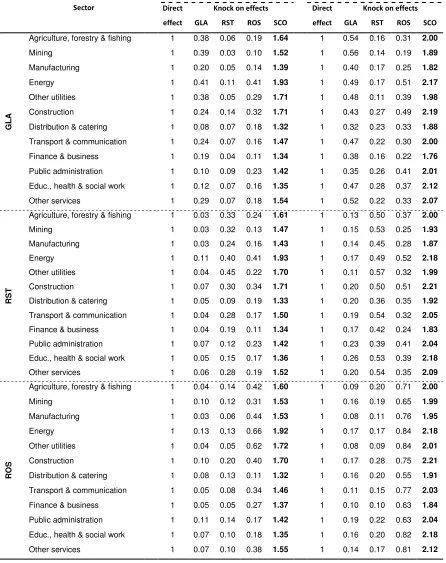
The interregional Type-I and Type-II multipliers are shown in a disaggregated
format in Table 6, revealing the direct effect upon the host region and the knock
on effects for each of the 3-regions12 and Scotland as a whole. For example, for
Public Administration in Glasgow the total Scotland-wide Type-II output multiplier
is 2.01. This is composed of the direct effect upon the host region GLA (1) in
addition to knock impacts upon GLA (0.35), RST (0.26) and ROS (0.41). From the
multipliers, it is clear that interregional intermediate trade (indirect effects as
gauged by the Type-I multiplier) drives significant spill-over effects, but that this
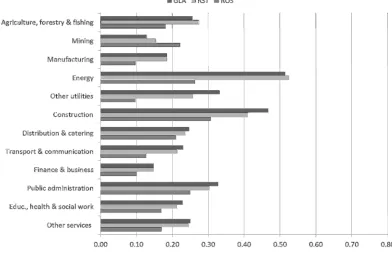
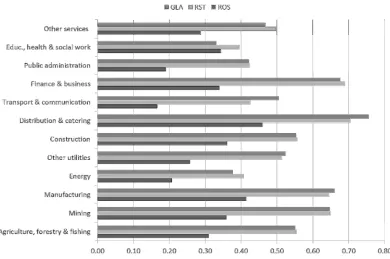
varies across sectors and sub-regions. A graphical exposition of this point is
provided in Figure 3.
Figure 3 knock-on effects that spill over to other regions by sector and
host-region.
12 For ease of exposition the sectors were aggregated from 126 to 12 for each sub-region,
[image:25.595.116.508.410.669.2]25
When incorporating induced effects, using the Type-II multipliers, a greater
degree of interregional interdependency is revealed. Figure 4 is identical to Figure
3 and drawn in the same scale to facilitate comparison This reveals the increase in
interregional spill-overs of knock-on effects, once induced effects are accounted
for in addition to indirect effects. Again, the individual sub-regions differ in the
extent to which host-region demand stimuli spill over to the other regions. In this
regards GLA and RST are clearly more open than the larger ROS.
Figure 4 Type-II knock-on effects that spill over to other regions by sector
and host-region.
5
Alternative specifications and sensitivity of
multipliers
Sensitivity analysis is conduced around two dimensions: the approach used to
[image:26.595.119.509.352.611.2]26
impacts; and the treatment of wages and household consumption, which
influence the nature of induced impacts.
5.1
Intermediate transactions
The IO-table is estimated using alternative LQs. The FLQ formula is used under a
range of δ parameters and compared to a version of the IO-table estimated using
SLQs. Three parameter values are chosen. To simplify the presentation of results
the industrial sectors are aggregated into 1 sector for each region. These are
presented in Table 7. Which shows these aggregate multipliers broken down into
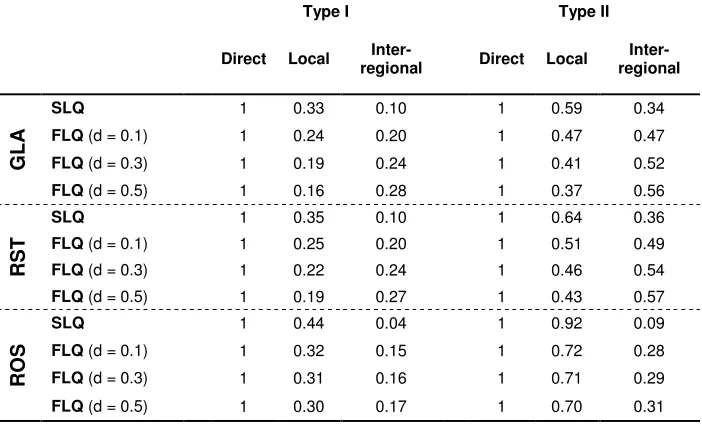
their constituent components: direct effect, local knock-on effect and
[image:27.595.124.475.396.608.2]interregional knock-on effect.
Table 7 Spatial decomposition of aggregate multipliers by sub-region
Type I Type II
Direct Local Inter-
regional Direct Local
Inter- regional
G
L
A
SLQ 1 0.33 0.10 1 0.59 0.34
FLQ (d = 0.1) 1 0.24 0.20 1 0.47 0.47
FLQ (d = 0.3) 1 0.19 0.24 1 0.41 0.52
FLQ (d = 0.5) 1 0.16 0.28 1 0.37 0.56
R
S
T
SLQ 1 0.35 0.10 1 0.64 0.36
FLQ (d = 0.1) 1 0.25 0.20 1 0.51 0.49
FLQ (d = 0.3) 1 0.22 0.24 1 0.46 0.54
FLQ (d = 0.5) 1 0.19 0.27 1 0.43 0.57
R
O
S
SLQ 1 0.44 0.04 1 0.92 0.09
FLQ (d = 0.1) 1 0.32 0.15 1 0.72 0.28
FLQ (d = 0.3) 1 0.31 0.16 1 0.71 0.29
FLQ (d = 0.5) 1 0.30 0.17 1 0.70 0.31
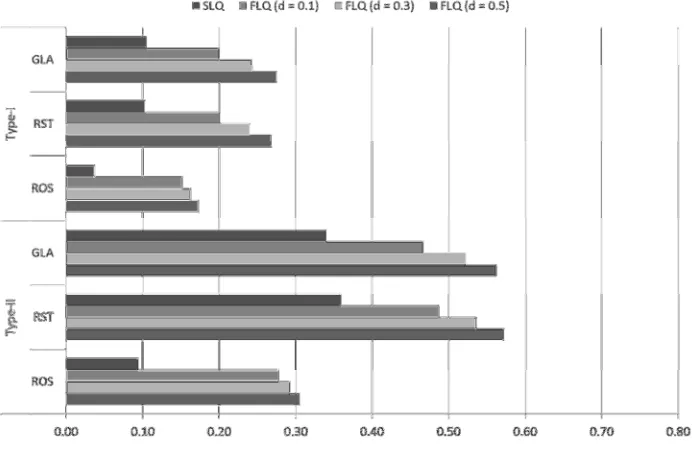
A graphical summary of these results is presented Figure 5 below. The horizontal
bars identify the interregional component of the multiplier of the aggregate
sector in each region, based on estimates using alternative LQ specifications.
Looking at the Type-I multipliers, the difference between the estimated results
27
assumption of FLQ (δ=0.3), for every £1 of final demand stimulus locally there
would be an interregional spill-over effect of 24p, whereas under the SLQ this
would only be 10p. Varying the δ parameter does vary the outcome, but this
sensitivity is much less distinct than the initial choice between SLQ and FLQ.
Furthermore, there is a clear qualitative distinction between results obtained in
the smaller more open sub-regions of GLA and RST, vis-á-vis the larger and more
self-contained ROS. In the latter case spill-over effects are much less distinct, 16p
in the pound for the baseline assumptions, but only 4p based on SLQs.
Figure 5 Knock-on impacts that spill over across sub-regional boundaries
under alternative LQ-formulas.
As expected, the Type-II multipliers reveal larger spill-over effects. For example,
based on the base case assumption a £1 of final demand stimulus in Glasgow will
result in 52p of knock-on impacts in the other two sub-regions. Again, these
[image:28.595.116.462.357.586.2]28
5.2
Household incomes and expenditures
As is detailed in section 4.3 and 4.4.1 this paper adopts a simple method to allow
for interregional flows of wages and consumption. For comparison the table was
re-estimated using a typical LQ-type approach, where all employment is assumed
to be local and all household consumption is assumed to occur locally. The results
indicate that allowing for these drivers of spill-over effects, is important when
looking at smaller geographical units. Figure 6 reveals that under
‘origin-destination’ assumptions for wages and consumption each £1 of final demand
stimulus in GLA and RST leads to spill-over effects of 52 and 54p respectively.
Whereas, under the ‘standard’ assumptions, these spill-over impacts would be
reduced to 42p and 39p respectively. However, for the larger ROS the
specification of the income and expenditures of the household sector is not
important.
Figure 6 Comparison of the interregional knock-on impacts of aggregate
sectors, based on a ‘standard’ treatment of household incomes/expenditures
[image:29.595.120.473.534.775.2]29
Figure 7 Presents the same comparison disaggregated to 12 sectors in each
sub-region. This suggests that an accurate treatment of the household is most
important for those sectors that are most labour intensive.
Figure 7 Comparison between the interregional component of the multiplier
based on a ‘standard’ treatment of household incomes-expenditures and an
origin-destination treatment acknowledging interregional commuter and
[image:30.595.120.514.316.572.2]30
6
Conclusions
This paper explores the sensitivity of multipliers to assumptions adopted when
constructing local Input-Output tables using non-survey methods. The official
Scottish IO-table is spatially disaggregated to identify interdependencies between
the largest city, Glasgow, its wider city-region in the rest of the Strathclyde region
and the wider regional economy in the rest of Scotland. Once the base case has
been established sensitivity analysis is conducted around two dimensions: the
specification of intermediate inputs and the flow of wages and household
consumption. The analysis supports existing finding in the literature that accurate
estimation of intermediate trade is important if multipliers are not to be
overstated. However, it further argues that researchers need also to think about
accurate estimation of wage and consumption flows if Type-II multipliers are not
to be overstated (and spill over effects underestimated when working a
multi-region context). This is particularly important when working at smaller scales
where commuting and shopping trips occur beyond the study area. Glasgow
exemplifies this situation with 40% of jobs taken by in-commuters and conversely,
about a quarter of all household consumption in its wider city-region is spent
within the city. However, these concerns are not urgent when looking at larger
geographical areas, such as is exemplified by results for the rest of Scotland.
The results clearly indicate that researchers must adopt a wider stance than solely
focussing on trade when constructing local level IO tables. Given that these results
are based on simulation it would be highly desirable to verify them through
empirical testing. However, this is not possible for the case of Glasgow, as a fully
surveyed benchmark table is lacking. There are several local economy tables
31
and therefore not suitable to test for the impact of commuting and shopping trips
when using non-survey methods to estimate local level IO-tables.
The interregional IO table features a simple mechanism that utilises secondary
data to capture wage and consumption flows over regional boundaries. This is a
significant improvement over conventional approaches but still suffers
weaknesses, which would require more detailed data to address. In particular it
would be useful to obtain sector specific commuting intensities and more detailed
picture of interregional flows of household consumption. The first of these could
be achieved with further disaggregation of census results but the latter does not
have an obvious solution short of extensive primary data collection. A possible
solution might be making use of data on card payments, which are stored in great
32
References
Batten, D. (1982). The Interregional Linkages between National and Regional
Input-Output Models. International Regional Science Review. Vol. 7, No. 1, pp.
53-67.
Bonfiglio A. (2009) On the Parameterization of Techniques for Representing
Regional Economic Structures. Economic Systems Research. Vol. 21, pp. 115−127.
Brand, S. (1997). On the Appropriate Use of Location Quotients in Generating
Regional Input-Output Tables: A Comment. Regional Studies, Vol. 31.8, pp.
791-794.
Flegg, A.T, & Tohmo, T. (2011). Regional Input–Output Tables and the FLQ
Formula: A Case Study of Finland. Regional Studies. DOI:
http://dx.doi.org/10.1080/00343404.2011.592138
Flegg. A.T., Webber, C.D. & Elliott, M.V. (1995). On the appropriate use of location
quotients in generating regional input-output tables. Regional Studies, Vol. 29,
No. 6, pp. 547-561.
Flegg, A.T. & Webber, C.D. (1996). Using Location Quotients to Estimate Regional
Input-Output Coefficients and Multipliers. Local Economy Quarterly. Vol. 4, pp.
58-86.
Flegg, A.T. & Webber, C.D. (1997). On the appropriate use of location quotients in
generating regional input-output tables: Reply. Regional Studies, Vol. 31, No. 8,
33
Flegg, A.T. & Webber, C.D. (2000). Regional size, regional specialisation and the
FLQ formula. Regional Studies. Vol. 34, No. 6, pp. 563-569.
Flegg, A.T & Tohmo, T. (2010). Regional Input-Output Tables and the FLQ Formula:
A Case Study of Finland. University of the West of England, Department of
Economics, Discussion Paper. Retrieved from the World Wide Web:
http://carecon.org.uk/DPs/1005.pdf
Fleming, A.D. (2006). Scotland’s Census 2001 Statistics on Travel to Work or Study.
General Register Office for Scotland. Occasional Paper No. 12.
Harrigan, F., McGilvray, J.W. & McNicoll, I.H. (1980a). Simulating the Structure of a
Regional Economy. Environment and Planning A. Vol.12, pp. 927-36.
Harrigan, F., McGilvray, J., & McNicoll, I. (1980b). A comparison of regional and
national technical structures. The Economic Journal, 90(360), 795-810.
Harris, R.I.D. & Liu, A. (1998). Input-Output Modelling of the Urban and Regional
Economy: The Importance of External Trade. Regional Studies, Vol. 32, No. 9, pp.
851-862.
Hillis, I. (1998). Sub Regional Government Accounts (experimental). Office for
National Statistics (ONS). Retrieved from the World Wide Web:
http://www.statistics.gov.uk/statbase/Product.asp?vlnk=9580&More=Y
Lahr, M.L. (1993). A Review of the Literature Supporting the Hybrid Approach to
Constructing Regional Input-Output Models. Economic Systems Research. Vol. 5,
34
Lahr, M. & de Mesnard, L. (2004). Biproportional Teqhniques in Input-Output
Analysis: Table Updating and Structural Analysis. Economic Systems Research. Vol.
16, No. 2, pp. 115-134.
Norcliffe, G.B. (1983. Using location quotients to estimate the economic base and
trade flows. Regional Studies. Vol. 17, No. 3. pp. 161-168.
McCann, P. & Dewhurst, J. (1998). Regional Size, Industrial Location and
Input-Output Expenditure Coefficients. Regional Studies, Vol. 32.5, pp. 435-444.
Miller, R.E. & Blair, P.D. (1985). Input-Output Analysis: Foundations and
Extensions, 1st. edition. Prentice Hall.
Miller, R.E. & Blair, P.D. (2009). Input-Output Analysis: Foundations and
Extensions, 2nd edition. Cambridge: Cambridge University Press.
Oosterhaven, J. & Stelder, D. (2007). Regional and Interregional IO Analysis.
Monograph: University of Groningen, Faculty of Economics and Business.
Richardson, H. W. 1985. Input-Output and economic base multipliers: Looking
backward and forward. Journal of Regional Science Vol. 25, No. 4, pp. 607-61.
Roberts, D.J. (2005). The role of households in sustaining rural economies: A
structural path analysis. European Review of Agricultural Economics, vol 32, no. 3,
pp. 393-420.
Robison, M.H. (1997). Community input-output models for rural area analysis with
35
Robison, M.H. & Miller, J.R. (1988). Cross-Hauling and Nonsurvey Input-Output
Models: Some Lessons from Small-Area Timber Economies. Environment and
Planning A, Vol. 20, pp. 1523-1530.
Robison, M.H. & Miller, J.R. (1991). Central Place Theory and Intercommunity
Input-Output Analysis. Papers in Regional Science. Vol. , No. 4, pp. 399-417.
Round, J.I. (1978). An Interregional Input-Output Approach to the Evaluation of
Nonsurvey Methods. Journal of Regional Science. Vol. 18, No. 2., pp. 179-194.
Schaffer, W.A. & Chu, K. (1969). Nonsurvey Techniques for Constructing Regional
Interindustry Models. Papers in Regional Science. Vol. 23, No. 1, pp. 83-104.
Smith, P. & Morrison, W.I. (1974). Simulating the Urban Economy: Input-Output
Techniques. Pion, London.
Snickars, F. (1979). Construction of Interregional Input Iutput Tables by Efficient
Information Adding. In Bartels, C.P.A. & Ketellapper, R.H. (eds). Exploratory and
Explanatory Statistical Analysis of Spatial Data. Berlin: Springer.
Snickars, F. & Weibull, J.W. (1977). A Minimum Information Principle: Theory and
Practice. Regional Science and Urban Economics. Vol. 7, pp. 137-168.
Stoeckl, N. (2010). International Regional Science Review. Comparing Multipliers
from Survey and Non-Survey Based IO Models: An Empirical Investigation from
Northern Australia. International Regional Science Review. Published online
36
Tohmo, T. (2004). New Developments in the Use of Location Quotients to
Estimate Regional Input-Output Coefficients and Multipliers. Regional Studies,
Vol. 381, No. 1, pp. 45-54.
Willis, K.G. (1987). Spatially disaggregated input-output tables: an evaluation and
comparison of survey and nonsurvey results. Environment and Planning A.
Volume 19, pp. 107-116.