Rochester Institute of Technology
RIT Scholar Works
Theses
Thesis/Dissertation Collections
12-10-1993
Examining the Creative Process; Electronic
technology in art and design
Michael Hahn
Follow this and additional works at:
http://scholarworks.rit.edu/theses
This Thesis is brought to you for free and open access by the Thesis/Dissertation Collections at RIT Scholar Works. It has been accepted for inclusion
in Theses by an authorized administrator of RIT Scholar Works. For more information, please contact
Recommended Citation
Rochester Institute
of
Technology
A
Thesis Submitted
to
the
Faculty
of
The School
of
Art
and
Design,
College
of
Imaging
Arts
and
Sciences
in
Candidacy
for
the
Degree
of
MASTER OF
FINE
ARTS
Examining
the
Creative
Process;
Electronic
Technology
in
Art
and
Design
By
Michael
Gerard Hahn
Prologue
The
possibilities
inherent in
the
computeras a creative
tool
willdo little
to
changethose
idioms
of
artwhich
rely
primarily
onthe
dialogue between
the artist,
his
ideas,
and
the
canvas.It
will,
however,
increase
the
scopeof
artand contribute
to
its diversity.
Section
Page
I
Introduction
1
t
Research
3
3
4
7
8
Procedure
10
Results
20
Conclusion
23
Appendix
26
Footnotes
Introduction
The
purposeofthis thesis
is
to
examinethe
impact
that
electronic
technology
has had in reshaping
the
artists' approach
to the
creative process.As
computersbecome
a vital resourceandcreative
tool
for
the
artcommunity,
it is important for
the
artist,
andpublicalike,
to
understandthe
significance of electronic
technology
in
facilitating
the
creativeprocess.Without
question computers aremaking extraordinary
aesthetic experiences
possible,
andrevolutionizing
the
way
art canbe
conceived,
created and perceived.At
the
forefront
oftechnical
and socialchange, the
computer provides a newmedium and a new
way
to
look
at art.But
a computer shouldnot
be looked
at as a replacementfor
the
creative process.We
tend to
assumethat
a newtechnology
leads
to
a newform
ofart,
instead
ofasking
if
perhapsthe
arrival of a newtechnology
is
the
resultof new
forms
ofthinking.
Artists have
traditionally
had
a reputation ofbeing
atthe
forefront
ofexperimentation;
searching for
a newtool,
tech
nique or
idea.
Some
artistshave
embracedthe
computer and seeit
as atool
for both
the
fine
and applied arts.Before
being
accepted as a
legitimate
artisticmedium,
some ofthe
challenging
aesthetic and philosophical
issues
raisedby
computer-generated artmustbe
addressed.The
most significant questions concernthe
impact
ofthe
technology
onthe artist, the
creativeprocess,
andthe
nature of art.More
specifically; to
what extentdo
the
available systems and software
deterrnine
the
results?The
realquestion
may be
notsomuch,
"What is
computerart?"
but
"What
willartbecome in
the
computerIntroduction
As
partofmy examination,
I
have
tried to
addressthe
impact
ofelectronictechnology
onfine
andappliedarts education,
andhow
these
issues influence
astudents' creative
develop
ment,
as wellas,
their
ability
to
succeedin
a professional environ ment.While
electronictechnology
has
providedthe
artist with newwaysto
approachideas,
there
is
adangerous
temptation to
become
enamoredwith clevertechnical
solutionsinstead
ofintelligent
design
solutions.The
result of whichmay be
aless-than-positive
impact
onboth
the
quality
of studentscoming
out ofAmerica's
design
schools,
andthe
quality
of workcoming
out ofAmerica's
design firms.
Historically,
suchdebates have followed
the
collision ofvirtually every
newtechnology
withwell-entrenched ways of
thinking
aboutanddoing
work.There is
atension that
existsbetween
artandtechnology,
and afear
that the
computer willreplace
the
creativeprocess;
clirninishing
the
chancesfor diver
sity
andhuman
expressionin design. And
while computershave
become
the
answerto the
dreams
of somedesigners,
andthe
purveyor of nightmares
for
others,
it is inarguable
that the
computer
is
becoming
anintegral
part ofthe
design
environ mentThe
principal challenge nowfor
this
newtechnology
is
to
manifest
itself in
the
creation of effective and appropriatedesign
Research
Research
ofselectedliterature
was conductedin
the
content areasofcomputers
in
the
fine
arts,
design
education andtechnological
implications.
Research
material was selectedto
encompass
current,
as wellas,
future
perspectivesregarding
the
impact
ofelectronictechnology
onthe
fine
and applied arts.The field
ofcomputerart represents anextraordinarily
broad
body
of workthat
consistently
generates a wide spectrumof opinion and
interpretation.
Resistant
to
fully
embrace works createdonthe
computer,
the
fine
artworld,
and publicalike,
have
yetto
fully
acceptthe
unique qualities ofthe
creativeprocess
in
computer art.Confronted
by
this
lack
of understanding,
computer artists continueto
strugglefor
acceptancein
many
traditional
avenues of success and recognition:the
artgallery
andmuseum.Exposing
the
myththat
art and computers aremutually
exclusiveconcepts,
"The Digital
Canvas"
looks
athow
some oftoday's
artistshave found
waysto
usethe
computer as aninter
mediary in
almostany
medium or style.It
is
not uncommonfor
artists
to
combine work onthe
computer withtraditional
artmethods;
although computer artists are careful notto
say
that
their
workis
superiorto
traditionalmediums:"If
there
is
adisadvantage
to
computerart,
it is
that the
basic
aesthetics aremissing."1
The
"basic
aesthetics"refer
to the tactile
relationship
that
artiststraditionally
have had
withtheir
art.With
most computerart, there
is
nomodeling
ofclay
withhands
ortouch
ing
ofbrush
to
canvas.As
aresult,
questions plaguethe
fine
arts world asto
the
legitimacy
ofthis
newartform.
accepting
electronic
technology
Research
Those
critical of computer art arefearful that it
somehowdetracts from
the
artist'screativity,
whilethe
perceptionamong
establishedmuseums
is
that
computer arthas
not yet come ofageand
that there
is
not enoughin
the
field
to
warranttaking
it
seriously in
comparisonto the
otherarts.This is
notthe
first
time the
artcommunity has
reactedso
strongly
towards
anemerging
artform.
Published
in
1892,
Naturalistic Photography for Students
ofthe
Art,
by
Dr.
Peter
H.
Emerson,
became
the
first
majoraesthetic statement onphotography
asfine
art.2The book
createdafuror among
artcritics and photographers
by insisting
that the
independent
medium of
photography
couldbe
usedto
express uniquecreative visions and
be
the
vehiclefor
great art.Influenced
by
these
issues,
artists such asAlfred
Stieglitz
went onto
become
major contributors
in
developing
views onphotography
andart
in
the
first half
ofthis
century.Arielle
Emmett,
authorofthe
article"Computers
andFine
Arts,"
emphasizes
the
needto
recognizethe
aesthetic qualitiesin
computer
art,
pointing
outthat; "Computer
arttoday
stillmeansanything
that
is
visualwithcomputers,as opposedto things that
are
strictly
'Identifying
thesequalitiesmay be
assimpleas
looking
to the
basic
elements oftraditionaldesign;
organizational
composition,
techniqueand contentIn
general,
though,
the
public andthe
art worldmay
continueto
focus
onan unresolved
fascination
withthe
computerasatool,
ratherthan
the
aestheticorformal
values ofthe
workproduced.In
order
to
define
the
legitimate
rolecomputerscanplay in
the
creative
process,
artists mustfight
the
notionthat the computer,
Research
Confident
that
gallerieswill embracethe
mediumin
the
future,
Gary
Pfitzer,
author ofthe
article"State
ofthe
Arts,"recognizes
the
recentemergenceof more galleries and museumswilling
to
acknowledgethe
digital
medium.4The
currenttrend
for
most venuesis
to
not gocompletely
digital,
but
to
offerboth
computerworksand
those
derived
from
more establishedfine
artmediums.
As
morecommercial galleriesbegin
to
actively
promote
computer-generated
art,
artistsseeking
to
presenttheir
work,
and gallerieslooking
to
sellit
willbe forced
to tackle
suchpressing
issues
asartisticvalue,
originality,
andthe
archivability
of
digital
artFor
the
mostpart, artists,
and galleriesalike,
areworking
hard
to
makethe
computer medium work successfully.But
the
future
successand,
ultimately,
the
acceptance of computerart,
will
rely
on severalcontributing
factors: "the embracing
ofthe
computer
by
establishedartistsfrom
traditionalmediums,
increased
sophistication andmaturity
onthe
part offine
artistsnow
using
the
computer,
...andthe
successful generationof amarket
by
the galleries,
sothat
more collectors will wantto
buy
computer
art." 5
Finding
waysto
usethe
computerin
artmay be
avery
individual
process with a multitude of creative solutions.In
order
for
the
mediumto
be
accepted,
artists must remindthe
art
viewing
publicthat,
as withany
othertraditionalmedium,
computer art
is
notcreatedby
the computer,
but
by
the
artist.In addition,
the
artworld must workharder
to
recognizethose
works
that
expressboth
artistic and technologicalexcellence,
while
being
critical ofthose
worksthat
don't
expand culturalThe
following
articles examinethe
role of electronictechnology
in fine
and applied arteducation,
andits ability
to
make
learning
experiences more effective.Research
"Design Education:
Creating
Effective Courses in Com
puter
Graphics Takes Careful
Planning,"
by
H. Lind
Babcock,
examines
the
issues
facing
design departments attempting
to
integrate
computersinto
their
design
curricula-6Chief among
these
concernsis
the
cost of equipment and alack
of specificguidelines
for
course content.Although
the
technology
may be
readily
availableto
many
institutions,
learning
curvesfor using
sophisticated software are still
steep,
leaving
little
time
to
learn
about
the
conceptual and creative processesinvolved,
and someeducators remain reluctant
to
embracethe
newtechnology.In
asurvey
conductedin 1990
during
anannualmeeting
of
the
ACM SIGGRAPH
(the
computer graphics"special
interest
group"
of
the
Association for
Computing
Machinery),
aconference
devoted
to the
discussion
oftopics
relevantto the
scientificcommunity,
design
educatorsparticipatedin
aworkshop
to
determine
the
role oftechnology
in
university
curriculaThe
study
concludedthat
"most
interdisciplinary
andmany fine
artsprograms
tend
to
favor
the
artist-as-programmerapproach,whilemost graphicdesign- oriented programs
favor
the
artist-as-user
Defining
specificguidelinesfor
computergraphics
in
the
educationstructure,
some arguethat
it is
necessary
to teach the
basics
first
leaving
computersfor
moreadvanced work.
Others believe
that
"As
computersarebecoming
aubiquitous
tool
in
the
visualarts,
computer graphicsdeserves
aplace
in
the
generalfoundation
coursesfor
allart studentsdetermining
the
roleof
electronic
technology
in design
Research
It is
noted,
however,
in
the
accompanying
article"Wanted:
Computer-Sawy
Artists,"that, first
andforemost,
artists anddesigners
musthave
creativetalent,
andthat
computeradept-ness shouldnot
necessarily
replacethe
creativeprocess.8Expanding
onthese
issues,
"Artistic
Challenge;
Establish
ing
Aesthetic Standards in Computer
Art"underlines
the
growing
movementamong
educatorsto
create undergraduateand
MFA
programsin
computer artthat
facilitates
atraditionalist's
understanding
oftypography,
mechanicals and pagelayout,
whileguarding
againstafacility
wherethe
only
agendais
the
student'smastery
of software.Teaching
disciplines
shouldutilize
methodology
whichinvolves adapting
the
traditionalartistic process
to the
computeras a visualproblem-solving
tool-students should
be "encouraged
to
makedecisions
abouthow
to
best
usethe
computer's capabilitiesfor
aparticularprojectandeven
to
determine if
the
computeris
9In
the
article"Graphic
Design
Education,"
D.K. Holland
attributes
the
currentstate of graphicdesign
educationto the
inability
ofeducationalinstitutions
to
adaptto the
changing
roleof
design
professionals.10
Studio
courses must evolveto
better
address
the
effect of electronictechnology
onthe
creativeprocess.
Flexibility,
speed,
and rapidinnovation
are all outgrowths of
the
presence ofcomputersin
the
studio courses ofallart students.
It
shouldbe
noted,
however,
thataneducationthat
focuses
almostexclusively
on studiocoursesfails
to
adequately
preparethe
studentto
competein
achanging
workenvironment.
Today's designers
arebeing
challengedto
define
and
defend
their
positionin
the
business
environment,espeResearch
Therefore,
it is
essentialto
introduce
studentsto
new ways ofthinking, in
additionto
liberal
arts andbusiness
relatedcourses,
in
orderto
providethem
withthe
mentaldiscipline
andinforma
tion framework necessary
to
realizetheir
full
potential.Revealing
andprovocative,
"The Computer
Debate"features opposing
viewpointsconcerning
the
effects of electronictechnology
onthe
design
environmentMichael
Manwaring,
oneof
the
co-authors ofthe article,
attributesthe
increased
proliferation
ofdesign
materialto; "an
increasing
sophisticationofsoftware
and,
moreimportantly,
the
increasing
numberof,
andcharacteristics
of, the
peopleusing
it."
When
the
first
Macintosh
computer systems were made available
to the
publicin
1983,
they
created as much excitement withinthe
design
community
as
they
did
contempt.Using
alimited
number of availabletype
styles and
"clip-art"
(simple
graphics)
packages,
many
new practitioners,
some of who were eitherunder-orun-schooledin
artand
design,
were ableto
produce workthat
had
the
appearanceof professional competence.
As
aresult, the
sheer volume ofwork
being
produced,
coupled with alimited
softwareselection,
diminished
the
potentialfor
unique creativeexpression.In
the
past
10
years,
Manwaring
explains;
"I
have
seenincreased formal
complexity,
but
without regardto
meaning
orcraft ...the
abdication
of personal stylefor
the
orthodoxy
oftechnical nCo-author
Duncan
B.
Sutherland
Jr.
pointsto the
inven
tion
ofthe
telephone,
by
Alexander Graham Bell
in
1876,
asevidence of
how society
evaluates a newtoolbased
uponpreconceived paradigms:
"seldom
canthe
ultimateimpact
ofa newtool
be
anticipatedin
advance ofits
extended 12Although
Research
design,
in
today's
electronicbusiness
environment,
computertechnology
offersdesign firms
significant competitive advantageover
businesses
who electto
maintaintraditional
design
environments.
In
a series of articles writtenfor Communication
Arts,
amagazine
catering
to
design
professionals,
authorWendy
Richmond
addressesthe
effect oftechnology
onthe
design
profession.
She describes
the
currentlanguage
oftechnology
as"being
removedfrom
physicalreality,
...its
terms
and processesobscure.
There
is
no representation ofprocess,
ofhow
something
works;
no correlationbetween
anactionand whatit
causes."1S
The
success of electronictechnology
may depend
upon
its ability
to
become
enabling,
ratherthangetting
in
ourway.
New
technology
offersthe
user a chanceto
be
aparticipantin
the communication,
thereby
gaining
greaterunderstanding
ofthe
information
being
delivered.
Electronic
technology
in
educationshould providethe
tools
necessary
to motivate,
as well asempowerthe
studentto
learn. The
flexibility
and speed ofmany
computergraphicsprograms should allow emphasis
to
be
placed uponthe
creativeprocess,
ratherthanonthe
mechanics ofthe
programitself,
in
addition
to
positively
influencing
the
perceptionofdesign
andProcedure
The
thesis
project evolvedto
encompasstwo
distinct
areas of
thought: the
changing
role of electronictechnology
in design
education,
andthe
impact
of electronictechnology
on
the
artists'
approach
to the
creative processin
fine
andapplied art.
Topics
were selected onthe
basis
oftheir
relationship
to
issues in
whichI
was animmediate
participant,
enabling
meto
draw
upon personalexperience,
in
additionto
information
acquired priorto,
andduring
research.Because
electronictechnology
in
fine
and applied arteducation plays an
important
rolein
the
creativedevelopment
of
the
artstudent,
part ofthe
research section ofthis
projectwas used
to
examinethe
effectiveuse of electronictechnology
in
educational curricula.From
this
foundation,
the
remaining
research,
and procedureresults,
study
the
effect of electronictechnology
onthe
creative process.In
additionto this
infor
mation,
an evaluation of each phase ofthe
creative processwas conducted
using
severalillustrations
that
were createdspecifically for
this purpose,
as well as work createdpriorto
this
project.Each
composition,
asit
appearsin
the appendix,
is
meantto
serve as a visual referencefor
the
creative processes referenced throughout
this section,
and not as abasis
for
presentation.In
determining
the
contentfor
eachillustration,
I
decided
to
evaluatefine
art anddesign
separately
due
to the
fact
that
fine
artistsanddesigners
approachthe
creativeprocess with
different
objectivesandrequirements.While
the
creative process
in
fine
artmay be
thatofinward
problem-solving,
usedby
the
artistas a vehiclefor
self-expression;the
Procedure
creative process
in design is
oneofoutwardproblem-solving
through
publicparticipation.Therefore,
how
andwhy
tech
nology is
usedby
eachgroup
of artiststo
facilitate
the
creativeprocess,
became
animportant
part ofthe
final
evaluation.The
technical
parametersofthe project,
usedduring
the
productionphase,
wereto
employ
the
use of aMacintosh
Ilci
computer with a16" colormonitor,
keyboard,
mouse,
24
bit
colorflatbed
scanner,
removable mediadrive,
and severaldifferent
color outputdevices. The final
presentationwouldnot require
any
ofthe
aforementioneddevices,
as ahard copy
presentation was planned.
As
the
first
oftwo
compositions createdto
evaluatethe
creativeprocess
in fine
art,
Bright Lights
... madeuse ofgeometric
forms,
layering
and colorto
emphasizeboth
depth
and compositional
balance. To
enhancethe
geometric natureof
the composition,
each elementwaslayered
withina squareframe. Within
that
frame,
the
layout
waspositioneddiago
nally,
extending
specific elementsbeyond
the
frame
of reference, to
makethe
composition moredynamic.
Using
the
strength of
the
computerto create,
duplicate,
arrange andmodify individual
shapes,
I
was ableto
experimentwithseveral
different
potentiallayouts,
all within a single workspace,
anddynamically
viewany
changesbefore selecting
onesolution over another
(appendix).
After sketching
aninitial
concept onpaper, the
pencilrendering
was scannedinto
the
computerusing
anEpson
color
flatbed
scannerand saved asa1 bit TIFF (Tagged Image
File
Format)
file. The Tiff file
wasthen
imported
into Aldus
Procedure
Freehand
(a
Macintosh
illustration
program),
whereit
wasused as a
template to
createthe
initial
wireframe
outline ofthe
illustration. The
TIFF
file
wasthen
deleted from
the
[image:17.539.118.276.225.427.2]composition
(Fig.
1).
Fig. 1. Detailof wireframe fromBright Lights...
illustration
Each
ofthe
remaining
steps wereapproachedfrom
atraditional
artists'
understanding
ofhow
colorand style effectperception.
Applying
these
principlesto
the computer,acolorpalette
consisting
oftwo colors,
including
screenpercentages,
waschosento
provide subtlecontrast,and emphasize
balance
anddepth.
Each
elementin
the
compositionwas madeup
of anindividual
outline,
or closedpath,
which was thengivena setofattributes.
An
attribute refersto the style, width,
and colorof
the
line,
as wellas, the
style offill
appliedto
an element.Attributes
werethen
appliedto
eachelement,including
solidProcedure
and
blended fills.
A
blended
fill is
achievedeithermanually
orthrough
designated
program parameters.Beginning
andending
colors arespecified,
as wellas, the
direction
of progression.
The
programthen
calculatesthe
number ofinterme
diate
steps requiredto
createasmoothtransition
between
the two
colors(Fig. 2
a,
b).
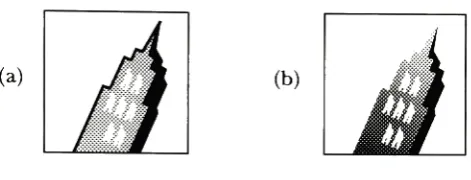
(a)
(b)
Fig.
2.Element
attributes;(a)
1pointline,
solidfill
(b)
No
line,
blended
fillThe final step
wasto
layer
each elementaccording
to
its
designated
positionin
the
original composition.This
wasaccomplished
by
using
commandsbuilt into
the
programto
either send an element
forward
orbackward in relationship
to
otherelementswithinthe
layout.
Emphasizing
both form
and motionthroughfree-form
shapes andabstract
imagery,
The
Analogue became
the
secondcomposition
to
evaluatethe
creative processin
fine
art.Using
electronic
technology
to
compensatefor
alack
oftraditional
drawing
skills,
I
was ableto
usethe
computerto
createdetailed
forms
that
showfluid
motion.In
contrastto tradi
tional
methods,
eachillustration
was createdin
separatedocuments,
allowing
meto
workonforeground
andback
ground elements
simultaneously,
before assembling
the
final
composition
(appendix).
[image:18.539.83.319.253.343.2]Procedure
Creating
a rough sketch of eachfigure
on separatepieces of
paper, the
images
werethen
scannedinto
the
computer and saved as
1 bit TIFF files. The
TIFF
files
wereimported into
separateAldus Freehand
documents,
wherethey
were used astemplates to
createwireframe
outlines.After
deleting
the
TIFF
file from
eachFreehand
document,
the
outlines were cut and pastedinto
a singleFreehand
[image:19.539.105.299.299.481.2]document
(Fig. 3).
Fig. 3. Detailofwireframe
from The
Analogueillustration
Appearing
in
the
foreground,
the
dogs
became
the
first
elementscreated,
andthe
initial focal
point ofthe
composition.
To
complimentthe
dynamic
nature ofadog
in
full
stride,
each musclegroup
wasrenderedasafluid
shape.Several
additionalforeground
elementswereexperimentedwith,
but
none provedinteresting
enoughto
maintainthecontinuity
of shape ormotionthat
had
been
establishedearlier with
the
dogs.
Ultimately,
ahuman figure
wasdecided
Procedure
upon.
Its
muscularity
andposition,
relativeto that
ofthe
dogs,
was emphasizedin
orderto
maintainthe
appearance of motionthat
later became
adominate
characteristicofthe
final
composition.Creating
abackground
image
capable ofbringing
the
entire composition
together,
withoutinterfering
withthe
foreground
elements,
provedto
be
the
mostchallenging
aspect of
the
entireillustration.
After experimenting
withseveral
different
backgrounds,
I
decided
to
create animage
that
would enhancethe
overallfeeling
ofmotion,
withoutcompeting
withthe
foreground
elementsasthe
focal
point ofthe
illustration. The resulting background
provides visualcontrast
between
the
foreground
andbackground
throughabstract
imagery,
using indistinguishable
shapes and colorsto
create
the
appearance of motion(Fig. 4
a,
b).
(a)
(b)
Fig. 4.
Detail
ofbackground(a)
Original image(b)
Crystallize
filterapplied
The
original photographofautumnfoliage
wasscannedinto
the
computerand openedwithinAdobe
Photoshop
(a
Macintosh
image editing
program),
whereit
was saved as a24
bit EPS (Encapsulated
PostScript)
file.
Within
Photoshop,
a customfilter
called"crystallize"
was applied
to
achievethe
resulting image. The image
was thenimported
into Aldus
Freehand,
whereit
was placedin
the
background
ofthe
Procedure
existing
composition.
To further
emphasizeform
and motionthroughout
the
composition,
several small stylizedfemale
figures
wereaddedto the
background.
Experimenting
withdifferent
colorsolutions onthe
computer,
individual
elementswere given a metallicfeel
to
emphasizea surrealquality.
Colors
for
the
remaining
elements were
then
selected,
applying
line
andfill
attributesto
emphasize
form
andstructure.Working
with severaldifferent
layers,
I
was ableto
view,
editandapply
colorsto
each elementseparately.
During
the
final
phaseofproduction,
eachlayer
wascombinedandassembledin
the
final
composition.The first
oftwo
compositions createdto
examinethe
impact
ofelectronictechnology
onthe
creative processin
examplesof graphic
design,
the
Untitled
seriesfeatured four
reproductions of
late
nineteenthcentury french
soap
andperfume
labels (appendix).
Appearing
in
anissue
ofUpper
and
Lower Case
magazine, the
originallabels
provided anexcellent
opportunity
for
comparisonbetween
the techniques
used
to
createthe
originallabels
andthose
usedto
createthe
computer generated
illustrations (Fig.
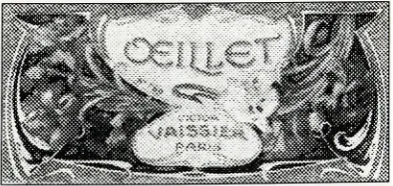
5).14
^I_8Si.-Fig.
5.
Original label
asit
appearedin Upperand Lower Casemagazine [image:21.539.100.297.536.629.2]Procedure
Even
though the
originallabels
were used asdrawing
templates, recreating
eachlabel
onthe
computer provedto
be
asomewhat slow process.
Whereas
atraditionaldesigner
might use a single
brush
stroketo
define
adesign
elementin
a
layout;
that
sameelement,
drawn
onthe computer,
wouldrequire severalpoints which
define
the
element as an outline.The
outline wouldthen
requireline
andfill
attributes.While
time may be
alegitimate
concernfor design
professionals,
having
the
flexibility
to
editlayouts
onthe
computermay
result
in less time
requiredduring
subsequentiterations.
After
the
generaloutline of eachlabel
wastraced
onpaper, the tracings
were scannedinto
the
computerand savedas
1 bit
TIFF
files. The
TIFF
files
werethenimported
into
separate
Adobe
Illustrator
(a
Macintosh illustration program)
files,
and used astemplates to
create wireframe
outlines.The
[image:22.539.104.297.445.547.2]TIFF
files
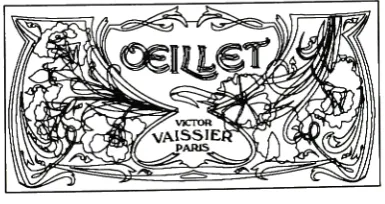
were thendeleted from
each composition(Fig. 6).
Fig. 6. Detailof wireframe
from
Untitled,
1of4illustrations
A
colorpalettewasthenselectedfor
eachillustration
based
uponthe
colorsappearing
in
the
originallabels.
During
this
phase ofproduction,the
computer offeredasignificantadvantage overtraditional methods,
allowing
meto
experiment with
different
color solutionsonasinglelayout,
untilProcedure
the
proper combination ofblended fills
couldbe
achieved.The
traditional
artist mighthave had
to
create a series ofcomprehensive
layouts,
experimenting
withdifferent
colorcombinations and
painting techniques, before applying
those
techniques to the
final
composition.After using
the
computerto
creatematching
patterned andblended
fills,
each elementin
the
composition was given a set ofline
andfill
attributes,
and
layered
accordingly.Upon
completion, the
illustrations
were cut
from
their
originaldocuments
and pastedinto
asingle
layout.
Whereas
the
illustrations
createdfor
the
seriesUntitled
demonstrated
artistic elegancethrough
detailed
ornamentation
andcolor, the
final
compositionexaminedthe
capabilities
ofthe
computer as atool
for
technicalillustration. The
resulting image
of a5775 Color Copier
combinescomplexity,
detail,
perspective andcolor,
in
anillustration
that
became
atechnical
challengeto
execute(appendix).
Using
atraditionally
developed
technicalillustration
ofa color copier as
reference, the
reflectiveimage
was scannedinto
the
computerand saved as an8 bit
colorTIFF
file. The
TIFF
file
wasthen
imported into Aldus
Freehand,
whereit
was usedas a
template to
create a wireframe
outline ofthe
copier
body
andinternal
components.Enlarging
complexareas of
the
TIFF
file
onthe
computer,I
was ableto
createdetailed
componentoutlines,
withoutbeing
restrictedto the
size of
the
originalimage.
These
"component"
illustrations
werethenscaled
down
andplacedin
theircorresponding
locations
withinthe
copierbody. The
TIFF
file
was thendeleted from
the
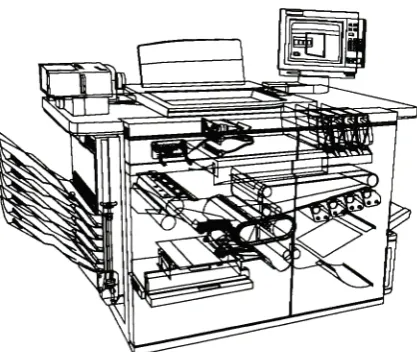
composition(Fig.
7).
Procedure
Fig.
7.
Detail
of wireframe
from 5775
color copierillustration
The
printedcopierpage,
appearing
in
three
separatelocations along
the
paper path withinthe
copierframework,
wascreated
in
Photoshop
from
an actual printedlayout. The
pagewasscanned
into
the
computer and saved as an8 bit
EPS file. With its capacity for
holding
andmanipulating
images,
I
was ableto
usethe
computerto
duplicate,
scale anddistort
the
originalimage. Within
Photoshop,
three
images
were created and saved as separate
EPS files. The images
werethen
imported
into
the
color copierlayout
andplacedin
their
corresponding
locations.
After
each elementin
the
illustration had been
created,
colors were
selected,
andfill
andline
attributeswere applied.Working
with severaldifferent
layers,
I
was ableto view,
editand
apply
colorsto
eachelement separately.During
the
final
phaseof
production,
each element waslayered according
to
its
corresponding
location
withinthe
composition.Labels
were
then
placed on major component partsto
facilitate
identification.
[image:24.539.97.306.113.289.2]The final
project was completed asanticipated,
fulfilling
the
objectives setforth in
the thesis
proposal.An
evaluationof
the
integrity
of aesthetic principlesin
works created onthe
computer,
andthe
impact
of electronictechnology
onthe
creative
process,
was conductedusing
severalillustrations
that
werecreated
specifically for
this purpose,
as wellas workcreated prior
to
this
project.Even
though
severalillustrations
were created prior
to,
andin
conjunctionwith, those
createdspecifically for
this project,
they
provided valuableinforma
tion
that
notonly
addressedthe
impact
of electronictechnology
onthe
creativeprocess,
but
the
adaptation oftraditionalmethods
to the
computer as well.The fact
that
I
had
had
priorexperienceusing
drawing
software on
the
computermay have biased
the
eventualresults,
enabling
meto
avoidmany
ofthe
operationalpitfallsencountered
by
someoneapproaching
this
projectas aninexperienced
"User."Even
so,
many
ofthe
problemsthatwere encountered
during
the
project reflectthe
impact
that
electronic
technology
has had
onthe
approachto the
creative process.
As
each projectbegan
to unfold,
severalconsiderations were made
to
accountfor
the
use ofthe
computeras opposed
to
traditionalmethods.As
withtraditional
processes, there
arecertainlimitations
that
accompany
the
decision
to
use onetooloveranother.Although
some ofthese
decisions
werebased
uponthelimitations
ofthecomputer
to
achieve specificresults, this
may be
attributedto
alack
ofunderstanding
onthe
part ofthe
artist, thanonthe
medium
itself.
The
strength ofthe
computer as an artist'stool
may lie
in its ability
to
manipulateimages in
terms
ofcolor,
resolution,
size andform. For
severalprojects,
there
was a needto
view several
different
solutionsbefore
deciding
uponthe
final
composition.
Using
the
computerto
view variationsin
color,
contentand
arrangement,
I
was ableto
retrieve anddevelop
apromising
intermediate
stage,
withoutstarting
a newlayout.
Having
this
flexibility
allowed meto
planmy
expressionsmore
fully
priorto the
actualexecutionofthe
final
composition. And
whilethe
time it
takes to
completea projectmay be
a
legitimate
concernfor design
professionals,
both
artists,
anddesigners
alike,
willultimately benefit
by
having
the
flexibility
to
experiment withdifferent
concepts onthe
computer.Because
productionis
animportant
part ofthe
creativeprocess, the
following
information
illustrates
some ofthe
technicalchallenges
that
accompany
the
decision
to
producework
electronically,
as opposedto
traditionalmethods.Determining
the
method of outputfor
eachillustration
presented
the
first
realtechnicalchallenge.Using
a colorcopier controlled
by
aninterface
that
allowedfor
the
direct
downloading
ofcomputerfiles
viaaMacintosh
computer,I
was able
to
receiveimmediate feedback in
the
form
ofaprinted
hard
copy.Probably
the
single mostsignificantdrawback
to
computersbeing fully
acceptedby
the
art community,
is
the
inability
ofthe
computerto
accurately
matchcolors
displayed
on-screenwiththat
ofthe
printedoutput.Using
the
color copierfor
outputduring
the
intermediate
stages of
development,
I
was ableto
edit colorsuntilthe
desired
paletteusedfor
presentationwasachieved.Because
several ofthe
illustrations
containedEPS
images,
it
wasnecessary
to
accountfor
the
resolution ofthe
output
device
whenspecifying
the
optimum resolution of eachimage.
Printing
at an effective resolution of400
spi(spots
perinch),
the
color copier was capable ofaccurately
reproducing
a photographicimage
scannedinto
the
com puter at a resolution of100
spi,
without significantdegrada
tion in image
quality.To
ensurethat
eachEPS image
would printcorrectly,
a resolution of150
spi was chosen.Images
that
have been
scannedinto
the
computerat aresolutioncomparable
to that
ofthe
outputdevice may
printsharper,
but
the
increase is
oftenminimal,
andthe
chances of an erroroccurring
during
file
downloading
is
significantly
greater.The final
considerationsthat
weremade,
priorto
printing,
werethat
ofcompressionandtransportability.Since
the
illustrations
were created at an alternatelocation from
printing,
a method oftransportationwas required.Although
someindividual
files
were small enoughto
fit
onhigh
density
floppy
disks
throughthe
use ofcompression,repeatedcom pressionandexpansionof afile may
yieldunexpectedresultsduring
printing.Ultimately,
it
wasdecided
to
copy
the
files
onto a
Syquest Media
Cartridge
(a
removable storagemediawithan effectivestorage
capacity
ofeither44
or88
megabytes),
andtransportthem to the
printing
location
wherethey
couldbe
copied onto a"Host"
computer
for
printing.Conclusion
The
profoundimpact
ofelectronictechnology
onthe
arts,
and whatit
predictsfor
the
future is only
beginning
to
be
fully
realized.Although
the
first
computer-aidedartisticexperiments
took
placeovertwenty-five
yearsago,
computershave
sincebeen
appliedto
every facet
ofthe
artmaking
process.
Future
applications ofthis
newtechnology
willin
nodoubt
transform the
way
artis
created and perceived withinour
environment.
Suffering
from both
alack
ofvisibility
and understanding
onthe
part ofthe
public,
the
mere mention of computerart
usually
conjuresup images
of"Algorithmic" or"Fractal"art,
ratherthan the
less
publicizedfine
arts applications.Although it
wouldbe implausible
to
dismiss
the
influence
that
computer-aidedresearch
has had
oncomputerart,
it becomes
ironic
that the
rejection of computer art wasinitially
based
asmuch on
the
dubious
aestheticquality
ofearly
computergraphics accomplishments
by
scientists,
who were mislabeledas
artists,
as on afear
ofthe
machineitself.
Today's dynamic
computerprogramshave
the
ability
to
positively influence
the
perception ofdesign
andincrease
the
comprehension ofcompositionalprinciples.Due
to the
flexible
nature ofmany
softwarepackages,
artists arefree
to
apply
the
principles ofcompositionon anexperimentalbasis.
At
the
sametime,
they
receiveimmediate feedback
ontheirwork,
making
for
an effectivelearning
experiencebased
uponan
understanding
ofthe
basic
technology,
as wellas,
traditionalcreative principles.
Conclusion
Artists
anddesigners
cometo the
computerwithdiffer
ent
abilities
andobjectives.
They
like
using
the
computerbecause images
andinformation
canbe easily
andquickly
recalled,
allowing
them to experiment
andinteract
withthe
system.
For
someartists,
the
computeris
merely
atool that
facilitates
design
decisions;
for
others,
the
artworkitself
assumes
the
form
ofdirect
computeroutput;
still othersthink
ofcomputeroutput as
the
pointofdeparture
for further
elaboration andexecution
in
anentirely different
medium.Access
to
morepower atless
expensehas
enabled artiststo
exploit
the
computer'sfull
potential.In
the past,
in
orderto
use
computers,
artistshad
to
gain accessto
researchfacilities
containing
highly
expensive scientificequipment.Now,
withthe
advent ofinexpensive
andreadily
available personalcomputers and
software,
artists candevelop
their
expressionswith
the
easethat
had
oncebeen
associated withmany
tradi
tional
mediums.For
agrowing
number of artists whohave
chosen
to
develop
their
images
withcomputers, the
challengenow
is
to
reintroducethe tactile
sense andimmediacy
that
has
become
the
signature ofmany
traditionalmediums.Recent
artistic accomplishmentshave clearly demon
strated
the
ability
ofanindividual working
with computertechnology
to
assert adistinctive form
ofpersonalexpression.Computer
artmay
containany
or all aspects of atool,
amedium,
or even a subject.Many
artists whohad previously
focused
onthe
computerexclusively
as atool, have
reevaluated and
transformed their total
approachto the
artmaking
process,
reflecting
anevolving
commitmenttowardslegiti
mate artisticexpression.
Conclusion
Art
created onthe
computer provides an alternateform
oflearning,
leading
to the
development
of valuable skills and an
understanding
ofthe
basic
technology.
Unlike
traditional
forms
oflearning,
electronictechnology has
enabledthe
educationalinstitution
to
prepare studentsfor
the
information
ageby building
onthe
home
experience.After
all,
many
studentshave already
had
accessto
the
latest technology, in
oneform
oranother,
priorto
enrollment.With
the
increasing
accessibility
andaffordability
ofcomputers,
agrowing
understanding
ofthe
potentialapplications, the
devel
opment of new software
tailored
to
artistic requirements,
anda greatercommitmentfrom
museumsand galleriesalike,
computerswillnotonly
changetheway
artists create
art,
but how it is defined
as well.Appendix
r#
"
JM
4
Appendix
Appendix
W
_#.___
Rfl
__ _sBK
^.1
SAVONNERIE P.TRANOY
@k
&
*
-iM_
w*
_.r
i
I
s_lG_j
Jl
__Trv
1_!__H
___mt
i>._
*ii
M/'"
la
Savon
Noyiaua %Mb
l?S_fj_IVIl!
7?^"*~._L
AU^__J_.TA1- tJg--, .__:______li%Cr_^Awl
V
Villi
. ino
/jjjjjt-.
m^jj^fea
V4
ysM'gfM
K_E
_____!____-__ "_B^^^___H__k_______dC _S____l-*____1>_______SC\v
WMWammkM
^MmmmhMt
Appendix
o
Processor
UserInterface
Tray3andPaperTrayBypass
O
Film Projector
O
Footnotes
xHank
Nuwer,
"The Digital
Canvas."CompuServe Magazine.
April
1992,
19.
2P.H.
Emerson,
Naturalistic Photography for Students
ofthe
Art
(New
York:
Arno
Press,
1973).
'Arielle
Emmett,
"Computers
andFine
Arts: Computer Art
Struggles
For
Acceptance in
aConservative Art
World."Computer
Graphics
World.
October
1988,
vol.11
no.10,
69.
4Gary
Pfitzer,
"State
ofthe
Arts."Computer Graphics World.
March
1993,
vol.16
no.3,
25.
5Ibid.,
32.
6H.
Lind
Babcock,
"Design Education:
Creating
Effective
Courses in Computer Graphics Takes Careful
Planning,"Computer
Graphics World. Tulv
1988,
vol.11
no7.
7Jim
Strothman,
"Wanted:
Computer-Sawy
Artists."
Computer
Pictures.
December/January
1990-91,
31.
8Ibid.,
28.
9H.
Lind
Babcock,
"Design Education:
Creating
Effective
Courses in Computer Graphics Takes
Careful
Planning,"Computer
Graphics
World.
Tulv
1988,
vol.11
no7,
95.
10D.K.
Holland,
"Graphic
Design
Education,"Communication
Arts.
September/October
1992.
nMichael
Manwaring
andDuncan
B.
Sutherland
Jr.,
"The
Computer
Debate."HOW. Tulv/August
1991,
77-78.
Footnotes
"Wendy
Richmond,
"The Generation
Gap."Communication
Arts.
March/
April
1993,
149.
14Steven
Heller,
"Confessions
of aCompetitive
Collector."
Bibliography
Adobe Illustrator Rel
3.1,
Adobe Systems
Incorporated,
Mountain
View,
CA.
Adobe
Photoshop
Rel
2.5,
Adobe Systems
Incorporated,
Mountain
View,
CA.
Aldus Freehand Rel
3.1,
Aldus
Corporation,
Seattle,
Washington.
Angelo,
Jean Marie. "Open Minded
Collectors."Computer Pictures.
January/February
1992,
23-26.
.
"Digital Art
Finally
Breaking
Into
The
Mainstream."Computer Pictures. May/June
1993,
18-22.
Babcock,
H. Lind. "Design Education:
Creating
Effective
Courses
in
Computer Graphics Takes Careful
Planning."Computer
Graphics
World. July
1988,
vol.11
no7,
94-97.
Duncan,
Alastair. The Encyclopedia
ofArt Deco.
New
York,
New
York: E.P.
Dutton,
1988.
Emerson,
P.H.
Naturalistic Photography
for Students
ofthe
Art.
New
York: Arno
Press,
1973.
Emmett,
Arielle. "Computers
andFine Arts:
Computer
Art Struggles
For
Acceptance in
aConservative Art
World."
Computer
Graphics World. October
1988,
vol.11
no.10,
68-74.
Gerken,
J.
Ellen,
ed.Click
1:
The Brightest in Computer-Generated
Design
andIllustration.
Ohio:
North Light
Books,
1990.
Goodman,
Cynthia.
Digital Visions: Computers
andArt.
New
York:
Harry
N.
Abrams, Inc.,
1987.
Heller,
Steven.
"Confessions
ofaCompetitive
Collector."
Upper
andBibliography
Holland,
D.K.
"Graphic
Design
Education."Communication Arts.
September/October
1992,
24-30.
Jeffers,
Carol S. "The Electronic
Revolution."School Arts.
March
1986,
36-56.
Kaplan,
Michael. "Louis
Fishauf."Communication Arts. July
1993,
164-170.
Le
Winter, Renee,
andCynthia Baron. "Artistic
Challenge;
Establishing
Aesthetic Standards in
Computer
Art."Computer
Graphics World.
February
1990,
vol.13
no.2,
48-56.
Loveless,
Richard
L.,
ed.The
Computer Revolution
andtheArts.
Florida:
University
Presses
ofFlorida,
1989.
Malina,
Roger
F.
"Art in
the
Computer
Age."Technology
Review,
October
1989,
71-75.
Manwaring, Michael,
andDuncan
B. Sutherland Jr. "The
Computer
Debate."
HOW.
Tulv/August
1991,
76-81.
Meltzer,
Bonnie.
"Computers
Should Be Seen
asArtist's
Tools,
Rather
Than Enemies
ofthe
Arts."
PC
Week.
February
1988,
vol.
5
no.6,
33-34.
Miller,
Michael
J. "The
Multimedia Revolution Needs
Teachers,
Too."
NewMedia. December
1992,
12.
Noel,
Lee Jr. "The New
Renaissance:
The
Computer
in Fine
Art."
Compute.
November
1991,
17-24.
Nuwer,
Hank. "The
Digital
Canvas."CompuServe
Magazine,
April
1992,
11-19.
Pfitzer,
Gary. "State
ofthe
Arts."
r.nmpnter Graphics
World,
Bibliography
Prince,
Patric D.
"Creating
Art
withComputers."Personal
Computing. October
1989,
129-131.
.
"A
Showcase
for Computer
Art."
Personal Computing.
October
1989,
132-134.
Reichardt,
Jasia. The
Computer
in Art New York: Van Nostrand
Reinhold,
1971.
Richmond,
Wendy. Design & Technology:
Erasing
the
Boundaries.
New York: Van Nostrand
Reinhold,
1990.
.
"Do
Computers
Work For
Us
orDo We
Work
for
Computers?"
Communication Arts.
November
1990,
238.
.
"Participatory
Communication."Communication Arts.
May/June
1990,
125-126.
.
"Tangible
Reality."
Communication
Arts.
September/
October
1992,
166.
.
"The Generation
Gap."
Communication
Arts,
March/
April
1993,
149.
Strothman,
Jim.
"Wanted:
Computer-Sawy
Artists."Computer
Pictures,
December/January
1990-91,
26-31.
Sullivan,
Michael.
"Computer
Art
andArtists Are
Finding
Their
Limelight."HOW.
October
1992,
144-147.
Wilson,
Stephen.
Using
Computers
toCreate Art. New
Jersey: