QUANTIFICATION OF SUPPLY CHAIN RISKS : DEVELOPMENT AND
APPLICATION OF A NOVEL RISK MANAGEMENT FRAMEWORK
Abroon Qazi1, John Quigley1, and Alex Dickson2
1
Department of Management Science, University of Strathclyde, Glasgow, G1 1QE
2
Department of Economics, University of Strathclyde, Glasgow, G4 0GE
Introduction
Supply chain risk management (SCRM) is defined as “the management of supply chain risk through coordination or collaboration among the supply chain partners so as to ensure profitability and continuity” (Christopher and Lee, 2004). Supply chain risks can be viewed with respect to three broad perspectives; a ‘butterfly’ concept that segregates the causes, risk events and the ultimate impact, the categorization of risks with respect to the resulting impact in terms of delays and disruptions and network based categorization in terms of local-and-global causes and local-and-global effects (Sodhi and Tang, 2012).
The existing risk modelling techniques being applied in the domain of SCRM, mostly consider the risk events as independent and therefore, fail in capturing the interacting dynamic nature of risk factors. Furthermore, the risks associated with the conflicting incentives of supply chain stakeholders are not taken into consideration. Bayesian belief network (BBN) is a probabilistic graphical method that represents causal relationship between variables and captures uncertainty in dependency in terms of conditional probabilities (Sigurdsson et al., 2001, Fenton et al., 2007). BBNs have been used in modelling supply chain risks but mostly, the scope of such models has been limited to focussed areas like supplier selection, risk profiling, etc. (Lockamy III, 2011, Dogan and Aydin, 2011, Lockamy III and McCormack, 2012). Furthermore, the current BBN based models do not consider conflicting incentives among the stakeholders.
Game theory is a study of strategic decision making. It assesses the risks associated with the conflicting incentives of various partners. It has been used in the conventional domain of supply chain management but its integration within the BBN based modelling of supply chain risks is considered to be a novel approach (Qazi et al., 2014). Game theory involves modelling various games as simultaneous-move games or sequential-move games (Nash, 1951). Game theory can capture the uncertainty associated with the information or belief of players represented as Bayesian games (Osborne, 2003).
Research Problem and Contribution
Supply chain risk management is an active area of research and a review of the literature reveals a gap between existing risk modelling techniques and their application to supply networks (Khan and Burnes, 2007). We propose a hybrid methodology integrating techniques of BBN and Game theory. BBNs can capture the interdependency between risk factors while Game theory can assess the conflicting incentives among stakeholders. We have coined a new term ‘Game theoretic risks’ that captures the risks associated with misaligned objectives of stakeholders in a supply chain. The methodology has been applied to a case study concerning the development of a new commercial aircraft. The proposed risk management model can help project managers visualize a holistic view of interdependent risk factors and select effective risk mitigation strategies.
A Novel Framework for Supply Chain Risk Management
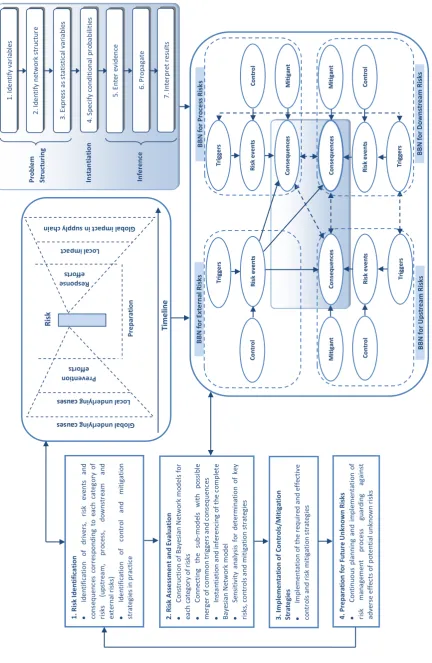
We have developed a novel framework that captures the interaction between risk factors across the entire supply chain as shown in Figure 1. The risk management framework captures a holistic view of the risks associated with a supply chain. Following is the brief description of this framework:
Risk Identification
Risk identification involves identification of risk drivers, events and the consequences corresponding to each category of risks (upstream, process, downstream and external). We adopt the butterfly concept of risk (Sodhi and Tang, 2012). This stage of the risk management process also includes identification of control and mitigation strategies in place.
Risk Assessment and Evaluation
BBN models are constructed for each category of risks. Modelling a BBN comprises three broad stages of problem structuring, instantiation and inferencing (Sigurdsson et al., 2001). The sub-models for each category of risks are connected in relation to common triggers and consequences. Such modelling of the interaction between multiple risks makes this framework a more realistic abstraction of real time risks as opposed to the conventional risk registers that assume independency of the risk factors. The complete BBN model is instantiated and its inferencing results in the determination of significant risks, controls and mitigation strategies.
Implementation of Controls/Mitigation Strategies
Once the key risk drivers, controls and mitigation strategies are identified, these are implemented in order to achieve the objectives of the focal firm.
Preparation for Future Unknown Risks
Risk management is a closed loop process. The process must evolve in order to prepare for the future risk events. Therefore, risk management is a continuous and dynamic process that involves monitoring of the current risks and repeating the phases of risk management framework for the unknown risks arising in future.
Application on Development Project of Boeing 787 Aircraft
Game Theoretic Analysis
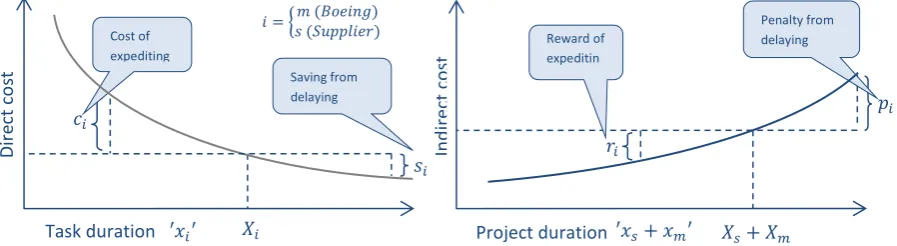
In order to analyze the project through the lens of Game theory, we assume that all the Tier-1 suppliers start their respective tasks at the same time and perform in parallel. Furthermore, the decision to keep or delay the schedule is taken once at the start of the task and therefore, holds good for the entire project. Boeing undertakes the assembly phase only after the completion of tasks by all the suppliers. Direct costs correspond to each task of the project including costs related to labour, material, shipping, etc. Indirect costs do not relate directly to the tasks but these are linked to the project duration. Overhead, delaying penalty, order cancellations and financial losses are some of the examples of indirect costs. A longer task is considered to lower direct costs while a longer project increases indirect costs (Nahmias, 2000). The variation of direct and indirect costs with task and project duration is shown in Figure 2. We consider games between two suppliers and Boeing.
Game between Two Suppliers with Uncertainty regarding Project Completion
In this game, we consider a situation in which both the suppliers are uncertain about the response of Boeing keeping in view delay incurred by one of the suppliers (or both). Therefore, in case of delay, a node represented by ‘Nature’ is introduced having probability ‘r’ denoting the chance of Boeing expediting the project for timely completion as shown in Figure 3. The matrix form of the game is shown in Table 1. In a loss-sharing partnership between two suppliers and OEM, the suppliers may either delay (D) or keep (K) their tasks in time {as given in Equations ( 1 ) and ( 2 )} under following conditions:
All the players having complete knowledge of the cost functions of each other The amount of penalty being greater than the saving resulting from delaying the task An uncertainty ‘r’ related with the completion of project in time
( 1 )
( 2 )
Game between Two Suppliers with Uncertainty about Cost Function of Supplier 2
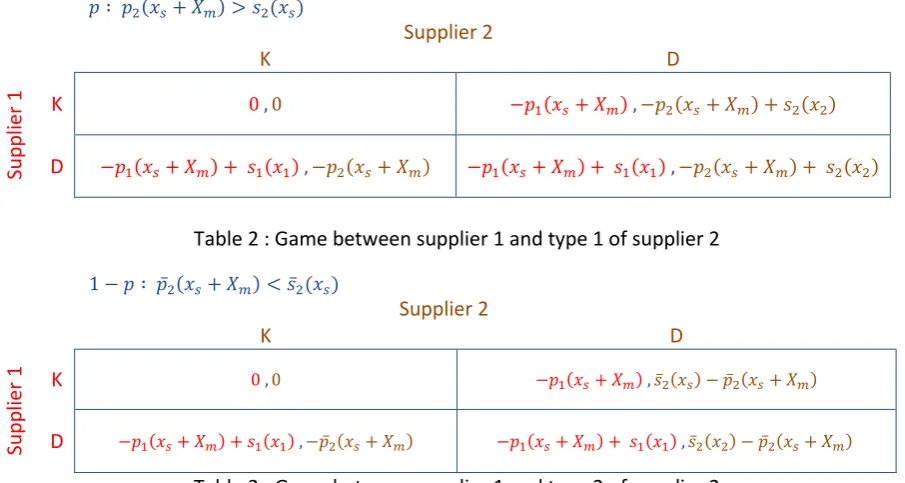
[image:4.595.74.523.247.370.2]In this game, we incorporate uncertainty about the cost function of a supplier. Supplier 1 knows about its pay-offs but cannot differentiate between the two types of Supplier 2; one having penalty function greater than the saving function (Type 1) while the other having converse of it (Type 2). Supplier 2 knows about the pay-offs of both of them. The matrix forms of the game between Supplier 1 and each of the types of Supplier 2 are presented in Table 2 and Table 3 respectively.
Figure 2 : Variation of direct and indirect costs with task and project duration respectively 𝑋𝑖
Cost of expediting
𝑠𝑖
Dire
ct
co
st
Task duration ′𝑥𝑖′
𝑐𝑖
Saving from delaying
𝑖 = 𝑠 𝑆𝑢𝑝𝑝𝑙𝑖𝑒𝑟 𝑚 𝐵𝑜𝑒𝑖𝑛𝑔
𝑋𝑠 𝑋𝑚
Penalty from delaying
Project duration
In
d
ire
ct
cos
t
′𝑥𝑠 𝑥𝑚′
𝑟𝑖
𝑝𝑖
Supplier 2
D K
Su
p
p
lier
1 D { }{ }
{ }{ } { }{ { }{ } }
K { }{ { }{ } }
Table 1 : Matrix form of the game between two suppliers with uncertainty about Boeing’s response
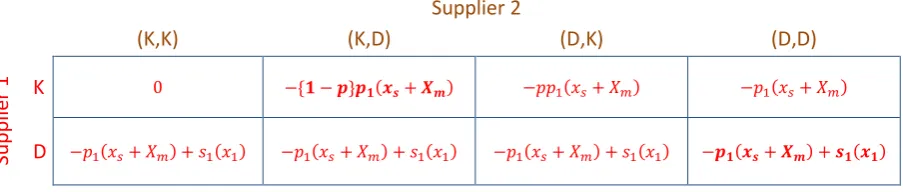
For this situation, a pure strategy Nash equilibrium is defined as a triple of actions (Osborne, 2003); one for Supplier 1 and one for each type of Supplier 2, with the property that the action of Supplier 1 is optimal, given the actions of the two types of Supplier 2 (as shown in Table 4) and the action of each type of Supplier 2 is optimal, given the action of Supplier 1.
Supplier 2
K D
Su
p
p
lier
1 K
[image:5.595.86.514.71.277.2]D
Table 2 : Game between supplier 1 and type 1 of supplier 2
̅ ̅
Supplier 2
K D
Su
p
p
lier
1 K ̅ ̅
D ̅ ̅ ̅
Table 3 : Game between supplier 1 and type 2 of supplier 2
Nature
r
1-r
𝑝 𝑥𝑠 𝑋𝑚 𝑠 𝑥 𝑝 𝑥𝑠 𝑋𝑚 𝑠 𝑥
𝑝 𝑥𝑠 𝑋𝑚 𝑝 𝑥𝑠 𝑋𝑚 𝑠 𝑥
𝑠 𝑥 𝑠 𝑥
𝑠 𝑥
𝑝 𝑥𝑠 𝑋𝑚 𝑠 𝑥 𝑝 𝑥𝑠 𝑋𝑚
𝑠 𝑥
Supplier 1
Supplier 2
D
K
r
1-r D
K
r
1-r D
[image:5.595.130.447.311.411.2]K
[image:5.595.69.522.513.754.2]Supplier 2
(K,K) (K,D) (D,K) (D,D)
Su
p
p
lier
1 K { }
[image:6.595.74.526.74.170.2]D
Table 4 : Expected pay-offs of supplier 1 for each pair of actions of two types of supplier 2
In a loss-sharing partnership between two suppliers and OEM, the suppliers may either delay or keep their tasks in time {as given in Equations ( 3 ), ( 4 ) and ( 5 )} under following conditions:
A supplier having uncertainty about the cost function of other supplier
The amount of penalty being greater than the saving resulting from delaying the task for the supplier having incomplete information
{ } { } ( 3 )
{ } ( 4 )
{ } ( 5 )
Bayesian Belief Network Analysis
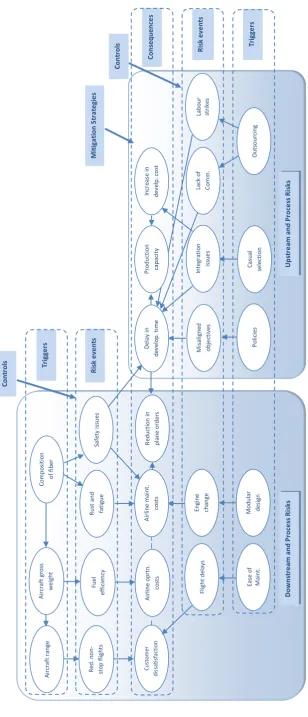
We developed cognitive maps based on the qualitative case studies published in peer-reviewed journals. This was followed by the construction of three BBN models comprising the oversimplified model based on Boeing’s perception, real time model excluding game theoretic risks and an integrated model of all the risks including game theoretic risks. The models were populated on the basis of publically available statistics and the judgement of two of the researchers having expertise in aviation industry. The application of our developed framework on the Boeing 787 project is shown in Figure 4.
The model clearly illustrates the interdependency between risk triggers, events and consequences. Controls can be devised to inhibit the probability of the occurrence of a risk event while mitigation strategy helps reducing the impact of the resulting consequence. Such a model can help decision makers visualize the dynamics of interacting risk factors in order to take well-informed decisions. The comparison of three developed models is tabulated in Table 5. Boeing was over optimistic in considering the probability of development cost and time exceeding the expectation being as low as 0.22 and 0.09 respectively. Once the interdependency of risks was considered (excluding game theoretic risks), the relevant probabilities increased to 0.79 and 0.76 respectively. However, the incorporation of game theoretic risks made the project vulnerable to major delays augmenting the probabilities to the highest values of 0.81 and 0.98 respectively.
Conclusion
Model
Probability of development cost
(high)
Probability of development time (exceeding schedule) Boeing’s perceived model
(ignoring interdependency between risks) 0.22 0.09 Real model capturing interdependency
between risks excluding game theoretic risks 0.79 0.76 Real model capturing interdependency
between risks including game theoretic risks 0.81 0.98
Table 5 : Comparison of various models developed for Boeing 787 Project
that integrates two techniques of Bayesian belief network and Game theory. The novel framework captures interdependency between risk factors including the Game theoretic risks. We have applied our framework on development project of Boeing 787 aircraft. The three developed models have been compared against the quantification of risks and the model incorporating the dynamic interaction of risks including game theoretic risks, projects most reliable estimation of risks. The game theoretic modelling of the behavioural aspects of stakeholders reveals their conflicting incentives in terms of the choice of delaying strategy against timely completion of the project. Integrating the interdependency between risk drivers, events and consequences helps modelling and managing risks in a holistic manner for better decision making.
References
Qazi, A., Quigley, J. and Dickson, A. (2014), ‘A Novel Framework for Quantification of Supply Chain Risks’, 4th Student Conference on Operational Research, University of Nottingham (in press). Christopher, M. and Lee, H. (2004), 'Mitigating Supply Chain Risk through Improved Confidence',
International Journal of Physical Distribution and Logistics Management, Vol. 34, pp. 388-396.
Dogan, I. and Aydin, N. (2011), 'Combining Bayesian Networks and Total Cost of Ownership Method for Supplier Selection Analysis', Computers and Industrial Engineering, Vol. 61, pp. 1072-1085.
Fenton, N. E., Neil, M. and Caballero, J. G. (2007), 'Using Ranked Nodes to Model Qualitative Judgments In Bayesian Networks', IEEE Transactions on Knowledge and Data Engineering, Vol. 19,
pp. 1420-1432.
Khan, O. and Burnes, B. (2007), 'Risk and Supply Chain Management: Creating a Research Agenda',
The International Journal of Logistics Management, Vol. 18, pp. 197-216.
Lockamy III, A. (2011), 'Benchmarking Supplier Risks Using Bayesian Networks', Benchmarking: An
International Journal, Vol. 18, pp. 409-427.
Lockamy III, A. and Mccormack, K. (2012), 'Modeling Supplier Risks using Bayesian Networks',
Industrial Management and Data Systems, Vol. 112, pp. 313-333.
Nahmias, S. (2000), Production and Operations Analysis, Mcgraw-Hill/Irwin.
Nash, J. (1951), 'Non-Cooperative Games', The Annals of Mathematics, Vol. 54, pp. 286-295. Osborne, M. J. (2003), An Introduction to Game Theory, Oxford University Press.
Sigurdsson, J. H., Walls, L. A. and Quigley, J. L. (2001), 'Bayesian Belief Nets for Managing Expert Judgement and Modelling Reliability', Quality and Reliability Engineering International, Vol. 17,
pp. 181-190.
Sodhi, M. S. and Tang, C. S. (2012), Managing Supply Chain Risk, International Series in Operations Research and Management Science, Vol. 172, New York : Springer.
Tang, C. S., Zimmerman, J. D. and Nelson, J. I. (2009), 'Managing New Product Development and Supply Chain Risks: The Boeing 787 Case', Supply Chain Forum: An International Journal, Vol. 10,