Sanford, A.J.S. and Price, J. and Sanford, A.J. (2009) Enhancement and suppression effects
resulting from information structuring in sentences. Memory & Cognition, 37 (6). pp. 880-888.
http://
strathprints
.strath.ac.uk/
19881
/
Strathprints is designed to allow users to access the research output of the University
of Strathclyde. Copyright © and Moral Rights for the papers on this site are retained
by the individual authors and/or other copyright owners. You may not engage in
further distribution of the material for any profitmaking activities or any commercial
gain. You may freely distribute both the url (
http://
strathprints
.strath.ac.uk
) and the
content of this paper for research or study, educational, or not-for-profit purposes
without prior permission or charge. You may freely distribute the url
(
http://
strathprints
.strath.ac.uk
) of the Strathprints website.
880 The relative importance of particular parts of a sentence is signaled through devices of information structuring and prosodic stress, which control the focus of information within sentences, as is made clear in an extensive lin-guistic literature (see, e.g., Gundel, 1999; Halliday, 1967; Jackendoff, 1972; Rooth, 1992). In the present article, our interest is in the cognitive effects of linguistic prominence, which can be manipulated through information structur-ing devices, such as the it-cleft construction. This con-struction is illustrated in (1), which shows how an it-cleft structure can signal prominence linguistically.
(1) It was Harry who threw the snowball at Mary. This construction consists of a presupposed part—that someone threw a snowball at Mary (Delin, 1992; Prince, 1978)—and a new assertion, that Harry was the person who did the throwing (see, e.g., Hedberg, 2000; Prince, 1978). Use of the it-cleft structure clearly distinguishes the given from the new information and enables speakers to single out the clefted constituent in order to focus at-tention on it (Hedberg, 2000). Linguistic analyses suggest that the cleft—it 1 copula 1 clefted constituent—puts the clefted constituent into referential focus. Effectively, sen-tence (1) answers the question Who threw the snowball, putting emphasis on Harry as opposed to on any other individual; hence, the effect of clefting is referred to as contrastive focus (e.g., Rooth, 1992).
It is already well established that linguistic focus leads to a privileged and deeper analysis of the focused term. For
instance, the Moses illusion in form (2) is easily missed, whereas in (3) it is not (Bredart & Modolo, 1988):
(2) Moses put two of each animal on the Ark, true or false?
(3) It was Moses who put two of each animal on the Ark, true or false?
The point of this illusion is that people do not usually notice that it was Noah, not Moses, who put the animals on the Ark. However, because the cleft construction in (3) causes a deeper analysis of the term Moses, detection of the anomaly is higher in this case. A variety of other studies have shown that focused elements are more easily processed at the discourse level. Cutler and Fodor (1979) manipulated contrastive focus through discourse context, presenting sentences such as (4) or (5) before the target sentence (6):
(4) Which man was wearing the hat? (5) What hat was the man wearing?
(6) The man on the corner was wearing the blue hat. Sentence (4) has the effect of putting The man on the corner into narrow focus, whereas (5) has the effect of putting the blue hat into narrow focus. Using a phoneme monitoring task, it was found that the phoneme detection latency was shorter for words in the scope of focus than for words outside of the scope of focus. Similar evidence of enhancement was found by Sturt, Sanford, Stewart, and
from information structuring in sentences
Alison J. s. sAnford
University of Strathclyde, Glasgow, Scotland
And
JessicA PriceAnd Anthony J. sAnford
University of Glasgow, Glasgow, Scotland
Information structuring through the use of cleft sentences increases the processing efficiency of references to elements within the scope of focus. Furthermore, there is evidence that putting certain types of emphasis on individual words not only enhances their subsequent processing, but also protects these words from becoming suppressed in the wake of subsequent information, suggesting mechanisms of enhancement and suppression. In Experiment 1, we showed that clefted constructions facilitate the integration of subsequent sentences that make reference to elements within the scope of focus, and that they decrease the efficiency with reference to elements outside of the scope of focus. In Experiment 2, using an auditory text-change-detection paradigm, we showed that focus has similar effects on the strength of memory representations. These results add to the evidence for enhancement and suppression as mechanisms of sentence processing and clarify that the effects occur within sentences having a marked focus structure.
Focusand cleFt constructions 881
Stress could be put on one of two words—for instance, the word election, or the word date. In one condition, date was treated as the target word, and in a subsequent visual presentation, a related word (e.g., time) was given. Par-ticipants performed a lexical decision task, which enabled an estimate of the extent of priming from the target word. The question was whether there would be more priming for the target word in the focused (contrastively stressed) condition than in the unfocused (unstressed) case. Norris et al. found that priming occurred in both stressed and unstressed cases; there were no reliable differences. They claimed (p. 174) that contrastive accent does not increase semantic processing on the accented word alone, but that it encourages fuller processing of the meaning of the sentence as a whole. This finding stands in contrast with the claims of numerous other results cited earlier. For the purpose of the present study, however, note that the prim-ing effect obtained for the accented word was 43 msec, whereas for the deaccented word, it was 24 msec. So, nu-merically at least, there is some evidence for a trend in selective enhancement.
The present experiments were concerned with cleft constructions—prime exemplars of information structur-ing. We made a direct test of the influence of informa-tion structuring (cleft and pseudocleft construcinforma-tions) on elements that were either within (8) or outside of (10) the scope of focus. We assessed both enhancement and suppression by using a control condition with no narrow focus, which will be referred to as a “neutral” condition, as in (9):
(8) At the party, what Harry liked was the cake. (Cake in narrow focus)
(9) At the party Harry liked the cake. (Neutral) (10) At the party, it was Harry who liked the cake. (Cake outside scope of focus, but Harry in narrow focus)
The critical issue here was whether cake was advantaged (in terms of some measure of accessibility or depth of pro-cessing) in (8) over the neutral condition (9), and whether it would be disadvantaged in (10) as compared with the neutral condition.
We assessed the effects of such information structuring on processing in two experiments. In the first, we used self-paced reading time for an anaphoric sentence. The self-paced reading procedure enables the relative ease of the processing of references to be examined. For a concept to be easily available for pronominal reference, it has to be prominent in the discourse representation (Garnham, 2001; A. J. Sanford & Garrod, 1981). Central to linguis-tic ideas of how an element within the scope of focus of an it-cleft is treated is the proposal that this element is more referentially available (see, e.g., Gundel, Hedberg, & Zacharski, 1993). Therefore, one can reason that the time to integrate a sentence containing a pronominal ana-phor to an antecedent in an earlier sentence will be longer if the antecedent is more difficult to process than it would be if it was easily processed. This reasoning has been used to investigate various aspects of prominence and focus Dawydiak (2004), who used a visual presentation. They
used a text-change task, in which readers saw two succes-sive versions of short passages; the second presentations of the passages sometimes contained a small alteration, comprising a changed word. If the word that changed was within the scope of focus, then detection was enhanced, as opposed to when it was not within the scope of focus, suggesting a stronger memory trace for that word.
Other studies have shown that focus enhances memory for terms within its scope, and that it also enhances prim-ing (Birch, Albrecht, & Myers, 2000; Birch & Garnsey, 1995; Birch & Rayner, 1997). More recently, Cowles, Walenski, and Kluender (2007) showed that both topical-izing an individual in a sentence or short text, and using cleft constructions to manipulate focus, reduced the time required to name the individual that was emphasized. Using auditory presentations, they found that it was nec-essary to put stress on the word within the scope of the it-cleft in order to obtain clear effects, suggesting that for spoken presentations, corresponding stress is important. In addition, anaphoric resolution is easier for focused than for nonfocused antecedents (Almor, 1999). This type of facilitation has been replicated, and its basis has been examined in detail by Foraker and McElree (2007), which will be discussed later. Raising prominence also ensures that when there are several possible antecedents for a pronoun, the selection of the appropriate one is fa-cilitated (see, e.g., Greene, McKoon, & Ratcliff, 1992; A. J. Sanford & Garrod, 1981; see Cowles et al., 2007, for a discussion of various factors in the pronoun–antecedent selection process).
There is also work suggesting the existence of sup-pression effects (Gernsbacher & Jescheniak, 1995; see also Gernsbacher, 1989). Using a probe-recognition task, Gernsbacher and Jescheniak showed that the use of vocal stress can bring about both enhancement of the accessi-bility of a concept and the suppression of access to an earlier unstressed concept in the same sentence. One issue with the Gernsbacher and Jescheniak results is that they demonstrated suppression effects only on unstressed con-cepts that preceded the introduction of a vocally stressed concept. A more general issue is whether the presence of a stressed (or focused) concept results in the suppression of other concepts, regardless of whether they precede or follow the focused item. Whether mechanisms of en-hancement and suppression can be demonstrated for cleft structures in which (in some cases) unfocused concepts follow focused concepts is an open question. Addition-ally, Gernsbacher and Jescheniak’s demonstrations were restricted to the use of the probe technique; there has been no demonstration of suppression effects in conventional anaphoric resolution, for example.
Finally, it is worth noting that one other piece of re-search introduces a complication. Using a cross-modal priming paradigm, Norris, Cutler, McQueen, and Butter-field (2006, Experiment 4C) examined the effect of con-trastive accent in spoken stimuli, as in:
experimental stimuli appeared in each file, with six stimuli appear-ing in each of the six conditions. In addition, to each file was added 64 filler items from an unrelated experiment.
Participants
Forty-two adults from the Glasgow University community took part in the experiment and were each paid £5. All were native speak-ers of English, with either normal or corrected-to-normal vision.
Procedure
The sentences were presented on a PC laptop using E-Prime (Schneider, Eschman, & Zuccolotto, 2002). Participants read at their own pace, pressing the space bar in order to display each sentence. They read the passages line by line on a computer screen, and read-ing times to the target sentence with millisecond accuracy were col-lected. Participants were instructed to read at their normal rate, and they were simply told to read for meaning. They then had to answer a comprehension question; for example, the comprehension question associated with the sample presented in Table 1 was “Did he/she wander off to the zoo?”
Results and Discussion Accuracy
There was a high proportion of correct answers to the comprehension questions, at 86.4% (SD 5 2.15) under the pseudocleft condition, at 85.7% (SD 5 5.17) under the cleft condition, and at 87.2% (SD 5 6.13) under the neutral baseline condition. None of these numerical dif-ferences was statistically reliable.
Global Reading Time Effects
The overall reading time results are shown in Figure 1. ANOVAs were carried out by participants (F1) and by items (F2) on these data. The only reliable effect was the interaction between the anaphoric sentence (to NP1 or NP2) and the focus condition (cleft, neutral, pseudocleft) [F1(2,82) 5 24.10, p , .001; F2(2,70) 5 21.43, p , .001]. (Almor, 1999; Anderson, Garrod, & Sanford, 1983;
Gor-don & Scearce, 1995; Hudson, Tanenhaus, & Dell, 1986; A. J. Sanford, Moar, & Garrod, 1988; see Garnham, 2001, for other examples).
Our predictions were as follows: If focus leads to en-hancement of anaphoric integration of elements in focus, then anaphoric sentences should be read more rapidly, providing empirical support for a selective process. Simi-larly, elements not in the scope of focus of cleft sentences should be suppressed relative to those of a control sen-tence, and anaphoric sentences should thus be read more slowly. Experiment 1 represented a test of enhancement and suppression within the context of a naturally occur-ring discourse process (anaphoric integration), and is completely novel with respect to the suppression claim.
Experiment 1 only allowed a check on anaphoric pro-cessing efficiency as a result of information structuring. In Experiment 2, we investigated a possible basis for the anaphoric processing effect using a text-change procedure (see, e.g., A. J. Sanford & Sturt, 2002; Sturt et al., 2004), which is essentially a test of the quality of the memory rep-resentation of elements (NPs) within and beyond the scope of focus. It also allows a test of alternative conceptions of how focus operates on memory, implementing the selectiv-ity we expect to find. Considerations specific to this ex-periment, along with the significance of using text change, are discussed in the introduction to Experiment 2.
ExPERimEnT 1 Self-Paced Reading Time
In Experiment 1, we investigated focus effects by using a whole-sentence self-paced reading time paradigm.
method Design and materials
A set of 36 sentence pairs was created (see Table 1 for an ex-ample). Each pair of sentences consisted of a sentence in a cleft, pseudocleft, and neutral form, and of a target sentence in which the pronoun referred to either NP1 or NP2. In the cleft version, focus was always on NP1, whereas in the pseudocleft version, it was on NP2. There were thus six conditions in all: 3 (antecedent sentence type) 3 2 (anaphor referring to NP1 or NP2).
The design allowed for tests of both focus enhancement and sup-pression. Thus, to show cleft focus enhancement, the appropriate comparison was between target sentences referring to NP1 in the cleft case, as compared with NP1 in the neutral case. To test for suppression, the corresponding comparison was between target sen-tences referring to NP2 in the cleft case, and targets referring to NP2 in the neutral case. For the pseudocleft case, mutatis mutandis, to check for focus-based enhancement, the comparison was between NP2 reading times, whereas to check for suppression, the compari-son was between NP1 reading times.
[image:4.576.86.468.88.135.2]The 36 experimental stimuli were assigned to six different scripts, so that a given stimuli appeared in only one of its six conditions in a given file, but in all six conditions when rotated over files. Thus, all
Table 1
Sample Stimuli for Experiment 1
Cleft Form Pseudocleft Neutral
It was John who lost his daughter. What John lost was his daughter. John lost his daughter.
He/She had wandered off in the park. He/She had wandered off in the park. He/She had wandered off in the park.
1,000 1,200 1,400 1,600 1,800 2,000 2,200
NP1 NP2
Noun Phrase
Mean Reading Time (msec) Cleft Pseudocleft Neutral
[image:4.576.284.511.563.706.2]Focusand cleFt constructions 883
tences referring to focused elements, and they reduced the efficiency of the integration of sentences referring to unfo-cused elements. This was independent of the order in which the focused and unfocused elements were introduced.
ExPERimEnT 2 Text-Change Detection With
Pseudocleft Constructions
In Experiment 1, we utilized a whole-sentence reading time paradigm to examine differential effects on the in-tegration of anaphoric sentences with an earlier sentence that had the key element in or out of the scope of focus. In Experiment 2, we assessed how being within or outside of the scope of focus influenced the representation of a key element. We used the text-change detection paradigm, in which participants hear (or read) a brief text on two suc-cessive presentations. With this procedure, there may be a change to a word on the second presentation, and the par-ticipant’s task is to indicate when they detect a change. The method is analogous to perceptual change detection, which has been prominent in the vision science literature (e.g., Simons & Levin, 1997) as a way of determining where at-tention is deployed within a scene. In the same way, the detection of changes to a word in a text indexes the attention paid to that word and the effect that this has on its memory representation. It has been shown that detection is sensi-tive to clause status (A. J. Sanford, 2002), discourse focus (A. J. S. Sanford, Sanford, Molle, & Emmott, 2006; Sturt et al., 2004), syntactic and referential complexity (A. J. S. Sanford, Sanford, Filik, & Molle, 2005), and text-based de-vices of emphasis (Emmott, Sanford, & Dawydiak, 2007). Sturt et al. (2004) used change detection to examine the effects of cleft constructions and of contextual manipula-tion of contrastive focus (comparable to Cutler & Fodor, 1979, who manipulated spoken stress). They observed that changes to words within the scope of focus result in better detection than do changes to words that are not fo-cused. However, Sturt et al. did not test the idea that words in cleft constructions that are outside of the scope of focus might show a suppression effect, and this was the primary question under investigation in Experiment 2. Changes to such words should be less well detected, relative to those of a neutral control.
A secondary question concerns the nature of enhance-ment and suppression. Although there is evidence for a strengthened memory representation for items in focus, there has been relatively little discussion of the nature of enhancement. However, Foraker and McElree (2007) claimed that words in focus result in more distinct repre-sentations than do those that are not in focus. This idea is similar to the theory used by Sturt et al. (2004), which is based on the notion of the granularity of representations (Hobbs, 1985). The logic is that when the level of the rep-resentation of a word is so coarse that it is indistinguish-able from the representation of a related word, a change from the original to the related word will not be noticed. According to the granularity theory (Sturt et al., 2004), focus works by making the granularity of a representation finer, resulting in an increase in detections of change. This pattern is exactly what would be expected given a
pattern of enhancement for focused elements (NP1 for the cleft construction, NP2 for the pseudocleft) and of suppression for the unfocused elements (NP2 for the cleft construction, NP1 for the pseudocleft). These different patterns for cleft and pseudocleft emerge clearly. However, to make the argument of enhancement and suppression fully, each case has to be examined against the appropriate baseline in the neutral sentence. This was done through four planned comparisons, which are detailed below.
Enhancement and Suppression Effects
In order to test for relative enhancement and suppres-sion, comparisons of reading times were made between the neutral (simple declarative) sentence and the cleft and pseudocleft sentences.
Cleft construction. Comparisons by t test were made separately to check for enhancement and suppression ef-fects. To check for enhancement, the target sentence read-ing times for the anaphoric reference to the focused el-ement of the cleft sentences (NP1) were compared with those for NP1 in the neutral sentences, with reading times being shorter for the cleft condition than for the neutral condition. This difference in reading times (256 msec) is reliable [t1(41) 5 2.78, p , .01, and t2(35) 5 2.09, p , .05]. Thus, there was a clear enhancement of integration when the critical anaphoric NP was in focus, as was ex-pected. To determine whether there was a suppression ef-fect, the reading times for the unfocused comparison (NP2) were examined. This time, the unfocused element in the cleft construction led to a longer reading time than did the corresponding neutral control (a difference of 261 msec) [t1(41) 5 2.54, p , .01, and t2(35) 5 2.41, p , .05]. There was a reduction in integration efficiency relative to base-line when the NP in question was not in focus. In this case, the unfocused NP was subsequent to the focused NP.
Pseudocleft construction. To test whether pseudocleft focusing leads to enhancement and suppression, we com-pared target reading times for anaphoric sentences in the focused element versus the neutral element (NP2), and to test for suppression, we compared reading times for NP1.
For the pseudocleft focused comparison, the target sen-tence was read 164 msec faster in the focused condition than in the neutral condition [t1(41) 5 2.30, p , .05, and t2(35) 5 2.53, p , .05]. Thus, there was an enhancement of integration relative to baseline when the NP in question was in focus. For the unfocused comparison, there was an increase of 336 msec in target sentence reading time as compared with that in the neutral condition when the NP was outside of the scope of focus [t1(41) 5 2.43, p , .05, and t2(35) 5 2.29, p , .05]. In this case, the unfocused NP preceded the focused NP. There is thus evidence of a reduction in integration efficiency relative to baseline when the NP in question was not in focus.
sen-cies showed no reliable difference (F , 1). Furthermore, the words were approximately equated for length: first by the number of let-ters [original 5 5.63, close 5 5.67, distant 5 5.33 (SE 5 .31)], and second by the number of syllables [original 5 1.54, close 5 1.67, distant 5 1.63 (SE 5 .14)]. Two separate one-way ANOVAs showed no reliable differences (both Fs , 1).
In addition to the 24 experimental stimuli, 24 filler items with the same three constructions were created (matched fillers), but these did not contain a change on the second presentation. A further 32 filler items with different structural configurations were added to the set of stimuli; 24 of these contained very obvious changes ranging over locations from early in the first sentence to late in the final sen-tence. The remaining 8 contained no changes across presentations. Previous work (see, e.g., A. J. S. Sanford et al., 2005) had dem-onstrated that this mixture of fillers—with and without changes— eliminated the ability of participants to predict when a change might occur. The stimuli were assigned to six playlists; each contained only one of the six possible versions of each experimental stimuli. The 32 fillers (in three versions) were rotated over the files so that each type appeared equally often in the lists.
Recording. The stimuli were recorded by speakers from the Royal Scottish Academy of Music and Drama to ensure that the recordings were of clear voice quality. A male’s voice was used for the record-ing of the first presentation, and a female’s voice was used for the second, in order to minimize the possibility of participants detecting surface changes. Speakers were asked, when reading the stimuli, to consider the point of the story (i.e., who was the main character or what was the theme) and to read the stimuli clearly and naturally. A 5-sec interval followed each pair of stimuli on the recording. The stimuli were arranged in the playlists in a fixed, random order.
With speech, much of the information structuring signal is carried by well-understood changes in pitch track (see, e.g., Ladd, 1996; Pierrehumbert & Hirschberg, 1990), in which there are changes in the fundamental frequency and duration of words within the scope of focus. Recall that Cowles et al. (2007)—in their comparison of different devices of emphasis—found that only when contrastive stress was given to a word within the scope of it-cleft focus was there any enhancement effect. In the present case, we established whether natural pitch-track changes were present in our stimuli. Pitch-track data on the spoken experimental stimuli were obtained using Praat— a freeware program for the analysis and reconstruction of acoustic speech signals (Boersma & Weenink, 2005). Measures of duration and changes in pitch contour (maximum 2 minimum fundamental frequency, f 0) were taken from the speech record for each target word, when it was in the pseudocleft (henceforth “focus”), cleft (henceforth “unfocused”), and neutral conditions.
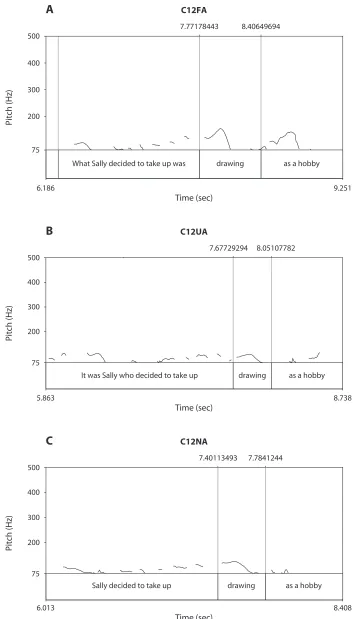
Examples of pitch accent occurring on the target words in one experimental stimulus are shown in Figures 2A, 2B, and 2C. These figures illustrate the annotated pitch contour (changes in the fun-We can illustrate how focus works by using an example
(11) taken from Sturt et al. (2004):
(11) Everyone had a good time at the pub. A group of friends had met up there for a stag night. It was Jamie who really liked the cider, apparently.
The focus of the final sentence is on Jamie, so even though the word cider occurs in the text, it may be represented at such a coarse level of granularity as to be distinguishable only as a drink. So, if the word is changed from cider to beer, this change would not be noticeable. In contrast, if a change was made to a very different concept, such as music, then this would be detectable. At coarse levels of granularity, large semantic changes would be noted, but small differences would not. In contrast, at fine levels of granularity, both small and large changes should be noted. So, if an experimental manipulation compared conditions in which coarse and fine levels were contrasted, there should be an interaction between the semantic distance of changes and granularity condition, with the small se-mantic changes showing a bigger effect of granularity. This interaction was reported by Sturt et al. and was taken as support for the granularity hypothesis. The account differs from previous explanations of focus, which sug-gest that focus simply increases the ease of referring to an item.
Thus, our first question was whether we could show suppression effects in Experiment 2, and the second was whether we could obtain the same pattern of interaction obtained by Sturt et al. (2004) for enhancement (a replica-tion) and suppression (constituting novel data).
method Design and materials
A total of 24 experimental stimuli were constructed; each con-sisted of three sentences. An example is shown in Table 2. For each experimental stimulus, three versions were constructed: pseudocleft, cleft, and neutral. Changes to one word (the noun of NP2) were made in the second presentation of the stimuli. In half of the experi-mental stimuli, this change occurred in the second sentence, and in the other half of the experimental stimuli, the change occurred in the third sentence. The change could be either to a closely related word, or to a distantly related word. So, the full design was 3 (pseudocleft, cleft, or neutral) 3 2 (close or distant change).
The semantic distance variable was validated over the word sets by pretesting for differences in perceived semantic distance. Twenty-four independent participants rated the semantic relationship be-tween the original word and the close and distant changes on a 10-point scale: Low ratings indicated dissimilarity, and high ratings indicated similarity. The ratings were made with the words shown within the context of the experimental stimuli. All 24 stimuli showed significant differences between the semantically distant and seman-tically close word conditions (all ps , .001). Additionally, there was a reliable difference between the overall rating for the close (M 5
7.72, SD 5 1.94) and the distant (M 5 2.30, SD 5 1.46) conditions (sign test, p , .001).
Since word frequency and length might also influence the likeli-hood of detecting a change, these were matched over the original, distant, and close changes by determining how frequently each word occurred in the British National Corpus (900 million words). The mean log frequencies of occurrence per million were: original 5
3.03 (SE 5 .15), close change 5 3.01 (SE = .16), distant change 5
3.21 (SE = .19). A one-way ANOVA carried out on these
frequen-Table 2
Sample Stimuli for Experiment 2 Focusing Pseudocleft Sentence
Everyone had just got back from a long and tiring swim in the sea. What Simon sat down on was the chair near the beach hut. The picnic lunch was very welcome.
Unfocusing Cleft Sentence
Everyone had just got back from a long and tiring swim in the sea. It was Simon who sat down on the chair near the beach hut. The picnic lunch was very welcome.
Neutral Sentence
Everyone had just got back from a long and tiring swim in the sea. Simon sat down on the chair near the beach hut. The picnic lunch was very welcome.
Focusand cleFt constructions 885
A
What Sally decided to take up was drawing as a hobby 75
500
200 300 400
Pitch (Hz)
Time (sec)
6.186 9.251
7.77178443 8.40649694
C12FA
B
It was Sally who decided to take up drawing as a hobby 75
500
200 300 400
Pitch (Hz)
Time (sec)
5.863 8.738
7.67729294 8.05107782
C12UA
C
Sally decided to take up drawing as a hobby 75
500
200 300 400
Pitch (Hz)
Time (sec)
6.013 8.408
7.40113493 7.7841244
[image:7.576.122.475.86.705.2]C12NA
condition (close condition, p , .01; distant condition, p , .05) or the neutral condition (close, p , .05; distant, p , .001). Differences in the change in pitch were nonsignificant between the unfocused and neutral conditions (close, p . .1; distant, p . .05). Overall, these results show that critical words in the first or second presentation in the focused condition had longer durations and larger changes in pitch than did critical words in the other two conditions. This pat-tern holds true for both speakers and, for Speaker B, the patpat-tern is consistent across both of the levels of semantic distance.
Participants
Ninety students from the Glasgow University community took part in the experiment; they were each paid £5. All were native speakers of English. None were aware of the purpose of the study.
Procedure
Testing took place in a quiet room with only the experimenter and participant present. Before the experiment began, the participants were given written instructions explaining that they were going to hear a series of vignettes, each repeated twice, and that some of the vignettes might have a small change the second time they were heard. Each participant listened to the 80 stimuli through a laptop computer; the sound was tested beforehand to ensure that the par-ticipant could hear the sentences clearly. After each pair of presenta-tions of a vignette, the recording was paused and the participant was asked whether he or she had noticed a change between the two pre-sentations, and if so, exactly what the changes were. A response was considered correct if the participant noticed the change and could state what the change involved (e.g., chair changed to seat). The experimenter was present throughout the whole session and noted the participants’ responses.
Results and Discussion
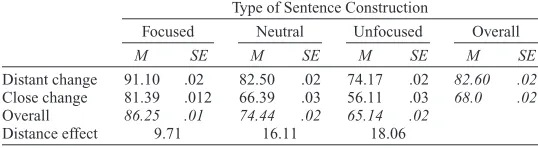
The mean percentages of changes correctly detected are shown in Table 4, along with an indication of the semantic distant effects under each focus condition.
The arcsine-transformed proportional data were ana-lyzed using a 3 (sentence type) 3 2 (close vs. distant change) ANOVA. Detection rates were higher for dis-damental frequency, f 0) for the target sentence in the experimental
stimulus, with the critical word (drawing) separated out so that mea-sures of duration and changes in pitch can be obtained.
In Figure 2A, the focus condition, the pitch accent on the word drawing rises sharply before falling, forming what Ladd (1996) has described as the “hat”-shaped pitch contour. Note also that the dura-tion of the critical word is longer—a typical indicadura-tion of emphasis being added to a word. In Figure 2B, the unfocused condition, the main focus of the sentence is on the subject (Sally) rather than on the critical word, which receives less emphasis, resulting in smaller changes in pitch and in a shorter duration of the critical word. In the neutral condition (Figure 2C), the pitch contour over the word drawing is relatively flat, and the duration is also shorter than it is in the focused condition.
The data (means and SEs) are presented in Table 3. Since Speaker B recorded the second presentations of stimuli, when the critical words could change to either a related or unrelated word, the data for this speaker have been further divided, so that the patterns for the stimuli when the critical word changed can be displayed.
A one-way repeated ANOVA and post hoc analysis showed that for Speaker A, the manipulations of focus had resulted in longer durations of the critical word ( p , .001) when the word was the focus of the sentence than when the word was unfocused or when the word occurred in the neutral condition ( p , .001). However, no dif-ferences in duration were observed between unfocused and neutral conditions ( p . .10). A similar pattern was obtained for changes in pitch, with larger changes in pitch occurring for critical words in the focused condition than in the unfocused condition ( p , .01) or the neutral condition ( p , .05). Differences in the change in pitch were nonsignificant between the unfocused and neutral conditions ( p . .10).
An analysis of the speech data for Speaker B showed main effects for both duration ( p , .001) and changes in pitch ( p , .005). In both of the semantic distance conditions, longer durations of the critical word occurred when that word was in focus ( p , .001) than when the word was either unfocused or the word occurred in the neutral condition ( p , .001). Again, no differences in duration were observed between unfocused and neutral conditions ( p . .05).
[image:8.576.94.457.113.189.2]The analysis of the pitch data from Speaker B, for both closely and distantly related critical words, revealed larger changes in pitch for critical words in the focused condition than in the unfocused
Table 3
means and Standard Errors of Duration and Changes in Pitch for Speaker A (First Presentation) and for Speaker B (Second Presentation, Closely and Distantly Related Words), for Each Focus Condition
Duration of Words (sec) Maximum 2 Minimum Pitch (Hz)
Focused Unfocused Neutral Focused Unfocused Neutral
M SE M SE M SE M SE M SE M SE
Speaker A .58 .02 .39 .02 .39 .02 112.77 24.36 54.29 15.66 49.80 10.53 Speaker B
Close .52 .02 .42 .02 .42 .20 117.61 1.88 70.60 6.07 80.78 7.19 Distant .54 .02 .42 .02 .41 .02 102.18 10.24 80.43 8.43 61.99 4.71
Table 4
mean Proportions and Standard Errors of Correct Detections Due to Sentence Construction and Semantic Relatedness of Words That Changed
in items, including the Distance Effect (Distant 2 Close) Type of Sentence Construction
Focused Neutral Unfocused Overall M SE M SE M SE M SE Distant change 91.10 .02 82.50 .02 74.17 .02 82.60 .02 Close change 81.39 .012 66.39 .03 56.11 .03 68.0 .02
Overall 86.25 .01 74.44 .02 65.14 .02
[image:8.576.141.410.658.732.2]Focusand cleFt constructions 887
have demonstrated that the order of focused and unfocused elements has no effect on this. Primarily, Gernsbacher and Jescheniak’s studies aimed to test the idea that stressed (or focused) elements are enhanced, and that a stressed ele-ment will suppress a previously presented eleele-ment. We are not claiming, as they did, that an unfocused element is sup-pressed by a subsequent, focused element. Rather, we have shown that cleft constructions bring about enhancement of focused words and suppression of unfocused elements, regardless of the order in which they appear.
In Experiment 2, we explored the strength of the mem-ory trace of words within and outside of the scope of focus using a text-change detection procedure. The results again showed that for cleft constructions, enhancement effects (better detection relative to a control) occurred for words within the scope of focus, and that suppression effects (poorer detection) occurred for words outside of the scope of focus. In this study, suppression effects were also ob-served in the case in which the unfocused word followed the focused word, as in Experiment 1. These findings may be taken as consistent with the position of Foraker and McElree (2007) with respect to enhancement effects with cleft constructions. Using speed–accuracy trade-off esti-mates of accessing antecedents, these investigators con-cluded that clefting increases the strength of the represen-tation of a focused word in memory.
The results of both experiments run counter to the claim by Norris et al. (2006) that there are no differential en-hancement effects among constituents of a sentence that are given contrastive stress. Because our data plainly show that in the case of clefting there are not only differential effects, but also suppression effects, we suggest that their findings are limited to the particular case they presented, or that they are incorrect in general (as was argued in the introduction).
Experiment 2 enabled us to test the idea that when a word is in focus, its meaning representation is at a finer grain than when it is not in focus. This view is consis-tent with Foraker and McElree’s (2007) idea that stronger memory representations are more distinct representations. According to the granularity account (Sturt et al., 2004), changes to words in focus should be more detectable than to words not in focus, and the semantic distance effect should be reduced for these items. This is because finer grains of representation will give an advantage to words with similar meanings as opposed to words with very dif-ferent meanings. By extension, for Experiment 2, the se-mantic distance effect should be smaller for the focused condition than for the control (due to an increase in the fineness of grain), and it should be larger for the unfo-cused condition than for the control (due to a decrease in the fineness of grain).
For the enhancement effect (focused as compared with baseline), there was some evidence for such an interac-tion, although it was present only in the by-subjects analy-sis. For the suppression effect (unfocused as compared with baseline), there was no trace of an interaction. Thus, the granularity hypothesis received some support in the case of enhancement, but not in the case of suppression. This result could be due to a lack of sensitivity or power in tant than for close changes [F1(1,89) 5 84.66, p , .001;
F2(1,23) 5 20.04, p , .001]. There was a main effect of focus [F1(2,178) 5 64.03, p , .001; F2(2,46) 5 37.88, p , .001]. Planned comparisons (Bonferroni) revealed that the differences between focus conditions were all significant (all ps , .001), showing suppression and en-hancement effects. Suppression of the unfocused element occurred, even though it followed the focused element.
There was a trace of an interaction [F1(2,178) 5 3.78, p , .05], but it was nonsignificant by items [F2(2,46) 5 1.23, p . .10]. To examine the specific effects of enhance-ment and suppression on the granularity of processing, a series of 2 (focus) 3 2 (semantic distance) ANOVAs were conducted, comparing the distance effect in each pair of focus conditions (i.e., focused/unfocused, focused/ neutral, unfocused/neutral). First, an analysis comparing the focused/unfocused condition’s interaction with se-mantic distance revealed a significant interaction by F1 but not by F2 [F1(1,89) 5 7.43, p , .01; F2(1,23) 5 1.94, p 5 .18]. Detecting changes to semantically related words was more facilitated when the critical word was in focus. This analysis replicates the results reported by Sturt et al. (2004). The interaction between the focused/neutral condi-tions and semantic distance was also significant by F1, but not by F2 [F1(1,89) 5 3.83, p , .05; F2(1,23) 5 .61, p 5 .44]. Finally, the two-way interaction between unfocused/ neutral conditions and semantic distance was not reliable [F1(1,89) 5 0.58, p 5 .45; F2(1,23) 5 0.83, p 5 .14]. These results thus provide some evidence in favor of a granularity account for enhancement, but there is no sup-port for a granularity account for suppression (although the data are numerically in the right direction).
GEnERAl DiSCuSSion
Cleft constructions are used to put emphasis on ele-ments within the scope of the cleft. In the present article, we explored the mechanisms through which emphasis is realized, using two experimental procedures. In Experi-ment 1, we explored anaphoric integration, a key eleExperi-ment of discourse comprehension. The experiment utilized a self-paced sentence-by-sentence reading procedure, al-lowing a test to be made of the ease of anaphoric inte-gration of sentences referring to antecedents that were within the scope of clefting (focus), or beyond the scope of clefting, or in simple declarative control constructions. The results showed enhanced (faster) integration for ana-phors referring to words within the scope of clefting than for the control case, but suppressed (slower) integration for anaphors to words outside of the scope of clefting, as compared with those for the appropriate control. This result has not been observed previously with anaphoric integration. Furthermore, the suppression and enhance-ment effects occurred regardless of the order in which the focused and unfocused elements were introduced.
Gordon, P. C., & Scearce, K. A. (1995). Pronominalization and dis-course coherence, disdis-course structure and pronoun interpretation. Memory & Cognition, 23, 313-323.
Greene, S., McKoon, G., & Ratcliff, R. (1992). Pronoun resolu-tion and discourse models. Journal of Experimental Psychology: Learning, Memory, & Cognition, 18, 266-283. doi:10.1037/0278 -7393.18.2.266
Gundel, J. K. (1999). On three kinds of focus. In P. Bosch & R. van der Sandt (Eds.), Focus: Linguistic, cognitive and computational perspec-tives (Studies in natural language processing) (pp. 293-305). Cam-bridge: Cambridge University Press.
Gundel, J. K., Hedberg, N. A., & Zacharski, R. (1993). Cognitive status and the form of referring expressions in discourse. Language, 69, 274-307.
Halliday, M. A. K. (1967). Notes on transitivity and theme in English— Part 2. Journal of Linguistics, 3, 199-244.
Hedberg, N. A. (2000). The referential status of clefts. Language, 76, 891-920.
Hobbs, J. P. (1985). Granularity. In A. Joshi (Ed.), Proceedings of the 9th International Conference on Artificial Intelligence (pp. 432-435). Los Altos, CA: Morgan Kaufmann.
Hudson, S. B., Tanenhaus, M. K., & Dell, G. S. (1986). The effect of the discourse center on the local coherence of a discourse. In Proceed-ings of the 8th Annual Conference of the Cognitive Science Society (pp. 96-101). Hillsdale, NJ: Erlbaum.
Jackendoff, R. (1972). Semantic interpretation in generative grammar. Cambridge, MA: MIT Press.
Ladd, R. (1996). Intonational phonology. Cambridge: Cambridge Uni-versity Press.
Norris, D., Cutler, A., McQueen, J. M., & Butterfield, S. (2006). Phonological and conceptual activation in speech comprehension. Cog-nitive Psychology, 53, 146-193. doi:10.1016/j.cogpsych.2006.03.001 Pierrehumbert, J., & Hirschberg, J. (1990). The meaning of
intona-tional contours in the interpretation of discourse. In P. Cohen, J. Mor-gan, & M. Pollack (Eds.), Intentions in communication (pp. 271-311). Cambridge, MA: MIT Press.
Prince, E. F. (1978). A comparison of wh-clefts and it-clefts in dis-course. Language, 54, 883-906.
Rooth, M. (1992). A theory of focus interpretation. Natural Language Semantics, 1, 75-116.
Sanford, A. J. (2002). Context, attention and depth of processing dur-ing interpretation. Mind & Language, 17, 188-206. doi:10.1111/1468 -0017.00195
Sanford, A. J., & Garrod, S. C. (1981). Understanding written lan-guage: Explanations in comprehension beyond the sentence. Chi ches-ter, U.K.: Wiley.
Sanford, A. J., Moar, K., & Garrod, S. C. (1988). Proper names as controllers of discourse focus. Language & Speech, 31, 43-56. Sanford, A. J., & Sturt, P. (2002). Depth of processing in language
comprehension: Not noticing the evidence. Trends in Cognitive Sci-ences, 6, 382-386. doi:10.1016/S1364-6613(02)01958-7
Sanford, A. J. S., Sanford, A. J., Filik, R., & Molle, J. (2005). Depth of lexical–semantic processing and sentential load. Journal of Mem-ory & Language, 53, 378-396. doi:10.1016/j.jml.2005.05.004 Sanford, A. J. S., Sanford, A. J., Molle, J., & Emmott, C. (2006).
Shal-low processing and attention capture in written and spoken discourse. Discourse Processes, 42, 109-130. doi:10.1207/s15326950dp4202_2 Schneider, A., Eschman, S., & Zuccolotto, A. (2002). E-Prime
user’s guide. Pittsburgh, PA: Psychology Software Tools, Inc. Simons, D. J., & Levin, D. T. (1997). Change blindness. Trends in
Cog-nitive Sciences, 1, 261-267. doi:10.1016/S1364-6613(97)01080-2 Sturt, P., Sanford, A. J., Stewart, A., & Dawydiak, E. (2004).
Linguistic focus and good-enough representations: An application of the change-detection paradigm. Psychonomic Bulletin & Review, 11, 882-888.
(Manuscript received July 29, 2008; revision accepted for publication March 24, 2009.) the data. Or, if we take the findings at face value, it may be
the case that when suppression occurs, it is not through a mechanism of reduction of grain of the semantic represen-tation of the element in question, relative to baseline. Only further experimentation will cast light on this problem.
In sum, we have shown that suppression and enhance-ment effects result from using cleft constructions, and that these effects do not depend on the order in which the fo-cused and unfofo-cused words appear. The effects appear in the act of anaphoric integration, and also in the strength of underlying memory traces revealed by the change detec-tion task. The evidence provides support for the predic-tions of the granularity theory for enhancement, but not for suppression.
AuThoR noTE
J.P. was funded by an ESRC (U.K.) Ph.D. scholarship, and A.J.S.’s contribution was supported by AHRC Grant B/RG/AN8799/APN17330. Address correspondence to A. J. S. Sanford, Department of Psychology, University of Strathclyde, 40 George St., Glasgow G1 1QE, Scotland (e-mail: [email protected]).
REFEREnCES
Almor, A. (1999). Noun-phrase anaphora and focus: The informational load hypothesis. Psychological Review, 106, 748-765. doi:10.1037/ 0033-295X.106.4.748
Anderson, A., Garrod, S. C., & Sanford, A. J. (1983). The acces-sibility of pronominal antecedents as a function of episode shift in narrative text. Quarterly Journal of Experimental Psychology, 35, 427-440.
Birch, S. L., Albrecht, J. E., & Myers, J. L. (2000). Syntactic focusing structures influence discourse processing. Discourse Processes, 30, 285-304. doi:10.1207/S15326950dp3003_4
Birch, S. L., & Garnsey, S. (1995). The effect of focus on memory for words in sentences. Journal of Memory & Language, 34, 232-267. doi:10.1006/jmla.1995.1011
Birch, S. [L.], & Rayner, K. (1997). Linguistic focus affects eye move-ments during reading. Memory & Cognition, 25, 653-660.
Boersma, P., & Weenink, D. (2005). Praat: Doing phonetics by com-puter (Version 4.3.14) [Comcom-puter program]. Retrieved May 31, 2005, from www.praat.org.
Bredart, S., & Modolo, K. (1988). Moses strikes again: Focaliza-tion effects on a semantic illusion. Acta Psychologica, 67, 135-144. doi:10.1016/0001-6918(88)90009-1
Cowles, H. W., Walenski, M., & Kluender, R. (2007). Linguistic and cognitive prominence in anaphor resolution: Topic, contrastive focus, and pronouns. Topoi, 26, 3-18.
Cutler, A., & Fodor, J. A. (1979). Semantic focus and sentence compre-hension. Cognition, 7, 49-59. doi:10.1016/0010-0277(79)90010-6 Delin, J. (1992). Properties of It-cleft presupposition. Journal of
Seman-tics, 9, 289-306. doi:10.1080/01690969508407089
Emmott, C., Sanford, A. J., & Dawydiak, E. J. (2007). Stylistics meets cognitive science: Studying style in fiction and readers’ attention from an interdisciplinary perspective. Style, 41, 204-225.
Foraker, S., & McElree, B. (2007). The role of prominence in pronoun resolution: Active versus passive representations. Journal of Memory & Language, 56, 357-383. doi:10.1016/j.jml.2006.07.004
Garnham, A. (2001). Mental models and the interpretation of ana-phora. Hove, U.K.: Psychology Press.
Gernsbacher, M. A. (1989). Mechanisms that improve referential ac-cess. Cognition, 32, 99-156. doi:10.1016/0010-0277(89)90001-2 Gernsbacher, M. A., & Jescheniak, J. D. (1995). Cataphoric devices