2nd Micro and Nano Flows Conference West London, UK, 1-2 September 2009
Gas Dynamics at the Micro-scale: A Review of Progress in Hydrodynamic
Modelling
Jason M. REESE1, Duncan A. LOCKERBY 2, *, David R. EMERSON 3
* Corresponding author: Tel.: ++44 (0)2476 523132; Email: [email protected] 1: Mechanical Engineering, University of Strathclyde, UK
2: School of Engineering, University of Warwick, UK 3: STFC Daresbury Laboratory, Daresbury, UK
Abstract We review some recent developments in the modelling of non-equilibrium (rarefied) gas flows at the micro- and nano-scale using extended hydrodynamic models. Following a brief exposition of the challenges that non-equilibrium poses in micro- and nano-scale gas flows, we outline the field of extended hydrodynamics, describing the effective abandonment of Burnett-type models in favour of high-order regularised moment equations. We then review the boundary conditions required if the conventional Navier-Stokes-Fourier (NSF) fluid dynamic model is applied at the micro scale, describing how 2nd-order
Maxwell-type conditions can be used to compensate for some of the non-equilibrium flow behaviour near solid surfaces. While extended hydrodynamics is not yet widely-used for real flow problems because of its inherent complexity, we finish with an outline of recent ‘phenomenological extended hydrodynamics’ (PEH) techniques — essentially the NSF equations scaled to incorporate non-equilibrium behaviour close to solid surfaces — which offer promise as engineering models.
Keywords: microfluidics, nanofluidics, rarefied gas dynamics, non-equilibrium fluid dynamics, slip flow, Knudsen layer, micro- and nano-scale flows, extended hydrodynamics.
1. Introduction
The set of Navier-Stokes-Fourier (NSF) equations, with velocity-slip and no-temperature-jump conditions at solid bounding surfaces, is the traditional model for the near-equilibrium transfer of heat and momentum in fluid flows. While it has proven successful for flows ranging from liquids in capillaries to the atmospheres of planets, remarkably it can be a very poor predictor of micro-scale gas flows and nano-scale liquid flows. This is because some surprising non-equilibrium effects occur in these types of flows that are not obvious under more conventional (macro-scale) circumstances.
While flow non-equilibrium remained essentially a curiosity from the late 19th -century through to the mid 20th-century, in order to model and optimise the performance of newly-emerging technologies that manipulate fluids at the smallest scales it is now important to address this weakness in our understanding. The non-intuitive flow physics involved also represents an opportunity to engineer devices with capabilities beyond any
currently conceived.
In this paper we describe some of the most recent computational and theoretical tools that engineers and scientists are bringing to bear on this problem. We focus on gas micro flows, because in this case methods grounded in the powerful kinetic theory of gases can often be deployed effectively.
Gas micro- and nano-flow devices are being developed for a broad range of applications, from extracting biological samples to active aerodynamic flow control1,2. However, gases confined in small-scale geometries behave differently from their macro-scale flow counterparts. Examples of this behaviour include: increased flowrates caused by velocity slip at the wall and the Knudsen layers3, inverted velocity profiles in cylindrical Couette flows4, and the ‘Knudsen minimum’ in channel flowrates5. This unique non-equilibrium flow behaviour can also be exploited to make devices with new
capabilities, e.g., the Knudsen
low-speed, low-Reynolds-number, and non-equilibrium (rarefied). The Knudsen number,
Kn, indicates whether a gas is in local thermodynamic equilibrium; in terms of the molecular mean-free-path, λ, and a characteristic length scale, L, of the fluid system:
, (1)
where l represents a suitable spatial direction and Q is a quantity of interest, such as the gas density, pressure or temperature. When the mean-free-path of the gas molecules approaches the length scale of the flow system, microscopic effects and bulk flow effects become increasingly coupled. Lack of both scale separation and local thermodynamic equilibrium means that the linear constitutive relations for viscous-stress and heat-flux, which underpin the NSF set of equations, are no longer valid.
The NSF equations with no-velocity-slip and no-temperature-jump bounding wall conditions are generally only appropriate when
Kn<0.001, but gas flows in micro- and nano-devices are often in the slip regime (0.001<Kn<0.1) or the transition-continuum regime (0.1<Kn<10). In these regimes, the gas flows cannot properly be described as “quasi-equilibrium continuum”, nor quite as “free molecular”. In practice, most devices operate with a range of Knudsen numbers in different parts of the device; this makes it even more difficult to develop a generalised flow model.
Traditionally, research into non-equilibrium gas flows has been for high-speed (usually aerodynamic) applications. Highly accurate methods have been developed for these flows, including directly solving the Boltzmann equation and using the direct simulation Monte Carlo (DSMC) method. However, for low-speed gas flows, accurate solutions from these kinetic methods are often beyond current computer capabilities, certainly for practical device design purposes in 3D; DSMC suffers large statistical scatter, while direct solution of the Boltzmann equation is very computationally-demanding7,8. While DSMC, molecular dynamics, and direct kinetic methods are beyond the scope of this review
paper — and really require a separate article of their own9 — in the absence of experimental micro- or nano-flow data they are often relied on to provide independent benchmark data; many of the models outlined below are explicitly validated against DSMC or other numerical/molecular data.
It took some 30 years for computational fluid dynamics (CFD) to develop from an academic research topic into an industrial design tool, but the current rapid development of micro- and nano-technologies means the need for reliable, accurate and computationally-efficient non-equilibrium flow models is more urgent. Extended hydrodynamics is a leading contender for such models. It has the advantage of being more computationally-efficient than molecular-based methods, and is the focus of much current work on improving their applicability to non-equilibrium flows. In the remainder of this paper we outline the development of this approach and discuss its current achievements and future challenges.
2. Extended Hydrodynamics
The conventional description of heat and momentum transport in fluid flows is the NSF model, which is regarded as being accurate only to 1st-order in Kn. ‘Extended hydrodynamics’ refers to transport models whose approximate nature is more suitable for resolving high-Kn phenomena. While these models encompass the NSF equations, they include additional terms or equations that are generally higher-order (and typically non-linear) in the gradients of flow quantities.
Extended hydrodynamics is under active investigation for micro and nano gas flows because it is presumed it should not be much more expensive computationally than the standard NSF equations, so complex simulations in 3D could become numerically much more tractable. Another important advantage is that the extended models reduce to NSF hydrodynamics in regions of low Kn, so in principle the same set of equations can be applied across an entire mixed-rarefaction flow field.
2nd Micro and Nano Flows Conference West London, UK, 1-2 September 2009
have been more than a dozen different extended hydrodynamic models proposed over the last 20 years or so. The majority of these stem from two alternative approaches to solving the Boltzmann equation for a gas, i.e.:
, (2)
where f(r,v,t) is the function describing the number density of gas molecules with position r and velocity v at a certain time t, under the influence of a body force F, and suffering binary collisions described through the production term C(f). Equation (2) is presumed to be a suitable model for the rarefied gas flows that occur in micro and nano systems, so if f can be calculated then the state of the gas in the system is known.
DSMC and other direct methods for solving for the distribution function, f, are beyond the scope of this paper, so we focus here on approximate methods. The classical approach to solving equation (2) is the Chapman-Enskog technique, where an approximate solution to the molecular velocity distribution function is proposed as a perturbation series in increasing order in Kn
around the equilibrium Maxwellian distribution. The presumption is that the more terms that are taken in this series, the better the approximation to the non-equilibrium distribution function. The expressions for the viscous fluid stress and heat-flux that then follow from taking successive terms in this approximation are: the Navier-Stokes equations at 1st-order, the Burnett equations at 2nd-order, and the super-Burnett equations at 3rd-order in Kn. Chapman and Cowling10 give a good introduction and overview of this highly mathematical topic.
Since the first derivation of the Burnett equations in 1935, ample evidence has mounted of their, and the super-Burnett equations’, inability to reproduce non-equilibrium flow phenomena accurately. They cannot reproduce Knudsen layer behaviour in micro-flows11, and they also demonstrate pathological instabilities for even simple flows12,13. We can say with near-definitiveness that the Burnett and super-Burnett equations are not a promising route for further
investigation, even with the ad hoc corrections sometimes proposed to alleviate the problems with them. (Although see section 2.2 below and also the work of Lockerby and Reese14 for examples of how the Burnett equations, applied carefully, can provide insight into the flow behaviour.)
A more promising method of solving the Boltzmann equation was proposed by Grad15. He expanded the molecular distribution function up to 3rd-order in a series of Hermite tensor polynomials, with variable parameters, around the Maxwellian equilibrium state. What are termed Grad’s 13-moment equations are retrieved for 13 dependent variables in the conservation equation set. These are somewhat more complicated than the Burnett and super-Burnett equations, in that they involve a coupling of the viscous stress with the heat-flux.
Struchtrup13 and Struchtrup and Torrilhon16,17 proposed regularised 13-moment equations (denoted the R13 equations), which are similar to Grad’s equations but introduce some higher-order effects through a first-order perturbation of the 13-moment expansion. In this framework, the Navier-Stokes-Fourier relations are the ‘R5 equations’ (i.e. a first-order perturbation of the 5-moment, or Euler, equations), so the R13 equations require an additional 8 transport equations to be solved.
This process need not stop at 13 moments and can proceed to arbitrary order; the R20 equations (which follow from a first-order perturbation of the complete 3rd-order polynomial set) have been recently derived for Maxwell-molecules and investigated by Mizzi and co-workers18,19. Space limitations here preclude detailed description of the derivations of the R13 and R20 models, but these can be found in the relevant literature just cited.
2nd Micro and Nano Flows Conference West London, UK, 1-2 September 2009
0 0.5 1 1.5 2
0.1 0.15
radial distance from inner cylinder, r/!
nondimensional tangential velocity
No slip
Conventional slip Maxwell’s original slip Analytical solution DSMC
[image:4.595.60.282.71.228.2]
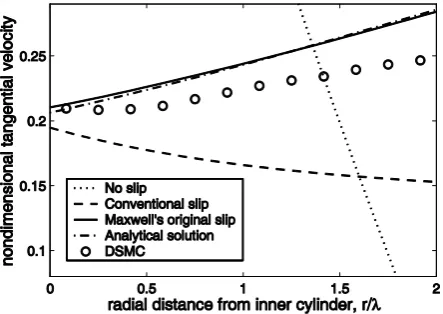
Figure 1. Cylindrical Couette flow (Kn=0.5, argon gas), non-dimensional velocity radial profiles, comparing hydrodynamic solutions calculated using various slip-velocity models with benchmark DSMC data. The inner wall (at r/λ=0) is rotating
with a tangential velocity approximately a third the speed of sound relative to the outer wall (at r/λ=2),
the momentum accommodation coefficient is 0.1. Note the inverted velocity profile, captured by DSMC and an analytical kinetic theory but not by a hydrodynamic model (in this case, the NSF equations) unless the Maxwell original slip equation25 is implemented properly in this curved
geometry. (Reprinted from DA Lockerby, JM Reese, DR Emerson, RW Barber (2004) Velocity boundary condition at solid walls in rarefied gas calculations. Phys. Rev. E, 70:017303.)
these moment equations do generally display temporal and spatial stability for bulk flows12,13, unlike their Burnett counterparts, so at present they are the most promising of the extended hydrodynamic models.
Specifying the additional boundary conditions required for these higher-moment equations remains, however, a critical problem. In the case of the R20 model, most recently Mizzi18 has systematically derived boundary conditions that describe the
micro-processes in a Maxwell-type
phenomenological manner (see also section 2.3). In brief, the bounding wall is assumed non-porous so half-space moments are considered, and the net flux of any moment should then be zero. By applying this balance representation iteratively on all the moments considered, boundary conditions follow that are appropriate for any of the Grad-type models18,19,20,21.
2.2 Boundary Conditions
The problem of properly defining additional boundary conditions for extended hydrodynamics, as outlined in the previous section, means that many micro- and nano-scale gas flow investigations are still conducted within the conventional NSF framework. However, there are still issues surrounding the correct implementation of non-equilibrium boundary conditions. To illustrate, we confine our attention here to models for calculating the slip-velocity to be imposed on hydrodynamic simulations at solid bounding surfaces, although calculation of the temperature-jump at surfaces also requires careful consideration22.
While there has been recent interest in using a Langmuir adsorption model of the gas/surface interaction to retrieve rarefied flow boundary conditions23,24, for flows of
Kn>0.001 Maxwell’s phenomenological expression25 remains the most often-used expression for the tangential slip-velocity,
:
, (3)
where τ is the tangential shear stress and q the tangential heat-flux at the surface, σ the momentum accommodation coefficient (ranging from 1 for surfaces that reflect all incident molecules diffusely, to 0 for purely specular reflection), Pr is the gas Prandtl number, µ the gas viscosity, γ the specific heat ratio, and p the gas pressure.
Because equation (3) requires the viscous-stress and heat-flux, we can choose to use the NSF constitutive expressions for these, as Maxwell himself did. For a flow bounded by planar surfaces (and for a perfect gas), we then obtain the conventional equation for the magnitude of the slip-velocity tangential to the surface, viz.
, (4)
2nd Micro and Nano Flows Conference West London, UK, 1-2 September 2009
the gas at the wall.
While equation (4) has the advantage of simplicity, it should be remembered that it is incorrect for simulations of gas flows over curved or rotationally-moving surfaces, such as serpentine bends, spheres and cylinders, and other geometries in which the velocity normal to the surface varies in the streamwise direction (such as deflecting flaps). In such cases, using equation (4) instead of equation (3) misses out some important flow physics (such as an in the case of the inverted velocity profile in cylindrical Couette flow4, see Figure 1).
The conventional slip-velocity expression (4) is 1st-order in flow property gradients, but 2nd-order slip conditions have been proposed to account for the effect of Knudsen layers. These conditions compensate for the existence of a Knudsen layer through changing the magnitude of the slip-velocity, but they do not model the Knudsen layer structure itself. A 2nd-order formulation calculates a different magnitude for the slip-velocity in an attempt to capture the increase in mass flowrates observed at higher Kn, but it cannot alter the near-wall stress/strain-rate (constitutive) behaviour which characterises the Knudsen layer. The general form of these 2nd-order conditions is, for planar surfaces,
, (5)
where we have also now assumed there is no heat flux along the surface. The values to be assigned to the coefficients A1 and A2 are still the subject of much discussion, and are in any case likely to be geometry-dependent.
While the form of equation (5) has been proposed because researchers wish to account for any unevaluated 2nd-order contributions to the slip-velocity, the original Maxwell slip condition (3) was proposed from physical considerations. Inspection of this equation, and its original derivation25, shows that there is no
a priori restriction on the expressions for the stress or heat-flux that it requires. While Maxwell used the NSF model, we are free to use another constitutive model; Lockerby and co-workers4 used the Burnett expression for the viscous-stress to derive a linearised
‘Maxwell-Burnett’ boundary condition, which is formally 2nd-order in space and stable in its solution. Expressing this new boundary condition in the form of equation (5) allows its coefficients A1 and A2 to be evaluated, and which are in line with many other estimates.
While the general problems with the Burnett equations outlined in section 2.1 still stand, the justification for using them in this new 2nd-order boundary condition is that they may at least be better approximations than the NSF model for the non-equilibrium stress and heat-flux close to a surface. In support of this, Lockerby and co-workers4 showed that the new Maxwell-Burnett boundary condition, applied with a conventional NSF hydrodynamic model for the bulk flow, generates a thermal-stress slip flow (as distinct from a thermal creep flow) when there is a tangential variation in the wall-normal temperature gradient. While this flow behaviour cannot be captured by Maxwell’s boundary condition with an NSF model for the shear stress, its existence was first deduced by Sone26 from kinetic theory arguments.
The Maxwell-Burnett boundary condition has the advantage of relative simplicity because the Burnett equations provide an explicit expression for the viscous-stress, but in principle an R13 or R20 constitutive model (see section 2.1) in equation (3) would also be possible and may be advantageous.
2.3 Near-wall constitutive scaling
(‘phenomenological extended hydrodynamics’)
this approach to modelling non-equilibrium flows is that no additional boundary conditions beyond the slip/jump conditions outlined in section 2.2 are required.
This approach has been termed ‘phenomenological extended hydrodynamics’ (PEH), and incorporates a constitutive scaling of the NSF equations that depends on distance to the nearby solid surface. The physical basis for this constitutive scaling can be traced to the work of Stops27, who demonstrated that the molecular mean-free-path of a gas is foreshortened (in comparison to its bulk flow value) close to an immovable solid surface. As the mean-free-path can be directly related to the viscosity and thermal conductivity of the gas, the fluid properties and behaviour of the gas some one to two mean-free-paths from a surface (i.e. in the Knudsen layer) are therefore expected to be different to those in the bulk flow.
Guo and co-workers28 developed a numerical solution method for Stops’ original expression for the mean-free-path which, together with 2nd-order slip boundary conditions, produced good predictions for phenomena such as the Knudsen minimum in Poiseuille flow. Fichman and Hetsroni29, and Li and colleagues30, used independent mean-free-path arguments to propose that both the viscosity and the thermal conductivity of the gas fall monotonically and uniformly to half their bulk flow values across the region of a couple of mean-free-paths up to a surface. Analogous work includes viscosity-modification models for thin-film lubrication flows by Sun and co-workers31, and Schrag and Wachutka32 (the latter building on a previous model by Veijola and others33).
Some of the most recent work in this field focuses on developing relatively simple analytical forms of the mean-free-path variation close to surfaces, from which non-linear constitutive relations can be straightforwardly derived. These modified NSF relations incorporate wall-distance scaling functions derived from planar kinetic theoretical results12,22,34,35,36,37. For example, for isothermal cases this scaling acts to change the form of the 3D low-speed steady-state
incompressible NSF momentum equation to: , (6) where U is the gas flow velocity and
. The near-wall scaling function, Φ, in this equation is given by
, (7)
where is the perpendicular distance (nondimensionalised with λ) from the nearest wall surface12.
Lilley and Sader38,39, drawing on Boltzmann theoretical solutions for hard-sphere molecules, propose a power-law structure to the inner part of the momentum Knudsen layer, with the consequence that the viscosity of the gas closest to the solid surface is effectively zero. The PEH model of Lockerby and Reese12 adopts a similar power-law structure, viz. the test functions Ψi in
equation (7) are of the form:
(8) and ai, bi and ci are coefficients that are determined once by optimisation from benchmark kinetic theory solutions to be:
a1 = 0.1859, b1= –0.4640, c1= –0.7902;
a2 = 0.4205, b2= –0.3518, c2= –0.4521. (9)
The flow-dependent variable, K, in equation (7) is in essence a form of local Knudsen number, and is introduced to provide a 2nd -order component to the constitutive scaling:
(10)
where the shear stress , Π is the viscous stress tensor, a unit vector in the wall-normal direction, and a unit vector perpendicular to in a direction that gives maximum τ. This PEH model as a whole can indirectly (although will not necessarily) affect the shear stress field, which in turn will alter K, producing a weak coupling effect.
2nd Micro and Nano Flows Conference West London, UK, 1-2 September 2009
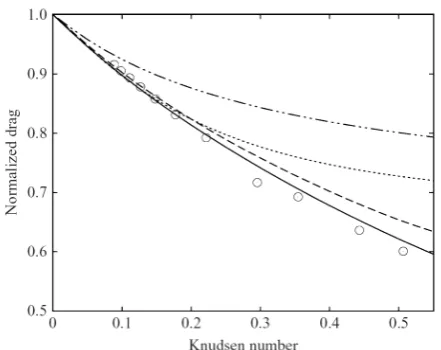
Figure 2. Flow around a sphere at various Kn, normalized drag force, comparing predictions using the near-wall constitutive scaling model of Lockerby and Reese (─ ─) with Basset’s classical slip solution (─ · · ─), Cercignani’s 2nd-order slip
solution (· · ·), BGK kinetic theory results (○), and experimental data (—). (Reprinted with permission from DA Lockerby, JM Reese (2008) On the modelling of isothermal gas flows at the microscale. J. Fluid Mech., 604:235-261.)
that the coefficients (9) for the test-functions are derived from planar kinetic theory results, Lockerby and Reese’s model also shows good agreement in non-planar gas flow problems, such as the flow around a micro-sphere (see Figure 2). It even shows moderate success when applied to high-speed thermal rarefied
gas flows, e.g. in hypersonic
aerothermodynamics40, despite having mainly been derived for isothermal micro flows. In the form of effective mean-free-path models, near-wall scaling is even being introduced into lattice Boltzmann methods. This seems to indicate a useful generality to the PEH technique which is worth exploring in the future.
While PEH offers some exciting new possibilities, and shows an ability to capture some essential features of non-equilibrium flows at the micro scale, it will never be as accurate — in terms of recovering the detailed flow behaviour — as a rational extended hydrodynamics model based on the fundamental physics.
3. Conclusions
Recent years have seen resurging
international interest in methods for simulating rarefied and other non-equilibrium flows. This interest has been stimulated by the need for effective design tools for micro- and nano-scale systems, coupled with a growing appreciation that the fluid dynamics of these small-scale systems is often crucially different to that at the macro-scale.
Any review of this diverse field needs to be selective, and can provide only a snapshot of the techniques being explored. In this short paper we have attempted to pick out some of the most important and exciting recent developments, and point to a few of the interesting links between them. Considering the hydrodynamic framework, the models now being pursued range from accurate but complex R13 and R20 moment models, to elegantly simple ‘engineering models’ of near-wall constitutive scaling (PEH). Each model strikes a different balance between simulation accuracy and computability, and choosing which one to use depends on the flow situation under investigation and the modelling requirements.
Acknowledgements
This work is funded in the UK by the Engineering and Physical Sciences Research Council through
grants EP/F002467/1, EP/D07455X/1,
EP/D007488/1 and EP/F028865/1.
References
1. M Gad-el-Hak (1999) The fluid mechanics of
microdevices. J. Fluids Eng.-Trans. ASME,
121:5-33
2. GE Karniadakis, A Beskok, N Aluru (2005)
Microflows and nanoflows: fundamentals and simulation. Springer, New York
3. EB Arkilic, MA Schmidt, KS Breuer (1997)
Gaseous slip flow in long microchannels. J. MEMS,
6:167-178
4. DA Lockerby, JM Reese, DR Emerson, RW Barber
(2004) Velocity boundary condition at solid walls
in rarefied gas calculations. Phys. Rev. E,
70:017303
5. M Knudsen (1909) Die gesetze der
molecularströmung und der inner reibungsströmung
der gase durch röhren. Annal. Physik, 28:75
6. SE Vargo, EP Muntz, GR Shiflett, WC Tang (1999)
Knudsen compressor as a micro- and macroscale
vacuum pump without moving parts or fluids. J.
[image:7.595.60.281.72.247.2]7. RK Agarwal, KY Yun, R Balakrishnan (2001) Beyond Navier-Stokes: Burnett equations for flows
in the continuum-transition regime. Phys. Fluids,
13:3061-3085
8. F Sharipov, LMG Cumin, D Kalempa (2004) Plane
Couette flow of binary gaseous mixture in the
whole range of the Knudsen number. Eur. J. Mech.
B-Fluids, 23:899
9. M Kalweit, D Drikakis (2008) Multiscale methods
for micro/nano flows and materials. J. Comput.
Theor. Nanosci., 5:1923
10. S Chapman, TG Cowling (1970) The mathematical
theory of non-uniform gases. Cambridge University
Press, UK
11. DA Lockerby, JM Reese, MA Gallis (2005) The
usefulness of higher-order constitutive relations for
describing the Knudsen layer. Phys. Fluids,
17:100609
12. DA Lockerby, JM Reese (2008) On the modelling
of isothermal gas flows at the microscale. J. Fluid
Mech., 604:235-261
13. H Struchtrup (2005) Macroscopic transport
equations for rarefied gas flows. Springer
14. DA Lockerby, JM Reese (2003) High-resolution
Burnett simulations of micro Couette flow and heat
transfer. J. Comput. Phys., 188:333-347
15. H Grad (1949) On the kinetic theory of rarefied
gases. Comm. Pure Appl. Math., 2:331-407
16. H Struchtrup, M Torrilhon (2003) Regularization of
Grad’s 13-moment equations: derivation and linear
analysis. Phys. Fluids, 15:2668-2680
17. H Struchtrup, M Torrilhon (2007) H theorem,
regularization, and boundary conditions for
linearized 13 moment equations. Phys. Rev. Lett.,
99:014502
18. S Mizzi (2008) Extended macroscopic models for
rarefied gas dynamics in micro-sized domains. PhD
thesis, University of Strathclyde, UK
19. S Mizzi, XJ Gu, DR Emerson, RW Barber, JM
Reese (2008) Computational framework for the regularized 20-moment equations for
non-equilibrium gas flows. Int. J. Num. Meth. Fluids,
56:1433-1439
20. XJ Gu, DR Emerson (2007) A computational
strategy for the regularized 13 moment equations
with enhanced wall-boundary conditions. J.
Comput. Phys., 225:263.
21. S Mizzi, DR Emerson, SK Stefanov, RW Barber,
JM Reese (2007) Effects of rarefaction on cavity
flow in the slip regime. J. Comput. Theoret.
Nanosci., 4:817-822
22. L O’Hare, TJ Scanlon, DR Emerson, JM Reese
(2008) Evaluating constitutive scaling models for
application to compressible microflows. Int. J. Heat
Mass Transf., 51:1281-1292
23. RS Myong, JM Reese, RW Barber, DR Emerson
(2005) Velocity slip in microscale cylindrical
Couette flow: the Langmuir model. Phys. Fluids,
17:087105
24. RS Myong, DA Lockerby, JM Reese (2006) The
effect of gaseous slip on microscale heat transfer:
an extended Graetz problem. Int. J. Heat Mass
Transf., 49:2502-2513
25. JC Maxwell (1879) On stresses in rarified gases
arising from inequalities of temperature. Phil.
Trans. Roy. Soc. London, 170:231-256
26. Y Sone (1972) Flow induced by thermal-stress in
rarefied-gas. Phys. Fluids, 15:1418-1423
27. DW Stops (1970) The mean free path of gas
molecules in the transition regime. J. Phys. D: Appl.
Phys., 3:685-696
28. ZL Guo, BC Shi, CG Zheng (2007) An extended
Navier-Stokes formulation for gas flows in the
Knudsen layer near a wall. EPL, 80:24001
29. M Fichman, G Hetsroni (2005) Viscosity and slip
velocity in gas flow in microchannels. Phys. Fluids,
17:123102
30. JM Li, BX Wang, XF Peng (2000) ‘Wall-adjacent
layer’ analysis for developed-flow laminar heat
transfer of gases in microchannels. Int. J. Heat
Mass Transf., 43:839-847
31. YH Sun, WK Chan, NY Liu (2003) A slip model
for gas lubrication based on an effective viscosity
concept. Proc. Inst. Mech. Engin., J-J. Eng.
Tribology, 217:187-195
32. G Schrag, G Wachutka (2002) Physically based
modelling of squeeze film damping by mixed-level
system simulation. Sensors & Actuators A,
97-98:193
33. T Veijola. H Kuisma, J Lahdenperä, T Ryhänen
(1995) Equivalent-circuit model of the squeezed
gas film in a silicon accelerometer. Sensors &
Actuators A, 48:239
34. S Mizzi, RW Barber, DR Emerson, JM Reese, SK
Stefanov (2007) A phenomenological and extended continuum approach for modelling non-equilibrium
flows. Cont. Mech. Thermodyn., 19:273-283
35. L O’Hare, DA Lockerby, JM Reese, DR Emerson
(2007) Near-wall effects in rarefied gas
micro-flows: some modern hydrodynamic approaches. Int.
J. Heat Fluid Flow, 28:37-43
36. JM Reese, Y Zheng, DA Lockerby (2007)
Computing the near-wall region in gas micro- and
nanofluidics: critical Knudsen layer phenomena. J.
Comput. Theoret. Nanosci., 4:807-813
37. DA Lockerby, JM Reese, MA Gallis (2005)
Capturing the Knudsen layer in continuum-fluid
models of non-equilibrium gas flows. AIAA J.,
43:1391-1393
38. CR Lilley, JE Sader (2007) Velocity gradient
singularity and structure of the velocity profile in the Knudsen layer according to the Boltzmann
equation. Phys. Rev. E, 76:026315
39. CR Lilley, JE Sader (2008) Velocity profile in the
Knudsen layer according to the Boltzmann equation.
Proc. Roy. Soc. A, 464:2015-2035
40. AJ Lofthouse, LC Scalabrin, ID Boyd (2008)
Velocity slip and temperature jump in hypersonic
aerothermodynamics. J. Thermophys. Heat Transf.,