Buchanan, Steven and McMenemy, David (2012) Digital service analysis
and design : the role of process modelling. International Journal of
Information Management, 32 (3). pp. 251-256. ISSN 0268-4012 ,
http://dx.doi.org/10.1016/j.ijinfomgt.2011.11.008
This version is available at
https://strathprints.strath.ac.uk/46429/
Strathprints is designed to allow users to access the research output of the University of Strathclyde. Unless otherwise explicitly stated on the manuscript, Copyright © and Moral Rights for the papers on this site are retained by the individual authors and/or other copyright owners. Please check the manuscript for details of any other licences that may have been applied. You may not engage in further distribution of the material for any profitmaking activities or any commercial gain. You may freely distribute both the url (https://strathprints.strath.ac.uk/) and the content of this paper for research or private study, educational, or not-for-profit purposes without prior permission or charge.
Any correspondence concerning this service should be sent to the Strathprints administrator:
Digital service analysis and design: the role of process modelling
Steven Buchanan*
Department of Computer and Information Sciences, University of Strathclyde, Glasgow G1 1XH, UK [email protected], Tel.: +44 (0)141 548 3409, Fax.: +44 (0)141 548 4523
David McMenemy
Department of Computer and Information Sciences, University of Strathclyde, Glasgow G1 1XH, UK [email protected], Tel.: +44 (0)141 548 3045, Fax.: +44 (0)141 548 4523
*Corresponding author
Abstract
Digital libraries are evolving from content-centric systems to person-centric systems. Emergent digital services are interactive and multidimensional, associated systems multi-tiered and distributed. A holistic perspective is essential to their effective analysis and design, for beyond technical
considerations, there are complex social, economic, organisational, and ergonomic requirements and relationships to consider. Such a perspective cannot be gained without direct user involvement, yet evidence suggests that development teams may be failing to effectively engage with users, relying on requirements derived from anecdotal evidence or prior experience. In such instances, there is a risk that services might be well designed, but functionally useless. This paper highlights the role of process modelling in gaining such perspective. Process modelling challenges, approaches, and success factors are considered, discussed with reference to a recent evaluation of usability and usefulness of a UK National Health Service (NHS) digital library. Reflecting on lessons learnt, recommendations are made regarding appropriate process modelling approach and application.
Keywords: digital library; digital service; process modelling; system usefulness.
1. Introduction
This paper considers the role of process modelling in facilitating a holistic perspective during the analysis and design of emergent digital services within digital libraries. This reflective study follows on from a recent evaluation of a National Health Service (NHS) digital library that found users satisfied with usability aspects, but questioning usefulness in situ (Buchanan & Salako, 2009). Our hypothesis is that process modelling would have provided valuable contextual understanding beyond the interface during initial system analysis and design, to better understand and consider system usefulness. Reflecting on lessons learnt, we consider how this might have been approached, addressing three highlighted process modelling challenges: elicitation, decomposition, and representation. Success factors are identified and recommendations made regarding appropriate approach and application.
2. Background
The DELOS Network of Excellence on Digital Libraries, describing the digital library as Ôa tool at the centre of intellectual activity having no logical, conceptual, physical, temporal or personal barriers on informationÕ (DELOS, 2007, p.15), have argued that digital libraries, in pursuit of personalised interactive user experiences, have evolved from content-centric systems to person-centric systems. Arguably inherent within such a role is the provision of digital services (services or resources accessed and/or provided via digital transaction (Williams et al., 2008)), which go beyond simple provision of digital content. Such services can range from the relatively straightforward, such as provision of online tools and virtual space for communication and collaboration, sharing of content etc., to online reference services, to the more complex, such as digitized local archive collections purposefully linked to local school curriculumÕs via virtual learning environments. Associated information systems are typically distributed, interdependent, and multidimensional. They must take into account complex social, economic, organisational, and ergonomic requirements and
importance of a holistic perspective, which arguably cannot be gained without direct user involvement, yet evidence suggests that digital library development teams may be failing to effectively engage with users, relying on requirements derived from anecdotal evidence or prior experience (Blandford et al., 2007).
This paper follows on from a recent study that evaluated the usability and usefulness of a UK National Health Service digital library (Buchanan & Salako, 2009). Usability and usefulness are related
properties of system interaction (Tsakonas & Papatheodorou, 2006), which in combination, determine system satisfaction and usage. Often approached separately (Dicks, 2002), or with emphasis upon usability (for example, Xie (2008) reports that the majority of digital library evaluation studies are usability studies), there is emerging consensus among the research community for their unified consideration (Tsakonas and Papatheodorou, 2008), for while usability evaluations might lead to more usable systems, it is argued that without consideration of usefulness, systems could prove to be effectively designed, but functionally useless (Greenberg and Buxton, 2008). Neither is this problem limited to usability studies, with Blandford et al (2008) for example, arguing that information retrieval research has a tendency to view finding information as an end point, to the exclusion of how it might be used.
The digital library evaluated had been developed and recently launched to provide clinicians with direct access to clinical evidence and best practice recommendations to support decision-making at point of care, and to support ongoing professional development. Reflecting best practice, evaluation was multi-method, in this case combining questionnaire and observation, with volunteer participants (33 clinicians) instructed to identify an information need related to patient care based upon a hypothetical or real medical case (providing a more realistic test-case scenario framed within an operational context (Borlund, 2000; Hornbak, 2006; Granic, 2008)), and to then use the digital library to retrieve the required information. Tasks were conducted on location within the user environment, but for ethical reasons, not in the presence of patients.
Participants found the digital library to be usable (i.e. effectiveness, efficiency, aesthetic appearance, terminology, navigation, and learnability), but not particularly useful (i.e. relevance, reliability,
currency), questioning its purpose in relation to existing e-library services, and more importantly, how it might be used at point of care. We were fortunate that participants themselves (voluntarily)
questioned how the system might be used at point of care, for it soon became apparent that our test scenarios did not fully account for variable clinical situations and constraints (in particular short clinical consultation timeframes, and limited (system) access points). This raised questions not only
regarding our approach to test scenario planning, but also in relation to initial analysis and design. Although not involved during system development, it would appear that, similar to our test planning, important contextual considerations might not have been fully taken into account. Recognizing the role of process modelling in gaining such insight led us to consider how modelling of the clinical consultation process might have been approached.
3. Process Modelling
Processes, in simple terms, are sets, or sequences, of activity, that results in the accomplishment of a task, or the achievement of an outcome. Processes begin with an input, and end with an output; contain sub-processes; have one or more customers, and typically, several stakeholders. They can be entirely automated or entirely manual, but are typically a combination of both, to greater or lesser degrees.
Process modelling is now widely used as a method to improve our understanding of organisational operations and to deconstruct real-world complexity (Bandera et al., 2005). Applied to information systems development, it has been variously described as key to formulating user requirements (Sewchurran and Petkov, 2007), the first prerequisite to understanding integration requirements (Umapathy et al., 2008), and essential for understanding complex techno-social phenomena (Barjis, 2008). The process view is embedded within popular enterprise architecture frameworks such as TOGAF and Zachman, and as an approach to modelling business architecture, facilitates the identification of candidate application services, central to the development of reusable service oriented architectures (Mark and Bell, 2009). For example, application services associated with a digital library lending service would include: login; catalogue browsing; order creation; order fulfilment activation; order confirmation message etc.
Bandera et al (2005) identify three major benefits of process modelling applied to systems development:
¥ Documentation benefits: through a common, basic language that can be readily understood by stakeholders (based on shared vocabulary).
¥ Design benefits: through understanding current processes, exploring new scenarios, and planning for implementation.
¥ Use benefits: through visualisation of workflow and scenarios.
As an example, Waring & Wainwright (2002), reflecting on a number of failed information systems projects within the NHS, argued that root cause was a failure to fully consider complex human and organisational issues and relationships during initial requirements analysis, with resultant systems then failing to reflect work practice (an end result similar to our own experience when evaluating the NHS digital library). Calling for more innovative approaches to initial requirements analysis, they trialled a participatory approach to requirements analysis utilising process modelling in a North East Hospital Trust with a history of failed IT projects. They found the approach highly effective in bringing stakeholders together and as a method to describe, communicate, and interpret system complexity. They reported that resultant models required no expert knowledge to interpret, and via wider staff consultation, exposed several system issues that challenged the rationale for the proposed project (an integrated email and document workflow system).
Bargis (2008) reports similar stakeholder benefits when modelling processes as part of the development of an enterprise-wide patient admission system for a large US medical centre, with process models facilitating formal analysis and visual simulation during requirements specification, bringing together analysts, developers, and users.
Importantly, process modelling transcends the functional view of an organisation, encouraging managers to adopt an end-to-end view of workflow, identifying the sequence of activity required to achieve or support valued organisational outcomes, irrespective of functional or organisational boundaries (Waring & Wainwright, 2002; Gibb, Buchanan, & Shah, 2006). Such a perspective has parallels with systems thinking, with processes at the heart of systems thinking models.
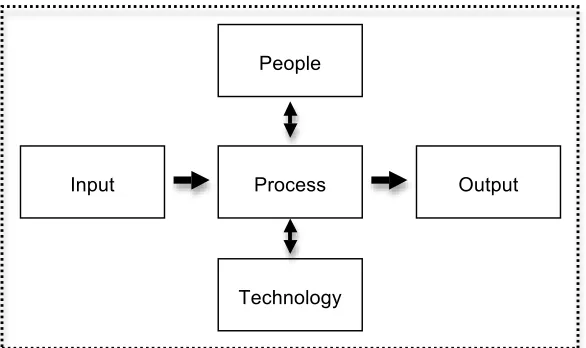
In simple terms, a system is a collection of entities linked together in a regulated set of relationships forming a complex whole. Examples encompass organisational and biological systems, but for our purposes a system is defined as a set of logical, related components consisting of people, technology, inputs, processes, and outputs, brought together to accomplish a predefined organisational goal (see Fig. 1), which within digital libraries is accomplished primarily through the processing of information.
Figure 1. Systems Thinking Model
Notably, within systems theory there are two perspectives regarding the fundamental nature of systems and how they should be defined, modelled, and measured: a hard systems view advocated by engineers that maintains that systems are tangible; and a soft systems view advocated by social scientists that argues that systems are partly based on ideas, or models of the world, not always possible to represent. In truth both perspectives provide useful insights into the processes and information flow that underpin an organisation, as effective systems must be designed and built in response to the needs of both the organisation and its environment (for a discussion of the
information system design-science paradigm, see Hevner et al. (2004)). For example, Alter (2006), arguing that techno-centric analysis is at the root of many information systems development issues, calls for greater application of systems thinking to information systems development.
4. Process Modelling Challenges
Process modelling is acknowledged as inherently complex, and prone to errors (Van Dongen et al., 2005). From our own experiences of teaching process modelling to postgraduate students, and modelling information flow and/or processes as part of information audits (see Buchanan & Gibb, 2008), we have observed it to be particularly challenging for first time modellers, who find it difficult to
elicit information from staff, decompose processes, and represent less well-defined or tangible activity or resources.
4.1. Elicitation
Process modelling is a consultative process of identification, modelling, and verification. Process knowledge is typically gathered from staff and stakeholders through interview, workshop, or observation (often combined). As a consequence, modelling demands a broad skill set of the modeller, from investigative and analytical skills, to facilitation, communication, and people skills. Fundamental to effective elicitation is to recognise that it is an incremental and iterative process, which benefits from a structured approach. For example, Ould (1995), as part of the STRIM
methodology, recommends an eight-step approach to process modelling, which places emphasis on the importance of elicitation through multiple incremental stages of consultation and modelling:
1. Determine modelling objectives to provide overall scope, direction and purpose. 2. Establish an overall picture to provide a high level perspective.
3. Interview senior personnel to verify objectives, discuss and refine the overall picture, and identify suitable representative personnel to participate in modelling sessions.
4. Interview groups as part of facilitated modelling sessions, which identify and explore process goals, procedures, roles, resource usage, and information flow etc.
5. Interview individuals to define the process in detail (representative of the roles identified in the previous modelling sessions).
Input Process Output
People
6. Review, revise, and validate models through feedback sessions (individual and/or group). 7. Analyse the models (final analysis as analysis began from the outset)
8. Respond to the analysis as per the objectives.
Importantly, one of the first steps is to establish scope, which then assists with complexity by partitioning the domain. Ould (1995) provides limited direction regarding scope, but key dimensions to consider are vertical division (by organisational unit) or horizontal division (by cross-organisational process), with decisions determined by organisational priorities and dependent relationships (and possibly pragmatism). A further dimension is the degree of granularity required, discussed below.
4.2. Decomposition
Large enterprises will typically have between 15 and 25 top-level major processes (Gibb, Buchanan, & Shah, 2006). However, each major process will decompose into sub-processes with corresponding levels beneath (see Figure 2), with number of processes quickly mounting. For example, sub
processes of library ÔLending ServicesÕ (including alternative paths) might be Ôbrowse stock (or catalogue)Õ, Ôselect items (or check availability)Õ, Ôwithdraw (or reserve) itemsÕ, and Ôreturn (or renew) itemsÕ. In turn, Ôwithdraw (or reserve) itemsÕ would contain further (sub) sub processes such as Ôauthenticate and confirm borrower privilegesÕ etc.
Figure 2. Process decomposition
In-depth process modelling may have to model to level three as a minimum, for this is typically where individual steps, procedures, decision points, objects and resources are identified (for example, interaction with discreet applications within a Library Management System such as the catalogue or customer records databases). Of course, the requirement to drill down three, or possibly further levels is not an absolute rule as it will be dependent upon the scale and complexity of the domain, what is being modelled, and for what purpose. It may also be possible to go directly to level three, but this is not something to be encouraged, as adopting a top-down approach provides valuable organisational understanding and identifies key relationships between processes. A complete high-level model also facilitates ongoing scope management, allowing the modeller to identify processes that are in or out of scope (and associated system boundaries), and whether or not there is a logical order to their
modelling suggested by dependent relationships. Cyclical validation steps are important during decomposition as inherent within methodologies such as STRIM (see Section 4.1.).
4.3. Representation
IDEF (¯-5) integrates the modelling of people, processes, machines, materials, computers and information. IDEF describes what a system does, who controls it, what it works on, how it performs functions and what it produces. Diagrams are based upon simple box and arrow graphics used to produce a Ôfunction modelÕ Ð a structured representation of functions, activities or processes within the modelled system. Diagrams adhere to hierarchical decomposition, beginning with a high-level context diagram, representing the whole system as a single unit (one box with arrow interfaces linking to other processes outside the system). Successive levels of sub-processes are then revealed, gradually introducing greater and greater levels of detail. Processes are represented as boxes and data or object interfaces are shown as directional left (input) and right (output) arrows. Controls point into the box from the top specifying the conditions required for the process to produce correct outputs. Resources/mechanisms support the execution of the process and point into the box from the bottom.
DFDs, an evolution of graphical flowcharts, describe and illustrate the movement of data through a system (manual or automated) including processes, data stores, and delays in the system. DFDs use a set of standardised symbols to show flows, processes and data stores. Processes are shown as rectangles labelled with actions. Data flows are shown as directed arrows labelled with the data type moving through the system. Data stores (database files, records etc) are shown as boxes or ellipses labelled with data type. Circles represent external entities (sources/sinks) with which the system communicates, for example, individuals, groups, and external systems. DFDs can be drawn for each level within a system (again adhering to functional decomposition), beginning at the general level and gradually expanded as required.
UML consists of 13 diagram types with use case and activity diagrams perhaps most applicable to process modelling. Use-case diagrams describe a sequence of interactions between a system and external actors (person, system, or device) with a use case a discrete, stand-alone activity that an actor can perform to achieve an outcome. A scenario is a specific instance (typically classified as normal or alternative scenarios) providing a high-level visual representation of user requirements and logical scenarios. Basic use-case notation illustrates actors as stick figures, use cases as ovals, and the system boundary as a box border. Use case diagrams are relatively simple, but are supported by extensive written descriptions of system behaviour (preconditions, post-conditions, normal and alternative course, exceptions and business rules). Activity diagrams provide a dynamic view of a system by depicting flow from one activity to another (similar to flowcharts) showing decision points and alternative courses. Basic notation consists of start and end points (filled in circles), activities (rounded rectangle), and decision points (diamonds).
STRIM is based on the concepts of roles, composed of activities, which produce and operate on entities and which communicate, co-ordinate and collaborate through interactions. A role involves a set of activities, which are designed to achieve a particular responsibility or set of responsibilities. In STRIM modelling it is important to know what makes an activity start and stop, and when and why an activity is done. STRIM uses goals in models rather than inputs and outputs. A typical goal would be Ôto reach the state where the customer is satisfiedÕ which would be equivalent to the desired state of the model. This differs from input/output methods where the input would be Ôa customer needing to be satisfiedÕ and the output Ôsatisfied customerÕ. In STRIM, entities are anything that is the subject matter of an activity. A role activity diagram is used to record the process model, describing roles,
component activities and interactions, together with external events and the logic that determines what activities are carried out when. Basic notation depicts roles as shaded blocks, activities as smaller black boxes, and interactions as white boxes.
BPMN is a standard graphical notation for business process diagrams, usable for both business and technical purposes. Developed by the Business Process Management Initiative, it is now maintained by the Object Management Group. There are four categories of graphical elements to BPMN:
¥ Flow objects: which are events (process triggers or results), activities (task or sub process), and gateways (activity intersections and/or decision points).
¥ Swimlanes: which are pool (a process participant) and lane (separate or sub-partition activity). ¥ Artefacts: which are data objects (data and documents), group (informal groupings for visual
purposes (sequence independent)), and annotation (explanatory notes for models).
BPMN denotes events as circles, activities as rounded rectangles, gateways as diamonds, sequence flow as solid line arrows, message flow as dotted line open arrows, association as dotted lines, pools as rectangles with lanes associated, data as folded corner rectangles, group as rounded corner rectangles and dashed lines, and annotations as annotations.
Although variance can be noted in the above example modelling techniques, it is also possible to identify broad similarities: simple modelling notation is based upon inputs, functions, and outputs, while extended notation adds further elements such as events, rules/controls, decision points, data flows and data stores, resources, external entities, and boundaries. Additional supporting
(descriptive) information can include: preconditions, post conditions, normal and alternative courses, exceptions, and business rules.
5. Process Modelling Success Factors
Bandera and Rosemann (2005), in a study of process modelling projects, identified eight key success factors, categorised as either model related or project related. Model related success factors were the existence of a modelling methodology supported by a modelling language and a modelling tool. Project success factors were stakeholder participation, effective management support, access to information resources, modeller expertise, and overarching project management. Bandera and Rosemann also identified two moderating variables which influenced success: complexity of
domain/processes, and importance of the project; and six measures of success: modeller satisfaction with achievement of modelling objectives, quality of the process models, extent to which the models are applied and used, user satisfaction, and the impact on the processes modelled and associated stakeholders. In a further study, Rosemann (2006), discussing common pitfalls of process modelling, makes the following recommendations:
¥ Drawing tools have their raison dÕetre; however they may not be scalable to larger business process modelling activities.
¥ Complementary methodologies are required to fully utilize the capabilities of modelling tools and techniques.
¥ Process models have to be relevant, not necessarily complete.
¥ Customizing of the modelling technique should strive towards applicability, not perfection.
¥ The discovery experience during the journey is part of the overall outcomes of process modelling. ¥ Define an appropriate level of detail in light of the underlying objectives and strive for simplicity.
Rosemann (2006) highlights the importance of remaining focused on primary objectives, and in relation to this, to avoid over-engineering associated process models. Recker (2010) makes a related point post analysis of 120 BPMN models. Interested in the frequency of occurrence of all 50 BPMN constructs he identified a relatively small set frequently used: normal flow, task, start/end events, pool, data-based XOR. Recker (2010, p.192) argues that Òthere is a core of BPMN symbols used for the simple documentation of organisational processesÓ with the majority remaining either limited to specialist application (e.g. process orchestration) or unnecessary overhead. Concerned that the full BPMN specification might present challenges for less experienced modellers, Recker (2010, p.193) argues, Òease of use of process modelling is sacrificed for sheer expressive powerÓ and argues Òthe simpler the betterÓ (p.194). This is an important point, for beyond modeller challenges, there are participant factors to consider. Ould (1995, p.19), in his fourth law of process modelling argues, ÒProcess models are about people, for people. The notation must make sense to people. If you canÕt explain the model in ten minutes, it doesnÕt make senseÓ. Such points remind us of the benefits of above all, keeping it simple.
6. Process modelling for digital library analysis and design
Regardless of particular process modelling methodology adopted, it should be apparent that the various respective methods adopt broadly similar approaches and conventions (see Section 4), which can be summarised as follows:
¥ Modelling is regarded as an incremental and iterative process, which benefits from a structured approach.
¥ Modelling adheres to hierarchical top-down decomposition. ¥ Modelling is logically flow-based.
¥ Simple modelling notation is based upon inputs, functions, and output, which can then be extended as necessary.
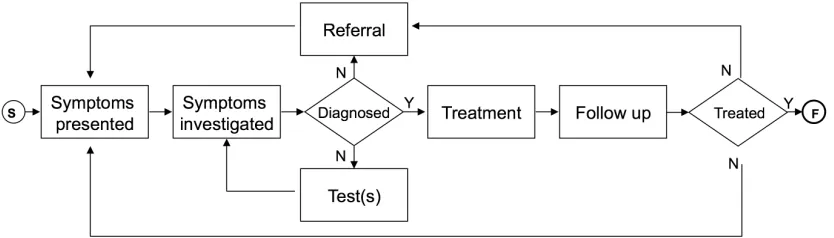
[image:9.595.73.490.365.484.2]With the benefit of hindsight, process modelling of the clinical consultation process in advance of usability/usefulness tests would have provided a method to more accurately plan and design realistic test scenarios, drawing our attention to environmental constraints and allowing us to plan accordingly (for example, identifying and incorporating consultation time constraints). For our purposes, this could have been arrived at through one or more interviews with clinicians in advance of tests (to guide test scenario planning). An example of such a high level process model is shown in Figure 3, illustrating start/end points, processes, normal and alternative paths, and decision points (in this instance retrospectively arrived at through information gathered during post observation interviews).
Figure 3. Clinical consultation process
Importantly, such a process model, while assisting with scenario planning for post deployment usability/usefulness tests, would have arguably proved even more invaluable during initial analysis and design of the digital library service. Arrived at through user consultation, the model would have encouraged a holistic perspective, facilitating better (development team) understanding of activity to be supported, and identification of environmental conditions and constraints influencing use, and crucially, at an earlier stage in development. Via structured process walkthrough and discussion with clinicians, the role of the digital library might have been better explored, including the associated role of the proposed new digital service. Through further process decomposition, more detailed models could have been used to identify associated data, application, and technology architecture
requirements (potentially highlighting system access issues (via gap analysis) and associated requirements). It is reasonable to conclude that such analysis might have had implications for initial proof of concept (similar to Waring & WainwrightÕs (2002) experience (see Section 3)).
As previously highlighted, evidence suggests that our experience may not be an isolated case. Blandford et al (2007) has previously reported a lack of user consultation during digital library
development, observing developers on two digital library projects arriving at abstract design scenarios based on functional or technical requirements derived from anecdotal evidence or prior experience. Worryingly, Blandford et al (2007, p.79) found that Òdevelopers had no interest in completely
transforming their design processes to make them user centredÓ. Observing a predominantly functional (component based) approach to design, Blandford et al (2007, p.79) reports that
library development, for a lack of user involvement has long been highlighted as an issue during system development (see the often cited Standish Group reports1 documenting software project
failures from 1985 to present day, which regularly report requirements related issues). It may simply be, that as digital libraries evolve from digital transaction-based repositories to providers of
personalised interactive digital services, such issues are brought to the fore.
7. Conclusion
Emergent digital services are interactive and multidimensional, associated systems multi-tiered and distributed. A holistic perspective is essential to their effective analysis and design, for beyond technical considerations, there are complex social, economic, organisational, and ergonomic
requirements and relationships to consider. Such a perspective cannot be gained without direct user involvement, yet evidence suggests that development teams may be failing to effectively engage with users, relying on requirements derived from anecdotal evidence or prior experience. In such
instances, there is a risk that services might be well designed, but functionally useless.
Process modelling can be used by development teams to engage with the user, to establish common views of current processes, condition and constraints, and to explore new scenarios. Process modelling can also assist with usability and usefulness tests, facilitating the design of realistic test case scenarios. A suitable modelling framework would adopt a structured approach similar to the eight-step STRIM approach, modelling incrementally and iteratively in a top-down fashion with processes decomposed as required. Suitable modelling techniques include IDEF, DFD, UML, STRIM, and BPMN. Striving for simplicity, it is recommended that initial models be based upon simple input/output notation, and then extended as necessary. Such models will provide invaluable contextual understanding to future digital service analysis and design.
References
Alter, S. (2006) The work system method: connecting people, processes and IT for business results. Larkspur, CA: Work System Press.
Bandara, W., Gable, G.G., & Rosemann, M. (2005). Factors and measures of business process modelling: model building through a multiple case study. European Journal of Information Systems, 14, 347-360.
Bandara, W. & Rosemann, M. (2005). What are the secrets of successful process modelling? Insights from an Australian case study. Systemes dÕInformation et Management, 3(10), 47-126. Barjis, J. (2008) The importance of business process modelling in software systems design. Science of Computer Programming 71(1), pp.73-87.
Blandford, A., Keith, S., Butterworth, R., Fields, B., & Furniss, D. (2007) Disrupting digital library development with scenario informed design. Interacting with Computers, 19(1), 70-82.
Blandford, A., Adams, A., Attfield, S., Buchanan, G., Gow, J., Makri, S., Rimmer, J., & Warwick, C. (2008). The PRET A Rapporter framework: evaluating digital libraries from the perspective of information work. Information Processing and Management, 44(1), 4-21.
Borlund, P. (2000). Experimental components for the evaluation of interactive information retrieval systems. The Journal of Documentation, 53(1), 71-90.
Buchanan, S. & Gibb, F. (2008). The information audit: theory versus practice. The International Journal of Information Management, 28(3), 150-160.
Buchanan, S., & Salako, A. (2009). Evaluating the usability and usefulness of a digital library. Library Review, 58(9), 38-651.
Champy, J. (2002). X-engineering the corporation: reinvent your business in the digital age. London: Hodder & Stoughton.
Checkland, P. (1999). Systems thinking, systems practice. Chichester: John Wiley & Sons.
Dicks, R.S. (2002). Mis-Usability: on the uses and misuses of usability testing. In: Proceedings of the 20th Annual International Conference on Computer Documentation (ACM, Toronto, 2002), 26-30. Gibb, F., Buchanan, S., & Shah, S. (2006). An integrated approach to process and service management. International Journal of Information Management, 26(1), 44-58.
Gibb, F. & Buchanan, S. (2006). A framework for business continuity management. International Journal of Information Management, 26(2), 128-141.
Granic, A. (2008). Experience with usability evaluation of e-learning systems. Universal Access in the Information Society, 7(4), 209-221.
Greenberg, S. & Buxton, B. (2008). Usability evaluation considered harmful (some of the time). In:
Proceedings of the twenty-sixth annual SIGCHI conference on human factors in computing systems
(ACM, Florence, 2008), 111-120.
Hevner, A.R., March, S.T., and Park, J. (2004) Design science in information systems research. MIS Quarterly 28(1), pp.75-105.
Hornbak, K. (2006). Current practice in measuring usability: challenges to usability studies and research. International Journal of Human-Computer Studies, 64(2), 79-102.
Marks, E.A. & Bell. M. (2009). Service-Oriented Architecture: a planning and implementation guide for business and technology. New Jersey: John Wiley & Sons Ltd.
Ould, M.A. (1995). Business processes: modelling and analysis for re-engineering and improvement.
Chichester: John Wiley & Sons Ltd.
Recker, J. (2010) Opportunities and constraints: the current struggle with BPMN. Business Process Management 16(1), pp.181-201.
Rosemann, M. (2006). Potential pitfalls of process modelling: part B. Business Process Management Journal, 12(3), 377-384.
Sewchurran, K., & Petkov, D. A systematic framework for business process modelling combining soft systems methodology and UML. Information Resources Management Journal 20(3), pp.46-62. Tsakonas, G. & Papatheodorou, C. (2006). Analyzing and evaluating usefulness and usability in electronic information services. Journal of Information Science, 32(5), 400-419.
Van Dongen, B.F., Van Der Alst, W.M.P., and Verbeek, H.M.W. (2005) Verification of EPCs: Using reduction rules and Petri nets, in: Proceedings of the 17th Conference on Advanced Information Systems Engineering, pp.372-386. Lecture notes in Computer Science 3520: Springer-Verlag. Williams, K., Chatterjee, S., & Rossi, M. (2008). Design of emerging digital services: A taxonomy.
European Journal of Information Systems, 17(5), 505-517.