Addressing challenges of the remanufacturing process
with the application of lean practices
Elzbieta Pawlik1 ([email protected]); Daryl Powell2; Winifred Ijomah1; Jonathan Corney1
1
Department of Design, Manufacture and Engineering Management University of Strathclyde, Glasgow, United Kingdom.
2
Department of Production and Quality Engineering,
Norwegian University of Science and Technology, Trondheim, Norway.
Abstract
The success of the remanufacturing process, currently rated as one of the most promising product recovery options, is influenced by a number of inherent challenges, somewhat different to those found in conventional manufacturing. The combination of remanufacturing with lean manufacturing principles appears to offer a plausible methodology for increasing process efficiencies but there are only limited reports of investigations into how lean is best implemented within this type of industry. This paper addresses the gap in the literature by presenting multiple case studies to examine how lean methodologies have been applied in practice to the organizational and technical challenges inherent to remanufacturing firms.
Keywords: Remanufacturing, Lean Production, Lean Remanufacturing
Introduction
However despite the apparent synergies there are few reports of practical applications thus, , there is a need for more empirical research in order to investigate the practical use of lean practices in remanufacturing environments (Seitz, 2007). Therefore, the main aim of this paper is to empirically examine the connection between the application of lean manufacturing practices and the challenges which occur within remanufacturing shop floor activities. A comparative analysis is carried out in order to evaluate whether or not lean practices may be used to overcome the challenges inherent to the remanufacturing process. The investigation focuses within the automotive industry, which often demonstrates a greater understanding of lean principles, thus strengthening the validity and trustworthiness of the research results.
The paper is organized as follows: Firstly, we present an overview of the generic remanufacturing process. Then we identify the major challenges that complicate PPC in remanufacturing operations. Thirdly, following a short overview of the lean paradigm, we discuss the developments in lean remanufacturing. Then, after presenting our research design, we investigate the practical application of lean tools and techniques within the remanufacturing operations of two case companies based in the United Kingdom. Finally, we compare our findings from the case studies and suggest ways in which lean tools and techniques can be applied to relieve the effects of the aforementioned remanufacturing challenges.
Theoretical background
The remanufacturing process
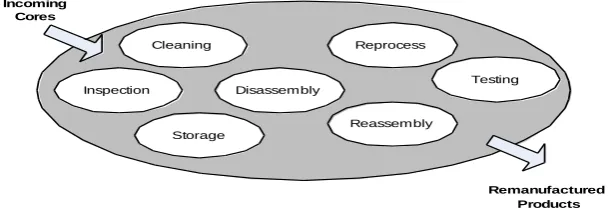
[image:2.595.143.449.460.565.2]Figure 1 illustrates a generic remanufacturing process. Because the remanufacturing process is product-type dependent, the various operations may be arranged in a slightly different order, or some of them may even be completely omitted (Sundin, 2004).
Figure 1 -The generic remanufacturing process(Sundin, 2004)
Usually, the remanufacturing process starts from the initial cleaning of used products (cores). Generally the cores that return from market are dirty, which often impedes assessing their condition (Ijomah et al., 1999). Upon receipt, cores are disassembled so that each component is separated. The components are then individually cleaned which helps to investigate their condition. Depending on the quality of the components, the value of the components (cost of remanufacture compared to cost of a new component), and safety restrictions; the parts are remanufactured or rejected from the process. Remanufacture of the components includes all activities that would bring worn parts to at least the original OEM specification (for example surface grinding, welding etc.). When all required components are collected (including remanufactured parts and new components), assembly kits can be organized and the product reassembled. After this, the entire product passes a final test to ensure that quality is at least equal to a newly manufactured, equivalent product (Ijomah, 2002). In some cases, products can be
Cleaning
Testing Reassembly
Reprocess
Disassembly Storage
Inspection
Incoming Cores
upgraded to the latest version (Ijomah et al., 2007).
Remanufacturing challenges
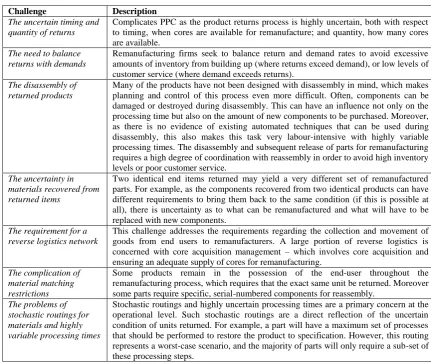
[image:3.595.77.509.185.549.2]Table 1 identifies Guide (2000) the major challenges that influence and complicate PPC activities within remanufacturing industry:
Table 1- Inherent challenges to the remanufacturing process (adapted from Guide, 2000)
Challenge Description
The uncertain timing and quantity of returns
Complicates PPC as the product returns process is highly uncertain, both with respect to timing, when cores are available for remanufacture; and quantity, how many cores are available.
The need to balance returns with demands
Remanufacturing firms seek to balance return and demand rates to avoid excessive amounts of inventory from building up (where returns exceed demand), or low levels of customer service (where demand exceeds returns).
The disassembly of returned products
Many of the products have not been designed with disassembly in mind, which makes planning and control of this process even more difficult. Often, components can be damaged or destroyed during disassembly. This can have an influence not only on the processing time but also on the amount of new components to be purchased. Moreover, as there is no evidence of existing automated techniques that can be used during disassembly, this also makes this task very labour-intensive with highly variable processing times. The disassembly and subsequent release of parts for remanufacturing requires a high degree of coordination with reassembly in order to avoid high inventory levels or poor customer service.
The uncertainty in materials recovered from returned items
Two identical end items returned may yield a very different set of remanufactured parts. For example, as the components recovered from two identical products can have different requirements to bring them back to the same condition (if this is possible at all), there is uncertainty as to what can be remanufactured and what will have to be replaced with new components.
The requirement for a reverse logistics network
This challenge addresses the requirements regarding the collection and movement of goods from end users to remanufacturers. A large portion of reverse logistics is concerned with core acquisition management – which involves core acquisition and ensuring an adequate supply of cores for remanufacturing.
The complication of material matching restrictions
Some products remain in the possession of the end-user throughout the remanufacturing process, which requires that the exact same unit be returned. Moreover some parts require specific, serial-numbered components for reassembly.
The problems of stochastic routings for materials and highly variable processing times
Stochastic routings and highly uncertain processing times are a primary concern at the operational level. Such stochastic routings are a direct reflection of the uncertain condition of units returned. For example, a part will have a maximum set of processes that should be performed to restore the product to specification. However, this routing represents a worst-case scenario, and the majority of parts will only require a sub-set of these processing steps.
Lundmark et al. (2009) emphasize that it will be important for future research to examine how to meet existing remanufacturing challenges. Both Seitz (2007) and Kucner (2008) suggest that the application of the lean manufacturing principles might overcome such challenges. However, in the extant literature there is not enough existing evidence to suggest that lean tools and principles can indeed help to reduce or eliminate the previously identified remanufacturing challenges.
Lean Manufacturing
with the production of standardized products in high volumes. However, Womack and Jones (1996) suggest that the implementation of lean thinking can bring benefits in the other sectors as well, thus the application of a lean manufacturing approach within remanufacturing operations may indeed be an effective way in which to improve the profitability of remanufacturing companies (Kucner, 2008; Seitz, 2007).
Lean Remanufacturing
The application of the lean manufacturing approach within a remanufacturing context – termed “Lean Remanufacturing” – has only recently gained the attention of researchers and practitioners (Pawlik et al., 2012). Hence, there is limited literature on this subject. However although slim the reported work does suggested that the combination of remanufacturing and lean principles offers a good opportunity to increase process efficiencies within the remanufacturing industry (Kucner, 2008; Seitz, 2007). Amezquita and Bras (1996) present the first reported study of lean remanufacturing in a case study that focuses on an independent automotive remanufacturer, and specifically analyses the process of remanufacturing clutches. This research shows that the effectiveness of the remanufacturing process can be improved through the development of lean automation techniques as well as the application of setup reduction methods. Moreover, Fargher (2003) and Pawlik et al. (2012) claim that the application of lean manufacturing within remanufacturing operations can bring significant benefits including a reduction in lead-time, reduced work in process, improved on-time shipments, increased utilization of floor space, improved quality, increased production control (Pawlik et al., 2012). However as with all case study based investigations the observations can only be generalize when a verity of different industries have been investigate.
Research design and methodology
adopted to identify how the lean manufacturing can be more tightly integrated within the remanufacturing environment. The central idea is to constantly compare theory and data, iterating toward a theory which closely fits the data (Eisenhardt, 1989).
Case Studies
Case study one: Combat Vehicles (UK) BAE Systems
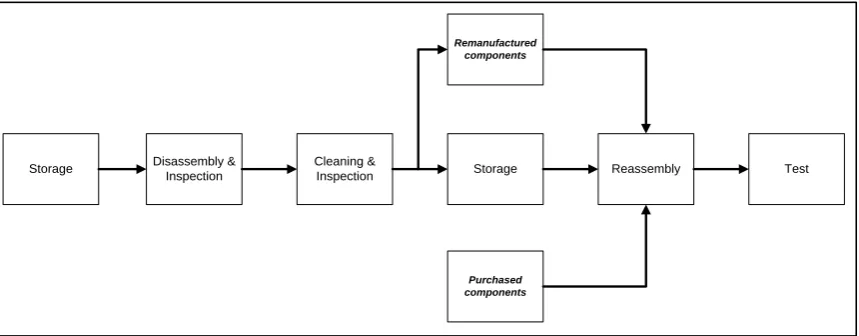
BAE Systems Combat Vehicles is an OEM Remanufacturer based in Newcastle-upon-Tyne, in the UK. At its Tyne & Wear facility, BAE Systems remanufacture Hydrogas suspension units, final drives, track tensioners and bridging equipment for combat vehicles, such as the Challenger II tank. With such vehicles serving in very testing climates and conditions, these parts are of course classified high-wear items. The remanufacturing process starts from the disassembly and inspection of old products, which occurs at the same time. Then components are cleaned and again inspected to ensure that nothing was overlooked at the first inspection. Afterwards, components are put on a pallet and a Manufacturing Engineer creates a rebuild kit which is sent to storage, where it remains until such a kit is required for remanufacturing. At this point, components are reassembled and the remanufactured product is tested (see Figure 2). BAE Systems started to implement lean manufacturing principles within the Tyne & Wear facility in 2007.
Disassembly & Inspection
Cleaning &
Inspection Storage Reassembly Test
Remanufactured components
Purchased components
[image:5.595.89.519.375.543.2]Storage
Figure 2- Simplified overview of the remanufacturing process: BAE Systems
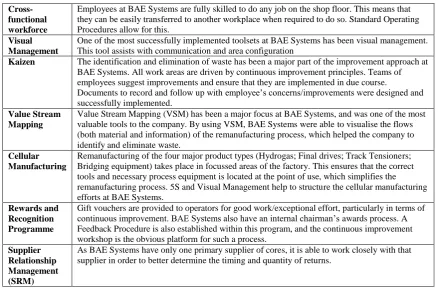
The lean tools and techniques that have been applied at BAE Systems are listed in Table 2. They have also been categorised by functional area in Table 3, with a list of the more generally applied practices in the lower part of the table.
Table 2- Application of Lean Tools at BAE Systems
5S BAE Systems have applied 5S in certain areas. There are clear examples of Sorting, Setting in order and Systematic cleaning in the plant. However, Standardizing and Self-discipline have proved difficult to maintain, though the company does use daily, weekly and monthly checklists. Kitting BAE Systems gather components and parts needed for the reassembly of a Hydrogas units as a
kit. Moreover, the company attempts to standardize rebuild kits, classifying them as a light, medium and heavy in term of amount of work that is required to remanufacture them. This classification method has proved to be useful with supporting the planning process, particular in terms of Production Levelling.
Standard Operating Procedures (SOPs)
Cross-functional workforce
Employees at BAE Systems are fully skilled to do any job on the shop floor. This means that they can be easily transferred to another workplace when required to do so. Standard Operating Procedures allow for this.
Visual Management
One of the most successfully implemented toolsets at BAE Systems has been visual management. This tool assists with communication and area configuration
Kaizen The identification and elimination of waste has been a major part of the improvement approach at BAE Systems. All work areas are driven by continuous improvement principles. Teams of employees suggest improvements and ensure that they are implemented in due course.
Documents to record and follow up with employee’s concerns/improvements were designed and successfully implemented.
Value Stream Mapping
Value Stream Mapping (VSM) has been a major focus at BAE Systems, and was one of the most valuable tools to the company. By using VSM, BAE Systems were able to visualise the flows (both material and information) of the remanufacturing process, which helped the company to identify and eliminate waste.
Cellular Manufacturing
Remanufacturing of the four major product types (Hydrogas; Final drives; Track Tensioners; Bridging equipment) takes place in focussed areas of the factory. This ensures that the correct tools and necessary process equipment is located at the point of use, which simplifies the remanufacturing process. 5S and Visual Management help to structure the cellular manufacturing efforts at BAE Systems.
Rewards and Recognition Programme
Gift vouchers are provided to operators for good work/exceptional effort, particularly in terms of continuous improvement. BAE Systems also have an internal chairman’s awards process. A Feedback Procedure is also established within this program, and the continuous improvement workshop is the obvious platform for such a process.
Supplier Relationship Management (SRM)
[image:6.595.77.516.82.372.2]As BAE Systems have only one primary supplier of cores, it is able to work closely with that supplier in order to better determine the timing and quantity of returns.
Table 3- Lean Tools at BAE Systems Classified by Functional Area
Storage Disassembly & Inspection Cleaning & Inspection Storage Reassembly Test
5S, SOP, Supplier
Relationship Management 5S Kitting
5S, SOP, Cellular Manufacturing
5S, SOP
---Visual Management--- ---Value Stream Mapping--- --- Cross-functional workforce --- --- Rewards & Recognition Programme ---
--- Kaizen (Continuous improvement) ---
Case Study Two: MCT ReMan Limited
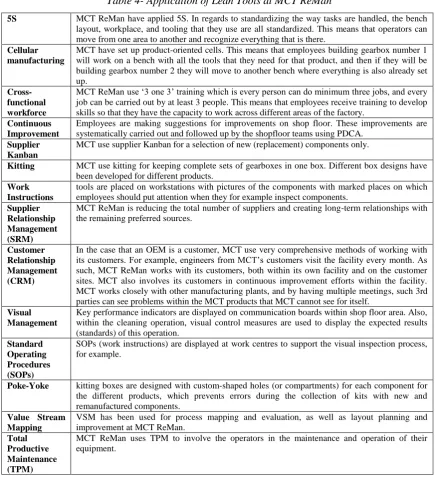
MCT ReMan is one of the largest contracted remanufacturers in the automotive sector across Europe. The company is based in Weston-super-Mare, in the UK. Transmissions (mostly manual, but also some automatic) and engines (both petrol and diesel) are the main products that are remanufactured at the facility in Somerset. MCT ReMan disassembles cores and cleans the component parts; replacing the worn components with remanufactured or new components, and finally reassembles the products to their original fit and function (Figure 3):
Storage Disassembly Cleaning Component Inspection Remanufacture Reassembly Final Test Packing
Purchased components
[image:6.595.89.510.660.750.2]Table 4- Application of Lean Tools at MCT ReMan
5S MCT ReMan have applied 5S. In regards to standardizing the way tasks are handled, the bench layout, workplace, and tooling that they use are all standardized. This means that operators can move from one area to another and recognize everything that is there.
Cellular manufacturing
MCT have set up product-oriented cells. This means that employees building gearbox number 1 will work on a bench with all the tools that they need for that product, and then if they will be building gearbox number 2 they will move to another bench where everything is also already set up.
Cross-functional workforce
MCT ReMan use ‘3 one 3’ training which is every person can do minimum three jobs, and every job can be carried out by at least 3 people. This means that employees receive training to develop skills so that they have the capacity to work across different areas of the factory.
Continuous Improvement
Employees are making suggestions for improvements on shop floor. These improvements are systematically carried out and followed up by the shopfloor teams using PDCA.
Supplier Kanban
MCT use supplier Kanban for a selection of new (replacement) components only.
Kitting MCT use kitting for keeping complete sets of gearboxes in one box. Different box designs have been developed for different products.
Work Instructions
tools are placed on workstations with pictures of the components with marked places on which employees should put attention when they for example inspect components.
Supplier Relationship Management (SRM)
MCT ReMan is reducing the total number of suppliers and creating long-term relationships with the remaining preferred sources.
Customer Relationship Management (CRM)
In the case that an OEM is a customer, MCT use very comprehensive methods of working with its customers. For example, engineers from MCT’s customers visit the facility every month. As such, MCT ReMan works with its customers, both within its own facility and on the customer sites. MCT also involves its customers in continuous improvement efforts within the facility. MCT works closely with other manufacturing plants, and by having multiple meetings, such 3rd parties can see problems within the MCT products that MCT cannot see for itself.
Visual Management
Key performance indicators are displayed on communication boards within shop floor area. Also, within the cleaning operation, visual control measures are used to display the expected results (standards) of this operation.
Standard Operating Procedures (SOPs)
SOPs (work instructions) are displayed at work centres to support the visual inspection process, for example.
Poke-Yoke kitting boxes are designed with custom-shaped holes (or compartments) for each component for the different products, which prevents errors during the collection of kits with new and remanufactured components.
Value Stream Mapping
VSM has been used for process mapping and evaluation, as well as layout planning and improvement at MCT ReMan.
Total Productive Maintenance (TPM)
MCT ReMan uses TPM to involve the operators in the maintenance and operation of their equipment.
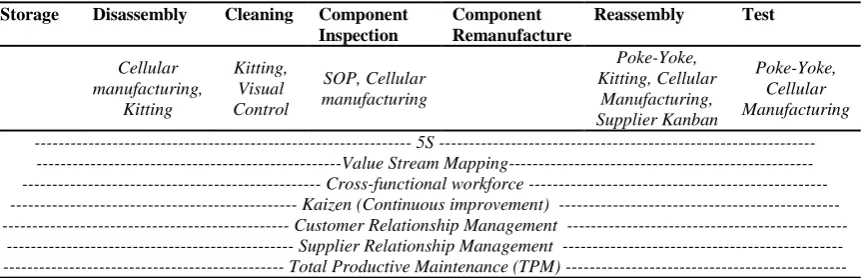
Table 5- Application of Lean Tools at MCT ReMan
Storage Disassembly Cleaning Component
Inspection
Component Remanufacture
Reassembly Test
Cellular manufacturing,
Kitting
Kitting, Visual Control
SOP, Cellular manufacturing
Poke-Yoke, Kitting, Cellular
Manufacturing, Supplier Kanban
Poke-Yoke, Cellular Manufacturing
--- 5S --- ---Value Stream Mapping--- --- Cross-functional workforce --- --- Kaizen (Continuous improvement) --- --- Customer Relationship Management ---
--- Supplier Relationship Management --- --- Total Productive Maintenance (TPM) ---
Results and Discussion
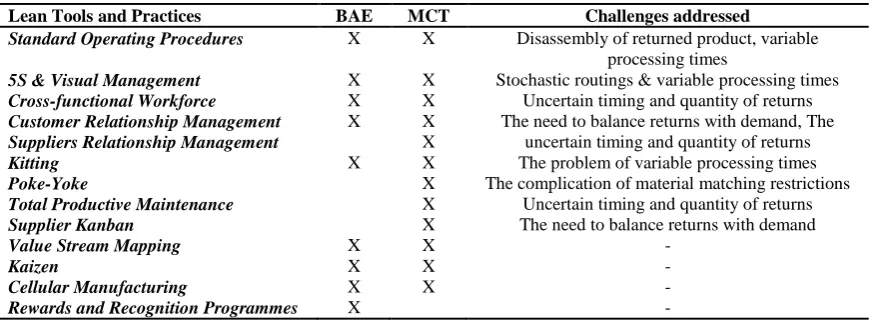
We present a summary of the lean practices that were observed in the case companies in Table 6, where we also list the challenges that were addressed. Such a cross-case analysis shows that lean manufacturing tools are regularly being applied in remanufacturing companies. We therefore suggest that this gives positive indications that by adopting a lean approach, remanufacturers are able to relieve the negative effects of several of the previously identified remanufacturing challenges, thus making PPC activities in remanufacturing environments simpler to execute. For example, the uncertain timing and quantity of returns can be alleviated through applying the following methods:
Supplier Relationship Management. SRM was being used by BAE Systems to enable the company to plan more effectively for the arrival time and quantity of returned cores.
Cross-functional workforce. This ensures that employees are able to work in more than one process area, thus increasing flexibility and simplifying the remanufacturing planning process. For example, cross-functional workers are imperative to the success of production levelling within the Toyota Production System, a prerequisite for Just-in-Time production (see Ohno, 1988; Shingo, 1981).
TPM. The deployment of TPM can help to ensure that remanufacturing equipment is available whenever cores arrive at the facility. It is a way of increasing the reliability of production machinery.
Likewise, the need to balance returns with demand is made simpler by applying:
Supplier Relationship Management. The use of SRM increases confidence levels in medium-term planning.
Customer Relationship Management. Similarly, when applied correctly, CRM acts to some extent as an effective balance mechanism between returns and demand. Furthermore, the complication of material matching restriction can be eased through:
Kitting. Gathering components for the end-product as a kit will to support controlling activities.
Table 6- Summary of Applied Lean Tools in Case Companies & Challenges Addressed
Lean Tools and Practices BAE MCT Challenges addressed
Standard Operating Procedures X X Disassembly of returned product, variable
processing times
5S & Visual Management X X Stochastic routings & variable processing times
Cross-functional Workforce X X Uncertain timing and quantity of returns
Customer Relationship Management X X The need to balance returns with demand, The
uncertain timing and quantity of returns
Suppliers Relationship Management X
Kitting X X The problem of variable processing times
Poke-Yoke X The complication of material matching restrictions
Total Productive Maintenance X Uncertain timing and quantity of returns
Supplier Kanban X The need to balance returns with demand
Value Stream Mapping X X -
Kaizen X X -
Cellular Manufacturing X X -
Rewards and Recognition Programmes X -
In addition, we have seen that the problems of stochastic routings for materials and highly variable processing times can be relieved through the application of:
Kitting. BAE Systems have developed a classification and kitting procedure which classifies returned cores as light, medium, or heavy kits. This allows for flexibility in the re-build schedule, as light kits can easily be remanufactured in the absence of more complicated, heavy kits; or in periods of high demand.
SOP. Both companies have applied SOPs to the remanufacturing processes. Though the standardization of processes is very difficult in a remanufacturing environment (due to uncertainty in the condition of component parts within the cores), the case studies did demonstrate advantages of using such an approach.
5S. Visual management and 5S have proven to be very useful in supporting the planning and control of operations in remanufacturing companies. Such lean tools provide the fundamental requirements for success, and remove a lot of unnecessary waiting, operator motion (such as searching for tools) and over-processing.
Finally, the challenge of disassembling returned product can in some cases be solved or at least moderated through the creation of standard operating procedures (SOPs).
Conclusion and further work
By applying practical insights from two case studies in the automotive remanufacturing sector, we have identified several effective tools for lean practices to be implemented to address the challenges inherent to this type of industry. We suggest that further work should look more closely at developments for adapting Just-in-Time (JIT) production control methods to remanufacturing, in particular how JIT could be used to address the challenge “the need to balance returns with demand”. Further consideration should also
be given to “the uncertainty in materials recovered from returned items” and “the requirements for a reverse logistics network”, as these two challenges are seemingly not
yet tackled by lean practices.
Acknowledgements
The authors would like to thank BAE System and MCT Reman for their support in data collection for this study.
References
Amezquita, T. & Bras, B. 1996. Lean remanufacture of an Automobile clutch. Proceedings of the First
International Working Seminar on Reuse. Eindhoven, The Netherlands.
Deming, W. E. 1950. Elementary Principles of the Statistical Control of Quality. Japanese Union of Scientists and Engineers.
Eisenhardt, K. M. 1989. Building Theories from Case Study Research. Academy of Management: The
Academy of Management Review, 14 (4), 532-549.
Fargher, J. S. W. 2003. Lean: Dealing with Eight Wastes. ReMaTec News, September 24-25.
Feld, W. M. 2001. Lean Manufacturing: Tools, Techniques, and How to Use Them, Boca Raton, FL., St
Lucie Press.
Guide, V. D. R. 2000. Production planning and control for remanufacturing: industry practice and
research needs. Journal of Operations Management, 18 (4), 467-483.
Ijomah, W. L. 2002. A model-based definition of the generic remanufacturing business process. PhD
thesis, University of Plymouth.
Ijomah, W. L., Bennett, J. & Pearce, J. 1999. Remanufacturing: evidence of environmentally conscious
business practice in the UK. EcoDesign'99: First International Symposium on Environmentally
Conscious Design and Inverse Manufacturing. Tokyo, Japan: IEEE.
Ijomah, W. L., Mcmahon, C. A., Hammond, G. P. & Newman, S. T. 2007. Development of design for
remanufacturing guidelines to support sustainable manufacturing. Robotics and Computer-Integrated
Manufacturing, 23 (6), 712-719.
Kucner, R. J. 2008. A socio-technical study of lean manufacturing deployment in the remanufacturing
context. PhD thesis, University of Michigan.
Lage Junior, M. & Godinho Filho, M. 2012. Production planning and control for remanufacturing:
literature review and analysis. Production Planning & Control, 23 (6), 419-435.
Lundmark, P., Sundin, E. & Björkman, M. 2009. Industrial challenges within the remanufacturing system.
Proceedings of Swedish Production Symposium, Stockholm, Sweden, pp 132-138.
Ohno, T. 1988. Toyota Production System: Beyond large-scale production New York, Productivity Press.
Pawlik, E., Ijomah, W. & Corney, J. 2012. Current state and future perspective research on lean
remanufacturing – focusing on the automotive industry. Advances in Production Management Systems
(APMS) 2012 International Conference - Competitive Manufacturing for Innovative Products and Services. Rhodes Island, Greece. 24-26 September 2012.
Scandura, T. A. & Williams, E. A. 2000. Research methodology in management: Current practices, trends,
and implications for future research. Academy of Management Journal, 1248-1264.
Seitz, M. A. 2007. A critical assessment of motives for product recovery: the case of engine
remanufacturing. Journal of cleaner production, 15 (11), 1147-1157.
Shingo, S. 1981. A Study of the Toyota Production System, New York, Productivity Press.
Steinhilper, R. 1998. Remanufacturing: the ultimate form of recycling, Fraunhofer IRB Verlag Stuttgart.
Sundin, E. 2004. Product and Process design for Successful Remanufacturing. PhD thesis, Linkoping
University, Sweden.
Voss, C. A., Tsikriktsis, N. & Frohlich, M. 2002. Case Research in Operations Management.
International Journal of Operations & Production Management, 22 (2), 195-210.
Womack, J. P. & Jones, D. T. 1996. Lean Thinking: Banish Waste and Create Wealth in Your
Corporation, New York, Simon and Schuster.