Quality Enhancement Themes:
The First Year Experience
Printed copies of current publications are available from: Linney Direct
Adamsway Mansfield NG18 4FN
Tel 01623 450788
Fax 01623 450481
Email [email protected]
The First Year Experience
Personal Development Planning in the first year
KKiirrssttyy M
Miilllleerr
D
Drr C
Co
olliinn C
Caallddeerr
A
Allllaann M
Maarrttiinn
M
Maauurreeeenn M
MccIInnttyyrree
IIssaabbeellllee PPo
ottttiinnggeerr
D
led and learner centred. It was developed through a partnership of the Scottish Funding Council (SFC), Universities Scotland, the National Union of Students in Scotland (NUS Scotland) and the Quality Assurance Agency for Higher Education (QAA) Scotland. The Higher Education Academy has also joined that partnership. The Enhancement Themes are a key element of a five-part framework, which has been designed to provide an integrated approach to quality assurance and enhancement. The Enhancement Themes support learners and staff at all levels in further improving higher education in Scotland; they draw on developing innovative practice within the UK and internationally.
The five elements of the framework are:
z a comprehensive programme of subject-level reviews undertaken by higher education institutions (HEIs) themselves; guidance is published by the SFC (www.sfc.ac.uk)
z enhancement-led institutional review (ELIR), run by QAA Scotland (www.qaa.ac.uk/reviews/ELIR)
z improved forms of public information about quality; guidance is provided by the SFC (www.sfc.ac.uk)
z a greater voice for students in institutional quality systems, supported by a national development service - student participation in quality scotland (sparqs) (www.sparqs.org.uk)
z a national programme of Enhancement Themes aimed at developing and sharing good practice to enhance the student learning experience, facilitated by QAA Scotland (www.enhancementthemes.ac.uk).
The topics for the Enhancement Themes are identified through consultation with the sector and implemented by steering committees whose members are drawn from the sector and the student body. The steering committees have the task of establishing a programme of development activities, which draw on national and international good practice. Publications emerging from each Theme are intended to provide important reference points for HEIs in the ongoing strategic enhancement of their teaching and learning provision. Full details of each Theme, its steering committee, the range of research and development activities as well as the outcomes are published on the Enhancement Themes website (www.enhancementthemes.ac.uk).
1 Executive summary 2
2 Introduction 5
2.1 Background and context 5
2.2 Content of the project 6
3 Issues and recommendations 7
3.1 Focusing PDP in the first year 7
3.2 Transition issues 9
3.3 Pedagogy and assessment issues 10
3.4 Engagement issues 11
3.5 Means of delivery issues 13
3.6 Staff and student support issues 14
4 The way forward 17
5 Case studies 18
5.1 University of Strathclyde 18
5.2 University of Glasgow 22
5.3 Napier University 27
5.4 Heriot-Watt University 30
6 Concluding remarks 32 7 Appendices
Appendix 1: Literature review 35
Acknowledgements
The Project Director, Kirsty Miller, University of Dundee, and Project Partners, Dr Colin Calder, University of Aberdeen; Allan Martin, formerly University of Glasgow; Maureen McIntyre, Edinburgh College of Art; Isabelle Pottinger, Heriot-Watt University and Dr Geri Smyth, University of Strathclyde, would like to thank all those involved in The First Year Experience Quality Enhancement Theme, who, in their many individual ways, contributed to the outcomes of this Project through discussion and sharing of experience.
In particular, we would like to thank Helen Godfrey, Napier University, and Patricia Barton, University of Strathclyde, for their case study contributions; fellow Project Directors Dr Hazel Knox, University of Paisley, and Ruth Whittaker, Glasgow Caledonian University, for sharing sections of their reports; Rob Ward, Centre for Recording
Achievement, and those who participated in the interim findings workshop for the sector, including colleagues from the Peer Support in the first year Project, at the University of Dundee in May 2007.
1 Executive summary
This report presents the outcomes of the 'Personal development planning (PDP) in the first year' practice-focused development project for the First Year Experience Quality Enhancement Theme. The project's aims and objectives are set out in the context of the work of the other eight projects for this Enhancement Theme, each of which focused on different aspects of student engagement and empowerment in the first year, and on other significant developments in PDP implementation in Scotland.
The content of the project is outlined with reference to the outcomes - case studies in Section 4 and a literature review which is appended. Reference is also made to the outcomes of a workshop held to discuss interim findings with the sector, available on the Enhancement Themes website (www.enhancementthemes.ac.uk).
The main body of the report examines the key issues identified by the literature review and workshop discussions and makes reference to case studies, which are used to
illustrate some of the issues arising, as well as listing associated recommendations for the sector. Each recommendation may not appear as particularly innovative in itself, but taken as a whole they should help to progress the engagement and empowerment of participants in PDP.
The following main recommendations (selected from the full list) are summarised under six broad themes:
11..11
PPD
DPP iinn tthhee ffiirrsstt yyeeaarr
z Institutions should state a 'support entitlement', which makes clear from the outset the areas and levels of support provided for students.
z To underpin this entitlement, PDP should be implemented as a means of enabling students to gain self-awareness as developing learners and to plan the actions that will enhance personal and career development.
z Institutional policy should make specific reference to the rationale for introducing PDP in the first year and to the purposes of PDP for first-year students.
11..22
TTrraannssiittiio
onn
z Time and resources should be allocated within the curriculum to PDP discussion and activities to ease new students into the first year. There should be recognition of prior experience of and exposure to PDP.
z Opportunities for peer mentoring (for example, second or third years supporting first years) need to be expanded as a support mechanism to help in acknowledging entrants' prior experiences of PDP (good or bad), as these may influence attitudes and engagement.
11..33
PPeeddaaggo
oggyy aanndd aasssseessssm
meenntt
z The relationship of PDP tools and processes to pedagogy and assessment should be clearly stated and discussed with students.
z An 'academic literacies' perspective may facilitate whole-institution provision for the development of reflective writing.
11..44
EEnnggaaggeem
meenntt
z The careers service should be involved in implementing PDP in non-vocational degrees (where the links to career planning are less tangible than in vocational degrees), in order to encourage engagement. Careers staff have a specific role in assisting students to clarify goals, which can help to engage them in the process.
z More student-facing publications focusing on PDP in the first year should be developed for the sector.
11..55
D
Deelliivveerryy
z PDP systems should involve human as well as online elements. The relationship between human and online processes should be made clear and discussed with students.
z The design of online systems should be clearly linked to pedagogical or other explicit goals, which should be discussed with users.
11..66
SSuuppppo
orrtt
z Staff development and training opportunities focused on staff working with first-year students should be offered to raise awareness of the benefits of PDP, the boundaries of their role, and the sources of expert help within their institution.
z Students should be encouraged to participate in supporting their peers in PDP mentoring or 'buddying' initiatives.
z More research into effective strategies for supporting academic 'buy-in' to PDP, and into staff development needs, should be undertaken and guidelines produced for the sector.
Given the parameters of the project, some aspects of PDP in the first year could have been explored further. Areas for future development are therefore covered in a section entitled: 'The way forward'.
For students
z gives a means of forming a full picture of themselves as learners in the broadest context:
{ links current personal (identity), social (friendships and networks) and academic aspects
{ links to prior learning and education
{ provides a mechanism to relate these to current and future plans
z serves as a framework or structure to bridge:
{ between different educational settings
{ within the different elements of the first-year student life cycle
z plays a crucial role in personalising the mass experience of being a first year:
{ through owning and keeping track of their development and making sense of their experiences
{ by giving opportunities for peer support
z links employability to the curriculum, while providing opportunities for identifying and planning for career goals in a structured way
z provides a 'support entitlement', which makes clear how they are supported throughout the student life cycle when experiencing significant or critical incidents
z assures coherence and allows for equitable access to the appropriate tools (educational and technological).
For staff
z integrates PDP and pedagogy from the beginning:
{ important because learning practices (including reflection) are set in the first year
{ assessment of the PDP process is essential for students' (and staff's own) engagement
z confirms senior management's commitment to PDP
z fosters staff engagement through recognising the need for time to develop tailoring to discipline needs
z raises the profile of those who teach first-year students.
In theory, by implementing PDP in the first year, using an integrated approach, institutions can benefit from increased retention from more engaged and empowered students, increased employability and more effective learners. However, there still seems to be a long way to go to meet a universal student entitlement to an effective PDP system which meets students' needs and engages and empowers all students, whatever their chosen subject.
2 Introduction
22..11
BBaacckkggrro
ouunndd aanndd cco
onntteexxtt
'Personal development planning (PDP) in the first year' was one of the nine projects of the First Year Experience Quality Enhancement Theme, planned and directed by its steering committee as part of the work of the Scottish Higher Education Enhancement Committee, supported by QAA Scotland1. The focus of this Theme was on the nature
and purpose of the first year and how it can be developed as a transformative experience for the broadest range of students (rather than on the narrower support needs of a diverse range of entrants from widening access initiatives and issues relating to student retention).
Within this broad theme, the aim of this practice-focused development project was to consider student engagement and empowerment in the first year in relation to PDP. Its objective was to set out ways in which Scottish higher education institutions (HEIs) and their staff might change and enhance their practice to engage and empower students with respect to PDP.
There are links to the other eight projects, although we found that PDP was not often referred to in the literature on the first year experience and not necessarily seen as a priority in discussions pertaining to the first year. The other six practice-focused development projects covered key aspects of the first year experience, including
curriculum design, assessment, scholarship skills, personalisation, peer support and issues of transition. Of the two sector-wide discussion projects, one reflected on the nature and purpose of the first year and considered the status of first-year teaching. The other explored with students their expectations, experiences and reflections on the first year (see Appendix 2 for full list of projects).
A number of other Scottish PDP-related projects and forums are running or have recently published their outcomes:
z The 'Individualised Support for Learning through ePortfolios' (ISLE) project2, funded
under the Scottish Funding Council's Transformation Programme to look at how a shared model of PDP supported by e-portfolios can benefit the learning process (reported summer 2007).
z The Effective Learning Framework (ELF)3, an initiative coordinated by the Joint
Working Group of the Scottish Advisory Committee for Credit and Access and Universities Scotland. Universities Scotland was designed to support institutions as they implement PDP. It published its reports in 2007.
z Forums held in April, May and June 2007 jointly by the Centre for Recording Achievement (CRA), the Higher Education Academy (HEA) and Quality Assurance Agency for Higher Education (QAA) Scotland, who are working together to support
1 www.enhancementthemes.ac.uk/themes/FirstYear/default.asp 2 http://isle.paisley.ac.uk
higher education (HE) in Scotland to implement PDP.
z Scottish Higher Education Employability Network projects (SHEEN4), funded by the
Scottish Funding Council, which include several PDP implementation pilots.
This Enhancement Theme project has been the only one uniquely focused on the first year experience, but it could usefully have drawn on the outcomes of the others if the timing had been right. However, the resulting focus on PDP practice is providing a stimulus towards PDP implementation in the sector.
22..22
C
Co
onntteenntt o
off tthhee pprro
ojjeecctt
The project partners, all of whom are members of the Personal Development Planning in Higher Education (PDP in HE) (Scotland) group5, identified a number of potential issues
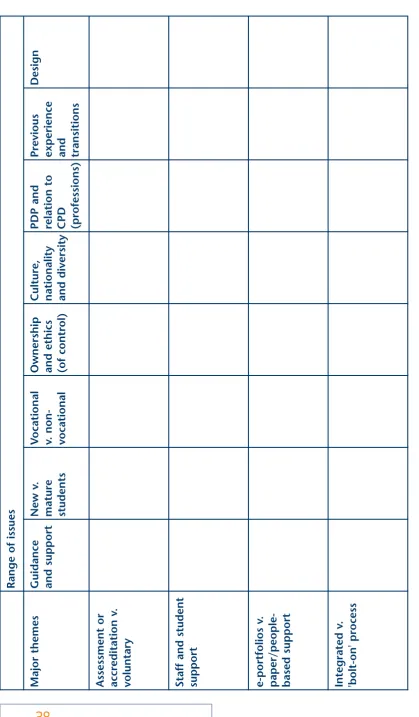
to explore regarding student engagement and empowerment in relation to PDP. They included: the use of e-portfolios to support PDP processes; the role of assessment or accreditation of PDP; the efficacy of integrated models of PDP delivery compared to 'bolt-on' processes as a means of first-year engagement; and empowering students and staff to engage in PDP. These issues are examined in the literature review (Appendix 1).
The interim findings from the literature review were taken to the workshop organised for the sector in May 2007 at the University of Dundee. The outcomes of these discussions helped to clarify ideas and practice for future development. The workshop report is available from the QAA Enhancement Themes website6.
Case studies (Section 4) were used primarily as a means of identifying and exploring the issues regarding the adoption of PDP in the first year of study in Scottish HE. These case studies were not intended to showcase 'good practice' in order to encourage its emulation. The practices described are therefore to be regarded as neither 'good' nor 'bad', but as real occurrences that may be typical of situations in which PDP is being addressed.
Case studies 1, 3 and 4, in particular, serve to illustrate the potential role of PDP in supporting students through various significant or critical incidents in the first-year student life cycle (Appendix 1, section 2.5). Without a structured PDP process involving key staff to offer support, students may not find the abilities, people or skills to cope with these critical incidents, which can be positive or negative.
The project team found the use of the student life cycle illustrated in the work of the First Year Experience Enhancement Theme project on 'Personalisation of the first year' helpful in considering when, where and why PDP might be important. Also helpful in this regard were the diagrams offering structures to address and develop positive strategies to learn from feedback and critical incidents in Effective Learning Framework: Using focused learner questions in personal development planning to support effective
learning(pp 7-9) (QAA Scotland, 2007).
4 www.heacademy.ac.uk/aboutus/scotland/institutions/sheen
5 A longstanding network of active practitioners from a wide range of disciplines and services in
Scottish HEIs.
3 Issues and recommendations
The following issues and associated recommendations, arranged under six broad themes, are drawn from:
z the discussions featured in the literature review (Appendix 1)
z a workshop for the sector, held to discuss the interim findings from this review7
z the four case studies (Section 4).
Further details of these issues can be found in the specific link to the source of evidence, noted in brackets. Reference is also made to links with the other practice-focused
projects, where appropriate.
33..11
FFo
occuussiinngg PPD
DPP iinn tthhee ffiirrsstt yyeeaarr
The findings of the series of projects under the umbrella of the First Year Experience Enhancement Theme have underlined the importance of the first year of study in HE8.
During this period, new students must settle into the culture and practice of university life. Learning is a lifelong personal process, about building meaning and identity, which happens in a social context of relationships and communities. For students at university, learning happens in three areas which affect each other:
z personal - growing up is learning to be grown up
z social - forming and developing friendships and networks
z study - becoming familiar with the content, methods and rules of the discipline.
For new students arriving, assimilation into university life in each of these three areas may be traumatic and for most involves a substantial shift of attitudes and practices in a very short period of time (Appendix 1, section 2.5b; section 3).
Students are entitled to effective preparation, induction and support in the process of making the transition - personal, social and intellectual - into university studenthood. Faculties and departments clearly have a key role to play here in engaging students with the culture and community of practice of the discipline. A corollary of this role is that of identifying and supporting those students for whom the process of assimilation does not go well. Such students may have difficulty with the culture, content or methods of the discipline. Most can be brought to some satisfactory engagement, but a minority will ultimately feel that their choice of subject was not correct for them. Working with
academic staff, student support services of all kinds have essential roles to play in sustaining and developing student engagement and commitment (Appendix 1, section 2.5b).
In this context, PDP activities can be a means of enabling students to gain an awareness of their own development as learners, reflect on the progress of that development, and make plans and decisions which forward their development in the direction they feel is right for them.
A plethora of terms, strategies, processes and products are used to describe these PDP activities, resulting in no uniform understanding of what PDP is beyond the commonly used definition from the Guidelines for HE Progress Files (QAA, 2001), point 28. PDP practice in HE can thus be defined by an institution, college or faculty, department or school, programme or module context (Section 4, case study 2). It may also be defined differently in other sectors - school, further education (FE), employment (Appendix 1, section 2.8a). As PDP is increasingly delivered electronically, a further factor is people's understanding of the terminology surrounding e-portfolios (Appendix 1, section 2.9).
From the different models of PDP in practice, the evidence suggests that 'one size does not fit all', and that such diversity is therefore an essential feature of PDP. However, this lack of uniformity can affect a first-year student's experience by conveying mixed messages about purpose, process and outcomes:
z between different educational sectors
z within different academic discipline cultures in their degree (for example in arts, humanities or social science)
z as students progress within the undergraduate curriculum.
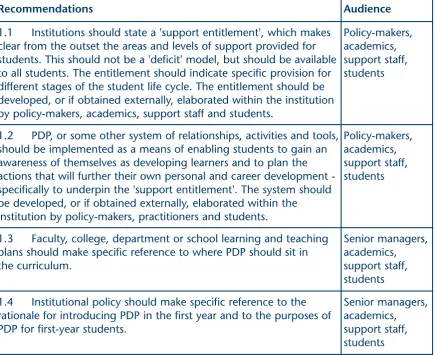
[image:13.595.62.501.402.757.2]Clarity about the rationale for implementing PDP in the first year is therefore essential (Appendix 1, section 2.1).
Figure 1: recommendations for focusing PDP in the first year
Recommendations Audience
1.1 Institutions should state a 'support entitlement', which makes clear from the outset the areas and levels of support provided for students. This should not be a 'deficit' model, but should be available to all students. The entitlement should indicate specific provision for different stages of the student life cycle. The entitlement should be developed, or if obtained externally, elaborated within the institution by policy-makers, academics, support staff and students.
Policy-makers, academics, support staff, students
1.2 PDP, or some other system of relationships, activities and tools, should be implemented as a means of enabling students to gain an awareness of themselves as developing learners and to plan the actions that will further their own personal and career development -specifically to underpin the 'support entitlement'. The system should be developed, or if obtained externally, elaborated within the
institution by policy-makers, practitioners and students.
Policy-makers, academics, support staff, students
1.3 Faculty, college, department or school learning and teaching plans should make specific reference to where PDP should sit in the curriculum.
Senior managers, academics, support staff, students
1.4 Institutional policy should make specific reference to the rationale for introducing PDP in the first year and to the purposes of PDP for first-year students.
33..22
TTrraannssiittiio
onn iissssuueess
A wide variety of students enter HE in Scotland, with a range of educational, work and social experiences. Some institutions have adopted specific measures to bridge the gap between prior experience and entry into HE (Section 4, case study 3), introducing students to the skills they will need in order to cope during their HE studies and encouraging them to plan for their exit. This career planning element is particularly significant for new students who have achieved advanced entry, as their exit point arrives more quickly than for those entering at level 1. In discussions with students on the Napier University Bridging Course, students in higher years were found to be valuable assets.
Students express worries about their first year experiences, and these concerns change throughout the year (Section 4, case study 1). A PDP process can help students to keep track of their development and enable staff to understand better the student experience, and may contribute to improving the design of the first year. It can also identify any problems or concerns about individual students, enabling appropriate support to be put in place at an early stage, thus hopefully minimising the effect of any problems.
This support could be peer sharing or mentoring (Section 4, case study 4).
The school sector has a history of National Records of Achievement and Progress Files which incorporate PDP-type activities, but there was no evidence from the literature to suggest whether this helps or hinders student engagement at HE level. At present, there is no consistent system of PDP or similar activity in schools or colleges. However, significant projects are underway to introduce new approaches to teaching and learning within Scottish schools, notably the 'Assessment is for Learning' initiative. Careers Scotland anticipates being more involved with S4-6 pupils in future, helping them to develop a career plan of action. These developments are likely to have an impact on HE entrants in the future, with students arriving with a greater understanding of how they learn and greater experience of reflection and planning processes (Appendix 1, section 2.5a).
The benefits of a well-designed PDP system are that students are supported in their transition into HE, and engagement with their course is likely to be enhanced. The implications for staff and institutions are that time and resources have to be channelled to develop and support the process. However, this can lead to greater understanding of their students and to better design of the first-year curriculum.
No research was uncovered in the literature review to indicate whether induction to PDP in the first or second year engages more students, though some research has suggested a gradual process of induction. Some have advocated focusing more on the necessary skills at first, for example, reflection; others that induction to PDP should be embedded from the beginning of entry to HE, along with induction to the product or tools (for example, e-portfolio). Information overload could be an issue, unless properly managed (Appendix 1, section 2.4b).
Figure 2: recommendations for transition issues
33..33
PPeeddaaggo
oggyy aanndd aasssseessssm
meenntt iissssuueess
Education is recognised as a major arena for the creation of meaning in a social context and hence for the social development of individual identity. Hence students are no longer perceived as empty jars to be filled with knowledge according to the judgements of others, or as organisms that can be trained to replicate preferred observable behaviours, but as individuals involved in the process of building their own identity in a social context and of realising themselves as members of society. The student is the central actor in this process of identity construction, and education is gradually shifting to a position of enabling students to develop the ability to make meaning and thus to take decisions affecting their own future. Current pedagogical approaches focus on enabling the development of individual identity in the context of learning as social action.
We believe that PDP can make an important contribution to a student-centred pedagogy, in enabling students to form a full picture of themselves as learners
(Appendix 1, section 2.1). To make this possible, course leaders should be explicit about pedagogical approaches, including assessment, and the relationship of PDP processes to
Recommendations Audience
2.1 Ongoing dialogue between the school, FE and HE sectors about PDP developments should be supported and encouraged, to ease transition and understand the changing experience of entrants to HE in the future.
Scottish Executive, Scottish Funding Council, QAA Scotland, HEA, academic staff, support staff
2.2 Time and resources should be allocated within the curriculum to PDP discussion and activities to ease new students into the first year. There should be recognition of any prior experience of and exposure to PDP. Interoperability of systems by sectors would provide a seamless transition and would be the preferred method for some; others will highlight the differences between prior experience in other sectors and PDP in HE.
Senior managers, academic staff, support staff
2.3 Opportunities for peer mentoring (for example, second or third years supporting first years) need to be expanded as a support mechanism to help in acknowledging entrants' prior experiences of PDP (good or bad), as these may influence attitudes and engagement.
Academic staff, support staff, students
2.4 Induction to PDP should focus on the process of personal development planning (what it is, the benefits, where it fits into the curriculum), as well as introducing the product or tools used (most often e-portfolios). Attention should be given to designing this process in such a way that time is built in to support student needs arising.
them. The extent to which PDP systems and processes are owned by students is important in influencing usage. The habits and practices which pedagogy encourages are established in the first year of study, and it is therefore important to integrate PDP processes and pedagogy closely from this point on.
There is evidence that assessment of the PDP process is essential for engagement by the majority of students. However, assessment of the actual reflections is almost certainly counterproductive; in that students will write what they consider is required. Fortunately, assessment can take many forms, including peer assessment (Appendix 1, section 2.3).
In order to engage effectively with PDP, a reflective capability is required. Not all students find reflection easy, and some staff may not understand what place reflective activities have within the curriculum. If PDP is assessed, then reflection may no longer be a private and personally motivated activity. Reflection can be at different levels
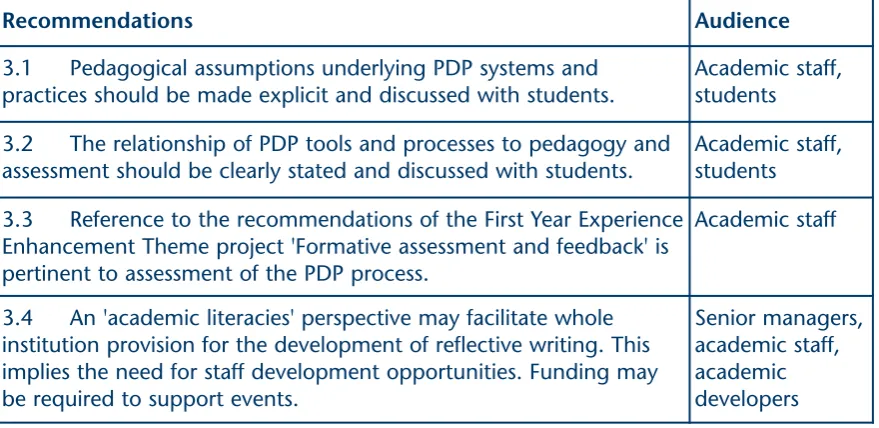
[image:16.595.101.541.350.564.2](superficial or deep); the context will determine this. Students also need to be able to switch between different forms of writing for different purposes, including reflective writing (Appendix 1, section 2.4).
Figure 3: recommendations for pedagogy and assessment issues
33..44
EEnnggaaggeem
meenntt iissssuueess
Subject discipline culture seems to be a major factor in both student and staff engagement with PDP and whether and how PDP is implemented in the first year (Section 4, case study 2).
There is evidence that more vocational degrees than non-vocational ones (such as those in the humanities) are engaging with PDP from the first year (Appendix 1, sections 2.2 and 2.8). In subject disciplines linked to vocational pathways (such as nursing or
education), where students are encouraged to consider issues of being a 'professional in training', PDP can help them to make meaning of the skills, competences and attributes valued in the profession they are seeking to join; support them in articulating, with examples, the skills they are developing; and make them aware of any skills gaps and
Recommendations Audience
3.1 Pedagogical assumptions underlying PDP systems and practices should be made explicit and discussed with students.
Academic staff, students
3.2 The relationship of PDP tools and processes to pedagogy and assessment should be clearly stated and discussed with students.
Academic staff, students
3.3 Reference to the recommendations of the First Year Experience Enhancement Theme project 'Formative assessment and feedback' is pertinent to assessment of the PDP process.
Academic staff
3.4 An 'academic literacies' perspective may facilitate whole institution provision for the development of reflective writing. This implies the need for staff development opportunities. Funding may be required to support events.
how they might fill them (PDP project workshop outcomes, University of Dundee, 14 May 2007). An issue for vocational degrees is therefore not so much about
encouraging engagement in the PDP process at an early stage, but the specific focus of vocationally orientated PDP systems. First-year students on these degrees may miss out on a more generic approach to PDP which aims to stimulate more personal reflection and development (Appendix 1, section 2.7).
A key issue for students in the first (or first two) years of non-vocational degrees is that by studying a selection of subjects they do not belong to any one department. This can lead to potential lack of cohesion in terms of ownership of the PDP process and
consistency in how PDP is approached across different subjects. To some extent this can be overcome by faculty-wide PDP systems focused on faculty mentors (Section 4, case study 1) or personal tutors; however, many of these are voluntary in nature, which is another contrast with vocational degrees.
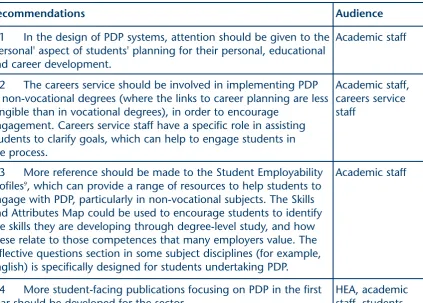
[image:17.595.70.494.393.696.2]A further issue concerns the academic culture of some non-vocational subjects, where employability is (paradoxically) less of a focus than in vocational subjects, leading to less engagement with PDP for both students and staff. Evidence suggests that student engagement with PDP can be enhanced by linking it to employability, although the literature review revealed little evidence on whether the first year is the appropriate time to start (Appendix 1, sections 2.2 and 2.7b).
Figure 4: recommendations for engagement issues
Recommendations Audience
4.1 In the design of PDP systems, attention should be given to the 'personal' aspect of students' planning for their personal, educational and career development.
Academic staff
4.2 The careers service should be involved in implementing PDP in non-vocational degrees (where the links to career planning are less tangible than in vocational degrees), in order to encourage
engagement. Careers service staff have a specific role in assisting students to clarify goals, which can help to engage students in the process.
Academic staff, careers service staff
4.3 More reference should be made to the Student Employability Profiles9, which can provide a range of resources to help students to
engage with PDP, particularly in non-vocational subjects. The Skills and Attributes Map could be used to encourage students to identify the skills they are developing through degree-level study, and how these relate to those competences that many employers value. The reflective questions section in some subject disciplines (for example, English) is specifically designed for students undertaking PDP.
Academic staff
4.4 More student-facing publications focusing on PDP in the first year should be developed for the sector.
HEA, academic staff, students
9 The profiles were produced by the HEA, Enhancing Student Employability Coordination Team (ESECT) and
33..55
M
Meeaannss o
off ddeelliivveerryy iissssuueess
3.5.1 Means of delivery: e-pdp
Digital technology has enabled a PDP breakthrough. By allowing the development of tools that can be used to store and manipulate PDP data to a much greater degree than is possible with paper-based systems, there is more justification for spending time on PDP activities. However, e-pdp systems are only tools (although powerful ones) and remain adjuncts to, rather than substitutes for, human-based systems.
Digital tools themselves raise issues which need to be addressed. The use of digital tools emphasises the value of information management skills. However, information
management should not be confused with learning. Good information management is a step towards learning, but is not in itself evidence of good learning. Digital tools can be very powerful shapers of behaviour, and PDP systems will influence student behaviour. It is therefore important that their design should serve clear goals (Appendix 1, section 2.1g). Online systems that appear to be private can lead to students mounting much personal data, which could be leaked from the system or used improperly within the institution. The limits to private data entered and the use of this data should be made clear, and measures taken to safeguard data privacy (Appendix 1, section 2.1c). PDP is intended as a lifelong and therefore transferable tool; this raises issues of technical interoperability and the procedures by which PDP data are stored and made suitable for transfer to other systems.
Potential confusion arises from the interchangeability of the terms PDP and e-portfolio. In addition, the term e-portfolio has a range of meanings, from 'the system' to 'packages of items'. E-portfolios can be used for a range of purposes; four main ones are
presentation, assessment, supporting learning and personal/professional career
development (Appendix 1, section 2.9). Anecdotally, some academics talk about 'doing PDP', but they are actually using e-portfolio tools for some of the above purposes (PDP project workshop outcomes, University of Dundee 14 May 2007).
Recommendations Audience
5.1 PDP systems should involve human as well as online elements. The relationship between human and online processes should be made clear and discussed with students.
PDP designers, academic staff, students
5.2 The design of online systems should be clearly linked to pedagogical or other explicit goals, which should be discussed with users.
PDP designers, academic staff, students
5.3 Justification for private data to be entered onto e-pdp systems should be made and the limits of such data made clear, along with the measures in place to safeguard data privacy. These matters should be discussed with users.
PDP designers, academic staff, students
5.4 Measures should be taken at the design and implementation stage to ensure that PDP data are portable. This should include the ability of PDP systems in HE to capture relevant data from pre-HE stages, and consideration given to graduate use.
Figure 5: recommendations for means of delivery issues
3.5.2 Means of delivery: face to face
At the PDP project workshop (University of Dundee, 14 May 2007), issues were raised surrounding a perceived over-emphasis on electronic means of PDP delivery.
The discussion debated whether or not reflection was better done on paper, or indeed whether it was more dynamic as a group discussion activity. Also, while an institution-wide online PDP facility may provide a consistent experience for students, is it the most effective way of engaging students and helping them to understand the process?
Napier University's Bridging Course (Section 4, case study 3), a two-week pre-entry programme, provides an intensive and powerful opportunity for students to share and discuss the skills they need for HE and issues surrounding their career planning with their peer group, experienced students and academic tutors.
Houghton (2003) (Appendix 1, section 2.4b), from his studies with a cohort of first-year engineering students, suggested that students' own analysis of their progress is
inconsistent and unreliable. He considered that encouraging students to engage in a dialogue about their learning prior to an e-pdp system may be more effective. Malins (2004) surveyed levels of tutor support for students undertaking stand-alone PDP systems and found that where tutor support was absent, students made a negative response to the process.
Figure 6: recommendations for means of delivery: face to face issues
33..66
SSttaaffff aanndd ssttuuddeenntt ssuuppppo
orrtt iissssuueess
Issues of support for students undertaking PDP and for staff delivering PDP have not been predominant in the literature to date, particularly in relation to the first year (Appendix 1, section 2.6).
At the PDP project workshop (University of Dundee, 14 May 2007), staff identified a number of factors that colleagues needed reassurance on in order to engage with PDP
Recommendations Audience
5.6 Consideration should be given to introducing dialogue and discussion on PDP, particularly in the early stages of the first year. This could benefit students by giving them a deeper understanding of the process, and could support their induction into the course. Students in later years could also be involved in the discussion.
Academic staff, PDP developers, students
Recommendations Audience
5.5 The term 'portfolio' should always have a modifier or adjective that describes its purpose, for example PDP portfolio or educational portfolio (as suggested by Barrett, 2005a) because of the many purposes of e-portfolios.
implementation. One example was clarity on the value of PDP to students. Questions were raised about whether dedicated staff should deliver PDP, or whether all staff should be involved. This was linked to the perceived importance of PDP by academics.
While there has been no overall analysis of the current picture, it is probably safe to say that delivery of PDP in Scottish higher education is at present 'patchy'. At one end of the spectrum, PDP is being delivered in a blanket way, perhaps electronically, with little or no tutor intervention; at the other end it is being delivered by individual staff who are enthusiastic about PDP and are often inspirational to their students in the delivery of it (Appendix 1, section 2.8b).
All the evidence suggests that if PDP is to be delivered to all HE students in a meaningful and helpful way, then staff engagement must be a priority (Appendix 1, section 2.8b). Staff need to be clear about its purpose in relation to their own context (within their subject as well as their institution), in addition to understanding the benefits to them and to their students. Databases of practice showing successful strategies for engaging first-year students exist and will continue to grow10. Raising awareness of these,
improving staff's own experience of CPD, offering staff development opportunities to understand the PDP processes and activities they must deliver all need to focus on staff working with first-year students. If PDP is to be a successful experience for students throughout their university career, its introduction at level 1 needs to be done in a positive way and made relevant to their circumstances.
It is important that staff delivering PDP understand the process and are sensitive to boundaries when leading group discussions or talking to individual students. Training in how to manage appropriate referral to expert support staff within HEIs is important to ensure that students are protected from inappropriate disclosure, to tutors or peers, of information they may on reflection prefer to keep private (Appendix 1, section 2.6).
Three specific areas of student support needs arise from implementation of PDP: personal, educational and technological (the diversity of intake means a range of
information technology (IT) literacies). Specific skills are required to effectively engage in PDP (Appendix 1, section 2.4). Student engagement may also be enhanced by training in how to make the most of their PDP experience. Involving students from other years as advocates, guides and role models will also raise engagement, possibly more powerfully than using staff (Appendix 1, section 2.6).
10Centre for Recording Achievement; HEA Subject Centres; ISLE project.
Recommendations Audience
6.1 Staff development and training opportunities focused on staff working with first-year students should be offered to raise awareness of the benefits of PDP, the boundaries of their role, and the sources of expert help within their institution.
HEA, academic staff, academic development departments, student services staff
6.2 Students should be encouraged to participate in supporting their peers in PDP mentoring or 'buddying' initiatives.
Figure 7: recommendations for means of delivery: staff and student support issues
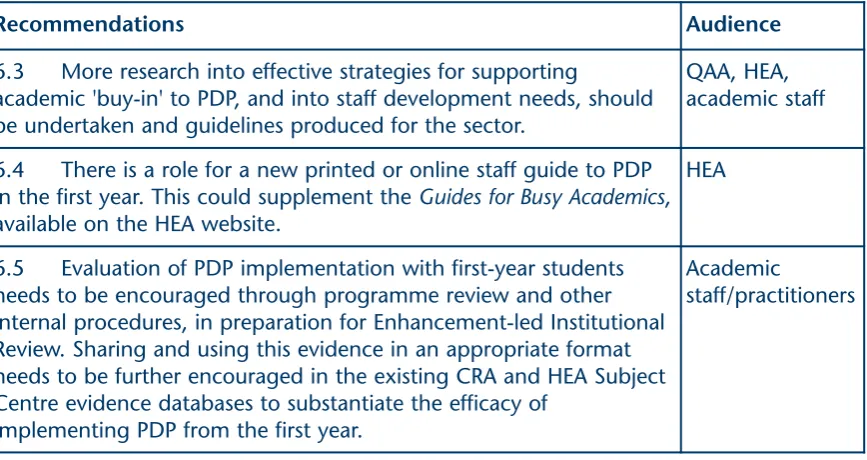
Recommendations Audience
6.3 More research into effective strategies for supporting
academic 'buy-in' to PDP, and into staff development needs, should be undertaken and guidelines produced for the sector.
QAA, HEA, academic staff
6.4 There is a role for a new printed or online staff guide to PDP in the first year. This could supplement the Guides for Busy Academics, available on the HEA website.
HEA
6.5 Evaluation of PDP implementation with first-year students needs to be encouraged through programme review and other internal procedures, in preparation for Enhancement-led Institutional Review. Sharing and using this evidence in an appropriate format needs to be further encouraged in the existing CRA and HEA Subject Centre evidence databases to substantiate the efficacy of
implementing PDP from the first year.
Academic
4 The way forward
Recommendations for future work which this project did not have time to address include:
z drawing more specifically on examples (from Australia, Europe and the USA) where PDP is introduced in the first year of HE, to highlight the key factors for staff and student engagement
z exploring the balance in different academic disciplines between effective learning and employability as the focus for first-year implementation of PDP, perhaps
investigating the references relevant to the first year from two specific sources - the ISLE project11 (whose report was published after the main research for this project
had taken place) and the CRA website12, which contains growing evidence
of practice
z further developing the concept of PDP as a framework to support significant or critical incidents - both positive and negative - in the student life cycle; and, in particular, illustrating this in diagrammatical format.
No specific reference is made to the resources required to implement these
recommendations. However, resources will be needed for additional research and/or evaluation on specific issues, at both micro and macro level, as well as on staff development time and costs and to support the tools made available to deliver PDP.
5 Case studies
55..11 U
Unniivveerrssiittyy o
off SSttrraatthhccllyyddee
Patricia Barton
Law, Arts and Social Sciences (LASS) Faculty PDP Coordinator Department of History
University of Strathclyde [email protected]
5.1.1 Aims of scheme
The scheme was introduced into the Law, Arts and Social Sciences Faculty during 2005-06 to meet the requirement that the cohort of around 600 first-year students would be entitled to PDP. This requirement needed to be met without inflating staff costs or commitments. It was hoped that a successful scheme would help students to adjust during the transition period between school/college and university, and that it would link with the existing LASS Faculty mentor scheme. The belief was that such a scheme would offer the possibility of revamping the early warning system. Finally, it was hoped that the scheme would improve faculty retention rates.
Contributors included members of the LASS Faculty staff, the Careers Advisory Service, staff from the Centre for Academic Practice and Learning Enhancement and local employers (specifically for second and third-year PDP).
5.1.2 The scheme
The LASS Faculty scheme operates as e-PDP using the domestic University of Strathclyde virtual learning environment (VLE) developed by the Department of Pharmacy.
A pre-existing e-PDP VLE package was adaptable to the Faculty's needs, and is able to evolve to meet the emerging requirements of the scheme as it is rolled out into second and third-year levels.
Training in the use of the university's VLE is embedded into the first-year IT class. Although it bears no credits, this class is compulsory unless students have an exemption because of prior training. However, the VLE session is still recommended for such students.
The e-PDP scheme is also non-credit bearing. After the initial session in the IT class, it is a purely voluntary scheme.
5.1.3 The elements of e-PDP
The scheme has three core elements:
information gathering and analysis; IT skills; time management; effective
information gathering in lectures; essay and report writing; making a presentation; tutorials/small-group work.
ii Diary- students are asked to identify two key skills they would like to work on during the first semester or first year. In their diary they record why they have identified these areas, to develop and establish a development plan.
iii Diary review - at the end of the first and second semesters, students are asked to review the progress they have made, identifying in their own estimation the extent to which they have succeeded in improving their skill level in identified areas.
On the university's VLE, students can maintain course files in which they are able to upload their work. They can also establish a blog and group discussion boards,
customise their records and put privacy locks on material they do not wish to share with the PDP Coordinator or their discussion group. The confidentiality of the scheme is stressed. The Coordinator and VLE administrator is the only member of staff given initial access to the development plans. Students are at liberty to discuss the contents with any other member of staff, but it is their choice.
Administrator tools on the VLE enable the Coordinator to know which students have completed the elements of e-PDP, how many times they have tackled the questionnaire or made diary entries, and the dates of last entries. This allows the preparation of statistics on students' participation in the scheme.
On students' VLE e-PDP pages, links are provided to various people who can help them to formulate their plans or seek other help during their first year, including:
z university support schemes (for example, welfare, special needs, Centre for Academic Practice and Learning Enhancement)
z Students' Association support schemes
z mentor scheme
z departmental contacts
z adviser of studies.
5.1.4 Response to the scheme
The extent to which students have taken the diary and forward planning elements of e-PDP has been heartening. Very few students have provided one-line responses. Most have clearly thought about the exercise, and provide detailed and mature responses. Effectively, they are using the e-PDP diary as a personal blog, and most appear comfortable with this. There is no major difference between the sexes or the age of students in their responses.
For instance, in the first semester most students (65 per cent) identify effective
Development plans have included: identifying material remembered from school/college so that students can concentrate on giving the Coordinator information; creating time to complete the prescribed additional reading; attending study-skills seminars; and actually trying to listen to the lecturer.
Time management issues for students include weaknesses in forward planning, falling asleep in class because the external paid employment/university work balance is poor, mature students worrying about when they will find time to complete work while coping with family responsibilities, spending too much time (and money) on their social life, and generally leaving too much to the last minute.
Development plans have included: establishing study timetables; ending procrastination; assessing the difficulty of tasks and assigning appropriate time to complete them; not leaving things to the last minute; buying a diary; trying to get external paid employment shifts worked out in advance.
The comments have provided an interesting insight into student priorities, hopes and worries.
5.1.5 2006-07 statistical results
Note: Figures in brackets are for the 2005-06 session.
z 11 per cent (12 per cent) did not sign up for e-PDP
z 10.5 per cent (22 per cent) logged onto the VLE, but did not complete any element of PDP
z 21 per cent (12 per cent) completed diary reviews
z 27.5 per cent completed diaries
z 30 per cent completed questionnaires only.
Overall, 78.5 per cent (61 per cent) of first-year students carried out at least one element of e-PDP, and 48.5 per cent (41 per cent) carried out two or more elements.
There was a marked increase in engagement in e-pdp by the 2006-07 first-year cohort in comparison with the previous year. The scheme was emphasised more during the
induction week, but it appears that the 2006-07 first-year cohort were more comfortable with the exercise.
Students were asked informally why only 21 per cent completed the diary review. The responses included concentrating on exams then forgetting or regarding it as a second-year exercise.
5.1.6 Other results
The pattern of responses over the year has provided a snapshot of the first year
experience, allowing better planning of departmental skills development programmes. Essentially, the responses suggested that students have worries throughout the first-year experience, but that they change over time. From early generic worries about time management and lecture note-taking, by late semester 1 and early semester 2 the concerns are practical issues of essay and report writing, information gathering and working in small groups. Knowing this suggests that there is little point in sessions on essay-writing skills during induction week or early in semester 1 - it is too early and most of the information will have been forgotten when required. Skills development sessions embedded in the departmental syllabus should adapt to the pattern of the first-year experience. This would allow a more meaningful induction process, giving students a quicker sense of belonging to the university.
The practical skills identified as a priority later in the first-year experience also correlated with higher patterns of completion. Students identifying the need to improve
essay-writing skills, information gathering and small-group work were more likely to complete the development review and assess their level of satisfaction with the skills developed. This would seem to reflect that already during the first year students were maturing and, while still anxious, were better developing the ability to identify and manage their skills development.
E-PDP helped in understanding the 'at risk' student and made the early warning system both faster and more precise. Students who had not engaged with e-PDP by week 4 of semester 1 were cross-referenced with information from Basic (First Year) Class
Coordinators to identify patterns of poor engagement. These students were then invited to meet with Graham Hollier and Patricia Barton to identify ways in which they could be helped. This contrasted with our previous early warning system, which would take until week 8 to be effective, at which point many troubled students had decided to leave. It helped to identify students not yet ready for university life, enabling them to enter voluntary suspension or leave university before incurring heavy student debt.
Anecdotal evidence suggested that the Faculty's retention rate is improving, and it will be interesting to see if this is borne out.
5.1.7 Conclusion
55..22
U
Unniivveerrssiittyy o
off G
Gllaassggo
ow
w
Allan Martin
Formerly IT Education Unit University of Glasgow
5.2.1 Introduction
Case studies have been adopted in this project as a means of identifying and exploring the issues that have arisen with respect to adoption of PDP in the first year of HE. This account of the University of Glasgow is not intended to be exhaustive, but to give an indication of developments that have occurred and to identify some issues that have emerged.
5.2.2 Early Adopters
Between the publication of the Dearing report in 1997, with its recommendation to develop progress files as well as transcripts, and the efforts of the QAA in the early 2000s to encourage HEIs towards adoption of PDP, several 'early adopters' had taken up paper-based PDP systems. In the Faculty of Medicine, 'Personal and Professional development' (PPD) was established as part of the undergraduate curriculum, which in the late 1990s had been completely reconstructed on a problem-based learning basis. In the Education Faculty, staff implemented a paper-based professional development reflective tool for the BEd degree programme, and later (2005-06) consulted closely with students to develop an online PDP tool, offered as an optional extra which students may take up if they wish. The Chemistry department adopted a paper-based PDP issued by the Royal Society of Chemistry.
5.2.3 PDP and Employability
In the early 2000s employability began to be regarded as a key aspect of HE. PDP was seen as one of the major routes in developing employability. The university's
employability strategy, presented in December 2003, included a commitment to 'Introduce elements of PDP (where not already in existence) to undergraduate
programmes by session 2005/06.' Towards the end of 2003 the university conducted an employability audit, which included 'preparedness for PDP implementation'. Most responding departments felt they were not yet ready for the implementation of PDP in 2005-06. Recommendations of the audit report focused on the need to give more information and support, to seek better awareness of subject relevance and of what tools and approaches are available. An employability working party took a special interest in PDP and enabled interested individuals across the university to network more effectively. Employability groups also existed in some faculties, and promoted actions such as an employability project running across all three science faculties.
5.2.4 The Student Development Suite
(Martin, 2006). This led to the idea of a digital literacy PDP, which would allow students to see themselves developing as digitally literate persons, and to decide what digital competences would help them in the direction they wished to develop. This concept was discussed with contacts in academic departments, who responded that the plan for a digital literacy PDP could be developed into a generic online PDP system.
Contacts with the Arts Faculty led to a university Learning and Teaching Development grant to develop an online PDP system in the Arts Faculty, focused initially around a programme of employability events for students. Work began on the system, known as the Student Development Suite (SDS) in the spring of 2006. The SDS would offer the student five main facilities: a Learning Record, where learning achievements, formal and informal, could be recorded; an Evidence Base, where items giving evidence of learning achievements could be stored; a Personal Planner, where personal plans for study, work and life could be set out and compared with current achievements; a Reflective Focus Tool, where reflective topics set by students' own departments or faculties could be addressed; and a Curriculum Vitae Builder, which would enable students to set up and maintain an up-to-date CV.
The Medical Faculty, which had been supportive of the Digital Literacy Framework development, saw the SDS as a means of moving their PPD activity onto an online medium, and joined the development process. This provided an addition in perspective, since while those leading the PPD activity for medical undergraduates had a clear idea of what they wanted to achieve - moving the existing PPD action online and seeking whatever additional benefits could then be gained - the members of the Arts PDP group were still thinking through how the online PDP tool could complement their
employability programme, and for this group the specification of the SDS tool was part of the process of establishing what PDP meant for them.
As this work proceeded, it became evident that there was considerable interest in it among those staff interested in taking forward PDP. It should be noted that this group was very small in size, but perhaps more influential than might first appear, since the members, being committed to innovation and the improvement of learning and
teaching generally, were themselves, or were close to, Associate Deans for Learning and Teaching in various faculties. Several faculties expressed interest in using SDS once it became available, and a demonstration of the semi-completed SDS prototype attracted an audience from across the university.
5.2.5 Strategic Adoption of e-PDP
At the same time the need to make strategic decisions on PDP development within the university was becoming recognised as urgent by the university management. Electronic PDP (or ePortfolio) was becoming more widely visible across the UK HE sector, and awareness was growing of the electronic PDP tools used elsewhere, some based on in-house development, others on the adoption of commercial options. The development of SDS offered a possible in-house solution, but there was perhaps a worry that if central initiative were not taken, the result might be a plurality of PDP systems throughout the university.
with, the Moodle VLE. A product that met this criterion was MyStuff, being developed by the Open University, which had also adopted Moodle as its VLE. The compatibility with Moodle was a powerful factor in support of the adoption of this product. There was also probably an element of caution, in avoiding the risk of going it alone with an in-house product, preferring to join an established and well-funded major player in a system that other HEIs might also be expected to use. The open-source aspect was also seen as a cost-minimising factor, although it was acknowledged that internal development and customisation of MyStuff would require some resource. Although not developed in Moodle, SDS could be made to pop up in Moodle, and possessed the advantage of any in-house product - that the university would have complete control over it.
The choice was not easy to make since both SDS and MyStuff had advantages and disadvantages. However, a decision to adopt MyStuff was made in early May 2007. At this point development work on the SDS project was brought to a halt, with the draft version of the product about 50 per cent complete. This is not to say that nothing was gained, or that the modest investment in SDS was wasted. Important gains were made in learning about what PDP could be used for, and how it could integrate with
pedagogy. For the Arts Faculty, these gains would enable customisation of MyStuff to be more rapidly focused. As a catalyst for thought and then action, SDS was a significant development in the movement towards PDP adoption, for the discussions focused around it indicated academics' awareness that realising PDP as a learning adjunct could be more effectively achieved when supported by an electronic tool.
However, the process has now moved on, and a system having been chosen for
university-wide adoption, the university's Learning and Teaching Centre, which has been given responsibility for the online PDP system, is at the stage of planning the
customisation and roll-out of MyStuff, and the support and training that will be required to make best use of it.
Part of the process will undoubtedly be to involve consultation of students. Consultation of the SRC as part of the decision-making process on online PDP adoption elicited the response that students would be interested in PDP if it were beneficial for them, but that they knew very little about it and would appreciate more information. This echoes the low profile given to PDP by students in the Quality Enhancement Theme project on Student expectations, experiences and reflections of the first year.
5.2.6 Developmental Progress
To view the point reached now from a developmental perspective, the model derived from the Management in the 90s research project at the Massachusetts Institute of Technology is useful (Scott Morton, 1991). The transformational model indicates the effect of IT on change in companies, and involves five stages grouped into three phases which are outlined below.
The Evolutionaryphase represents the movement from uncoordinated ad hoc
developments towards an organised structure, although IT remains supportive of, rather than embedded within, core business activities. It consists of two stages:
ii Co-ordinated- these initiatives are brought together into an organised structure, or replaced by a centrally imposed structure, which maintains the same types of activity.
The second phase is the Transformative, in which rethink of IT activities is undertaken. It consists of one stage:
iii Transforming- change agents begin to reshape IT activities, and to draw them closer to core business activities, which are themselves caused to change.
The final phase is the Revolutionary, in which IT activities move into the centre of core activities and themselves become a force for change. It consists of two stages:
iv Embedded - IT activities have become embedded within core business activities, which are now radically different from before.
v Innovative - IT activities now become a source of ongoing change to the core activities themselves and the nature of the business and the company.
This model can be applied as a generic model of the integration of IT-related innovation within an organisation. We can thus reasonably apply it to PDP adoption in HE. What we find is that Glasgow University, like many other HEIs, remains in the first, evolutionary, phase but has reached the second, co-ordinatedstage, at which individual localised developments are being brought together into a developing strategic context. There is also a desire to move into the transformative stage, an awareness that development of effective PDP will affect the whole learning process. There is still some way to go if PDP is to play a part in changing the fundamental nature of the way in which the university goes about its business. Proponents of PDP argue that it is part of the move towards a more empowering, lifelong, student-centred practice of learning, and as such, has real transformative potential.
5.2.7 Varying Perspectives on PDP
It is clear from discussions with PDP-interested individuals in different faculties and departments that perceptions of what PDP is and what it could or should do vary considerably. Thus for Medicine, PDP is identified with the personal and professional
development element of the medical curriculum, itself derived from the expectations of the professional body, and seen as a useful way of enabling students to engage in appropriate activities, by describing and analysing relevant experiences, and evaluating their own learning from these. By contrast, in Education the vocationally-focused self-evaluative activities similar to the PPD element of the medical curriculum are seen as part of the course assessment apparatus, and not as PDP; by PDP is meant an add-on, optional and wholly student-controlled tool to enable reflection on more general transferable skills. In the Arts Faculty it is seen as a means, initially, of supporting employability, but also perhaps as an adjunct to the assessment process, whereby students may be persuaded to reflect upon the comments given by tutors on their assessed work, and derive from this process more specific as well as general learning benefits.
This variation in approach is consistent with research in this area. Clegg and Bradley (2006) propose three 'ideal types' of the attitudes of different subject or discipline areas to PDP: the professionaltype, shaped by the requirements of professional and statutory bodies; the employmenttype, which includes a general orientation to graduate
which focused on academic development of the student, incorporating metacognitive skills and those of the subject discipline. Experience at Glasgow broadly supports this view. The first type, the professional, could be observed in Medicine, and the second and third, together, perhaps in Chemistry, where employability benefits were tied to subject understanding. The third type, the academic, was masked in the Arts Faculty by employability concerns, however, as the process rolls out to include staff less committed to employability initiatives, the pure meta-skills aspect may come to dominate. This point reminds us that initial developments are driven by innovators and later evolution may be more influenced by the majority of staff.
Another interesting take on perspective on PDP is the distinction between positivist and constructivist models of PDP made by Paulson and Paulson (1994). They characterise the former as institution-focused, tending towards testing and standardisation, and the latter as student-focused, encouraging self-evaluation and personalisation. They suggest
however that by their nature as individually-created objects, portfolios tend to encourage constructivist forms. In terms of this dichotomy, perceptions at Glasgow tended towards asserting the constructivist approach, but sometimes suggesting that assessment goals could be met even through a student-owned product. In Education a clear distinction was made between what the institution owns (the assessment process) and what the student owns (the PDP process).
5.2.8 Involvement in PDP
The most worrying aspect from the point of view of PDP innovators was the low level of involvement shown by the generality of both staff and students. For staff, other than as a QAA requirement or an aid to assessment in vocational areas, PDP still has to be justified in terms which will bring them willingly on board. The awareness-raising effort and level of support offered will need to be substantial.
For students the challenge may be even greater. If PDP is compulsory, the response may simply be to address the requirements in a very instrumental way, supplying strictly what is required to succeed (this approach may also apply to staff). If not, the task of
55..33
N
Naappiieerr U
Unniivveerrssiittyy
Helen Godfrey
Academic Support Adviser
Napier University Business School Edinburgh
EH14 1DJ
5.3.1 Background
The Effective Learning and Career Development module is delivered in a two-week programme prior to the start of the academic session to students who are moving to the university from Higher National Certificate (HNC) or Higher National Diploma (HND) courses in further education. It is a 15-credit module, assessed at level 2. Assessments take place at the end of the two-week course and again at the end of semester 1, which is of 15 weeks' duration.
Numbers vary year on year, but in 2006 approximately 120 students attended. The course is led by five tutors and five student facilitators, although these numbers also vary from year to year. Participants are mostly business school students who are entering a variety of courses at level 2 or level 3 but the module is open to any direct entry student from other subject areas and has included small numbers of social science and creative industries students. Similar numbers were anticipated for 2007 entry.
The module has been developed over a 10-year period and was an initiative in response to needs expressed by students to help to prepare for the different approach to study at higher education. As students making this transition tend to be more mature and more concerned about their career prospects, a career planning element was also introduced.
5.3.2 Module content
The students attend a series of skills development workshops in groups of 25, and receive a file of support materials for each session. They self-assess their skills at the beginning and again at the end of the two-week programme. Students develop and practice a range of study and other skills, including:
z effective reading and note-making
z essay writing
z critical thinking
z referencing
z presentation skills
z exam and revision strategies
z team-building and group-work skills
z career development and employability skills.