http://pim.sagepub.com/
the Maritime Environment
Engineers, Part M: Journal of Engineering for
http://pim.sagepub.com/content/222/1/13
The online version of this article can be found at:
DOI: 10.1243/14750902JEME90
222: 13
2008
Proceedings of the Institution of Mechanical Engineers, Part M: Journal of Engineering for the Maritime Environment
D Konovessis and D Vassalos
Risk evaluation for RoPax vessels
Published by:
http://www.sagepublications.com
On behalf of:
Institution of Mechanical Engineers
can be found at:
Maritime Environment
Proceedings of the Institution of Mechanical Engineers, Part M: Journal of Engineering for the
Additional services and information for
http://pim.sagepub.com/cgi/alerts
Email Alerts:
http://pim.sagepub.com/subscriptions
Subscriptions:
http://www.sagepub.com/journalsReprints.nav
Reprints:
http://www.sagepub.com/journalsPermissions.nav
Permissions:
http://pim.sagepub.com/content/222/1/13.refs.html
Citations:
What is This?
- Mar 1, 2008
Version of Record
Risk evaluation for RoPax vessels
D Konovessis* and D Vassalos
The Ship Stability Research Centre, Department of Naval Architecture and Marine Engineering, Universities of Glasgow and Strathclyde, Glasgow, UK
The manuscript was received on 31 July 2007 and was accepted after revision for publication on 14 November 2007.
DOI: 10.1243/14750902JEME90
Abstract: The paper presents the results of a recent risk evaluation study for roll-on–roll-off passenger (RoPax) vessels, carried out as part of the activities of the SAFEDOR Integrated Project. The objective of the study was to investigate hazards and their causes during RoPax operation and to quantify, to the extent possible, their frequencies and consequences. A previous study on the safety assessment of RoPax vessels sailing in north-west European waters, covering the period until 1994, was used as the basis in putting together a high-level risk model for the current study. All scenarios are presented in the form of event trees, quantification of which is made on the basis of worldwide accident experience (from 1994 to 2004), relevant past studies, and judgement. The study estimates the risk of loss of life among passengers and crew (by calculating for each scenario the individual risk and the potential loss of life and by plotting the corresponding F–N curves) and compares them with current risk acceptance criteria.
Keywords: Marine accident analysis, formal safety assessment, risk acceptance criteria
1 INTRODUCTION
The overall scope of this high-level generic risk evaluation study is to investigate and quantify credible accident scenarios that may occur during roll-on–roll-off passenger (RoPax) operations. As such, the work relates to step 1 (hazard identifica-tion) and step 2 (risk assessment) of the Interna-tional Maritime Organization’s (IMO) formal safety assessment (FSA) process and has been performed in accordance with the relevant FSA guidelines [1].
Occupational accidents that would affect indivi-dual members of the crew and passengers’ personal accidents, such as slips or falls, have not been included in the study. The following operational phases, as considered during a hazard identification (HAZID) session, provide the range that is taken into account in performing this study:
(a) loading;
(b) departing quay;
(c) transit and navigation in coastal waters; (d) transit in open sea;
(e) arriving at port, mooring, and preparing for unloading;
(f) unloading.
In this respect, no analysis has been carried out for accident scenarios that may occur during construc-tion, sea trials, dry docking, repairs, and scrapping, as well as for security hazards.
2 SAFETY REGULATIONS
The main consequences on a RoPax following an accident may be graceful sinking or capsize and/or fire, which can result in great loss of life among the passengers and crew on board. Some of IMO’s regulations, namely the International Convention for the Safety of Life at Sea (SOLAS) [2], are particularly relevant to RoPax operations and are briefly outlined in under the following headings: subdivision and damage stability; fire safety; im-plementation of the International Safety Manage-ment (ISM) Code.
2.1 Subdivision and damage stability (SOLAS Chapter II-1 [2])
Currently the global standard for the damage stability of RoPax ships is for the vessel to be able to sustain any two-compartment damage and also to fulfil a set of deterministic requirements known as SOLAS 90. This represents a significant improvement on the standards applicable at the beginning of 1990s and is in general considered a sufficient and satisfactory standard. In north-west Europe, an increased standard is applied for existing ships, known as the ‘Stockholm Agreement’ or SOLAS 90+50, which requires either fulfilment of the deterministic standards of SOLAS 90 with an addi-tional height of water on deck (maximum of 50 cm), or the demonstration by means of model experi-ments that the vessel can survive in damaged conditions in the sea state in the area of operation, as this is characterized by the corresponding significant wave height not exceeded by a probability of more than 10 per cent [3,4].
The IMO’s Sub-Committee on Subdivision, Load Lines and Fishing Vessel Safety has developed a new set of probabilistic rules for all ship types for global application from 2009 onwards. These rules follow the approach developed in Resolution A.265 (IMO issued this resolution in 1974, as an alternative to the deterministic SOLAS damage stability requirements) and are mainly based on extensive research work carried out in the late 1990s and early 2000s as part of the activities of the research project HARDER, funded by the European Commission.
2.2 Fire safety (SOLAS Chapter II-2 [2])
To accommodate novel designs and issues relating to the human element, the IMO Sub-Committee on Fire Protection undertook an 8 year effort that led to the adoption of an entirely new structure for SOLAS Chapter II-2 which may better accommodate the way that port and flag states and ship designers would deal with fire safety issues in the future.
The new structure focuses on the ‘fire scenario process’ rather than on ship type, as the current SOLAS Chapter II-2 is structured. Thus, the regula-tions start with prevention, detection, and suppres-sion and progress to cover all aspects of the process through to escape. In addition, to make the revised SOLAS Chapter II-2 a more user-friendly specific system, related technical requirements were moved to a new International Fire Safety Systems (FSS) Code and each regulation will now have a purpose
statement and functional requirements to assist port and flag states in resolving matters that may not be fully addressed by prescriptive requirements.
The revised SOLAS Chapter II-2 also has a new part E that deals exclusively with human element matters such as training, drills, and maintenance issues and a new part F that sets out a methodology for approving alternative (or novel) designs and arrangements. With regard to the latter, the regula-tions contained in part F will be supported by a new set of guidelines. The new guidelines are intended to provide technical justification for alternative design and arrangements to SOLAS Chapter II-2. The guidelines will outline the methodology for the engineering analysis required by the new SOLAS regulation II-2/17, dealing with alternative design and arrangements, where approval of an alternative design deviating from the prescriptive requirements of SOLAS Chapter II-2 is sought.
The revised SOLAS Chapter II-2 and the associated FSS Code entered into force on 1 July 2002 and will apply to all ships built on or after 1 July 2002, although some of the amendments apply to existing ships as well as new ships.
2.3 ISM Code (SOLAS, Chapter IX [2])
The ISM Code was adopted by the 1993 Assembly at IMO as Resolution A.741(18). The ISM Code is mandatory for all SOLAS ships, regardless of their year of construction.
3 REFERENCE DATA
3.1 World RoPax fleet
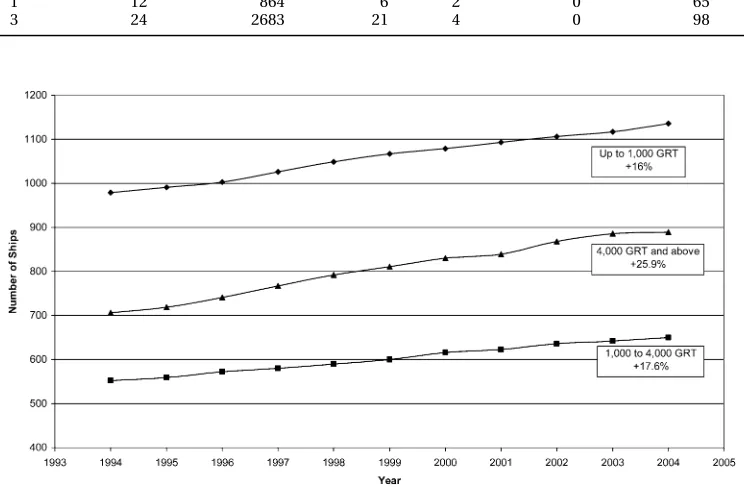
[image:4.595.47.555.423.491.2]Table 1 shows the number and size distribution of the RoPax fleet worldwide, as of March 2006, according to Lloyds Register – Fairplay (LRFP) data. A first observation is that a large percentage of the fleet (42.2 per cent) is ships of 1000 gross register tonnage (GRT) and below. The development of the fleet over the period 1994 – 2004 is illustrated in Fig. 1.
Figures 2 and 3 illustrate the age distribution of RoPax ships. It can be deduced from these two graphs that newer ships are usually of higher tonnage, and also that the fleet, as absolute numbers and as tonnage, is ageing, a factor that may have significant safety implications.
Finally, Table 2 shows the distribution of the maximum passenger-carrying capacity of 1153 Ro-Pax vessels.
3.2 Data used
To carry out the risk evaluation study for RoPax a set of reference generic data should be considered. As
illustrated in section 3.1 the distribution of sizes of the RoPax fleet is wide; hence it is considered that by selecting a RoPax ship with specific characteristics would greatly limit the scope of the study. Hence, the following considerations and assumptions are made.
1. RoPax ships of 1000 GRT and below are usually engaged on short crossings and passages and are often of an open-type configuration. A represen-tative RoPax for a generic risk analysis study should be of a closed-type configuration and part of her trip is usually exposed to weather. On this basis, all RoPax ships of 1000 GRT and below are excluded from this study.
2. To distinguish between small and larger RoPax ships, two categories are considered in the first instance: one category of 1000 – 4000 GRT and another category of 4000 GRT and above. The purpose of this consideration is to investigate the differences in accident frequencies between small and larger RoPax ships.
3. The distribution of number of passengers in Table 2, reproduced from reference [5], indicates an average maximum carrying capacity of around 1000 passengers.
Table 1 Current RoPax fleet, worldwide data (March 2006)
GRT range Converting or rebuilding
In casualty or repairing
In service or commission
Laid up To be broken up
Unconfirmed ships
New construction
Total
Up to 1000 2 4 1163 8 2 0 17 1196
1000 – 4000 0 8 656 7 0 0 16 687
4000 and above 1 12 864 6 2 0 65 950
Total 3 24 2683 21 4 0 98 2833
[image:4.595.113.485.472.718.2]In carrying out risk estimations for individual risk and potential loss of life (PLL) and producing a plot of the frequencyFof fatalities against the numberN
of fatalities, the following assumptions are made.
1. Different traffic loads indicate great fluctuations in the number of passengers carried, depending on the period of the year. Taking into account the average maximum carrying capacity of 1000
passengers, traffic seasonality is assumed as follows:
(a) 25 per cent of trips carrying full passenger load (1000 passengers);
(b) 25 per cent of trips carrying half of maximum passenger load (500 passengers);
(c) 50 per cent of trips carrying 75 per cent of maximum passenger load (750 passengers).
Fig. 2 Age distribution of the RoPax fleet (number of ships)
[image:5.595.153.443.65.234.2]Fig. 3 Age distribution of the RoPax fleet (gross tonnage)
Table 2 World RoPax fleet: distribution of passenger-carrying capacity (2000) [5]
LAOrange
Number of passengers for the following length overall (LOA) (m)
Below 500 500 – 1000 1000 – 1500 1500 – 2000 Above 2000 Total
Below 100 162 192 56 4 1 415
100 – 120 33 67 62 15 7 184
120 – 150 22 93 100 53 23 291
150 – 180 23 49 25 33 31 161
Above 180 7 34 26 18 17 102
[image:5.595.148.448.276.455.2] [image:5.595.49.547.516.607.2]2. The number of crew on board a RoPax is usually between 75 and 120. For the purpose of this study, a crew number of 100 is considered as an average.
4 HAZID RESULTS
The outcome of a HAZID session for RoPax has been reported in reference [6]. The HAZID session was organized by personnel from LMG Marin (Norway) and The Ship Stability Research Centre and involved personnel from Color Line Marine (Norway), Flens-burger Shipyard (Germany), Det Norske Veritas (Norway), and the Maritime and Coastguard Agency (UK). Various RoPax operational phases were sidered for which hazards, their causes, and con-sequences were recorded and analysed qualitatively in a structured manner.
A risk register has been developed, consisting of the most relevant hazards that may occur in RoPax operations. A total of 58 hazards were identified within the following operational phases:
(a) loading (seven hazards); (b) departing quay (eight hazards);
(c) transit and navigation in coastal waters (12 hazards);
(d) transit in open sea (six hazards);
(e) arriving in port, mooring, and preparing for unloading (six hazards);
(f) unloading (six hazards);
(g) bunkering, treatment of fluid, and solid garbage (three hazards);
(h) emergency evacuation and drills (eight hazards);
(i) other (two hazards).
For the purpose of ranking the hazards identified and in order to derive a prioritized list of the most significant hazards, the HAZID participants provided subjective qualitative estimates of their frequency and severity, by using the relevant frequency index (FI) and severity index (SI), as these are defined in the IMO FSA guidelines [1]. According to these guidelines, the risk index (RI) is established by adding the FI and SI (RI 5 FI+ SI), since these are defined on a logarithmic scale. The FI can take values between 1 (extreme remote; referring to an incident likely to occur once in a lifetime of a world fleet of 5000 ships) and 7 (frequent; likely to occur once per month on one ship) and the SI can take values between 1 (minor; an accident involving a single or minor injuries and/or local equipment damage) and 4 (catastrophic; an accident involving multiple fatalities and/or total loss of the ship).
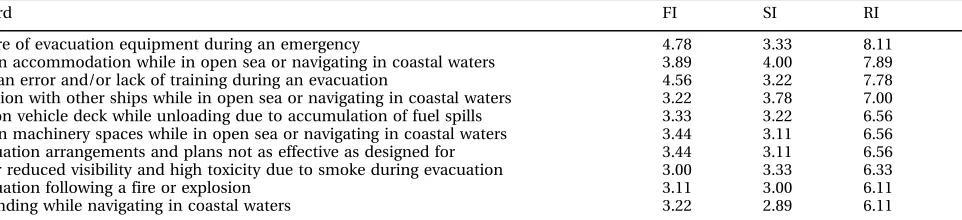
[image:6.595.68.549.477.587.2]Table 3 contains the top-ranked hazards identified during the HAZID session. Table 4 is also of relevance, as it contains top-ranked hazards with high frequency of occurrence, but of generally low consequences. It is interesting to note that the top-ranked hazard in both Table 3 and Table 4 is a ‘failure of evacuation equipment during an
Table 3 Top-ranked high-consequence hazards
Hazard FI SI RI
Failure of evacuation equipment during an emergency 4.78 3.33 8.11
Fire in accommodation while in open sea or navigating in coastal waters 3.89 4.00 7.89
Human error and/or lack of training during an evacuation 4.56 3.22 7.78
Collision with other ships while in open sea or navigating in coastal waters 3.22 3.78 7.00 Fire on vehicle deck while unloading due to accumulation of fuel spills 3.33 3.22 6.56 Fire in machinery spaces while in open sea or navigating in coastal waters 3.44 3.11 6.56 Evacuation arrangements and plans not as effective as designed for 3.44 3.11 6.56 No or reduced visibility and high toxicity due to smoke during evacuation 3.00 3.33 6.33
Evacuation following a fire or explosion 3.11 3.00 6.11
[image:6.595.45.551.621.734.2]Grounding while navigating in coastal waters 3.22 2.89 6.11
Table 4 Top-ranked high-frequency hazards
Hazard FI SI RI
Failure of evacuation equipment during an emergency 4.78 3.33 8.11
Collision between a car and the vessel or between two cars during loading 6.22 1.78 8.00
Human error and/or lack of training during an evacuation 4.56 3.22 7.78
Heavy ship movements due to weather while in open sea 5.89 1.11 7.00
Failure of loading equipment (gangways, ramps, cranes, etc.) 4.67 2.11 6.78
Own wash effect while navigating in coastal waters 5.00 1.44 6.44
Passengers misbehaving 4.44 2.00 6.44
Relative ship–shore movement while loading 4.89 1.11 6.00
Fire or explosion during loading 4.33 1.56 5.89
emergency’, which was considered to be of high frequency and also of potentially high consequences by the participants of the HAZID session.
The HAZID results have confirmed the haz-ards expected to be significant. In this respect, scenarios initiated by collisions, groundings, fire, and flooding from other causes are carried forward for consideration in the risk analysis study of this report.
5 CASUALTY DATA ANALYSIS
This work is based on casualty historical data for the period 1994 – 2004, obtained by the Lloyds Maritime Information Unit (LMIU) and on fleet statistics for the same period, obtained by Lloyds Register – Fairplay (LMFP). These two sources are considered the most comprehensive available for casualty data and fleet-at-risk data respectively. The reason for the selection of the said period is that the safety assessment study for RoPax vessels carried out as part of the North-West European Project by DNV Technica [7, 8] covered the period 1978 – 1994 and hence providing some reasonable basis for compar-ison of the corresponding safety records over the two periods.
5.1 Frequency analysis
The LMIU casualty database includes 1147 incidents for RoPax ships worldwide for the period 1994 – 2004. 54 incidents have occurred during repairs or conversions, labour, and other disputes on vessels that were already laid up or to be broken up (nine incidents for RoPax of 1000 – 4000 GRT and 45 incidents for RoPax of 4000 GRT and above). These incidents have not been taken into account in the analysis. Also, there were a further three incidents which are attributed to acts of terrorism (notably one
explosion involving a considerable number of fatal-ities), which have also not been taken into account in the analysis. 42 of the incidents included in the database have occurred on RoPax of 100 – 1000 GRT. These are excluded from the analysis for the reasons given in section 3.2. Irrespective of this, given the great number of RoPax ships under 1000 GRT (1196 ships, according to LRFP data of March 2006), this casualty figure indicates serious under-reporting of casualties.
Casualty records held by LMIU classify incidents as serious and non-serious. An incident is consid-ered as serious if it has involved a single fatality or multiple fatalities, damage to the vessel that has interrupted her service, or if the vessel has been lost. Tables 5, 6 and 7 contain analyses of the LMIU ro– pax casualty data for the period 1994 – 2004, for RoPax of 1000 – 4000 GRT, for RoPax of 4000 GRT and above, and for RoPax of 1000 GRT and above respectively.
Other recent studies have also estimated accident frequencies, covering periods similar to that ana-lysed in this paper. More specifically there are as follows.
1. In reference [9] the frequency of collisions for all passenger ships over 4000 GRT for the period 1990 – 2000 was estimated as 5.1661023per ship year. Table 6 indicates a collision frequency of 1.5961022per ship year, of which only 57 per cent represent collisions under way, i.e. a frequency of collisions under way of 9.0661023per ship year. 2. Similarly, reference [9] reported a frequency of
groundings for all passenger ships over 4000 GRT for the period 1990 – 2000 of 1.0361022per ship
year. Table 6 indicates a grounding frequency of 1.1361022per ship year.
[image:7.595.44.549.600.736.2]3. Finally, in reference [10] the frequency of serious fires for RoPax over 5000 GRT for the period 1990 – 2002 was estimated as 1.9061023per ship year.
Table 5 Number of incidents and frequencies: RoPax of 1000 – 4000 GRT (1994 – 2004)
Number of incidents Percentage of incidents (%) Frequency (per ship year)
Total Serious Total Serious Total Serious
Collision 53 4 18.6 8.2 8.0161023 6.0461024
Contact 62 8 21.8 16.3 9.3761023 1.2161023
Fire/explosion 29 13 10.2 26.5 4.3861023 1.9661023
Wrecked/stranded 48 14 16.8 28.6 7.2561023 2.1161023
Hull damage 5 0 1.8 0.0 7.5561024
0.00
Foundered 0 0 0.0 0.0 0.00 0.00
Machinery damage 75 10 26.3 20.4 1.1361022
1.5161023
Miscellaneous 13 0 4.6 0.0 1.9661023 0.00
Total 285 49 100.0 100.0 4.3161022
Table 6 indicates a frequency of 4.1861023 per
ship year.
Taking into account the differences in reporting periods, the different samples (importantly the fact that the figures presented in reference [9] refer to all passenger ships, including cruise ships and RoPax) and possibly the different definitions of casualty categories and/or the way that data are used, it can be considered that fair agreement exists between the results of relevant studies.
5.2 Comparison with previous periods
A comparison with frequencies calculated in refer-ences [7] and [8] referring to north-west European experience for the period 1978 – 1994 is attempted in this section. The following points can be made.
1. Collision. The frequency of collisions under way in north-west Europe during the period 1978 – 1994 was 1.3261022per ship year. From Table 7
and considering that collisions under way repre-sent only 63 per cent of the total frequency, the frequency of collisions under way worldwide for the period 1994 – 2004 is estimated to be 7.8861023 per ship year. This indicates a fre-quency reduction of 40 per cent.
2. Grounding. The frequency of groundings in north-west Europe during the period 1978 – 1994 was 2.0061022per ship year. From Table 7, the frequency of groundings worldwide for the period 1994 – 2004 is estimated to be 9.5761023
per ship year. This indicates a frequency reduc-tion of 52 per cent.
3. Impact. The frequency of impacts in north-west Europe during the period 1978 – 1994 was 4.9061022 per ship year. From Table 7, the
frequency of impacts worldwide for the period 1994 – 2004 is estimated to be 1.2561022per ship year. This indicates a frequency reduction of 74 per cent.
4. Flooding from other causes.Comparison of corre-sponding data indicates no change in this frequency.
5. Fire. The frequency of fires in north-west Europe during the period 1978 – 1994 was 1.0061022per
ship year. From Table 7, the frequency of fires worldwide for the period 1994 – 2004 is estimated to be 8.2861023 per ship year. This indicates a
frequency reduction of 17 per cent.
[image:8.595.46.551.78.212.2]6. Overall frequency. The overall frequency for all critical scenarios (collisions under way, ground-ings, impacts, and flooding from other causes and fires) in north-west Europe during the period 1978
Table 7 Number of incidents and frequencies: RoPax of 1000 GRT and above (1994 – 2004)
Number of incidents Percentage of incidents (%) Frequency (per ship year)
Total Serious Total Serious Total Serious
Collision 194 20 18.4 11.0 1.2561022 1.2961023
Contact 193 21 18.3 11.6 1.2561022
1.3661023
Fire/explosion 128 50 12.2 27.6 8.2861023 3.2361023
Wrecked/stranded 148 47 14.1 26.0 9.5761023
3.0461023
Hull damage 35 7 3.3 3.9 2.2661023 4.5361024
Foundered 2 2 0.2 1.1 1.2961024 1.2961024
Machinery damage 289 31 27.5 17.1 1.8761022 2.0061023
Miscellaneous 63 3 6.0 1.7 4.0761023 1.9461024
Total 1052 181 100.0 100.0 6.8061022
1.1761022 Fleet at risk (1994 – 2004) 15 468
Table 6 Number of incidents and frequencies: RoPax of 4000 GRT and above (1994 – 2004)
Number of incidents Percentage of incidents (%) Frequency (per ship year)
Total Serious Total Serious Total Serious
Collision 141 16 18.4 12.1 1.5961022 1.8161023
Contact 131 13 17.1 9.8 1.4861022 1.4761023
Fire/explosion 99 37 12.9 28.0 1.1261022 4.1861023
Wrecked/stranded 100 33 13.0 25.0 1.1361022
3.7361023
Hull damage 30 7 3.9 5.3 3.3961023 7.9161024
Foundered 2 2 0.3 1.5 2.2661024
2.2661024
Machinery damage 214 21 27.9 15.9 2.4261022 2.3761023
Miscellaneous 50 3 6.5 2.3 5.6561023
3.3961024
Total 767 132 100.0 100.0 8.6761022 1.4961022
[image:8.595.46.550.251.383.2]– 1994 was estimated to be 9.4461022 per ship year. From Table 7, the overall frequency for these accident scenarios worldwide for the period 1994 – 2004 is estimated to be 4.0561022per ship year. This indicates an overall frequency reduc-tion of 57 per cent.
Because of differences in reporting (LMIU started a systematic collection of casualty data on 1994; before that, only serious accidents were reported), the frequency reductions calculated above should be used for reference only. In any case, the estimated reductions provide a concise indication that safety has improved during the period 1994 – 2004.
5.3 Potential loss of life
Table 8 contains a list of the 14 fatal incidents that occurred worldwide during the period 1994 – 2004. It is noted that this set of data does not include the Al Salam Boccaccio 98 incident, which happened on 3 February 2006 with around 1000 fatalities. Table 9 indicates a historical PLL value of 9.5361022 per
ship year, on the basis of the data covering the period 1994 – 2004 (Table 8). Including the Al Salam Boccassio 98 incident in a PLL calculation for the period 1994 – 2006, a value of 1.3561021 per ship year is obtained. Figure 4 presents theF–Ncurves on
the basis of accident experience in north-west Europe for the period 1978 – 1994 and for worldwide experience for the period 1994 – 2006 (including the Al-Salam Boccassio 98 incident). The criteria lines between negligible, as low as reasonably practicable (ALARP), and intolerable regions of the
F–N graph are those stipulated for use on RoPax vessels in reference [11]. With reference to the IMO FSA guidelines [1], intolerable criterion means that the risk cannot be justified except in extra-ordinary circumstances, the negligible criterion means that the risk has been made so small that no further precaution is necessary, and the ALARP criterion means that the risk falls between these two states.
6 RISK MODEL
6.1 Description of the model
This section describes the high-level risk model for RoPax operations. The risk model consists of event trees containing potential outcomes for the follow-ing initiatfollow-ing events:
(a) collision;
[image:9.595.45.547.440.598.2](b) grounding (incidents classified by LMIU as ‘wrecked/stranded’);
Table 8 RoPax fatal incidents worldwide (1994 – 2004)
Date Vessel Event Location*
Number of fatalities
18 May 1994 Al-Qamar Al-Saudi Al-Misri Fire or explosion RED 21
28 June 1994 Tag Al Salam Fire or explosion BAL 1
28 September 1994 Estonia Flooding BAL 852
18 September 1998 Princess of the Orient Flooding SCH 94
1 November 1999 Spirit of Tasmania II Fire or explosion EME 14
25 November 1999 Dashun Fire or explosion SCH 282
23 December 1999 Asia South Korea Fire or explosion SCH 56
16 July 2000 Ciudad de Ceuta Collision WME 6
17 August 2000 Gurgen 2 Fire or explosion EME 1
26 September 2000 Express Samina Grounding EME 94
22 June 2002 Al Salam Petrarca 90 Fire or explosion RED 1
11 August 2002 Tacloban Princess Fire or explosion SCH 2
22October 2002 Mercuri 2 Flooding EME 49
1 July 2003 Paglia Orba Collision WME 1
[image:9.595.48.548.646.736.2]*RED, Red Sea; BAL, Baltic Sea; SCH, South China, Indochina, Indonesia, and Philippines; EME, East Mediterranean and Black Sea; WME, West Mediterranean.
Table 9 PLL for RoPax of 1000 GRT and above (1994 – 2004)
Number of Incidents Number of Fatalities PLL (per ship year)
Percentage (%)
Collision 2 7 4.5361024 0.5
Fire/explosion 8 378 2.4461022 25.6
Wrecked/stranded 1 94 6.0861023 6.4
Hull damage 3 995 6.4361022 67.5
Total 14 1474 9.5361022
(c) impact (incidents classified by LMIU as ‘contact’);
(d) other flooding (incidents classified by LMIU as ‘hull damage’ or ‘foundered’);
(e) fire/explosion.
This selection of initiating events is in agreement with the outcome of the HAZID work (described in section 4). As can be seen from the frequency analysis of section 5, these initiating events provide a sufficient basis for the derivation of a complete risk profile for RoPax operations, for the following reasons.
1. All fatal incidents were initiated by one of these causes, as shown in Tables 8 and 9, and also in previous relevant studies (see, for example, references [7], [8], and [12]).
2. These five initiating causes represent 66.5 per cent of all incidents and 81.2 per cent of serious incidents recorded for the period 1994 – 2004 (Table 7). This is mainly because incidents re-corded as ‘machinery damage/failure’ are not taken forward for further analysis and elabora-tion. Incidents recorded as such by LMIU did not develop on to any subsequent accident of the five categories mentioned above. Extended time off-service for repair is the reason that LMIU re-corded a number of ‘machinery damage/failure’ incidents as serious.
Potential outcomes (accident scenarios) for the five initiating events taken forwards for analysis are based on the analysis carried out in the safety assessment study of the Joint North-West European Project [7,8]. Since the risk model required by this study is at a high level, this previous work is sufficient for this purpose.
For clarity, definitions for the five initiating events considered within the high-level risk model are as follows, adopting the accident classification of references [7] and [8].
1. Collisions. This is events where two vessels accidentally come into contact with each other. This may lead to sinking, to grounding, or to a fire on the vessel, but these are counted as collisions if this was the cause. This definition includes collisions between two ships under way, and also events sometimes known as ‘strikings’, where a moving ship strikes another ship at a berth.
2. Groundings. In these cases a vessel comes into contact with the seabed or shore, including underwater wrecks. If the ship is stuck fast, this is known as ‘stranding’. If the ship sinks, this is sometimes known as ‘wreck’. The category ‘wreck/stranded’ used by LMIU is equivalent to the term ‘grounding’ used in this study.
3. Impacts. In these cases, a vessel comes into contact with objects other than ships, the seabed,
[image:10.595.77.516.64.329.2]or the shore. This includes impacts on berths, bridges, and offshore platforms. It is known by LMIU as ‘contact’.
4. Other flooding. These are cases where water enters a ship for reasons other than collision, impact, or grounding (treated separately). Some of these events are included by LMIU under the category ‘hull/machinery damage’. If the ship sinks, this is known by LMIU as ‘foundering’. The ‘other flooding’ category is also taken to include weather damage, cargo shifting, and intact in-stability events which would lead to flooding if the ship were to sink.
5. Fire/explosion. In these cases, fires and/or explo-sions occur for reasons other than collision, impact, or grounding (treated separately).
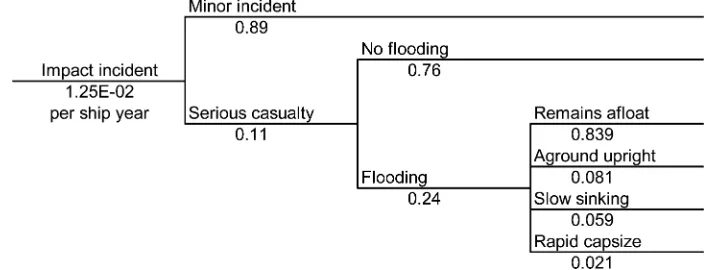
The Appendix contains the five event trees (Figs 6 to 10) put together for the high-level risk model. The scenarios included in the event trees are in accor-dance with the outcome of the HAZID session (section 4) and historical risk evaluations (section 5) and follow to a large extent the event trees developed in references [7] and [8]. The branch probabilities have been derived using data available and reflect possible outcomes following collisions, groundings, impacts, flooding from other causes, and fires.
6.2 Summary calculations
Table 10 summarizes the risk calculations carried out on the basis of the risk model.
The individual risk calculated by the risk model is 2.6161024per year, assuming that the vessel is at sea and the person is on board for the full duration of the year, as recorded in Table 10. To provide an estimate of the individual risk experienced by crew members and passengers, the following points can be considered.
1. For crew members. Assuming a 50–50 rotation scheme and that the vessel is at sea half of each day, the model predicts an overall individual risk for crew of 6.5261025 per year. If it is assumed
that three crews rotate on a vessel (this is not a widespread practice but is valid for some crew positions on board a RoPax), then the overall individual risk becomes 4.3461025per year. 2. For passengers. A passenger that spends 1 week
per year travelling on board a RoPax experiences an individual risk of 5.0161026 per year. For a
RoPax sailing at sea for 12 h per trip, the assumption of 1 week per year means that the passenger takes seven round trips a year. Con-sidering a passenger that makes one such return trip a week, the individual risk becomes 3.726 1025per year (this estimation may be appropriate
for a truck driver who travels regularly on a RoPax route).
Criteria for individual risk have been specified in reference [11], as follows: risks to an individual (passenger or member of crew) are negligible if they are lower than 1.061026 per year; risks are
intoler-able if they are greater than 1.061024per year for a
passenger and if they are greater than 1.061023per
year for a crew member; for intermediate values, risk are considered to be ALARP. Considering the values above, it can be concluded that individual risk levels are within the ALARP region for both passenger and crew members.
Figure 5 presents theF–N curve calculated by the risk model.
7 CONCLUSIONS
The main conclusions of the study are the following.
1. The frequency of any collision, grounding, im-pact, flooding from other causes, or fire/ explosion incident happening is 4.526102 per ship year (1 in 22 ship years; worldwide casualty data, 1994 – 2004). This breaks down as collision (28 per cent), grounding (21 per cent), impact (28 per cent), flooding from other causes (5 per cent), and fire/explosion (18 per cent).
[image:11.595.44.547.648.732.2]2. The frequency of aserious collision, grounding, impact, flooding from other causes, or fire/
Table 10 Risk calculations (risk model) for RoPax of 1000 GRT and above worldwide( 1994 – 2004)
Frequency (per ship year)
Frequency (%)
Individual risk (per year)
PLL
(per ship year)
PLL (%)
Fatalities (per year)
Collision 1.2561022
28 2.7561025
2.3461022
11 31
Grounding 9.5761023 21 3.0261025 2.5761022 12 23
Impact 1.2561022
28 1.6361026
1.3961023
1 2
Flooding 2.3961023 5 1.3161024 1.1261021 50 148
Fire 8.2861023 18 7.0061025 5.9561022 27 79
explosion incident happening is 9.5061023 per
ship year (1 in 105 ship years; worldwide casualty data, 1994 – 2004). This breaks down as collision (14 per cent), grounding (32 per cent), impact (14 per cent), flooding from other causes (6 per cent) and fire/explosion (34 per cent).
3. These values are in general agreement with other published studies, covering periods contempora-neous with that of this study.
4. There is significant reduction in the frequency of incident occurrence. As an indication, compar-ison of the data above with data of the North-West European Project on the safety of RoPax vessels (period 1978 – 1994) shows a reduction of 40 per cent in collision frequency, 52 per cent in grounding frequency, 74 per cent in impact frequency, 17 per cent in fire/explosion fre-quency and 57 per cent in the overall frefre-quency of these events.
5. During the period 1994 – 2004 there have been 14 fatal incidents, resulting in 1474 fatalities. The corresponding PLL is 9.5361022 per ship year (approximately 134 fatalities per year). The figure is dominated by incidents involving flooding from other causes (67.5 per cent of fatalities), followed by fire/explosion (25.6 per cent) and grounding incidents (6.4 per cent).
6. Comparison on theF–Ncurve of the PLL for the period 1994 – 2006 worldwide with north-west
European experience for the period 1978 – 1994 demonstrates a considerable risk reduction. However, it also demonstrates that risk is still high within the ALARP region (Fig. 4).
7. The frequency reductions estimated when com-paring with previous periods provide a concise indication that safety has improved for the period 1994 onwards. This can be attributed to the application of contemporary rules and regulations and implementation of robust safety procedures in operating the vessels. However, risks are still high within the ALARP region, indicating more measures need to be taken. 8. A high-level risk model is proposed, which
includes a number of potential outcomes, con-sidered to represent sufficiently the risk profile of RoPax operations. Section 6 of the paper pro-vides the details of the model, with results presented in Table 10 and Fig. 5.
9. Probabilities for the various accident scenarios considered were derived from accident experi-ence over the period 1994 – 2004 and, where this was not sufficient, these predictions were based on previous studies (accident experience from earlier periods, relevant calculations, or judge-ment). However, use of expert judgement was kept to a minimum.
10. Risks are found to be high within the ALARP region, indicating the need for further risk
[image:12.595.66.529.65.337.2]control options to be assessed and recom-mended.
11. Uncertainties in using the model refer mainly to the average fatality rates used for the various accident scenarios considered. In this study, these are based solely on past actual experience with RoPax vessels. This has proven inevitable, since no other feasible alternative was available for the wide range of accident scenarios considered.
ACKNOWLEDGEMENTS
The work reported in this paper has been carried out under the SAFEDOR Integrated Project IP-516278, with partial funding from the European Commis-sion. The opinions expressed are those of the authors and should not be construed to represent the views of the SAFEDOR partnership.
REFERENCES
1 Guidelines for formal safety assessment (FSA) for use in the IMO rule-making process. MSC/Circular 1023, International Maritime Organization, Lon-don, 2002.
2 International Convention for the Safety of Life at Sea(SOLAS), 1974 (International Maritime Organi-zation, London).
3 Agreement concerning specific stability require-ments for ro–ro passenger ships undertaking regular scheduled international voyages between or to or from designated ports in North West Europe the Baltic Sea. MSC/Circular 1891, Inter-national Maritime Organization, London, 1996.
4 Ro–ro passenger ship safety: guidance notes on Annexes 1, 2 and 3 of the agreement concerning specific stability requirements for ro–ro passenger ships undertaking regular scheduled international voyages between or to or from designated ports in North West Europe and the Baltic Sea. Document SLF 40/INF.14, International Maritime Organiza-tion, London, 1996.
5 Kanerva, M. From handy size up to large cruise ferries, elements required to design and build successful configurations. In Proceedings of the European Conference on Passenger ship design, construction, safety and operation, October 2001, pp. 83–112 (Ship Design Laboratory, National Technical University of Athens, Hernonissos, Greece).
6 HAZID for ropax. Document SAFEDOR Deliverable D4.2.1, SAFEDOR Integrated Project, 2006.
7 DNV Technica, Safety assessment of passenger ro– ro vessels. Main Report REP-T09-003, Joint North-West European Project, 1996.
8 DNV Technica, Safety assessment of passenger ro-ro vessels. Report Appendices REP-T09-003A, Joint North-West European Project, 1996.
9 Vanem, E.andSkjong, R.Collision and grounding of passenger ships – risk assessment and emer-gency evacuations. In Proceedings of the Third International Conference onCollision and ground-ing of ships(ICCGS), 25–27 October 2004, pp. 195– 202 (Society of Naral Architects of Japan, Izu, Japan).
10 Vanem, E.andSkjong, R.Fire and evacuation risk assessment for passenger ships. In Proceedings of the Tenth International Conference on Fire safety and engineering, (INTERFLAM 2004), 5–7 July 2004, pp. 365–374 (Interscience Communications Ltd, Edinburgh).
11 Risk evaluation criteria. Document SAFEDOR De-liverable D4.5.2, SAFEDOR Integrated Project, 2005.
12 Aldwinckle, D. S. and Prentice, D. The safety record and risk analysis of ro–ro passenger ferries. In Proceedings of the International Symposium on
The safety of ro–ro passenger ships, London, UK, 26– 27 April 1990, 20 pp. (The Royal Institution of Naural Architects, London).
APPENDIX
Fig. 6 Generic collision event tree using worldwide experience (1994–2004)
Fig. 7 Generic grounding event tree using worldwide experience (1994–2004)
[image:14.595.99.502.66.314.2] [image:14.595.96.501.366.494.2] [image:14.595.119.474.541.676.2]Fig. 9 Generic flooding event tree using worldwide experience (1994–2004)
[image:15.595.125.466.460.694.2]