City, University of London Institutional Repository
Citation
:
Jones, S., Lynch, P., Maiden, N. and Lindstaedt, S. (2008). Use and Influence of
Creative Ideas and Requirements for a Work-Integrated Learning System. Proceedings of
the 16th IEEE International Requirements Engineering Conference, pp. 289-294. doi:
10.1109/RE.2008.54 ISSN 1090-705X
This is the unspecified version of the paper.
This version of the publication may differ from the final published
version.
Permanent repository link:
http://openaccess.city.ac.uk/2801/
Link to published version
:
http://dx.doi.org/10.1109/RE.2008.54
Copyright and reuse:
City Research Online aims to make research
outputs of City, University of London available to a wider audience.
Copyright and Moral Rights remain with the author(s) and/or copyright
holders. URLs from City Research Online may be freely distributed and
linked to.
City Research Online:
http://openaccess.city.ac.uk/
[email protected]
Use and Influence of Creative Ideas and Requirements for a Work-Integrated
Learning System
Sara Jones, Perry Lynch, Neil Maiden, Stefanie Lindstaedt
1Centre for HCI Design, City University. London, UK
1
Know-Center, Inffeldgasse 21a, 8010 Graz, Austria
[email protected]
,
[email protected]
,
[email protected]
, [email protected]
Abstract
In this paper, we describe a creativity workshop that was used in a large research project, called APOSDLE, to generate creative ideas and requirements for a work-integrated learning system. We present an analysis of empirical data collected during and after the workshop. On the basis of this analysis, we conclude that the work-shop was an efficient way of generating ideas for future system development. These ideas, on average, were used at least as much as requirements from other sources in writing use cases, and 18 months after the workshop were seen to have a similar degree of influence on the project to other requirements. We make some observations about the use of more and less creative ideas, and about the techniques used to generate them. We end with sugges-tions for further work.
1.
Introduction
According to many commentators, creativity is the new key economic activity. Indeed the UK government has declared that in the current climate, innovation can be seen as crucial to both productivity growth and social gain [18]. This is true for the development of software-intensive systems as much as it is anywhere else in the economy, and so we must look for ways of bringing greater creativity into the software development process.
As we have reported previously [7,10], requirements engineering can be seen as a fundamentally creative process in which stakeholders and engineers work togeth-er to create ideas for new software systems that are even-tually expressed as requirements. However, while most current requirements processes and research activities support problem analysis and system specification, inven-tion is often perceived as part of the design process that follows requirements engineering [6], and little support for this is provided at the requirements stage.
We have developed an approach to integrating crea-tivity into our RESCUE requirements process through the use of what we call creativity workshops. Previous work has reported on the way in which such workshops are conducted, and the kinds of ideas that are typically gener-ated [7,8,9,10]. However, there has so far been little
in-vestigation of the relative contributions from different techniques used to stimulate creativity during the work-shops, the way in which ideas generated during the course of such workshops are used later in the project, or the extent to which they influence later development work. In this paper, we present some preliminary findings on these three issues based on data gathered during and 18 months after a previously unreported creativity workshop. This workshop was conducted as part of the requirements process for the APOSDLE project. APOSDLE (see
www.aposdle.org) is an on-going European project,
funded under the Framework 6 programme, whose aim is to ‘enhance knowledge worker productivity by providing learning support integrated into the work tasks and the computational work environment’. As such, APOSDLE is a real project, with real constraints on time and resources, and where the quality of the requirements process will be fundamental to the success of the project as a whole.
The remainder of this paper is structured as follows. In section 2, we provide a brief review of related work, in-cluding other creativity workshops that have employed techniques similar to those used in the workshop reported here. Section 3 describes the APOSDLE workshop itself, as well as the use case authoring process that followed the workshop. Section 4 describes our approach to collecting data, and section 5 presents our analysis of this data. Fi-nally, in section 6, we draw some conclusions, and identi-fy directions for further research.
2.
Creativity in the Requirements Process
2.1
Related Work
environment, which compared the use of the elementary pragmatic model from communication theory with stan-dard brainstorming techniques for triggering combina-tional creativity during requirements acquisition. Schmid [16] has presented some preliminary findings from a small-scale study, which used creativity triggers [14] to help workshop participants invent requirements. Howev-er, we are not aware of any other longitudinal studies, such as the one reported in this paper, evaluating the up-take of creative ideas during later stages of a software development project.
2.2
Creativity Workshops in RESCUE
RESCUE is a concurrent requirements engineering process that we have developed, in which different mod-eling and analysis processes take place in parallel [6]. Creativity workshops are an important part of the RESCUE requirements process, and normally take place after a requirements team has specified the system boun-daries and before it specifies use cases. The main purpose of a creativity workshop is to discover and invent the re-quirements and ideas needed to specify use cases. These ideas are the main workshop outputs.
The workshop activities are designed using 3 estab-lished models of creativity from cognitive and social psy-chology. This is described in detail in [8]. Briefly, a workshop is designed to support the divergence from and convergence towards ideas as described in the CPS model [12], using 3 basic types of creativity identified by Boden [1] – exploratory, combinational and transformational creativity - and encouraging 4 essential creative processes reported in [13]: preparation, incubation, illumination and verification.
A two-day workshop is usually composed of 4 half-day creativity periods. In each period we use a different creativity technique to encourage different types of crea-tivity. For example, in one period we might use analogical reasoning to encourage combinational creativity, or con-straint removal to encourage transformational creativity. Further details of the way in which this was done in the APOSDLE workshop will be given below.
3.
The APOSDLE Creativity Workshop
The APOSDLE project is an EU funded project, aimed at developing a work-integrated learning environment for knowledge workers. The project will run for 4 years and involves 12 partner organizations from 7 different coun-tries. The APOSDLE creativity workshop was conducted in month 4 of the project, when a system context diagram, use case diagram and short use case précis of one para-graph each had already been developed.
One facilitator, 2 scribes, and 16 stakeholders attended the APOSDLE workshop. Each stakeholder was from one of the project partners, with some representing ‘technical’
partners, or organizations who would develop the system, and others representing ‘application’ partners – organiza-tions that would use the systems developed in the project. The layout of the room in which the workshop took place, and the basic ground rules were the same as for previous-ly reported workshops (see, for example, [8]).
3.1
Structure of the workshop
The overall structure of the APOSDLE workshop, in-corporating a small number of sessions each using a dif-ferent technique to stimulate creativity, was the same as for previous workshops, as feedback from participants had suggested that this worked well.
On day-1, the morning period activities began with a ‘round-robin’ session in which each stakeholder was asked to come up with one or two ‘big ideas’ for the sys-tem. This was essentially a warm-up session, and lasted approximately half an hour. This was followed by a ses-sion designed to support exploratory creativity [1] by ask-ing participants to work with the creativity triggers de-fined in [14]. Participants worked in groups of 4 with each group including representatives of both technical and application partners from different organizations. The session lasted for approximately 2 hours, with each group choosing one of the five triggers, and using this to gener-ate new ideas for APOSDLE.
The afternoon session on day 1 was based around the idea of constraint removal. This session was designed to support transformational creativity [1]. At the beginning of the session, participants were divided into 4 different groups of 4, still maintaining a mix of application and technical partners from different organizations in each group. One facilitator then led a brainstorming session involving all participants to discover 35 constraints on the future system. Each group worked with 7 or 8 constraints, being asked to envisage the removal of each constraint, and to consider what would be possible for the new sys-tem in the absence of the relevant constraint. This session lasted for approximately 3 hours.
On the morning of day 2, participants listened to 4 dif-ferent solution presentations from technology partners, each lasting approximately 5 minutes, and used these as triggers for further ideas. This session was designed to support combinational creativity [1], in that it provided the opportunity for combining ideas about the application of particular technologies with ideas about problems or needs as experienced by application partners.
In the final session on the afternoon of day 2, use cases were prioritized and four final groups took the 4 highest priority use cases and constructed storyboards for them using as many as possible of the ideas that had been asso-ciated with the those use cases during the workshop.
work-shop were transcribed, verbatim, and those that had been associated with use cases during the workshop appeared in the report alongside the revised use case précis, in rea-diness for the use case authoring process described below. All ideas identified during the workshop were listed in an appendix to the report.
3.2
Writing use cases following the workshop
Following the creativity workshop, the APOSDLE use cases were rationalized – some were split into several different parts, and some were combined – to produce a coherent set. This set of use cases was prioritized, so that 10 would be worked on in the first phase of the project, and others would be worked on at a later stage. In month 5 of the project, one month after the workshop, the project partners began the process of writing use case specifica-tions. The process was as follows. The set of use cases to be developed during the first phase of the project were divided up into 4 groups depending on the functionality they would specify. Each group was allocated to a pair of project members – usually comprising one person from a technical partner organization, and one from an applica-tion partner. Each pair was given a template for each of their use cases, where templates included all the informa-tion that had been associated with the use cases during the creativity workshop. This usually included the title, the précis and whatever requirements and ideas had been as-sociated with the use case. The pair was first asked to identify what they thought were the ‘big ideas’ for each of their use cases. They were then asked to look through all the requirements which had so far been identified as part of the project, as well as all the ideas from the creativity workshop that had been left at ‘system level’, to see whether any of these seemed appropriate to their use case now that they had had more time to reflect. These re-quirements and ideas were then included into the tem-plate. Finally, they wrote the complete use case specifica-tion, using both the précis and all of the associated ideas to guide them. The completed specifications, together with the associated ideas from the creativity workshop were then passed to developers for use in more detailed system specification.
3.3
Developing APOSDLE prototypes
According to the APOSDLE project plan, 3 prototypes were to be developed. Mock-ups were not initially planned for but research partners soon felt the need for a concrete ‘object to think with’. The role of the mock-ups was to illustrate which requirements, ideas, and ultimately features should make it into the corresponding prototype. In addition, the mock-ups helped to develop a first com-mon look and feel for the prototype. The requirements and creative ideas from the creativity workshop and else-where in the project were provided as inputs into the
de-velopment of both mock-ups and prototypes.
The first mock-up was developed in month 2 of the project using the requirements that existed at that time. This mock-up then underwent a multitude of iterative changes to include new requirements and ideas from the creativity workshop, right up to the deliverable of the software architecture document in month 8. The first inte-grated prototype was delivered in month 12. For the second prototype we followed a similar process. The second mock-up was delivered in month 18, and based on this, the new software architecture was delivered in month 20 and the second prototype in month 24. Prototype 2 is currently undergoing user evaluation, and the third proto-type is planned for month 36.
4.
Data Collection
The main sources of data for this paper were workshop and project documentation, and questionnaires completed by workshop participants, and key project stakeholders, as described below.
4.1
Data about how creative our ideas were
Soon after the workshop, we asked participants to complete a questionnaire about a representative sample of the ideas generated during the workshop, in order to give us data about which ideas were perceived to be the most and least creative. Questionnaires were completed by 14 out of the 16 workshop participants. This enables us to comment on the relative use and influence of ideas judged to be more and less creative as described below.
Questionnaires were constructed as follows. Each questionnaire included 40 different ideas – 10 ideas from each of the 4 main sessions in which ideas were generat-ed: round robin (RR), creativity triggers (CT), constraint removal (CR) and solution presentation (SP). These ideas were randomly selected, and in half the questionnaires, they were presented in reverse order, to minimize any ordering effects in questionnaire responses.
From a review of the literature on creativity, we de-termined that most definitions of creativity include two dimensions such as newness, or novelty and value, or importance. For example, Boden [2] defines creativity as ‘The ability to come up with ideas or artefacts that are new, surprising and valuable’, and Sternberg and Lubart [17] define creativity as ‘the ability to produce work that is both novel (i.e. original, unexpected) and appropriate (i.e. useful, adaptive concerning task constraints)’. For each of the 40 ideas, respondents were therefore asked to provide a rating, on a scale of 1 – 5 for novelty and im-portance, as explained below.
‘value’ was interpreted in terms of an idea’s usefulness or importance to the success of the project, and to assess this we asked ‘How important do you think the incorporation of this idea would be to the overall success of APOSDLE?’, with responses from 1 (‘not at all impor-tant’) to 5 (‘very imporimpor-tant’).
4.2
Data about influence of ideas
At month 22 of the project, 18 months after the crea-tivity workshop, and during the process of developing the second prototype, a further questionnaire was constructed in order to assess the impact of workshop ideas on the development of project prototypes. These questionnaires were completed by three key project ‘experts’, who were managing and co-ordinating development work in the project as a whole, and in particular of the development of the project mock-ups and prototypes. The questionnaires included the same 40 ideas as the first questionnaire, and an additional 10 requirements, which were also available at the time of the creativity workshop and use case author-ing process, but had been collected usauthor-ing other require-ments acquisition techniques. These requirerequire-ments acted as a control condition, allowing comparison of ideas gener-ated during the workshop with requirements identified elsewhere in the project.
In this second questionnaire, we simply asked respon-dents, for each idea or requirement, to answer the ques-tion ‘How much influence do you think this idea/requirement has had on the development of the APOSDLE prototype so far?’, again using a rating scale of 1 – 5, where 1 denoted ‘no influence’, and 5 represented ‘a lot of influence’.
5.
Results
During the two day APOSDLE creativity workshop, a total of 195 ideas were generated. This compares very favorably with the total of 172 requirements that had been identified in the first 4 months of the project using other, more standard requirements elicitation techniques, includ-ing interviews and visits to the users’ workplaces as well as some preliminary context modeling. In the rest of this section, we present data relating to the three main areas of interest, identified in section 1.
5.1
Allocation of ideas to use cases
First we present data relating to the allocation of ideas to use cases, both during the workshop, as described in sec-tion 3.1, and as part of the use case authoring process de-scribed in section 3.2.
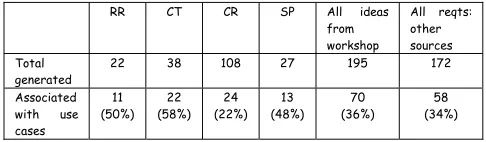
Table 1 shows the total numbers of ideas generated during the workshop using each of the individual tech-niques described in section 3.1: round robin (RR), creativ-ity triggers (CT), constraint removal (CR) and solution
presentations (SP), as well as the numbers and propor-tions of those ideas which were associated with the 10 phase 1 use cases either during or after the workshop. The total number of ideas, and overall proportion of ideas from the workshop that were allocated to use cases is also shown. Finally, for comparison, we show the total number of requirements from other sources that were available at that stage in the project, and the proportion of those that were associated with use cases.
RR CT CR SP All ideas
from workshop
All reqts: other sources Total
generated 22 38 108 27 195 172
Associated
with use
cases
11
(50%) (58%) 22 (22%) 24 (48%) 13 (36%) 70 (34%) 58
[image:5.612.322.565.186.257.2]
Table 1: Proportions of ideas associated with use cases
We can see from Table 1 that the overall proportions of ideas from the creativity workshop and requirements from elsewhere in the project that were associated with use cases are very similar. However, there appear to be consi-derable differences in the proportions of ideas generated using the different techniques that were judged relevant to any use cases. The proportions of ideas from the round robin, solution presentation and, in particular, creativity triggering sessions that were associated with use cases are considerably higher than the overall average for both ideas from the workshop and requirements from other sources. However, the proportion of ideas from the con-straint removal session that was associated with use cases is much lower.
The differences between the proportions of ideas used from each of the sessions are partly accounted for by the differences in numbers of ideas generated. For example, although only 22% of ideas from the constraint removal session were associated with use cases, the total number of ideas generated in this session was very high (108), so that the number of ideas from that session that were used in use case writing compares favorably with the numbers of ideas from other sessions. The low proportion of con-straint removal ideas associated with use cases may also be a reflection of the range of different kinds of ideas aris-ing from this session, as reported in [8]: for example, ‘ideas’ that simply describe overall advantages of the APOSDLE system are unlikely to be seen as particularly useful during use case authoring. However, there may also be other reasons for the apparently low use of ideas from this session, as discussed below.
5.2
Influence of ideas on later work
us-ing data collected as described in section 4.3.
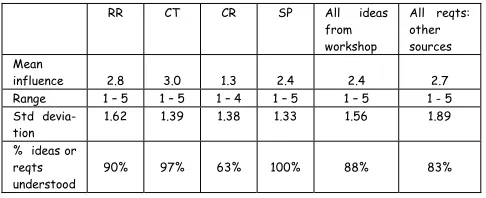
Table 2 shows the average (mean) ratings of influence for ideas generated by different techniques during the workshop on a scale of 1 – 5 and, for comparison, for requirements from elsewhere in the project. Using the number of times ideas and requirements in the question-naire were rated N/A, to denote that they were not unders-tood, we have also calculated the proportion of ideas from each session that were understood by our 3 expert respon-dents, 18 months after the workshop.
RR CT CR SP All ideas
from workshop
All reqts: other sources Mean
influence 2.8 3.0 1.3 2.4 2.4 2.7
Range 1 – 5 1 – 5 1 – 4 1 – 5 1 – 5 1 - 5
Std devia-tion
1.62 1.39 1.38 1.33 1.56 1.89
% ideas or reqts
[image:6.612.53.296.197.296.2]understood 90% 97% 63% 100% 88% 83%
Table 2: Ratings of influence for ideas and requirements
Here we can see a similar pattern to that in Table 1. Once again, the overall average ratings of influence for ideas from the creativity workshop and requirements from other project sources are similar (2.4 and 2.7 respective-ly). But once again, there appear to be substantial differ-ences between the influence ratings for ideas generated by different techniques in the workshop. The mean ratings for influence of ideas from the round robin and creativity triggering sessions are higher than that for requirements from elsewhere, whereas the rating for ideas from the constraint removal session is noticeably lower. The per-centages of ideas and requirements that were understood provides some explanation for this, and possibly also the results reported in section 5.1. Only 63% of the ideas from the constraint removal session were understood, compared with 100% of ideas from the solution presenta-tion session. If ideas are simply not understood, they will not be used in the use case authoring process, or influence prototype development. The average influence of ideas from the constraint removal session that were understood is 2.1, which is closer to the average for requirements from elsewhere, but still lower. Once again, this may be partly explained by the mix of different kinds of ideas which arose from the constraint removal session. Howev-er, they may be additional factors at work as described below.
5.3
Analysis of creative and ‘uncreative’ ideas
As stated above, we used a definition of creativity as being a function of both novelty and importance. We were curious to know whether different techniques tended to produce ideas that were judged by participants to be more or less creative. Table 3 shows the numbers of ideas from
each of the workshop sessions that were rated as creative (novel and important) and not creative (neither novel nor important), according to data collected using the ques-tionnaires described in section 4.1. The numbers of crea-tive ideas, shown in the top row of Table 3, were calcu-lated by looking for ideas that scored either 4 or 5 (on a scale of 1 – 5) for both novelty and importance. By con-trast, numbers of ‘uncreative’ ideas, shown in the bottom row, were calculated by looking for ideas that scored ei-ther 1 or 2 for both novelty and importance. Numbers of important but not novel, and novel but unimportant ideas were calculated in a similar way.
RR CT CR SP
No. of novel, important ideas 27 27 10 26
No. of novel but not important
ideas 9 2 16 10
No. of important but not novel
ideas 25 26 20 15
No. of unimportant and not
[image:6.612.323.565.221.294.2]novel ideas 15 16 18 18
Table 3: Creativity of ideas (most and least creative shown highlighted)
The rows in which the constraint removal session ap-pears to be something of an outlier are the first and second. Here we can see that the constraint removal ses-sion generated less creative ideas (only 10, compared with 26 or 27 from other sessions), and more novel but unim-portant, or ‘whacky’ ideas (16 compared with 2, 9 and 10 from other sessions).
Finally, we adopt a more stringent definition of crea-tivity in order to investigate the impact of the most and least creative ideas from the workshop. In total, an idea included in the first questionnaire was rated by a respon-dent as being 5 for novelty and 5 for importance 14 times. This involved 10 different ideas (3 of these ideas were rated as 5/5 by more than one subject). Of those 10 ideas, 5 were associated with use cases worked on in the first phase of the project, and a further 4 were associated with use cases to be developed at a later stage in the project. In other words, 9 out of the 10 most creative ideas were as-sociated with use cases.
6.
Conclusions
Overall, results from the APOSDLE project confirm the conclusion tentatively drawn in [8] that ‘RESCUE creativity workshops have the capacity to discover both novel and unoriginal ideas that can be integrated into use case descriptions’. They also echo the observation made in [15] that creativity workshops seem to be a very effi-cient way of generating ideas. Ideas from the APOSDLE creativity workshop were, on average, used at least as much as requirements from other sources in writing use cases, and, according to the subjective ratings provided by our three project experts, had a similar degree of influence on the project to other requirements. In future studies, it will be interesting to investigate whether these observa-tions can be substantiated using more objective measures of influence.
Looking at the different techniques used in the work-shop to generate ideas, we can see some differences, for the APOSDLE workshop at least, in the proportions of ideas from each technique that were judged to be relevant during use case authoring, and the average degree of in-fluence of the ideas. It appears from the data above that the constraint removal technique produced less useful and influential ideas than other sessions. However, we would argue that the session using this technique may have ful-filled an important role in promoting divergent thinking – generating the whacky ideas – which is commonly recog-nized as an important part of the creative process [12].
Of course, the results reported in this paper come from a single workshop, conducted as part of a particular project, subject to the influences of the particular individ-uals and organizations involved. Furthermore, since APOSDLE is a non-commercial research project, devel-oping a unique application, it has not been possible to investigate issues such as return on investment or the im-pact of creativity techniques on profit or commercial suc-cess. However, the commonality with findings from other reported workshops [8,15] lead us to be hopeful that our findings may be replicated in future studies.
7.
Acknowledgements
APOSDLE is partially funded under the FP6 of the Eu-ropean Commission within the IST work program 2004 (FP6-IST-2004-027023). The Know-Center is funded within the Austrian COMET Program - Competence Cen-ters for Excellent Technologies - under the auspices of the Austrian Ministry of Transport, Innovation and Technol-ogy, the Austrian Ministry of Economics and Labor and by the State of Styria.
8.
References
[1] Boden M.A., 1990, The Creative Mind, Abacus, London
[2] Boden M.A., 2004, The Creative Mind: Myths and Me-chanisms’ (2nd ed.), Routledge.
[3] Bonnardel, N., 1999, ‘Creativity in Design Activities: The Role of Analogies in a Constrained Cognitive Environ-ment’, in Proc. Creativity and Cognition 1999, ACM, 158-165.
[4] Cross, N., 2002, ‘Creative Cognition in Design: Processes for Exceptional Designers’, in Proc. Creativity and Cogni-tion 2002, ACM, 14-19.
[5] Heitmeyer C., 2005, ‘System Designers, Not Analysts, Should Design’, IEEE Software 22(1), 49-51.
[6] Jones S.V. and Maiden N.A.M., 2005, ‘RESCUE: An Inte-grated Method for Specifying Requirements for Complex Socio-Technical Systems’, in ‘Requirements Engineering for Socio-Technical Systems’, ed. J.L. Mate & A. Silva, Ideas Group, 245-265.
[7] Maiden N.A.M., Manning S., Robertson S. & Greenwood J., 2004, ‘Integrating Creativity Workshops into Structured Requirements Processes’, in Proc. DIS 2004, Cambridge Mass, ACM, 113-122.
[8] Maiden N.A.M., Ncube, C. and Robertson, S., 2007, ‘Can Requirements Be Creative? Experiences with an Enhanced Air Space Management System’, in Proc. ICSE 2007, ACM, 632 – 641.
[9] Maiden N.A.M. & Robertson S., 2005, ‘Integrating Crea-tivity into Requirements Processes: Experiences with an Air Traffic Management System’, in Proc. RE05, IEEE CS, 105 – 114.
[10]Maiden N., Robertson S. & Gizikis A., 2004, ‘Provoking Creativity: Imagine What Your Requirements Could be Like’, IEEE Software 21(5), 68-75.
[11]Mich L., Anesi C & Berry D.M., 2004, ‘Requirements Engineering and Creativity: An Innovative Approach Based on a Model of the Pragmatics of Communication’, in Proc. REFSQ 2004, Essener Informatik Beiträge, ISBN 3-922602-91-6.
[12]Osborn A.F., 1953, ‘Applied Imagination: Principles and Procedures of Creative Problem Solving’, Charles Scribn-er’s Sons, New York.
[13]Poincare H., 1982, The Foundations of Science: Science and Hypothesis, The Value of Science, Science and Me-thod, Univ. Press of America, Washington.
[14]Robertson, J. and Robertson, S., 2004, ‘Requirements and Creativity Tutorial’ at RE04, Kyoto, IEEE.
[15]Schlosser, C., Jones, S. and Maiden, N.A.M., ‘Using a Creativity Workshop to Generate Requirements for an Event Database Application’, to appear in Proc. REFSQ 2008.
[16]Schmid, K., 2006, ‘A Study on Creativity in Requirements Engineering’, available from http://pi.informatik.uni-siegen.de/stt/26_1/index.html
[17]Sternberg and Lubart, 1999, ‘The Concept of Creativity: Prospects and Paradigms’ in ‘Handbook of Creativity’, Sternberg, R. J. (Ed.), Cambridge University Press. [18]HM Treasury, 2002, ‘Investing in Innovation: A Strategy
for Science, Engineering and Technology’, from
http://www.hm-treasury.gov.uk