1 DOI: 10.1002/((please add manuscript number)) Article type: Communication
Tripeptide Emulsifiers
Gary G. Scott†, Paul McKnight§, Tell Tuttle†* and Rein V. Ulijn†‡*
† Gary G. Scott, Dr Tell Tuttle and Prof. Dr Rein V. Ulijn
WestCHEM, Department of Pure and Applied Chemistry, University of Strathclyde, Glasgow G1 1XL, U.K.
E-mail: [email protected]
§ Paul McKnight
Macphie of Glenbervie, Stonehaven, Scotland, AB39 3YG
‡ Prof. Dr. Rein V. Ulijn,
Advanced Science Research Center (ASRC), City University of New York, New York, NY10031, USA.
E-mail: [email protected]
Keywords: self-assembly, tripeptide, emulsions, computational,
Traditional, surfactant based emulsions have applications in the food, cosmetic, encapsulation and materials industries.1-8 The majority of the surfactants that are currently in use are based on
lipids that are extracted from natural sources,9-13 however, other surfactants, based on
polypeptides,14-16 copolymers17-19 and solid particles (Pickering emulsions)20-27 are also used.
The process by which traditional amphiphilic surfactants stabilize biphasic mixtures by interfacial assembly and the consequent reduction of surface tension is well understood. Although these surfactants are well-suited to stabilize emulsions, they are not always biocompatible or biodegradable. In addition, they may not have sufficient stability at elevated temperatures or extremes of pH,28-32, which can limit their utility in a variety of applications.
2
Peptide self-assembly is a viable approach for the formation of nanoscale objects.33 The use of
very short peptide sequences as self-assembling structures was established with the discovery of the self-assembling diphenylalanine (FF) by Gazit.34 FF based nanostructures have since
been studied widely and have been demonstrated to be versatile materials showing a range of unexpected properties,35-37 while they can be processed using techniques not normally
associated with biological materials, such as chemical vapor deposition and electrospinning.38,39
In addition, by inclusion of capping groups such as Fmoc/Boc, self-supporting hydrogels may be formed.40,41 We have developed computational screening methods that enable the di- and
tripeptide sequences space to be searched for promising self-assembly candidates. This tool has enabled the discovery of a number of new gels based purely on alpha peptides.42,43
Short peptides and derivatives thereof have also been explored as surfactants and emulsifiers. For example, Zhang et al.33 first described short peptide sequences composed of block-like
sequences of hydrophobic and hydrophilic amino acids, giving rise to designer peptide surfactants. We recently demonstrated that aromatic peptide amphiphiles (Fmoc and pyrene peptides) are able to stabilize emulsions by the formation of nanofiber networks at the oil/water interface. 44 We demonstrated that these fiber networks are able to stabilize organic droplets
(chloroform) within an aqueous solution formed upon brief shaking of the oil/water/peptide mixture by hand, showing enhanced stability compared to SDS.41 The formation of interfacial
nanofibrous networks, rather than a surfactant bilayer provides a distinctly different way to stabilize emulsions.
In this work, we demonstrate how the self-assembling ability of unprotected tripeptides42 can
3
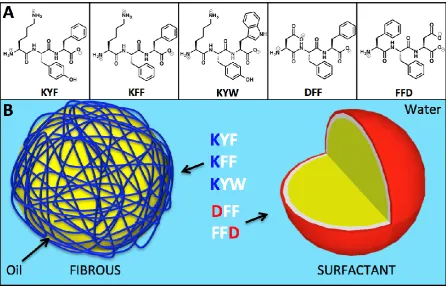
surfactant-like stabilized droplets or through the formation of nanofibrous networks (Figure 1) depending on their sequence.
The computational aspect of the work is focused on coarse grain molecular dynamics simulations, primarily utilizing the MARTINI coarse grained force field45, which has recently
been demonstrated to be useful to model the molecular self-assembly of supramolecular materials.42,43,46-49 Our previously reported methodology which relied on the aggregation propensity of di- and tripeptides42,43 was used to identify various tripeptides that showed a high tendency for aggregation in water.
Proceeding from the previously reported initial screen of 8000 tripeptides42, an extended
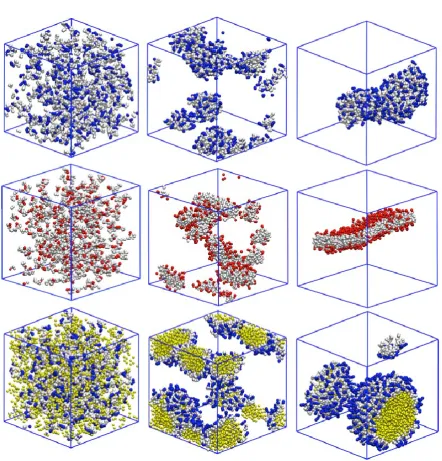
screening of favorably aggregating tripeptides revealed distinct differences in the type of nanoscale structures that were formed upon equilibration of the systems over long timescales. In particular, it became clear that two types of aggregation behavior could be distinguished depending on peptide sequence – a subset of tripeptides formed bilayer structures, while a second set formed fiber-like morphologies, (Figure 2). While KYW, KFF and KYF were previously identified as candidates that are able to form fibers (Figure 2A), the two additional peptides (FFD and DFF) were shown to self-assemble into bilayer-like structures (Figure 2B) in aqueous medium over 9.6 µs simulations (see Supporting Information for details of the computational methods). We previously reported that KYF, KFF, and KFW form gels in water (40 mM) and now observed that FFD and DFF form free flowing solutions at these concentrations. FTIR studies were performed on these five tripeptides in D2O (40 mM
4
hydrogen bonding between the amide groups of the peptide chains.. Similarly, a larger broad peak around 1560 cm-1 is indicative of the deprotonated carboxylate group, COO-. The shift
and broadening of this peak from the solution state to the nanofibrous state indicates an introduction of a salt bridge between either the corresponding termini or the lysine side chain. This proposes a head to tail interaction between the COO- and H
3N+ termini of the peptides
with hydrogen bonding between the two the self-assembled structures giving an overall extended stable structure. DFF and FFD do not show defined peaks thus no nanostructures are present within the sample.
Having established differential self-assembly in aqueous media, the five tripeptides were selected for extended simulations of 9.6 µs in a biphasic water/octane solution, using the MARTINI coarse-grained force field45 (see Figure S1 in the Supporting Information). The simulations show the assembly of the organic solvent as droplets with the peptides assembled at the water/octane interface (see Figure S2 in Supporting Information). As expected, the peptides assemble with the hydrophobic groups exposed to the organic core of the droplet thus decreasing the interfacial tension between the two phases. Similarly, the hydrophilic groups act as a barrier for the water phase (Figure 2C). It is not clear from the current simulation whether these tripeptides may also form nanofibers around the interface due to the size limitations of the model (300 tripeptides), which does not provide sufficient coverage, to encapsulate the octane droplet. Nonetheless, the ability of the tripeptides to interact with both the organic and aqueous phases is a positive indicator for these molecules to act as emulsifiers and the simulations in water suggest two distinct behaviors for the K and D containing sequences. Therefore, laboratory experiments were carried out to test whether stabilized emulsions could be formed.
5
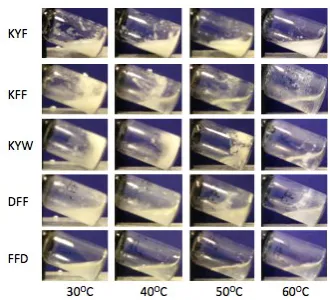
To create the emulsions, 100 μL rapeseed oil (with 1mg/mL concentration sudan II) was added to each of the systems. Rapeseed oil was chosen as it is a food-regulated oil and tunable peptide-based emulsions have potential applications in food science. Homogenization was carried out on each sample for 5 seconds using a bench top homogenizer. Thereafter; the samples were stored for 24hrs to ensure a stable emulsion was formed (see the Supporting Information for the complete experimental details – Figure S3). Visual inspection of the resulting emulsions revealed KYF, KFF and KYW forming more stable emulsions compared to DFF and FFD. The opacity of the samples (Figure 3B) differs between the surfactant like (FFD and DFF) and fibrous (KYF, KFF, KFW) emulsifiers, with the more opaque emulsion suggesting a more complete dispersion of oil within the aqueous phase.
To confirm that the tripeptides form self-assembled nanoscale network structures, rather than aggregating in a surfactant-like manner at the interface, FTIR spectroscopy was carried out on the emulsions in order to compare key interactions between aqueous and emulsions states which are indicative of self-assembly of the peptides. In the biphasic systems where the emulsions are formed, the samples that form fibers (KYF, KFF, KYW) have similar FTIR spectra to those observed in the aqueous phase. This indicates that similar fibrous networks are forming and therefore, these droplets are most likely stabilized by nanofiber networks (Figure 3D). In contrast, comparison of the FTIR spectra for FFD and DFF between the aqueous and biphasic systems, reveal the emergence of peaks, at approx. 1650 cm-1, in the emulsion state indicating
6
In order to visualize the interfacial assemblies, fluorescent microscopy was carried out on each of the samples to identify the size and distribution of the droplets as well as to identify how the peptides interact at the interface (see Supporting Information for the complete set of tripeptide emulsions, Figure S4). Figure 4 shows the results of these studies for KYW. Labeling the organic phase with Sudan II reveals stabilized organic droplets (Figure 4A). The introduction of Thioflavin T,51,52 which labels the peptide region (β-sheet formation) shows that the KYW is
localized to the interface of the droplets (Figure 4B). This suggests that, in the case of KYW, the tripeptide is self-assembling into fibrils at the interface to create a network which is stabilizing the droplet, as previously observed for a range of Fmoc-dipeptides.44 For DFF,
smaller and fewer droplets were seen. Staining with Thioflavin T did not show any fluorescence indicating that no β-sheet forming fibrils are forming. The combination of the two dyes (Figure 4D) further highlights the localization of the tripeptide to the surface of the droplet. In addition to the fluorescence staining, transmission electron microscopy was carried out to visualize the fibril assembling at the water/oil interface. Figure 4E/F shows the presence of fibrils at the interface, for KYF, indicating that these fibrils stabilize the droplets. TEM image of KYW stabilized emulsion droplet can be found in the Supporting information Figure S5. KFF could not be imaged due to the weakness of the emulsion. Since DFF and FFD do not form fibrils these were not imaged.
The ability to control separation of an emulsion through environmental triggers is a useful property within a variety of application areas.53,54 In particular, the ability to disrupt emulsions
at various temperatures is a key property of interest for the application of emulsions in the food industry.55,56 Therefore, the thermal stability of the emulsions was investigated for each of the
7
As the temperature is increased the emulsion separates into two different layers. This de-emulsification is observed for all samples at 60°C apart from KYF, which remains in the emulsified state at this temperature. This shows that KYF has a higher tolerance for heat than the other samples and that there are opportunities to tune heat resistance through the modification of the peptide sequence. Across the range in temperatures, it is clear that DFF and FFD de-emulsify more easily, which correlates with the initial observations that these peptides are not strong emulsifiers.. KFF begins to break down at approximately 40°C with KYW breaking down at 50°C suggesting the strength of the nanofiber assembly is directly proportional to the stability of the emulsion.
The thermal transitions from emulsion to separated solutions were investigated at the supramolecular level by investigating changes in FTIR spectra at varying temperature. These experiments were carried out in D2O/oil mixtures. For KYF and KYW, the peak at ~1625 cm -1, associated with the H-bonded C=O stretch, begins to decrease in intensity towards the higher
temperatures, this is more noticeable for KYW (breakdown of the fibers at 70ºC) due to the greater stability of KYF (no breakdown at 80ºC, see Supporting Information, Figure S6, for additional information). Subtle differences are observed for KFF, although this is a weaker emulsifier and as such increases in the temperature disrupts the molecular packing at an earlier stage (50ºC, Figure 64, Supporting Information). Surfactant-like tripeptides FFD and DFF showed no observable temperature dependence when analyzed by FTIR. The relative stability of the tripeptide-based emulsions is also confirmed through the pH and concentration dependence of the emulsions, which can be found in the Supporting Information, Figures S7 and S8.
8
properties that are tunable and dependent on sequence. In particular, we show that peptides that have a preference for fibrillar assembly form more stable emulsions compared with the traditional surfactant model. Due to their inherent biodegradability to natural amino acids, these peptides are promising candidates for food and cosmetics applications.
Supporting Information
Supporting Information is available from the Wiley Online Library or from the author.
Notes
The University of Strathclyde has filed a patent application on technology related to the processes described in this article. Several authors are listed as inventors on the patent application.
Acknowledgements
This work was supported by ESPRC and Macphie of Glenbervie. Computational results were obtained using the EPSRC-funded ARCHIE-WeST High Performance Computer (www.archie-west.ac.uk; EPSRC grant no. EP/K000586/1). The research leading to these results has received funding from the European Research Council under the European Union's Seventh Framework Programme (FP7/2007-2013)/EMERgE/ERC Grant Agreement No. (258775).
Received: ((will be filled in by the editorial staff)) Revised: ((will be filled in by the editorial staff)) Published online: ((will be filled in by the editorial staff))
(1) Bais, D.; Trevisan, A.; Lapasin, R.; Partal, P.; Gallegos, C. J. Colloid Interface Sci.
2005, 290, 546.
9
(3) Garti, N. LWT - Food Sci. Technol. 1997, 30, 222.
(4) McClements, D. J.; Li, Y. Adv. Colloid Interface Sci.2010, 159, 213.
(5) Miller, D. J.; Henning, T.; Grünbein, W. Colloids Surfaces A: Physicochem. Eng.
Aspects2001, 183–185, 681.
(6) Sanguansri, P.; Augustin, M. A. Trends in Food Sci. Technol. 2006, 17, 547. (7) Weiss, J.; Takhistov, P.; McClements, D. J. J. Food Sci.2006, 71, R107. (8) Lim, G. K.; Wang, J.; Ng, S. C.; Gan, L. M. Langmuir1999, 15, 7472. (9) Antonietti, M.; Wenzel, A.; Thünemann, A. Langmuir1996, 12, 2111. (10) Fang, Y.; Dalgleish, D. G. Colloids Surfaces B: Biointerfaces1993, 1, 357. (11) Holmberg, K. Curr. Opin. Colloid Interface Sci.2001, 6, 148.
(12) Miller, K. W.; Small, D. M. J. Colloid Interface Sci.1982, 89, 466.
(13) Veldhuizen, R.; Nag, K.; Orgeig, S.; Possmayer, F. Biochim. Biophys. Acta
(BBA)-Molecular Basis of Disease1998, 1408, 90.
(14) Hanson, J. A.; Chang, C. B.; Graves, S. M.; Li, Z.; Mason, T. G.; Deming, T. J. Nature
2008, 455, 85.
(15) Morikawa, M. a.; Yoshihara, M.; Endo, T.; Kimizuka, N. Chem.-A Eur. J. 2005, 11, 1574.
(16) Malcolm, A. S.; Dexter, A. F.; Middelberg, A. P. J. Asia-Pacific J. Chem. Eng. 2007, 2, 362.
(17) Schlaad, H.; Antonietti, M. Eur. Phys. J. E: Soft Matter and Biological Physics 2003,
10, 17.
(18) Zhao, Y.; Sakai, F.; Su, L.; Liu, Y.; Wei, K.; Chen, G.; Jiang, M. Adv. Mater.2013, 25, 5215.
(19) Zhang, J.; Coulston, R. J.; Jones, S. T.; Geng, J.; Scherman, O. A.; Abell, C. Science
2012, 335, 690.
(20) Binks, B. P. Curr. Opin. Colloid Interface Sci.2002, 7, 21. (21) Dickinson, E. Curr. Opin. Colloid Interface Sci. 2010, 15, 40.
(22) Fujii, S.; Read, E. S.; Binks, B. P.; Armes, S. P. Adv. Mater.2005, 17, 1014. (23) Melle, S.; Lask, M.; Fuller, G. G. Langmuir2005, 21, 2158.
(24)Pickering, S. SU, J’. Soc. Client. Ind. London1910, 29, 129. (25) Tcholakova, S.; Denkov, N.; Lips, A. PCCP2008, 10, 1608.
(26) Wolters, D.; Meyer‐ Zaika, W.; Bandermann, F. Macromol. Mat. Eng.2001, 286, 94. (27) Wang, Z.; vanOers, M. C. M.; Rutjes, F. P. J. T.; vanHest, J. C. M. Ange. Chem. Int. Ed.2012, 51, 10746.
(28) Chu, Z.; Feng, Y. Chem. Commun.2011, 47, 7191.
(29) Fowler, C. I.; Muchemu, C. M.; Miller, R. E.; Phan, L.; O’Neill, C.; Jessop, P. G.; Cunningham, M. F. Macromolecules2011, 44, 2501.
(30) Liu, Y.; Jessop, P. G.; Cunningham, M.; Eckert, C. A.; Liotta, C. L. Science2006, 313, 958.
(31) Minkenberg, C. B.; Florusse, L.; Eelkema, R.; Koper, G. J.; van Esch, J. H. J. Am. Chem. Soc.2009, 131, 11274.
(32) Ristenpart, W. D.; Bird, J.; Belmonte, A.; Dollar, F.; Stone, H. Nature2009, 461, 377. (33) Zhang, S. Nat. Biotechnol.2003, 21, 1171.
(34) Reches, M.; Gazit, E. Science2003, 300, 625.
(35) Ikeda, M.; Tanida, T.; Yoshii, T.; Hamachi, I. Adv. Mater.2011, 23, 2819. (36) Ryu, J.; Lim, S. Y.; Park, C. B. Adv. Mater.2009, 21, 1577.
(37) Smith, A. M.; Williams, R. J.; Tang, C.; Coppo, P.; Collins, R. F.; Turner, M. L.; Saiani, A.; Ulijn, R. V. Adv. Mater.2007, 20, 37.
10
(39) Singh, G.; Bittner, A. M.; Loscher, S.; Malinowski, N.; Kern, K. Adv. Mater.2008, 20, 2332.
(40) Jayawarna, V.; Ali, M.; Jowitt, T. A.; Miller, A. F.; Saiani, A.; E., G. J.; Ulijn, R. V.
Adv. Mater.2006, 18, 611.
(41) Mahler, A.; Reches, M.; Rechter, M.; Cohen, S.; Gazit, E. Adv. Mater.2006, 18, 1365. (42) Frederix, P., W. J. M.; Scott, G. G.; Abul-Haija, Y. M.; Kalafatovic, D.; Pappas, C. G.; Javid, N.; Hunt, N. T.; Ulijn, R. V.; Tuttle, T. Nat. Chem.2015, 7, 30.
(43) Frederix, P. W. J. M.; Ulijn, R. V.; Hunt, N. T.; Tuttle, T. J. Phys. Chem. Lett.2011, 2, 2380.
(44) Bai, S.; Pappas, C.; Debnath, S.; Frederix, P. W. J. M.; Leckie, J.; Fleming, S.; Ulijn, R.
V. ACS Nano2014, 8, 7005.
(45) Marrink, S. J.; Risselada, H. J.; Yefimov, S.; Tieleman, D. P.; De Vries, A. H. J. Phys.
Chem. B2007, 111, 7812.
(46) Lee, O.-S.; Cho, V.; Schatz, G. C. Nano Lett.2012, 12, 4907.
(47) McCullagh, M.; Prytkova, T.; Tonzani, S.; Winter, N. D.; Schatz, G. C. J. Phys. Chem. B2008, 112, 10388.
(48) Guo, C.; Luo, Y.; Zhou, R.; Wei, G. ACS Nano2012, 6, 3907. (49) Guo, C.; Luo, Y.; Zhou, R.; Wei, G. Nanoscale2014, 6, 2800.
(50) Sakamoto, K.; Yoshida, R.; Hatano, M.; Tachibana, T. J. Am. Chem. Soc. 1978, 100, 6898.
(51) Shimadzu, H.; Suemoto, T.; Suzuki, M.; Shiomitsu, T.; Okamura, N.; Kudo, Y.; Sawada, T. J. Labelled Compd. Radiopharm.2003, 46, 765.
(52) Gebbink, M. F.; Claessen, D.; Bouma, B.; Dijkhuizen, L.; Wösten, H. A. Nat. Rev.
Microbiol. 2005, 3, 333.
(53) Ngai, T.; Behrens, S. H.; Auweter, H. Chem. Commun.2005, 331.
(54) Alava, C.; Saunders, B. R. Colloids Surf. Physicochem. Eng. Aspects2005, 270, 18. (55) Guzey, D.; McClements, D. J. Adv. Colloid Interface Sci.2006, 128, 227.
11
[image:11.595.74.521.100.386.2]12
13
[image:13.595.74.411.68.394.2]14
15
[image:15.595.104.435.93.393.2]