Swarm Shape Manipulation through Connection Control
Giuliano Punzo, Derek J. Bennet and Malcolm Macdonald
Abstract— The control of a large swarm of distributed agents is a well known challenge within the study of unmanned autonomous systems. However, it also presents many new opportunities. The advantages of operating a swarm through distributed means has been assessed in the literature for efficiency from both operational and economical aspects; practically as the number of agents increases, distributed control is favoured over centralised control, as it can reduce agent computational costs and increase robustness on the swarm. Distributed architectures, however, can present the drawback of requiring knowledge of the whole swarm state, therefore limiting the scalability of the swarm.
In this paper a strategy is presented to address the challenges of distributed architectures, changing the way in which the swarm shape is controlled and providing a step towards verifiable swarm behaviour, achieving new configurations, while saving communication and computation resources. Instead of applying change at agent level (e.g. modify its guidance law), the sensing of the agents is addressed to a portion of agents, differentially driving their behaviour. This strategy is applied for swarms controlled by artificial potential functions which would ordinarily require global knowledge and all-to-all interactions. Limiting the agents’ knowledge is proposed for the first time in this work as a methodology rather than obstacle to obtain desired swarm behaviour.
I. INTRODUCTION
Increased interest in multi-agent systems has lead to the development of several techniques to provide large ensembles of agents with reliable autonomous control means. Robotics is the most promising field of application for swarm engineering where large groups of agents are driven toward the accomplishment of a task through decentralised control. Swarms are appealing as robotic systems since, compared to centralised systems designed for the same task, they can have much simpler components [1]. In particular, in fields where robotic systems must provide high levels of reliability and fault tolerance, the redundancy characterised by swarming systems is a key factor. The problem of distributed control has been addressed in several ways, often taking inspiration from nature and trying to reproduce group behaviour by applying heuristic control rules [2], [3]. In the bio-inspired approach for group behaviour modeling it has been pointed out how, for many species that aggregate in
Giuliano Punzo is with the Advanced Space Concepts Laboratory, Uni-versity of Strathclyde, James Weir Building, 75 Montrose Street Glasgow
G1 1XJ United [email protected]
Dr. Derek J. Bennet is with the Advanced Space Concepts Laboratory, University of Strathclyde, James Weir Building, 75 Montrose Street Glasgow
G1 1XJ United [email protected]
Dr. Eur Ing Malcolm Macdonald is the Associate Director of the Advanced Space Concepts Laboratory, University of Strathclyde, James Weir Building, 75 Montrose Street Glasgow G1 1XJ United Kingdom
large groups, individuals do not have complete knowledge of group dynamics yet they can clearly sense local creatures and interact with them [4]. In this sense many aggregates show a limited topological knowledge, for example, their swarm environment knowledge is limited to the nearest neighbours.
Many authors have succeeded in reproducing observable natural behaviours and desirable swarm formation through the use of artificial potential functions defined as pairwise interactions presenting a single minimum that represents the equilibrium state [5], [6], [7], [8], [9]. The use of artificial potential methods in swarm engineering is useful due to the possibility of describing the system dynamics from an analytic point of view, obtaining the highest level of predictability possible through proof of the swarm system stability. By this approach an agent senses its neighbours and moves as if pushed by the potential field generated by interacting with them. In many of these cases the communication graph established among swarm members is complete (i.e. every agent has global knowledge of the swarm state). On the other hand, some previous works proved that partially connected swarm members can achieve a common velocity, organise themselves in clusters and avoid dispersion [10], [11], [12]. In this sense the only advantage of limited connectivity is the reduction of communications within the swarm. Indeed the problem of limited knowledge was also addressed in pioneering work by Reynolds[13] where, in a context of computer graphics, the motion of flocks of birds was simulated constructing an algorithm on three simple rules: cohesion, separation and alignment. Such rules operate, typically in explicit form, in almost all the algorithms used to simulate swarming systems. Furthermore, it is found that these rules are often applied by a means based on the concepts of artificial potential functions.
It was shown in [14] that when interactions among the swarm agents are activated by closeness (agents closer that a certain threshold distance interact), dispersion and multiple clustering are very likely to happen. Nevertheless the condition for avoiding dispersion and clustering was defined in [15] where a rigorous treatment of multi-agent dynamics and stability is presented using a combination of graph-theoretic and system-theoretic tools.
Considering the interplay between connections and guidance functions this paper illustrates a new way to control swarm shape by managing the connections in
the communication graphs. Using a Morse-like artificial potential in conjunction with two different dissipation and steering functions, the swarm shape is changed from an initial round cluster to a dumbbell, from random initial conditions. Arguments are presented to illustrate stability characteristics and robustness of the method presented. At the same time a threshold on agent minimum connectivity to ensure cohesion is spotted. The connection rule used will make the swarm correctly achieve the new shape without dispersing provided that the number of connections per agent does not drop below the half of the total number of agents. The approach presented within this paper uses the limited connectivity to achieve a stable swarm configuration which would otherwise not be achievable when the swarm benefits from global knowledge without changes at agent level. Indeed complete connectivity drives the agents to a homogeneous behaviour such as fully symmetric shapes. This paper is structured as follows: section II recalls basic definitions of graph theory and describes the kind of network structure used; section III provides a description of the model used for driving the swarm and a more detailed description of the methodology used to manipulate swarm shape; section IV illustrate the effects of the methodology used on the swarm shaping; section V reports simulation results about an ensemble of 60 agents that change their spatial arrangement on a plane from a tight cluster to a wider dumbbell shape. Conclusions and future works are finally presented in section VI.
II. GRAPH THEORY DEFINITIONS AND NETWORK STRUCTURE
Before going into the description of the model used and the method adopted to change swarm behaviour, a short overview of the concepts used to describe the swarm system are derived, first at lower level, as graph theory, then at higher level considering the network layout originated from simple connection rules.
A. Graph Theory:
A graphGis defined in mathematics as a pair composed by a set of nodesν and a set of ordered pairs of verticesε
which are called edges.
In the following we make use of some concepts from graph theory that are worth defining here:
• A graph is said to be directed if all the edges are ordered
pairs of vertices. A graph is said to be undirected if all the edges are unordered pairs of vertices. A graph with ordered and unordered pairs of vertices is said to be mixed.
• A graph is said to be complete if and only if any two
distinct vertices of the graph are the end-points of an edge of the graph.
• The degree of a vertexuin an undirected graph is the
number of edges which includeu. The in-degree (out-degree) of a vertexuin a directed graph is the number
of edges entering (exiting from) u. A graph is said to be regular if all the vertices have the same degree. The adjacency matrix of a graphGonN vertices denoted by A(G) is an N×N matrix (square matrix of size N2
), having rows and columns labeled by the vertices of G, and
ijth entry,a
ij, defined as follows;
aij = 1⇔ui, uj∈ε aij = 0 otherwise
(1) where,ui, uj∈ν.
Furthermore, the notion of component of a graph is used which is the pair composed by a subset of nodes and the correspondent subset of ordered edges contained in the graph and which does not connect by any edge to the rest of the graph’s nodes. In particular the component is said giant component when the subsets correspond to the whole sets they they are contained into, i.e. there are no isolated nodes in the graph.
For all other definitions concerning graph theory refer to [16], [17], [18].
B. Network Structure:
The network is constructed on the nearest neighbors base: if N is the total number of nodes (agents), each of them is connected to its n nearest neighbors in a directed graph whatever their actual distance is where 1 ≤ n < N. The connections are not exclusive: if an agent a is connected to an agent b (i.e. a is influenced by the potential of b) thenb is not prevented brom being connected to a (i.e. an oriented edge b, a is still in the set of the possible edges in the graph). The adjacency matrix that characterises this graph is not symmetric. The graph is regular with respect to the in-degree that isnwhile the out-degree changes from node to node, but its average is stilln. It turns out that the adjacency matrix presentsN×nnonzero entries.
III. MODEL AND NETWORK
In this section the artificial potential functions used are illustrated together with the way the nearest neighbors rule is implemented within the swarm together with the implications of this.
A. Dynamic models
A swarm of agents is considered which are connected through the use of pairwise artificial potential functions. These potentials provide long range attraction to avoid dis-persion and short range repulsion to avoid collisions. In order to develop a control methodology based on connections, artificial potential functions,Ua
ij,Uijr, defined in [5] are used. These are
Ua
ij =−Caexp
−|xij|
la
Ur
ij =Crexp
−|xij|
lr
(3) whereCa, Crandlaare constants with unitary value,lr= 0.2andxij is the relative position vector of agenti respect to agentj. The model can be completed by the orientation functionu(t)resulting in a final form as
dxi
dt =vi (4)
mdvi
dt =−∇U a i − ∇U
r
i −u(t) (5)
where,
Ua i =
X
j
(aijUija) U r i =
X
j
(aijUijr)
whereaij is the entry of the adjacency matrix as defined in section II. In particularCa andCr represent the strength of the potentials whilelaandlrgovern the range over which the the potentials are mainly effective.
The form that u(t) takes changes the behaviour of the swarm. Two alternatives are considered for u(t). These are firstly the steering function,
u(t) = X
j
(aijΛij) =
= X
j aij
C0(vij·ˆxij) exp
−|xij|
l0
(6) and secondly a viscous function,
u(t) =σvi (7)
wherevij is the relative velocity vector of agenti andj,
C0, l0, are constants with values of0.1,0.5 respectively, as defined in [5]. As with attraction and repulsion potentials,
C0 is the strength of the orientation function and l0 is the range over which the orientation interaction occurs for u(t) defined in Eq. 6 and (ˆ·) denotes a unit vector. By using this, motion towards or away from neighbors is weakly damped, proportional to the component of relative velocity along the vector connecting neighboring particles. This happens by means of the dot product in Eq. 6 as it is intuitive to understand. This results in a local alignment of particle velocity vectors, driving the swarm towards a global rotational motion.
On the other hand Eq. 7 damps agent velocity however oriented by means of a velocity-proportional damping coefficient σ controlling the amplitude of dissipation and driving the swarm towards a static configuration. Throughout this workσis equal to0.7 as defined in [7].
The swarm behaviours described were observed when communication graphs are completely connected in [6], [8], where, within the same hypothesis, stability characteristics of the models were proven as well.
B. Network structure
The nearest neighbors rule network is implemented by connecting every agent in a directed graph to a number of agents equal to the half of the whole ensemble rounded toward zero if this number is odd. If N is the number of swarm agents, N −1 is the number of possible available connections for every agent. Connecting any agent this way means connecting it to just more than the half of its potential mates. This has non-trivial implications. Although each agent can sense just hN/2i mates (where h·i rounds down the argument) there are some agents (one ifN is odd, 2 ifN is even) that are sensed by all the others although still sensing each of them just hN/2i mates. hN/2i represents in this sense a threshold to ensure cohesion of the swarm and robustness as outlined in the next section. If each agent was supposed to link to less than hN/2i agents, isolated clusters can emerge. It is easy to understand how the graph could split into two isolated components each node of which would satisfy the minimum number of connections within the component and without the need to establish a connection with any node in the other. This would make the dynamics of each subgroup independent from the other. This connection rule leads to satisfy the condition outlined in [15] for a discrete-time model to achieve a coherent behaviour that can be summarised as at least one agent always connected to all the others as time progresses.
IV. SWARM SHAPING
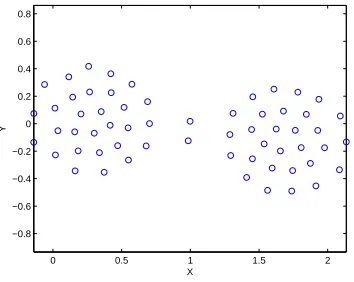
The connection scheme previously outlined leads to the splitting of the swarm into two subgroups that do not drift apart as their communication graph is still connected in one giant component. This happens regardless to the kind of model used. Referring to the agents sensed by all the swarm mates as the ‘most connected agents’, by symmetry of the formation they will find their position at the centre of the swarm that splits into two subgroups (a dumbbell as shown in Fig.1) joined by the first ones. In particular the subset given by the edges belonging to the first subgroup and the subset given by the edges belonging to the second one will intersect by mean of the edges belonging to the most connected agents.
This arrangement provides the network graph with an uniform in-degree ofhN/2i, which is equal to the average out-degree. It thus follows that the number of total links in the swarm is,
K=X
i X
j aij =
N2
2 (8)
0 0.5 1 1.5 2 −0.8
−0.6 −0.4 −0.2 0 0.2 0.4 0.6 0.8
X
[image:4.595.85.262.89.230.2]Y
Fig. 1. Dumbbell formation obtained by connecting agents on nearest
neighbours rule base. The picture is obtained by using Eqs. 4, 5 with the
steering function u(t)defined in Eq. 6 but the final shape would be the
same also using the dissipation functionu(t)as defined in Eq. 7
number of agents was odd the closest agent to the most connected agent from the opposite side of the dumbbell to where the failure happened would become one of the most connected ones. If one of the most connected agents fails in a swarm with an even number of agents, the swarm falls automatically into the equilibrium condition for an odd number of agents (one most connected agent in the middle). On the other hand, if the number was originally odd and the only agent in the middle fails each side of the swarm, in order to be connected to at least hN/2i mates will link to one agent from the other side, the closest one. The two agents so selected will form again the central couple of most connected agents in the swarm.
The splitting of the swarm does not depend on the kind of guidance law as long as this guarantees clustering and spacing between agents. As for dissipation and steering func-tions, they have no influence on the formation, but do have so on the motion of the ensemble because of the presence of asymmetric interactions making the swarm achieve non-zero values of angular and linear momentum. Nevertheless momentum is prevented from accumulating because of the fact that the potential energy functions, and their derivative, are bounded. Thus the swarm remains cohesive, with an absence of fragmentation bounding the moment of inertia. Considering the real energy of the swarm as,
E=X
i (miv
2
i) +I X
i Ω2
i (9)
where, I is the total moment of inertia of the ensemble defined as,
I=X i
(mir
2
i) (10)
where,riis defined as the distance of each agent from the ensemble centre-of-mass, andΩis the total angular velocity of the ensemble rotating about its centre of mass. As the swarm remains cohesive the swarms moment of inertia must
be bound. Furthermore, as the total mass is constant and the energy stabalises to a constant minimum state, due to the potential functions, it logically must follow that the linear and angular velocities cannot windup and must remain confined. Variation of physical quantities of the swarm in general can be better understood looking at the examples provided in the next section.
V. SIMULATION RESULTS
To illustrate the effect of the new network arrangement a swarm of 60 autonomous robots moving on a plane was simulated.
Robots are first asked to stabilise by using dynamic models presented with an all-to-all communication scheme (complete graph), subsequently their communication graph is changed as illustrated in the previous sections: each agents links to its 30 nearest neighbours to change formation from a single cluster to two clusters in a dumbbell shape. Integration of the equations of motion is performed using a simple explicit Euler scheme with integration step of 0.005s. Test duration is 50 seconds. No external perturbation is introduced and no saturation of actuators is considered. As expected the swarm first relaxes to the minimum energy state defined in the original global knowledge model, then, when applying the new connection protocol, agents first tend to increase their relative distances and finally relax into a new dumbbell configuration (see Fig. 2).
−0.6 −0.4 −0.2 0 0.2 0.4 −0.4
−0.3 −0.2 −0.1 0 0.1 0.2 0.3 0.4 0.5
X
Y
−0.5 0 0.5 −0.4
−0.3 −0.2 −0.1 0 0.1 0.2 0.3 0.4
X
Y
(i) (ii)
−1 −0.8 −0.6−0.4−0.2 0 0.2 0.4 0.6 0.8 −0.6
−0.4 −0.2 0 0.2 0.4 0.6
X
Y
−1 −0.5 0 0.5 1 −0.8
−0.6 −0.4 −0.2 0 0.2 0.4 0.6 0.8
X
Y
(iii) (iv)
Fig. 2. Relaxation of the swarm into a cluster when provided with
global knowledge and passage to dumbbell by connecting agents on nearest
neighbours rule base. Switching occurs att= 16.67s. (i) initial conditions
att= 0s(ii) minimum energy cluster state att= 15s(iii) increase of
relative distance att= 21s(iv) dumbbell configuration att= 50s. The
picture is obtained by using Eq. 4 and 5, with the steering functionu(t)
defined in Eq. 7 but the final shape would be the same also using the steering
functionu(t)as defined in Eq. 6
[image:4.595.322.545.435.634.2]A. Viscous-like dissipation
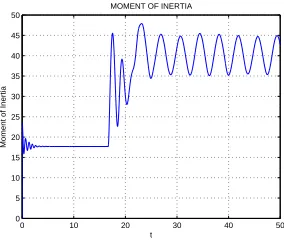
When viscous-like dissipation is used, Eq 7, relative positions stabilize into a crystalline configuration. This can be noted by looking at the moment of inertia of the whole ensemble in Fig. 3. On the other hand rigid drifting and rotation of the ensemble persist because of the asymmetric interactions between agents. In more details some agents can pull other agents without being themselves pulled: this results in the pulled agent achieving the same momentum of the pulling agent. Absence of relative motion between agents drives the moment of inertia of the formation towards a constant, as well as linear and angular momenta that, although viscously damped, is in general different from zero due to the presence of asymmetric interactions generating a continuous non balanced pulling force.
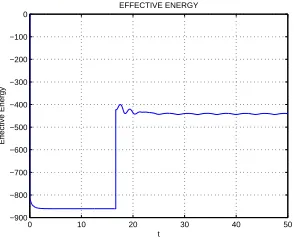
Viscous-like damping make the linear and angular momen-tum stabilize at a constant level (see Fig 4, 5 by balancing the action of asymmetric forces. Indeed when the system is completely relaxed the net force on each agent is the instan-taneous artificial potential field force balanced by the viscous dissipation. The new configuration is also characterised by a new value of effective energy which stabilizes about a new steady state (see Fig. 6).
0 10 20 30 40 50
0 5 10 15 20 25 30 35 40 45 50
MOMENT OF INERTIA
t
[image:5.595.355.511.84.207.2]Moment of Inertia
Fig. 3. Moment of inertia for30nearest neighbours network swarm and
viscous-like dissipation
0 10 20 30 40 50
−1.5 −1 −0.5 0 0.5 1 1.5 2
t
Linear Momentum
LINEAR MOMENTUM
[image:5.595.355.510.258.383.2]x−component y−component magnitude
Fig. 4. Linear momentum for30nearest neighbours network swarm and
viscous-like dissipation
0 10 20 30 40 50
−0.4 −0.2 0 0.2 0.4 0.6 0.8 1
t
Angular Momentum
[image:5.595.100.251.389.511.2]ANGULAR MOMENTUM
Fig. 5. Angular momentum for30nearest neighbours network swarm and
viscous-like dissipation
0 10 20 30 40 50
−900 −800 −700 −600 −500 −400 −300 −200 −100 0
EFFECTIVE ENERGY
t
[image:5.595.96.252.572.696.2]Effective Energy
Fig. 6. Effective energy for30nearest neighbours network swarm and
viscous-like dissipation
B. Steering function
When a steering function is used instead of viscous damp-ing the swarm achieves a more dynamic behaviour, while still converging towards the dumbbell shape. In particular, effective energy and moment of inertia oscillate about a new average value (see Fig. 10, 7). Momentum also has an oscillating trend (see Fig. 8, 9), however the behaviour is not that regular. Nevertheless an exponential wind up, as expected if the system were unstable, is not observable. This just confirm arguments developed in section IV. It is therefore clear how asymmetric interactions generate an asynchronous rotation of the ensemble and chaotic trend on momenta time histories.
0 10 20 30 40 50
0 5 10 15 20 25 30 35 40 45 50
MOMENT OF INERTIA
t
Moment of Inertia
Fig. 7. Moment of inertia for30nearest neighbours network swarm and
[image:5.595.363.505.610.730.2]0 10 20 30 40 50 −5
−4 −3 −2 −1 0 1 2 3 4 5
t
Linear Momentum
LINEAR MOMENTUM
[image:6.595.106.247.83.201.2]x−component y−component magnitude
Fig. 8. Linear momentum for30nearest neighbours network swarm and
pairwise interaction based steering
0 10 20 30 40 50
−0.6 −0.4 −0.2 0 0.2 0.4 0.6 0.8 1 1.2 1.4
t
Angular Momentum
[image:6.595.102.246.259.380.2]ANGULAR MOMENTUM
Fig. 9. Angular momentum for30nearest neighbours network swarm and
pairwise interaction based steering
0 10 20 30 40 50
−900 −800 −700 −600 −500 −400 −300 −200 −100 0
EFFECTIVE ENERGY
t
Effective Energy
Fig. 10. Effective energy for30nearest neighbours network swarm and
pairwise interaction based steering
VI. CONCLUSIONS AND FUTURE WORK A. Conclusions
A methodology to shape swarms of agents without insert-ing any change at agent level was presented. The method-ology employs the asymmetry of a directed graph to reduce the number of communication links active while preserving the coherent behaviour of the formation. Arguments were given to show that the methodology does not lead to dis-persion or fragmentation of the ensemble while halving the number of communication channels with clear advantages on communication and computation resources saving. The threshold of hN/2i links per agent was spotted to ensure cohesiveness and the emergence of one only giant component in the communication graph. Robustness characteristics of the methodology were discussed although not mathemati-cally or rigorously proven and examples were given using two different guidance laws, verifying that the methodology performs in both cases as expected.
B. Future Work
Application of the nearest neighbors rule with directed graph leads the swarm to the achievement of a stable, reliable and fault tolerant dumbbell shape. The concept of employing particular structures in designing the communication graph can be extended in order to achieve even more possible con-figurations without changing the guidance laws. Preliminary investigations over different kind of communication networks among the agents suggest that partially connected formations share common features. Over all the tests performed it was noted that total effective energy of the formation (artificial potential plus kinetic energy) in the global knowledge (EGN) and partially connected (EP C) cases, are in the same ratio of the number of links active in the two cases. Indeed they satisfy the relation
EP C EGN
≈
P i
P jaij
N(N−1) (11)
regardless to the fact that connections are oriented or not. Future investigation will seek analytical definition for the trend of swarm physical quantities and further exploiting of the connection network to shape and maneuver large formation of autonomous agents with particular interest in robotics applications.
Another important issue to consider is the performance reliability of the techniques developed when applied to real world. In order to assess this, the algorithms developed should consider real hardware implications such as environ-mental disturbances, limited sensor ranges and fields of view, time delay of knowledge as it passes through the swarm and actuators saturation.
REFERENCES
[1] G. Beni. From swarm intelligence to swarm robotics. In SAB 2004
International Workshop, July 17, 2004 - July 17, 2004, volume 3342
[image:6.595.100.247.438.557.2][2] I.D. Couzin, J. Krause, N.R. Franks, and S.A. Levin. Effective leadership and decision-making in animal groups on the move. Nature, 433(7025):513–516, 2005.
[3] T. Vicsek, A. Czirk, E. Ben-Jacob, I. Cohen, and O. Shochet. Novel type of phase transition in a system of self-driven particles. Physical
Review Letters, 75:1226, 1995.
[4] I.D. Couzin. Collective cognition in animal groups. Trends in
Cognitive Sciences, 13(1):36–43, 2009.
[5] C.R. McInnes. Vortex formation in swarms of interacting particles.
Physical Review E (Statistical, Nonlinear, and Soft Matter Physics),
75(3):032904, 2007.
[6] M.H. Mabrouk and C.R. McInnes. Nonlinear stability of vortex
formation in swarms of interacting particles. Physical Review E
(Statistical, Nonlinear, and Soft Matter Physics), 78(1):012903, 2008.
[7] D.J. Bennet and C.R. McInnes. Verifiable control of a swarm of
unmanned aerial vehicles. Proceedings of the Institution of Mechanical
Engineers, Part G: Journal of Aerospace Engineering, 223(7):939–
953, 2009.
[8] M.R. DOrsogna, Y.L. Chuang, A.L. Bertozzi, and L.S. Chayes. Self-propelled particles with soft-core interactions: Patterns, stability, and collapse. Physical Review Letters, 96(10):104302, 2006.
[9] H. Levine, W. Rappel, and I. Cohen. Self-organization in systems of self-propelled particles. Physical Review E, 63:017101, 2000. [10] W.M. Spears. Physicomimetics for mobile robot formations. volume 3,
pages 1528–1529, 2004.
[11] W.M. Spears, D.F. Spears, R. Heil, W. Kerr, and S. Hettiarachchi. An overview of physicomimetics. In SAB 2004 International Workshop,
July 17, 2004 - July 17, 2004, volume 3342 of Lecture Notes in Computer Science, pages 84–97, Santa Monica, CA, United states,
2005. Springer Verlag.
[12] H. G. Tanner, A. Jadbabaie, and G. J. Pappas. Flocking in fixed
and switching networks. Automatic Control, IEEE Transactions on, 52(5):863–868, 2007.
[13] C.W. Reynolds. Flocks, herds, and schools: a distributed behavioral model. In Seminal graphics: poineering efforts that shaped the field, pages 273–282. ACM, 1998.
[14] R. Olfati-Saber. Flocking for multi-agent dynamic systems:
Al-gorithms and theory. IEEE Transactions on Automatic Control,
51(Compendex):401–420, 2006.
[15] L. Moreau. Stability of multiagent systems with time-dependent
communication links. IEEE Transactions on Automatic Control,
50(Compendex):169–182, 2005.
[16] R. Gould. Graph theory. Benjamin/Cummings Pub. Co., Menlo Park, Calif., 1988.