phenomenon? A systematic review of randomized controlled trials with meta-analyses. White Rose Research Online URL for this paper:
http://eprints.whiterose.ac.uk/90698/ Version: Accepted Version
Article:
Rodrigues, AM, O'Brien, N, French, DP et al. (2 more authors) (2015) The
question–behavior effect: Genuine effect or spurious phenomenon? A systematic review of randomized controlled trials with meta-analyses. Health Psychology, 34 (1). pp. 61-78. ISSN 0278-6133
https://doi.org/10.1037/hea0000104
© 2014 American Psychological Association. This is an author produced version of a paper published in Health Psychology. This article may not exactly replicate the final version published in the APA journal. It is not the copy of record. Uploaded in accordance with the publisher's self-archiving policy.
[email protected] https://eprints.whiterose.ac.uk/
Reuse
Unless indicated otherwise, fulltext items are protected by copyright with all rights reserved. The copyright exception in section 29 of the Copyright, Designs and Patents Act 1988 allows the making of a single copy solely for the purpose of non-commercial research or private study within the limits of fair dealing. The publisher or other rights-holder may allow further reproduction and re-use of this version - refer to the White Rose Research Online record for this item. Where records identify the publisher as the copyright holder, users can verify any specific terms of use on the publisher’s website.
Takedown
If you consider content in White Rose Research Online to be in breach of UK law, please notify us by
The Question-Behavior Effect: Genuine effect or Spurious Phenomenon?
A systematic review of randomized controlled trials with meta-analyses
Angela M. Rodrigues1, Nicola Hobbs1, David P. French2, Liz Glidewell3 & Falko F. Sniehotta1 1 Newcastle University; 2 University of Manchester; 3 University of Leeds
Angela M. Rodrigues and Nicola Hobbs are joint first authors.
Acknowledgements:
Abstract
Background: Simply answering questions about a specific behavior may change that behavior.
This is known as the mere measurement effect or the question-behavior effect (QBE). Purpose:To synthesize the evidence for the QBE on health-related behaviors.
Methods: Included studies were randomized controlled trials which tested the effect of
questionnaires or interviews about health-related behaviors and/or related cognitions compared with a no measurement control condition or with another form of measurement. Subgroup analyses were conducted to identify potential moderators.
Results: Thirty-eight papers reporting 41 studies were included assessing a range of health
behaviors. Meta-analyses showed a small overall QBE effect (SMD= 0.09; 95% CI= 0.04; 0.13; k=33). Studies showed moderate heterogeneity, variable risk of bias and evidence for publication bias. No dose-response relationships were found from studies comparing more with less intensive measurement conditions. There were no significant differences in QBE by behavior, but QBE effects for dental flossing, physical activity and screening attendance were significantly different from zero. Findings were not altered by whether behavior or cognitions were measured; whether or not attitudes were measured; whether studies used questionnaires or interviews; or whether
outcomes were taken objectively or by self-report.
Conclusions: There is some evidence for the QBE in relation to health-related behavior. However,
risk of bias within studies and evidence of publication bias indicates that the observed small effect size may be an over-estimate, especially given that some studies also included intervention
Introduction
Measuring health-related behavior and/or related cognitions may change the behavior under
investigation. This has been called the mere measurement effect (Morwitz, Johnson, & Schmittlein,
1993; Sherman, 1980) or, more recently, the “question-behavior effect (QBE)” (Ayres et al., 2013;
French & Sutton, 2010; Godin, Bélanger-Gravel, Vézina-Im, Amireault, & Bilodeau, 2012). The QBE has been reported for different types of behavior including consumer and voting behavior (Chapman, 2001; Morwitz & Fitzsimons, 2004; Spangenberg, Sprott, Grohmann, & Smith, 2003). More recently, several studies have examined the QBE on health behaviors such as physical activity, blood donation and cervical screening (Godin, Sheeran, Conner, & Germain, 2008;
Sandberg & Conner, 2009; Spence, Burgess, Rodgers, & Murray, 2009). However, evidence for the QBE is not consistent across studies. For example, whilst some studies have shown that answering questions about safe sex behaviors affects subsequently measured safe sex behaviors (Knaus, Pinkleton, & Weintraub Austin, 2000), other studies have not found such effects (Kvalem, Sundet, Rivø, Eilertsen, & Bakketeig, 1996).
Investigation of the QBE on health-related behaviors is important for research as well as for evidence-based practice in healthcare (French & Sutton, 2010). The positive implications of the QBE on behavior for healthcare practice is that many forms of measurement, such as self-report questionnaires, are inexpensive and could be distributed widely. If their completion is found to lead to desirable changes in behavior, then distributing questionnaires could potentially be a viable and cost effective public health intervention. The implications for healthcare research are more
(McCambridge & Kypri, 2011). Moreover, in some trials, individuals allocated to an intervention group could receive different forms of measurement in order to tailor intervention components to participants. In this case, it may be difficult to disentangle measurement and intervention effects.
The QBE can also limit the external validity of a trial. For example, baseline measurement may stimulate a participant to deliberate about behavior increasing their motivation to engage with the intervention. To better understand the potential interaction between baseline measurement and intervention effects, more sophisticated factorial trial designs are useful, such as the Solomon four-group design. In this design participants are allocated to receive baseline measurement or not to receive baseline measurement, and to receive the intervention or not to receive the intervention (McCambridge, Butor-Bhavsar, Witton, & Elbourne, 2011).
The primary aim of this systematic review was to assess the effect of measurement by asking questions about health-related behaviors on subsequent behavior. This was supplemented by subgroup analyses which examined whether there were differences in effects between studies characterized by lower risk of bias and those with higher risk of bias. This review also explored a possible dose-response relationship in the QBE and explored several possible moderators of effects: features of participants (student vs. other samples), interventions (type of measurement: questions about behavior and/or questions about cognitions; format of measurement: questionnaire vs. interview) and outcomes (type of behavior; objective vs. self-reported).
Methods
The protocol for this review was published in advance of the work commencing in the PROSPERO database (record number: CRD42011001467) (Hobbs, Rodrigues, Sniehotta, French, & Glidewell, 2011).
Trials randomly allocating participants to measurement or no measurement control conditions or trials where groups were randomly allocated to different forms of measurement (i.e. differences in length or content of measures) were included in this review. Studies were eligible for inclusion if they reported health-related behavior as outcomes, defined as behavior judged to reduce the risk or severity of diseases or promote health including preparatory behaviors, such as buying condoms or food (Marteau et al., 2010) . Studies that only reported predictors of behavior (e.g., intention or self-efficacy) as outcomes were excluded. The measurement condition could include assessments of cognitions, behavior, or cognitions and behavior by questionnaire (paper and pencil or online) or
interview.Studies that used objective forms of measurement as interventions (e.g. pedometers,
blood pressure monitors) were not eligible for inclusion. We included studies with any length of follow-up that reported either objectively assessed or self-reported health-related behaviors.
Search Strategy
The following electronic databases were searched from the earliest available date to December 2012: MEDLINE, Cochrane Central Register of Controlled Trials (CENTRAL), EMBASE and PsycINFO. ERIC database was searched until March 2011 (see Appendix 1). An iterative process was used to develop a sensitive and specific search strategy with guidance from an information specialist. The search included studies providing an English language title and abstract. Publications in any language were eligible for inclusion. Reference lists of included studies were reviewed for additional eligible studies and key authors in the research field were invited to provide any additional published literature that fulfilled the inclusion criteria.
Study Selection and Data Extraction
five papers, the reviewers could not decide on inclusion and consensus was reached in discussion with a third reviewer (FFS). Data from each study were extracted independently by two reviewers (AR and NH) into a data extraction form developed for this review. One reviewer (AR) entered data into RevMan Software (version 5.0) (Review Manager, 2011) and another reviewer (NH)
independently verified entries. In cases where statistical data were missing, the authors were contacted and asked to make this data available to facilitate calculation of effect sizes.
Assessment of Risk of Bias and Critical Appraisal
Risk of bias was appraised using the Cochrane collaboration tool (Higgins & Green, 2011). For each of eight criteria (adequate sequence generation, allocation concealment, blinding (participants, personnel and assessors), incomplete outcome data addressed, free of selective outcome reporting, free of other bias) studies were categorized as low, unclear or high risk of bias, scoring 0, 1 or 2 respectively. An overall score between 0 and 16 was computed, where higher scores indicate higher risk of bias. For postal/online studies where no information was available about allocation
concealment, studies were classified as ‘low risk of bias’ for those criteria. When information about
blinding was not available and studies included an automated or online outcome assessment
(including self-report), studies were classified as ‘low risk of bias’.Risk of bias was assessed by
two reviewers independently (AR and NH) resulting in very good overall agreement of kappa = 0.92 aggregated over all eight criteria.
Analytic strategy
2005) to produce SMD for all included studies. SMDs were used in all reported analyses, which are equivalent to Cohen's d. For behavioral outcomes with more than one time point assessed, data reported at the first follow-up time point was used for meta-analyses. Where studies reported multiple behaviors as outcomes, the data were merged and the pooled effect was used for the main meta-analyses. Effect sizes for all outcomes were calculated. Heterogeneity across studies was assessed using Cochrane’s Q statistic and I2 test statistic to quantify the effect of heterogeneity
(Higgins & Green, 2011) and I2confidence intervals as suggested by Higgins and Thompson (2002).
The main comparison performed was measurement vs. no measurement conditions. Subgroup analyses were conducted to examine whether there were differences in effects on the basis of risk of bias. Studies were grouped into ‘higher’ and ‘lower’ risk of bias studies using a median cut-off split (Median = 3) of overall risk of bias score. A secondary comparison was conducted to identify a dose-response relationship comparing the most intensive measurement conditions with the least intensive measurement conditions (i.e. frequency/duration of assessment).
Subgroup analyses were also performed for the following pre-specified factors: features of participants (student vs. other samples), interventions (type of measurement: questions about
behavior and/or questions about cognitions1; format of measurement: questionnaire vs. interview)
and outcomes (type of behavior; objective vs. self-reported). The Cochran Q statistic was used to detect sources of heterogeneity in the subgroup analyses, and when a study had more than two conditions and a significant subgroup difference was observed, Z tests were used to determine between which groups the difference existed.
Publication bias was examined by plotting the inverse of the standard errors of effect estimates
using ‘funnel plots’ to explore symmetry. These were assessed visually to see if the effect decreased
with increasing sample size and there was evidence of considerable asymmetry. Egger’s regression
test (Higgins & Green, 2011) was used to formally test for the presence of publication bias.
1 There were insufficient studies to allow meaningful comparisons for more specific comparisons
This report follows the PRISMA guidance for reporting systematic reviews (Moher, Liberati, Tetzlaff, & Altman, 2009).
RESULTS
Description of included studies
Thirty-eight papers reporting 41 studies met the inclusion criteria. The paper by Conner, Godin,
Norman, and Sheeran (2011) reported two studies and Levav and Fitzsimons’ (2006) paper reported
three studies. From the 41 studies, 33 were included in the main meta-analysis, five other studies were compared in the most intensive versus least intensive measurement meta-analysis and the remaining three studies were included narratively.
Figure 1 shows the flow diagram of the study inclusion and exclusion, providing reasons for
exclusion2. The characteristics of included studies are displayed in Table 1.
[Insert Figure 1 and Table 1 here]
Participants
The review represents a total of 71,362 participants (Range: 31 – 7,008). Seventeen of the included
studies involved student samples, with 16 studies including university students and one study with high school students. Fifteen studies took place in healthcare settings; three studies recruited in emergency departments, one in a treatment center for alcohol, one in a center for drug abuse, two in hospitals, three in blood donation agencies, and one in a central agency for cervical screening. Seven studies were conducted within community settings. One study included both community and university samples, and one study recruited participants in a health club.
Measurement manipulations
2Two of the included studies (Knaus & Austin, 1999; Knaus, et al., 2000) had to be excluded from
Of the 41 studies in total, the majority (n=33) utilized questionnaires as the format of measurement, whilst seven used interviews and one used both questionnaires and interviews. In 14 studies, the measurement condition involved questions about the behavior under investigation. In 12 studies, the measurement condition involved questions about cognitions towards the health-related behavior. In the remaining 15 studies, the measurement condition consisted of questions about both behavior and related cognitions. For those studies assessing cognitions, ten used constructs abstracted from the Theory of Planned Behavior.
Outcomes: health-related behaviors
Outcomes included alcohol consumption (n=10) , physical activity (n=5), sex-related behaviors (n=5), blood donation (n= 4), cancer screening attendance (n=4), choice of low or high fat snacks (n=2), dental flossing (n=2), attendance for a health assessment (n=2), uptake of a health plan (n=1), health club attendance (n=1), participation in chlamydia screening (n=1), vaccination uptake (n=1), medication adherence (n=1), and hand washing (n=1). One study assessed and reported multiple behaviors as outcomes, including fruit and vegetable consumption, alcohol consumption and physical activity frequency (Kypri & McAnally, 2005). The majority of studies reported self-reported outcomes (n=29) whilst 12 studies self-reported objectively assessed outcomes. Outcomes were reported both as a dichotomous measures (n=19) and continuous measures (n=22).
Risk of bias
Table 1 shows risk of bias scores for each included study in this review. Overall there was considerable risk of bias. Eighteen studies reported adequate random sequence allocation of participants to conditions. Twenty-one studies were considered to have utilized appropriate procedures for allocation concealment. Thirty studies stated numbers and reasons for participant dropout or used adequate methods to deal with incomplete outcome data. Six studies had
allocation. Twenty-four studies reported effective blinding procedures for outcome assessors and 21
studies for intervention providers. It was unclear whether ‘other’ risk of bias was present in four
studies due to missing baseline information about groups/participants (n=2) or information about how the outcome measure was computed (n=2). Only one study (Moreira & Foxcroft, 2008) was pre-registered on a public database, a key requirement of the CONSORT guidance (Schulz, Altman, & Moher, 2010).
[Insert Figures 2 and 3 here]
Does answering questions change behavior?
Comparison of studies with measurement v no measurement conditions (k=33)
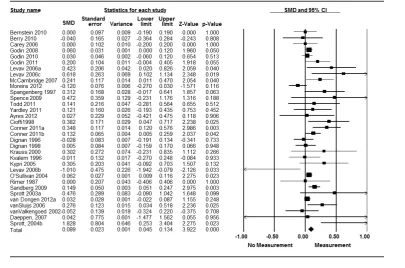
For n=33 studies comparing measurement and no measurement conditions, there was an overall small but significant QBE (Figure 3: SMD= 0.09; 95% CI= 0.04; 0.13; n= 37452). Statistical
heterogeneity was moderate with an I2 of 44% and a Q of 57.39 (95% CI = 15.7%, 63.1%; df=32,
p= 0.004).
Two additional studies did not provide sufficient information for meta-analysis. No significant difference was identified between participants randomized to measurement or no measurement conditions in these studies (Knaus & Austin, 1999; Knaus, et al., 2000).
Long term effects (k= 4)
In addition to the Moreira et al (2012) study which only assessed relevant outcomes at 12 months and was entered in the main meta-analysis, three further studies reported additional outcomes at 12 months. In line with Moreira et al (2012), Carey et al. (2006), Godin et al. (2010) and Kvalem et al. (1996) did not find QBE at 12 months. Only Godin et al. (2008) found a sustained significant QBE at 12 months (SMD=0.08, 95% CI = 0.02, 0.14; n= 6835).
Egger’s regression test shows that there was significant evidence of publication bias (p=0.01;
illustrated in Figure 2). Under the assumption of a normal distribution of effect sizes, there was evidence that studies with smaller or no effects were less likely to be published.
Subgroup analysis by risk of bias of trials
There was no evidence that effects were moderated by risk of bias. There was a significant effect in favor of the measurement condition for studies with a lower risk of bias (SMD=0.10, 95% CI=0.06
to 0.14; I2=39%, 95% CI= 0.0%, 66.2%; k= 16; n= 32908) and a non-significant effect for studies
with a higher risk of bias (SMD=0.07, 95% CI=-0.03 to 0.17; I2=48%, 95% CI= 8.0%, 70.3%; k=
17; n= 4660). Q-test shows that there were no significant differences between subgroups (Q=0.35, p=.55) by risk of bias.
Comparison of most intensive versus least intensive measurement (k=5)
Meta-analysis of five trials comparing conditions with different intensity of measurement did not find a difference between the most intensive measurement conditions (e.g. brief screening plus full assessment; repeated assessments points) and the least intensive measurement conditions on health-related behaviors (SMD= 0.02, 95% CI=-0.28; 0.33; n= 1262). Statistical heterogeneity was high
with an I2 of 84% and a Q of 25.14 (95% CI= 64.1%, 92.9%; df=4, p<0.001).
Possible moderators of the QBE
1. Type of participants
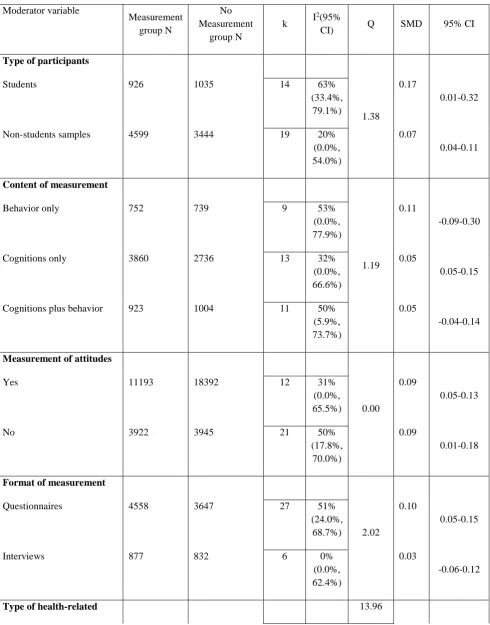
95% CI = 0.04, 0.11). The difference was not significant between subgroups (Q=1.38, p=.24) (Table 3).
[Insert Table 2 here]
2. Interventions: content of measurement
Subgroup analysis showed no significant effect in favor of measurement condition when only behavior was measured (SMD = 0.11, 95% CI = -0.09, 0.30); a small significant effect when only cognitions were measured (SMD = 0.10, 95% CI = 0.05, 0.15); and no significant effect when both behavior and cognitions were measured (SMD = 0.05, 95% CI = -0.04, 0.14) (Table 2). No
significant difference between subgroups was identified (Q=1.19, p=.55).
2.1. Interventions: measurement of attitudes
Subgroup analysis showed no differences (Q=0.00, p=.98) between measurement conditions when attitudes were measured (SMD = 0.09, 95% CI = 0.05, 0.13) and when no attitudes were measured (SMD = 0.09, 95% CI = 0.01, 0.18) with both subgroups showing significant QBEs on health-related outcomes (Table 2).
3. Interventions: format of measurement
A small significant effect in favor of the measurement condition was identified when using questionnaires (SMD = 0.10, 95% CI = 0.05, 0.15) but not when using interviews (SMD = 0.03, 95% CI = -0.06, 0.12); however, no significant difference between subgroups was identified
(Q=2.02, p=.15) (Table 2). An additional study that tested the effect of using a questionnaire and an interview separately and thus could not be meta-analyzed as it was not comparable to other studies, (Kalichman, Kelly, & Stevenson, 1997) found no difference between these two modes of
assessment on sexual behavior (OR = -0.10, 95% CI = -0.79, 0.59).
For dental flossing behavior, a significant medium size effect was found in favor of the
measurement condition (SMD = 0.50, 95% CI = 0.18, 0.81). Small but significant effects were also found for physical activity (SMD = 0.20, 95% CI = 0.08, 0.32) and screening attendance (SMD = 0.06, 95% CI = 0.003, 0.12). No effects were found for blood donation (SMD = 0.05, 95% CI = -0.00, 0.10), alcohol consumption (SMD = 0.04, 95% CI = -0.08, 0.16), dietary (SMD = 0.08, 95% CI = -0.68, 0.84) or sexual behaviors (SMD = 0.05, 95% CI = -0.20, 0.31). However, no significant differences between subgroups were identified (Table 2) (Q=13.96, p= .052);
5. Outcomes: type of measurement
Small significant effects were found for both objective outcome measures (SMD = 0.08, 95% CI = 0.04, 0.13) and self-report measures of behavior (SMD = 0.10, 95% CI = 0.01, 0.19) (Table 2). There were no differences between subgroups (Q=0.14, p=.71).
DISCUSSION
This is the first systematic review with meta-analysis synthesizing evidence for the effects of completing measures by questionnaire and interview on health-related behaviors. Previous reviews with more optimistic conclusions were not systematic and did not focus on health-related behaviour (Dholakia, 2010; Sprott, Spangenberg, Knuff, & Devezer, 2006). A recent review on the Hawthorne effect (McCambridge, Witton, & Elbourne, 2014) showed that there is some evidence for
participants being aware that they are being studied for the behaviors being investigated, but it did not focus on measurement specifically.
by behavior, but QBE effects for dental flossing, physical activity and screening attendance were significantly different from zero. These findings were not altered in studies where students or other samples were studied; cognitions, behavior or both were measured; attitudes were measured or not measured; questionnaires or interviews were used; or outcomes were taken objectively or as self-reports. After the completion of this review, a new trial was published comparing five different measurement conditions (intention only, interrogative intention, intention plus moral norm, intention plus regret and intention plus self-positive image) and one implementation intention intervention with a no intervention control condition (Godin, Germain, Conner, Delage, & Sheeran, 2013b). The comparison between the five measurement conditions and the control condition yielded an aggregated small effect size of 0.16 (95% CI = 0.09, 0.23). This effect is slightly higher that the main effect size found in the present meta-analysis.
differences in behavior (Dwan et al., 2008). In this case, the small effects found in this review might be an artifact of publication bias. With the exception of one study (Moreira & Foxcroft, 2008), which was pre-registered and for which a full protocol has been published (and reported
subsequently a null finding), none of the trials included in this review were pre-registered. Thus, there are no safeguards to ensure that comparisons, outcomes and analyses were specified a-priori and that the studies achieved the target sample-size that based on an a priori power analysis. Thirdly, intervention procedures are often insufficiently described and therefore it is difficult to conclude that the measurement conditions in this review were not confounded with other
procedures potentially affecting outcomes. For example, it is good practice in survey research to send reminders to those who do not respond to an initial questionnaire (McColl, Jacoby, Thomas, Soutter, & Bamford, 2002). In question-behavior effect studies, larger response rates are thought to lead to higher reactivity effects as more participants engage with the questions (Spence, et al., 2009). Three large randomized controlled trials of measurement on blood donation were included in this review (Godin et al., 2010; Godin, et al., 2008; van Dongen, Abraham, Ruiter, & Veldhuizen, 2012). The Van Dongen et al (2012) and Godin et al (2010) trials showed that completing
questionnaires did not change blood donations in two Dutch and one Canadian sample, which is in contrast with the Godin et al (2008) trial that showed a significant effect on blood donations. In
their 2008 study, Godin and colleagues sent reminders and ‘thank you’ notes to participants in the
Findings for alcohol consumption differed slightly from those reported in a recent review of measurement reactivity effects in trials of brief alcohol interventions (McCambridge & Kypri, 2011), which found that measurement does affect Alcohol Use Disorders Identification Test
(AUDIT: (Bush, Kivlahan, McDonell, Fihn, & Bradley, 1998)) measures but not other measures of consumption. Our review does not find an overall effect of measurement on alcohol consumption. Differences between both reviews are in the aggregation of outcome data between the AUDIT and other measures of consumption and in the exclusion of one trial in this review which did not use a randomized controlled design (Richmond, Heather, Wodak, Kehoe, & Webster, 1995).
Implications for research and practice
The current evidence base is characterized by variable methodological quality and publication bias. Despite 41 randomized trials in this review, it is still not clear whether the QBE exists, largely due to it being unclear how many unpublished negative trials exist. In our view, the best way of making progress in this area, we strongly recommend to journals the principle of publishing QBE trials only if study protocols have been pre-registered. There are at least three good reasons for this (Dickersin & Rennie, 2003). First, estimates of effect sizes based on the results of trials registered in advance are more likely to be free from publication bias. As previously noted, there are good reasons to suspect that publication bias is a particular issue for this area of research, and the results of this review provide empirical support for this suspicion. Second, the non-publication of trials which find null results would be apparent. Third, pre-registration of trials would allow scrutiny of how
From a theoretical perspective, there is not sufficient evidence to date to allow synthesizing the effects for different theoretical measures and possible mechanisms at this stage. The majority of the studies assessing cognitions used questionnaires abstracted from the Theory of Planned Behavior
(Ajzen, 1991). Studies using ‘think aloud’ technique (Darker & French, 2009; French, Cooke,
McLean, Williams, & Sutton, 2007) have shown that using questionnaires based on the ‘Theory of
Planned Behavior’ can result in participants forming beliefs about topics which they have
previously devoted little thought. This may thereby increase the salience of beliefs about specific features or aspects of performing that behavior (Morwitz & Fitzsimons, 2004). In a similar way, measurement can also form attitudes towards the behavior itself and/or make specific aspects of performing a behavior more accessible, thereby fostering performance (Morwitz & Fitzsimons, 2004). It is possible that the mere fact of being measured influences the formation of judgments and/or accessibility of these for respondents (Chandon, Morwitz, & Reinartz, 2005). Research comparing QBEs for different theoretical measures and/or different constructs has been published in recent years (Conner, Godin, Norman, & Sheeran, 2011; Godin, et al., 2008) and it is likely that these comparative trials will enhance our understanding of if, how and when measurement changes behavior. The range of cognitive measures investigated to date has predominantly focused around constructs abstracted from the Theory of Planned Behavior as well as on anticipated regret. Other measures such as identity (van Dongen et al., 2012), self-image (Godin, Germain, Conner, Delage, & Sheeran, 2013a) and more emotion-related measures such as worry may deserve additional attention in future research. Effects may also differ due to features of the study population and the period of follow-up (Godin, et al., 2013a).
Current evidence of small effects with moderate heterogeneity suggests that it might be worthwhile to estimate small increases in control conditions when establishing the required sample size for randomized trials. To date there is no compelling evidence for baseline measurement by
that there might not be a systematic bias in the evidence base about behavior change interventions as a result of baseline measurement in trials.
Implications for practice are more difficult to identify at this stage. The evidence for sending questionnaires to increase behavioral uptake is limited. However, first robust evidence for a QBE has to be accumulated. Second, before the QBE should be used as a behavior change strategy, it has to be shown to not only exist, but also to produce greater changes in behavior than simply sending reminders to perform the behavior.
In summary, this systematic review advances the field by 1) providing a comprehensive synthesis of the evidence; 2) including evidence from various health-related behaviors; 3) providing
quantification of effects sizes with moderator analyses; and 4) identifying and critically appraising potential sources of systematic bias. Small QBEs were found with moderate heterogeneity between studies. Future QBE trials should focus on reducing risk of bias and providing detailed description of procedures in each trial arm. Pre-registration of trials is paramount to allow a more precise assessment of measurement reactivity.
References
Ajzen, I. (1991). The theory of planned behavior. Organizational Behavior and Human Decision Processes, 50(2), 179-211. doi: http://dx.doi.org/10.1016/0749-5978(91)90020-T
Ayres, K., Conner, M., Prestwich, A., Hurling, R., Cobain, M., Lawton, R., & O’Connor, D. B.
(2013). Exploring the question-behaviour effect: Randomized controlled trial of
motivational and question-behaviour interventions. British Journal of Health Psychology, 18(1), 31-44. doi: 10.1111/j.2044-8287.2012.02075.x
Bernstein, J., Heeren, T., Edward, E., Dorfman, D., Bliss, C., Winter, M., & Bernstein, E. (2010). A brief motivational interview in a pediatric emergency department, plus 10-day telephone follow-up, increases attempts to quit drinking among youth and young adults who screen positive for problematic drinking. Academic Emergency Medicine, 17 (8), 890-902. Berry, T. R., & Carson, V. (2010). Ease of imagination, message framing, and physical activity
messages. British Journal of Health Psychology, 15(1), 197-211.
Borenstein, M., Hedges, L., Higgins, J., & Rothstein, H. (2005). Comprehensive Meta-analysis (Version 2). Englewood, NJ: Biostat.
Bush, K. R., Kivlahan, D. R., McDonell, M. B., Fihn, S. D., & Bradley, K. A. (1998). The audit alcohol consumption questions (audit-c): An effective brief screening test for problem drinking. Archives of internal medicine, 158(16), 1789-1795. doi:
Carey, K. B., Carey, M. P., Maisto, S. A., & Henson, J. M. (2006). Brief motivational interventions for heavy college drinkers: A randomized controlled trial. Journal of consulting and clinical psychology, 74(5), 943-954.
Chandon, P., Morwitz, V. G., & Reinartz, W. J. (2005). Do Intentions Really Predict Behavior? Self-Generated Validity Effects in Survey Research. Journal of Marketing, 69(2), 1-14. doi: 10.1509/jmkg.69.2.1.60755
Chapman, K. J. (2001). Measuring intent: There's nothing “mere” about mere measurement effects.
Psychology and Marketing, 18(8), 811-841. doi: 10.1002/mar.1031
Cherpitel, C. J., Korcha, R. A., Moskalewicz, J., Swiatkiewicz, G., Ye, Y., & Bond, J. (2010). Screening, Brief Intervention, and Referral to Treatment (SBIRT): 12-month outcomes of a randomized controlled clinical trial in a Polish emergency department. Alcoholism: Clinical and Experimental Research, 34(11), 1922-1928.
Cioffi, D., & Garner, R. (1998). The Effect of Response Options on Decisions and Subsequent Behavior: Sometimes Inaction is Better. Personality and Social Psychology Bulletin, 24(5), 463-472. doi: 10.1177/0146167298245002
Clifford, P. R., Maisto, S. A., & Davis, C. M. (2007). Alcohol treatment research assessment exposure subject reactivity effects: Part I. Alcohol use and related consequences. Journal of Studies on Alcohol and Drugs, 68 (4), 519-528.
Conner, M., Godin, G., Norman, P., & Sheeran, P. (2011). Using the question-behavior effect to promote disease prevention behaviors: two randomized controlled trials. Health psychology, (3), 300-309. Retrieved from doi:10.1037/a0023036
Daeppen, J.-B., Gaume, J., Bady, P., Yersin, B., Calmes, J.-M., Givel, J.-C., & Gmel, G. (2007). Brief alcohol intervention and alcohol assessment do not influence alcohol use in injured patients treated in the emergency department: a randomized controlled clinical trial. Addiction, 102(8), 1224-1233. doi: 10.1111/j.1360-0443.2007.01869.x
Darker, C. D., & French, D. P. (2009). What sense do people make of a theory of planned behaviour questionnaire?: A think-aloud study. Journal of Health Psychology, 14(7), 861-871. doi: 10.1177/1359105309340983
Dholakia, U. M. (2010). A critical review of question–behavior effect research. Review of
Marketing Research, 7, 145-197.
Dickersin, K., & Rennie, D. (2003). REgistering clinical trials. JAMA, 290(4), 516-523. doi: 10.1001/jama.290.4.516
Dignan, M., Michielutte, R., Blinson, K., Wells, H. B., Case, L. D., Sharp, P., . . . McQuellon, R. P. (1996). Effectiveness of health education to increase screening for cervical cancer among eastern-band Cherokee Indian women in North Carolina. [Clinical Trial; Randomized Controlled Trial; Research Support, U.S. Gov't, P.H.S.]. Journal of the National Cancer Institute, 88(22), 1670-1676.
Dignan, M., Michielutte, R., Wells, H. B., Sharp, P., Blinson, K., Case, L. D., . . . McQuellon, R. P. (1998). Health education to increase screening for cervical cancer among Lumbee Indian Women in North Carolina. Health Education Research, 13(4), 545-556. doi:
10.1093/her/13.4.545
Dwan, K., Altman, D. G., Arnaiz, J. A., Bloom, J., Chan, A.-W., Cronin, E., . . . Williamson, P. R. (2008). Systematic Review of the Empirical Evidence of Study Publication Bias and Outcome Reporting Bias. PLoS ONE, 3(8), e3081. doi: 10.1371/journal.pone.0003081 French, D. P., Cooke, R., McLean, N., Williams, M., & Sutton, S. (2007). What Do People Think
about When They Answer Theory of Planned Behaviour Questionnaires?: A `Think Aloud' Study. Journal of Health Psychology, 12(4), 672-687. doi: 10.1177/1359105307078174 French, D. P., & Sutton, S. (2010). Reactivity of measurement in health psychology: How much of
a problem is it? What can be done about it? British Journal of Health Psychology, 15(3), 453-468. doi: 10.1348/135910710x492341
among overweight and obese individuals. The International Journal of Behavioral Nutrition and Physical Activity, 2. doi: 10.1186/1479-5868-8-2
Godin, G., Bélanger-Gravel, A., Vézina-Im, L.-A., Amireault, S., & Bilodeau, A. (2012). Question–
behaviour effect: A randomised controlled trial of asking intention in the interrogative or declarative form. Psychology & Health, 27(9), 1086-1099. doi:
10.1080/08870446.2012.671617
Godin, G., Germain, M., Conner, M., Delage, G., & Sheeran, P. (2013a). Promoting the Return of
Lapsed Blood Donors: A Seven-Arm Randomized Controlled Trial of the Question–
Behavior Effect.
Godin, G., Germain, M., Conner, M., Delage, G., & Sheeran, P. (2013b). Promoting the Return of
Lapsed Blood Donors: A Seven-Arm Randomized Controlled Trial of the Question–
Behavior Effect. Health Psychology, In Press.
Godin, G., Sheeran, P., Conner, M., Delage, G., Germain, M., Belanger-Gravel, A., & Naccache, H. (2010). Which survey questions change behavior? Randomized controlled trial of mere measurement interventions. Health Psychology, 29 (6), 636-644.
Godin, G., Sheeran, P., Conner, M., & Germain, M. (2008). Asking questions changes behavior: Mere measurement effects on frequency of blood donation. Health Psychology, 27(2), 179-184.
Higgins, J. P. T., & Green, S. (2011). Handbook for Systematic Reviews of Interventions Version 5.1. 0 [updated March 2011]. The Cochrane Collaboration.
Higgins, J. P. T., & Thompson, S. G. (2002). Quantifying heterogeneity in a meta-analysis. Statistics in Medicine, 21(11), 1539-1558. doi: 10.1002/sim.1186
Hobbs, N., Rodrigues, A., Sniehotta, F. F., French, D. P., & Glidewell, L. (2011). Does
measurement change health-related behaviour? A systematic review. from PROSPERO http://www.crd.york.ac.uk/PROSPERO/display_record.asp?ID=CRD42011001467
Kalichman, S. C., Kelly, J. A., & Stevenson, L. (1997). Priming effects of HIV risk assessments on related perceptions and behavior: An experimental field study. AIDS and Behavior, 1(1), 3-8.
Knaus, C. S., & Austin, E. W. (1999). The AIDS Memorial Quilt as preventative education: a developmental analysis of the Quilt. AIDS education and prevention : official publication of the International Society for AIDS Education, 11(6), 525-540.
Knaus, C. S., Pinkleton, B. E., & Weintraub Austin, E. (2000). The Ability of the AIDS Quilt to Motivate Information Seeking, Personal Discussion, and Preventative Behavior as a Health Communication Intervention. Health Communication, 12(3), 301-316. doi:
10.1207/s15327027hc1203_05
Krauss, B. J., Goldsamt, L., Bula, E., Godfrey, C., Yee, D. S., & Palij, M. (2000). Pretest assessment as a component of safer sex intervention: a pilot study of brief one-session interventions for women partners of male injection drug users in New York City. [Clinical Trial; Randomized Controlled Trial, Research Support, Non-U.S. Gov't]. Journal of Urban Health, 77(3), 383-395.
Kvalem, I. L., Sundet, J. M., Rivø, K. I., Eilertsen, D. E., & Bakketeig, L. S. (1996). The Effect of Sex Education on Adolescents' Use of Condoms: Applying the Solomon Four-Group Design. Health Education & Behavior, 23(1), 34-47. doi: 10.1177/109019819602300103 Kypri, K., Langley, J. D., Saunders, J. B., & Cashell-Smith, M. L. (2006). Assessment may conceal
therapeutic benefit: Findings from a randomized controlled trial for hazardous drinking. Addiction, 102 (1), 62-70.
Kypri, K., & McAnally, H. M. (2005). Randomized controlled trial of a web-based primary care
intervention for multiple health risk behaviors. Preventive medicine, 41(3–4), 761-766. doi:
http://dx.doi.org/10.1016/j.ypmed.2005.07.010
Levav, J., & Fitzsimons, G. J. (2006). When Questions Change Behavior: The Role of Ease of Representation. Psychological Science, 17(3), 207-213. doi:
Marteau, T. M., French, D. P., Griffin, S. J., Prevost, A. T., Sutton, S., Watkinson, C., . . . Hollands, G. J. (2010). Effects of communicating DNA-based disease risk estimates on risk-reducing behaviours. Cochrane Database Syst Rev, 10.
McCambridge, J., Butor-Bhavsar, K., Witton, J., & Elbourne, D. (2011). Can research assessments themselves cause bias in behaviour change trials? A systematic review of evidence from solomon 4-group studies. PLoS One, 6(10), e25223. doi: 10.1371/journal.pone.0025223 McCambridge, J., & Day, M. (2008). Randomized controlled trial of the effects of completing the
Alcohol Use Disorders Identification Test questionnaire on self-reported hazardous drinking. Addiction, 103(2), 241-248. doi: 10.1111/j.1360-0443.2007.02080.x
McCambridge, J., & Kypri, K. (2011). Can simply answering research questions change behaviour? Systematic review and meta analyses of brief alcohol intervention trials. PLoS One, 6(10), e23748. doi: 10.1371/journal.pone.0023748
McCambridge, J., Witton, J., & Elbourne, D. R. (2014). Systematic review of the Hawthorne effect: New concepts are needed to study research participation effects. Journal of clinical
epidemiology, 67(3), 267-277.
McColl, E., Jacoby, A., Thomas, L., Soutter, J., & Bamford, C. (2002). Design and use of questionnaires: a review of best practice applicable to surveys of health service staff and patients. Health Technology Assessment, 5(31), 256. doi: 10.3310/hta5310
Moher, D., Liberati, A., Tetzlaff, J., & Altman, D., G. (2009). Preferred reporting items for systematic reviews and meta-analyses: the PRISMA statement. BMJ, 339. doi: 10.1136/bmj.b2535
Moreira, T., & Foxcroft, D. R. (2008). The effectiveness of brief personalized normative feedback in reducing alcohol-related problems amongst University students: Protocol for a
randomized controlled trial. BMC public health, 8(113).
Moreira, T., Oskrochi, R., & Foxcroft, D. R. (2012). Personalised Normative Feedback for Preventing Alcohol Misuse in University Students: Solomon Three-Group Randomised Controlled Trial. PLoS ONE, 7(9).
Morwitz, V. G., & Fitzsimons, G. J. (2004). The Mere-Measurement Effect: Why Does Measuring Intentions Change Actual Behavior? Journal of Consumer Psychology, 14(1-2), 64-74. Morwitz, V. G., Johnson, E., & Schmittlein, D. (1993). Does measuring intent change behavior?
Journal of consumer research, 46-61.
O’ Sullivan, I., Orbell, S., Rakow, T., & Parker, R. (2004). Prospective Research in Health Service Settings: Health Psychology, Science and the ‘Hawthorne’ Effect. Journal of Health Psychology, 9(3), 355-359.
Review Manager. (2011). (RevMan) (Version Version 5.1) [Computer program]. Copenhagen: The Nordic Cochrane Centre, The Cochrane Collaboration.
Richmond, R., Heather, N., Wodak, A., Kehoe, L., & Webster, I. A. N. (1995). Controlled
evaluation of a general practice-based brief intervention for excessive drinking. Addiction, 90(1), 119-132. doi: 10.1046/j.1360-0443.1995.90111915.x
Rimer, B., Levy, M. H., Keintz, M. K., Fox, L., Engstrom, P. F., & MacElwee, N. (1987).
Enhancing cancer pain control regimens through patient education. Patient Education and Counseling, 10(3), 267-277. doi: http://dx.doi.org/10.1016/0738-3991(87)90128-5
Sandberg, T., & Conner, M. (2009). A mere measurement effect for anticipated regret: impacts on cervical screening attendance. [Comparative Study]. British Journal of Social Psychology, 48(Pt 2), 221-236.
Sandberg, T., & Conner, M. (2011). Using self-generated validity to promote exercise behaviour. British Journal of Social Psychology, 50(4), 769-783. doi:
10.1111/j.2044-8309.2010.02004.x
Schulz, K. F., Altman, D. G., & Moher, D. (2010). CONSORT 2010 Statement: Updated
Sherman, S. J. (1980). On the self-erasing nature of errors of prediction. Journal of Personality and Social Psychology, 39(2), 211.
Spangenberg, E. (1997). Increasing Health Club Attendance Through Self-Prophecy. Marketing Letters, 8(1), 23-31. doi: 10.1023/A:1007977025902
Spangenberg, E., Sprott, D. E., Grohmann, B., & Smith, R. J. (2003). Mass-Communicated
Prediction Requests: Practical Application and a Cognitive Dissonance Explanation for Self-Prophecy. Journal of Marketing, 67(3), 47-62. doi: 10.2307/30040536
Spence, J. C., Burgess, J., Rodgers, W., & Murray, T. (2009). Effect of pretesting on intentions and behaviour: a pedometer and walking intervention. [Randomized Controlled Trial].
Psychology & health, 24(7), 777-789.
Sprott, D. E., Smith, R. J., Spangenberg, E. R., & Freson, T. S. (2004). Specificity of Prediction Requests: Evidence for the Differential Effects of Self-Prophecy on Commitment to a Health Assessment. Journal of Applied Social Psychology, 34(6), 1176-1190. doi: 10.1111/j.1559-1816.2004.tb02002.x
Sprott, D. E., Spangenberg, E. R., & Fisher, R. (2003). The importance of normative beliefs to the self-prophecy effect. Journal of Applied Psychology, 88(3), 423.
Sprott, D. E., Spangenberg, E. R., Knuff, D. C., & Devezer, B. (2006). Self-prediction and patient health: Influencing health-related behaviors through self-prophecy. Medical science monitor, 12(5).
Todd, J., & Mullan, B. (2011). Using the theory of planned behaviour and prototype willingness model to target binge drinking in female undergraduate university students. Addictive behaviors, 36(10), 980-986. doi: http://dx.doi.org/10.1016/j.addbeh.2011.05.010 van Dongen, A., Abraham, C., Ruiter, R. C., & Veldhuizen, I. T. (2012). Does Questionnaire
Distribution Promote Blood Donation? An Investigation of Question–Behavior Effects.
Annals of Behavioral Medicine, 1-10. doi: 10.1007/s12160-012-9449-3
van Sluijs, E. M. F., van Poppel, M. N. M., Twisk, J. W. R., & van Mechelen, W. (2006). Physical activity measurements affected participants' behavior in a randomized controlled trial. [Multicenter Study; Randomized Controlled Trial]. Journal of clinical epidemiology, 59(4), 404-411.
van Valkengoed, I. G. M., Morré, S. A., Meijer, C. J. L. M., van den Brule, A. J. C., & Boeke, A. J. P. (2002). Do questions on sexual behaviour and the method of sample collection affect participation in a screening programme for asymptomatic Chlamydia trachomatis infections in primary care? International journal of STD & AIDS, 13(1), 36-38.
Walters, S. T., Vader, A. M., Harris, T. R., & Jouriles, E. N. (2009). Reactivity to alcohol assessment measures: an experimental test. [Randomized Controlled Trial; Research Support, N.I.H., Extramural]. Addiction, 104(8), 1305-1310.
Figure 1: Trial selection flow diagram (adapted from PRISMA (Moher, et al., 2009))
Records screened for eligibility
n=1348
Records excluded
n=1285
Full papers retrieved for eligibility n=63
Included studies
n= 41 (38 papers)
Studies included in meta-analyses
n=38
Studies included narratively
n=3
Records excluded n=22 Reasons:
No health-related behaviour outcome (n=9) Not an RCT (n=7)
Not a measurement intervention (n=6) Additional records from other sources (n=26)
Contact with authors (n=19)
References from previous systematic reviews (n=7) Records identified through database searching n=1656
Medline (1948 December 2012) n=463 Embase (1980 December 2012) n=468 PsycInfo (1806 December 2012) n=253 CENTRAL (up to December 2012) n=293
ERIC (1965 March 2011) n=179
Records after de-duplication
n=1322
Duplicate records excluded
n=334
Records excluded from meta-analysis n=3
Reasons:
missing statistics (n=2)
Figure 2: Funnel plot of trials reporting health-related behaviour outcomes
-2.0 -1.5 -1.0 -0.5 0.0 0.5 1.0 1.5 2.0
0.0
0.2
0.4
0.6
0.8
1.0
St
a
n
d
a
rd
Er
ro
r
Std diff in means
TABLE 1: Characteristics of included studies
Study ID Format of
measurement Type of measure Content of measurement Health-related outcome
Follow-up Country Study
Setting Population age and gender composition Sample size at follow up
Risk of bias score
0 (low risk) – 16 (high
risk) Ayres, et al.
(2013)
Questionnaire Dichotomous Intention, attitudes and anticipated regret Health plan uptake (objective) Immediately after measurement
UK Community Mean age: 53.4 (71.2 %
female) Measurement condition: 67 No measurement condition: 79 0
Bernstein et al.
(2010)
Questionnaire Continuous Drinking behavior, other health behaviors, patient health questions and PTSD symptoms Alcohol use (self-report)
12 months USA Pediatric emergency department
Age ≤ 17y = 114
≥18y = 739
Measurement condition: 209 No measurement condition: 198 4 Berry and Carson (2010)
Questionnaire Continuous Behavior and attitude
Physical activity
(self-report)
7-10 days Canada University and community Students sample: mean age 19.7 (73.7% female) Community sample: mean age 72.0 (75.4% female) Measurement condition: 117 No measurement condition: 54 7 Carey, Carey, Maisto, and
Interview Continuous Behavior Alcohol use (self-report)
1, 6 and 12 months
Henson (2006) No measurement
condition: 197 Cherpitel et al.
(2010)
Questionnaire Continuous Behavior Alcohol use (self-report)
12 months Poland Emergency Department 39% <30 years (16% female) Screened only: 87 Assessed: 97 4 Cioffi and Garner (1998)
Questionnaire Dichotomous Cognitions only
Blood donation behavior (objective)
1-week USA University Not provided Measurement condition: 277 No measurement condition: 370 3 Clifford, Maisto,
and Davis (2007)
Interview Continuous Behavior Alcohol use (self-report)
6 and 12 months
USA Treatment Centre for alcohol and other drugs abuse Mean age: 40.01 (37% female) Intensive assessment: 59 Least intensive assessment: 62 3
Conner, et al.
(2011)a
Questionnaire Dichotomous Theory Planned Behavior cognitions Health check attendance (objective)
Conner, et al.
(2011)b
Questionnaire Dichotomous Theory Planned Behavior cognitions Vaccination uptake (objective)
2 months Canada Public hospital Mean age: 38.1 (83.4% female) Measurement condition: 600 No measurement condition: 600 2
Daeppen et al.
(2007)3
Interview Dichotomous Behavior % of hazardous
drinkers (self-report)
12 months Switzerland Emergency department Mean age: 36.7 (21.8% female) Measurement condition: 277 No measurement condition: 257 3
Dignan et al.
(1996)
Interview Dichotomous Knowledge, intentions and behavior Pap smear screening attendance (self-report)
12 months USA Tribal community: Cherokee Indian 63.8% <45 years (100% female) Measurement condition: 448 No measurement condition: 367 7
Dignan et al.
(1998)
Interview Dichotomous Knowledge, intention and behavior Pap smear screening attendance (self-report)
12 months USA Tribal community: Lumbee Native American Mean age: 42.4 (100% female) Measurement condition: 413 No measurement condition: 8
426 Godin, et al.
(2008)
Questionnaire Continuous Theory Planned Behavior cognitions Blood donation behavior (objective)
6 and 12 months
Canada Blood Donors agency Mean age control: 43.8 (38.7% female) Mean age measurement: 44.7 (38.3% female) Measurement condition: 2900 No measurement condition: 1772 1
Godin, et al.
(2010)4
Questionnaire Continuous Anticipated regret and intention Blood donation behavior (objective)
6 and 12 months
Canada Blood Donors agency
Mean age: 30.4 (53 % female) Measurement condition: 879 No measurement condition: 888 2 Godin, Bélanger-Gravel, Amireault, Vohl, and Pérusse (2011)
Interview Continuous Theory Planned Behavior cognitions, anticipated regret, moral and descriptive norms, self-efficacy, facilitating factors and positive Physical activity (self-report)
3 months Canada Quebec city community
Mean age: 40.2 (47 % female) Measurement condition: 194 No measurement condition: 180 2
feelings Krauss et al.
(2000)
Questionnaire Dichotomous Knowledge, perceived partner risk, behavior Safe sex Index (self-report)
7 weeks USA Community: public spaces
Mean age: 36.7 (100 %
female) Measurement condition: 45 No measurement condition: 28 2
Kvalem, et al.
(1996)
Questionnaire Dichotomous Behavior Condom use (self-report)
6 and 12 months
Norway High school 16-20 years (50 % female) Measurement condition: 148 No measurement condition: 133 9 Kypri, Langley, Saunders, and Cashell-Smith (2006)
Questionnaire Continuous Behavior Alcohol use (self-report)
6 and 12 months New Zealand Primary Health-care clinic Mean age control: 20.1; Mean age measurement:
20.3 (52.2 % female) Measurement condition: 126 No measurement condition: 126 0 Kypri and
McAnally (2005)5
Questionnaire Dichotomous Behavior Fruit and veg consumption, alcohol consumption, and physical activity frequency
6 weeks New Zealand University primary Health-care clinic Mean age: 20.2 (49 % female) Measurement condition: 64 No measurement condition: 60 2
(self-report) Levav and
Fitzsimons (2006)a
Questionnaire Continuous Intention to floss
Flossing (self-report)
2-weeks USA University Not provided Measurement condition: 51 No measurement condition: 46 6 Levav and Fitzsimons (2006)b
Questionnaire Dichotomous Behavior Choice of low or high
fat snack (self-report)
Immediately after pre-test
USA University Not provided Measurement condition: 25 No measurement condition: 23 4 Levav and Fitzsimons (2006)c
Questionnaire Continuous Intention to floss
Flossing (self-report)
1-week USA University Not provided Measurement condition: 30 No measurement condition: 30 8 (McCambridge
& Day, 2008)
Questionnaire Continuous Questionnaire (General
Health questionnaire-
GHQ, history of trauma scale – HTS,
and alcohol use - AUDIT)
Alcohol use – AUDIT (self-report)
2-3 months England University Mean age control: 20.7
(66 % female); Mean age measurement:
20.6 (67 % female) Measurement condition: 156 No measurement condition: 144 0 Moreira, Oskrochi, and Foxcroft (2012)
Questionnaire Continuous Behavior,
behavior-related problems,
Alcohol use (self-report)
6 and 12 months
UK University 58.5% 17-19 years (61 %
female)
Measurement condition:
369
perceived norms, positive expectancies) No measurement condition: 332 O’ Sullivan, Orbell, Rakow, and Parker (2004)
Questionnaire Dichotomous Perceptions of susceptibility and severity of colorectal cancer and attitudes and personal beliefs Colorectal cancer screening uptake (objective)
6-weeks UK Community Age between 50 and 69
years Measurement condition: 1944 No measurement condition: 10,413 0
Rimer et al. (1987)
Interview Dichotomous Behavior and disease-related information, knowledge and concerns about pain regimens, perceived personal control and anxiety Medication regimens adherence (self-report)
4 weeks USA Hospitals Age: 53.9% more than 60y (44.3 % female) 230 participants 7 Sandberg and Conner (2011)
Questionnaire Continuous Theory Planned Behavior cognitions Physical activity (objective)
2-weeks UK University Mean age: 19.7 (62.0 % female) TPB only: 192 TPB + regret: 384 2 Sandberg and Conner (2009)
Questionnaire Dichotomous Theory Planned Behavior cognitions, Cervical screening attendance
4 months England Central Agency responsible for cervical
Mean age: 39.1 (100 %
female)
Measurement condition:
1426
anticipated regret
(objective) screening No
measurement condition:
1277 Spangenberg
(1997)
Questionnaire Continuous Behavior Health club attendance (objective)
10 days and 6 months attendance
USA Health club Not provided Measurement condition: 73
No measurement condition: 69
4
Spence, et al.
(2009)
Questionnaire Continuous Behavior, illness perceptions, self-efficacy, intention Walking behavior (self-report)
1 week Canada University 95% <30 years (100 %
female) Measurement condition: 15 No measurement condition: 16 5 Sprott, Smith, Spangenberg, and Freson (2004)b
Questionnaire Dichotomous Behavior Health and fitness assessment attendance (self-report) Immediately after pre-test
USA University Not provided Measurement condition: 61 No measurement condition: 60 4 Sprott, Spangenberg, and Fisher (2003)a
Questionnaire Dichotomous Behavior Choice of low-fat or higher fat snack (self-report) Immediately after pre-test
USA University Age not provided (100 % female) Measurement condition: 36 No measurement condition: 44 4
Todd and Mullan
(2011)
Questionnaire Continuous Behavior, prototypes and Theory Planned
Alcohol use (self-report)
Behavior cognitions,
condition: 42
van Dongen, et
al. (2012)
Questionnaire Dichotomous Intention, attitudes (affective and cognitive), subjective, descriptive and moral norms, self-efficacy and role identity Blood donation behavior (objective)
6 months The Netherlands Blood Donors agency: new donors Mean age: 33.4 (67 % female) Measurement condition: 3518 No measurement condition: 3490 2
van Sluijs, van
Poppel, Twisk, and van Mechelen (2006) Questionnaire and accelerometers (without display)
Dichotomous Behavior and barriers to PA, knowledge, health process of change, social support and self-efficacy Physical activity (self-report)
6 months The Netherlands GP practices Mean age: 55.7 (54% female) Measurement condition: 155 No measurement condition: 172 3 van Valkengoed, Morré, Meijer,
van den Brule,
and Boeke (2002)
Questionnaire Dichotomous Behavior Chlamydia screening attendance (objective)
Not provided Netherlands Primary care practice 15-40 years (63.2% female) Measurement condition: 143 No measurement condition: 149 3 Walters, Vader, Harris, and Jouriles (2009)
Questionnaire Continuous Behavior, readiness to change, normative beliefs Peak blood alcohol concentration (self-report)
66 Yardley, Miller,
Schlotz, and
Little (2011)
Questionnaire Continuous Theory Planned Behavior cognitions, perceived risk of infection Hand washing (self-report)
4 weeks England GP practices
Mean age: 49.8 (64 % female) Measurement condition: 77 No measurement condition: 80 4
Studies excluded from meta-analysis
Kalichman, et al.
(1997)
Interview and questionnaire
Continuous Behavior Sexual risk behaviors (self-report)
2 weeks USA Community: African American
Mean age: 34.0 (100 %
female) 158 participants 10 Knaus and Austin (1999)
Questionnaire -- Perceptions, self-efficacy, behavior Sexual risky behavior Index (self-report)
8 weeks USA University Mean age: 19.41 (54 %
female)
237 participants
7
Knaus, et al.
(2000)
Questionnaire -- Behavior Safe sex behaviors Index (self-report)
TABLE 2: Standardized mean differences (Cohen’s d) for question-behavior effect by moderator variables6
Moderator variable
Measurement group N
No Measurement
group N
k I
2(95%
CI) Q SMD 95% CI Type of participants
1.38
Students 926 1035 14 63%
(33.4%, 79.1%)
0.17
0.01-0.32
Non-students samples 4599 3444 19 20%
(0.0%, 54.0%)
0.07
0.04-0.11
Content of measurement
1.19
Behavior only 752 739 9 53%
(0.0%, 77.9%)
0.11
-0.09-0.30
Cognitions only 3860 2736 13 32%
(0.0%, 66.6%)
0.05
0.05-0.15
Cognitions plus behavior 923 1004 11 50% (5.9%, 73.7%)
0.05
-0.04-0.14
Measurement of attitudes
0.00
Yes 11193 18392 12 31%
(0.0%, 65.5%)
0.09
0.05-0.13
No 3922 3945 21 50%
(17.8%, 70.0%)
0.09
0.01-0.18
Format of measurement
2.02
Questionnaires 4558 3647 27 51%
(24.0%, 68.7%)
0.10
0.05-0.15
Interviews 877 832 6 0%
(0.0%, 62.4%)
0.03
-0.06-0.12
Type of health-related 13.96
6 For each subgroup analysis, total k = 33 with the exception of type of health-related behavior subgroup analysis. In
behavior
Flossing 81 76 2 0%
(NA)
0.50
0.18-0.81
Blood donation 7574 6520 4 33%
(0.0%, 76.1%)
0.05
0.00-0.10
PA 573 598 6 0%
(0.0%, 65.9%)
0.20
0.08-0.32
Screening 4374 12632 5 24%
(0.0%, 69.5%)
0.06
0.003-0.12
Drinking 1262 1281 7 35%
(0.0%, 72.5%)
0.04
-0.08-0.16
Diet 124 130 3 76%
(21.2%, 92.7%)
0.08
-0.68-0.84
Sexual Behavior 193 161 2 7%
(NA)
0.05
-0.20-0.31 Type of outcome
0.39
Objective 3852 2729 11 45%
(0.0%, 72.6%)
0.08
0.04-0.13
Self-report 1683 1750 22 46%
(11.8%, 67.6%)
0.10
0.01-0.19
Cochrane’s Q = heterogeneity for the subgroup differences analysis Standardised Mean Difference (SMD) = Cohen’s d = pooled effect size **p< .01; NA= Not available
Appendix 1: Database searches
MEDLINE from inception to December 2012 1. randomized controlled trial.pt.
2. controlled clinical trial.pt. 3. randomized.ab.
4. placebo.ab. 5. drug therapy.fs. 6. randomly.ab. 7. trial.ab. 8. groups.ab.
9. 1 or 2 or 3 or 4 or 5 or 6 or 7 or 8 10. exp animals/ not humans.sh. 11. 9 not 10
12. interview/
15. health care surveys/
16. exp "Weights and Measures"/
17. (complet* adj3 (measure* or scale* or interview* or survey* or questionnaire* or test*)).tw. 18. "Outcome Assessment (Health Care)"/
19. (panel* adj3 survey*).tw. 20. exp Mass Screening/
21. ("follow up" adj1 (outcome* or measure* or score* or interview* or assessment*)).tw. 22. (behavio?r* adj4 measure*).ti.
23. 12 or 13 or 14 or 15 or 16 or 17 or 18 or 19 or 20 or 21 or 22 24. (behavio?r adj2 measure*).ti.
25. Behavioral Research/ 26. Health Behavior/ 27. exp patient compliance/ 28. exp self-examination/ 29. treatment refusal/ 30. feeding behavior/ 31. fasting/
32. food habits/ 33. food preferences/ 34. illness behavior/
35. exp reproductive behavior/ 36. risk reduction behavior/ 37. risk-taking/
38. exp sexual behavior/ 39. exp "tobacco use cessation"/ 40. motor activity/
41. Alcohol Drinking/
42. ("physical exercise*" or "physical activit*").tw. 43. Alcoholism/
44. (drink* adj1 (alcohol* or pattern* or problem* or addict*)).tw.
45. 24 or 25 or 26 or 27 or 28 or 29 or 30 or 31 or 32 or 33 or 34 or 35 or 36 or 37 or 38 or 39 or 40 or 41 or 42 or 43 or 44 46. (panel* adj2 conditioning).tw.
47. (pretest* adj2 (response* or effect* or bias* or reactivity)).tw. 48. (test* adj2 (response* or effect* or bias* or reactivity)).tw.
49. (measurement* adj2 (response* or effect* or bias* or reactivity)).tw. 50. (assessment* adj2 (response* or effect* or bias* or reactivity)).tw. 51. (question* adj2 (response* or effect* or bias* or reactivity)).tw. 52. (interview* adj2 (response* or effect* or bias* or reactivity)).tw. 53. (reactiv* adj2 (response* or effect* or bias* or measure*)).tw. 54. "generated validity".tw.
55. mere measur$.tw. 56. "self prophecy".tw.
57. (solomon adj3 (group$ or design$ or trial$ or study or studies)).tw. 58. (solomon adj2 island$).tw.
59. 57 not 58