This is a repository copy of
Load Adaptive Caching Points for a Content Distribution
Network
.
White Rose Research Online URL for this paper:
http://eprints.whiterose.ac.uk/96333/
Version: Accepted Version
Proceedings Paper:
Igder, S, Idjmayyel, H, Qazi, B et al. (2 more authors) (2015) Load Adaptive Caching
Points for a Content Distribution Network. In: 2015 9th International Conference on Next
Generation Mobile Applications, Services and Technologies. 9th International Conference
on Next Generation Mobile Applications, Services and Technologies, 09-11 Sep 2015,
Cambridge, UK. IEEE . ISBN 978-1-4799-8660-6
https://doi.org/10.1109/NGMAST.2015.24
[email protected] https://eprints.whiterose.ac.uk/ Reuse
Unless indicated otherwise, fulltext items are protected by copyright with all rights reserved. The copyright exception in section 29 of the Copyright, Designs and Patents Act 1988 allows the making of a single copy solely for the purpose of non-commercial research or private study within the limits of fair dealing. The publisher or other rights-holder may allow further reproduction and re-use of this version - refer to the White Rose Research Online record for this item. Where records identify the publisher as the copyright holder, users can verify any specific terms of use on the publisher’s website.
Takedown
If you consider content in White Rose Research Online to be in breach of UK law, please notify us by
Load Adaptive Caching Points for a
Content Distribution Network
Samaneh Igder1, Hamdi Idjmayyel2, Bilal R. Qazi3, Samya Bhattacharya1, Jaafar M. H. Elmirghani1 1
School of Electronic and Electrical Engineering, University of Leeds, UK 2
was with School of Electronic and Electrical Engineering, University of Leeds, UK 3
was with School of Electronic and Electrical Engineering, University of Leeds, UK 1
{elsi, s.bhattacharya, j.m.h.elmirghani} @leeds.ac.uk,[email protected],[email protected]
Abstract-The unprecedented growth in content demand on smartphones has significantly increased the energy consumption of current cellular and backbone networks. Apart from achieving stringent carbon footprint targets, provisioning high data rates to city vehicular users while maintaining quality of service (QoS) remains a serious challenge. In previous work, to support content delivery at high data rates, the number and locations of caching points (CPs) within a content distribution network (CDN) were optimized while reducing the operational energy consumption compared to typical cellular networks. Further reduction in energy consumption may be possible through sleep cycles, which reduces transmission energy consumption. However, sleep cycles degrade the quality of service. Therefore, in this paper, we propose a novel load adaptation technique for a CP which not only enhances content download rate but also reduces transmission energy consumption through random sleep cycles. Unlike a non-load adaptive (deterministic) CP, the performance results reveal that the load adaptive CP achieves considerably lower average piece delay (approximately 60% on average during the day), leveraging the introduction of random sleep cycles to save transmission energy. The proposed CP saves up to 84% transmission energy during off-peak hours and 33% during the whole day while fulfilling content demand in a city vehicular environment.
Keywords — Load adaptive data rate; content caching; content distribution network; random sleep cycles; vehicular networks.
I. INTRODUCTION
With the increased interest in media-rich user
experience and content offloading in the state-of-the-art fourth generation (4G) networks, content distribution networks (CDNs) are gaining considerable attention, where content is placed within the end users’ catchment area to help improve quality of service (QoS) parameters such as end-to-end delay. Moreover, content caching reduces network congestion by offloading significant amount of traffic of a BS to a number of cache points (CPs) that are usually capable of offering high download rates, hence reducing the download time [1]. CDNs support a wide variety of applications such as Internet Protocol TV (IPTV), Catch-up TV (CuTV) and Video-on-Demand (VoD) [2, 3], where such applications require high bandwidth for downloading/streaming and large storage for storing content. Due to the growing demand of such media-rich applications along with the availability of infrastructure-to-vehicle (I2V) communication that offers high data rates, content caching in vehicular networks is also gaining attention. Moreover, the authors in [4] argue that 75% of the global mobile data traffic is going to be a form of video by 2019, with a yearly increase of 33%.
These growing figures, especially in a dynamic vehicular
environment, intensify the problem of providing
reasonable QoS in an energy efficient way. Currently, the information and communications technology (ICT) sector contributes to 2%-2.5% of the globally emitted carbon, where this figure is expected to increase considerably in the near future [5]. With ‘connectivity on the move’ being an integral part of our lives and the exponential growth in media rich content demand, substantial deployment in
incumbent cellular third/fourth generation (3G/4G)
wireless infrastructure has increased the overall network energy consumption many-folds. Therefore to cope with the ever-growing demand while keeping the energy consumption to a minimum, there is a need for energy efficient dedicated vehicular CDNs.
To decrease the overall network energy consumption, a switching off strategy was proposed in [6], which reduced the number of base stations. A similar strategy was employed on the CPs in a city vehicular CDN, where the number and locations of the CPs were optimized with vehicle mobility and hourly traffic [7], [8]. However, there would be transient variation in traffic within any period of time. Thus, there could be numerous occasions, where a CP has no request to serve. Thus, further reduction in network energy consumption is possible by efficiently scheduling CP transmissions, hence the focus
of this paper. Reduction in transmission energy
consumption at a CP can be obtained by switching OFF its transmitting circuitry for a random time duration when there is no request to serve. This process is called random sleep cycles [9]. Such reduction, though lesser in magnitude than that of the network energy savings, enhances the overall energy savings. However this is generally achieved at the expense of degraded QoS [9]. Therefore, it is worthwhile to study the trade-off between QoS and energy savings through transient analysis of the city vehicular CPs instead of day wise or hourly steady state analysis. The QoS can substantially be improved through the introduction of load adaptation, which enables the CP to operate at variable data rates depending upon the load. This leverages maximum energy savings with acceptable QoS. The introduction of our load adaptive
technique and random sleep cycles redefines the
performance of CPs in a city vehicular CDN. Therefore, our contributions in this paper are the following:
i. A detailed transient load analysis has been carried out at both primary and secondary CPs in terms of
piece request arrival rate and number of
ii. Based on (i), the load adaptive service discipline for the proposed CP is implemented through det-Neg distribution [37].
iii. A be-spoke simulator has been developed to obtain performance results, in terms of energy savings, average queue size, average piece delay, and average content delay utilizing typical vehicular traffic profiles gathered at the city of Saskatoon, Canada [10].
Following the introduction, this paper is organized as follows: Section II gives a brief discussion on related work. An overview of the studied scenario is presented in Section III. In Section IV, we develop a simulator for the CPs with multiple random sleep cycles and load adaptation. Section V evaluates the performance of the CPs with different sleep durations. Finally, the paper concludes in Section VI.
II. RELATEDWORK
Content caching and distribution are attracting
considerable attention in vehicular networks [11]-[15]. The authors in [11] introduce a caching scheme that uses relay to offer VoD playback service with a lower delay. In [12], the authors proposed a content distribution scheme for VANETs with the aim of achieving low latency content distribution in a dense vehicular highway network. RSUs were used to distribute the content to vehicles in a unidirectional highway network, with the help of V2V communication to achieve better connectivity and lower latency. The authors in [13] proposed a push-based popular content distribution (PCD) scheme in which RSUs proactively broadcast popular content to the vehicles in an area of interest. The vehicles that were within the range of each other form a VANET to distribute the received content among them. A symbol-level network coding (SLNC) technique was used to address the network fragmentation problem and to reduce the overheads while maintaining the desired performance. In [14], the authors proposed a Cooperative Content Distribution System for Vehicles (CCDSV) which utilized a set of access points (APs) that cooperated in disseminating content to vehicles. The proposed scheme addressed a number of issues such as the quality of mobility prediction and the lack of APs resources. A novel system, namely Vehicular Content Distribution (VCD) is proposed in [15], which enables high bandwidth content distribution in vehicular environments. In VCD, a link between a vehicle and an AP is opportunistically established. In order to efficiently utilize such links, the content is proactively pushed to the APs that vehicles are likely to visit in the near future (which are predicted via a dedicated algorithm). Hence the entire wireless capacity of the AP is utilized efficiently rather than experiencing the bottlenecks of the traditional Internet connectivity.
There have been a number of research efforts in the recent past to make wireless networks energy efficient. While one of the views is to optimize RF output power [16]- [17] of wireless nodes, others [18] found it little useful as the power consumption of the circuitry can be
much higher than the transmitter output power.
Collectively, maximum energy savings in a wireless network can be obtained with reduced transmission power
and optimized operational power. Considerable effort has been devoted to optimizing the location of fixed nodes like base stations (BSs) or roadside units (RSUs) to reduce network energy consumption [19], [20].While the bulk of the savings was achieved through these techniques, further savings may be possible by reducing the transmission energy consumption at a node by introducing sleep strategies during the inactivity periods [21], [22]. Introducing sleep is an attractive solution for wireless networks as it does not require a complete overhaul of network devices, protocols or architecture as such techniques have already been utilized for the line-cards in the routers [23], [24] where up to 79% reduction in energy consumption was achieved. Such major reduction may not be feasible in wireless and mobile network (e.g. cellular or vehicular) as they are not intrinsically over-provisioned and the link quality dependent upon the varying wireless channel, which makes it susceptible to degraded QoS. Recent research on energy savings encompasses various methods, where the principal objective is to maintain quality of service (QoS) for communication networks [8], [25]-[27]. Nevertheless, a few research groups have proposed a number of sleep strategies to make cellular network energy efficient [28]-[30]. In [29], the authors
proposed dynamic switching for a BS in low traffic
conditions. However, fast switching may not be feasible to
accommodate transient traffic behavior because of the
number of operations a large BS has to perform[30]. In a macro-micro cellular architecture [31], where small RSUs are used for offloading purposes, introducing sleep cycles (random [9]) can be extremely effective due to the shorter resource activation time of an RSU. Therefore, such mechanisms are worth exploring in the context of a vehicular CDN.
To improve the performance of vehicular networks, a number of rate adaptation techniques have been utilized in the literature [32]-[35]. An exhaustive experimental
evaluation of rate adaptation algorithms in real
environments was presented in [32], followed by the development of a low-overhead rate adaptation algorithm
which maximized the network throughput while
minimizing the bit error rate. The authors in [33] analyzed the performance of rate adaptation techniques based on the concept of ‘coherence time’ using a channel emulator. Moreover, a rate selection policy was presented based on the speed and location of a vehicle [34]. Rate adaptation can also be utilized for energy efficiency as shown in [35]. However, introducing load dependency in conjunction with sleep cycles redefines the performance from both QoS and energy perspectives in a city vehicular environment.
III. THESTUDIEDSCENARIO
channels, the traffic arrived at the CPs reduce only by a fraction due to loss, hence not the focus of this paper. A CP provides coverage of 200 meters (diameter) and the maximum speed of a vehicle in a typical city is considered to be 13 m/s. Therefore, a vehicle stays in the range of a CP for a minimum of 16 seconds. The impact of handoffs is not considered as the content file is divided into smaller pieces in such a way that typical vehicular mobility and download rates result in vehicles being within the range of a CP until a piece of size 6 MB is completely downloaded (even when vehicles travel at the maximum legal speed in the city). Hence the content of size 200 MB [36] is divided into 33 equal pieces. The mean inter arrival time of piece requests is considered as 16 seconds and is Negative exponential distributed.
Figure 1: City vehicular scenario.
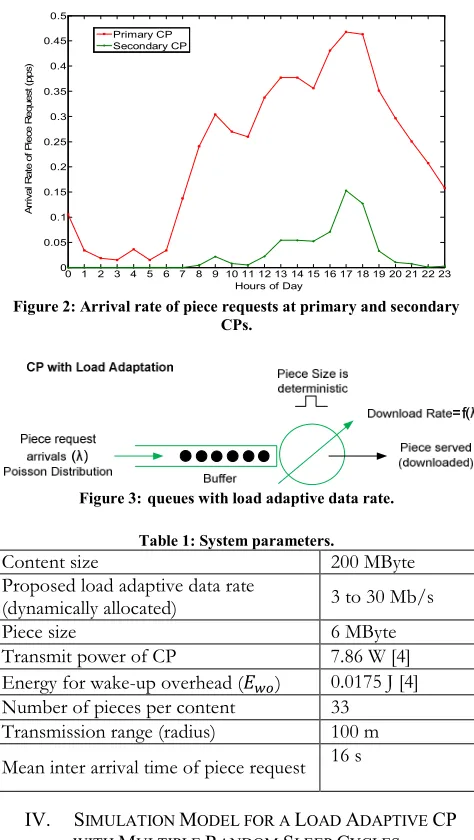
It is assumed that as soon as the number of simultaneous connections (piece downloads) exceeds 10 at a CP, a new CP is installed to cater for the remaining data traffic. The former CP is termed as primary while the latter as secondary. The primary and secondary CPs are co-located so that the secondary CPs can be turned on demand to accommodate excess traffic. The arrival and service rates (shown in Figure 2 and Figure 6, respectively) are the inputs to the proposed simulation model for the primary and secondary CPs. The total number of piece requests within an hour results in the arrival rate (see Figure 2) at each CP whereas the number of simultaneous connections (each operating at 3 Mb/s) reflects the variable service rate within that hour (see Figure 6). To minimize transmission energy consumption at a CP, multiple random sleep cycles operate in the following way. When the CP is idle (i.e. its buffer is empty) it switches to sleep mode for a random amount of time with a certain mean duration in order to save transmission energy. In order to implement energy savings through sleep cycles, the distribution of sleep durations is assumed to be negative exponential considering Poisson distributed arrival process of piece request and negative exponential distributed piece service discipline. The transmitter power
consumption of a CP is determined as =
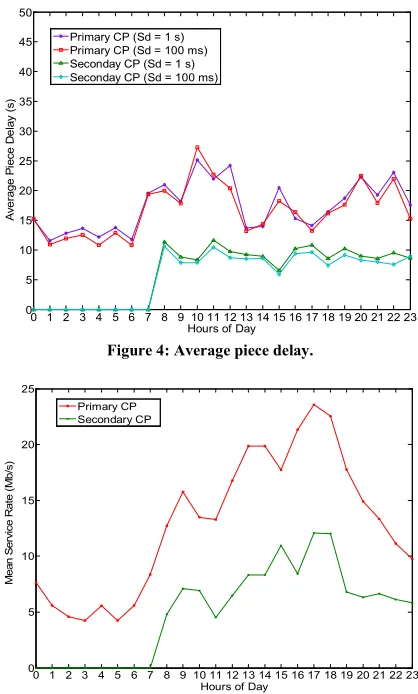
[image:4.595.325.541.55.194.2][4]. Upon waking up, if there are requests waiting in the buffer to be served, the CP serves them, otherwise, the CP switches to sleep mode again. Figure 3 shows a queuing model of a CP with load adaptation. All system parameters are summarized in Table 1.
Figure 2: Arrival rate of piece requests at primary and secondary CPs.
Figure 3: queues with load adaptive data rate.
Table 1: System parameters.
Content size 200 MByte Proposed load adaptive data rate
(dynamically allocated) 3 to 30 Mb/s Piece size 6 MByte Transmit power of CP 7.86 W [4] Energy for wake-up overhead ( ) 0.0175 J [4] Number of pieces per content 33
Transmission range (radius) 100 m Mean inter arrival time of piece request 16 s
IV. SIMULATIONMODEL FOR ALOADADAPTIVECP
WITHMULTIPLERANDOMSLEEPCYCLES
The load adaptive CP works on the concept of statistical multiplexing, where parallel simultaneous connections are multiplexed into a single serial pipeline. It is an established theory that a server with capacity is superior to the parallel servers, each with capacity in terms of latency [4]. Since the piece size is fixed (deterministic), where each piece is ensured to receive an average download rate between 3 Mb/s and 30 Mb/s (corresponding to 1 to 10 simultaneous connections), the service duration of a piece can be represented as a det-Neg distribution [37]. The algorithm is presented in Figure 6.
V. PERFORMANCEEVALUATION
The performance of the system has been evaluated in terms of average piece delay, average content delay and transmission energy savings with respect to load adaptive data rate and average sleep cycle durations of 100 ms and 1 s. The load adaptive data rate reflects varying vehicular density throughout the day. In traditional access networks, packet size can be fixed / variable but the data rate is generally fixed. However, in the present case, pieces with fixed size are served with a load adaptive data rate, which
statistically multiplexes (aggregates) up to 10
simultaneous connections. Hence, the proposed CP in this 0 1 2 3 4 5 6 7 8 9 10 11 12 13 14 15 16 17 18 19 20 21 22 23 0
0.05 0.1 0.15 0.2 0.25 0.3 0.35 0.4 0.45 0.5
Hours of Day
A
rr
iv
a
l
R
a
te
o
f
P
ie
c
e
R
e
q
u
e
s
t
(p
p
s
)
[image:4.595.45.274.239.380.2]paper can serve at data rates that vary between 3 Mb/s and 30 Mb/s depending on the number of simultaneous connections rather than serving with a fixed data rate of 3 Mb/s/user. Note that the buffer is assumed to be infinite as the cache point with storage can virtually hold infinite number of piece requests.
A. Average Piece Delay
[image:5.595.306.550.72.419.2]Figure 4 shows the average piece delay served by the primary and secondary CP throughout the entire day. The average piece delay does not follow the trend of the load (Figure 2) as the data rate here is load adaptive.
Figure 4: Average piece delay.
Figure 5: Load adaptive mean service rate (Mb/s).
Unlike the usual case (with traditional CPs) where the increase in average piece delay is only governed by the offered load, the average piece delay in the proposed CP is primarily dependent on adaptive service rate (Figure 5), sleep cycles and their transient variations. The number of times a CP operates sleep cycles is inversely dependent on load. Thus the waiting delay for a piece due to sleep cycles does not increase at high load. In contrast, the serving duration (download time) decreases at higher load due to the adaptive data rate. This decreases the overall average piece delay at higher load. It is to be noted that the load adaptive CP never operates on its maximum value throughout an hour. Thus, the mean service rate never reaches 30 Mb/s.
Algorithm Load Adaptive CP
Input: Lambda,MeanSleepDuration,Connections(c) CP,n Pieces
Output:Delay,CP. Queue,NumberOfSleep
1. for alltime= = 1, 2, 3, ….,T do
2. initializeInterArrivalTime[piece (n)] = exprand(MeanInterArrivalTime);
3. Computedet-Neg(MeanOfConnections(c),VarianceOfConnections(c),PieceSize)
4. if InterArrivalTime[piece n then
5. generateRequest[piece (n)];
6. recordtime[Request[piece (n)]];
7. addRequest[piece (n)]toCP(c). Queue; 8. ifCP(c). sleep= 1 then
9. SleepDuration CP c ; 10. ifsleep duration CP c then 11. CP(c). sleep= 0;
12. CP(c). busy= 0;
13. else ifCP(c)isBusy then
14. ServiceDuration--; 15. ifServiceDuration then 16. CP(c). busy= 0; 17. CP(c). sleep= 0;
18. else ifCP(c). Queue > 0then
19. initializeServiceDuration = exprand(det Neg);
20. startDownload [piece[(n)];
21. recordtime[Download [piece(n)];
22. removeRequest[piece (n)]fromCP(c). Queue;
23. CP(c). busy= 1; 24. CP(c). sleep= 0;
25. ComputeDelay[piece (n)];
26. else
27. SetSleepDuration[cp] = exprand (MeanSleepDuration); 28. NumberOfSleep(c) + +;
29. CP(c). sleep= 1; 30. CP(c). busy = 0;
31. end if
32. end if
33. else
34. InterArrivalTime[piece (n)]--;
35. end if
36. time++;
37. end if
38. end for
Figure 6 : Algorithm of load adaptive cache point.
B. Average Content Delay
[image:5.595.57.266.211.558.2]Figure 7 shows the average content delay at both CPs for each hour of the day. The figure shows that the average content delay has a similar behavior as that of the average piece delay. This is because the content consists of 33 pieces, where the average content delay is computed as the sum of the average piece delay of 33 pieces. Moreover, since the average content delay depends on the average piece delay, the former exhibits similar behavior.
Figure 7: Average content delay. 0 1 2 3 4 5 6 7 8 9 10 11 12 13 14 15 16 17 18 19 20 21 22 23
0 5 10 15 20 25 30 35 40 45 50
Hours of Day
A
v
e
ra
g
e
P
ie
c
e
D
e
la
y
(s
)
Primary CP (Sd = 1 s) Primary CP (Sd = 100 ms) Seconday CP (Sd = 1 s) Seconday CP (Sd = 100 ms)
0 1 2 3 4 5 6 7 8 9 10 11 12 13 14 15 16 17 18 19 20 21 22 23 0
5 10 15 20 25
Hours of Day
M
e
a
n
S
e
rv
ic
e
R
a
te
(M
b
/s
)
Primary CP Secondary CP
0 1 2 3 4 5 6 7 8 9 10 11 12 13 14 15 16 17 18 19 20 21 22 23 0
200 400 600 800 1000 1200 1400
Hours of Day
A
v
e
ra
g
e
C
o
n
te
n
t
D
e
la
y
(s
)
[image:5.595.325.540.571.731.2]C. Energy Savings
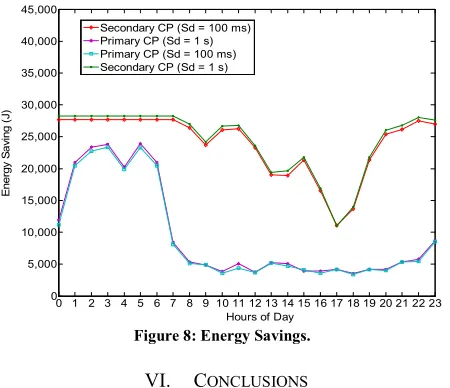
Figure 8 illustrates the energy savings achieved by both primary and secondary CPs throughout the entire day by operating multiple random sleep cycles with different mean durations. The figure shows that the energy savings achieved at the early hours of the day is higher due to the low vehicular load at the early hours that leads to a lower number of generated requests. This allows the CP to stay in the sleep mode for longer aggregated sleep duration in those hours and hence achieving higher energy savings. For example, the energy savings achieved by the primary CP at 03:00 hr is 23 kJ compared to only 4 kJ achieved at 17:00 hr. Moreover, the figure also shows that the
secondary CP achieves higher energy savings as
[image:6.595.51.276.422.616.2]compared to the primary CP. This is because the load on the primary CP is much higher than that on the secondary CP (please see Figure 2). The energy savings achieved by the secondary CP between 00:00 hr and 07:00 hr is approximately 28 kJ compared to the 11 kJ achieved at 17:00 hr. The figure also demonstrates that the sleep cycle duration has insignificant effect on the results of both CPs. This is mainly because of the relatively large piece size (i.e. 6 MByte), service time and very low total wakeup overhead, compared to the traditional packet-switched networks. Note that the total wakeup overhead is very low due to the smaller number of times the CP can switch to sleep mode. Since the CP operates sleep cycles only when there is no piece request waiting in the buffer, the probability of a request arriving at a CP during the service is very high.
Figure 8: Energy Savings.
VI. CONCLUSIONS
In this paper, energy efficient load adaptive CPs for vehicular CDN are proposed. The load adaptive service rate representing statistical multiplexing of parallel piece
downloads was implemented through det-Neg
distribution. Such a CP was simulated as an
M/det-Neg/1/∞ queue with queue length dependent vacations,
where typical city vehicular traffic profiles were utilized. The average piece delay at the proposed CP was dependent on adaptive service rate, sleep cycles and their transient variations. Since the number of times a CP operates sleep cycles was inversely dependent on load, the waiting delay for a piece due to sleep cycles did not
increase at high load. In contrast, the serving duration (download time) decreases at higher load due to the adaptive data rate. This decreases the overall average piece delay at higher load. The advantage of the proposed load adaptation (statistical multiplexing) technique at a CP operating sleep cycles is evident in terms of lower average piece delay and higher energy savings compared to that of a traditional CP. The performance results revealed that the proposed CP saved up to 84% transmission energy during off-peak hours and 33% during the whole day while fulfilling content demand in a city vehicular environment. Moreover, the secondary CP, due to its lower load, has achieved higher energy savings during its operating span
compared to that achieved by the primary CP.
Furthermore, the results revealed that the mean sleep cycle duration has insignificant effect on the energy savings of both CPs due to the large piece size (i.e. 6 MB), long service time and low wake-up overhead.
ACKNOWLEDGMENT
The authors would like to acknowledge the support of the Engineering and Physical Sciences Research Council (EPSRC), UK for funding the INTelligent Energy awaRe
NETworks (INTERNET) project under contract
EP/H040536/1.
References
[1] X. Wang, Y. Bao, X. Liu, and Z. Niu, "On the design of relay caching in cellular networks for energy efficiency," in
Computer Communications Workshops (INFOCOM WKSHPS), 2011 IEEE Conference on, 2011, pp. 259-264. [2] F. Thouin and M. Coates, "Video-on-demand networks:
design approaches and future challenges," Network, IEEE,
vol. 21, pp. 42-48, 2007.
[3] N. I. Osman, T. El-Gorashi, and J. M. Elmirghani, "Caching in green IP over WDM networks,"Journal of High Speed Networks,vol. 19, pp. 33-53, 2013.
[4] C. V. N. Index. Global Mobile Data Traffic Forecast Update,
2013–2018 [Online]. Available:
http://www.cisco.com/c/en/us/solutions/collateral/service- provider/visual-networking-index-vni/white_paper_c11-520862.html
[5] R. Hodges and W. White, "Go green in ICT,"SS PRASAD, C. KUMAR,2008.
[6] H. Idjmayyel, W. Kumar, B. R. Qazi, and J. M. Elmirghani, "Saving energy with QoS for vehicular communication," in
Wireless and Optical Communications Networks (WOCN), 2011 Eighth International Conference on, 2011, pp. 1-5. [7] H. Idjmayyel, B. R. Qazi, and J. M. Elmirghani, "Position
based routing protocol for a city environment," in Next Generation Mobile Applications, Services and Technologies (NGMAST), 2010 Fourth International Conference on, 2010, pp. 174-179.
[8] H. Idjmayyel, W. Kumar, B. R. Qazi, and J. M. Elmirghani, "Energy and QoS—A new perspective in a city vehicular communication network," in GLOBECOM Workshops (GC Wkshps), 2011 IEEE, 2011, pp. 327-331.
[9] W. Kumar, S. Bhattacharya, B. R. Qazi, and J. M. Elmirghani, "A vacation-based performance analysis of an energy-efficient motorway vehicular communication system,"
Vehicular Technology, IEEE Transactions on, vol. 63, pp. 1827-1842, 2014.
[10] T. C. Report. (2009). City of Saskatoon. Available: http://www.saskatoon.ca/DEPARTMENTS/Infrastructure%2 0Services/Transportation/TransportationPlanning/Documents/ 2009%20Traffic%20Characteristic%20Report.pdf
0 1 2 3 4 5 6 7 8 9 10 11 12 13 14 15 16 17 18 19 20 21 22 23 0
5,000 10,000 15,000 20,000 25,000 30,000 35,000 40,000 45,000
Hours of Day
E
n
e
rg
y
S
a
v
in
g
(J
)
[11] S. Sen, J. Rexford, and D. Towsley, "Proxy prefix caching for multimedia streams," in INFOCOM'99. Eighteenth Annual Joint Conference of the IEEE Computer and Communications Societies. Proceedings. IEEE, 1999, pp. 1310-1319. [12] M. Johnson, L. De Nardis, and K. Ramchandran,
"Collaborative content distribution for vehicular ad hoc networks," inAllerton conference on communication, control, and computing, 2006, pp. 751-760.
[13] M. Li, Z. Yang, and W. Lou, "Codeon: Cooperative popular content distribution for vehicular networks using symbol level network coding,"Selected Areas in Communications, IEEE Journal on,vol. 29, pp. 223-235, 2011.
[14] D. Zhang and C. K. Yeo, "Enabling efficient wifi-based vehicular content distribution," Parallel and Distributed Systems, IEEE Transactions on,vol. 24, pp. 479-492, 2013. [15] U. Shevade, Y.-C. Chen, L. Qiu, Y. Zhang, V. Chandar, M.
K. Han, H. H. Song, and Y. Seung, "Enabling high-bandwidth vehicular content distribution," inProceedings of the 6th International COnference, 2010, p. 23.
[16] P. Kolios, V. Friderikos, and K. Papadaki, "Ultra low energy store-carry and forward relaying within the cell," inVehicular Technology Conference Fall (VTC 2009-Fall), 2009 IEEE 70th, 2009, pp. 1-5.
[17] W. R. Heinzelman, A. Chandrakasan, and H. Balakrishnan, "Energy-efficient communication protocol for wireless microsensor networks," in System sciences, 2000. Proceedings of the 33rd annual Hawaii international conference on, 2000, p. 10 pp. vol. 2.
[18] E. Callaway, "Low power consumption features of the ieee 802.15. 4/zigbee lr-wpan standard," Mini-tutorial, ACM Sensys,vol. 3, pp. 5-7, 2003.
[19] P. Cheng, C.-N. Chuah, and X. Liu, "Energy-aware node placement in wireless sensor networks," in Global Telecommunications Conference, 2004. GLOBECOM'04. IEEE, 2004, pp. 3210-3214.
[20] Y. T. Hou, Y. Shi, H. D. Sherali, and S. F. Midkiff, "On energy provisioning and relay node placement for wireless sensor networks," Wireless Communications, IEEE Transactions on,vol. 4, pp. 2579-2590, 2005.
[21] C.-S. Hsu and Y.-C. Tseng, "Cluster-based semi-asynchronous power-saving protocols for multi-hop ad hoc networks," inCommunications, 2005. ICC 2005. 2005 IEEE International Conference on, 2005, pp. 3166-3170.
[22] L. Ning, X. Yuan, and X. Sheng-li, "A power-saving protocol for ad hoc networks," in Wireless Communications, Networking and Mobile Computing, 2005. Proceedings. 2005 International Conference on, 2005, pp. 808-811.
[23] W. Fisher, M. Suchara, and J. Rexford, "Greening backbone networks: reducing energy consumption by shutting off cables in bundled links," in Proceedings of the first ACM SIGCOMM workshop on Green networking, 2010, pp. 29-34. [24] M. Gupta and S. Singh, "Greening of the Internet," in
Proceedings of the 2003 conference on Applications, technologies, architectures, and protocols for computer communications, 2003, pp. 19-26.
[25] B. R. Qazi and J. M. Elmirghani, "M-PRMA protocol for vehicular multimedia communication,"International Journal of Communication Networks and Distributed Systems,vol. 4, pp. 28-48, 2010.
[26] B. R. Qazi, H. Alshaer, and J. M. Elmirghani, "Analysis and design of a MAC protocol and vehicular traffic simulator for multimedia communication on motorways," Vehicular Technology, IEEE Transactions on, vol. 59, pp. 734-741, 2010.
[27] W. Kumar, S. Bhattacharya, B. R. Qazi, and J. M. Elmirghani, "An energy efficient double cluster head routing scheme for motorway vehicular networks," in
Communications (ICC), 2012 IEEE International Conference on, 2012, pp. 141-146.
[28] G. Fettweis and E. Zimmermann, "ICT energy consumption-trends and challenges," in Proceedings of the 11th International Symposium on Wireless Personal Multimedia Communications, 2008, p. 6.
[29] A. Capone. Energy and mobility: Scalable solutions for the mobile data explosion. GreenTouch. Politecnico di Milano.
[Online]. Available:
http://www.greentouch.org/uploads/documents/4%20Antonio %20Capone_SEW%20Capone%20presentation.pdf [30] S.-E. Elayoubi, L. Saker, and T. Chahed, "Optimal control for
base station sleep mode in energy efficient radio access networks," inINFOCOM, 2011 Proceedings IEEE, 2011, pp. 106-110.
[31] F. Richter, A. J. Fehske, and G. P. Fettweis, "Energy efficiency aspects of base station deployment strategies for cellular networks," inVehicular Technology Conference Fall (VTC 2009-Fall), 2009 IEEE 70th, 2009, pp. 1-5.
[32] A. U. Joshi and P. Kulkarni, "Vehicular wifi access and rate adaptation," ACM SIGCOMM Computer Communication Review,vol. 41, pp. 423-424, 2011.
[33] J. Camp and E. Knightly, "Modulation rate adaptation in urban and vehicular environments: cross-layer implementation and experimental evaluation," Networking, IEEE/ACM Transactions on,vol. 18, pp. 1949-1962, 2010. [34] P. Shankar, T. Nadeem, J. Rosca, and L. Iftode, "Cars:
Context-aware rate selection for vehicular networks," in
Network Protocols, 2008. ICNP 2008. IEEE International Conference on, 2008, pp. 1-12.
[35] Z. Dou, Z. Zhao, Q. Jin, L. Zhang, Y. Shu, and O. Yang, "Energy-efficient rate adaptation for outdoor long distance WiFi links," in Computer Communications Workshops (INFOCOM WKSHPS), 2011 IEEE Conference on, 2011, pp. 271-276.
[36] BBC iPlayer [Online]. Available:
http://www.bbc.co.uk/iplayer/