PROGRAMME
PROGRESS
REPORT
January -June 1982
COMMISSION OF THE EUROPEAN COMMUNITIES
JOINT RESEARCH CENTRE
Ispra Establishment
Italy
Central Bureau for Nuclear Measurements
Geel Establishment
Belgium
Petten Establishment
The Netherlands
European Institute for Transuranium Elements
Karlsruhe Establishment
Federal Republic of Germany
COMMUNICATION
Category
1.0
Nr
3986
Specific support
for the Commission's
sectoral activities
WARNING
The information contained in this document is
communicated confidentially by the Commission of the European Communities to Member States, persons and undertakings and should not be passed on to third parties.
(Euratom-Treaty. Article 13, and Regulation (EEC) No. 2380/74 of the Council of Ministers).
Programme Progress Report - JRC Ispra January - June 1982
Specific Support for the Commission Sectoral Activities
INFORMATICS
Abstract
The programme «Informatics» aims at providing a public service in the field of automatic collection, automatic treatment and dissemination of technical-scientific information and the underlying techniques. Three activities are included in the pro-gramme, staffed with 34 research men:
a) Contribution to the research in the field of Teleinformatics which include work on a number of the terrestrial networks which are interconnected and linked to a satellite network. In particular in the reporting period work on a fiber optic net-work started. In addition net-work is done on protocols to be used in these netnet-works and in particular for problems of burotique. Human and organizational aspects of office automation are as well investigated.
Data Base query language and automatic indexing are also studied for several applications.
b) The European Computer Program Institute (EUROCOPI) with an information ser-vice on computer programs and their application.
The new Eurocopi Data Base is now operational and the relevant documentation was published.
Studies on the implementation of engineering packages and on programming for software sharing took place.
c) The European Shielding Information Service (ESIS), a specialized information centre on shielding data and shielding computer and calculation methods. In the reporting period the work concerned mainly the preparation of the new sodium experiment and the completion of iron benchmark experiments.
Methods of calculation for data adjustment were also further developed. For each of these activities details are given about the progress in the reporting period, the results obtained in selected fields and the planning of the future work.
COMMISSION OF THE EUROPEAN COMMUNITIES
JOINT RESEARCH CENTRE
Ispra Establishment
Italy
Central Bureau for Nuclear Measurements
Geel Establishment
Belgium
Petten Establishment
The Netherlands
European Institute for Transuranium Elements
Karlsruhe Establishment
Federal Republic of Germany
Specific support
for the Commission's
sectoral activities
B E M Æ R K
Den viden, som rummes i dette dokument, meddeles som fortrolig fra Kommissionen for de europæiske Fællesskaber til Medlemsstater, per-soner og virksomheder og ma ikke videreaives til trediemand. (Euratom-traktatens artikel 13 og Minersterrådetsforordning(EUF) N° 2380/74). Hverken Kommissionen for de Europæiske Fælleskaber eller nogen, som optræder pa Kommissionens vegne er ansvarling for den eventuelle brug af information, som er indeholdt i det følgende.
ZUR BEACHTUNG
Die in diesem Dokument enthaltenen Kenntnisse werden von der Kom-mission der Europäischen Gemeinschaften den Mitgliedstaaten, Per-sonen und Unternehmen der Gemeinschaft vertraulich mitgeteilt und dürfen nicht an Dritte weitergegeben werden. (Euratom-Vertrag, Arti-kel 13, und Beschlussdes Ministerrates (EWG) Nr. 2380/74).
Weder die Kommission der Europäischen Gemeinschaften noch Perso-nen, die im Namen dieser Kommission handeln, sind für die etwaige Verwendung der nachstehenden Informationen verantwortlich.
NOTICE
The information contained in this document is communicated confi-dentially by the Commission of the European Communities to Member States, persons and undertakings and should not be passed on to third parties. (Euratom-Treaty, Article 13, and Regulation (EEC) No. 2380/74 of the Council of Ministers).
Neither the Commission of the European Communities nor any person acting on behalf of the Commission is responsible for the use which might be made of the following information.
AVERTISSEMENT
Les connaissances contenues dans le présent document sont communi-quées confidentiellement par la Commission des Communautées euro-péennes aux Etats membres, personnes et entreprises et ne peuvent être transmises à des tiers. (Traité Euratom, article 13, et règlement (CEE) N° 2380/74 du Conseil de Ministres).
Ni la Commission des Communautés européennes, ni aucune personne agissant au nom de la Commission, n'est responsable de l'usage qui pourrait être fait des informations ci-après.
A V V E R T I M E N T O
Le cognizioni contenute nel presente documento sono comunicate con-fidenzialmente dalla Commissione delle Comunità europee agli Stati membri, persone ed imprese e non debbono essere trasmesse a terzi. (Trattato Euratom, articolo 13, e regolamento (CCE) N° 2380/74 del Consiglio dei Ministri).
Né la Commissione delle Comunità europee, né alcuna persona che agisca per suo conto, è responsabile dell'uso che dovesse essere fatto delle informazioni che seguono.
OPMERKING
De kennis, die in dit document is vervat, wordt door de Commissie van de Europese Gemeenschappen vertrouwelijk aan de Lid-Staten, per-sonen en ondernemingen medegedeeld en mag niet aan derden worden doorgegeven. (Euratom-Verdrag, artikel 13, en het besluit van de Mi-nisterraad (EEG) No. 2380/74).
CONTENTS
Introduction 3
Executive Summary 5
Projects 11
1. Teleinformatics 11
2. EUROCOPI 15
3. ESIS 21
JRC Publications 27
Glossary 29
INTRODUCTION
The programme «Informatics» includes those activities in which efforts have to be concentrated in order to make con-tributions to the Commission policy in this field and to pro-mote the use of advanced and efficient systems for the automatic collection, analysis, automatic treatment and dissemination of information and the underlying techniques. Three main items make up the programme, selected out of the public service activities, that can be expected to be per-formed by the JRC and on the basis of the specific ex-perience available:
— contribution to the research work in the field of Teleinfor-matics which shall lead to extend and improve the munication between geographically disseminated com-puters. The research is centered on the two subjects of «network» (language, operation, protocol) and «data» (data-banks, standards, processing).
— management of the EUROpean Computer Programme Institute (EUROCOPI), with the aim to integrate closely the research and service activities in software evaluation and dissemination. The research is oriented on program-ming techniques and software information transfer pro-blems; the information service is pursued by setting-up a computerized data base on program information and by the organization of a program distribution and program information service.
— running the European Shielding Information Service (ESIS), which in a specific field, where very relevant ex-perience has been accumulated at Ispra, fulfills the task of analysing, evaluating and synthetizing information on shielding data and calculation methods, as well as per-forming a shielding benchmark experiment. This infor-mation is exchanged with the interested organizations and firms in the European Community.
The work is in general pursued in collaboration with a range of bodies in the Community countries and in close contact with the relevant Commission services.
EXECUTIVE SUMMARY
1. TELEINFORMATICS
The research activities which are undertaken in the framework of the «Teleinformatics» project are intended to represent an original contribution to the international research effort in the field. Due to the accumulated ex-perience in contributing to such projects as EIN-COST 11 and EURONET/DIANE, the JRC Is now asked to actively par-ticipate to more ambitious projects which have been pro-moted by the Commission in the framework of her major «Telematics» plan as discussed by the Parliament and by the Council.
In particular, two projects have a direct influence on our work i.e.:
— the COST 11 bis research project which is intended to of-fer the working scenario for joint European research ven-tures in the field of teleinformatics;
— the INSIS (INterinStitutional Information Service) project which is aimed at providing the European Institutions and the National Administrations with the appropriate telein-formatics services which allow the exchange of the infor-mation in its various forms (voice, image, text). The two projects mentioned above have at least one impor-tant objective in common in the sense that they both repre-sent significant contributions to the overall process towards standardization. To this respect our work is also deeply In-fluenced by the emerging recommendations as produced by the competent standardization bodies ECMA, ISO, CEPT, CCITT and the Commission supported Working Group on Standards.
The stimuli originating from this rather complex external scenario lead us to concentrate our efforts on the problem of integrating existing and emerging network technologies with the view, on one hand to support new types of distributed services and on the other hand to contribute to the overall process towards standardization. In this spirit four major axes of research are followed:
— terrestrial networks — satellite networks
— information networks (burotique)
— standardization of protocols and services.
As far as the terrestial networks are concerned, the inter-nal network project has reached a satisfactory level of assessment as regards the interconnection of seven Solar 16 minicomputer, one of which is in the process of being in-stalled at our headquarters in Bruxelles.
The network of Solar systems represent an unique example of an X25 private network which extends over an X25 public service (EURONET) and offers gateway functions to other public and local X25 networks. Indeed in order to reach the wide public in the buildings and the offices we are installing a number of X25 concentrators, which are based on microtechnology, which appear to the major network of Solars as a multitude of private X25 networks.
Other technologies for local internetworking are under in-vestigation: the Cambridge ring, the Mininet and our Hermes ring based on fiber optics.
The Cambridge ring approach has temporarily been aban-doned because the systems which are available on the market present limitations as regards their capability to cover long distances as required by the topology of the Ispra Establishment.
The Mininet system, which is the result of a joint research and development effort by Italian and British universities, could represent an acceptable solution for the interconnec-tion of process control devices. We are looking forward to participate to the demonstration of the new version of the system that is expected to work at remarkable speeds. The fiber optics approach is also an interesting solution for local networks. In this field we have identified two items of research: the design of the channel access scheme and the design of a transport protocol which best utilises the intrinsic broadcasting capability of the transmitting media. The idea is to create a prototype working system with multicasting capabilities which are best suited to support two large classes of applications: real time control and computerized message broadcasting.
This project represents one of our most ambitious research initiatives, since speculation is undertaken in the rather unexplored field of broadcast protocols and services. A study contract has been finalized for the realization of a pro-totype ring network, based on micros, which takes the form of a joint R/D effort between the JRC and an industrial com-pany.
The broadcast protocols and services have been specified and a further contract will be finalized for the development of the software, after the prototype firmware has been proven satisfactory.
This initiative constitutes our original contribution to a major project called «High Speed Local Area Network, Design and Services» which is carried out in collaboration with the Technical University of Denmark, CNUCE Pisa and «J. Stefan» Institute Ljubljana in the framework of COST 11 bis. As regards the satellite networks, the idea to install an earth station at Ispra pointing to the OTS satellite was given up because of the major uncertainity about the lifetime of the satellite itself. We are looking forward for the provision of the adequate service by the European PTTs (the announced Telecom or ECS satellites).
In the meantime we are developing the necessary protocols using a twin Link Driving Computer to the one installed at CNUCE, which is connected to the OTS earth station in Pisa. The «Interconnection of Local Area Networks using satellite links and X25 public services» project aims at the definition of the appropriate internetworking protocols which make it possible for different types of terrestrial networks to inter-work by sharing the use of satellite links.
SCRIBA project plans for the integration of three types of technologies I.e.: distributed data bases, digital networks and office automation in order to offer a prototype text and facsimile communication system.
Four classes of problems have been identified: — the data base function
— the transport function — the postman
— the word processors and facsimile devices.
Distributed data bases are used to collect and manipulate the information about access rights, distribution lists, con-ference structures, address maps, etc. They play the role of a system of interconnected «post offices» which supervise the overall routing and broadcasting services as required by the end users.
The prototype data base function has recently been demonstrated. It offers a good example of the «intelligence» required by a computerized message distribution service. The data base function also provides a «quick service» for users who want to directly access their mailboxes or archives using simple terminals via the internal network, via Euronet or dial up lines.
The «delivery» of the messages to the destination printers or desk terminals is performed according to the Teletex CCITT recommendations.
The delivery function is currently under development. In the future another function called «postman» has to be added in order to complete the automatic delivery function. The postman is charged to interpret the envelopes of the messages and to drive the télétex transport service in such a way that the users can receive their mail without any in-tervention from their part.
The market of word processors and facsimile devices is con-stantly investigated with a view to indentifying those pro-ducts whose data communication interfaces best conform to current recommendations for advanced internetworking. In the meantime we have developed an adaptation software for the existing set of word processors.
The SCRIBA project is being developed as an original con-tribution to work carried out within INSIS.
The JRC staff is involved in INSIS at the level of the Steering Committee and at the level of two working groups: technologies and human/organizatorial aspects.
This latter acticity has as its primary goal the identification of arid response to human and organizational constraints likely to impede the large-scale introduction of high-technology of-fice systems in Community institutions and national ad-ministrations.
The first year of the activity coincided with the planning and design phase of INSIS. During this phase much of the activi-ty related to organization.
INSIS has an Inter-service steering group, with the actual ground-work being performed by an inter-service working group. The activity involves participation in this working group, chairing one of the sub-groups (Sub-Group IV: «Human and Organizational Aspects»), and liasing with other sub-groups. (These are concerned with «User Re-quirements», «Technical Options and Standards», «Economic and Financial Aspects» and «Data Base Policy»). As a final remark it should be stressed that the JRC is active-ly contributing to the general process towards standardiza-tion.
The Reference and Test Centre for higher level protocols Is now a continuous service, accessible via Euronet by the im-plementors of terminal stations or network software for host computers. In particular the remote printing stations of the Telesystems and Sit-lntel manufacturers have been properly
6
checked against our reference protocol and a UNIVAC ver-sion of it currently under test.
Similar test will be operated with ICL, Siemens and CII-HB which are at present planning for the installation in their systems of a file transfer capability according to the NIFTP recommendations.
The Reference and Test Centre services might be expanded In order to cover the ¡nterworking of message exchange systems and office equipment. A technical proposal has been submitted to INSIS and Is currently being considered by our management.
The JRC leads the COST 11 bis Working Group on transport layer which has produced the final report. «Basic specifica-tion of the transport service and protocols» which is suppos-ed to be a reference document for the implementation of the emerging recommendations by ISO.
As a further example of our involvement in the field of stan-dardization the JRC acts as the technical leader of a joint research effort between GMD (D), Adl (F), NPL (UK) and sup-ported by DG III on the methodologies for the certification of protocols.
Finally it has to be mentioned that regular progress of the work on Data Base Query Language took place and that the collaboration with the GID-Frankfurt and the University of Linz went on in Jhe field of Automatic Indexing.
2. EUROCOPI
The main objective of the EUROCOPI project is to provide EC users of scientific/technical computer programs with a pro-gram information and propro-gram distribution service. These services and additional development activities, including the related research activities, are the following:
— Computer program information service — Computer program library techniques
— Practical programming and documentation techniques for the development of computer programs which are structured, flexible, and portable.
During the last half year there has been an emphasis on the function extension of the data base as well as the program library and on two topics in applied research and technical development. This means in detail:
— Adaptation of the data base to the ADABAS version 4 — Critical review of necessary future data base
im-provements
— First practical experience with efficient data sources — Adaptation of the program library to new user
re-quirements
— Production of the new user manual «The ICES System» — Completion of the study «FORTRAN IV Dialect Conver-sion, A case study: CDC to IBM» (end of the first study performance status)
— Technical editing of text for a book on «Programming for Software Sharing»
The adaptation of the DB to the DBMS ADABAS version 4 has been successfully finished, so that the DB can be con-sidered as fully operational In this new improved version. Further technical and functional Improvements have been considered according to the first practical experience gain-ed and will be achievgain-ed in relation to practical necessities. Concerning data input further efficient data sources have been located and the first practical cooperation in data transfer has already taken place.
use, and maintenance of engineering packages (see ref. 1) and the study on FORTRAN dialect conversion has been completed (see ref. 2). Furthermore the preparation of the publication of the Ispra Courses on «Programming for Soft-ware Sharing» has been started.
The work planned for the next half year period is: a) Data base
— Operation of the DB under the public experimental test phase
— Realization of the first planned phase of im-provements (general data converter, general data up-date program)
— Data conversion and input from computer program libraries and documentation centres.
b) Program Library
— Last phase of reorganization:
Creation of effective procedures for storage, retrieval, updates, and distribution of programs and data files as well as printed materials
— Compatibility between the program library and the DB c) Applied Research and Technical Developments
— Practical realization in software quality control and studies about the characteristics of the software for vector computers
— Evaluation of the reactions to the study on FORTRAN dialect conversion.
References
1. A. INZAGHI: «II Sistema ICES», Commission of the EC, JRC Ispra, Dept. A, Div. 1, EUROCOPI, Jan 1982. 2. A. A. POLLICINI: «Converting CDC FTN4 to IBM
FOR-TRAN IV», Commission of the EC, JRC Ispra, Dept. A, Div. 1, Computing Centre Newsletter, Handbook Series, May 1982.
3. ESIS
As already reported, R & D in ESIS is focussed on integral deep penetration neutron shielding benchmarks and simplified gamma ray attenuation algorithms in multilayered shields. From time to time the methods under development are applied to prototypical shielding problems.
In this reporting period neutron streaming in ducts of a PWR and the experimental facilities of an accelerator were analyzed.
In the iron benchmark experiment, which is being com-pleted, a series of calibration measurements have been car-ried out. Parallel to this measuring campaign, the preparatory work for a similar deep penetration sodium ex-periment has reached the following achievements: comple-tion of the safety report including detailed 3-D activacomple-tion calculations, planning, construction and mechanical tests of the sodium containers and preparation of the sodium melting procedure.
The newly developed data adjustment code ADJUST-EUR has - after improvements and careful tests - been applied to the ASPIS experiment.
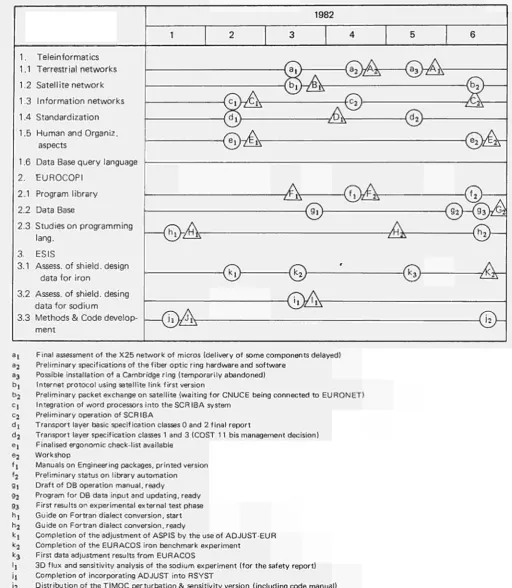
Table I. Significant achievements compared to planning
1982
1. Teleinformatics 1.1 Terrestrial networks 1.2 Satellite network 1.3 Information networks 1.4 Standardization 1.5 Human and Organiz.
aspects
1.6 Data Base query language 2. EUROCOPI
2.1 Program library 2.2 Data Base
2.3 Studieson programming lang.
3. ESIS
3.1 Assess, of shield, design data for iron
3.2 Assess, of shield, desing data for sodium
3.3 Methods & Code develop ment
©A—©A-A
-®A
Λ
©Δ-—©A
© © 2 ^
A
—©—
©
A-©
al
a2 a3 bi b2
<=1 C2 d l d2 el e2
f l
fa
91 92 93 hi
'1 ¡1 ¡2
Final assessment of the X 2 5 network of micros (delivery of some components delayed) Preliminary specifications of the fiber optic ring hardware and software
Possible installation of a Cambridge ring (temporarily abandoned) Internet protocol using satellite link first version
Preliminary packet exchange on satellite (waiting for CNUCE being connected to EURONET) Integration of w o r d processors into the SCR IBA system
Preliminary operation of SCRIBA
Transport layer basic specification classes 0 and 2 final report
Transport layer specification classes 1 and 3 (COST 11 bis management decision) Finalised ergonomie checklist available
Workshop
Manuals on Engineering packages, printed version Preliminary status on library automation Draft of DB operation manual, ready
Program for DB data input and updating, ready First results on experimental external test phase Guide on Fortran dialect conversion, start Guide on Fortran dialect conversion, ready
Completion of the adjustment of ASPIS by the use of ADJUSTEUR Completion of the EURACOS iron benchmark experiment
First data adjustment results f r o m EURACOS
3D flux and sensitivity analysis of the sodium experiment (for the safety report) Completion of incorporating ADJUST into RSYST
Distribution of the T I M O C perturbation & sensitivity version (including code manual)
[image:14.595.36.549.50.639.2]Table II. Planned activities and important milestones
1982
9 | 10 11 12
1st
semester 1983
1. Teleinformatics 1.1 Terrestrial networks 1.2 Satellite network 1.3 Information networks 1.4 Standardization
1.5 Human and Organiz. aspects 1.6 Data Base query language
2. EUROCOPI
2.1 Program library 2.2 Data Base
2.3 Studies on programming techniques
3. ESIS
3.1 Assess, of shield, design data for iron
3.2 Assess, of shield, design data for sodium
3.3 Methods & Code development
■©
<Ξ>
<$Kò
<©
<S>-<h>
<S>
<s>
<s^
a j Final specifications HERMES broadcast protocols and service a2 INET extention to Bruxelles w i t h job inout and delivery
33 HERMES ring prototype evaluation
b j Preliminary version of internetworking protocol via satellite c j Feasibility of integration of facsimile
c2 Acceptance of the SCR IBA data base function
c3 Tests of T E X IS
C4 Specifications for POSTMAN
d j Start of basic specifications f o r transport class 1 and 3 d2 First results on certification methodologies
e Book text finalised f 1 Last phase of organisation
f2 Compatibility between Progral Library DB
g j Operation of the DB under the public experimental test phase g2 First phase of improvements: due to converter
g3 First phase of improvements: updating program
g,j Data conversion + input f r o m libraries: t w o applications
h i Software quality control + v e c t o r computers, practical realizations h2 Study on F O R T R A N dialect conversion, evaluation of user's reactions k j Completion of the adjustment of the ASPIS experiment
k2 First iron adjustment results f r o m EURACOS
k3 Completion of the iron adjustment based on EURACOS measurements
! Completion of the assembly of the sodium benchmark experiment at the EURACOS facility
2 Begin of the measuring compaign in sodium
3 Conclusion of the first series of measurements in sodium
[image:15.595.43.552.25.691.2]PROJECTS
1. TELEINFORMATICS
Current trends in teleinformatics research show that the in-terest is rapidly moving from the area of low speed to high speed networks such as local area and satellite networks. In parallel, new types of informatics services are conceived which best exploit the capabilities of the new network technologies.
A large and dispersed community of users of conventional informatics services, such as timesharing infomation retrieval and remote job entry, can already benefit from the services offered by the public networks which allow the ac-cess to the hosts offering those services. The challenges for research activities arise now in the fields of message ex-change systems, office automation and distributed control of physical and social processes.
Some systems, which provide those advanced services, do already exist as prototype realizations or even in the market: the problem is rather their integration into coherent and possibly heterogeneous systems and their accessability via public network services. In this sense a remarkable effort in terms of standardization is needed.
In accordance with the above remarks, our activities can be classified in the following way:
— terrestrial networks (SOLAR net, X25 network of micros, HERMES fiber optics project, other Local Area Net-works),
— satellite networks (contribution to the COST 11 bis pro-ject),
— information networks (burotique, SCRIBA),
— standardization (transport layer, RTC, certification methodologies).
In addition, work progressed on Data Base Query Language.
TERRESTRIAL NETWORKS
Following the satisfactory assessment of our internal X25 network based on SOLAR 16 mini-computers, we are now proceeding in the installation of new types of networks. Those networks offer some remarkable peculiarities in terms of serviceability and capacity. The already developed net-work of SOLAR constitutes the flexible kernel around which a mesh of networks of distinct characteristics can be build.
Access to Data Base from Euronet
A certain amount of effort has been spent in tidying up the access mechanism, as the sudden appearance of about 80 external users for the ECDIN data base (which is now in its experimental phase) has spotlighted certain problem areas which had not shown up previously. This has happened mainly because the external users are unaccustomed to our particular system and do not always do what is expected of them. The major cause of problems has been users discon-necting during a session, thus leaving a time-sharing session in course on the mainframe computer. The Solar computer now attempts to close the TSO session in this situation, although It is not always possible.
A second modification has been to add a third data base to those for which access is given from Euronet, although the access Is restricted at the present time to those developing it. This new data base is SHIPY, and is intended to provide in-formation about the shipyard industries.
On-Line Information Service
With being a host of Euronet/Diane, the Ispra computing centre has been overwhelmed by requests for information about the services provided. In order to answer all these re-quests, it has been decided to implement an «On-Line Infor-mation Service», which is currently available on Euronet and can be interrogated by prospective users of our various ser-vices.
The aim of this system is to provide at least a first level of in-formation about the computing facilities available at Ispra to Euronet users. This «first level» of information is equivalent to the information already contained in the various brochures describing some of the services and should be sufficient to allow potential users to identify services that are useful to them.
X25 Network of Micros
This technology is particularly suited for interconnecting a dispersed population of computers and terminals.
A prototype configuration, manufactured by a French com-pany, has been installed and tested. Its compatibility with the Euronet standards has been proven. Such a network might represent a solution to the low-medium traffic requirements of INSIS. Indeed with a comparable cost to that of the re-quired modems, terminal concentrators can be installed almost anywhere in the buildings. These concentrators offer up to four X25 ports and up to fifteen X28 asynchronous ports.
A network of eight such units has been installed. This net-work supports a population of terminals and offers ports to the mainframe computer and, via the SOLAR network, to Euronet.
HERMES: Fiber Optics Ring
The fiber optics approach represents some undoubtful ad-vantages as compared to coaxial cables and in particular it is characterized by low attenuation and low sensitivity to ex-ternal sources of electromagnetic noise. With the adoption of fiber optic trunks, the ring networks can be extended up to remarkable distances (several Kms).
We are currently developing the prototype firmware of the Link Access Module for such network.
The link access scheme has been designed taking into con-sideration the functions required by the higher level broad-cast and synchronization services. The adopted solution shows, even at the theoretical level, some remarkable ad-vantages as compared to other link access schemes (CSMA/CD, token passing).
By the end of the year, we plan to offer a demonstration bas-ed on a network of three nodes with trunks of 1 Km each and working at 10Mb/s.
The top down approach required that the overal network ser-vices be defined before the basic serser-vices.
In this sense we have found the technical solution for the following classes of network services:
— free broadcasting
— broadcasting with reservation
— multisender-multireceiver transmission — X25 virtual circuits
— n to m transmission with error and flow control. The implied protocols have been specified. The details of the realization on cheap microcomputers will be considered after the satisfactory evaluation of the prototype ring. As a general remark we believe that this project, if suc-cessful, is going to provide us with an extremely flexible test bed for proving the validity of new services and applications in the field of teleinformatics. Indeed the conceived services cover all conventional data transmission features (point to point liaisons with or without error/flow control) and in addi-tion they provide multicast data transmission funcaddi-tions and synchronization primitives for distributed processes. The qualifying difference to what has been realized so far is
that the «communication scenario» can be defined, for all foreseen services, by the communicating partners as well as by any third «intelligence» which can act as the «operator» of the communication. In this sense the notion of «monitor» is introduced in the data transmission protocols.
The «monitor» concept has proved to be extremely powerful in the definition of the existing «operating systems» of the data processing systems. An analogous impact is expected to be implied by the concept of «monitor» as applied to data transmissions networks.
Other Local Area Networks
The installation of a «Cambridge ring» system as proposed in the framework of the COST 11 bis project has been postpon-ed. We are looking forward for a system which can support longer distances between nodes as required by the topology of the JRC Ispra Establishment. In the meantime our interest is focused on the announced new version of «Mininet» which is expected to provide fast, reliable transportation of short packets between data collection and data analysis systems. We believe that this system can properly solve data com-munication problems In the areas of real time and process control.
Satellite Networks
A DEC systems has been installed and equipped with the re-quired features (high level language compilers and data communication interfaces) for running all the sofware pro-duced in the framework of the COST 11 bis joint venture on «Interconnection of local area networks using satellite links and X25 public services».
A 1Mb/s link between our Satellite Link Driving Computer and the Teledetection laboratory has been satisfactory testes.
This link allows the access to all software development facilities which are available in other DEC installations from our relatively small system.
The same link is going to be used in case large amounts of data (ex. satellite images) are to be transferred to/from the teledetection laboratory. In the future the proprietary «Decnet» services will also be accessible through our LDC. The LDC is connected to our SOLAR network by means of an X25 gateway. A virtual connection is prolonged over Euronet to the twin LDC computer installed at CNUCE (Pisa) which in turn drives the earth station to the OTS satellite. In this way we can communicate via the satellite with the other partners
12
of the COST 11 bis project.
In collaboration with those partners we are at present con-cerned with the development of the commonly agreed In-ternetworking protocol.
We hope that by the end of next year an experiment on in-ternetworking via satellite can be set up with the aim at demonstrating the result of this collaborative effort.
INFORMATION NETWORKS
This project is intended to demonstrate the feasibility of an advanced information distribution service based on the latest developments in three relatively unrelated fields i.e.: data base management, network services and equipment for office automation.
The project takes into consideration recent announcements concerning new services offered by the European PTTs (ex. Teletex, Telemail) and the preliminary studies which are car-ried out in the framework of INSIS.
We recall that the INterinStitutional Information Service pro-ject is a Commission action aimed at the realization of a teleinformatics system which allows the exchange of Infor-mation in its various form (voice, text, image) between the European Institution and the National Administrations. The JRC actively contributes to the technical working groups of INSIS.
We are also designing some prototypes systems which can be considered as test beds for the major project.
Burotique
Two actions have been undertaken in this field: the definition of a compatible Teletex private network and the adaptation to it of some existing word processors.
As soon as Teletex terminals with an X25 interface will be available on the market, they will be connected to our system of X25 networks and therefore the point to point transmission of documents will be supported.
Teletex Network and uPostman» Function
The TEXIS software package provides a «value added» ser-vice which consists of «storing and forwarding» télétex documents and facsimile files in order to decouple the physical resources (the terminal devices) from the bursts of traffic.
TEXIS primitives will also be used by the «postman» function which is charged to best exploit the network and the terminal resources for driving an automatic mail delivery service without any human intervention.
The technical specification of the software for a fully com-patible télétex network has been the subject of a call for tender addressed to European software houses. The idea is to build, on top of our basic X25 network kernel, a télétex ser-vice which offers the document transfer function for the sub-mittal and the delivery of the computerised mail.
The system (called TEXIS) will be accessible by télétex com-patible terminals connected to either our internal network or to the emerging télétex public services.
The basic store and forward capability of TEXIS will mainly be driven by the «postman».
The postman software function will take decisions on how, when and where the messages can be delivered to the destination print out stations, on the basis of the current traf-fic and the availability of the terminals.
even the conventional mail service «delivers» the mail to destinations without the addressees being obliged to repetetively ask the service provider if there Is any mail for them.
TEXIS Is under development and the specifications for POSTMAN will be ready within this year.
Word Processors
Taking into account that the X25 compatible télétex ter-minals are not yet available on the market and that a reasonable population of Olivetti word processors are already installed at the JRC, we have developed a proper in-terface that makes those word processors appear as stan-dard télétex statlons.
Like many other mapping modules, this software runs on the SOLARs which act as the collectors of all letters to be mailed and originated from the Olivetti's.
SCRIBA
SCRIBA is the name of our prototype information distribution system which integrates the services offered by the word processors, the printing stations, the network data transfer capabilities and the data bases which support the overall distribution service.
The data base function of SCRIBA is currently in the im-plementation phase and some preliminary demonstration have already shown some good results.
The data base is supported by the ADABAS Data Base Management System which is available on our mainframe computer and on some other mainframes (DEC, Siemens). In addition ADABAS has demonstrated full compatibility with the CODASYL recommendations and, consequently, the SCRIBA implementation is considered to be portable to other computer systems with a relatively small effort.
SCRIBA has been conceived as a distributed computerized message exchange system. A number of SCRIBA systems will cooperate exactly in the same way as regional post of-fices cooperate for performing the overall distribution func-tion, each of them taking care of its local subscribers. In addition SCRIBA holds the data structures describing con-ference memberships, personal access rights, public and private archives, routing criteria as defined by its end users and mailboxes.
By means of an adequate interface to the POSTMAN func-tion, the SCRIBA systems are capable of best exploiting the available multicasting capabilities of the underlying network services (see our HERMES research project).
As a final remark we stress that the nature of the message plays no role within the overall architecture of the system: the contents of a message can be voice, text, facsimile or graphic.
Human and Organizational Aspects of Office Automa-tion
Two activities are at the moment under way under this heading which forms part of the general EC project known as INSIS, the first aiming to gain experience of using the new technology under discussion, the second concerning the organization of a major expert workshop on this subject. Work has also been done on provision of ergonomie guidelines.
In this field an inquiry of the «European Communittee for Standardisation (CEN)» among its members, the national standard institutes of 16 European states, has been evaluated. The evaluation showed that a rather large number of standards for «Office furniture and the work place» and for «The office environment: lighting, climate, noise» exist in some member states. Very few standards, even in the form of draft or pre-standards, exist for «The
visual display unit (VDU) work station» which is specific to in-formation technology.
The initial idea to compile an ergonomie check list for VDU-work stations was given up in favour of charging specialists with writing a small brochure about ergonomie considera-tions for VDU use. At present we are looking for groups with suitable experience in this field.
STANDARDIZATION
The JRC is actively contributing to the overall process of standardization. The implied activities are carried out at various levels of technicalities and in the framework of various contextes.
Reference and Test Centre
This service is offered by the JRC to the implementors of the EURONET higher level protocols. Our debug and certifica-tion facility for the Remote Printing Protocol has helped the Sit-lntel and Telesystems companies in the tuning of their realizations of the Euronet printing station. At present a UNIVAC implementation of the remote printing protocol is under test.
Similar help Is now offered to ICL, Siemens and CII-HB main-frame manufacturers in the development of their File Transfer Protocol service (NIFTP version 81).
In order to offer a better user-friendly interface to the NIFTP testing tool, a text editor for describing the test scenarios has been added to the system.
We have plans to extend the service to the fields of message exchange systems and the interfaces to office automation equipment. The idea is currently under discussion within IN-SIS.
Transport Layer
The Transport layer is likely to be the first issue for standar-dization within the ISO Open Systems Interconnection reference model. Current work carried out by ISO experts shows that at least classes 0 and 2 or the transport service are to be considered as stabilized.
The COST 11 bis project has activated an action titled «Basic specifications of the transport Service and Protocols» which is meant to offer an unambiguous, implementation oriented interpretation of the recent recommendations by ISO. The JRC leads the COST 11 bis working group which has undertaken this analysis which has recently produced its final document on classes 0 and 2.
An analogous study contract is now proposed for covering classes 1 and 3 too.
European Collaboration on Protocol Testing Techniques
The JRC is participating in a European collaborative project which is a «Pre-development study of testing techniques for implementations of High Level Protocols».
As well as the JRC, the participants are: — National Physical Laboratory, Teddington — Agence d'Informatique, Paris
— Gesellschaft fuer Mathematik und Datenverarbeitung, Darmstadt
who are being partly financed by the Commission for the ex-ecution of this work.
the emerging ISO standards for Network Service, Transport Service, and Session Service.
As these techniques are based on original techniques developed and used at Ispra, the JRC was invited to par-ticipate in a technical advisory capacity, not having the resources available for a greater participation at the present time. However, suggestions made by the JRC have already been accepted by the other participants, and in particular, an initial phase of collaboration has been agreed, during which a common set of terms, protocol primitives etc. will be defined, and then used in the remainder of the project. This is seen as an important first step in the convergence towards a final common solution.
DATA BASE QUERY LANGUAGE
The more significant contributions to the development of a generalized query language based on the ADABAS DBMS and oriented towards bibliographic and factual data bases are, in the reporting period, the following:
1. The macroprocessor which had been set up last year has been enhanced and new programming modules have been added.
2. New facilities have been programmed to improve the ADAGF capability. They are:
a) extension of the proximity searching in free-text abstracts feature to any possible series of words, situated at any place In a sentence (interrupted se-quence).
b) display of histogrammes related to a relevant part of the data base and not only to the whole.
c) display of data stored in a network structure of files. In order to upgrade our Data Base and, obviously, the actual generalized query language, the migration of ADABAS from the current version 3 to the version 4 has been performed. In the frame of the Automatic Indexing activity, the contract on the dictionary construction to be used in the Automatic In-dexing System (SLC II) has been successfully terminated.
Some Indexing runs were performed on Food Science & Technology material using this new dictionary with promis-ing results.
The collaboration between University of Linz, G.I.D. Frankfurt and Ispra will go on for further development of the system.
COLLABORATION WITH EXTERNAL ORGANIZATIONS It has been pointed out in the above description that our ac-tivities are closely related to current R & D efforts carried out by other research laboratories, manufacturers, PTTs and standardization bodies.
In particular, our participation to the COST 11 bis research project and our active role in the INSIS project, offer us several opportunities for adjusting our own research ac-tivities to common objectives of widely recognized interest. Examples of some joint research ventures are the satellite, local area networks, transport protocol and certification methodologies projects mentioned above.
We feel that our technical expertise is complementary to the organizatorial effort performed by other Commission ser-vices in orientating the European R & D ventures in teleinfor-matics.
REFERENCES
G. DE GRANDI, A. ENDRIZZI - HERMES: fiber optics ring network
Protocols and Services specifications. J. C. REY
- Automatic Job Input and Listing Delivery for INET - RTCFT-lspra File Transfer Protocol Test Facility Reference
Manual COST 11 bis
- Basic Transport Service, Transport Protocol for ISO class 0 and 2 and associated Network Service.
Final Report
- Need for continued concerted teleinformatics research in Europe.
J. LOCQUET
- INET interconnection to STELLA.
2. EUROCOPI
The results achieved during the first half year period are reported under the following main headings:
— Activities in Applied Research and Technical Develop-ment
— Computer Program Information and Distribution Service In addition, a more detailed report is given on the structure use and application of the ICES System (engineering package).
a. Activities in Applied Research and Technical Developments
a1. Engineering Packages
Taking into account the long and wide experience with the ICES System in theory and practice, a gap of the ICES system documentation has been filled by writting a user oriented system description, which facilitates the access to a comprehensive understanding and to a first use and application of this large engineering package. This description shows the basic philosophy, structure and range of applications and save the engineer from the necessity of reading some extensive volumes. The draft version of this manual «The ICES System» was presented and discussed during the last session of the IUG Directory Board, where it was judged to be a very useful complementary element to the already existing ICES documentation.
Concerning all implemented engineering packages (BERSAFE, NASTRAN, ICES) the support in system and informatics related aspects (introduction, use, applica-tion) continued as well as the new implementations and daily maintenance.
Calculations in natural sciences and enginnering are now more oriented towards the use of vector and matrix operations. Actual computer architecture developments consider these types of data processing requirements. Modifications and implementations of existing software however require special training for vector computing. For this purpose two members of EUROCOPI par-ticipated in a 3 day seminar on «Parallel computers and scientific calculation» organised by IBM Italy.
a2. Practical approach to portability
The preceeding report contained a special introduction to the study «FORTRAN IV Dialect Conversion, a case study: CDC to IBM». This subproject advanced and the following additional steps were completed:
- After the successful user's review the final version of the conversion check list is available.
- A set of library routines has been produced (6 for character handling and 3 for octal to decimal conver-sion).
- The conversion guide and the questionnaire are ready for publication. They will be published as a handbook issue of the JRC Ispra Computing Centre Newsletter. - A two day training course has been announced on the
subject.
a3. Utility tools for data base operation
Remembering that this program information service should run for some years under the present technical conditions and respecting the experience gained from recent use of the data base we considered in a technical study all topics still to be improved concerning the overall data base operation, i.e. informatics and data aspects.
Considering that the manpower allocation for the data base is very limited we planned that this improvement work should take place over two years and this time has been subdivided into 3 priority sections.
Concerning the technical aspects we also considered 3 sections which are: data input, data base operations, and DB use. Further technical details will be reported when Important achievements will be completed. a4. Publication of research and technical development
results
Publication of the lectures prepared for the Ispra Courses on «Programming for Software Sharing» is en-visaged. The supervision of the technical editing for this book will be performed under contract by a member of the University of Edlnburg, UK.
The main subjects treated are: - Software Development Methodology - Flexibility
- Transfer/Sharing - General.
b. Program Information and Distribution Service b1. Technical maintenance of the data base
a) Data base operation
Concerning the data base operation we now have a pool of about 160 modules containing programs, data sets of different data types, and procedures handling the DB, moving and checking data, executing programs, etc. We have recently adapted, implemented, and tested again the total set of procedures according to changes in the computer system organization and according to changes of the DBMS ADABAS (we used the ADABAS version 4). All these tests have been finished.
Providing that there will not be additional major modification of the DB operation, the number of opera-tional modules can be reduced to a figure which allows us to operate the DB in a simple and elegant way. b) Authorized files
Concerning the thesauri we again updated the subject classification file EPOS (reduction of records together with a structure compression) and the computer system file COMP (extension to 1600 descriptive records). These updates make the code assignment operations much easier.
To perform fast updates of files, some sets of macros have been developed which can adapt information on-line in a more sophisticated way.
c) Data sources
Our first cooperation efforts for acquiring new data sources were successful. We achieved practical agreements and procedures to transfer the total data collection of the «CPC Program Library» at the Queen's University of Belfast and of the «Informationszentrum Sozialwissenschaften (IZ)» at Bonn. The IZ is regularly in contact with software documentation centres and soft-ware producers in the member countries of the EC and the USA. The subject fields covered are statistics, linguistics, graphics, information retrieval, network analysis, and simulation.
d) Data security
As well as backups regularly performed for all ADABAS files we created a raw data archive so that we can restart the DB from zero in the case of very severe breakdowns.
b2. Program Library
During the last half year the following phases of the reorganization of the EPDA (European Program Distribu-tion Agency) were achieved:
- Disk units have been replaced and new peripheral system software has been implemented. Consequent-ly all libraries, programs, and data files of different types had to be transferred.
- The total material check of the computer programs has been finished and the check of the software itself is in progress.
- An inventory of all remaining printed documentation has been drawn up including the reclassification of this material.
- Concerning the inventory and reclassification of documents the same actions have been applied to all tapes, on-line and archived files. This phase Is still under way.
- For the remaining programs, the abstract production from the available documentation has been started. Furthermore all program descriptions of the EPDA library have been converted from SIMAS to ADABAS format and structure and updated in the content. - Finally the last phase of the reorganization has been
started, namely to create effective procedures for the storage, retrieval, update and distribution of programs and data files as well as printed materials.
- We received five new programs which have been tested and made available for distribution.
External Cooperation
In this connection the following may be mentioned: a) IUG(ICES User Group)
Participation in the IUG Directory Board meetings at Delft Technical University and Bologna: this board manages all matters related to the maintenance development, and ap-plication of the basic system and of the different sub-systems.
b) Computer program documentation centres
Agreements on a regular data transfer to EUROCOPI has been set up with:
- CPC (Computer Physics Communications) Program Library, Dept. of Applied Mathematics, Queen's Univer-sity of Belfast, Ireland.
- Informationszentrum Sozialwissenschaften (IZ), Bonn, Germany.
In the following a somewhat detailed presentation of the ICES system is given.
16
Main features of the ICES system
(A. Inzag h I)INTRODUCTION
A group of researchers from the Department of Civil Engineering at M.I.T. (Massachusetts Institute of Technology) dedicated itself in 1964 to the examination of engineering programmes and the languages used in their creation in order to find any gaps, in respect of the possible user requirements.
Some of the negative characteristics which emerged were: rigid formats for input and output, preset dimensions of the variables and structure of the data, inflexible solution pro-cesses, technical difficulties of access to computer use by those without a computer background and poor use of the memory.
To eliminate the inconveniences listed above and to fulfil other needs M.I.T. Invented the ICES (Integrated Civil Engineering System). Prestigious firms and private and public American organizations took part in the expensive project.
For several years a world organization - IUG (ICES USERS' GROUP) - has promoted the ICES philosophy everywhere and helps the many users (about 800).
The two main characteristics of the ICES system are as follows:
a) Software development tool
b) A tool for the analysis and solution of problems.
At present ICES can operate on the following computers: IBM 360/370, UNIVAC 70/1100, CDC CYBER 70/170/700, Philips, Siemens and Vax.
The ICES system
ICES is a integrated system used in the various engineering fields. It is made up of the Base System and the applied Sub-systems. There is a heirarchical relationship between these as the Subsystems are run under the control of the Base System. ICES is controlled by the Operating System of the computer, from which it calls for suitable services: space allocation, loading of the modules etc.
The Subsystems are developed with special programs in-cluded in the ICES Base System.
Each Subsystem is associated with an area of application. In other words, a Subsystem can only treat a previously defined «class of problems». The engineer (user) com-municates with the Subsystem using a language oriented towards the problem (POL) also previously defined using the CDL language.
The use of the (POL) language makes the engineer-computer contact much easier.
The applied programs written in ICETRAN, once supplied as «input» to the ICETRAN Precompiler, become Fortran grams with special characteristics. A Fortran compiler pro-duces the corresponding object programs with which, using the ICES «Link-edit» procedures, one obtains the modules which can be executed by an ICES Subsystem.
Some Programs of the Base System
Analysis of the future capacities of the Subsystem and definition of the
(POL) commands
Construction of the Common Write commands
(POL) in CDL language
Common specified in input to the
CDL program
Write programs in ICETRAN
language
_J
implementation ICETRAN programs to
precompiler
Commands (POL) inputto the
CDL program
Fort, produced in compiler Object progr.
output
Construction of dictionary (CDBS)
Build up executable
modules
| Test Subsystem
Fig. 1. Scheme of Development of an ICES Subsystem
possible to achieve dynamic linking between external infor mation, programs and data.
— CDL Command Definition Language. Is the language (program) of the Base System which allows the program mer to create the commands which make up the (POL) of a hypothetical new Sybsystem and to construct the vocabulary.
— ICETRAN (ICESFortran). Is the language (program) available to the programmer to write the programs which will supply the Subsystem.
— CI (Command Interpreter). Recognises the (POL) com mands which the engineer uses during the analyses and arranges the appropriate services.
— EXECUTOR Is the heart of the Base System. It manages the «control» during a run. It governs the flow of information recognised by the CI, the Subsystem modules, the «Management Programs» and as a function of the dynamic needs, calls up the services as required from the Operation System.
Problem Oriented Language (POL)
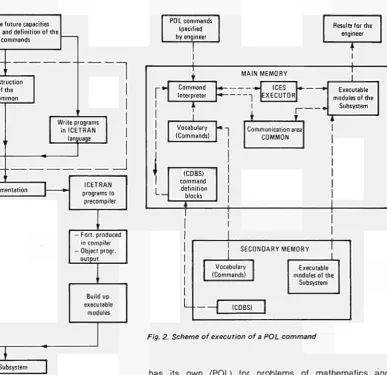
In ICES the Command Definition Language (CDL) and the Command Interpreter (CI) are the programs available for writing and using a Problem Oriented Language (POL). Each ICES Subsystem solves problems which belong to a certain discipline; it has an appropriate (POL) which the engineer uses. (See fig. 2).
The Strudl Subsystem has its own (POL) for problems of structural analysis, the Project Subsystem has its own (POL) to deal with working activities in time; the STATS Subsystem
POL commands specified by engineer
Results for the engineer
I
MAIN MEMORY Command
Interpreter
— ï —
ι
_ |
♦ ICES EXECUTOR
I
Executable modules of the
Subsystem Vocabulary (Commands) Communication area COMMON L_ (CDBS) command definition blocks
SECONDARY MEMORY Vocabulary
(Commands)
I
Executable modules of the
Subsystem
L._
-Í
(CDBS)Fig. 2. Scheme of execution of a POL command
has its own (POL) for problems of mathematics and statistics, and so on.
The languages (POL) are created with words (Commands) which are very similar to the natural language which an engineer normally uses. For example, if it necessary to deal with a problem of structural analysis, the ICES applicative Subsystem available is Strudl (Structural Design Language). Its (POL) used for describing a problem is made up of Com mands (Words) such as UNIT, JOINT, MEMBER, LOAD, FORCE, MOMENT, etc., familiar to a structural analyst, and taken from English.
It is possible to define a (POL) with words taken from other languages.
The Programs
A Subsystem is usually made up of several modules, the sum of their dimensions often being considerably larger than the dimensions of the primary memory of any computer. During the execution of a problem however only some of them are used and this not simultaneously. The selecting is done indirectly by the user by means of the commands (POL) used to describe a problem.
The Data
The data of the problem in ICES have a flexibility and a struc ture which is adequate to the needs of the user.
These characteristics are contained in the structure of the commands, and in the definition and structure of the variables contained in the programs which make up the modules.
A communication area «COMMON AREA» acts as a bridge by which all the information and data pass from the com mands to the executable modules and vice versa.
The dynamic structure of the data and their size are con sidered during the execution of a program. The space
[image:23.595.32.299.13.414.2] [image:23.595.157.545.15.390.2]Commands employed
I/O unit
results
Operative System
(Resident part)
, 1
Operative System
ICES Base System
command interpreter
.. I
Vocabulary (CDBS)
Work area
executable dynamic
modules data
Î
Library of modules
l i
[image:24.595.31.556.20.842.2]Extensions of the memory
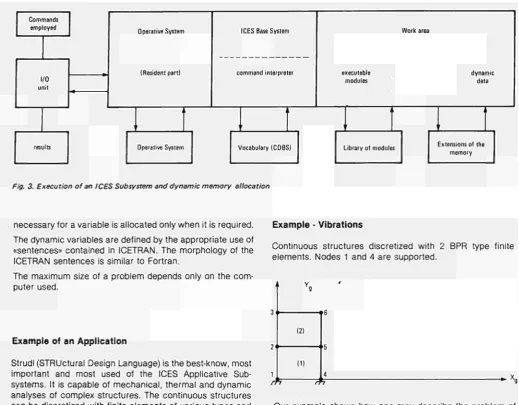
Fig. 3. Execution of an ICES Subsystem and dynamic memory allocation
necessary for a variable Is allocated only when it is required. The dynamic variables are defined by the appropriate use of «sentences» contained in ICETRAN. The morphology of the ICETRAN sentences is similar to Fortran.
The maximum size of a problem depends only on the com puter used.
Example of an Application
Strudl (STRUctural Design Language) is the bestknow, most important and most used of the ICES Applicative Sub systems. It is capable of mechanical, thermal and dynamic analyses of complex structures. The continuous structures can be discretized with finite elements of various types and geometries (plane and threedimensional elements etc.). Strudl also deals with structures of trusses and mixed struc tures. It communicates with the Subsystem using the ap propriate commands (POL) required by the problem. (See Fig. 3).
Example Vibrations
Continuous structures discretized with 2 BPR type finite elements. Nodes 1 and 4 are supported.
Our example shows how one may describe the problem of finding the natural frequencies (eigen frequencies) of the structure in the figure, discretised with BPR (Plate Bending Rectangular) elements. The characteristics of each finite element are stored on a permanent file during the installa tion of Strudl.
INTEGRATED CIVIL ENGINEERING SYSTEM I C E S DEC16, 1981
IUG VERSION V2M1, MAY 1977
TIME= 13.27.37
STRUDL "EX. 2 " "NATURAL VIBRATION OF PLATES"
ICESSTRUDLII
THE STRUCTURAL DESIGN LANGUAGE
IUG VERSION V3M1, MAY 1977 SIZE OF POOL 8K BYTES
13:28:01 12/16/81
GRIDDEFINX 1 AT 15. Y 2 AT 15. WALL Ζ 1 T 1 . ELE TYP "BPR"
ENDOFDEFIN
TYPE PLATE BENDING
CONST E 7.2E5 A L L
[image:24.595.34.554.28.433.2]RESULTS OF LATEST ANALYSES
JOB ID - EX. 2 JOB TITLE - NATURAL VIBRATION OF PLATES
ACTIVE U N I T S - L E N G T H FORCE ANGLE TEMPERATURE INCH LB RAD DEGF
TIME SEC ACTIVE STRUCTURE TYPE - PLATE BENDING
ACTIVE COORDINATES AXES Χ Y
EIGENVALUES
MODE EIGENVALUE.
0.263781 D 07 0.251446D 08 0.699913D 08
.FREQUENCY
0.258489 D 03 0.798073D 03 0.133150D 04
PERIOD. _ 0.386863D-02 0.125302D-02 0.751031 D-03
RADIANS / 0.162414D 04 0.501444D 04 0.836608D 04
LIST DYN EIGENVE 3
RESULTSOF LATEST ANALYSES
JOB ID - EX. 2 JOB TITLE - NATURAL VIBRATION OF PLATES
ACTIVE U N I T S - LENGTH INCH FORCE LB ANGLE RAD TEMPERATURE DEGF TIME SEC ACTIVE STRUCTURE TYPE - PLATE BENDING
ACTIVE COORDINATES AXES Χ Y
EIGENVECTORS MODE 1 JOINT 2 GLOBAL 3 GLOBAL 5 GLOBAL 6 GLOBAL
/-X DISP. -DISPLACEMENT-YDISP.
/ /
-Ζ DISP. X ROT.
0.3273615 0.9999995 0.3273615 0.9999995 0.0379246 0.0483015 0.0379246 0.0483015 ..ROTATION. Y ROT. 0.0000000 0.0000000 0.0000000 0.0000000 Ζ ROT. MODE 2 JOINT 2 GLOBAL 3 GLOBAL 5 GLOBAL 6 GLOBAL X DISP. DISPLACEMENT. Y DISP.
1 I
Ζ DISP. X ROT.
0.5884114 0.9999996 -0.5884114 -0.9999996 0.0367314 0.0258905 -0.0367314 -0.0258905 ROTATION. Y ROT. 0.0784549 0.1333333 0.0784549 0.1333333 Ζ ROT. MODE 3 JOINT
I—
X DISP.
DISPLACEMENT. Y DISP.
/ /
Ζ DISP. X ROT.
2 GLOBAL 3 GLOBAL 5 GLOBAL 6 GLOBAL 0.9999999 -0.6547225 0.9999999 -0.6547225 0.0098651 -0.1704050 0.0098651 -0.1704050 .ROTATION Y ROT. -0.0000000 0.0000000 -0.0000000 -0.0000000
Ζ ROT.
FINISH
Description Comment
STRUDL «EX. 2» «NAT. VIBRAT. OF PLATES» GRID DEFINX 1 AT 15. Y 2 AT 15. WALL Ζ 1 Τ 1. ELE TYP «BPR» END OF DEFIN TYPE PLATE BENDING CONST E 7.2E5 ALL DENSITY 0.000108 ALL INERTIA LUMPED
NORMALIZE EIGENVE PRINT STR DATA DYN ANA EIG 3
LIST DYN EIGENVA 3 FINISH
call to subsystem
automatic generation of the structure
type of geometry
Young's module and densi ty
■ inertia concentrated at the nodes
■ Nomallsation
Output of structural data Type of dynamic analysis and number of eigenvalues requested
Results requested End of problem described
CONCLUSIONS
shows the «development» ¡application» aspects of the This paper describes ICES,
(scheme only, see Fig. 1) and System with an example.
Its purpose (see ref.) is to inform and assist the potential user and to clarify certain concepts concerning the architecture of ICES to the reader including those who in the Centre or elsewhere regularly use the existing application Sub systems.
REFERENCES
1. A. INZAGHI The ICES System
To be publisher, Jan. 1982