This is a repository copy of A Framework for and Empirical Study of Algorithms for Traffic Assignment.
White Rose Research Online URL for this paper: http://eprints.whiterose.ac.uk/80380/
Article:
Perederieieva, O, Ehrgott, M, Raith, A et al. (1 more author) (2015) A Framework for and Empirical Study of Algorithms for Traffic Assignment. Computers and Operations
Research, 54. 90 - 107. ISSN 0305-0548 https://doi.org/10.1016/j.cor.2014.08.024
© 2015, Elsevier. Licensed under the Creative Commons Attribution-NonCommercial-NoDerivatives 4.0 International http://creativecommons.org/licenses/by-nc-nd/4.0/
Reuse
Unless indicated otherwise, fulltext items are protected by copyright with all rights reserved. The copyright exception in section 29 of the Copyright, Designs and Patents Act 1988 allows the making of a single copy solely for the purpose of non-commercial research or private study within the limits of fair dealing. The publisher or other rights-holder may allow further reproduction and re-use of this version - refer to the White Rose Research Online record for this item. Where records identify the publisher as the copyright holder, users can verify any specific terms of use on the publisher’s website.
Takedown
If you consider content in White Rose Research Online to be in breach of UK law, please notify us by
A Framework for and Empirical Study of Algorithms for Traffic
Assignment
Olga Perederieievaa, Matthias Ehrgottb, Andrea Raitha, Judith Y. T. Wangc a
University of Auckland, Auckland, New Zealand
b
Lancaster University, Lancaster, UK
c
University of Leeds, Leeds, UK
Abstract
Traffic congestion is an issue in most cities worldwide. Transportation engineers and urban
planners develop various traffic management projects in order to solve this issue. One way to
evaluate such projects is traffic assignment (TA). The goal of TA is to predict the behaviour
of road users for a given period of time (morning and evening peaks, for example). Once such
a model is created, it can be used to analyse the usage of a road network and to predict the
impact of implementing a potential project. The most commonly used TA model is known
as user equilibrium, which is based on the assumption that all drivers minimise their travel
time or generalised cost. In this study, we consider the static deterministic user equilibrium
TA model.
The constant growth of road networks and the need of highly precise solutions (required
for select link analysis, network design, etc) motivate researchers to propose numerous
meth-ods to solve this problem. Our study aims to provide a recommendation on what methmeth-ods
are more suitable depending on available computational resources, time and requirements on
the solution. In order to achieve this goal, we implement a flexible software framework that
maximises usage of common code and, hence, ensures comparison of algorithms on common
ground. In order to identify similarities and differences of the methods, we analyse groups
of algorithms that are based on common principles. In addition, we implement and compare
several different methods for solving sub-problems and discuss issues related to accumulated
numerical errors that might occur when highly accurate solutions are required.
1. Introduction and Motivation
Because of the fast development of cities and road networks, transportation engineers
face various difficulties of maintaining current roads and planning improvements and changes
of the infrastructure in order to satisfy the existing and future travel demand. Since any
changes to the urban infrastructure require large investments of time and money, making
wise strategic decisions is very important [1]. One way to evaluate potential projects and
analyse the usage of existing road networks is to apply mathematical modelling. As
pre-sented in Ort´uzar and Willumsen [1], transportation planning tools include many different
mathematical models designed to solve various tasks. In our study, we concentrate on the
traffic assignment (TA) problem that is part of transportation planning.
The TA model describes travel behaviour of road users. In particular, this model is
designed to predict what route choice every individual will make during a given period of
time. The conventional approach to model the behaviour of travellers is to make some
assumptions on how people choose routes and to find a traffic flow pattern satisfying these
assumptions. The most well-known assumptions are the ones following Wardrop’s first
principle (also called user equilibrium condition): “The journey times on all the routes
actually used are equal, and less than those which would be experienced by a single vehicle
on any unused route” [2].
This principle models the behaviour of travellers by assuming that all drivers are selfish
and that they choose the fastest routes going from their origin to their destination. As a
result, an equilibrium state is achieved, when no one has an incentive to switch to another
route. This principle allows different mathematical formulations of the problem based on
different additional assumptions. The classical model that is commonly used in practice is
a static deterministic traffic assignment (TA) that is the subject of this paper. Other traffic
assignment problems such as the TA problem with elastic demand (see Ryu et al. [3]) or
dynamic TA (see Carey and McCartney [4]) are not considered in this paper.
This classical model was developed in the 1950s and since then various algorithms have
First, TA is a challenging problem that arises in different practical applications. Second, the
existing transportation models continue to grow and become more detailed. For example,
in 2006 the ART model (Auckland Regional Transport Model) included 202 zones, whereas
in 2008 it contained 512 zones [5]. A zone refers to an area of a transportation network
that can vary from a city block to a neighbourhood [6]. Third, high accuracy of the solution
is required for select link analysis1 and for consistent comparison between design scenarios, as presented in Slavin et al. [7] and Gentile [8]. Therefore, we can conclude that there is a
growing need for efficient algorithms able to solve TA problems of realistic size with high
accuracy.
Regardless the number of proposed algorithms in the literature, there is no comprehensive
survey study comparing them. To the best of our knowledge, only the paper of Inoue and
Maruyama [9] analyses many different methods under the same computational environment.
The authors implemented 11 algorithms for traffic assignment. However, all implementation
details are omitted in the paper. It is not clear if the authors used the same framework for
all algorithms and how carefully they followed the descriptions of the algorithms available
in the literature.
The aim of our research is to analyse and compare the most promising approaches for
solving TA in the context of a framework that can be shared by different algorithms. We
compare methods without considering any special implementation details that may have
been used in commercial or research software. Instead, we focus on the use of common code
wherever possible. This will allow testing general ideas of the methods without giving an
advantage to any of them.
Another motivation of this study is to identify the advantages and disadvantages of
differentgroups of algorithms (the classification is presented in Section 3). Early on only
link-based approaches were available because of memory limitations. In recent years, however,
other types of algorithms have been implemented in many commercial software packages
used by practitioners. One of the main advantages of new algorithms is that they can
1
Select link analysis provides information of where traffic is coming from and going to for vehicles at
provide the path choice information which is necessary to evaluate effects of schemes such as
congestion pricing without re-running the algorithm [10]. Therefore, it becomes important
to analyse them and to compare them with classical link-based approaches. Other factors
that motivate our research are highlighted in Section 3 along with a literature overview.
Preliminary results of our study can be found in Perederieieva et al. [11].
The rest of the paper is organised as follows. Section 2 states the deterministic static
traffic assignment problem. Section 3 is devoted to a literature review and our choice of
algorithms for comparison. In Section 4, various implemented methods for solving traffic
assignment are described. Section 5 discusses the computational study and comparison of
algorithms. Finally, Section 6 presents conclusions and future work.
2. Problem Formulation
This section introduces a mathematical formulation of the TA problem and notation that
is used throughout the paper.
A transportation network is defined as a directed graph G(N, A) where N is a set of
nodes and A is a set of links. The users of the transportation network travel from their origins to their destinations. Let Dp denote travel demand between origin-destination
(O-D) pairp∈Z, where Z is the set of all O-D pairs. Ademand represents how many vehicles are travelling from an origin to a destination
The key feature of TA models consists in taking into account congestion effects that
occur in road networks. In order to consider congestion, link cost functions are introduced
into the model. They represent travel times through links of a network depending on the
traffic flow on those links. Let ca(f) denote a link cost function of link a that depends on link flowsf = (f1, f2, ..., f|A|). Link flow is the number of vehicles per time unit on each link.
LetF= (F1, ..., F|K|) denote a vector of path flows, whereK is the set of all simple paths
of graph G(N, A). Path flows are related to link flows by the expression
fa=
X
p∈Z
X
k∈Kp
where δk
a equals one if link a belongs to path k, and zero otherwise; Kp ⊆ K is the set of paths between O-D pairp. Let path cost function Ck(F) denote the travel time on path k. The conventional model of the traffic assignment problem is based on two assumptions
that allow to formulate and solve it as a mathematical programme.
1. Additivity of path cost functions: travel time on each path is the sum of travel times
of links belonging to this path, i.e. Ck(F) = Pa∈Aδakca(f);
2. Separability of link cost functions: travel time on each link depends only on flow on
this link, i.e. ca(f) =ca(fa).
If these assumptions are satisfied, solving the following optimisation problem (2) results in
the link flows satisfying the user equilibrium condition [6].
minX a∈A
fa
Z
0
ca(x)dx
X
k∈Kp
Fk =Dp, ∀p∈Z,
Fk ≥0, ∀k ∈Kp,∀p∈Z,
fa=
X
p∈Z
X
k∈Kp
δakFk, ∀a ∈A.
(2)
If all path cost functions Ck(F) are positive and continuous then existence of a solution of TA is ensured. If, furthermore, the path cost functions arestrictly monotone, the solution
is guaranteed to be unique [12]. In the following, it is assumed that these requirements are
satisfied.
The formulation (2) is sometimes referred to as link-route or path flow formulation [13,
14]. We will use the latter term. The path-based algorithms that are discussed in Section 4.2
use this mathematical programme. Other optimisation formulations of the TA problem
based on a different set of decision variables can be found in Patriksson [13] and Bertsekas
3. Literature Overview
One of the possible ways to classify traffic assignment algorithms is according to how the
solution is represented: link-based (solution variables are link flows), path-based (solution
variables are path flows) and bush-based (solution variables are link flows coming from a
particular origin), see [15].
Historically, the first algorithms developed for solving the traffic assignment problem were
link-based. The most well-known such algorithm is Frank-Wolfe (FW), a general algorithm
for convex optimisation problems [16]. Due to its simplicity and low memory requirements,
it is used even now and is implemented in different commercial software packages. However,
this algorithm is known to tail badly in the vicinity of the optimum and usually cannot be
used to achieve highly precise solutions as demonstrated by numerous numerical studies [9,
10, 17].
Many improvements of FW were proposed in the literature. As explained in Zhou and
Martimo [15], some of them try to improve the FW search direction (for example, see [18,
19, 20]) or step size (see [21, 22]). Among these variations of FW, we are interested in
conjugate (CFW) and bi-conjugate Frank-Wolfe (BFW) methods [20] as explained later in
this section. In Zhou and Martimo [15], the authors also categorise restricted simplicial
decomposition (RSD) [23] and non-linear simplicial decomposition (NSD) [24] as link-based
methods. These algorithms apply a more complicated structure than FW, however, they
use FW as a special case. In RSD and NSD the link flow solution is represented by a convex
combination of extreme points. Algorithms of this type usually have two main routines:
generating new extreme points and optimising the restricted master problem with respect
to previously generated extreme points.
Path-based methods decompose the TA problem into sub-problems corresponding to O-D
pairs. They bring the current solution to the equilibrium by sequentially shifting path flows.
The first path-based algorithm called path equilibration (PE) was proposed in Dafermos
and Sparrow [25]. Its main idea is to shift flow from the longest path (path with maximum
algorithm was published, path-based methods were considered impractical because they
required to store all paths. When column generation approaches for the TA problem were
proposed by Gibert [26] and Leventhal et al. [27], the development of path-based methods
started again since it allowed to generate paths when needed instead storing all of them.
Larsson and Patriksson [28] proposed disaggregated simplicial decomposition (DSD) which
is similar to RSD in the way that it also uses a convex combination of extreme points to
represent the solution. However, the extreme points are in the space of path flows instead of
link flows. In Jayakrishnan et al. [29], the gradient projection (GP) method was proposed
and further studied in Chen and Jayakrishnan [30]. It is similar to PE, but O-D flow is
moved from several non-shortest paths to the shortest path. Another path-based algorithm
was proposed in Florian et al. [10]. It is called projected gradient (PG) and is based on
the idea of moving flow from the set of paths with cost greater than the average path cost
to the set of paths with cost less than the average path cost. Another similar approach
called improved social pressure (ISP) algorithm was developed in Kumar and Peeta [31] and
compared to its previous version called social pressure algorithm (SP). This method also
shifts flow from the set of costlier paths to the set of cheaper paths, but a more complicated
strategy of flow distribution than in GP and PG is applied.
Bush-based algorithms (sometimes called origin-based) represent a more recent
develop-ment. Their main idea is to decompose the problem into a sequence of sub-problems that
operate on acyclic sub-networks of the original transportation network [32]. In general, for
this group of algorithms, the flow shifts are restricted to sub-problems and are usually
sim-ilar to the ideas presented earlier for path- and link-based approaches. The first algorithm
of this type applied to the traffic assignment problem was proposed by Bar-Gera [33]. It is
called origin-based algorithm (OBA). Nie [34] presented some corrections to OBA, and Nie
[32] compared different bush-based algorithms (corrected OBA (COBA) and modified OBA
(MOBA)) based on OBA. Other recently developed bush-based methods include: algorithm
B (B) proposed by Dial [35], some modifications of it (iB), see Inoue and Maruyama [9] and
Zhang et al. [36], linear user cost equilibrium (LUCE) developed by Gentile [8] and traffic
be noted that TAPAS cannot be strictly classified as a bush-based algorithm: it uses origin
flows in order to represent the solution, however the general structure of the algorithm is
different from other bush-based approaches.
In order to select algorithms for implementation, we analyse different empirical
stud-ies from the literature. During such analysis it is important to pay attention to how the
algorithms were compared (re-implemented by the authors of the study or using existing
software), what instances were used and how precise the obtained solutions were.
In the majority of the studies, relative gap is used as a convergence measure. It is
calculated as follows:
RGAP = 1− P
p∈ZDp·C p min
P
a∈Afa·ca
, (3)
whereCminp = mink∈KpCk is the shortest path of O-D pairp. We divide the existing numeri-cal studies into two groups of low and high precision, that correspond to the accuracy of the
solution. The algorithms from the low precision group are stopped when the relative gap
is in the interval [10−7,10−4], and for the high precision group the interval is [10−14,10−10]. Table 1 presents the first group and Table 2 the second one. In each table, one algorithm
from each study is highlighted in bold, which means that it showed the best performance
on the majority of the tested instances. All other algorithms in the same study are listed in
the order of decreasing performance. If in a particular study the existing executable of the
algorithm or commercial software was used, it is highlighted in dark grey. If comparison of
the algorithms was made indirectly, i.e. based on the running times reported in other papers,
it is highlighted in light grey. We also try to align the algorithms that were compared in
different studies. However, since sometimes contradictory conclusions are drawn in different
papers, this alignment is approximate. The last line of each table summarises the algorithms
that seem to be the most promising. The article of Chen et al. [38] is not included in Tables 1
and 2 because they study convergence of algorithms GP and DSD with respect to relative
error based on objective function values. This makes it difficult to categorise this study with
respect to relative gap. GP is reported to have a better performance. As discussed later,
Table 1: Summary of existing empirical studies. Low precision: RGAP ∈[10−7,10−4] M it ra d ji ev a an d L in d b er g [2 0] Z h ou an d M ar ti m o [1 5] S la v in et al . [3 9] D ia l [3 5] Fl or ia n et al . [1 0] G en ti le [8 ] Z h an g et al . [3 6] K u m ar an d P ee ta [3 1] LUCE ISP
PG PG SP
B B B iB, B
OBA OBA OBA OBA
FW FW FW FW FW
GP GP OBA
BFW BFW
CFW CFW
FW FW
OBA OBA
DSD
Most promising: BFW, GP, PG, ISP, B, LUCE
As presented in Tables 1 and 2, in many studies only a few algorithms are compared.
Often existing executables of algorithms and low precision are used. None of these studies
analysed how different methods for solving sub-problems influence the performance of TA
algorithms. These facts motivate us to study the TA methods in more detail and to analyse
their advantages and disadvantages.
Following the above analysis of Tables 1 and 2, we choose to implement the following
algorithms:
1. Link-based: FW (FW is consistently reported to have the worst performance. However,
it is the basis for CFW and BFW, which is why it is also considered in our study),
Table 2: Summary of existing empirical studies. High precision: RGAP ∈[10−14,10−10]
Bar-Gera [33] Nie [32] Bar-Gera [37] Inoue and
Maruyama [9]
TAPAS TAPAS
B B, iB
MOBA
COBA
OBA OBA OBA OBA, DSD,
MOBA, LUCE,
ASD
FW FW FW
Most promising: B, TAPAS
2. Path-based: PE (this algorithm was not compared in the studies presented above. We
choose to implement it due to its simplicity and ideas similar to other path-based
approaches), GP, PG and ISP;
3. Bush-based: B, LUCE, TAPAS.
4. Algorithms
One of the reasons for the development of various traffic assignment algorithms is a
specific problem structure that can be exploited by solution methods in many different
ways [13].
The constraints of the TA problem represent a polyhedral set and the objective function
is convex. As a result, feasible direction methods can be applied as a solution technique [40].
The algorithms described later in this section belong to this type of non-linear optimisation
methods. The main idea behind this type of methods is: starting from a feasible solution, a
feasible direction of descent is calculated and the solution is moved along this direction [41].
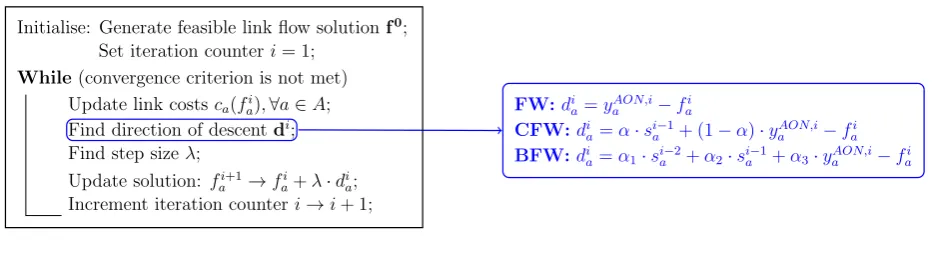
Initialise: Generate feasible link flow solutionf0
;
Set iteration counteri= 1;
While(convergence criterion is not met)
Update link costsca(fai),∀a∈A;
Find direction of descentdi;
Find step sizeλ;
Update solution: fi+1
a →fai+λ·dia;
Increment iteration counteri→i+ 1;
FW:di
a=yaAON,i−fai
CFW:di
a=α·sia−1+ (1−α)·yaAON,i−fai
BFW:di
[image:12.595.65.532.108.235.2]a=α1·sia−2+α2·sai−1+α3·yAON,ia −fai
Figure 1: Framework for link-based algorithms
function.
Another property of traffic assignment that can be exploited is the O-D pair separability:
the flow conservation constraints of one O-D pair do not affect those of any other pair. This
fact gives raise to various algorithms based on the idea of decomposing the problem into
smaller sub-problems that can be solved one after another or in parallel [13].
The TA problem allows various formulations based on different solution variables [13].
As a result, different solution spaces are used by the methods such as link, path, origin flows,
etc.
This section discusses several decomposition approaches and algorithms. In particular,
we focus on the algorithms that were chosen for our numerical study, see Section 3.
4.1. Link-based Algorithms
This section presents Frank-Wolfe and two of its modifications: conjugate and bi-conjugate
Frank-Wolfe methods. These algorithms can be described by the framework presented in
Figure 1. The methods differ only in the way the direction of descent is defined.
Each algorithm starts with an initial feasible link flow pattern. It is usually generated by
all-or-nothing (AON) assignment. Each link flow is initialised with zero and corresponding
link travel times are calculated. Then shortest paths for each O-D pair are found and all
corresponding demand is assigned to each shortest path. All these path flows are then
projected on all links using equation (1) which gives the initial feasible link flows.
FW further exploits the AON procedure. In order to generate a feasible direction of
yAON,i
a ,∀a∈A. Since the AON link flow solution is feasible, given a current link flow solution
fi
a,∀a∈A, vectordia=yAON,ia −fai,∀a∈Ais a feasible direction. Moreover, this direction is also a direction of descent [6]. The FW direction of descent is, in fact, obtained by solving a
linearised problem (the objective function in (2) is linearised based on the first order Taylor
series expansion) [14]. For the TA problem this linearised problem becomes a shortest path
problem and, hence, AON is applied [14].
The CFW and BFW algorithms use information about previously generated directions of
descent in order to find a new one. In particular, the new search direction is constructed via
mutually conjugate directions with respect to the Hessian of the objective. CFW takes into
account the usual FW direction and the direction from the previous iteration, whereas BFW
in addition considers one more direction from iterationi−2 whereiis the current iteration. Both algorithms operate on auxiliary variables si
a,∀a ∈ A called points of sight that store information about previously generated directions of descent (for details see Mitradjieva and
Lindberg [20]).
After finding a direction of descent, each algorithm proceeds to step size calculation
which determines how far the current solution must be moved along the direction of descent.
Section 4.4.2 discusses how to solve this sub-problem.
4.2. Path-based Algorithms
Path-based methods exploit the O-D pair separability and a path flow formulation (2)
of the TA problem. This group of methods operates in the space of path flows. At each
iteration, the flows are moved only within one O-D pair and path flows of the other O-D
pairs are fixed. Therefore, paths and the corresponding path flows must be stored. LetK+
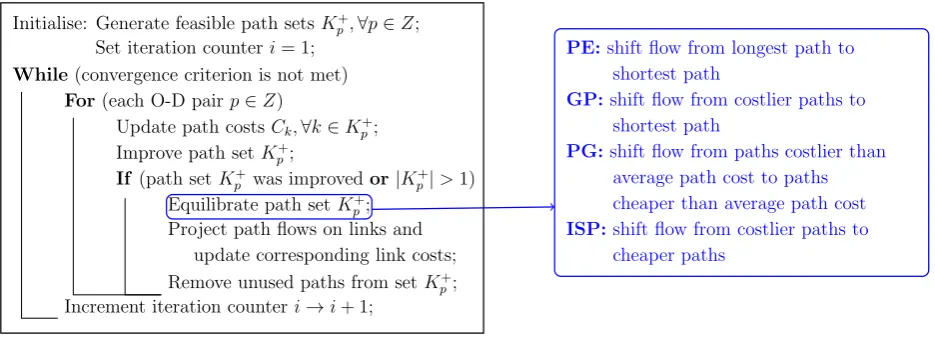
p denote the set of paths between O-D pairpthat are currently in use, i.e. they carry positive flow. A general framework of this group of algorithms is presented in Figure 2.
In order to prevent storing all possible paths for each O-D pair, a column generation
approach is usually applied, which is based on the idea of generating new paths when
needed [13]. For a given O-D pair p find the shortest path and add it to K+
Initialise: Generate feasible path setsK+
p,∀p∈Z;
Set iteration counteri= 1;
While(convergence criterion is not met)
For(each O-D pairp∈Z)
Update path costsCk,∀k∈Kp+;
Improve path setK+
p;
If (path setK+
p was improvedor|Kp+|>1)
Equilibrate path setK+
p;
Project path flows on links and update corresponding link costs;
Remove unused paths from setK+
p;
Increment iteration counteri→i+ 1;
PE:shift flow from longest path to
shortest path
GP:shift flow from costlier paths to
shortest path
PG:shift flow from paths costlier than
average path cost to paths cheaper than average path cost
ISP:shift flow from costlier paths to
[image:14.595.65.533.110.279.2]cheaper paths
Figure 2: Framework for path-based algorithms
to“Improve path set K+
p ” of the framework. In order to keep only promising paths inKp+, the paths that do not carry flow are removed from K+
p .
As in the case of link-based methods, initialisation is performed by AON assignment. In
addition to a link flow solution, each set K+
p ,∀p ∈ Z must also be initialised. This can is done by adding the shortest path corresponding to O-D pair p toK+
p . Every such shortest path pis initialised with flow equal to demand Dp.
Let a commodity refer to trips between a single D pair. Due to the decomposition by
O-D pairs, the solution to the original TA problem is found by solving several single commodity
sub-problems sequentially until the desired precision of the solution is reached. This single
commodity sub-problem is identical to (2), but restricted to O-D pair p and fixed set of
paths K+
p . Path-based algorithms differ in how such a sub-problem is solved. As presented in Patriksson [13], for the single commodity sub-problem the feasible direction of descent
is defined as the path cost differences between cheaper and costlier paths. Equivalently,
moving the current solution in the feasible descent direction means that path set K+
p is equilibrated, i.e. some or all of the path costs of set K+
p are equalised.
Many algorithms for convex optimisation problems scale the direction of descent by the
Hessian matrix or its approximation in order to achieve higher convergence rate [41]. In the
case of a single commodity sub-problem the direction of descent can also be scaled before
on how the direction is scaled. “Newton method” here means that second order derivatives
are used to guide the search direction to solve decomposed sub-problems. However, the
structure of these algorithms is a Gauss-Seidel decomposition2 process, the convergence rate of which is linear [32].
If the direction of descent is scaled by the Hessian matrix, then the resulting method
corresponds to a constrained version of the Newton method [41]. If an approximation of the
Hessian is used instead, then the method can be viewed as a scaled gradient projection or
constrained quasi-Newton approach [41].
The case when the direction of descent contains only two non-zero elements (it also means
that the flow is moved between only two paths) is of a particular interest. In this case, the
Hessian matrix is a scalar and can be easily calculated. In the following, this situation will
be referred to as Newton step (for details, see Section 4.4.3). When there are more than
two non-zero elements in the direction of descent, i.e. more than two paths are considered
simultaneously, then different approximations of the Hessian matrix can be used.
The following subsections discuss different path-based algorithms and their variations
depending on whether a scaled or non-scaled direction of descent is applied. All algorithmic
steps are described for one O-D pair denoted by p. We also simplify the notation of path
cost functions by using Ck instead of Ck(F).
4.2.1. Path Equilibration
The PE algorithm equalises the costs of the current longest pathl ∈K+
p with positive flow and the current shortest paths∈K+
p . The direction of descent d is defined as follows [12]:
ds =Cl−Cs,
dl =Cs−Cl,
dj = 0,∀j ∈Kp+, j 6=s, j 6=l.
(4)
The current path flow solution is moved along this direction using the step size calculated
as presented in Section 4.4.2.
2
Gauss-Seidel decomposition refers to the process of solving a problem by decomposing it into several
Since only two path costs are equalised, the Newton step can be applied as discussed in
Section 4.4.3.
Originally PE was implemented to solve the traffic assignment problem with quadratic
link cost functions and was applied only to small instances [27]. In Leventhal et al. [27], it
is not specified what method was used to equalise path costs at each iteration. Florian and
Hearn [12] present a feasible direction method with a line search for PE. We implemented
both scaled and non-scaled descent directions for this algorithm.
4.2.2. Gradient Projection
The GP algorithm considers several paths at each iteration. In particular, it moves
flow to the current shortest path s ∈ K+
p from all other paths of set Kp+. As presented in Jayakrishnan et al. [29], firstly, a flow shift is calculated:
∆Fk =
Ck−Cs
P
a∈As,k
∂ca
∂fa
,∀k∈Kp+, k 6=s, (5)
where As,k is the set of links that belong either to path k or to path s but not to both of
them. Secondly, a new solution is projected onto the feasible set:
Fk =Fk−min{α∆Fk, Fk},∀k ∈Kp+, k6=s,
Fs =Dp−Pk∈K+
p,k6=sFk,
(6)
whereαis a predefined constant that must be small enough in order to guarantee convergence of the algorithm [29]. Jayakrishnan et al. [29] recommend to set it to 1. However, after
several runs of the algorithm we setα to 0.25, because this value allows all tested instances to converge. The algorithm performance depends a lot on parameter α. In particular, for
some instances when the algorithm converges with α = 1, it achieves the required level of precision much faster compared to the case when α = 0.25. However, we did not adjust α
specifically for every instance, but rather fixed it to a value that allows all tested instances to
converge. Chen et al. [42] and Chen et al. [43] also suggest a self-adaptive step size strategy
for GP and other algorithms that we did not implement in our study. Another modification
This version of GP with projection operator can be classified as a scaled gradient
pro-jection with diagonal approximation of the Hessian [14]. In the following, this method will
be referred to as GP Newton.
Alternatively, instead of projecting the current solution onto the feasible set, a feasible
direction of descent combined with a line search can be used:
dk = PCs−Ck
a∈As,k ∂ca∂fa
,∀k ∈K+
p , k 6=s,
ds =−Pk∈K+p,k6=sdk.
(7)
Once the direction of descent is calculated the current solution is updated: Fk =Fk+λdk,
whereλis a step size found by applying a line search (see Section 4.4.2). This approach was presented in Cheng et al. [45]. In the rest of the paper, this method will be called GP2.
Another variation of GP includes a non-scaled feasible direction combined with a line
search. The descent direction is:
dk=Cs−Ck, ∀k∈Kp+, k 6=s,
ds=−Pk∈Kp+,k6=sdk.
(8)
In the following, this method will be denoted GP1.
4.2.3. Projected Gradient
The main idea of the PG algorithm is to move flow from the paths that have cost greater
than the current average path cost to the paths that have cost less than the average value.
It is equivalent to defining the following direction of descentd:
dk= ¯Cp−Ck,∀k ∈Kp+, (9) where ¯Cp =
P
k∈Kp+Ck
|K+p| is the average cost of the paths of O-D pairp[10]. In order to find the appropriate amount of flow to move, a line search is applied along direction d. As a result, step sizeλis calculated and the path flows are updated accordingly: Fk=Fk+λdk,∀k∈Kp+. For this particular algorithm, it is not obvious how the Hessian matrix can be
approx-imated. A first idea that comes to mind is to apply the same approach as for GP Newton
choose these two paths (in GP Newton flow is always shifted from non-shortest paths to the
shortest path). Therefore, scaled direction of descent is not implemented in our study for
PG.
4.2.4. Improved Social Pressure
The ISP algorithm is based on the idea of “social pressure” which is defined as the
difference between the cost of a path and the cost of the shortest path [31]. All the paths
are divided into two groups Pp ⊂ K+
p ,∀p∈ Z (paths with cost less than or equal to some value π) and Pp ⊂Kp+,∀p ∈ Z (paths with cost greater than π) such that Pp∪Pp =Kp+. The value ofπ is determined at each iteration asπ =Cs+δ·(Cl−Cs), whereCs andCl are the costs of the current shortest and longest paths, δ is a predefined constant that was set to 0.15 as suggested in Kumar and Peeta [31]. Flow is shifted from the paths belonging to
setPp to the paths belonging to setPp. This is equivalent to defining a direction of descent
d and moving the solution along this direction. Direction d is:
dk =Cs−Ck,∀k ∈Pp,
dl =
−Pk∈Ppdk sl(Fl)·Pm∈P p
1
sm(Fm),∀l ∈Pp,
(10)
wheresm(Fm) is the first derivative of the cost function of pathmwith respect to path flow,
sm(Fm) = Pa∈m ∂ca(fa)
∂fa . The step sizeλ is calculated as presented in Section 4.4.2 and path flows are updated according to Fk =Fk+λdk,∀k ∈Kp+.
ISP scales some elements of the direction of descent by a scaling factor based on second
derivative information. Such an approach can be viewed as an approximation of the Hessian.
Applying a non-scaled direction of descent to PG makes this algorithm equivalent to
GP1 (the non-scaled part of the direction of descent in equation (10) is the same as in
equation (8) of GP1) and, hence, is not implemented in our study.
4.3. Bush-based Algorithms
Bush-based algorithms exploit the O-D pair separability of the TA problem. But instead
of decomposing the problem into sub-problems corresponding to each O-D pair, algorithms
iteration, flows are moved within a special data structure called bush. As presented in Nie
[32], a bush is a directed sub-network of the original network G(N, A), rooted at a given origin o. Every bush is
1. Connected, i.e. using only links in the bush, it is possible to reach every node that is
reachable in the original network;
2. Acyclic, i.e. the bush does not contain directed cycles.
We denote a bush by Bo(Ao, N) ⊂ G(A, N), where Ao ⊂ A. Let O ⊆ N denote the set of origins. Then, in each iteration, only one bush Bo(Ao, N) is considered. The
so-lution variables are represented by origin flows fo
a, which denotes the flow on link a of the bush Bo(Ao, N) [35]. The current link-based solution f is the sum of |O| link flows of
Bo(Ao, N),∀o ∈O, i.e. fa =Po∈Ofao,∀a∈A.
The decomposition with respect to origins is equivalent to solving the TA problem by
sequentially solving several single commodity problems as in the case of decomposition by
O-D pairs. However, the difference consists in the sub-problem formulation: path-based
approaches use a path flow formulation defined for each O-D pair, bush-based methods use
a link flow formulation defined for each origin. Link flow formulations do not use path
flow variables in the constraint set. Several such formulations based on different decision
variables exist, see [14, 32, 35].
Decomposition of the traffic assignment problem by origin is possible due to theacyclicity
of user equilibrium: for the single origin formulation (when the problem is restricted to flows
coming from a given origin) of the traffic assignment problem, links that have positive flow
at user equilibrium never form a directed cycle [32]. This property gives several advantages
from a practical point of view since different operations such as shortest path calculations
can be performed more efficiently on acyclic structures (such as bushes) than on general
networks [32]. This is possible due to existence of topological orders in directed acyclic
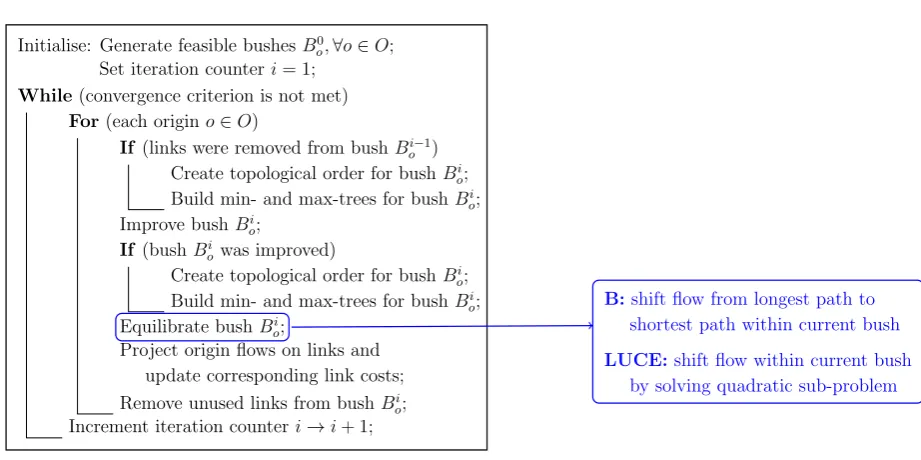
graphs. A topological order is a labelling of each node of an acyclic graph with a number
Initialise: Generate feasible bushesB0
o,∀o∈O;
Set iteration counteri= 1;
While(convergence criterion is not met)
For(each origino∈O)
If (links were removed from bushBi−1
o )
Create topological order for bushBi
o;
Build min- and max-trees for bushBi
o;
Improve bushBi
o;
If (bushBi
owas improved)
Create topological order for bushBi
o;
Build min- and max-trees for bushBi
o;
Equilibrate bushBi
o;
Project origin flows on links and update corresponding link costs;
Remove unused links from bushBi
o;
Increment iteration counteri→i+ 1;
B:shift flow from longest path to
shortest path within current bush
[image:20.595.65.526.99.329.2]LUCE:shift flow within current bush by solving quadratic sub-problem
Figure 3: Framework for bush-based algorithms
All algorithms that decompose the TA problem by origins share a general framework
presented in Figure 3. Each bush Bo(Ao, N) is usually initialised with a shortest path tree
rooted at origin o and the link flows are initialised by AON assignment.
As in the case of path-based methods, bushes are constructed iteratively by adding
promising links and removing unused ones. The links that carry zero flow are dropped if
the connectivity of the bush is retained. The addition of new links must be performed with
care in such a way that directed cycles are not created. The reader is referred to Nie [32]
for a detailed explanation of this algorithmic step.
4.3.1. Algorithm B
Algorithm B was introduced by Dial [35]. Its main idea is similar to PE (see
Sec-tion 4.2.1), i.e. the flow is shifted from the longest used path to the shortest path, but
within a given bush. Instead of considering paths from a given origin explicitly, for every
nodej of the current bush (considered in descending topological order) the algorithm builds
two segments of paths: one segment belongs to the shortest path ending at nodej and the other one belongs to the longest path with flow also ending at node j (if such a segment
are built, flow is moved from the segment with higher cost to the segment with lower cost.
As in the case of PE, in order to find the amount of flow to move several approaches can be
implemented, i.e. feasible direction with a line search and Newton step.
4.3.2. Linear User Cost Equilibrium Algorithm
This algorithm was proposed by Gentile [8]. It decomposes the problem by destinations.
We reformulated it as an origin-based approach in order to use the same framework as for
other bush-based algorithms. The main idea of this method is to seek at every node the
equilibrium flow coming from the same origin among the in-coming links of this node. LUCE
uses flow portions φij,∀(i, j)∈ Ao as solution variables. Let ηj denote the total amount of flow coming to node j from a given origin, thenφij is a portion of flow on every link coming into node j.
The descent direction of LUCE is obtained by solving a quadratic programming
sub-problem presented in [8]. Unlike algorithm B, this sub-sub-problem is based on flow portions
φij. This raises certain difficulties related to the fact that the second order derivative of the objective function with respect to φij is not available in closed form [47]. The practical
implications of this are discussed in Xie et al. [47] and in Section 5.2.3. Once the direction of
descent is calculated, a line search is used in order to determine the appropriate flow shift.
4.3.3. TAPAS
This algorithm was developed by Bar-Gera [37]. As mentioned earlier, this method
cannot be strictly classified as a bush-based approach since its structure is different from
other bush-based techniques. However, we classify it as bush-based because it uses origin
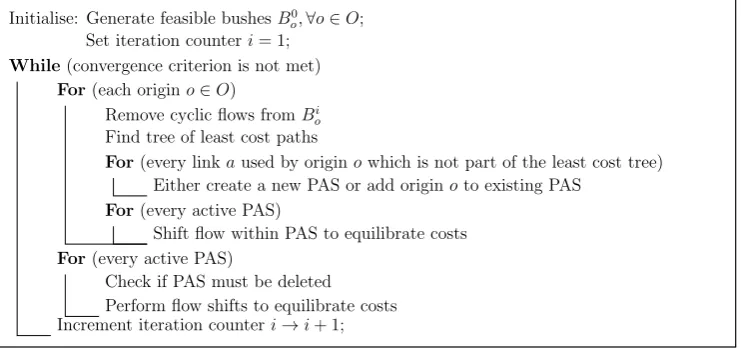
flows as solution variables. The TAPAS framework is presented in Figure 4.
The algorithm uses paired alternative segments (PAS). A paired alternative segment
contains two path segments that do not share links and have the same first and last nodes.
A PAS is not related to any particular O-D pair or origin, but it can be the part of paths
belonging to different O-D pairs. In fact, each PAS has a set of origins associated with it.
TAPAS consists of two routines. First, it loops through all origins (during this stage new
Initialise: Generate feasible bushesB0 o,∀o∈O; Set iteration counteri= 1;
While(convergence criterion is not met) For(each origino∈O)
Remove cyclic flows fromBi o Find tree of least cost paths
For(every linkaused by originowhich is not part of the least cost tree) Either create a new PAS or add originoto existing PAS
For(every active PAS)
Shift flow within PAS to equilibrate costs For(every active PAS)
[image:22.595.114.485.112.287.2]Check if PAS must be deleted Perform flow shifts to equilibrate costs Increment iteration counteri→i+ 1;
Figure 4: Framework for TAPAS
this stage flows are shifted within the PASs and inactive PASs are removed).
Flow is shifted within each PAS from the higher cost segment to the lower cost one.
This flow shift is similar to the one in PE and algorithm B and the same approaches can be
applied in order to do this (feasible direction with a line search or Newton step). In addition,
each PAS has a set of relevant origins, which means that when a flow shift within a given
PAS is performed, origin flows of relevant origins must be updated (for details see [37]).
It is not necessary to keep bushes acyclic in the way it is usually done in bush-based
approaches. Cyclic flows are directly removed from each bush if they occur (in case of
algorithm B or LUCE links that can create directed cycles are never added to the bush).
This is done by applying a topological sorting algorithm to links of a given bush that carry
positive flow. Then cyclic flow is removed along each identified cycle.
TAPAS seems to be similar to algorithm B because it also moves flows between path
segments. However, unlike algorithm B, one flow move in TAPAS usually involves changes
of origin flows of several origins.
It must be noted that we didn’t implement the iterations of maintaining the condition
of path flow proportionality because we didn’t need unique path flows which are
guaran-teed to be found if this condition is applied. Our implementation is not randomised as
our computational experiments.
4.4. Solving Sub-problems
This section presents different methods that were implemented in our study for solving
sub-problems that arise in the TA algorithms outlined in Sections 4.1-4.3.
4.4.1. Shortest Path
Each TA method requires solving shortest path problems many times. Link-based
ap-proaches need a single-source shortest path algorithm for general graphs. The same type of
shortest path algorithm is also required for the relative gap calculation. For this purpose,
we implemented the label correcting algorithm presented in Sheffi [6].
Path-based approaches, on the other hand, require a point-to-point shortest path method
since at each iteration only one O-D pair is considered. As discussed in Section 4.2, before
shifting flows between paths of a particular O-D pair, we check if the set of active paths
contains a path with smaller cost than the current shortest path. For this, we used the A* algorithm3, see Goldberg et al. [48].
Alternatively, instead of calculating the shortest path between each O-D pair before
performing a flow move, we can calculate shortest paths from a given origin to all other
nodes and use this shortest path tree in further calculations, as suggested in Chen and
Jayakrishnan [30]. Once all O-D pairs coming from one origin are considered, a new shortest
path tree is calculated for the next origin. Thus, the same shortest path tree is used for
all O-D pairs coming from one origin, but the link travel times are updated after each flow
move. The advantage of this approach is a smaller number of shortest path calculations: |O|
one-source shortest path calculations (where|O|is the total number of origins) compared to
|Z| point-to-point shortest path calculations (where |Z| is the total number of O-D pairs). However, this approach might lead to an increase of the total number of iterations required
by a path-based algorithm since the information about new shortest paths is available only
3
An implementation of the A*
when the algorithm proceeds to the next origin. We did not implement this particular
shortest path strategy in our study. It is subject of our future research.
For bush-based methods we implemented the shortest path algorithm for directed acyclic
graphs that uses topological order, see Dasgupta et al. [46].
4.4.2. Line Search
This section discusses how to find a step size that can be used to move a current solution
along a given direction of descent. We denote by y = (y1, ..., y|A|) the direction of descent
defined in terms of link flows. Determining step sizeλ is equivalent to solving the following
optimisation problem [10]:
V(λ) = minP
a∈A fa+λya
R
0
ca(x)dx
s.t. 0≤λ≤λub,
(11)
wherefa is the current flow of linkaandλub is an upper bound on the step size that ensures
that the new solution will remain feasible.
For link-based approaches and LUCE, the direction of descent is already defined in terms
of link flows and can be directly used as y. For path- and other bush-based methods, the direction of descent must be projected onto links: y= ∆dwhere ∆ is a matrix with elements δka such thatδak is equal to one if link a belongs to pathk and zero otherwise.
The value ofλubdepends on the direction of descent. It is equal to one if the direction of
descent cannot cause the solution to become infeasible (link-based methods and LUCE). If
the solution can become infeasible, the upper bound is derived from feasibility constraints:
λub = min k
n
−Fkmax
dk |dk <0
o
whereFmax
k is a maximum feasible flow shift (it might be path or origin flow depending on the algorithm) [12, 45].
Problem (11) is a one-dimensional optimisation problem. It can be solved in one of the
following ways:
1. Exactly: find a value of λ that minimises the objective function in (11), for example,
2. Approximately: find the value of λ that does not necessarily minimise the objective
function in (11), but guarantees the decrease of the objective function value after
applying this step size. For example, one of the following approaches can be applied:
(a) Armijo-like rule: determine the largest step λ = βk for any non-negative inte-ger k, such that the directional derivative of the objective function V(λ) (see
mathematical programme (11))
∂V(λ)
∂λ =c(f +λy)
T
·y, (12)
is negative [8]. The decrement β in our study was set to 2 as proposed in [8]. (b) Quadratic approximation: the objective function along the direction of descent is
approximated by a quadratic function and minimised using the analytic solution,
i.e. λ= minnλub,1/1− ∂V(λub)/∂λ
∂V(0)/∂λ
o
, see [8, 45].
In our study, we implement bisection, the Armijo-like rule and quadratic
approxima-tion. The impact of different line search strategies on the performance of TA algorithms is
discussed in Section 5.2.1.
4.4.3. Newton Step
This section presents how to calculate a flow shift between two paths in order to equalise
their costs using the Newton method.
Let l denote a path from which the amount of flow ∆F will be shifted to a path s. If Cl(∆F) and Cs(∆F) are the costs of path l and s, respectively, after the flow shift, then
one has to solve the non-linear equation
Cl(∆F)−Cs(∆F) = 0, (13)
with respect to flow shift ∆F. After applying the Newton method to equation (13), the
appropriate flow shift is
∆F = PCl−Cs a∈A′
∂ca
∂fa
whereA′ is the set of links that belong to path l and path s without links common to both
these paths. It must be noted that flow shift ∆F might be infeasible causingFl to become negative. That is why projection onto the feasible set is required:
Fl =Fl−min{Fl,∆F},
Fs =Fs+ min{Fl,∆F}.
(15)
A Newton step can be applied iteratively to the two paths under consideration until the
desired precision is reached. However, it is usually applied only once [47] and we follow this
convention.
4.4.4. Equilibration Strategies
Path- and bush-based algorithms iterate between improving an element of decomposition
(add better paths to a set of active paths, add better links to a bush, create new PASs)
and equilibrating it. This set of steps can be performed once for each of the decomposition
elements or several times before proceeding to the next one. In the following, the strategy
of improving and equilibrating each element only once will be called Equilibration I and
the strategy of improving and equilibrating a current element several times will be called
Equilibration II. These approaches are also presented in the literature [32, 49].
In order to implement Equilibration II we must decide how many iterations of improving
and equilibrating should be applied to a given decomposition element before proceeding to
the next one. We propose to switch to a new element if the current decomposition element
is equilibrated to some desired precision. We also limit the maximum number of these
iterations to ten in order to have more control over the total running time of the algorithms.
Equilibration I and II are studied in Section 5.2.2.
4.5. Difficulties of Comparison of Groups of Algorithms
As can be seen from Sections 4.1-4.3, the algorithms that belong to the same group of
methods (link-, path- and bush-based) share the same framework and differ only slightly.
methods belonging to different groups require special algorithms specific only to that
par-ticular group. This might lead to difficulties when comparing groups of algorithms even
though they use the same code as much as possible. For example, all path-based methods
implement A* to solve point-to-point shortest path problems. However, there might exist more efficient algorithms for this purpose that might lead to a better performance of the
entire group of path-based methods. Moreover, special implementation techniques might
further improve the performance of some groups of algorithms or particular algorithms (for
example, “thread following” used to update shortest paths [50], flow update schemes for
FW [51], multi-threaded implementations [39], etc). Therefore, the comparison of groups of
algorithms should be considered with care as it possibly depends on particular
implementa-tions.
5. Computational Study
5.1. Problem Instances and Computational Environment
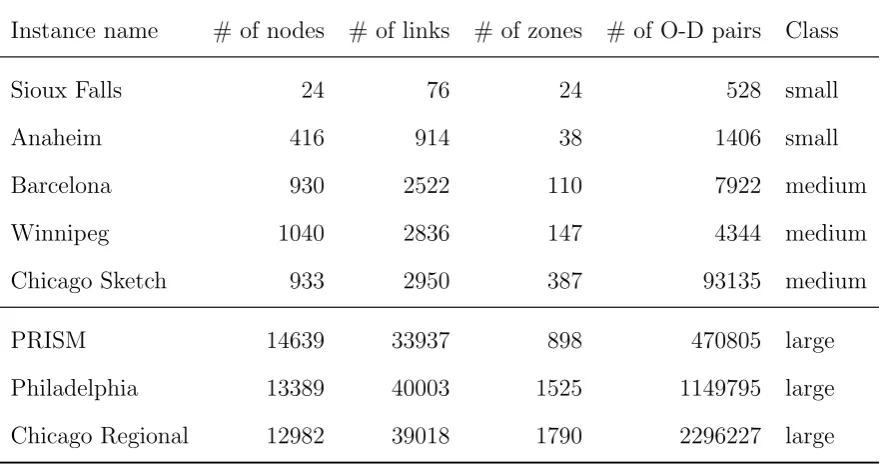
We performed computational tests on the instances available at the web-site http://
www.bgu.ac.il/~bargera/tntp/. The main characteristics of these instances are presented in Table 3. The first five instances are of small to medium size, whereas the last three
instances are large and are used in a separate numerical test (see Section 5.2.4).
All instances use BPR link cost functions of the form
ca(fa) = f reeF low·
1 +B·
fa
capacity
power
,
wheref reeF low, B, capacity and power are function parameters.
All algorithms were implemented in the C++ programming language in terms of the
framework presented in Section 4 that ensures the usage of common code wherever possible.
We used the compiler g++ 4.7.3 (Ubuntu/Linaro 4.7.3-1ubuntu1) with optimisation option
-O3.
All algorithms were implemented with different options. For line search we implemented
bisection, Armijo-rule and quadratic approximation; for the different algorithms we
Table 3: Problem instances
Instance name # of nodes # of links # of zones # of O-D pairs Class
Sioux Falls 24 76 24 528 small
Anaheim 416 914 38 1406 small
Barcelona 930 2522 110 7922 medium
Winnipeg 1040 2836 147 4344 medium
Chicago Sketch 933 2950 387 93135 medium
PRISM 14639 33937 898 470805 large
Philadelphia 13389 40003 1525 1149795 large
Chicago Regional 12982 39018 1790 2296227 large
algorithms we used extended floating point precision (C++ long double type). All tests on
small and medium instances were performed under the environment OS – Ubuntu Release
13.10 64-bit; CPU – Intel Core i5-2500 CPU, 4 Core, 3.30GHz; RAM – 7.7 GB. All tests on
large instances were performed under the environment OS – Ubuntu Release 12.10 64-bit;
CPU – Intel Core i5-3570 CPU, 4 Core, 3.40GHz; RAM – 15.6 GB.
5.2. Results
We use the relative gap RGAP (see equation (3)) as a convergence criterion because it is a common measure of convergence (see [10, 32, 35, 39]), and it can be calculated for all
tested algorithms.
We decided to perform several numerical tests. Since tests on large instances might
require long computational time, we first performed tests on small and medium instances
with different configuration options for all algorithms. Based on the results of these tests,
we chose the best configuration options for each algorithm and eliminated methods that do
not seem promising and performed numerical tests on large instances with the remaining
It must be noted that not all algorithms can find highly accurate solutions in a reasonable
amount of time. Because of this we developed several tests in order to choose the best options
for every algorithm.
1. Test 1: For this test, we chose the algorithms that can achieve high precision (PE,
GP, ISP, B, TAPAS) and examined Equilibration I strategy. The required accuracy
of the solution was set toǫ= 10−14, i.e. the algorithms were stopped after the relative gap was less than ǫ.
2. Test 2: In this test, we investigated the impact of Equilibration II on the algorithms
from Test 1. Again, high precision of ǫ= 10−14 was used.
3. Test 3: This test is devoted to all remaining algorithms that cannot achieve high
precision (FW, CFW, BFW, PG, LUCE) in a reasonable amount of time. A time
limit was used in addition to the stopping condition based on the relative gap.
Finally,Test 4 is devoted to large instances. Only the best algorithms with the best options
were considered and a time limit was used as an additional stopping criterion.
5.2.1. Test 1: High Precision
Test 1 was performed on the five small and medium instances listed in Table 3. We tested
the following algorithms with Equilibration I and high precision of 10−14of relative gap: PE, GP, ISP, B and TAPAS with various options for line search and direction of descent.
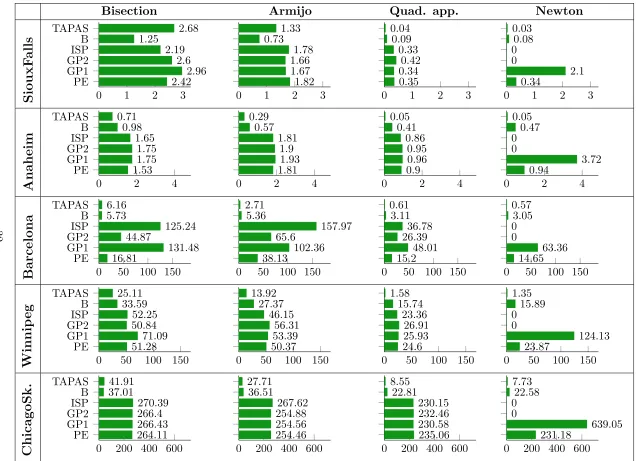
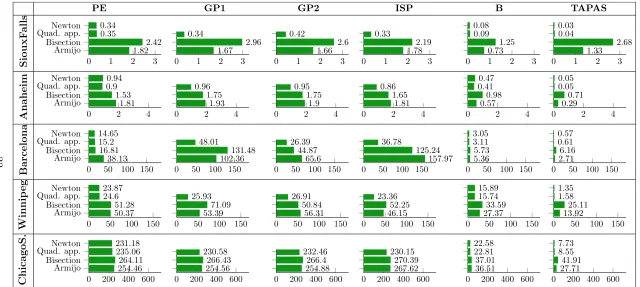
Figures 5 and 6 show CPU time in seconds for different instances where algorithms are
grouped in different ways. In Figure 5 all algorithms are grouped according to the way the
step size is calculated: Armijo rule, bisection, quadratic approximation and other methods
that do not use a line search (this category includes all methods that implement Newton
step and GP Newton). In Figure 6, all configurations are grouped according to a particular
algorithm. However, GP Newton is not considered because it shows the worst performance
compared to the other approaches. The time reported in Figures 5 and 6 is pure iteration
time – the time needed to perform the iterations of an algorithm, but it does not include
object creation, output operations and convergence check is negligible compared to the pure
iteration time. Because of this all conclusions are derived based only on pure iteration time.
After analysing different configurations of the algorithms we can conclude that for PE
the best option is Newton step, for GP1 and GP2 it is quadratic approximation, for ISP
– quadratic approximation, for algorithm B – Newton step, for TAPAS – Newton step.
This observation regarding different configurations of the algorithms shows that if a line
search is applied, it is better to approximate the step size using quadratic approximation.
However, applying a Newton step is preferable to a line search, if it is possible. All
path-based algorithms except GP Newton show similar performance with the exception of the
Barcelona instance, where PE is a better choice. GP Newton depends on an
algorithm-specific constant that influences its performance and convergence [30]. In our study, this
constant was set to a small enough value in order to achieve convergence for all instances.
As a result of this choice, this particular configuration does not always perform well, but
converges for all instances. A different choice of this constant for different instances can lead
to better performance of GP Newton for those instances. In general, path-based algorithms
are outperformed by bush-based algorithms represented by algorithm B and TAPAS. Overall,
TAPAS with Newton step shows the best performance.
Considering only total running times needed for the algorithms to reach the required
precision is not sufficient for the algorithm comparison since the convergence behaviour
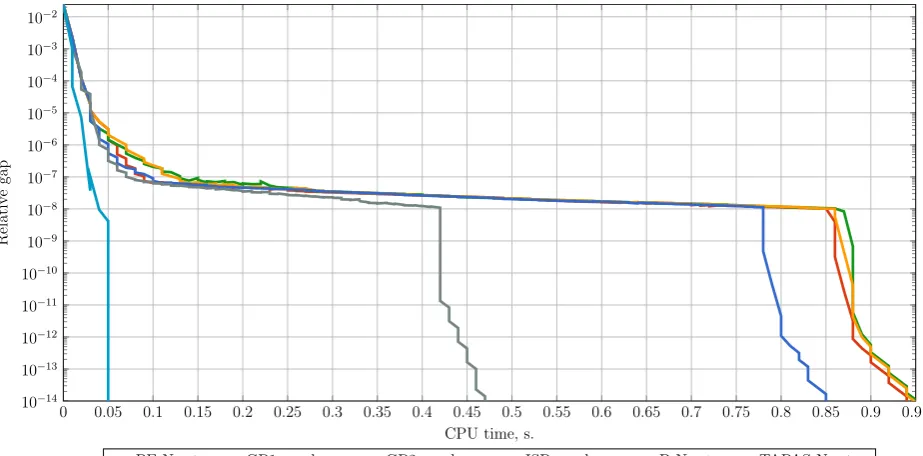
cannot be seen. Figures 7-10 show the convergence of the algorithms on three selected
instances with the best options identified in Figures 5 and 6 (other figures of convergence
behaviour can be obtained by request). CPU times reported on theses figures consider only
pure iteration time.
Let us analyse convergence patterns. On all instances, the algorithms converge fast to
the level of relative gap around 10−6 and slow down after this point. TAPAS is an exception to this observation. Usually TAPAS requires more time during the first iterations compared
to other algorithms and then converges faster. Initial iterations of TAPAS take more time
because many PASs are created at this stage. For example, consider the Winnipeg instance.
the 4th only 183 new PASs were created.
Several instances show specific convergence patterns. For example, on the Anaheim
instance (Figure 7), the majority of algorithms “stall” with the value of relative gap around
10−7 and after some time they suddenly improve performance significantly. Plateaus like this can be seen on other instances. However, they usually do not last for as long as for
the Anaheim instance. After analysing in more detail what happens, we conclude that the
situation is similar to “extreme coupling” discussed in Bar-Gera [37]. In this case, only small
amounts of flow are moved between several paths and the algorithm does not significantly
improve the current solution until a sufficient amount of flow has been shifted. An example
can be found in Bar-Gera [37].
On the Winnipeg and Barcelona instances (Figure 8) many algorithms show zigzag
pat-terns when the value of relative gap is lower than 10−6. These two instances use high powers in the BPR functions (for Barcelona power ∈ [0,16.83], for Winnipeg power ∈ [0,6.8677]) compared to the other instances where power is bounded by 4. As pointed out in Spiess [52], the use of high powers in BPR functions is not recommended for two reasons.
1. During initial iterations of traffic assignment algorithms, many links can have high
values of the ratio fa
capacity. If the parameter power is also high, this might lead to numerical problems like overflow and loss of precision;
2. In the situation when the ratio fa
capacity is small, high values of power might cause the BPR function to become numerically not strictly increasing, i.e. it will return the same
value for different link flows.
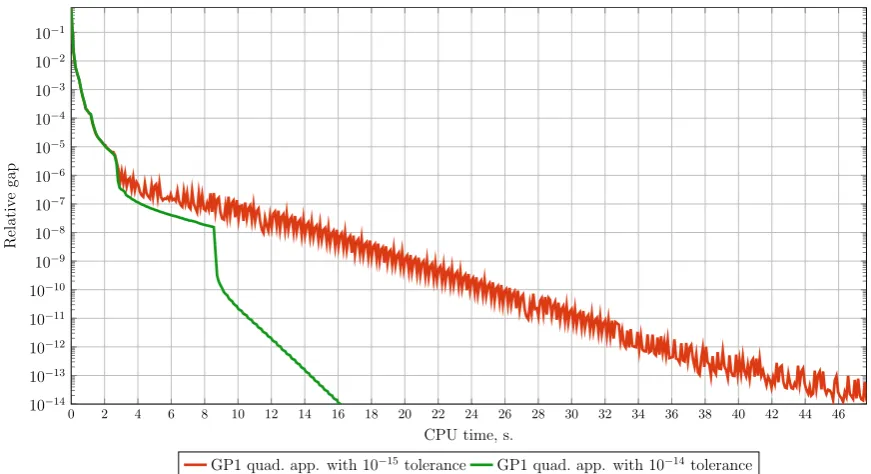
We investigated in detail algorithm GP1 with quadratic approximation on the Barcelona
instance. In fact, if we change the tolerance of the direction of descent from 10−15 to 10−14 (it means that only 14 digits of the direction of descent are considered significant), the
al-gorithm converges within 16 seconds compared to 48 seconds as demonstrated in Figure 9.
This fact means that the magnitude of error accumulated in the calculation of the direction
know the magnitude of error beforehand and adjust the algorithm accordingly. Long times
of reaching a highly precise solution might be related to rounding errors and not to the
per-formance of algorithms. However, some algorithms are more stable in terms of accumulated
numerical errors than the others. This issue is discussed in Section 5.2.3.
Bottom line:
1. All path-based algorithms show similar performance;
2. Algorithm B and TAPAS outperform path-based methods;
3. Overall TAPAS shows better performance than other approaches;
4. In the case of a line search, it is preferable to apply quadratic approximation, however,
if Newton step is applicable it is preferable;
5. When a highly precise solution is required, the algorithms might experience instability
Bisection Armijo Quad. app. Newton
Si
o
ux
F
a
ll
s
0 1 2 3
PE GP1 GP2ISP B TAPAS
2.422
.96 2.6 2.19 1.25 2.68
0 1 2 3
1.82 1.67 11.66.78 0.731.33
0 1 2 3
0.35 00..3442 0.33 0.09 0.04
0 1 2 3
0.34 2
.1 0
00.08 0.03
A
na
he
im
0 2 4
PE GP1 GP2ISP B TAPAS
11.53
.75 1.75 1.65 0.98 0.71
0 2 4
11.81
.93 1.9 1.81 0.57 0.29
0 2 4
00.9
.96 0.95 0.86 0.41 0.05
0 2 4
0.94 3
.72 0
00
.47 0.05
B
a
r
ce
lo
na
0 50 100 150 PE
GP1 GP2ISP B TAPAS
16.81 131.48 44.87 125.24 5.73
6.16
0 50 100 150 38.13 102.36
65.6 157.97 5.36
2.71
0 50 100 150 15.248.01
2636.39.78 3.11 0.61
0 50 100 150 14.6563.36 0
03.05 0.57
Wi
nni
p
e
g
0 50 100 150
PE GP1 GP2ISP B TAPAS
5171.28
.09 5052.84
.25 33.59 25.11
0 50 100 150
5053.37
.39 56.31 46.15 27.37 13.92
0 50 100 150
2425.6
.93 26.91 23.36 15.74 1.58
0 50 100 150
23.87 124
.13 0
015
.89 1.35
C
hi
ca
g
o
Sk
.
0 200 400 600 PE
GP1 GP2ISP B TAPAS
264.11 266.43 266270..439 3741..0191
0 200 400 600 254.46 254.56 254267..8862 36.51
27.71
0 200 400 600 235.06 230.58 232.46 230.15 22.81 8.55
0 200 400 600 231.18 639.05 0
022.58 7.73
[image:33.842.99.735.62.523.2]PE GP1 GP2 ISP B TAPAS Si o ux F a ll s
0 1 2 3
Armijo Bisection Quad. app.Newton
1.822.42 0.35
0.34
0 1 2 3
1.67 2.96 0.34
0 1 2 3
1.66 2.6 0.42
0 1 2 3
1.782.19 0.33
0 1 2 3
0.731.25 0.09 0.08
0 1 2 3
1.33 2.68 0.04
0.03
A
na
he
im
0 2 4
Armijo Bisection Quad. app.Newton
1.81 1.53 00..994
0 2 4
1.93 1.75 0.96
0 2 4
1.9 1.75 0.95
0 2 4
1.81 1.65 0.86
0 2 4
0.057.98 00..4147
0 2 4
0.029.71 0.05 0.05
B a r ce lo na
0 50 100 150 Armijo
Bisection Quad. app.Newton
38.13 16.81 15.2 14.65
0 50 100 150 102131.36
.48 48.01
0 50 100 150 65.6 44.87 26.39
0 50 100 150 157.97 125.24 36.78
0 50 100 150 5.36
5.73 3.11 3.05
0 50 100 150 26.71
.16 0.61 0.57
Wi
nni
p
e
g
0 50 100 150 Armijo
Bisection Quad. app.Newton
5051..3728 24.6 23.87
0 50 100 150 5371.39.09 25.93
0 50 100 150 56.31 50.84 26.91
0 50 100 150 4652.15.25 23.36
0 50 100 150 2733.37.59 15.74 15.89
0 50 100 150 1325.92.11
1.58 1.35
C hi ca g o S.
0 200 400 600 Armijo
Bisection Quad. app.Newton
254264..4611 235.06 231.18
0 200 400 600 254266..5643 230.58
0 200 400 600 254266..884 232.46
0 200 400 600 267.62 270.39 230.15
0 200 400 600 36.51
37.01 22.81 22.58
0 200 400 600 2741..7191
[image:34.842.99.739.136.423.2]8.55 7.73
Figure 6: Test 1. CPU time, s.
0 0.05 0.1 0.15 0.2 0.25 0.3 0.35 0.4 0.45 0.5 0.55 0.6 0.65 0.7 0.75 0.8 0.85 0.9 0.95 10−14
10−13
10−12
10−11
10−10
10−9
10−8
10−7
10−6
10−5
10−4
10−3
10−2
CPU time, s.
R
el
at
iv
e
ga
p
[image:35.595.69.531.109.337.2]PE Newton GP1 quad. app. GP2 quad. app. ISP quad. app. B Newton TAPAS Newton
Figure 7: Test 1. Convergence on the Anaheim instance.
0 2 4 6 8 10 12 14 16 18 20 22 24 26 28 30 32 34 36 38 40 42 44 46 48 10−14
10−13
10−12
10−11
10−10
10−9
10−8
10−7
10−6
10−5
10−4
10−3
10−2
10−1
CPU time, s.
R
el
at
iv
e
ga
p
PE Newton GP1 quad. app. GP2 quad. app. ISP quad. app. B Newton TAPAS Newton
[image:35.595.66.534.399.638.2]0 2 4 6 8 10 12 14 16 18 20 22 24 26 28 30 32 34 36 38 40 42 44 46
10−14
10−13
10−12
10−11
10−10
10−9
10−8
10−7
10−6
10−5
10−4
10−3
10−2
10−1
CPU time, s.
R
el
at
iv
e
ga
p
GP1 quad. app. with 10−15tolerance GP1 quad. app. with 10−14tolerance
Figure 9: Effect of change in tolerance of the direction of descent of GP1 on the Barcelona instance.
0 10 20 30 40 50 60 70 80 90 100 110 120 130 140 150 160 170 180 190 200 210 220 230 10−14
10−13
10−12
10−11
10−10
10−9
10−8
10−7
10−6
10−5
10−4
10−3
10−2
10−1
CPU time, s.
R
el
at
iv
e
ga
p
[image:36.595.81.517.127.364.2]PE Newton GP1 quad. app. GP2 quad. app. ISP quad. app. B Newton TAPAS Newton
[image:36.595.66.530.442.671.2]![Table 2: Summary of existing empirical studies. High precision: RGAP ∈ [10−14, 10−10]](https://thumb-us.123doks.com/thumbv2/123dok_us/7903249.188384/11.595.104.491.136.380/table-summary-existing-empirical-studies-high-precision-rgap.webp)