White Rose Research Online URL for this paper:
http://eprints.whiterose.ac.uk/84995/
Version: Published Version
Article:
Chalendar, I, Gorkin, P and Partington, JR orcid.org/0000-0002-6738-3216 (2015) Inner
functions and operator theory. North-Western European Journal of Mathematics, 1. pp.
9-28.
(c) The Authors 2015. Published by North-Western European Journal of Mathematics.
Reproduced in accordance with the publisher's contract licence.
(http://math.univ-lille1.fr/~nwejm/#Policies)
[email protected] Reuse
Items deposited in White Rose Research Online are protected by copyright, with all rights reserved unless indicated otherwise. They may be downloaded and/or printed for private study, or other acts as permitted by national copyright laws. The publisher or other rights holders may allow further reproduction and re-use of the full text version. This is indicated by the licence information on the White Rose Research Online record for the item.
Takedown
If you consider content in White Rose Research Online to be in breach of UK law, please notify us by
North-Western European Journal of Mathematics
Inner functions and operator theory
Isabelle Chalendar1 Pamela Gorkin2 Jonathan R. Partington3
Received: December 7, 2014/Accepted: March 6, 2015/Online: April 2, 2015
Abstract
This tutorial paper presents a survey of results, both classical and new, link-ing inner functions and operator theory. Topics discussed include invariant subspaces, universal operators, Hankel and Toeplitz operators, model spaces, truncated Toeplitz operators, restricted shifts, numerical ranges, and interpola-tion.
Keywords:inner functions, invariant subspaces, universal operators, Hankel and Toeplitz operators, model spaces, interpolation.
msc: 47A15, 47B35, 30H10, 30E05.
1 Introduction
Inner functions originally arose in the context of operator theory, via Beurling’s theorem on the invariant subspaces of the unilateral shift operator. Since then, they have been seen in numerous contexts in the theory of function spaces. This tutorial paper surveys some of the many ways in which operators and inner functions are linked: these include the invariant subspace problem, the theory of Hankel and Toeplitz operators and the rapidly-developing area of model spaces and the operators acting on them.
The paper is an expanded version of a mini-course given at the Eleventh Ad-vanced Course in Operator Theory and Complex Analysis, held in Seville in June 2014.
1.1 Hardy spaces and shift-invariant subspaces
All our spaces will be complex. We writeDfor the open unit disc inCandT=∂D,
the unit circle.
1Université Lyon 1, INSA de Lyon, École Centrale de Lyon, CNRS, UMR 5208, Institut Camille
Jordan, 43 bld. du 11 novembre 1918, F-69622 Villeurbanne Cedex, France
Recall that Hardy spaceH2orH2(D) is the space of analytic functions onD
with square-summable Taylor coefficients; that is,
H2(D) =
f :D→Canalytic,f(z) =X∞
n=0
anzn,kfk2=X∞
n=0
|an|2<∞
.
AlsoH2(D) embeds isometrically as a closed subspace ofL2(T) via
∞
X
n=0
anzn7→
∞
X
n=0
aneint,
where the series converges almost everywhere onTas well as in the norm ofL2(T).
Indeed, limr→1−f(re
it
) exists almost everywhere and gives the boundary values of a functionf inH2(D). (See, for example Hoffman (1962).)
It is useful to use the isometric isomorphismℓ2(Z)→L2(T) given by
(an)n∈Z7→
∞
X
n=−∞ aneint,
which is a consequence of the Riesz–Fischer theorem; this restricts to an isomor-phismℓ2(Z+)→H2(D).
The first connection between inner functions and operator theory arises on considering the right shiftR:ℓ2(Z)→ℓ2(Z). We may ask what its closed invariant
subspaces are; that is, the subspacesM ⊂L2(T) such thatRM ⊂ M. The answer is to look at the unitarily equivalent operatorSof “multiplication byz” onL2(T).
ℓ2(Z) −−−−−−→R ℓ2(Z)
y y
L2(T) −−−−−−→S L2(T)
There are two cases, forMa nontrivial closed subspace ofL2(T):
1. SM=M, if and only if there is a measurable subsetE⊂Tsuch thatM={f ∈
L2(T) :f|T\E= 0 a.e.}(Wiener4).
2. SM(M, if and only if there is a unimodular functionφ∈L∞(T) such that
M=φH2(Beurling–Helson5).
As a sketch proof of item 2, which will be the more important for us, take
φ∈ M ⊖SMwithkφk2= 1. One can verify thatφis unimodular and thatM=φH2.
1. Introduction
Corollary 1 (Beurling’s theorem6,7) – LetMbe a nontrivial closed subspace ofH2;
then SM ⊂ Mif and only if M =θH2 whereθ is inner, that isθ ∈ H2(D) with
|θ(eit)|= 1a.e.
It is easily seen thatθis unique up to multiplication by a constant of modulus 1. Now, any functionh∈H2, apart from the zero function, has a multiplicative factorizationh=θu, whereθis inner, anduisouter: Beurling showed that outer functions satisfy
spann
u, Su, S2u, S3u, . . .o=H2,
and they therefore have an operatorial interpretation, as cyclic vectors for the shift
S. The inner-outer factorization is unique up to multiplication by a constant of modulus one.
1.2 Examples of inner functions
IfMis a shift-invariant subspace of finite codimension, thenθis a finite Blaschke product,
θ(z) =λ n
Y
j=1
z−αj
1−αjz ,
with|λ|= 1 andα1, . . . , αn∈D. Then
M=nf ∈H2:f(α1) =···=f(αn) = 0
o
,
with the obvious interpretation in the case of non-distinctαj. We may also form
infinite Blaschke products
θ(z) =λzp ∞
Y
j=1
|αj|
αj αj−z
1−αjz,
where|λ|= 1, all theαjlie inD\{0},pis a non-negative integer andP∞
j=1(1−|αj|)<∞.
Recall that the sequences ofD satisfying the last condition are called Blaschke
sequences.
There is also a class of inner functions without zeroes, namely the singular inner functions, which may be written as
θ(z) = exp
"
−
Z π
−π eit+z eit
−zdµ(t)
#
,
6Beurling, 1949, “On two problems concerning linear transformations in Hilbert space”.
7See also Garnett, 2007,Bounded analytic functions, theorem II.7.1; Nikolski, 2002, Operators,
whereµis a singular positive measure on [−π, π). For example ifµis a Dirac mass at 0, thenθ(z) = exp((z+ 1)/(z−1)).
A complete description of inner functions is now available, as they are given as
Bs, whereBis a Blaschke product andsis a singular inner function. Either factor may be absent.
Note that ifθ1andθ2are inner, thenθ1θ2is unimodular onT. These are not
all the unimodular functions, but ifφ∈L∞(T) is unimodular then for eachε >0
it can be factorized asφ=h1h2, withh1, h2∈H∞andkh1k,kh2k<1 +ε8. Related to
this is the Douglas–Rudin theorem that the quotientsθ1θ2withθ1andθ2inner are
uniformly dense in the unimodular functions inL∞(T)9.
Of particular importance are the interpolating Blaschke products: a Blaschke productBwith zeroes (zj) is interpolating if its zero sequence is an interpolating sequence forH∞or, equivalently, there existsδ >0 such that
inf
k
Y
j:j,k
zj−zk
1−zkzj
=δ.
These Blaschke products play an important role in the study of bounded analytic functions: consider a closed subalgebraBofL∞containingH∞properly. In
estab-lishing a conjecture of R. G. Douglas, Chang; Marshall10proved that such algebras
(now called Douglas algebras) can be characterized using interpolating Blaschke products: if
UB=n
b:binterpolating andb−1∈Bo,
then an algebra is a Douglas algebra if and only if it is the closed algebra generated byH∞ and the conjugates of the functions inU
B. In other words,B= [H∞, UB].
Much more is known about interpolating Blaschke products: in particular, Jones11
showed that one can take the Blaschke products in the Douglas–Rudin theorem to be interpolating. Related work can be found in Marshall and Stray (1996), Garnett and Nicolau (1996), and Garnett (2007). One very interesting question remains open: can every Blaschke product be approximated (uniformly) by an interpolating Blaschke product Hjelle and Nicolau12have shown that given a Blaschke product,
B, there is an interpolating Blaschke product that approximatesBin modulus onD,
but this is the best result to date.
8Bourgain, 1986, “A problem of Douglas and Rudin on factorization”;
Barclay, 2009, “A solution to the Douglas-Rudin problem for matrix-valued functions”; Chalendar and Partington, 2011,Modern approaches to the invariant-subspace problem. 9Douglas and Rudin, 1969, “Approximation by inner functions”.
10Chang, 1976, “A characterization of Douglas subalgebras”; Marshall, 1976, “Subalgebras ofL∞containingH∞”. 11Jones, 1981, “Ratios of interpolating Blaschke products”.
2. Some operators associated with inner functions
2 Some operators associated with inner functions
2.1 Isometries
1. It is not hard to see that theanalytic Toeplitz operatoror Laurent operator,
Tφ:H2→H2,f 7→φf, whereφ∈H∞, is an isometry if and only ifφis inner.
Moreover codimφH2<∞if and only ifφis a finite Blaschke product.
2. Forφ:D→Dholomorphic, we may consider thecomposition operatorCφ:
H2→H2,f 7→f ◦φ. See for example Cowen and MacCluer (1995) for full details on these. In particular, by Littlewood’s subordination theorem13,C
φis
automatically continuous.
It is a result of E. A. Nordgren14thatC
φis an isometry if and only ifφis inner
andφ(0) = 0. Note that ifφis inner, withφ(0) = 0, then forn > mwe have
hφn, φmi=hφn−m,1i=φ(0)n−m= 0,
so that the orthonormal sequence (zn)n≥0 in H2 is mapped to the orthonormal
sequence (φn)n≥0.
Conversely, since hz,1i= 0, we must haveφ(0) =hφ,1i= 0 if Cφ is to be an
isometry. Also the conditionkφnk= 1 for allncan be used to check thatφis inner.
Bayart15 shows thatC
φ issimilarto an isometry if and only ifφis inner and φ(p) =pfor somep∈D.
2.2 Universal operators
An operatorU defined on a separable infinite-dimensional Hilbert spaceHis said to beuniversalin the sense of Rota, if for every operatorT on a Hilbert spaceK there is a constantλ∈Cand an invariant subspaceMforU such thatT is similar to the restrictionλU|M.
H −−−−−−→
λU H
x
x
M −−−−−−→
λU M
J
y J
y
K −−−−−−→
T K
13Littlewood, 1925, “On inequalities in the theory of functions”. 14E. A. Nordgren, 1968, “Composition operators”.
The following theorem provides many examples of universal operators.
Theorem 1 (Caradus16) – If the operatorU:H → His surjective with infinite-dimen-sional kernel, then it is universal.
1. Takeθinner, but not a finite Blaschke product. Then using Theorem theorem 1 one can show that the Toeplitz operatorTθ=Tθ∗:H2→H2, withf 7→PH2(θf)
is universal.
Such an operatorTθ∗ is similar to the backward shiftAonL2(0,∞), given by
Af(t) =f(t+ 1),
which by the Laplace transform is unitarily equivalent to the adjoint of the operator Me−s of multiplication of e−s on the Hardy spaceH2(C+) of the
right half-plane C+ (heres is the independent variable). Note thate−s is inner: still, in spite of Beurling’s theorem mentioned above, there is no usable characterization of the invariant subspaces ofA.
2. Letφ:D→Dbe defined by
φ(z) =z+ 1/2 1 +z/2;
this is a (hyperbolic) automorphism fixing±1. The composition operatorCφ
has spectrum given by
σ(Cφ) =n
z∈C: 1/√3≤ |z| ≤√3o
.
Forλ∈intσ(Cφ), it can be shown thatCφ−λI is universal17. Note that it
has the same invariant subspaces asCφ, and a complete description of them would give a solution to the invariant subspace problem.
These ideas have stimulated studies on cyclic vectors and minimal invariant subspaces forCφ(e.g. Mortini (1995) and Gallardo-Gutiérrez and Gorkin (2011)).
2.3 Hankel and Toeplitz operators
We begin with the orthogonal decomposition
L2(T) =H2⊕H02
into closed subspaces spanned by{eint:n≥0}and{eint:n <0}, respectively. Write P:L2(T)→H2for the orthogonal projection.
16Caradus, 1969, “Universal operators and invariant subspaces”.
2. Some operators associated with inner functions
Definition 1 – Letφ∈L∞(T). Then theToeplitz operatorTφ:H2→H2is defined byTφf =P(φf) for f ∈ H2. The Hankel operator Γ
φ : H2 → H02 is defined by Γ
φf = (I−P)φf forf ∈H2.
It is well known thatkTφk=kφk∞18and thatkΓ
φk= dist(φ, H∞)19.
2.4 Kernels
1. If u ∈kerΓφ, then φu ∈ H2, so thatzφu∈ H2 andzu ∈ kerΓφ. Hence, by
Beurling’s theorem, kerΓ
φ=θH2for some inner functionθ.
For example, if θ is inner, thenu ∈ kerΓ
θ if and only ifθu ∈ H2, which
happens if and only ifu ∈θH2. So all Beurling subspaces occur as Hankel kernels.
2. Suppose thatθis inner. Thenf ∈kerTθif and only ifhθf , gi= 0 for allg∈H2. This is equivalent to the conditionhf , θgi= 0; that is,f ∈H2⊖θH2. We shall study these spaces in Section section 3 on the following page.
Toeplitz kernels in general have thenear-invarianceproperty. Ifu ∈H2 and
θu ∈kerTφ for some inner functionθ, thenφθu =zh for someh∈ H2. Hence
φu=θzhand thusu∈kerTφ.
That is, ifv∈kerTφandv/θ∈H2, thenv/θ∈kerTφ.
In particular, ifv∈kerTφandv/z∈H2, thenv/z∈kerTφ. This property is not the same as beingS∗-invariant, even thoughS∗v=v/zifv/z∈H2.
For example, letφ(z) =e−z/z2. One may verify that
kerTφ={(a+bz)ez:a, b∈C}.
HoweverS∗ez=ez−1
z , which does not lie in kerTφ.
Now Hitt20showed that a subspaceM ⊂H2is nearlyS∗-invariant if and only if
it can be written asM=f Kθ, whereθis inner,θ(0) = 0,f ∈ M ⊖(M ∩zH2), and
Kθis the model spaceH2⊖θH2, discussed in Section section 3 on the next page. Moreover, Hayashi; Hayashi21showed that such anMis in fact a Toeplitz kernel
if and only if the functionf has the property thatf2isrigid, which means that if
g∈H1withg/f2>0 a.e., theng=λf2for some constantλ >0. A rigid function is necessarily outer.
18Brown and Halmos, 1963, “Algebraic properties of Toeplitz operators”. 19Nehari, 1957, “On bounded bilinear forms”.
20Hitt, 1988, “Invariant subspaces ofH2of an annulus”. 21Hayashi, 1986, “The kernel of a Toeplitz operator”;
3 Model spaces
3.1 Definitions and examples
Since the invariant subspaces forShave the formθH2, withθinner, those forS∗
have the formH2⊖θH2, usually writtenKθ. Such spaces are calledmodel spaces.
Example 1 –
1. Takeθ(z) =zN, which is inner. Then
Kθ= spann
1, z, z2, . . . , zN−1o.
2. Forθ(z) =QN
k=11z−α−αkkz withα1, . . . , αNdistinct, we havef ∈θH
2if and only if
f(α1) =···=f(αN) = 0. Then
Kθ= span
(
1 1−α1z, . . . ,
1 1−αNz
)
.
Indeed, forα∈D,kα:z7→1−1αz is thereproducing kernelatα; i.e.,
f(α) =hf , kαi for f ∈H2,
and clearlyf ∈θH2if and only iff is orthogonal tokα1, . . . , kαN.
3. For a fixedτ >0 we write
L2(0,∞) =L2(0, τ)⊕L2(τ,∞). (1)
Under the Laplace transform this maps to the orthogonal decomposition
H2(C+) =Kθ⊕θH2(C+),
whereθ(s) =e−sτ; that is,θis inner. ThenK
θcan be written asesτ/2PWτ/2,
wherePWτ/2is aPaley–Wienerspace, consisting of entire functions, as
consid-ered in signal processing.
In generalKθis finite-dimensional if and only ifθis a finite Blaschke product.
3.2 Decompositions of
H
2and
K
BLetθbe inner. Then
3. Model spaces
This is an orthogonal direct sum, since ifk1, k2∈Kθand 0≤m < n, then
hθmk1, θnk2i=hk1, θn−mk2i= 0,
sincek1⊥θH2.
Note thatTθacts as a shift here, i.e.,
θ(k1+θk2+θ2k3+···) =θk1+θ2k2+θ3k3+···
A special case of this can be identified from equation (1) on page 16, since
L2(0,∞) =L2(0, τ)⊕L2(τ,2τ)⊕ ···
We now look at model spaces corresponding to infinite Blaschke products. Ifα1, α2, . . .are the zeroes of an infinite Blaschke product B(assumed distinct),
then an orthonormal basis ofKBis the Takenaka–Malmquist–Walsh basis given by
orthonormalizing the sequence of reproducing kernels associated with the (αn). We
have
e1(z) =(1− |α1|2)1/2 1−α1z ,
e2(z) =(1− |α2| 2)1/2
1−α2z
z−α1
1−α1z
!
,
and, in general
en(z) =
(1− |αn|2)1/2
1−αnz
n−1
Y
k=1
z−αk
1−αkz
.
It is easily checked that these are orthonormal, and have the same closed span as the reproducing kernels1−α1
1z, . . . ,
1
1−αnz, . . .This closed span isKBwhen the (αn) form a Blaschke sequence, andH2otherwise.
3.3 Frostman’s theorem and mappings between model spaces
The following result shows that inner functions are not far from Blaschke products, in a precise sense.
Theorem 2 (Frostman22) – Letθbe any inner function. Then, forα∈D, the function
θ−α
Note that ifφandθare inner thenφ◦θis also inner (this is not obvious). Here we are considering simplyb◦θwherebis the inner function withb(z) = z−α
1−αz.
Frostman gave a stronger version of his theorem, expressed by saying that the exceptional set has logarithmic capacity zero; however, it is beyond the scope of this work.
Theorem 3 – TheCrofoot transform, defined forα∈Dby
Jαf =
1− |α|21/2
1−αθ f (f ∈Kθ),
is a unitary mapping fromKθontoKb◦θfor each inner functionθ.
In combination with Frostman’s theorem, this can be used to construct orthonormal bases for any model spaceKθ.
3.4 Truncated Toeplitz and Hankel operators
Truncated Toeplitz operators were introduced by Sarason23, and have received much
attention since then. The idea here is to put finite Toeplitz matrices of the form
a0 a−1 . . . a−n a1 a0 . . . a−n+1
. . . . . . . . . . . . an an−1 . . . a0
(2)
into a more general context. One may also consider finite Hankel matrices of the form
a−1 a−2 . . . a−n−1 a−2 a−3 . . . a−n−2
. . . . . . . . . . . . a−n−1 a−n−2 . . . a−2n−1
. (3)
Takeθinner, andφ∈L∞(T); then the truncated Toeplitz operatorAθ
φ:Kθ→Kθis
defined by
Aθφf =PKθ(φ·f) (f ∈Kθ),
whereP:L2(T)→Kθis the orthogonal projection.
22Frostman, 1935, “Potentiel d’équilibre et capacité des ensembles avec quelques applications à la théorie des fonctions”.
4. Restricted shifts
The motivating example involves the choiceθ(z) =zn+1, and the orthonormal basis{1, z, z2, . . . , zn}ofKθ, when the matrix ofAθφhas the form (2), with (an)n∈Zthe
Fourier coefficients ofφ.
Similarly for truncated Hankel operators. The operatorBθφ:Kθ→zKθis defined by
Bθφf =PzKθ(φ·f) (f ∈Kθ).
Now, ifθ(z) =zn+1, thenzK
θhas basis{z, . . . , zn+1}, and with these bases the operator Bθφhas a truncated Hankel matrix (3).
4 Restricted shifts
4.1 Basic ideas
We recall that the invariant subspaces of the backwards shiftS∗have the formKθ.
We now defineSθ:Kθ→Kθby
Sθ=PKθS|Kθ = (S|K∗
θ)
∗.
This is the truncated Toeplitz operator with symbolz, and if we takeθ(z) =zn+1it
maps as follows: 17→z, z7→z2, . . . , zn−17→zn, zn7→0, so that its matrix is given by
0 0 0 . . . 0 0 1 0 0 . . . 0 0 0 1 0 . . . 0 0
. . . .
0 0 0 . . . 0 0 0 0 0 . . . 1 0
.
The restricted shift has a part in the Sz.-Nagy–Foias functional model24: ifT
is a contraction on a Hilbert space H such thatk(T∗)nxk →0 for all x∈H and
rank(I−T∗T) = rank(I−T T∗) = 1, then there is an inner functionθsuch thatT is
unitarily equivalent toSθ.
Proposition 1 – The invariant subspaces for the restricted shiftSθare “shifted” model spaces of the formKθ∩φH2 =φKθ/φ, where φ is an inner function dividing θ in H∞(D).
Proof. The invariant subspaces for its adjoint,S∗
|Kθ are clearly of the formKφ, where
φdividesθinH∞(D). Their orthogonal complements are the invariant subspaces
forSθ, and have the required form.
It is easy to see that rankSθ<∞if and only ifθis a finite Blaschke product. We now define thespectrumof an inner functionθby
σ(θ) =w∈D: liminf
z→w |θ(w)|= 0
.
For a Blaschke productB, the setσ(B) is the closure of the zero set ofBinD. It can
then be shown that in generalσ(Sθ) =σ(θ)25.
4.2 Unitary perturbations and dilations
We shall now suppose thatθ(0) = 0: this simplifies some of the formulae, but is not a serious restriction. Clark26initiated a very fruitful study of unitary perturbations
of restricted shifts. In particular, he showed that the set of rank-1 perturbations of
Sθthat are unitary can be parametrised as{Uα:α∈T}, where
Uαf =Sθf +αhf , S∗θi1, (f ∈Kθ),
noting that the constant function 1 lies inKθbecauseθ(0) =hθ,1i= 0.
If we consider the caseθ(z) =zn+1, as above, we find that the matrix ofUα is now
0 0 0 . . . 0 α
1 0 0 . . . 0 0 0 1 0 . . . 0 0
. . . .
0 0 0 . . . 0 0 0 0 0 . . . 1 0
,
so that 1, z, . . . , zn−2, zn−1are mapped, respectively, toz, z2, . . . , zn−1, α.
The spectral measure of Uα is called a Clark measure, and there are various
applications. See, for example, the book Cima, Matheson, and Ross (2006). For an operatorT on a Hilbert spaceH, we consider the question of finding a unitary operatorU on a space containingH, such that its restriction toHisT. In matrix terms we may write
U = T ∗ ∗ ∗
!
.
IfU is defined onH⊕C, then we call it a 1-dilation. This is not the same as the
standard Sz.-Nagy–Foias dilation as in Szökefalvi-Nagy et al. (2010). In the context of restricted shifts and unitary dilations, there is a connection here with a classical result in geometry, which we now develop.
25Helson, 1964,Lectures on invariant subspaces, Lec. VIII.
4. Restricted shifts
4.3 Numerical ranges
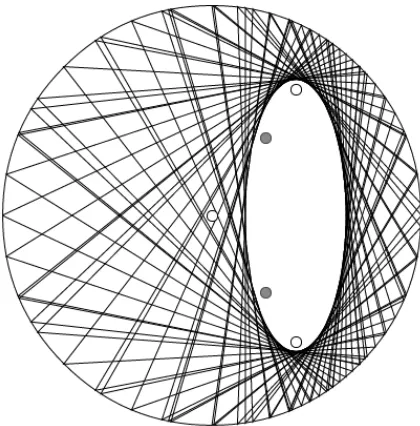
For an integern≥3, a closed subsetAofDhas then-Poncelet property, if whenever there exists ann-gonPsuch thatPcircumscribesAand has its vertices onT, then
every point on the unit circle is a vertex of such ann-gon. This was originally studied in the context of an ellipse, as in figure 1. (The figures were produced by an applet written by A. Shaffer.) Associated with the ellipse is a Blaschke product,
as we shall explain: its zeroes are denoted by light circles and the zeroes of its derivative by dark circles.
[image:14.482.139.349.216.429.2]We shall also be considering a generalization of this, namely, an infinite Poncelet property.
Figure 1: Poncelet ellipse with triangles
Let us suppose first thatθis a finite Blaschke product, and henceKθ is finite-dimensional. Recall that thenumerical rangeof an operatorT on a Hilbert spaceH
is defined by
W(T) ={hT x, xi:x∈H,kxk= 1},
and, according to the Toeplitz–Hausdorfftheorem, is a convex subset of the plane.
Theorem 4 – For the restricted shiftSθon a finite-dimensional model spaceKθwe have
W(Sθ) =\
α∈T
W(Uαθ),
where theUθ
α are the rank-1 Clark perturbations ofSzθ, which are equivalent to unitary 1-dilations ofSθ.
For versions of this results and further developments, see Gau and Wu (1998), Gau and Wu (2003), Gorkin and Rhoades (2008), and Daepp, Gorkin, and Voss (2010).
Note that
σ(Uαθ) ={z∈T:zθ(z) =α},
ann+ 1-point set if the degree ofθisn. Moreover,W(Uθ
α) is the convex hull of σ(Uθ
α), namely, a polygon. If degθ= 2, then it is known thatW(Sθ) is an ellipse,
with foci at the eigenvalues ofSθ. Therefore, this ellipse has foci at the zeroes ofθ, and it is here expressed as an intersection of triangles.
Figure 2 on the facing page and figure 3 on page 24 show similar examples with
n= 3 (quadrilaterals) andn= 4 (pentagons).
The following more general result was proved in Chalendar, Gorkin, and Part-ington (2009). Note that numerical ranges no longer need to be closed, so the formulation is slightly different.
Theorem 5 – Letθbe an inner function. Then W(Sθ) =\
α∈T
W(Uαθ),
where the Uαθ are the unitary 1-dilations of Sθ (or, equivalently, the rank-1 Clark perturbations ofSzθ).
In general we may regard the numerical ranges of theUαθas convex polygons with infinitely-many sides. Some vectorial generalizations of these results (involving more general contractions) are given in Benhida, Gorkin, and Timotin (2011) and Bercovici and Timotin (2014).
We may now ask how many polygons are needed to determineθuniquely. Note that the vertices of a polygon are solutions tozθ(z) =α, so we are motivated to consider boundary interpolation by inner functions.
4.4 Interpolation questions
4. Restricted shifts
Figure 2: Symmetrical Poncelet curve with quadrilaterals
{z1, . . . , zn}and{w1, . . . , wn}in the theorem are necessarily interlaced; that is, eachzj
lies between two successivewkand vice-versa.
Theorem 6 – For a finite Blaschke productsθ,φ of degreen, suppose that there are distinct pointsz1, . . . , znandw1, . . . , wninTsuch that
θ(z1) =···=θ(zn), θ(w1) =···=θ(wn),
and
φ(z1) =···=φ(zn), φ(w1) =···=φ(wn).
Thenφ=λ1θ−a−aθ for someλ∈Tanda∈D.
We say thatφis aFrostman shiftofθ.
Suppose now thatθis inner with just one singularity onT; that is, it extends
analytically acrossTexcept at one point, which we shall take to bez= 1. For some suchθ, but not all, there will be a sequence (tn)n∈ZinT(necessarily isolated since
θhas an analytic extension), accumulating on both sides of the point 1, such that
Figure 3: Asymmetrical Poncelet curve with pentagons
[image:17.482.146.327.430.517.2]4. Restricted shifts
We consider how to determineθfrom this data.
We transform to the upper half-planeC+, using the Möbius mapping
ψ(z) =i1 +z
1−z, with ψ(1) =∞.
Now considerF:=ψ◦θ◦ψ−1. ThenFis meromorphic onCwith real poles (bn)n∈Z
accumulating at±∞. It mapsC+ toC+andC−toC−. Such functions are called
strongly real. Without loss of generality we may assume that 0 is neither a pole nor a zero ofF, in which case we have the following theorem, given in Levin (1980) as the Hermite–Biehler theorem, but attributed to Krein.
Theorem 7 – ForF strongly real with poles(bn)tending to±∞, the zeroes(an)and poles(bn)are interlaced in the sense that we may writebn< an< bn+1for eachn, and
then
F(z) =cY n∈Z
1−z/an
1−z/bn, (4)
wherec > 0unless anbn <0, in which casec < 0. There is such a function for each sequence(an)interlaced with the(bn).
Our conclusion is that, given one limit point onT, approached from both sides
by solutions toθ(z) = 1, the set θ−1(1) does not determine θ, whereas the sets
θ−1(1) andθ−1(−1) together tell us whatθis, to within composition by a Möbius
transformation fixing±1.
In Chalendar, Gorkin, and Partington (2011) the case of finitely-many singu-larities is discussed, including cases then some singular points are approached on one side only. Curiously, there is a non-uniqueness case in the Hermite–Biehler expression, apparently missed by Krein. For suppose thatan→1 asn→ −∞and
an→ ∞asn→ ∞. Then, with interlaced (bn) there is one solution, namely (4), but
there is also another possibility, namely
F(z) =c(z−1)Y
n∈Z
1−z/an
1−z/bn
and these are the only possibilities.
On the circle, the correspondingθhas a singularity of type 1 in the terminology of Chalendar, Gorkin, and Partington (2012): see figure 4 on page 24. Thus there are two one-parameter families of inner functionsθfor such a choice ofθ−1(1) and
Some (necessarily less explicit) extensions of these ideas have been given by Bercovici and Timotin, Cor.6.327, in the case where the set of singularities of the
inner functionθis of measure zero.
References
Barclay, S. (2009). “A solution to the Douglas-Rudin problem for matrix-valued functions”. In:Proc. Lond. Math. Soc. Vol. 99. 3, pp. 757–786 (cit. on p. 12).
Bayart, F. (2003). “Similarity to an isometry of a composition operator”. In:Proc. Amer. Math. Soc. Vol. 131. 6, pp. 1789–1791 (cit. on p. 13).
Benhida, C., P. Gorkin, and D. Timotin (2011). “Numerical ranges ofC0(N)
contrac-tions”.Integral Equations Operator Theory70(2), pp. 265–279 (cit. on p. 22). Bercovici, H. and D. Timotin (2012). “Factorizations of analytic self-maps of the
upper half-plane”.Ann. Acad. Sci. Fenn. Math37(2), pp. 649–660 (cit. on p. 26). Bercovici, H. and D. Timotin (2014). “The numerical range of a contraction with
finite defect numbers”.J. Math. Anal. Appl417(1), pp. 42–56 (cit. on p. 22). Beurling, A. (1949). “On two problems concerning linear transformations in Hilbert
space”.Acta Math81, pp. 239–255 (cit. on p. 11).
Bourgain, J. (1986). “A problem of Douglas and Rudin on factorization”.Pacific J. Math121(1), pp. 47–50 (cit. on p. 12).
Brown, A. and P. R. Halmos (1963). “Algebraic properties of Toeplitz operators”.J. Reine Angew. Math213, pp. 89–102 (cit. on p. 15).
Caradus, S. R. (1969). “Universal operators and invariant subspaces”. In:Proc. Amer. Math. Soc. Vol. 23, pp. 526–527 (cit. on p. 14).
Chalendar, I., P. Gorkin, and J. R. Partington (2009). “Numerical ranges of restricted shifts and unitary dilations”.Oper. Matrices3(2), pp. 271–281 (cit. on p. 22). Chalendar, I., P. Gorkin, and J. R. Partington (2011). “Determination of inner
func-tions by their value sets on the circle”.Comput. Methods Funct. Theory11(1), pp. 353–373 (cit. on pp. 22, 25).
Chalendar, I., P. Gorkin, and J. R. Partington (2012). “The group of invariants of an inner function with finite spectrum”.J. Math. Anal. Appl389(2), pp. 1259–1267 (cit. on pp. 23, 25).
Chalendar, I. and J. R. Partington (2011).Modern approaches to the invariant-subspace problem. Ed. by C. U. Press.188. Cambridge: Cambridge Tracts in Mathematics (cit. on p. 12).
Chang, S.-y. A. (1976). “A characterization of Douglas subalgebras”.Acta Math
137(2), pp. 82–89 (cit. on p. 12).
Cima, J. A., A. L. Matheson, and W. T. Ross (2006).The Cauchy transform.125. Math-ematical Surveys and Monographs. American MathMath-ematical Society, Providence, RI (cit. on p. 20).
References
Clark, D. N. (1972). “One dimensional perturbations of restricted shifts”.J. Analyse Math25, pp. 169–191 (cit. on p. 20).
Cowen, C. C. and B. D. MacCluer (1995).Composition operators on spaces of analytic functions. Boca Raton, FL: Studies in Advanced Mathematics. CRC Press (cit. on
p. 13).
Daepp, U., P. Gorkin, and K. Voss (2010). “Poncelet’s theorem, Sendov’s conjec-tureand Blaschke products”.J. Math. Anal. Appl 365(1), pp. 93–102 (cit. on p. 22).
Douglas, R. G. and W. Rudin (1969). “Approximation by inner functions”.Pacific J. Math31, pp. 313–320 (cit. on p. 12).
Frostman, O. (1935). “Potentiel d’équilibre et capacité des ensembles avec quelques applications à la théorie des fonctions”.Medd. Lunds Univ. Math. Semin3, pp. 1– 118 (cit. on pp. 17, 18).
Gallardo-Gutiérrez, E. A. and P. Gorkin (2011). “Minimal invariant subspaces for composition operators”.J. Math. Pures Appl95(3), pp. 245–259 (cit. on p. 14). Garnett, J. B. (2007). Bounded analytic functions. first. 236. New York: Revised
Graduate Texts in Mathematics (cit. on pp. 11, 12).
Garnett, J. B. and A. Nicolau (1996). “Interpolating Blaschke products generate
H∞”.Pacific J. Math173(2), pp. 501–510 (cit. on p. 12).
Gau, H.-L. and P. Y. Wu (1998). “Numerical range ofS(φ)”.Linear and Multilinear Algebra45(1), pp. 49–73 (cit. on p. 22).
Gau, H.-L. and P. Y. Wu (2003). “Numerical range and Poncelet property”.Taiwanese J. Math7(2), pp. 173–193 (cit. on p. 22).
Gorkin, P. and R. C. Rhoades (2008). “Boundary interpolation by finite Blaschke products”.Constr. Approx27(1), pp. 75–98 (cit. on p. 22).
Hayashi, E. (1986). “The kernel of a Toeplitz operator”.Integral Equations Operator Theory9(4), pp. 588–591 (cit. on p. 15).
Hayashi, E. (1990). “Classification of nearly invariant subspaces of the backward shift”. In:Proc. Amer. Math. Soc. Vol. 110. 2, pp. 441–448 (cit. on p. 15). Helson, H. (1964).Lectures on invariant subspaces. New York–London: Academic
Press (cit. on pp. 10, 20).
Hitt, D. (1988). “Invariant subspaces ofH2of an annulus”.Pacific J. Math134(1), pp. 101–120 (cit. on p. 15).
Hjelle, G. A. and A. Nicolau (2006). “Approximating the modulus of an inner function”.Pacific J. Math228(1), pp. 103–118 (cit. on p. 12).
Hoffman, K. (1962).Banach spaces of analytic functions. Series in Modern Analysis.
Inc., Englewood Cliffs, N. J: Prentice-Hall (cit. on p. 10).
Jones, P. W. (1981). “Ratios of interpolating Blaschke products”.Pacific J. Math95(2), pp. 311–321 (cit. on p. 12).
Littlewood, J. E. (1925). “On inequalities in the theory of functions”. In:Proc. London Math. Soc. 2. Vol. 23, pp. 481–519 (cit. on p. 13).
Marshall, D. E. (1976). “Subalgebras of L∞ containing H∞”. Acta Math 137(2), pp. 91–98 (cit. on p. 12).
Marshall, D. E. and A. Stray (1996). “Interpolating Blaschke products”.Pacific J. Math173(2), pp. 491–499 (cit. on p. 12).
Mortini, R. (1995). “Cyclic subspaces and eigenvectors of the hyperbolic composition operator”.Travaux mathématiques Fasc. VII, Sém. Math. Luxembourg, Centre Univ. Luxembourg, pp. 69–79 (cit. on p. 14).
Nehari, Z. (1957). “On bounded bilinear forms”.Ann. Math65(1), pp. 153–162 (cit. on p. 15).
Nikolski, N. K. (2002).Operators, functions, and systems: an easy reading. Vol. 1. Hardy, Hankel, and Toeplitz. Trans. from the French by A. Hartmann.92. Mathematical Surveys and Monographs. American Mathematical Society, Providence, RI (cit. on p. 11).
Nordgren, E. A. (1968). “Composition operators”.Canad. J. Math20, pp. 442–449 (cit. on p. 13).
Nordgren, E., P. Rosenthal, and F. S. Wintrobe (1987). “Invertible composition operators onHp”.J. Funct. Anal73(2), pp. 324–344 (cit. on p. 14).
Sarason, D. (2007). “Algebraic properties of truncated Toeplitz operators”.Oper. Matrices1(4), pp. 491–526 (cit. on p. 18).
Szökefalvi-Nagy, B. et al. (2010).Harmonic analysis of operators on Hilbert space.
enlarged. New York: Revised and Universitext. Springer (cit. on pp. 19, 20). Wiener, N. (1988). The Fourier integral and certain of its applications. 1933rd ed.
Contents
Contents
1 Introduction . . . 9
1.1 Hardy spaces and shift-invariant subspaces . . . 9
1.2 Examples of inner functions . . . 11
2 Some operators associated with inner functions . . . 13
2.1 Isometries . . . 13
2.2 Universal operators . . . 13
2.3 Hankel and Toeplitz operators . . . 14
2.4 Kernels . . . 15
3 Model spaces . . . 16
3.1 Definitions and examples . . . 16
3.2 Decompositions ofH2andKB . . . 16
3.3 Frostman’s theorem and mappings between model spaces . 17 3.4 Truncated Toeplitz and Hankel operators . . . 18
4 Restricted shifts . . . 19
4.1 Basic ideas . . . 19
4.2 Unitary perturbations and dilations . . . 20
4.3 Numerical ranges . . . 21
4.4 Interpolation questions . . . 22
References . . . 26