Bias in the Perception of Success
The Harvard community has made this
article openly available.
Please share
how
this access benefits you. Your story matters
Citation Preston, Jesse Lee, Ryan S. Ritter, and Daniel M. Wegner. 2011. Action embellishment: An intention bias in the perception of success. Journal of Personality and Social Psychology 101(2): 233-244.
Published Version doi:10.1037/a0023231
Citable link http://nrs.harvard.edu/urn-3:HUL.InstRepos:9925389
Action Embellishment:
An Intention Bias in the Perception of Success
Jesse Lee Preston & Ryan S. Ritter
University of Illinois at Urbana-Champaign
Daniel M. Wegner
Harvard University
First submitted: 08/13/07 Resubmitted: 12/02/10 References & notes: 58 Word count: 9626 Tables: 1
ABSTRACT
Naïve theories of behavior hold that actions are caused by an agent’s intentions, and the subsequent success of an action is measured by the satisfaction of those
intentions. But when an action is not as successful as intended, the expected causal link between intention and action may distort perception of the action itself. Four studies found evidence of an intention bias in perceptions of action. Actors perceived actions to be more successful when given a prior choice (e.g., choose between two words to type) and also when they felt greater motivation for the action (e.g., hitting pictures of disliked people). When the intent was to fail (e.g., singing poorly) choice led to worse estimates of performance. A final experiment suggested that intention bias works independent from self-enhancement motives. In observing another actor hit pictures of Hillary Clinton and Barack Obama, shots were distorted to match the actor’s intentions, even when it opposed personal wishes. Together these studies indicate that judgments of action may be automatically distorted, and that these inferences arise from the expected consistency between intention and action in agency.
Word count: 186
Action Embellishment: An Intention Bias in the Perception of Success
The perceived link from intention to action in human behavior is a fundamental aspect of social cognition, and has repeatedly captured the attention of researchers interested in the naïve psychology of action (Heider, 1958), the intentional stance (Dennett, 1987), the folk concept of intentionality (Malle & Knobe, 1997) and theory of mind (Premack & Woodruff, 1978). The crux of these lay theories is the expectation that intentions cause actions, and moreover that stronger intent should result in more
successful actions. Unfortunately, people often fall short of this ideal. Our lives are polluted with countless typos, pratfalls, botched parallel parking attempts, and many other instances where actions do not live up to our ambitions. But when best laid plans go awry, the expectation of consistency between intention and action may blind people to the true extent of their failure. In this research we suggest that such an intention biascan result in distorted perceptions of action. The success of observed actions may be
embellished above actual performance, to be consistent with the strength of the underlying intention.
Intention as the Cause of Action
commonly applied to agents (Wegner, 2002). An agent is an entity that moves by self-propulsion (e.g., humans, animals, robots), in contrast with inanimate objects that move only by external physical force (Michotte, 1963; Molina, Van de Walle, Condry, & Spelke, 2004). In other words, an agent is its’ own cause, or a “first cause”. But the
ultimate source of action is seen as the intention to act: agents move because they want to, toward some desired outcome (Repacholi & Gopnik, 1997).
Like other kinds of causal judgments, agency judgments are often snap decisions that occur spontaneously and effortlessly (Hassin, Bargh & Uleman, 2002), suggesting automatic processing (Bargh, 1994; Uleman 1999). As noted by Guthrie (1993), the automaticity of agent detection is an important evolutional advantage - in identifying who might be potential enemies, friends, mates, predators, or prey. The mere appearance of self-propelled movement in a target is often enough to prompt attributions of agency (Premack, 1990; Morewedge, Preston, & Wegner, 2007), especially if the end state of movement appears to satisfy some goal (Heider & Simmel, 1958; Csibra, Gergely, Biro, Koos, & Brockbank, 1999). Apparent symmetry between one’s own intentions and actions also cues judgments of agency in the self, reinforcing feelings of conscious will over own behavior when it seems consistent with a prior intention (Wegner & Wheatley, 1999; Dijksterhuis et al, 2008).
and action may help to fill in occasional “blind spots” by matching what is missing to what is observed: creating a prior intention to explain action, or distorting the perception of action to align with intention. For example, watching another person performing an action (e.g., roommate scrubbing the floor), may instantly prompt thoughts of underlying motivation consistent with that action (e.g., to impress a coming houseguest) (McClure, 2002). The ability to instantly mind-read the invisible mental states of others proves to be an essential social skill (Baron-Cohen, 1995; Sacks, 1995), as people do not usually publicize their intentions before action, like calling shots in a pool game. Fortunately, inferences of intention can occur automatically (Hassin, Arts, & Ferguson, 2005), which allows one to quickly make sense of social interactions as they happen, and to respond in a timely fashion.
examples of confabulating intentions for actions when they cannot access the true reason for behavior (Gazzaniga, 1988; Gazzaniga & LeDoux, 1978). For instance, one split-brain patient giggled in response to a nude picture shown only to her left visual field, but she told the experimenters she laughed because “the machine was funny”. Although she did not really know why she laughed, she quickly concocted a reason that made sense and accounted for her behavior (Gazzaniga & LeDoux, 1978). Evidence from the cognitive dissonance and self-perception literatures have also long shown that judgments of own attitudes (and the behavioral intentions they carry) can be altered post-hoc to be
consistent with action (Wicklund & Brehm, 1976; Bem, 1972). Most remarkable about these various confabulations is that they are almost always made with certainty and sincerity (e.g., Nisbett & Wilson, 1977). Even when people observe themselves act without knowing why, they can concoct a prior intention that explains the behavior, seamlessly weaving the reasons for action into their ongoing personal narrative.
Intention Bias
Strengthening intention can also enhance predictions for future action, although it may not always translate into actual behavior (Koehler & Poon, 2006). People become more optimistic about their gambling prospects as they become more involved in the process (Langer & Roth, 1975; Risen & Gilovich, 2007), or desire for success is particularly intense (Biner, Angle, Park, Mellinger, & Barber, 1995; Thompson, Armstrong &
Thomas, 1998), both of which may contribute to a feeling of intentionality. Furthermore, when making a decision people begin to exhibit exaggerated positive illusions
(unrealistic optimism about success of action) only after they finish deliberating about an action and have shifted to a post-decisional phase (Taylor & Gollwitzer, 1995), i.e., they have decided on a plan for action and are preparing to put that plan into motion.
These findings suggest that strong intentionality can distort judgments of action in the past, future, or in the abstract. But because lay theories of intention-to-action
causation may be inherent to human cognition, an intention bias may also work
automatically to embellish perceived action. Yet there is little research to show that such distortion can occur in real time, as the action takes place. One likely reason is that these other forms of self-assessments are more ambiguous, and therefore benefit from the biased selection of memories, or idiosyncratic criteria that define success (Dunning, Meyerwitz, & Holzberg, 1989). This is in sharp contrast to judgments made during the observation of the action itself. Often performance feedback is immediate and
upcoming hill appear steeper (Proffitt, 2006), but having choice over action reduces this effect, making distances and slopes seem more surmountable (Balcetis & Dunning, 2007). Likewise, action itself may be distorted as it occurs if the actual success is unclear. Actions may be ambiguous because they happen quickly (e.g. plays in a baseball game), or the result is not immediately available for review (e.g., grade on a test). In such cases perceptions of actions may bend toward their intent, so that better actions should appear from stronger intentions. Because these judgments can occur automatically, one may never be aware of the distortion until corrected by the cold hard facts. But until such negative feedback is given, a fly ball may look like a homerun, a bombed test could seem like an ace, and if your good intentions should lead you straight to Hell- it could still look like Heaven when you get there.
The Present Research
In this research we predict that an automatic intention bias can distort the
perception of action as it occurs. As intention to succeed increases so should perceptions of success, irrespective of actual performance. Four specific predictions were tested. First, factors that increase perceived intentionality (e.g. desire, choice) should result in action embellishment, distorting the perceived success above actual performance.
intention bias is separable from self-enhancement biases: distortions should extend beyond the self to actions performed by other agents. When the intentions of another agent are salient, the apparent success of action should be distorted to be consistent with the actors’ intentions, irrespective of one’s own personal desires.
In four studies, participants engaged in an activity (e.g., a typing task), or observed another engage in an activity, and reported the success immediately following each attempted act. In Experiments 1 and 2, intentionality was manipulated by the choice before action. In Experiments 3 and 4, desire for an outcome was used as an indicator of intention, specifically, the desire to hit a target picture of a liked vs. disliked person.
EXPERIMENT 1:GOOD INTENTIONS
Participants engaged in a typing study on a computer and reported
estimates of typing accuracy throughout the task. For half the typing trials
participants chose between two words to type, and on half the trials no choice was
given. In pretests, we found word choice was associated with stronger feelings of
intent to type the word. There was also a between subject factor of difficulty. In the
difficult condition participants completed the typing task while wearing gardening gloves that made it more difficult to press individual keys. Greater embellishment was expected in this difficult version of the task for two reasons. First, increased difficulty is a
Method
Participants
Ninety-nine participants were recruited by flyers in the Psychology department for $5 payment.
Procedure
Participants were greeted by an experimenter and seated in front of a computer in a private lab room. All instructions were given on the computer. Participants were
informed that a seven-letter word would appear on the computer screen, and that their job was to type the word as accurately as possible without looking at the keys on the
keyboard. To prevent any temptation to cheat, the characters on the keys were covered by round yellow stickers. After each word was typed, participants estimated how many letters of the word they had typed correctly, from zero to seven, and entered this estimate into the computer. The specific scoring criteria were given to participants during the instructions, along with examples for each. Points were deducted if the participant
missed a letter, typed an incorrect letter, had two sequential letters out of order, or for any extra letters typed. For instance, for the target word “OCTOPUS”, 6/7 points would be given for mistakes such as: OCOPUS, OCTIPUS, OCTOUPS, or OCTOPUSS. Scores could not be lower than zero.
easy condition the task was to simply type a word on the screen without looking at the keyboard. In the difficult condition participants wore heavy gardening gloves as they typed, which made it more difficult to press individual keys. All words were presented in 24 point Garamond type, and remained displayed on screen as the participant typed. No feedback about the success was given to participants. After typing the word, participants pressed the enter key to proceed to the next trial. Two orders were used: no-choice/ choice; choice/ no-choice, randomly assigned at the beginning of the study. The sequence of trials within each section was randomly generated.
Results
Difficulty
Mean scores for perceived and actual typing accuracy was calculated for both choice and no-choice trials. The difference between participants’ perceived performance and actual performance on a given typing trial represented the degree of distortion for that trial. Using these means a 2 (Choice) × 2 (Distortion: Actual vs. Perceived typing) ×
2 (Difficulty: Easy vs. Difficult) × 2 (Order) ANOVA was conducted, with repeated measures on the first and second variables. There were no main effects or interactions with Order, so we dropped this variable from further analyses and conducted a 2
(Choice) x 2 (Distortion) x 2 (Difficulty) ANOVA. There was a robust effect of difficulty
condition, F (1, 97) = 135.69, p < .001, ηP2= .58, such that both actual and estimated
performance were lower in the difficult version. In addition, there was a two-way interaction between distortion and difficulty, F (1, 97) = 61.64, p < .001, ηP2= .39, with
Mreport = 3.36, SD = 1.72) whereas participants in the easy condition underestimated
performance (Mactual = 6.64, SD = 1.11; Mreport = 5.54, SD = 1.60). This is consistent with
previous research demonstrating greater embellishment for difficult tasks (Moore & Healy, 2008). Further, difficult tasks require more effort and attention to execute which also denotes intention strength. Consistent with our hypothesis, expending these
resources could lead to embellished perceptions of performance relative to the actual success of the action.
Choice
Our principal hypothesis that choice would increase embellishment was supported
by a two-way interaction between Distortion and Choice, F (1, 97) = 11.13, p = .001, ηP2
= .10 (see Figure 1). Typing estimates for the choice trials (M = 4.53 letters; SD = .20) were significantly greater than both the typing estimates for no-choice trials (M = 4.37,
SD = .25; F (1, 97) = 10.87, p = .001), and actual typing performance on choice trials (M
= 4.25, SD = .26; F (1, 97) = 4.69, p < .05). In other words, participants thought they typed better when first given a choice versus no choice, and this perceived success on choice trials was embellished above their actual performance. Despite this perception, choice did not improve actual performance (Mchoice = 4.25, SD = .26, Mno-choice = 4.31, SD
= .20; F (1, 97) = 1.30, ns). This predicted effect of Choice on distortion held up for both
the easy version (F (1, 46) = 6.34, p < .05, ηP2= .12) and the difficult version (F (1, 51) =
4.56, p < .05, ηP2= .08). This embellishment was not observed on no-choice trials,
estimated performance was consistent with actual performance (Mperceived = 4.37, SD =
Discussion
In Experiment 1, both increased choice and increased difficulty resulted in positive distortions of action. First, task difficulty contributed to embellishment. Those who participated in a difficult version of the task (typing with gloves on) overestimated their performance relative to actual performance, whereas those in the easy version (no gloves) underestimated performance. One possible reason for this interaction with difficulty is that they are due to an effect of regressive judgments when feedback is ambiguous. In other words, when actual accuracy is quite low (high difficulty condition), people will make greater estimates, but when actual accuracy is quite high (low difficulty condition), estimates tend to be lower (e.g., Fiedler, Walther, & Nickel, 1999). However, these results could also be explained by embellishment effects, consistent with our
hypothesis. Difficult tasks require more effort, which also indicates intention strength. The difficulty experienced in the task might increase embellishment by increasing the exertion put into the action. But more important than the effect of difficulty condition, we observed a strong effect of choice on embellishment. As predicted, participants
overestimated their typing performance when they had been given a choice between two words to type, but did not embellish their performance in the absence of choice. And although participants believed they were better typists when given a choice, in reality they typed equally well without the choice. In sum, the results of Experiment 1 provide initial evidence that people embellish actions consistent with an intention bias.
EXPERIMENT 2:BAD INTENTIONS
Ross, 1978), and so might be explained by a need to feel good about the self (Taylor & Brown 1988). Experiment 2 addressed this question by attempting to reverse this effect—causing people to diminish performance,rather than embellish, if they intended to fail, rather than succeed. Ordinarily people do not try to fail, but there are certain circumstances under which people might deliberately sabotage their own actions. For example, a professional athlete might be bribed to take a dive in an important sporting match, or a reluctant law student might try to bomb the LSAT to avoid entering the family business. If actions are embellished when intention to succeed is high, then by the same token actions ought to be diminished when trying to fail. In Experiment 2,
participants recorded themselves singing two brief excerpts from pop songs; but they were told the goal was to sing as poorly as possible. We expected that choice would result in exaggerated perception of the action to match their overall intention, in this case, that their singing performance will seem worse than actual performance.
Method
Participants
27 undergraduates (9 men, 18 women) volunteered to take part in a voice sample study, for 3$ payment or partial course credit.
Instructions
You will be asked to sing two short songs, and we will record your voice to be rated by other people at another time. There is a twist to this study: Your job in this study is to try to sing as BADLY as possible. Remember, the people who will listen to you later won't know you are trying to sing badly. So, please don't try to be funny or “cheesy” as you sing, just try to give a really poor singing performance.
Task
Participants sang two short excerpts from popular songs into the tape recorder; once with a choice of two songs to sing, once with no choice. The three song selections used were Billie Jean by Michael Jackson, You Give Love a Bad Name by Bon Jovi, and
I’m Too Sexy by Right Said Fred. These songs were found in pretests to be familiar to undergraduate participants. In three conditions, each song was used once as the no-choice option, with the other two songs as the no-choice option. When participants were ready to sing, they began recording on the tape recorder and the computer provided the song lyrics on the monitor. The song excerpts consisted of two verses. Following each performance, participants were asked to rate the quality of own singing on an 11-point scale (0 = The absolute worst, 10 = Perfect).
Results
Two judges, blind to condition, listened to the participants’ recordings and rated their performances on the same scale participants evaluated themselves (0 = The absolute
worst, 10 = Perfect). These two judges had an inter-reliability rating of α = .78. The
To assess whether subjects rated their own performance as worse, relative to judges, we conducted a 2 (Choice: none, choice) × 2 (Rater: self, judge) ANOVA with repeated measures on the first variable. There were no main effects of Rater, F (1, 26) = 1.06, ns, nor of Choice, F (1, 26) = 1.89, ns. But as predicted, there was a two-way interaction between Rater and Choice on evaluations of singing performance, F (1, 26) = 4.11, p = .05 (see Figure 2). Participants gave lower ratings of their own singing when they chose which song to sing, compared to when no choice was given, (Mchoice = 2.19;
SD = 1.06, Mno-choice = 2.70; SD = 1.54; F (1, 26) = 5.43, p < .05). In contrast, judges’
ratings did not differ with respect to choice, (Mno-choice = 2.72; Mchoice = 2.78, F < 1).
Relative to the judges’ ratings, participants underestimated their performance following choice, (Mself = 2.19; Mjudge = 2.78; F (1, 26) = 3.94, p =.06). When no choice of song was
given, self ratings were consistent with the judges’ evaluations, (Mself = 2.70; Mjudge =
2.72, F < 1).
Preference for Song
Finally, we also tested whether there were any differences in participants’ song choice, and whether this affected the participants ratings. When Billie Jean was forced and there was a choice between I’m Too Sexy, and You Give Love a Bad Name, no song was preferred over the other, χ2 (1, n = 7) < 1, ns. But when given the choice, Billie Jean
was selected significantly more often (n = 18) than either You Give Love a Bad Name (n = 1) or I’m Too Sexy (n =1; χ2 (2, n = 20) = 12.8, p = .002). Given this clear preference for Billie Jean, it was important to rule out the possibility that our observed
self-ratings across song choice, F (2, 24) = .435, p = .65), nor judge-ratings across song choice (F (2, 24) = 1.352, p = .28) These results support the hypothesis that diminished perceptions of own performance were driven primarily by the act of choosing (rather than by particular song selection.
Discussion
The results show that choice can result in diminished perceptions of performance, if the actor’s overall intention is to fail rather than succeed. Self-assessment corresponded with the judges’ assessments when no choice was given, but when participants were given a choice of song to sing poorly they rated their performance more poorly than judges did. We can conceptualize these results as a mirror image of those from Experiment 1, with only perceived success following choice deviating from the other values. But whereas participants embellished their performance in Experiment 1, participants in this study perceived worse performance following choice when they had been trying to perform poorly. The fact that participants in the present study diminished their actions, rather than embellished, indicates that these distortions may be guided by the specific intention of the actor, not just a general bias towards positivity or success.
EXPERIMENT 3:MIXED MOTIVES
In two studies actions were embellished to be closer to the intended goal when the actor was first given a choice prior to action. We have suggested these action
embellishment effects. In the present study, desire for a particular outcome was used as a measure of intention strength. Desire can be experienced at various intensities and so might better predict the degree of an observer’s distortion. Also, whereas choice embodies key cognitive components of intentionality (e.g., the decision for action, and the identification of a specific goal), an agent’s desire could be considered the “heart” of intentionality as it represents both the underlying reasons for action, and the motivation that drives them.
In a paradigm modeled after Rozin, Millman and Nemeroff (1986), participants in the present study engaged in a shooting task with a toy gun. The targets used were either well-liked people (e.g., Mahatma Gandhi) or extremely disliked people (e.g., Adolf Hitler). As in the study by Rozin and colleagues, it was expected people would be more motivated to hit disliked people vs. liked people. In this present experiment we made a new prediction: regardless of actual performance, perceptions of accuracy would change with the liking of a target. The effect of liking on actual performance was limited by making aim difficult to control. Consistent with their desire to do well, we hypothesized that people would embellish performance when the target was disliked.
Method
Participants
Stimuli and Apparatus
We pretested several famous figures for familiarity and likeability, from which we selected 4 disliked figures and 4 liked figures as targets. The liked figures were Albert Einstein, John F. Kennedy, Martin Luther King, Jr., and Mahatma Gandhi. The disliked figures were Osama Bin Laden, Adolf Hitler, Saddam Hussein, and OJ Simpson. In a pretest there was a strong negative correlation between target likability (1 = dislike extremely, 7 = like extremely), and own intention to hit the target figure (1 = Do not intend, 7 = Strongly intend), r (64) = -.66, p < .001.
A slide projector displayed the target faces onto a large piece graph paper with a grid of one-inch squares. All photos selected were black and white, in which the target person was facing forward and making eye contact with the camera. The projected image was 36” × 24”. The paper had a large florescent pink circle in the center to serve as the bull’s-eye, which was centered between the targets’ eyes. Participants fired at the target with a shotgun-style toy gun with foam bullets. After hitting the target, the bullets would fall to the ground. The toy gun used was a discontinued model, unfamiliar to
participants, and difficult to aim with precision. 1
Procedure
Before the experimental session began, participants gave liking ratings for all the target figures. For each target, participants first indicated whether they generally liked or disliked the person. If they disliked the person, degree of dislike was rated on a negative 7-point scale (-1 = dislike slightly, -7 = dislike intensely). If they reported liking the
1 Difficulty in shooting was verified by one of the authors through extensive pretesting, in the name of
person, they rated their liking on a positive 7-point scale (1 = like slightly, 7 = like intensely).
It was explained to subjects that their task was to try to shoot at a target, and to estimate their own performance after each shot. Participants faced a wall with a large graph paper with a grid of one inch squares, at a distance of ten feet away. In pretests, the grid on the target was not visible to participants at this distance. The experimenter (a research assistant blind to hypotheses) stood adjacent to the target area during the task and recorded the location of each shot on the grid as they occurred. Immediately
following each shot, subjects estimated in inches how close they were to the bull’s-eye of the target. Subjects were given 10 practice trials with no target face before the study began. A total of 96 trials were used, 12 trials per figure.
Results
One subject reported knowing OJ Simpson personally and was excluded from all further analyses, leaving a sample of 113 participants.
Embellishment and Dislike
Mean actual and perceived accuracy were calculated for Liked (Gandhi, King, and Einstein) and Disliked Figures (Bin Laden, Hitler, Hussein). Because Simpson and Kennedy were so controversial among participants’ ratings, we did not include them in these discrete categories. In the few remaining cases in which a person’s preferences deviated from the majority, we used participant’s own attitudes to create the categories of Liked and Disliked Targets. Using these means, we conducted a 2 (Liking) × 2
(Distortion: Actual vs. Reported Marksmanship) ANOVA with repeated measures on the second variable. There was a main effect of Distortion, such that people generally
overestimated their distance from the bull’s-eye (Maccuracy , = 6.16 inches, Mreport = 6.78
inches; F (1,112) = 11.70, p = .001, ηP2= .10). It is unknown whether this overestimation
of distance reflected a general modesty, however we expect it was due to a general miscalibration of distance. More relevant to our hypotheses, there was an expected
two-way interaction between Liking and Distortion, F (1, 112) = 7.24, p < .01, ηP2= .06.
Although actual marksmanship did not vary between disliked targets vs. liked targets, (F
< 1), people reported better marksmanship when firing at disliked targets (Mdisliked = 6.57 inches; SD = 2.31, Mliked= 6.89, SD = 2.73; F (1,112) = 5.15, p < .05, ηP2= .04).
Degree of liking
Using the categories of Liked and Disliked targets there was greater reported marksmanship toward the Disliked targets, consistent with our predictions. But more specifically, we were interested in whether the degree of embellishment would be
when shooting at pictures of Hitler (M= 6.45 inches), also the most disliked figure on average (Mlike = -6.57). All eight targets were rank-ordered by mean liking. Using this
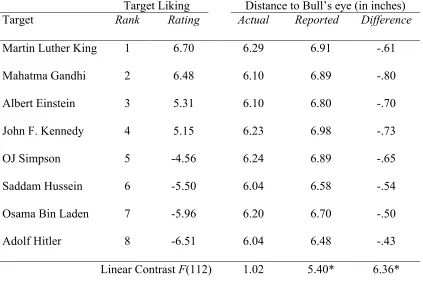
rank order, reported distance, actual distance, and distortion were submitted to a repeated measures ANOVA using a linear contrast. The linear contrast was significant on reported distance, F (1, 112) = 5.40, p < .05, with better perceived performance for worse liked targets. Important however, there was no linear trend on actual distance, F < 1. Perhaps more important, the distortion between actual and reported distance showed a significant linear trend, F (1, 112) = 7.15, p < .01. Mean judgments of marksmanship were distorted further from the actual hit as mean liking for the target increased (see Table 1).
negatively correlated (r (113) = -.11, p < .05). Participants perceived better marksmanship as they personally disliked the specific target being hit.
Finally, we investigated the possibility that participant's liking for a target
influenced their correlational accuracy (i.e., the correlation between actual and perceived marksmanship). In other words, while we have established that participants distorted their judgments of accuracy depending on how much they liked the target, it is also possible that participant's actual and perceived accuracy correlated differently across targets. Accordingly, the correlation between reported and actual distance was calculated for each target within each participant. Next, correlations between these 8 correlational accuracy scores and reported liking were computed (using the same 14-point liking scale as above). A one-sample t-test on the resulting mean correlation between correlational accuracy and personal liking was not found to be significantly different from zero, r
(113) = -.003, ns.
Discussion
In Experiment 3, desire for an action led to greater action embellishment. People perceived better marksmanship when aiming at disliked targets vs. liked targets. The degree of this distortion was also consistent with the reported intensity of liking/disliking. These results provide further evidence that an intention bias can distort the perception of action.
doing the hitting. It is possible participants may have seen what they wanted to see, rather than what they intended to do. As noted by many philosophers, it can be tricky to
separate desires from intention (Mele, 1988; Searle, 1984). And in this case, there is a natural confound between intention and preferred result. But this is not necessarily the case when one observes the actions of another agent. In Experiment 4, we try to disentangle the two by changing the target act to that of another person.
EXPERIMENT 4:OTHERS’INTENTIONS
In three studies, people embellished perceptions of their own actions when they felt greater intentionality. These studies provide support for an intention bias in judging actions, but to this point, judgments have been limited to the self’s actions. Own actions might benefit from embellishment to a greater extent than others’ actions, in part because there is an introspective advantage in knowing one’s own (good) intentions (Kruger & Gilovich, 2004). But if the intentions of another agent are well known, people should expect the same consistency between intentions and actions for that agent as they would for themselves - sometimes even contrary to personal wishes. In the present study, we examined whether an intention bias extends to the actions of other agents. In judging the actions of others, people should use that agent’s intention as a cue. Actions should be embellished to match the intention of the actor, not the intentions of the self.
In this study, participants observed an actor throw a ball at two different targets: Hillary Clinton and Barack Obama, who at the time were in a highly publicized
the participants were told that the actor was a Democrat who supported Clinton, and the other half were told he was a Democrat who supported Obama. We hypothesized that observers would see perceive the pitcher’s shots to be closer to the target for the opposed candidate , (i.e., the Clinton supporter better at hitting Obama vs. Clinton, and vice versa for the Obama supporter) and further, this effect should be mediated by the perceived intention of the actor. Also important, this bias should emerge regardless of the
observers’ own political attitudes. When the intentions of the actor are clear, perceptions of action would be distorted by the perceived intent of the actor, rather than the wishes of the observer.
Method
Participants
Sixty-nine undergraduates (22 men, 47 women) participated in the study for partial course credit.
Procedure
much the actor intended to hit Clinton and Obama, respectively (1 = Not at all, 7 = Strongly intend).
Video Judgments. Participants then watched 32 video clips of the actor pitching a ball at a picture of Hillary Clinton or Barack Obama, 16 shots per target. As in
Experiment 3, the pictures were projected onto a wall, with a large red dot on the target’s nose. All participants watched the same 32 clips, shown to participants in a random order. Marksmanship (distance to bull’s eye) ranged from 1 – 12 inches, and clips for were matched on marksmanship for throws at Clinton and Obama, respectively. Immediately following each clip, participants estimated the distance of the shot to the target bull’s-eye, in inches, to the nearest two decimal places.
Retrospective Judgments. After viewing all the video clips, subjects rated how well the pitcher hit Clinton and Obama, respectively, on two separate 7-point scales (1 = Very bad hitting Clinton/ Obama, 7 = Very good hitting Clinton/ Obama), and also how much the pitcher tried to hit Clinton and Obama, respectively (1 = Did not try, 7 = Tried very hard). Finally, participants reported which candidate they personally preferred, and which party they expected to vote for in the 2008 election.
Results
Pre-Task Judgments.
Before watching the video, participants were asked to rate whom they believed the actor was going to vote for in the Democratic primary on a 7 point scale (1=
Clinton supporter condition believed he would vote for Clinton (M = 1.67 SD = .92). Judgments of actor intention to hit Clinton and Obama, respectively, were given immediately following the manipulation and prior to the distance judgment task, and analyzed by between-subjects ANOVA2. As expected, perceived intention to hit Clinton was stronger for the Obama supporter (M = 5.86, SD = 1.33), compared to the Clinton
supporter (M = 2.91, SD = 1.84, F (1, 66) =58.45, p < .001, ηp2 =.47), and perceived
intention to hit Obama was stronger for the Clinton supporter M =5.25, SD = 1.85) vs.
Obama supporter (M = 2.39, SD = 1.52, F (1, 66) =49.06, p < .001, ηp2 =.42). A single
intention score was calculated by the difference between intention ratings, with greater scores indicating more intent to hit Clinton vs. Obama. Overall intention score was significantly different between affiliation conditions, F (1, 66) =68.99, p < .001 ηp2 =.51.
and correlated with predicted vote of the actor, Pearson’s r (68) = .73, p < .001.
Task Embellishment
Perceived performance was assessed by judgments of distance to the bull’s eye for each observed throw. We tested our central hypothesis that the actions would be distorted to according to the affiliation of the actor using a 2 (Target: Clinton/ Obama) ×
2 (Actor Affiliation: Clinton/ Obama) ANOVA on distance scores, with repeated
measures on the first variable. There were no main effects of Target (F (1, 67) =2.36, p = .13), nor Affiliation (F < 1).Consistent with our hypothesis, the two-way interaction between Target and Affiliation was significant, F (1, 67) = 4.21, p < .05, ηp2 =.06. Task
embellishment was defined as the mean difference between judgments, such that greater
scores indicate better perceived marksmanship on pictures of Clinton vs. Obama. The actor was perceived to be better hitting the bull’s eye on Obama vs. Clinton when he was presented as a Clinton supporter (M = -.05 inches), but worse hitting Obama vs. Clinton when presented as an Obama supporter (M= .36 inches).
Retrospective embellishment.
After all clips, participants were asked to rate how well the pitcher hit Clinton, and Obama, respectively. Retrospective embellishment was defined as mean difference between scores, such that greater scores better marksmanship for Clinton vs. Obama. There was a main effect of Supporter condition on the retrospective judgments of
performance, F (1, 67) = 6.59, p < .05, ηp2 =.09. Important, retrospective embellishment
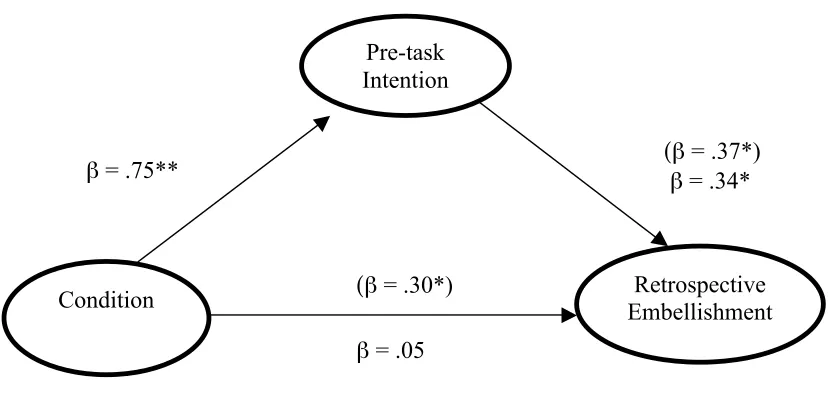
correlated with pre-task intention r (69) = .37, p < .01, and embellishment during the task, r (69) = .30, p < .05. Using linear regression, we found evidence that the main effect of condition on retrospective embellishment was mediated by judgments of intention before the task. When controlling for pre-task intention, condition did not predict
retrospective embellishment, β = .05, t < 1, ns, but intention significantly predicted
retrospective embellishment when controlling for condition, β = .34, t = 1.93, p =.05. As
a test of mediation, a Sobel test was conducted on the regression of condition on
Observer Preference
Finally, it was important to examine whether the perceptions were affected by the viewer’s own attitudes toward the targets. Overall 76% of participants favored Obama, 12% participants preferred Clinton, and 12% reported no preference. Because the preferences were highly skewed, we examined the perceived marksmanship towards the
favored candidate and disfavored candidate (excluding the undecided participants). A repeated measures ANOVA was conducted on perceived accuracy for liked vs. disliked target according to own preferences. Own political preference had no effect on
perceptions of accuracy (F = 1.83, ns). Including undecided participants, no correlation between own preference and the distortion difference between targets was found, r (69) = - .03, ns.
Discussion
GENERAL DISCUSSION
Issues and Limitations
Alternative Accounts
In Experiments 1 and 2, intentionality was manipulated by the choice of action. Consistent with predictions, choice distorted perceived action to be consistent with the intention – either better typing performance (Experiment 1) or poorer singing
performance (Experiment 2). The use of choice as a manipulation of intention may suggest a cognitive dissonance account for the results, that the perceived outcome was distorted because participants were motivated to see their actions be successful. For example, dissonance research shows that people readily revise their prior attitudes (e.g., against raising tuition) to match their present behavior (promoting raising tuition), but that this revision is dependent on the appearance of free choice in their behavior
(Festinger & Carlsmith, 1959; Bem and McConnell, 1970). Experiments 3 and 4 help to address this issue, as these studies used the actor’s desire rather than choice as a
between intention and action is so deep-seated in our social reasoning that it is often taken for granted. The revisions of attitudes (and the intentions associated with them) demonstrated in dissonance research may be part of this more general belief about the mechanics of ideal agency. More recent studies of cognitive dissonance have found that the orientation toward action is a critical factor in producing cognitive dissonance effects. For example, there is greater post-decisional spreading of alternatives when people first the actions that they will undertake (Harmon-Jones & Harmon-Jones, 2002).
Elements of Intentionality
These studies focused on choice, desire, and to a lesser extent effort as measures of intentionality, but it is important to acknowledge the other components of
Conscious awareness and deliberate initiation of action may comprise the mechanics –
how the intention seems to create action. Because intentionality is not a discrete mental state but a composite of different mental states, we used two manipulations of
intentionality that best converge on overall intentionality: the goal choice before action (Experiments 1 & 2), and motivation for success (Experiments 3 & 4). What is important here is that we should expect that additional elements of intentionality to have an additive effect on embellishment: as more factors are present, intentionality is strengthened, and embellishment is more likely. In general, we should expect more embellishment when there is greater premeditation, motivation, decision, and effort. Indeed, the division of these intentional components may be reason for the additive effects of choice and effort observed in Experiment 1.
Ability and expertise
Even experts can embellish actions when conditions are right, i.e. the result is ambiguous, and prior intent was strong.
Likewise, embellishments are not necessarily constrained by actual poor ability. Generally people believe themselves to be effective agents even when they are not, and overestimate their skills at various activities (Kruger & Dunning, 1999). More relevant than one’s true ability, are one’s beliefs about ability and self-efficacy that suggest how well one can expect to enact their intentions (Rotter, 1966). Expectations are different for individuals who are depressed, have low self-esteem or feel outcomes are beyond their control (Bandura, 1977). Consistent with this reasoning, narcissists are more likely to commit extreme overestimates of competence (Ames & Kammrath, 2004), but people with low self-esteem show reduced cognitive dissonance effects, that is they don’t revise prior intentions following a counter-attitudinal action (Stone, 2003).
Reality Check
In a few of the studies presented here, the difference between conditions in the perceived success of actions was relatively small- for instance in Experiment 1, people in the choice condition embellished their typing performance by ¼ of a letter on average, and in Experiment 3, the perceived distance to the bull’s-eye was less than a half-inch closer for the disliked target. These relatively small distortions raise the question: if action embellishment is possible, is it only in small amounts? Intentionality can distort perceived action, but perceptions of action are always anchored to the actual
an outcome, or the effort we put towards that goal, there is a limit to how far we can bend reality. A person may know that no matter how much he wants to or tries, he can’t lift a car over his head, or jump to the moon, so it is unlikely that he will believe he has done so.
An extreme instance of action embellishment that exceeds the limits of rationality is found in the condition of anosognosia (also see: Kruger & Dunning, 1999).
parts of the left hemisphere act as imaginative story-tellers, interpreting (and sometimes exaggerating) the perceived environment (Gazzaniga 1988), this region of the right hemisphere works as a kind of devil’s advocate, questioning the plausibility of these interpretations. Anything that doesn’t stand up to the scrutiny will be dismissed, even before a person is conscious of the thought. Without such a reality check patients with anosognosia are free to accept any confabulation they like, regardless of glaring evidence to the contrary.
The effects of action embellishment reported here represent an example of this phenomenon in a non-clinical population. People showed a distorted perception of the actual success – for example, the actual distance to a target seemed to grow or shrink in their eyes. It is possible that these minute distortions can be increased as time passes, and become the basis for later memory distortions and general evaluations. In the meantime, as action is observed, these minor distortions would pass a reality check because they are both consistent with expectations, and not far from the truth.
Conclusion
Acknowledgments
This research conducted with support from doctoral and postdoctoral fellowships from the Social Sciences and Humanities Research Council of Canada awarded to Jesse Preston. We thank Ricardo Alanis, Ashley Augustine, Marie Baldwin, Michael
Berkowitz, Leanne Gaffney, Lucy Grayson, Devin Lyons-Quirk, Christine Mathieson, Linda Miller, Ari Moskowitz, and Ansel Witthaus for their assistance in data collection. We also thank Justin Kruger, Carey Morewedge, Jim Olson, Chick Judd, and three anonymous reviewers for helpful feedback from on an earlier draft of this paper.
REFERENCES
Alicke, M.D. (1985). Global self-evaluation as determined by the desirability and controllability of trait adjectives. Journal of Personality and Social Psychology, 49, 1621-1630.
Ames, D. R., & Kammrath, L. K. (2004). Mind-reading and metacognition: Narcissism, not actual competence, predicts self-estimated ability. Journal of Nonverbal Behavior, 28, 187-209.
Balcetis, E., & Dunning, D. (2007). Cognitive dissonance and the perception of natural environments. Psychological Science, 10, 917-921.
Bandura, A. (1977). Self-efficacy: Toward a unifying theory of behavioral change.
Psychological Review, 84, 191-215.
Bargh, J. A. (1994). The four horsemen of automaticity: Awareness, intention, efficiency, and control in social cognition. In R. S. Wyer, Jr., & T. K. Srull (Eds.). Hillsdale, NJ: Erlbaum.
Baron-Cohen, S. (1995). Mindblindness. Cambridge, MA: MIT Press.
Biner, P.M., Angle, S. T., Park, J. H., Mellinger, A. E., & Barber, B. C. (1995). Need state and the illusion of control. Personality and Social Psychology Bulletin, 21,
899-907.
Csibra, G., Gergely, G., Biro, S., Koos, O., & Brockbank, M. (1999). Goal attribution without agency cues: The perception of "pure reason" in infancy. Cognition, 72, 237-267.
Dennett, D. C. (1987). The intentional stance. Cambridge, MA: Bradford Books/The MIT Press.
Dijksterhuis, A., Preston, J., Wegner, D. M., & Aarts, H. (2008). Effects of subliminal priming of self and God on judgments of authorship. Journal of Experimental Social Psychology, 44. 2-9.
Dunning, D., Meyerowitz, J. A., & Holzberg, A. D. (1989). Ambiguity and
self-evaluation: The role of idiosyncratic trait definitions in self-serving assessments of ability. Journal of Personality and Social Psychology, 57, 1082-1090.
Fiedler, K., Walther, E. & Nickel, S. (1999). The covariation principle in attribution: Not to be presupposed and not to be ignored. Personality & Social Psychology
Bulletin, 25, 607-622.
Gazzaniga, M. S., & LeDoux, J. E. (1978). The integrated mind. New York: Plenum. Gilbert, D. T., Pelham, B. W., & Krull, D. S., (1988). On cognitive busyness: When
person perceivers meet persons perceived. Journal of Personality and Social Psychology, 54, 733-740.
Guthrie, S. E. (1993). Faces in the clouds: A new theory of religion. New York: Oxford University Press.
Harmon-Jones, E. & Harmon-Jones, C. (2002). Testing the action-based model of
cognitive dissonance: The effect of action-orientation on post-decisional attitudes.
Hassin, R. R., Aarts, H., & Ferguson, M. (2005). Automatic goal inferences. Journal of Experimental Social Psychology, 41, 129-140.
Heider, F. (1958). The psychology of interpersonal relations. New York: Wiley. Kruger, J., & Dunning, D. (1999). Unskilled and unaware of it: How difficulties in
recognizing one's own incompetence lead to inflated self-assessments. Journal of Personality and Social Psychology, 77, 1121-1134.
Kruger, J., & Gilovich, T. (2004). Actions and intentions in self-assessments: The road to self-enhancement is paved with good intentions. Personality and Social
Psychology Bulletin,30, 328-339.
Langer, E., & Roth, J. (1975). Heads I win, tails it's chance: The illusion of control as a function of the sequence of outcomes in a pure chance task. Journal of
Personality and Social Psychology, 32, 951-955.
Malle, B. F. (1999). How people explain behavior: A new theoretical framework.
Personality and Social Psychology Review, 3, 23-48.
Malle, B.F. & Knobe, J. (1997). The folk concept of intentionality. Journal of Experimental Social Psychology, 33, 102-121.
McClure, J. L. (2002). Goal-based explanations of actions and outcomes. European Review of Social Psychology, 12, 201-236.
Michotte, A. (1963). The perception of causality (T. R. Miles & E. Miles, Trans.). New York: Basic Books.
Miller, D. T., & Nelson, L. D. (2002). Seeing approach motivation in the avoidance behavior of others: Implications for an understanding of pluralistic ignorance.
Miller, D. T., & Ross, M. (1975). Self-serving biases in the attribution of causality: Fact or fiction? Psychological Bulletin, 82, 213-225.
Molina, M., Van de Walle, G. A., Condry, K., Spelke, E. S. (2004). The animate-inanimate distinction in infancy: Developing sensitivity to constraints on human actions. Journal of Cognition and Development, 5, 399-426.
Moore, D. A. & Healey, P. J. (2008). The trouble with overconfidence. Psychological Review, 115, 502-517.
Morewedge, C. K., Preston, J. & Wegner, D. M. (2007). Timescale bias in the attribution of mind, Journal of Personality and Social Psychology. 93, 1-11.
Pearson, J., Clifford, C., & Tong, T. (2008). The functional impact of mental imagery on conscious perception. Current Biology, 18, 982 – 986.
Premack, D., & Woodruff, G. (1978). Does the chimpanzee have a theory of mind? Brain & Behavioral Sciences, 1, 515-526.
Preston, J., & Wegner, D. M. (2005). Ideal agency: On perceiving the self as an origin of action. In A. Tesser, J. Wood, & D. Stapel (Eds.), On building, defending, and regulating the self (pp. 103-125). Philadelphia, PA: Psychology Press.
Preston, J., & Wegner, D. M. (2007). The eureka error: Inadvertent plagiarism by effort misattribution. Journal of Personality and Social Psychology, 92, 575-585. Proffitt, D. R. (2006). Embodied perception and the economy of action. Perspectives on
Psychological Science, 1, 110-122.
Ramachandran, V. S. (1995). Anosognosia in parietal lobe syndrome. Consciousness
Risen, J. L., & Gilovich, T. (2007). Another look at why people are reluctant to exchange lottery tickets. Journal of Personality and Social Psychology. 93, 12-22
Ross, M., & Sicoly, F. (1979). Egocentric biases in availability and attribution. Journal of Personality and Social Psychology, 37, 322-336.
Rotter, J. B. (1966). Generalized expectancies for internal versus external control of
reinforcement. Psychological Monographs: General & Applied, 80, 1-28.
Rozin, P., Millman, L. & Nemeroff, C. (1986). Operation of the laws of sympathetic
magic in disgust and other domains. Journal of Personality & Social
Psychology, 50, 703-712.
Sacks, O. (1995). An anthropologist on Mars. NY/London: Alfred Knopf/ Picador. Simons, D. J. & Chabris, C. F. (1999). Gorillas in our midst: Sustained inattentional
blindness for dynamic events. Perception, 28, 1059-1074.
Stone, J. (2003). Self-consistency for low self-esteem in dissonance processes: The role of self-standards. Personality and Social Psychology Bulletin, 29, 846-858. Taylor, S. E., & Brown, J. D. (1988). Illusion and well-being: A social psychological
perspective on mental health. PsychologicalBulletin, 103, 193-210.
Taylor, S. E., & Gollwitzer, P.M. (1995). Effects of mindset on positive illusions. Journal of Personality and Social Psychology, 69, 213-226.
Thompson, S. C., Armstrong, W., & Thomas, C. (1998). Illusions of control,
Uleman, J.S. (1999). Spontaneous versus intentional inferences in impression formation. In S. Chaiken & Y. Trope (Eds.). Dual-process theories in social psychology (pp. 141-160). New York: Guilford.
Wegner, D. M. (2002). The illusion of conscious will. Cambridge, MA: MIT Press. Wicklund, R. A., & Brehm, J. W. (1976). Perspectives on cognitive dissonance.
Table 1.
Mean Actual and Reported distance to bull’s eye by Target, Experiment 3.
Target Liking Distance to Bull’s eye (in inches) Target Rank Rating Actual Reported Difference
Martin Luther King 1 6.70 6.29 6.91 -.61
Mahatma Gandhi 2 6.48 6.10 6.89 -.80
Albert Einstein 3 5.31 6.10 6.80 -.70
John F. Kennedy 4 5.15 6.23 6.98 -.73
OJ Simpson 5 -4.56 6.24 6.89 -.65
Saddam Hussein 6 -5.50 6.04 6.58 -.54
Osama Bin Laden 7 -5.96 6.20 6.70 -.50
Adolf Hitler 8 -6.51 6.04 6.48 -.43
Linear Contrast F(112) 1.02 5.40* 6.36*
Table 2.
Judgments of prior intention and retrospective success for pitcher’s throws at Obama
and Clinton, by condition, Experiment 4
Condition
Clinton supporter Obama Supporter Mean (SD) Mean (SD)
Intention to hit Clinton 2.94 (1.84) 5.86 (1.33)
Intention to hit Obama 5.25 (1.85) 2.39 (1.52)
Retrospective success – Clinton 4.03 (1.47) 4.69 (1.64)
Figure Captions
Figure 1. Actual and Perceived typing performance by choice, Experiment 1
Figure 2
Note: Betas are standardized coefficients. Parenthetical coefficients represent direct effect of target speed and positivity with no mediator in the model. Asterisks indicate
significant relations (*p < .05, ** p < .001).
Retrospective Embellishment
β = .75** (ββ = .34* = .37*)
Pre-task Intention
Condition (β = .30*)