This text was adapted by The Saylor Foundation under a Creative
Commons Attribution-NonCommercial-ShareAlike 3.0 License without
Preface
This text has an attitude: that in addition to providing sources of practical information, it should introduce you to a way of thinking about your personal financial decisions. This should lead you to thinking harder and farther about the larger and longer
consequences of your decisions. Many of the more practical aspects of personal finance will change over time, as practices, technologies, intermediaries, customs, and laws change, but a fundamental awareness of ways to think well about solving financial questions can always be useful. Some of the more practical ideas may be obviously and immediately relevant—and some not—but decision-making and research skills are lasting.
You may be enrolled in a traditional two- or four-year degree program or may just be taking the course for personal growth. You may be of any age and may have already done more or less academic and experiential learning. You may be a business major, with some prerequisite knowledge of economics or level of accounting or math skills, or you may be filling in an elective and have no such skills. In fact, although they enhance personal finance decisions, such skills are not necessary. Software, downloadable
applications, and calculators perform ever more sophisticated functions with ever more approachable interfaces. The emphasis in this text is on understanding the fundamental relationships behind the math and being able to use that understanding to make better decisions about your personal finances.
Entire tomes, both academic texts and trade books, have been and will be written about any of the subjects featured in each chapter of this text. The idea here is to introduce you to the practical and conceptual framework for making personal financial decisions in the larger context of your life, and in the even larger context of your individual life as part of a greater economy of financial participants.
Structure
The text may be divided into five sections:
1. Learning Basic Skills, Knowledge, and Context (Chapter 1 "Personal Financial Planning"–Chapter 6 "Taxes and Tax Planning")
2. Getting What You Want (Chapter 7 "Financial Management"–Chapter 9 "Buying a Home")
3. Protecting What You’ve Got (Chapter 10 "Personal Risk Management: Insurance"–Chapter 11 "Personal Risk Management: Retirement and Estate Planning")
4. Building Wealth (Chapter 12 "Investing"–Chapter 17 "Investing in Mutual Funds, Commodities, Real Estate, and Collectibles")
This structure is based on the typical life cycle of personal financial decisions, which in turn is based on the premise that in a market economy, an individual participates by trading something of value: labor or capital. Most of us start with nothing to trade but labor. We hope to sustain our desired lifestyle on the earnings from labor and to gradually (or quickly) amass capital that will then provide additional earnings.
Learning Basic Skills, Knowledge, and Context (Chapter 1 "Personal Financial Planning"–Chapter 6 "Taxes and Tax Planning")
Chapter 1 "Personal Financial Planning" introduces four of its major themes:
• Financial decisions are individual-specific (Section 1.1 "Individual or “Micro”
Factors That Affect Financial Thinking").
• Financial decisions are economic decisions (Section 1.2 "Systemic or “Macro”
Factors That Affect Financial Thinking").
• Financial decision making is a continuous process (Section 1.3 "The Planning
Process").
• Professional advisors work for financial decision makers (Section 1.4 "Financial
Planning Professionals").
These themes emphasize the idiosyncratic, systemic, and continuous nature of personal finance, putting decisions within the larger contexts of an entire lifetime and an
economy.
Chapter 2 "Basic Ideas of Finance" introduces the basic financial and accounting
categories of revenues, expenses, assets, liabilities, and net worth as tools to understand the relationships between them as a way, in turn, of organizing financial thinking. It also introduces the concepts of opportunity costs and sunk costs as implicit but critical
considerations in financial thinking.
Chapter 3 "Financial Statements" continues with the discussion of organizing financial data to help in decision making and introduces basic analytical tools that can be used to clarify the situation portrayed in financial statements.
Chapter 4 "Evaluating Choices: Time, Risk, and Value" introduces the critical
relationships of time and risk to value. It demonstrates the math but focuses on the role that those relationships play in financial thinking, especially in comparing and
evaluating choices in making financial decisions.
Chapter 5 "Financial Plans: Budgets" demonstrates how organized financial data can be used to create a plan, monitor progress, and adjust goals.
types, purposes, and impacts of taxes; the organization of resources for information; and the areas of controversy that lead to changes in the tax rules.
Getting What You Want (Chapter 7 "Financial Management"–Chapter 9 "Buying a Home")
Chapter 7 "Financial Management" focuses on financing consumption using current earnings and/or credit, and financing longer-term assets with debt.
Chapter 8 "Consumer Strategies" discusses purchasing decisions, starting with recurring consumption, and then goes into detail on the purchase of a car, a more significant and longer-term purchase both in terms of its use and financing.
Chapter 9 "Buying a Home" applies the ideas developed in the previous chapter to what, for most people, will be the major purchase: a home. The chapter discusses its role both as a living expense and an investment, as well as the financing and financial
consequences of the purchase.
Protecting What You’ve Got (Chapter 10 "Personal Risk Management:
Insurance"–Chapter 11 "Personal Risk Management: Retirement and Estate Planning")
Chapter 10 "Personal Risk Management: Insurance" introduces the idea of
incorporating risk management into financial planning. An awareness of the need for risk management often comes with age and experience. This chapter focuses on planning for the unexpected. It progresses from the more obvious risks to property to the less obvious risks, such as the possible inability to earn due to temporary ill health, permanent disability, or death.
Chapter 11 "Personal Risk Management: Retirement and Estate Planning" focuses on planning for the expected: retirement, loss of income from wages, and the subsequent distribution of assets after death. Retirement planning discusses ways to develop alternative sources of income from capital that can eventually substitute for wages. Estate planning also touches on the considerations and mechanics of distributing accumulated wealth.
Chapter 12 "Investing" presents basic information about investment instruments and markets and explains the classic relationships of risk and return developed in modern portfolio theory.
Chapter 13 "Behavioral Finance and Market Behavior" then digresses from classical theory to take a look at how both personal and market behavior can deviate from the classic risk-return relationships and the consequences for personal financial planning and thinking.
Chapter 14 "The Practice of Investment" looks at the mechanics of the investment process, discussing issues of technology, the investor-broker relationship, and the differences between domestic and international investing.
Chapter 15 "Owning Stocks", Chapter 16 "Owning Bonds", and Chapter 17 "Investing in Mutual Funds, Commodities, Real Estate, and Collectibles" look at investments
commonly made by individual investors and their use in and risks for building wealth as part of a diverse investment strategy.
How to Get Started (Chapter 18 "Career Planning")
Chapter 1
Personal Financial Planning
Introduction
Bryon and Tomika are just one semester shy of graduating from a state college. Bryon is getting a degree in protective services and is thinking of going for certification as a fire protection engineer, which would cost an additional $4,500. With his protective services degree many other fields will be open to him as well—from first responder to game warden or correctional officer. Bryon will have to specialize immediately and wants a job in his state that comes with some occupational safety and a lot of job security.
Tomika is getting a Bachelor of Science degree in medical technology and hopes to parlay that into a job as a lab technician. She has interviews lined up at a nearby regional hospital and a local pharmaceutical firm. She hopes she gets the hospital job because it pays a little better and offers additional training on site. Both Bryon and Tomika will need additional training to have the jobs they want, and they are already in debt for their educations.
Tomika qualified for a Stafford loan, and the federal government subsidizes her loan by paying the interest on it until six months after she graduates. She will owe about
$40,000 of principal plus interest at a fixed annual rate of 6.8 percent. Tomika plans to start working immediately on graduation and to take classes on the job or at night for as long as it takes to get the extra certification she needs. Unsubsidized, the extra training would cost about $3,500. She presently earns about $5,000 a year working weekends as a home health aide and could easily double that after she graduates. Tomika also
qualified for a Pell grant of around $5,000 each year she was a full-time student, which has paid for her rooms in an off-campus student co-op housing unit. Bryon also lives there, and that’s how they met.
Bryon would like to get to a point in his life where he can propose marriage to Tomika and looks forward to being a family man one day. He was awarded a service scholarship from his hometown and received windfall money from his grandmother’s estate after she died in his sophomore year. He also borrowed $30,000 for five years at only 2.25 percent interest from his local bank through a family circle savings plan. He has been attending classes part-time year-round so he can work to earn money for college and living expenses. He earns about $19,000 a year working for catering services. Bryon feels very strongly about repaying his relatives who have helped finance his education and also is willing to help Tomika pay off her Stafford loan after they marry.
is his trusty old pickup truck, which has no liens and a trade-in value of $3,900. For both Tomika and Bryon, having reliable transportation to their jobs is a concern. Tomika hopes to continue using public transportation to get to a new job after graduation. Both Bryon and Tomika are smart enough about money to have avoided getting into credit card debt. Each keeps only one major credit card and a debit card and with rare exceptions pays statements in full each month.
Bryon and Tomika will have to find new housing after they graduate. They could look for another cooperative housing opportunity or rent apartments, or they could get married now instead of waiting. Bryon also has a rent-free option of moving in temporarily with his brother. Tomika feels very strongly about saving money to buy a home and wants to wait until her career is well established before having a child. Tomika is concerned about getting good job benefits, especially medical insurance and family leave. Although still young, Bryon is concerned about being able to retire, the sooner the better, but he has no idea how that would be possible. He thinks he would enjoy running his own catering firm as a retirement business some day.
Tomika’s starting salary as a lab technician will be about $30,000, and as a fire
protection engineer, Bryon would have a starting salary of about $38,000. Both have the potential to double their salaries after fifteen years on the job, but they are worried about the economy. Their graduations are coinciding with a downturn. Aside from Tomika’s savings bonds, she and Bryon are not in the investment market, although as soon as he can Bryon wants to invest in a diversified portfolio of money market funds that include corporate stocks and municipal bonds. Nevertheless, the state of the
economy affects their situation. Money is tight and loans are hard to get, jobs are scarce and highly competitive, purchasing power and interest rates are rising, and pension plans and retirement funds are at risk of losing value. It’s uncertain how long it will be before the trend reverses, so for the short term, they need to play it safe. What if they can’t land the jobs they’re preparing for?
Tomika and Bryon certainly have a lot of decisions to make, and some of those decisions have high-stakes consequences for their lives. In making those decisions, they will have to answer some questions, such as the following:
1. What individual or personal factors will affect Tomika’s and Bryon’s financial thinking and decision making?
2. What are Bryon’s best options for job specializations in protective services? What are Tomika’s best options for job placement in the field of medical technology? 3. When should Bryon and Tomika invest in the additional job training each will
need, and how can they finance that training?
4. How will Tomika pay off her college loan, and how much will it cost? How soon can she get out of debt?
5. How will Bryon repay his loan reflecting his family’s investment in his education? 6. What are Tomika’s short-term and long-term goals? What are Bryon’s? If they
marry, how well will their goals mesh or need to adjust?
9. What should they do about getting married and starting a family? 10.What should they do about buying a home and a car?
11. What is Bryon’s present and projected income from all sources? What is Tomika’s?
12.What is the tax liability on their present incomes as singles? What would their tax liability be on their future incomes if they filed jointly as a married couple?
13.What budget categories would you create for Tomika’s and Bryon’s expenses and expenditures over time?
14.How could Tomika and Bryon adjust their budgets to meet their short-term and long-term goals?
15.On the basis of your analysis and investigations, what five-year financial plan would you develop for Tomika and Bryon?
16.How will larger economic factors affect the decisions Bryon and Tomika make and the outcomes of those decisions?
You will make financial decisions all your life. Sometimes you can see those decisions coming and plan deliberately; sometimes, well, stuff happens, and you are faced with a more sudden decision. Personal financial planning is about making deliberate decisions that allow you to get closer to your goals or sudden decisions that allow you to stay on track, even when things take an unexpected turn.
The idea of personal financial planning is really no different from the idea of planning most anything: you figure out where you’d like to be, where you are, and how to go from here to there. The process is complicated by the number of factors to consider, by their complex relationships to each other, and by the profound nature of these decisions, because how you finance your life will, to a large extent, determine the life that you live. The process is also, often enormously, complicated by risk: you are often making
decisions with plenty of information, but little certainty or even predictability.
Personal financial planning is a lifelong process. Your time horizon is as long as can be— until the very end of your life—and during that time your circumstances will change in predictable and unpredictable ways. A financial plan has to be re-evaluated, adjusted, and re-adjusted. It has to be flexible enough to be responsive to unanticipated needs and desires, robust enough to advance toward goals, and all the while be able to protect from unimagined risks.
1.1
Individual or “Micro” Factors That Affect
Financial Thinking
LEARNING OBJECTIVES
1. List individual factors that strongly influence financial thinking.
2. Discuss how income, income needs, risk tolerance, and wealth are affected by individual factors. 3. Explain how life stages affect financial decision making.
4. Summarize the basis of sound financial planning.
The circumstances or characteristics of your life influence your financial concerns and plans. What you want and need—and how and to what extent you want to protect the satisfaction of your wants and needs—all depend on how you live and how you’d like to live in the future. While everyone is different, there are common circumstances of life that affect personal financial concerns and thus affect everyone’s financial planning. Factors that affect personal financial concerns are family structure, health, career choices, and age.
Family Structure
Marital status and dependents, such as children, parents, or siblings, determine whether you are planning only for yourself or for others as well. If you have a spouse or
dependents, you have a financial responsibility to someone else, and that includes a responsibility to include them in your financial thinking. You may expect the
dependence of a family member to end at some point, as with children or elderly parents, or you may have lifelong responsibilities to and for another person.
Partners and dependents affect your financial planning as you seek to provide for them, such as paying for children’s education. Parents typically want to protect or improve the quality of life for their children and may choose to limit their own fulfillment to achieve that end.
Providing for others increases income needs. Being responsible for others also affects your attitudes toward and tolerance of risk. Typically, both the willingness and ability to assume risk diminishes with dependents, and a desire for more financial protection grows. People often seek protection for their income or assets even past their own lifetimes to ensure the continued well-being of partners and dependents. An example is a life insurance policy naming a spouse or dependents as beneficiaries.
Your health is another defining circumstance that will affect your expected income needs and risk tolerance and thus your personal financial planning. Personal financial planning should include some protection against the risk of chronic illness, accident, or long-term disability and some provision for short-term events, such as pregnancy and birth. If your health limits your earnings or ability to work or adds significantly to your expenditures, your income needs may increase. The need to protect yourself against further limitations or increased costs may also increase. At the same time your tolerance for risk may decrease, further affecting your financial decisions.
Career Choice
Your career choices affect your financial planning, especially through educational requirements, income potential, and characteristics of the occupation or profession you choose. Careers have different hours, pay, benefits, risk factors, and patterns of
advancement over time. Thus, your financial planning will reflect the realities of being a postal worker, professional athlete, commissioned sales representative, corporate lawyer, freelance photographer, librarian, building contractor, tax preparer, professor, Web site designer, and so on. For example, the careers of most athletes end before middle age, have higher risk of injury, and command steady, higher-than-average incomes, while the careers of most sales representatives last longer with greater risk of unpredictable income fluctuations. Figure 1.1 "Median Salary Comparisons by
[image:10.612.79.268.428.691.2]Profession" compares the median salaries of certain careers.
Most people begin their independent financial lives by selling their labor to create an income by working. Over time they may choose to change careers, develop additional sources of concurrent income, move between employment and self-employment, or become unemployed or reemployed. Along with career choices, all these changes affect personal financial management and planning.
Age
Needs, desires, values, and priorities all change over a lifetime, and financial concerns change accordingly. Ideally, personal finance is a process of management and planning that anticipates or keeps abreast with changes. Although everyone is different, some financial concerns are common to or typical of the different stages of adult life. Analysis of life stages is part of financial planning.
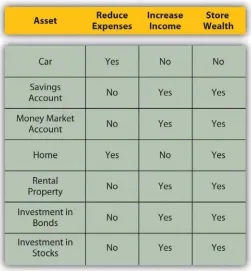
At the beginning of your adult life, you are more likely to have no dependents, little if any accumulated wealth, and few assets. (Assets are resources that can be used to create income, decrease expenses, or store wealth as an investment.) As a young adult you also are likely to have comparatively small income needs, especially if you are providing only for yourself. Your employment income is probably your primary or sole source of income. Having no one and almost nothing to protect, your willingness to assume risk is usually high. At this point in your life, you are focused on developing your career and increasing your earned income. Any investments you may have are geared toward growth.
As your career progresses, income increases but so does spending. Lifestyle expectations increase. If you now have a spouse and dependents and elderly parents to look after, you have additional needs to manage. In middle adulthood you may also be acquiring more assets, such as a house, a retirement account, or an inheritance.
Figure 1.3 Financial Decisions Related to Life Stages
Early and middle adulthoods are periods of building up: building a family, building a career, increasing earned income, and accumulating assets. Spending needs increase, but so do investments and alternative sources of income.
Later adulthood is a period of spending down. There is less reliance on earned income and more on the accumulated wealth of assets and investments. You are likely to be without dependents, as your children have grown up or your parents passed on, and so without the responsibility of providing for them, your expenses are lower. You are likely to have more leisure time, especially after retirement.
Without dependents, spending needs decrease. On the other hand, you may feel free to finally indulge in those things that you’ve “always wanted.” There are no longer
dependents to protect, but assets demand even more protection as, without
employment, they are your only source of income. Typically, your ability to assume risk is high because of your accumulated assets, but your willingness to assume risk is low, as you are now dependent on those assets for income. As a result, risk tolerance
decreases: you are less concerned with increasing wealth than you are with protecting it.
Effective financial planning depends largely on an awareness of how your current and future stages in life may influence your financial decisions.
KEY TAKEAWAYS
• Personal circumstances that influence financial thinking include family structure, health, career
choice, and age.
• Age and stage of life affect sources of income, asset accumulation, spending needs, and risk
tolerance.
• Sound personal financial planning is based on a thorough understanding of your personal
circumstances and goals.
EXERCISES
1. You may be surprised at what you discover. In the process, consider how information in this text specifically relates to your observations and insights. Reading this chapter, for example, identify and describe your current life stage. How does your current age or life stage affect your financial thinking and behavior? To what extent and in what ways does your financial thinking anticipate your next stage of life? What financial goals are you aware of that you have set? How are your current experiences informing your financial planning for the future?
2. Continue your personal financial journal by describing how other micro factors, such as your present family structure, health, career choices, and other individual factors, are affecting your financial planning. The My Notes feature allows you to share given entries or to keep them private. You can save your notes. You also can highlight and right click on your notes to copy and paste them into a word document on your computer.
3. Find the age range for your stage of life and read the advice at
http://financialplan.about.com/od/moneybyageorlifestage/Money_and_Personal_Finance_by_
Age_Life_Stage.htm. According to the articles on this page, what should be your top priorities in
financial planning right now? Read the articles on the next life stage. How are your financial
planning priorities likely to change?
1.2 Systemic or “Macro” Factors That Affect
Financial Thinking
LEARNING OBJECTIVES
1. Identify the systemic or macro factors that affect personal financial planning. 2. Describe the impact of inflation or deflation on disposable income.
3. Describe the effect of rising unemployment on disposable income.
4. Explain how economic indicators can have an impact on personal finances.
Financial planning has to take into account conditions in the wider economy and in the markets that make up the economy. The labor market, for example, is where labor is traded through hiring or employment. Workers compete for jobs and employers
compete for workers. In the capital market, capital (cash or assets) is traded, most commonly in the form of stocks and bonds (along with other ways to package capital). In the credit market, a part of the capital market, capital is loaned and borrowed rather than bought and sold. These and other markets exist in a dynamic economic environment, and those environmental realities are part of sound financial planning.
In the long term, history has proven that an economy can grow over time, that investments can earn returns, and that the value of currency can remain relatively stable. In the short term, however, that is not continuously true. Contrary or unsettled periods can upset financial plans, especially if they last long enough or happen at just the wrong time in your life. Understanding large-scale economic patterns and factors that indicate the health of an economy can help you make better financial decisions. These systemic factors include, for example, business cycles and employment rates.
Business Cycles
An economy tends to be productive enough to provide for the wants of its members. Normally, economic output increases as population increases or as people’s expectations grow. An economy’s output or productivity is measured by its
gross domestic product or GDP, the value of what is produced in a period. When the GDP is increasing, the economy is in an expansion, and when it is decreasing, the
Figure 1.4 GDP Percent Change (Based on Current Dollars)[1]
Over time, the economy tends to be cyclical, usually expanding but sometimes
contracting. This is called the business cycle. Periods of contraction are generally seen as market corrections, or the market regaining its equilibrium, after periods of growth. Growth is never perfectly smooth, so sometimes certain markets become unbalanced and need to correct themselves. Over time, the periods of contraction seem to have become less frequent, as you can see in Figure 1.4 "GDP Percent Change (Based on Current Dollars)". The business cycles still occur nevertheless.
There are many metaphors to describe the cyclical nature of market economies: “peaks and troughs,” “boom and bust,” “growth and contraction,” “expansion and correction,” and so on. While each cycle is born in a unique combination of circumstances, cycles occur because things change and upset economic equilibrium. That is, events change the balance between supply and demand in the economy overall. Sometimes demand grows too fast and supply can’t keep up, and sometimes supply grows too fast for demand. There are many reasons that this could happen, but whatever the reasons, buyers and sellers react to this imbalance, which then creates a change.
Employment Rate
An economy produces not just goods and services to satisfy its members but also jobs, because most people participate in the market economy by trading their labor, and most rely on wages as their primary source of income. The economy therefore must provide opportunity to earn wages so more people can participate in the economy through the market. Otherwise, more people must be provided for in some other way, such as a private or public subsidy (charity or welfare).
The unemployment rate is a measure of an economy’s shortcomings, because it shows the proportion of people who want to work but don’t because the economy cannot provide them jobs. There is always some so-called natural rate of unemployment as people move in and out of the workforce as the circumstances of their lives change—for example, as they retrain for a new career or take time out for family. But natural
Unemployment also shows that the economy is not efficient, because it is not able to put all its productive human resources to work.
The employment rate, or the participation rate of the labor force, shows how
successful an economy is at creating opportunities to sell labor and efficiently using its human resources. A healthy market economy uses its labor productively, is productive, and provides employment opportunities as well as consumer satisfaction through its markets. Figure 1.6 "Cyclical Economic Effects" shows the relationship between GDP and unemployment and each stage of the business cycle.
Figure 1.6 Cyclical Economic Effects
At either end of this scale of growth, the economy is in an unsustainable position: either growing too fast, with too much demand for labor, or shrinking, with too little demand for labor.
If there is too much demand for labor—more jobs than workers to fill them—then wages will rise, pushing up the cost of everything and causing prices to rise. Prices usually rise faster than wages, for many reasons, which would discourage consumption that would eventually discourage production and cause the economy to slow down from its “boom” condition into a more manageable rate of growth.
If there is too little demand for labor—more workers than jobs—then wages will fall or, more typically, there will be people without jobs, or unemployment. If wages become low enough, employers theoretically will be encouraged to hire more labor, which would bring employment levels back up. However, it doesn’t always work that way, because people have job mobility—they are willing and able to move between economies to seek employment.
If unemployment is high and prolonged, then too many people are without wages for too long, and they are not able to participate in the economy because they have nothing to trade. In that case, the market economy is just not working for too many people, and they will eventually demand a change (which is how most revolutions have started).
Other Indicators of Economic Health
durable goods (e.g., appliances and automobiles), consumer confidence, producer prices, and so on. However, GDP growth and unemployment are the two most closely watched indicators, because they get at the heart of what our economy is supposed to accomplish: to provide diverse opportunities for the most people to participate in the economy, to create jobs, and to satisfy the consumption needs of the most people by enabling them to get what they want.
An expanding and healthy economy will offer more choices to participants: more choices for trading labor and for trading capital. It offers more opportunities to earn a return or an income and therefore also offers more diversification and less risk.
Naturally, everyone would rather operate in a healthier economy at all times, but this is not always possible. Financial planning must include planning for the risk that
economic factors will affect financial realities. A recession may increase unemployment, lowering the return on labor—wages—or making it harder to anticipate an increase in income. Wage income could be lost altogether. Such temporary involuntary loss of wage income probably will happen to you during your lifetime, as you inevitably will endure economic cycles.
A hedge against lost wages is investment to create other forms of income. In a period of economic contraction, however, the usefulness of capital, and thus its value, may decline as well. Some businesses and industries are considered immune to economic cycles (e.g., public education and health care), but overall, investment returns may suffer. Thus, during your lifetime business cycles will likely affect your participation in the capital markets as well.
Currency Value
Stable currency value is another important indicator of a healthy economy and a critical element in financial planning. Like anything else, the value of a currency is based on its usefulness. We use currency as a medium of exchange, so the value of a currency is based on how it can be used in trade, which in turn is based on what is produced in the economy. If an economy produces little that anyone wants, then its currency has little value relative to other currencies, because there is little use for it in trade. So a
currency’s value is an indicator of how productive an economy is.
A currency’s usefulness is based on what it can buy, or its purchasing power. The more a currency can buy, the more useful and valuable it is. When prices rise or when things cost more, purchasing power decreases; the currency buys less and its value decreases.
For example, say you can buy five video games for $20. Each game is worth $4, or each dollar buys ¼ of a game. Then we have inflation, and prices—including the price of video games—rise. A year later you want to buy games, but now your $20 only buys two games. Each one costs $10, or each dollar only buys one-tenth of a game. Rising prices have eroded the purchasing power of your dollars.
If there is deflation, prices fall, so maybe a year later you could buy ten video games with your same $20. Now each game costs only $2, and each dollar buys half a game. The same amount of currency buys more games: its purchasing power has increased, as has its usefulness and its value (Figure 1.7 "Dynamics of Currency Value").
Figure 1.7 Dynamics of Currency Value
Inflation is most commonly measured by the consumer price indexA measure of inflation or deflation based on a national average of prices for a “basket” of common goods and services purchased by the average consumer. (CPI), an index created and tracked by the federal government. It measures the average nationwide prices of a
“basket” of goods and services purchased by the average consumer. It is an accepted way of tracking rising or falling price levels, indicative of inflation or deflation. Figure 1.9 "Inflation, 1979–2008" shows the percent change in the consumer price index as a measure of inflation during the period from 1979 to 2008.
Currency instabilities can also affect investment values, because the dollars that investments return don’t have the same value as the dollars that the investment was expected to return. Say you lend $100 to your sister, who is supposed to pay you back one year from now. There is inflation, so over the next year, the value of the dollar decreases (it buys less as prices rise). Your sister does indeed pay you back on time, but now the $100 that she gives back to you is worth less (because it buys less) than the $100 you gave her. Your investment, although nominally returned, has lost value: you have your $100 back, but you can’t do as much with it; it is less useful.
If the value of currency—the units in which wealth is measured and stored—is unstable, then investment returns are harder to predict. In those circumstances, investment involves more risk. Both inflation and deflation are currency instabilities that are troublesome for an economy and also for the financial planning process. An unstable currency affects the value or purchasing power of income. Price changes affect
consumption decisions, and changes in currency value affect investing decisions.
It is human nature to assume that things will stay the same, but financial planning must include the assumption that over a lifetime you will encounter and endure economic cycles. You should try to anticipate the risks of an economic downturn and the possible loss of wage income and/or investment income. At the same time, you should not assume or rely on the windfalls of an economic expansion.
KEY TAKEAWAYS
• Business cycles include periods of expansion and contraction (including recessions), as measured by the economy’s productivity (gross domestic product).
• An economy is in an unsustainable situation when it grows too fast or too slowly, as each situation
causes too much stress in the economy’s markets.
• In addition to GDP, measures of the health of an economy include
o the rates of employment and unemployment, o the value of currency (the consumer price index).
• Financial planning should take into account the fact that periods of inflation or deflation change
the value of currency, affecting purchasing power and investment values.
• Thus, personal financial planning should take into account
o business cycles,
o changes in the economy’s productivity, o changes in the currency value,
EXERCISES
1. Go to http://www.nber.org/cycles.html to see a chart published by the National Bureau of Economic Research. The chart shows business cycles in the United States and their durations between 1854 and 2001. What patterns and trends do you see in these historical data? Which years saw the longest recessions? How can you tell that the U.S. economy has tended to become more stable over the decades?
2. Record in your personal financial journal or in My Notes the macroeconomic factors that are influencing your financial thinking and behavior today. What are some specific examples? How have large-scale economic changes or cycles, such as the economic recession of 2008–2009, affected your financial planning and decision making?
3. How does the health of the economy affect your financial health? How healthy is the U.S.
economy right now? On what measures do you base your judgments? How will your appreciation of the big picture help you in planning for your future?
4. How do business cycles and the health of the economy affect the value of your labor? In terms of supply and demand, what are the optimal conditions in which to sell your labor? How might further education increase your mobility in the labor market (the value of your labor)?
5. Brainstorm with others taking this course on effective personal financial strategies for a. protecting against recession,
b. hedging against inflation,
c. mitigating the effects of deflation,
d. taking realistic advantage of periods of expansion.
[1] Based on data from the Bureau of Economic Analysis, U.S. Department of Commerce, http://www.bea.gov/national/ (accessed November 21, 2009).
[2] Based on data from the Bureau of Labor Statistics, U.S. Department of Labor,
1.3 The Planning Process
LEARNING OBJECTIVES
1. Trace the steps of the financial planning process and explain why that process needs to be repeated over time.
2. Characterize effective goals and differentiate goals in terms of timing. 3. Explain and illustrate the relationships among costs, benefits, and risks. 4. Analyze cases of financial decision making by applying the planning process.
A financial planning process involves figuring out where you’d like to be, where you are, and how to go from here to there. More formally, a financial planning process means the following:
• Defining goals
• Assessing the current situation • Identifying choices
• Evaluating choices • Choosing
• Assessing the resulting situation • Redefining goals
• Identifying new choices • Evaluating new choices • Choosing
• Assessing the resulting situation over and over again
Personal circumstances change, and the economy changes, so your plans must be flexible enough to adapt to those changes, yet be steady enough to eventually achieve long-term goals. You must be constantly alert to those changes but “have a strong foundation when the winds of changes shift.”[1]
Defining Goals
Figuring out where you want to go is a process of defining goals. You have shorter-term (1–2 years), intermediate (2–10 years), and longer-term goals that are quite realistic and goals that are more wishful. Setting goals is a skill that usually improves with
experience. According to a popular model, to be truly useful goals must be Specific, Measurable, Attainable, Realistic, and Timely (S.M.A.R.T.). Goals change over time, and certainly over a lifetime. Whatever your goals, however, life is complicated and risky, and having a plan and a method to reach your goals increases the odds of doing so.
next decade, she foresees having a family; if so, she will want to purchase a house and perhaps start saving for her children’s educations. Her income will have to provide for her increased expenses and also generate a surplus that can be saved to accumulate these assets.
In the long term, she will want to be able to retire and derive all her income from her accumulated assets, and perhaps travel around the world in a sailboat. She will have to have accumulated enough assets to provide for her retirement income and for the travel. Figure 1.10 "Timing, Goals, and Income" shows the relationship between timing, goals, and sources of income.
Figure 1.10 Timing, Goals, and Income
Alice’s income will be used to meet her goals, so it’s important for her to understand where her income will be coming from and how it will help in achieving her goals. She needs to assess her current situation.
Assessing the Current Situation
Figuring out where you are or assessing the current situation involves understanding what your present situation is and the choices that it creates. There may be many choices, but you want to identify those that will be most useful in reaching your goals.
Assessing the current situation is a matter of organizing personal financial information into summaries that can clearly show different and important aspects of financial life— your assets, debts, incomes, and expenses. These numbers are expressed in financial statements—in an income statement, balance sheet, and cash flow statement (topics discussed in Chapter 3 "Financial Statements"). Businesses also use these three types of statements in their financial planning.
whether she is making progress toward them. Even a ballpark assessment of the current situation can be illuminating.
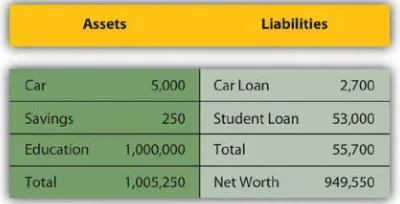
Alice’s assets may be a car worth about $5,000 and a savings account with a balance of $250. Debts include a student loan with a balance of $53,000 and a car loan with a balance of $2,700; these are shown in Figure 1.11 "Alice’s Financial Situation".
Figure 1.11 Alice’s Financial Situation
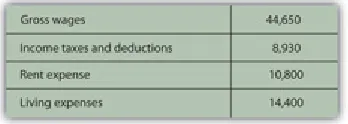
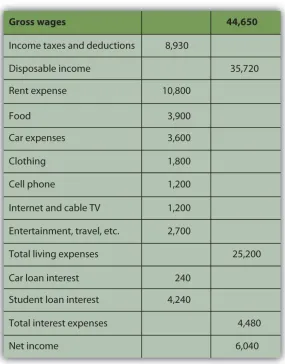
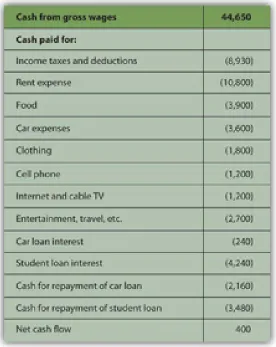
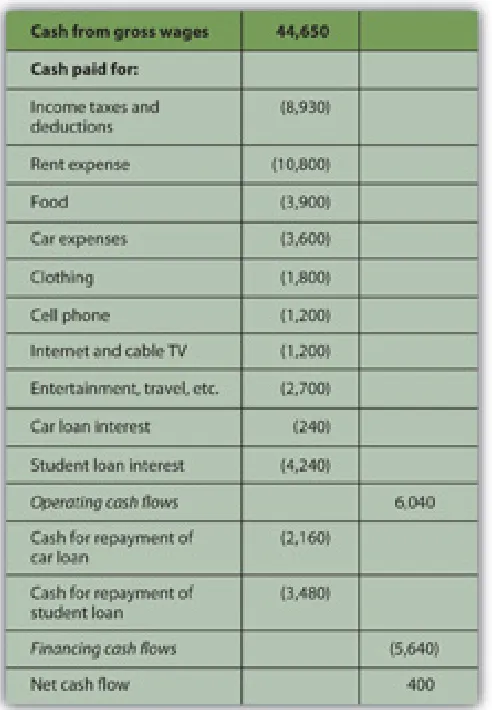
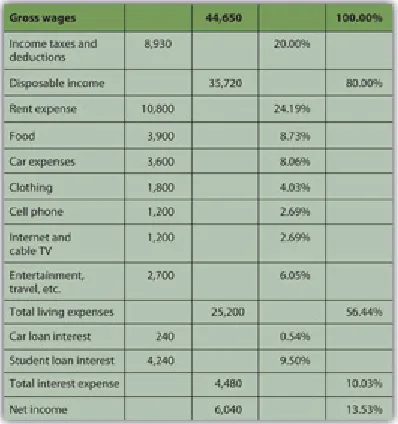
Her annual disposable income (after-tax income or take-home pay) may be $35,720, and annual expenses are expected to be $10,800 for rent and $14,400 for living
expenses—food, gas, entertainment, clothing, and so on. Her annual loan payments are $2,400 for the car loan and $7,720 for the student loan, as shown in Figure 1.12 "Alice’s Income and Expenses".
Alice will have an annual budget surplus of just $400 (income = $35,720 − $35,320 [total expenses + loan repayments]). She will be achieving her short-term goal of
reducing debt, but with a small annual budget surplus, it will be difficult for her to begin to achieve her goal of accumulating assets.
To reach that intermediate goal, she will have to increase income or decrease expenses to create more of an annual surplus. When her car loan is paid off next year, she hopes to buy another car, but she will have at most only $650 (250 + 400) in savings for a down payment for the car, and that assumes she can save all her surplus. When her student loans are paid off in about five years, she will no longer have student loan
payments, and that will increase her surplus significantly (by $7,720 per year) and allow her to put that money toward asset accumulation.
Alice’s long-term goals also depend on her ability to accumulate productive assets, as she wants to be able to quit working and live on the income from her assets in
retirement. Alice is making progress toward meeting her short-term goals of reducing debt, which she must do before being able to work toward her intermediate and long-term goals. Until she reduces her debt, which would reduce her expenses and increase her income, she will not make progress toward her intermediate and long-term goals.
Assessing her current situation allows Alice to see that she has to delay accumulating assets until she can reduce expenses by reducing debt (and thus her student loan payments). She is now reducing debt, and as she continues to do so, her financial situation will begin to look different, and new choices will be available to her.
Alice learned about her current situation from two simple lists: one of her assets and debts and the other of her income and expenses. Even in this simple example it is clear that the process of articulating the current situation can put information into a very useful context. It can reveal the critical paths to achieving goals.
Evaluating Alternatives and Making Choices
Figuring out how to go from here to there is a process of identifying immediate choices and longer-term strategies or series of choices. To do this, you have to be realistic and yet imaginative about your current situation to see the choices it presents and the future choices that current choices may create. The characteristics of your living situation— family structure, age, career choice, health—and the larger context of the economic environment will affect or define the relative value of your choices.
In her current situation, Alice is reducing debt, so one choice would be to continue. She could begin to accumulate assets sooner, and thus perhaps more of them, if she could reduce expenses to create more of a budget surplus. Alice looks over her expenses and decides she really can’t cut them back much. She decides that the alternative of reducing expenses is not feasible. She could increase income, however. She has two choices: work a second job or go to Las Vegas to play poker.
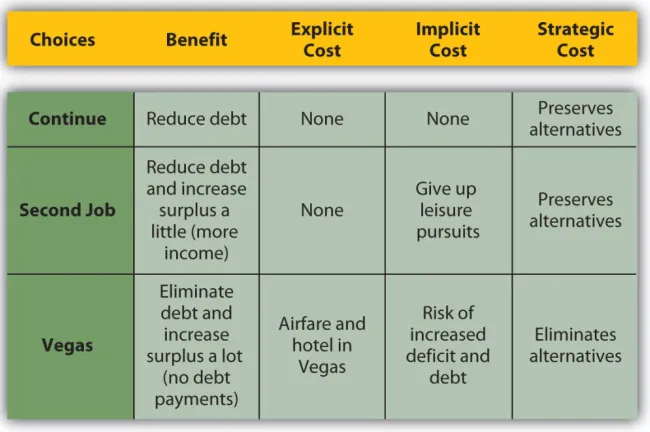
Alice could work a second, part-time job that would increase her after-tax income but leave her more tired and with less time for other interests. The economy is in a bit of a slump too—unemployment is up a bit—so her second job probably wouldn’t pay much. She could go to Vegas and win big, with the cost of the trip as her only expense. To evaluate her alternatives, Alice needs to calculate the benefits and costs of each (Figure 1.13 "Alice’s Choices: Benefits and Costs").
Figure 1.13 Alice’s Choices: Benefits and Costs
Laying out Alice’s choices in this way shows their consequences more clearly. The alternative with the biggest benefit is the trip to Vegas, but that also has the biggest cost because it has the biggest risk: if she loses, she could have even more debt. That would put her further from her goal of beginning to accumulate assets, which would have to be postponed until she could eliminate that new debt as well as her existing debt.
Figure 1.15 Considering Risk in Alice’s Choice
The Vegas option becomes least desirable when its risk is included in the calculations of its costs, especially as they compare with its benefits.
Its obvious risk is that Alice will lose wealth, but its even costlier risk is that it will limit her future choices. Without including risk as a cost, the Vegas option looks attractive, which is, of course, why Vegas exists. But when risk is included, and when the decision involves thinking strategically not only about immediate consequences but also about the choices it will preserve or eliminate, that option can be seen in a very different light (Figure 1.16 "Alice’s Choices: Benefits and More Costs").
Figure 1.16 Alice’s Choices: Benefits and More Costs
immediate benefit but more choices later. Risk itself is a cost, and choice a benefit, and they should be included in your assessment.
KEY TAKEAWAYS
• Financial planning is a recursive process that involves
o defining goals,
o assessing the current situation, o identifying choices,
o evaluating choices, o choosing.
• Choosing further involves assessing the resulting situation, redefining goals, identifying new
choices, evaluating new choices, and so on.
• Goals are shaped by current and expected circumstances, family structure, career, health, and
larger economic forces.
• Depending on the factors shaping them, goals are short-term, intermediate, and long-term. • Choices will allow faster or slower progress toward goals and may digress or regress from goals;
goals can be eliminated.
• You should evaluate your feasible choices by calculating the benefits, explicit costs, implicit costs,
and the strategic costs of each one.
EXERCISES
1. Assess and summarize your current financial situation. What measures are you using to describe where you are? Your assessment should include an appreciation of your financial assets, debts, incomes, and expenses.
2. Use the S.M.A.R.T. planning model and information in this section to evaluate Alice’s goals. Write your answers in your financial planning journal or My Notes and discuss your
evaluations with classmates. a. Pay off student loan
d. Retire
e. Travel around the world in a sailboat
Identify and prioritize your immediate, short-term, and long-term goals at this time in your life. Why will you need different strategies to achieve these goals? For each goal identify a range of alternatives for achieving it. How will you evaluate each alternative before making a decision?
4. In your personal financial journal or My Notes record specific examples of your use of the following kinds of strategies in making financial decisions:
a. Weigh costs and benefits b. Respond to incentives c. Learn from experience
d. Avoid a feared consequence or loss e. Avoid risk
f. Throw caution to the wind
On average, would you rate yourself as more of a rational than nonrational financial decision maker?
[1] “Forever Young,” music and lyrics by Bob Dylan.
1.4 Financial Planning Professionals
LEARNING OBJECTIVES
1. Identify the professions of financial advisors.
2. Discuss how training and compensation may affect your choice of advisor.
3. Describe the differences between objective and subjective advice and how that may affect your choice of advisor.
4. Discuss how the kind of advice you need may affect your choice of advisor.
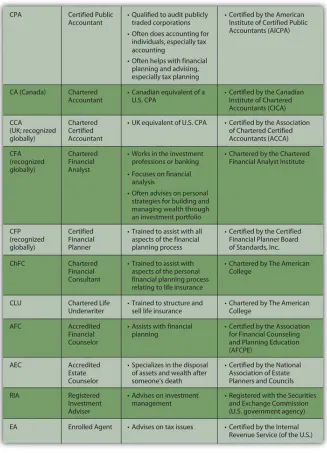
There are a multitude of financial advisors to help with financial planning, such as accountants, investment advisors, tax advisors, estate planners, or insurance agents. They have different kinds of training and qualifications, different educations and backgrounds, and different approaches to financial planning. To have a set of initials after their name, all have met educational and professional experience requirements and have passed exams administered by professional organizations, testing their knowledge in the field. Figure 1.17 "Professional Classifications" provides a perspective on the industry classifications of financial planning professionals.
Figure 1.17 Professional Classifications
understand where the advisor’s interests lie (as well as your own). It is always important to know where your information and advice come from and what that means for the quality of that information and advice. Specifically, how is the advisor compensated?
Some advisors just give, and get paid for, advice; some are selling a product, such as a particular investment or mutual fund or life insurance policy, and get paid when it gets sold. Others are selling a service, such as brokerage or mortgage servicing, and get paid when the service is used. All may be highly ethical and well intentioned, but when choosing a financial planning advisor, it is important to be able to distinguish among them.
Sometimes a friend or family member who knows you well and has your personal
interests in mind may be a great resource for information and advice, but perhaps not as objective or knowledgeable as a disinterested professional. It is good to diversify your sources of information and advice, using professional and “amateur,” subjective and objective advisors. As always, diversification decreases risk.
Now you know a bit about the planning process, the personal factors that affect it, the larger economic contexts, and the business of financial advising. The next steps in financial planning get down to details, especially how to organize your financial
information to see your current situation and how to begin to evaluate your alternatives.
References to Professional Organizations
The references that follow provide information for further research on the professionals and professional organizations mentioned in the chapter.
• American Institute of Certified Public Accountants (AICPA):http://www.aicpa.org. • Canadian Institute of Chartered Accountants (CICA):http://www.cica.ca.
• Association of Chartered Certified Accountants (ACCA):http://www.accaglobal.com. • Chartered Financial Analyst Institute: http://www.cfainstitute.org.
• Certified Financial Planner Board of Standards: http://www.cfp.net.
• Financial Planners Standards Council of Canada:http://www.fpsccanada.org. • The American College: http://www.theamericancollege.edu.
• The Association for Financial Counseling and Planning Education:http://www.afcpe.org. • The National Association of Estate Planners and Councils:http://www.naepc.org.
• U.S. Securities and Exchange Commission: http://www.sec.gov.
• Internal Revenue Service, U.S. Treasury Department:http://www.irs.gov.
• Financial advisors may be working as accountants, investment advisors, tax advisors, estate
planners, or insurance agents.
• You should always understand how your advisor is trained and how that may be related to the
kind of advice that you receive.
• You should always understand how your advisor is compensated and how that may be related to
the kind of advice that you receive.
• You should diversify your sources of information and advice by using subjective advisors—friends
and family—as well as objective, professional advisors. Diversification, as always, reduces risk.
EXERCISES
1. Where do you get your financial advice? Identify all the sources. In what circumstances might you seek a professional financial advisor?
2. View the video “Choosing a Financial Planner”
athttp://videos.howstuffworks.com/marketplace/4105-choosing-a-financial-planner-video.htm.
Which advice about getting financial advice do you find most valuable? Share your views with classmates. Also view the MSN Money video on when people should consider getting a financial advisor: http://video.msn.com/?mkt=en-us&brand=money&vid=6f22019c-db6e-45de-984b-a447f52dc4db&playlist=videoByTag:tag:
money_top_investing:ns:MSNmoney_Gallery:mk:us:vs:1&from=MSNmoney_8ThinsYourFinani
cal PlannerWontTellYou&tab=s216. According to the featured speaker, is financial planning
advice for everyone? How do you know when you need a financial planner?
3. Explore the following links for more information on financial advisors:
a. National Association of Personal Financial Advisors (http://www.napfa.org)
b. U.S. Department of Labor Bureau of Labor Statistics on the job descriptions, training requirements, and earnings of financial analysts and personal financial advisors
(http://www.bls.gov/oco/ocos259.htm)
c. The Motley Fool’s guidelines for choosing a financial advisor
Chapter 2
Basic Ideas of Finance
Introduction
Money, says the proverb, makes money. When you have got a little, it is often easy to get more. The great difficulty is to get that little.
Adam Smith, The Wealth of Nations[1]
Personal finance addresses the “great difficulty” of getting a little money. It is about learning to manage income and wealth to satisfy desires in life or to create more income and more wealth. It is about creating productive assetsResources that can be used to create future economic benefit, such as increasing income, decreasing expenses, or storing wealth, as an investment. and about protecting existing and expected value in those assets. In other words, personal finance is about learning how to get what you want and how to protect what you’ve got.
There is no trick to managing personal finances. Making good financial decisions is largely a matter of understanding how the economy works, how money flows through it, and how people make financial decisions. The better your understanding, the better your ability to plan, take advantage of opportunities, and avoid disappointments. Life can never be planned entirely, of course, and the best-laid plans do go awry, but
anticipating risks and protecting against them can minimize exposure to the inevitable mistakes and “the hazards and vicissitudes”[2] of life.
[1] Adam Smith, The Wealth of Nations (New York: The Modern Library, 2000), Book I, Chapter ix. Originally published in 1776.
[2] Franklin D. Roosevelt, remarks when signing the Social Security Act, August 14, 1935. Retrieved from the Social Security Administration archives,
http://www.socialsecurity.gov/history/fdrstmts.html#signing (accessed November 23, 2009).
2.1 Income and Expenses
LEARNING OBJECTIVES
1. Identify and compare the sources and uses of income.
4. Define opportunity and sunk costs and discuss their effects on financial decision making.
Personal finance is the process of paying for or financing a life and a way of living. Just as a business must be financed—its buildings, equipment, use of labor and materials, and operating costs must be paid for—so must a person’s possessions and living expenses. Just as a business relies on its revenues from selling goods or services to finance its costs, so a person relies on income earned from selling labor or capital to finance costs. You need to understand this financing process and the terms used to describe it. In the next chapter, you’ll look at how to account for it.
Where Does Income Come From?
Income is what is earned or received in a given period. There are various terms for income because there are various ways of earning income. Income from employment or self-employment is wages or salary. Deposit accounts, like savings accounts, earn
interest, which could also come from lending. Owning stock entitles the shareholder to a dividend, if there is one. Owning a piece of a partnership or a privately held corporation entitles one to a draw.
The two fundamental ways of earning income in a market-based economy are by selling labor or selling capital. Selling labor means working, either for someone else or for yourself. Income comes in the form of a paycheck. Total compensation may include other benefits, such as retirement contributions, health insurance, or life insurance. Labor is sold in the labor market.
Selling capital means investing: taking excess cash and selling it or renting it to someone who needs liquidity (access to cash). Lending is renting out capital; the interest is the rent. You can lend privately by direct arrangement with a borrower, or you can lend through a public debt exchange by buying corporate, government, or government agency bonds. Investing in or buying corporate stock is an example of selling capital in exchange for a share of the company’s future value.
You can invest in many other kinds of assets, like antiques, art, coins, land, or
Figure 2.2 Sources of Income
In the labor market, the price of labor is the wage that an employer (buyer of labor) is willing to pay to the employee (seller of labor). For any given job, that price is
determined by many factors. The nature of the work defines the education and skills required, and the price may reflect other factors as well, such as the status or desirability of the job.
In turn, the skills needed and the attractiveness of the work determine the supply of labor for that particular job—the number of people who could and would want to do the job. If the supply of labor is greater than the demand, if there are more people to work at a job than are needed, then employers will have more hiring choices. That labor market is a buyers’ market, and the buyers can hire labor at lower prices. If there are fewer people willing and able to do a job than there are jobs, then that labor market is a sellers’ market, and workers can sell their labor at higher prices.
Similarly, the fewer skills required for the job, the more people there will be who are able to do it, creating a buyers’ market. The more skills required for a job, the fewer people there will be to do it, and the more leverage or advantage the seller has in negotiating a price. People pursue education to make themselves more highly skilled and therefore able to compete in a sellers’ labor market.
When you are starting your career, you are usually in a buyers’ market (unless you have some unusual gift or talent), if only because of your lack of experience. As your career progresses, you have more, and perhaps more varied, experience and presumably more skills, and so can sell your labor in more of a sellers’ market. You may change careers or jobs more than once, but you would hope to be doing so to your advantage, that is, always to be gaining bargaining power in the labor market.
Your ability to sell labor and earn income reflects your situation in your labor market. Earlier in your career, you can expect to earn less than you will as your career
progresses. Most people would like to reach a point where they don’t have to sell labor at all. They hope to retire someday and pursue other hobbies or interests. They can retire if they have alternative sources of income—if they can earn income from savings and from selling capital.
Capital markets exist so that buyers can buy capital. Businesses always need capital and have limited ways of raising it. Sellers and lenders (investors), on the other hand, have many more choices of how to invest their excess cash in the capital and credit markets, so those markets are much more like sellers’ markets. The following are examples of ways to invest in the capital and credit markets:
• Buying stocks
• Buying government or corporate bonds • Lending a mortgage
The market for any particular investment or asset may be a sellers’ or buyers’ market at any particular time, depending on economic conditions. For example, the market for real estate, modern art, sports memorabilia, or vintage cars can be a buyers’ market if there are more sellers than buyers. Typically, however, there is as much or more
demand for capital as there is supply. The more capital you have to sell, the more ways you can sell it to more kinds of buyers, and the more those buyers may be willing to pay. At first, however, for most people, selling labor is their only practical source of income.
Where Does Income Go?
Expenses are costs for items or resources that are used up or consumed in the course of daily living. Expenses recur (i.e., they happen over and over again) because food, housing, clothing, energy, and so on are used up on a daily basis.
When income is less than expenses, you have a budget deficit too little cash to provide for your wants or needs. A budget deficit is not sustainable; it is not financially viable. The only choices are to eliminate the deficit by (1) increasing income, (2) reducing expenses, or (3) borrowing to make up the difference. Borrowing may seem like the easiest and quickest solution, but borrowing also increases expenses, because it creates an additional expense: interest. Unless income can also be increased, borrowing to cover a deficit will only increase it.
Figure 2.3 Budget Deficit
When income for a period is greater than expenses, there is a budget surplus. That situation is sustainable and remains financially viable. You could choose to decrease income by, say, working less. More likely, you would use the surplus in one of two ways: consume more or save it. If consumed, the income is gone, although presumably you enjoyed it.
If saved, however, the income can be stored, perhaps in a piggy bank or cookie jar, and used later. A more profitable way to save is to invest it in some way—deposit in a bank account, lend it with interest, or trade it for an asset, such as a stock or a bond or real estate. Those ways of saving are ways of selling your excess capital in the capital markets to increase your wealth. The following are examples of savings:
1. Depositing into a statement savings account at a bank 2. Contributing to a retirement account
3. Purchasing a certificate of deposit (CD) 4. Purchasing a government savings bond 5. Depositing into a money market account
Figure 2.5 "Budget Surplus" shows the choices created by a budget surplus.
Figure 2.5 Budget Surplus
There are two other important kinds of costs aside from expenses that affect your financial life. Suppose you can afford a new jacket or new boots, but not both, because your resources—the income you can use to buy clothing—are limited. If you buy the jacket, you cannot also buy the boots. Not getting the boots is an opportunity cost of buying the jacket; it is cost of sacrificing your next best choice.
In personal finance, there is always an opportunity cost. You always want to make a choice that will create more value than cost, and so you always want the opportunity cost to be less than the benefit from trade. You bought the jacket instead of the boots because you decided that having the jacket would bring more benefit than the cost of not having the boots. You believed your benefit would be greater than your opportunity cost.
In personal finance, opportunity costs affect not only consumption decisions but also financing decisions, such as whether to borrow or to pay cash. Borrowing has obvious costs, whereas paying with your own cash or savings seems costless. Using your cash does have an opportunity cost, however. You lose whatever interest you may have had on your savings, and you lose liquidity—that is, if you need cash for something else, like a better choice or an emergency, you no longer have it and may even have to borrow it at a higher cost.
When buyers and sellers make choices, they weigh opportunity costs, and sometimes regret them, especially when the benefits from trade are disappointing. Regret can color future choices. Sometimes regret can keep us from recognizing sunk costs.
Sunk costs are costs that have already been spent; that is, whatever resources you traded are gone, and there is no way to recover them. Decisions, by definition, can be made only about the future, not about the past. A trade, when it’s over, is over and done, so recognizing that sunk costs are truly sunk can help you make better decisions.
For example, the money you spent on your jacket is a sunk cost. If it snows next week and you decide you really do need boots, too, that money is gone, and you cannot use it to buy boots. If you really want the boots, you will have to find another way to pay for them.
Unlike a price tag, opportunity cost is not obvious. You tend to focus on what you are getting in the trade, not on what you are not getting. This tendency is a cheerful aspect of human nature, but it can be a weakness in the kind of strategic decision making that is so essential in financial planning. Human nature also may make you focus too much on sunk costs, but all the relish or regret in the world cannot change past decisions. Learning to recognize sunk costs is important in making good financial decisions.
KEY TAKEAWAYS
• It is important to understand the sources (incomes) and uses (expenses) of funds, and the budget
• Wages or salary is income from employment or self-employment; interest is earned by lending; a
dividend is the income from owning corporate stock; and a draw is income from a partnership. • Deficits or surpluses need to be addressed, and that means making decisions about what to do
with them.
• Increasing income, reducing expenses, and borrowing are three ways to deal with budget deficits. • Spending more, saving, and investing are three ways to deal with budget surpluses.
• Opportunity costs and sunk costs are hidden expenses that affect financial decision making.
EXERCISES
1. Where does your income come from, and where does it go? Analyze your inflows of income from all sources and outgoes of income through expenditures in a month, quarter, or year. After analyzing your numbers and converting them to percentages, show your results in two figures, using proportions of a dollar bill to show where your income comes from and proportions of another dollar bill to show how you spend your income. How would you like your income to change? How would you like your distribution of expenses to change? Use your investigation to develop a rough personal budget.
2. Examine your budget and distinguish between wants and needs. How do you define a financial need? What are your fixed expenses, or costs you must pay regularly each week, month, or year? Which of your budget categories must you provide for first before satisfying others? To what extent is each of your expenses discretionary—under your control in terms of spending more or less for that item or resource? Which of your expenses could you reduce if you had to or wanted to for any reason?
3. If you had a budget deficit, what could you do about it? What would be the best solution for the long term? If you had a budget surplus, what could you do about it? What would be your best choice, and why?
2.2 Assets
LEARNING OBJECTIVES
1. Identify the purposes and uses of assets. 2. Identify the types of assets.
3. Explain the role of assets in personal finance. 4. Explain how a capital gain or loss is created.
As defined earlier in this chapter, an asset is any item with economic value that can be converted to cash. Assets are resources that can be used to create income or reduce expenses and to store value. The following are examples of tangible (material) assets:
• Car
• Savings account
• Wind-up toy collection • Money market account • Shares of stock
• Forty acres of farmland • Home
When you sell excess capital in the capital markets in exchange for an asset, it is a way of storing wealth, and hopefully of generating income as well. The asset is your
investment—a use of your liquidity. Some assets are more liquid than others. For example, you can probably sell your car more quickly than you can sell your house. As an investor, you assume that when you want your liquidity back, you can sell the asset. This assumes that it has some liquidity and market value (some use and value to
someone else) and that it trades in a reasonably efficient market. Otherwise, the asset is not an investment, but merely a possession, which may bring great happiness but will not serve as a store of
![Figure 1.1 Median Salary Comparisons by Profession[1]](https://thumb-us.123doks.com/thumbv2/123dok_us/10036.568/10.612.79.268.428.691/figure-median-salary-comparisons-profession.webp)