This text was adapted by The Saylor Foundation under a
Creative
Commons Attribution-NonCommercial-ShareAlike 3.0 License
without
Preface
As a young Hmong American child growing up in two cultures, I played a game where I guessed the cultural background of everyone around me, regardless of their ethnicity or race, gender or class. It was my version of the game “I Spy,” a popular game in the United States that encourages children to be observant of, and learn to identify, objects, places, people, and things. My elementary
schoolteacher taught me the game, and because I wanted to be “just like every American child,” I played it every time I had the opportunity. At that time, I did not realize that I was categorizing the things “I spied” into boxes:
I spy a white person who goes to church.
I spy a rich, white man going to work.
I spy a black man running to catch the bus.
I did not know about “labels” and “stereotypes” and how an innocent game of observation can become harmful in creating blind spots, yet be powerful in bringing to the surface one’s assumptions and perceptions.
It is hard for human beings not to categorize because labels help us relate to the world. Ruth
Hubbard,1 an American scientist, said that language helps us to categorize our feelings and thoughts.
In this way, we come to understand what is real in our world. These thoughts and feelings set the context for the ways in which we see the world. They frame our thinking and structure our behaviors. George Lakoff2 wrote that every word in our thinking “evokes a frame,” which has been embedded in
the brain over long periods of time. Speaking or thinking about the words and images strengthens the neural circuit and reinforces the frame. Although much of what we know and what we have learned came from our early childhood, our thinking continues to be shaped through daily verbal and nonverbal communication and interactions. When we see something that disrupts our frame, our reaction is to protect ourselves and our ways of knowing—anything we can do to reinforce our frame.
There have been numerous times when I have stood in line—in a grocery store, a movie theater, a bank, or a retail store—and the person before or after me becomes visibly upset when a person (usually from a different ethnic group) cuts into the line. “Those people! Don’t they know what a line is?” Yet, in other situations, I hear, “That person just cut in line. Oh well.” Depending on one’s frame—in this case, a cultural frame—standing in a line may or may not be a cultural norm. Your response to the disruption (the image of someone cutting in line) reinforces your frame. You can react with any of the following emotions: anger, surprise, disappointment, rage, or impatience. Alternatively, you may simply ignore it.
Cultural frameworks have a significant impact on how we express ourselves. I frequently tell managers and leaders that we need to learn how to shift our paradigms when working with cultural differences. When we shift, we not only see a different perspective, we are transformed in the process. Margaret Wheatley calls this system shift “emergence,” which she describes as “a sudden appearance of a new insight, a new system, and a new capacity.”3 The process is about “stepping
outside” and “standing apart” from our world views. When we emerge, we see our thought patterns and habits that form. In this process, we choose to let go of old, inactive learning. Consciously, we choose to participate in continuously learning by adapting to the changing nature of our
Cultural intelligence (CI) principles help to facilitate awareness for, and understanding of, cultural frames. When applied, they bring our frameworks to a conscious level. At a level where we can see the frames, we can then identify what it will take to learn new patterns of thought—new ways to reframe. Reframing, according to Lakoff, “requires a rewiring of the brain. That may take an investment of time, effort, and money.”4 To be culturally intelligent is to reframe or rewire your
brain. You create new patterns and new frames by suspending your judgments and assumptions, by considering the old patterns in the face of the new or unfamiliar, and by choosing to change your behavior and attitudes based on reflection and new interpretation. Cultural intelligence is the openness to emergence, not just about the unfamiliar and new culture but about you—who you are and who you could become.
Why This Book?
Peter Drucker,5 the famous scholar of management, said that we are in an “age of social transformation,” a
period of our lives where social order is drastically transforming the human condition and what it means
from what we have previously known it to be. This age requires us to reflect differently than before about
our relationships, about how we resolve intercultural and social conflicts, and the consequences our
actions produce when we are not mindful of our intentions. Similarly, Daniel Pink,6 in A Whole New
Mind, speaks about a conceptual age where empathy and emotional intelligence are essential in business; where stories and storytelling are powerful tools to create unity, develop trust, and resolve unsettled
business; and how using play can help us find life’s meaning and a deeper alignment to our core values.
The changes we see in societies around the globe necessitate a new and different paradigm for how we
come to think about culture. All this makes it harder and more challenging to think and practice cultural
competence in the same way. Gardner7 says we need to approach the challenges that differences bring
through acceptance, respect, and learning—a frame that he calls the “respectful mind.” We must engage in
intercultural situations and activities fully; we need to immerse ourselves and experience the “flow”8 in
order to harness the emotions needed to perform and learn from our cultural interactions. Leaders must
In this age of social transformation, cultural intelligence is a topic of urgency for organizational leaders. I
hear it from leaders and managers, and I see it in everyday organizational life. Environmental, political,
and technological factors are quickly shifting the ways we work and interrelate with one another. Culture
shifts are happening at a faster rate than organizations are ready for and capable of managing, thus
creating mental and emotional havoc in managing and leading through cultural transitions. In many
cases, the result is a tighter hold on the invisible aspects of culture and stronger emphasis for “the ‘right’
way to do the work.”
More and more, people ask for the tools and information that help carry them through intercultural and
cross-cultural interactions. There are a multitude of tools and methodologies that are useful for managing
and leading on a global level—the cultural intelligence framework is one of them. It is only one component
in the equation for improving the management and leadership of cultural interactions. I tell leaders, “You
need to recognize that no matter what tool or method you use, who you are and how you use the tool or
method is the biggest part of the equation.”
The information in this book is designed to help you understand a piece of that equation. The ideas
behind cultural intelligence help you to grasp the important impact of cultural interactions while assisting
in your practice as a culturally intelligent leader. Even if you have worked with cultural intelligence or
other intercultural communication tools and principles, this book serves as a tool to further develop your
proficiency.
Who Is This Book For?
This book is written for leaders who want to learn about cultural intelligence and its application to
leadership. Leaders emerge from all walks of life, in formal and informal ways, and notions of leadership
differ among cultures. This book uses the definition of leadership from the GLOBE study of leadership
across cultures: the ability of an individual to influence, motivate, and enable others to contribute toward the effectiveness and success of the organizations which they are members.9 People who engage
in this process are called leaders.
The model of cultural intelligence is a research-based model that I have used in my consulting and
parents, and more. Whether you are in government or in a nonprofit or private sector business, the
cultural intelligence framework is practical enough to help you create organizational growth and change.
The model speaks to a diverse audience base, and its theoretical foundations, are useful to those who want
to learn more about the scientific elements of culture.
Reading the Book
This book outlines the importance of understanding culture and its impact on our lives, the strategic value
of cultural intelligence, and the significance of integrating and practicing cultural intelligence in everyday
life. The book is designed to help you overcome the challenges in intercultural interactions by focusing on
cultural intelligence in leadership and management.
This book does not focus on specific cultural etiquettes or how to do business in other countries. It is a
book designed to help you apply cultural intelligence to any cultural situation. This is not an academic
textbook, although the concepts presented here are essential to your knowledge about culture and
intercultural interactions.
The eight chapters in this book consist of reflection exercises and case studies that can be used as a guide
to your continued learning and development in cultural intelligence. Each chapter begins with a personal
story, quote, or idea about culture and intercultural work and ends with a summary of the key concepts.
To continue your work in cultural intelligence, there is a website (http://www.cileadership.com) that has been set up to provide you with more sample case studies and inventories.
The Introduction provides an overview to the topic of cultural intelligence. It examines globalization and its significance for culturally intelligent leadership.
Chapter 1 "Culturally Intelligent Leadership Matters" explores the literature on culture and
leadership. It examines several studies that illustrate the importance of understanding culture in
leadership and management.
Chapter 2 "Understanding Culture" examines the concept of culture. The chapter focuses on
recognizing the different levels of culture and how culture is shared and learned. It also highlights
Chapter 3 "Cultural Intelligence Defined" focuses on what cultural intelligence is and what it
consists of. It describes how cultural intelligence is different from other forms of intelligences.
Chapter 4 "Thinking About Thinking" delves into the first component of cultural intelligence:
cultural strategic thinking. It focuses on the topics of cognition and metacognition. Techniques
and tools to practice and improve metacognition are offered.
Chapter 5 "I Think I Can and I Will" moves into a discussion of motivation and mindfulness, the
second part to cultural intelligence. The chapter centers on the role of self-efficacy in culture and
the value mindfulness has in intercultural interactions.
Chapter 6 "Adapting and Performing" focuses on the third component of cultural intelligence:
behavior. It focuses on the notion of self-concept and how this impacts behavior and attitudes.
Additionally, this section examines the impact of behavioral communication.
Chapter 7 "Cultural Intelligence in Action" consists of 10 case studies that illustrate different
cultural situations. It provides you with the opportunity to practice the cultural intelligence
principles.
Chapter 8 "The Future of Cultural Intelligence" looks into the future and examines what is
needed for cultural intelligence principles to thrive. It also discusses the types of leadership
needed to bring more attention to cultural intelligence.
You can read this book in the following ways:
Begin at the beginning. If you would like to understand cultural intelligence and its relationship to culture in depth, I recommend starting at the beginning and reading the book sequentially. The book
is written as if you were taking a workshop in cultural intelligence; it begins with a basic foundation to
culture before delving into principles of cultural intelligence.
Read individual chapters. Cultural intelligence principles overlap with each other. In this book, each cultural intelligence principle is discussed separately in its own chapter so you can choose which
chapter to focus on. But each chapter is written in a way to help you connect that principle to other
Read case studies and work on inventories. If you would like to use cultural intelligence as a training
tool, you can visit the websitehttp://www.cileadership.com for a list of inventories and updated case studies.
Definitions and Terminology
Throughout the book, the following terms will be used. Sometimes they are used interchangeably,
sometimes alone, and sometimes together. Additionally, this book makes a clear distinction between
management and leadership and managers and leaders, a difference that is outlined in Chapter 1 "Culturally Intelligent Leadership Matters".
Culture: shared beliefs, values, and assumptions of a group of people who learn from one another and
teach to others that their behaviors, attitudes, and perspectives are the correct ways to think, act, and
feel.10
Cross-Cultural: involving two or more cultures
Diversity: distinct and unlike elements or qualities (interests, people, ideas, perspectives, ability, region, etc.); can be visible and invisible
Intercultural: between or among people of different cultures Intracultural: within the same culture
Multicultural: many or several cultures
Intercultural competence: ability to successfully interact with people of different cultural backgrounds
We are living in exciting times that call for courageous and authentic leadership in leading through
blurred boundaries. The changes we see are opportunities for growth and development as individuals,
organizations, and communities. We have an opportunity to identify and clarify our interpretation of the
world through our relationships with one another. We can seize the chance to identify our blind spots and
to uncover the stories we tell about ourselves and why we can or cannot interact with others. We have the
potential to explore our work around cultures in a way that uncovers the hidden routines and habitual
Endnotes
1. Hubbard (2002), p. 1.
2. Lakoff (2006), p. 1.
3. Wheatley (n.d.), p. 4.
4. Lakoff (2006), p. 4.
5. Drucker (1994), p. 7.
6. Pink (2005).
7. Gardner (2006).
8. Csikszentmihalyi (1996).
9. House, et al. (2004), p. 15.
10. This definition of culture is adapted from Edgar Schein’s definition found in “Organizational Culture
Introduction: A Global Community
When I left Minnesota in the 1990s to attend college on the east coast, I was excited because I knew that I would experience a multitude of cultures that did not exist or were barely visible in Minnesota. In an urban setting like Minneapolis and St. Paul, it was not uncommon to enter a Target store or visit a museum or a local library and see that Minnesota was primarily inhabited by people of northern European origin. In the past 20 years, Minnesota, much like the rest of the United States, has reflected a global community. Refugees and immigrants are coming from all over the world— West and East Africa, Southeast Asia, Russia and Bosnia, Central and South America, and the Middle East—and contributing to the economic system.
I noticed this change when I returned to Minnesota after my studies. I remember dropping my siblings off at their high school and saw for the first time a group of high school girls wearing
the hijab, a head covering and the jilbab, the dress coat. I could not take my eyes off them. I had read books and magazine articles and seen pictures of women with the hijab on the evening news. I was used to seeing these images, yet I was completely transfixed with the actual experience of seeing the pictures come to life only 100 feet away from me. I wondered, what was their story? How did they come to the United States? Did they like wearing the hijab? Was it a choice?
Soon after this experience I became more aware of the East African population in the Twin Cities. I noticed them when I was standing in line at the grocery store, the library, and the bank. I began to hear stories on the evening news about the resettlement challenges they faced as new immigrants, which reminded me of my own. Eventually, I worked alongside them and learned about their cultural history and life in the U.S. Through these intercultural experiences, I learned in my early 20s that although culture can shape people to have different beliefs and values, different language and customs, the globalization of societies was quickly forcing us to work and live together in ways we had not done before. It is making us more aware of who we are, our differences, and how we relate to others.
In The World is Flat, Thomas Friedman1 describes forces that are flattening the world and creating a
online collaborative communities, and offshoring and outsourcing, among others. These factors are changing our social environment and redefining the ways in which we interact with one another. We do not need to fly across the globe to experience national cultural shifts—they come to us, no matter where we live. This is a familiar picture across the United States, but it is not unique to U.S. citizens. Even in countries like India and China, which are experiencing phenomenal economic growth, globalization has altered their lifestyles. As an example, my colleague in China gets up either very early or stays up very late into the night for her business meetings with clients in the United States. Owning a business and working globally has limited her social life to business events and
networking. She hardly has time for her family and she feels guilty that she is not the traditional Chinese daughter and mother.
My colleague, like many others around the world doing business globally, is learning to cope with cultural shifts. A few years ago I attended a leadership conference where I met Betsy, who had lived and worked in the Midwest for all her life. At that time she worked for a U.S. company and was part of a management team supervising a customer service division in Bangalore. As we talked about the challenges of working in a multicultural, global team, Betsy shared with me that her employees in India were fascinated with Americans, especially that they wanted to learn how to speak more “American”. I asked her what she meant about “speaking more American” and she replied,
“They want to know American slang and how we pronounce words. They are motivated to want to learn to speak better English without an accent.”
“Why is it important for them to speak without an accent?” I asked.
“It helps the customers.” She said. Betsy explained further, “Customers in the U.S. feel better if they speak to someone who doesn’t have an accent. They feel like they’re speaking to someone right here in the U.S. instead of thousands of miles away in a different part of the world.”
Then I said to her, “If you have a problem understanding them, don’t you think that your Indian work force in India also has problems understanding the way you talk? It seems to me that your staff in India is really motivated to adapt, and I wonder if you think your team here in the U.S. can be just as adaptable?”
Betsy pondered that for a moment, and then said, “Sure. It’s easy to say that we can be adaptable but actually doing it is very hard.”
I replied, “I think it’s hard for everyone.”
I walked away from that conversation thinking that global changes will only increase, especially in countries like China and India, and that Betsy and her team would be better equipped for the future if they could learn to be more adaptable. James Canton, a social scientist and global futurist, predicts that global changes will create an “innovation economy.” He wrote, “Already, every economy—local, regional, national, or global—is deeply affected by innovation. Those effects will multiply a thousand fold over the next fifty years.”2 This innovation economy includes the following characteristics and
trends:
Development of new manufacturing processes to enable faster, on-demand production
New communication systems that connect people to information in real time
Creation of information services that are translatable into software, games, and programs that provide
greater customer value to consumers and businesses
Development of materials that are smarter, safer, and cleaner to make into products
A focus on developing renewable, clean, and affordable fuels
Discovery of new methods to increase ability of individuals and companies to be more mobile and
reach more customers3
Hispanics and women will dominate the U.S. work force.
Women will comprise a high percentage of new workers and leaders.
Increased immigration will be necessary to enable available talent to keep up with the demands of
business and society.
The future work force will not be defined by geography; rather, it will be defined by talent.
The aging population in America and Europe will have dramatic effects on society and the economy.
Innovation will be a key driver of work force skills, requiring an overhaul of the education system.4
The next list consists of statistics that point to additional changes in the global economy; these are expediting the need for intercultural understanding and awareness:
The United States exported US$1.57 trillion in goods and services in 2009.5
Hispanics or Latinos, blacks or African Americans, and Asians continue to increase their share of the
labor force6 and are projected to be faster than their white counterparts.
Between 1992 and 2012, the increase in the labor force for African American women will be 39.6%, for
Asian Americans, 75.7%, and for Latina Americans, 109.8%.7
Factors impacting the composition and growth of the labor force over the next 50 years will include
the baby-boomer generation, the stabilization of the women’s labor force, and increasing racial and
ethnic diversity in the work force.8
Increased immigration rates will further diversify the U.S. population and labor force.9
The 2010 U.S. Census estimates that the “nation’s minority population is steadily rising and now
makes up 35 percent of the United States, advancing an unmistakable trend that could make
minorities the new American majority by mid-century.”10
All of this information, along with international migration, the restructuring of jobs and
organizations, and international market expansion means that “as economic borders come down, cultural barriers go up presenting new challenges and opportunities in business; when cultures come into contact, they may converge on some aspects, but their idiosyncrasies will likely amplify.”11 Take
Joan is the president of a Chamber of Commerce located in the Midwest. As part of their on-going work, they need to partner with local businesses to discuss a multi-million dollar commercial revitalization project proposed by the city. Many of the local business owners in the district are Hispanic, and their business would be severely affected by the changes. Joan’s association has partnered in the past with some of the businesses for association events, but not a lot of
collaboration has occurred between the Chamber and the Hispanic business owners. It’s essential that the Chamber meet and discuss potential barriers to the project with the Hispanic
community.
Joan identifies specific Hispanic business owners to partner with in hopes that they would help bring in other members of their community. Early in the partnership Joan encounters problems. It takes her several times to secure a meeting with four business owners in the district. When the first meeting is scheduled, two of the three were late and one never showed up.
Because the meeting started late, Joan quickly facilitates introductions, and then moves on to discussing the proposed changes from the city and the impact it could have on business owners. She moves quickly through the agenda items, helping the group to stay on task and focused on the purpose of the meeting. In the end, the group decides to meet again to discuss the proposal. When it comes time again for their second meeting, no one shows up.
For Joan, time is running out. The city wants to hear how the Chamber will help the Hispanic business owners with the new proposal. After several attempts to connect with the business owners, Joan finds out from other sources that the business owners do not trust the Chamber. The owners do not feel the Chamber knows what is important to the Hispanic community. Joan is surprised. The purpose for the first meeting was to establish trust and to build a relationship with the community, which she thought they did. Joan doesn’t understand how a meeting could set off a chain of reactions like this.
Both Joan and the Hispanic business owners come to a meeting to discuss a commercial
of culture. Because Joan is not aware of the cultural idiosyncrasies, it is hard for her to understand and correct the situation. Even if she did not know the specific cultural facts of how to conduct and interact in meetings with Hispanic business owners, she could still adapt to the situation by being present in the moment and noticing the verbal and nonverbal cues of her colleagues. All this points to the need for leaders to be culturally intelligent when working with one another, whether it is on a local, regional, national, or international level.
Leaders cannot afford to make mistakes in business due to cultural differences. Joan’s mistake was being unaware of the cultural differences between herself and her Hispanic colleagues. This lack of awareness and understanding led her to behave in a way that was culturally inappropriate, leading to consequences that would impact her organization. Even with Betsy and her multicultural team, cultural barriers such as language can play a large role in the success or failure of her global team. The recognition of cultural challenges is essential even when a group appears to be homogenous. Paying attention to the idiosyncrasies will likely enable a leader to make different choices that contribute to the effectiveness of a team and organization. Not considering cultural differences can lead to the loss of sales and contracts, damaged reputations, and broken partnerships, as in the example of Joan and the Chamber of Commerce. These are just some of the consequences of intercultural misunderstandings.
Working in a global community means that leaders must learn to overcome cultural differences in the following ways:
1. Understand cultural differences and their manifestations. Throughout the course of my
work in diversity and leadership, I meet leaders who encounter challenges, big and small, related to
cultural differences. The ones I found to effectively lead through the differences were those who took
the initiative to understand differences and how they played out among individuals, team members,
and organizations. For example, John, the chief of police for a city in Alabama, told me that one thing
he helps his employees to understand is the pervasiveness of culture. He constantly reminds them
that a person’s individual culture can impact the entire culture of a team and organization. He said,
“What happens to a person one day can change that person’s perspective and belief. If this person
you better believe that the rest of his peers will begin to believe what he believes. That’s my challenge.
Every day I tell my directors they need to lead through the challenges.”
2. Be able to transfer cultural knowledge from one culture to another. I found that culturally
intelligent leaders are those that take the time to know about a culture. They look for opportunities to
learn about the cultural facts, the music, the history, the language, and the behaviors of people within
the culture. They tell others about what they have learned, thus helping them to remember the
information and verbalize their experiences. Most importantly, they use the information gained to
help them understand themselves and their own cultural upbringing. By doing this, they are able to
adapt from one culture to another.
3. Recognize their biases, assumptions, and cultural frameworks. When leaders are able to
identify and recognize their cultural biases and assumptions, it helps them to let go of preconceived
ideas. The ability to do this helps leaders to identify the elements of their thinking that get in the way
of culturally intelligent behaviors. I learned that culturally intelligent leaders take the time to reflect
on their biases and assumptions; they use mistakes and failures as opportunities to improve. I once
consulted with a senior director who told me that the more she practiced thinking about her thinking,
the more it enabled her to learn about herself and her reactions to situations.
4. Be motivated and committed to working through cultural conflicts. Intercultural conflicts
are extremely challenging but not impossible to work through. The times I found success in conflict
resolution among team members or a manager and employee were when both parties were willing
and motivated to discuss the conflict, even when it seemed that the process was at a standstill. As an
example, I worked with a director and her employee to help them understand each other’s working
style to enable them to work better together. At the end of an emotionally charged session the director
committed herself to continuing the dialogue. Additionally, she committed resources to help both of
them learn more about each other. The director’s expression of her commitment modeled the way for
the employee to do the same.
5. Be willing to adapt and learn to live and work with different cultures. I am always amazed
at the ability of human and organizational systems to be adaptive and resilient. A leader’s positive
looking for my help to implement diversity workshops, I noticed that Susan always had a positive
approach to thinking about culture, and it showed up in the words she used. She would say, “I’m
optimistic” or “It will be a challenge but I know that we can make this work.” Whereas
Megan seemed optimistic about the work, but you could hear seeds of doubt in her words. She would say, “It’s a challenge and I am not sure how we can make it work.” At one point Susan was quite
frustrated and told Megan that if they did not try to make a change, they would remain in the
situation with the same problems. What turned Megan around was her willingness to move toward
adaptation; her attitude changed and as a result, both directors became models of working with
change.
In an innovation economy, leaders will need to be culturally intelligent. The demographic changes of societies, including the make-up of the work force, require leaders to gain new skills and knowledge that help them to maintain an ideology of change and adaptation. To be competent in global cultures is no longer the norm; it is a requirement for leaders to cultivate their competence into cultural intelligence. It is more than competence, which is having the abilities to function or develop in specific ways. It is about knowing how to use the abilities and making sense of them in cultural situations. CI can be used to help leaders work through intercultural dilemmas and create
understanding and awareness across and between cultures. In the new innovation economy, leaders must be familiar with the basic principles of intercultural interaction and communication, and they must be able to teach and pass on this knowledge to those they lead. In this way, leaders embrace and perform cultural intelligence in their daily lives.
Chapter Summary
Globalization is flattening the world and has created changes to our social and political environments.
Lifestyle changes are happening all around the world.
Technological changes are creating an “innovation economy” that will require new skill sets and
knowledge, and new organizational structures.
Demographic changes in the work force are affecting intercultural work. The most important changes
include an aging baby boomer generation, increasing immigration, a growing Hispanic population in
Cultural challenges and value conflicts will naturally occur as economic boundaries disappear.
Culturally intelligent leaders are needed to resolve intercultural issues and find solutions for working
with one another.
Endnotes
1. Friedman (2007).
2. Canton (2007), p. 50.
3. Canton (2007), p. 60.
4. Canton (2007), p. 90.
5. U.S. Census (2009).
6. Lein (2004), p. 28.
7. Catalyst (2004).
8. Toossi (2006).
9. Toossi (2006).
10. Washington Times, (2010):
Chapter 1
Culturally Intelligent Leadership Matters
The first time I taught cultural intelligence principles to a group of executives in Minnesota, I miscalculated the time and distance it would take me to reach the hotel where the training was held. I did not have the conference coordinator’s e-mail or phone number, which was useless to me anyway since my cell phone froze.
When I arrived at the site, the entire parking lot was packed with cars, and so were the side streets and adjacent parking areas for at least a four-block radius. When I finally found a parking space, I hurriedly picked up the large box in the back of my car that held my training materials. By the time I reached the conference room, I was tired and sweaty from walking in my 3-inch-high-heeled pumps. The coordinator was anxiously awaiting my arrival. Even though I profusely apologized for being late, she gave me “a look” that said, “how unprofessional.”
As I entered the room, all eyes were on me, of course. Everyone was on time, and I, as the trainer, should have been there before the first person entered the room. Any reason I provided would have been a terrible excuse for this particular crowd, made up of professionals dressed in their business suits, with pens and paper in hand, ready to learn. They paid a lot of money for the conference, of which I was teaching only one half-day session.
What went through my mind as I set up my materials, quickly handing them out to the
participants? I messed up. Wow, this is really bad and unprofessional. They are not bringing me back, for sure. Those people in the corner look mad. At least that woman over there seems sympathetic—or was that a facial twitch?
“Oh, I’m sorry. Is there something wrong with what I said? Let me explain. You all arrived here on time, as Americans generally would. I also arrived here on time, as a Hmong person would. You just happened to be on American time, and I’m following Hmong time. You might think I’m late, but in Hmong time, I’m actually quite early.” That broke the ice for the group, and I decided to use the experience to lead into the session about cultural intelligence.
“Since all of you were here really early, I’m sure you had the chance to introduce yourselves; find out about each others’ families, where you’re from, who you’re related to, right? No? Well, that’s not right. We can’t start the training if you haven’t had the chance to relax and just learn about each other. We better do that or else we’re going to face some problems later.”
The experience was the perfect opportunity to share and discuss the challenges involved in navigating cultural terrains. Turning my personal experience into a “teaching moment” gave the audience the chance to pause and reflect about the differences in cultural expression and behavior. The example was used to help the participants dig deeper and to draw out their Western, cultural assumptions. They learned to ask questions like the following:
What are the differences in time between her culture and mine?
How do Hmong people approach meetings and trainings?
Is this behavior specific to the trainer, as an individual, regardless of her national culture?
Is this behavior specific to her family and how she was raised?
Why do I care if she was “late”?
Can I let go of my emotional attachment for her be here “on time”?
What am I not seeing in this situation?
What is my motivation for resolving this situation?
How am I behaving? Do I need to change my behavior? If so, what can I do?
surroundings—you create a new picture of the situation. The practice of creating new awareness and understanding is your ability to be adaptable and flexible.
In the Tao te Ching, an ancient Chinese manuscript written by Lao Tzu and translated by Stephen Mitchell,[1] Lao Tzu explains how one can live their life in perfect harmony with conflicting forces. He
writes throughout the book about the importance of a person’s ability to be flexible and adaptable. At birth, he says, we are all malleable. As we grow older, knowledge that we gain from our social and cultural environments often leads us to become rigid and blocked. Lao Tzu says that flexibility is essential to growth and evolution, and that we need to choose adaptability over rigidity for survival.
In a world where organizations must be change-focused, adaptable, and flexible in their intercultural work, leaders are being asked to help people work through, and come to terms with, the changes that differences often bring. Organizations and leaders that expect change are those that tend to thrive— they anticipate and envision different scenarios of environmental change, both internally and
externally.[2] Leaders who are bound to a single viewpoint or perspective are no longer effective when
leading because the perspectives narrow the opportunities for sustainable organizational growth. When leaders are change focused and embrace an adaptability mindset, they can be better informed, make the right decisions, and provide the right resources to motivate their employees to succeed and perform at their best levels.
[1] Mitchell (1988).
1.1
The Difference between Managers and Leaders
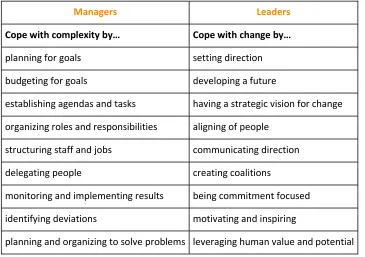
Warren Bennis famously wrote in his book On Becoming a Leader that a manager does things right and leaders do the right thing.[1] Like other leadership scholars, Bennis makes a clear distinction
[image:22.612.67.432.261.518.2]between leadership and management and between managers and leaders. A manager’s behavior and activities focus on controlling, planning, coordinating, and organizing. This differs from a leader, whose behaviors and tasks focus on innovation, vision, motivation, trust, and change.[2]
Table 1.1 Difference Between Management and Leadership.
Managers Leaders
Cope with complexity by… Cope with change by…
planning for goals setting direction
budgeting for goals developing a future
establishing agendas and tasks having a strategic vision for change
organizing roles and responsibilities aligning of people
structuring staff and jobs communicating direction
delegating people creating coalitions
monitoring and implementing results being commitment focused
identifying deviations motivating and inspiring
planning and organizing to solve problems leveraging human value and potential
Note. Adapted from Kotter, What Leaders Really Do (1999). Cambridge, MA: Harvard Business Review.
Cultural intelligence requires leadership, not management. It calls for what Ronald Heifetz[3] defines
Culturally intelligent leaders must create an environment where diversity and culture flourish, and where conflicting values can be safely expressed and explored through dialogue. Barry Salzberg, CEO of Deloitte, says that organizations and leaders must ask themselves the hard questions: Does our corporate culture really accept the differences it invites, and do we really embrace the different perspectives that come from increasing our commitment to recruiting?[5] This type of perspective
demands leaders who work toward transformation, or what Couto calls citizen leaders, “transforming leaders who engage others in efforts to reach higher levels of human awareness and relationships.”[6]
[1] Bennis (1985).
[2] Bennis (1985).
[3] Taylor (1999).
[4] Goldsmith (2006).
[5] Salzberg (2008), p. 123.
1.2
Importance of Leadership in a Global Economy
Over the years, leadership scholars have found in their studies that, when talking about the
leadership process, culture matters.[1] In general, the leadership literature points to the critical need
for cross-cultural and global leadership, especially given the pressing need to build networks and relationships[2] and to create an appreciation for differences and similarities. Bennis noted that,
although leadership competencies have remained the same, it is “our understanding of what it is and how it works and the ways in which people learn to apply it has shifted.”[3]
Leadership theories and models available thus far, while helpful in understanding leadership
development, are inadequate paradigms for a full understanding of the changing nature of leadership in the 21st century. Goldsmith et al.[4] argued for new forms of leadership that include thinking
globally, appreciating cultural diversity, developing technological savvy, building partnerships and alliances, and sharing leadership. Research intocross-cultural leadership revealed that understanding national cultures is critical to leadership development and that organizations must accept differing perceptions of leadership.[5]
Leadership theories and programs that operate from a Western-based,
androcentric framework hinder the shift that is required for understanding leadership on a broader level. Situational leadership theories,[6] which focus on leadership traits, skills, and styles, are
inadequate models in this regard because their basic foundation (understanding the individual as leader) implies a Western-based ideology of leadership that does not exist in many national cultures; therefore, the underlying concepts of this style of leadership do not always translate universally. Other theories, such as transformational and team leadership, emphasize the collective voice as essential yet neglect the cultural implications for leadership. Even cultures that share similar
Western beliefs about organizational structure still operate differently based on their unique cultural contexts.[7]
stakeholder needs. Edgar Schein noted that leaders can do this by having a “personal sense that they are the creation of the cultures of the countries, families, occupations, and reference groups, and that culture plays a huge role in the capacities of their organization to form.”[8] Culturally intelligent
leaders need be strategic in aligning the culture of their organizations with the people who work in them. This organizational culture becomes an advantage for leaders, making it easier for them to respond to external environmental factors, which include culture shifts.
Debbe Kennedy[9] proposed the following five qualities that leaders need in order to address and use
cultural differences to the advantage of their organization:
Leaders must make diversity a priority.
Leaders must get to know people and their differences.
Leaders must enable rich communication.
Leaders must make accountability a core value.
Leaders must be able to establish mutualism as the final arbiter.
These five characteristics I have seen as important differences between the ways that managers and leaders handle cultural conflicts and situations. Culturally intelligent leaders are those that elevate diversity to the top of organizational planning and view it as a critical factor to innovation and creativity. Innovation in diversity begins with a definition of diversity, which many organizations lack or have poorly articulated. If they do, diversity definitions are focused on race and ethnicity and do not explore the dynamic dimensions implicit in culture. In a 2007 study on diversity in the workplace, the Society of Human Resource Management[10] reported that only 30% of organizations
have a shared definition of diversity in the workplace. However, 75% feel that diversity can be used to improve work and relationships. A focus for, and an articulation of, defining diversity and its
importance in the work force can open dialogue for organizations.
creativity and curiosity when they set aside some time, on a day-to-day basis, to practice and master their cultural intelligence skills.
When I have seen culturally intelligent leaders in action, they cultivate an environment of trust, which is critical when working with differences in the workplace. Patrick Lencioni[11] wrote that trust
is a critical foundational element in interpersonal relationships. Leaders must be willing to be vulnerable in intercultural interactions, openly admitting what they know and don’t know about culture and cultural differences. They must be able to admit that they might not be able to resolve intercultural differences. By demonstrating vulnerability, a leader enables richer communication and creates an inviting space and environment for intercultural dialogue. In this situation, people are more willing to ask for help and to provide one another with constructive feedback; they take risks and learn to appreciate the differences in skills and style that each person brings to the work environment.
For diversity and culture to flourish in organizations, everyone in the workplace must hold each other accountable toward differences. My experiences working with leaders of different sectors, both formal and informal, have shown me that the creation of a mission and vision for diversity can only take an organization so far. Culturally Intelligent leaders create standards of accountability,
explaining what is expected of each employee and of themselves in intercultural interactions.
When everyone is held accountable for their choices and behaviors in an intercultural workplace, there is a higher level of respect and trust among workers. Everyone is encouraged to perform his or her best and to hold themselves to the highest standards in working with each other. Intercultural conflicts still occur, but the responses to these conflicts from individuals are different.
Lee Bolman and Terrence Deal[13] wrote that organizations are a coalition of individuals and groups
with different interests, preferences, and beliefs. The differences among individuals and groups can change, but this usually occurs very slowly. Leaders must be able to identify mutual interests, values, and beliefs in order to create a culture of mutual interdependence. Because conflict is unavoidable, and often necessary, it is best for leaders to create a picture of mutual dependence that is both beneficial and progressive for employees.
Leadership matters even more when cultures are intertwined in the workplace. Leadership and culture are like two pieces of rope. On their own, they can be used to bundle objects, connect one thing to another, and even support weight. When threaded and intertwined, they do all of these things but are much stronger and have less chances of being snapped. A rope is firm and strong yet flexible and pliable. Because change is constant, leaders can use their cultural intelligence to steer organizations, and those they lead, toward finding innovative strategies and solutions to intercultural issues.
Like an anthropologist, culturally intelligent leaders explore, discover, and find cultural artifacts in their business environment that are both barriers to, and promoters of, growth. A culturally intelligent leader will accomplish this from an “outsider” perspective while keeping his or her “insider” perspective in line. Ronald Heifetz[14] says that one should take a leap to get a balcony
[1] Koopman, Hartog, & Konrad (1999).
[2] Goldsmith, Greenberg, Robertson, & Hu-Chan (2003).
[3] Bennis (1985), p. 3.
[4] Goldsmith et al. (2003), p. 7.
[5] Derr, Roussillon, & Bournois (2002), p. 298.
[6] Northouse (2007), pp. 15–108.
[7] Mutabazi (2002), p. 204.
[8] Schein (2006), p. 259.
[9] Kennedy (2008), pp. 35–40.
[10] Human resource management guide (n.d.).
[11] Lencioni (2002).
[12] Kennedy (2008).
[13] Bolman & Deal (2008).
1.3
Chapter Summary
Culturally intelligent leaders are change-focused and change-ready. They anticipate different
scenarios for change and enable their organizations and people to embrace change.
Many leadership scholars differentiate between management and leadership and managers and
leaders.
Managers are responsible for controlling, coordinating, planning, and organizing. Leaders are people
who inspire, motivate, unite people, and create visions for the future.
Cultural intelligence requires leadership and leaders, not management and managers.
Historically, leadership theories and frameworks are based on Western ideologies and perspectives.
Leadership theories and frameworks must incorporate a global perspective that considers differences
in perceptions of leadership and leaders.
Leaders must be able to create cultures where differences thrive. They may accomplish this by:
making diversity a priority, getting to know people and their differences, enabling trust, holding each
person accountable for differences, and establishing mutual interdependence.
Leadership and culture are intertwined like two halves of a rope threaded together. At times, leaders
must be able to step away from what they are experiencing to understand the full impact of culture on
Chapter 2
Understanding Culture
When my parents came to the United States in 1979, their world became vastly different than what they had known. Before their arrival, they lived in a small hilltop, tribal village in the mountains of Laos, like many of their ancestors before them. They had the simplest tools for doing their work and for living their lives. The natural world provided everything they needed. If they wanted to use the bathroom, they went outside—not to an outhouse but to the woods. When they were hungry, they cooked the meal in a pot over a large fire pit. When relatives asked them to attend celebrations and notified them that the celebration meal would begin sometime when the sun was to set, my parents knew that the path of the sun would let them know when they should leave their house.
There were a lot of assumptions my parents made about their world. When they had to relocate to the United States, they found out how different their assumptions were when they were tested in an environment that contradicted their ways of being. They were not aware of a different way of living their lives, because the norms that shaped their lives influenced their actions and behaviors. The norms helped them to learn that what they did was the correct way to live.
One of their most difficult challenges was to unlearn what they knew in a different context and with different materials and tools that they did not have before. What naturally occurred was a process of culture shock and then a period of acculturation. When my parents’ sponsors showed them how to use the toilet by gesturing what to do and how to flush, my parents were embarrassed. Coming from a culture where modesty is important, they did not know how to respond to the American sponsor’s gestures, yet their embarrassment quickly turned into fascination when they saw how a toilet could dispose of materials.
placing it on a heated surface for the water to boil, taking the pot off the surface to let the water cool. The differences, they noticed, were in the equipment used and the timing of the water boiling. What a surprise it was for them to realize that one could adjust and control temperature!
As human beings who are accustomed to behaving (consciously and unconsciously) in specific ways, we often do not recognize another perspective until it is presented to us. Ellen Langer,[1] a social
psychologist, says that it is in the perspective of another that we learn to see ourselves—to see who we really are. As an educator and facilitator, I meet people in positions of leadership every day who believe that their perspective about culture and how they should work with differences is the right way and that there is no other possibility for a different way of working or thinking. For example, a participant in my training session, Jacob, felt very strongly about the “invasion” (his word, not mine) of immigrants in his neighborhood. As a result, the city he worked for was increasingly diverse and would need to set up services and programs to meet the needs of the new immigrants.
As a native of the city, Jacob felt strongly that his neighbors needed to assimilate more quickly. As a city employee and manager, he felt excluded that the city would create new services for the
immigrants. His issue of conflict here was that he had developed proposals for expanding current services in his department, but they were never approved, mostly because of budgetary reasons. He did not understand why creating “special services for a small population” mattered more than the services for current residents of the city, and he was angry that the funds set aside for the new programming would be large, much larger than his proposed changes.
When Jacob was presented with another perspective, he let his guard down. Over time, he was able to focus on the real issue, which was that no matter what your status, creed, ethnicity, or reason for moving to the United States, as a public sector employee it was his role to provide the appropriate services that would meet the residents’ needs.
As leaders, we must make strong efforts to see a different perspective than what we believe and hold to be true. We must challenge ourselves, as Byron Katie[2]says, by asking whether we know what we
see to be true is really, in fact, true. And if it is, how do we know that? What stories have we told ourselves? To understand this, we need to look at the “roots of culture” and how our cultural systems have shaped our realities of the world.
[1] Langer (1990).
2.1
Cultural Systems
Imagine a tree as a metaphor for a cultural system—all the things that make up who you are. The roots of a tree are essential for the survival of the tree. They carry the nutrients needed for the growth of the tree and store nutrients for later feeding. Roots of trees are generally located in the top 6 to 24 inches of the ground, not too deep from the surface. The roots are impacted by their surrounding, and environmental factors contribute to their health and vitality.
Just like the roots on a tree, cultural systems have roots that are impacted by their surroundings. A culture’s rituals, traditions, ceremonies, myths, and symbols provide it with the nutrients it needs to survive. Environmental factors can change a tree by uprooting it or letting it die off, making space for new life in its place. Similarly, environmental changes impact cultural systems, forcing it to adapt and change to its surroundings or transition into death, creating new cultural stories that carry new life.
But unlike trees and their roots, we get stuck in our cultural systems and do not budge even when our surroundings have changed. Trees, like anything in an ecosystem, have natural cycles of renewal and rebirth. Sometimes this renewal and rebirth is gradual and gentle, while other times it is fast,
disruptive, and violent. Trees, because they share their environments with others, will learn to adapt and allow change to occur, no matter what the direction of change may be. Change in their cultural environments is inevitable and a part of the life cycle.
2.2
What is Culture?
[image:34.612.70.534.268.528.2]Definitions of culture cover a wide range of perspectives. When I ask participants in my business workshops to describe culture, the following are words and phrases they use: food, religion, language, music, region or geography, ethnicity, clothes, and so on. Generally, there is always one person who raises his or her hand timidly and says, “I think culture is more than that. It’s the things we don’t see, like our beliefs or views about gender.” Both are correct—culture represents the things we see, the tangible, as well as the intangible things.
Figure 2.1
Iceberg Metaphor
The iceberg, a commonly used metaphor to describe culture, is a great example for illustrating the tangible and the intangible. When talking about culture, most people focus on the “tip of the iceberg,” which is considered as making up 10% of the object. The rest of the iceberg, 90% of it, is below the waterline. Most leaders in businesses, when addressing intercultural situations, pick up on the things they see—things on the “tip of the iceberg.” This means that they never address the
I once had a manager describe and define culture as “a monster.” After some laughter from the group, he clarified his statement: “It’s so messy and sometimes it’s too big to handle. And, it’s scary because you don’t know what you’re dealing with.” What he said rings true for many people and businesses that work in multicultural settings. It is certainly not fun to clean up cultural messes, bloopers, or misunderstandings, and when not addressed right away, they can result in large cultural conflicts. The ability to acknowledge one’s cultural mistakes, and having a commitment to learning what culture brings, is a skill that one must have in cultural intelligence work.
This definition of culture as a “monster” is one that looks at culture and its manifestations. Some may even say it is negative and does not paint culture in a positive light. From my experiences working with leaders, defining culture is not about positives or negatives—culture just is, and that is why it can be a challenge to describe it. Definitions of culture usually incorporate an expression of values and beliefs of groups, the learning that occurs in groups, and the expressions of those cultural norms.
The following is a definition of culture that is used in this book and that will be useful in your work:[1]
Culture consists of the shared beliefs, values, and assumptions of a group of people who learn from one another and teach to others that their behaviors, attitudes, and perspectives are the correct ways to think, act, and feel.
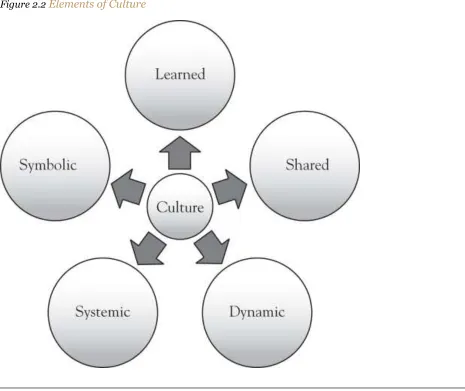
It is helpful if you can think about culture in the following five ways:
Culture is learned.
Culture is shared.
Culture is dynamic.
Culture is systemic.
Figure 2.2
Elements of Culture
2.3
Culture is Learned
Geert Hofstede[1] views culture as consisting of mental programs, calling it softwares of the mind,
meaning each person “carries within him or herself patterns of thinking, feeling, and potential acting which were learned throughout their lifetime.”[2] Similarly, Peter Senge[3] argued that mental models
lock individuals and groups into a specific perception about the world. Like a computer, we are programmed to act or behave in certain ways. The conscious and unconscious learning we undergo, over time, turns into beliefs that we consider to be valid. We then teach each other that these beliefs are cultural norms, and they are then expressed in our daily lives as behaviors and actions.
Think about your first day with your current organization or one you worked for in the past. Typically, your boss or a co-worker gave you an orientation to the company, describing its mission, products, and services. Most likely, you met your co-workers and received a tour of the office facilities. Perhaps you met and talked with co-workers to get a sense of how your job related to their work. Maybe you spent time reading company materials, reviewing your department files, or talking with your supervisor about the details of your job responsibilities. Perhaps you had lunch with other staff members and were told about some parts of the organization such as, “Jane Doe should be fired but is still working here,” “The CEO has control issues,” or “The fax machine breaks down three times a day.” Whatever you did in those first hours or days of orientation and training, you created an image of how you would fit into the company. In that moment, you told yourself a story of how you would work with the company and how it would work with you because others in that business culture told you how you needed to behave. This moment is so powerful that it shapes your
experiences, including your thoughts, actions, behaviors, beliefs, and attitudes for the rest of your time with the company.
[1] Hofstede (1991).
[2] Hofstede (1991), p. 4.
2.4
Culture is Shared
Ming is a recent college graduate with a degree in accounting. She has taken a job with a large accounting
firm. Although she gets along with members of her department and team, she tends to spend her free time
with other colleagues who are of Asian descent, especially those who are in her generation. She feels that
this group of coworkers understands her better and shares her values and ideas around work–life balance.
John has been with his state employer for thirty years, working up the ranks into seniority in his state
agency. It’s been customary for him and six coworkers of his age group to meet for lunch every day and
discuss the latest sporting events. Once a week during the summer they meet up after work to play
baseball at a local park and recreation site.
These two examples describe culture as a shared learning experience. Although you may think of yourself as an individual, you share beliefs, rituals, ceremonies, traditions, and assumptions with people who grew up or live in similar cultural backgrounds. It is easier for you to relate to someone who has shared value systems and ways of doing things than someone who does not share the same values.
The patterns of culture bind us together and enable us to get along with each other. Even though it feels good to be around people who think, act, and behave as you, shared learning can create blind spots. Shared cultures create a dynamic of an in-group, where people segregate themselves from each other. Within teams in organizations, in-group blind spots can lead to “group think,” a term coined by Irving Janis[1] to explain the ways in which groups ignore alternative solutions and take on
actions and behaviors that discount the experiences for others.
2.5
Culture is Dynamic
Culture is dynamic and thus complex. Culture is fluid rather than static, which means that culture changes all the time, every day, in subtle and tangible ways. Because humans communicate and express their cultural systems in a variety of ways, it can be hard to pinpoint exactly what cultural dynamics are at play. Consider, for example, a conversation about a person’s attitude or feelings. In this type of conversation, Albert Meharbian[1] found that people pay attention to (a) the words, or
what is being said; (b) the tone, or how the words are said; and (c) the visual behind the words, often called the body language. All of these are aspects of culture that are interpreted differently depending on the cultural context. Add multiple layers of culture to the conversation—such as time, power and authority, emotion, age, gender, religion, nationality, and even previous intercultural interactions— and communication at a cross-cultural level becomes complex and hard to manage. The following is an example of the dynamism of cultures:
Sheila is the director of marketing for a social services agency. She provides feedback to one of her
managers about how to improve services. Sheila sits behind a large executive desk and is leaning forward.
The employee sits with her arms crossed, leaning away from Sheila.
If you were observing this scene, are you able to tell from the body language what each person is thinking? Why or why not? What cultural factors might be present?
In the example, Sheila’s body language can be interpreted as any of the following: eager to assist or help, intensely interested in what the employee has to say, aggressive and wanting more information, or needing deeper engagement in the conversation. Her employee’s body language could mean any of the following: protective, suspicious, not caring, or relaxed. To understand the dynamics of culture in this example, you would need to pay attention to the things you do not see such as:
Is Sheila older or younger than her employee?
What has been their working relationship?
Does Sheila naturally lean forward when speaking with her employees?
What is the tone of voice in the conversation?
2.6
Culture is Systemic
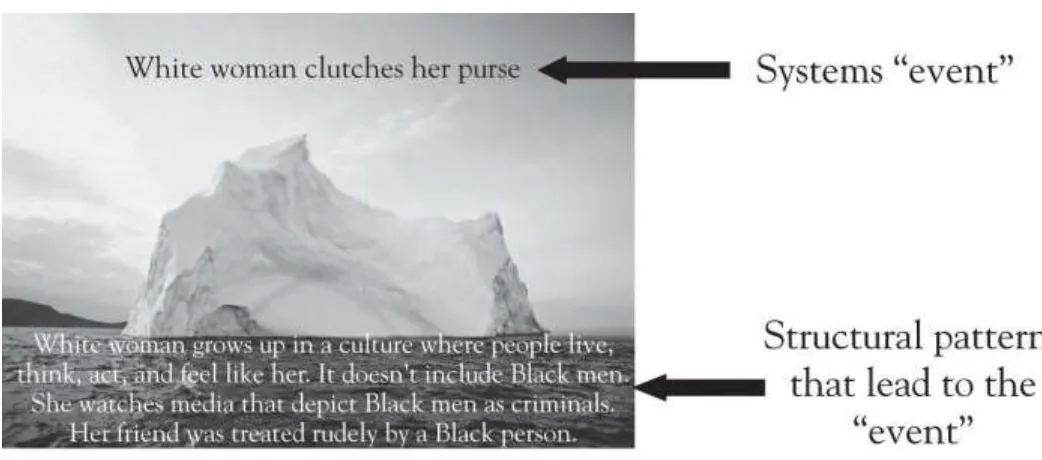
In systems theory, systems are interrelated, interconnected parts that create a whole. There are patterns of behavior, deeply rooted structural systems, which are beneath the waterline. What we see at the top of the iceberg are the behaviors; we do not see what contributes to those behaviors.
Consider, for example, a white woman walking down a quiet street. She quickly clutches her handbag closer to her body as she passes a black man. Then, when she spots a white man walking toward her, she loosens her hold on the purse.
To address the system, one must be able to address the underlining patterns. These patterns, because they are deeply embedded in the system, will take up significant effort, time, and resources. Changes to the system are slow and gradual; visible changes may not appear until months, or even years, later.
Because most leaders spend their time evaluating and finding solutions to an “event,” they revisit the issues over and over again, with no positive and sustainable results. The following case study
[image:40.612.71.592.445.675.2]illustrates the systemic nature of culture:
Langley, Knox, and Cooper, a law firm in the Midwest, knows that it has to do more to be inclusive to
women attorneys. It has met challenges in retaining its female work force. The majority of women hired to
work at the firm leave within a three year period. To address the issue, the firm provides gender sensitivity
training to the entire company, attends graduate career fairs to actively recruit female attorneys, and has
quotas for promoting women. However, the efforts in the past five years have yielded little results.
[image:41.612.73.537.359.499.2]Langley, Knox, and Cooper focus much of their attention on the “events” of the system: women leaving after three years or providing gender sensitivity training. A look at the structural patterns reveals a more complex issue that cannot be solved through training and career fairs. The structural pattern is an insidious belief that women enter the law profession with the same opportunities and access to practicing law as men in the firm. Underlining this belief are more patterns of thought that keep this structural pattern in place. Possible patterns of thought could be:
Figure 2.4
A Systems Approach to Find Structural Patterns in Gender Conflicts
Other women attorneys don’t have this problem, what’s the big deal here?
Everyone faces the same challenges in making partner. It’s part of becoming a lawyer.
We match our junior attorneys with senior attorneys who serve as their mentors. Everyone gets the
same level of attention, so I am not sure what all the complaints are about.
This law firm is different from others. If they don’t like it here, then they can leave.
We give the women in this firm more time off and flexibility than ever before, yet they still think it’s
not enough.
2.7
Culture is Symbolic
2.8
Stereotypes and Generalizations
One of the things that can happen in the context of discussing culture is falling into the stereotypes and generalizations of a cultural group or norm. It is important to recognize the difference and the impact these factors have in cultural interactions. In general, stereotypes are negative statements and interpretations made about a group of people. Stereotypes, whether deemed positive or negative, place people into boxes and categories and limit them to those specific perspectives. A stereotype, such as “Asians are good at math,” does not provide the complete picture someone needs to
understand the Asian culture or the differences between Asian cultures. Similarly, just because you meet a 70-year old who does not know how to use current technology, it does not mean that other individuals in that generation do not know how to use it.
By contrast, generalizations of cultures are broad statements based on facts, experiences, examples, or logic. There are two kinds of generalizations, valid and faulty, and it is your role to determine which generalizations have validity behind them. Broad characterization of cultural groups can serve as a framework for cultural interactions. For example, Hispanic societies have a high degree of machismo, or, in Middle Eastern cultures, women have a lesser status than men—these types of generalizations are helpful when engaging with people of those cultures. But in all cultural
2.9
Levels of Culture
One of the basic tenets of culture is that it consists of levels and sublevels. It is useful to think about culture in terms of five basic levels: national, regional, organizational, team, and individual. Within each of these levels are tangible and intangible sublevels of culture.
National Culture
A businesswoman from the United States is in Germany for contract negotiations between her employer
and a larg