Reconsidering Generic Composition:
the Tag-then-Encrypt case
Francesco Berti, Olivier Pereira, Thomas Peters ICTEAM/ELEN/Crypto Group
Universit´e catholique de Louvain B-1348 Louvain-la-Neuve, Belgium
emails:{francesco.berti,thomas.peters,olivier.pereira}@uclouvain.be
Abstract. Authenticated Encryption (AE) achieves confidentiality and authenticity, the two most fundamental goals of cryptography, in a sin-gle scheme. A common strategy to obtainAEis to combine a Message Authentication Code (MAC) and an encryption scheme, either nonce-based oriv-based. Out of the 180 possible combinations, Namprempre et al. [25] proved that 12 were secure, 164 insecure and 4 were left un-resolved: A10, A11 and A12 which use an iv-based encryption scheme and N4 which uses a nonce-based one. The question of the security of these composition modes is particularly intriguing as N4, A11, and A12 are more efficient than the 12 composition modes that are known to be provably secure.
We prove that: (i) N4 is not secure in general, (ii) A10, A11 and A12 have equivalent security, (iii) A10, A11, A12 and N4 are secure if the underlying encryption scheme is either misuse-resistant or “message mal-leable”, a property that is satisfied by many classical encryption modes, (iv) A10, A11 and A12 are insecure if the underlying encryption scheme is stateful or untidy. All the results are quantitative.
1
Introduction
Authenticated encryption and generic composition. From its start, the goal of cryptography is to prevent that anyone but the intended receiver can read a message (privacy) and that anyone can send a message impersonating someone else (authenticity). In order to answer this privacy (resp. authenticity) require-ment, encryption schemes (resp. Message Authentication Codes (MACs)) were designed independently. When there is a need for both privacy and authenticity, Authenticated Encryption (AE) can be used [7,16,18,6]. Moreover, AE may be used to authenticate associated data (AD), which are data attached to a message which do not need to be private, but do need to be authenticated (e.g., message header [32]). We suppose that both the sender and the receiver share the same private key (symmetric scenario).
CAESAR candidates [8]. When following the second path, the problem is to de-cide how to compose the ingredients. This problem is calledgeneric composition
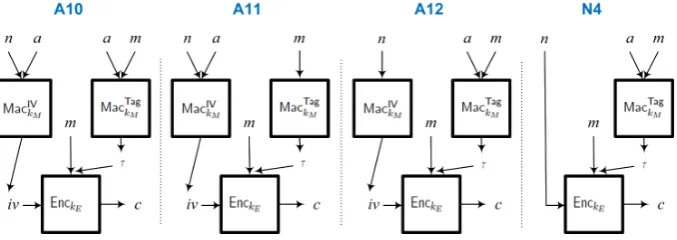
and was introduced and studied first by Bellare and Namprempre [6]. They and Krawczyk proved the well-known result thatEncrypt-then-MACis secure [7,18]. Namprempre et al. have made a deeper analysis [25], which considered in detail the assumptions on the Encryption scheme, whether it isiv-based (ivE[with the ivrandomly picked]) or nonce-based (nE[with the noncennever repeated]) and assumed that theMACs are PRFs. Out of all the possible composition modes, 12 (9 withivE, 3 withnE) were proved to be secure, 164 to be insecure and 4 were unresolved: N4 which uses a nE and A10, A11, A12 which use an ivE. These four modes, which are depicted in Fig. 1, are based on the Tag-then-Encrypt paradigm: given a noncen, an associated dataaand a messagem, the resulting AEs simply output c =EncnkE(mkτ) or c =EncivkE(mkτ) for somen/iv, where τ is the tag provided by the MAC, and is computed either asMackM(a, m) or
as MackM(m) depending on the mode. When an ivE scheme is used, the iv is
computed using a PRFMACthat takes as input eithernor (n, a). Interestingly three of these modes (N4, A11 and A12) use the n, aand m only once in to-tal during both the computation of iv (MacIVk
M) and τ (Mac
Tag
kM), which makes
them the most efficient among all Tag-then-Encrypt schemes. In this paper, we investigate the security of these four composition modes, focusing on ciphertext integrity, as Namprempre et al. already established the expected confidentiality guarantees.
Fig. 1.The four modes A10, A11, A12, and N4.
Our contribution Our investigation gives several new results.
First, the mode N4 does not guarantee ciphertext integrity in general, and we offer a counterexample. The idea of this counterexample is to carefully inject a kind of Trojanin thenEencryption scheme, which can only be activated during the decryption queries using well-crafted ciphertext. The Trojan is triggered through the nonce and a block of the message.
these reductions, which are based on the uniqueness of the nonce and, in other cases, recrafting these nonces.
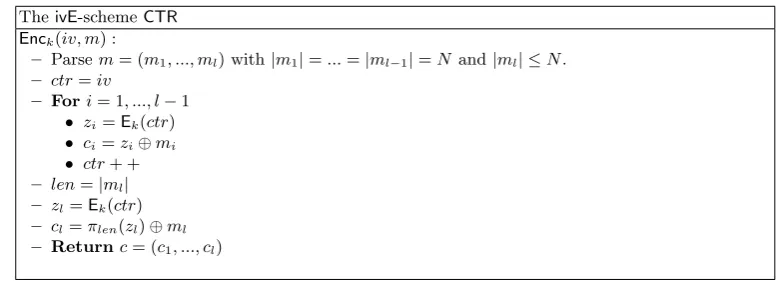
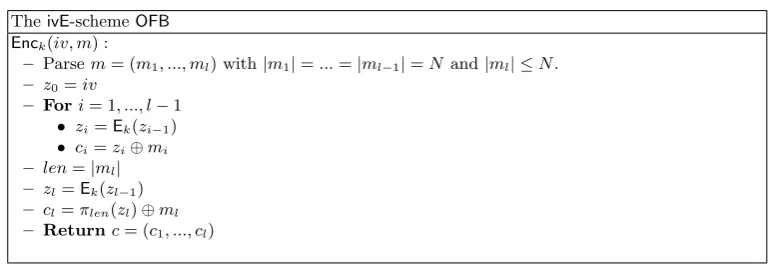
Third, we push our analysis further, by investigating the security of these 3 modes by making some additional hypothesis on the ivE scheme. We found that these modes are secure if the ivE scheme is either misuse-resistant (that is, repeated nonces can only lead to repeated ciphertexts without further secu-rity degradation) or “message-malleable” (that is, given a triple (iv, m, c) with c = Enciv(m), it is possible to compute correctly every other triple (iv, m0, c0) with c0 = Enciv(m0) [resp. m0 =Deciv(c0)] for the sameiv from m0 [resp. c0]). Many common schemes, like CTR and OFB [15], CHACHA20 [26] or any other stream ciphers, are “message-malleable”, thus we have proved that the three composition modes are secure if implemented with these encryption schemes. This is another evidence of the “generic composition’s sensitivity to definitional and algorithmic adjustments” [25]. While the proof for misuse-resistant ivE -schemes is relatively straightforward, the proof for “message-malleable” ivE is more interesting as it uses a reduction of a INT-CTXT (ciphertext integrity) adversary to a CPA (Chosen Plaintext Attack) adversary and not only to the properties of theMACschemes. Interestingly, the N4 mode also becomes secure when the same extra requirements are made for thenEencryption scheme. With respect to the Namprempre et al. [25], we have still to use an additional hy-pothesis (they used Knowledge of Tag [KoT]), but ours are much easier to prove although they are less general.
Fourth, we find two insecure variants for all three modes, one if the ivE
encryption scheme is not tidy, the other if it is stateful. Although Namprempre et al. [25] already used tidiness in security proofs, ourivEscheme correctly encrypts the tag and it decrypts in the “natural” way. Thus, our analysis supports the idea that tidiness is also a security property (already present in Namprempre et al. [25] and in Paterson et al. [28], with respect to CRD). Concerning the attack using a secure stateful scheme (AE stateful schemes were defined by Bellare et al. [4] and their security redefined by Rogaway and Zhang [36]), the idea is to use the state in order to emulate the trojan approach that was used in our attack against mode N4. Namprempre et al. considered only stateless schemes, but it is interesting to see how the security of a mode may depend on the fact of being stateful or stateless. Moreover, stateful AE schemes are an interesting subject of studies [28,5,17,11].
2
Background
2.1 Notations
We use finite binary strings. The length of the string xis denoted by |x| and the concatenation of the stringsxandy is denoted by xky. The set of all finite strings is denoted by{0,1}∗. We denote the set of alln-bit strings as{0,1}nand
the set of strings of at mostnbits as{0,1}≤n. Given a stringx= (x
1, x2, ..., xl)
ofl bits, we denote withπt(x) the string (x1, ..., xT) whereT =min(|x|, t).
We reserve calligraphic notation for sets. In particular we denote with K,N, IV,A,M, T W,T,X and C respectively thekey space, nonce space, iv-space, associated data space, message space, tweak space, tag space, input space of the MACand theciphertext space. We suppose thatM=A={0,1}∗, that is, these
spaces contain all the finite binary strings. We suppose thatC ⊆ {0,1}∗. Given the setY, we writey← Y to denote the uniformly random selection ofy in Y.
We reserve sans serif (Alg) notations for algorithms. If the algorithm Alg is probabilistic, we can think of its output as a distribution. We denote with a←
Alg(b, c, d) the fact that we sample from the distribution induced by algorithm
Alg on inputs (b, c, d), and we obtain a. We may write part of the arguments of the algorithm as subscripts or superscripts, that is, Algcb(d) = Algb(c, d) =
Alg(b, c, d).
A (q, t)-adversaryAis a probabilistic algorithm which can make at mostqqueries to the oracle(s) he is granted access to, and runs in time bounded byt.
Let algorithmAlgbe an algorithm whose inputs are inS1× · · · × Sn and whose
output is in Y. We say that algorithmAlg does not reveal, via the length of its output, any information about its inputs apart from their lengths if there exists a deterministic function f : Nn 7−→ Ns.t. |y| = f(|s
1|, ...,|sn|) for all possible
inputs (s1, ..., sn). We assume that all theEncandAEncalgorithms we use have
this property.
Given a game, where the adversaryAis allowed to query many oracles, we use a single counter for all the queries made by adversaryA, during the game. The oracle ⊥(·,·) always answers ⊥. When an adversary is playing a game where he has access either to an oracle implemented with algorithm Alg(·,·) or the oracle $(·,·) it means that the oracle $(·,·) answers a random bit string of length |Alg(·,·)|.
We write Pr[B;A1, A2, ...] for the probability of event B after the experiment described by steps A1, A2, ....
2.2 Pseudorandom functions (PRF)
We now define the PRF-security notion, the base of many cryptographic primi-tives:
Definition 1. A functionF:K × M 7−→ T is a (q, t, )-pseudorandom function (PRF)if for every(q, t)adversaryA, the advantage :
AdvPRFF (A) :=|Pr[A
is upper bounded bywherek andfare chosen uniformly at random from their domains, namely K and the set of functions fromMtoT,F U N C(M,T). In a similar way,Fis a pseudorandom permutation(PRP) ifFkis a permutation
and the above advantage isbounded whenfis selected as a random permutation.
We remind that a PRP is a PRF (see Proposition 3.27 [15]).
In some of our constructions, we will also use tweakable pseudorandom func-tions [20]. They are PRFs with an additional input, the tweak: E:K × T W × M 7−→ T, and their security advantage is then defined as AdvTPRFE (A) :=
AdvPRFF (A) whereF(k,(tw, m)) :=E(k, tw, m). In a similar way, tweakable pseu-dorandom permutations require that Eis indistinguishable from a random per-mutation for any choice ofkandtw.
2.3 Nonce-based Authenticated Encryption (nAE) and Encryption
(nE and ivE) schemes
For the syntax of encryption schemes we follow the approach of Namprempre et al. [25] (taken by the work of Rogaway [34]) where the encryption algorithm is deterministic and an “initialization vector”(IV)iv is surfaced (and it may be seen as part of the AD [35]). Using this approach we classify encryption schemes according to the requirements of this extra input to provide CPA-security.
Definition 2 ([25]).A scheme fornonce-based authenticated encryption(nAE) is a triple Π := (K,AEnc,ADec), where the keyspaceK is a nonempty set, the encryption algorithmAEncis a deterministic algorithm which takes as input the tuple(k, n, a, m)∈ K × N × A × Mand outputs a stringc←AEncn,ak (m)called ciphertext.
The decryption algorithmADecis a deterministic algorithm which takes as input the tuple(k, n, a, c)∈ K ×N ×A×C and outputsm←ADecn,ak (c)which is either a string m∈ Mor the symbol ⊥(”invalid”).
We require that the algorithms AEnc and ADec are the inverse of each other, that is:
– (Correctness)if AEncn,ak (m) =c thenADecn,ak (c) =m
– (Tidiness)ifADecn,ak (c) =m6=⊥thenAEncn,ak (m) =c
If ADecn,ak (c) =⊥we say that the algorithm rejectsc, otherwise it accepts c. A sloppynAEscheme satisfies everything but the tidiness condition.
A nonce-based Encryption scheme (nE) is a triple Π = (K,Enc,Dec), where Enc and Dec do not take input the AD, that is, Enc : K × N × M 7−→ C and Dec:K × N × C 7−→ M.
An iv-based encryption schemeivE is synctactically equivalent to a nEscheme, with the only difference that the nonce space N is replaced with an IV spaceIV.
a security property. Tidy schemes are inherently CRD-secure, since there is one and only valid ciphertext for each input, but the converse is not valid (because CRD-security is obtained when adversaries are able to break it with negligible probability, while tidiness always works).
The difference between nE schemes and ivE schemes lies in their security requirements. A complete survey aboutnAE,nEandivE schemes can be found in Supp. Mat. A.
2.4 Security for nAE, nE and ivEschemes
The security definitions for nAE, nE and ivE schemes are inspired from those in [25] and [35].
Definition 3. A nonce-based authenticated encryption scheme(nAE)Π:= (K, AEnc,ADec) is (q, t, )-nAE-secureif the advantage
AdvnAEΠ (A) := Pr
h
AAEnck(·,·,·),ADeck(·,·,·)⇒1
i
−PrhA$(·,·,·),⊥(·,·,·)⇒1i (1) is bounded by for every (q, t)-adversaryA that respects the following two con-ditions: (i) If Aqueried the first (encryption) oracle on input (n, a, m)and was answered c, then he is not allowed to query the second (decryption) oracle on input(n, a, c). (ii)Ais not allowed to repeat the first component (the nonce) on different left oracle queries.
Π is(q, t, )-nAE−Esecure, if the advantage AdvnAEΠ −E(A) :=
Pr
h
AAEnck(·,·,·)⇒1i−PrhA$(·,·,·)⇒1i
(2)
is bounded by for every(q, t)-adversary Athat respects Condition (ii) above. A nonce-based encryption scheme (nE) Π := (K,Enc,Dec) is (q, t, )-nE -secureif the advantage,
AdvnEΠ(A) := Pr
h
AEnck(·,·)⇒1
i
−PrhA$(·,·)⇒1i
(3)
is bounded by for every(q, t)-adversary Athat respects Condition (ii) above. An iv-based encryption scheme ivE Π := (K,Enc,Dec) is (q, t, )-ivE-secure
if the advantage
AdvivEΠ(A) := Pr
h
AEnc$k(·)⇒1
i
−PrhA$(·)⇒1i
(4)
is bounded by for every (q, t)-adversary. Here the oracleEnc$(m)picks a ran-dom iv← IV, then computesc←Enck(iv, m)and returns(iv, c).
randomivs are expected to differ with overwhelming probability. The contrary does not hold: the CTR mode is well-known illustration (details are provided in Supp. Mat. G.1).
In some cases, it is desirable to guarantee some security even if nonces are repeated: this is called resistance to nonce misuse, or simply misuse resistance.
Definition 4. If we drop Condition (ii) on the non repetition of the nonces in thenAE(resp.nE) security definitions, then we augment the security notions withmisuse resistance. Namely, we say that thenAE(resp.nE) scheme is(q, t, ) -mrAE(resp. (q, t, )-mrE) secure.
We point out that in themrEdefinition the adversary has only access to an encryption oracle. An example of an nEscheme which is mrE and notmrAE is given in Supp. Mat. H.
ThemrE definition is trivially extended to ivE schemes, since the syntax ofnE
schemes andivE schemes is identical.
2.5 Chosen-plaintext attack security with chosen nonce
We definemCPAsecurity fornEandivEschemes in the multi-challenge setting, following [15], [6]. This security notion is implied by theivE,nE, andnAEsecurity notions, and is equivalent to the more common single-challenge notion (details are provided in Supp. Mat. A.5andA.6).
Definition 5. A nonce-based Encryption schemenEΠ = (K,Enc,Dec)is(q, t, ) -mCPAsecure, or(q, t, )-secure against chosen plaintext attacks for multiple en-cryptions, if:
AdvmCPAΠ (A) := 1 2 −Pr
h
b0=b;b← {0,1}, b0 ←AEncbk(·,·,·)
i
is bounded by for any(q, t)-adversary. Here the oracleEncbk(·,·,·)is an oracle, which on input (n, m0, m1)∈ N × M2 outputs c ← Enck(n, mb) for a random
secret bitb← {0,1}, which the oracle has picked at the start of the game. When the adversaryAqueriesEncbk(·,·,·), he must choose two messagesm0andm1s.t. |m0|=|m1|. Moreover he cannot repeat the first input (the nonce) in different
queries.
There is a completely similar definition for ivE schemes. We only have to replaceEncbk(·,·,·) withEnckb,$(·,·), and to adapt the $(·,·,·) oracle accordingly. Similarly there is a similar notions fornAEschemes, obtained from the previous one by replacingEnck(·,·) withAEnck(·,·,·) and adapting $(·,·,·) accordingly.
2.6 Authenticity (INT-CTXT)
Definition 6. A nonce-based authenticated encryption scheme nAE Π = (K, AEnc,ADec)is (q, t, )-INT-CTXT1(Ciphertext integrity with only 1 decryption query)-secure if
AdvINTΠ -CTXT1(A) := Prh⊥6=m∗←ADeck(n∗, a∗, c∗); (n∗, a∗, c∗)←AAEnck(·,·,·)
i
is bounded by for every (q, t) adversary. The adversary A is not allowed to repeat the first component (the nonce) on different oracle queries. Moreover he is not allowed to output(n∗, a∗, c∗) if he received c∗ asc∗ ←AEnck(n∗, a∗, m∗)
for a certain input(n∗, a∗, m∗)that he asked to the first oracle.
As we can expect, annAE scheme that offers both mCPA and INT-CTXT1 security is annAEscheme, and we prove this in Supp. Mat. A.7.
2.7 Message Authentication Code (MAC)
Apart from an encryption scheme, all our composition modes are based on a deterministic notion of Message Authentication Code (MAC).
Definition 7. AMessage Authentication CodeMACis a tripleΠ = (K,Mac,Vrfy)
where the keyspace K is a non-empty set, the tag-generation algorithm Mac is a deterministic algorithm that takes as input the couple (k, m) ∈ K × M and outputs the tagτ ←Mack(m) from the tag spaceT. The verification algorithm
Vrfy takes as input a triple (k, m, τ)in K × M × T and outputs > (accept) or
⊥(reject). We ask that Vrfy(k, m,Mac(k, m)) =>.
A string-input MAC strMAC has as input space a set of strings, that is M ⊆ {0,1}∗.
A vector-input MAC vecMAC has as input space M which has one or more component and it can accept tuples of strings as input.
Usually the security forMACs is expressed as unforgeability, but our compo-sition modes rely on aMacfunction that is a (q, t, PRF)−PRF.
Definition 8. ([25]) AMAC Π = (K,Mac,Vrfy) is (q, t, )−PRF-secure if AdvPRFΠ (A) :=AdvPRFMac (B)
is bounded by for any (q, t) adversary B and ifVrfy(k, m,Mac(k, m)) =>iff τ =Mac(k, m).
For completeness, the standard definitions are put in Supp. Mat. A.9.
3
Problem
As discussed earlier, Namprempre et al. [25] left open the problem of thenAE
security of 4 modes based on the Tag-then-Encrypt paradigm, which have been shown in Fig.1.
Formally, the first three modes compose anivEscheme Π = (KE,Enc,Dec)
and twovecMACschemes using the same key,MACIV = (KM,MacIV,VrfyIV) and
– A10: AEncn,ak
E,kM(m) := c with iv = Mac
IV
kM(n, a), τ = Mac
Tag
kM(a, m) and
c=EnckE(iv, m||τ) – A11: AEncn,ak
E,kM(m) := c with iv =Mac
IV
kM(n, a), τ =Mac
Tag
kM(m) and c = EnckE(iv, m||τ)
– A12: AEncn,ak
E,kM(m) := c with iv =Mac
IV
kM(n), τ =Mac
Tag
kM(a, m) and c = EnckE(iv, m||τ)
The fourth mode composes a nEEncryption schemeΠ = (KE,Enc,Dec) and a
vecMAC=MAC= (KM,Mac,Vrfy):
– N4:AEncn,ak
E,kM(m) :=c withτ=Mac
Tag
kM(a, m) andc=EnckE(n, m||τ)
For clarity we reserve bold notationsmfor the messages inputs of thenAE
scheme Π and normal notations m for the messages inputs to the underlying
nE(orivE)-schemeΠ (so, we typically have thatm=mkτ).
IfΠ is tidy and the MACis PRF-secure, then the AE scheme Π, obtained composing these components, is tidy. These modes also offerCPAsecurity, which directly results from the underlying encryption schemes (a proof of this statement is available in Supp. Mat. Thm.3 and 4).
As a result, the open question lies in theINT-CTXTsecurity of these modes.
4
Attack against mode N4
We provide here an attack against the mode N4, explicitly presenting annAE -schemeΠ, based on annEEncryption schemeΠ = (KE,Enc,Dec) and avecMAC
MAC = (KM,Mac,Vrfy) which is PRF-secure. For simplicity, we consider only
the case when the messagemofΠisN-bit long and the tag isN-bit long, leaving the general case to Supp. Mat. D. The nEEncryption scheme, which encrypts 2N-bit long message, is nE-secure and tidy, but the nAE-scheme Π obtained composing them according to mode N4, is not secure and, in particular, it is not
INT-CTXT1-secure as we show a forgery.
The idea of the forgery is to force the tagτ of a couple (a,m) to be encrypted identically for two different nonces, while keeping the nE-security.
4.1 Construction
Following the definition of mode N4, an authenticated ciphertext is computed as c=EnckE(n,m||MackM(a,m)), for whichMac is a PRF. We now define the nEschemeΠ.
This behavior is benign when considering thenEsecurity ofΠ: the only way to observe it would be to make two encryption queries with nonces 1 and 2, and first message blockv∗. But doing this would require guessingv∗before querying with nonce 1 (the nE adversary is nonce respecting), and this cannot be done but with probability 2−N: it would require guessingv∗.
As we will see, it is not benign anymore when considering the ciphertext integrity property: there,Advis free to use the nonces 1 and 2 in its decryption query, even if these nonces were used in encryption queries.
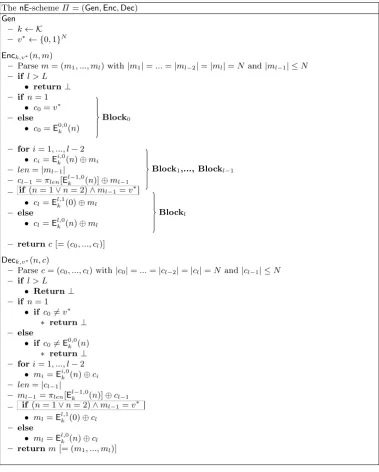
To make things concrete, we define the encryption process Enc of Π using a TPRF E : K × T W × {0,1}N 7−→ T = {0,1}N with tweak space T W =
{0,1,2}×{0,1}. For a messagem= (m1, m2)∈ {0,1}2N, the ciphertextEncnk(m)
is made of three blocks (c0, c1, c2) computed as follows:
– c0=E (0,0)
k (n) unlessn= 1, in which casec0:=v∗.
– c1=m1⊕E (1,0)
k (n).
– c2=m2⊕E (2,0)
k (n), unless the condition [(n= 1∨n= 2)∧m1=v∗] is met, in which casec2=m2⊕E
(2,1)
k (0).
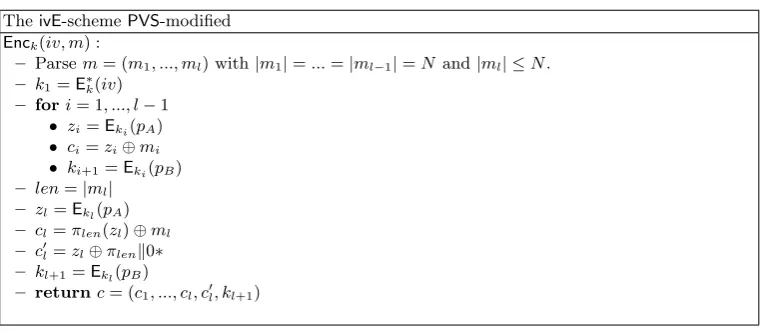
With such a definition, the blockc0looks random for any input, and its only purpose is to leakv∗ whenn= 1. The blockc1is a traditional encryption of the message blockm1using the TPRFE. The blockc2is computed in the same way (just incrementing the tweak), except under a very specific condition: the nonce is either 1 or 2, and the first message block m1 = v∗. Under that condition, the ciphertext block becomes independent of the nonce. As explained above, this condition is designed in such a way that it cannot lead to any observable event whenAdvcan only access an encryption oracle in a nonce respecting way: that would require queryingEnc on a message starting with v∗ on bothn = 1 and n= 2, but v∗ is only learned after a query with n= 1, and it is then not permitted to make a second query withn= 1 andv∗ as message block.
The decryption ofΠ works in the natural way. In particular, in order to guar-antee the tidiness of thenEencryption scheme,Decmust verify the correctness of the first ciphertext blockc0.
The proofs thatΠ isnE-secure (Prop.10) and tidy (Prop.11) can be found in Supp. Mat. F.2.
4.2 Forgery
The composition of the previousnEschemeΠwith a PRF-secureMACaccording to mode N4 is notINT-CTXT1-secure. In fact, we provide a forgery where the adversaryAasks the encryption of only two messages:
1. It first asks for an encryption of (1, a,m), for arbitrary choices of a and
m. This returns a ciphertext whose first block is v∗, second block is c1 =
m⊕E(1k,0)(1), and third block is ignored.
2. It then asks for an encryption of (2, a, v∗). This returns a ciphertext whose last block isc2=MackM(a, v
∗)⊕E(2,1)
Eventually, Adv makes a decryption query on (1, a,(v∗, c1⊕m⊕v∗, c2)), which is different of the two previously obtained ciphertexts, and has a valid decryption tov∗, hence violating the ciphertext integrity property.
This shows that N4 is not a secure composition mode, in general.
5
Security relations among A10, A11 and A12
While we are able to prove the generic insecurity of N4, we are not able to prove that modes A10,A11 and A12 are either secure or insecure in general. Still, in this section, we prove that these three modes are either all secure or all insecure. To prove it we need to replace the twovecMACsvecMACIV and vecMACTag
with two vecMACs based on the random functions fIV andfTag. Now the key of the new nAE scheme is k := (kE,fIV,fTag). To highlight these changes, we call
the new modes A10,A11 and A12 and the new nAE-schemesΠ. The security relations among modes A10,A11 and A12 immediately lift to modes A10,A11 and A12. The standard details are discussed in AppendixF.3(Lemma3).
We show the security equivalence of A10, A11 and A12 based on two events, B andC, that we define below. Consider aINT-CTXT1 adversary Aagainst an
nAEschemeΠ (which is made according to any of A10, A11 or A12). If theq-th decryption query (nq, aq, cq) is valid, thencq =AEnck(nq, aq,mq) for a certain
message mq, as a result of tidiness. Depending on the value of (nq, aq) (or only nq forA12), we distinguish between two possibilities, which define eventB:
– (nq, aq) is fresh, that is, (nq, aq)6= (nj, aj)∀j = 1, ..., q−1 (we call this event B) [for mode A12, we only demand that nq is fresh, that is nq 6=nj ∀j =
1, ..., q−1].
– (nq, aq) = (nj, aj) for a j ∈ {1, ..., q−1} (This j is unique since the nonce ncannot be repeated) [for mode A12, we only demand that nq =nj for a j∈ {1, ..., q−1}].
With regard to (aq,mq) (or only mq for mode A11), we again consider two
possibilities, which define eventC:
– (aq,mq) is fresh, that is (aq,mq) 6= (aj,mj) ∀j = 1, ..., q−1 (we call this event C) [for mode A11, we only demand that mq is fresh, that is mq 6=
mj ∀j = 1, ..., q−1].
– (aq,mq) = (aj,mj) for somej∈ {1, ..., q−1}(there can be several suchj’s)
[for mode A11, we only demandmq=mj for somej∈ {1, ..., q−1}].
Clearly by total law of probability
Lemma 1. Let fIV : N × A 7−→ IV [for mode A12, fIV : N 7−→ IV ] and fTag:A × M 7−→ T [for mode A11, fTag:M 7−→ T ] be two random functions and letΠ = (KE,Enc,Dec)be a(q, t, ivE)-ivE-secure encryption scheme. LetΠ
be the nAE scheme obtained composing fIV,fTag and Π according to mode A10
or A11or A12. Then we can bound
Pr[Awins ∩C] + Pr[Awins ∩B∩C]≤q|T |−1+ (q−1) ivE
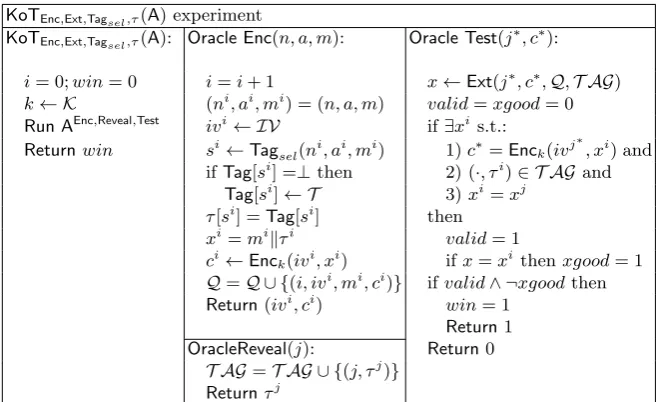
The proof is completely standard and can be found in Supp. Mat. F.3(the ideas of this proof are already present in Namprempre et al. [25]. The proofs of the security implications between the 3 “A” modes then results from implications in the caseAwins ∩B∩C, which we examine in the rest of this section.
In order to make our notations more precise, if eitherfIVorfTaghave different signatures for two modes that we compare, we use a subscript to denote the mode that is used (e.g.fIV10 for mode A10).
In some proves we use hash function and their collision resistance, for more details about this see Katz and Lindell [15] or Supp. Mat. A.10.
5.1 TheINT-CTXT1-security of A12 implies theINT-CTXT1-security of A10
Proposition 1. Let fIV10 : N × A 7−→ IV and fTag : A × M 7−→ T be two
random functions and let Π = (KE,Enc,Dec) be a (q, t, ivE)-ivE-secure
en-cryption scheme. Then, if mode A12 implemented with the random function fIV12 : N 7−→ IV is (q−1, t, INT
-CTXT1)-INT-CTXT1-secure then mode A10
is(q−1, t, q|T |−1+ (q−1)ivE+INT
-CTXT1)-INT-CTXT1-secure The proof can be found in Supp. Mat. F.3.
Let f0IV12 : N × A 7−→ IV be defined f0IV12(n, a) := fIV12(n) ∀n ∈ N, a ∈ A (it is an extension offIV12). The proof is based on the fact that it is impossible using only encryption queries to mode A10 to distinguish if it is used fIV10 or
f0IV12 (as in mode A12), since it is not possible for the adversaryAto force the
nAEalgorithm to call fIV10 on inputs (n, a
1) and (n, a2) (with a1 6=a2) during encryption queries. Moreover, the couple (nq, aq) of the decryption query must not be fresh (due to eventB), thus, using f0IV12 is indistinguishable from using
fIV10.
5.2 TheINT-CTXT1-security of A11 implies theINT-CTXT1-security of A10
Proposition 2. Let fIV :N × A 7−→ IV andfTag10 :A × M 7−→ T be two ran-dom functions and letΠ = (KE,Enc,Dec) be a (q, t, ivE)-ivE-secure encryption
scheme. Let H: A 7−→ {0,1}N be a (0, t,
cr) collision resistant hash function.
Then, if mode A11, implemented with the random functionfTag11:M 7−→ T and
with any(q, t, ivE+ q 2
2|IV|)−ivE-secure Encryption scheme, is(q−1, t, INT-CTXT1)
The complete proof can be found in Supp. Mat. F.3.
The idea is to reduce the INT-CTXT1 adversary A against scheme Π (mode A10), which uses the ivE scheme Π, to a INT-CTXT1 adversary C against scheme Π0 (mode A11), which uses the ivE scheme Π0. When the adversary
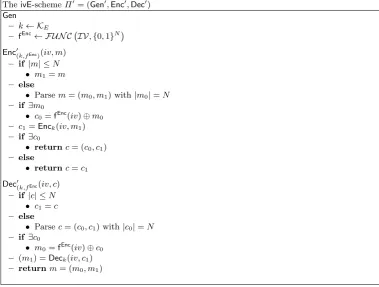
Amakes an encryption query (ni, ai,mi) the adversaryCmakes an encryption query (ni, ai,m0i) with m0i = H(ai)kmi. The ivE scheme Π0 encrypts m0i =
(H(ai)kmi[= mikτi]) in this way: Enc0(m0i) := H(ai)⊕fEnc(ivi)kEnc(ivi, mi),
wherefEnc is a random function (and it is part of the key the schemeΠ0). When
the adversaryAmakes his decryption query (nq, aq, cq) the adversaryCsimply
asks the decryption of (nq, aq,
fEnc(ivq)⊕H(aq)
kcq) (theivq must be not fresh
due to eventB).
5.3 The INT-CTXT-security of A10 implies the INT-CTXT-security of A12
Proposition 3. Let fIV12 : N 7−→ IV and fTag : A × M 7−→ T be two
ran-dom functions and letΠ = (KE,Enc,Dec) be a (q, t, ivE)-ivE-secure encryption scheme. LetΠ be thenAE-scheme obtained composing these components accord-ing to mode A12. Let H:A 7−→ {0,1}N be(0, t,
cr).
Then, if mode A10, implemented with the random functionfIV10 :N × A 7−→ IV
and with any(q, t, ivE+ q 2
2|IV|)−ivE-secure Encryption scheme, is(q, t, INT-CTXT1)
-INT-CTXT1-secure then mode A12 is(q−1, t, )-INT-CTXT1-secure with =q|T |−1+ (q−1)ivE+
cr+INT-CTXT1. The complete proof can be found in Supp. Mat. F.3.
The idea of the proof is similar to the previous one (Propo.2), where we replace
mi withm’i= (H(aikmi).
5.4 The INT-CTXT-security of A10 implies the INT-CTXT-security of A11
Proposition 4. Let fIV : N × A 7−→ IV and fTag11 : M 7−→ T be two
ran-dom functions and letΠ = (KE,Enc,Dec) be a (q, t, ivE)-ivE-secure encryption
scheme. LetΠ be thenAEscheme obtained composing these components accord-ing to mode A11. Let H: A 7−→ {0,1}N be a (0, t,
cr)-collision resistant hash
function.
Then, if mode A10, implemented with the random functionfTag10 :A×M 7−→ T, is(q, t, INT-CTXT1)-INT-CTXT1-secure then mode A11is(q−1, t, 0)-INT-CTXT1
-secure with
=q|T |−1+ (q−1)
ivE+cr+INT-CTXT1. The complete proof can be found in Supp. Mat. F.3.
adversaryA makes an encryption query (ni, ai,mi), the adversaryCmakes an
encryption query (nikH(ai), a,mi). When the adversaryAmakes his decryption query (nq, aq, cq) the adversaryA0simply asks the decryption of (nqkH(aq), a, cq).
6
Secure variants of modes N4, A10, A11 and A12
As a step towards the proof of the generic (in-)security of A10, A11 and A12, we consider two natural conditions on theivEscheme that are sufficient to guar-antee a secure composition. More precisely, we show that, if the ivE scheme is misuse resistant or if it is “message-malleable” (a condition that is satisfied by many standard modes, and that we formalize precisely below), then these modes are secure. Interestingly, these two properties are the two extreme of the range (clearly, it is impossible for a scheme to have both properties).
We prove everything only for mode A10, since the proofs can be straight-forwardly extended to the other two modes. In this section we use the same replacement as in the previous one (we replace mode A10 with mode A10). Sur-prisingly, we prove the same results for mode N4.
Then, we conclude this section, comparing our partial results about the (in)-security of modes A10, A11 and A12 with those of Namprempre et al. [25].
6.1 Misuse-resistant ivE scheme
Proposition 5. Let theivEschemeΠ be a(q, t, mrE)-misuse resistantmrEand (q, t, ivE)−ivE secure, letfIV :N × A 7−→ IV andfTag:A × M 7−→ T be two random functions. Then, the scheme Π obtained composing these components according to mode A10, is (q−1, t,(q−1)|T |−1+ (q−1)ivE+ (q−1)mrE)−
INT-CTXT1-secure.
The details of the proof are available in Supp. Mat. F.4. As seen above, we only need to consider the case not studied in Lemma1. The idea of the proof is to reduce theINT-CTXT1 adversary to amrE-adversary. Since we are not in the cases studied in Lemma1, the couples (nq, aq) and (aq,mq) are not fresh, and it is enough for themrEadversary to ask one more encryption query guessing that the message encrypted mqkτq is one of the message theINT-CTXT1 adversary has already asked to encrypt with the same AD aq (that is, mq ∈ Maq where
Maq := {mi i = 1, ..., q −1 s.t.ai = aq}). If the ciphertext obtained is the
ciphertext cq that he is asked to decrypt, then he outputs 1 and, otherwise, 0.
ThemrEadversary wins only if he guesses correctly and he can guess correctly at most with probability (q−1)−1.
Allowing the mrEadversary to ask (2q−2) encryption queries the schemeA10 would be (q, t,2|T |q−1 + 2mrE)−INT-CTXT1-secure, because the mrE adversary may try every possible message in Maq (see for more details Supp. Mat. F.4
We remember that for the misuse-resistance of Enc (Def.3) the adversary has only access to encryption queries.
6.2 “Message-malleable” nE scheme
Definition 9. A nonce-based encryption schemenEΠ = (K,Enc,Dec)is message-malleable if, given an encryption c of a message m with nonce n, an adver-sary can efficiently decrypt all couples (n, c0), i.e., he is able to computem0 s.t. m0 ←Deck(n, c0)without having access to a decryption oracle.
The same definition may be done for ivE schemes. Many standard schemes (as
CTR and OFB [15]) have this “insecurity” property when they are used for fixed length messages. We detail some examples in Supp. Mat. G. Message-malleability is easy to prove in many cases, e.g., when the ciphertext c =
Encivk (m) is computed as a pseudorandom bitstreamrcomputed from theivand it is XORed with the messagem(that is,c=r⊕m), thenDeckiv(c0) =c⊕c0⊕m. Message-malleability allows us to prove the following proposition for A10, which can be easily extended to modesA11 andA12).
Proposition 6. Let theivE schemeΠ be(q, t, ivE)-ivE-secure, (q−1, t, mCPA) -mCPA-secure and “message-malleable”, let fIV :N × A 7−→ IV and fTag : A × M 7−→ T be two random functions. Then, the scheme Π obtained composing these components according to modeA10, is(q, t,(q−1)ivE+q|T |−1+ 8mCPA)−
INT-CTXT1-secure.
The details of the proof are available in Supp. Mat. F.4.
Again, we only need to consider the case that is not covered by Lemma1. The idea of the proof is to reduce the INT-CTXT1 adversary to anmCPA-adversary. Since we are not in the cases studied in Lemma1, the couples (nq, aq) (thusivq)
and (aq,mq) are not fresh. ThemCPAadversary, when he is asked to simulate theAEnc oracle on input (ni, ai, mi) simply computes ivi and τi using the ap-propriate functions and asks hisEncoracle on input (ivi, mikτi, mikri) whereri is a random value picked inT, receivingci which he forwards to theINT-CTXT
adversary. When this latter adversary outputs (nq, aq, cq), themCPAadversary
computes ivq, which, due to the fact that we are in the case not covered by
Lemma 1, isivj for a j ∈ {1, ..., q−1}. Now using the fact that Π is
“nonce-message-malleable”, he can decryptcq as if ci=EncivkEi(mikτi). He outputs 0 if the decryption query is valid, 1 otherwise. We observe that ifci=EncivkEi(m
ikri)
the decryption query may be valid with probability |T |−1 since the tags have never been used before the decryption query.
6.3 Extension to N4
Surprisingly, although mode N4 is not secure in general (see Sec. 4), if the nE
Propo.5and Propo.6 to thenEcase (Prop. 13.
This implies that for N4 it is capital that the adversary can efficiently decrypt
everything. In fact, thenEscheme used in Sec.4 is message-malleable except in the case ifn= 1 or 2 when trying to decrypt or encrypt (v∗,·).
6.4 Comparison to Namprempre et al. [25]
Namprempre et al. [25] gave partial results using the Knowledge-of-Tag property (KoT) (introduced in Supp. Mat. B). That is, adversaries must forge without any (extractable) knowledge of the tag used in the decryption query [25]. With respect to their work, although the main ideas of the proofs are very similar, it is much easier to prove that a scheme is mrE or message-malleable, than to prove that a scheme is KoT-secure (while it may be easy to prove that it is not KoT-secure). In fact, to prove that a scheme is message-malleable it is enough to provide an algorithm which efficiently computes the result. On the other hand to prove that a scheme is not message-malleable (a part from proving that it ismrE), it must be proved thatallefficient adversaries are not able always to decrypt. Similarly to prove the KoT security it must be proved that for all
possible efficient extractors the scheme has this property, while to prove that a scheme is not KoT secure, it is enough to provide a counterexample.
7
Insecure variants of modes A10, A11 and A12
While, in the previous section, we proved the security of A10, A11 and A12 by making some extra requirements on the ivE scheme, this section considers the relaxation of some of the requirements onivE that makes these 3 modes to become insecure. More precisely, we show how to compute forgeries against the
INT-CTXTproperty of mode A10 when the ivE scheme is non tidy or stateful. These attacks imply that the three modes are notnAE-secure, when implemented with such schemes.
7.1 Tidiness as a security property
Given an IV-based encryption Π = (K,Enc,Dec), our idea is to turnΠ into a sloppy IV-based scheme. This modification augments the ciphertextc=Enck(iv, m)
withc0=Enck0(iv, m), leading to a double and independent encryptionmwith
the same iv. It is easy to see that, for random iv, the new scheme has pseu-dorandom ciphertext C = (c, c0) as long as Π has pseudorandom ciphertext, (that is, if Π is ivE-secure). However, given iv, if we define the decryption of C = (c, c0) simply as Deck(iv, c) without any validity consideration on c0, the
More formally, we build Π0 = (K,Enc0,Dec0) with keyspace K2, message spaceMand ciphertext spaceC2 as follows:Enc0
(k,k0)(iv, m) outputsC= (c, c0)
where c=Enck(iv, m) andc0=Enck0(iv, m);Dec0(k,k0)(iv, C) parses the
cipher-text as C = (c, c0) and outputs m = Deck(iv, c). For any c00 6= c0, we have
Enc0(iv,Dec0(iv,(c, c00))) = (c, c0)6= (c, c00) so thatΠ0 is not tidy.
LetnAEbe the authenticated encryption obtained from the A10 mode whose ciphertext has the formC= (c, c0) wherec=Enck(iv,mkτ) andc0=Enck0(iv,mkτ)
with iv = MacIVk
M(n, a) and τ = Mac
Tag
kM(a,m). Now, we consider the forger A which makes a single encryption query on any triple (n, a,m) and receives back C = (c, c0) as above. Then, A picks any (samplable) c00 ∈ C distinct of c0 and outputs C? = (c, c00). Following the description of the A10 mode
we find that the decryption starts by running iv = MacIVk
M(n, a) and then Dec0(k,k0)(iv, C?) =Deck(iv, c) =mkτ. Finally, since the checkτ=Mac
Tag
kM(a,m)
passesm6=⊥is returned althoughC?6=C.
Message-malleability. In order to further emphasize the crucial role of the tidi-ness in the insecurity of the authenticated encryption based onΠ0, we stress that if the underlying IV-based schemeΠ is tidy and message-malleable (Def.9), the A10 composition implemented withΠ leads to annAE-secure scheme (as shown in Sec. 6.2). However, even if Π0 is not tidy, it is easy to see that Π0 remains message-malleable while we proved that it never leads to a nAE-secure scheme. As a summary, (non) tidiness alone has an intrinsic propensity to degrade the
nAE-security of theAEncbased on the Tag-then-Encrypt paradigm.
7.2 Forgery against stateful A10, A11 & A12
In stateful AE schemes the AEnc and ADec algorithms receive at the start of the game an additional input, thestate, which is updated during every call and kept in memory to be reused in the following call. The scheme we use has a statelessADecalgorithm, that is, it does not use the state and every reordering and omission is tolerable (L0of Rogaway et al. [36]). (for more details see Supp. Mat. F.5). With respect to their work we allow the adversary to choose the state at the start of the game.
The idea of this forgery is to use the state, which in our case is simply a counter of the encryption queries, as the nonce was used in the attack against mode N4 (Sec.4). At the end of the section we discuss the meaning of tidiness for stateful schemes.
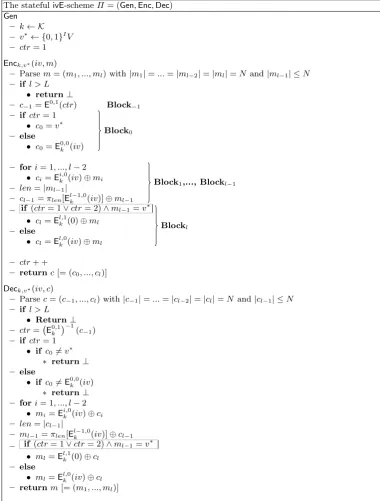
TheivEwe present is an adaptation of thenEscheme used in Sec.4. As there, we present it only for N-bit long message, leaving the general case in Supp. Mat. ‘E. The main changes are:
– We use a TPRPE:K × T W × {0,1}N 7−→ {0,1}N instead of a TPRF.
– A new blockc−1 is added to the ciphertext, in order to give the decryption algorithm the actual value of the counterctrwhich isan internal state only of the encryption device, and c−1 =E
(0,1)
this to retrieve the correct ctr. The blockc−1 is random since it is always obtained with different inputs (as long as the number of encryption queries is<<2n).
– To compute this block, the TPRFEis called with a tweak (0,1) that is never used else
– The boxedif is triggered by the value of the counterctr(not of the nonce) andm
– Theiv replaces the noncenin the input of the TPRFE.
Note again that, due to mode A10, the messages which thenAEscheme Πcan encrypt, areN bits long, while those whichΠ can encrypt are 2N bits long. The full details can be found in Supp. Mat. F.5as well with the general scheme for any message in{0,1}∗.
The forgery is an easy adaptation of that presented in Sec.4(the full details are in Supp. Mat. F.5).
The schemeΠ is clearly ivE-secure (the details are in Supp. Mat. F.5), the only important change with Sec. 4is the fact that we have to consider also the blockc−1). Now we have to discuss what means for a statefulnAE(ornEorivE) scheme to betidy.
For statelessnAE schemes the definition was given in Def.12 (similarly fornE
andivE): ifADecn,ak (c) =m6=⊥thenAEncn,ak (m) =c.
Now if thenAEscheme is stateful it means thatAEncn,ak (m) is no more de-fined, because the statesmay influence the output ofAEnc(k·,·)(·). Thus, denoting withS the set of possible states, we redefine tidiness as:
Definition 10. We say that an nAE scheme is tidy if ADecn,ak (c) = m then c∈ {AEncn,ak,s(m)}s∈S.
Similarly annE(resp. anivE) scheme istidyifDecn,ak (c) =m(resp.Deciv,ak (c) = m thenc∈ {Encn,ak,s(m)}s∈S (resp.c∈ {Enciv,ak,s (m)}s∈S).
According with this new definition, the ivE scheme Π which we have just used, presented in Fig.7is tidy, as it follows from a close inspection of the pseu-docode provided, thus thenAEschemeΠ is tidy.
We have also to redefine for stateful schemes all the notions presented in Sec.2. We do it allowing the adversaryat the start of the game to set the state of the scheme as he wishes.
8
Conclusion
and three of them are the most efficient among the 180 possible modes based on these building blocks.
We have proved that mode N4 is not secure in general, and that modes A10, A11 and A12 have equivalent security. Moreover we have proved that if these four modes are instantiated with many common schemes (likeCTR, OFB) they are all secure. Finally, we have showed that tidiness (again) and being stateless can have a decisive impact on security, as the application of A10, A11 and A12 on untidy or stateful modes can lead to insecure solutions.
Our analysis still leaves as an open problem to decide if modes A10, A11, and A12 are secure in general.
References
1. Vijayalakshmi Atluri, editor.Proceedings of the 9th ACM Conference on Computer and Communications Security, CCS 2002, Washington, DC, USA, November
18-22, 2002. ACM, 2002.
2. Mihir Bellare, Oded Goldreich, and Anton Mityagin. The power of verification queries in message authentication and authenticated encryption.IACR Cryptology
ePrint Archive, 2004:309, 2004.
3. Mihir Bellare and Sriram Keelveedhi. Authenticated and misuse-resistant encryp-tion of key-dependent data. In Phillip Rogaway, editor,Advances in Cryptology -CRYPTO 2011 - 31st Annual Cryptology Conference, Santa Barbara, CA, USA,
August 14-18, 2011. Proceedings, volume 6841 ofLecture Notes in Computer
Sci-ence, pages 610–629. Springer, 2011.
4. Mihir Bellare, Tadayoshi Kohno, and Chanathip Namprempre. Authenticated en-cryption in SSH: provably fixing the SSH binary packet protocol. In Atluri [1], pages 1–11.
5. Mihir Bellare, Tadayoshi Kohno, and Chanathip Namprempre. Breaking and prov-ably repairing the SSH authenticated encryption scheme: A case study of the encode-then-encrypt-and-mac paradigm. ACM Trans. Inf. Syst. Secur., 7(2):206– 241, 2004.
6. Mihir Bellare and Chanathip Namprempre. Authenticated encryption: Relations among notions and analysis of the generic composition paradigm. In Okamoto [27], pages 531–545.
7. Mihir Bellare and Phillip Rogaway. Encode-then-encipher encryption: How to exploit nonces or redundancy in plaintexts for efficient cryptography. In Okamoto [27], pages 317–330.
8. Dan J Bernstein. Caesar call for submissions, final, january 27 2014.
9. Francesco Berti, Fran¸cois Koeune, Olivier Pereira, Thomas Peters, and Fran¸ cois-Xavier Standaert. Ciphertext integrity with misuse and leakage: Definition and efficient constructions with symmetric primitives. In Jong Kim, Gail-Joon Ahn, Seungjoo Kim, Yongdae Kim, Javier L´opez, and Taesoo Kim, editors,Proceedings of the 2018 on Asia Conference on Computer and Communications Security,
Asi-aCCS 2018, Incheon, Republic of Korea, June 04-08, 2018, pages 37–50. ACM,
2018.
10. Francesco Berti, Olivier Pereira, Thomas Peters, and Fran¸cois-Xavier Standaert. On leakage-resilient authenticated encryption with decryption leakages. IACR
11. Colin Boyd, Britta Hale, Stig Frode Mjølsnes, and Douglas Stebila. From state-less to stateful: Generic authentication and authenticated encryption constructions with application to TLS. In Kazue Sako, editor,Topics in Cryptology - CT-RSA 2016 - The Cryptographers’ Track at the RSA Conference 2016, San Francisco, CA,
USA, February 29 - March 4, 2016, Proceedings, volume 9610 ofLecture Notes in
Computer Science, pages 55–71. Springer, 2016.
12. Morris J Dworkin. Recommendation for block cipher modes of operation: Ga-lois/counter mode (gcm) and gmac. Technical report, 2007.
13. Shay Gueron and Yehuda Lindell. GCM-SIV: full nonce misuse-resistant authen-ticated encryption at under one cycle per byte. In Ray et al. [31], pages 109–119. 14. IETF. The transport layer security (tls) protocol version 1.3 draft-ietf-tls-tls13-28. Technical report, 2018. https://tools.ietf.org/html/ draft-ietf-tls-tls13-28.
15. Jonathan Katz and Yehuda Lindell.Introduction to Modern Cryptography, Second
Edition. CRC Press, 2014.
16. Jonathan Katz and Moti Yung. Unforgeable encryption and chosen ciphertext secure modes of operation. In Bruce Schneier, editor, Fast Software Encryption, 7th International Workshop, FSE 2000, New York, NY, USA, April 10-12, 2000,
Proceedings, volume 1978 of Lecture Notes in Computer Science, pages 284–299.
Springer, 2000.
17. Tadayoshi Kohno, Adriana Palacio, and John Black. Building secure crypto-graphic transforms, or how to encrypt and MAC.IACR Cryptology ePrint Archive, 2003:177, 2003.
18. Hugo Krawczyk. The order of encryption and authentication for protecting com-munications (or: How secure is ssl?). In Joe Kilian, editor,Advances in Cryptology - CRYPTO 2001, 21st Annual International Cryptology Conference, Santa
Bar-bara, California, USA, August 19-23, 2001, Proceedings, volume 2139 ofLecture
Notes in Computer Science, pages 310–331. Springer, 2001.
19. Will Landecker, Thomas Shrimpton, and R. Seth Terashima. Tweakable block-ciphers with beyond birthday-bound security. In Reihaneh Safavi-Naini and Ran Canetti, editors, Advances in Cryptology - CRYPTO 2012 - 32nd Annual
Cryp-tology Conference, Santa Barbara, CA, USA, August 19-23, 2012. Proceedings,
volume 7417 ofLecture Notes in Computer Science, pages 14–30. Springer, 2012. 20. Moses Liskov, Ronald L. Rivest, and David A. Wagner. Tweakable block ciphers.
In Moti Yung, editor,Advances in Cryptology - CRYPTO 2002, 22nd Annual In-ternational Cryptology Conference, Santa Barbara, California, USA, August 18-22,
2002, Proceedings, volume 2442 ofLecture Notes in Computer Science, pages 31–46.
Springer, 2002.
21. David A. McGrew. An interface and algorithms for authenticated encryption.
RFC, 5116:1–22, 2008.
22. Bart Mennink. Optimally secure tweakable blockciphers. In Gregor Leander, editor,
Fast Software Encryption - 22nd International Workshop, FSE 2015, Istanbul,
Turkey, March 8-11, 2015, Revised Selected Papers, volume 9054 ofLecture Notes
in Computer Science, pages 428–448. Springer, 2015.
23. Atsushi Mitsuda and Tetsu Iwata. Tweakable pseudorandom permutation from generalized feistel structure. In Joonsang Baek, Feng Bao, Kefei Chen, and Xuejia Lai, editors, Provable Security, Second International Conference, ProvSec 2008,
Shanghai, China, October 30 - November 1, 2008. Proceedings, volume 5324 of
24. Yusuke Naito. Tweakable blockciphers for efficient authenticated encryptions with beyond the birthday-bound security.IACR Trans. Symmetric Cryptol., 2017(2):1– 26, 2017.
25. Chanathip Namprempre, Phillip Rogaway, and Thomas Shrimpton. Reconsidering generic composition. In Phong Q. Nguyen and Elisabeth Oswald, editors,Advances in Cryptology - EUROCRYPT 2014 - 33rd Annual International Conference on the Theory and Applications of Cryptographic Techniques, Copenhagen, Denmark,
May 11-15, 2014. Proceedings, volume 8441 ofLecture Notes in Computer Science,
pages 257–274. Springer, 2014.
26. Yoav Nir and Adam Langley. Chacha20 and poly1305 for IETF protocols. RFC, 7539:1–45, 2015.
27. Tatsuaki Okamoto, editor.Advances in Cryptology - ASIACRYPT 2000, 6th Inter-national Conference on the Theory and Application of Cryptology and Information
Security, Kyoto, Japan, December 3-7, 2000, Proceedings, volume 1976 ofLecture
Notes in Computer Science. Springer, 2000.
28. Kenneth G. Paterson, Thomas Ristenpart, and Thomas Shrimpton. Tag size does matter: Attacks and proofs for the TLS record protocol. In Dong Hoon Lee and Xiaoyun Wang, editors,Advances in Cryptology - ASIACRYPT 2011 - 17th Inter-national Conference on the Theory and Application of Cryptology and Information
Security, Seoul, South Korea, December 4-8, 2011. Proceedings, volume 7073 of
Lecture Notes in Computer Science, pages 372–389. Springer, 2011.
29. Olivier Pereira, Fran¸cois-Xavier Standaert, and Srinivas Vivek. Leakage-resilient authentication and encryption from symmetric cryptographic primitives. In Ray et al. [31], pages 96–108.
30. Thomas Peyrin and Yannick Seurin. Counter-in-tweak: Authenticated encryption modes for tweakable block ciphers. In Matthew Robshaw and Jonathan Katz, edi-tors,Advances in Cryptology - CRYPTO 2016 - 36th Annual International Cryptol-ogy Conference, Santa Barbara, CA, USA, August 14-18, 2016, Proceedings, Part I, volume 9814 ofLecture Notes in Computer Science, pages 33–63. Springer, 2016. 31. Indrajit Ray, Ninghui Li, and Christopher Kruegel, editors.Proceedings of the 22nd ACM SIGSAC Conference on Computer and Communications Security, Denver,
CO, USA, October 12-6, 2015. ACM, 2015.
32. Phillip Rogaway. Authenticated-encryption with associated-data. In Atluri [1], pages 98–107.
33. Phillip Rogaway. Efficient instantiations of tweakable blockciphers and refinements to modes OCB and PMAC. In Pil Joong Lee, editor, Advances in Cryptology -ASIACRYPT 2004, 10th International Conference on the Theory and Applica-tion of Cryptology and InformaApplica-tion Security, Jeju Island, Korea, December 5-9,
2004, Proceedings, volume 3329 ofLecture Notes in Computer Science, pages 16–
31. Springer, 2004.
34. Phillip Rogaway. Nonce-based symmetric encryption. In Bimal K. Roy and Willi Meier, editors,Fast Software Encryption, 11th International Workshop, FSE 2004,
Delhi, India, February 5-7, 2004, Revised Papers, volume 3017 ofLecture Notes in
Computer Science, pages 348–359. Springer, 2004.
35. Phillip Rogaway and Thomas Shrimpton. A provable-security treatment of the key-wrap problem. In Serge Vaudenay, editor, Advances in Cryptology - EURO-CRYPT 2006, 25th Annual International Conference on the Theory and Applica-tions of Cryptographic Techniques, St. Petersburg, Russia, May 28 - June 1, 2006,
Proceedings, volume 4004 of Lecture Notes in Computer Science, pages 373–390.
36. Phillip Rogaway and Yusi Zhang. Simplifying game-based definitions - indistin-guishability up to correctness and its application to stateful AE. In Hovav Shacham and Alexandra Boldyreva, editors,Advances in Cryptology - CRYPTO 2018 - 38th Annual International Cryptology Conference, Santa Barbara, CA, USA, August
19-23, 2018, Proceedings, Part II, volume 10992 of Lecture Notes in Computer
Supplementary material
A
Detailed background
A.1 Pseudorandom functions (PRF)
For completeness we represent the PRF section, expanding them:
Definition 1. A functionF:K × M 7−→ T is a (q, t, )-pseudorandom function (PRF)if for every(q, t)adversaryA, the advantage :
AdvPRFF (A) :=|Pr[AFk(·)⇒1 ]−Pr[Af(·)⇒1 ]|
is upper bounded bywherek andfare chosen uniformly at random from their domains, namely K and the set of functions fromMtoT,F U N C(M,T). In a similar way,Fis a pseudorandom permutation(PRP) ifFkis a permutation
and the above advantage isbounded whenfis selected as a random permutation.
We remind that a PRP is a PRF (see Propo. 3.27 [15]).
A function, which is PRF-secure is often the base which encryption schemes are based on (see, for example, [15]). To add more flexibility the notion of tweak-able pseudorandom functions was introduced by Liskov et al. [20].
Definition 11. [20]A tweakable pseudorandom functionE:K × T W × M 7−→ T is(q, t, )−TPRF (tweakable pseudorandom)-secure if for every(q, t)−TPRF -adversaryA the advantage
AdvTPRFE (A) := Pr
h
AEk(·,·)⇒1i−PrhAf(·,·)⇒1i
is bounded by for any(q, t)adversary.
Here f(·,·)is a random function, that is a function picked uniformly at random from the sets of all the functions having the same signature asEk(·,·).
If M= T and, for every k ∈ K and for every tw ∈ T W, the function Etwk (·)
is a permutation, E is called a (q, t, )-tweakable pseudorandom permutation (TPRP). In the advantage expression,f(tw,·)is then selected as an independent random permutation on Mfor every value of tw.
There are many ways to build a TPRF from a PRF (and a TPRP from a PRP), for example see [33], [23], [23], and [22] or directly [19], and [24].
A.2 Nonce-based Authenticated Encryption (nAE) schemes
Definition 12 ([25]). A scheme for nonce-based Authenticated Encryption
called ciphertext.
The decryption algorithmADecis a deterministic algorithm which takes as input the tuple(k, n, a, c)∈ K ×N ×A×C and outputsm←ADecn,ak (c)which is either a string m∈ Mor the symbol ⊥(”invalid”).
We require that the algorithms AEnc and ADec are the inverse of each other, that is:
– (Correctness)if AEncn,ak (m) =c thenADecn,ak (c) =m
– (Tidiness)ifADecn,ak (c) =m6=⊥thenAEncn,ak (m) =c
If ADecn,ak (c) =⊥we say that the algorithm rejectsc, otherwise it accepts c. A sloppynAEscheme satisfies everything but the tidiness condition.
Tidiness, as correctness, is usually seen as a syntactic requirement (for ex-ample Namprempre et al., [25]). Instead, in this paper, we show an explicit case where this property is fundamental to provide security (see Section7.1).
Definition 13 ([25]). A nonce-based authenticated encryption scheme (nAE) Π:= (K,AEnc,ADec)is (q, t, )−nAE-secureif the advantage
AdvnAEΠ (A) :=
Pr
h
AAEnck(·,·,·),ADeck(·,·,·)⇒1i−PrhA$(·,·,·),⊥(·,·,·)⇒1i
is bounded by for every(q, t)-adversary.
If the adversaryAqueried the first (encryption) oracle on input(n, a, m)and he was answeredc, the adversaryAis not allowed to query the second (decryption) oracle on input (n, a, c). Moreover the adversary Ais not allowed to repeat the first component (the nonce) on different left oracle queries.
If we want that the nAEscheme provides only privacy, we can use the fol-lowing definition:
Definition 14. A nonce-based authenticated encryption scheme (nAE) Π := (K,Enc,Dec)is (q, t, )−nAE−E-secure if the advantage
AdvnAEΠ −E(A) := Pr
h
AAEnck(·,·,·)⇒1
i
−PrhA$(·,·,·)⇒1i
is bounded by for every(q, t)-adversary.
The adversary A is not allowed to repeat the first component (the nonce) on different oracle queries.
A.3 Encryption schemes (nE and ivE)
Definition 15 ([25]). Anonce-based Encryption scheme (nE)is a tripleΠ = (K,Enc,Dec), where the keyspace K is a non-empty set, the encryption algo-rithm Enc is a deterministic algorithm that takes as input the tuple (k, n, m)∈ K × N × Mand outputs a stringc←Encnk(m).
The decryption algorithm Decis a deterministic algorithm which takes as input the tuple(k, n, c)∈ K × N × Cand outputs either a stringm∈ Mor the symbol
⊥(”invalid”).
As for nAE the properties of correctness and tidiness are required, making Enc and Dec one the inverse of the other, that is, Decnk(Encnk(m)) = m and if Decnk(c)6=⊥,Enckn(Decnk(c)) =c.
We observe that an nAE scheme is an nE scheme: in fact it is enough to consider as the noncen0:= (nka) and it is syntactically an nEscheme.
Definition 16. A nonce-based encryption scheme (nE) Π := (K,Enc,Dec) is
(q, t, )−nE-secureif the advantage AdvnEΠ(A) :=
Pr
h
AEnck(·,·)⇒1i−PrhA$(·,·)⇒1i
is bounded by for every(q, t)-adversary.
The adversary A is not allowed to repeat the first component (the nonce) on different oracle queries.
If instead of a nonce, aniv is used, we have:
Definition 17 ([25]). An iv-based encryption scheme (ivE) is a triple Π = (K,Enc,Dec), where the keyspaceKis a non-empty set, the encryption algorithm Enc is a deterministic algorithm which takes as input the tuple(k, iv, m)∈ K × IV × Mand outputs the stringc←Encivk (m).
The decryption algorithm Decis a deterministic algorithm which takes as input the tuple(k, iv, c)∈ K × IV × Cand outputs either a stringm∈ Mor the symbol
⊥(”invalid”).
As fornAEandnE, the properties of correctness and tidiness are required, making Enc andDecone the inverse of the other.
The two Definitions15and17are semantically identical. However the secu-rity properties they aim are different. In fact:
Definition 18 ([35]).An iv-based Encryption schemeivEΠ :=K,Enc,Dec)is
(q, t, )−ivE-secure if the advantage AdvivEΠ(A) :=
Pr
h
AEnc$k(·)⇒1
i
−PrhA$(·)⇒1i
is bounded by for every(q, t)-adversary.
Here the oracle Enc$(m) first picks a random iv ← IV, then it computes c ←
We can observe that ivE-security implies nE security, because if the iv are picked uniformly at random, they are all different with overwhelming probability. The contrary does not hold, e.g. CTR (for details see Supp. Mat. G.1). The difference between ivE-security and nE-security is how the nonces or the ivs are treated, that is the nonce must be unique, while theiv must be randomly chosen.
When the only request is not to repeat the nonce, it is possible to allow the adversary to completely control the nonce, since it is efficiently checkable if the adversary respects the non-repeating property. This is not the case if it is necessary to check if theivs are picked uniformly at random, so it is not possible to give the control of theivs to the adversary.
A.4 Nonce(iv)-misuse
Naturally we may wonder what happens if we get rid of the requirements about the nonces or theivs in Definitions 13,16,14and 18. For certain schemes it is devastating. We have already observed that, if theivs are not randomly picked, some iv-based encryption schemes may have problems, e.g. CTRand OFB (see Supp. Mat. G.1).
This can be the case even for nonce-based encryption schemes. In fact, if to an adversaryA, who had asked the encryption of (n, m) receiving the ciphertextc, is given the ciphertextc0 obtained as the encryption of (n, m0), the adversaryA
may recoverm0. Examples of such Encryption schemes are given in Supp. Mat. G.1for a fixed length scheme, that is, schemes that encrypt only messages of the same fixed length, or in Supp. Mat. G.2 for a various length scheme. We have called these schemes “message malleable” (Def.9). Moreover, there are schemes, which are not message-malleable, but which are insecure if the nonces are re-peated (for example, the scheme used in Sec.4 orCBC).
However, it is possible to produce encryption schemes whose outputs look still completely random even if the nonces are repeated, provided that the nonces are not repeated with the same message. This security property (mrAE) was introduced by Rogaway and Shrimpton [35] for nonce-based Authenticated En-cryption schemes nAE:
Definition 19 ([35]). A nonce-based Authenticated Encryption scheme (nAE) Π:= (K,AEnc,ADec) is (q, t, )−mrAE-secure (misuse resistant)if the advan-tage
AdvmrAEΠ (A) := Pr
h
AAEnck(·,·,·),ADeck(·,·,·)⇒1i−PrhA$(·,·,·),⊥(·,·,·)⇒1i
is bounded by for every(q, t)-adversary.
If the adversary A queried the first (encryption) oracle on input (n, a, m) ob-taining c, he is not allowed to query the second (decryption) oracle on input
This is exactly Def.13 where we have got rid of the hypothesis about the non-repeating of the nonces in encryption queries.
A similar notion can be given for nonce-based encryption scheme:
Definition 20. A nonce-based encryption scheme (nE) Π := (K,Enc,Dec) is
(q, t, )−mrE-secure (misuse resistant) if the advantage AdvmrEΠ (A) :=
Pr h
AEnck(·,·)⇒1
i
−PrhA$(·,·)⇒1i
is bounded by for every(q, t)-adversary.
This is exactly Def.16 where we have got rid of the hypothesis about the non-repeating of the nonces in encryption queries.
Clearly this security notion is stronger than thenEone, that ismrEimplies
nE(similarlymrAEimpliesnAE). In fact, in these two security definition we have got rid of the hypothesis that the nonce is anonce, that is, it is never repeated. Such schemes are callednonce misuse resistant and there is a flourishing litera-ture about them [30], [9], [10], [13], [3], and [35].
AnnAEscheme may bemrEand notmrAE: consider anmrEscheme, for which the decryption algorithm gives, for invalid ciphertexts the key. The example is given in Sec.H.
A.5 The Chosen-Plaintext Attack(CPA) security
TheivE and thenE(and thenAE−E) notions implies the natural extention of
CPA(Chosen-Plaintext Attack) security IV-based and nonce-based encryption:
Definition 21. A nonce-based schemenEΠ = (K,Enc,Dec)is(q, t, )−CPA(Chosen Plaintext Attack)-secureif the advantage
AdvCPAΠ (A) := 1 2−Pr
h
b0 =b;b← {0$ ,1}, (st, n, m0, m1)←A Enck(·,·)
1 ,
c←Encnk(mb), b0←A
Enck(·,·)
2 (st, c) i
is bounded by for every (q, t)adversary. The adversary A is composed by two algorithms A= (A1,A2). The first algorithm A1, after having queried its oracle q1 times, outputs st, which is the information it wants to give to the second
algorithm A2, a nonce n and two messages m0 andm1 in M, which have the
same length |m0|=|m1|. The algorithmA1 may not repeat the first component
on different oracle queries. The nonce n in the output of adversary A1 cannot
be a nonce used in an oracle query.
It may not repeat the first component on different oracle queries. Moreover it cannot use, as the first component of one of its queries, the nonce n output by algorithmA1, or a nonce used in an oracle query by the first algorithmA1 (that
is, a nonce can never be repeated during the whole game). The ciphertext c←Enck(n, mb)is called challenge ciphertext.
This is theCPA-definition of Katz and Lindell [15] tailored fornEschemes. There is a completely similar definition forivEschemes. We have only to replace
Enck(·,·) with Enc$k(·), and to change the $(·,·) oracle accordingly. Similarly
there is a similar notions for nAE schemes, obtained from the previous one by replacingEnck(·,·) withAEnck(·,·,·) and changing $(·,·,·) accordingly. The CPA
security of ivE corresponds to the usual CPA security notion when the encryp-tion is made probabilistic: it picks itself the random IV.
The nE (and the ivE) security implies the CPA-security since after having replaced the encryption Enc algorithm with $ it is not possible to guess better than with a random guess what plaintext the challenge ciphertext encrypts. Thus, we have proved the following:
Proposition 7. LetΠ = (K,Enc,Dec)be a(q, t, nE)−nEsecure (r.(q, t, ivE)−
ivE) encryption scheme. ThenΠ is(q−1, t, nE)−CPAsecure (r.(q−1, t, ivE)−
CPAsecure).
On the other hand, the nE (r. ivE) security is stronger. In fact, given the
nE (r.ivE)CPA-secure scheme Π = (K,Enc,Dec), then the nE(r. ivE) scheme Π0 = (K,Enc0,Dec0), defined byEnc0k(n, m) := Enck(n, m)k1 (r.Enc0k(iv, m) :=
Enck(iv, m)k1), is asCPAsecure as Π, but it is notnE(r.ivE) secure since the
last bit of every ciphertext is 1 (and not random).
There is also a version of theCPAsecurity, where, instead of having a single ci-phertextcwhich is either the encryption of (n, m0) or (n, m1) (with|m0|=|m1|), the adversaryAhas multiple ciphertextsci which are either all the encryptions
of (ni, mi
0) or all the encryptions of (ni, mi1) (as usual with |mi0|=|mi1|). Thus we have the following definition, which we have already introduced:
Definition 5. A nonce-based Encryption schemenEΠ = (K,Enc,Dec)is(q, t, ) -mCPAsecure, or(q, t, )-secure against chosen plaintext attacks for multiple en-cryptions, if:
AdvmCPAΠ (A) := 1 2 −Pr
h
b0=b;b← {0,1}, b0 ←AEncbk(·,·,·)
i
is bounded by for any(q, t)-adversary. Here the oracleEncbk(·,·,·)is an oracle, which on input (n, m0, m1)∈ N × M2 outputs c ← Enck(n, mb) for a random
secret bitb← {0,1}, which the oracle has picked at the start of the game. When the adversaryAqueriesEncbk(·,·,·), he must choose two messagesm0andm1s.t. |m0|=|m1|. Moreover he cannot repeat the first input (the nonce) in different