ISSN 2286-4822
www.euacademic.org DRJI Value: 5.9 (B+)
A Study of Social Networking in Nursing Discipline,
Gender and Age Differences: Structural Equation
Modeling
ELNOUR MUBARAK M. A. OMAR
Arn Institute for Training, Kingdom of Saudi Arabia, Madinah
ELHADI NASR ELHADI MUSTAFA
Arab Open University, Kingdom of Saudi Arabia, Riyadh
Abstract
The main purpose of the study was to test a model that predicts the relationship between social networking and nursing discipline. It specifically examined relationship between social networking dimensions (Entertainment, social interactions and academic purposes) and nurses’ usage. Data were collected from 131 participants from public hospitals in Sudan- Khartoum city. The present study was employed e- questionnaire. Structural Equation Modelling (SEM) 16 Version and SPSS 11.5 Version were used. A hypothesized model was tested for model fit. The result demonstrated that two exogenous variables social interactions and academic purposes were positively related to nurses’ usage social networking. Conversely, entertainment was an exogenous variable and it was not represented in the final model because it did not satisfy requirements of Structural Equation Modelling (SEM) analysis. Thus, the model crossed age and gender factors.
Key words: Social networking, nursing discipline, demographic factors.
1. INTRODUCTION
purposes. No doubt that, social networking as a commination medium rises extremely fast and escalating via applications through mobile devices nowadays. So, social networking become familiar among young adults with sharing their everyday life and advanced experiences in keeping in touch with friends, managers, colleagues, and family talking about their interests (Gupta & Bashir 2018 ). It has been observed that in the past few years explosion of usage of different social networking applications for instance Twitter, Facebook, Whatsapp, MySpace, Youtube, LinkedIn, Instogram ...etc. This may increase dramatically numbers of applicants who are interested in using these applications. There are different definitions of social networking for instance use online technology tools that allow users to connect simply, fast and share information text, audio, you tube, video, images, podcasts and multimedia communications. It has described interactions and communication activities between individuals, groups, communities, organizations in a variety of ways and contexts. Pertaining to social networking in nursing discipline have been used widely and it has many benefited for nurses for instance they can share health information, interact with debate health practice issues, communicate with the public and promote the primary health care behaviors. It provides opportunities for healthcare practitioners to keep pace with the latest healthcare developments even they were separated by a long distance. Nurses can stream the surgical procedures and ask questions via the Internet simultaneously. Nurses have a golden opportunity to participate in online forums through social networking. (Mohamed. S, 2018). Also it has many advantages such as benefit health care in terms of fostering professional connections, promoting timely communication with patients and family members, educating and informing consumers in health care. (Spector & Kappal, 2012). Thus, nursing discipline is explored as ‘preferable in the marketing’ and as ‘social networking in action’.
1.1 Statement of the problem
Nurses often use social networking in order to promote health care in different ways, including connections with patients, family members and informing consumers. Within the nurses field this means that people are posting things relating to their own health, reviews on certain medical treatments, and raising awareness of relevant health conditions. Nurses might become hesitant and uncertain of concerning the use of social networking in their own discipline. In fact, many studies have conducted in social networking in discipline of nursing. Although social networking have reflected many advantages in nursing discipline such as confidentiality of patients and interaction with patients ...etc, but some previous studies have documented in both negative and positive manners. It seems that differences in terms of age and gender have not been highlighted enough in nursing discipline is exited.
Figure 1: Theoretical Framework adapted from Gupta & Bashir (2018)
Figure 2: Conceptual model
1.2 Objectives of the study
The present study attempts to test:
1- Social networking nurses’ use for academic purposes. 2--Social networking nurses’ use for entertainment. 3- Social networking nurses’ use for social interactions. 4- Difference of nurses’ gender in using social networking. 5- Difference of nurses’ age in using social networking.
1.3 Questions of the study
The present study will answer the following questions:
Actor network theory Nursing discipline
Academic purposes
Entertainment
Social interactions
1-What social networking do nurses use in an academic discipline? 2-What social networking do nurses use in entertainment?
3-What social networking do nurses use for social interactions? 4-What are the difference of gender in using social networking? 5- What are the difference of age in using social networking?
1.4 Hypotheses of the study
Based on the previous research studies, the present study hypothesizes that:
H1: There is a significant relationship between academic purposes and nurses’ usage .
H2: There is a significant relationship between social interactions and nurses’ usage.
H3: There is a significant relationship between entertainment and nurses’ usage.
H4: There is a significant relationship between age difference and nurses’ use social networking.
H5:There is a significant relationship between gender difference and nurses’ use social networking.
1.5 Significance of the study
1-The present study would meet certain expectations in nursing discipline.
2-Finding would be benefited to nursing and public at large. 3-The study will help to explore age differences.
4-The study will help to explore gender differences.
5-Interactive social networking enhances nurses to broaden their capacities of knowledge.
2. LITERATURE REVIEW
profession, and among themselves. Jennifer Jackson, Robert Fraser (2014) state that social media use for nurses can develop healthcare. Wilma K. Schroeder (2017says that nurses can use social media to promote family health, reduce illness make relationships with families outside of clinic Chang C.et.al (2011) social media effect on patient safety and provide information. Mohammed .S(2018) nurses can enhance their nursing competence by obtaining information in real time interaction and Casella, E Mills, J & Usher, K. ( 2014). Nurses use social media into assessing, diagnosing, planning, implementing and evaluating care. H1: There is significant relationship between academic social interactions and nurses use social networking. H2: There is significant relationship between academic purpose and nurses use social networking. There are some studies supported this hypothesis H2. So, Hao & Gao (2017) , (Sinclair et. al 2015), (Rose,J 2012), Casella .et.al (2014), assessing, diagnosing, planning, implementing and evaluating care. Ross, J (2012). Nurses use to their jobs and clinical information, Mohammed .S(2018) enables registered nurses to enhance their nursing competence by obtaining evidence-based information in real time. Kakushi, L. E. & Evora,Y.D (2016) indicate that audios, videos, quizzes, animations, forums, guidance, support, discussions and research group. Ronal, P. et.al (2013) provide forums to share ideas and information and send questions and connect with others. Thus, previous studies have supported hypothesis of present study. H3:
the gap of this study because there is no previous research study supported it.
3. METHODOLOGY OF THE STUDY
3.1 Research Design
The data were collected by e-questionnaire. The respondents of the present study were selected by utilizing stratified technique random sampling. The Structural Equation Modelling (SEM) was employed to address the objectives of the present study. The quantitative descriptive research method involves the data in order to measure the attitudes, opinions towards a specific social event, and investigate the relationships numerically Sekaran & Bougie (2016).
3.2 Participants’ Characteristics and Data Collection
3.2.1The instrumentation
In order to test the research hypotheses and questions e -questionnaire which was translated to Arabic language and included the 5-point Likert scale with 1 = Strongly Disagree and 5 = Strongly Agree was developed. The e-questionnairecomprised 42 items which measured three major constructs namely: Entertainment, social interaction and social networking. The e-questionnaire was modified from Gupta & Bashir (2018). A pilot study was conducted with a group of nurses professional from different Sudanese public hospitals on 4th Dec 2019 – 21st April 2020 in order to find out the reliability of
Table 1: Demographic Information of the Participants (N=131)
Variable Scale Frequencies (%)
Gender Male 43.8
Female 56.2
Age 19 -23years 15.7
24- 28 years 32.0
29 -33years 29.0
34- 38 years 11.2
Over 40years 12.1
3.2.2 Data Analysis
The data of this study were treated via Principal Component Analyses (PCA) with Varimax rotation and most of the loading of the items between 0.80 to 0.70 and items less than 0.40 loading were deleted and retain appropriate items. Structural Equation Modeling (SEM) was used in order to estimate the hypotheses. Version 16.0 of AMOS was employed; two ways were conducted: Firstly, test measurement model via Confirmatory Factor Analysis (CFA) to obtain reliability and validity of the items; in other words, to test the relationship between observed variables and latent variables. Secondly, a structural model was employed to test the relationship among latent variables.
3.2.3 Model Fit
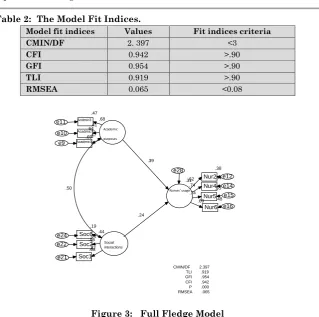
Table 2: The Model Fit Indices.
Model fit indices Values Fit indices criteria
CMIN/DF 2. 397 <3
CFI 0.942 >.90
GFI 0.954 >.90
TLI 0.919 >.90
RMSEA 0.065 <0.08
Academic purposes .47 Acadmic1 e9 .41 AcadmicT2 e10 64 .47 Acdmic3 e11 .31 Nurses’ usage .38 Nur2 e12 .62 .54 Nur4 e14 .74 .55 Nur5 e15 .74 .48 Nur6 e16 .69
CMIN/DF 2.397 TLI .919 GFI .954 CFI .942 P .000 RMSEA .065
Social interactions .47 Soc1 e21 .31 Soc2 e22 .19 Soc6 e24 .44 e28 .68 .69 .68 .56 .50 .39 .24
Figure 3: Full Fledge Model
4. DISCUSSION
The present study attempted to participate in the body of knowledge in terms of conceptualized model and there are three exogenous variables namely: Academic purposes, social interactions and entertainment and one endogenous variable which is nurses’ usage. Mainly, the present study tested relationship between social networking in nursing discipline after measuring and revising the model one variable has been deleted because did satisfy statistical requirements this variable was entertainment. This study found out that hypothesis H1: There is significant relationship between academic social interactions and nurses’ usage. This result indicates
supported by previous research studies such as Hao & Gao (2017) , Sinclair et. al .( 2015), Rose, J (2012) and Casella .et.al (2014). The result showed that usage of social networking for academic purposes in terms of nursing might lead nurses to be effective and interactive with the nurses and their colleagues or managers. This result might attract nurses interact academically via social networking and alleviate and continue in pursuing their academic disciplines by studying a new term assessing contact with a short course.
H2: There is significant relationship between academic purpose and nurses’ perceptions. This result has been supported by previous research studies for instance Ronal, P et al (2013), Hao & Gao (2017) , (Sinclair et. al 2015), (Rose, J 2012), Casella et al (2014). Whereas, in the present there were variables measured indirect which age and gender. So the result showed that there was a relationship between nurses perceptions who use social networking gender and age this result supported by previous research studies, the result meant that nurses between 19 - 28 years old specifically like to use social networking for social interaction and for academic purposes. While gender variable has been tested in this study and found out that there was relationship between gender and nurses perceptions for using social networking and this result has been supported by previous studies for example, Kakushi & Evora ( 2016), Thlwall,M(2008), (Hafekamp et.al 2012), Precott,J,wilson,s & Becket,G. (2013). Thus, the study showed that male like to use networking in nursing discipline.
5. LIMITATIONS AND RECOMMENDATIONS
The present study was conducted among nurses in the public hospitals in Sudan on 4th December 2019- 21st April 2020, the
responses from the females and even over all responses were 131 nurse. Further research studies should test in the future social networking in different disciplines such pure science , business management and engineering discipline. Researchers should be concerned with positive feedback throughout their delivered and accessed to social networking, and also take into account that nurses should invigorate their colleagues during working hours use social networking for further enquiries.
6. CONCLUSION
Social networking is widely used in nursing discipline, particularly academic purposes, entertainment and social interactions variables. Social networking and nurses usage were carried out from quantitative research approach. The present study tested the relationship between social networking and nursing discipline. The present study showed two exogenous variables namely: Academic purposes and social interactions, while endogenous variable was not tested. However, age and gender were tested within the original conceptual model of the present study, which was adapted from study of Gupta & Basir (2018). The result showed that academic purposes and social interactions were positively and significantly related to nurses usage social networking within nursing discipline, specifically nurses who work in public hospitals in Sudan – Khartoum city.
REFERENCES
1. Al Saqri, S. & Alkwiese, H. M. (2016). Influence of Utilization of
Social Networking Sites (SNS) on Study Habits Among Saudi Nursing Students in Ha’il University. Journal of biology agriculture and healthcare. Vol. 6, No (24) .
2. Burton, C., McLemore, M. & Carrick, J. (2016). Social media
awareness and implications in nursing leadership: A pilot professional meeting campaign. Journal of policy, politics & nursing practice, 17 (4), 187-197.
3. Byrne, B.M.(2010). Structural education modelling with AMOS basic
4. Casella, E Mills, J & Usher, K. (2014).Social media and nursing practice: changing the balance between the social and technical
aspects of work. 21(2)
https://www.ncbi.nlm.nih.gov/pubmed/25109210. Chang, C.W.
5. Callon, M. (1986). Some elements of a sociology of translation;
domestication of the scallops and the fishermen of St Brieuc Bay. In Law J. (ed.), Power, Action and Belief. A New Sociology of Knowledge? Routledge and Kegan Paul, London.
6. Callon, M. (1991). Techno-economic networks and Irreversibility. In
Law, J. (ed.), A Sociology of Monsters. Essays on Power, Technology and Domination, Routledge, London.
7. Huang H., Chiang C, Hsu. C.P. & C.C. (2011). Social capital and
knowledge sharing: effects on patient safety. Journal of Advanced
Nursing 68(6), 1793–1803.
8. Spector, N. (2011)Nurses and social media: Regulatory concerns and
guidelines. J. Nurs. Regul., 2,3.PP. 37–40. Cronquist.
9. Dubois ,A & Perron, A.(2016). Exploring the Potential Contribution
of Actor-Network Theory in Nursing Using the Integration of Nurse Practitioners as an Exemplar. Numéro .8. ( 2). downloaded fromhttps://www.researchgate.net/publication/_Exploring_the_Potent ial_Contribution
10. Davy. A & Savla, J. (2010). Statistical Power Analysis with Missing
Data: A Structural Equation Modeling approach.
11. Farrelly, R.(2014). Nurses and social media. British journal of
nursing .23(6) 343- 354.
12. Gupta, S. & Bashir, L. (2018) . Social networking usage
questionnaire: Development and validation in an Indian higher education context .Turkish online journal of distance education. 19.(.13) .214 - 224.
13. Hair, J.F, Black, W.C, Babin, B.J.& Anderson, R.E. (2010).
Multivariate data analysis .New Jersey :Pierson hall.
14. Hao.J & Gao, B. (2017). Advantages and disadvantages for nurses of
using social media .Journal of primary healthcare & general practice. Vol 11. no(1). Retrieved from scienceline.org/open-access on 20.feb.2020.
15. Kakushi, L. E. & Evora ,Y.D (2016). Social networking in nursing
education: Integrative literature review.
16. Kline, B,R.(2010). Principles and practice of structural equation
modeling.3ed. Guilford Press.
17. Hafekamp, N. Elimler,S. Papadkis ,M. & Kruck ,J . (2012). Men are
18. Jennifer Jackson, Robert Fraser, Peter Ash, B.Mgmt, (2014) . Social Media and Nurses: Insights for Promoting Health for Individual and Professional Use. The online journal of issues in nursing .Vol. 19 – 2014.no3.
19. Nimmo, R. (2011). ANT and methodology : Social research in a more
–than human world. Journal methodological innovation online .6.(3). 108- 119.
20. Mohamed, S.(2018). The use of social media in the nursing
profession . Laurea University of Applied Sciences. Nursing Degree Programme Bachelor Unpublished Thesis.
21. Dubois, A & Perron, A.(2016). Exploring the Potential Contribution
of Actor-Network Theory in Nursing Using the Integration of Nurse Practitioners as an Exemplar .Aporia . Vol.8. No( 2).
22. Jackson, J. Fraser, R. & Ash, P., (2014). Social Media and Nurses:
Insights for Promoting Health for Individual and Professional Us . The Online Journal of Issues in Nursing .19, ( 3).
23. Law, J. (1992a). The Olympus 320 engine. A case study in design,
autonomy and organisational control. Technology and Culture, forthcoming.
24. Latour ,B . (2005). Reassembling the Social: An Introduction to
Actor- Network-Theory, Oxford: Oxford University Press.
25. Ronal,P ,Lewis, V. Terri .R, Hee, S. & Emeott, A (2013). To tweet or
not to tweet? Nurses, social media , and patient care. Journal of nursing management .Vol.44 . No (5). 52 -53.
26. Ross, J. (2012). Social networking :Possible risks to Nurses. Journal
of Perianesthesia Nursing. Vol27(3).212 – 213.
27. Spector, N & Kappal, D. (2012). Guidelines for using electronic
using electronic and social media :The regulatory perspective .The online journal of issues in nursing .17.(3). 1.
28. Sinclair,L. McLoughlin, M. & Warne .T(2015) To Twitter to Woo:
harnessing the power of social media(SoMe) in nurse education to enhance the student's experience .Nurse education in practice 15.(6).507- 511.
29. Shiga, J ( 2007). Translations: Artifacts from an Actor-Network
Perspective. Artifact online journal .Vol. 1.No(1).40- 55. Retrieved from https://www.tandfonline.com/doi/ on 23.feb.2020.
30. Schroeder, W. K. (2017) . Leveraging Social Media in Family
Nursing Practice .Journal of family nursing . Vol.23. No ( 1). 55- 72.
31. Walsham, G. & Sahay, S. (1999). GIS for district-level
32. Walsham, G., & Sahay, S. (1999). GIS for district- level administration in India: Problems and opportunities. Management Information Systems Quarterly, 23(1), 39–66.
33. Zawawi, N. (2018). Actor - Network theory and inter-organizational