Experimental Analysis and Demonstration of the
NS2 Implementation of Dynamic Buffer Sizing
Strategies for 802.11 Based Wireless Networks
Santosh Hosamani, G.S.Nagaraja Dept of CSE, R.V.C.E,
Bangalore, India.
Abstract— All Internet routers contain buffers to hold packets
during the time of congestion. Buffers are used to reduce the packet loss and to ensure high link efficiency. The widely used general rule-of-thumb is to have buffers size as the bandwidth-delay product (BDP) of the network. The use of the fixed size buffers in 802.11 based wireless networks results in either undesirable channel under-utilization or unnecessary high delays. We propose dynamic buffer sizing algorithms to overcome the drawbacks of the fixed size buffers. Experimental results demonstrate that the utility of the proposed algorithms work better compared to the general rule of thumb. The network simulator version 2 is used for the simulation of the wireless scenario. The coding of the modules is done using the tcl scripting language. The graphs are generated for each of the module showing the buffer occupancy. The simulation of buffer sizing strategies are evaluated based on the metrics like number of packets delivered, number of packets lost and the current buffer size.
Keywords— Wireless LAN, 802.11, TCP, Buffer Sizing.
I. INTRODUCTION
Buffer sizing is an important network configuration parameter. Under-buffered networks lead to frequent packet loss and subsequent underutilization of network resources, while over buffered networks lead to increased queuing delays. Buffer sizing is an active research topic in both wired and the wireless networks [1]. In case of the wired scenario we consider the buffer sizing for the wired routers mainly based on the classical rule of thumb. In the wired case the buffer sizes are set as the product of the bandwidth of the link and the average delay (round trip time or the RTT) of the flows utilizing this link. This rule is also called as the Bandwidth Delay Product (BDP) rule.
Buffers play a key role in 802.11 based wireless networks.The current state of the art, which makes use of fixed-size buffers, can easily lead to poor performance. In this paper, the sizing of buffers in 802.11 based WLANs is considered. It is mainly focused on single-hop WLANs, but note that the proposed schemes can be easily applied in multi hop wireless networks. The main focus in this paper is on TCP traffic since this continues to constitute the bulk of traffic in modern networks i.e. 80%–90% of current internet traffic [2] and also WLAN traffic.
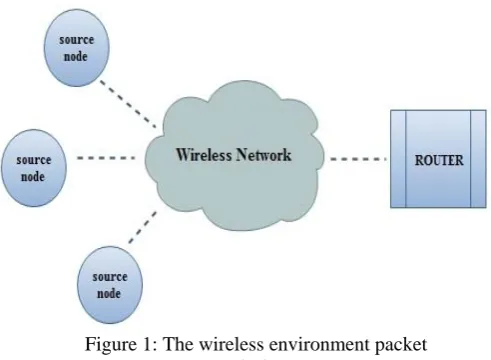
The simple wireless scenario used for the implementation is shown in figure 1.
Figure 1: The wireless environment packet transmission
In the wireless environment shown above three nodes are used as the sender nodes for the packet transmission through the wireless network to the router. In this paper we study the experimental analysis of the rule of thumb and we find that it shows requirement for adaptation of buffer size in response to changing network conditions. This leads naturally to the consideration of dynamic buffer sizing strategies that adapt to changing conditions. We propose two dynamic buffer sizing algorithms for 802.11 based WLANs and implement them on the NS2 simulator. A video file is used to generate the packets. The full duplex links are used between the nodes created in the simulator. This paper is organized as follows. Section II describes the literature survey on sizing the router buffers and the rule of thumb. We also analyze the various buffer sizing rules. In section III we describe the functional modules for the dynamic strategies for the buffer sizing for the 802.11 WLANs. Section IV presents the system architecture proposed for the dynamic buffer sizing for 802.11 based wireless networks. The section V gives the simulation results. The section VI presents the conclusion followed by the references.
II. LITERATURE SURVEY
Sizing the Router Buffers and the Rule of Thumb
The Analysis of the Buffer Sizing rules
The Analysis of Buffer Sizing Strategies for TCP flows in 802.11 WLANsRouter buffers are basically sized with two primary objectives. Accommodating the short-term packet bursts and ensuring the AIMD throughput efficiency. The TCP makes use of the additive increase multiplicative decrease (AIMD) congestion control algorithm. Whenever the TCP detects the network congestion it decreases the number of packets in flight by half of the total number of packets by using the AIMD congestion control algorithm.
A. Sizing the Router Buffers and the Rule of Thumb
The size of the buffers is determined by the TCP’s congestion control algorithm. To be more specific the goal is to make sure that when a link is congested, it is busy for all the time. In other words it is equivalent to making sure that its buffer never goes empty. Generally the router buffers are sized based on a rule-of-thumb. It states that each link needs a buffer of size according to a relation B = RTT × C, where RTT is the average round-trip time of a flow passing across the link, and C is the data rate of the link.
The dynamics of TCP’s congestion control algorithm yields the rule of thumb. To be specific, a single TCP flow passing through a bottleneck link requires a buffer size equal to the bandwidth-delay product in order to prevent the link from going idle and resulting in losing the throughput.
The key idea to sizing the buffer is to make sure that while the sender pauses, at this time the router buffer should not go empty and it should not force the bottleneck link to go for idle state. We can determine the size of the reservoir needed to prevent the buffer from going empty by determining the rate at which the buffer drains. It shows that this is equal to the distance in bytes between the peak and trough of the sawtooth representing the TCP window size and this can be easily mapped to the rule-of-thumb.
B. The Analysis of the Buffer Sizing Rules
In this section we briefly present the different buffer sizing rules and the assumptions on which these rules depend. We also notice that different rules lead to different buffer sizes.
The rule of thumb works as per the product of the Bandwidth and the Delay utilizing that particular link. The shape of the TCP window determines the Bandwidth. In order to not to lose the throughput we need T × C amount of buffering to ride out the reductions in window size [3].
The small buffers rule works on the assumptions that utilization as the main metric for buffer sizing in a router and flows are not synchronized when many in number. On employing the small buffers rule the statistics we observe are, the network is not stable and should have low throughput due to the periodic changes in the aggregate window size[4].
The drop based buffers rule comes into picture where a large number of flows share a heavily congested low capacity bottleneck link towards the edge of the network. It can be showed that one might get a substantial packet drop
rates up to 17%. When the drop rates goes higher then we can go for increasing buffer sizes [5]. Increasing the buffer size only delays the feedback to the sender. But, large drop-rates eventually cause TCP performance to fall apart. Thus this fact suggests a lower bound on the buffer size depending on the speed of the link.
The tiny buffers rule is most widely used in the optical routers. The theory behind the tiny buffers rule suggests that a network could be build with the tiny buffers if we are willing to sacrifice a small amount of throughput [3]. It should be noted that in an all-optical network capacity is abundant, and the buffer size is the bottleneck. Most of the Internet core networks are operated at extremely low link utilizations. These facts might justify the reduction in throughput as a result of tiny buffers rule.
C. The Analysis of Buffer sizing Strategies for TCP flows
in 802.11 WLANs
Considering the TCP Fairness in 802.11e WLANs we need to take into account the cross layer interactions between the flow and congestion control mechanisms and the 802.11 MAC. The transport layer unfairness in infrastructure WLANs is resolved by the new 802.11e MAC techniques [6]. To analyze the TCP unfairness over 802.11 WLANs we consider unfairness between competing TCP upload flows and between competing upload and download flows.
When we consider the buffer sizing for the 802.11 WLANs it mainly depends on the mean service rate and the packet inter service times. Considering the performance with fixed buffering, in contrast to wired networks, the mean service rate at a wireless station is not fixed but instead depends upon the level of channel contention and the network load [7].
When it is considered for the adaptive buffer sizing for the 802.11 WLANs mainly the provision of Access Point buffers in WLANs is considered. The use of static buffers in WLANs leads to either undesirable channel underutilisation or unnecessary high delays, which motivates the use of dynamic buffer sizing. This mechanism includes feedback control of the buffer size based on buffer idle and busy times. For the efficient link utilization the buffer should not lie empty for too long time. If the buffer size is increased it results in reduction of buffer idle time. Also to ensure the buffer should be as small as possible. Therefore an approach is adopted where the buffer occupancy is monitored for a particular interval of time. If the buffer rarely empties, then decrease the buffer size to avoid high delay. Conversely, if the buffer is empty for too long period, then increase the buffer size to maintain high throughput.
III.FUNCTIONAL MODULES FOR THE DYNAMIC STRATEGIES FOR BUFFER SIZING
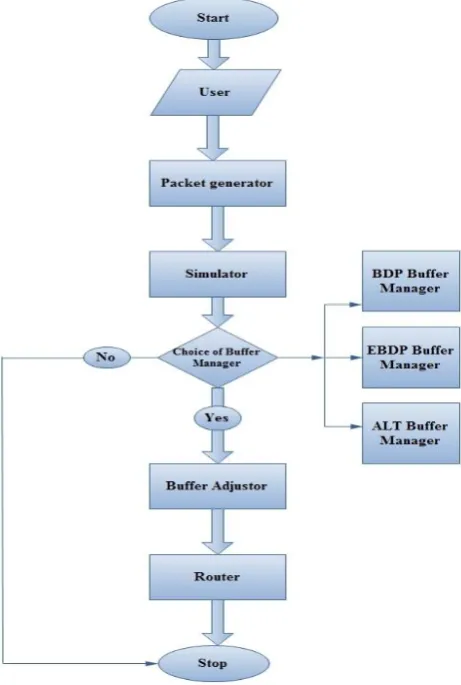
sizing which could adjust the buffer size according to a dynamic strategy. The overall system design consists of three main modules. The system flowchart for the simulation of the Buffer Sizing strategy is as shown in figure 2.
Figure 2: The system flow chart for the simulation of Buffer Sizing strategy
The user generates the packets using the packet generator. A video file is used to generate the packets. The packets are transferred through the network simulator from source nodes to the destination. The user can make use of any of the three Buffer Manager Modules for the simulation using the NS2 simulator. The three Buffer Manager Modules are BDP Buffer Manager Module, EBDP Buffer Manager Module and the ALT Buffer Manager Module. Using the appropriate Buffer Manager the buffer size is determined by the Buffer size Adjuster, and the packets are then forwarded to the Router.
A. BDP Buffer Manager Module
This module gives the buffer size based on the Bandwidth Delay Product algorithm. The BDP rule is derived from the behaviour of the TCP congestion control i.e. reduction of cwnd by half on packet loss.
This module considers the bandwidth and the delay provided by the user to calculate the buffer size. It mainly considers the product of the bandwidth and the delay of the link to calculate the buffer size. This is the basic rule of thumb used in the wireless networks to calculate the buffer size. On transferring the packets through the network simulator to the destination by the user, this module adjusts
the correct buffer size and forwards the packets to the router. The packets generated from the video file are given as input to the number of source nodes selected in the topology. Buffer size based on the BDP rule is provided as the output to the user through the network simulator.
User has to set the source nodes for sending the data and a single destination node for receiving the data as per the topology of the network. The main functionalities included in this BDP Buffer Manager Module are reading the values of the bandwidth and the delay provided by the user, the calculation of the buffer size and the buffer queuing process. If the current value of the queue size is less than the value of the buffer size calculated then the packets are buffered. On the other hand if the current value of queue size is greater than the buffer size calculated then the packets are dropped.
B. EBDP Buffer Manager Module
This module gives the buffer size based on the Emulated Bandwidth Delay Product algorithm.
This module mainly consists of two functional operations. The first one is the MAC operation of the EBDP algorithm and the second one is the Drop tail Operation. The measurement of time parameter process monitors the packet sending time to record the service start time ts. It also monitors the packet arrival time to record the
service end time te. Using these measurements the packet
service time Tserv is calculated and it is given as input to the
Drop tail operation.
The current queue occupancy is compared with the calculated buffer size. If the current queue occupancy is less
than the calculated buffer size then the packets are queued and the statistics are given to the router. On the other hand if the current queue occupancy is greater than the calculated buffer size then the packets are dropped. Hence the name the Drop tail operation.
The buffer sizecalculator process and the current queue occupancy comparator process are the two main processes of the Drop tail operation. A target queuing delay Tmax is
set. The mean service time Tserv is taken from the MAC
operation. An upper limit on the buffer size is set as max buffer size. Along with these parameters an over provisioning parameter set as c are given as input to the buffer size calculator process. Thus based on the comparison results of the queue occupancy comparator the buffer size is calculated as per the EBDP algorithm and the results are provided to the user through the network simulator.
C. ALT Buffer Manager Module
This module gives the buffer size based on the Adaptive Limit Tuning algorithm.
To begin with this module it mainly consists of the adjustment of the step size operations. Initially a queue size, the minimum buffer size qmin and the maximum buffer size
qmax are set. The increment step size a1 and the decrement
step size b1 are set by the user. For every t seconds measure
the idle time. The buffer size adjuster calculates the buffer size as per the relation qALT = qALT + a1ti - b1(t- ti). Finally
Buffer size adjuster of ALT algorithm is provided as the output to the user through the network simulator.
The importance of ALT Buffer Manager Module that EBDP Buffer manager Module fails in a condition when multiple flows share the same link. At this situation EBDP Buffer Manager Module is unable to take the advantage of the statistical multiplexing of TCP cwnd backoffs [8]. Therefore we find a need to design a measurement based module which is capable of taking advantage of the statistical multiplexing opportunities.
IV.SYSTEM ARCHITECTURE FOR THE DYNAMIC BUFFER SIZING STRATEGY FOR 802.11 BASED WLANS
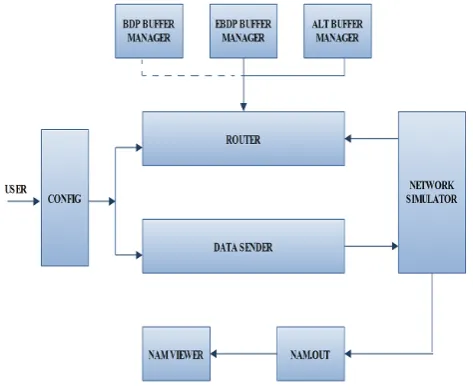
Considering the wireless network scenario using the Network Simulator version 2 the system architecture can be as shown in the figure 3.
Figure 3: System architecture for the simulation environment.
In the above system architecture for the simulation environment the user configures the condition of simulation using Config Module. Configuration of the data sender includes configuring the parameters like sending rate and packet size. The Router has three different buffer managers and the configuration includes which algorithm the router should use. The algorithms are Bandwidth Delay Product algorithm (BDP), Emulating Bandwidth Delay Product Algorithm (EBDP) and Adaptive Limit Tuning Algorithm (ALT). Data Sender continuously sends the packets to the Router through the network simulator. The incoming packets are moved into the buffer present in the router. Each algorithm function acts as a buffer manager to calculate the buffer sizing. Data Sender and Router are able to communicate through packets using the Wireless Network Simulator.
V. SIMULATION RESULTS
The network simulator version 2 is used for the simulation of the wireless scenario. The operating system used is Linux on the fedora 13 platform. The coding of the modules is done using the tcl scripting language. The coding is done in such a configuration that maximum we can make use of 200 source nodes. In this scenario only the
single hop wireless networks are considered. A video file is used for the buffering. The graphs are generated for each module showing the buffer occupancy. The graphs are obtained using the gnu plot package. We make use of the Ad hoc On-Demand Distance Vector (AODV) as the routing protocol. It is a reactive routing protocol that establishes a route to a destination only on demand. AODV, as the name indicates, is a distance-vector routing protocol. AODV avoids the counting-to-infinity problem of other distance-vector protocols by using sequence numbers on route updates, a technique pioneered by Destination Sequence Distance Vector (DSDV). AODV is capable of both unicast and multicast routing.
The simulation is run for a specified interval of time at given time intervals called as the events. The events are scheduled in the simulator at specified interval of times. Network simulator records the simulation scenario and generates a file called nam.out. This file is given to the NAM Viewer to show the simulation in a neat Graphical User Interface (GUI). Figure 4 shows constant Buffer Occupancy in case of BDP algorithm used in the BDP Buffer manager module.
Figure 4:Buffer occupancy and the time histories measured as per the BDP algorithm.
The inputs given to this module are Bandwidth=1MHz and Delay=2msec parameters are used in the simulation. Thus it gives the constant buffer size of 20 as shown in the
figure 4.
Figure 5 shows the Buffer Occupancy in case of EBDP algorithm used in the EBDP Buffer manager module.
Figure 5:Buffer occupancy and the time histories measured as per the EBDP algorithm.
Smoothing parameter W=0.4, Upper limit on Buffer size Qmax=200, Initial Buffer size QeBDP=30. In the output graph
we can see the dynamic variation of buffer size as 30, 70, 100, 200, and 80 for different time counts.
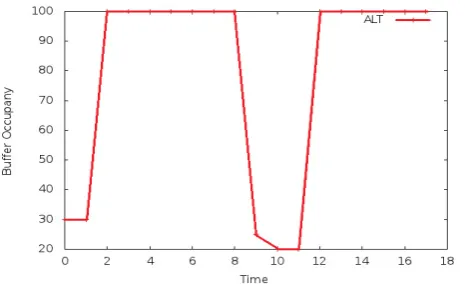
Figure 6 shows the Buffer Occupancy in case of ALT algorithm used in the ALT Buffer manager module.
Figure 6:Buffer occupancy and the time histories measured as per the ALT algorithm.
The inputs given to this module are Max Buffer size qmax=100, Min Buffer size qmin=20, Initial queue size
QALT=30, Increment step size =20, Decrement step size =5.
In the output graph we can see the dynamic variation of buffer size as 30, 100, 25, 20, and 100 for different time counts.
VI.CONCLUSION
Buffer sizing is an important network configuration parameter. Buffers play a key role in 802.11 wireless networks. Buffers are used to accommodate short term packet bursts so as to mitigate packet drops and to maintain high link efficiency. Packets are queued if too many packets arrive in a sufficiently short interval of time during which a network device lacks the capacity to process all of them immediately. The use of fixed size buffers in 802.11 networks inevitably leads to either undesirable channel under-utilization or unnecessary high delays. The adaptive buffer sizing strategies are used to maintain high network utilization while providing low queuing delays in 802.11 based wireless networks through the dynamic buffer sizing algorithms.
The simulation of buffer sizing strategies are evaluated based on the metrics like number of packets delivered, number of packets lost and the current buffer size. Based on the simulation results we can state that the proposed dynamic buffer sizing algorithms gives the better performance compared to the general rule of thumb .ie. Bandwidth Delay Product rule. The buffer can be managed more efficiently.
REFERENCES
[1] G. Vu-Brugier, R. Stanojevic, D. Leith, and R. Shorten, “A Critique of Recently Proposed Buffer-Sizing Strategies,” ACM Computer Communication Review, vol. 37. no. 1, Jan. 2007.
[2] G. Appenzeller, I. Keslassy, and N. McKeown, “Sizing router buffers,” in Proc. of the ACM SIGCOMM ’04, Sep. 2004, pp. 281– 292.
[3] C. Villamizar and C. Song. High performance TCP in ANSNET. ACM Computer Communications Review, 24(5):45–60, 1994. [4] G. Appenzeller, I. Keslassy, and N. McKeown. Sizing router
buffers. In SIGCOMM ’04, pages 281–292, New York, NY, USA, 2004. ACM Press.
[5] A. Dhamdhere and C. Dovrolis. Open issues in router buffer sizing. ACM Sigcomm Computer Communication Review, 36(1):87–92, January 2006.
[6] A. Detti, E. Graziosi, V. Minichiello, S. Salsano, and V. Sangregorio, “TCP fairness issues in IEEE 802.11 based access networks,” submitted paper.
[7] D. J. Leith, P. Clifford, D. Malone, and A. Ng, “TCP fairness in 802.11e WLANs,” IEEE Commun. Lett., vol. 9, no. 11, pp 964– 966, 2005.
[8] K. Kumaran, M. Mandjes, A.L. Stolyar, “Convexity Properties of Loss and Overflow Functions,” Operations Research Letters, vol. 31, no.2, pp. 95- 100, 2003.
Santosh Hosamani, received the Undergraduate degree in Electronics & Communication Engineering from Guru Nanak Dev Engineering College, Bidar, in 2010. Currently he is pursuing post graduation degree in Computer Network Engineering (2010-2012) from RVCE, Bangalore-59. His area of interest includes Networking and Cloud Computing. He has published a paper in a referred International Journal.