Energy Procedia 16 (2012) 810 – 815
1876-6102 © 2011 Published by Elsevier B.V. Selection and/or peer-review under responsibility of International Materials Science Society. doi:10.1016/j.egypro.2012.01.130
Energy
Procedia
Energy Procedia 00 (2011) 000–000www.elsevier.com/locate/procedia
2012 International Conference on Future Energy, Environment, and Materials
Developing Sustainability Consciousness in Engineering
Curriculum through Materials Education
Josef Rojter
Centre for Environmental Safety and Risk Engineering, Victoria University PO Box 14428MC, Melbourne City, Vic 8001, Australia
Abstract
Samuel(1991) in identifying problems associated with engineering education observed that the product of engineering education does not have an identifiable entity. Unlike professions such as medicine, law or accountancy it is difficult to associate the work of professional engineers with a defined discourse. However the perceptions of professional engineers as occupations that concern themselves with productive processes and wealth creations are increasingly augmented by views of engineering profession as one that is also concerned with environmental issues. This paper takes the view that commitment to sustainability of the end process of engineering work must serve as the ideological core of the engineering profession and therefore issues of sustainability provide the framework for engineering education. One way of enhancing the education of sustainability in engineering curricula is to raise sustainability issues in areas of engineering science. Another way is to integrate engineering subjects through service subject and weave sustainability issues as an aspect of engineering life. This paper takes the view that students’ sustainability consciousness can be raised through service subject such as materials.
© 2011 Published by Elsevier Ltd. Selection and/or peer-review under responsibility of [name organizer]
Keywords; Education,: Materials; Environment; Engineering
1. Introduction
The notions that the practice of engineering as the means for wealth creation and economic growth has not provided an adequate perception of engineering profession as one that is socially responsible. The positivist orientation of engineering education is partly to blame. This was recognized by reports presented by UNESCO [over thirty years ago [1],[2]. These reports argued that if environmental issues are not placed as the focus of engineering practice then the engineering profession faces being marginalised. Bella has suggested that the engineering profession has been marginalized because it lost
© 2011 Published by Elsevier B.V. Selection and/or peer-review under responsibility of International Materials Science Society.
Open access under CC BY-NC-ND license.
community trust due to the perception that the engineering profession was responsible for many of the harmful side effects as a result of development and the implementation of new technologies [3].
Collins, Ghey and Mills [suggested that sensitivity to the environmental consequences of technology, in the course of engineering practice, is essential if the profession is to gain the social trust. Environmental consciousness as the lynchpin of engineering workplace discourse is essential to regaining the public trust and strengthening the professional status of engineering [4]. The report Our Common Future (World Commission for Environment and Development [in its conclusion, suggested that the focus of engineering practice must lie in sustainable development [5]. If the professional work is one which deals with environmental problems, then the engineering educational discourses therefore need to have a pronounced environmental emphasis.
The scientific and technical core (including engineering design), in engineering education, must therefore incorporate themes such as ecology, ecosystems, and natural resources, to facilitate sustainable solutions to problems of technology. Placing environmental (and sustainability) issues, as ideological cores of engineering educational discourses, is essential to the development of engineering awareness. This has been recognized by the Industry Commission which suggested that an environmental focus of engineering education would improve the technological literacy of professional engineers because it carried with it the implicit understanding of liability and long-term economic viability of engineering practice, and also recognised the fact that technical solutions can only provide numerical answers to a complex situation [6]. Constraints imposed by environmental sustainability allows greater emphasis, in engineering education, to be placed on comparative technologies as tools for choosing most appropriate designs or manufacturing routes which will minimize environmental and social impacts.
The professional engineer in technical practice is an initiator, implementer and a restraining agent of technology. It is through the last role that the professional engineer has an essential role as the guardian and the protector of society from the side effects of the application of unsuitable technologies. Environmental and ecological consciousness provides the engineering profession with a value system that can underpin ethical practice. Even in economic terms the environmental function of engineering practice makes sense. Deleterious side effects of technologies lead to closure of productive processes and loss of investment.
Environmental literacy focuses professional engineering into risk management. Side effects such as acid rain, creation of toxic dumps, and poor disposal of toxic wastes are no longer politically, socially, economically and environmentally acceptable. A holistic rather than just technical emphasis on environmental education in engineering is required if it is to provide engineering graduates with adequate knowledge basis to address environmental issues that are encountered in the course of engineering work. Hardy in observing the shift in engineering workplace discourses to greater environmental focus, suggested that in meeting these challenges, the engineering curriculum needs to be anchored by four contexts [7]. These are:
• Technology. The context that concerns itself with the technical nature and solutions of engineering practice;
• Law. The legal constraints imposed by the society to protect environment that limits the technical options proposed by professional engineers. Understanding of law provides professional engineers with appreciation of the sensitivity with which the society views application of technology;
• Motivation. Professional engineers are concerned with the organization of work to ensure the success of the engineering enterprise. Professional engineers need to be acquainted with the ways of
• Accountability. All engineering decisions need to be based on environmental considerations. Given the fact that these involve the interplay of complex variables, such engineering decisions constitute the basis of reflective practice.
2. Environmental and Sustainable Education in Engineering
The need for addressing environmental issues in engineering education was identified in Britain in the early 1980’s. The Engineering Council called, in 1983, for the re-aligning of engineering curricula to the goals of environmental sustainability [8]. The “Agenda 21” document issued by the United Nations Conference on Environment redefined the practice of engineering from economic to sustainable development, and therefore, by implication, suggested that educational discourses in engineering ought also to place greater focus on sustainability [9]. The rhetoric of the engineering profession demands greater social and multidisciplinary awareness, of the profession, in seeking environmentally sustainable solutions, a view shared by the Review into Engineering Education in Australia which clearly stated, in its introduction that engineering discourses will, in the future, be more multidisciplinary and requiring greater environmental sensitivity and awareness [10].
An engineering curriculum underpinned by environmental considerations is not new. The undergraduate engineering curriculum at the more respected universities in Brazil positioned environmental issues at the centre of their engineering courses in the 1980’s [11]. Engineering science subjects dealt with the principles of conservation of mass, energy and momentum in engineering processes and their applications to problems concerned with the environment. Environmental issues can also serve as a useful platform for problem-based learning (PBL), in which thermodynamic laws can be used to illustrate the inevitable side effects of engineering outcomes. Engineering education with an emphasis on environmental discourses is likely to enhance, in the public eye, the professional standing of the engineering profession. This was also the opinion of the Review of Engineering Education in Australia which recognized that interfacing between community and technology was an essential function of the profession [10]. The ability to apply knowledge on the basis of environmental considerations, especially in health and safety, was seen in the workplace as a positive attribute of a professional engineer [12],[13]. He pointed out that chemical engineers, for example, in the course of their work, will never use most of the knowledge they acquired at university, but they will, in the course of their work, have to make decisions on the basis of the environment and health and safety.
3. Role of Materials Education in Engineering Curriculum
Knowledge of materials represents the “physicality” of the engineering product. It is the three dimensional outcome of engineering work and its success depends on whether the design is fulfilled by the right selection of materials and the ability to produce the product with the selected materials. In terms of engineering outcomes, then knowledge of materials is empowering.
However, like engineering design, materials subjects can also integrate engineering knowledge and therefore can be a focus for the development of ideological position of professional engineering education. At Victoria University, the position I take is one of environmental responsibility. Materials properties and selection are placed in the framework of energy use. For instance life cycle analysis provides means for materials knowledge as an integral part of professional engineering life. The material courses are structured three major issues. These are:
3) Do these materials affect our environment? This can be addressed through the greenhouse effect on the environment and, therefore four areas of energy consumption are addressed. These being:
• Energy requirements to produce the material;
• Energy requirements to fabricate products with the chosen material;
• Energy requirements in use. In transportation, for instance, properties such as specific strength are of issue. Durability of material also affects the energy balance; and
• Energy requirements for recycling or re-usage of materials.
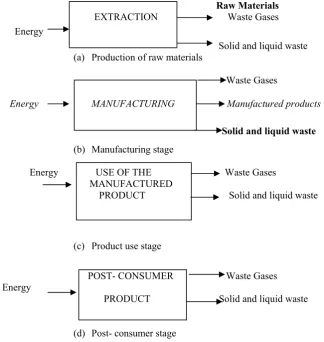
Each of the above issues integrates knowledge gained in engineering sciences with the purpose for a critical analysis of engineering design with a sustainable focus. Engineering analysis of manufacturing processes analysis, using materials knowledge, can be performed to critically appraise environmental sustainability of a manufacturing process based on a given engineering design. This is shown in Figure 1.
Raw Materials EXTRACTION Waste Gases Energy
Solid and liquid waste (a) Production of raw materials
Waste Gases
Energy MANUFACTURING Manufactured products
Solid and liquid waste (b) Manufacturing stage
Energy USE OF THE Waste Gases MANUFACTURED
PRODUCT Solid and liquid waste
(c) Product use stage
POST- CONSUMER Waste Gases Energy
PRODUCT Solid and liquid waste
(d) Post- consumer stage
Figure 1. Engineering processes expressed through by environmental perspectives.
mass of the whole productive process. Through this life cycle analysis the full picture of technical engineering emerges in the form of an engineering audit that is based on energy and mass consumption. Production of waste and greenhouse gases can be identified through this audit and this therefore allows the calculation of the true economic cost to the community. The environmental focus of the engineering curriculum, in this author’s view, will extend the intellectual dimension of the engineering student and, at the same time, is likely to produce a graduate with greater awareness of engineering and the social reality. For example, the engineering analysis of the production of motorcars can use the model shown in Figure1. The selection of materials is based on an energy audit in the production stage of materials (Figure 1 a), through the comparisons of the effects of that the production of raw materials, such as various plastics, composites, ferrous and non-ferrous alloys and ceramic, have on the environment. The manufacturing stage creates waste and requires consumption of energy (Figure 1b); the comparisons of different manufacturing processes each process dealing with different materials, need to be made in order to minimize material and energy loss. The engineering course then focuses on the practical aspects of engineering where the scale of an engineering enterprise is given a prominence. The energy consumed by the product itself (Figure 1c) provides the issues of design. In the case of the production of motorcars, the efficiency of the engine, transmission, the rolling friction coefficient of the tyres, the reliability and durability of the product are the essential features of technical engineering, which is underpinned by environmental considerations. The final aspect of the environmental audit concerns the product itself once its service life is exceeded (Figure 1d).
The value-added entities, such as the energy locked in the product itself, form the intellectual core of engineering issues and innovation. Questions that arise concerning this product are whether all or part of the product ought to be re-used, re-cycled with the view of either re-using the materials or recovering energy from the materials, or placed in a municipal waste dump, and these continually give rise to new engineering problems that need to be tackled that translates to reflective engineering discourse.
4. Discussion
The linkage between materials end environment has been well established. The European Union’s Joint Research Centre at Ispra, Italy, has in its research activity placed materials technology and environment under one umbrella. It is almost impossible to think of any human productive activity that is not associated with materials and impact on the environment. It is therefore the view of this author that for engineering education to seriously address sustainability issues, there needs to be greater allocation in engineering curricula to materials subjects.
References
[1]. UNESCO. International Conference on Trends in Teaching and Training of Engineers- Recommendation of the Commission. Final Report. Paris: UNESCO Press, 1968.
[2]. UNESCO (). The Meeting of Experts on Engineering Education.. Final Report. July 21-24, Paris: UNESCO Press, 1970. [3]. Bella, A.D. Engineering and Erosion of Trust. Journal of Professional Issues in Engineering, 113 (2), p.117-129, 1987. [4]. Collins, S., Ghey, J., and Mills, J. The Professional Engineer in Society. London: Jessica Kingsley Publishers, p.88, 1989. [5]. World Commission for Environment and Development (WECD). The Brundtland Report: Our Common Future. Oxford: Oxford University Press, 1987.
[6]. Industry Commission . New and Advanced Materials. Report No 42, March, Melbourne: Australian Government Printing
[7]. Hardy, D.J. Educating Engineers for Positive Environmental Action. In Duggan, T.V. (Ed), International Quality and Environmental Issues, Proceedings of the 3rd World Conference on Engineering Education. Vol.,1 Portsmouth, Southampton:
Computational Mechanics Publications, p.560-561, 20-25 September,1992.
[8]. Engineering Council .The enhanced and extended undergraduate engineering courses. London: EC, 1983.
[9]. Thom, D. Engineering Education and the New Industrial Revolution. International Journal of Engineering Education. 14 (2), p.79-94, 1988.
[10]. Johnson, P. (chair). Changing the Culture: Engineering Education into the Future. Barton, ACT: Institution of Engineers, Australia, 1996.
[11]. Bauer, C. Environment in Technology and Engineering Education. In Baez, A.V., Knamiller, G.W., Smyth, J.C (Eds), The Environment and Science and Technology Education. New York: Pergamon Press, 1987.
[12]. Kletz, T. Safety in Design. Chemical Engineering Progress, 80 (3), p.13-14, 1984.