On the Exact Round Complexity of Secure Three-Party
Computation
Arpita Patra and Divya Ravi? Indian Institute of Science, India {arpita,divyar}@iisc.ac.in
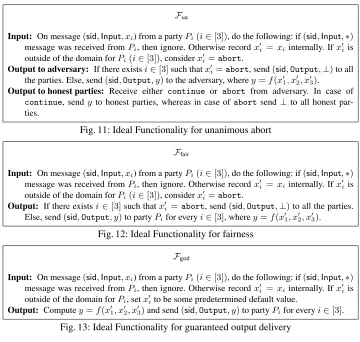
Abstract. We settle the exact round complexity of three-party computation (3PC) in honest-majority setting, for a range of security notions such as selective abort, unanimous abort, fairness and guaranteed output delivery. Selective abort security, the weakest in the lot, allows the corrupt parties to selectively deprive some of the honest parties of the output. In the mildly stronger version of unan-imous abort, either all or none of the honest parties receive the output. Fairness implies that the corrupted parties receive their output only if all honest parties receive output and lastly, the strongest notion of guaranteed output delivery im-plies that the corrupted parties cannot prevent honest parties from receiving their output. It is a folklore that the implication holds from the guaranteed output de-livery to fairness to unanimous abort to selective abort. We focus on two network settings– pairwise-private channels without and with a broadcast channel. In the minimal setting of pairwise-private channels, 3PC with selective abort is known to be feasible in just two rounds, while guaranteed output delivery is in-feasible to achieve irrespective of the number of rounds. Settling the quest for exact round complexity of 3PC in this setting, we show that three rounds are nec-essary and sufficient for unanimous abort and fairness. Extending our study to the setting with an additional broadcast channel, we show that while unanimous abort is achievable in just two rounds, three rounds are necessary and sufficient for fairness and guaranteed output delivery. Our lower bound results extend for any number of parties in honest majority setting and imply tightness of several known constructions.
The fundamental concept of garbled circuits underlies all our upper bounds. Con-cretely, our constructions involve transmitting and evaluating only constant num-ber of garbled circuits. Assumption-wise, our constructions rely on injective (one-to-one) one-way functions.
?This article is a full and extended version of an earlier article (https://link.
Table of Contents
On the Exact Round Complexity of Secure Three-Party Computation . . . 1
Arpita Patra, Divya Ravi 1 Introduction. . . 3
1.1 Our Results . . . 5
1.2 Techniques. . . 7
1.3 Roadmap . . . 11
2 Preliminaries. . . 11
2.1 Model. . . 11
2.2 Primitives. . . 12
3 3-round 3PC with Fairness. . . 13
3.1 Protocolfairi . . . 14
3.2 Protocolcerti. . . 15
3.3 Protocolfair. . . 17
4 2-round 3PC with Unanimous Abort . . . 25
4.1 Protocoluai . . . 26
4.2 Protocolua. . . 29
5 3-round 3PC with Guaranteed Output Delivery. . . 31
5.1 Protocolgodi. . . 32
5.2 Protocolgod . . . 33
6 Lower Bounds. . . 37
6.1 The Impossibility of 2-round Fair 3PC. . . 37
6.2 The Impossibility of 2-round 3PC with Unanimous Abort. . . 40
7 Conclusion. . . 43
Appendices A Primitives . . . 48
A.1 Properties of Garbling Scheme . . . 48
A.2 Non-Interactive Commitment Schemes (NICOM) . . . 48
A.3 Equivocal Non-interactive Commitment Schemes (eNICOM). . . 49
A.4 Symmetric-Key Encryption with Special Correctness . . . 50
B The Security Model . . . 50
C Optimizations . . . 52
D Round Optimal 3PC with fairness. . . 53
D.1 Schematic Diagram. . . 53
D.2 Formal Proof of Security for Protocolfair . . . 53
E Proof of Security for Protocolua . . . 61
F Proof of Security for Protocolgod . . . 65
1
Introduction
In secure multi-party computation (MPC) [GMW87,CDG87,Yao82],nparties wish to jointly perform a computation on their private inputs in a secure way, so that no ad-versaryAactively corrupting a coalition oftparties can learn more information than their outputs (privacy), nor can they affect the outputs of the computation other than by choosing their own inputs (correctness). MPC has been a subject of extensive re-search and has traditionally been divided into two classes: MPC with dishonest majority [GMW87,DO10,BDOZ11,DPSZ12,GGHR14,BHP17,ACJ17] and MPC with honest majority [BGW88,CCD88,RB89,BMR90,Bea91,DN07,BFO12,BH06,CDD+99]. While the special case of MPC with dishonest majority, namely the two-party compu-tation (2PC) has been at the focus of numerous works [Yao82,IPS08,Lin13, SS13, HKK+14,AMPR14,RR16,MR17], the same is not quite true for the special case of MPC protocols with honest majority.
The three-party computation (3PC) and MPC with small number of parties main-taining an honest majority make a fascinating area of research due to myriad reasons as highlighted below. First, they present useful use-cases in practice, as it seems that the most likely scenarios for secure MPC in practice would involve a small num-ber of parties. In fact, the first large scale implementation of secure MPC, namely the Danish sugar beet auction [BCD+09] was designed for the three-party setting. Several other applications solved via 3PC include statistical data analysis [BTW12], email-filtering [LADM14], financial data analysis [BTW12] and distributed creden-tial encryption service [MRZ15]. The practical efficiency of 3PC has thus got con-siderable emphasis in the past and some of them have evolved to technologies [Gei07,BLW08,LDDA12,LADM14,CMF+14,FLNW17,AFL+16]. Second, in prac-tical deployments of secure computation between multiple servers that may involve long-term sensitive information, three or more servers are preferred as opposed to two. This enables recovery from faults in case one of the servers malfunctions. Third and im-portantly, practical applications usually demand strong security goals such as fairness (corrupted parties receive their output only if all honest parties receive output) and guaranteed output delivery (corrupted parties cannot prevent honest parties from receiv-ing their output) which are feasibleonlyin honest majority setting [Cle86]. Fourth and interestingly, there are evidences galore that having to handle a single corrupt party can be leveraged conveniently and taken advantage of to circumvent known lower bounds and impossibility results. A lower bound of three rounds has been proven in [GIKR02] forfairMPC witht≥2and arbitrary number of parties, even in the presence of broad-cast channels. [IKKP15] circumvents the lower bound by presenting atwo-round4PC protocol tolerating asinglecorrupt party that provides guaranteed output delivery with-out even requiring a broadcast channel. Verifiable secret sharing (VSS) which serves as an important tool in constructing MPC protocols are known to be impossible with
The world of MPC for small population in honest majority setting witnesses a few more interesting phenomena. Assumption-wise, MPC with 3,4 and5 parties can be built from just One-way functions (OWF) or injective one-way functions/permutations [IKKP15, MRZ15, CGMV17], shunning public-key primitives such as Oblivious Transfer (OT) entirely, which is the primary building block in the 2-party setting. Last but not the least, the known constructions for small population in the honest majority setting perform arguably better than the constructions with two parties while offering the same level of security. For instance, 3PC with honest majority [IKKP15,MRZ15] al-lows to circumvent certain inherent challenges in malicious 2PC such as enforcing cor-rectness of garbling which incurs additional communication. The exact round complex-ity is yet another measure that sets apart the protocols with three parties over the ones with two parties. For instance, 3PC protocol is achievable just in two rounds with the minimal network setting of pairwise-private channels [IKKP15]. The 2PC (and MPC with dishonest majority) protocols achieving the same level of security (with abort) necessarily require 4 rounds [KO04] and have to resort to a common reference string (CRS) to shoot for the best possible round complexity of 2 [HLP11].
With the impressive list of motivations that are interesting from both the theoretical and practical viewpoint, we explore 3PC in the honest majority setting tolerating a malicious adversary. In this work, we set our focus on the exact round complexity of 3PC. To set the stage for our contributions, we start with a set of relevant works below.
Related Works. Since round complexity is considered an important measure of effi-ciency of MPC protocols, there is a rich body of work studying the round complexity of secure 2PC and MPC protocols under various adversarial settings and computational models. We highlight some of them below. Firstly, it is known that two rounds of in-teraction are essential for realizing an MPC protocol irrespective of the setting. This is because in a 1-round protocol, a corrupted party could repeatedly evaluate the “resid-ual function" with the inputs of the honest parties fixed on many different inputs of its own (referred as “residual function" attack) [HLP11]. In the plain model, any actively secure 2PC is known to require 5 rounds in non-simultaneous message model [KO04] (under black-box simulation). The bound can be improved to4even in the dishonest majority setting [GMPP16] in simultaneous message model and tight upper bounds are presented in [BHP17,ACJ17,HHPV17]. With a common reference string (CRS), the lower bound can be further improved to 2 rounds [HLP11]. Tight upper bounds are shown in [GGHR14] under indistinguishability obfuscation (assumption weakened to witness encryption by [GLS15]), and in [MW16] under a variant of Fully Homomor-phic Encryption (FHE) and Non-interactive Zero-knowledge (NIZK).
In the plain model, three rounds are shown to be necessary for MPC with fairness andt ≥ 2, even in the presence of a broadcast channel and arbitrary number of par-ties [GIKR02]. In an interesting work, [IKKP15] circumvents the above result by con-sidering 4PC with onecorruption. The protocol provides guaranteed output delivery, yet does not use a broadcast channel. In the same setting (plain model and no broad-cast), [IKKP15] presents a 2-round 3PC protocol tolerating single corruption; whose communication and computation efficiency was improved by the 3-round protocol of [MRZ15]. Both these protocols achieve a weaker notion of security known as security with selective abort. Selective abort security [IKP10] (referred as ‘security with abort and no fairness’ in [GL02]) allows the corrupt parties to selectively deprive some of the honest parties of the output. In the mildly stronger version of unanimous abort (re-ferred as ‘security with unanimous abort and no fairness’ in [GL02]), either all or none of the honest parties receive the output. An easy observation concludes that the 3PC of [MRZ15] achieves unanimous abort, when its third round message is broadcasted, albeit for functions giving the same output to all. The works relevant to honest majority setting are listed below.
3PC has been studied in different settings as well. High-throughput MPC with non-constant round complexity are studied in [FLNW17,AFL+16]. [CKMZ14] studies 3PC with dishonest majority. Recently, [CGMV17] presents a practically efficient 5-party MPC protocol in honest majority setting, going beyond 3-party case, relying on dis-tributed garbling technique based on [BMR90].
Ref. Setting Round Network Setting / Assumption Security Comments [AJL+12]t < n/2 ≥5 private channel, Broadcast / CRS, FHE, NIZK fairness upper bound [GLS15] t < n/2 3 broadcast-only / CRS, FHE guaranteed output delivery upper bound [GLS15] t < n/2 2 broadcast-only / CRS, PKI, FHE guaranteed output delivery upper bound [BJMS18]t < n/2 3 broadcast-only / Zaps, FHE, Dense Crypto-systems guaranteed output delivery upper bound [ACGJ18] t < n/2 3 broadcast-only / Zaps, public-key encryption guaranteed output delivery upper bound [IKP10] n= 5, t= 12 private channel / OWF guaranteed output delivery upper bound [IKKP15] n= 3, t= 12 private channel / OWF selective abort upper bound [IKKP15] n= 4, t= 12 private channel / (injective) OWF guaranteed output delivery upper bound [MRZ15] n= 3, t= 13 private channel, Broadcast / PRG unanimous abort upper bound [GLS15] t < n/2 3 broadcast-only / CRS fairness lower bound [GIKR02] n;t >1 3 private channel, Broadcast fairness lower bound
1.1 Our Results
This work settles all the above questions via two lower bound results and three upper bounds. Both our lower-bounds extend for generalnandtwith strict honest majority i.e.n/3≤t < n/2. They imply tightness of several known constructions of [IKKP15] and complement the lower bound of [GIKR02] which holds for onlyt >1. Our upper bounds are from injective (one-to-one) one-way functions. The fundamental concept of garbled circuits (GC) contributes as their key basis, following several prior works in this domain [CKMZ14,IKKP15,MRZ15]. The techniques in our upper bounds do not seem to extend fort > 1, leaving open designing round-optimal protocols for the general case with various security notions. We now elaborate on the results below:
Without Broadcast Channel. In this paper, we show that three rounds are necessary to achieve 3PC with unanimous abort and fairness, in the absence of a broadcast channel. The sufficiency is proved via a 3-round fair protocol (which also achieves unanimous abort security). Our lower bound result immediately implies tightness of the 3PC proto-col of [IKKP15] achieving selective abort in two rounds, in terms of security achieved. This completely settles the questions on exact round complexity of 3PC in the minimal setting of pair-wise private channels. Our 3-round fair protocol uses a sub-protocol that is reminiscent of Conditional Disclosure of Secrets (CDS) [GIKM00], with an addi-tional property of authenticity that allows a recipient to detect the correct secret. Our implementation suggests a realisation of authenticated CDS from privacy-free GCs.
With Broadcast Channel. With access to a broadcast channel, we show that it takes just two rounds to get 3PC with unanimous abort, implying non-optimality of the 3-round construction of [MRZ15]. On the other hand, we show that three rounds are necessary to construct a 3PC protocol with fairness and guaranteed output delivery. The suffi-ciency for fairness already follows from our 3-round fair protocol without broadcast. The sufficiency for guaranteed output delivery is shown via yet another construction in the presence of broadcast. The lower bound result restricted fort = 1complements the lower bound of [GIKR02] making three rounds necessary for MPC with fairness in the honest majority setting for all the values oft. The lower bound further implies that for two-round fair (or guaranteed output delivery) protocols with one corruption, the number of parties needs to be at least four, making the 4PC protocol of [IKKP15] an optimal one. Notably, our result does not contradict with the two-round protocol of [GLS15] that assumes PKI (where the infrastructure contains the public keys of a ‘special’ FHE), CRS and also broadcast channel.
The table below captures the complete picture of the round complexity of 3PC. The necessity of two rounds for any type of security follows from [HLP11] via the ‘residual attack’. Notably, broadcast facility only impacts the round complexity of unanimous abort and guaranteed output delivery, leaving the round complexity of selective abort and fairness unperturbed.
1.2 Techniques
Lower Bounds. We present two lower bounds–(a) three rounds are necessary for
achieving fairness in the presence of pair-wise channels and a broadcast channel;(b)
three rounds are necessary for achieving unanimous abort in the presence of just pair-wise channels. The lower bounds are shown by taking a special 3-party function and by devising a sequence hybrid executions under different adversarial strategies, allowing to conclude any 3PC protocol computing the considered function cannot be simultane-ously private and fair or secure with unanimous abort.
Upper Bounds. We present three upper bounds– (a) 3-round fair protocol;
(b) 2-round protocol with unanimous abort and (c) 3-round protocol with guaranteed output delivery. The former in the presence of just pairwise channels, the latter two with an additional broadcast channel. The known generic transformations such as, unanimous abort to (identifiable) fairness [IKP+16] or identifiable fairness to guaranteed output delivery [CL14], does not help in any of our constructions. For in-stance, any 3-round fair protocol without broadcast cannot take the former route as it is not round-preserving and unanimous abort in two rounds necessarily requires broadcast as shown in this work. A 3-round protocol with guaranteed output delivery cannot be constructed combining both the transformations due to inflation in round complexity.
Building on the protocol of [MRZ15], the basic building block of our protocols needs two of the parties to enact the role of the garbler and the remaining party to carry out the responsibility of circuit evaluation. Constrained with just two or three rounds, our protocols are built from the parallel composition of three sub-protocols, each one with different party enacting the role of the evaluator (much like [IKKP15]). Each protocol consumes two rounds. Based on the security needed, the sub-protocols deliver distinct flavours of security with ‘identifiable abort’. For the fair and unanimous abort, the identifiability is in the form of conflict that is local (pri-vately known) and public/global (known to all) respectively, while for the protocol with guaranteed output delivery, it is local identification of the corrupt. Achieving such iden-tifiability in just two rounds (sometime without broadcast) is challenging in themselves. Pulling up the security guarantee of these subprotocols via entwining three executions to obtain the final goals of fairness, unanimous abort and guaranteed output delivery constitute yet another novelty of this work. Maintaining the input consistency across the three executions pose another challenge that are tackled via mix of novel techniques (that consume no additional cost in terms of communication) and existing tricks such as ‘proof-of-cheating’ or ‘cheat-recovery’ mechanism [Lin13,CKMZ14]. The issue of input consistency does not appear in the construction of [MRZ15] at all, as it does not deal with parallel composition. On the other hand, the generic input consistency tech-nique adopted in [IKKP15] can only (at the best) detect a conflict locally and cannot be extended to support the stronger form of identifiability that we need.
scenario through two simple tricks [IKKP15,MRZ15]. First, the garblers use common randomness to construct the same garbled circuit individually. A simple comparison of the GCs received from the two garblers allows to conclude the correctness of the GC. Since at most one party can be corrupt, if the received GCs match, then its correctness can be concluded. Second, the evaluator shares its input additively among the garblers at the onset of the protocol, reducing the problem to a secure computation of a function on the garblers’ inputs alone. Specifically, assumingP3as the evaluator, the computation
now takes inputs from P1 andP2 as(x1, x31)and(x2, x32)respectively to compute
C(x1, x2, x31, x32) =f(x1, x2, x31⊕x32). Since the garblers possess all the inputs
needed for the computation, OT is no longer needed to transfer the evaluator’s input in encoded form toP3.
Next, to force the garblers to input encoding and decoding information (the keys) that are consistent with the GCs, the following technique is adopted. Notice that the is-sue of input consistency where a corrupt party may use different inputs as an evaluator and as a garbler in different instances of the sub-protocols is distinct and remains to be tackled separately. Together with the GC, each garbler also generates the commit-ment to the encoding and decoding information using the common shared randomness and communicates to the evaluator. Again a simple check on whether the set of com-mitments are same for both the garblers allows to conclude their correctness. Now it is infeasible for the garblers to decommit the encoded input corresponding to their own in-put and the evaluator’s share to something that are inconsistent to the GC without being caught. Following a common trick to hide the inputs of the garblers, the commitments on the encoding information corresponding to every bit of the garblers’ input are sent in permuted order that is privy to the garblers. The commitment on the decoding infor-mation is relevant only for the fair protocol where the decoding inforinfor-mation is withheld to force a corrupt evaluator to be fair. Namely, in the third round of the final protocol, the evaluator is given access to the decoding information only when it helps the honest parties to compute the output. This step needs us to rely on the obliviousness of our gar-bling scheme, apart from privacy. The commitment on the decoding information and its verification by crosschecking across the garblers are needed to prevent a corrupt party to lie later. Now we turn to the challenges specific to the constructions.
information such as GCs and commitments. This protocol internally mimics a CDS pro-tocol [GIKM00] for equality predicate, with an additional property of ‘authenticity’, a departure from the traditional CDS. An authenticated CDS allows the receiver to de-tect correct receipt of the secret/certificate (similar to authenticated encryption where the receiver knows if the received message is the desired one). As demonstrated below, the certificate allows to identify the culprit behind the confusion on one hand, and to securely transmit the decoding information from a confused honest party to the happy honest party in the third round, on the other. The certificate, being a proof of correct behaviour, when comes from an honest party, sayPi, the other honest party who sees conflict in the information distributed byPicommunicated over point-to-point channel, can readily identify the corrupt party responsible for creating the conflict in Round 3. This aids the latter party to compute the output using the encoded output of the former honest party. The certificate further enables the latter party to release the decoding infor-mation in Round 3 in encrypted form so that the other honest party holding a certificate can decrypt it. The release of encryption is done only for the parties whose distributed information are seen in conflict, so that a corrupt party either receives its certificate or the encryption butnotboth. Consequently, it is forced to assist at least one honest party in getting the certificate and be happy to compute the output, as only a happy party releases the decoding information on clear. In a nutshell, the certification mechanism ensures that when one honest party is happy, then no matter how the corrupt party be-haves in the third round, both the honest parties will compute the output in the third round. When no honest party is happy, then none can get the output. Lastly, the corrupt party must keep one honest party happy, for it to get the output.
Yet again, we use garbled circuits to implement the above where a party willing to receive a certificate acts as an evaluator for a garbled circuit implementing ‘equality’ check of the inputs. The other two parties act as the garblers with their inputs as the common information dealt by the evaluator. With no concern of input privacy, the circuit can be garbled in a privacy-free way [JKO13,FNO15]. The certificate that is the key for output1is accessible to the evaluator only when it emulates a broadcast by dealing identical copies of the common information to both the other parties. Notably, [IW14] suggests application of garbling to realise CDS.
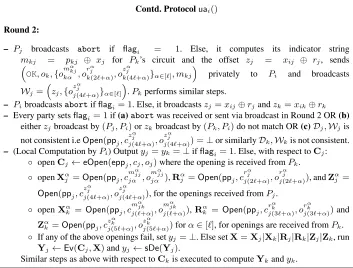
input is released in the second round via broadcast without hampering security, while allowing public detection. Thus the sub-protocol achieves global/public conflict and helps the final construction to exit with⊥unanimously when any of the sub-protocol detects a conflict.
Achieving guaranteed output delivery in 3 rounds.For achieving this stronger notion, the sub-protocol here needs a stronger kind of identifiability, identifying the corrupt locally to be specific, to facilitate all parties to get output within an additional round no matter what. To this effect, our sub-protocol is enhanced so that the evaluator either successfully computes the output or identifies the corrupt party. We emphasise that the goals of the sub-protocols for unanimous abort and guaranteed output delivery, namely global conflict vs. local identification, are orthogonal and do not imply each other. The additional challenge faced in composing the executions to achieve guaranteed output delivery lies in determining the appropriate ‘committed’ input of the corrupt party based on which round and execution of sub-protocol it chooses to strike.
Tackling input consistency.We take a uniform approach for all our protocols. We note that a party takes three different roles across the three composed execution: an evaluator, a garbler who initiate the GC generation by picking the randomness, a co-garbler who verifies the sanity of the GC. In each instance, it gets a chance to give inputs. We take care of input consistency in two parts. First, we tie the inputs that a party can feed as an evaluator and as a garbler who initiates a GC construction via a mechanism that needs no additional communication at all. This is done by setting the permutation strings (used to permute the commitments of encoding information of the garblers) to the shares of these parties’ input in a certain way. The same trick fails to work in two rounds for the case when a party acts as a garbler and a co-garbler in two different executions. We tackle this by superimposing two mirrored copies of the sub-protocol where the gar-blers exchange their roles. Namely, in the final sub-protocol, each garbler initiates an independent copy of garbled circuit and passes on the randomness used to the fellow garbler for verification. The previous trick is used to tie the inputs that a party feeds as an evaluator and as a garbler for the GC initiated by it (inter-execution consistency). The input consistency of a garbler for the two garbled circuits (one initiated by him and the other by the co-garbler) is taken care using ‘proof-of-cheating’ mechanism [Lin13] where the evaluator can unlock the clear input of both the other parties using conflict-ing output wire keys (intra-execution consistency). While this works for our protocols with unanimous abort and guaranteed output delivery, the fair protocol faces additional challenges. First, based on whether a party releases a clear or encoded input, a corrupt garbler feeding two different inputs can conclude whetherfleads to the same output for both his inputs, breaching privacy. This is tackled by creating the ciphertexts using con-flicting input keys. Second, inspite of the above change, a corrupt garbler can launch ‘selective failure attack’ [MF06,KS06] and breach privacy of his honest co-garbler. We tackle this using ‘XOR-tree approach’ [LP07] where every input bit is broken into
sshares and security is guaranteed except with probability2−(s−1) per input bit. We do not go for the refined version of this technique, known as probe-resistant matrix, [LP07,SS13] for simplicity.
bind-ing property for any (includbind-ing adversarially-picked) public parameter. Our protocols, having 2-3 rounds, seem unable to spare rounds for generating and communicating the public parameters by a party who is different from the one opening the commitments.
On concrete efficiency.Though the focus is on the round complexity, the concrete ef-ficiency of our protocols is comparable to Yao [Yao82] and require transmission and evaluation of few GCs (upto 9) (in some cases we only need privacy-free GCs which permit more efficient constructions than their private counterparts [JKO13,FNO15]). The broadcast communication of the optimized variants of our protocols is independent of the GC size via applying hash function. We would like to draw attention towards the new tricks such as the ones used for input consistency, getting certificate of good behaviour via garbled circuits, which may be of both theoretical and practical interest. We believe the detailed take on our protocols will help to lift them or their derivatives to practice in future.
1.3 Roadmap
We present a high-level overview of the primitives used in Section2. The security def-inition and the functionalities appear in AppendixB. We present our 3-round fair pro-tocol, 2-round protocol with unanimous abort and 3-round protocol with guaranteed output delivery in Section3,4and5respectively. The respective security proofs appear in AppendicesD,E andFand the common optimizations in Appendix C. Our lower bound results appear in Section 6. We define authenticated CDS in AppendixGand show its realisation from one of the sub-protocol used in our 3-round fair protocol.
2
Preliminaries
2.1 Model
We consider a set ofn= 3partiesP ={P1, P2, P3}, connected by pair-wise secure
and authentic channels. Each party is modelled as a probabilistic polynomial time Tur-ing (PPT) machine. We assume that there exists aPPTadversaryA, who can actively corrupt at mostt= 1out of then= 3parties and make them behave in any arbitrary manner during the execution of a protocol. We assume the adversary to be static, who decides the set oftparties to be corrupted at the onset of a protocol execution. For our 2-round protocol achieving unanimous abort and 3-2-round protocol achieving guaranteed output delivery, a broadcast channel is assumed to exist.
We denote the cryptographic security parameter byκ. A negligible function inκ
is denoted bynegl(κ). A functionnegl(·)isnegligibleif for every polynomialp(·) there exists a valueN such that for allm > N it holds that negl(m) < p(1m). We denote by[x], the set of elements{1, . . . , x}and by[x, y]fory > x, the set of elements {x, x+ 1, . . . , y}. For anyx∈R{0,1}
m
2.2 Primitives
Garbling Schemes. The term ‘garbled circuit’ (GC) was coined by Beaver [BMR90], but it had largely only been a technique used in secure protocols until they were for-malized as a primitive by Bellare et al. [BHR12]. ‘Garbling Schemes’ as they were termed, were assigned well-defined notions of security, namelycorrectness,privacy,
obliviousness, and authenticity. A garbling scheme G is characterised by a tuple of
PPTalgorithmsG= (Gb,En,Ev,De)described below.
– Gb(1κ, C)is invoked on a circuitCin order to produce a ‘garbled circuit’C, ‘input encoding information’e, and ‘output decoding information’d.
– En(x, e)encodes a clear inputxwith encoding informationein order to produce a garbled/encoded inputX.
– Ev(C,X)evaluatesConXto produce a garbled/encoded outputY.
– De(Y, d)translatesYinto a clear outputyas per decoding informationd.
We give an informal intuition of the notion captured by each of the security proper-ties, namelycorrectness,privacy,obliviousness, andauthenticity. Correctness enforces that a correctly garbled circuit, when evaluated, outputs the correct output of the un-derlying circuit. Privacy aims to protect the privacy of encoded inputs. Authenticity enforces that the evaluator can only learn the output label that corresponds to the value of the function. Obliviousness captures the notion that when the decoding information is withheld, the garbled circuit evaluation leaks no information aboutanyunderlying clear values; be they of the input, intermediate, or output wires of the circuit. The for-mal definitions are deferred to AppendixA.1.
We are interested in a class of garbling schemes referred to as projective in [BHR12]. When garbling a circuit C : {0,1}n 7→ {0,1}m, a projective garbling scheme produces encoding information of the forme= e0
i, e1i
i∈[n], and the encoded
inputXforx= (xi)i∈[n]can be interpreted asX=En(x, e) = (exi
i )i∈[n].
Our 3-round fair protocol relies on garbling schemes that are simultaneously cor-rect, private and oblivious. One of its subroutine uses a garbling scheme that is only authentic. Such schemes are referred asprivacy-free[JKO13,FNO15]. Our protocols with unanimous abort and guaranteed output delivery need a correct, private and au-thentic garbling scheme that need not provide obliviousness. Both these protocols as well as the privacy-free garbling used in the fair protocol further need an additional de-coding mechanism denoted assoft decodingalgorithmsDe[MRZ15] that can decode garbled outputs without the decoding informationd. The soft-decoding algorithm must comply with correctness:sDe(Ev(C,En(e, x))) = C(x)for all(C, e, d). While both sDeandDecan decode garbled outputs, the authenticity needs to hold only with respect toDe. In practice, soft decoding in typical garbling schemes can be achieved by simply appending the truth value to each output wire label.
Non-interactive Commitment Schemes. A non-interactive commitment scheme
commitment and corresponding opening information(c, o),PPTalgorithmOpen out-puts the messagex. The algorithms should satisfy correctness, binding (i.e. it must be hard for an adversary to come up with two different openings of any c andanypp) and hiding (a commitment must not leak information about the underlying message) properties. We need this kind of strong binding as the same party who generates the ppand commitment is required to open later. Two such instantiations of NICOM based on symmetric key primitives (specifically, injective one-way functions) and the formal definitions of the properties are given in AppendixA.2.
We also need a NICOM scheme that admits equivocation property. An equivocal non-interactive commitment (eNICOM) is a NICOM that allows equivocation of a cer-tain commitment to any given message with the help of a trapdoor. The formal defini-tions and instantiadefini-tions appear in AppendixA.3.
Symmetric-Key Encryption (SKE) with Special Correctness. Our fair protocol uses a SKEπ= (Gen,Enc,Dec)which satisfies CPA security and a special correctness prop-erty [JW16,LP09]– if the encryption and decryption keys are different, then decryption fails with high probability. The definition and an instantiation appear in AppendixA.4.
3
3-round 3PC with Fairness
This section presents a tight upper bound for 3PC achieving fairness in the setting with just pair-wise private channels. Our result from Section6.2rules out the possibility of achieving fairness in 2 rounds in the same setting. Our result from Section6.1further shows tightness of 3 rounds even in the presence of a broadcast channel.
Building on the intuition given in the introduction, we proceed towards more de-tailed discussion of our protocol. Our fair protocol is built from parallel composition of three copies of each of the following two sub-protocols: (a)fairi wherePi acts as the evaluator and the other two as garblers for computing the desired functionf. This sub-protocol ensures that honestPi either computes its encoded output or identifies just a conflict in the worst case. The decoding information is committed toPi, yet not opened. It is released in Round 3 of the final composed protocol under subtle conditions as elab-orated below. (b)certiwherePiacts as the evaluator and the other two as garblers for computing an equality checking circuit on the common information distributed byPi in the first round of the final protocol. Notably, though the inputs come solely from the garblers, they are originated from the evaluator and so the circuit can be garbled in a privacy-free fashion. This sub-protocol ensures either honestPigets its certificate, the key for output1(meaning the equality check passes through), or identifies a conflict in the worst case. The second round ofcertiis essentially an ‘authenticated’ CDS for equality predicate tolerating one active corruption as discussed in AppendixG. Three
globalvariables are maintained by each partyPi to keep tab on the conflicts and the corrupt. Namely, Ci to keep the identity of the corrupt, flagj and flagk (for distinct
Once{fairi,certi}i∈[3]complete by the end of round 2 of the final protocol fair,
any honest party will be in one of the three states: (a) no corruption and no conflict detected ((Ci = ∅)∧(flagj = 0)∧(flagk = 0)); (b) corruption detected (Ci 6= ∅); (c) conflict detected(flagj = 1)∨(flagk = 1). An honest party, guaranteed to have computed its encoded output and certificate only in the first state, releases these as well as the decoding information for both the other parties unconditionally in the third round. In the other two states, an honest party conditionally releases only the decoding information. This step is extremely crucial for maintaining fairness. Specifically, a party that belongs to the second state, releases the decoding information only to the party identified to be honest. A party that belongs to the third state, releases the decoding information in encrypted formonlyto the party whose distributed information are not agreed upon, so that the encryption can be unlocked only via a valid certificate. A corrupt party will either have its certificate or the encrypted decoding information, but
notboth. The former when it distributes its common information correctly and the latter when it does not. The only way a corrupt party can get its decoding information is by keeping one honest party in the first state, in which case both the honest parties will be able to compute the output as follows. The honest party in state one, sayPi, either gets it decoding information on clear or in encrypted form. The former when the other honest party,Pjis in the first or second state and the latter whenPjis in the third state.
Piretrieves the decoding information no matter what, as it also holds the certificate to open the encryption. An honest partyPjin the second state, on identifyingPias honest, takes the encoded output ofPiand uses its own decoding information to compute the output. The case for an honest partyPjin the third state is the most interesting. Since honestPibelongs to the first state, a corrupt party must have distributed its common information correctly as otherwisePi will find a conflict and would be in third state. Therefore,Pj in the third state must have foundPi’s information on disagreement due the corrupt party’s misbehaviour. Now,Pi’s certificate that proves his correct behaviour, allowsPjto identify the corrupt, enter into the second state and compute the output by taking the encoded output of honestPi. In the following, we describe executionfairi assuming input consistency, followed bycerti. Entwining the six executions, tackling the input consistency and the final presentation of protocolfairappear in the end.
3.1 Protocolfairi
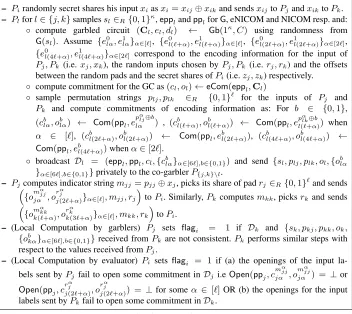
At a high level,fairiworks as follows. In the first round, the evaluator shares its input additively between the two garblers making the garblers the sole input contributors to the computation. In parallel, each garbler initiates construction of a GC and commit-ments on the encoding and decoding information. While the GC and the commitcommit-ments are given to the evaluatorPi, the co-garbler, acting as a verifier, additionally receives the source of the used randomness for GC and openings of commitments. Upon verifi-cation, the co-garbler either approves or rejects the GC and commitments. In the former case, it also releases its own encoded input and encoded input for the share ofPi via opening the commitments to encoding information in second round. In the latter case,
follows from the fact that it is either constructed or scrutinised by a honest garbler. The decoding information remains hidden (yet committed) withPiand the obliviousness of GC ensures thatPicannot compute the output until it receives the correct opening.
To avoid issues of adaptivity, the GCs are not sent on clear in the first round toPi who may choose its input based on the GCs. Rather, a garbler sends a commitment to its GC toPiand it is opened only by the co-garbler after successful scrutiny. The cor-rectness of evaluated GC still carries over as a corrupt garbler cannot open to a different circuit than the one committed by an honest garbler by virtue of the binding property of the commitment scheme. We use an eNICOM for committing the GCs and decoding information as equivocation is needed to tackle a technicality in the security proof. The simulator of our final protocol needs to send the commitments on GC, encoding and de-coding information without having access to the input of an evaluatorPi(and thus also the output), while acting on behalf of the honest garblers infairi. The eNICOM cannot be used for the encoding information, as they are opened by the ones who generate the commitments and eNICOM does not provide binding in such a case. Instead, the GCs and the decoding information are equivocated based on the input of the evaluator and the output.
Protocolfairiappears in Figure1wherePireturns encoded outputsYi= (Y j i,Yik) (initially set to⊥) for the circuits created byPj, Pk, the commitments to the respec-tive decoding information Cdec
j , Ckdec and the flags flagj,flagk (initially set to false) to be used in the final protocol. The garblers output their respective corrupt set, flag for the fellow garbler and opening for the decoding information corresponding to its co-garbler’s GC andnotits own. This is to ensure that it cannot break the binding of eNICOM which may not necessarily hold for adversarially-picked public parameter.
Lemma 1. Duringfairi,Pβ∈ C/ αholds for honestPα, Pβ.
Proof. An honest Pα would includePβ inCαonly if one of the following hold: (a) Both are garblers andPβsends commitments to garbled circuit, encoding and decoding information inconsistent with the randomness and openings shared privately withPα(b)
Pαis an evaluator andPβis a garbler and either (i)Pβ’s opening of a committed garbled circuit fails or (ii)Pβ’s opening of a committed encoded input fails. It is straightforward to verify that the cases will never occur for honest(Pα, Pβ). ut
Lemma 2. If honestPihasCi=∅andflagj=flagk = 0, thenYi= (Y j i,Y
k i)6=⊥.
Proof. According tofairi,Pi fails to compute Yi when it identifies the corrupt or finds a mismatch in the common informationDj orDkor receives anOKsignal from one of its garblers. The first condition impliesCi 6=∅. The second condition implies,
Pi would have set eitherflagj or flagk to true. For the third condition, if Pj sends
nOKthenPi would setflagk = 1. Lastly, if Pk sendsnOK, thenPi setsflagj = 1. Clearly whenCi =∅ ∧flagj = 0∧flagk = 0,Pi evaluates bothCj,Ck and obtains Yi= (Y
j
i,Yik)6=⊥. ut
3.2 Protocolcerti
Protocolfairi()
Inputs: PartyPαhasxαforα∈[3].
Common Inputs: The circuitC(x1, x2, x3, x4)that computesf(x1, x2, x3⊕x4). Output: A garblerPl(l∈ {j, k})outputs corrupt setCl,flag{j,k}\landO
dec
i .Pioutputs(Ci, Yi= (Yij,Y
k
i), Cjdec, Ckdec,flagj,flagk)whereYidenote a pair of encoded outputs or⊥. Primitives: A garbling schemeG = (Gb,En,Ev,De)that is correct, private and oblivious, a
NICOM(Com,Open), an eNICOM(eGen,eCom,eOpen,Equiv)and a PRGG.
Round 1:
– Pirandomly secret shares his inputxiasxi=xij⊕xikand sendsxijtoPjandxiktoPk. – Plforl∈ {j, k}samplessl∈R{0,1}κ,epplandpplforG, eNICOM and NICOM resp. and:
◦ compute garbled circuit (Cl, el, dl) ← Gb(1κ, C) using randomness from G(sl).
Assume{e0
lα, e1lα}α∈[`],{e0l(`+α), e 1
l(`+α)}α∈[`],{e0l(2`+α), e 1
l(2`+α)}α∈[2`]denote the
encoding information for the input ofPj, Pkand the secret shares ofPirespectively.
◦ compute commitments for GC and decoding information.(cl, ol)←eCom(eppl,Cl)
and(cdecl , o
dec
l )←eCom(eppl, dl).
◦ sample permutation strings plj, plk ∈R {0,1}` for the inputs ofPj andPk.
Com-pute commitments to encoding information as: for b ∈ {0,1}, (cblα, oblα) ← Com(ppl, e
pαlj⊕b lα ), (c
b l(`+α), o
b
l(`+α)) ← Com(ppl, e pαlk⊕b
l(`+α)) when α ∈ [`],
(cbl(2`+α), o b
l(2`+α))←Com(ppl, e b
l(2`+α))whenα∈[2`].
◦ sendDl= (eppl,ppl, cl,{cblα,}α∈[4`],b∈{0,1}, cdecl )to both the other parties and send
{sl, plj, plk, ol,{oblα,}α∈[4`],b∈{0,1}, oldec}only to co-garblerP{j,k}\l.
– Pj sets Cj = Pk ifDk and {sk, pkj, pkk, ok,{obkα,}α∈[4`],b∈{0,1}, odeck }are inconsistent.
Else, setOdeci =o
dec
k .Pkperforms similar steps for the values received fromPj.
Round 2:
– PisendsDjtoPkandDktoPj.Pjsetsflagk= 1ifDkreceived fromPiandPkdoes not
match. Similar step is executed byPk.
– Pjcomputes the indicator stringsmjj =pjj⊕xj, mkj =pkj⊕xjfor its inputs. IfPk ∈/
Cj, then send
OK,Dk,(ok,{o mαkj kα , o
xαij
k(2`+α)}α∈[`], mkj),({o mαjj jα , o
xαij
j(2`+α)}α∈[`], mjj)
toPi. Else, sendnOKtoPi.Pkperforms similar steps.
– (Local Computation)PisetsYji =⊥andflagj= 1when(a)PksentnOKor(b)Djsent by
PjandPkdo not match. Otherwise,PisetsCjdec=cdecj ∈ Djand does:
◦ openCj←eOpen(eppj, cj, oj)withojreceived fromPk. SetCi=PkifCj=⊥.
◦ openXα
j =Open(ppj, c mα
jj jα , o
mα jj jα ),X
α
ij =Open(ppj, c xα
ij j(2`+α), o
xα ij
j(2`+α)), forα∈
[`], for the opening received fromPjand the commitments taken fromDj. IncludePj
inCiif any of the opened input labels above is opened to⊥.
◦ openXα
k =Open(ppj, c mα
jk j(`+α), o
mα jk
j(`+α))andX α
ik =Open(ppj, c xαik j(3`+α), o
xαik j(3`+α))
forα ∈ [`], for the opening received fromPkand the commitments taken fromDj.
IncludePkinCiif any of the opened input labels above is opened to⊥.
◦ IfCi=∅, setX=Xj|Xk|Xij|Xik, runYij←Ev(Cj,X). Else setYji =⊥
Similar steps forCkwill be executed to computeYik, populateCiand updateflagk.
who should it release the decoding information (that it holds as a garbler) to in the final protocol. Protocolcerti, in a nutshell, is introduced to help a confused party to identify the corrupt and take the honest party’s encoded output for output computation, on one hand, and to selectively deliver the decoding information only to the other honest party, on the other. Protocolcertiimplements evaluation of an equality checking function that takes inputs from the two garblers and outputs1when the test passes and outputs the in-puts themselves otherwise. In the final protocol, the inin-puts are the common information (GCs and commitments) distributed byPiacross all executions offairj. The certificate is the output key corresponding to output1. Since input privacy is not a concern here, the circuit is enough to be garbled in privacy-free way and authenticity of garbling will ensure a corruptPidoes not get the certificate.certi follows the footstep offairiwith the following simplifications: (a) Input consistency need not be taken care across the executions implying that it is enough one garbler alone initiates a GC and the other garbler simply extends its support for verification. To divide the load fairly, we assign garblerPj wherei = (j+ 1) mod 3to act as the generator of GC incerti. (b) The decoding information need not be committed or withheld. We use soft decoding that allows immediate decoding.
Similar tofairi, at the end of the protocol, eitherPi gets its certificate (either the key for 1 or the inputs themselves), or sets its flags (when GC and commitment do not match) or sets its corrupt set (when opening of encoded inputs fail).Pioutputs its certificate, the flag for the GC generator and corrupt set, to be used in the final protocol. The garblers output the key for1, flag for its fellow garbler and the corrupt set. Notice that, whencertiis composed in the bigger protocol,Piwill be in a position to identify the corrupt when the equality fails and the certificate is the inputs fed by the garblers. The protocol appears in Figure2.
Lemma 3. Duringcerti,Pβ∈ C/ αholds for honestPα, Pβ.
Proof. An honestPαwould includePβ inCαonly if one of the following holds: (a)
Pβ sends inconsistent(sβ,Wβ)toPα. (b)Pβ’s opening of committed encoded input or garbled circuit fails. It is straightforward to verify that the cases will never occur for
honest(Pβ, Pα). ut
Lemma 4. If an honestPihasCi=∅andflagj=flagk= 0, then,certi 6=⊥.
Proof. The proof follows easily from the steps of the protocol. ut
3.3 Protocolfair
Building on the intuition laid out before, we only discuss input consistency that is taken care in two steps: Inter-input consistency (across executions) and intra-input consis-tency (within an execution). In the former,Pi’s input as an evaluator infairiis tied with its input committed as garblers for its own garbled circuits infairj andfairk. In the latter, the consistency ofPi’s input for both garbled circuits infairj (and similarly in fairk) is tackled. We discuss them one by one.
certi()
Common Inputs: The circuitC(γj, γk)that outputs1if(γj =γk)and(0, γj, γk)otherwise.
For distincti, j, k∈[3],Piis assumed to be the evaluator and(Pj, Pk)as the garblers. We
assumei= (j+ 1) mod 3, k= (j+ 2) mod 3.
Primitives: A correct, authentic, privacy-free garbling schemeG = (Gb,En,Ev,De)that has the property ofsoft decoding, a PRGG, a NICOM(Com,Open)
Output: A garbler Pl for l ∈ {j, k} outputs corrupt set Cl and keyi. Pi outputs
(certi,Ci,flagj,flagk). GarblerPkadditionally outputsflagj.
Round 1:Pjdoes the following:
– Choose a seedsi∈R{0,1}κforGand construct a garbled circuit(Ci, ei, di)←Gb(1κ, C).
Generate commitment on garbled circuitCias(ci,oi)←Com(Ci)and on the encoding
informationeias(ci, oi) ←Com(ei)using randomness fromG(si). LetWi ={ci, ci}.
Send(si,Wi)toPkandWitoPi.
– (Local Computation byPk)Pk addsPjtoCk if(si,Wi)are inconsistent and is not as per
what an honestPjshould do.PjandPkoutputkeyiequals to the key for output1ofCi.
Round 2:
– PisendsWitoPk.Pksetsflagj= 1ifWireceived fromPiandPjis not identical. – Pj opens its encoded input Xj (corresponding toγj) toPi by sending the opening of the
corresponding commitment inci.
– IfPj ∈ Ck,PksendsnOKtoPi. ElsePksendsWi, opening for garbled circuitoi and its
encoded inputXk(forγk) toPi.
– (Local Computation byPi) IfPidoes not receive identicalWifromPjandPkor receives
nOKfromPk,Pisetscerti=⊥andflagj= 1. Else,Piuses the opening information sent
byPj, Pkto retrieveXj,Xk.PiaddsPl(l ∈ {j, k})toCiand setscerti=⊥if any of
the openings sent byPlresult in⊥. Else,PirunsY←Ev(Ci,Xj,Xk). IfsDe(Y) = 1,
then setcerti=Y, else setcerti= (γ0j, γ 0
k)where these two are decoded fromY.
Fig. 2: Protocolcerti
an evaluator duringfair1and as a garbler duringfair2,fair3with respect to his GCC1.
Since the protocol is symmetric in terms of the roles of the parties, similar tricks are adopted forP2andP3. Let in the first round offair1,P1shares its inputx1by handing
x12andx13toP2andP3respectively. Now corresponding toC1duringfair2,P1and
P3who act as the garblers usex13as the permutation vectorp11that defines the order
of the commitments of the bits ofx1. Now input consistency ofP1’s input is guaranteed
ifm11transferred byP1infair2is same asx12,P1’s share forP2infair1. For an honest
P1, the above will be true sincem11=p11⊕x1=x13⊕x1=x12. If the check fails,
thenP2 identifiesP1 as corrupt. This simple check forcesP1 to use the same input
in bothfair1 andfair2 (corresponding toC1). A similar trick is used to ensure input
consistency of the input ofP1acrossfair1andfair3(corresponding toC1) whereP1and
P2who act as the garblers usex12as the permutation vectorp11for the commitments
of the bits ofx1. The evaluatorP3infair3checks ifm11transferred byP1infair3is
consistency with respect toP1’s GC, unfortunately, the same technique cannot be used
to enforceP1’s input consistency with respect toC2infair3(orfair2) sincep21cannot
be set tox12which is available toP2only at the end of first round. While,P2needs to
prepare and broadcast the commitments to the encoding information in jumbled order as per permutation stringp21in the first round itself. We handle it differently as below.
The consistency of Pi’s input for both garbled circuits in fairj (and similarly in fairk) is tackled via ‘cheat-recovery mechanism’ [Lin13]. We explain with respect to
P1’s input infair3.P2prepares a ciphertext (cheat recovery box) with the input keys of
P1corresponding to the mismatched input bit in the two garbled circuits,C1andC2in
fair3. This ciphertext encrypts the the input shares of garblers thatP3misses, namely,
x12andx21. This would allowP3to compute the function on clear inputs directly. To
ensure that the recovered missing shares are as distributed infair1andfair2, the shares
are not simply distributed but are committed via NICOM by the input owners and the openings are encrypted by the holders. Since there is no way for an evaluator to detect any mismatch in the inputs to and outputs from the two GCs as they are in encoded form, we use encryption scheme with special correctness (Definition6) to enable the evaluator to identify the relevant decryptions. Crucially, we depart from the usual way of creating the cheat recovery boxes using conflicting encoded outputs. Based on whether the clear or encoded output comes out of honestP3in round 3, corrupt garblerP1feeding two
different inputs toC1andC2can conclude whether its two different inputs lead to the
same output or not, breaching privacy. Note that the decoding information cannot be given via this cheat recovery box that uses conflicting encoded outputs as key, as that would result in circularity.
Despite using the above fix, the mechanism as discussed above is susceptible to ‘se-lective failure attack’, an attack well-known in the 2-party domain. While in the latter domain, the attack is launched to breach the privacy of the evaluator’s input based on whether it aborts or not. Here, a corrupt garbler can prepare the ciphertexts in an in-correct way and can breach privacy of its honest co-garbler based on whether clear or encoded output comes out of the evaluator. We elaborate the attack infair3considering
a corruptP1and single bit inputs.P1is supposed to prepare two ciphertexts
correspond-ing toP2’s input bit using the following key combinations– (a) key for0inC1and1in
C2and (b) vice-versa. CorruptP1may replace one of the ciphertexts using key based
on encoded input0ofP2in both the GCs. In caseP2indeed has input0(that he would
use consistently across the 2 GCs duringfair3), thenP3 would be able to decrypt the
ciphertext and would send clear output in Round 3.P1can readily conclude thatP2’s
input is0. This attack is taken care via the usual technique of breaking each input bit to
snumber of xor-shares, referred as ‘XOR-tree approach’ [LP07] (probe-resistance ma-trix [LP07,SS13] can also be used; we avoid it for simplicity). The security is achieved except with probability2−(s−1).
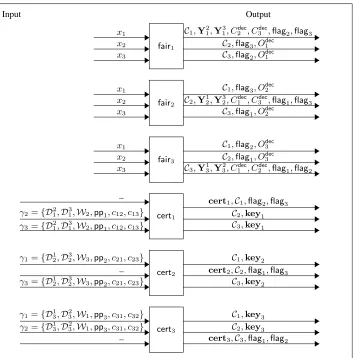
of the ciphertexts. If any honest party is in this state, our protocol results in all parties outputting this output. In Round 3, this party can send the computed output along with the opening of the shares he recovered via the ciphertexts as ‘proof’ to convince the honest party of the validity of the output. The protocolfairappears in Figure4and the schematic diagram is given in AppendixD.1.
We now prove the correctness offair.
Lemma 5. Duringfair,Pj ∈ C/ iholds for honestPi, Pj.
Proof. An honest Pi will not include Pj in its corrupt set in the sub-protocols {fairα,certα}α∈[3] following Lemma 1, Lemma3. Now we prove the statement
in-dividually investigating the three rounds offair.
In Round 1 offair,PiincludesPj as corrupt only if (a)Pi, Pj are garblers andPj setspjj 6=xjior (b)Pj sendsppj, cji, oji, xji toPisuch thatOpen(ppj, cji, oji)6=
xji. None of them will be true for an honestPj. In Round 2 offair,PiincludesPjas corrupt only if (a)Pjis a garbler andPiis an evaluator andmjj 6=xjior (b)Piobtains certi = (γj0, γ0k)and detectsPj’s inputγj0 incertito be different from the information sent by him. The former will not be true for an honestPj. The latter also cannot hold for honestPjby correctness of the privacy-free garbling used. In the last round offair,Pi will identifyPj as corrupt, if it hasflagk = 1and yet receivescertkwhich is same as keykfromPk. A corruptPkreceiveskeykonly by handing out correct and consistent common information toPiandPjuntil the end of Round 1. Namely, the following must be true forPkto obtainkeyk(except for the case when it breaks the authenticity of the GC): (i)γiandγjforcertkmust be same and (ii)Pk must not be in the corrupt set of any honest party at the end of Round 1. In this case,flagkcannot be1. ut
Lemma 6. No corrupt party can be inst1by the end of Round 1, except with negligible
probability.
Proof. For a corruptPk, its honest garblersPiandPjcreates the ciphertextscts using keys with opposite meaning for their respective inputs from their garbled circuits. Since honestPi andPj use the same input for both the circuits,Pk will not have a key to open any of the ciphertexts. The openings(oij, oji)are therefore protected due to the security of the encryption scheme. Subsequently,Pkcannot computey. ut
Definition 1. A partyPi is said to be ‘committed’ to a unique input xi, if Pj holds (cij, cik, oij, xij)andPkholds(cij, cik, oik, xik)such that:(a)xi =xij⊕xikand(b)
cijopens toxij viaoijand likewise,cikopens toxikviaoik.
We next prove that a corrupt party must have committed its input if some honest party is inst1 orst2. To prove correctness, the next few lemmas then show that an
honest party computes its output based on its own output or encoded output if it is in
st1or st2or relies on the output or encoded output of the otherhonestparty. In all
cases, the output will correspond to the committed input of the corrupt party.
Lemma 7. If an honest party is in{st1,st2}, then corrupt party must have committed
Protocolfair()
Inputs: PartyPihasxifori∈[3].
Output: y=f(x1, x2, x3)or⊥where the inputs and the function output belong to{0,1}`. Subprotocols: fairifori∈ [3](Figure1),certifori∈ [3](Figure2), SKE(Enc,Dec)with
‘special correctness’ (Definition6).
Round 1: Fori∈[3]and for distinct indicesj, k∈[3]\ {i}
– EachPicomputes an encoding of length`scorresponding to its inputxi. For each bitbof
xi, the encodingb1, . . . bsis such thatb=⊕sα=1bα. Reusing the notation, we refer to this
encoding asPi’s inputxiand its length by`. – Round 1ofcertiis run.
– Round 1offairiare run with the following amendments:(1)The circuit infairiis changed as
follows: each input wire is replaced by a gate whose input consists ofsnew input wires and whose output is the exclusive-or of these wires.(2)PjandPk work with the permutation
stringspjjandpkkrespectively asxjkandxkj.
– Pi samplesppi, generates (cij, oij) ← Com(ppi, xij), (cik, oik) ← Com(ppi, xik) and
sends{ppi, cij, cik}toPj, Pk. Additionally,Pisendsoij,oiktoPj, Pkrespectively. – (Local Computation byPi)PiaddsP`inCiifOpen(cli, oli)6=xli.PjaddsPkinCjif:(a)
pkknot taken asxkjor(b)the check infairiorcertifails.PkaddsPjinCkif:(a)pjjnot
taken asxjkor(b)the check infairiorcertifails.
Round 2:Fori∈[3]and for distinct indicesj, k∈[3]\ {i}:
– IfPi6∈ Cj,Pjsends(ppi, cij, cik)toPk. IfPi6∈ Ck,Pksends(ppi, cij, cik)toPj. They set flagi= 1in case of mismatch or no communication.
– IfPi 6∈ Cj,Pjparticipates incertias a garbler with inputγjas{Dij,D k
i,Wk,ppi, cij, cik}
whereDji,D k
i,Wkand(ppi, cij, cik)was received fromPiduring Round 1 offairj,fairk, certk(assumingk= (i+ 1) mod 3) andfairrespectively. Similar step is taken byPk. – Ifcerti= (γj0, γ
0
k),PisetsCi=Plifγl06={D j i,D
k
i,Wk,ppi, cij, cik}forl∈ {j, k}. – IfPi∈ C/ j,Pjparticipates inRound 2offairi. WhenPk6∈ Cj,Pjadditionally sends the
ci-phertextsctβjα forβ ∈ {0,1}andα ∈ [`]created as follows. Let{X0 l(`+α),X
1 l(`+α)},
denote the encoding information of co-garbler Pk’s input wire α corresponding toCl
(l ∈ {j, k}). Then ctβjα = Encskβ
α(ojk, okj) for sk 0
α = X0j(`+α) ⊕X 1
k(`+α) and sk1
α=X1j(`+α)⊕X 0
k(`+α).Pktakes similar steps.
– (Local Computation byPi) IncludePlinCiifmll =6 xliforl ∈ {j, k}. IfCi=∅,flagj=
0,flagk = 0, then use keyXm α jk j(`+α)⊕X
mαkk
k(`+α) (α ∈ [`])to decrypt the ciphertextsct 0 jα
orct1jα obtained fromPj. If the decryption succeeds, retrieveokj, ojk. Executexkj ← Open(ckj, okj)andxjk ← Open(cjk, ojk). If the opening succeeds, then evaluatef on
(xi, xji⊕xjk, xki⊕xkj)to obtainy. Similarly, steps are taken with respect toPj’s input,
using the keyXm α jj jα ⊕X
mαkj
kα to decrypt the ciphertextsct 0 kαorct
1
kαobtained fromPk.
Fig. 3: A Three-Round Fair 3PC protocol
A party Pi is said to be in stα for α ∈ [4]if the following conditions are satisfied. Let
(Yi, Cjdec, Ckdec),Odecj andOdeck denote the output ofPiinfairi,fairj andfairk, respectively.
Letcerti,keyj, andkeykdenotes the output ofPiincerti,certjandcertkrespectively.
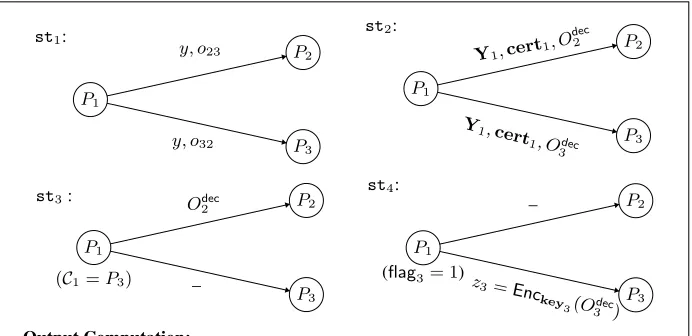
(i) st1(output is already computed): Ifyand proofs(ojk, okj)are computed in Round 2. (ii) st2 (no corruption and no conflict detected): If((Ci =∅)∧(flagj = 0)∧(flagk = 0))
(which impliesYi6=⊥andcerti6=⊥) (iii) st3(corruption detected): If(Ci6=∅)
(iv) st4(conflict detected, but no corruption detected): If(flagj= 1)∨(flagk= 1)
Round 3:EachPifori∈[3]does the following based one of the four states that it belongs to.
– If inst1, then sendytoPj, Pk. SendojktoPjandokjtoPkas proofs. – If inst2, then send(Yi,certi, Oldec)toPlforl∈ {j, k}.
– If inst3, then sendOdecl toPlforl∈ {j, k}only ifPl6∈ Ci. – If inst4, then sendzl = Enckeyl(O
dec
l )toPlonly ifflagl = 1. Ifflagj = 1andcertj
received fromPjis same askeyj, then setCi=Pk. Similar steps are taken to check and
identify ifPjis corrupt. Update state fromst4tost3if corrupt is identified. – If inst1, then outputy.
– If in{st2,st3,st4}and if any other party is identified to be inst1, namely ifyis received
fromPjorPkwithokiorojirespectively such thatOpen(ppi, cli, oli)6=⊥forl∈ {j, k},
then output the receivedy.
– If inst2, then computeyas follows: RetrieveOdeci from eitherzi (withcerti as the key)
received fromPjor from direct communication ofPj. Ifd←eOpen(eppk, C
dec
k , Odeci )is
not⊥, then usedto computey ←De(Yik, d). Similar steps are executed with respect to
Pk’s communication ifyis not computed yet.
– If inst3, then output y ← De(Yli, d)whereYl is received from (honest)Pl 6∈ Ci and
decoding informationdis known as garbler duringfairl. Otherwise outputy=⊥. – If inst4, outputy=⊥.
Fig. 4: A Three-Round Fair 3PC protocol
or distributed incorrect opening information to some honest party. In the former case, flagk will be set byPi. In the latter case, at least one honest party will identifyPk to be corrupt by the end of Round 1. If it isPi, thenCi 6=∅. Otherwise,Pjpopulates its corrupt set withPk, leading toPisettingflagk= 1in Round 2. ut
Lemma 8. If an honest party is inst1, then its output y corresponds to the unique
input committed by the corrupt party.
Proof. An honestPiis inst1only whenCi =∅,flagj = 0,flagk = 0hold at the end of Round 2 and it computesyvia decryption of the ciphertextsctsent by eitherPjor
Pk. AssumePkis corrupt. By Lemma7,Pk has committed to its input. The condition flagj = 0implies that Pk exchanges the commitments on the shares of Pj’s input, namely{cji, cjk}, honestly. Now if Pi opens honest Pj’s ciphertext, then it unlocks the opening information for the missing shares, namely (okj, ojk) corresponding to common and agreed commitments(ckj, cjk). Using these it opens the missing shares
actsent by corruptPk. In this case, no matter how the ciphertext is created, the binding property of NICOM implies thatPk will not be able to opencjk, ckjto anything other thanxjk, xkj except with negligible probability. Thus, the output computed is still as
above and the claim holds. ut
Lemma 9. If an honest party is inst2, then its encoded outputYcorresponds to the
unique input committed by the corrupt party.
Proof. An honestPiis inst2only whenCi =∅,flagj = 0,flagk = 0hold at the end of Round 2. The conditions also imply thatPihas computedYisuccessfully (due to Lemma2) andPkhas committed to its input (due to Lemma7). Now we show thatYi correspond to the unique input committed by the corruptPk. We first note thatPkmust have used the same input for both the circuitsCjandCkinfairi. Otherwise one of the ciphertexts prepared by honestPj must have been opened andy would be computed, implyingPibelongs tost1and not inst2as assumed. We are now left to show that the
input ofPkfor its circuitCkinfairiis the same as the one committed.
Infair, honestPj would use permutation stringpkk =xkjfor permuting the com-mitments inDkcorresponding toxk. Therefore, one can conclude that the commitments inDkare constructed correctly and ordered as perxkj. Now the only wayPk can de-commitx0kis by givingmkk=pkk⊕x0k. But in this case honestPiwould addPktoCi as the checkmkk=xkiwould fail (mkk =pkk⊕x0k 6=pkk⊕xk) and will be inst3
and not inst2as assumed.
u t
Lemma 10. If an honest party is inst2, then its outputycorresponds to the unique
input committed by the corrupt party.
Proof. Note that an honest partyPi inst2 either uses y of another party inst1 or
computes output from its encoded outputYi. The proof for the former case goes as follows. By Lemma6, a corruptPkcan never be inst1. The correctness ofycomputed
by an honestPj follows directly from Lemma8. For the latter case, Lemma9implies thatYicorresponds to the unique input committed by the corrupt party. All that needs to be ensured is thatPigets the correct decoding information. The conditionflagj = flagk = 0implies that the commitment to the decoding information is computed and distributed correctly for bothCjandCk. Now the binding property of eNICOM ensures that the decoding information received from eitherPj(forCk) orPk(forCj) must be correct implying correctness ofy(by correctness of the garbling scheme). ut
Lemma 11. If an honest party is inst3 orst4, then its outputy corresponds to the
unique input committed by the corrupt party.
Proof. An honest partyPi inst3 either usesy of another party inst1 or computes
output from encoded outputYj of Pj who it identifies as honest. For the latter case note that an honestPj will never be identified as corrupt byPi, due to Lemma5. The claim now follows from Lemma6, Lemma8and the fact that corruptPk cannot forge the ‘proof’oij(binding of NICOM) for the former case and from Lemma9and the fact that it possesses correct decoding information as a garbler forYjfor the latter case. An honest partyPiinst4only usesyof another party inst1. The lemma follows in this
Theorem 1. Protocolfairis correct.
Proof. In order to prove the theorem, we show that if an honest party, sayPioutputsy that is not⊥, then it corresponds tox1, x2, x3wherexjis the input committed byPj (Definition1). We note that an honestPibelong to one among{st1,st2,st3,st4}at
the time of output computation. The proof now follows from Lemmas7,8,10,11. ut Fairness implies: (a) if a corrupt party gets the output then so does the honest parties; (b) if an honest party gets the output then so does the other parties. We give the intuition for both below starting with (a). The formal proof appears in AppendixD.2.
A corruptPk cannot be inst1(due to Lemma6). The only way it can retrieve the
output is by having an honest party inst1orst2. An honest party inst3only releases
the decoding information and it never release it to a corrupt party (Lemma 5implies it identifies the honest party correctly). An honest party inst4releases the encrypted
decoding informationzk under keykeyk toPk conditionally whenflagk = 1. The condition flagk = 1 implies thatPk must have distributed the common information incorrectly and so γi andγj are not same. This further impliescertk is not same as keykand soPkdoes not have access to the key to openzk and cannot recover the de-coding information. So the corruptPkgetting the output implies that at least one honest party is in{st1,st2}. Lemma7implies that in this case,Pkmust have committed to a unique input. By Lemma8and Lemma10, theyand encoded outputYcomputed by any honest party inst1and inst2respectively will correspondPk’s committed input. Further, ifPkcomputes encoded outputYk, it also correspond toPk’s committed input. So no matter how the corrupt party compute the output, it will be with respect to unique (x1, x2, x3). We need to show that both honest parties receive the same output. This
easily follows when at least one honest party is inst1. We now prove the lemma based
on the following cases. (a) BothPi, Pj are inst2: They receive the decoding
informa-tion from each other on the clear and use their respective computed encoded output to compute the outputy. (b)Piis inst2andPjinst3:Piuses the decoding information sent exclusively to him byPjand decode the output as in the previous case.Pjuses the encoded output ofPi,Yi and its decoding information (held as a garbler) to compute the output. (c)Pi is inst2 andPj inst4:Pj must be inst4 because offlagi = 1. Ifflagk = 1,Piwill have the same status for this flag and would belong tost4. Now
sinceflagi= 1,Pjsends encryption of the decoding informationzitoPiwho can use certito decryptziand compute the output as in the previous two cases.Pj, on noting thatflagi= 1, yetPiobtainedcerti=keyi, will identifyPkto be corrupt, upgrade to
st3and compute the output as in the previous case.
Next, we argue for part (b). For an honest party to compute the outputy, at least one honest party must be in{st1,st2}. If both belong to{st3,st4}, then neitherPk has committed any input (due to Lemma7) nor anyone gets the output. The latter follows by the argument below. An honest party inst3only outputs based on the encoded output
of the other honest party. But since the other honest party is in{st3,st4}, it will output
⊥. An honest party inst4outputs⊥, except for the case it finds one inst1which is not
true for bothPjandPk(Lemma6). The corruptPkdoes not get the output too following the fact that it cannot be inst1(Lemma6) and it does not receive decoding information
from an honest party. An honest partyPiinst3sends the decoding information only to