Directional Distance-Bounding Identification
Protocols
Ahmad Ahmadi
Reihaneh Safavi-Naini
Abstract
Distance bounding (DB) protocols allow a prover to convince a verifier that they are within a distance bound. A public key distance bounding relies on the public key of the users to prove their identity and proximity claim. There has been a number of approaches in the literature to formalize security of public key dis-tance bounding protocols. In this paper we extend an earlier work that formalizes security of public key DB protocols using an approach that is inspired by the secu-rity definition of identification protocols, and is referred to it as distance-bounding identification (DBID). We first show that if protocol participants have access to a directional antenna, many existing protocols that have been proven secure, will become insecure, and then show to revise the previous model to include this new capability of the users. DBIDapproach provides a natural way of modeling man-in-the-middle attack in line with identification protocols, as well as other attacks that are commonly considered in distance bounding protocols. We propose a new DBIDscheme, calledPoxy, with security proof. We compare the existing public key DB models, and prove the security of the scheme known asProProx, in our model.
1
Introduction
Distance upper bounding (DB) protocols were first proposed in [12] to provide security against Man-in-the-middle (MiM) attack in authentication protocols. They have found wide diversity of applications in location and proximity based services [6, 25, 15, 20, 10]. Most DB protocols are symmetric key protocols where the prover and the verifier share a secret key. More recently public key DB protocols have been proposed where the prover is only known through their public keys, while their secret key remains private to them [3, 28, 2]. In these models, the verifier only has access to system public parameters as well as public keys of the participants.
one bitchallengesare sent by the verifier to the prover, and the corresponding responses by the prover is recorded and used for distance estimation. Achallenge-response table includes responses that are required for all possible challenges and is calculated by the prover before the fast challenge-response rounds start. The challenge-response table is constructed using the provers’ secret key, and some nonces that are communicated during the slow phase of the protocol.
In symmetric key setting, the challenge-response table can also be constructed by the verifier and used for the verification of responses In public key setting however, the verifier only knows the prover’s public key, and cannot calculate the challenge-response table. In this case, the verifier verifies the correctness of the prover’s responses using their relation with the provers’ public key.
For a DB protocol with distance boundD, we refer to participants whose distance to the verifier are less thanD asclose-byparticipants (setS) and those who are farther away thanD, asfar-awayparticipants (setF).
Important attacks against DB protocols are:
(A1) Distance-Fraud [7];where a dishonest far-away prover tries to be accepted in the protocol. Distance-Hijacking [10]is a special case of this attack, where a far-away prover takes advantage of the communication of honest close-by provers to succeed in the protocol.
(A2) Mafia-Fraud (MF) [12]; a close-by actor tries to use the communications of a far-away honest prover, to succeed in the protocol.
(A3) Strong-Impersonation [2]; a close-by actor learns from past executions of the protocol by a close-by honest prover and tries to impersonate the prover in a new execution when the prover is either inactive or is not close-by anymore.
(A4) Terrorist-Fraud (TF) [12];a dishonest far-away prover colludes with a close-by actor to succeed in the protocol. In theoriginal TF, it’s assumed that the prover does not leak their secret key to the actor. In therecent TF[27] this restriction is removed, but it is required that non-negligible success of TF attack results in non-negligible improvement in future impersonation attacks by the actor.
To prove security of the existing public key DB protocols, such as [3, 7, 8, 28, 17, 2, 16],PoPoK[28] proposed a formal security model that uses a cryptographic PoK system and considers distance bound as an additional property of the system. InDBID [2] an alternative approach was proposed that follows the security formalization of identificationprotocols (usingΣ-protocols), and includes distance-bound as an extra property. TheProProxscheme [28] was first proven secure in the former model [28], and later in the latter model [2].
scheme.DBPoK-log+[3] is another public key DB protocol that uses a different cryp-tosystem and uses the normal amount of fast phase communications, which makes it more efficient compared toProProx. However, the security proof of this protocol has not been yet provided and it is not reliable in presence of noisy channel.
Our work: We consider provers that have access to directional antennas. Such an-tennas allow point to point communication with minimum interception by eavesdrop-pers who are outside the main transmission direction [1]. Advances in beamforming techniques and smart antennas in recent years [1] has made these antennas readily accessible to users. Distance bounding protocols, during the fast challenge-response phase, rely on physical layer communication and so it is important to consider this ex-tra attacking capability for protocol participants. We will show that indeed directional antenna affects the security evaluation of DB protocols, and in particular effectively allows a malicious prover to launch a successful TF attack against protocols that had provable security against this attack. In Section 3 we show how this extra capability can be used by a malicious prover who is aided by a helper to break security ofVSSDB[16] andDBPoK-log+[3] schemes. Directional antennas had been previously considered for actors during MF attack. In this paper we consider a dishonest prover with access to this type of antenna. For distance fraud, a directional antenna does not appear to affect security. In TF however, the dishonest prover is aided by a helper and directional antenna and this affects the security definition.
We extend theDBIDformal security model [2] to include this new attacker’s capability. The directional TF attack is captured in the revised TF-resistance (Property 4.4). We propose a newDBID scheme, calledPoxy, and provide the security proof. We also prove that the existingProProxscheme is indeed secure in this new model.
This paper is the full version of conference paper [4].
Organization. Section 2 is preliminaries. Section 3 shows directional TF attack on some public key DB protocols. Section 4 presents our model, Section 5 and Section 6 describe the construction ofPoxyandProProx, respectively, and give security theo-rems and proofs. Section 7 gives a summary of related works, and Section 8 concludes the paper.
2
Preliminaries
In this section we introduce a primitive that will later be used in our model.
Definition 2.1. (Σ-protocol).A prover P and verifier V execute three’ algorithms (Commit,Response,Check)using inputs(x,y)and(y), respectively in the following order. x is private and y is public.
LetC,HandRdenote three sets defined as follows.Cis the set of possible input that is chosen by the prover;His the set of possible challenges chosen by the verifier; andRis the set of possible responses of the prover. The steps of the protocol are as follows:
1. P randomly chooses a∈C, computes the commitment A=Commit(a), and sends A to V .
2. Challenge and Response messages that are defined as follows:
(a) V randomly chooses a challenge c∈Hand sends it to P,
(b) P computes r=Response(x,a,c)∈Rand sends it to V ,
3. V calculates ret=Check(y,c,r,A), where ret∈ {accept,re ject}.
At the end of the protocol, V outputs OutV=1if ret=accept, and OutV =0 other-wise.
In anidentification scheme(ID), a proverPconvinces a verifierVthat they know a wit-nessxrelated to a public valuey. The scheme is given by the tupleID=(KeyGen;Commit; Response;Check). KeyGenis a PPT algorithm that generates(x,y). The PPT algo-rithmsCommit,ResponseandCheckspecifying an interactive protocol between the proverPand the verifierVas aΣ-protocol (Definition 2.1).
An identification scheme is correct if theCheck function outputsaccept if R(x,y) holds, andre ject otherwise. An identification scheme is secure if an adversary with access to a set of valid transcriptsT={(A,c,r)}, cannot generate a valid transcript (A0,c0,r0)for a c0 that has not appeared in T. Note that a transcript(A,c,r)is valid according to public keyy, if the functionCheck(y,c,r,A)returnsaccept.
Here we define a more general form ofΣ-protocols, calledΣ∗-protocols, in which the verifier consecutively sends multiple challenges, each (except the first one) after receiving the response to the previous challenges.
Definition 2.2. (Σ∗-protocol).A prover P and verifier V run the following
LetC,HandRdenote three sets defined as follows.Cis the set of possible input that is chosen by the prover;His the set of possible challenges chosen by the verifier; andRis the set of possible responses of the prover. The steps of the protocol are as follows:
1. P randomly chooses a∈C, computes the commitment A=Commit(a), and sends A to V .
2. Challenge and Response messages that are defined as follows:
(b) P computes r=Response(x,a,c,¬c)∈R, where¬c is the list of previous challenges before c, and sends it to V ,
Steps 2-(a) and 2-(b) may be repeated a number of times.
3. V calculates ret =Check(y,[c],[r],A), where ret∈ {accept,re ject} and[c]
and[r]are lists of all challenges and responses, respectively.
At the end of the protocol, V outputs OutV=1if ret=accept, and OutV =0 other-wise.
3
Directional Attacks on Public-Key DB Protocols
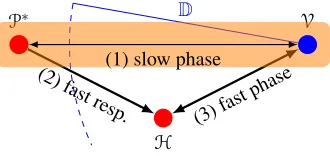
Directional attacks assume that participants have access to directional antennas that allow them to direct messages to specific participants, and prevent other participants from receiving them. Figure 1 shows how such an antenna can be exploited by a malicious prover in a TF attack. The helper does not receive slow phase messages that are sent by the prover, as prover uses a directional antenna (orange ribbon in Figure 1) for communication in this phase. Before the start of the fast-phase, the prover sends all fast-phase responses (e.g., the fast challenge-response table) to the helper, making the helper in-charge of responding to the fast-phase challenges.
This means that the adversary is able to separate the slow phase messages of the pro-tocol from the fast-phase messages. In a vulnerable propro-tocol, the prover may succeed in TF attack without leaking their long term key to the helper, using this separation technique. Therefore, the attacker’s success in TF will not imply success in future impersonation.
H
V
P∗ D
(2) fast
resp.
(3)fast phase (1) slow phase
Figure 1: Directional TF
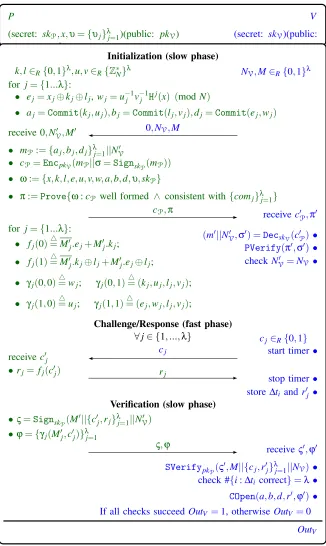
In the following we describe how this setting helps a malicious prover to succeed in terrorist-fraud againstVSSDB[16] andDBPoK-log+[3] schemes.
3.1
Attack against
VSSDB
[16]
P V
(secret: skP,x,υ={υj}λj=1)(public: pkV) (secret: skV)(public:
pkP,{comj}λj=1) Initialization (slow phase)
k,l∈R{0,1}λ,u,v∈R{Z∗N}λ NV,M∈R{0,1}λ
for j={1...λ}:
• ej=xj⊕kj⊕lj,wj=u−j1v
−1
j Hj(x) (modN)
• aj=Commit(kj,uj),bj=Commit(lj,vj),dj=Commit(ej,wj) 0,NV,M
receive 0,NV0,M0
• mP:={aj,bj,dj}λj=1||NV0
• cP=EncpkV(mP||σ=SignskP(mP))
• ω:={x,k,l,e,u,v,w,a,b,d,υ,skP}
• π:=Prove{ω:cP well formed ∧ consistent with{comj}λj=1}
cP,π receivec0
P,π0
(m0||NV0,σ0) =DecskV(c0P)•
PVerify(π0,σ0)•
checkNV0 =NV• for j={1...λ}:
• fj(0)
4
=M0j.ej+M0j.kj; • fj(1)
4
=M0j.kj⊕lj+M0j.ej⊕lj;
• γj(0,0)
4
=wj; γj(0,1)
4
= (kj,uj,lj,vj);
• γj(1,0)
4
=uj; γj(1,1)
4
= (ej,wj,lj,vj);
Challenge/Response (fast phase)
∀j∈ {1, ...,λ} cj∈R{0,1}
start timer•
cj
receivec0j
•rj=fj(c0j) rj
stop timer• store∆tiandr0j •
Verification (slow phase)
•ς=Signsk P(M
0||{c0
j,rj}λj=1||N
0
V) •ϕ={γj(M0j,c
0
j)}λj=1
ς,ϕ receive
ς0,ϕ0
SVerifypk
P(ς
0,M||{c
j,r0j}λj=1||NV)• check #{i:∆ti correct}=λ•
COpen(a,b,d,r0,ϕ0)• If all checks succeedOutV =1, otherwiseOutV =0
OutV
Figure 2: Πprotocol of VSSDBscheme. (Commit,COpen)is a commitment scheme. (Enc,Dec)is a secure public key encryption scheme. (Sign,SVerify)is a signature scheme.(Prove,PVerify)is a proof-of-knowledge scheme.His a secure hash func-tion with pseudo-random output.xis the private key of the prover, with random distri-bution. υ={υj}λj=1whereυj=Hj(x). comj=Commit(xj,υj). The fast
Lemma 1. In theΠprotocol ofVSSDBscheme, the fast challenge-response table does not leak information about the secret value skPof prover, assuming that skP and x are independently chosen.
Proof. The elements of the fast challenge-response table are calculated asrj=fj(c0j) ∈ {0,1} for j={1, ...,λ}. Therefore, by knowing the table, one can, at the most, extract the values ofej,kj,ljfor j={1, ...,λ}. By finding these values, one can extract the value ofxusing the equationxj=ej⊕kj⊕lj for j={1, ...,λ}. Sincekj andlj are chosen randomly, therefore, this table only contains information about randomly chosen valueskandl, and the value ofx, which are independent of the secret value skP.
Attack: In this attack, the prover sends the messages of the slow phase to the verifier using directional antenna. The prover then sends the fast challenge-response table (i.e., ∀j∈ {1, ...,λ}: either(ej,kj)or(kj⊕lj,ej⊕lj)) to the helper before running the fast phase. Note that the fast challenge-response table does not leak the prover long-term secretskPaccording to Lemma 1.
This allows the helper to respond to the verifier’s challenges during the fast phase. The collusion of the prover and the helper will make the verifier to accept (i.e.,OutV =1) and this is without the prover sending to the helper any information that is dependent on the secret keyskP. The secretskP is required to generate a valid signatureσ in the messageπ. This means that the helper’s success chance in a future impersonation attack will not improve. This completes a successful TF.
3.2
Attack against
DBPoK-log
+[3]
The presented model of [3] follows the original definition of TF (Attack 4), and so our attack can be seen as outside their model. However, we showed that the original definition of TF is not suitable for anonymous distance-bounding protocols. In this section we present a TF attack againstDBPoK-log+, using the more recent definition of TF (Attack 4).
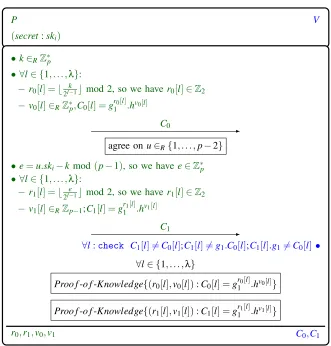
TheΠprotocol in DBPoK-log+scheme consists of the following four sub-protocols between the verifier (V) and the prover (P). The prover takes secret-key(ski,r) as input, and the verifier takes prover’s public-keypki=gsk1i.gr2as input. The following is an improved version of the scheme presented in [3], in terms of being noise resistant.
committed values are {Cb[l]}l={1,...,λ},b={0,1}, and the corresponding ran-domness of commitments are indicated by {vb[l]}l={1,...,λ},b={0,1}, where
vb[l]∈Z∗p. The commitment function is as follows: Cb[l] =g rb[l]
1 .hvb[l] for b∈ {0,1},l={1...λ}, andg1,h∈Zp. The committed table and the ran-domness is kept secret at the prover, while the commitments are sent to the verifier. Figure 3 shows the details of this step. The parts that are shown in a box, are sub-protocols whose details are omitted.
P V
(secret:ski)
• k∈RZ∗p
• ∀l∈ {1, . . . ,λ}:
−r0[l] =b2l−k1cmod 2, so we haver0[l]∈Z2
−v0[l]∈RZ∗p,C0[l] =gr10[l].hv0[l]
C0
agree on u∈R{1, . . . ,p−2}
• e=u.ski−kmod(p−1), so we havee∈Z∗p • ∀l∈ {1, . . . ,λ}:
−r1[l] =b2l−e1cmod 2, so we haver1[l]∈Z2
−v1[l]∈RZp−1;C1[l] =gr11[l].hv1[l]
C1
∀l:check C1[l]6=C0[l];C1[l]6=g1.C0[l];C1[l].g16=C0[l]•
∀l∈ {1, . . . ,λ}
Proo f-o f-Knowledge{(r0[l],v0[l]):C0[l] =gr10[l].hv0[l]}
Proo f-o f-Knowledge{(r1[l],v1[l]):C1[l] =gr11[l].hv1[l]}
r0,r1,v0,v1 C0,C1
Figure 3:DBPoK-log+Step (i):Bit Commitment
P V
(secret:r0,r1)
forl={1. . .λ}
c[l]∈R{0,1} •
Measure Time(t1)•
c[l]
Receivec0[l]
• r[l] =c0[l]r
0[l] +c0[l]r1[l] r[l]
Receiver0[l]
Measure Time(t2)•
Verify Response Time(t2−t1)•
c,r0
c0
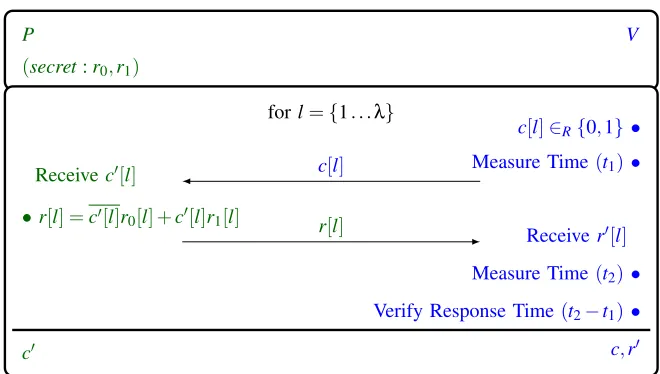
Figure 4:DBPoK-log+Step (ii):Fast Challenge/Response
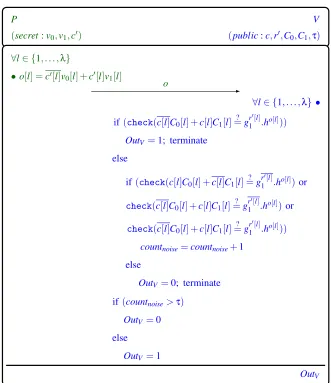
Step (iii) Commitment Openingis used to open half of the commitments, that corre-spond to the challenge bits sent by the verifier inFast Challenge/Response step. In this step, the prover uses the secret commitment randomness (i.e.,
{vb[l]:l={1...λ},b={0,1}}) and the challenge values ofFast Challenge/Response step (i.e., c0), and the verifier uses the committed values (i.e.,{Cb[l]:l=
P V
(secret:v0,v1,c0) (public:c,r0,C0,C1,τ)
∀l∈ {1, . . . ,λ}
• o[l] =c0[l]v0[l] +c0[l]v1[l]
o
∀l∈ {1, . . . ,λ} •
if(check(c[l]C0[l] +c[l]C1[l] ?
=gr
0[
l] 1 .ho[l]))
OutV=1; terminate
else
if(check(c[l]C0[l] +c[l]C1[l]=? gr
0[l]
1 .ho[l])or
check(c[l]C0[l] +c[l]C1[l] ?
=gr10[l].ho[l])or
check(c[l]C0[l] +c[l]C1[l]=? gr
0[l]
1 .ho [l]))
countnoise=countnoise+1
else
OutV=0; terminate
if(countnoise>τ)
OutV=0
else
OutV=1
OutV
Figure 5:DBPoK-log+Step (iii):Commitment Opening
Step (iv) Proof-of-Knowledgeis a protocol for zero-knowledge proof of equality that shows the secret key and the bitwise committed secret key ofBit Commitment step are the same. In this protocol, the prover uses the secret key(ski,r)and the commitment randomness ofBit Commitmentstep, and the verifier uses the public-key and bit committed values ofBit Commitmentstep, as input. zis the accumulation of the committed values ofBit Commitmentstep as z=∏λl=1(C0[l]C1[l])2
l−1
modp, andvis the accumulation of the commit-ment randomness of step (ii) asv=∑λl=12l.(v0[l] +v1[l])mod(p−1).
This protocol runstiterations of ZK proof wherezandCsatisfy the follow-ing relation:PoK[(ski,v,r):z=gu.ski.hv∧pki=gski.gr
If all steps terminate successfully, then the verifier outputsOutV=1.
Lemma 2. InDBPoK-log+scheme, the fast challenge-response table does not leak information about the randomness of secret-key of the prover (r), unless negligible probability.
Proof. We know that by having the fast challenge-response table, we can calculate part of the secret-key of the prover, asski=k+eu mod(p−1)wherekis fresh randomness. Note that the fast challenge-response table is the output of random function that takes skias input. So it cannot leak any information about other independent secrets of the prover, includingr.
If there is an adversaryAthat can calculate the randomnessrfrom the secret-keyski andpki=gski.gr2, thenAcan solve the discrete log problem forgr2. Therefore, since we assume discrete log is a hard problem, then the success chance ofAis negligible.
Attack: In directional TF attack (Figure 1), a malicious far-away prover will use a directional antenna for the slow phase ofDBPoK-log+protocol (all steps except step (ii)) to communicate directly with the verifier, without the helper being able to inter-cept the messages. The prover sends the fast challenge-response table to the helper before running step (ii). Note that the fast challenge-response table does not leak any information aboutr, according to Lemma 2. In this way, the helper can respond in time and correctly to the challenges of the verifier during the fast challenge-response rounds. This attack makes the verifier to accept the protocol.
Since the fast challenge-response table does not leak any information about the ran-domnessr, the helper will not be able to pass step (iv) in future and so it cannot imper-sonate the prover. This completes a successful terrorist fraud onDBPoK-log+.
4
Model
First we define the settings of our system. This includes entities, their communication, their views, and the adversarial capabilities. Then we define distance-bounding iden-tification scheme (DBID) and describeDBIDexperiment, which simulates an instance of DBID scheme. Finally we formalize four properties: (Completeness,Soundness, DF-resistance, andTF-resistanceof distance-bounding identification schemes, using a game-based approach and described as aDBIDexperiment where adversary is active, and the game is between a challenger that sets up the system, taking into account the adversary’s input. Finally in fundamental lemma, we discuss the relation between the location of participants, the timing of messages and their content.
A trusted group manger generates the public parameters of the system, and registers users and issues a key pair to each user. The useruis identifiable by its’ private key. The private key, that must be kept secret, forms the secret input of the user in providing authentication proof. The private key of a useruis shared by all their proversP. The corresponding public key of the user is published by the group manager.
There is a single verifier in the system, that for uniformity of notations, we refer to it as a setVthat has a single member. The verifier only access to the public parameters of the system.
There is a set ofactors(T) that only have access to the public parameters of the system. In this paper we refer to the members of the setsP,VandTasparticipants.
Each participant has a locationloc= (x,y)∈R×R, that is an element of a metric space equipped with Euclidean distance, and is fixed during the protocol. The distance functiond(loc1,loc2)returns the distance between two locations. Message travel time between locationsloc1andloc2isd(locL1,loc2), whereLis the speed of light. A bit sent over the channel may flip with probabilitypnoise(0≤pnoise≤1).
Participants that are located within a predefined distance boundD from the verifier, excluding the verifier, are calledclose-byparticipants (setS), and those who are outside the distance bound from the verifier are calledfar-awayparticipants (setF).
Communication Structure. All participants have access to directional antennas: a participantA in locA can send a message to participantB at locB, such that others who are not on the straight line connectinglocAandlocB, cannot intercept it. Using omni-directional antenna however allows a message to be seen and modified by other participants. A participant may have multiple antennas that can be either directional or omni-directional. We allow a participant to send multiple messages to multiple parties at the same time, each from a separate antenna. Multiple messages that are received at the same time on the same antenna are combined and received as a single message.
View. The view of an entity at a point of a protocol consists of: all the inputs of the entity (including random coin tosses) and the set of messages that they have received up to that point in the protocol.Receiving a message is called anevent. ViewΓ
x(e)is a random variable that denotes the view of an entity (or a set of entities)xright after the eventein protocolΓ. The short notationViewΓ
x is used to indicate the view ofxat the end of the protocolΓ,i.e.,ViewΓ
x =ViewΓx(elast)whereelast is the last event in the protocolΓ.
Adversary.An adversary can corrupt a subset of participantsX∗⊂P∪V∪T. As we will see later in this section, for each security property,X∗will have certain restrictions; inCompletenessX∗=0/, inSoundnessX∗⊆T, inDF-resistanceX∗⊆P, and in TF-resistanceX∗⊆P∪T.
who are controlled by the adversary and may be activated simultaneously. However, we assume the non-corrupted provers follow the protocol, and a user only uses one of its devices at a time (i.e., the execution time of the proversPdo not overlap). This is because an honest user does not use multiple devices simultaneously.
Definition 4.1. (Distance-Bounding Identification Scheme). For a security pa-rameterλ, a distance-bounding identification scheme (DBID) is defined by a tuple (X,Y,S,P,D,pnoise,Init,KeyGen,Π,Revoke), where
(I) XandYare the sets of possible master keys and public keys of the system, respectively, chosen based on the security parameterλ. The system master key
msk∈X, and group public key gpk∈Yare generated using
(msk,gpk)←Init(1λ)algorithm;
(II) S and P are sets of possible private keys and public keys of the users re-spectively, chosen according to the security parameterλ. The user private key sk∈S, and public key pk ∈Y are generated using either (sk,pk)← KeyGen(1λ,msk,gpk)algorithm orKeyGen{U(1λ,gpk)↔GM(1λ,msk)} pro-tocol;
TheKeyGenalgorithm is run by the group manager and the output is a user key pair and updated group public key. The user key pair is securely sent to the user, and the public key is published by the group manager, i.e., gpk0:=
gpk∪ {pk}. However, theKeyGenprotocol is run between the group manager GM(1λ,msk)and a user U(1λ,gpk). The user outputs a key pair(sk,pk), and the group manager outputs the updates group public key gpk0:=gpk∪ {pk}.
(III) Πis aΣ∗-protocol between a prover P(sk,pk,gpk)and the verifier V(pk,gpk),
in which V verifies if the prover is authentic and is located within the distance boundD∈Rto the verifier.
(IV) The transmitted bits of a fast challenge-response round inΠprotocol are af-fected by noise where pnoise∈[0,1]is the probability of a bit flip on each fast challenge-response message.
(V) (gpk0)←Revoke(msk,gpk,i)is an algorithm that takes the master secret key, the group public key and the index of a user. The algorithm removes the cor-responding user uifrom the system and updates the group public key accord-ingly, i.e., gpk→gpk0. TheRevokeoperation is optional inDBIDscheme.
Below we describe execution of an instance of theDBIDscheme, which we callDBID experiment.
Definition 4.2. (DBID Experiment). A DBID experiment is defined by a tuple
(DBID;U;P;V;T), where
(i) DBIDis a distance-bounding identification scheme as defined in Definition 4.1.
(ii) Uis the set of users that are members of the group; each user uj∈Uhas three attributes:
• uj.RT that is the registration time of the user that can be any time, and
• uj.Rev that is a flag that shows if the user is revoked.
(iii) Pis the set of provers; each prover has access to the secret key of a single user.
(iv) Vis the set of verifiers; that have access to the public parameters of theDBID system. We consider the case whereVhas a single member.
(v) Tis the set of actors; each actor has access to the public parameters of the DBIDsystem.
Members of the setX=P∪V∪Tare called participants of the system. Each of the participants x∈X, has the following attributes:
a1. x.Loc is the location of the participant,
a2. x.Code is the code to run by the participant,
a3. x.St that is the start time of the x.Code execution, and
a4. x.Corr is a flag indicating if the participant is corrupted or not.
In addition to these attributes, each prover p∈Phas one extra attribute:
a5. p.Key that is the secret key of the corresponding user, i.e., p.Key=uj.Key for user uj∈U.
The start time of all provers is after registration time of the user, i.e.,∀u∈U,∀p∈ P:p.St>u.RT .
The provers of a user are either all honest or all dishonest. Because of users’ keys are independently chosen, we can only consider a single user and so for simplicity we omit other users. i.e.,∀p∈P:p.Corr=f lag, where f lag∈ {true,f alse}. Honest provers p∈Pfollow theΠ protocol (i.e., p.Code=DBID.Π.P(.)) and there is no
overlap in the execution time of the honest provers. If the verifier is honest, then it follows theΠprotocol (i.e., v.Code=DBID.Π.V(.)for v∈V).
The experiment is run by asimulator that sets the attributes of the participants, and interacts with the group manager to assign keys to the provers of a user. If there is an adversary in the system, the simulator interacts with the adversary and follow their requested operations, that will influence the experiment.
The experiment, without an adversary, proceeds as follows:
1. Setup.
(a) Initiate: The group manager runs(msk/gpk)←DBID.Init(1λ) algo-rithm to generate the master secret key and group public key.
2. Run:The simulator starts the execution of x.Code for all participants x∈X=
P∪V∪Tat time x.St.
The simulation uses a clock.Time(e)indicates the time of evente. The start and finish time of a protocolΓis indicated as stTime(Γ) and f shTime(Γ)respectively, which form the execution timeexTime(Γ) = (stTime(Γ),f shTime(Γ))as the range of time and the execution time periodexLen(Γ) =f shTime(Γ)−stTime(Γ). Different provers have different execution time period (i.e., they participate in a protocol from timet1to t2), and possibly different locations.
In the following, we define security properties ofDBIDscheme, using a game between a challenger and an adversary. This game is a DBID experiment that is run by the challenger who interacts with an adversary. In this game we only consider one user, i.e.,|U|=1. The challenger plays both roles of the simulator and the group manager in theDBID experiment (Definition 4.2). The adversary’s capabilities is modelled as access to a query that it presents to the challenger.
Definition 4.3. (DBIDGame).ADBIDgame between a challenger and adversary is aDBIDexperiment that is defined by a tuple(DBID;U;P;V;T;CorruptParties)
where
• DBIDis a distance-bounding identification scheme as defined in Definition 4.1.
• U,P,V,Tare the sets of users, provers, verifiers and actors as defined in Def-inition 4.2, that are determined through interaction of the challenger and the adversary.
• CorruptParties(Q)is a query that allows the adversary to plan (program) their attack. Q is a set of participants, that may exist in the system or be introduced by the adversary.
The game setup phase is by the challenger while playing the roles of the simulator and the group manager, and interacting with the adversary.
In more details:
1. Setup.
(a) Initiate: Challenger runs(msk/gpk)←DBID.Init(1λ)and publishes gpk. Note that the execution codes of an honest prover and verifier are known by the challenger and the adversary at this point, and are referred to asDBID.Π.P andDBID.Π.V , respectively.
(b) Generate Players:The sets(U,V,P,T)are formed through the interac-tion of the challenger and the adversary as follows:
i. The challenger creates the sets(U,V,P,T)as follows:
• Chooses a verifierV={v}, with the following attributes:
a1. v.Loc=loc0,
a3. v.St=0, and
a4. v.Corr=f alse.
• Runs (sk,pk)←DBID.KeyGen(1λ,msk,gpk) once and forms the set U={u}. The user key is set as u.Key=sk, the reg-istration time of the user is set as u.RT =0and the revocation flag is set as u.Rev=f alse. The group public key is updated as gpk0:=gpk∪ {pk}.
• Creates a prover set Pand for each member p ofP, assigns their attributes as:
a1. p.Loc is set arbitrarily,
a2. p.Code=DBID.Π.P,
a3. p.St is set arbitrarily such that there is no overlap in the execution time of the provers (i.e., @p1,p2∈P: p1.St < p2.St∧p1.St+exLen(DBID.Π)>p2.St),
a4. p.Corr=f alse, and
a5. secret key p.Key=u.Key.
• T=0/
ii. The challenger sends the attributes(x.Loc,x.Code,x.St)for all x∈ P∪V∪Tto the adversary. The size of the setXis n.
iii. The adversary uses the published values to form their corruption queryCorruptParties(Q)that is sent to the challenger. The se-cret information of the corrupted participants in Q is given to the adversary and the behaviour (Code) of the corresponding partici-pants, is assigned according to the adversary instruction.
More specifically, the parameter of this query is Q={q1, ...,qn0}. Each qiconsists of the location, the execution start time and the ex-ecution code of a participant. i.e., qi= (type,location,code,time), where type∈ {veri f ier,prover,actor,user}indicates the type of the participant, location∈R×R, code∈ {0,1}∗indicates the location of the participant and time∈Nindicates the execution start time of the participant.
If qi∈X=P∪V∪T∪U, it determines the settings of an existing participant, and if qi∈/X, it determines the settings of a new partic-ipant.
iv. Upon receiving theCorruptParties(Q)where Q={q1, ...,qn0}, the challenger runs:
• For each qithat qi.type=user , sets the users’ revocation flag as u.Rev=true where u∈U, runs(gpk0)←Revoke(msk,gpk,1), and then updates the group public key gpk←gpk0. This applies only if theDBIDscheme provides user revocation.
• If there is a qi that qi.type=prover, then for each member p of the set P, sets their corruption flag p.Corr=true. If qi is not corresponding to an existing prover, then create a new prover p and add it to the prover setP. Set the attributes of the participant p as follows:
a1. location p.Loc=qi.location,
a2. execution code p.Code=qi.code,
a3. start time p.St=qi.time,
a4. corruption flag p.Corr=true, and
a5. secret key p.Key=u.Key.
• For each qithat qi.type=actor, add a new actor x to the setT, and assign its attributes as follows:
a1. location x.Loc=qi.location,
a2. execution code x.Code=qi.code,
a3. start time x.St=qi.time, and
a4. corruption flag x.Corr=true.
v. The challenger sends the key of the corrupted provers and the key of revoked user to the adversary, i.e., p.Key for all p∈Psuch that p.Corr=true and u.Key for all u∈Usuch that u.Rev=true.
2. Run:Challenger activates all participants x∈X=P∪V∪Tat time x.St for execution of x.Code.
The game ends when the last participant’s code completes its execution.
Using the above game, we define four distinct properties for distance-bounding identi-fication schemes. The winning condition of the above game, varies for each property.
Property 4.1. (DBIDCompleteness). Consider aDBIDscheme and aDBIDgame when Q=0/in theCorruptParties(Q)query and the setPis not empty.
TheDBIDscheme is(τ,δ)-complete for0≤τ,δ≤1, if the verifier returns OutV=1 with probability at least1−δ, under the following assumptions:
• the fast challenge-response rounds are independently affected by noise and at leastτportion of them are noiseless, and
A complete scheme must have negligibleδ to be able to function in the presence of communication noises.
Property 4.2. (DBIDSoundness).Consider aDBIDscheme and aDBIDgame with the following restrictions:
• Pis nonempty and∀p∈P,v∈V:d(p.Loc,v.Loc)>DBID.D, and
• in theCorruptParties(Q)query, qi.type∈ {actor,user}for all qi∈Q.
In this game the verifier and provers are honest, while the adversaryAcorrupts a set of actors and sets their locations (and, if applicable) revokes some users. The corrupted actors are controlled by the adversary, and can simultaneously commu-nicate with multiple provers and the verifier. They can receive a message m from a prover and send m0to the verifier, and vice versa. The certificate of the revoked users are sent to the adversary.
TheDBIDscheme isγ-sound if the probability of the verifier outputting OutV =1is at mostγ.
This general definition captures the following attacks by considering special values for the parameters of the game;
• relay attack[7] where the MiM attacker only relays the messages between the honest verifier and a far-away honest prover. The MiM attacker tries to convince the verifier that the prover is located close to the verifier. This attack is achieved by adding extra restrictions on the adversary of Property 4.2 as follows: • ∀qi∈Qwe haveqi.code=”relay messages”.
• mafia-fraud[12] is when there is an honest verifier, an honest far-away prover, and a close-by MiM attacker who tries to convince the verifier that the prover is located close to the verifier. The attacker listens to the legitimate communi-cations for a while, before running the attack as the learning phase. This attack corresponds to adding extra restrictions on the adversary in Property 4.2 as fol-lows:
•Pis nonempty, and
• ∀qi∈Qwe haved(qi.location,v.Loc)≤DBID.Dforv∈V.
• impersonation attack[5] happens when there is an honest verifier and a single close-by attacker who tries to convince the verifier that the prover is located close to the verifier. The attacker can have a learning phase before running the attack. We can achieve this attack by adding extra restrictions on the adversary of Property 4.2 as follows:
•Pis nonempty, and
• ∀qi∈Qwe haved(qi.location,v.Loc)≤DBID.Dforv∈V, and
•among all the successfulDBID.Πprotocols (Πsuccset) during the game,∃π∈ Πsucc,∀p∈P:t=f shTime(π),t∈/[p.St,p.St+exLen(p.Code)].
hap-pens. We can achieve this attack by adding extra restrictions on the adversary of Property 4.2 as follows:
•Pis nonempty, and
• ∀qi∈Qwe haved(qi.location,v.Loc)≤DBID.Dforv∈V, and
•among all the successfulDBID.Πprotocols (Πsuccset) during the game, at least one of the following conditions hold:
(i) ∃π∈Πsucc,∀p∈P:t=f shTime(π),t∈/[p.St,p.St+exLen(p.Code)]
(ii) ∃p∈P,∃π∈Πsucc,v∈V:t=f shTime(π),t∈[p.St,p.St+exLen(p.Code)]
∧d(p.Loc,v.Loc)>DBID.D.
We consider two types of attacks by a dishonest prover: far-away dishonest provers (Property 4.3), and far-away dishonest provers with a close-by helper (Property 4.4).
Property 4.3. (DBIDDistance-Fraud).Consider aDBIDscheme and aDBIDgame with the following restrictions:
• Pis nonempty and∀p∈P,v∈V:d(p.Loc,v.Loc)>DBID.D, and
• in theCorruptParties(Q)query, qi.type=prover and d(qi.location,v.Loc)> DBID.Dfor all qi∈Q and v∈V.
TheDBIDscheme isα-DF-resistant if, for anyDBID.Πprotocol in such game, we
havePr[OutV =1]≤α.
In the following we define the TF-resistance of DBID protocols.
Property 4.4. (DBID Terrorist-Fraud). Consider a DBID scheme and a DBID game with the following restrictions:
• Pis nonempty and∀p∈P,v∈V:d(p.Loc,v.Loc)>DBID.D, and
• in theCorruptParties(Q)query, qi.type∈ {prover,actor}and d(qi.location, v.Loc)>DBID.Dfor all qi∈Q that qi.type=prover and v∈V.
TheDBIDscheme is µ-TF-resistant, if the following holds about the above game:
• If the verifier returns OutV =1in theΠprotocol of gameΓwith non-negligible probabilityκ, then there is an impersonation attack as aDBIDgameΓ0with honest
verifier, no prover and one close-by actor that takes the view of close-by partici-pants (ViewΓ
S) as input, and makes the verifier return OutV=1with probability at leastκ−µ in theΠprotocol ofΓ0game.
In Lemma 3 we show that if aDBIDscheme is TF-resistant (Property 4.4), using a direc-tional antenna (as in Figure 1) will not affect its security. We only provide an informal proof because a formal proof needs formalizing properties of directional antennas.
Lemma 3. If aDBID scheme is resistant (Property 4.4), it is directional TF-resistant.
Proof. The main observation is that in a TF attack (Property 4.4), all close-by par-ticipants, except the verifier, are controlled by the adversary. So, using a directional antenna to communicate with close-by participants such that the verifier is excluded, adds the transmitted message to the view of adversary, and replacing the directional antenna with an omni directional one, does not change this view.
The messages that are sent to the verifier using directional antenna, will not be included in the impersonation adversary view,i.e.,ViewΓ
S.
Using property 4.4, if there is a successful TF attack against aDBIDscheme, the TF-resistantproperty guarantees existence of an impersonation attacker with non-negligible probability that takes theViewΓ
S as input. Since the view of actors in a directional TF attack will include this view, therefore, in aTF-resistantDBIDscheme, having a suc-cessful directional TF attack implies future impersonation attack.
In fundamental lemma, we relate (i) the local timing of a received message at the verifier, (ii) physical distances traveled by the message, and (iii) the message content. It shows that any responserfor the challengec, that is received by the verifierV, can be split into two partsrSandrFbased on the distance of the sender, and each part can be computed from two separate inputs; (a)rSfrom the challengecand the views of close-by participants before seeingc, and (b) rF from the views of far-away participants before seeingc.
The difference between our fundamental lemma compared to the proposed fundamental lemma of [28] is twofolds: we allow a received message to be combination of multi-ple sent messages which is more realistic in wireless communications, and we do not require a global clock.
Lemma 4. (Fundamental Lemma).Consider a multi-party protocol executionΓ
with a distinguished participant v∈Vthat measures the local time of events, the set of far-away participantsFand the set of close-by participantsS. At local time t, v broadcasts a random message c and waits for a response r. Accdenotes the event that r was received by v at local time t0≤t+2LD. The message from a participant x is independent from c, if it is the result of running the participant algorithm with ViewΓ
x(¬c)as input.
IfAccoccurs, then r consists of two components (rF,rS) (i.e., r=sum(rF,rS)for a deterministic function summation:M∗→M, whereMis the set of all possible messages that v may receive), where rFis sent from members ofFand rSis sent from members ofSthat: rF=MsgF→v(t0)(¬c)and∃J0:rS=J0(ViewΓS(¬c),c,MsgF→S(¬c)).
ofFthat get received by the verifier at time t0, which are independent of c. Note that MsgF→v(t0)(¬c)∈M.
Proof. We consider three cases for possible sources of the responser, received byv; (i)ris solely sent by a subsetF⊆F, (ii)ris solely sent by a subsetC⊆S, or (iii) otherwise. In this proof, we show that the response can be generated according to the lemma in all the cases.
Case (i) In the first case, let’s consider the received messager=rFby the verifier, as the summation1of multiple messages(r
1, ...,rl)that are sent by participantsF = {F1, ...,Fl} at time{t10, ...,tl0}, respectively. All these messages arrive at the verifier at the same time, so the sending times are according the mutual distance between the sender and the verifier. Without lose of generality, we assume that fori={1...l−1}, the participantFiis closer tovthan participantFi+1, and soti0≥t
0
i+1.
IfAccoccurs, we havet10 ≤t+2D−d(v,F1)
L , and sinced(v,F1)>D, then we have t10 <t+d(v,F1)
L which is before the time F1could see the challenge c. We have the same inequality for other participants, sor=rF=MsgF→v(t0)(¬c) =sum(r1, ...,rl)is
independent ofc.
Case (ii) In the second case, let’s consider the received messager=rSby the verifier, as the summation of multiple messages(r1, ...,rl)that are sent by participantsC= {C1, ...,Cl} at time{t10, ...,tl0}, respectively. All these messages arrive at the verifier at the same time, so the sending times are according the mutual distance between the sender and the verifier. Without lose of generality, we assume that fori={1...l−1}, the participantFiis closer tovthan participantFi+1, and soti0≥t
0
i+1.
We make the algorithmJ0 simulate all close-by participantsx∈Sin the time range [t+d(vL,x),t+2D−Ld(v,x)](i.e., from the event of seeing c, until before it’s too late to send a message to the verifier and makeAccoccur). The simulation is in parallel and in chronological order. The output ofJ0 is the messager=rS delivered tovas the summation of messages sent fromC⊆Sat timet0≤t+2D−d(v,C1)
L , whereC1is the closest responder.
Here we claim that the input (m) of each responderx∈Cis either part of the input of J0in the lemma. In order to prove it, we consider four cases about the source ofm;
• mcomes from the internal view ofxbefore seeingc,i.e.,ViewΓ
x(¬c); sincex∈S, thenViewΓ
x(¬c)∈ViewΓS(¬c)that is included in the input of the simulator.
• mcomes from far-away participants; in this case it must be independent from cdue to the distance constraints, and som∈MsgF→S(¬c), that is included in simulator’s input.
1The summation of multiple messages that are received at the same time, depends on the physical
• mcomes fromv; sincevonly sendscbeforer, then the messagemcan be either c, or already is in the view of the close-by participants beforec,i.e.,ViewΓ
S(¬c). • mcomes from a close-by participant y∈S; then the above three cases about
x, applies toytoo. This part is a recursive argument till these is no close-by participant left to send the message.
Case (iii) In the third case, let’s consider the received messagerby the verifier, as the summation of messages sent from close-by participants (rS) and messages sent from far-away participants (rF). Note that all messages are delivered at the same timet0to v. We have thus showed that there are algorithms that can generaterS andrF sepa-rately. Therefore by applying the summation functionr=sum(rS,rF), the algorithm can compute the response messagerwith correct timing.
5
Poxy
Scheme
In this section we present a newDBID construction as an extension of DBPK-log+ [3] andDBPK-log[8]. This protocol uses Pedersen [24] cryptosystem. As a DBID
(X;Y;S;Init;KeyGen;Π;D;pnoise)protocol,Poxyconsists of all of the operations in the scheme as follows;
(
msk
,
gpk
)
←
Init(
1
λ)
The group manager initializes a Pedersen commitmentwithλbit security: chooses a largeλ-bit strong primep, such thatp=2q+1 for a primeq. It also chooses the group generatorgforZ∗pand a random elementh∈RZ∗p.
The group manager initiates a certificate mechanism for validating the public key of the user,i.e., creates a certificate key pair(skCert,pkCert). We omit this mechanism from the rest of this section for simplicity. So we havemsk= (skCert) andgpk=
(p,q,g,h,pkCert,Ξ)whereΞ=0/.
(
sk
,
pk
)
←
KeyGen(
msk
,
gpk
)
Assume l−1 users have joined the group andP V
(secret: sk) (public: pk,gpk)
Session key exchange
ξ,xV∈RZp−1•
yV=gxV (mod p);x=pkxV (mod p)•
µ=Encx(ξ)• repeat above untilx6=p−1 c
yV,µ
•x=yskV (mod p);ξ=Decx(µ)
commitment phase (fori=1...λ and j=1...t) •ki j∈R{0,1};vk,i j,ve,i j∈RZp−1;ei j=ski⊕ki j;cryi j=ki j.ei j •Ak,i j=Commit(ki j;vk,i j);Ae,i j=Commit(ei j;ve,i j) =gei j.hve,i j •vj=∑λi=1(2i
−1.(v
k,i j+ve,i j))mod(p−1) •cryj=∑λi=12i.cryi j;Acry,j=gcryj.hvj (mod p)
A
Ak,i j,rAe,i j,Acry,j
zj=∏λi=1(Ak,i jAe,i j)2 i−1
=gsk+cryj.hvj (modp); checkz
j=Acry,j.pk•
checkAe,i j6=Ak,i j;Ak,i j6=g.Ae,i j;Ae,i j6=g.Ak,i j•
ZKP[(ki j,vk,i j,ei j,ve,i j):Ak,i j=gki j.hvk,i j∧Ae,i j=gei j.hve,i j]
fast challenge-response (fori=1...λand j=1...t)
ci0,ci1∈R{0,1}
reset timer• c
ci j=ci j0||ci j1
receivec0i j0,c0i j1
•ri j= (c0i j¯0ki j+c0i j0ei j)⊕c0i j1 rri j receiver0
i j
check timer≤2B• commitment opening (fori=1...λ and j=1...t)
•δi j=Encx({c0i j0,c
0
i j1,ri j}||ξ) rδi j
checkξ0=ξ;({c0i j0,c0i j1,ri j},ξ0)←Decx(δi j)•
for all i=1. . .λ, find set of noiseless roundsIi⊆ {1, ...,t}•
terminate if∃i∈ {1. . .λ}with|Ii|<τ.t • •γi j=c0i j¯0vk,i j+c0i j0ve,i j rγ
i j
check ¯c0i j0Ak,i j+c0i j0Ae,i j=gri j
⊕c0i j1
.hγi j •
proof of knowledge (for j=1...t)
ZKP[(sk,cryj,vj):pk=gsk∧Acry,j=gcryj.hvj]
OutV
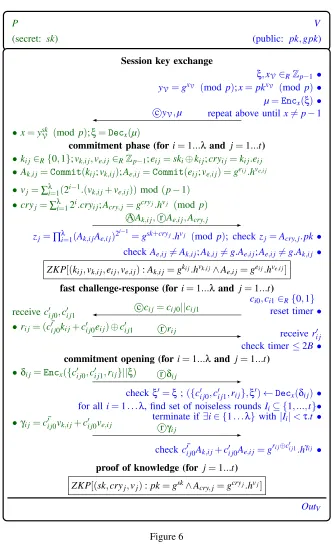
Figure 6(previous page): Πprotocol ofPoxyscheme. Commitis Pedersen commit-ment scheme. (Enc,Dec)is a secure symmetric encryption scheme. ZKPis a zero-knowledge proof-of-zero-knowledge protocol. The notation Aby a message, indicates that the message is considered as commitment ofΣ∗-protocol. The notations cand r indicate the challenge and response messages ofΣ∗-protocol, respectively. cryj is the vector of carry ons in adding the two vectorskjandej.
accept
/
re ject
←
Π
{
P
(
sk
,
pk
)
↔
V
(
pk
)
}
When a prover of a registered userwants to run theDBID.Π protocol with the verifier, they will follow the protocol de-scribed in Figure6.
The current form of the protocol is for better readability. However, the actual order of the messages is in the order ofΣ∗-protocol, that consists of three type of messages: commitment, challenge and response. In Figure6, the messages are mark by three signs; Aas commitment, cas challenge, and ras response of aΣ∗-protocol. If we rearrange the messages (including the messages of ZKP sub-protocols) based on the type, according to Definition2.2, thenPoxy.Πbecomes aΣ∗-protocol.
(
msk
0,
gpk
0)
←
Revoke(
msk
,
gpk
,
i
)
The group manager removes theithpublickey from the setΞ.i.e.,Ξ:=Ξ\ {pki}.
5.1
Security Analysis
In this section we provide the security analysis ofPoxyprotocol.
Theorem 1. Assuming ZKP is aκ-sound (Definition.1) andζ-zero-knowledge au-thentication protocol (Definition.4) for negligible values ofκandζ, and(Enc,Dec)
is an IND-CCA symmetric encryption scheme;
Poxyis(τ,δ)-complete, µ-TF-resistant,γ-sound,α-DF-resistant and zero-knowledge (Definition.4)DBIDscheme for negligible values ofδ, µ,γandα, when t is linear in security parameterλ, andλ.(1−pnoise−ε)>λ.τ≥λ−(12−2ε)dλ2efor some
constantε>0.
Lemma 5. (Completeness). Poxyis a(τ,δ)-completeDBIDprotocol for negligi-ble value ofδ, assuming1−pnoise−ε>τfor some constantε>0and(Enc,Dec)is an IND-CCA symmetric encryption scheme.
Proof. Consider aDBIDgame withPoxyscheme, in which there is no actor, and the provers and the verifier are honest,i.e.,∀x∈P:x.Code=Poxy.Π.P(.)∧d(x.Loc,v.Loc)≤
Dforv∈V:v.Code=Poxy.Π.V(.). The verifier has access to the correct public key of provers. In this proof, we calculate the success chance of an honest prover in aΠ protocol.
let’s assume the verifier sends the challenge sequence [c] = ([a],[b]), where [a] = [a1...aλ], and[b] = [b
∀i∈ {1, ...,λ},j∈ {1, ...,t}: Pr[ai j=a0i j] =1−pnoise. Correspondingly, the prover sends the response sequence[r] = ([d],[e])and the verifier receives[r0] = ([d0],[e0]), where∀j∈ {1, ...,λ},∀j∈ {1, ...,t}: Pr[di j=di j0] =1−pnoise.
After the commitment opening phase, the verifier is able to find the noisy rounds (except with probabilityAdvEnc
Corrthat is negligible). The probability of having at leastτ noiseless fast challenge-response rounds for eachj∈ {1, ...,t}isTail(λ,τ.λ,1−pnoise). As a result, the failure chance of the protocol isttimes 1−Tail(λ,τ.λ,1−pnoise), which is less than e−2ε2λ based on Chernoff bound (Lemma14). And we havet.e−2ε2λ < negl(λ)iftis linear toλ.
Lemma 6. (Distance-Bounding). Poxy is anα-DF-resistantDBID protocol for negligible value ofδ, assumingτ.λ≥λ−(21−ε)bλ2cfor some constantε>0,
Diffie-Hellman key exchange is computationally unforgeable, ZKP is aκ-sound
(Defini-tion.1), andζ-zero-knowledge authentication (Definition.4) for negligibleκandζ.
Proof. Consider a DBID game of Poxy scheme with no actors (i.e., T=0/), honest verifier (i.e.,v∈V:v.Code=Poxy.Π.V(.)) and far-away corrupted provers (i.e.,∀x∈ P:d(x.Loc,v.Loc)>D∧x.Code6=Poxy.Π.P(.)) that might overlap in their execution time (i.e.,x,y∈P:y.St<x.St+exLen(x.Code)≤y.St+exLen(y.Code)).
In a successfulΠprotocol, the verifier getsξ0=ξat the end ofcommitment opening phase, which implies that the prover has the correct value of x, unless negligible probabilityAdvDH
f orge, as the forgery chance of the semi-fresh Diffie-Hellman key ex-change protocol [13], which is used in session key exex-change phase. If the adver-sary succeeds incommitment andproof-of-knowledgephases, then they know a certain{(e0j,k0j)}j=1...t that satisfies “e0j⊕k0j=sk” for all j∈ {1, ...,t}. Therefore, they can efficiently findsk, unless negligible probability(2λ+t)AdvZKPsound+AdvDHf orge= (2λ+t)κ+AdvDHf orge.
Since the value ofskis chosen randomly, then we have Pr[ei j=ki j] = 12fori=1...λ and j=1...t. In a DF attack, any collaboration of far-away provers in sending the re-sponseriis independent from the challenge bitci, according to the fundamental lemma (Lemma 4). Therefore, for the cases thatei j6=ki j(i.e., half of the rounds), the success chance of adversary in sending the correctri j is 12. As a result, the success chance of adversary in guessing the correct responses is limited byTail(bλ
2c,τ.λ− d λ 2e,
1 2)λ, which is negligible based on Chernoff bound (Lemma14).
We prove TF-resistance ofPoxyin Lemma 8 that uses the following lemma.
Lemma 7. (Extractor). Consider aDBIDgameΓwith TF attack (Property 4.4), forPoxyscheme. If there is aΠprotocol in the gameΓin which, the verifier returns OutV =1with non-negligible probability p, then there is a PPT extractor E, that takes the view of all close-by participants, except the verifier (ViewΓ
Proof. (Extractor).Let’s assume there is a TF adversaryAthat succeeds inΠprotocol with non-negligible probability p, i.e., generates a transcriptξ= (A,[c],[r]) that is accepted by the verifier with probabilityp. We construct a PPT extractor algorithmE for the secret key.
In aΠprotocol from gameΓ, the sequence of all challenges[c](slow and fast) is chosen randomly and broadcasted by the honest verifier. We define[r] = [r]f ast||[r]slow and
[c] = [c]f ast||[c]slowwhere the superscripts show the type of the phase of the challenges.
LetS be the event that for alli={1...λ}, and j∈Ii, the verifier’s checkri j⊕ci j1= ¯
ci j0ki j+ci j0(ski⊕ki j)hold true, whereci=ci0||ci1. This can be verified by check-ing success of allZKP’s incommitmentphase, all theZKP’s inPoKphase and all the checks incommitment openingphase. In other words, when incommitment opening phase all checks succeed, we haveri j⊕ci j1=ci j¯0ki j+ci j0(ei j). And when allZKP’s ofcommitmentphase succeed, we have the commitment to every bit ofki jandei jfor i={1...λ}and j={1...t}, that buildszjas the commitment toej⊕kj. And when all ZKP’s ofcommitmentphase succeed, we havesk=ej⊕kj for all j={1...t}. This implies the occurrence ofS.
SinceZKPisκ-sound, we conclude that at least for oneZKPwe have Pr[succZKP|¬S]
≤κ and then Pr[succZKP,¬S]≤κ, where¬S indicates negation ofS. So we have Pr[validξ,¬S]≤κ.
Based on the fundamental lemma (Lemma 4), any valid responseri j that is received by the verifier consists of two parts rF andrS that rF=MsgF→v(t0)(c¬i j) and∃J0:
rS=J0(ViewΓ
S(c¬i j),ci j,MsgF→S(c¬i j)). We haveri j=sum(rF,rS), for a deterministic functionsum()that is determined by the physical communication channel. We assume there exist a deterministic subtraction functionsub()such that for anyx=sum(z,y), we havez=sub(x;y)andy=sub(x;z).
We consider the view of close-by participants before sending the response ri j, i.e., ViewΓ
S(¬ri j), relative to the view of the close-by participants before seeing the chal-lenge ci j, i.e.,ViewΓS(¬ci j). In the time period between receiving the challenge ci j and sending ri j, the close-by participants can receive messages from two different sources: the verifier, and the far-away participants. The only message from the ver-ifier in this period is ci j and we indicate the messages from the far-away partici-pants asMsgF→S(¬ci j)which is independent from ci j. So we haveViewΓS(¬ri j) = ViewΓ
S(¬ci j)||ci j||MsgF→S(¬ci j).
We conclude that there is an algorithmJ0that takesViewΓ
S(¬ri j)and generatesrS, such that the correct responseri jis calculated asri j=sum(MsgF→v(t0)(c¬i j),rS). Note that
ViewΓ
S(¬ri)includes the challengeci j.
Since there is an algorithmJ0that generatesrespi j=J0(ViewΓS(¬ci j)||ci j||MsgF→S(¬ci j)), then we construct the algorithmJthat callsJ0four times for different values ofci jwith the following inputs:respdi j=J0(ViewΓ
S(¬ci j)||d||MsgF→S(¬ci j))ford={00,01,10,11}. As a result,Jreturns{respd
Note that the value ofrFis not known to the extractor.
From the final view of the close-by participants, we can find their partial view at the time of sending responseri jfor all j=1. . .λandi=1. . .t, and then call the algorithm J. So we can calculate(resp00i j,resp01i j,resp10i j,resp11i j)for alli=1. . .λand j=1. . .t, from the final view of the close-by participants.
Since we have sub(sum(resp11i j,rF);sum(resp01i j,rF)) = sub(resp11i j;resp01i j), and sub(sum(resp10i j,rF);sum(resp00i j,rF)) =sub(resp10i j;resp00i j),then for all values ofresp00i j, resp01i j,resp10i j,resp11i j andrF, calculating the difference between the two correct re-sponses for both values of the challenge bitci j0givenci j1, is equal to the difference
betweenresp1i j||ci j1 andresp0i j||ci j1, which are computable from the final view of close-by participants (ViewΓ
S). In the following, we use functionsub⊕(.;.)that is defined as: sub⊕(a;b):=0 ifsub(a;b) =0, andsub⊕(a;b):=1 otherwise.
We build the extractor E as follows: E runs(resp00i j,resp10i j)←J(ViewΓ
S) for all i=1. . .λand j=1. . .t, and findsξi j=sub⊕(resp10i j;resp00i j), and then calculates the key bitsski0=ma jority(ξi j)over j={1...t}.
Note that in a simple case that the received message at receiver is sent from a single source, we havesub⊕(resp10i j;resp00i j) =respi j10⊕resp00i j and also for alld={0,1}we
haverespdi j||1=respdi j||0⊕1. In the following we calculate the success chance of this extractor.
A received responseri jd||bford,b∈ {0,1} is correct ifrdi j||b= (d.k¯ i j+d.ei j)⊕b. For succeeding in theΠprotocol (eventS), for at leastτ.tvalues of j∈ {1...t}the received response should be correct for all values ofi∈ {1, ...,λ}. Since the challenge ci,j is chosen randomly and we assume the secretsk is chosen randomly too, then the distribution of a correct response is uniform. So the messages of far-away provers,i.e., rF, have at most 12 chance of being the correct response. Therefore, for at least τ.t values of j={1...t}, the close-by actors help the prover.
An extracted responserespdi j||0ford∈ {0,1}is correct ifsum(respdi j||0,rF) =d¯.ki j+ d.ei j. We defineRi j∈ {0,1,2}as the number of challenge bitsd∈ {0,1}for which the
extracted responserespdi j||0is correct. If we haveRi j=2 thenξi j=ski, but ifRi j=1 then we might haveξi j6=ski.
ConsiderR= (R1, ...,Rλ)for vectorRi= (R
i1, ...,Rit), whereRi jis defined as above and calculated by comparing the(resp00i j,resp10i j)with correct responses for alli=1. . .λ andj=1. . .t. We define the setRas all vectors in{0,1,2}tsuch that at leastbt
2c+1 values are 2. For a vectorRi∈Rwe haveξi j=ski.
Since the verifier selects the challenges randomly, then knowingRi jallows us to find the probability that the responseri j=sum(respi j,rF)is correct: ifRi j=2 then this probability is 1, otherwise this probability is at most 12 (a response can always be guessed randomly). For anyRi∈/R, at leastdt
in theith round by havingRi∈/ Ris limited by pB=Tail(dt2e,τ.t− b2tc,12), where
Tail(n,k,ρ):= ∑n
i=k n
i
ρi(1−ρ)n−i.
We defineW as the random variable showing the number ofi’s that vectorRi∈/R. So we have Pr[S|W =w]≤pwB. So Pr[S,W=w]≤pwBPr[W =w]and then Pr[S,W≥w]≤ pwB. As a result, we have:
Pr[W ≥w,validξ]≤Pr[¬S,validξ] +Pr[S,W≥w]≤κ+pwB
Each index jwhereskj6=sk0j, corresponds toRj∈/R. Therefore, having the verifier outputtingOutV =1 (i.e.,ξis valid) and the extractor giving at leastwerrors occurs with probability bounded byµ=κ+pwB. This implies that we can build a key extractor fromViewΓ
S that follows the success chance of the TF attack (i.e., p), except with probabilityµ, which is negligible due to Chernoff bound (Lemma14).
Lemma 8. (TF-resistance).Poxyis a µ-(TF-resistance)DBIDscheme for negli-gible value ofµ.
Proof. Consider aDBID game with single limitation of having honest verifier (i.e., V.Code=ID.V(.)). Based on the TF definition (Property4.4), here we show that if there is a non-negligible TF attacker, then these existence impersonator that take the view of close-by actors and succeeds with same chance, except negligible probability µ.
If there is a TF attacker that succeeds with probabilityp, then based on Lemma 7, there is an extractor that takes the view of close-by actors and returns the secret key of prover sk0=skwith success chancep−µfor negligibleµ.
Therefore, the impersonator first runs the extractor and gets prover’s secret keysk0, and then runs the prover protocolP(sk0)with the verifier. The success chance of the impersonator is at leastp−µ.
Lemma 9. (Zero-Knowledge).By assuming ZKP andEncoperations are compu-tationally negl-zero-knowledge, thenΠprotocol ofPoxyscheme with honest prover is a computationally ζ-zero-knowledge protocol according to Definition.4, where
ζ=negl.
Proof. Here we show that inΠoperation, given two participantsP(sk)andV∗(pk,gpk), there exists a simulator S(pk,gpk) such that the view of V∗(pk,gpk) in the inter-actionV∗(pk,gpk)↔P(sk)is computationally indistinguishable from the output of S(pk,gpk). We basically show that there is a simulator that consist of some smaller simulators for each part of the protocol.
SinceZKPandEncoperations are assumed to be computationallynegl-zero-knowledge, then by definition there is a simulator for the view ofV∗after these operations, that only takes the view ofV∗as input and returns an indistinguishable output from the normal case. Now we can remove the prover side ofZKPoperations. The same thing applies to the Diffie-Helman key exchange session. Therefore, the view of adversary is reduced to: ∀j∈ {1, ...,t},i∈ {1, ...,λ}:(Ak,i j,Ae,i j,ri j,γi j,ci j), where the adversary chooses the values{ci j}.
Since the relation betweeneandkis no longer checked by the above removals, then we can make their mutual relation to be random on the prover side.i.e., choosee ran-domly. Therefore both values ofeandkwill be random and the view of verifier in this case is indistinguishable from the case wheneis computed asei j=ski⊕ki j for j∈ {1, ...,t},i∈ {1, ...,λ}. In this modified case, the value ofskis no longer used. Therefore, we can replaceskat the prover with randomness and still be indistinguish-able at the verifier. As a result, we built a simulator that doesn’t use the secret of prover (sk) and produces indistinguishable output from the output of verifier while it’s interacting with real prover.
Lemma 10. (Soundness).Poxyis aγ-soundDBID(Prop4.2) protocol forγ=negl, under the following assumptions; t is polynomial,τ> 12+εfor some constantε, ZKP is aκ-sound (Definition.1) andζ-zero-knowledge authentication (Definition.4) for negligibleκandζ, andEncisζ-zero-knowledge.
Proof. According to theDBIDgame settings, we have some lists of proversPj∈Pthat there is no overlap in the execution time of any listPj, however the provers of two different listsPj6=Pican run simultaneously. The corrupted actorsTare controlled by the adversary. In this game, the adversary succeeds if any of the following is true;
(i) ∃t∈N,∀p∈P:t=Time(OutV=1),t∈/[p.St,p.St+exLen(p.Code)], or
(ii) ∃(p,t)∈(P,N):t=Time(OutV=1),t∈[p.St,p.St+exLen(p.Code)],d(p,V)> D
In this proof, we calculate the success chance of the adversary in both conditions.
Here we introduce two time periods: the learning phase is from the beginning of the game till the beginning of the first session that makes the adversary to win, and the attack session, that is right after thelearning phasetill end of theIDoperation that makes the adversary to win.
Let’s assume the adversary uses{Ae,i j} and{Ak,i j} in the commitment phase of the attack session, which are the bit commitments ofeandk. Let’s assume the response table used in fast phase ise0andk0, which is known by the close-by participant.
In the first condition (i.e., no active prover during attack session), since there isZKPfor all 2λt of the committed values ({Ae,i j}and{Ak,i j}), the adversary should know the committed valueseandk, unless with negligible probability 2λ.t.AdvZKPsound=2λ.t.κ. If
not be able to pass the ZKPof proof-of-knowledgephase, unless with negligible probabilityt.AdvZKPsound=t.κ.
In the second condition (all active provers are far-away from verifier during attack session), based on Lemma9, we know that the close-by participants (actors) have neg-ligible information aboutsk. In this case, for each row of the response table (i.e., the two bitse0i jandk0i j) there is one bit uncertainty (Pr[ei j=e0i j,ki j=k0i j] =
1
2). Otherwise, the adversary would gain some information aboutski. Therefore, by assuming that the challenge bits of fast phase are chosen randomly, then for half of the fast rounds, the verifier sends the challenge value that the actor needs to make a guess for the correct answer. As a result, for each value ofi∈ {1, ...,λ}the success chance of related round
in fast phase is12 t
2−(1−τ)t=1 2
(τ−1
2)t. Therefore, the success chance of the adversary is limited by 2λ.t.κ+t.κ+12(τ−
1
2)t.λ+ζ, which is negligible.
6
ProProx
Scheme [28]
ProProxscheme is a public key DB protocol [28] that fits ourDBIDmodel. We also prove security of the protocol in this model. The details of the operations ofProProx is given below. Letλandnbe the security parameters that are linearly related.
(
msk
,
gpk
)
←
Init(
1
λ)
The group manager initializes a Goldwasser-Micalicryp-tosystem withλbit security: choosesN=p.qand choosesθthat is a quadratic residue moduloN. It also chooses choosesb∈ {0,1}nwith Hamming weight of bn
2c. The group master key ismsk= (p,q); the group public key isgpk= (N,b,θ,Ξ) where Ξ=0/.
(
sk
,
pk
)
←
KeyGen(
msk
,
gpk
)
Assume l−1 users have joined the group andtheir public keys are in the setΞ={pk1, ...,pkl−1}that is published by the group man-ager. For thelthuser, the group manager generates a key pair(sk,pk), such thatsk∈R {0,1}λandpkis the output of a homomorphic and deterministic commitment scheme ComH()onsk= (sk1...skλ); that ispk=ComH(sk) = (Com(sk1;H(sk,1)), ...,Com(skλ; H(sk,λ))), whereCom(u;v)is Goldwasser-Micali encryption (=θuv2 (modN)) and His a one-way hash function. The group manager securely sends the key pair to the new user and adds the public keypkto the setΞ.
accept
/
re ject
←
Π
{
P
(
sk
,
pk
)
↔
V
(
pk
)
}
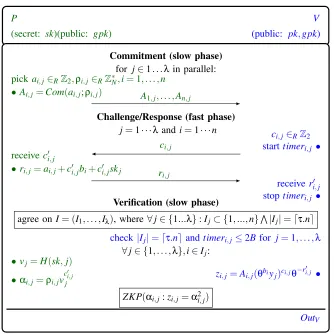
When a prover (Pl) of a registereduser wants to run theDBID.Πprotocol with the verifier, they will follow the protocol described in Figure7.
In the verification phase, the prover and the verifier agree on a listI= (I1, ...,Iλ), where eachIj consists ofdτ.neindices from 1 ton. Both parties believe∀j={1...λ},i∈