Secure Packet Broadcast and Maximizing
the Network Lifetime in MANET
1 CH. Hareesh, 2 N. Naveen
1M.Tech Research Scholar, Priyadarshini Institute of Technology & Science, Chintalapudi, India 2 Assistant professor, Priyadarshini Institute of Technology & Science, Chintalapudi, India
Abstract
—
Mobile ad hoc networks withwireless de-vices supporting multitude of
radio access technologies are witnessing
increasing interest from network providers
and consumers alike. Energy efficiency in
such networks has become an important
design consideration due to the limited
battery life of mobile terminals on one side,
and the ever increasing operational
expenses pertaining to energy expenditure
on the other. In this paper, we present a
routing protocol for multi–radiomulti–hop
wireless networks, which aims to achieve a
trade–off between energy consumption in
the network and routing delay, considering
both the energy consumption at the devices
and the link energy costs. We also present
optimum route-path selection strategies by
defining a utility function to minimize the
energy consumption in the network while
maximizing the network lifetime. Using
simulations, we verify the utility of the
route-path selection strategies and the
efficiency of the energy aware routing
algorithm. It turns out that the proposed
protocol is energy efficient in terms of path
selection, with a slight compromise in the
end–to–end delay.
Index Terms:
Multi-hop networks, energy efficiency, routing, network lifetime,performance evaluation, battery capacity.
I. INTRODUCTION
nergy optimization has been a major concern in the design of routing protocols for multi–hop wireless networks due to the limited battery life of network nodes. As the network interfaces consume significant amount of power, considerable research has been devoted to low–power design of network protocol stacks to ensure the energy efficiency at the device[1][2]. The network–wide energy
efficiency where a largemouth of energy is wasted in maintaining communication links and network connectivity is dealt in [3]. In multi–how wireless networks, energy efficient routing schemes main try to minimize the active communication energy required transmit and receive packets [4]. In many real–time applications, the stringent end–to–end delay requirements demand hybrid routing schemes which balance energy efficiency and QoS optimization. Moreover, transmission rates are shown to have considerable impact on the transmission delay and transmission distance, together with the transmission power, which can also influence energy aware routing mechanisms [4][5]. The heterogeneity of available
This work was partly supported by the EU-FP7 ICT-248577 C2POWER project, funded by the European Commission wireless interfaces at the network devices also affects the energy efficiency of the routing protocols. Localized energy optimization is not an acceptable strategy for multi–hop wireless networks equipped with multiple wireless technologies, where power consumption at the device or over a specific link is not an accurate metric to assess the overall energy efficiency from a network– wide scale for data forwarding over multi– hop links [6]. However, there are only few studies on energy-aware rout-ing for multi-radio heterogeneous wireless networks which consider the balance between QoS and energy efficiency [4][7][8][9][13]. Most of these algorithms focus on maximizing the network lifetime when dealing with route requests without latency constraints, where
The rest of the paper is organized as follows. Section 2 introduces the system model and problem definition. In Section 3, we present the optimum path selection strategies that support the routing framework. Section 4 presents the proposed energy aware routing technique. Section 5 discusses the performance evaluation and finally, we conclude the paper in Section 6.
II. NETWORKMODEL
In this section, we present the multi– radio heterogeneous wireless network model that we consider in this work. Figure 1 depicts the considered network model with multi–radio interfaces between nodes and the corresponding energy link costs [6]. The routing strategy for this network model also cons idlers the multiple link options per node–pair (and the corresponding energy link cost) to route the packets. Note that the energy cost per link option may vary with time depending on the channel gain variation over time. In the energy aware model, we only consider the residual battery lifetime of the wireless nodes and the energy link cost related to the data transmission process. The energy link cost relates to the required power to transmit the data from a transmitter to a receiver over a distance, the corresponding data rate and the length of the information to be transmitted. Our goal is tomaximize the energy efficiency in communications, pertaining to the routing of information and overhead related to maintaining the route topologies. To focus on the communication energy reduction, in our model, we consider a systemic decay of the battery capacity at the mobile nodes for
energy spent on other physical and application level processes. Since our main objective is to propose a routing protocol for multi–radio heterogeneous wireless networks, the details on how to coordinate transmissions with multiple radios are beyond the scope of this paper. Therefore, we assumed that (a) MAC layer technologies are implemented independently for each interface and (b) the nodes in the network are using the common interface over the same frequency channel.
III.OPTIMUMROUTE-.
PATHSELECTIONSTRATEGIES
given environmental condition at a given time, which could vary in practice with time depending on node mobility and changing
Channel conditions. We consider a time period where the network environment shows no significant changes during the route discover process, and as mentioned before any changes in the network are reported periodically for route maintenance after the discovery process. LetN(k)2Nbe the total number of nodes per route–pathk, where k= 1;2;:::K. Furthermore, the n(k) the link and the n(k) the node in the route–path has the information metric (n;k), described by the pair (n;k) =fE(n;k);T(n;k)g (1) where,n(k) = 1;2;:::N(k), the element E(n;k)2R + is the energy cost for then the link in the k the path, and(n;k)2R+is the estimated residual lifetime (remaining lifetime) of the n the node in the path if the route is selected by the destination Das the selected route path. Note that(1;k) for all krefers to the residual lifetime of the source node itself, the knowledge of the residual lifetime of the source node is important if the destination node is required to choose the strategy to minimize the link energy cost for the first hop to increase the lifetime of the source node itself. It is important to note here thatsimultaneous optimization of the total energy link cost and the network
lifetime may not be possible always since in many cases one needs to be sacrificed instead of the other that is to be traded–off. Hence we try to find a good trade-off between the two cost parameters based on some internal policies. If is the trade-off factor then we can define a utility function given by U1 (k) = N(k) X n=1 E(n;k) +1 minfT(n;k); 8n6= 1g m(2) where,0 1;8 2 R + . Then the corresponding optimum path for a given is obtained by minimizing the utility function given by, ^ k= arg min k fU1 (k)g (3)
for
all the participating links given by, =N(k)Xn=1K Xk=1E(n;k) (4)the second term of U1(k) can be normalized with the inverse of the current network lifetime, where the network lifetime is defined as the residual lifetime of the node corresponding to the lowest residual lifetime in the network, given by, = maxfT(n;k) 1 8n;kg (5) The utility function based on the normalized values is then given by, U1(k) = N(k)Xn=1E(n;k) 1+(1 )1minfT(n;k); 8n6= 1g(6)Based on (6), now we can say that for a given value of, total energy link cost is traded–off with the network lifetime with a quantitative measure of. Note that andwill change over time but such changes however would not affect the optimization process.
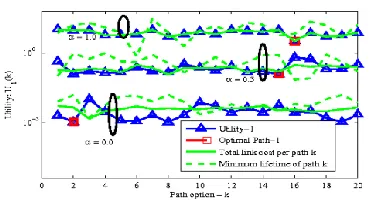
Figure 2 depicts the strategy related to the utility functionU1 (k) for =f1:0;0:5;0:0g, note that the cases = 0:0 and 1:0 are scaled appropriately in order to fit all the three cases (for ) onto the same figure. As we observe from thefigure, for= 1:0the destination node selects the route path(k= 16in the figure) corresponding to minimum energy cost regardless of the values T(n;k) for all n;k.For = 0:0on the other hand the destination node selects the route path
corresponding to the path (k= 2in the figure) that has the node with the maximum lifetime of the nodes with minimum residual lifetime per path k, Finally, for = 0:5 the route path corresponding to k = 15is selected by quantitatively giving equal emphasis to the network lifetime and the total energy link cost. For the case of = 0:5we can see that the chosen path does not correspond to maximizing the network lifetime nor minimizing the total energy link cost, but tries to achieve both the requirements to some extent at the same time defined by the value
.
IV. ENERGYAWAREROUTING
the cooperative behavior of wireless nodes in heterogeneous networks [6]. Secondly, unlike the on– demand approach where the destination node choosing the first arriving route request packet with minimum hop count [12], the destination node in EAR considers all the RD Ppackets received within a pre–defined time window to estimate the most energy efficient path without compromising the end–to–end path delay to ensure adequate QoS for the flows.
During the route discovery process, each intermediate node piggybacks the energy related metrics (such asthe remaining battery level, energy cost per bit, etc.,) as well as its identity on the RDP message and forwards the packets (re-broadcasts). The destination node receives multiple RDP packets, but chooses the best route with respect to the optimum route path selection strategy chosen by the destination (as explained in Section 3). The destination node upon receiving the first RDP packet will issue a time out period within which it will listen to and receives all the RDP packets with the respective identifier. The route discovery process and the path information aggregation approaches are shown in Algorithm.
1and Algorithm. 2 respectively.Algorithm 1Route Discovery Process
Message depending on its remaining battery capacity. When it is higher than a threshold value, the RDP is forwarded; otherwise in the case of the battery capacity dropping between secondary thresholds, the RDP will be forwarded only on the minimum power interface, and lastly upon exceeding the secondary threshold, the packet is dropped. This will ensure that the destination is receiving the RDP packets only through the best available links and through nodes with a minimum available battery capacity.
Eventually, in the event of the entire network nodes below a particular threshold, to ensure that the data forwarding process is still active, the revised RDP(in case the source does not receive a route to the destination for a period of time) will be sent with a higher sequence flag to ensure that the nodes use arevised threshold for the battery capacity. At this moment, we adopt similar route maintenance approach as in DSR [12] using the Route Error Reply (RER) packet sent to the source node upon discovery of broken links at intermediate nodes.
V. SIMULATION RESULTS
wireless device is considered to have dual interfaces and B, and we used a transmission power between (60–80)mW for interface And (40-50)mWfor interface B. In order to send 1800unicast packets from10source nodes to 10destination nodes, the application layer sent a UDP data flow (1 packet each 1s with a packet size of1000 bytes). Therefore, the scenario has considered10data flows existing simultaneously. Atthe network level, we implemented two routing protocols (i) Dynamic Source Routing (DSR) [12] and (ii) Energy Aware Routing (EAR) in order to compare the network performance. The parameters used at the MAC layer are according to 802.11 and CSMA/CA standard protocols for interface And B respectively. Results shown in this paper are the average of 10 runs in order to present reliable results. We would like to remark that for all simulated cases the packet loss was 0%.
time–out value has low impact on energy consumption of the network while has a higher impact on energy consumption
of the network as expected. To understand the impact on network lifetime, we fix the RDP–time–out value to2sbased on the results from Fig 4. The results in Figure 5 show the residual lifetime density the nodes. From the figure, the initial condition is simply the value of battery capacity at the beginning of the simulation. For the other results, the residual lifetime density was calculated using the remaining battery capacity in the nodes after 1800 transmissions. We can observe from the results that for EAR, the network residual lifetime density is narrower than in DSR, which means that more nodes in the network have better lifetime as we desired. Figure 6
topology of our scenario. Consequently, there are fixed latency values between the nodes and thus the latency values vary around specific values. Finally, we repeated the simulation by varying the positions of the nodes randomly for the same parameters for differen network topologies. Fig 8 shows the total energy consumption of the network using 10 different network topologies for DSR and EAR. The results show that the EAR protocol is more efficient than the DSR protocol in terms of energy consumption. For the network topology number 7;8 and 9 the energy consumption in EAR protocol with = 0is larger than the energy consumption with the DSR protocol. This is due to the fact that, the strategy related to the utility function U1 (k) for = 0is to maximize the network lifetime rather than the energy consumption.
VI. CONCLUSIONS
We investigated the problem of finding energy–efficient routing paths to minimize the energy consumption and maximize the overall network lifetime in heterogeneous multi-hop wireless networks with multiple radio nodes. We proposed an on–demand energy aware path selection mechanism which was shown to optimize the energy consumption at the nodes participating in routing packets in the network. The proposed routing mechanism was evaluated under various scenarios and the results show the applicability of our algorithm in the context of multi–hop networks with multiple interfaces which can help the participating nodes in optimizing their energy performance. Moreover, the
path selection strategies were evaluated for their utility in the context of energy–aware routing. Finally, the results show that EAR performs around 30%–50% better than the DSR protocol in terms of energy consumption and lifetime. We are currently evaluating multiple path selection strategies and their influence on the different routing approaches to identify the trade–offs with the choice of the policies and deciding parameters in choosing route paths. Because,the choice of the value may be an interesting topic for better performance of the proposed routing protocol. Moreover, we are currently extending the EAR approach to mobile network scenarios in order to investigate the correlation between the routemaintenance measures and the route path selection strategies in mobile environments.
REFERENCES
[1] F. Meshkati, H. V. Poor, S. C. Schwartz, and N. B. Mandayam. Anenergy-efficient approach to power control and receiver design in wirelessnetworks. IEEE Trans. Commun., vol. 5, no. 1, pp. 3306-3315, Nov. 2006.
[2] N. Feng, S. C. Mau, and N. B. Mandayam. Pricing and Power Controlfor Joint Network-Centric and User-Centric Radio Resource Management. IEEE Trans. Commun., vol. 52, no. 9, pp. 1547-1557, Sep. 2004.
[4] Q. Li, J. Aslam, and D. Rus. Online power-aware routing in wireless Ad-hoc networks. In Proceedings of MobiCom ’01. ACM, New York, NY;97-107.
[5] W. Yang, W. Liang, J. Luo, W. Duo. Energy-Aware On-line Routing withQoS Constraints in Multi-Rate Wireless Ad Hoc Networks. IWCMC, July2010; 721-725.
[6] URL of C2POWER Project http://www.ict-c2power.eu
[7] S. Lindsey, K. Sivalingam, C.S Rahgavendra .Power optimization inrouting protocols for wireless and mobile networks. Wireless Networksand Mobile Computing Handbook, Stojmenovic I (ed.), John Wiley &Sons: 2002; 407-424.
[8] D. Qiao, M. C. Gursoy, S. Velipasalar. Energy Efficiency of Fixed-Rate Wireless Transmissions
under QoS Constraints. IEEE International
Conference on Communications, ICC 2009.
[9] K. Kar, M. Kodialam, T. V. Lakshman, L.
Tassiulas. Routing for NetworkCapacity
Maximization in Energy-constrained Ad-hoc
Networks. IEEEInfocom 2003; 673-681.
[10] G. Zussman, A. Segall. Energy Efficient Routing in Ad Hoc DisasterRecovery Networks. IEEE Infocom 2003.
[11] A.E. Khandani, J. Abounadi, E. Modiano, and L.
Zheng. Cooperativerouting in static wireless
networks. IEEE Transactions on Communica-tions, 55(11):2185-2192, November 2007.
[12] B. Johnson, A. Maltz, and Y. Hu. The Dynamic Source Routing Protocol for Mobile Ad Hoc Networks. IETF INTERNET DRAFT, 24 February 2003.
[13] T. Rasheed, K. Al agha, U. Javaid and L. Reynaud. Cluster-quality basedhybrid routing for large scale mobile multi-hop networks. in Proc. IEEE WCNC April 2007, pp. 3052-3057.