Itsuku: a Memory-Hardened Proof-of-Work Scheme
Fabien Coelho and Arnaud Larroche and Baptiste Colin [email protected]
MINES ParisTech, PSL Research University
Version 1.51 on November 29, 2017
Abstract
Proof-of-Work (PoW) schemes allow to limit access to resources or to share rewards for crypto-currency mining. The MTP-Argon2 PoW by Biryukov and Khovratovich is loosely based on the Argon2 memory-hard password hashing function. Several attacks have been published. We in-troduce a new transposed parallel implementation attack which achieves higher performance by circumventing apparent bandwidth requirements. We then present Itsuku, a new scheme that fixes known issues by changing MTP-Argon2 parameters and adds new operations to improve memory hardness. Our scheme is built on a simple security criterion: any implementation which requires half the memory or less should induce at least a×64 computation cost for difficultyd≤100. The Itsuku proof size is typically1/16th of the initial scheme, while providing better memory hardness.
We also describe high-end hardware designs for MTP-Argon2 and Itsuku.
Contents
1 Introduction 2
2 The MTP-Argon2 PoW 2
3 Attacks on MTP-Argon2 5
3.1 Raw Recomputation Attack . . . 5
3.2 Memory Saving Attack . . . 6
3.3 Pseudo-Random Array Attack . . . 6
3.4 Dinur-Nadler Precomputation Attack . . . 6
3.5 Parallel Searches Attack . . . 8
3.6 Hash Composability Attack . . . 8
3.7 Parallel Function Attack . . . 8
4 The Itsuku PoW 9 5 Software and Hardware Implementations 14 5.1 Software Implementations . . . 14
5.2 Hardware Implementation Hypotheses . . . 15
5.3 Direct Approach Hardware . . . 15
5.4 Half-Array Compression Attack Hardware . . . 16
5.5 Parallel Search Hardware . . . 16
5.6 Dinur-Nadler Attack Hardware . . . 17
5.7 Hardware Implementation Evaluation . . . 17
6 Memory-Hard Crypto-Currency PoW Schemes 19 6.1 CryptoNight . . . 19
6.2 Wild Keccak . . . 20
6.3 PoW Schemes Comparison . . . 20
7 Conclusion 21
1
Introduction
Proof-of-Work (PoW) functions [16] must be hard to compute but easy to check. There are challenge-response (interactive) and solution-verification (no direct interaction between prover/miner and veri-fier) protocol variants. Their hardness may be based on computations, memory accesses [3, 4, 15, 11, 19] or possibly other criteria. Memory-hardness claims have been made about latency, bandwidth or amount of memory required for a task. In the context of crypto-currencies, the solution-verification PoW scheme is an essential building block that allows to distribute the rewards between miners that maintain the distributed ledger, a.k.a. blockchain. Finding schemes for which ASIC or FPGA hard-ware implementations do not show an undue advantage over CPU or GPU softhard-ware implementations is key to avoid the kind of mining power concentration that has occurred with Bitcoin. When ASICs are considered, requiring significant memory is considered a good deterrent.
We first describe and comment the initial MTP-Argon2 PoW scheme (Section 2). It shows a high memory requirement for the solver, but a much lower one for the verifier. This differ fundamentaly from memory-hard password hash schemes such as Argon2 [5] which require the same amount of memory on both sides. We then discuss in depth the various known attacks and present new ones (Section 3). This leads us to propose the Itsuku PoW, which fixes all known attacks (Section 4). The expected software and hardware performance of MTP-Argon2 and Itsuku implementations are discussed (Section 5). We then compare different memory-bound schemes (Section 6), before concluding (Section 7).
2
The MTP-Argon2 PoW
TheEgalitarian Computing paper [9] presents Proof-of-Work schemes loosely based on the Argon2 [5] memory-hard password hashing function. It includes instantiation settings for crypto-currency appli-cations, time-lock puzzles and disk encryption. Although the Argon2 function could be used directly for such purposes, its very high single-execution computation and memory cost is prohibitive for the verifier: Schemes displaying smaller verifier cost but yet requiring large memory are sought. We focus on the PoW scheme introduced in the paper and the proposed crypto-currency instantiation.
The PoW construction builds a Merkle tree over an array and pseudo-randomly selects a subset of the leaves based on the root hash of the tree as proof of computation, similarly to [12]: The feedback loop means that changing inconvenient leaves requires recomputing the root hash, thus would change the leaf selection. If enough leaves are provided, it ensures that most of the Merkle tree has been computed. However, unlike [12], the array is quite large and the PoW does not end at the Merkle tree, which is expected to be a small part of the PoW. It adds a classical iterative partial hash inversion search on top of the construction, which also depends on the contents of the large array. The idea is to enforce some memory-hardness property by showing that the array was mostly computed, stored and used in a large iterative search. The naming of the scheme (MTP-Argon2 PoW – Merkle Tree Proof Argon2 Proof-of-Work) seems unfortunate, as the Merkle tree aspect of the proof is not directly related to the PoW scheme itself and it does not actually use the Argon2 function.
The following notations are taken from [9] and re-used: I, challenge identifier, e.g. a 32 or 64 bytes hash of something.
T, number (power of 2?) of array elements of size x.
L, length of one search, which induces the proof size and verifier cost.
d, difficulty of the PoW, i.e. number of expected binary zeros at the beginning or end of the final hash value. In practice, a target limit value is rather used (i.e. final hash Ω< t≈2S−d) so that difficulty changes are continuous: dmust not be assumed strictly as an integer.
Hs(x), a variable-size (sbytes) cryptographic hash function. The paper uses BLAKE2 [6] (1≤s≤64)
complexity purposes with BLAKE2, we count a unit of cost per 128-byte block of input data, which encompasses 12 calls to the underlying compression function G.
x0 =P(x), Permutation P. It performs 8 calls to compression functionGloosely based on BLAKE2 internal round function (Annexe A of [5]). It takes 128 bytes at a time and uses 64-bit add (+64)
and xor (⊕64), 32-bit input 64-bit result multiplication (∗32 – deemed expensive on ASIC), circular 64-bit shift (x) and left 64-bit shift (a.k.a. multiply by 2) operations.
B0 =F(B0, B1), a compression function taken from Argon2 that takes two 1 KiB inputs, produces
one 1 KiB output, and which relies on 16 calls to PermutationP internally (Section 3.4 of [5]). Total computation cost is about 16·8 = 128 compression function calls, or aboutcF = 12812 ≈11
BLAKE2 128-byte processing calls.
φ(i), a contextual indexing function that depends on the current iteration, on the phase of the com-putation, on the data-dependent (d) or independent (i) variant, on the degree of parallelism. . . The data-dependent variant has a quadratic bias, so that array accesses are less unbalanced in the initial array-building sweep. Indexing functionφ relies on the previous element and implies an integer modulo operation to select an element among the already computed ones, i.e., we have: φ(i) =φd(X[i−1]) mod (i−1) (where φd is a data-dependent function).
We describe MTP-Argon2 with a few changes from the original paper so that the algorithm is well defined; some redundancy is removed, the array and variable indexing starts from 0 following usual conventions, and some implicit choices are made explicit.
FromI,L andd, we compute:
1. Build memoryX[0. . . T −1]:
(a) X[0. . .1] =H2x(I)
(b) X[i] =F(X[i−1], X[φ(i)]) fori≥2 and with 0≤φ(i)< i−1
2. Compute Merkle tree root hash Φ ofX withH16
3. Choose nonceN
4. Y0 =H16(ΦkN)
5. For 1≤j ≤Lcompute:
(a) ij−1 =Yj−1 modT
(b) Yj =H16(Yj−1 kX[ij−1])
6. IfYL has at leastdtrailing binary zeros, the PoW search ends, otherwise go to Step 3
7. Final output is (N,Z) where Z is the opening (a.k.a. Merkle Tree Proof) of the L memory antecedents of X[ij], namely X[ij−1] andX[φ(ij)] ifij ≥2, orX[ij] ifij <2.
Search State Size Within the search loop, the search state is the current values of nonce N (say 11 bytes), iteration j (1 byte) and current hash Y (16 bytes), that is about 28 bytes. This is quite small and allows efficient parallel searches as discussed in Section 3.5.
Complexity The computation complexity in hash-block calls is 232x+cF(T−2) + (cX+ 1)T−1 +
(cXL+ 1) 2d ≈ (cF +cX + 1)T +cXL2d ∝ cF+ccXX+1T +L2d ≈ 2.3T +L2d. The first part is the
Partial Dependency on Challenge The Merkle tree proof part of the PoW in [9] is expected to show that most selected array elements are such that X[i] = F(X[i−1], X[φ(i)]) holds. This is a local property which does not depend on the challenge; thus it does not follow that these elements were computed from the provided challenge, nor that they were stored in memory instead of being possibly recomputed when doing the iterative search. Reusing a previous instance can work, as taken advantage of by the Dinur-Nadler attack discussed in Section 3.4. This issue can be addressed by using the challenge in hashes at every step of the computation, both when building the array and in the search loop.
Merkle Tree Openings Phase 7 provides the separate openings of the antecedents of the selected array elements, but does not include the selected elements themselves. One merged opening for all leaves can be proposed instead, which would reduce the number of nodes to provide, hence the overall proof size. Moreover, letting out the selected array elements allows the very efficient pseudo-random array attack (Section 4.1 of [14], described in Section 3.3). The selected array elements must also be included in the opening.
Crypto-currency Instantiation The instantiation for crypto-currency, called MTP-Argon2 in tion 4.5 of [9], uses the Argon2d (data-dependent) variant with 4 parallel lanes (discussed in Sec-tion 3.7), uses hash funcSec-tion BLAKE2 [6] forH, usesH16for the Merkle tree,T = 221so that arrayX
is 2 GiB, andL = 70, which leads to 225.3+ 2d+9.3 hash-block operations and 222.6+ 2d+6.1 memory accesses on X. The choice of hash function BLAKE2 for a memory-hard PoW seems reasonable: it uses about half cycle-per-byte compared to SHA-3, which, for memory-hard PoW purpose where the expectation is to emphasize memory accesses, seems appropriate.
Time-Area Proof A proof based on a simple abstract analytical model [9] suggests that, with the chosen parameters, ASIC implementations can be shrinked by a 1/12 factor at most. However, this
proof has some drawbacks. This time-area cost analysis does not take into account efficiency properly. It focusses on area and time involved between computing cores and DRAM, whereas our hardware analysis in Section 5 shows that the performance bottleneck of a hardware implementation is memory bandwidth, which does not appear in the model (Equation (4) in [9]), although it is said that it could have a contribution. Moreover, our implementations show performance threshold effects on parallel implementations between slow off-die DRAM and faster on-die SRAM once the array can fit, that are not represented by the simple model. The proof is based on 64 KiB DRAM memory area being equivalent to one hash core, whereas our 4T SRAM implementations rather have 64 KiB equivalent to over five cores, allowing significantly more computation power by substituting. The proof seems to assume that a cheating test failure costs as much as a non cheating test failures ((1−ε)−L factor), which is not the case, as a cheating failure can be detected early when an unavailable block is required, as outlined by Equation (5) where 9 iterations are needed to provide over×26security for a half array. Finally, the proof is not linked to the PoW structure and does not prevent the many attacks presented in Section 3. These drawbacks make us believe that a simple time-area analysis does not reflect the performance and cost tradeoffs of efficient MTP-Argon2 hardware implementations.
Choice of Length The proposed lengthL looks somehow arbitrary. It is partially justified by the time-area proof discussed previously. The final proof size and verification cost are proportional toL, so the lower the better. Other security criteria push towards a reasonably largeL. First, it should be large enough so that computing only a fraction of X impairs the search algorithm significantly, but for that constraint a much smaller L could be chosen. Equation (2) in [12], for a related problem, provides a relative cost lower bound for a provable Merkle tree computation that depends on the required number of proofs 2L, the number of leavesT and the fraction f of the array that has been computed, so that
L≥ −1
ChoosingL= 70 is consistent with this formula forf = 0.9. We discuss in Section 4 conditions under which a much smaller length Lmay be picked.
Constraints on Difficulty For the search to be as progress free as possible, that is to allow available computing power to contribute easily to mining, the array initialization phase must be negligeable,
i.e., 2.3T L2d, which leads to d > 16 ≈ log22.3 + log2T −log2L. A trivial constraint is that difficulty d is smaller than the hash size it targets, the limit of the partial inversion being a full inversion of the hash function, thus d ≤ 8·16 = 128. The actual choice for d between 17 and 128 depends on the implementation speed, available computation power, and desired frequency of finding a solution. For reference, as of Octobre 2017 bitcoin mining typically requires about 272 relatively inexpensive SHA-256 operations for each block1. A working memory-hard scheme would be expected to be significantly harder. If we focus on computation only, BLAKE2 hardware efficiency is similar to SHA-256 [18], and one candidate hash with default settings requires 631 invocations, so the relative computation ratio over Bitcoin’s SHA-256 is about 29.3. Itsuku (Section 4) involves 15 hash calls (23.9 computation ratio). A somehow large mining power operation where dozen millions of cores would compute one billion candidate hash per second and find a hit every few minutes leads to d≤70. In the following, we will assumed≤70 as large but still realistic andd≤100 as conservative.
Proof Size The PoW is composed of 2L1 KiB array elements and their associated per-leaf openings. With 16 byte hashes, the MTP-Argon2 PoW size is about 16+L·d18log2Te+2·L·1024+2·L·log2T·16 bytes (first a rounded nonce, then selected leaf indexes, followed by their antecedents, and finally their openings). This leads to 186 KiB, three quarters of which are array elements. Such a size is a significant burden on the crypto-currency chain that we will aim at reducing.
Number of Antecedents The proposed scheme suggests to include one-level antecedents of the needed array elements. The scheme could have considered going multiple levels, e.g. two levels and recomputing both levels, or the array element could depend on more previous array elements, i.e.
X[i] =F(X[φ0(i)], X[φ1(i)], . . . , X[φn−1(i)]). (1)
Adding dependencies increases the cost of some attacks, but it also enlarges the proof size unless L can be significantly reduced. We will investigate such option carefully.
3
Attacks on MTP-Argon2
We discuss various attacks on MTP-Argon2. We measure the benefit of an attack as a couple (f, σ) withf the needed memory as a fraction of the standard implementation memory andσ the associated computation cost as a multiplier of the standard implementation cost. This criterion allows to choose parameters so as to provide a uniform security margin. We propose that for a memory-hard PoW function, any scheme requiring half the memory or less f ≤ 12 should induce a significantσ ≥64 cost multiplier for conservative difficultyd≤100. These values result in quite inefficient hardware attack implementations, as shown in Section 5.
3.1 Raw Recomputation Attack
A baseline attack that breaks the memory requirement is simply to recompute each value when needed, recursively following dependencies. This seems to requires about log2T
log21.5 elements space. The cost of
computing theith element is aboutci ≈1 +ci−1+c2
3(i−1), as it depends on its previous element and
on a pseudo-randomly chosen one with a biased selector, and starting from c0 = 0, c1 = 0, c2 = 1.
This sequence growths steadily; the average cost per element with the default parameters is 2263.1
1BTC block height 488101 hash [1] is
calls toF (per a numerical simulation). The attack benefit is about (≈0.0, cF ·2263.1): no memory is
needed, at the price of many computations.
3.2 Memory Saving Attack
Section 4.2 in [9] presents amemory savingattack and argues that the resulting space-time complexity is prohibitive for significant compression.
Let us consider f = 12 compression of array X where one in two elements are discarded. When running the search loop, the prover has 50% probability that a needed element is available and can be processed directly, and 50% that is must be recomputed. The recomputation cost is it to applyF on the available previous element and theφ(i) element, which may in turn be available or not, and so on recursively. The average recomputation cost in F calls is: 12 ·0 +12 ·1 +14 ·1 +. . .≈1. The average number ofX accesses is: 12 ·1 +12·23+14·32+. . .≈2. For a limited recomputation cost, the memory requirement can be halved. This attack benefit is (0.5,≈ cX+cF
cX ≈2.2): half of memory is saved but
accessing an array element costscF on average instead of 0, which impacts the overall search cost.
This cost increases very quickly when the memory saving is increased further (Section 5.1 in [5]). The resistance to memory compression can be improved by making F rely on more antecedents, as outlined in Equation (1).
3.3 Pseudo-Random Array Attack
This attack is described in Section 4.1 of [14]. As the openings provided by the MTP-Argon2 PoW do not include the selected array element themselves, they do not need to belong to the Merkle tree; hence the tree may not be based on F.
Consider building a pseudo-random array from some cheap PRNG, e.g. X[i] = R(i), compute its Merkle tree root, then at Phase 5b build a fake element from regenerated antecedents X0[i] = F(R(i−1), R(φ(i))). The proof is accepted because antecedents do belong to the Merkle tree and the F property on the selected array elements holds. A suspicious verifier may detect such an attack if a selected array element is also an antecedent of some other selected array element. This check has a low 2LT2 success probability and can be easily avoided by the prover. Also, if an odd array element is selected, then its even predecessor opening should include its hash, which can be checked by a verifier. If performed, the probability of this check to detect an issue is (1−1
2 L
), which is very high if L is large. The efficiency of this attack is about (0.0,≈ cX+cF
cX ): no memory is needed, but one call toF
is needed on each array accesses. This attack also works with a challenge-specific function F. The selected array elements and all their antecedents must be included in the collective opening, so theF property is shown to hold within the Merkle tree itself.
3.4 Dinur-Nadler Precomputation Attack
A detailed and theoretically convincing cheating attack is presented in [14], which is somehow a clever application of the block modification attack (Section 4.2 in [9]) with an added twist to allow recomputing many blocks instead of storing them, at the price of some precomputations.
cost, at the price of a more expensive search (Section 5.1 of [14]). We will not consider this trade-off as our analysis is mostly driven by the search phase cost.
The special arrayX construction involves pre-computing suitable control blocks so that all follow-ing (t−1) blocks depend on the preceding block or another available control block. In [14] the cost of this precomputation for each T /t sequence is evaluated to tt−2 calls to F, that is an overall chain precomputation cost T·tt−3 (Equation (7) in [14]). We refine this evaluation to
cF · t−2
X
i=1
i(t−1)t−i+ (t−2)t(2−t) !
·tt−2·T
t =cF ·
1 + 1 t−1·
1− 1
tt−3
·T·tt−3 (2)
which countsF costs. The summation computes the cost of failing to find a sequence afteriiterations starting from a chosen control block, weighted by their probability. The second term is the cost of the one that succeeds. The last block does not need to be computed; it is sufficient to know that its dependencies are available. The following term is the number of expected iterations to find one sequence and the final one the number of sequences to compute. The main term is the same as the approximation provided [14].
When considering the search algorithm, the probability of finding available blocks on a partial array X is reduced in the iterative search to (t−t1) at each stage, which ends up being quite costly if t is small as only (t−t1)L iterations succeed in computing a final hash. The F calls cost to compute oneYL is evaluated to cF ·t·2t ·(t−t1)L (Equation (9) in [14], witht the average number of iterations
alongL,2t the average cost of recomputing a block, and the last term the expected number of attempts to compute one hash). This search cost can be refined, based on cF and cX costs, with the formula
L−1
X
i=0
1 +
cX +cF
t 2
·i t−1 t i 1 t + 1 +
cX +cF
t 2
·L t−1 t
L! ·
t t−1
L =
cX +cF
t 2
(t−1) + 1
·
t t−1
L −1
!
+ 1 (3)
The summation computes the cost of stopping when computing Yj because a control block is found,
with probability 1t, for which the attacker does not have suitable antecedents to produce as proof. The second part is the cost for the computation that got through the whole loop. The final term is the expected number of attempts to get one final value. Again, the main term is the same as [14].
Although the attack pre-computation cost seems prohibitive, in the context of a crypto-currency the reward could also be large, especially as it only needs to be done once and can be reused afterwards indefinitely. although the special array would be leaked when providing openings which each include many control blocks. In order to thwart this attack, a simple counter measure, not mentioned in [14], is to makeF depend on the challenge so that precomputations have to be performed for each challenge.
t log2 Eq (2) d+ log2 Eq (3) 5 29.41 d+ 29.73 10 47.86 d+ 19.81 15 71.44 d+ 17.28 20 98.01 d+ 16.28 25 126.68 d+ 15.82 30 156.99 d+ 15.58 35 188.64 d+ 15.47 40 221.41 d+ 15.41 45 255.15 d+ 15.40
Table 1: Dinur and Nadler Attack Cost Numerical Evaluation in Hash calls
resulting scheme would really be beneficial depends on the specifics of the implementation and the expected usage pattern. For the proposed parameters, the best achievable search cost is at least d+ 15.4, that is about 215.4−9.3 = 26.1 ≈ 68.4 more BLAKE2 calls2 compared to the non-cheating search. The attack benefit, without taking into account precomputation costs, which are assumed amortizable over many challenges, is (≈0.0,68.4): almost no memory is needed, but at a significant cost. We show in Section 5.6 that such multiplier makes the attack only weakly beneficial even with favorable assumptions. The attack is avoided if several antecedents in the array construction are chosen with data-independent functions. It is also mitigated by a challenge-specific F which makes precomputations to be recomputed for each challenge.
3.5 Parallel Searches Attack
Memory hardness has been sought for based on latency, bandwidth and size.
Latency is usually significant when computing just one memory-hard function. However, when doing an extensive search, such as in password enumeration or PoW, several passwords or nonces can be evaluated together and the latency of one is masked by the computation of others, so that the key limiting factor is really memory bandwidth [11], at least when the memory size required is larger than the available cache. Thus bandwidth [19] and possibly cache hit ratio are the relevant factors for miners who want to compute the hash function on a set of nonces. When under a memory bandwidth bottleneck, the prover is interested in performing more computation per loaded data, or with data already available in cache. To do that, the search paradigm can be transposed so that instead of fetching array X elements needed for updating the Y value for nonces, it rather fetches or uses the current Y values for which the array elements are available, and scans the array in a round-robin fashion so as to make all parallel searches progress. This algorithmic change is profitable if the search state for a nonce is small compared to an array element. A possible hardware implementation of such a solver is outlined in Section 5.5, with either a limited number of search states kept on-die or a large number stored in external memory. This issue is avoided if the search state is larger than array elements. This also impacts ASIC design if threads are needed to mask memory access latencies and the search state must be replicated.
3.6 Hash Composability Attack
The composability property of hash functions may change the memory requirements significantly. Hash functions use an internal state that is updated as block of data are put in to be hashed, and the actual hash extract part or all of this state. The initial state isHα, the final extraction isHω, and the
Hπ(block) is the state updating function, so that for instanceH(B1 kB2) =Hω◦Hπ(B2)◦Hπ(B1)◦Hα.
When using such a composable hash function for memory hardness, a potential issue is that initial blocks may be preprocessed so that only the hash function state needs to be kept and the actual block content can be discarded, replacing a large memory block by a smaller hash state. In order to avoid this issue, it is important thatH(x, y) in [9] is really implemented as H(xky) and that on each call parameters are sorted so that the most recently known value is processed first by the hash function.
3.7 Parallel Function Attack
The Argon2 [5] specification emphasizes the internal parallelism of the memory-hard hash function with a parametric loosely interdependent number of lanes which induces issues of its own (Attacks 1 and 4 in [8]). Using parallelism makes sense for password checking on multi-core devices. On the verifier side, the hash value must be recomputed for checking the password, thus taking advantage of parallelism provides both speed and yet consumes resources. On the password-cracking-attacker side, parallelism will be used anyway to enumerate passwords. Whether this property is desirable for crypto-currency memory-hard PoW is at the least debatable.
The alternative is to have either a fully sequential or a highly parallel array construction phase. With the sequential (i.e. 1 lane) approach, all provers are penalized as they have a significant setup cost before the partial hash inversion search can start. The PoW is less progress free, and the penalty worsens with larger arrays. With a highly parallel approach, e.g. with independent segments of array elements, the PoW is more progress free as provers can use more of their processing power for the initialization phase. If segments are short enough, the verifier could actually verify fully the construction phase by recomputing the segments that appear in the opening. However, short segments are easier to recompute on the fly, thus could weaken the memory hardness of the approach. We investigate with Itsuku (Section 4) the segmented array approach with a clear security criteria. The result will be that such segments must be quite long, typically 212 to 215 elements, still allowing a lot of parallelism, but keeping a high full-verification cost.
4
The Itsuku PoW
We describe Itsuku, a new memory-hard PoW scheme closely inspired by MTP-Argon2 [9]. From this initial design, we retain the Merkel tree loopback which originates from [12], the iterative loop and the biased φ function, extend the array building parallelism for progress freeness, change most parameters and functions and add new operations to strengthen memory hardness. The new scheme fixes known issues presented in the previous section. Its design follows a simple and homogeneous security principle: any search implementation that requires half the array memory or less should imply a × 64 computation cost for a conservative difficulty d ≤ 100. We also aim at reducing the proof size, which is an important criterion for applying the scheme to crypto-currencies.
The Itsuku search algorithm is, from I and d, with P = T`, do:
1. Build challenge-dependent memoryXI[0. . . T −1] asP independent segments of length`:
(a) XI[p`+i] =Hx(i k p k I) for 0≤p < P and 0≤i < n
(b) XI[p`+i] =Fp,I(XI[p`+φ0(i)], . . . , XI[p`+φn−1(i)])
for 0≤p < P,n≤i < ` and assuming ∀k,0≤k < n,0≤φk(i)< i
2. Compute Merkle tree root hash Φ ofX withHMI (e) =HM(ekI)
(a) LetB[0. . .2T−2] be an array of 2T −1 elements of sizeM bytes
(b) Compute array X element leaf hashes: B[i+T−1] =HMI (XI[i]) for 0≤i < T
(c) Compute intermediate node hashes: B[i] =HMI (B[2i+ 1] k B[2i+ 2]) for iinT −2→0 (d) Root hash Φ is B[0]
3. Choose NonceN 4. Y0 =HS(N kΦkI)
5. For 1≤j ≤Lcompute:
(a) ij−1 =Yj−1 modT
(b) Yj =HS(Yj−1 kXI[ij−1]⊕I)
6. Back sweep over intermediate hashes in reverse order Ω =HS(YLk. . .kY1−Lmod 2⊕I)
7. If Ω has dbinary leading zeros, the PoW search ends, otherwise go to Step 3
• I ={ij} for 0≤j < L, the indexes of selected leaves.
• L is for selected leaves either their n ordered antecedents if ij mod` ≥ n, or the leaves
themselves otherwise (although they could also be recomputed in this case).
• Z is the collective opening (Merkle tree proof) of both the selected leaves and their an-tecedents if any.
Some provisions could be made to avoid repeating a leaf contents if it appears twice through some ordering convention.
The verification algorithm is, from I,dand the proof output: 1. WithI and L, computeX[ij] leaves withFp,I.
2. WithX[ij],L and Z compute Φ, the root hash of the Merkle tree.
3. WithN, Φ, I and X[ij] compute Ω and keep the set of selected indexes.
(a) Check that selected indexes are exactlyI. (b) Check that Ω hasdbinary trailing zeros.
Preferred Parameters The choices determine whether the security constraint is met. Our pre-ferred parameters, justified below, are: T at least 225 and scheduled to grow depending ondor chain height,x= 64, `= 215,n= 4, M ≈ d+log2((cX+1/2)·L)+6
8 ,L= 9,S =x,φk functions. . .
Proof Size The formula is extended to include the number of antecedents and to provide a merged opening instead of independent per-leaf openings, to
16 +L
1 8log2T
+n L x+ (n+ 1)L(log2T−log2L−log2(n+ 1))M (4)
which, with our parameters for 2 GiB and realistic d= 70, leads to about 11 KiB.
Complexity Let cX be the cost for computing one array X element hash at Steps 2b or 5b and
cF the cost of calling Fp,I once as Step 1b. The search computation complexity in hash-block calls
is about (cF +cX + 1)·T + 1 + (cX+128S )·L
·2d ∝ L2d (if X initialization is negligeable). The search memory access complexity on arrayX is about (n+ 1)T+L2d. With our prefered parameters above, we have about 226.6+ 2d+3.9 hash operations. The verification complexity is about
cFL+ (n+ 1)cXL+ (n+ 1) (log2T −log2L−log2(n+ 1)) L+ 1 +
cX +
1 2
L
≈
cF + (n+ 2)cX + (n+ 1) (log2T−log2L−log2(n+ 1)) +
1 2
L
i.e. with our parameters around 945 hash operations, most of which for the opening check. Actually checking the X values is parallel and would cost anothern L cF `2 ≈219.2 ≈600,000 hash calls, which
although large is still doable in 1/8 second with 2 MiB of memory on one 3 GHz core.
Dependence on Challenge I One key enabler of the Dinur-Nadler attack is that array X de-pendency on the challenge was not really checked because compression function F was fixed; thus expensive precomputations could be done to build a special array independent of challenge I and reuse it for each PoW. To avoid this kind of issue, a challenge-dependent function FI is devised, so
Element Sizex MTP-Argon2 arrayXelement size is 1024 bytes. It requires a specialFcompression function to build new elements from their two antecedents. Moreover, as the search state (aboutS+12) is smaller than an array element, it allows efficient parallel searches (Section 3.5), which share loading array elements from memory between several searches, improving the performance under a memory bandwidth bottleneck, as shown in Section 5.5. Also, the array elements constitute a major part of the final proof size. These arguments push towards a smaller size. We choose x = 64 bytes which is the largest hash size provided by a single call to the BLAKE2 hash function, so that the F compression function can be directly based onH, leading to cF =cX = 1.
Hash Function H BLAKE2 [6] choice as a base hash function is sound. A single processing call produces a 64 bytes hash from a 128 bytes input. As the BLAKE successor, its security has been extensively discussed and is well understood, and hardware designs have been proposed for this family of hash functions [18]. We think that using unaltered secured hash functions allows to build trust into the schemes that use them; so reducing rounds or changing operators or constants of existing hash functions (see Section 6) should be avoided. In order to ensure the dependency on the challenge, we have usedH(. . .kI) when the input is expected below 128 bytes (Steps 1a, 2 and 4), andH(. . .⊕I) (applied at the end) when the input is expected to be larger (Step 5b and Step 6), so that the dependency does not add significant computation costs to the scheme.
Enhanced Hash Function H Following [9], we recommand that a fast ASIC-expensive hash func-tion, involving costly operators available in CPU and GPU such as large width multiplication or division, should be designed. From this perspective, BLAKE2 can be improved upon, as the design criteria and selection process for hash functions are rather to minimize hardware footprint and max-imise throughput by using simple logical operators. A convenient function can also be built on top of a cryptographic hash function by adding an external xor layer that uses expensive operators, i.e.
H0(v) =H(v)⊕E(v), withv=v0...15decomposed as 16 unsigned 64-bit integers with indexing modulo
its size, then for 0≤i <8
qi=vi·vi+8+vi+4, di =vi+12|232 and E(v) =k7i=0(qi÷di)≪32⊕(qi moddi)
adds 32 integer arithmetic and 24 bitwise operations on 64-bit integers. The combining construction retains the proven security of H and adds the cost of E.
Compression Function Fp,I Withx= 64 the array building compression function can use hashH.
In passing, we want to avoid special properties such as F(B, B) = 0 which can propagate. Also, we want to avoid simplifications in case the φk functions collide for an index. The function must depend
both onI andpso that each challenge and parallel segment has its own unique computations, avoiding potential Bevand-like attacks [8]. We suggest to rely on +64 modular addition on the array element
considered as a vector of 8 unsigned 64-bit integers to combine array elements so that only one hash call is needed, for i≥n:
XI[p`+i] =Hx((p`+i)⊕ k<n+12
X
k=0
XI[p`+φ2k(i)] k I⊕ k<n2
X
k=0
XI[p`+φ2k+1(i)])
Size T Growth Section 5 shows hardware implementations with 2 GiB arrays. The efficiency of a dedicated chip changes significantly with the area budget considered, which depends on evolving technology. We thus advise to consider extendingT to 226or even 227to avoid efficient implementations allowed by improved technologies in the mid term. We also suggest that the overall array size must not be fixed but allowed to grow. An additional benefit of a varying memory size requirement is that it provides another deterrent against ASIC investments, as they would become more risky if they stop working for some size. A possible scheme to achieve a long term growth is to make the array size depend on difficulty d, which is automatically adjusted in a cryptocurrency in order to control the blockchain throughput. For instance, a linear formula like log2T = 21 + d8 would inflate the array from 1 GiB with d= 24 up to 16 GiB withd= 63. The parameters should be chosen carefully based on projected mining capabilities and technology evolution.
Another option is to specify the size of the array depending on the blockchain height, so that it grows with age, e.g. for doubling every 6 years: log2T = 25 + 6current height·blocks per year. The drawback of age-dependent growth is that it is hard to foresee the long term technology pace and limit and the mining resources dedicated to the ledger. Accepting non power of two sizes can smooth the slope at the expense of some code complications, such as modulo operations in the search and handling uneven Merkle trees. This could lead to defining parallelismPd for fixed segment length`(T =P·`)
with some formula such as P0 = 2 21
` and for d >0 some rational progression on 64-bit integers, e.g.
Pd=4,580,259/222·Pd−1, or even some hardwired precomputed values. This would help prevent miner
instability, as suddenly doubling the memory requirement could rule out part of available mining power from one block to the next.
Constant Array X? In the context of crypto-currencies PoW, does it matter if the array depends on challengeI? It depends. A desirable property is that the PoW verifier can check the PoW locally, without actually allocating the array. If this property is not needed for the use case, say because the verifier already shares large amount of data with miners, then array X may be constant or shared somehow. A possible construction scheme for building a large array X could be to use the Argon2 scheme [5] using at least two sweeps (t > 1) on some password, or possibly to rely on blockchain data [10]. With this approach, the memory does not need to be checked and the whole Merkle tree (Phase 2) can be skipped, as well as sending array elements (Phase 8). This would remove most of the weight of the PoW. This approach would result in a more classical partial hash inversion search intertwined with array accesses. In the following, we will assume that the array is challenge-specific and that its construction must be checked, without verifiers needing to allocate a large shared array.
Hash Size S We suggest S = 64 which is the maximum for one invocation of BLAKE2. Back sweep Step 6 makes one search state size at leastLS bytes and adds a significant memory requirement for threaded parallel searches. Percival [22] defines memory-hard as a function that requires memory proportionally to its computation cost. The back sweep ensures that the internal memory requirement for computing the PoW candidate from the nonce is proportional to the computation, especially as recomputation tradeoffs cannot be beneficial: although intermediate Yj values could be recomputed
from available data, keeping their value around takes less space than their dependencies as S = x, thus are not worth it. If pipelining is used, the average number of values needed is about L2 + 1 per search and should be considered to dimension the memory requirements.
constraint. If fractionf of the array is available, then the search cost in hash calls with cX = 1 is L−1
X
k=0
(1 +k)fk(1−f) +
1 +
3 2L
fL
!
·f−L·2d=
1 2L
+f
−L−f
1−f
·2d
where the summation computes the weighted costs of attempts on nonces failing because of missing array elements at stepk+ 1, followed by the cost of the one that succeeds to produce an Ω, multiplied by the expected number of attempts to produce a working Ω and finally the number of attempts to succeed as a PoW. The search cost multiplier, which we want above 64 whenf ≤ 12, is then
m(f, L) = d
1/2·Le+ f−L−f 1−f
d3/2·Le+ 1 (5)
L= 9 gives safe enoughm(12,9) = 68.5 (but alsom(12,8) = 39.6,m(34,9) = 3.7 andm(34,8) = 3.2).
Number of Antecedents n This is a key parameter to trigger a dense recomputation when the array is only partially available. The initial scheme chose n = 2, which allows a small average recomputation costcR= 1.0 when half the array is available. We investigaten≥3 in order to enlarge
the cost in this case, so as to fulfill our security objective. The larger the parameters, the more array elements are included in the PoW when providing antecedents, thus the larger the proof, but also the larger the recomputation cost. The investigation in the next paragraphs leads us ton= 4.
Indexing Functions φk and Bias We are going to evaluate the recomputation cost for a missing
array element when every other element is skipped. This cost is very sensitive to the number of antecedents and to the choice of indexing functions φk with 0≤k < n. We considered the following
debatable mixture of data-dependent and independent functions up to 6 antecedents: φ0(i) =i−1,
φ1(i) = φ(i), φ2(i) = φ(i)+i2 , φ3(i) = 78·i, φ4(i) = φ(i)+34 ·i and φ5(i) = 3·φ(i)+i4 , where φ(i) is the
data-dependent quadratic-biased function defined in the Argon2 scheme, or possibly a cubic-biased version, with 0 ≤ φ(i) < i. A side effect of adding dependencies with several data-independent indexing functions (φ0 and φ3above) is that the scheme is immune to the Dinur-Nadler attack, as the
necessary precomputations cannot fall on control blocks for all i.
n
log2`
9 10 11 12 13 14 15 16 17 18
2 1.0 1.0 1.0 1.0 1.0 1.0 1.0 1.0 1.0 1.0
3 3.9 4.5 5.2 5.8 6.5 7.2 7.9 8.7 9.3 10.2
4 17.1 27.4 43.6 69.3 110.0 174.9 278.4 442.7 704.7 1125.4 5 32.7 58.7 105.3 189.2 340.0 612.0 1101.3 1982.8 3569.4 6429.6 6 37.3 69.6 129.3 240.2 446.0 828.2 1536.2 2853.4 5295.5 9815.7
Table 2: Half Array Element Access CostcR with Quadratic-biased φ
Recomputation Cost cR Table 2 shows the average recomputation cost cR in F calls to access
access costs: we conjecture that the every-other approach might the best possible one, or close to. A rough analytical model can also be derived: when every other element is available, the cost of accessing an element is either 0 (the element is available) or it must be recomputed. When it is recomputed, its predecessor is necessary available, thus (n−1) other antecedents must be accessed, and may or may not be available recursively. Accessing elementishould thus cost aboutc(i) =1/2·(1 + (n−1)c(φ(i))),
which with n > 3 leads to c(i) = n−13(iβ(log2(n−1)−1)−1). When averaging over segment length `,
withHn(m) the generalized harmonic number, we then have
cR≈
1 n−3
1 ` ·H
(−β·(log2(n−1)−1))
`−1 −1
Note that this approximation does not take into account collisions on recomputed elements.
Segment Length ` and Parallelism P Based on the previous recomputation cost evaluation and with cX = 1, the associated cost multiplier for the search algorithm is about 1+(cR+
3/2)·L 1+3/2·L ≈
2·cR
3 if
cR 32 and L 1, so we are looking for cR > 96. We suggest to take an additional at least × 2
margin to account for possible clever storage strategies. Small number of antecedents do not allow to reach the target cost level. As expected, the greater the number of antecedents or the array size, the higher the cost, hence the multiplier. Choosing an even (forF symmetry) but not too large (for limiting the number of leaves to provide in a proof) results in the number of dependenciesn= 4, with `= 215 and cR= 278.4. The choices induces a significant parallelismP = 210 for 2 GiB. If half-array
storage strategies are better analysed, we may go as low as ` = 213 leading to P = 212. While a parallel initialization benefits largely from cache effects on each independent segment, thus contribute to better progress freeness, the later search which encompasses all segments does not.
Hash Size M To reduce the PoW size, the Merkle tree computation can use a smaller hash size without ampering the overall security [12]. With a simple criterion that one inversion should cost more than the whole PoW, for our preferred parameters this leads to 28·M ≥226.6+ 2d+3.9, which is roughly satisfied with a×26 margin ifM =dd+log2(1+cXL+dL/2e)+6
8 eand if the initial phase is negligeable. For
realisticd≤70 this gives M ≤10, and for conservative d≤100, M ≤14. Note that collisions on Φ do not constitute a replay, as computations both before and after depend on challenge I.
5
Software and Hardware Implementations
This section evaluates optimistic software and hardware implementations of both MTP-Argon2 and Itsuku. We show that CPU or GPU software implementations are expected to be computation-bound, but the dedicated hardware bottleneck is rather memory bandwidth.
We first describe the expected performance on CPU and GPU (Section 5.1). Then we present the optimistic hardware hypotheses which are used for designing hardware PoW solvers (Section 5.2). We consider different hardware implementations: direct approach (Section 5.3), half-array compression (Section 5.4), parallel searches (Section 5.5) and Dinur-Nadler attack (Section 5.6). The designs are instanciated based on current hardware capabilities, examplified by the NVIDIA Volta V100 GPU [20] (June 2017 – 12 nm process, 21.1 billion transistors≈5,275 MGE accomodating on die 5,120 CUDA cores running at 727.5 MHz and about 45 MiB of SRAM, and off die 16 GiB DRAM with 1 TB/s memory bandwidth assumed either way), and possible future larger capabilites, such as a 30 billion transistor chip by 2019 [17] and hypothetical 50 billion and 100 billion transistor chips by 2022 and 2026 respectively (Section 5.7).
5.1 Software Implementations
CPU Performance BLAKE2 processes 947 MiB/s [2] on one core of an Intel Core i5-6600 (Skylake microarchitecture, 3.3 GHz, 14 nm, Q3’2015), that is about 3.33 cycles per byte. Given the typical memory bandwidth of multi-core CPU in tens of GB/s, the performance is likely to be computation-bound. We thus expect 427 cycles per 128-byte hash call,i.e. a one-core hash tick runs at 7.77 MHz (222.9 hashes per second). As the 2 GiB initialization phase is around 100 M (226.6) hash calls, the initialization computation could take about 13 seconds on a single core, or even more because of memory latency when building with 1 lane [8]. This duration may be considered large for a PoW expected to return a proof every few minutes, and justifies our effort to parallelize the initialization phase significantly. Provided that memory latency can be masked during the search phase, each core would probably produce 12,300 (≈213.6) candidate-Ω per second for MTP-Argon2, and about 518,000 (≈219) candidate-Ω per second for Itsuku.
GPU Performance BLAKE2 hash computations are amenable to parallel SIMD implementations, thus suit the GPU programming model and available operators. If memory bandwidth is a bottleneck, theNB figures (Section 5.3) in Ω/tick would provide a hint of the expected performance, provided that
cores can keep up with the computations. On a GPU V100 this would mean that Itsuku performs at up to 1.7 GΩ/s. With 5,120 cores running at 725.5 MHz, that would imply one hash performed every 143 cycles. However, BLAKE2 performance figures rather suggest at least 427 cycles per hash calls on 64-bit architectures; thus on GPU the performance would rather be computation-bound at about 566 MΩ/s(about 229Ω/s), typically consumming 1/3 of the available memory bandwidth.
5.2 Hardware Implementation Hypotheses
Instead of considering abstract implementations and time-area ratios as [9], we discuss ambitious hardware designs for PoW solvers that pipeline hash cores to implement the search loop and produce one candidate Ω per tick. We intentionally make optimistic assumptions to be on the safe side; so the performance figures must be interpreted as upper bounds that may not be really achieved by actual implementations: transistors are switched freely between hash cores and SRAM, the internal (on die) bandwidth is never a bottleneck, and cache lines fit our element size perfectly.
The gate-equivalent (GE) budget G of the chip is shared between BLAKE2 hash cores of area H (in GE) running at F (in Hz) and on-die SRAM of area M GE per byte and if necessary external DRAM access with bandwidthB. PoW variants are abstracted with the size of the arrayT x= 2 GiB, the number of search loop hashesC0 and array element accessesLto compute a candidate Ω, the cost
of computing or hashing an array element (cF orcX), and the search state size S.
In order to evaluate the area cost for a BLAKE2 core, we consider BLAKE-64 VLSI implementa-tions. A high performance 8G (compression function) hardware is evaluated to 128 kGE and 15 cycles running at 298 MHz to process a 128-byte input block (Table III in [18]), that is 2.37 GiB/s. Taking this as a reference, and considering that BLAKE2 differs from BLAKE-64 with less rounds (12 instead of 16), lower memory requirement and operation count per round, we will assume a BLAKE2 hard-ware implementation with H = 100 kGE can run in 10 cycles at 300 MHz, which will be considered as 1 tick, i.e. a tick is one 128-byte input block hashing and runs atF = 30 MHz. We consider this as representative of the time-area performance of the BLAKE2 hash function, with possible smaller area leading to more cycles and vice-versa. With 4T SRAM, we haveM= 8 GE/B.
5.3 Direct Approach Hardware
We investigate the implementation of a pipelined PoW solver with the direct method. Each solver accesses L array elements per tick. There are two cases: either the array can be stored on die (2 GiB· M ≤ G), or not.
remainder could be used for active hash cores. If we assume optimistically that on-die array accesses are not a bottleneck, then we can cram Nsram = G−2 GiBC0·H·M on-die PoW solvers producing NsramF
candidates Ω per second, with an implied on-die bandwidth ofx L NsramF bytes per second.
In DRAM Array Otherwise the array would be stored in DRAM, with the cpu area budget shared between hash cores and cache. In order to mask the induced latency [25], typically θ = 9 threads holding S bytes of search state can be used. The performance bottleneck is either the computation or the memory bandwidth. The number of PoW solvers for a given area budget is NG = C G
0H+θLSM.
The number of PoW solvers than can be fed with a given bandwidth is NB = xLBF. As we typically
have NB NG, most of the area budget can be dedicated to cache, which reduces the bandwidth
requirement and thus improves markedly the overall performance. The cache hit ratio is then γ =
G−N0
B(C0H+θLSM)
2 GiB·M , with the number of solvers to feed NB0 = B
(1−γ)xLF. The memory-bottleneck PoW
throughput is then NB0 F candidates Ω per second. The overall bandwidth limited design is not very efficient because only a small part of the area is actually dedicated to computing.
5.4 Half-Array Compression Attack Hardware
The half-array compression attack consists in keeping part of the array and recomputing the missing elements when needed, as discussed in Section 3.2. We assume that every other element of the array is kept. LetcR be the average number ofF calls to access and possibly recompute one array element
from its antecedents. The number of cores for a fully pipelined PoW solver is thenC∂ =C0+cR·cF·L.
Moreover, the average number of actual memory accesses for an array element ism∂= (n−1)·cR+ 1,
either by fetching it directly or recursively via its dependencies for recomputation. As with the previous case, either the half array fits on die, or not.
On-die Half Array If the 1 GiB half array fits on die, then the remainder area can be used for hash cores, providing N∂ = G−1 GiBC ·M
∂·H PoW solvers, which output N∂F candidates Ω per second.
The implied on-die bandwidth ism∂x L N∂F bytes per second, which would be typically very large.
In DRAM Half Array Otherwise the half array must be stored in DRAM. The number of solvers for a given area budget, including thread states, is N∂,G = C∂H+mG∂LθSM. The number of solvers for
a given bandwidth is N∂,B = m∂BxLF. In practice N∂,B N∂,G, i.e. the performance is
bandwidth-limited. Similarly to the direct approach, the remaining area can be used for cache with a cache hit ratio γ = G−N
0
∂,BC∂H
M·1 GiB , with the number of PoW solvers that can be fed N
0
∂,B = (1−γ)mB∂xLF. The
memory bottleneck PoW throughput is thenN∂,0 BF candidates Ω per second.
Pseudo-Random Array This attack [14], discussed in Section 3.3, is similar to a half array as elements are recomputed on the fly with one F call applied on regenerated antecedents. It can be thwarted by actively checking openings for inconsistencies or including the selected array elements in the PoW openings. The PoW solvers can produce aboutNPRA= (C0+cG
FL)·H candidates Ω per tick.
5.5 Parallel Search Hardware
On-die Search States Instead of fetching needed array elements, on-die parallel searches move forward depending on arriving array elements. Let S+ 4 be the search state size and a minimum array and linked-list data structure to store searches per array element. Holding one search per array element on average requires about T(S+ 4)Marea; so the maximum number of searches per array element is at most nk ≤ bT(S+4)G Mc. The memory bandwidth limits the number of array elements
that can be brought to B/x per second, each pushing forward nk searches, implying nkcXB/x hashes
per second to do so, thus requiring nkcXB/xF array element processing hash cores. One final hash is produced every such cXL hashes, thus the overall performance is nkB/x L candidate Ω per second.
Another interpretation of this figure is that the array element throuput B/x L for computing one Ω is
shared between nk searches. For each array element loaded, the solver accessesnk(S+ 4) search state
bytes. The overal data moved internally for each element isµ nk(S+ 4) +x, (withµ= 2 without
back-sweep andµ= 3 with it), for the array element and for updating (read and write) their corresponding search states. The implied on-die internal bandwidth is thus 1 +µ nk(S+4)/xB, which is above but
typically close to the DRAM bandwidth.
In DRAM Search States Another implementation is that both array elements and search states are stored in a large DRAM,e.g. 32 GiB shared between 2 GiB of array and 30 GiB of search states which allows for about 480 MTP-Argon2 search states for each array element. In that setting, array elements are sent to the chip, then search states are sent to be updated and stored back in DRAM. Loading an array element can be amortized on many states, so that the performance limit is really the transfers in and out of search statesB/µ(S+4)requiring each C0/Lcores to be processed. Also, when
there is a back-sweep, on average for each current search about L/2 hash results of size S must be
kept in memory, instead of juste one without back-sweep. It generates B/µ(S+4)LF candidate Ω per
second. This can be larger that the previous on-die approach depending on the relative strength of the bandwidth compared to the area that can be used to store search states. The implied internal on-die bandwidth is basicallyB,i.e. the same as the external memory bandwidth.
5.6 Dinur-Nadler Attack Hardware
The Dinur-Nadler attack has been summarized in Section 3.4 with a multiplier costcDNapplied to the
search phase. When the attack is carried out, the memory requirement for array X is much lower; thus it is assumed as negligeable and available on die. The number of on-die pipelined PoW solvers is thenNDN=
G
cDNC0H, which provideNDNF candidates Ω per second. The implied on-die bandwidth is
low as elements are recomputed and would fit on close-to-computation caches.
5.7 Hardware Implementation Evaluation
This section discusses the expected performance of 2 GiB PoW variants.
PoW name Parameters Costs
cF cX n x T L S bs P cR S cDN
MTP-Argon2 [9] 9 11 2 1024 221 70 16 F 1(4) 1.0 28 68.4
Itsuku, Section 4 1 1 4 64 225 9 64 T 210 278.4 380 –
Table 3: MTP Variants for 2 GiB array
Table 3 summarizes the parameters of MTP-Argon2 and Itsuku. Column bs tells whether there is a back-sweep over Y values to compute the final Ω. The number of search loop hashes is C = 1 +cX ·L+dL2e ·bs. Search state sizeS is taken as a 12LS average over the pipeline length. Itsuku is
immune to the Dinur-Nadler attack if several indexing functions are data-independent.
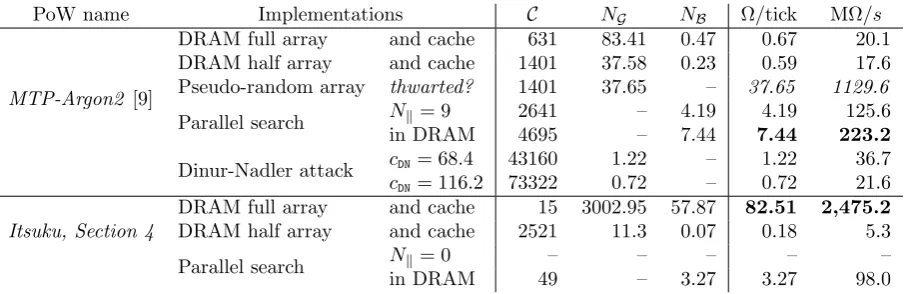
PoW name Implementations C NG NB Ω/tick MΩ/s
MTP-Argon2 [9]
DRAM full array and cache 631 83.41 0.47 0.67 20.1 DRAM half array and cache 1401 37.58 0.23 0.59 17.6 Pseudo-random array thwarted? 1401 37.65 – 37.65 1129.6
Parallel search Nk= 9 2641 – 4.19 4.19 125.6 in DRAM 4695 – 7.44 7.44 223.2
Dinur-Nadler attack cDN= 68.4 43160 1.22 – 1.22 36.7 cDN= 116.2 73322 0.72 – 0.72 21.6
Itsuku, Section 4
DRAM full array and cache 15 3002.95 57.87 82.51 2,475.2 DRAM half array and cache 2521 11.3 0.07 0.18 5.3
Parallel search Nk= 0 – – – – –
in DRAM 49 – 3.27 3.27 98.0
Table 4: MTP variants with NVIDIA Volta V100 GPU technology (G= 5.275 GGE, B= 1 TB/s)
to on-die memory, but the Dinur-Nadler implementations. The designs are not very efficient, because the algorithms’ bottleneck is the memory bandwidth and the over 50,000 BLAKE2 hash cores that could fit on die cannot be usefully employed. The best performance of MTP-Argon2 is achieved by the transposed parallel search with states in DRAM, thanks to the small search state and relatively good bandwidth. The half-array compression performance is quite close to the full array performance because the additional costs are masked by the improved cache hit ratio. Both Dinur-Nadler perfor-mance figures are on the optimistic side because the precomputation costs are amortized on a very large number of PoW. Itsuku cannot implement the on-die transposed search because of the large memory requirement induced by the larger search state size and number of array elements. Its half-array implementation performance is very low because of the high number of half-array element accesses to recompute missing elements.
PoW name Implementations C NG NB Ω/tick MΩ/s
MTP-Argon2 [9]
DRAM full array and cache 631 118.59 0.60 1.07 32.0 DRAM half array and cache 1401 53.43 0.30 1.91 57.3
Parallel search Nk= 13 4960 – 7.86 7.86 235.8 in DRAM 6104 – 9.67 9.67 290.2
Dinur-Nadler attack cDN= 68.4 43160 1.74 – 1.74 52.1 cDN= 116.2 73322 1.02 – 1.02 30.7
Itsuku, Section 4 DRAM full array and cache 15 4269.59 75.23 130.43 3,913.0 DRAM half array and cache 2521 16.07 0.09 0.57 17.1 Parallel search in DRAM 63 – 4.20 4.20 126.0
Table 5: Hypothetical 30 billion transistor chip by 2019 (G= 7.5 GGE, B= 1.3 TB/s)
Table 5 shows similar performance figures for an hypothetical 30 billion transistor chip, for which we assume a somehow slower-paced memory bandwidth improvement. The overall results are similar to the previous case. For MTP-Argon2 the best performance is achieved by the parallel search. The half-array compression performance beats the direct approach, because the chip is nearly large enough to hold the half array; thus the cache hit ratio is high. This effect does not apply to Itsuku, thanks to the significant recomputation costs.
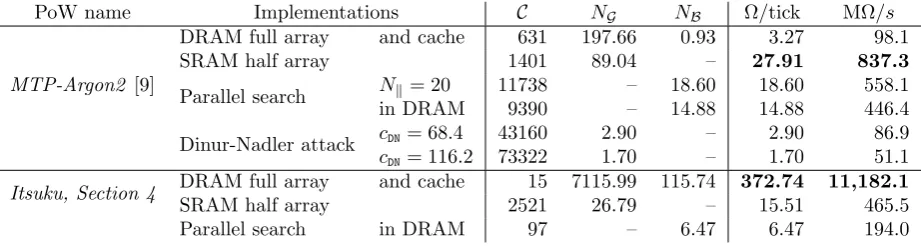
Table 6 shows performance figures on a 50 billion transistor chip. The transposed parallel search performs better with states stored on-die compared to DRAM because of the decreasing relative bandwidth we have chosen. For this area, the half array fits on die, thus achieves the best performance but for Itsuku, which is limited by its high recomputation cost.
PoW name Implementations C NG NB Ω/tick MΩ/s
MTP-Argon2 [9]
DRAM full array and cache 631 197.66 0.93 3.27 98.1
SRAM half array 1401 89.04 – 27.91 837.3
Parallel search Nk= 20 11738 – 18.60 18.60 558.1 in DRAM 9390 – 14.88 14.88 446.4
Dinur-Nadler attack cDN= 68.4 43160 2.90 – 2.90 86.9 cDN= 116.2 73322 1.70 – 1.70 51.1
Itsuku, Section 4 DRAM full array and cache 15 7115.99 115.74 372.74 11,182.1
SRAM half array 2521 26.79 – 15.51 465.5
Parallel search in DRAM 97 – 6.47 6.47 194.0
Table 6: Hypothetical 50 billion transistor chip by 2022 (G= 12.5 GGE, B= 2.0 TB/s)
PoW name Implementations C NG NB Ω/tick MΩ/s
MTP-Argon2 [9]
SRAM full array 631 395.31 – 123.93 3,718.0 SRAM half array 1401 178.09 – 117.13 3,513.9
Parallel search Nk= 40 35213 – 55.81 55.81 1,674.2 in DRAM 14085 – 22.32 22.32 669.7
Dinur-Nadler attack cDN= 68.4 43160 5.79 – 5.79 173.8 cDN= 116.2 73322 3.41 – 3.41 102.3
Itsuku, Section 4 SRAM full array 15 14231.97 – 5213.42 156,402.6
SRAM half array 2521 53.57 – 65.10 1,953.1
Parallel search in DRAM 145 – 9.67 9.67 290.0
Table 7: Hypothetical 100 billion transistor chip by 2026 (G= 25.0 GGE, B= 3.0 TB/s)
Hardware Efficiency We analyse the performance of the PoW variants on the increasing area and bandwidth hardware. For the MTP-Argon2 PoW, the bandwidth bottleneck and small search state size favor the transposed search. It is beaten by the half-array compression implementation once it fits on die, and finally by the on-die full array, which both assume a very high on-die bandwidth. The efficiency can be mesured as the best hardware performance in MΩ/s divided by the area budget in billion transistors. For MTP-Argon2 implementations the efficiency per increasing budget is 10.58, 9.67, 16.75 and 37.18. For Itsuku, the direct implementation is always the best one, thanks to its design with a large search state size and number of dependencies between array elements. The hardware efficiency is 117.3, 130.4, 223.6 and 1564.0. There is a large efficiency improvement once the array fits on die, hence the necessity that it should not be a fixed size.
6
Memory-Hard Crypto-Currency PoW Schemes
As noted in the introduction, crypto-currencies such as Bitcoin rely on a PoW function to randomly share the rewards for the maintainance of the distributed ledger, a.k.a. blockchain. Relying on a simple computation-bound hash function has centralized the bitcoin mining market around a select group of miners who can afford the specialized mining hardware. A consequence of mining power concentration is that it can be open to cheating strategies which allow a participant to receive more rewards than their mining power should entitle them. Thus PoW schemes impervious to FPGA or ASIC implementations are sought, focusing in particular on memory-bound approaches. Memory boundness has been defined in term of latency [3, 15, 4, 11], bandwidth [19] or size [22, 9]. The standard approach is to combine hashing and memory access in some pseudo-random way. We discuss here two particular schemes: the CryptoNight [23] and Wild Keccak [10] hash functions.
6.1 CryptoNight
value, combining Keccak [7] (a.k.a. SHA-3), repeated AES simple round iterations, XOR, the Keccak permutation, and one of BLAKE, Groestl, JH and Skein hash functions. The choices of the various parameters (e.g. 219 iterations) is not justified, nor the apparent over-complication with multiple and partial cryptographic primitives. A possible insentive to chose a number of different hash functions is that a hardware implementation would require them all. However, as some hash functions are seldom used, it would be efficient just to implement the frequently used ones in hardware and keep the others in software, so this explanation is not convincing. Using only partial or modified cryptographic algorithms means that the security properties expected and studied for the full designs cannot be ensured; thus the whole security should be re-analysed very carefully. An analysis of the complexity, cost and of potential performance bottlenecks would have been welcome. On the whole, it is plausible that the 2 MiB scratchpad is really needed to compute the final value, without shortcut. However, the same property could probably have been obtained with a simpler and more argumented approach. From a crypto-currency perspective, we think that the approach is not ideal: CryptoNight is certainly an expensive hash function which requires 2 MiB. However, verifying the results require the same amount of computation and memory, which we believe are both too expensive on this side: A memory-hard PoW scheme should not require the same memory constraint for the verifier. Moreover, even if 2 MiB is expensive for ASIC, it is still doable, especially as technology improves.
6.2 Wild Keccak
The Wild Keccak hash function [10] has been proposed for the Boolberry project. It aims at reducing memory-hardness on the verifier side while keeping a high requirement for the miner. For this purpose, a global scratchpad is built with data coming from the blockchain itself, and is then extended as the chain moves forward, targetting a 90 MiB per year growth. The hash function is a modification of Keccak [7] where internal state update operations are modified and intertwined with memory dependencies accessing the currency state. We agree with the authors who state: It is debatable if this modification will keep all cryptographic properties of hash function. . . such changes should be discussed in depth. Each hash computation involves 1100 accesses to 32-byte blocks of scratchpad. The paper lacks an analysis of how much of the stratchpad would be used in a typical search and more generally an analysis of performance bottlenecks. A proof-of-concept implementation shows a 25−45 µs per hash computation, depending on the scratchpad size.
In the crypto-currency context, we agree that relying on the blockchain data is potentially a good idea to build a relevant scratchpad, provided that data is pseudo-random. Another benefit is that it paves the way to a future growth of the requirement, although only a linear one. However, this also means that the verifier needs this data: the verification cannot be performed using the block itself and the light-weight-verifier property is only partially obtained.
6.3 PoW Schemes Comparison
We compare CryptoNight, Wild Keccak, MTP-Argon2 and Itsuku.
The PoW function computation cost, essential for verification, is very large for CryptoNight, say hundreds of thousands of calls, just one call for Wild Keccak, and a few hundreds for MTP-Argon2 and Itsuku when counting Merkle tree opening checks. We think that this number should be kept reasonably low. CryptoNight and Wild Keccak would benefit from a precise performance bottleneck analysis, taking into account potential hardware implementation, which we have provided for MTP-Argon2 and Itsuku.
The underlying PoW properties, inherited from key design choices, are significantly different. The verifier needs to store or rebuild the memory scratchpad with both CryptoNight and Wild Keccak, enduring significant memory costs, while the MTP approach relies on the Merkle tree proof to only convey part of the array, which is thus not fully needed for verification. As a consequence proofs are significantly larger for MTP-Argon2 and Itsuku, from 186 KiB down to 11 KiB. Moreover, the array building cost must be amortized on a significant number of searches so as to be negligeable and have a near progress free scheme.
For a memory-hard scheme, a key overall design option is the memory size requirement. It is remarkable that proposals vary so widely on that point: CryptoNight deems 2 MiB as enough, Wild Keccak starts with about 100 MiB, and MTP-Argon2 requires 2 GiB. We think that even more is needed to provide enduring resistance to the scheme.
7
Conclusion
We bring a new memory-hard PoW based on [9] that attempts to counter known attacks [14, 8] on the scheme. Key contributions, which are steps toward a better memory-hard PoW scheme, include:
• a new parallel search attack on MTP-Argon2 which can achieve good performance under limited bandwidth condition.
• a refinement of the evaluation of the Dinur-Nadler attack costs, with precise closed formulae. • to make all primitives (F,H) depend on challengeI and based on a cryptographic hash function.
Even if the Dinur-Nadler attack is not practical, such a dependency ensures that any pre-computation-based attack would have to be specific to the challenge, which is a good property. • to consider using a larger number of smaller elements for arrayX, thus reducing the proof size
and making a parallel search uninteresting oncex=S.
• to enlarge the search state size per nonce, and a way to do so with a back sweep hashing on intermediate search hashes, so as to increase the memory requirement of threaded hardware implementations.
• to consider starting from a larger than 2 GiB array and include a way to increment its size as hardware capabilities evolve, for instance by linking array size to PoW difficulty.
• to build array X in parallel, making the scheme more progress free.
• to use a constant arrayX if possible for the use case, allowing a small PoW, as the whole MTP part is avoided.
• to reduce the hash size for the Merkel Tree depending on d, thus the proof size.
• a reference implementation for Itsuku [13] under development on Github.
We relied on numerical simulations to evaluate various costs,e.g. the recomputation costs presented in Table 2. The results are highly sensitive to the choice ofφfunctions. Of course, the implementations used may have bugs that could change the resulting figures significantly. The evaluation codes used are available online [13].
PoW functions are ecological hazards [21]: avoid them if you can.
Thanks
We would like to thank Itai Dinur, Niv Nadler, Alex Biryukov, Dmitry Khovratovich, Ling Ren, Claude Tadonki, Juan Agust´ın Rodriguez and Mark Bevand for discussions and feedback; Bahamut, Haroun Belta¨ıfa and Pierre Jouvelot for proofreading; Wolfram Alpha for partial help with some formulae; Doubloon Skunkworks and Zcoin for support.
References
[1] Bitcoin Block Height 488101.https://blockchain.info/block-height/488101, October 2017.
[2] BLAKE2 – fast secure hashing, November 2017. https://blake2.net/.
[3] Mart´ın Abadi, Mike Burrows, Mark Manasse, and Ted Wobber. Moderately Hard, Memory-bound Functions. In10th Annual Network and Distributed System Security Symposium (NDSS), San Diego, CA, USA, February 2003.
[4] Mart´ın Abadi, Mike Burrows, Mark Manasse, and Ted Wobber. Moderately Hard, Memory-Bound Functions. ACM Trans. Inter. Tech., 5(2):299–327, 2005. A previous version appeared in NDSS’2003.
[5] Biryukov Alex, Daniel Dinu, and Dmitry Khovratovich. Argon2: the memory-hard function for password hashing and other applications. Technical report, University of Luxembourg, Luxem-bourg, March 2017. Version 1.3,https://www.cryptolux.org/images/0/0d/Argon2.pdf.
[6] Jean-Philippe Aumasson, Samuel Neves, Zooko Wilcox-O’Hearn, and Christian Winnerlein. BLAKE2: simpler, smaller, fast as MD5, January 2013. Version 2013.01.29, https://blake2. net/blake2.pdf.
[7] Guido Bertoni, Joan Daemen, Micha¨el Peeters, and Gilles Van Assche. The Keccak SHA-3 Submission (Version 3), January 2011.
[8] Marc Bevand. Attacks on Merkle Tree Proof, August 2017. http://blog.zorinaq.com/ attacks-on-mtp/.
[9] Alex Biryukov and Dmitry Khovratovich. Egalitarian Computing. In 25th USENIX Security Symposium, pages 315–326, Austin, Texas, USA, August 2016.
[10] Boolberry Team. Block Chain Based Proof-of-Work Hash and Wild Keccak as a Reference Imple-mentation. http://boolberry.com/files/Block_Chain_Based_Proof_of_Work.pdf, August 2014.