c e-ISSN: 2348-6848, p- ISSN: 2348-795X Volume 3, Issue 01, January 2016
International Journal of Research (IJR)
Available at http://internationaljournalofresearch.org
Study of failure probability by deterministic method
reliability-strength applied to metal cables intended for off
shoring
A. Chouairi
1; A. Hachim
2; E. Boudlal
2& M. El Ghorba
1 1Laboratory of Control and Mechanical Characterization of Materials and of Structures, National School of electrical and mechanical, Hassan II University, BP 8118 Oasis, Road El Jadida, Casablanca, Morocco
2
Higher Institute of Maritime Studies, Department of Machinery, 7 km Road El Jadida, Hassan II University, BP 8118 Oasis Casablanca, Morocco
EMAIL: [email protected]
Abstract
Current developments in technology and
production techniques, as well as the increase in competition, have led manufacturers to make significant progress in the quality of their products, that is to say their ability to meet the growing needs of industrial, therefore, in this process of quality improvement stands reliability. Indeed, it measures changes in the capacity of a product based on running time, possibly taking into account malfunction time.
To ensure the structural operation in optimal conditions, an analysis of its security must be combined with well-defined inspection procedures. Unfortunately many cables have never been subject to inspection or, otherwise, only very partially, due to the limitations of inspection techniques (visual, acoustic, etc.).
We will focus, in this work, to studying reliability
based on the probability evaluation of
instantaneous failure, why an analytical and numerical modeling will be performed to assess reliability related to probability of failure in considered case of strands connected in series - parallel and in the case of parallel - series configuration drawing on dependability computing relationships. The approach is a multi-scale approach with a total decoupling between the scale of wire and cable. The results will allow for a comparison between different models of the literature to tie the model which allows better planning maintenance.
Key Words: Reliability; security; cables; probability; failure; multi-scale; maintenance.
1.
Introduction
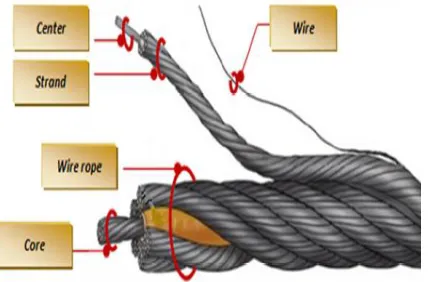
Wire rope drives are present in many areas of our daily life, in domestic and industrial lifting and pulling equipment and hoists, cable cars and ski lifts, cable railways, harbor cranes, and similar applications. The key components in a wire rope drive are the wire rope and the rollers, over which the wire rope is repeatedly bent when the rope drive is in operation (Figure 1).
Steel wires for wire ropes are normally made of high-strength non-alloy carbon steel. The rods for rope wires have a high carbon content of 0.4-0.95%.
Figure 1: Steel Wire Rope of type 19*7 and
c e-ISSN: 2348-6848, p- ISSN: 2348-795X Volume 3, Issue 01, January 2016
International Journal of Research (IJR)
Available at http://internationaljournalofresearch.org
The number in the name of the steel gives the mean content of carbon in weight percent multiplied with the factor 100. For example, the steel name C 82 D means that the steel has a mean carbon content of 0.82%.
Steels with high carbon content close to 0.86% with eutectoid fine perlite - a mix of cementite (Fe3C) and ferrite - are preferred for rope wires.
Industrial wire ropes have played a major role in the engineering and architecture of many large structures and are widely used for industrial applications including construction, mining, fishing, marine and elevator, as well as, for ski lifts, bridges and supported structures such as towers and roof systems.
They are characterized by a very complex architecture (Figure 2). Every wire rope has three basic components: the wires, strands and core. The basic unit is the drawn wire [1].
The wires are then twisted to form a strand; the wire rope is finally made of multistrand metal wires wrapped around a suitable core material during the cabling operation [2].
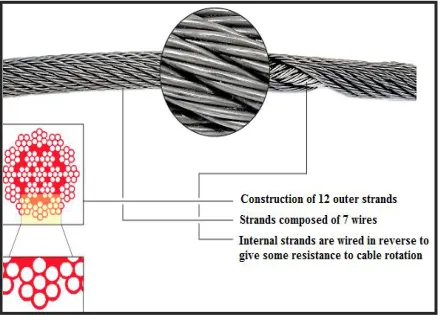
Figure 2: Steel Wire Rope of type 19*7 and
antigyratory construction (1x7 + 6x7 + 12x7)
This specific structure permits the wire ropes to resume loads despite the break of one or more wires [3], Furthermore, the compaction of strands
results in a longer service life and less wear of sheave and drum. Despite all the advantages that this specific conception represents, it is an accepted fact that wire ropes are consumable with a limited life. The continual processes of degradation associated with operational service, will ultimately lead to failure, and the cable should be replaced before the risk of failure becomes unacceptable [4].
2.
Failure of wire ropes
Cables suffer from continued aggression of environment (urban, industrial, marine…..). The effects of the aggression manifested through various events, including the direct effects are strong changes in geometrical and mechanical characteristics of the components, which indicate a significant reduction in the strength capacity of the cable over time, which can sometimes lead to partial rupture.
In general, the defects of the hoisting ropes are classified into four categories:
1- Reduction of the section by wear, corrosion or abrasion;
2 - Rupture of wires steel;
3 - Strains such as bird cages, shell, crush....; 4 - Fatigue.
Various tests on wire ropes were carried out in the first half of the last century, but the first studies on the analysis of inner load and the stresses in the wires caused by them were made by Hruska [5] [6] [7] in the 1950s.
Hruska assumed that the single wire was subject to simple traction load and demonstrated that, for small displacements, the normal stresses vary with the square of the winding angle cosine. Hruska assumed as a basic hypothesis that a metallic rope subjected to a pure axial load produces three types of force:
c e-ISSN: 2348-6848, p- ISSN: 2348-795X Volume 3, Issue 01, January 2016
International Journal of Research (IJR)
Available at http://internationaljournalofresearch.org
_ a radial force that causes pressure of the wires and the strands against the core of the rope;
_ a tangential force that produce torque that tends to open the rope.
The work of Hruska was extended by Leissa [8] to the case of a rope made up of six strands, each of seven wires. Leissa sought a relationship between the stresses in the single wires and the geometry of the rope and the load applied, also as regards the stresses due to contact between the single wires and the strands. Starkey and Cress [9] developed a simplified mathematical model for the calculation of the contact stresses; the importance of this work is the introduction of the fretting problem, in other words the fatigue due to contact and relative slipping between wires.
The need for simplified models and the complexity of particular phenomena like friction and stresses due to wire contact, have constituted a limit to the development of new theories to such an extent that it is common to think that the design of a rope is more an art than a science. Costello and Philips examined the highly non-linear behavior (due to the winding angle helix variation) of a rope subjected to axial force and torsion. Developing the theory of Love [10] on thin beams in space, Costello and Philips, despite omitting the effect of friction between wires, obtained a system of non-linear differential equations that, using appropriate hypotheses, could be reduced to an algebraic linear system.
For the calculation of stresses due to the curvature of the rope over a sheave, there are published studies that can be grouped according to two different approaches. In the first, used by Costello [11], the equations of equilibrium of a wire, wrapped as a straight helical spring and whose axis has been bent, were set and resolved in an approximate way, obtaining a relationship between the radius of curvature of wire rope axis and the bending moment that generates it. In the second, proposed by various authors [11] [12] [13], the state of stress is correlated directly to the local
curvature change of the various wires. The wires in the rope are, in fact, characterized by initial curvatures due to the helix winding on which they are laid (around the rectilinear axis) and assume a new curvature when the rope is bent (axis of the bent rope).
By knowing the local curvature of the wires in the two states, it is possible to find the bending moment that generates the difference of curvature, thus going back to the local stresses. The simplified hypothesis that in a rope with a rectilinear axis and free of load there are no residual stresses has been made in both the models. Hobbs and Nabijou [14] obtain the curvature in the deformed case both for a single helix and for a double helix. Knapp [12] and Lee [13] developed the same approach.
3.
Materials and methods
Wire ropes are identified by classifications based upon the number of strands and nominal number of wires in each strand. Our approach is to study the behavior of a strand belonging to a steel wire rope of type 19*7 (includes 19 strands with each strand consisting of 7 individual wires) and antigyratory structure (1x7 + 6x7 + 12x7) (Figure 3).
c e-ISSN: 2348-6848, p- ISSN: 2348-795X Volume 3, Issue 01, January 2016
International Journal of Research (IJR)
Available at http://internationaljournalofresearch.org
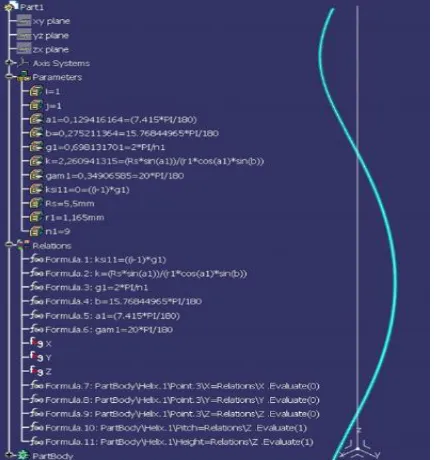
Figure 3: Representation of first wire in first layer of cable studied
Figure 4: Representation of the first layer (1 + 6) of (19 * 7) cable
To understand a material behavior, it is essential to identify it first, namely to analyze the chemical and mechanical characteristics (Figure 5).
Figure 5:Modeling of the longitudinal section in single-strand cable (1 + 6) of the first layer
3.1. Chemical Composition
The chemical composition is obtained by spectrometric analysis using a spectrometer peak spark. The result is summarized in Table 1.
Table 1:Chemical composition of (19*7) wire rope
Element C Si Mn S Cr Mo Ni
% 1.47 2.04 2 0.14 0.18 0.20 0.12
It is noticed that the wire rope is made of low alloy steel with high percentage of carbon (about 1,478%). They are obtained by the cold wire-drawing process, which consists of passing the wire through a conical die until the desired diameter. Indeed, this reduction of diameter causes a hardening of the metal and then provides a high tensile strength.
3.2. Mechanical properties
To extract the mechanical properties of the material, tensile tests were performed in the Public Testing Laboratory and Studies, on virgin strands specimens.
The mechanical properties of the virgin strands extracted from tensile test curve are reported in table 2.
Table 2: Mechanical properties of the material
Young’s modulus
Poisson’s ratio
Elastic limit
Breaking stress E = 189
GPa
ν = 0.3 σe =
1035 MPa
σr = 1992
MPa
3.
Analysis intersection of the trio
combination“core-wire-strand”
c e-ISSN: 2348-6848, p- ISSN: 2348-795X Volume 3, Issue 01, January 2016
International Journal of Research (IJR)
Available at http://internationaljournalofresearch.org
Figure 6: Comparison between strand and core from
the interaction of reliability distributions
Curve explicit reliability based on the probability density between the strand and the core. The results show that core has a much greater reliability then strand of rope, which is the main function of core that is the backbone of cable (Figure 6).
The core reliability that reached 98% compared to strand which has a reliable round about 65%, which shows that core also improves the functioning of strand and increases its resistance.
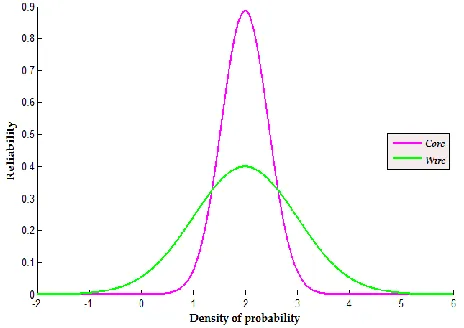
Figure 7: Comparison between core and wire from the interaction of reliability distributions
Changes in the reliability of the core compared with reliability of wire as a function of probability density are shown in Figure 7. We note that the reliability of wire is far from that of core whose reliability is 98%.
It will be understood that at the time the cable is under strong contraction increasingly important during his service, the resolution of probability density increases, resulting in significant errors in the measurement of failure. Given the excellent reproducibility observed in core, it is this unforeseen failure of strand that is causing a dispersion of reliability curves.
Figure 8: Comparison between strand and wire from the interaction of reliability distributions
Figure 8 shows reliability curves for strand and wire from the cable (19 * 7). Reliability associated over is 39% or 30% lower than the reliability of the strand. There is also significant difference in behavior between strand and wire, which results in slightly different reliability values to threshold.
c e-ISSN: 2348-6848, p- ISSN: 2348-795X Volume 3, Issue 01, January 2016
International Journal of Research (IJR)
Available at http://internationaljournalofresearch.org
Figure 9: Comparison of results from the interaction of reliability distributions
The comparison of reliability results shows that the three curves undergo egocentric tendencies around the same value “2”.
We see from this comparison that the soul is strong enough to disperse and therefore slightly improves the accuracy and resolution fault location (Figure 9).
The reliability of the strand is approximately 65% of total cable reliability, which shows that strand replaces the operation of core in the case of his failure or his brutal rupture.
4.2. Strength depending on the density of probability
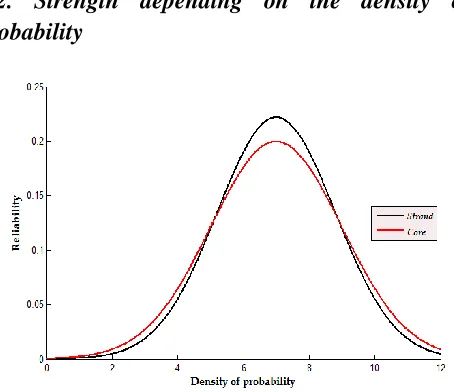
Figure 10: Comparison of strand and core results from the interaction of strength distributions
Analysis of strand resistance and core helps look critically on cable behavior. We note that the strength results are very close to two curves.
We find that the cable resistances mechanical characterization put forward two clearly distinct behaviors, which we demonstrated by an estimate of density probability (Figure 10).
Figure 11: Comparison of wire and core results from the interaction of strength distributions
According to the comparison of curves of core resistance and the cable wire, there is a significant probability density effect the transition to strain rates greater than 0 that is manifested by a slowing in growth (decrease) the length of core and a greatly accelerated change in the security index (Figure 11).
6. Conclusion
Reliability is increasingly becoming important during the design of engineering systems, as our daily lives and schedules are more dependent than ever before on the satisfactory functioning of these systems. Some examples of these systems are computers, trains, automobiles, aircraft, and space satellites.
c e-ISSN: 2348-6848, p- ISSN: 2348-795X Volume 3, Issue 01, January 2016
International Journal of Research (IJR)
Available at http://internationaljournalofresearch.org
Faced with the inability of the deterministic method to take into account the diversity of physical phenomena that apply to structures, engineers have developed another more suitable method with uncertain physical phenomena. In this method, the failure of a structure is made, if the probability of failure exceeds a predetermined threshold.
The probabilistic method is increasingly used in engineering as evidenced by the different applications in industry. It is applied to verify that the probability is sufficient when the geometry of the structure is known, or to optimize the design of the structure in order to meet certain objectives, such as a desired cost or expected level of probability. Furthermore, the reliability analysis is an important tool for decision-making to establish a maintenance and inspection plan. Also, it can be used in the validation of standards and regulations.
In this context we introduced the theory of reliability / resistance that is considered the basis of the probabilistic method by putting under the microscope study of the entire wire strand-soul, and determining the usefulness of each of these components.
References :
[1.] EN 10264-4 : 2012, Steel wire and wire products-steel wire for ropes – part 4 : stainless steel wire, ISSN : 0335-3931 : European Standard approved by CEN on 19 November 2011.
[2.] Canadien Centre of Occupational Health and Safety, Wire rope lifting, February 2010.
[3.] O.bassile, Characterization of systems reliability subject to stress variables, Polytechnique Faculty of Mons, Belgium, 2005.
[4.] R. Judga, Z. Yang, SW. Jones, G.Beattie, Full 3D fnite element modeling of spiral strand
cables, Journal of Construction and Building Materials, p. 452-459, 2012.
[5.] FH. Hruska, Calculation on stresses in wire ropes, Wire products, p. 455, 1951.
[6.] FH. Hruska, Radial forces in wire ropes, Wire products, p.459, 1952.
[7.] FH. Hruska, Tangential forces in wire ropes, Wire products, p. 455, 1953.
[8.] AW. Leissa, Contact stresses in wire ropes, Wire products, p. 307, 1959.
[9.] WL. Starkey, HA. Cress, An analysis of critical stresses and mode of failure of a wire rope, Industrial Journal of Engineering, Trans ASME, p. 807, 1999.
[10.] AE. Love, Treatise on the mathematical theory of elasticity, New York: Dover, 1944.
[11.] GA. Costello, Theory of wire rope, 2nd edition Berlin: Springer, 1995.
[12.] RH. Knapp, Helical wire stresses in bent cables, Journal of Offshore Mechanical Engineering, p. 55-66, 1988.
[13.] WK. Lee, An insight wire rope geometry, International Journal of Solids Structures, p. 471, 1991.