Smartcard Implementation Using One Trace
Wei Cheng1, Chao Zheng1, Yuchen Cao1,2, Yongbin Zhou1,2,
Hailong Zhang1, Sylvain Guilley3,4, Laurent Sauvage3,4
1State Key Laboratory of Information Security, Institute of Information Engineering,
Chinese Academy of Sciences, Beijing, China
2School of Cyber Security, University of Chinese Academy of Sciences, Beijing, China
3
LTCI, T´el´ecom ParisTech, Universit´e Paris-Saclay, Paris, France
4Secure-IC S.A.S., Cesson-S´evign´e, France
{wei.cheng,zhouyongbin}@iie.ac.cn,
{sylvain.guilley}@telecom-paristech.fr
Abstract. Rotating Sbox Masking (RSM) scheme is a highly efficien-t masking scheme proposed efficien-to proefficien-tecefficien-t crypefficien-tographic implemenefficien-taefficien-tions from side channel attacks. It is a Low Entropy Masking Scheme and has attracted special attention for its low overhead but high perfor-mance. The two public targets of international academic competition DPA Contest v4 are both RSM-masked AES implementations, specif-ically, RSM-AES-256 for v4.1 and RSM-AES-128 for v4.2 respectively. The side channel security of RSM-AES-256 was intensively studied by researchers worldwide under the framework of DPA Contest and sever-al flaws were identified, while the security of RSM-AES-128 is still not thoroughly studied. In this paper, we focus on analyzing the practical se-curity of RSM-AES-128 from a profiling attack point of view. Specifically, we firstly present a Multivariate Template Attack (MTA) to maximize the success rates of key recovery attack. Next, we propose a new Depth-First Key Enumeration Algorithm (DFKEA) that could be applied to find the correct key efficiently after a side channel attack. By integrat-ing the DFKEA to our MTA, we propose a novel multivariate profilintegrat-ing attack which could recover the whole secret key of RSM-AES-128 with over 95% possibility only using one electromagnetic trace. It is the best attack among all attacks submitted to DPA Contest Official up to now. Finally, we present one proposal to further improve the practical security of RSM-AES-128 at an acceptable overhead.
Keywords: Side Channel Attacks·Template Attack ·DPA Contest ·
Countermeasures·Rotating Sbox Masking Scheme·Shuffling Scheme.
1
Introduction
the advent of the Internet of Things (IoTs), since on one hand the IoT devices are typically too constrained with resources to deploy complex countermeasures for achieving a high security level. On the other hand, the adversary always has full control on these devices to carry out certain very intensive analysis and powerful attacks, especially including some profiling attacks. Particularly, recent attacks Spectre [6] and Meltdown [5] are essentially two Cache-based S-CA exploiting architectural vulnerabilities in CPU-level, which severely affect almost all modern CPUs. Although huge differences exist between IoT devices and CPU-based devices (like PC and cloud server) from architectures to low-level implementations, they all perform physically observable computations [12] and share the great threat induced by SCA. Therefore, countermeasures are the integrant parts of the security-critical systems.
In order to protect cryptographic implementations (devices) against SCA, many countermeasures have been proposed including masking, shuffling and hiding. Specifically, masking schemes [13,24,34,27] randomize the dependency between sensitive data and leakages by dividing each sensitive variable into sev-eral random shares to thwart SCA, while Shuffling schemes [25,26] randomize the order of operations during the executions. Quite differently, by circuit-level alteration, hiding-based countermeasures [32,34,14] make the leakages uniformly independent to the data processed. Among them, masking schemes are a class of the most attractive and frequently used techniques against SCA, since they pro-vide formally provable security and could be implemented on algorithmic-level with no hardware alteration. Despite the improvements with respect to SCA security, almost all countermeasures always cause a significant overhead and performance loss on cryptographic implementation compared to an unprotected one. As a consequence, lightweight and efficient solutions for SCA countermea-sures are very attractive for researchers and designers.
in which several pitfalls were fixed [1] and it is the open target of DPACv42. The improved RSM scheme in RSM-AES-128 is also called RSM scheme, since we only focus on the improved one, there is no ambiguity in denotation.
Intuitively, the combination of different countermeasures could improve the practical security of the cryptographic implementations only if they are carefully implemented. This strategy was adopted in DPA Contest v4.2, in which both masking and shuffling are applied to upgrade the original RSM in terms of SCA security. Since several implementation flaws have been fixed (mainly by reprogramming in assembly code, precharging and the improved RSM scheme) and a new shuffling scheme is adopted [1], RSM-AES-128 is expected to achieve a high SCA security level. However, its practical security is still not intensively studied, especially from a viewpoint of profiling setting. In this paper we focus on security analysis of RSM-AES-128 using profiling attacks [23]. More concretely, although in presence of these security-oriented improvements in RSM-AES-128, our final question is that, can we recover the secret key of RSM-AES-128 only using one trace? If possible, what’s the most efficient way to find the secret key? To answer these two questions, two techniques are utilized in this paper to carry out our attack against RSM-AES-128. One is Template Attack, which is the strongest form of SCA from a perspective of information theory [28]. It’s a natural better choice compared to other profiling attacks like Linear-Regression based attacks [4,9]. Furthermore, the multivariate attack which exploits leak-ages of consecutive intermediates [36] (similar to Multi-target DPA [29]) is more powerful compared to univariate counterpart. The other one is Key Enumera-tion Algorithm (KEA). KEA is a post-processing technique to find the correct key effectively after an attack. Recently, several KEA [37,39,38] have been pro-posed to optimize the effectiveness, efficiency and memory overhead. Particularly, the optimal KEA [37] provides an optimal order to enumerate the results after an attack but with large memory overhead in terms of “key trails”, while the Histograms-based KEA [38] leads to straightforward parallelization with simple bounds of rounding errors. These KEA methods generally assume that differen-t subkey candidadifferen-tes are similarly disdifferen-tribudifferen-ted, differen-therefore differen-they can be viewed as breadth-first methods and adopt a combine-then-verify route. However, if the distributions of different chunks of key candidates vary from each other, existing KEA method would be less efficient since extra computational costs are induced and more key verifications are inevitable for finding the secret key.
Our Contributions. Since the goal is to carry out attacks against RSM-AES-128 with only one trace, our contributions are threefold as follows.
the RSM scheme and shuffling scheme with 100% probability using one trace, meanwhile the partial success rates (PSR [8], corresponding to recovery of each subkey) of attack varies in a range from 93% to 98%, and the global success rate (GSR [8], corresponding to the recovery of entire secret key) is increased from 55% to 83% which increased 50.91% (also using one trace).
Depth-First Key Enumeration Algorithm (DFKEA). We propose a new key enumeration algorithm DFKEA featured with the high efficiency in find-ing the secret key after SCA. Compared to the state of the art KEA method, on one hand, DFKEA doesn’t need to combine the possibilities of subkey can-didates in different chunks, by which reduces the extra computations to speed up the key-finding process. On the other hand, the ranks of correct subkey hy-pothesis after side channel attacks could be very various in different chunks after a practical attack. Actually, our DFKEA adopts a (bounded) depth-first approach to efficiently traverse the most possible subkey hypothesis. By inte-grating DFKEA into our MTA scheme, its GSR is significantly increased from 83% to 95% (increased 14.46%, evaluation from DPA Contest Official) with an acceptable computation overhead. These results distinctly indicated that RSM-AES-128 is vulnerable to profiling attacks, especially for our MTA.
Shuffled Offset. Countermeasures are requisite for leakage-preventing to thwart SCA. Since the shuffling scheme and RSM scheme are independently applied in RSM-AES-128 [1], they can be compromised separately. To address this problem, by encoding the nonce used in shuffling scheme into offset, we propose a method to improve the security of RSM scheme by eliminating the mask-dependent leakage existing in full rounds of encryption process.
The rest of the paper is organized as follows: Section 2 introduces the details of RSM-AES-128 and template attacks. Section 3 explains the rationale of our MTA and its application to break the RSM scheme and shuffling scheme, and then to conduct the key-recovery attack. In section 4, the new key enumeration algorithm DFKEA is proposed with necessary validation experiments, and one proposal to further improve the practical security of RSM-AES-128 is described in section 5. Finally, conclusions are drawn in section 6 and some evaluation results of our attack from DPA Contest Official are in Appendix.
2
Preliminary and Notations
2.1 RSM-AES-128 Implementation
RSM-AES-128 [1] is a software implementation of AES-128 algorithm protected by both RSM scheme and shuffling scheme. Specifically, RSM scheme is applied to full rounds of encryption to protect all intermediate variables, while shuffling is only adopted in the first and last rounds of transformation to protect the commonly “vulnerable” part of implementation [42].
the mask set only contains 16 fixed mask values as follows. M ={ 0x03,0x0c,0x35,0x3a,0x50,0x5f,0x66,0x69,
0x96,0x99,0xa0,0xaf,0xc5,0xca,0xf3,0xf c} (1) wheremi andMi both denotes thei-th mask value (i= 0,1, . . . ,15).
In a masked cryptographic implementation, all sensitive variables are re-quired to be masked, and the nonlinear layer of the cipher is the most critical part for designers [22]. In AES, its round function consists of four subfunction, namelyKeyAdd (AK),SubBytes (SB),ShiftRows (SR) andMixColumns (MC). TheSubBytes is the only nonlinear part in AES, while the other three are linear transformations, in which the RSM could be applied straightforwardly.
LetSB,M SBdenote the original and maskedSubBytesrespectively,x∈Fn2
(n= 8 in AES) is an intermediate variable. Then the RSM-masked Sbox is M SBi(x) =SB(x⊕mi)⊕mi+1, i= 0, ...,15 (2)
where the mi, mi+1 denotes the input and output mask of Sbox respectively,
which are consecutive in mask setM. The index ivaries for all sixteen Sboxes, which determined by an offset vector with 16 elements, namely−−−−→of f set, to guar-antee that all Sboxes are masked independently. Finally, the mask compensations MaskComp are applied at the end of each round to ensure correctness.
M askCompi,r =
(
M−−−−→
of f set+r⊕M C(SR(M−−−−→of f set+r)), f or r= 1, ...,9
SR(M−−−−→
of f set+r), f or r= 10
(3)
whereris the round index of AES and all indexes are increasing withmod(16).
Shuffling Scheme. In RSM-AES-128, the shuffling scheme only adopted to protect the Sbox layer (SubBytes) in the first and last round by using Shuffle0 andShuffle10 respectively. It is a 4-bit based permutation applied to change the order of sixteen Sboxes.
Shuffle0, Shuffle10:{0,1, ...,15} −→ {0,1, ...,15} (4)
2.2 Template Attacks
TA is the strongest form of SCA in an information theoretic sense, which assume that an adversary can fully characterize the leakage features of target device [28,23]. It’s a two-phase attack consisting of profiling phase and attacking phase. Letk∗, kdenote the secret key and any possible key hypothesises respectively, andT is the public parameters like plaintext or ciphertext. We suppose that all intermediatesxare elements ofFn
2. Letf(·) be a mapping fromT to a sensitive
variableX, the measured leakagesLcan then be written as
denotesD PoIs (points-of-interest) in a leakage trace, and a set ofN measured traces areL={L1, L2, . . . , LN}.
Profiling Phase. In this phase, templates are built for each value of targeted intermediate v ∈ V in a cryptographic implementation. A template is parame-terized by the mean vector and covariance matrix of the leakages corresponding tov, namely (µv, Σv). In practice, the tuple (µv, Σv) are estimated by empirical mean and covariance matrix (µv,b Σvb ) as follows.
b
µv= 1 Nv
Nv X
i=1
Lv,i
b
Σv= 1 Nv−1
Nv X
i=1
(Lv,i−µvb )T(Lv,i−µvb )
(6)
where Lv,i denotes the i-th trace in divided groups associated to intermediate variablev, whileNv is the number ofv-th group of traces.
Attacking Phase. Assume that all |V| templates have constructed for each value ofv∈ V. Let theL0 ={L1, L2, . . . , LQ}denotes theQattacking traces. In order to determine which value of v was used inLi, the matching probabilities are computed for each template (µv, Σv) as follows.
pi,v(Li; (µv, Σv)) =
exp(−1
2(L
i−µ
v)TΣv−1(Li−µv))
p
(2π)D·det(Σv) (7) where again D is the dimensionality of Li. Finally, with Maximum Likelihood (ML) principle the value of sensitive intermediatevis indicated by maximalpi,v.
v∗= arg max v∈Fn2
pi,v(Li; (µv, Σv)) (8)
Note thatvis key-dependent intermediate, resulting that the secret key could be inferred after all chunks ofvare recovered. Under the independence assumption among different traces, attacking results of Qtraces are usually integrated for high confidence of correct key hypothesis.
In practice, SCA are more likely to focus on single sensitive intermediate, especially true when against protected implementations. However, under the context of profiling attacks like TAs, an attacker always has capacity to carry out attacks against several directly associated intermediates in sequence.
3
Multivariate Template Attack against RSM-AES-128
TA integrated with PCA against protected cryptographic implementation with minimal number of traces, while the latter is mainly adopted for leakage-features extraction on physical leakages rather than data-dimension reduction.
The Onion-peeling strategy is the core to our attack against RSM-AES-128. Firstly, TAs are applied against masking scheme and shuffling scheme by recovering−−−−→of f setandShuffle0, respectively. Once the combined countermeasure is compromised, a MTA is applied to recover the secret key with as high success rates as possible. Finally, post-processing methods like our DFKEA in Sec.4are employed to dramatically improve the success rates at a practical tractable cost. LetVi, i∈ [1,2,3,4,5] denote the sensitive intermediates related to masks, shuffles, inputs of Sbox (Sboxin), Outputs of Sbox (Sboxout) and inputs to the MixColumns (MCin) respectively, thus Vi,j, j ∈ [0,1, . . . ,15] is j-th byte, and vi,j is the instance ofVi,j.
Li=L(Vi) +N oise=HW(Vi) +N oise, f or i= 1, ...,5
Vi=
M−−−−→
of f set, i= 1
Shuffle0, i= 2
M−−−−→
of f set⊕K⊕T, i= 3
M SB(M−−−−→
of f set⊕K⊕T), i= 4
SR(M SB(M−−−−→
of f set⊕K⊕T)), i= 5
(9)
where SR(·) is ShiftRows in AES, and the same as usual, Hamming Weight (HW) model are used for leakage detection and PoI selection.
3.1 Breaking the Combined Countermeasure
Attacking RSM scheme. All masks in RSM scheme are determined by−−−−→of f set= {s0, s1, . . . , s15}. In the first round of encryption, all masks are involved into the
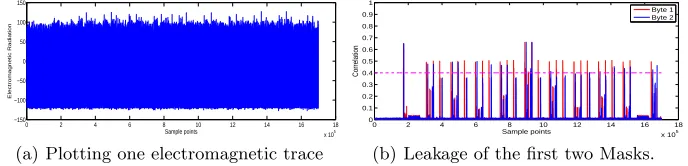
encryption process. As a consequence, our TA targets allMsi in the first round for simplicity (similar to carry out TA targeting at last round operations). The leakage features of the first two masks of RSM-AES-128 are depicted as Fig.1(b).
0 2 4 6 8 10 12 14 16 18
x 105
−150 −100 −50 0 50 100 150
Electromagnetic Radiation
Sample points
(a) Plotting one electromagnetic trace
0 2 4 6 8 10 12 14 16 18
x 105
0 0.1 0.2 0.3 0.4 0.5 0.6 0.7 0.8 0.9 1
Correlation
Sample points
Byte 1 Byte 2
(b) Leakage of the first two Masks.
Fig. 1.(a) Visualization of one trace, and (b) leakage of masks in the first two bytes of RSM-AES-128 (HW, Correlation).
to extract device-specific leakage features, for each V1,j, leakages selected from about 1200 PoIs are integrated, then only top 10 components corresponding to first 10 eigenvalue (data-dimensions are reduced from D = 1200 to D = 10) are chosen to build templates (µV1,j, ΣV1,j) as Equ.6. In attacking phase, Equ.7 and Equ.8 are applied to determine the most possible mask (or equivalently sj, j∈[0,1, . . . ,15]) hypothesis after PCA.
Our experimental results validated the effectiveness of our PCA-based TA against RSM scheme. The success rates for recovering all masks are 100%. One main reason is that all masks involved almost all cryptographic operations throughout entire execution of RSM-AES-128, thus from an attacker’s point of view, these operations leak sufficient information to recover all masks.
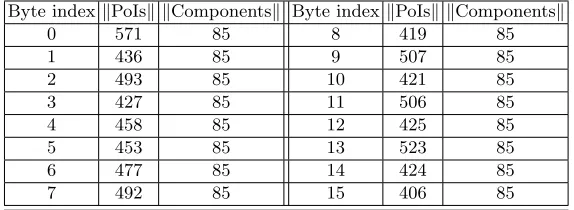
Attacking Shuffling scheme. The attack of shuffling scheme is very similar to compromise RSM scheme. The major difference and main difficulty is the very limited exploitable leakages only leaking from Sbox-shuffling in the first round of RSM-AES-128. As a consequence, in order to recover theShuffle0 by one trace, different number of PoIs are used for each element ofShuffle0 (as Tab.1).
Table 1.Number of PoIs for PCA and selected number of components after PCA
Byte indexkPoIsk kComponentsk Byte indexkPoIsk kComponentsk
0 571 85 8 419 85
1 436 85 9 507 85
2 493 85 10 421 85
3 427 85 11 506 85
4 458 85 12 425 85
5 453 85 13 523 85
6 477 85 14 424 85
7 492 85 15 406 85
Despite the variety existed in number of PoIs when attacking different ele-ments ofShuffle0, the success rate of recoveringShuffle0 is 100%.
Once the combined countermeasure is compromised, RSM-AES-128 becomes an unprotected implementation, thus the key-recovery attack can be carried out to recover the secret key. Particularly, our experiments also validate the effectiveness of applying PCA and a profiling attack to break countermeasures in a very efficient way (especially from a engineering perspective).
3.2 Our Multivariate Template Attack
We propose a MTA to retrieve the secret key in an effective way. Here mul-tivariate means that multiple key-dependent variables are targeted to obtain subkeys. Specifically, our MTA targets at three sensitive variables depending on the same subkey. These three variables are V3,j = M−−−−→of f set[j] ⊕Kj ⊕Tj,
V4,j =M SB(M−−−−→of f set[j]⊕Kj⊕Tj) andV5,j =SR(M SB(Mof f set−−−−→[j]⊕Kj⊕Tj)).
Similarly, in profiling phase, all templates are built for each possible value of V3,j, V4,j and V5,j, j ∈ [0,1, . . . ,15] using Equ.6. The PCA is also used to extract features of data-dependent leakages and to reduce the data complexity. Concretely, leakages selected from 500 PoIs (D= 500) are feeded into PCA and various number of components are chosen to build templates, which the latter differs from the component-choosing method in recoveringShuffle0. The number of selected components are listed in Tab.2.
Table 2.Number of chosen components after PCA forV3,j, V4,j andV5,j
Byte indexj kV3,jk kV4,jk kV5,jk Byte indexjkV3,jk kV4,jk kV5,jk
0 70 50 55 8 60 50 55
1 75 50 60 9 50 50 50
2 60 50 55 10 60 50 50
3 75 50 50 11 70 50 50
4 60 50 65 12 60 50 50
5 60 50 50 13 70 50 60
6 65 50 50 14 60 50 55
7 55 50 50 15 55 50 55
Subsequently, in attacking phase, leakages from selected PoIs firstly feed into PCA and then Equ.7is applied to obtain the ranked subkey candidates, which sorted by their possibilities. Since the combined protection scheme has been compromised, we focus on key-dependent variables by assuming that −−−−→of f set andShuffle0 are known for following analysis.
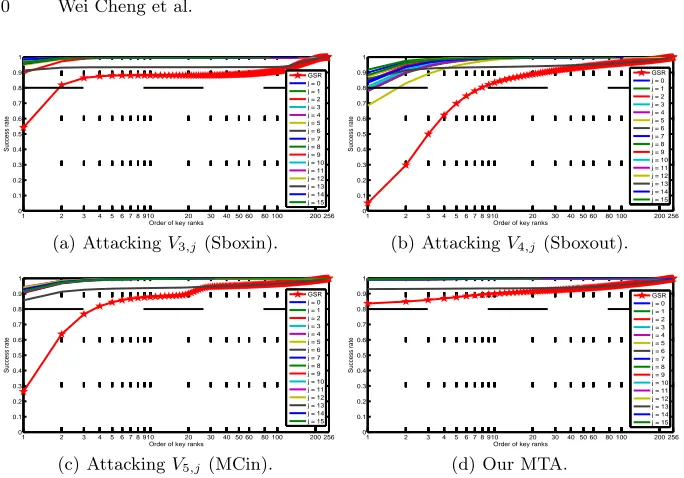
Thed-th order partial and global success ratesV3,j, V4,j,V5,j (j∈[0, . . . ,15]) and our MTA are plotted in Fig.2. Particularly, for our MTA, Fig.2(d) shows that the first-order PSR of all subkey bytes are over 98%, except the fourteenth subkey byte for 93%. In addition, we can observe that:
1. PSR of all subkey candidates follow a extreme Pareto distribution, which means the roughly 10% of subkey candidates lead to almost 90% of PSR. The lower the rank (from 1 to 256 and the lowest one is 256-th) of subkey candidates, the lower possibility of it to be the correct subkey hypothesis. 2. More importantly, compared to univariate TA, MTA makes the correct
sub-key hypothesis approach to the highest ranks among all subsub-key candidates, even for the worst subkey. This approaching effect also validates the positive impact of our MTA on revealing the secret key. Consequently, the GSR of MTA is significantly higher than all three univariate TAs.
3. Different byte-positions (indexes) of subkeys have small effects on attacking results except the fourteenth subkey, which is the worst byte of all subkeys in all four cases. However, this “information” could be exploited to improve the success rates by post-processing techniques, especially to improve GSR. But in order to keep the generality of our attack, this “information” is not utilized in our MTA and following DFKEA.
1 2 3 4 56 7 8 910 20 30 40 50 60 80 100 200 256 0 0.1 0.2 0.3 0.4 0.5 0.6 0.7 0.8 0.9 1 Success rate
Order of key ranks
GSR j = 0 j = 1 j = 2 j = 3 j = 4 j = 5 j = 6 j = 7 j = 8 j = 9 j = 10 j = 11 j = 12 j = 13 j = 14 j = 15
(a) AttackingV3,j(Sboxin).
1 2 3 4 56 7 8 910 20 30 40 50 60 80 100 200 256
0 0.1 0.2 0.3 0.4 0.5 0.6 0.7 0.8 0.9 1 Success rate
Order of key ranks
GSR j = 0 j = 1 j = 2 j = 3 j = 4 j = 5 j = 6 j = 7 j = 8 j = 9 j = 10 j = 11 j = 12 j = 13 j = 14 j = 15
(b) AttackingV4,j (Sboxout).
1 2 3 4 56 7 8 910 20 30 40 50 60 80 100 200 256
0 0.1 0.2 0.3 0.4 0.5 0.6 0.7 0.8 0.9 1 Success rate
Order of key ranks
GSR j = 0 j = 1 j = 2 j = 3 j = 4 j = 5 j = 6 j = 7 j = 8 j = 9 j = 10 j = 11 j = 12 j = 13 j = 14 j = 15
(c) AttackingV5,j (MCin).
1 2 3 4 56 7 8 910 20 30 40 50 60 80 100 200 256
0 0.1 0.2 0.3 0.4 0.5 0.6 0.7 0.8 0.9 1 Success rate
Order of key ranks
GSR j = 0 j = 1 j = 2 j = 3 j = 4 j = 5 j = 6 j = 7 j = 8 j = 9 j = 10 j = 11 j = 12 j = 13 j = 14 j = 15
(d) Our MTA.
Fig. 2.Partial Success Rates (PSR) and Global Success Rate (GSR) of key-recovery
attacks targeted at (with logarithmic X-axis) (a) V3,j, (b) V4,j, (c) V5,j and (d) our
MTA for eachj-th subkey,j∈[0, . . . ,15], only one trace is used in all four cases.
In next section, we propose the Depth-First Key Enumeration Algorithm to dramatically improve the GSR of MTA based on observation 1 and 2.
4
Depth-First Key Enumeration Strategy
Our primary interest is to recover the secret key of RSM-AES-128 in a very efficient way, thus two main requirements for post-processing methods are the high efficiency of key-finding and the maximal success rates. The former requires the minimal number of key verifications and less extra computations which may be caused by combining all sixteen sorted subkey lists together to obtain global key sorting results [37,39,38]. While the latter requires a high coverage of the highly possible subkey candidates.
Keeping these requirements in mind, we firstly investigate the distribution of errored subkey candidates. Here “errored” subkey means its correct candidate is not ranked first among all possible candidates. The ranks of errored subkeys and cumulative errors of each subkey are depicted as Fig.3. Unsurprisingly, same as observed in Sec.3.2, the fourteenth subkey is the worst case among all subkeys from an attacking point of view.
0 1 2 3 4 5 6 7 8 9 10 11 12 13 14 15 0 20 40 60 80 100 120 140 160 180 200 220 240 260 Subkey index
Ranks of errored subkey 50
100 150 200 250
(a) The ranks of errored subkeys.
0 1 2 3 4 5 6 7 8 9 10 11 12 13 14 15 0 500 1000 1500 2000 2500 3000 3500 4000 4500 5000 5500 6000
Cumulative errors of each subkey
Subkey index 50 100 150 200 250
(b) Cumulative errors of each subkey.
Fig. 3.The distribution of errored subkey candidates, “errored” means failed to recover
a subkey by first-order rank (80,000 traces from DPA Contest v4.2 [16] are used).
1) Nerr≤4, and 2) the frequency of eachNerr significantly decreases with the increase of Nerr. Hence, if we take Nerr into consideration, and enumerate all possible subkey candidates along with the increase of Nerr, the most possible subkey could be covered. Thus key-recovery could be very efficient. Hereafter, we propose a Depth-First Key Enumeration Algorithm (DFKEA) to utilize these Nerr-related information to find the secret key. To keep portability to other attack scenarios, we insist on only utilizing statistics ofNerr in our DFKEA.
0 1 2 3 4 5 6 7 8
0 0.5 1 1.5 2 2.5 3 3.5 4x 10
4
Number of attacks
Number of errored bytes
40000 traces 35000 traces 30000 traces 25000 traces
(a) Number of Errored SubkeysNerr
0 1 2 3 4 5 6 7 8
0 0.1 0.2 0.3 0.4 0.5 0.6 0.7 0.8 0.9 1 Frequency rate
Number of errored bytes 0.7812
0.2598
0.0244 0.00096 4e−05 0 0 0 0 40000 traces 35000 traces 30000 traces 25000 traces
(b) Frequency
Fig. 4. The distribution of number of errored subkeys (Nerr) with number of traces
from 25,000 to 40,000 (the first eight datasets from DPA Contest v4.2 [16]).
4.1 Proposal of DFKEA
schematic of our DFKEA withNerr= 1 is depicted as Fig.5(b). In fact, principles behind of the state-of-the-art KEA methods are the breadth-first strategy as illustrated in Fig.5(a), in which all sixteen subkeys candidates are enumerated with an approximately equal depth. On the contrary, our DFKEA adopts a depth-first strategy, which treat each byte of subkey differently, resulting with different enumeration depthdj for each byte of subkey.
(a) A breadth-first KEA (b) Our DFKEA withNerr= 1
Fig. 5.Main enumeration strategies of the breadth-first KEA vs our DFKEA.
Our algorithm of DFKEA is described as Alg.1. Note that convertKey(ci) in line 10 converts each combinationci to the errored subkey indexes by which these errored subkeys will be enumerated later.
Algorithm 1Our Depth-First Key Enumeration Algorithm (DFKEA) Input : Sixteen lists of possible subkey candidates,skCandi[256][16],
Nerr,dj,nerr[], plaintextsP[16] and ciphertextsC[16].
Output: Secret key or the most possible subkey candidatessk[16]. 1: F lag=f alse
2: if true== KeyVerification(P[],C[],skCandi[1][])then
3: Flag =true
4: returnsk[] =skCandi[1][]
5: else
6: fornerr∈[0, Nerr]do
7: comb[nerr] ={C16nerr elements}/*C
k
m is the combination formula */
8: forci∈comb[nerr]do
9: /*convertKey(ci) convertsci to subkey indexes for enumeration */
10: keyInd= convertKey(ci)
11: forkey∈skCandi[dj,nerr[]][keyInd]do
12: F lag = KeyVerification(P[],C[], key)
13: if true==F lagthen
14: returnsk[] =key
15: end if
16: end for
17: end for
18: end for
19: end if
20: if f alse==F lagthen
21: returnsk[16] =skCandi[1][]/*Deal with failures on finding the correct key */
In practice, the efficiency is straightforwardly determined by the number of key verifications. For our DFKEA, we assume that the enumeration depths dj,nerr keep the same for each subkey, while change with different nerr. Note
that this setting is for the sake of simplicity but not necessary, since if an at-tacker knows that attacks on some subkeys are always worse than others, their enumeration depth dj,nerr could be larger to improve the coverage of possible candidates. Let EC denotes the number of enumerations, ECnerr denotes EC for Nerr = nerr, and the first-order success rate of each subkey is p, thus we assume that nerr obeys the binomial distribution, nerr ∼ B(16, p). The total number of enumerationsECtotal can be computed as follows.
ECnerr 6Cnerr
16 ∗(dj,nerr −1)
nerr
ECtotal= Nerr
X
nerr=0
P r(nerr)∗ECnerr
6 Nerr
X
nerr=0
Cnerr
16 ∗(1−p)
nerr ∗p16−nerr∗(dj,n err −1)
nerr
(10)
where6is used because our DFKEA will stop (Early Stopping) once the correct key is found, anddj,nerr keep the same forj ∈[0, . . . ,15]. Typically, letnerr = 1
anddj,nerr =dj,1= 256, thus the maximal number of enumerations isECnerr =
EC1 = C161 ∗255 ≈ 212. For increased nerr = 3, we set dj,nerr = dj,3 = 10,
thusEC3=C163 ∗(10−1)3≈218.64. Apparently,nerr (or more precisely,Nerr)
anddj,nerr directly affect the number of enumerations for our DFKEA and the coverage of possible subkey candidates.
4.2 Analysis and Experimental Results
The efficiency of an algorithm is critical in practice. Here, we primarily take the number of enumerationsEC into account, which is also the number of key-verifications. The computational complexity comparison of our DFKEA with the simple KEA is tabled as Tab.3. Importantly note that the state-of-the-art KEA adopts the same breadth-first strategy with this simple KEA.
Table 3.Comparison of our DFKEA and a simple KEA withECas evaluation criteria,
totalismax(ECtotal) computed withNerr= 3
Depthdj,nerr
DFKEA using Equ.10
Simple KEA
nerr= 1 nerr= 2 nerr= 3 total(Nerr= 3)
2 24.00 26.91 29.13 29.44 216.00
3 25.00 28.91 212.13 212.29 316≈225.36
4 25.58 210.08 213.88 213.99 416= 232.00
5 26.00 210.91 215.13 215.21 516≈237.15
10 27.17 213.25 218.64 218.67 1016≈253.15
20 28.25 215.40 221.87 221.89 2016≈269.15
In Tab.3, it is divided into two parts by the table-cells colored with green. The upper half part is featured withEC6230, while the lower-right part is on the
contrary. Obviously, compared to this breadth-first KEA, our DFKEA are much powerful on enumerating candidates with high enumeration depths. Although we always theoretically assume that attacks against different subkeys would obtain similar distribution for different candidates, practical results of different subkeys always varies from each other, especially when using electromagnetic traces. Hence, our DFKEA is very suitable for these attacking scenarios.
With the same 40,000 traces as in Fig.4, we practical evaluate the effective-ness of our DFKEA. Considering the high efficiency requirement, we restrict the enumeration depthes with EC 6 220, which means that roughly d
j,1 = 256,
dj,2= 20,dj,3= 10 anddj,4= 5 fornerr= 1,2,3,4, respectively. For purpose of comparison, the enumeration depth of simple KEA is set to d1 = 2 andd2= 5
which means EC1 = 216 and EC2 = 237.15, respectively. The experimental
re-sults are depicted as Fig.6. Quite clearly, our DFKEA is significantly better than the simple KEA, and the success rates increase by 24.06% and 20.05% compared to the breadth-first KEA ford1= 2 and d2 = 5, respectively. These results are
also in very accordance with our observations from Fig.4 that the number of errored subkeys dropped off sharply with the increase of nerr, thus it’s very advantageous to adopt the depth-first strategy as in DFKEA. However, as a post-processing technique, DFKEA also improves the error-tolerant capability of side channel attacks, since not only the first-ranked subkey candidates, but also some of the most possible subkey candidates would be verified to obtain a high success rate.
1 2 3 4 5 6 7 8 9 10 20 30 40 50 60 70 80 90 200 256
Key ranks 0.5
0.55 0.6 0.65 0.7 0.75 0.8 0.85 0.9 0.95
0.981
Success rate
Our DFKEA No enumeration Simple KEA with d = 5 Simple KEA with d = 2
Fig. 6.Comparison between our DFKEA and the breadth-first KEA with respect to different enumeration depth (with logarithmic X-axis).
scheme can recover the entire secret key of RSM-AES-128 by using only one electromagnetic trace with a probability of more than 95% (more details refer to official evaluation report released by DPA Contest v4.2[17]).
5
Proposal for Further Improving RSM-AES-128
RSM scheme is a first-order masking scheme which featured with high efficiency and low overhead, even integrated with shuffling scheme as in RSM-AES-128. Practically, it’s hard to retrieve masks (offsets) and shuffling vectors used in pro-tected cryptographic implementations (e.g. RSM-AES-128) with non-profiling attacks, but these sensitive parameters aren’t immune to profiling attacks like TA and leakage “fingerprints” matching methods [43]. This is also evidently val-idated by our attacks in Sec.3. In fact, our attack exploits the distinct leakage features to differentiate and recover the masks and shuffle vectors. Therefore, the core to improve the practical security of RSM-AES-128 (or other RSM-masked implementations) is to reduce or even eliminate these distinguishable leakage fea-tures. Based on our observations and results of MTA and DFKEA, we hereafter present one proposal to improve the practical security of RSM-AES-128.
Shuffled Offset Method.Considering the RSM scheme applied in RSM-AES-128, all 16×11 = 176 masks are determined by sixteen offsets denoted as−−−−→of f set. In fact, each element of −−−−→of f set determines all eleven masks used in entire ten rounds. From attacking point of view, it’s a deterministic relation between each offset and corresponding eleven masks. As a result, the leakages of every eleven masks could be exploited to recover corresponding offset[43]. For illustration, leakages of the first two and four bytes of masks are showed in Fig.7.
0 2 4 6 8 10 12 14 16 18
x 105
0 0.1 0.2 0.3 0.4 0.5 0.6 0.7 0.8 0.9 1
Correlation
Sample points
Byte 1 Byte 2
(a) One trace with 1,700,000 samples
0 0.5 1 1.5 2 2.5 3 3.5
x 105
0 0.1 0.2 0.3 0.4 0.5 0.6 0.7 0.8 0.9 1
Correlation
Sample points
Byte 1 Byte 2 Byte 3 Byte 4
(b) Zoomed in from 150,000 to 500,000.
Fig. 7.Leakages of (a) masks used in the first two byte positions and (b) masks used in the first four byte positions respectively (HW, Correlation, with 40,000 traces).
In Fig.7(a), it’s obvious that each of eleven masks corresponding to the first two bytes leaked the mask-dependent information during whole encryption pro-cess, which could be exploited to reveal the first two offsets. Similarly, all sixteen offsets could be revealed. By zoomed in view in Fig.7(b), it’s clear that leakages of masks in the first four bytes occur in a deterministic sequential order.
scheme. The rationale of new M askComp(·) is to update all offsets for every rounds of encryption. Specifically, we only change the offsets and mask compen-sation adopted in RSM scheme of RSM-AES-128. Namely, the new offset vector is determined by−−−−→of f setin and round indexr as follows.
M SB0(X) =SB(X⊕M−−−−→
of f setin+(r−1))⊕M −−−−→
of f setin+r (11)
where M SB0(·) is the new masked sboxes. In order to improve efficiency, we assign−−−−→of f setin =
−−−−→
of f set+sh[r−1], wheresh[r] is ther-th element ofShuffle0. Then the masking and compensation could be done easily as follows.
M SB0(X) =SB(X⊕M−−−−→
of f set+sh[r−1]+(r−1))⊕M−−−−→of f set+sh[r−1]+r
M askComp0i,r =
M−−−−→
of f set+sh[r]+r⊕M C(SR(M−−−−→of f set+sh[r−1]+r)), f or r= 1, ...,9
SR(M−−−−→
of f set+sh[r−1]+r), f or r= 10
(12)
More importantly, our new improved RSM scheme is more secure than RSM scheme used in RSM-AES-128, since it would be degraded to the original RSM scheme if the Shuffle0 is compromised or deactivated by adversaries (in the worst case). By using independent−−−−→of f setin adjacent rounds, attacks exploiting multi-round leakages[43] to against RSM scheme can be effectively hindered.
Apparently, our proposal is compatible with other proposals like new mask set[21] to provide a high level of practical security for cryptographic devices. In addition, it could be implemented on the other platforms like FPGA integrated with typical hardware-oriented countermeasures (e.g. random delays[34]).
6
Conclusions and Perspectives
However, although our DFKEA is very efficient than a simple breadth-first KEA, there are still some theoretical and practical issues need to be studied, like the quantitative relation between the global success rate and enumeration depths. From a more practical point of view, parallel computing is very suitable for key enumeration algorithm, especially using GPU platforms. Therefore, it’s worthwhile to transform our DFKEA to a paralleled fashion in future work.
Acknowledgments. This work was supported in part by National Natural Sci-ence Foundation of China (Grant No.61632020, No.61472416 and No.61602468).
References
1. Shivam Bhasin, Nicolas Bruneau, Jean-Luc Danger, Sylvain Guilley, Zakaria Najm. Analysis and Improvements of the DPA Contest v4 Implementation. SPACE 2014: 201-218 (2014)
2. Houssem Maghrebi, Sylvain Guilley, Jean-Luc Danger. Leakage Squeezing Counter-measure against High-Order Attacks. WISTP 2011: 208-223 (2011)
3. Eric Brier, Christophe Clavier, Francis Olivier. Correlation Power Analysis with a Leakage Model. CHES 2004: 16-29 (2004)
4. Julien Doget, Emmanuel Prouff, Matthieu Rivain, Fran¸cois-Xavier Standaert.
Uni-variate side channel attacks and leakage modeling. J. Cryptographic Engineering 1(2): 123-144 (2011)
5. Lipp Moritz, Schwarz Michael, Gruss Daniel, Prescher Thomas, Haas Werner, Man-gard Stefan, Kocher Paul, Genkin Daniel, Yarom Yuval, Hamburg Mike. Meltdown. ArXiv e-prints, arXiv 2018:1801.01207 (2018)
6. Kocher Paul, Genkin Daniel, Gruss Daniel, Haas Werner, Hamburg Mike, Lipp Moritz, Mangard Stefan, Prescher Thomas, Schwarz Michael, Yarom Yuval. Spectre Attacks: Exploiting Speculative Execution. ArXiv e-prints, arXiv 2018:1801.01203 (2018)
7. Shivam Bhasin, Claude Carlet, Sylvain Guilley. Theory of masking with codeword-s in hardware: low-weight dth-order correlation-immune Boolean functioncodeword-s. IACR Cryptology ePrint Archive 2013: 303 (2013)
8. Fran¸cois-Xavier Standaert, Tal Malkin, Moti Yung. A Unified Framework for the
Analysis of Side-Channel Key Recovery Attacks. EUROCRYPT 2009: 443-461 (2009)
9. Nicolas Bruneau, Claude Carlet, Sylvain Guilley, Annelie Heuser, Emmanuel Prouff, Olivier Rioul. Stochastic Collision Attack. IEEE Trans. Information Forensics and Security 12(9): 2090-2104 (2017)
10. Claude Carlet, Jean-Luc Danger, Sylvain Guilley, Houssem Maghrebi. Leakage Squeezing of Order Two. INDOCRYPT 2012: 120-139 (2012)
11. Maxime Nassar, Youssef Souissi, Sylvain Guilley, Jean-Luc Danger. RSM: A small and fast countermeasure for AES, secure against 1st and 2nd-order zero-offset SCAs. DATE 2012: 1173-1178 (2012)
12. Silvio Micali, Leonid Reyzin. Physically Observable Cryptography (Extended Ab-stract). TCC 2004: 278-296 (2004)
13. Suresh Chari, Charanjit S. Jutla, Josyula R. Rao, Pankaj Rohatgi. Towards Sound Approaches to Counteract Power-Analysis Attacks. CRYPTO 1999: 398-412 (1999) 14. Pablo Rauzy, Sylvain Guilley, Zakaria Najm. Formally Proved Security of Assembly
Code Against Leakage. IACR Cryptology ePrint Archive 2013: 554 (2013)
15. TELECOM ParisTech SEN Research Group. The DPA Contest 4th Edition.
16. TELECOM ParisTech SEN Research Group. The DPA Contest 4th Edition.
2014-2018, DPACv42,http://www.dpacontest.org/v4/42 doc.php(2018)
17. Evaluation Reports of the Submitted Attacking Scheme. Available at:
http://www.dpacontest.org/v4/evals/2016-01-25 anonymous.pdf. (2016)
18. Amir Moradi, Sylvain Guilley, Annelie Heuser. Detecting Hidden Leakages. ACNS 2014: 324-342 (2014)
19. Xin Ye, Thomas Eisenbarth. On the Vulnerability of Low Entropy Masking Schemes. CARDIS 2013: 44-60 (2013)
20. Maxime Nassar, Sylvain Guilley, Jean-Luc Danger. Formal Analysis of the Entropy / Security Trade-off in First-Order Masking Countermeasures against Side-Channel Attacks. INDOCRYPT 2011: 22-39 (2011)
21. Nikita Veshchikov, Sylvain Guilley. Implementation flaws in the masking scheme of DPA Contest v4. IET Information Security 11(6): 356-362 (2017)
22. Claude Carlet, Louis Goubin, Emmanuel Prouff, Micha¨el Quisquater, Matthieu
Rivain. Higher-Order Masking Schemes for S-Boxes. FSE 2012: 366-384 (2012)
23. Fran¸cois-Xavier Standaert, Fran¸cois Koeune, Werner Schindler. How to Compare
Profiled Side-Channel Attacks?. ACNS 2009: 485-498 (2009)
24. Jean-S´ebastien Coron, Emmanuel Prouff, Matthieu Rivain. Side Channel
Crypt-analysis of a Higher Order Masking Scheme. CHES 2007: 28-44 (2007)
25. Christoph Herbst, Elisabeth Oswald, Stefan Mangard. An AES Smart Card Im-plementation Resistant to Power Analysis Attacks. ACNS 2006: 239-252 (2006) 26. Matthieu Rivain, Emmanuel Prouff, Julien Doget. Higher-Order Masking and
Shuf-fling for Software Implementations of Block Ciphers. CHES 2009: 171-188 (2009) 27. Matthieu Rivain, Emmanuel Prouff. Provably Secure Higher-Order Masking of
AES. CHES 2010: 413-427 (2010)
28. Suresh Chari, Josyula R. Rao, Pankaj Rohatgi. Template Attacks. CHES 2002: 13-28 (2002)
29. Luke Mather, Elisabeth Oswald, Carolyn Whitnall. Multi-target DPA Attacks: Pushing DPA Beyond the Limits of a Desktop Computer. ASIACRYPT (1) 2014: 243-261 (2014)
30. Paul C. Kocher. Timing Attacks on Implementations of Diffie-Hellman, RSA, DSS, and Other Systems. CRYPTO 1996: 104-113 (1996)
31. Paul C. Kocher, Joshua Jaffe, Benjamin Jun. Differential Power Analysis. CRYP-TO 1999: 388-397 (1999)
32. Christophe Clavier, Jean-S´ebastien Coron, Nora Dabbous. Differential Power
Anal-ysis in the Presence of Hardware Countermeasures. CHES 2000: 252-263 (2000) 33. Karine Gandolfi, Christophe Mourtel, Francis Olivier. Electromagnetic Analysis:
Concrete Results. CHES 2001: 251-261 (2001)
34. Stefan Mangard, Elisabeth Oswald, Thomas Popp. Power analysis attacks - reveal-ing the secrets of smart cards. Sprreveal-inger 2007, ISBN 978-0-387-30857-9, (2007) 35. Dakshi Agrawal, Bruce Archambeault, Josyula R. Rao, Pankaj Rohatgi. The EM
Side-Channel(s). CHES 2002: 29-45 (2002)
36. Nicolas Bruneau, Sylvain Guilley, Zakaria Najm, Yannick Teglia. Multi-variate High-Order Attacks of Shuffled Tables Recomputation. CHES 2015: 475-494 (2015)
37. Nicolas Veyrat-Charvillon, Benoˆıt G´erard, Mathieu Renauld, Fran¸cois-Xavier
S-tandaert. An Optimal Key Enumeration Algorithm and Its Application to Side-Channel Attacks. Selected Areas in Cryptography 2012: 390-406 (2012)
38. Romain Poussier, Fran¸cois-Xavier Standaert, Vincent Grosso. Simple Key
39. Andrey Bogdanov, Ilya Kizhvatov, Kamran Manzoor, Elmar Tischhauser, Marc Witteman. Fast and Memory-Efficient Key Recovery in Side-Channel Attacks. SAC 2015: 310-327 (2015)
40. Fran¸cois-Xavier Standaert, C´edric Archambeau. Using Subspace-Based Template
Attacks to Compare and Combine Power and Electromagnetic Information Leak-ages. CHES 2008: 411-425 (2008)
41. Youssef Souissi, Maxime Nassar, Sylvain Guilley, Jean-Luc Danger, Florent Fla-ment. First Principal Components Analysis: A New Side Channel Distinguisher. ICISC 2010: 407-419 (2010)
42. Emmanuel Prouff. DPA Attacks and S-Boxes. FSE 2005: 424-441 (2005)
43. Zeyi Liu, Neng Gao, Chenyang Tu, Jian Zhou, Yuan Ma, Yuan Zhao. Leakage Fingerprints: A Non-negligible Vulnerability in Side-Channel Analysis. AsiaCCS 2016: 807-818 (2016)
A
Appendix
A.1 Evaluation Results of Our attack from DPA Contest v4.2 [17]
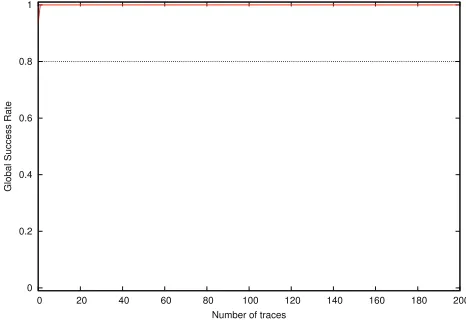
For our experimental results using all sixteen public datasets (80,000 traces in total), the success rate is 100%, while the success rate is about 95% which is evaluated by DPA Contest Official with their private datasets. Although the success rate decreased, the evaluation results still validated the effectiveness of our Multivariate Template Attack (MTA) and Depth-First Key Enumeration Algorithm (DFKEA).
The Global Success Rate (GSR) and the Partial Success Rates (PSR) [8] released by DPA Contest Official are depicted as Fig.8and Fig.9. For the purpose of comparison, the evaluation results of Partial Guessing Entropy (PGE) are also showed as Fig.10.
0 0.2 0.4 0.6 0.8 1
0 20 40 60 80 100 120 140 160 180 200
Global Success Rate
Number of traces
0 0.2 0.4 0.6 0.8 1
0 20 40 60 80 100 120 140 160 180 200
Partial Success Rate
Number of traces Partial Success Rate for Subkey Bytes #1 to #8
01 02 03 04 05 06 07 08
(a) Subkey index from #1 to #8
0 0.2 0.4 0.6 0.8 1
0 20 40 60 80 100 120 140 160 180 200
Partial Success Rate
Number of traces Partial Success Rate for Subkey Bytes #9 to #16
09 10 11 12 13 14 15 16
(b) Subkey index from #9 to #16
Fig. 9.The Partial Success Rate (PSR) of our proposed attack released by DPA Con-test Official, for all sixteen subkeys.
0 50 100 150 200 250
0 20 40 60 80 100 120 140 160 180 200
Partial Guessing Entropy
Number of traces Partial Guessing Entropy for Subkey Bytes #1 to #8
01 02 03 04 05 06 07 08
(a) Subkey index from #1 to #8
0 50 100 150 200 250
0 20 40 60 80 100 120 140 160 180 200
Partial Guessing Entropy
Number of traces Partial Guessing Entropy for Subkey Bytes #9 to #16
09 10 11 12 13 14 15 16
(b) Subkey index from #9 to #16
![Fig. 3. The distribution of errored subkey candidates, “errored” means failed to recovera subkey by first-order rank (80,000 traces from DPA Contest v4.2 [16] are used).](https://thumb-us.123doks.com/thumbv2/123dok_us/7958030.1320300/11.612.141.479.357.453/distribution-errored-subkey-candidates-errored-recovera-subkey-contest.webp)