Developing an ANFIS-PSO Based Model to Estimate Mercury
Emission in Combustion Flue Gases
Alireza Baghban1, Masoud Hadipoor2, Shahaboddin Shamshirband3,4,*
1 Department of Chemical Engineering, Amirkabir University of Technology (Tehran
Polytechnic), Mahshahr Campus, Mahshahr, Iran
2 Department of Petroleum Engineering, Ahwaz Faculty of Petroleum Engineering, Petroleum
University of Technology (PUT), Ahwaz, Iran
3 Department for Management of Science and Technology Development, Ton Duc Thang
University, Ho Chi Minh City, Viet Nam
4 Faculty of Information Technology, Ton Duc Thang University, Ho Chi Minh City, Viet Nam
Abstract
Mercury content in the output gas from boilers was predicted using an Adaptive Neuro-Fuzzy
Inference System (ANFIS). Input parameters selected from coal characteristics and the operational
configuration of boilers. The ANFIS approach is capable of developing a nonlinear model to
represent the dependency of flue gas mercury content into the specifications of coal and also the
boiler type. In this study, operational information from 82 power plants has been gathered and
employed to educate and examine the proposed ANFIS model. Resulted values from the model
compared to the collected data, and it indicates that the model possesses an extraordinary level of
precision with a correlation coefficient of unity. The MARE% for training and testing parts were
0.003266 and 0.013272, respectively. Furthermore, relative errors between acquired data and
predicted values were between -0.25% and 0.1% which confirm the accuracy of PSO-ANFIS
model.
Keywords: Flue gas; Emission; Mercury; ANFIS; PSO
1. Introduction
Mercury contamination can cause significant ecological issues, and it has a considerable effect on
human well-being around the world. As a lethal and exceedingly volatile metal, Mercury can cause
contamination of both nearby and removed streams and lakes. It is the most dangerous hazard for
babies and youthful kids as it influences the central nervous system, causing them utero and some
other nasty illnesses. Nowadays, it is no longer in doubt that a substantial amount of mercury
outflows to the earth comes from coal-consuming power plants. In 2010, roughly 2000 mg mercury
outflows to the air from various sections worldwide(Amap/Unep, 2013). Coal burning had a share
of 24% which is a relatively high share(Burmistrz et al., 2016). Power plants are in charge of
around 33% Mercury outflows, and this type of emission caused by human beings (Alto, 2001)
and Elemental mercury emission is about 20-50% of mercury emissions which originate from
combustion of coal(Carpi, 1997; Srivastava et al., 2006). Nowadays mercury emission from coal
consumption is a global concern. In 2006, total coal consumption in China was about 40.1% of the
world consumption which is equivalent to 1238.3 million tons of oil (Zhang et al., 2008). Some
studies predict that the amount of mercury emission is more likely to increase during the next years
because of more uses in developing countries(Streets et al., 2009). The U.S. Environmental
Protection Agency (EPA) distinguished this metal as one of the most dangerous air pollutants that
must be dealt with under specific concern. In 1999, an approximated amount of 45 tons of mercury
outflows from coal-consuming plants to the environment (Alto 2000). The developing worry of
this contamination in the U.S has incited government and specialists to start endeavors to
recognize, estimate and cut off on the anthropogenic emissions. As a result of the absence of
cost-effective, promptly accessible and efficient practical control methodologies in the U.S, discharge
of this dangerous contaminant from coal-consuming boilers are not basically under control. It gets
worse when the greater of part power supply in a big country such as the United States originates
from utility boilers that use coal (EPA 2001) and furthermore About 70% of electric power in
China is produced by burning coal, in which 50% of this coal burned in coal-based power plants
(Tian et al., 2012; Tian et al., 2011; You and Xu, 2010).
In 1998, Paying attention to the enormous potential for ecological dangers, EPA proposed a request
in order to ask coal-consuming plants to publish information on the amounts of mercury
major parts precisely. The principal stage was intended to gather all standard data on coal-burning
power plants around the U.S. afterward, analyzed feed data at the entrance of every plant during a
year collected. Eventually, in the third phase, EPA chose 84 out of 1084 plants to gather data of
mercury emission in some specified points within the selected plants. This selection was based on
some statistic activities on the feed specifications and also the operational structure of each plant.
Resulted in information from Stage III evaluated. Representing correlations were developed in
order to predict the emission of mercury in each plant concerning coal qualities and operating
conditions. It found that the best input data were characteristics of coal, for example, the
concentration of mercury, heating value, chlorine sulfur, operating parameters such as
temperatures and pressures and also yield parameters in boilers such as the amount of mercury
oxidization. Beside abovementioned backgrounds, artificial intelligence approaches are powerful
tools in order to forecast parameters by finding correlations between variables. This kind of
networks are able to find the nonlinear relationship between parameters, so they are an valuable
method (Baghban et al., 2015). Numerous investigations published in the literature regarding
applications of artificial intelligence approaches. Computational intelligence approach can be used
not only to predict the amount of mercury emission but also to reduce elemental mercury in outlet
gas of boilers (Li et al., 2018a). Dragomir and Oprea (Dragomir and Oprea, 2013) present a
multi-agent system for the operation of power plants. They used artificial neural networks (ANNs) to
predict the amount of SO2, NOx, particulate matters (PMs) and mercury emissions. Jensen et al
(Jensen et al., 2004) worked on the relationships between mercury in the flue gas and coal
specifications and the type of boiler by a multilayer perceptron artificial neural network
(MLP-ANN). They derived an accurate model with a correlation coefficient of 0.9750.
Antanasijević t al (Antanasijević et al., 2013) developed a model to forecast the amount of
PM10 emission by taking advantage of ANNs and genetic algorithm (GA). They conclude
the estimation of PM10 emission up to two years made successfully and accurately. Zhao
et al (Zhao et al., 2010) used support vector Machine to develop a model for mercury
speciation in flue gases. They concluded that the SVM provides better prediction
performances with a mean squared error of 0.0095 and the correlation coefficient of
0.9164. In 2016, Wang et al (Wang et al., 2016) worked on the application of GA-back
coal-fired boilers.Correlation coefficient training data points were as high as 0.895, and
they showed that GA-BP is a promising method for this goal. Li et al. (Li et al., 2018b)
employed computational intelligence approach to cut off on the elemental mercury in
coal-fired boilers, and finally, they found that the increment of capture efficiency can
approximately improve up to 15%.
In addition to the mentioned literature, a comprehensive literature review done. Adaptive
neuro-fuzzy inference system (ANFIS) and also particle swarm optimization (PSO) were rarely used and
needs to be investigated more in depth. The present study aims to find an reliable relationship
between elemental mercury in the output gas, the specification of feed and the type of boilers by
utilizing an ANFIS-PSO based approach.
2. Theory of Adaptive neuro-fuzzy inference system
A deep understanding of the power plant needed in order to control the amounts of mercury
emissions. Therefore, an accurate estimation of emission is vital for engineers who want to control
and reduce mercury emission (Song et al., 2017). The method of ANFIS proposed by Jang (Jang,
1991; Roger, 1993) and is a versatile and intelligent hybrid system. ANFIS approach can be
expressed as a complete collaboration between computing activities and neuro-fuzzy
system(Baghban, 2016). This method integrates natural and neural networks and uses their
strength into its advantage. Such methodology exploits back-propagation calculation from the
information gathering process to make the essential basics of the fuzzy system. Its framework is
related to an arrangement of fuzzy IF-THEN rules which have learning ability to estimate nonlinear
functions. Basics of ANFIS method are approximately similar to a fuzzy system developed by
Takagi-Sugeno-Kang (Sugeno and Kang, 1988; Takagi and Sugeno, 1985). In reverse spread
learning capability of the ANFIS method, which is based on the calculation of derivatives of
squared errors in a backward manner form output nodes to the input ones, this method constructs
and utilizes strong learning methodology based on gradient descent and least-squares methods. In
order to determine the consequence factors in the forward section, the least square approach
utilized. Then the preset parameters will reset by gradient descent in the regressive advance
(Baghban et al., 2016a). The adaptive network constructed of five layers. Figure 1 shows these
layers, their nodes, and connections with the assumption of two inputs expressed by “x” and ”y”
configuration of ANFIS, it noted that two fuzzy 'if-then' rules utilized which they follow sugeno
FIS as:
1 1 1 1 1 1
2 2 2 2 1 1
x=A , y
=B
x=A assume
assume , y=B
f P q y r
f P q y r
= + +
= + +
Fuzzification layer which is the first layer of the structure produces all membership grades for each
variable. Node functions in this layer can be defined as follows:
( )
1,i Ai 1, 2 (1)
O = x i=
( )
1,i Bi 2 3, 4 (2)
O = − x i=
Memberships of a fussy set are (Ai, Bi) and O1, i represents the resulted value from ith node of the
first layer. The input signals are generated by the nodes of layer 2.
( )
( )2,i i Ai Bi x 1, 2 (3)
O =w = x i=
The nodes of the third layer are used to compute the following parameter:
3,
1 2
1, 2 (4)
i i W O i W W = = = +
Where Wi is rule firing strengths of node i which has a normalized firing strength of ωi. Results of
layer 4 can be written as follows:
(
)
4, i i i i i 1, 2 (5)
O =f =i P +q y+r i=
In this notation pi, qi, and ri are called consequent parameters. Eventually, the general output can
be defined as follows which calculated in the nodes of layer 5:
2
1 1 2 2
5,
1 1 2
(6)
i i i
i f f O f W W = + = = +
A considerable number of optimization methodologies, such as PSO, are available to reinforce the
parameters and answers of ANFIS system(Baghban et al., 2016b). PSO is extraordinary compared
to other approaches with the end goal of optimization. This study takes the benefits of this
algorithm.
3. Model development
When there is not enough data on the detailed information of an operating power plant, it is tough
to build up a precise model in order to estimate the amount of mercury outflow. In the present
at some specified testing locations. In this kind of locations, every single factor that may influence
the mercury discharge considered and incorporated into the model. A total number of 82 data
points were gathered from literature to train and evaluate the model (Jensen et al., 2004). The
concentration of mercury in the inlet feed, ash content, chlorine content, the heating value of coal,
sulfur content, and the temperature chosen as the most useful variables. This data bank comprises
a total number of 82 data points, from which 75% used as training and the rest of them exploited
testing samples. In the developed ANFIS model, six previously mentioned parameters considered
as input parameters, and the elemental mercury emission selected as the target variable.
Furthermore, PSO algorithm was used to find the optimized Gaussian membership function
parameters of the proposed ANFIS model.
3.1. Fundamentals of Particle Swarm Optimization
Particle swarm optimization (PSO), inspired in the early 1990s from birds behavior seeking
food (Chen et al., 2006; El-Gallad et al., 2002). In this model, particles update their places and
pathways based on their and others information; so it was proposed that the particle possess a
memory function. The optimization process is based on competition and collaboration between
particles. When PSO is used to solve optimization problems, one can follow the particles state by
their pathways, and velocities. Three vectors Xi, Vi, Pbesti are introduced to explain the properties
of a particle: Xi is the current place; Vi the current speed; Pbestithe best spatial placement sought
by the particle. The position and pathway of the particle will be updated gradually, based on the
following formula:
1 2
( 1) ( ) (0,1) [ ( ) ( )] (0,1) [ ( ) ( )] (7)
v k+ =v k +c rand pbest k −persent k +c rand gbest k −persent k
present (k + 1) = present (k) + v (k + 1) (8)
Where, v( ) is particle speed; present( ) is particle position; c1, c2 are learning coefficients and are
greater than zero, and a random number between [0,1] is denoted using rand( ). Formula (7)
represents the updating process of the particle’s speed which includes particle’s historical
velocities and personal and global best positions (Meng and Pian, 2015).
4. Results and discussions
The amount of mercury emission was estimated using an ANFIS approach. Emission of mercury
into the environment generally is an active function of mercury six previously mentioned variables.
optimize the parameters. In addition to that, the total number of 10 clusters utilized in the ANFIS
hybrid system. Optimization conducted on a total number of parameters that were determined by:
N =N N NT c mf (9)
Where the number of parameters for undergoing optimization is denoted by NT, and Nmf, is used to
show the number of Gaussian membership functions that used, Nυ and Nc show how many
variables and clusters are used in the model, respectively. It is noteworthy to state that in this study,
two membership functions, seven input and output variables, and 10 clusters used. Eventually,
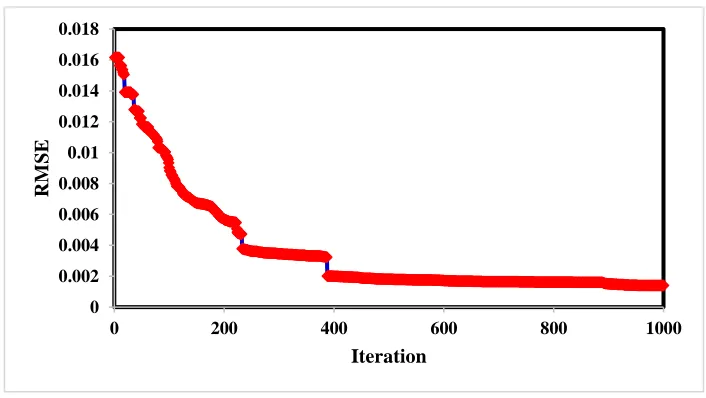
using a PSO algorithm, optimization was conducted for 140 tuning parameters. As is shown in
Figure 2, in order to evaluate the functionality of PSO algorithm, a root means square error
(RMSE) analyze used. Results show that in a total number of 1000 iterations, the minimum value
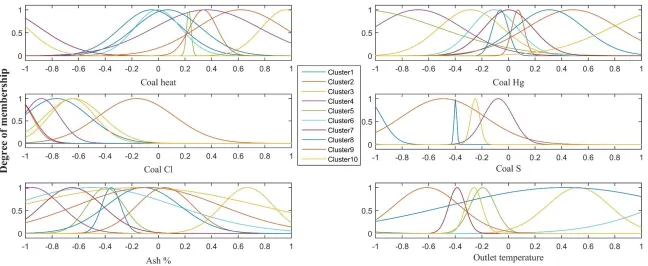
of RMSE touched. Figure 3 indicates train membership function parameters for each input
variables. It is seen that the results of the presented model are in good agreement with the obtained
data which is the result of great learning capability of the developed ANFIS model. Figure 4
illustrates the obtained data of mercury emissions versus the test and training of ANFIS hybrid
system. As is shown in Figure 5, actual and predicted mercury emissions are located on a straight
line with an approximate slope of 1 (45o line) which indicates that the obtained information and ANFIS predicted ones are in good agreement. The obtained cross-fit line in both test and training
data sets have an 𝑅2 equal to 1 which shows the accurateness of the model. In order to compare
the results of mthe odel and evaluate its precision, the method of mean absolute relative error is
used. For training and testing steps, using mean absolute relative error percentage (MARE %)
method, percentage values of 0.003266 and 0.013272 are calculated, respectively. Resulted
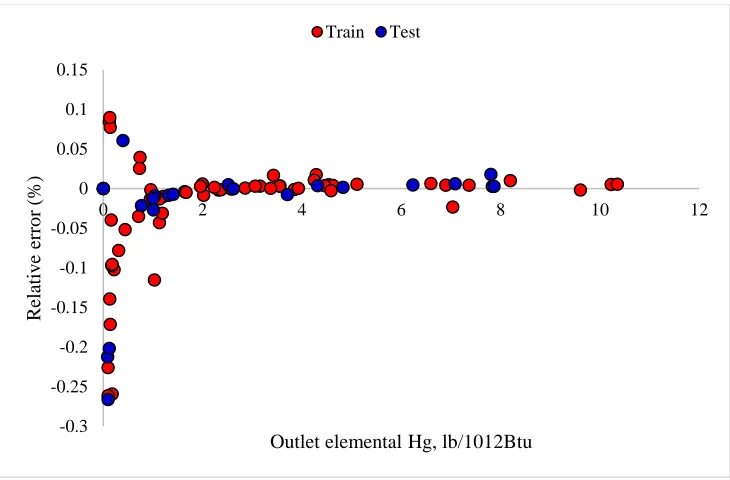
relative deviations are shown in Figure 6. Low relative deviations are observed due to
accurately-predicted values. Different statistical analyses were also presented in Table 1 for the suggested
Figure 1. A schematic view of the ANFIS intelligent system.
Figure 2. Root mean square errors versus a number of iterations. 0
0.002 0.004 0.006 0.008 0.01 0.012 0.014 0.016 0.018
0 200 400 600 800 1000
RM
SE
Figure 4. Obtained data from plants and ANFIS values for mercury emissions in the stages of
training and testing.
Figure 5. Regressions derived between estimated and collected data of mercury emissions.
0 2 4 6 8 10 12
0 10 20 30 40 50 60 70 80 90
Ou tlet elem en tal Hg , lb /1 0 1 2 B tu Data Index
Train Exp Test Exp Train Output Test Output
Train: y = 1.0001x - 0.0002 R² = 1
Test: y = 1.0001x - 0.0002 R² = 1
0 2 4 6 8 10 12
0 2 4 6 8 10 12
A ctu al Ou tlet elem en tal Hg , lb /1 0 1 2 B tu
Estimated Outlet elemental Hg, lb/1012Btu
Figure 6. The deviation between the obtained data from plants and predicted mercury emissions.
Table 1: Statistical analysis of the model for all phases
Train Test
R2 1.000 1.000
MSE 1.40E-07 1.39E-07
MRE (%) 0.037 0.044
5. Conclusions
Emission of mercury is known as one of the most perilous environmental contamination. In this
study, a comprehensive literature review was done, and a predictive model was built to estimate
the amount of mercury emission based on the characteristics of the coal supply, operational
conditions, and so forth. The presented model is based on the ANFIS system which utilizes a PSO
algorithm to estimate the amount of mercury emission to the environment. Data from 82 power
plants have been used to train and develop the ANFIS model. The MARE% for training and testing
parts were 0.003266 and 0.013272, respectively. Furthermore, relative errors between acquired
data and predicted values were between -0.25% and 0.1% which confirm the accuracy of
PSO--0.3 -0.25 -0.2 -0.15 -0.1 -0.05 0 0.05 0.1 0.15
0 2 4 6 8 10 12
R
elativ
e
er
ro
r
(%)
Outlet elemental Hg, lb/1012Btu
ANFIS model. It is obvious that for both training and testing parts the coefficient of determination
was calculated to equal to unity which reflects the accuracy of the proposed ANFIS-PSO based
model.
References
Alto, P., 2001. Power plants and mercury, environmental issues. Electric Power Research Institute, CA. Amap/Unep, 2013. Technical background report for the Global Mercury Assessment 2013. Arctic Monitoring and Assessment Programme, Oslo, Norway/UNEP Chemicals Branch Geneva, Switzerland. Antanasijević, D.Z., Pocajt, V.V., Povrenović, D.S., Ristić, M.Đ., Perić-Grujić, A.A., 2013. PM10 emission forecasting using artificial neural networks and genetic algorithm input variable optimization. Journal of Science of the Total Environment 443, 511-519.
Baghban, A., 2016. Application of the ANFIS strategy to estimate vaporization enthalpies of petroleum fractions and pure hydrocarbons. Pet. Sci. Technol. 34, 1359-1366.
Baghban, A., Ahmadi, M.A., Shahraki, B.H., 2015. Prediction carbon dioxide solubility in presence of various ionic liquids using computational intelligence approaches. The Journal of supercritical fluids 98, 50-64.
Baghban, A., Bahadori, M., Ahmad, Z., Kashiwao, T., Bahadori, 2016a. Modeling of true vapor pressure of petroleum products using ANFIS algorithm. Pet. Sci. Technol. 34, 933-939.
Baghban, A., Kashiwao, T., Bahadori, M., Ahmad, Z., Bahadori, A., 2016b. Estimation of natural gases water content using adaptive neuro-fuzzy inference system. Pet. Sci. Technol. 34, 891-897.
Burmistrz, P., Kogut, K., Marczak, M., Zwoździak, J., 2016. Lignites and subbituminous coals combustion in Polish power plants as a source of anthropogenic mercury emission. Fuel Process. Technol. 152, 250-258.
Carpi, A., 1997. Mercury from combustion sources: a review of the chemical species emitted and their transport in the atmosphere. Water Air Soil Pollut 98, 241-254
Chen, G., Huang, X., Jia, J., Min, Z., 2006. Natural exponential inertia weight strategy in particle swarm optimization, 2006 6th World Congress on Intelligent Control and Automation. IEEE, pp. 3672-3675. Dragomir, E.G., Oprea, M.J.I.P.V., 2013. A Multi-Agent System for Power Plants Air Pollution Monitoring. 46, 89-94.
El-Gallad, A., El-Hawary, M., Sallam, A., Kalas, A., 2002. Enhancing the particle swarm optimizer via proper parameters selection, IEEE CCECE2002. Canadian Conference on Electrical and Computer Engineering. Conference Proceedings (Cat. No. 02CH37373). IEEE, pp. 792-797.
Jang, J.-S.R., 1991. Fuzzy Modeling Using Generalized Neural Networks and Kalman Filter Algorithm. AAAI 91, 762-767.
Jensen, R.R., Karki, S., Salehfar, H., 2004. Artificial neural network-based estimation of mercury speciation in combustion flue gases. Fuel Processing Technology 85, 451-462.
Li, Q., Wu, J., Wei, H., 2018a. Reduction of elemental mercury in coal-fired boiler flue gas with computational intelligence approach. Energy 160, 753-762.
Li, Q., Wu, J., Wei, H., 2018b. Reduction of elemental mercury in coal-fired boiler flue gas with computational intelligence approach. J. Energy 160, 753-762.
Meng, X., Pian, Z., 2015. Intelligent Coordinated Control of Complex Uncertain Systems for Power Distribution and Network Reliability. Elsevier.
Roger, J.J.-S., 1993. ANFIS: adaptive-network-based fuzzy inference system. IEEE Transactions on Systems, Man, and Cybernetics 23, 665-685.
Song, J., Romero, C.E., Yao, Z., He, B., 2017. A globally enhanced general regression neural network for on-line multiple emissions prediction of utility boiler. Knowledge Based Syst. 118, 4-14.
Streets, D.G., Zhang, Q., Wu, Y., 2009. Projections of global mercury emissions in 2050. Environ. Sci. Technol. 43, 2983-2988.
Sugeno, M., Kang, 1988. Structure identification of fuzzy model. Fuzzy Sets Syst. 28, 15-33.
Takagi, T., Sugeno, M., 1985. Fuzzy identification of systems and its applications to modeling and control. transactions on systems, man, and cybernetics, 116-132.
Tian, H., Wang, Y., Cheng, K., Qu, Y., Hao, J., Xue, Z., Chai, F., 2012. Control strategies of atmospheric mercury emissions from coal-fired power plants in China. Journal of the Air & Waste Management Association 62, 576-586.
Tian, H., Wang, Y., Xue, Z., Qu, Y., Chai, F., Hao, J., 2011. Atmospheric emissions estimation of Hg, As, and Se from coal-fired power plants in China, 2007. Sci. Total Environ. 409, 3078-3081.
Wang, F., Tian, G., Wang, X., Liu, Y., Deng, S., Wang, H., Zhang, F., 2016. Application of genetic algorithm-back propagation for prediction of mercury speciation in combustion flue gas. Clean Technologies Environmental Policy 18, 1211-1218.
You, C.F.a., Xu, X.C., 2010. Coal combustion and its pollution control in China. Energy 35, 4467-4472. Zhang, L., Zhuo, Y., Chen, L., Xu, X., Chen, C., 2008. Mercury emissions from six coal-fired power plants in China. Fuel Process. Technol. 89, 1033-1040.