Purchase Process Standardization and
Application of Multi – Criteria Decision
Making Techniques for Vendor Selection of
Gear Generating Machine
Sanskruti M. Jajoo
B. Tech, Department of Production Engineering and Industrial Management, College of Engineering Pune,
Shivajinagar, Pune, Maharashtra, India
ABSTRACT: Purchase is one of the most common and important activities in every manufacturing industry. Purchase department has to take care of buying resources at the right quality, in the right quantity, from the right source, delivered at the right place, at the right time, with the right mode of transport. In most of the industries, the purchase process generally contains the study of the resource, request for quotation, negotiation with vendors, vendor selection and generation of purchase order. There might be different methods followed by individuals, which lead to different results and consequences. An attempt has been made in this paper to standardize the purchase process. The steps like negotiation with the vendor and vendor selection are the most important steps in purchase process. These steps should result from optimized qualitative techniques. Rapid growth of technology has been accompanied by the increase in number of vendors for each product, who come up with many different options. The purchase department has to compare options based on multiple criteria and choose one option. The purchase department thus faces difficulties in selecting one product with feasible cost out of the several possible options. Conventionally, the selected vendor was the experience based reliable source of that industry. This method resulted in losing the best offers in the new market and ultimately contributed towards opportunity and financial losses of the industry. In order to reduce confusion, avoid the personal bias and choose vendor wisely, mathematics and standardized techniques developed for solving Multi – Criteria Decision Making (MCDM) should be used. A case study of gear generating machine is discussed in this paper. MCDM techniques - Pugh matrix and TOPSIS are applied to obtain the alternative vendor and order of preference of vendors in conjunction to the requirements.
KEYWORDS: Gear generating machine, MCDM, Pugh matrix , Purchase process standardization, TOPSIS,.
I. INTRODUCTION
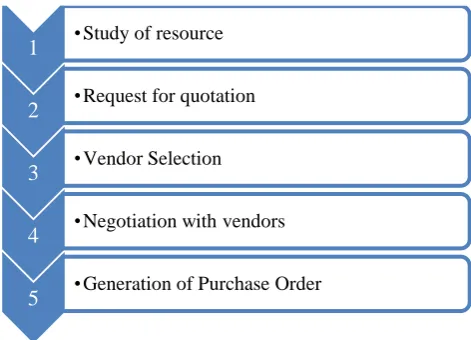
Copyright to IJIRSET DOI:10.15680/IJIRSET.2019.0811023 11036 These are the basic steps followed by every company.
Fig. 1. Flowchart of general purchase process
The general purchase method results in more time consumption for purchasing, which may also have adverse impacts on relationship between the vendor and the buyer company. Moreover, there is insufficiency to select the best vendor and lack of previous data, reduced productivity and efficiency. Such methods ultimately result in contributing to the financial losses of industries. Every individual also has different perspectives of looking at things and different approaches in carrying out tasks. For an organization to be system dependent and have reliable, optimum result every time, it becomes necessary to have a standardized purchase process.
Vendor selection is one of the most important steps in the purchase process. Conventionally, the selected vendor was the experience based reliable source of that industry. This method resulted in losing the best offers in the new market and ultimately contributed towards opportunity and financial losses of the industry.
The detailed study of the critical parameters of the machine is necessary as these parameters help in the selection of the machine. Many of the industries select the vendor offering the machine with lowest cost and tend to neglect the critical machine parameters. In such cases, factors like durability of machine get affected.
In order to reduce confusion, avoid the personal bias and choose vendor wisely, mathematics and standardized techniques developed for solving Multi – Criteria Decision Making (MCDM) should be used.
II. LITERATUREREVIEW
[1] The method TOPSIS was developed by Hwang & Yoon in 1981 for multiple attribute decision making methods and applications. There are many researches done using this method for construction project selection, vendor selection, logistics, design selection etc.
[2] Dr. Bhatt Rajiv and Dr. Bhatt Darshana applied 'TOPSIS' and 'VIKOR' Multi-Criteria Decision Making Methods for selection of Construction Projects. In this they considered many factors which affect the construction projects and by considering those factors in TOPSIS concluded with the best construction project among the projects.
[3] G. Muller (2011) used the Pugh matrix in the sub – sea equipment industry for concept selection. 6 different case studies were taken into consideration. The study found out alternate designs. It was also observed that older engineers were reluctant to application of Pugh matrix due to the everyday pressure.
1
•Study of resource2
•Request for quotation3
•Vendor Selection4
•Negotiation with vendorsIII.METHODOLOGY
The purchase process was studied and analysed. An attempt was made to standardize the process. One of the most important steps of purchasing is vendor selection. The detailed study of many mathematical techniques was done. At the end, we selected MCDM Techniques. These techniques are used to select one from many available options, with multiple criteria associated. There are many researches done using these methods for construction project selection, vendor selection, logistics, design selection etc. Pugh matrix and TOPSIS were the chosen MCDM techniques and applied for the case study of gear generating machine.
IV.PURCHASEPROCESSSTANDARDIZATION
1) Introduction:
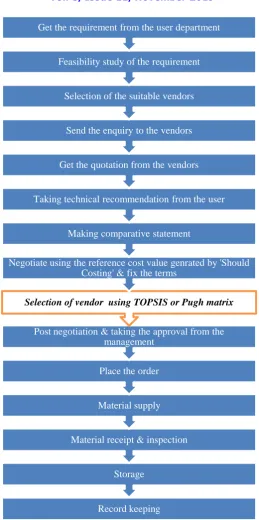
Copyright to IJIRSET DOI:10.15680/IJIRSET.2019.0811023 11038 Fig. 2. Flowchart of standardized purchase process
2) Description of Standardized Purchase Process:
The purchase process starts with the need of the product. After the detailed study of the required product the initiation for the vendor searching should takes place to which the request for quotations should be sent. After getting
Record keeping Storage
Material receipt & inspection Material supply
Place the order
Post negotiation & taking the approval from the management
Selection of vendor using TOPSIS or Pugh matrix Negotiate using the reference cost value genrated by 'Should
Costing' & fix the terms Making comparative statement
Taking technical recommendation from the user Get the quotation from the vendors
the required quotations from each vendor, techno-commercial synopsis should to be created. For getting the proper reference value calculating the ‘Should cost’ of machine is required. Should cost is the approximate cost the machine may cause. This can be generated by referring the previous purchase of machine in the same company or getting information from other company related to that machine. Should cost should consider the factors like inflation rate and currency, etc. and also considering the individual values of different units of the machine. After the negotiation with each vendor, the Standardization method should contain the selection of vendor by proper numerical analysis. Post negotiation and the approval from higher management authorities should finalize the value and the vendor. On the basis of this approval, the purchase order should be release. Supply, inspection and the storage are the last but the important steps of the purchase process. Record keeping of this proposals helps for future purchase decisions.
3) Conclusion and result from Purchase Process Standardization:
In the described case study it is examined that how the purchase process should take place i.e. standardized method. Standardizing the method will reduce the time required by the purchase process in general, make the vendor selection decision much more simple, avoiding personal bias, create the reference for negotiation, increase the productivity, creates a reference for negotiating with vendors and make the purchase process more efficient. Standardizing the process also reduces the dependency of individual experience which is the dependent factor on the employee. As mentioned above the suggested standardized purchase process is based on few case studies. One of which is described below. In the mentioned case study, the vendor selection which was the critical step of purchase process is described in detail. This proposed standardized method is focused on explicit connection of the purchase processing steps and important decision making mathematical techniques.
V. CASE STUDY:VENDOR SELECTION FOR GEAR GENERATING MACHINE
Standardized methods for selecting the right vendor are applied on gear generating machine. Gears are the most complex element of any machine. The factors like gear ratio, module, centre distance, helix angle are important. But these are not the only factors that affect the performance characteristics of the gears. Each and every parameter involved in the process of manufacturing gear is important, right from generating a gear to finishing. Durability of any machine is also dependent on the gears of that machine. Gears are mostly generated in high volume lots. For generating huge lots of gears with same dimensions and precision, gear generating machines are used. Thus, purchasing a perfect gear generating machine is very important. There are multiple criteria for selecting gear generating machine. There are many vendors and many variants of gear generating machine for same specifications in the market. Hence, choosing the right vendor is very difficult. In most of the industries, these decisions are taken on the basis of previous records or experience based reliable sources. This method has a lot of disadvantages. It resulted in losing the best offers in the new market and ultimately contributed towards opportunity and financial losses of the industry. Here, standardized methods - Pugh matrix and TOPSIS are applied to select the best vendor.
There are four vendors for given gear generating machine. The standardized purchase process was followed and the quotations were obtained from these vendors. On the basis of their quotations, the Techno – commercial synopsis was created. The vendor selection is generally done by studying Techno-commercial synopsis. At times when there are many parameters, it becomes difficult to arrive at the conclusion for choosing the best vendor. By referring the Techno commercial synopsis, the differences in the critical parameters were taken into consideration. These parameters with their respective values for each quotation were compiled in the matrix format as per the required method for Vendor selection.
A. Pugh matrix
Pugh matrix compares the options based on the scoring of attributes. Scoring is done as +, - and 0.
Where
Copyright to IJIRSET DOI:10.15680/IJIRSET.2019.0811023 11040 - Is for the value which is worse than baseline.
0 Is for the value which is about the same. Weight values are given to each attribute.
Final score is then calculated by summing up the scores for each option. On the basis of this, the rank is decided for each option.
1) Result from Pugh matrix
Table 1 Value of each criterion
Parameters A B C D
1 Work piece diameter (mm) 280 260 300 500
2 Work table diameter (mm) 280 121 140 180
3 Power machine axes details (in KW) 25 12 35 25
4 Connecting load (KVA) 133 100 130 130
5 Consumption (KW) 9 18 7.2 10
6 Cost (In Millions) 300 300 270 240
7 Cycle time (mins) 0.88 0.88 0.69 0.49
The above table contains the values for respective parameters. Above parameters are the critical parameters of the gear generating machine which are important in technical and commercial aspects for selecting the best gear generating machine.
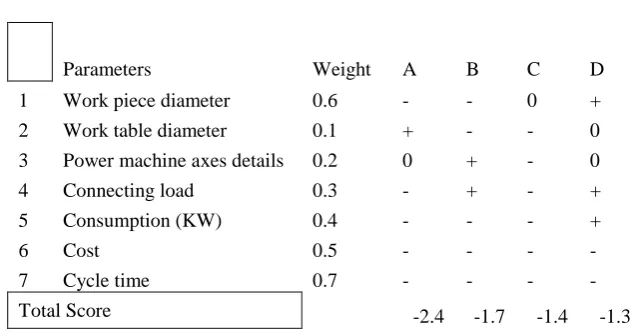
Table 2 Pugh Selection Matrix
Parameters Weight A B C D
1 Work piece diameter 0.6 - - 0 +
2 Work table diameter 0.1 + - - 0
3 Power machine axes details 0.2 0 + - 0
4 Connecting load 0.3 - + - +
5 Consumption (KW) 0.4 - - - +
6 Cost 0.5 - - - -
7 Cycle time 0.7 - - - -
Total Score -2.4 -1.7 -1.4 -1.3
Above table is the Pugh selection matrix formed by applying Pugh matrix method. In the above Pugh selection matrix Option A, B, C and D are having -2.4,-1.7,-1.4, -1.3 scores respectively. From which it can be seen that Option D has the maximum score. Therefore, Option D should be chosen for purchasing the gear generating machine according to Pugh matrix method.
2) Conclusion from Pugh matrix
Consider the given case of selection of vendors for gear generating machine. In this Pugh matrix (decision matrix) is created using the parameters and their respective weights. Based on these parameters and weights, the score is calculated. For vendors A, B, C and D, the respective scores are -2.4,-1.7,-1.4, -1.3. On the basis of these scores, the best vendor comes as vendor D.
This technique reduces the time required for selecting the best vendor. This method helps in selecting the best vendor by considering all the parameters.
This is a very primitive method and there is no consideration of weights of factors. The ideal solution and the closeness to the same are not calculated in this method. Another method, TOPSIS eliminates these disadvantages and makes use of mathematics to find the preference by similarity to ideal solution.
B. TOPSIS
Technique of Order Preference by Similarity to Ideal Solution is based on the Quantitative, Qualitative benefit Negative ideal alternatives. Ideal alternative are the one which has the best level for all attributes values. Negative ideal are those which has worst attribute values. This method selects the closest alternative to the ideal solution and farthest from the negative ideal.
m alternatives and n options are considered in TOPSIS. For each option there exist a score with respect to each criterion. Let mij be the score of option i with respect to criterion j
Consider a matrix M = (mij) mn matrix.
Let J be the set of benefit attributes or criteria (more is better) Let J' be the set of negative attributes or criteria (less is better) Step 1: Construction of normalized decision matrix.
Normalize the data by using following formula: rij = xij/ (x2ij) for i = 1, …, m; j = 1, …, n Where rij will be the new element of matrix.
Step 2: Construction of weighted normalized decision matrix. Consider a set wj for j = 1,…n of weights for each criteria.
Multiply each column of the normalized decision matrix by its linked weight. vij = wjrij where vij will be the new element of the matrix.
Step 3: Determine the ideal and negative ideal solutions. Ideal solution:
A* = { v1* , …, vn*}, where
vj* ={ max (vij) if j J ; min (vij) if j J' } Negative ideal solution:
A' = { v1' , …, vn' }, where
v' = { min (vij) if j J ; max (vij) if j J' }
Step 4: Calculation of separation measures for each alternative. The separation from the ideal alternative can be calculated by: Si * = [ (vj*– vij)2 ] ½ i = 1, …, m
Similarly, the separation from the negative ideal alternative can be calculated by: S'i = [ (vj' – vij)2 ] ½ i = 1, …, m
Step 5: Calculation of relative closeness to the ideal solution Ci* Ci* = S'i / (Si* +S'i ) , 0 ≤Ci* ≤1
Copyright to IJIRSET DOI:10.15680/IJIRSET.2019.0811023 11042 1) Result from TOPSIS
Table 3 Value of each criterion
Parameters A B C D
1 Work piece diameter (mm) 280 260 300 500
2 Work table diameter (mm) 280 121 140 180
3 Power machine axes details (in KW) 25 12 35 25
4 Connecting load (KVA) 133 66 130 107
5 Consumption (KW) 9 18 7.2 5
6 Cost (In Millions) 300 300 270 240
7 Cycle time (mins) 0.88 0.88 0.69 0.49
Important technical and commercial parameters for selecting the best gear generating machine are given in above table. In the above data, A,B,C and D are the options and the gear generating machine parameters are the attributes considered for selecting the gear generating machine.
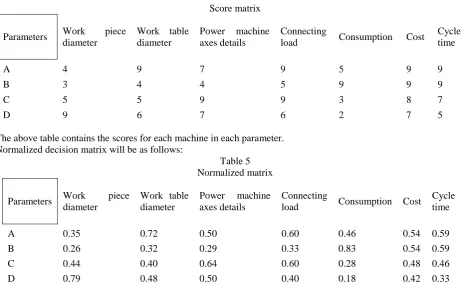
Score matrix will be:
Table 4 Score matrix
Parameters Work piece
diameter
Work table diameter
Power machine axes details
Connecting
load Consumption Cost
Cycle time
A 4 9 7 9 5 9 9
B 3 4 4 5 9 9 9
C 5 5 9 9 3 8 7
D 9 6 7 6 2 7 5
The above table contains the scores for each machine in each parameter. Normalized decision matrix will be as follows:
Table 5 Normalized matrix
Parameters Work piece diameter
Work table diameter
Power machine axes details
Connecting
load Consumption Cost
Cycle time
A 0.35 0.72 0.50 0.60 0.46 0.54 0.59
B 0.26 0.32 0.29 0.33 0.83 0.54 0.59
C 0.44 0.40 0.64 0.60 0.28 0.48 0.46
D 0.79 0.48 0.50 0.40 0.18 0.42 0.33
Let the set of weights be w= {0.6, 0.1, 0.2, 0.3, 0.4, 0.5, 0.7}
Table 6
Parameters
Work piece diameter
Work table diameter
Power machine axes details
Connecting
load Consumption Cost
Cycle time
A 0.21 0.07 0.10 0.18 0.18 0.27 0.41
B 0.16 0.03 0.06 0.10 0.33 0.27 0.41
C 0.26 0.04 0.13 0.18 0.11 0.24 0.32
D 0.47 0.05 0.10 0.12 0.07 0.21 0.23
The above matrix is the weighted normalized matrix which obtained after multiplying each value in normalized matrix with their respective weight. Here, work piece diameter and work table diameter are the benefit or positive attributes and other parameters are the negative attributes.
Table 7
Ideal and negative ideal solution
A+ 0.470 0.070 0.060 0.100 0.070 0.210 0.230
A- 0.160 0.030 0.130 0.180 0.330 0.270 0.410
Ideal solution is the one which is contains the best value in all the parameters. On the other hand, the negative ideal solution is the solution having the worst condition in all the parameters.
Separation measures will be:
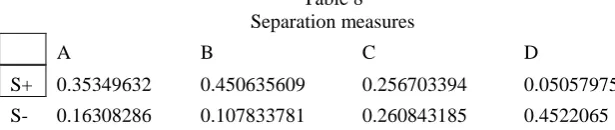
Table 8 Separation measures
A B C D
S+ 0.35349632 0.450635609 0.256703394 0.05057975
S- 0.16308286 0.107833781 0.260843185 0.4522065
The separation measures are calculated and written in the above table. It will enable us to calculate the relative closeness in the next step and thus select the best option.
Relative closeness will be:
Table 9 Relative closeness
A B C D
Closeness rating 0.315697702 0.193088077 0.503999438 0.89940109
The closeness rating indicates the closeness to the ideal solution. The closeness rating for ideal solution is 1. In our case, it can be observed that the closeness rating of option D is closest to 1. Therefore, option D should be chosen for purchasing gear generating machine.
2) Conclusion from TOPSIS
In case of selection of vendor for any machine, TOPSIS method allows to compare all the vendors based on different parameters and corresponding weights. It calculates the closeness rating for each vendor. Ultimately the closeness rating nearest to 1 is selected as best vendor.
Copyright to IJIRSET DOI:10.15680/IJIRSET.2019.0811023 11044 closeness rating nearest to 1 is selected as best vendor. For vendors A, B, C and D, the respective closeness ratings are 0.315697702, 0.193088077, 0.503999438, and 0.89940109. As vendor D is having the nearest value to 1, it is selected as the best vendor for purchasing the gear generating machine. The order of selecting the best vendor is D, C, A, and B. In such a way TOPSIS method gives the priorities of the vendors for purchasing machine.
VI.CONCLUSION
The standardized purchase process is the current requirement for many industries. For an organization to be system dependent and have reliable, optimum result every time, it becomes necessary to have a standardized purchase process.
The vendor selection is the most critical part in the purchase process. In general purchase method, the vendor selection is done on the basis of experience based reliable sources which results in negligence to the new vendors and purchase department may lose the best offers. Sometimes the vendor offering machine in lowest price is directly selected. This may affect factors like durability of machine, quality of product etc.
In order to reduce confusion, avoid the personal bias and choose vendor wisely, mathematics and techniques developed for solving multi – criteria decision making must be used. These methods will help to choose the best vendor. In this paper, Pugh matrix and TOPSIS are applied to obtain the alternative vendor and order of preference in conjunction to the requirements. Qualitative optimizing methods can make vendor selection easier in case of more than one vendor and with multiple criteria involved.
Pugh matrix gives the result in very less time. In case of getting the priority of the vendors with the use of mathematics, TOPSIS method is useful. It consumes more time than Pugh matrix technique but gives the optimized solution in lesser amount of time than general vendor selection method. So these techniques must be used as per the requirements. It enables to reduce the time of complete process and increases the productivity of department.
REFERENCES
[1] Hwang, C. L., & Yoon, K. “Multiple attribute decision making methods and applications: A state of the art survey”, New York: Springer-Verlag, 1981.
[2] Dr. Bhatt Rajiv* & Dr. Bhatt Darshana . "Supplier Selection for Construction Projects Through ‘TOPSIS’ and ‘VIKOR’ Multi-Criteria Decision Making Methods" ,International Journal of Engineering Research & Technology (IJERT), Vol. 3 Issue 5, May – 2014.
[3] G. Muller (2011) “Systems Engineering Research validation ”, http://www.gaudisite.nl/SEresearchValidationPaper.p, 2011
[4] Mandal, A., Deshmukh, S.G,. “Vendor selection using Interpretive Structural Modelling (ISM)”,International Journal of Operations and Production Management 14 (6), 52-59
[5] Vokurka, R.J., Choobineh, J., Vadi, L.“A prototype expert system for the evaluation and selection of potential suppliers”, International Journal of Operations and Production Management 16 (12),106-127
[6] Cukurova University, “Application of TOPSIS Technique for Financial Performance Evaluation of Technology Firms in Istanbul Stock Exchange Market, Berna (Kiran) Bulgurcu / Procedia” - Social and Behavioral Sciences 62 ( 2012 ) 1033 – 1040 – ELSEVIER
[7] Siti Rohanah, 2018, “An evaluation of students performance using TOPSIS and Entropy approaches”, IOSR Journal of Research & Method in Education (IOSR-JRME), e- ISSN: 2320–7388,p-ISSN: 2320–737X Volume 8, Issue 6 Ver. I. (Nov. – Dec. 2018), PP 01-06, www.iosrjournals.org
[8] Jyoti Vimal, Vedansh Chaturvedi, Ashutosh Kumar Dubey, 2012, “Application of TOPSIS method for supplier selection in manufacturing industry”, IJREAS Volume 2, Issue 5 (May 2012) ISSN: 2249-3905, http://www.euroasiapub.org
[9] Biranchi Narayan Panda, Bibhuti Bhusan Biswal, B B L V Deepak, “Integrated AHP and fuzzy TOPSIS Approach for the Selection of a Rapid Prototyping Process under Multi-Criteria Perspective”, 5th International & 26th All India Manufacturing Technology, Design and Research Conference (AIMTDR 2014) December 12th–14th, 2014, IIT Guwahati, Assam, India
[10] Chaitanya Gawandalkar, Arun B. Rane, “Case study based vendor selection by TOPSIS and Pugh Matrix approach”, International Journal for Research in Applied Science & Engineering Technology (IJRASET), Volume 4 Issue IX, September 2016.
[11] Srikrishna, Sreenivasulu Reddy, Vani,, “A New Car Selection in the Market using TOPSIS Technique”, International Journal of Engineering Research and General Science Volume 2, Issue 4, June-July, 2014, ISSN 2091-2730