Identifi
cation of signifi
cant genes in genomics
using Bayesian variable selection methods
Eugene Lin1
Lung-Cheng Huang2,3
1Vita Genomics, Inc., Wugu Shiang,
Taipei, Taiwan; 2Department
of Psychiatry, National Taiwan University Hospital Yun-Lin Branch, Taiwan; 3Graduate Institute
of Medicine, Kaohsiung Medical University, Kaohsiung, Taiwan
Correspondence: Lung-Cheng Huang Department of Psychiatry, National Taiwan University Hospital Yun-Lin Branch, Taiwan
Tel +886 5 532 3911 Fax + 886 6 234 5501 Email [email protected]
Abstract: In the studies of genomics, it is essential to select a small number of genes that are more signifi cant than the others for research ranging from candidate gene studies to genome-wide association studies. In this study, we proposed a Bayesian method for identifying the promis-ing candidate genes that are signifi cantly more infl uential than the others. We employed the framework of variable selection and a Gibbs sampling based technique to identify signifi cant genes. The proposed approach was applied to a genomics study for persons with chronic fatigue syndrome. Our studies show that the proposed Bayesian methodology is effective for deriving models for genomic studies and for providing information on signifi cant genes.
Keywords: Bayesian variable selection, genomics, Gibbs sampling, variable selection
Introduction
In the studies of genomics, the problem of identifying signifi cant genes remains a challenge for researchers. Single nucleotide polymorphisms (SNPs) can be used in clinical association studies to determine the contribution of genes to disease suscepti-bility or drug effi cacy. By using candidate gene approaches or genome-wide associa-tion studies, the key goal is to fi nd responsible genes and SNPs for certain events (for example, certain diseases or certain drug effi cacy). It is vital to select a small number of SNPs that are more signifi cant than the others and ignoring the SNPs of lesser signifi cance, thereby allowing researchers to focus on the most promising candidate genes and SNPs for diagnostics and therapeutics (Lee et al 2003; Lin et al 2007a). As we have 2p models with p SNPs, exhaustive computation over this model space is not
feasible when the model space is very large (Lee et al 2003).
conditional logistic regression likelihood to identify genetic loci relevant to a disease using case-parent triads. Oh (2007) also coupled the SSVS method with the new Haseman-Elston method to perform linkage analysis in rheumatoid arthritis. Similarly, Kwon and colleagues (2007) applied an iterative SSVS method to fi nd SNPs that are associated with rheu-matoid arthritis.
The rest of the paper is organized as follows. First, we propose a Bayesian-based methodology to identify the prom-ising candidate genes that are signifi cantly more infl uential than the others. Secondly, we evaluate and compare the proposed methods using a real dataset in a candidate gene study. Finally, we present the discussion and provide the conclusion.
Methods
Population
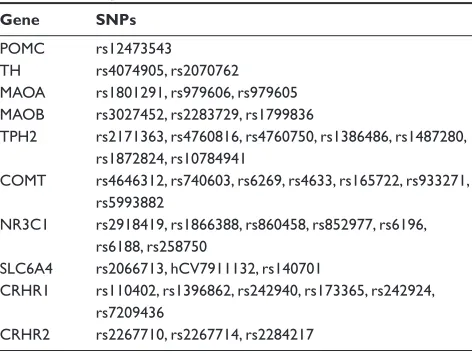
The study population was original to the previous study by the CDC Chronic Fatigue Syndrome Research Group. More information is available on the website (http://www. camda.duke.edu/camda06/datasets/index.html). In the pres-ent study, we only focused on the 42 SNPs as described in Table 1. There were 109 subjects, including 55 subjects having had experienced chronic fatigue syndrome (CFS) and 54 nonfatigued controls. In this analysis, we employed the 71 subjects, including 35 CFS subjects and 36 nonfatigue subjects, without any missing SNP values.
Gibbs variable selection
Assume that we observe p SNPs along the genome. Among the p SNPs, some may be tightly linked with large effects, and others may have only weak effects. Our aim is to identify
a small number of SNPs that have the greatest discriminating power.
We consider binary responses as Yi = 1 indicates that the subject has a certain disease and Yi= 0 indicates that the subject is a control, for i= 1, ..., n. The observed phenotypic value Yj can be described by the linear model as follows (Dellaportas et al 2000; Oh et al 2003):
Yi j j j
j p
= + +
=
∑
β0 γ β ε
1
X , (1)
where Xj is the design matrix, βj the parameter vector related to the j th term, and ε∼N(0,σ2). In GVS, a set of binary
indicator variables γj (j = 1, …, p), where γj= 1 or 0 repre-sents the presence or absence of covariate j in the model, respectively.
The prior for (γ, β ) is specifi ed as f (γ , β ) =f (γ ) f ( β |γ ). Furthermore, βcan be partitioned into two vectors βγ and β \γ corresponding to those components of β that are included (γj= 1) or not included (γj= 0) in the model. Then, the prior
f (β |γ ) may be partitioned into model prior f (βγ |γ ) and pseu-doprior f (β \γ|βγ ,γ ).
The sampling procedure is summarized by the following three steps (Dellaportas et al 2000):
1. We sample the parameters included in the model by the posterior
f(β β γγ | \γ, , )y ∝f( | , ) (y β γ f β γγ | ) (f β\γ |β γγ, ),
where y denotes the observed data.
2. We sample the parameters excluded from the model from the pseudoprior
f(β β γ\γ| γ, , )y ∝ f(β β γ\γ| γ, ). (3)
3. We sample each variable indicator j from a Bernoulli distribution with success probability Oj /(1 +Oj); where
Oj is given by
O f f f
f f
j
j j j j j
j j
= = = =
=
( | , , ) ( | , ) ( , )
( | , , ) (
\ \ \
\
y
y
β γ γ β γ γ γ γ
β γ γ
1 1 1
0 ββ γ| j=0,γ\j) (f γ =0,γ\j),
(4)
where γ \ j denotes all terms of γ except γ j.
For the simplest approach, it is assumed that the prior βj depends only on γj and is given by
Table 1 A panel of 42 SNPs by the CDC Chronic Fatigue Syndrome Research Group.
Gene SNPs
POMC rs12473543
TH rs4074905, rs2070762 MAOA rs1801291, rs979606, rs979605 MAOB rs3027452, rs2283729, rs1799836
TPH2 rs2171363, rs4760816, rs4760750, rs1386486, rs1487280, rs1872824, rs10784941
COMT rs4646312, rs740603, rs6269, rs4633, rs165722, rs933271, rs5993882
NR3C1 rs2918419, rs1866388, rs860458, rs852977, rs6196, rs6188, rs258750
SLC6A4 rs2066713, hCV7911132, rs140701
CRHR1 rs110402, rs1396862, rs242940, rs173365, rs242924, rs7209436
CRHR2 rs2267710, rs2267714, rs2284217
f(β γj| j) (= −1 γj) (f β γj| j =0)+γjf(β γj| j=1). (5)
The simplified prior (5) results in the following full conditional posterior distribution
f j j
f f j j j
f j j j
( | , \ , ) ( | , ) ( | )
( | ) .
β γ β γ β β γ γ
β γ γ
y
y
∝ = =
= =
⎧ ⎨ ⎪
⎩⎪
1 1
0 0
(6)
A mixture of Normal distribution is used for model parameters as follows:
f j j N j f j j
N j S j
( | ) ( , ) ( | )
( , ),
β γ β γ
μ
= ≡ =
≡
1 0Σ and 0
(7)
where μj, Sj are the mean and variance respectively in the
corresponding pseudoprior distributions and Σj is the prior variance, when the j term is included in the model.
Stochastic search variable selection
and unconditional priors
In summary, we present the similarities and differences between the three Bayesian variable selection methods including GVS, SSVS, and UP as follows. In the SSVS strat-egy, unlike GVS and UP, variables corresponding to γj= 0 are included in the model as follows (George and McCulloch 1993; Oh et al 2003):
Yi j j
j p
= + +
=
∑
β0 β ε
1
X . (8)
And in the SSVS strategy, βj parameters are constrained to be close to zero when γj= 0 (George and McCulloch 1993). In this situation, f (y| β ,γ ) is independent of γ. Thus, the first term on the right hand side of (4) can be omitted as follows:
O f f
f f
j
j j j
j j j
= = =
= =
( | , ) ( , )
( | , ) ( , ).
\ \
\ \
β γ γ γ γ
β γ γ γ γ
1 1
0 0 (9)
In the UP approach, a prior distribution for (γ ,β ) is speci-fi ed with β independent of γ (Kuo and Mallick 1998). Then, the second term on the right hand side of (4) is absent as follows:
O f f
f f
j
j j j
j j j
= = =
= =
( | , , ) ( , )
( | , , ) ( , ).
\ \
\ \
y
y
β γ γ γ γ
β γ γ γ γ
1 1
0 0 (10)
Two-stage Bayesian variable
selection methodology
In this study, we propose a two-stage selection methodology based on GVS. In Stage I, we conduct GVS on all potential variables (that is, genetic markers) and calculate the estimated posterior probabilities for all potential variables. After rank-ing the variables accordrank-ing to the posterior probabilities, we then select a subset of N variables with top main effects based on the estimated posterior probabilities. That is, we identify the top N candidate genetic markers in Stage I.
In Stage II, we perform GVS again only on the N variables selected in Stage I and rank the selected N variables accord-ing to the estimated posterior probabilities. Next, we choose a small subset of M variables with top main effects based on the sorted posterior probabilities. That is, we identify the top M candidate genetic markers as a panel of signifi cant genetic markers in Stage II.
Similarly, we can utilize SSVS or UP with the above two-stage selection methodology.
OpenBUGS software
The proposed Bayesian methodology can be implemented using the OpenBUGS software (Thomas et al 2006). The implementation involves the defi nition with a likelihood of the model f (y| β ,γ ) and the specifi cation of the prior distri-butions f ( β ,γ )and f (γ )using OpenBUGS (Ntzoufras 2002). The posterior probabilities are calculated using OpenBUGS and can be monitored using the command “summaryStats” in the OpenBUGS environment (Ntzoufras 2002).
When no restrictions on the model space are imposed, a common prior for the indicator variables γj is f (γj) =
Bernoulli(1/2) (Ntzoufras 2002). According to George and McCulloch (1993, 1997), the Gibbs sampler should begin with all γj= 1, which corresponds to starting with the full model. A selection of μj = 0 and Sj=Σj /k
2 with k=10 has
been proven to be an adequate choice (Ntzoufras 2002). The pseudoprior parameters μj, Sj , and k are only relevant
to the behavior of the MCMC chain and do not affect the posterior distribution (Ntzoufras 2002). Dellaportas and col-leagues (2000) suggested that the Gibbs sampler is run for 100,000 iterations for GVS, 500,000 iterations for SSVS, and 500,000 iterations for UP, respectively, after discarding the fi rst 10,000 iterations for the burn-in period.
Results
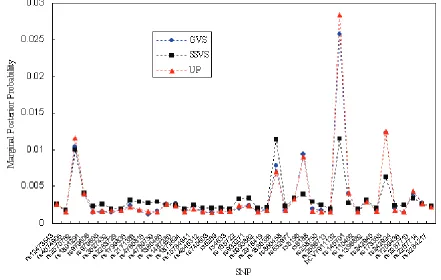
First, we calculated the estimated marginal posterior probabilities based on GVS, SSVS, and UP for all the poten-tial SNPs by using OpenBUGS. Figure 1 shows the results of the estimated marginal posterior probabilities in Stage I. Then, we ranked the SNPs according to the estimated mar-ginal posterior probabilities and selected ten SNPs with top main effects. Table 2 summarizes the top ten SNPs based on the calculated marginal posterior probabilities in Stage I. The results in Figure 1 were based on 100,000 iterations for
GVS, 500,000 iterations for SSVS, and 500,000 iterations for UP, respectively. For all methods, we discarded 10,000 iterations as a burn-in period. All three methods provided similar marginal posterior probabilities in Stage I. As shown in Table 2, the top ten SNPs in GVS were the same as the ones in UP, although the ranking in GVS was slightly differ-ent from the one in UP. And there were two differdiffer-ent SNPs between GVS and SSVS among the top ten SNPs.
Secondly, we calculated the estimated marginal posterior probabilities based on GVS, SSVS, and UP again for the selected ten SNPs on the fi rst run. Then, we ranked the SNPs according to the estimated marginal posterior probabilities and selected fi ve SNPs with top main effects as a panel of signifi cant SNPs. Table 3 shows the top fi ve SNPs based on
Figure 1.
Table 2 In Stage I, the top ten SNPs based on their marginal posterior probabilities using the OpenBUGS software for three Bayesian variable selection methods including the Gibbs variable selection (GVS), the Stochastic Search Variable Selection (SSVS), the unconditional priors (UP) approach.
Posterior GVS SSVS UP Ranking
1 hCV7911132 hCV7911132 hCV7911132
2 rs173365 rs1866388 rs173365
3 rs2070762 rs2070762 rs2070762
4 rs6196 rs173365 rs6196
5 rs1866388 rs1801291 rs1866388
6 rs140701 rs6196 rs2267710
7 rs2267710 rs2267710 rs140701
8 rs1801291 rs852977 rs1801291
9 rs852977 rs933271 rs852977
10 rs1396862 rs165722 rs1396862
Table 3 In Stage II, the top fi ve SNPs based on their marginal posterior probabilities using the OpenBUGS software for three Bayesian variable selection methods including the Gibbs variable selection (GVS), the Stochastic Search Variable Selection (SSVS), the unconditional priors (UP) approach.
Posterior Ranking GVS SSVS UP
1 hCV7911132 hCV7911132 hCV7911132
2 rs173365 rs2070762 rs173365
3 rs2070762 rs1866388 rs2070762
4 rs6196 rs173365 rs6196
the calculated marginal posterior probabilities in Stage II. The results in Table 3 were based on 100,000 iterations for GVS, 500,000 iterations for SSVS, and 500,000 iterations for UP, respectively. For all methods, we discarded 10,000 itera-tions as a burn-in period. All three methods provided similar marginal posterior probabilities in Stage II. Furthermore, all three methods selected the same top fi ve SNPs, although the ranking in GVS was different from the one in SSVS and was the same as the one in UP.
For all three methods, the OpenBUGS programs were run on a 2.4 GHz processor. The CPU execution time in Stage I was approximately 139 minutes for GVS, 45 minutes for SSVS, and 703 minutes for UP, respectively. Furthermore, the CPU execution time in Stage II was approximately 9.8 minutes for GVS, 4 minutes for SSVS, and 60 minutes for UP, respectively. Based on the above CPU execution time, SSVS seemed to be most effi cient among these three methods.
Discussion
We have developed a Bayesian-based methodology to address the problem of identifying genetic markers such as SNPs and genes that are more signifi cant than the others. This problem occurs frequently in genomic and epidemiologic studies ranging from candidate gene studies to high-density genome scans. Our method treats the mapping of genetic markers as a problem of model determination and variable selection. Variable selection approaches for gene mapping include Bayesian methods and frequentist methods (Swartz et al 2007b). Several reports compared Bayesian methods to frequentist methods and found that the Bayesian meth-ods may provide fewer false positives (Swartz et al 2007b). Because the dimensionality is kept constant across all pos-sible models, the Bayesian-based methodology can be easily implemented via the Gibbs sampler (Dellaportas et al 2000). The Bayesian procedure can even be implemented using the publicly available software OpenBUGS (Thomas et al 2006) and thus can be widely used in genomic studies.
As shown in the MCMC results, we compared three Bayesian variable selection strategies including GVS, SSVS, and UP. The proposed SSVS method was shown to be more effi cient than two other methods for discovering signifi cant genes under typical situations of a genomics study. These three methods are all based on the Gibbs sampler. Com-pared with the reversible-jump MCMC, the Gibbs sampling approach has advantages on simplicity of computation and diagnosis of convergence (George and McCulloch 1997). Another major advantage is that these methods can be
easily applied with the Gibbs sampling software such as OpenBUGS (Dellaportas et al 2000). The UP approach is extremely easy to implement, but may be insuffi ciently fl ex-ible for many practical problems (Dellaportas et al 2000). In the cases of hundreds of genetic markers, a second iteration of SSVS might be considered with a subset of variables based on the fi rst run (George and McCulloch 1993). Accuracy of estimating the main effects and the posterior probabilities may be improved by using this two-stage strategy (Yi et al 2003). Similarly, our proposed two-stage Bayesian method may have better accuracy by conducting a second run with a reduced set of genetic markers based on the fi rst run. More-over, Beattie and colleagues (2002) proposed a two-stage Bayesian variable selection strategy that incorporates the SSVS method with the intrinsic Bayes factor (IBF). In the fi rst stage, the SSVS procedure is employed on all factors. Then, in the second stage, the factors identifi ed in the fi rst stage are used as the input for the IBF analysis. The differ-ence between our proposed two-stage Bayesian method and theirs was that only Bayesian variable selection strategies such as GVS, SSVS, and UP were used for both stages in our study.
those of other studies may be the sample sizes. The studies conducted on small populations may have biased a particular result. Future research with independent replication in large sample sizes is needed to confi rm the role of the candidate genes identifi ed in this study.
In this study, we focused the context of this paper being a candidate gene approach. In future research, we will investigate the identifi ability (Gelfand and Sahu 1999) of the proposed method and explore the possibility of extension to larger scale problems such as genome-wide association studies, where thousands of SNPs for a chromosome scan are examined. Moreover, the proposed Bayesian-based method-ology was employed for modeling genetic markers associated with diseases and may be suitable for association studies in pharmacogenomics. In the studies of pharmacogenomics, genetic markers such as SNPs can be used to understand the relationship between genetic inheritance and the body’s response to drugs (Lin et al 2006a, 2006b). In future work, we aim to investigate the Bayesian-based methodology for application in pharmacogenomics.
Furthermore, we focused on the issue of selecting the signifi cant genes without considering epistatic models in this study. Epistasis analysis for gene-gene and gene-environment interactions have been advocated for deciphering these com-plex mechanisms, particularly when each involved genetic marker only demonstrates a minor marginal effect (Lin et al 2007a, 2007b). It is important to address gene–gene and gene–environment interactions for describing a trait involv-ing complex disease-related, pharmacokinetic and pharma-codynamic mechanisms. In future work, we will investigate gene–gene and gene–environment interactions based on the Bayesian variable selection strategies.
Conclusion
In this study, we propose an alternative Bayesian method for assessing signifi cant genes in genomic studies. Our method is based on the Bayesian variable selection methods. Our fi nd-ings suggest that our approach may provide a plausible way to identify a panel of genetic markers that is more signifi cant than the others. Over the next few years, the results of our studies could be utilized to develop molecular diagnostic/prognostic tools. However, application of genomics in routine clinical practice will become a reality after a prospective clinical trial has been conducted to validate genetic markers.
Acknowledgments
The authors extend their sincere thanks to Vita Genomics, Inc. for funding this research. The authors would also like to
thank Dr. Charles Wang for helpful suggestions and thank the anonymous reviewers for their constructive comments, which improved the context and the presentation of this paper.
References
Beattie SD, Fong DKH, Lin DKJ. 2002. A two-stage Bayesian model selec-tion strategy for supersaturated designs. Technometrics, 44:55–63. Brown PJ, Vannucci M, Fearn T. 1998. Multivariate Bayesian variable
selection and prediction. J Roy Stat Soc B, 60:627–41.
Dellaportas P, Forster JJ, Ntzoufras I. 2000. Bayesian variable selection using the Gibbs sampler. In: Dey DK, Ghosh S, Mallick B (eds). Generalized Linear Models: A Bayesian Perspective. New York: Marcel Dekker. Dellaportas P, Forster JJ, Ntzoufras I. 2002. On Bayesian model and variable
selection using MCMC. Statist Comput, 12:27–36.
Gelfand AE, Sahu SK. 1999. Identifi ability, improper priors and Gibbs sam-pling for generalized linear models. J Am Statist Assoc, 94:247–53. George EI, McCulloch RE. 1993. Variable selection via Gibbs sampling.
J Am Statist Assoc, 88:881–9.
George EI, McCulloch RE. 1997. Approaches for Bayesian variable selec-tion. Statistica Sinica, 7:339–74.
Goertzel BN, Pennachin C, de Souza Coelho L, et al. 2006. Combinations of single nucleotide polymorphisms in neuroendocrine effector and receptor genes predict chronic fatigue syndrome. Pharmacogenomics, 7:475–83. Kuo L, Mallick B. 1998. Variable selection for regression models. Sankhya,
B60:65–81.
Kwon S, Wang D, Guo X. 2007. Application of an iterative Bayesian variable selection method in a genome-wide association study of rheumatoid arthritis. BMC Proc, 1(Suppl 1):S109.
Lee KE, Sha N, Dougherty ER, et al. 2003. Gene selection: a Bayesian variable selection approach. Bioinformatics, 19:90–7.
Lin E, Hwang Y, Wang SC, et al. 2006a. An artifi cial neural network approach to the drug effi cacy of interferon treatments. Pharmacoge-nomics, 7:1017–24.
Lin E, Hwang Y, Tzeng CM. 2006b. A case study of the utility of the HapMap database for pharmacogenomic haplotype analysis in the Taiwanese population. Mol Diagn Ther, 10:367–70.
Lin E, Hwang Y, Liang KH, et al. 2007a. Pattern-recognition techniques with haplotype analysis in pharmacogenomics. Pharmacogenomics, 8:75–83. Lin E, Hwang Y, Chen EY. 2007b. Gene-gene and gene-environment interac-tions in interferon therapy for chronic hepatitis C. Pharmacogenomics, 8:1327–35.
Ntzoufras I. 2002. Gibbs variable selection using BUGS. J Statist Soft, 7(7). Oh C, Ye KQ, He Q, et al. 2003. Locating disease genes using Bayesian
variable selection with the Haseman-Elston method. BMC Genet, 4(Suppl 1):S69.
Oh C. 2007. A Bayesian genome-wide linkage analysis of quantitative traits for rheumatoid arthritis via perfect sampling. BMC Proc, 1(Suppl 1):S110. Sha N, Vannucci M, Tadesse MG, et al. 2004. Bayesian variable selection
in multinomial probit models to identify molecular signatures of disease stage. Biometrics, 60:812–19.
Smith AK, White PD, Aslakson E, et al. 2006. Polymorphisms in genes regulating the HPA axis associated with empirically delineated classes of unexplained chronic fatigue. Pharmacogenomics, 7:387–94. Swartz MD, Kimmel M, Mueller P, et al. 2006. Stochastic search gene suggestion:
a Bayesian hierarchical model for gene mapping. Biometrics, 62:495–503. Swartz MD, Shete S. 2007a. The null distribution of stochastic search
gene suggestion: a Bayesian approach to gene mapping. BMC Proc, 1(Suppl 1):S113.
Swartz MD, Thomas DC, Daw EW, et al. 2007b. Model selection and Bayesian methods in statistical genetics: summary of group 11 contributions to Genetic Analysis Workshop 15. Genet Epidemiol, 31(Suppl 1):S96–102. Thomas A, O’Hara B, Ligges U, et al. 2006. Making BUGS open. R News,
6:12–17.