The impact of error dependencies on
Ring/Mod-LWE/LWR based schemes
Jan-Pieter D’Anvers, Frederik Vercauteren, and Ingrid Verbauwhede
imec-COSIC, KU Leuven
Kasteelpark Arenberg 10, Bus 2452, B-3001 Leuven-Heverlee, Belgium [email protected]
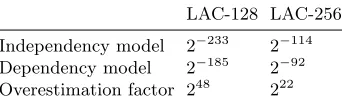
Abstract Current estimation techniques for the probability of decryp-tion failures in Ring/Mod-LWE/LWR based schemes assume indepen-dence of the failures in individual bits of the transmitted message to calculate the full failure rate of the scheme. In this paper we disprove this assumption both theoretically and practically for schemes based on Ring/Mod-Learning with Errors/Rounding. We provide a method to es-timate the decryption failure probability, taking into account the bit fail-ure dependency. We show that the independence assumption is suitable for schemes without error correction, but that it might lead to under-estimating the failure probability of algorithms using error correcting codes. In the worst case, for LAC-128, the failure rate is 248 times big-ger than estimated under the assumption of independence. This higher-than-expected failure rate could lead to more efficient cryptanalysis of the scheme through decryption failure attacks.
Keywords:Lattice cryptography, Ring-LWE, Error Correcting Codes, Decryption Failures
1
Introduction
Due to the recent developments in quantum computing and its threat to current asymmetric key schemes, the cryptographic community has increased its efforts towards the development of post-quantum cryptography, resulting in the NIST Post-Quantum Standardization Process. Several submissions to this process are built on top of the Learning with Errors (LWE) hard problem. These are fre-quently combined with the usage of polynomial matrix elements, resulting in Ring-LWE or Mod-LWE schemes such as New Hope [1], LAC [14], LIMA [16], R.Emblem [15] and Kyber [2]. Some schemes further reduce their communica-tion bandwidth by replacing the pseudorandomly generated errors terms with rounding errors, resulting in Ring-LWR and Mod-LWR schemes as in Round2 [8] and Saber [3] respectively.
Therefore, most candidates of the Post-Quantum Standardization Process aim for a failure probability around 2−128. To reduce the failure rate, some schemes utilize error correcting codes (ECC) to make the decryption resilient against a certain number of errors. The NIST candidate LAC [14] relies on extensive error correction, and Fritzmann et al. [6] made a study on the positive impact of the usage of ECC’s on the security and bandwidth of lattice-based schemes. Another possibility is to eliminate decryption failures altogether and thus eliminate at-tacks that exploit them, by selecting the parameter of the scheme accordingly. This comes at the price of a higher bandwidth and computational complexity. However, as most submissions to the NIST Post-Quantum Process have a small decryption failure probability, an analysis of the impact of decryption failures is essential.
A chosen ciphertext attack against Ring-Learning with Errors (Ring-LWE) schemes exploiting decryption failures was reported by Fluhrer [5]. This attack uses knowledge of failing ciphertexts to retrieve the secret. D’Anvers et al. [4] analyzed a decryption failure attack on (Ring/Mod)-LWE/LWR schemes that have protection against chosen ciphertext attacks. The security risk of decryption failures is also reflected in the post-quantum versions [11,12] of the Fujisaki-Okamoto transformation [7], which converts a chosen plaintext secure encryption scheme in a chosen ciphertext secure key encapsulation mechanism (KEM). The security bound of these transformations contains a term considering decryption failures. As this term is quadratic in the failure rate of the underlying scheme, it has an important effect on the security bound.
Consequently, the failure probability is an important factor in the security of these schemes and should be determined precisely. The common approach for computing this probability is calculating the failure rate for one bit of the message, from which the full failure rate is determined assuming the failures between the individual bits are independent. Jin and Zhao [13] proved that for some schemes the failures in individual bits are asymptotically independent if the number of bits goes to infinity. Hamburg [9] did an analysis of the indepen-dence of the bits for the NIST Post-Quantum Standardization Process submis-sion ThreeBears [10], which is based on the Integer Module Learning with Errors problem. He identified three sources of correlation: the norm of the secret, the norm of the ciphertext and the correlation between the failures of the individual bits due to the ring structure.
In this paper, we examine the independence assumption for Ring/Mod-LWE/LWR based schemes. First we show both theoretically as well as experimentally that this assumption is not correct. Then, we develop a method to handle the de-pendency issue in the failure rate calculation. We calculate the failure rate for variants of LAC and validate our method using experimental data1. Finally, we discuss the implications of the dependency in different scenarios: for schemes without error correcting codes, we reason that the assumption of independence leads to a slight overestimation of the failure probability. Looking into schemes
1
using error correcting codes to reduce the failure rate, we show that the indepen-dence assumption can lead to an underestimation of the failure rate, and thus an overestimation of the security of the underlying scheme. In the most extreme case for LAC-128, the failure rate is overestimated by a factor 248.
2
Preliminaries
2.1 Notation
LetZqdenote the ring of integers moduloq, letRqrepresent the ringZq[X]/(Xn+
1) and letRl1×l2
q designate the ring ofl1×l2matrices overRq. Polynomials will
be written using lowercase letters, vectors with bold lowercase, and matrices with bold uppercase. The l2-norm of a polynomial x is defined as kxk2 =
pP
ix
2
i
and the l2-norm of a vector xxx as kxxxk2 =
pP
ikxik22. The rounding operation
bxeq→p forx∈Zq, is calculated asbp/q·xe ∈Zp. Theabs() function takes the
absolute value of its input. These operations are extended coefficient-wise for polynomials and vectors. Letai, witha∈Rq denote theith coefficient ofa, and denote withaaaiforaaa∈Rl×1
q the (i modl)thcoefficient of thebi/lcth polynomial
ofaaa.
Letx←χ(Rq) indicate sampling the coefficients ofx∈Rq according to dis-tributionχ. The sampling operation is extended coefficient-wise for vectorsxxx∈ Rql×1asxxx←χ(Rlq×1). LetBinom(k, n, p) be the cumulative binomial distribution with ndraws and probability p, so that Binom(k, n, p) =Pbkc
i=0
n i
pi(1−p)n−i
and lethypergeom(k, N, K, n) be the hypergeometric distribution with popula-tion sizeN, success statesK and drawsnas defined by:
hypergeom(k, N, K, n) =
K k
N−K
n−k
N n
, (1)
where:
a b
= a!
b!(a−b)!. (2)
2.2 Ring/Mod-LWE/LWR based encryption
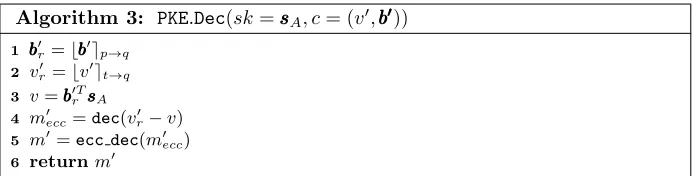
A general framework for Ring/Mod-LWE-LWR based encryption schemes is pro-vided in Algorithms 1 to 3. The algorithm uses the functiongento generate the pseudorandom matrix AAA from a seed seedAAA, the function enc to encode the
message m into an element of Rq and the inverse function dec to decode a
Algorithm 1: PKE.KeyGen()
1 seedAAA← U({0,1}256) 2 AAA←gen(seedAAA)∈Rlq×l
3 sssA←χs(Rlq×1), eeeA←χe(Rql×1) 4 bbb=bAAAsssA+eeeAeq→p
5 return(pk:= (bbb, seedAAA), sk:=sssA)
Algorithm 2: PKE.Enc(pk= (bbb, seedAAA), m, r)
1 AAA←gen(seedAAA)∈Rlq×l 2 sss0B←χs(Rql×1), eee0B←χe(Rlq×1) 3 e00B←χe(Rq)
4 bbbr =bbbbep→q 5 bbb0=bAAATsss0B+eee
0
Beq→p 6 mecc=ecc enc(m) 7 v0=bbbbTrsss0B+e
00
B+enc(mecc)eq→t 8 returnc= (v0, bbb000)
bits between mecc and m0ecc is less than a threshold d, which depends on the
chosen error correcting code (ECC). When no error correcting codes are used, the functions ecc enc and ecc dec act as the identity and return their input. The encryption algorithmPKE.Encuses the seed r to pseudorandomly generate
sss0B, eee0B ande00B.
By choosingl= 1, one obtains a Ring based scheme, while a bigger value ofl
indicates a module (Mod) based scheme. In Mod/Ring-LWE based schemes, the error distributionχe is nonzero, in contrast to Mod/Ring-LWR based schemes whereχe= 0. In the latter case, parameterspandtare smaller thanq, so that the rounding operationsb·eq→pandb·eq→tintroduce the errors necessary for security.
The rounding additionally compresses the ciphertexts. The rounding operations
b·ep→qandb·et→qdecompress the input back to approximately the original value.
The error introduced by these rounding and reconstruction operations will be denoted as follows:
uuuA=AAAsssA+eeeA−bbbr, (3)
u u
u0B=AAATsss0B+eee0B−bbb0r, (4)
u00B=bbbTrsss0B+e00B+enc(mecc)−v0r . (5)
As a first step in determining the error probability of the encryption scheme, we can calculate the value ofvr0 −v as follows:
v0r−v= (bbbTrsss0B+e00B+bq/2cenc(mecc) +u00B)−bbb0rTsssA (6)
Algorithm 3: PKE.Dec(sk=sssA, c= (v0, bbb000))
1 bbb0r =bbbb
0 ep→q 2 vr0 =bv0et→q 3 v=bbb0T
r sssA 4 m0ecc=dec(v
0
r−v) 5 m0=ecc dec(m0ecc) 6 returnm0
The distribution of one coefficient of−(eee0B+uuu0B)TsssA+ (eeeA+uuuA)TsssB0 + (u00B+e00B) can be calculated exhaustively. For the sake of convenience, we will rewrite this ascccTsss+g, wheresssis the vector constructed as the concatenation of −sssA and (eeeA+uuuA), where cccis constructed similarly as the concatenation of (eee0B+uuu0B)
andsss0
B, and where g=u00B+e00B:
sss=
−sssA eeeA+uuuA
, ccc=
eee0B+uuu0B sss0B
, g=u00B+e00B. (8)
A coefficient of the polynomialvr0 −v decodes correctly if the absolute value of the corresponding coefficient of the error termcccTsss+g is smaller thanq/4. A higher value results in a flipped bit after decoding, which will be called a bit error and will be denoted withFi withithe position of the bit in the message. If the number of bit errors exceeds the threshold for error correction d, a decryption failure occurs, which we will denote with the symbol F. A correct decryption will be denoted withS, so that by definitionP[S] = 1−P[F].
In Table 1, the parameters for LAC-128 and LAC-256 [14] are given. These schemes are used throughout this paper to validate our methodology, as their high failure rate and significant error correction causes their failure rate calcula-tion to be more sensitive to error dependencies. Due to the choices of the moduli
q, pandt, the rounding errorsuuuA,uuu0B equal the zero vector andu00B is the zero polynomial.
q p t n l d
LAC-128 251 251 251 512 1 29 LAC-256 251 251 251 1024 1 55 Table 1: Parameters for LAC
2.3 Key Encapsulation Mechanism
Algorithm 4: KEM.Encaps(pk)
1 m← U({0,1}256 ) 2 r=G(m)
3 c=PKE.Enc(pk, m, r) 4 K=H(r)
5 return(c, K)
Algorithm 5: KEM.Decaps(sk, pk)
1 m0=PKE.Dec(sk, c) 2 r0=G(m0)
3 c0=PKE.Enc(pk, m0, r0) 4 if c=c0 then
5 returnK=H(r) 6 else
7 returnK=⊥
of the Fujisaki-Okamoto transformation. The key generation phase is the same as Algorithm 1 and the Encapsulation and Decapsulation functions are defined in Algorithms 4 and 5 respectively, with G and H hash functions that model Random Oracles.
3
Error dependency
The typical method to calculate the failure rate, is to determine the error prob-ability of a single bit ofm0ecc, calculated aspb =P[|(cccTsss+g)i|> q/4], and then
assume independence to extend this error probability to the full failure rate. For a scheme that does not use any error correction, this can be expressed as 1−(1−pb)lm or 1−Binom(0, lm, pb), withlmthe length of the encoded message mecc. For schemes that deploy error correcting codes with a correction capability ofderrors, the failure rate amounts to 1−Binom(d, lm, pb).
However, this assumption of independence is not correct. In this section we will show both theoretically and experimentally that there is a positive correla-tion between the errors of the bits inm0ecc. Intuitively, one can make the following
reasoning: (cccTsss+g) with high norm forsss andccc is more likely to produce bit errors, and conversely, bit errors are also more likely to stem from high normsss
andccc. Therefore, a bit error at a certain location, increases the expected norm ofsss andccc, therefore increasing the bit error probabilities at other locations. In conclusion, bit errors are expected to be positively correlated.
to other schemes, making it possible to experimentally obtain enough errors to get accurate estimations. In Figure 1, one can see that the errors are clustered: there are more messages without errors and more messages with a high number of errors than predicted by the theoretical model, which confirms our hypothesis that the bit errors are positively correlated. Note that the error probability of a single bit is the same for the model and the experimental data, and that the errors are just more clustered compared to the prediction of the model.
0 5 10 15 20 25 number of flipped bits in the message
226 223 220 217 214 211 28 25 22
probability
theoretical experimental
Figure 1: The probability of a certain number of errors inm0ecc
3.1 Handling the dependency
In this section, we will develop a methodology to calculate the failure rate taking into account the dependency between the errors in the bits ofm0ecc. For the sake of simplicity, we will first assume that there is no error correcting code.
1−P[F] =P[S] (9)
=P[S0· · ·Sn] (10)
Under the independence assumption, one can derive the formulas of the previous section as follows:
1−P[F] =Y
i
P[Si] (11)
However step (11) is not valid if this assumption does not hold. To work around this issue, we involve conditional information in the form ofsss, cccandg:
1−P[F] =X
s ss,ccc,g
P[S0· · ·Sn|ss, ccc, gs ]P[sss, ccc, g] (13)
As the Si’s are fully determined conditioned onsss, cccand g, the error or success
of other bits does not convey any extra information. Therefore, the bit successes
Si are independent conditioned on the extra information, so we can write:
1−P[F] =X
s ss,ccc,g
Y
i
(P[Si|ss, ccc, gs ])P[sss, ccc, g] (14)
=X
s ss,ccc,g
(1−P[F0|sss, ccc, g])
n
P[sss, ccc, g] (15)
Unfortunately, this expression is not efficiently computable.
Note that thee00B term ofgj does not add any information toSi ifj6=iand
that its coefficients are independent. We will assume that this is also the case foru00B, so we can write:
P[Si|sss, ccc, g]≈P[Si|sss, ccc, gi] (16)
From this result we can see that g has little or no contribution to the de-pendency between theSi. As discussed in Section 3, the norm ofsssandccc is an important cause of dependency. For rings of the formZ[X]/(Xn+ 1) we could assume that this is the main cause of correlation, as different coefficients ofcccTsss
are calculated with different combinations of elements ofccc andsss, which can be formalized as follows:
Assumption 1. Forsss, ccc and g as described in equation (8), where g and the coefficients ofsssandccc are elements of the ringZ[X]/(Xn+ 1), we can approx-imate S0· · ·Sn to be independent conditioned onksssk2,kccck2, which is equivalent toP[S0· · ·Sn| ksssk2,kccck2]≈QiP[Si| ksssk2,kccck2].
Using this assumption we write:
1−P[F] = X ksssk2,kccck2
P[S0· · ·Sn| ksssk2,kccck2]P[ksssk2,kccck2] (17)
≈ X
ksssk2,kccck2
Y
i
(P[Si| ksssk2,kccck2])P[ksssk2,kccck2] (18)
≈ X
ksssk2,kccck2
(P[S0| ksssk2,kccck2])nP[ksssk2]P[kccck2] (19)
≈ X
ksssk2,kccck2
(1−P[F0| ksssk2,kccck2])
n
Using a similar derivation, the failure rate for schemes with error correction under Assumption 1 can be calculated as:
1−P[F]≈ X
ksssk2,kccck2
(1−Binom(d, lm, pb))P[ksssk2]P[kccck2] (21)
where: pb=P[F0| ksssk2,kccck2] (22)
To conclude, one has to calculate the failure rate for every value ofksssk2 and
kccck2, after which the failure rate can be found by taking a weighted average. The model from equation (20) can be seen as an intermediate between the model from equation (12) that was constructed using the independence assumption, and the exact but incalculable model from equation (15). In this intermediate model, the main source of correlation between theSi, following Assumption 1, is taken into account. In the next section we will experimentally assess our intermediate model and observe that it closely represents the experimental data, thus validating our assumption.
3.2 Experiments
To validate the developed methodology, we ran LAC-256 approximately 231times to get experimental data on the probability of a certain number of failures in
m0ecc. We calculated the same probability using the assumption of independence and our dependency aware model.
In generalP[F0| ksssk2,kccck2] can be calculated using a Gaussian assumption on the distribution ofcccTsss+g as described in [4]. For our calculations of LAC we use a more exact algorithm using the fact that the elements of ccc, sss and g
are ternary. Intuitively, we first calculate the probability that a certain number
l of nonzero coefficients ofcccandssscoincide during the multiplication, expressed as P[(abs(ccc)Tabs(sss))
0=l| ksssk2,kccck2]. Then, we assume the term (cccTsss)0 given (abs(ccc)Tabs(sss))
0 = l to be a sum of l elements randomly picked as plus or minus 1. The full derivation can be expressed as follows:
pb=P[abs(cccTsss+g)0> q/4| ksssk2,kccck2] (23)
=X
l
P[abs(cccTsss+g)0> q/4|(abs(ccc)Tabs(sss))0=l,ksssk2,kccck2]·
P[(abs(ccc)Tabs(sss))0=l| ksssk2,kccck2]
(24)
=X
l
P[abs(cccTsss+g)
0> q/4|(abs(ccc)Tabs(sss))0=l]·
P[(abs(ccc)Tabs(sss))0=l| ksssk2,kccck2]
(25)
=X
l
X
g0
P[abs(cccTsss+g)
0> q/4|(abs(ccc)Tabs(sss))0=l, g0]·
P[(abs(ccc)Tabs(sss))
0=l| ksssk2,kccck2]·P[g0]
(26)
We can modelP[(cccTsss)0> q/4−g0|(abs(ccc)Tabs(sss))0=l, g0] as the survival function of a binomial distribution, which can be calculated asBinom(l−q/4+g0
Similarly, P[(cccTsss)
0 < −q/4−g0|(abs(ccc)Tabs(sss))0 = l, g0] can be modelled as Binom(l−q/4−g0
2 , l,1/2), so that P[abs(ccc
Tsss+g)
0 > q/4|(abs(ccc)Tabs(sss))0 =
l, g0] is the sum of both probabilities. The distribution P[(abs(ccc)Tabs(sss))0 =
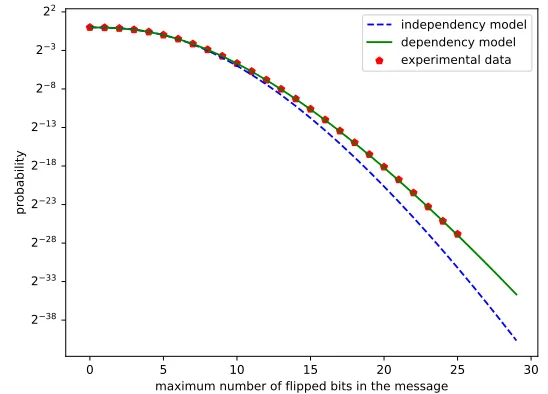
l| ksssk2,kccck2] can be seen as a hypergeometric distributionhypergeom(l, n,ksssk2,kccck2). The probability of a decryption failure is plotted for various error correction capabilities of the ECC in Figure 2. We can see that our new dependency aware model outputs a much better estimate of the probabilities of a certain maximum number of errors. Another observation to be made is that the independency based model deviates further from the experimental data as the number of errors increases, which is the case for codes with higher error correction capabilities. This makes the dependency issue especially important for schemes with extensive error correction.
0 5 10 15 20 25 30 maximum number of flipped bits in the message
238 233 228 223 218 213 28 23 22
probability
independency model dependency model experimental data
Figure 2: Probability of failure for various error correction capabilities ofecc enc
4
Implications
As seen in previous sections, the errors inm0
eccare positively correlated, meaning
assumption of independence will slightly overestimate the failure rate, and thus underestimate the security of the scheme with a small margin. As a result, the approximation using an assumption of independence is legitimate for schemes without an error correction step.
LAC-128 LAC-256
Independency model 2−233 2−114 Dependency model 2−185 2−92 Overestimation factor 248 222
Table 2: The failure rate of different versions of LAC under the different models
In the case of schemes with error correction, one has to be more careful. As can be seen in Figure 2, the independence model gives an underestimation of the failure rate, which corresponds to an overestimation of the security of the scheme. This overestimation grows as d, the error correction capability of the ECC, becomes larger. In Table 2, the estimated failure rate of different versions of LAC is compared under both models. The discrepancy between both models reaches a factor 248 in case of LAC-128. Therefore, the assumption of independence is not valid for schemes with error correction, and that it could lead to a serious overestimation of the security of the underlying algorithm.
More specifically, a higher failure probability suggests that the scheme might be more vulnerable to a decryption failure attack similar to the attack described by D’Anvers et al. [4], where the secrets are estimated statistically based on failing ciphertexts. Moreover, an attacker can reduce the failure probability by performing a precomputation for weak ciphertexts with higher failure probabil-ity. As LAC does not have any security against multi-target attacks that exploit decryption failures, this precomputation only needs to be performed once.
5
Conclusions
6
Acknowledgements
This work was supported in part by the Research Council KU Leuven grants: C16/15/058, C14/18/067 and STG/17/019 and by the European Commission through the Horizon 2020 research and innovation programme Cathedral ERC Advanced Grant 695305.
References
1. E. Alkim, L. Ducas, T. P¨oppelmann, and P. Schwabe. Post-quantum key exchange – a New Hope. InUSENIX Security 2016, 2016.
2. J. Bos, L. Ducas, E. Kiltz, T. Lepoint, V. Lyubashevsky, J. M. Schanck, P. Schwabe, and D. Stehl´e. Crystals – kyber: a CCA-secure module-lattice-based kem. Cryptol-ogy ePrint Archive, Report 2017/634, 2017. http://eprint.iacr.org/2017/634. 3. J. D’Anvers, A. Karmakar, S. S. Roy, and F. Vercauteren. Saber: Module-lwr based key exchange, CPA-secure encryption and CCA-secure KEM. InAFRICACRYPT 2018, pages 282–305, 2018.
4. J.-P. D’Anvers, F. Vercauteren, and I. Verbauwhede. On the impact of decryption failures on the security of LWE/LWR based schemes. Cryptology ePrint Archive, Report 2018/1089, 2018. https://eprint.iacr.org/2018/1089.
5. S. Fluhrer. Cryptanalysis of ring-lwe based key exchange with key share reuse. Cryptology ePrint Archive, Report 2016/085, 2016. https://eprint.iacr.org/ 2016/085.
6. T. Fritzmann, T. P¨oppelmann, and J. Sepulveda. Analysis of error-correcting codes for lattice-based key exchange. Cryptology ePrint Archive, Report 2018/150, 2018. https://eprint.iacr.org/2018/150.
7. E. Fujisaki and T. Okamoto. Secure integration of asymmetric and symmetric encryption schemes. Journal of Cryptology, 26(1):80–101, Jan 2013.
8. O. Garcia-Morchon, Z. Zhang, S. Bhattacharya, R. Rietman, L. Tolhuizen, and J.-L. Torre-Arce. Round2. Technical report, National Institute of Standards and Technology, 2017. available at https://csrc.nist.gov/projects/post-quantum-cryptography/round-1-submissions.
9. M. Hamburg. Integer module lwe key exchange and encryption: The three bears -draft 8. https://www.shiftleft.org/papers/threebears/threebears-draft8. pdf, 2017.
10. M. Hamburg. Threebears. Technical report, National Institute of Standards and Technology, 2017. available at https://csrc.nist.gov/projects/post-quantum-cryptography/round-1-submissions.
11. D. Hofheinz, K. H¨ovelmanns, and E. Kiltz. A modular analysis of the Fujisaki-Okamoto transformation. Cryptology ePrint Archive, Report 2017/604, 2017. http://eprint.iacr.org/2017/604.
12. H. Jiang, Z. Zhang, L. Chen, H. Wang, and Z. Ma. Post-quantum IND-CCA-secure KEM without additional hash. Cryptology ePrint Archive, Report 2017/1096, 2017. https://eprint.iacr.org/2017/1096.
13. Z. Jin and Y. Zhao. Optimal key consensus in presence of noise. Cryptology ePrint Archive, Report 2017/1058, 2017. https://eprint.iacr.org/2017/1058. 14. X. Lu, Y. Liu, D. Jia, H. Xue, J. He, and Z. Zhang. LAC. Technical report,
15. M. Seo, J. H. Park, D. H. Lee, S. Kim, and S.-J. Lee. Emblem and R.Emblem. Technical report, National Institute of Standards and Technology, 2017. avail-able at https://csrc.nist.gov/projects/post-quantum-cryptography/round-1-submissions.