Article Paper
1
The utility of data transformation for alignment, de
2
novo assembly and classification of short read virus
3
sequences
4
Avraam Tapinos1,*, Bede Constantinides1,3, My VT Phan2, Samaneh Kouchaki1,4, Matthew Cotten2,
5
and David L Robertson1,5
6
1 School of Biological Sciences, The University of Manchester, Manchester, UK
7
2 Department of Viroscience, Erasmus Medical Centre, Rotterdam, the Netherlands
8
3 Nuffield Department of Medicine, University of Oxford, Oxford, UK
9
4 Department of Engineering Science, University of Oxford, Oxford, UK
10
5 MRC-University of Glasgow Centre for Virus Research, Glasgow, UK
11
12
* Correspondence [email protected]; Tel.: +44 (0) 161 701 7563
13
Received: date; Accepted: date; Published: date
14
Abstract: Advances in DNA sequencing technology are facilitating genomic analyses of
15
unprecedented scope and scale, widening the gap between our abilities to generate and fully exploit
16
biological sequence data. Comparable analytical challenges are encountered in other data-intensive
17
fields involving sequential data, such as signal processing, in which dimensionality reduction (i.e.,
18
compression) methods are routinely used to lessen the computational burden of analyses. In this
19
work we explore the application of dimensionality reduction methods to numerically represent
20
high-throughput sequence data for three important biological applications of virus sequence data:
21
reference-based mapping, short sequence classification and de novo assembly. Despite using highly
22
compressed sequence transformations to accelerate the processes, our sequence processing approach
23
yielded comparable accuracy to existing approaches, and are ideally suited for sequences originating
24
from highly diverse virus populations. We demonstrate the application of our methodology to both
25
synthetic and real viral pathogen sequence data. Our results show that the use of highly compressed
26
sequence approximations can provide accurate results and that useful analytical performance can be
27
retained and even enhanced through appropriate dimensionality reduction of sequence data.
28
Keywords: Alignment, assembly, taxonomic classification, time series, data transformation, DWT,
29
DFT, PAA, data compression, compressive genomics
30
31
1. Introduction
32
Next generation sequencing (NGS) enables massively parallel determination of nucleotide
33
order within genetic material, making it possible to rapidly sequence the genomes of individuals,
34
populations and metagenomic samples [1-5]. However, the sequences generated by these
35
instruments are almost always considerably shorter in length than the genomic regions studied.
36
Genomic analyses often begin with the process of sequence assembly, where sequence fragments
37
(reads) are reconstructed into the larger sequences from which they originated. Computational
38
methods play a vital role in the assembly of short reads, and a variety of assemblers and related tools
39
have been developed in tandem with emerging sequencing platforms [6]. All subsequent analyses
40
and investigations depend upon the quality, accuracy and speed of this crucial sequence assembly
41
process.
42
There are many computational methods to generate consensus sequences representing the
43
genomes of coexisting species in a sample. Such approaches includes seed-and-extend alignment
44
methods using suffix array derivatives such as the Burrows-Wheeler Transform (BWT) for aligning
45
short reads informed by a known reference sequence [7,8], and graph-based methods employing
46
Overlap Layout Consensus (OLC) [9,10] and de Bruijn graphs of k-mers [11-13] for reference-free de
47
novo sequence assembly. However, for sequencing projects to characterise genetic variation within
48
populations (deep sequencing), metagenomics and pathogen discovery, the effectiveness of the
49
aforementioned approaches varies considerably [14].
50
Samples with mixed viral infections, especially those comprising divergent variants, present a
51
number of analytical and computational problems. The use of a reference sequence, even the use of a
52
data specific generated sequence, can lead to valuable read information being discarded during the
53
alignment process [15]. On the other hand, while de novo approaches require little a priori knowledge
54
of target sequence composition, the methods are computationally intensive and their performance
55
scales poorly with datasets of increasing size [9]. Aggressive heuristics must be employed, to
56
traverse graphs and deal with mismatches, to reduce the running time of de novo assemblers, which
57
in turn can compromise assembly quality. Indexing structures such as the BWT and FM-index are
58
widely used to reduce the burden of pairwise sequence comparison, for both reference base
59
mapping and de novo assembly. However, they cannot process mismatches within reads,
60
necessitating the use of aggressive and computationally expensive heuristics to establish
61
relationships on divergent reads. The increasing NGS read length will affect the performance of
62
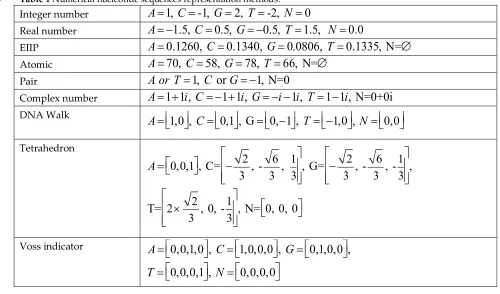
these approaches [16].
63
A major challenge working with high-throughput sequencing data for metagenomics and
64
within-host variation analysis is the substantially great diversity of biological data. Also the amount
65
of sequences generated challenge many computational system for a feasible working solution in
66
terms of time and the computational resources typically available in biological laboratories. For
67
biologists working in outbreak responses or pathogen discovery, both the accuracy of the assembly
68
results and the speed of sequence analyses (e.g. assembly, alignment and pathogen classification) are
69
crucial for crisis response and management. The ability to run analyses in the field on portable
70
computer systems without internet connectivity is also important. Here, we explore the utility of
71
data transform methods (used in data intensive fields such as signal and image processing) to extract
72
major features from viral NGS sequence data and use the features to analyse data in a lower
73
dimensional space.
74
Similar analytical challenges involving high dimensional sequential data are encountered in
75
other data-intensive fields such as signal and image processing, and time series analysis, where data
76
transforms and approximation techniques are used for data dimensionality reduction. Data
77
transform/approximation techniques include the discrete Fourier transform (DFT) [17], the discrete
78
wavelet transform (DWT) [18,19], and piece-wise aggregate approximation (PAA) [20,21]. The DFT
79
or DWT are used to transform data to their frequency domains, allowing feature extraction [22], and
80
PAA is used as a data approximation approach. In data intensive fields, data
81
transformations/approximations are commonly used as dimensionality reduction approaches, for
82
obtaining fast approximate solutions for a given problem. Due to the ordered nature of genetic data,
83
many of these transformation approaches can be applied to sequences of nucleotides [23] or amino
84
acids [24]. An example of a successful implementation of a Fourier transform in computational
85
biology is the alignment algorithm MAFFT [25] where the physiochemical properties of amino acids
86
are used to represent sequences for fast matching of homologous sequence regions for alignment.
87
Since most transformation approaches are suitable only for numerical sequences, the strings of
88
letters representing genetic sequences must be mapped into numerical space using a numerical
89
sequence representation method [26].
90
In addition to the DFT, the DWT and PAA, suitable methods for measuring the pairwise
91
similarity of sequential data or transformations include the Lp-norms [27], dynamic time warping
92
(DTW) [28], longest common subsequence (LCS) [29] and alignment approaches such as the
93
widely used Lp-norm method for sequential data comparison but can only be used on sequences
95
with same lengths. Furthermore, Lp-norm methods do not accommodate shifts in the x-axis (time or
96
position) and are thus limited in their ability to identify similar features within offset data. Elastic
97
similarity/dissimilarity methods such as LCS, unbounded DTW and various alignment algorithms
98
permit comparison of data with different dimensions and tolerate shifts in the x-axis. These
99
properties of elastic similarity methods can be very useful in the analysis of speech signals, for
100
example, but can be computationally expensive [30]. Several approaches have been proposed to
101
permit fast search with DTW, including the introduction of global constraints (wrapping path) or the
102
use of lower bounding techniques such as LB_keogh [28].
103
While pairwise comparison methods may be used for clustering, classification and similarity
104
searches, they are very time consuming for large datasets (O(n2) time complexity). Indexing
105
structures such as the R*-tree, KD-tree, VP-tree and MVP-tree have significantly lower time
106
complexity (O(n log(n))) for similarity search [31] and are more appropriate for efficient analysis of
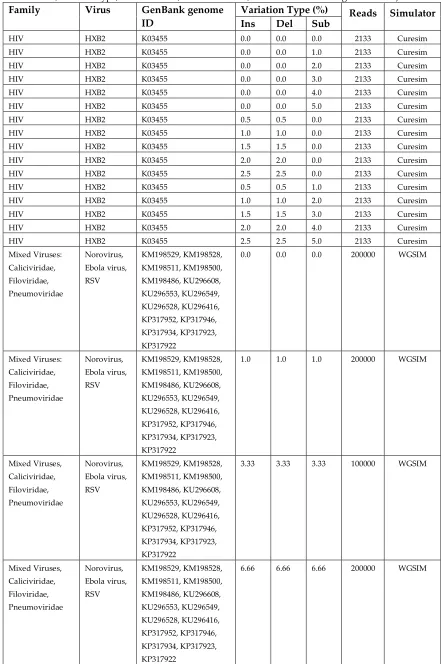
107
large datasets. The R*-tree [32,33] and KD-tree [34] indexing structures are very accurate for low
108
dimensional datasets. However, their performance deteriorates significantly in high dimensional
109
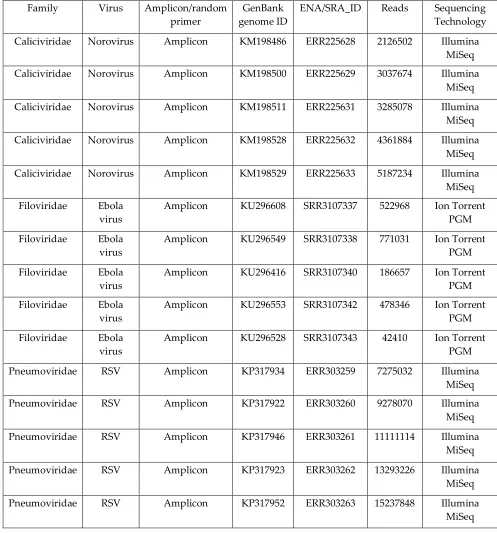
space [31], known as the ‘curse of dimensionality’ [35,36]. Metric trees such as the VP-tree [37] and
110
MVP-tree [38] are less prone to this limitation. Metric space indexing structures make use of
111
geometric properties for partitioning data and work efficiently on both low and high dimensional
112
data [39]. The curse of dimensionality can be further mitigated using data approximations such as
113
the DFT, the DWT, and the PAA to partition a dataset in an approximated space without loss of
114
generality [21].
115
Here we investigate the performance of three established dimensionality reduction techniques,
116
on three common analysis tasks involving viral short read sequence data: classification, reference
117
based mapping/alignment, and de novo assembly. We benchmarked the accuracy of our proposed
118
methodology against existing tools, and demonstrated the applicability of time series and signal
119
processing data mining techniques for the analysis of viral NGS data.
120
2. Materials and Methods
121
2.1. Symbolic to numeric sequence representations
122
Various numeric sequence representation methods can be used for symbolising a nucleotide
123
sequence to a numerical space (see Table 1). Depending on the chosen numerical representation,
124
each nucleotide is associated with a specific numerical value or vector. The specific values are
125
assigned to the position of each nucleotide indicating the presence of a nucleotide at each sequence
126
position (Equation 1). Ri is the indicator for a specific nucleotide in the ith position of the sequence S
127
with a length of n nucleotides. Values v1…v5 correspond to the numerical value or numerical vector
128
associated with each nucleotide.
129
(1)
130
131
Methods such as the electron-ion interaction pseudo potentials (EIIP) [40] and the atomic
132
representation approach [41] aim to mimic the biochemical properties of nucleic acids, but introduce
133
some mathematical bias that does not exist in reality [26]. Other methods, like the Voss indictor [42]
134
and the Tetrahedron approach, do not introduce internucleotide mathematical bias, meaning the
135
pairwise distances between each non-identical transformed nucleotide is the same (for example, the
136
distance between A and T is equal to the distances between A and C as well as A and G).
137
R
i=
v
1if
S
i= A
v
2if
S
i= T
v
3if
S
i= C
v
4if
S
i= G
v
5otherwise
ì
í
ï
ï
ï
î
ï
ï
ï
Furthermore, the cumulative sum of a numerical representation R can be used to indicate the
138
trajectory of a sequence in nucleotide space. Table 1 indicates the associate values used for different
139
representation methods [26].
140
2.2. Sequence Transformation
141
Effective methods for transforming/approximating sequential data should: i) accurately
142
transform/approximate data without loss of useful information, ii) have low computational
143
overheads, iii) facilitate rapid comparison of data, and iv) provide lower bounding—where the
144
distance between data representations is always smaller than or equal to that of the original
145
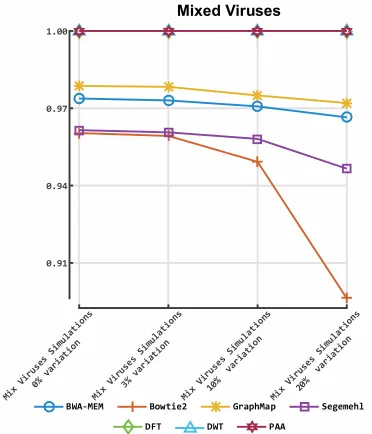
data—guaranteeing against false negative results [43]. We employ the DFT and the DWT
146
transformation methods and PAA approximation method as they satisfy the above requirements,
147
are widely used for analysing discrete signals [44], and can be used to transform/approximate
148
nucleotide sequence numerical representations to different levels of resolution, permitting reduced
149
dimensionality sequence analysis.
150
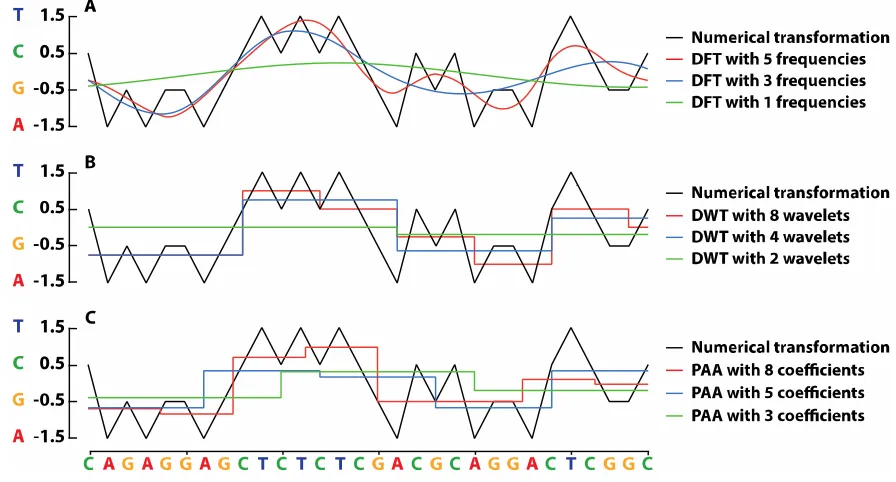
Figure 1A illustrates an example of the DFT and DWT transformations and PAA approximation
151
of a short nucleotide sequence. DFT and the fast Fourier transform (FFT) transform data from their
152
original domain to a frequency domain. In principle, the DFT decomposes a numerically represented
153
nucleotide sequence with n positions (dimensions) into a series of n frequency components ordered
154
by their frequency. A subset of the resulting Fourier frequencies are used to approximate the original
155
sequence in a lower dimensional space [17], and the tradeoff between analytical speed and accuracy
156
can be varied according to the number of frequencies considered [45]
157
DWT transform data from their original domain to their time-frequency, accommodating for
158
changes in signal frequency over time [18,46,47]. DWT is a set of averaging and differencing
159
functions that may be used recursively to represent sequential data at different resolutions and each
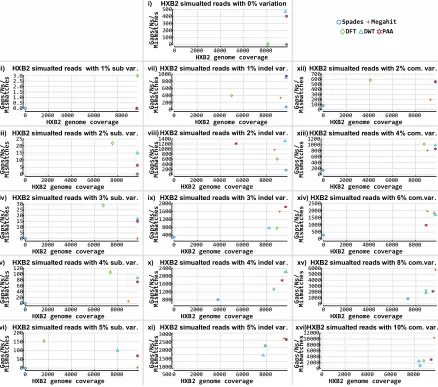
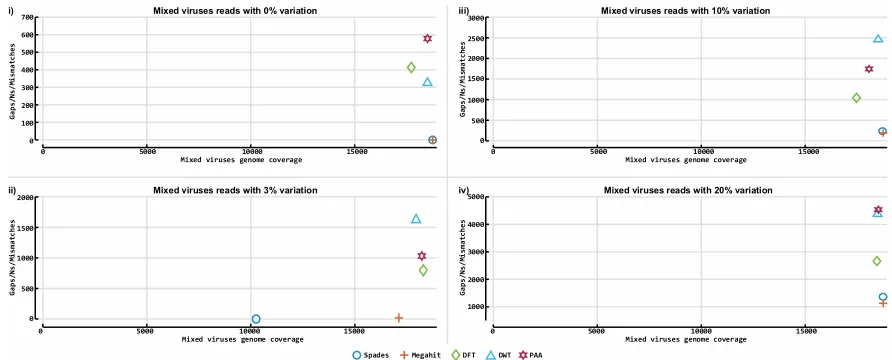
160
resolution can be used as an approximation of the original data. Figure 1B depicts an example of the
161
DWT transformations of a short nucleotide sequence.
162
In PAA a numerical sequence is divided into n equally sized windows, the mean values of
163
which together form a compressed sequence representation [20,21]. The selection of n determines the
164
resolution of the compressed or approximate representation. While PAA is faster and easier to
165
implement than the DFT and the DWT, unlike these two methods it is irreversible, meaning that the
166
original sequence cannot be recovered from the approximation. Figure 1C depicts an example of the
167
PAA transformations of a short nucleotide sequence.
168
2.3. Similarity search approaches for sequential data
169
Here we adopt the Euclidian distance and VP-indexing tree to partition our data based on their
170
approximate space distances and perform a fast k-nearest neighbor (k-NN) similarity search for
171
aligning the reads to the reference genome.
172
In a VP-tree indexing structure, data partitioning is implemented in metric space. A data point
173
which is used as a vantage point is selected (either randomly or by applying some heuristic to find
174
and use the furthest point in the dataset [37]), and the rest of the data points are partitioned into two
175
nodes based on their distance to that point. Data found to be closer to the vantage point than a given
176
threshold (the median distance between all the data points and the vantage point) are assigned to the
177
same node, and the rest of the data points to a different node. This function is repeated recursively in
178
order to complete the partitioning process. The resulting indexing structure can then be used for fast
179
identification of a k-nearest neighbour (k-NN) search. A k-NN-search returns the data points that are
180
closest to a query q. Initially, the distance between the query q and the vantage point in the top node
181
is calculated. If the distance between q and the vantage point satisfies a set of given conditions (the
182
distance is smaller or larger than a given threshold – this threshold being the median distance
183
between the vantage point and other data points within the node), a decision is made to visit either
184
one or both of the nodes. This process is repeated until the entire tree has been traversed. The k data
185
points—in this case reads— found closest to our query are the k-nearest neighbours to the query q.
186
2.4. Proposed short reads processing methodology
188
Our methodology for taxonomic classification, reference based mapping and de novo assembly
189
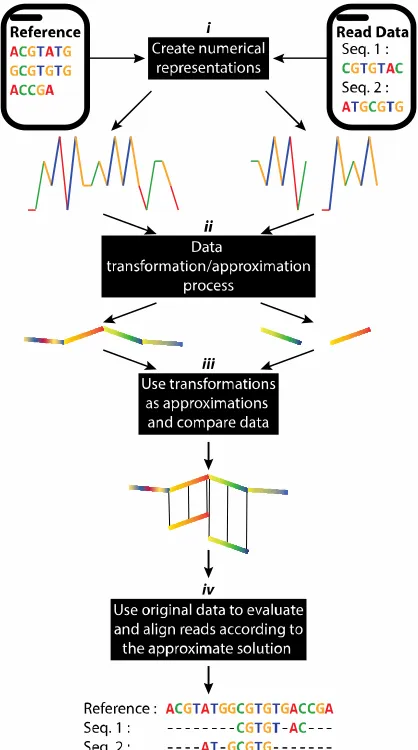
of short reads, used time series and digital signal processing data transformation techniques. Figure
190
2 illustrates the fundamental concept of our approach. The short reads and reference genomes are
191
mapped to a numerical space using an appropriate method from table 1. Subsequently, lower
192
dimensional approximations are generated for all data using the appropriate data transformation
193
method, such as DFT, DWT, and PAA. A VP-tree is constructed to allow fast data comparison.
194
Depending on the application, the VP-tree is constructed either by using k-mer transformations
195
obtained from the reference genomes or by using the short reads’ transformations. Consequently,
196
the best matches for our short reads’ transformations are identified using a k-NN search approach on
197
the VP-tree. As a final step, the results obtained from the k-NN search are re-evaluated in the original
198
space to remove potential false positive results.
199
2.5. Data
200
The implementations of our proposed methodologies were assessed with both simulated and
201
real virus datasets. The simulated datasets were generated using CuReSim [48] and WGSIM
202
(https://github.com/lh3/wgsim ). Simulated data included information such as the reference genome
203
used, the alignment position, and alignment direction for each read, enabling rigorous evaluation of
204
the proposed techniques. We used two simulators to generate different datasets to test our approach
205
under every eventuality. CuReSim can generate long Ion Torrent reads, allowing the user to control
206
the type of variation (insertion, deletion and substitution) to simulate. The user can also define the
207
extent of variation for each individual type of variation. WGSIM can simulate diploid genomes with
208
uniform insertion, deletion and substitution sequencing variation.
209
CuReSim was used to generate 16 HIV-HXB2 simulated datasets with different levels and
210
types of variation. WGSIM was used to generate 4 mixed virus datasets with different levels of
211
variation. Each simulation contained 200,000 reads generated using 5 Norovirus genomes, 5 Ebola
212
virus genomes, and 5 Respiratory syncytial virus (RSV) genomes, with various types and extents of
213
simulated variation. Table 2 contains detailed information about the simulated datasets.
214
Furthermore, 15 publicly available real virus datasets were used for the evaluation of our
215
methodology. The real datasets comprise 5 Norovirus, 5 Ebola virus, and 5 human respiratory
216
syncytial virus (RSV) short read datasets. Norovirus NGS datasets (ERR225628, ERR225629,
217
ERR225631, ERR225632, ERR225633) were generated from diarrhoeal patients in Vietnam [49].
218
Group A rotavirus datasets were obtained from human and pig samples from Vietnam [50]. Human
219
coronavirus NL63 datasets were obtained from Kenya [51]. The Ebola virus datasets (SRR3107337,
220
SRR3107338, SRR3107340, SRR3107342, SRR3107343) were retrieved from the bioproject
221
PRJNA309162, generated during the outbreaks in West Africa in 2013-2016 [52]. The human
222
respiratory syncytial virus (RSV) datasets, ERR303259, ERR303260, ERR303261, ERR303262,
223
ERR303263 [53], were generated from humans in Kenya. Further information for the real data can be
224
found in Table 3.
225
The HIV-HXB2 genome (K03455) was used as a reference index to align and or run the
226
taxonomic classification analysis for the HIV-HXB2 simulated dataset. The Norovirus genome
227
KM198509, the Ebola virus genome KM034562, and the RSV genome KP317934, were used as a
228
reference index to align and or run the taxonomic classification analysis for the mixed virus datasets.
229
The Norovirus genome KM198509 was used to run the taxonomic classification analysis on the real
230
Norovirus datasets, the Ebola virus genome KM034562 was used to run the taxonomic classification
231
analysis on the real Ebola datasets, and the RSV genome KP317934, was used to perform the
232
taxonomic classification analysis on the real RSV datasets. Further information for the reference
233
genomes can be found in Table 4.
234
The accuracy of a classification and an alignment tool can be quantified in terms of F-measure
236
[48], a balanced measure of precision and recall. With precision = true positive/true positive + false
237
positive and recall = true positive/true positive + false negative, then F-measure = 2 x (precision x
238
recall)/ (precision+recall) [48]. In the case of simulated data, information concerning the position of
239
the read on the reference and alignment direction can be used to establish the correctness of an
240
alignment, and thereby provide a more informative F-measure score. Unclassified reads are
241
considered a false negative result. Any hit on the correct section of the genome and in the correct
242
direction report is considered a true positive result. However, if the alignment position and direction
243
information are not available, the F-measure can be calculated from the number of hits reported for a
244
read, or the absence of a hit. Again, unclassified reads are considered false negative results, and
245
classified reads are considered true positive results. In the case of mixed genome data, the F-measure
246
score can be calculated by taking in consideration the number of hits that were reported for a read,
247
as well as if a read was assigned to a reference genome from the same family. If a read is assigned to
248
a genome from a different virus family, it is considered a false positive result, and unclassified reads
249
are considered a false negative result.
250
3. Results
251
3.1. Classification by numbers (CBN)
252
For the taxonomic classification analysis, a classification tool was implemented in C++
253
(https://github.com/Avramis/ClassificationByNumber). The implementation was developed to
254
evaluate our methodology but is not optimised for speed. Users may specify parameters such as the
255
representation method, transformation method, search stringency and the k-mer length. A
256
vantage-point tree (VP-Tree) indexing structure, containing information from a set of given genomic
257
references, is used to classify reads. The initial step to build the VP-Tree is to extract all of the unique
258
k-mers, of a user-specified size k, from a set of given reference genomes. Each unique k-mer is
259
represented in numerical sequence, and then transformed to a lower dimensional space. The
260
transformed data are then used to generate the VP-Tree indexing structure. Subsequently, each short
261
read from a query set is converted into numerical space and transformed to a lower dimensional
262
space and evaluated against the VP-tree. The approximate solution is then evaluated using the
263
original data to identify false positive results. The CBN algorithm generates two output files. The
264
first output is a text file providing detailed information on all of the classification hits generated for
265
each read. The information generated for each classification includes the reference name, the
266
direction in which the query read was aligned to the reference, the start and end position of the
267
query on the refence, the alignment score, the CIGAR string, and the actual alignment of the query
268
read on the refence genome. The second output file provides a brief review of the alignment. In
269
every line, it contains the short read’s name, the number of classifications generated for that
270
particular read, the highest classification score obtained, the name of the reference which provided
271
the highest classification score, the alignment direction and starting position on the reference.
272
The CBN tool was evaluated against NCBI-BLAST 2.8.1 BLASTn [54] and Kaiju 1.6.3 [55]
273
classifier tools. BLASTn performs the analysis in nucleotide space, whereas Kaiju translates
274
nucleotide sequences into every possible protein frame and performs the analysis in protein space.
275
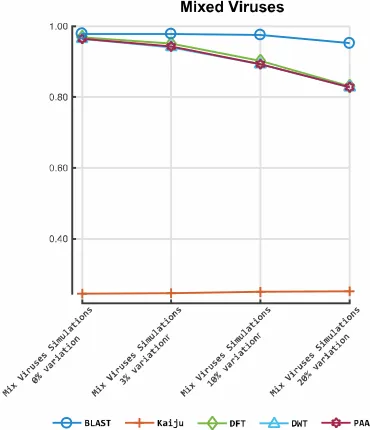
Figures 3, 4, and 5 illustrate the results of the classification evaluation process. Figure 3 shows the
276
results obtained from the classification process on the HIV-HXB2 data. Figure 4 illustrates the results
277
of the mixed virus datasets, and Figure 5 illustrates the results obtained from the real data.
278
In the taxonomic classification of HIV-HXB2 simulated data, where the short reads were
279
classified against the genome that was used to generate them, Kaiju reported the highest accuracy
280
scores. CBN outperformed BLASTn in most cases and only following behind in on the high variation
281
rates datasets. For the mixed viruses simulated datasets, where reads where classified against
282
species strains related to the ones used to generate the reads, BLASTn manage to correctly classify
283
data to the correct species, followed closely by CBN, and Kaiju falling last. In the evaluation of the
284
species, CBN generated more accurate results compared to the other tools, followed by Kaiju, and
286
BLASTn in third.
287
3.2. Alignment by numbers (ALBN)
288
To test the applicability of sequential data transformations and feature selection for read
289
alignment, we implemented a prototype k-NN read aligner (Table 5) in C++ (available at
290
https://github.com/Avramis/Alignment_by_numbers). As with the CBN classification analysis, the
291
ALBN code was not optimised for speed, and users may specify parameters such as the
292
representation method, transformation method, search stringency and the k-mer length used for
293
seeding alignments. The algorithm’s output was used to construct gapped alignments in the widely
294
used Sequence Alignment/Map (SAM) file format.
295
The ALBN tool was evaluated against a set of well established, widely used, stated of the art
296
tools such as, bowtie2 (version 2.3.1) [56], BWA-MEM (version0.7.16) [7], Graphmap (version 0.5.2)
297
[57], and Segmehl (version 0.3.4) [58]. Each aligner’s accuracy was quantified in terms of F-measure
298
[48]. CuReSim provides information such as the simulated read’s origin on the reference genome
299
and its alignment direction, enabling evaluation of each aligner’s output an calculation of alignment
300
accuracy in terms of F-measure. For mixed virus datasets, tool performance was evaluated in terms
301
of ability to match and align reads to the appropriate virus reference genome. For the real data,
302
F-measures were calculated according to the number of reads aligned to the given genome or
303
otherwise.
304
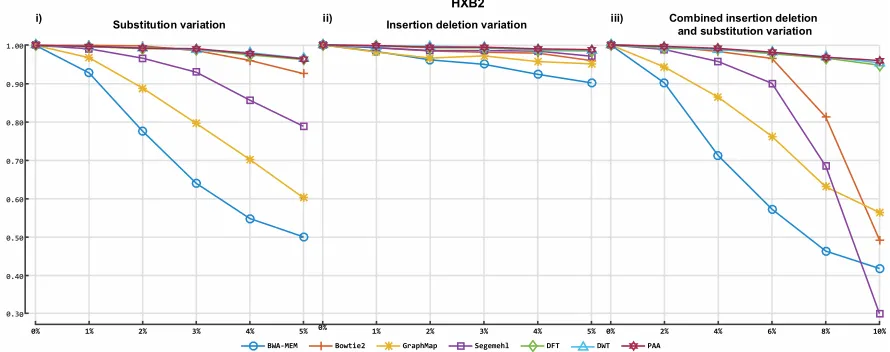
Figures 6, 7 and 8 illustrate the F-measures obtained by evaluating alignments from each
305
aligner. Figure 6 illustrates alignment performance for each of the 16 datasets simulated using the
306
K03455 HIV-HXB2 reference genome. Figure 7 illustrates alignment performance for virus reads
307
simulated with Norovirus genome KM198509.1, Ebola genome KM034562.1, and the RSV genome
308
KP317934.1. Figure 8-i to 8-iii illustrates alignment performance (F-measure) for alignments of real
309
Norovirus, Ebola virus and RSV sequences against the same corresponding reference genomes used
310
in the simulations.
311
ALBN provided highly accurate results in all data cases. Regarding the HIV-HXB2 data, where
312
the short reads were aligned to genome that was used to generate them, ALBN provided the most
313
accurate results in all 16 cases, followed by Bowtie2 in terms of accuracy. Also, in the case of the
314
mixed virus datasets, where reads were aligned against genome strains related to those used to
315
generate the dataset, ALBN provided the most accurate results, with Graphmap and BWA-MEM
316
third and fourth respectively. ALBN also generated the most accurate alignment results using real
317
data, where reads where aligned against a species-specific reference genome.
318
3.3. De novo assembly by numbers
319
Lastly, to test the applicability of this approach to the de novo assembly of short reads, we
320
implemented a naïve algorithm for all-against-all k-mer comparison using data
321
transformations/approximation. Figure 9 illustrates the main concept of our de novo assembly
322
approach. For the ASBN tool, reads are represented as numerical sequences using an appropriate
323
numerical representation method (Table 1). Here we use the tetrahedron numerical representation
324
approach. Every k-mer of each numerically represented read is identified and transformed to lower
325
dimensional space using the chosen transformation method. All k-mers’ transformations are used to
326
build a VP-tree, to allow for fast data comparison. Afterwards, all k-mers are compared to the rest of
327
the data using the VP-tree index. Information from the data comparison is used to construct a
328
weighted graph similar to that shown in Figure 9A. The shortest path on the weighted graph is
329
identified with a breadth-first search (BFS) (Figure 9B). Reads overlaps are used to generate an OLC
330
alignment of short reads (Figure 9C).
331
The ASBN assembler was compared with Megahit (version 1.1.3) [59], and SPAdes (version
332
3.13.0) [60] de novo assemblers on the HIV-HXB2 and mixed virus simulated datasets accordingly.
333
The derived contigs from each assembler were evaluated against the reference genomes used to
334
and plotted in a histogram. Secondly, a measure of assembly progress was plotted on an X-Y matrix
336
with X being the total coverage of the genomes generated and Y being the total number of gaps in
337
the coverage. A perfect assembly would have X = full genome length and Y = 0, implicating, that the
338
contig matches the genome in terms of size and nucleotide sequences, without any mismatches or
339
gaps. For the HIV-HXB2 datasets, the contigs were evaluated against the K03455 genome, and the
340
contigs obtained from the mixed virus datasets were evaluated against the 15 different genomes,
341
KM198529, KM198528, KM198511, KM198500, KM198486, KU296608, KU296553, KU296549,
342
KU296528, KU296416, KP317952, KP317946, KP317934, KP317923, and KP317922.
343
Figure 10 illustrates the assembly results of SPAdes, Megahit and all three variants of ASBN on
344
the 16 simulated HIV-HXB2 datasets, and Figure 11 illustrates the assembly results on the mixed
345
virus simulated databases. Although ASBN processes data and assembles short reads in a lower
346
dimensional space, it nevertheless generated contigs that collectively cover the expected genome
347
length and provided comparable results to both state of the art de novo assemblers in this
348
experiment(Figure 10, Figure 11). In all cases, ASBN generated contigs spanning the whole genomes
349
of their respective viral species.
350
4. Discussion
351
Although well-established data compression methods for reversible compression of
352
one-dimensional and multivariate signals, images, text and binary exist [61-63]; there are very few
353
examples of their application to biological sequence data. We developed algorithms incorporating
354
signal compression methods for three common biological sequence analysis problems: classification,
355
alignment and de novo assembly of NGS short read virus data. Our results show that our approach
356
permits accurate classification and reference alignment in spite of high rates of sequence variation or
357
the use of a divergent reference genome. Data approximation/summarisation techniques such as the
358
DFT, the DWT and the PAA can be used to extract major features of sequence data and to suppress
359
noise or low-level variation. This allows data comparison in terms of major characteristics, thus
360
enabling the identification of similarities among data that might otherwise be concealed by minor
361
variation or noise.
362
Collectively these results demonstrate that complete nucleotide-level sequence resolution is not
363
a prerequisite of accurate sequence analysis, and that analytical performance can be preserved or
364
even enhanced through appropriate dimensionality reduction (compression) of sequences. While
365
our implementations use k-mers, the nature of the transformation/compression methods used
366
showed that optimal k-mer selection is far less important than with conventional exact k-mer
367
matching methods. The inherent error tolerance of the approach also permits use of larger k values
368
than are normally used with conventional sequence comparison algorithms, reducing the
369
computational burden of pairwise comparison, and thus, in de novo assembly specifically, the
370
complexity of building and searching an assembly graph.
371
Efficient mining of terabase-scale biological sequence datasets requires looking beyond
372
substring-indexing algorithms towards more versatile methods of compression for both data storage
373
and analysis. The use of probabilistic data structures can considerably reduce the computer memory
374
required for in-memory sequence lookups at the expense of a few false positives, and Bloom filters
375
and related data structures have seen broad application in k-mer centric tasks such as error
376
correction [64], in silico read normalisation [65] and de novo assembly [66,67]. However, while these
377
hash-based approaches perform well on datasets with high sequence redundancy, for large datasets
378
with many distinct k-mers, large amounts of memory are still necessary [65]. Lower bounding
379
transformations and approximation methods (such as the DFT, the DWT and PAA) can exhibit the
380
same attractive one-sided error offered by these probabilistic data structures, but instead of hash
381
tables use concrete and thus reusable sequence representations.
382
Furthermore, transformations allow compression of standalone sequence composition,
383
enabling flexible reduction of sequence resolution according to analytical requirements, so that
384
redundant sequence precision need not hinder analysis. While the problem of read alignment to a
385
formidable problem in computing. Moreover, consideration of the metagenomic composition of
387
mixed biological samples, as demonstrated, further extends the scope and scale of the assembly
388
problem beyond what is tractable using conventional sequence comparison approaches. By
389
implementing a reference-based aligner and de novo assembler, we have demonstrated that using
390
compressed numerical representations representa a tractable and versatile approach for
391
reconstructing genomes and metagenomes sequenced with short reads.
392
In conclusion, short nucleotide sequences may be effectively represented as numerical series,
393
enabling the application of existing analytical methods from a variety of mathematical and
394
engineering fields for the purposes of sequence alignment and assembly. By applying established
395
signal decomposition methods, compressed representations of nucleotide sequences can be created,
396
permitting reductions in the spatiotemporal complexity of their analysis, without necessarily
397
compromising analytical accuracy.
398
399
Authors’ Contribution
400
AT designed and wrote the methods and software, and performed the data analysis with help
401
from BC, MP, SK, and MC. BC and MC, generated the simulated data and BC, MP and MC help on
402
the data evaluation. AT and DLR conceived the study. AT and BC wrote the manuscript with
403
comments from MP, MC and DLR. All authors read and approved the final manuscript.
404
405
Funding
406
This work has been supported by the Wellcome Trust [097820/Z/11/B]; the BBSRC
407
[BB/H012419/1 and BB/M001121/1 and BC by a BBSRC DTP studentship to DLR]; and the
408
VIROGENESIS project which receives funding from the European Union's Horizon 2020 research
409
and innovation programme under grant agreement No 634650.
410
411
412
Figure 1. A numerically represented DNA sequence transformed at various levels of spatial
413
resolution using the discrete Fourier transform (DFT) of the whole sequence (A), the Haar discrete
414
wavelet transform (DWT) (B), and piecewise aggregate approximation (PAA) (C). A 30 nucleotide
415
sequence (x-axis) is represented as a numerical sequence (black lines) using the real number
416
representation method (y-axis where T=1.5, C=0.5, G=-0.5 and A=-1.5) for DFT approximations of the
417
same sequence with 8 level wavelets (red), 4 level wavelets (blue), and 2 level wavelets (green) (B);
419
and PAA approximations of the same sequence with 8 (red), 5 (blue) and 3 (green) coefficients (C).
420
421
Figure 2. Overview of our proposed methodology using time series transformation/approximation
422
methods: (i) Creation of numerical representations of input sequences. (ii) Application of an
423
appropriate signal decomposition method to transform sequences into their feature space. (iii) Use of
424
approximated transformations to perform rapid data analysis in lower dimensional space. (iv)
425
Validation of inferences against original, full-resolution input sequences. In the case of
426
reference-based alignment, and taxonomic classification, approximated read transformations were
427
compared with a reference sequence. In our de novo implementation, pairwise comparisons were
428
430
Figure 3. Accuracy of our prototype classification implementation and two established tools on
431
HIV-HXB2 simulated datasets. All plots illustrate the F-measures obtained on the 16 different HIV
432
datasets. The Y axis indicates the F-measure score, and the X axis depicts the reads data files. Plot 3-i
433
depicts the F-measures obtained for each classifier on the simulations with 0% to 5% of substitution
434
variation rate. Plot 6-ii illustrates the F-measures obtained for each classifier on the simulations with
435
0% to 5% uniform insertion/deletion variation and plot 3-iii illustrates the F-measures obtained for
436
each tool on simulations of uniform 0% to 10% insertion/deletion and substitution variation.
437
438
Figure 4. Accuracy of our prototype classification implementation and two established tools on
439
mixed viruses simulated datasets. The Y axis indicates the F-measure score, and the X axis depicts the
440
reads data files. The plot depicts the F-measures obtained for each classifier on the mixed virus
441
simulations.
442
0.90 0.92 0.94 0.96 0.98 1.00
Substitution variation Insertion deletion variation Combined insertion deletion and substitution variation
0% 1% 2% 3% 4% 5% 0% 1% 2% 3% 4% 5% 0% 2% 4% 6% 8% 10% BLAST Kaiju DFT DWT PAA
HXB2
443
Figure 5. Accuracy of our prototype classification implementation and two established tools on real
444
sequences. The Y axis indicates the F-measure score, and the X axis depicts the reads data files. The Y
445
axis indicates the F-measure score, and the X axis depicts the reads data files. Plot 5-i depicts the
446
F-measures obtained for each classifier on the Norovirus sequences data. Plot 5-ii illustrates the
447
F-measures obtained for each classifier on the Ebola sequence data. Plot 5-iii illustrates the
448
F-measures obtained for each tool on Respiratory syncytial virus (RSV) sequence data.
449
450
Figure 6. Accuracy of our prototype reference alignment implementation and four established tools
451
on HIV-HXB2 simulated datasets. Figure 6 illustrates the F-measures obtained on the 16 different
452
HIV datasets. Plot 6-i depicts the F-measures obtained for each aligner on the simulations with 0% to
453
5% of substitution variation rate. Plot 6-ii illustrates the F-measures obtained for each aligner on the
454
simulations with 0% to 5% uniform insertion/deletion variation and plot 6-iii illustrates the
455
F-measures obtained for each tool on simulations of uniform 0% to 10% insertion/deletion and
456
substitution variation.
457
ERR3 0325
9
ERR3 0326
0
ERR3 0326
1
ERR3 0326
2
ERR3 0326
4
0.20 0.40 0.60 0.80 1.00
RSV
ERR2 2562
8
ERR2 2562
9
ERR2 2563
1
ERR2 2563
2
ERR2 2563
3
0.20 0.40 0.60 0.80
1.00 Norovirus
SRR3 1073
37.1
SRR3 1073
38.1
SRR3 1073
40.1
SRR3 1073
42.1
SRR3 1073
43.1
0.88 0.90 0.92 0.94 0.96 0.98 1.00
Ebola
BLAST Kaiju DFT DWT PAA
i) ii) iii)
0.40 0.50 0.60 0.70 0.80 0.90 1.00
Substitution variation Insertion deletion variation Combined insertion deletion and substitution variation
0% 1% 2% 3% 4% 5% 0% 1% 2% 3% 4% 5% 0% 2% 4% 6% 8% 10%
HXB2
0.30
BWA-MEM Bowtie2 GraphMap Segemehl DFT DWT PAA
458
Figure 7. Accuracy of our prototype aligner implementation and four established tools on mixed
459
viruses simulated datasets. The Y axis indicates the F-measure score, and the X axis depicts the reads
460
data files. The plot depicts the F-measures obtained for each aligner on the mixed virus simulations
461
462
Figure 8. Accuracy of our prototype aligner implementation and four established tools on real
463
sequences datasets. The Y axis indicates the F-measure score, and the X axis depicts the reads data
464
files. The Y axis indicates the F-measure score, and the X axis depicts the reads data files. Plot 8-i
465
depicts the F-measures obtained for each aligner on the Norovirus sequences data. Plot 8-ii illustrates
466
the F-measures obtained for each aligner on the Ebola sequences data. Plot 8-iii illustrates the
467
F-measures obtained for each tool on the Respiratory syncytial virus (RSV) sequences data.
468
Mix Viru
ses Simu
lati ons
0% v aria
tion
Mix Viru
ses Simu
lati ons
3% v aria
tion
Mix Viru
ses Simu
lati ons
10% var
iati on
Mix Viru
ses Simu
lati ons
20% var
iati on
0.91 0.94 0.97 1.00
Mixed Viruses
BWA-MEM Bowtie2 GraphMap Segemehl
DFT DWT PAA
ERR2 2562
8
ERR2 2562
9
ERR2 2563
1
ERR2 2563
2
ERR2 2563
3
0.20 0.40 0.60 0.80 1.00
Norovirus
SRR3 1073
37.1
SRR3 1073
38.1
SRR3 1073
40.1
SRR3 1073
42.1
SRR3 1073
43.1
0.84 0.88 0.92 0.96 1.00
Ebola
0.82
ERR3 0325
9
ERR3 0326
0
ERR3 0326
1
ERR3 0326
2
ERR3 0326
4
0.40 0.60 0.80 1.00
Respiratory Syncytial Virus
0.20
BWA-MEM Bowtie2 GraphMap Segemehl DFT DWT PAA
469
Figure 9. A de novo assembly methodology for numerically represented nucleotide reads.
470
All-against-all sequence comparison (A) enables construction of a read graph with weighted edges.
471
The weight assigned to each edge is the smallest pairwise distance between every possible k-mer
472
representation of the two reads. (B) The shortest path in the graph is identified with a breadth-first
473
search algorithm (red coloured edges) thereby (C) enabling read alignment. A DNA walk
474
representation of the overlapped reads (D) may subsequently be used as a three-dimensional
475
graphical portrayal of the reads, illustrating alignment characteristics.
476
477
Figure 10. Accuracy of our prototype de novo assembly implementation and two established tools on
478
HIV-HXB2 simulated datasets. The contigs obtained for each assembler were evaluated against the
479
reference genome used to generate the simulated data. BLASTn was used to align all contigs to a
480
0 10 15 20 25HXB2 genome coverage
HXB2 simualted reads with 2% sub. var .
5 iii)
0 2000 4000 6000 8000
HXB2 simualted reads with 0% variation
0 100 200 300 400 500
HXB2 genome coverage
0 2000 4000 6000 8000
i) 0.0 2.0 1.5 3.0 2.5 1.0 0.5
HXB2 genome coverage
HXB2 simualted reads with 1% sub var .
0 2000 4000 6000 8000
ii) G a p s / N s / M i s m a t c h e s
0 2000 4000 6000 8000
400 600 800 1000 0 200
HXB2 simualted reads with 1% indel var . vii)
HXB2 genome coverage 0 2000 4000 6000 8000
700 0 100 200 300 400 500 600
HXB2 simualted reads with 2% com. var. xii)
HXB2 genome coverage
0 200 400 600 800 1000
1200HXB2 simualted reads with 4% com. var. xiii)
HXB2 genome coverage
0 2000 4000 6000 8000
G a p s / N s / M i s m a t c h e s 0 200 400 600 800 1000 1200
1400HXB2 simualted reads with 2% indel var . viii) G a p s / N s / M i s m a t c h e s
HXB2 genome coverage
0 2000 4000 6000 8000
0 5 10 15 20 25 30
HXB2 simualted reads with 3% sub. var. iv)
HXB2 genome coverage
0 2000 4000 6000 8000
0 2040 60 80 100 120
HXB2 simualted reads with 4% sub. var. v)
HXB2 genome coverage
0 2000 4000 6000 8000
0 50 100 150 200
HXB2 simualted reads with 5% sub. var. vi)
HXB2 genome coverage
0 2000 4000 6000 8000
400 800 2000
1200 1600
HXB2 simualted reads with 3% indel var . ix)
HXB2 genome coverage
0 2000 4000 6000 8000
G a p s / N s / M i s m a t c h e s 2400 800 2000 1200 1600
HXB2 simualted reads with 4% indel var . x)
HXB2 genome coverage
0 2000 4000 6000 8000
G a p s / N s / M i s m a t c h e s 500 1000 1500 2000 2500 3000
HXB2 simualted reads with 5% indel var . xi)
HXB2 genome coverage
0 2000 4000 6000 8000
G a p s / N s / M i s m a t c h e s 0 500 1000 1500 2000 2500
HXB2 genome coverage
0 2000 4000 6000 8000
G a p s / N s / M i s m a t c h e s
HXB2 simualted reads with 6% com.var. xiv) 0 1000 2000 3000 4000 5000
6000HXB2 simualted reads with 8% com.var. xv)
HXB2 genome coverage
0 2000 4000 6000 8000
G a p s / N s / M i s m a t c h e s 0 2000 4000 6000 8000 10000 12000 G a p s / N s / M i s m a t c h e s
HXB2 simualted reads with 10% com. var . xvi)
HXB2 genome coverage
0 2000 4000 6000 8000
DFT DWT PAA
HIV-HXB2 refence genome and determine genome coverage. The Y axis indicates the number of
481
gaps and mismatches that exist in the contigs obtained for each tool, and the X axis depicts the length
482
of the genome the reported contigs cover. The contigs obtained from the assembly of the HIV-HXB2
483
simulated short read data were evaluated against the K03455 reference genome. Plot 10-i illustrates
484
results obtained from all assemblers on variation free data. Plots 10-ii to 10-vi illustrate results
485
obtained from all assemblers on data with different levels of substitution variation. Plots 10-vii to
486
10-xi illustrate results obtained from all assemblers on data with different levels of insertion/deletion
487
variation. Plots 10-xiii to 10-xvi illustrate results obtained from all assemblers on data with different
488
levels of combined insertion/deletion and substitution variation.
489
490
Figure 11. Accuracy of our prototype de novo assembly implementation and two established tools on
491
mixed viruses simulated datasets. The contigs obtained for each assembler were evaluated against
492
the reference genome that was used to generate the simulated data. BLASTn was used to align all
493
contigs to a HIV-HXB2 refence genome, and determine how much of the particular genome they do
494
cover. The Y axis indicates the number of gaps and mismatches that exist in the contigs obtained for
495
each tool, and the X axis depicts the length of the genome the reported contigs cover. The contigs
496
obtained from the mixed virus simulated dataset were evaluated against the, KM198529, KM198528,
497
KM198511, KM198500, KM198486, KU296608, KU296553, KU296549, KU296528, KU296416,
498
KP317952, KP317946, KP317934, KP317923, and KP317922 references genomes. Plots 11-i to 11-iv
499
illustrate results obtained from all assemblers on data with 0%, 3%, 10% and 20% variation levels
500
accordingly.501
502
G a p s / N s / M i s m a t c h e sMixed viruses reads with 0% variation
Mixed viruses genome coverage 0 100 200 300 400 500 600 700
0 5000 10000 15000
G a p s / N s / M i s m a t c h e s 0 500 1000 1500 2000
Mixed viruses genome coverage
Mixed viruses reads with 3% variation
0 5000 10000 15000
G a p s / N s / M i s m a t c h e s 0 500 1000 1500 2000 2500
3000 Mixed viruses reads with 10% variation
0 5000 10000 15000 Mixed viruses genome coverage
G a p s / N s / M i s m a t c h e s 1000 2000 3000 4000
5000 Mixed viruses reads with 20% variation
0 5000 10000 15000 Mixed viruses genome coverage
Spades Megahit DFT DWT PAA
i)
ii)
iii)
Table 1 Numerical nucleotide sequences representation methods.
503
Integer number
A
=
1,
C
=
-1,
G
=
2,
T
=
-2,
N
=
0
Real number
A
= -
1.5,
C
=
0.5,
G
= -
0.5,
T
=
1.5,
N
=
0.0
EIIP
A
=
0.1260,
C
=
0.1340,
G
=
0.0806,
T
=
0.1335, N=
Æ
Atomic
A
=
70,
C
=
58,
G
=
78,
T
=
66, N=
Æ
Pair
A
or
T
=
1,
C
or
G
= -
1, N=0
Complex number
A
=
1
+
1
i
,
C
= -
1
+
1
i
,
G
= -
i
-
1
i
,
T
=
1
-
1
i
, N=0+0i
DNA WalkA
=
é
ë
1,0
ù
û
,
C
=
é
ë
0,1
ù
û
, G
=
ë
é
0,
-
1
ù
û
,
T
= -
é
ë
1,0
ù
û
,
N
=
é
ë
0,0
ù
û
Tetrahedron
A
=
é
ë
0,0,1
ù
û
, C=
-
2
3
,
-6
3
,
1
3
é
ë
ê
ê
ù
û
ú
ú
, G=
-
2
3
,
-6
3
,
-1
3
é
ë
ê
ê
ù
û
ú
ú
,
T= 2
´
2
3
, 0,
-1
3
é
ë
ê
ê
ù
û
ú
ú
, N= 0, 0, 0
é
ë
ù
û
Voss indicator
A
=
é
ë
0,0,1,0
ù
û
,
C
=
ë
é
1,0,0,0
ù
û
,
G
=
é
ë
0,1,0,0
ù
û
,
T
=
é
ë
0,0,0,1
ù
û
,
N
=
é
ë
0,0,0,0
ù
û
504
506
Table 2. Simulated read data. Each row contains details for each simulated dataset (i.e. virus family, virus,
507
GenBank id, variation type, variation level, number of reads, and simulator used to generate data).
508
Family Virus GenBank genome
ID
Variation Type (%) Reads Simulator
Ins Del Sub
HIV HXB2 K03455 0.0 0.0 0.0 2133 Curesim
HIV HXB2 K03455 0.0 0.0 1.0 2133 Curesim
HIV HXB2 K03455 0.0 0.0 2.0 2133 Curesim
HIV HXB2 K03455 0.0 0.0 3.0 2133 Curesim
HIV HXB2 K03455 0.0 0.0 4.0 2133 Curesim
HIV HXB2 K03455 0.0 0.0 5.0 2133 Curesim
HIV HXB2 K03455 0.5 0.5 0.0 2133 Curesim
HIV HXB2 K03455 1.0 1.0 0.0 2133 Curesim
HIV HXB2 K03455 1.5 1.5 0.0 2133 Curesim
HIV HXB2 K03455 2.0 2.0 0.0 2133 Curesim
HIV HXB2 K03455 2.5 2.5 0.0 2133 Curesim
HIV HXB2 K03455 0.5 0.5 1.0 2133 Curesim
HIV HXB2 K03455 1.0 1.0 2.0 2133 Curesim
HIV HXB2 K03455 1.5 1.5 3.0 2133 Curesim
HIV HXB2 K03455 2.0 2.0 4.0 2133 Curesim
HIV HXB2 K03455 2.5 2.5 5.0 2133 Curesim
Mixed Viruses: Caliciviridae, Filoviridae, Pneumoviridae
Norovirus, Ebola virus, RSV
KM198529, KM198528, KM198511, KM198500, KM198486, KU296608, KU296553, KU296549, KU296528, KU296416, KP317952, KP317946, KP317934, KP317923, KP317922
0.0 0.0 0.0 200000 WGSIM
Mixed Viruses: Caliciviridae, Filoviridae, Pneumoviridae
Norovirus, Ebola virus, RSV
KM198529, KM198528, KM198511, KM198500, KM198486, KU296608, KU296553, KU296549, KU296528, KU296416, KP317952, KP317946, KP317934, KP317923, KP317922
1.0 1.0 1.0 200000 WGSIM
Mixed Viruses, Caliciviridae, Filoviridae, Pneumoviridae
Norovirus, Ebola virus, RSV
KM198529, KM198528, KM198511, KM198500, KM198486, KU296608, KU296553, KU296549, KU296528, KU296416, KP317952, KP317946, KP317934, KP317923, KP317922
3.33 3.33 3.33 100000 WGSIM
Mixed Viruses, Caliciviridae, Filoviridae, Pneumoviridae
Norovirus, Ebola virus, RSV
KM198529, KM198528, KM198511, KM198500, KM198486, KU296608, KU296553, KU296549, KU296528, KU296416, KP317952, KP317946, KP317934, KP317923, KP317922
509
Table 3. Real short reads data. Rows contain information for each real reads’ dataset (i.e. virus
510
family, virus, genome strain GenBank id, SRA project ID, number of reads, and technology used to
511
sequence data).
512
Family Virus Amplicon/random
primer
GenBank genome ID
ENA/SRA_ID Reads Sequencing Technology
Caliciviridae Norovirus Amplicon KM198486 ERR225628 2126502 Illumina MiSeq
Caliciviridae Norovirus Amplicon KM198500 ERR225629 3037674 Illumina MiSeq
Caliciviridae Norovirus Amplicon KM198511 ERR225631 3285078 Illumina MiSeq
Caliciviridae Norovirus Amplicon KM198528 ERR225632 4361884 Illumina MiSeq
Caliciviridae Norovirus Amplicon KM198529 ERR225633 5187234 Illumina MiSeq
Filoviridae Ebola virus
Amplicon KU296608 SRR3107337 522968 Ion Torrent PGM
Filoviridae Ebola virus
Amplicon KU296549 SRR3107338 771031 Ion Torrent PGM
Filoviridae Ebola virus
Amplicon KU296416 SRR3107340 186657 Ion Torrent PGM
Filoviridae Ebola virus
Amplicon KU296553 SRR3107342 478346 Ion Torrent PGM
Filoviridae Ebola virus
Amplicon KU296528 SRR3107343 42410 Ion Torrent PGM
Pneumoviridae RSV Amplicon KP317934 ERR303259 7275032 Illumina
MiSeq
Pneumoviridae RSV Amplicon KP317922 ERR303260 9278070 Illumina
MiSeq
Pneumoviridae RSV Amplicon KP317946 ERR303261 11111114 Illumina
MiSeq
Pneumoviridae RSV Amplicon KP317923 ERR303262 13293226 Illumina
MiSeq
Pneumoviridae RSV Amplicon KP317952 ERR303263 15237848 Illumina
MiSeq
513
Table 4. Reference genomes used during classification and reference based alignment
515
Family Virus GenBank id: Length (nt)
Retroviridae Human
immunodeficiency
virus 1
(HXB2)
K03455 9179
Caliciviridae Norovirus KM198509.1 7425
Filoviridae Zaire ebolavirus KM034562.1 18957
Pneumoviridae Human
orthopneumovirus
(Respiratory Syncytial
Virus)
KP317934.1 15233
516
517
Table 5. Pseudocode for the alignment procedure
518
519
520
References
521
1. Margulies, M.; Egholm, M.; Altman, W.E.; Attiya, S.; Bader, J.S.; Bemben, L.A.; Berka, J.; Braverman,
522
M.S.; Chen, Y.-J.; Chen, Z. Genome sequencing in microfabricated high-density picolitre reactors.
523
Nature 2005, 437, 376-380.
524
2. Bentley, D.R.; Balasubramanian, S.; Swerdlow, H.P.; Smith, G.P.; Milton, J.; Brown, C.G.; Hall, K.P.;
525
Evers, D.J.; Barnes, C.L.; Bignell, H.R. Accurate whole human genome sequencing using reversible
526
terminator chemistry. Nature 2008, 456, 53-59.
527
1) Represent short reads and reference genome as numerical sequences. 2) Select k-mer length.
3) Create transformations of each reference sequence k-mer, build VP-tree, and
create transformations of the initial k-mer of each short reads.
4) Identify candidate alignments using data transformations. for each read i
candidate_alignments[i] = VPtree.k-NNSearch(query i) end
5) Align approximate results with original data using the Smith-Waterman (SW)
algorithm:
for each read i best_score = null best_aln = []
for each k neighbour in candidate_alignments[i] if SW_score(k neighbour, read i)
best_score = SW_score(k neighbour, read i) best_aln = SW_aln(k neighbour, read i) end
end end