
Stream Cipher Operation Modes with Improved Security
against Generic Collision Attacks
Matthias Hamann and Matthias Krause
University of Mannheim, Germany {hamann,krause}@uni-mannheim.de http://th.informatik.uni-mannheim.de/
Abstract. Most stream ciphers used in practice are vulnerable against generic collision at-tacks, which allow to compute the secret initial state on the basis ofO(2n/2) keystream bits in
time and spaceO(2n/2), wherendenotes the inner state length of the underlying keystream generator. This implies the well-known rule that for reachingn-bit security, the inner state length should be at least 2n. Corresponding to this, the inner state length of recent proposals for practically used stream ciphers is quite large (e.g.,n= 288 for Trivium andn= 160 for Grain v1).
In this paper, we suggest a simple stream cipher operation mode, respectively a simple way how to modify existing operation modes like that in the Bluetooth system, which provides provable security near 22n/3against generic collision attacks. Our suggestion refers to stream
ciphers (likeE0 in Bluetooth) which generate keystreams that are partitioned into packets
and where the initial states for each packet are computed from a packet-IV and the secret session key using a resynchronization algorithm.
Our security analysis is based on modeling the resynchronization algorithm in terms of the F P(1)-constructionE(x, k) =F(P(x⊕k)⊕k), wherek denotes ann-bit secret key (corre-sponding to the symmetric session key),F denotes a publicly known n-bit function (corre-sponding to the output function of the underlying keystream generator),P denotes a publicly knownn-bit permutation (corresponding to the iterated state update function of the gener-ator), and the inputxis a public initial value. Our security bounds follow from the results presented in [12], where a tight 2
3nsecurity bound for theF P(1)-construction in the random
oracle model was proved.
Keywords: Stream Cipher Operation Modes, Time-Memory-Data Tradeoff Attacks, Provable Security, Even-Mansour Constructions
1
Introduction
During the last decades, many stream ciphers for practical use have been suggested and many dif-ferent techniques for cryptanalyzing them have been developed (correlation attacks, fast correlation attacks, guess-and-verify attacks, BDD-attacks, time-memory-data tradeoff attacks etc.). The typi-cal aim of these attacks is to gain some nontrivial information about the inner state of the underlying keystream generator (KSG) from a given piece of keystream.
While most attacks try to exploit structural weaknesses specific to the respective ciphers (e.g., of their KSG state transition and output function), generic collision attacks represent an inherent weakness of almost all existing practical stream ciphers. More precisely, time-memory-data tradeoff attacks like those of Babbage [2] andBiryukov andShamir [5] allow to compute the secret initial state on the basis ofO(2n/2) keystream bits in time and spaceO(2n/2), wherendenotes the inner
Based on the results in [12], our research shows a way to reduce the size of the inner state by using operation modes which yield provable security beyond the birthday bound against time-memory-data tradeoff attacks. The stream cipher operation modes presented in this paper refer to thepacket mode, used, e.g., with theE0cipher in the Bluetooth system [15], where the keystream is generated
packet-wise, i.e., as a sequence of packets of moderate packet lengthR (e.g., at most 2790 bits for the basic rate of Bluetooth, cf. [15]), and the initial state for each keystream packeti is computed from a secret session keykand a public initial value IVi by using a state initialization algorithm.
The packet mode can be seen as a compromise between theone-stream mode (used, e.g., by Trivium and Grain v1), which has minimal initialization effort per keystream bit but also minimal security w.r.t. generic time-memory-data tradeoff attacks, and block cipher-based modes (used, e.g., by the GSM standard A5/3), which have maximal security w.r.t. time-memory-data treadeoff attacks but also maximal initialization effort per keystream bit.
Our security results for packet modes are based on modeling the process of state initialization and keystream generation through FP-constructions, which were first introduced in [12]. This is done by identifying n with the inner state length of the KSG. The function P corresponds to stepping the KSG a certain number of times without producing output, an operation which is used in most state initialization algorithms of practical stream ciphers and can often be described by an efficiently invertible permutation.F corresponds to the function which assigns to eachx∈ {0,1}n
the blockF(x) of the firstnkeystream bits generated on the initial inner statex. Standard security assumptions on keystream generators imply that F must be a cryptographically strong one-way function.
A first consequence of this approach is that the initialization and keystream generation algorithm used in the Bluetooth cipherE0corresponds to theF(0)-constructionF(x⊕k) and allows to recover
the secret session key on the basis of 2n/2packets. However, a slight change in this algorithm, namely
adding the session key twice in the initialization phase, raises the security w.r.t. to time-memory-data tradeoff attacks fromn/2 to 2/3·n, wheren denotes the KSG’s inner state length (which is 132 bit in the case of E0).
A state initialization algorithm corresponding directly to theF P(1)-constructionF(P(x⊕k)⊕k) refers to a KSG with non-linear state update function and would execute the following three steps: Given a secret keyk∈ {0,1}nand an initial valueIVi∈ {0,1}n, loadIVi⊕kinto theninner state register cells, then iterate the KSG a certain number of times without producing output, then add
kbitwise to the resulting inner state and start to produce the i-th keystream packet. The block of the firstnkeystream bits then corresponds toE(IVi, k) :=F(P(IVi⊕k)⊕k).
The paper is structured as follows. In section 2, we provide an overview of the basic properties of stream ciphers and introduce the terminology used subsequently. In particular, we describe the typical components of stream ciphers employed in practice and distinguish between two different operation modes. In section 3, we then go into details about the inner workings of some prominent stream ciphers, with a focus on their respective state initialization algorithms and how they are operated. Following this, in section 4, we introduce a way of modeling the state initialization and keystream generation of stream ciphers and exemplify this model using the ciphers described in section 3. The resulting insights will finally allow us in section 5 to compare the security (w.r.t. generic collision attacks) of existing approaches for operating stream ciphers to the security of our new design paradigm.
2
Operation Modes of Stream Ciphers
who also knows k, decrypts the encrypted bitstream Y =X ⊕S by generatingS and computing
X =Y ⊕S.
Typically, a stream cipher is defined by the following three components:
– A session key generation protocol, which defines how Alice and Bob generate a common sym-metric session keyk.
– A keystream generator (KSG), which generates a keystream S(q1) in dependence of an initial
stateq1.
– A state initialization algorithm StateInit, which defines how to compute the initial KSG-state
q1=StateInit(IV, k) for the KSG from a (public) initial valueIV and the secret session key k.
In our context, we focus on the KSG and the state initialization algorithm. KSGs are clockwise working devices which can be formally specified by finite automata, defined by an inner state length
n, the set of inner states {0,1}n, a state update function δ : {0,1}n −→ {0,1}n and an output functionout : {0,1}n −→ {0,1}∗. Starting from an initial state q1, in each clock cycle i ≥1, the
KSG produces a piece of keystreamzi=out(qi) (as a rule, one bit long) and changes the inner state
according to qi+1 =δ(qi). The output bitstreamS(q1) is defined by concatenating all the outputs
z1z2z3· · ·.
Typically, the KSG is not only used for the keystream generation but also for performing the state initialization. In section 3, the specifications of the StateInit-algorithms and the KSGs for various practically used stream ciphers like Trivium, Grain v1, the Bluetooth cipher E0 etc. are
listed.
Among stream cipher operation modes, we distinguishone-stream modes andpacket modes. In a one-stream mode, the whole plaintext stream of the session is encrypted by a sufficiently long prefix of the keystreamS(q1), whereas in a packet mode, the plaintextX is partitioned into packets
X =X1X2X3· · · of a moderate maximum packet lengthR(e.g., at most 2790 bits for the basic rate
of Bluetooth, cf. [15]), and separate pieces of keystream Si =S(qi
1) are produced for each packet.
Here, in the packet mode, the initial packet statesqi
1 will be computed via
q1i =StateInit(IVi, k),
in dependence of the secret session keykand a separate public initial valueIVi for each packet.
3
Some Stream Cipher Examples
This section provides an overview of some prominent stream ciphers, with a focus on their respective state initialization algorithms and operation modes. It includes E0 (used in Bluetooth) and A5/1
(used in GSM) as well as the eSTREAM [14] hardware portfolio members Trivium and Grain v1. In section 4, we will see how the state initialization algorithms and the keystream generation of these stream ciphers can be modeled in relation to the FP-construction. Please observe in the following that E0 in Bluetooth andA5/1 in GSM are both operated in packet modes in the sense that each
packet in a session is encrypted under the same session key but using different, publicly known IVs as described in section 2.
3.1 E0 (used in Bluetooth)
The classical way of ensuring data confidentiality for Bluetooth connections between a master device
Aand a slave deviceButilizes stream cipher-based encryption on a per-packet basis. More precisely, when encryption is activated, the payload of each packet (at most 2790 bits for the so-called basic rate [15]) is encrypted under a separate payload key using the algorithm E0, which produces a
key, we refer to the initial state of the KSG just before the first keystream bit for the packet is produced (i.e., in terms of this paper, to the output of the state initialization algorithmStateInit). It is derived on the basis of the current 128-bit encryption key Kc, the 48-bit Bluetooth address ADR of the master, and 26 bits CL0, . . . , CL25 of the master’s clock (to which both devices are
synchronized) at the time of the first transmission slot of the packet.1Before we continue with the
respective details, please note that the encryption key Kc corresponds to a session key, i.e., Kc
is constant for a potentially very large number of successive packets. Consequently, the difference between the payload keys of different packets during such a session solely arises from the difference of the corresponding, publicly known clock values at the time of encryption.
In the following, we will describe how the individual payload key for a packet is generated by
E0 based on the inputsKc, ADR, andCL0, . . . , CL25.
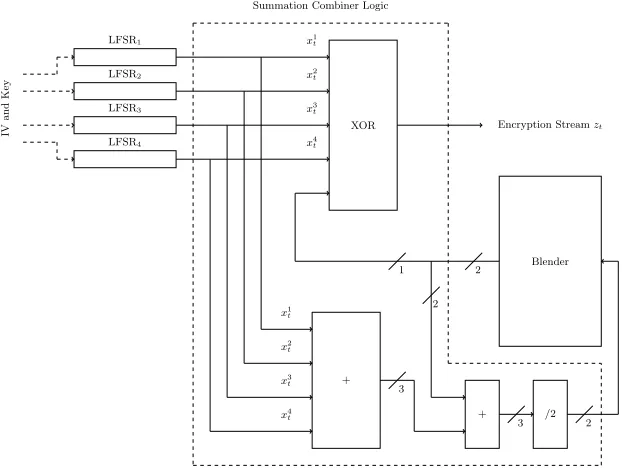
The general structure of the encryption engine ofE0 is depicted in figure 1.
IV
a
nd
Key
XOR Encryption Streamzt
LFSR1
LFSR2
LFSR3
LFSR4
x1 t
x2 t
x3 t
x4 t
Blender 2
1
2
+
+ /2
3
x1 t
x2 t
x3 t
x4 t
3 2
Summation Combiner Logic
Fig. 1.E0 encrpytion engine.x1t, . . . , x4t denote the output bits of the four LFSRs, respectively, in stept. (cf. [15], p. 1323)
The internal state of the four linear feedback shift registers (LFSRs) has a total size of 128 bits and the respective feedback polynomials are all primitive (cf. [15], p. 1322). Figure 2 shows the positions of the feedback taps. For further details like the exact definition of theblender finite state machine (4 bits), we refer the reader to the official Bluetooth specification ([15], p. 1322–1324). In our context, it is sufficient to understand that the inputsKc, ADR, and CL0, . . . , CL25 are split
up and, together with the two 3-bit constants 111 and 001, arranged as depicted in figure 2 prior to payload key generation, which then works as follows (cf. [15], p. 1325–1326):
1 Unlike the symmetric encryption keyKc, the valuesADRandCL
0, . . . , CL25are considered to be public.
ADR[2]CL[1]Kc[12]Kc[8]Kc[4]Kc[0]CL24 25
8 12 20
24 x1
t
ADR[3]ADR[0]Kc[13]Kc[9]Kc[5]Kc[1]CL[0]L0 0 1 31
12 16 24
24 x2
t
ADR[4]CL[2]Kc[14]Kc[10]Kc[6]Kc[2]CL25 33
4 24 28
32 x3
t
ADR[5]ADR[1]Kc[15]Kc[11]Kc[7]Kc[3]CL[0]U1 1 1 39
4 28 36
32 x4
t
CL[0]L=CL3. . . CL0
CL[0]U=CL7. . . Cl4
Fig. 2.Initializing theE0 LFSRs.ADR[i],Kc[i], andCL[i] denote the bytes ofADR,Kc, andCL,
respec-tively. (cf. [15], p. 1327)
1. Disable the feedback switches of the four LFSRs and set their contents to zero. (timet= 0) 2. Shift Kc,ADR,CL0, . . . , CL25, and the bits 111 and 001 into the registers of the four LFSRs
as depicted in figure 2 (e.g., at t = 1, CL24 is shifted into LFSR1, 1 into LFSR2, CL25 into
LFSR3 and 1 into LFSR4). For each LFSR, once the first input bit has reached the rightmost
cell, close the feedback switch.
3. When the switch of the last LFSR (i.e., LFSR4) is closed (t= 39), reset the blender registers (4
bits) to zero.
4. Shift in the rest of the input bits while starting to produce output bits which are notused as keystream.
5. Once all all input bits have been shifted in (at this point, LFSR1has been clocked 30 times with
closed switches, LFSR2 24 times, LFSR3 22 times, LFSR4 16 times), keep on clocking until 200
bits in total (including those in the previous step) have been produced. (t= 239)
The last 128 bits which were generated are then loaded in parallel (i.e., copied) into the registers of the four LFSRs as their new initial state att = 240 (for details, again, see [15]). The values of the blender registers are kept. At this point, the assignments to the registers of the four LFSRs as well as to the registers of the blender represent what was previously referred to as the payload key (132 bits in total). Based on this initial state, the encryption engine is then further clocked and its output bits serve as keystream bits for the encryption of the current payload.
If another packet needs to be encrypted, the whole initialization process of the cipher is repeated with a new clock value as the input of theE0 algorithm, leading to a different payload key.
3.2 A5/1 (used in GSM)
Though considered outdated for security reasons (see, e.g., [3] or the time-memory-data tradeoff attack using the FPGA cluster COPACOBANA in [10]), the stream cipher A5/1 is still widely used to encrypt GSM communication. Upon connection establishment, the mobile device is authenticated and a 64-bit symmetric session keyKc is generated using one of the COMP128 algorithms, which
take a publicly known 128-bit challenge (i.e., a random number produced by the authentication center of the network) and a common secret 128-bit key (stored on the SIM card and known to the authentication center) as inputs. Based on this 64-bit session key Kc and an additional IV, data
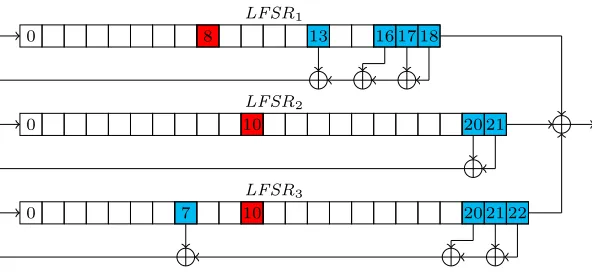
frames of 114 downlink bits and 114 uplink bits are protected using the A5/1 algorithm, whose basic structure is depicted in figure 3.
LFSR1
18 17 16 13 8
0
LFSR2
21 20 10
0
LFSR3
22 21 20 10
7 0
Fig. 3.Structure of A5/1, which consists of three LFSRs of total state length 64 bit. The blue register cells denote the feedback taps of the LFSRs, the red cells denote their majority bits.
each LFSR is clocked if and only if its majority bit equals the output of the majority function. Please note that the feedback polynomials of the three LFSRs are all primitive (cf. [4]). The corresponding feedback taps are depicted in figure 3.
Let Kc := (K63, . . . , K0) denote the secret session key and let F := (F21, . . . , F0) denote the
22-bit representation of the publicly known frame number. The 228 keystream bits, which will be XORed to the corresponding 114 downlink bits and 114 uplink bits, respectively, are generated as follows (cf. [4]).
1. Set all register cells of the three LFSRs to 0. 2. Fori= 0 to 63 do
2.1 LFSR1[0] = LFSR1[0] +Ki
LFSR2[0] = LFSR2[0] +Ki
LFSR3[0] = LFSR3[0] +Ki
2.2 Clock all three LFSRs (i.e., no majority clocking). 3. Fori= 0 to 21 do
3.1 LFSR1[0] = LFSR1[0] +Fi
LFSR2[0] = LFSR2[0] +Fi
LFSR3[0] = LFSR3[0] +Fi
3.2 Clock all three LFSRs (i.e., no majority clocking).
4. Clock the KSG 100 times using majority clocking and discard the output bits, which are each computed as the XOR of the three bits LFSR1[18], LFSR2[21], and LFSR3[22] as depicted in
figure 3.
5. Generate 114 keystream bits for downlink encryption clocking the KSG 114 times (using majority clocking).
6. Generate 114 keystream bits for uplink encryption clocking the KSG 114 times (using majority clocking).
For the enrcyption of the next frame, the above process is repeated with the same session key
Kc but a different frame numberF.
Please note that the state of the LFSRs after step 4 (i.e., right before the first keystream bit is produced) corresponds to what was called the payload key in the case of Bluetooth (cf. section 3.1) or, in terms of the abstract model introduced in section 2, to the output of theStateInit-algorithm.
3.3 Trivium
zi
s1
s 66
s94
s162 s
178 s243
s288
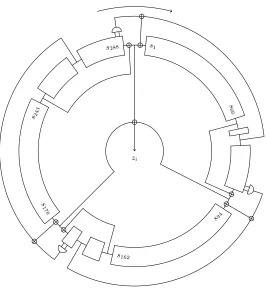
Fig. 4.Structure of Trivium (total state length 288 bit).zidenotes the output bit in stepi. (cf. [7])
and a 64-bit IV as inputs. Its inner structure consists of three shift registers of total length 288 bit, which are interwoven non-linearly as depicted in figure 4. Each keystream bit is computed as the XOR of six bits from the current internal state, two from each shift register.
Before the first keystream bit is output, the following initialization procedure is performed based on an 80-bit keyK:= (K80, . . . , K1) and an 80-bit initial valueIV := (IV80, . . . , IV1) (cf. [7]):
1. (s1, s2, . . . , s93)←(K80, . . . , K1,0, . . . ,0)
(s94, s95, . . . , s177)←(IV80, . . . , IV1,0, . . . ,0)
(s178, s179, . . . , s288)←(0, . . . ,0,1,1,1)
2. Fori= 1 to 4·288 do
2.1 t1←s66+s91·s92+s93+s171
t2←s162+s175·s176+s177+s264
t3←s243+s286·s287+s288+s69
2.2 (s1, s2, . . . , s93)←(t3, s1, . . . , s92)
(s94, s95, . . . , s177)←(t1, s94, . . . , s176)
(s178, s179, . . . , s288)←(t2, s178, . . . , s287)
In terms of our model (cf. section 2), the 288-bit state s1, . . . , s288 of the three shift registers
right after step 2 has been completed corresponds to the output of theStateInit-algorithm. Based on this internal state, the KSG is then clocked using the same operations as in step 2 of the initialization procedure with the only difference that in each clock cycle, the keystream bit
Please observe that the state update of Trivium is reversible (see also [7]), as this will be of importance when we model the state initialization of Trivium in terms of our FP-construction in section 4.
3.4 Grain v1
In the following, we will describe the 80-bit version of the stream cipher Grain v1 [11], which, like Trivium, is a member of the eSTREAM hardware portfolio. It takes an 80-bit key and a 64-bit IV as inputs and is composed of two shift registers, one an 80-bitnon-linear feedback shift register
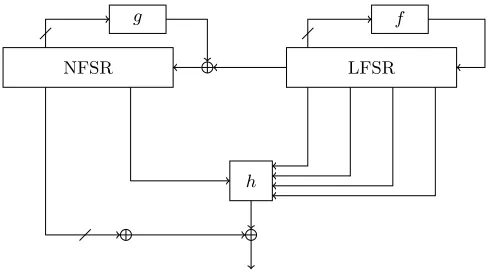
(NFSR) and one an 80-bitlinear feedback shift register (LFSR), which are connected as depicted in figure 5.
NFSR LFSR
h
g f
Fig. 5.Structure of Grain v1 (keystream generation phase).f denotes the linear feedback function of the LFSR,gdenotes the non-linear feedback function of the NFSR. (cf. [11])
Let us denote the 80-bit state of the NFSR by (n80, . . . , n1) and the 80-bit state of the LFSR by
(l80, . . . , l1). Then the state update of the NFSR is defined byn0i:=ni−1, i={80, . . . ,2}, and
n01=n59n52n47n43n35n28
+n71n65n59n52n47+n43n35n28n20n17
+n65n59n20n17+n47n43n28n20+n71n52n35n17
+n59n52n47+n35n28n20
+n71n65+n47n43+n20n17
+n80+n71+n66+n59+n52+n47+n43+n35+n28+n20+n18
+l80,
where (n080, . . . , n01) denotes the new state of the NFSR.
Analogously, the state update of the LFSR, whose feedback polynomial is primitive, can be defined byl0i:=li−1,i={80, . . . ,2}, and
l01:=l80+l67+l57+l42+l29+l18,
where (l080, . . . , l01) denotes the new state of the LFSR.
The result of the non-linear functionh, which takesl77, l55, l34, l16, andn17as inputs, is XORed
with the NFSR bitsn79, n78, n76, n70, n49, n37, n24to produce the output of the cipher. For the exact
observe that neitherl80 norn80are among the inputs ofh, as this implies that the state update is
not only reversible during the keystream generation phase2depicted in figure 5, but also during the initialization phase, which is depicted in figure 6 and will now be described in further detail.
NFSR LFSR
h
g f
Fig. 6.Structure of Grain v1 (initialization phase). (cf. [11])
At the beginning of the initialization phase, the 80-bit key is parallel loaded (i.e., copied) to the 80-bit NFSR register and the 64-bit IV is parallel loaded to the first 64 register cells of the LFSR (for an exact specification of indices, again, see [11]). The 16 remaining LFSR register cells are filled with ones. After this, the cipher is clocked 160 times but instead of producing keystream, the output is XORed to the state update for the register cellsn1andl1, as depicted in figure 6.
Here, the state of the two shift registers (160 bit in total) after the initialization phase corresponds to the output of theStateInit-algorithm in our model (cf. section 2).
3.5 Block Cipher-based Constructions
Before we move on to section 4, where we will see how the state initialization algorithms and the keystream generation of the stream ciphers described in subsections 3.1–3.4 can be modeled in relation to the FP-construction, we will briefly discuss another way how to realize stream ciphers, which might seem rather different at first but, in fact, is also connected to our model.
Instead of designing a KSG from scratch, stream ciphers can also be built on the basis of block ciphers, e.g., by using them in counter mode as depicted in figure 7.
Notably, “one of the requirements imposed on all eSTREAM stream cipher submissions was that they should demonstrate the potential to be superior to the AES in at least one significant aspect” [13] and the respective testing framework included AES in counter mode.
Please observe that using a block cipher in counter mode to generate a keystream as shown in figure 7 can also be interpreted as a kind of packet mode, similar to what we described forE0 and
A5/1. In this case, however, the packet size is not determined by the underlying technology (i.e., the maximum payload size for Bluetooth packets or the fixed frame size in case of GSM) but by the block size of the used block cipher instead. Concretely, the concatenation IV||Ctri used as the
input for the block cipher in figure 7 can be interpreted as a publicly known initial value IVi on
the basis of which the keystream Keystreami (i.e.,Si in terms of section 2) for the packeti, whose
size equals the block length of the underlying cipher, is generated.
2 The LFSR state update is trivially reversible and the NFSR update function containsn
80only as a linear
Block Cipher Encryption Key
IVkCtr0
Keystream0
Block Cipher Encryption Key
IVkCtr1
Keystream1
Block Cipher Encryption Key
IVkCtr2
Keystream2
Fig. 7. Example of block cipher-based keystream generation using counter mode. IV||Ctri denotes the concatenation of the initial valueIV and the counter valueCtriin stepi.Keystreamidenotes the keystream fragment produced in stepi.
4
Modeling the State Initialization and Keystream Generation of
Stream Ciphers
In this section, we are now going to introduce a way of modeling the state initialization and keystream generation of stream ciphers and exemplify this model using the ciphers described in section 3. The resulting insights will then allow us in section 5 to compare the security of existing approaches for operating stream ciphers to the security of our new design paradigm.
During the last decades, many KSGs for practical use have been suggested and many different techniques for cryptanalyzing stream ciphers have been developed (correlation attacks, fast correla-tion attacks, guess-and-verify attacks, BDD-attacks, time-memory-data tradeoff attacks etc.). The typical aim of these attacks is to gain some nontrivial information about the underlying inner state of the KSG from a given piece of keystream. To achieve this goal, most attacks exploit structural weaknesses of the KSG state transition and output function.
In this work, we discuss the security of stream ciphers with respect to generic collision attacks. More precisely, we address time-memory-data tradeoff attacks, which were first described in papers ofBabbage[2]: Letq1∈ {0,1}n be then-bit inner state of the keystream generator right before the
first output bit is produced (i.e.,q1is the result of theStateInit-procedure as described in section 2)
and letF:{0,1}n → {0,1}n denote a public, efficiently computable function, whereF(q) is defined
as the first nkeystream bits generated on some inner state q∈ {0,1}n. Suppose further that Eve
knows a prefix of length D+n−1 of the full keystream S(q1). Then, with high probability, after
sampling 2n/Dtimes a random stateq∈ {0,1}n and computingF(q), Eve finds some inner stateq∗
such thatF(q∗) is a substring ofS(q1), which allows to computeq1fromq∗ if the state transition is
efficiently invertible (as, e.g., in the case of Trivium and Grain v1). This yields a time-memory-data tradeoff of O(2n/2). The vulnerability of stream ciphers against this simple type of attack, which even works if the KSG is ideally designed, is one main reason for the rule that an inner state length of 2nhas to be invested for reachingnbit security. Many practical stream cipher designs like Trivium (288-bit internal state) or Grain v1 (160-bit internal state) were influenced by this principle, as we have already seen in section 3.
Note that the main security requirement for keystream generators is that it should be hard to distinguish a bitstreamS(q1), generated by the KSG on a secret initial stateq1 ∈ {0,1}n, from a
truly random bitstream. Clearly, this implies that it should be impossible to compute q1 from a
prefix of lengthnofS(q1), i.e.,F should be a cryptographically hard one-way function.
Having defined the initial state q1 ∈ {0,1}
n
as the output of theStateInit-procedure in section 2, we saw in section 3 that a typical subroutine ofStateInitis to clock the respective KSG a certain number of times without producing output. In practical stream ciphers, the state transition function
pre-images. In the following, we will identify this operation by an efficiently invertible, public function
P :{0,1}n−→ {0,1}n, which, as in the case of Trivium and Grain v1, is often a permutation or, as in the case of the Bluetooth cipherE0, very “close”3 to being one.
We now present some examples how the state initialization algorithms and the keystream gen-eration of the practical stream ciphers described in section 3 can be modeled by using functionsF
and P as describe above. Given some IVx and a secret session keyk,q1(x, k) denotes the initial
state produced by theStateInit-procedure of the respective stream cipher and E(x, k) denotes the firstnkeystream bits generated (i.e.,E(x, k) =F(q1(x, k)).4
E0 in Bluetooth (cf. sec. 3.1): The way x (80 bit) and k (128 bit) are loaded into the
four LFSRs at the beginning of the initialization procedure is completelyGF(2)-linear. Hence, the combined state of the four LFSRs right afterxandkhave been shifted in completely (i.e., att= 55) can be described asf(x)⊕g(k), where f :{0,1}80 −→ {0,1}128 andg:{0,1}128−→ {0,1}128 are
GF(2)-linear functions. Note, however, that, at this point in time, 32 bits of the secret session key
k have been shifted into LF SR1 (and nowhere else), which is only 25 bits wide (see figure 2 in
section 3.1). Consequently, a time-memory-data tradeoff attack recoveringf(x)⊕g(k) (see section 5.2) will “only” reveal a linear combination with reduced information about k, which may induce further effort, e.g., by requiring to search for the right 4-bit state of the blender engine, when trying to decrypt other packets encrypted under the same session key. The 4-bit stateh(x, k) of the blender registers att= 55 is determined by a non-linear functionh:{0,1}80× {0,1}128−→ {0,1}4
depending on the 80-bit IVxand the 128-bit keyk.
Based onf(x),g(k), andh(x, k), we can now denote the full inner state of the Bluetooth cipher
E0 at t= 55 as ((f(x)⊕g(k))||h(x, k)). As pointed out previously, the state transition ofE0 can
be described by an efficiently invertible and “nearly” bijective function. Hence, we will describe the phase between t = 56 and t = 111, during which, as part of the state initialization, the cipher is clocked and its output is discarded, using an efficiently invertible and “nearly” bijective function
P : {0,1}132 −→ {0,1}132. A distinctive property of the E0 cipher in Bluetooth is that, as the
final step of the state initialization algorithm, 128 output bits are produced (between t= 112 and
t= 239) which are not used as keystream (i.e., they are kept internal) but instead, att= 240, are parallel loaded to the registers of the four LFSRs. We will describe this step betweent = 112 and
t= 240 using the functionF0 :{0,1}132−→ {0,1}132, where, given a 132-bit state y∈ {0,1}132 at
t = 111, F0(y) denotes the concatenation of the first 128 bits of F(y) and the 4-bit stateh0(y) of the blender engine at t = 239.5 Subsequently, after t = 240, the keystream for the corresponding
Bluetooth packet (of length at most 2790 bits) is produced based on the initial state q1(x, k) =
F0(P(((f(x)⊕g(k))||h(x, k)))).
In summary, the way the Bluetooth cipher E0 generates the first 132 keystream bits in
depen-dence of the secret session keykand the initial valuexcan be modeled as
E(x, k) =F(F0(P(((f(x)⊕g(k))||h(x, k))))).
A5/1 in GSM (cf. sec. 3.2): The way the secret session key k and the IV x are loaded to the LFSRs of the A5/1 engine is rather similar to the Bluetooth cipher E0. A major difference,
however, is that, during the first 64 clock cycles of theStateInit-procedure, each of the 64 key bits is introduced in a GF(2)-linear way to each of the three LFSRs of total size 64 bit. The way we
3 InE
0, the state update of the four LFSRs (128 bit) is fully bijective as they are completely independent
of each other and the blender engine. Only the state update of the blender registers (4 bit) possibly isn’t.
4 For the sake of simplicity, we denote any combination of publicly known nonces and constants used as
inputs for the state initialization by a single IVx.
5 The 4-bit state of the blender engine doesn’t change during the parallel loading of the first 128 bits of
model A5/1 in terms ofF and P is based on the following two “key ideas” from [6] by Biryukov,
Shamir, andWagner:
– “Key idea 3: A5/1 can be efficiently inverted”,
– “Key idea 4: The key can be extracted from the initial state of any frame”6.
As in the case of the Bluetooth cipherE0, the wayx(22 bit) andk(64 bit) are loaded into the
three LFSRs at the beginning of the initialization procedure is completelyGF(2)-linear. Hence, the combined state of the LFSRs right afterxandkhave been shifted in completely (i.e., at the end of step 3 of the algorithm in section 3.2) can be described asf(x)⊕g(k), wheref :{0,1}22−→ {0,1}64
and g:{0,1}64−→ {0,1}64 areGF(2)-linear functions. Due to “key idea 4” ofBiryukov, Shamir, andWagner, the subsequent stepping of the KSG for 100 times using majority clocking (step 4 of the algorithm in section 3.2) can be described by an efficiently invertible function P :{0,1}64 −→ {0,1}64. Finally, based on the initial stateq1(x, k) =P(f(x)⊕g(k)) after step 4, the 228 keystream
bits for the corresponding frame are then produced. Hence, the way A5/1 generates the first 64 keystream bits in dependence of the secret session keyk and the initial valuexcan be modeled as
E(x, k) =F(P(f(x)⊕g(k))).
Trivium (cf. sec. 3.3):For Trivium, the way the IV x(208 bits including constants) and the secret keyk(80 bits) are introduced to the state registers of total length 288 bits of the KSG is even simpler than in the case ofE0or A5/1 as the respective values are simply parallel loaded (see step 1 of
the state initialization algorithm in section 3.3). As pointed out previously, the subsequent clocking of the Trivium engine without producing output (step 2 of the state initialization algorithm) is easily reversible. Thus, we can describe this step (comprising 4·288 clock cycles) by an efficiently invertible permutationP :{0,1}288−→ {0,1}288. Based on the resulting initial stateq1(x, k) =P(k||x), the
first 288 keystream bits produced in dependence of the secret session keyk and the initial valuex
can then be modeled as
E(x, k) =F(P(k||x)).
Grain v1 (cf. sec. 3.4):The state initialization of Grain v1 works similar to the one of Trivium. Once the secret keyk(80 bits) and the IVx(80 bits including constants) have been parallel loaded to the registers of the NFSR and the LFSR, respectively, the cipher is clocked 160 times without producing keystream. Even though the output of the non-linear functionhis fed back to both shift registers during this phase, we have seen in section 3.4 that the state update of Grain v1 is still straightforwardly reversible. In terms of our model, we can describe it using an efficiently invertible permutationP :{0,1}160 −→ {0,1}160. Just like in the case of Trivium, the resulting initial state can be modeled as q1(x, k) =P(k||x). Consequently,
E(x, k) =F(P(k||x))
describes how the first 160 keystream bits are produced in dependence of the secret session key k
and the initial valuex.
6
Note thatBiryukov,Shamir, andWagner refer to the state of the LFSRs right after the frame counter has been introduced (i.e., after step 3 of the algorithm in section 3.2) as the “initial state” whereas we denote
byinitial statethe output of theStateInit-procedure (i.e., the state at the end of step 4 of the algorithm
5
Analyzing and Improving the Security of Stream Ciphers against
Time-Memory-Data Tradeoff Attacks
In section 4, we have seen how to model the state initialization and keystream generation of promi-nent practical stream ciphers using the functions F and P. In this section, we are now going to describe the general concept of FP-constructions along with sharp security bounds for two special instances, namingly, theF(0)-construction and theF P(1)-construction (subsection 5.1). Moreover, we will show how the stream ciphers modeled in section 4 fit into this concept and how this allows to straightforwardly derive information about their security against time-memory-data tradeoff attacks (subsection 5.2). Finally, we will introduce the F P(1)-mode as a new design principle for stream ciphers, which provably allows to raise the security against time-memory-data tradeoff attacks from
n/2 to 2/3·n.
5.1 FP-Constructions and their Security Bounds
The concept of FP-constructions was introduced in [12]. The underlying motivation was to extend the focus of key alternating ciphers (like Even-Mansour ciphers [8]) through studying similar generic constructions for pseudorandom functions (PRFs), where, besides public permutations, a publicly known one-way functionF:{0,1}n −→ {0,1}n is allowed as a possible additional component.
Letx∈ {0,1}ndenote some publicly known value and letk∈ {0,1}nbe the secretn-bit key. The simplest FP-construction is theF(0)-constructionF(x⊕k), for which a sharpn/2-security bound in the so-calledrandom oracle model was already shown in [9] (see also [12] for a complete proof). The main result in [12] was a sharp 2/3·n-security bound for theF P(1)-constructionF(P(x⊕k)⊕k) depicted in figure 8, whereP denotes a public permutation over{0,1}n.
P F
x
k k
Fig. 8.TheF P(1)-construction. (cf. [12])
In the random oracle model, the adversary tries to recover the secret keykon the basis of oracle queries to aP/P−1-oracle, to anF-oracle and to anE-oracle, where queries to theE-oracle will be
answered according toF(P(x⊕k)⊕k). A sharp 2/3n-security bound means that, on the one hand, there is a successful key recovery attack of running time O(22/3·n) using O(22/3·n) oracle queries,
and that, on the other hand, for allα <2/3 any attack making onlyO(2α·n) oracle queries has an
only exponentially small (inn) success probability to recover the secret key. Note that this adversary model corresponds exactly to the generic time-memory-data tradeoff attacks against stream ciphers in [2] and [5].
5.2 Stream Ciphers corresponding to the F(0)-Construction
respective ciphers and operation modes in order to achieve 2/3·n-security as will be described in subsection 5.3.
E0 in Bluetooth (cf. sec. 3.1 and sec. 4): In section 4, we have seen that the way the
Bluetooth cipher E0 generates the first 132 keystream bits in dependence of the 128-bit secret
session keyk and the 80-bit initial valuexcan be modeled as
E(x, k) =F(F0(P(((f(x)⊕g(k))||h(x, k))))),
wheref andg areGF(2)-linear functions andhis non-linear.
Note that, in our model for E0, P was only “nearly” a bijection and, more importantly, the
StateInit-procedure was not efficently invertible as it contained the one-way functionF0. In conse-quence, a time-memory-data tradeoff attack (of complexity 266) recovering the initial state
q1(x, k) =F0(P(((f(x)⊕g(k))||h(x, k)))),
as described in section 4, would not yield the secret session keykbut instead only allow the attacker to decrypt the single packet whose IV wasx.
For a successful attack against all the other packets, one has to recover the secret session keyk. In order to do so, we define the one-way function ˜F:=F◦F0◦P forE0and consider a slightly different
attack scenario, i.e., we study the complexity of asession key recovery attack in dependence of the number of known (or partially known) keystream packets. It is easy to see that, now, the 132-bit inputq0:= (f(x)⊕g(k))||h(x, k) of ˜Fcan be recovered using a time-memory-data
tradeoff attack with time and memory complexity 266 on the basis of 266 keystream packets. Due
to the non-linearly derived 4-bit suffixh(x, k) of the intermediary stateq0(at t= 55) and the fact
thatg(k) will only reveal a linear combination ink(cf. section 4), the Bluetooth cipherE0 doesn’t
perfectly (but very closely) map to theF(0)-construction. However, the design principle suggested by theF P(1)-mode in section 5.3 will still apply.
A5/1 in GSM (cf. sec. 3.2 and sec. 4): We have seen in section 4 that the way A5/1 generates the first 64 keystream bits in dependence of the secret session keykand the initial value
xcan be modeled as
E(x, k) =F(P(f(x)⊕g(k))).
Here, as in the case ofE0,P is efficiently invertible but not a bijection. However, in contrast toE0,
theStateInit-procedure of A5/1 does not contain any one-way components. Thus, recovering some stateδj(q
1(x, k)), whereδdenotes the state transition function andq1(x, k) =P(f(x)⊕g(k)) is the
initial state of the corresponding packet, using a time-memory-data tradeoff attack with time and space complexity 232 on the basis of about 232 keystream bits, as described in section 4, will reveal
q1(x, k) and, hence,g(k) to an attacker.7This, in turn, will allow him to decrypt all packets which
were encrypted under the session keyk. (For improved time-memory-data tradeoff attacks on A5/1 see, e.g., [6].)
Trivium (cf. sec. 3.3 and sec. 4): Trivium, which is operated in a one-stream mode, maps perfectly to the FP-construction, i.e., the way the first 288 keystream bits are produced based on the 80-bit secret session keykand the 208-bit (including constants) initial valuexcan be described as
E(x, k) =F(P(k||x)),
where F denotes a public one-way function and P is a public, efficiently invertible permutation (see section 4). Using the conventional time-memory-data tradeoff attack with time and memory
7
We suppose that the attacker sees at least 64 subsequent keystream bits per packet. Moreover, it is obvious that the attack on A5/1 would also work for ˜F :=F ◦P when given 232 keystream packets, i.e., in a
complexity 2144on the basis of 2144keystream bits, some internal stateδj(q1(x, k)) can be recovered
with high probability and the corresponding initial stateq1(x, k) =P(k||x) can be computed as the
state transition function δ is efficiently invertible (see section 3.3). Clocking back the cipher even further, k||x and, hence, the secret key k is revealed. Again, as for A5/1, Trivium could also be modeled in terms of theF(0)-construction by setting ˜F :=F◦P and supposing ˜F to be a one-way function. A corresponding time-memory-data tradeoff attack with time and space complexity 2144
would require the cipher to be operated in packet mode with 2144 packets available to the attacker.
Grain v1 (cf. sec. 3.4 and sec. 4): In section 4, we have seen that Grain v1 can be modeled in exactly the same way as Trivium. Consequently, the same arguments apply with respect to time-memory-data tradeoff attacks when the cipher is used in one-stream or in packet mode (attack complexity 280).
5.3 The F P(1)-Mode for Stream Cipher-based Encryption
A more promising approach is to use a state initialization algorithm which mimics the F P (1)-construction. Given a secret session keyk ∈ {0,1}n, we use the term F P(1)-mode to refer to the following generic encryption scheme, which operates on packets of polynomially bounded lengthR. For each packet, do:
– Fix a public initial valuex∈ {0,1}n. – Loadx⊕kinto the inner state registers.
– Run the KSG (which is supposed to have a bijective, efficiently invertible but nonlinear state update function) for a certain number of clock cycles without producing output. (We denote this step byP :{0,1}n−→ {0,1}n.)
– Addkto the resulting inner state P(x⊕k).
– Generate the keystream on the resulting inner stateP(x⊕k)⊕k, which implies that the block of the firstnkeystream bits equalsF(P(x⊕k)⊕k).
For a convincing application of the previously described, sharp 2/3·n security bound for the
F P(1)-construction to this kind of stream cipher operation mode, one has to strengthen the original lower bound argument by considering stronger adversaries. This is because, for efficiency reasons, the packet length R should be allowed to be larger than the inner state lengthn. In consequence, with each packet, the adversary gets not only F(P(x⊕k)⊕k) (which corresponds to the first n
bits of the keystream packet) but even all valuesF(δj(P(x⊕k)⊕k)) forj= 0,· · ·, R−n, whereδ
denotes the KSG state update function andF(δj(P(x⊕k)⊕k)) corresponds to the keystream bits
j+ 1,· · · , j+nof the packet.
In [12],Krause shows that if the packet lengthRis polynomially bounded inn, the lower bound for the F P(1)-construction holds even in an extended random oracle model, where the adversary is allowed to ask an additional kind of oracle queries, which cover his potential knowledge of the complete packet keystream. Consequently, the F P(1)-mode is provably 2/3·n-secure w.r.t. time-memory-data tradeoff attacks.
Recalling that the Bluetooth cipherE0also works in packet mode, naturally the question arises
whether the ideas underlying theF P(1)-mode could be used to increase the security ofE0. And, in
fact, adding the key in a bitwise fashion after the parallel loading of the value ofF0 (i.e., right after
tradeoff attacks), which are a major cost driver when designing cryptographic protocols for ultra-constrained application-specific integrated circuits (ASICs) as described, e.g., in [1]. Consequently, our construction principle seems to be particularly interesting for lightweight applications.
6
Conclusion
In this work, we presented a simple stream cipher operation mode, respectively a simple way how to modify existing operation modes (like that ofE0in the Bluetooth system), which provides provable
security near 22n/3against generic collision attacks, wherendenotes the size of the internal state of
the underlying KSG. Our suggestion refers to stream ciphers with packet-wise keystream generation, where, for each packet of polynomially bounded length R, the initial state is computed from an individual packet-IV and the secret session key using a resynchronization algorithm.
For the security analysis, we made use of the concept of FP-constructions, which was introduced in [12]. Our results were twofold: On the one hand, we saw for several prominent stream cipher examples that each of them can be modeled in terms of theF(0)-construction and, hence, succumbs to time-memory-data tradeoff attacks of complexity O(2n/2). On the other hand, the tight 23n -security bound for theF P(1)-constructionF(P(x⊕k)⊕k) in the (extended) random oracle model proved in [12] allowed us to straightforwardly conclude the 23n-security of our F P(1)-mode against such generic collision attacks.
A natural topic for future research is the development of a concrete instantiation of a stream cipher using theF P(1)-mode. An interesting question closely related to this would be how to safely shrink the inner state of existing stream ciphers like Trivium or Grain v1 based on theF P(1)-mode without making them vulnerable to other types of attacks.
References
1. Frederik Armknecht, Matthias Hamann, and Vasily Mikhalev. Lightweight authentication protocols on ultra-constrained RFIDs - myths and facts. In Nitesh Saxena and Ahmad-Reza Sadeghi, editors,
Radio Frequency Identification: Security and Privacy Issues, volume 8651 ofLecture Notes in Computer
Science, pages 1–18. Springer International Publishing, 2014.
2. S.H. Babbage. Improved ”exhaustive search” attacks on stream ciphers. In Security and Detection,
1995., European Convention on, pages 161–166, May 1995.
3. Elad Barkan, Eli Biham, and Nathan Keller. Instant ciphertext-only cryptanalysis of GSM encrypted communication. In Dan Boneh, editor,Advances in Cryptology - CRYPTO 2003, volume 2729 ofLecture
Notes in Computer Science, pages 600–616. Springer Berlin Heidelberg, 2003.
4. Eli Biham and Orr Dunkelman. Cryptanalysis of the A5/1 GSM stream cipher. In Bimal Roy and Eiji Okamoto, editors,Progress in Cryptology —INDOCRYPT 2000, volume 1977 ofLecture Notes in
Computer Science, pages 43–51. Springer Berlin Heidelberg, 2000.
5. Alex Biryukov and Adi Shamir. Cryptanalytic time/memory/data tradeoffs for stream ciphers. In Tatsuaki Okamoto, editor,Advances in Cryptology — ASIACRYPT 2000, volume 1976 ofLecture Notes
in Computer Science, pages 1–13. Springer Berlin Heidelberg, 2000.
6. Alex Biryukov, Adi Shamir, and David Wagner. Real time cryptanalysis of A5/1 on a PC. In Gerhard Goos, Juris Hartmanis, Jan van Leeuwen, and Bruce Schneier, editors,Fast Software Encryption, volume 1978 ofLecture Notes in Computer Science, pages 1–18. Springer Berlin Heidelberg, 2001.
7. Christophe De Canni`ere and Bart Preneel. Trivium. In Matthew Robshaw and Olivier Billet, editors,
New Stream Cipher Designs, volume 4986 ofLecture Notes in Computer Science, pages 244–266. Springer
Berlin Heidelberg, 2008.
8. Shimon Even and Yishay Mansour. A construction of a cipher from a single pseudorandom permuta-tion. In Hideki Imai, Ronald L. Rivest, and Tsutomu Matsumoto, editors,Advances in Cryptology —
ASIACRYPT ’91, volume 739 ofLecture Notes in Computer Science, pages 210–224. Springer Berlin
Heidelberg, 1993.
9. Peter Gazi and Stefano Tessaro. Secret-key cryptography from ideal primitives: A systematic overview.
10. Tim G¨uneysu, Timo Kasper, Martin Novotny, and Christof Paar. Cryptanalysis with COPACOBANA.
IEEE TRANSACTIONS ON COMPUTERS, 57(11):1498–1513, 2008.
11. Martin Hell, Thomas Johansson, and Willi Meier. Grain: a stream cipher for constrained environments.
IJWMC, 2(1):86–93, 2007.
12. Matthias Krause. Analyzing constructions for key-alternating pseudorandom functions with applications to stream cipher operation modes. Cryptology ePrint Archive, Report 2015/636, 2015.http://eprint. iacr.org/.
13. ECRYPT European Network of Excellence for Cryptology. eSTREAM optimized code howto, 2005. http://www.ecrypt.eu.org/stream/perf/.
14. ECRYPT European Network of Excellence for Cryptology. eSTREAM: the ECRYPT stream cipher project, 2008. http://www.ecrypt.eu.org/stream/.
15. Bluetooth SIG. Bluetooth core specification 4.2, 2014.https://www.bluetooth.org/DocMan/handlers/ DownloadDoc.ashx?doc_id=286439.
Appendix
A
Bluetooth: Generating the Encryption Key
K
cWhen two Bluetooth devices connect for the first time (pairing), an initialization key Kinit is
computed based on a common PIN, the Bluetooth address of one of the devices, and some 128-bit random number using the algorithm E22. Subsequently, Kinit is used together with two random
128-bit values and the 48-bit Bluetooth addresses of both devices to create the the so-called link key (or combination key) Kab using the algorithm E21. This link key is sometimes also referred
to as the authentication key, as it is used together with some (changing) 128-bit random number during the subsequent authentications of the respective devices using the algorithmE1. As a result
of such an authentication during connection establishment, a 32-bit authentication tokenSRESand a 96-bit value called ACO (Authenticated Ciphering Offset) are produced. If authentication has been successful (i.e., the authentication tokens match), a new encryption keyKc will be generated
each time encryption is enabled by the communicating parties.8 The generation ofKc is performed
using the algorithm E3, which is based on a hash function with the following inputs: the link key
Kab, a 128-bit random number EN RAND, and the 96-bit ACO generated during authentication.
To account for legal export restrictions, the Bluetooth specification provides means of shortening the effective key length ofKc to less than 128 bits. The resulting keys are often referred to as Kc0.
However, as the absolute key length will still be 128 bits and as we are aiming for the highest possible security here, we omit this shortening step for the sake of clarity and simply talk of the encryption keyKc when describing packet encryption using the algorithmE0in section 3.1.
8 According to the official Bluetooth specification ([15], p. 1308), when usingE
0encryption, “the encryption
![Fig. 2. Initializing the E0 LFSRs. ADR[i], Kc[i], and CL[i] denote the bytes of ADR, Kc, and CL, respec-tively](https://thumb-us.123doks.com/thumbv2/123dok_us/7928487.1316474/5.612.145.472.95.225/fig-initializing-lfsrs-denote-bytes-adr-respec-tively.webp)
![Fig. 6. Structure of Grain v1 (initialization phase). (cf. [11])](https://thumb-us.123doks.com/thumbv2/123dok_us/7928487.1316474/9.612.185.433.153.288/fig-structure-grain-v-initialization-phase-cf.webp)

![Fig. 8. The FP(1)-construction. (cf. [12])](https://thumb-us.123doks.com/thumbv2/123dok_us/7928487.1316474/13.612.210.404.411.457/fig-the-fp-construction-cf.webp)
