A Review of Applications based on NFC Technology: Stepping
towards Ubiquitous Computing
Ms. Jayshri Maskar; Mr. Pritesh Gujar; Ms. Deepali Gore Ms. Sneha Izankar &
Mr. Mayur Gaikwad
Abstract
—
Near Field Communication (NFC) is a set of protocols and specifications for the wireless exchange of information over a short range and is the next technological stepping towards ubiquitous computing. It builds upon the existing RFID technology. NFC is a set of technical specifications and standards for transferring information between two proximate objects via the inductive coupling of radio frequency fields at 13.56 MHz. This technology will save the time. NFC technology allows people to integrate their daily-use loyalty cards, credit cards etc. into their mobile phones. In addition to integrating those cards into mobile devices, NFC technology brings innovation opportunities to mobile communications. It enables two users to easily communicate and exchange data simply by touching two two NFC enabled devices to each other.
Keywords—Near Field Communication (NFC); NFC Reader/writer; MiFare tag; RFID technology; User
Identification Number .
1. INTRODUCTION
Near field communication (NFC) is a set of ideas
and technology that enables smart phones and other devices to establish radio communication with each other by touching them together or bringing them into proximity, typically a distance of 10 cm 4, cm or less. Near Field Communication is a radio frequency technology that allows objects, such as mobile phones, computers, tags, or posters, to exchange information wirelessly across a small distance. it builds upon existing RFID technology and has been in development since the early 2000s. Every bursting NFC device can work in 3 modes: NFC Target; NFC Initiator; and NFC Peer to peer. Early business models such as advertising and industrial applications were not effective, having been overhauled by alternate technologies such as UHF tags, RFID tags, barcodes, or QR codes but what distinguishes NFC is devices are often cloud associated.
More precisely, NFC is a set of technical specifications and standards for transferring information between two proximate objects via the inductive coupling of radio frequency fields at 13.56 MHz. NFC evolved out of existing radio-frequency identification (RFID) standards, already familiar to many librarians, such that NFC-enabled devices can be compatible with some existing RFID systems and
infrastructure. The primary distinction between NFC and other RFID technologies, however, is its operating range: typically within three to five centimeters. In order to exchange data via NFC, then, two devices must be quite close to physical contact, though they need not actually touch; thus NFC can be categorized as a “contactless” technology even though it is sometimes described as a physical “tap „n‟ go” interaction. Like other RFID technology, an NFC data exchange requires two participating objects: an initiator (or reader) and a target (or
Fig 1: Data rate for different data transfer techniques
To launch an NFC exchange, the initiator uses an antenna to emit a radio wave at 13.56 MHz. Radio waves are electromagnetic fields, with both electric and magnetic field components, and the properties of these fields change as they propagate outward from the antenna. The signal strength of the magnetic field component drops off quickly, within one wavelength or less of the antenna. This is the “near field” in “near field communication,” and it establishes the proximity requirement for NFC: communication can only happen within this read range (or operating volume). The exact extent of this range varies with the strength of the initiator (among other factors), but it is typically only a few centimeters. It can, however, extend as far as 20 centimeters under certain conditions. If there is an NFC target within this range, the field will activate the target, establishing a communications link. If an initiator receives a response from more than one target, the initiator must then select the intended target before sending the content of the message; NFC communication is not a broadcast but a one-to-one transmission. This selection and connection process happens quickly, within less than a tenth of a second. A key property of NFC is its ability to rapidly establish a connection between two devices.
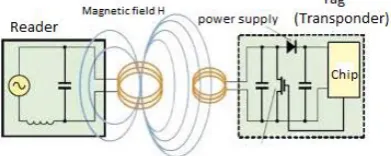
NFC standards define two categories of operation for data exchange: passive and active. In passive communication, only one device (the initiator) actively generates a radio frequency field, to which the other object (the target) responds by modulating
the initiator‟s field. A passive target does not require a power source in order to transfer data to the initiator; it is essentially “field energized,” powered by energy from the magnetic field generated by the initiator. Passive NFC communication is very similar to previous RFID standards, in which a reader initiates communication with a passive RFID tag. In
active communication, the target responds to the initiator by generating its own radio frequency field. The two devices can then interact in a two-way, peer-to-peer data exchange. While the device that begins the communication is still considered the initiator, both devices must be able to serve as either initiator or target.
2. LITERATURE OVERVIEW
2.1 Traditional Way for Operating the Books in Libraries:
In this system, User gets a library card by which books are issued or returned. Library has to maintain all user records manually in a computer system. Librarian manually inserts the data in the computer system. When a user borrows books, the information of borrower and borrowed book has to be updated in the computer by librarian. This process may take time as the data has to be entered all the time manually.
Disadvantages of this system are: 1. Queuing
2. Manually insertion of data 3. Time consuming
2.2 Using Barcodes for Library Management:
workload of the librarian, there are some disadvantages as follows:
1. Easy to copy the barcode.
2. Also easy to remove from object (book).
2.3 QR (Quick Response) code use in libraries:
These two-dimensional codes are similar to bar codes, but are much more versatile. When scanned with the camera on a mobile device (i.e. smart phone, iPod, or tablet), these codes provides the ability to capture much more than numeric information. Most commonly used on smart phones, the captured text can refer the user to a web page, initiate a phone call, begin an e-mail, or save other textual information to the device. QR (Quick Response) code use in libraries is just beginning to evolve.
2.4 NFC in Library:
NFC is designed to build on RFID by enabling more complex exchanges between participants .You can still read passive RFID tags with an NFC reader, and you can write to their limited amount of memory. NFC also allows you to write data to certain types of RFID tags using a standard format, independent of tag type. You can also communicate with other NFC devices in a two-way, or duplex, exchange. NFC devices can exchange information about each other‟s capabilities, swap records, and initiate longer term communications through other means. Now imagine another neighbor passes close, and when you see her, you invite her onto the porch for a chat. She accepts your invitation, and you sit together, exchange pleasantries about your lives, and develop more of a relationship. You talk with each other and you listen to each other for a few minutes. That‟s NFC. For example, you might tap your NFC-enabled phone to an NFC-enabled stereo so that they can identify each other, learn that they both have WiFi capability, and exchange credentials for communication over WiFi. After that, the phone will start to stream audio over WiFi to the stereo. Why doesn‟t the phone stream its audio over the NFC connection? Two reasons: first, the NFC connection is intentionally short range, generally 10cm or less. That allows it to be
low-power, and to avoid interference with other radios built into devices using it. Second, it‟s relatively low-speed compared to WiFi, Bluetooth, and other communications protocols. NFC is not designed to manage extended high-speed communications. It‟s for short messages, exchanging credentials, and initiating relationships. Think back to the front porch for a moment. NFC is the exchange you have to open the conversation. If you want to talk at length, you invite your neighbor inside for tea. That‟s WiFi, Bluetooth, and other extended communications protocols .What‟s exciting about NFC is that it allows for some sophisticated introductions and short instructions without the hassle of exchanging passwords, pairing, and all the other more complicated steps that come with those other protocols.
3. WORKING
3.1 How RFID Operates
to keep track of how much value is left on the card. However, since RFID systems generally are networked to a database, it‟s more common to store a data record indexed by the tag‟s UID in a remote database, and store all information about the tag in that remote database.
3.2 How NFC Operates:
As NFC is an extension of RFID, NFC exchanges also involve an initiator and a target like RFID. However, it can do more than just exchange UIDs and read or write data to the target. The most interesting difference between RFID and NFC is that NFC targets are often programmable devices, like mobile phones. This means that rather than just delivering static data from memory, an NFC target could actually generate unique content for each exchange and deliver it back to the initiator. For example, if you‟re using NFC to exchange address data between two phones, the NFC target device could be programmed to only provide limited information if it‟s never seen this particular initiator before. NFC devices have two communications modes. If the initiator always supplies the RF energy and the target gets powered by the initiator‟s field, they‟re said to be engaging in passive communication mode. If both target and initiator have their own energy sources, they‟re in active communication mode. These modes are the same as regular RFID communication modes. NFC devices have three
operating modes. They can be reader/writers that read data from a target and write to it. They can be
card emulators, acting like RFID tags when they‟re
in the field of another NFC or RFID device. Or they can operate in peer-to-peer mode.
Fig 2: Establishing connection for data exchange
NFC reader is provided with power supply, actively generates a radio frequency field, to which the passive NFC tag will respond by modulating the initiator‟s field. A passive target does not require a power source in order to transfer data to the initiator. When reader will discover any NFC enabled device within range, they can exchange information. All
NFC transmissions are half-duplex, the
communication is entirely local, with no external network or Internet access required. The rate of data exchange can be 106, 212, or 424 kbps; 848 kbps is available in some NFC-enabled devices as per type.
4. NFC COMMUNICATION PROCESS
Typical communication procedure between the initiator and target is illustrated as follows
Handshake:
1. The interrogator sends a command to start communication with transponder in the interrogator field and also to power it (passive transponders).
2. Once the tag has received sufficient energy and command from the reader, it reply‟s with its ID for acknowledgment.
3. The reader now knows which tag is in the field and sends a command to the identified tag for instructions either for processing (read or write) or Sleep.
Data exchange:
1. If the tag receives processing and reading commands, it transmits a specified block data and waits for the next command.
2. If the tag receives processing and writing commands along with block data, it writes the block data into the specified memory block, and transmits the written block data for verification.
5. CONCLUSION
specifically when more than one tag is used in a single physical object. Operators could scan tags without the need for network connections and explore the offered services at no additional cost. This would eliminate negative effects of network connections like costs and delay in time.
6. REFERENCES
[1] A. Lotito, D. Mazzocchi, Istituto Superiore Mario Boella, Italy, “OPEN-NPP: An open source library to enable P2P over NFC”, 2012 IEEE, 4th international workshop on NFC.
[2] Tatsumi Nagasawa, Barukula Ramesh, “Tap to Display, wireless display connecting on mobile devices Triggered by NFC tags”,2014 IEEE 3rd
Global conference on consumer Electronics.
[3] Michael Roland and Josef Langer, “Digital signature record for the NFC Data Exchange Format”, 2010 IEEE, Second International Workshop on Near Field Communication.
[4] Gianluca Ritrovati, Giuseppe De
Maso-Gentile, Cristiano Scavongelli, Massimo conti, “Active Role at a NFC Enabled Smart Phone in EV-EVSE charging process”, 2014 IEEE.
[5] Abhishek Gune, Anirudha Bhat, Abhijith
Pradeep, “Implementation of Near Field
Communication Based Healthcare Management System”, 2013 IEEE symposium on industrial electronics & applications(ISIEA, 2013), Malaysia.
[6] David Pons, Raquel valles, Marta Abarka, Francisco Rubio, “QR Codes in use: the Experience at the UPV library”, Serials 24(3) supplement, November 2011.
[7] Taiki Onishi, Toshihiro Hori, Yuuki Ota, Tomotaka Wada, Kouichi Mutsuura, Hiromi Okada,
“Performance Evaluation by Implementation
Experiments of Position Estimation of RFID Tags, ”Proceeding of the 2007 IEEE General Conference, B-7-182, March 2007.
[8] Ecma International, “Near Field