Aggregate Signcryption
Alexander W. Dent
Qualcomm Research
Abstract. Signcryption schemes provide an efficient messaging system for data that needs to be sent with data confidentiality, data integrity and data origin authentication. However, the bandwidth overhead for the use of signcryption in a network in which a large number of messages need to be sent may be high. Motivated by aggregate signature schemes, we propose the concept of an aggregate signcryption scheme. An aggregate signcryption scheme allows distinct signcryption ciphertexts intended for the same recipient to be merged into a single signcryption ciphertext of smaller sizewithout losing any of their security guarantees. This has the potential to provide significant bandwidth savings. We propose security models for this scheme, analyse the trivial generic constructions, propose an efficient new scheme, and analyse the bandwidth requirements of these schemes for a practical distributed database application.
1
Introduction
One of the most fundamental challenges for secure communication is end-to-end security for mes-sage transmission. This problem has been solved in many contexts using different technologies. In this paper we concentrate on the use of public-key cryptography to give data confidentiality, data integrity and origin authentication for message transmission. The original version of the problem was solved with the invention of public-key encryption and digital signature schemes [15]. Efficient combinations of public-key encryption and digital signatures are known as signcryption schemes [30] and can provide computationally efficient secure message transmissions.
This paper explores the concept of aggregate signcryption – a topic first introduced in the identity-based setting [28] and later explored in the certificateless setting [24]. This discussion will focus on the traditional public-key setting. Aggregate signcryption schemes take the conceptual ideas of aggregate signature schemes and apply them to signcryption schemes. An aggregate sign-cryption scheme allows individual signsign-cryption ciphertexts intended for the same recipient to be aggregated into a single (shorter) combined ciphertext without losing any of the security guaran-tees that would be present if the original signcryption ciphertexts were transmitted individually.
In other words, the aggregate ciphertext still provides a mechanism for message transmission with data confidentiality, data integrity and origin authentication, but with significantly reduced overhead. We stress that the aggregation algorithm is entirely public – it can be performed by any entity given a number of signcryption ciphertexts and the corresponding public keys.
This allows for signcryption ciphertexts intended for a single receiver to be combined within the network. If a network node receives two signcryption ciphertext which need to be routed to the same receiver, then the node can run the aggregation algorithm and forward the aggregate signcryption ciphertext at a reduced bandwidth cost.
Lastly, in Section 6, we analyse an example of the aggregate signcryption scheme in practice. We consider implementing the direct construction of Section 5 in the Gaian database system [6]. The Gaian database is a dynamic, distributed, federated database system in which data is held in nodes in an evolving database “graph”. The database is federated in the sense that a node which wishes to process a query on data that is not held locally will flood the database graph with queries for that data and collate the responses. The database is designed for use in scenarios which include military applications and so there is a strong requirement for secure message transmission in mobile networks with limited bandwidth. This makes aggregate signcryption an excellent candidate for securing intra-node communication in the Gaian database (particularly for the query response messages which every node has to produce and which are all sent to a single recipient). Our results show that the new scheme provides significant bandwidth savings compared to existing solutions (more than 13% when compared to the best existing comparable solution).
2
Preliminaries
2.1 Notation
Let←denote assignment and←$ denote random assignment. Thus, ifS a finite set, theny ←$ S denotes the assignment to y of a uniform random element of S. We assume that any vector x
is an ordered set of elements (x(1), . . . , x(n)) for some n. If A is a deterministic algorithm than y← A(x) denotes the output ofAgiven inputx. IfAis a probabilistic algorithm theny← A$ (x) denotes the output ofA given inputxand fresh random coins. Some algorithms may output an “invalid” symbol⊥. If we want to assess whether the outputA(x) has some property, then we will assume that⊥never has that property unless explicitly stated.
2.2 Aggregate Signatures
Aggregate signcryption schemes can be considered to be motivated by aggregate signature schemes; hence, it is useful to consider the purpose and security of aggregate signature schemes. An aggregate signature scheme [11] is a tuple of PPT algorithms (Gen,Sign,Aggregate,Ver).
– The key-generation algorithm generates a public/private key pair (pk,sk)←$ Gen(1k).
– The signing algorithm takes as input a message m and the private key sk, and outputs a signatureσ←$ Sign(sk, m).
– The aggregation algorithm Aggregate takes as input a vector of public keys pk, a vec-tor of messages m and a vector of signatures σ, and outputs an aggregate signature σ ← Aggregate(pk,m,σ).
– The verification algorithmVertakes as input a vector of public keyspk, a vector of messages
m and an aggregate signatureσ, and outputs either the valid symbol>or an invalid symbol ⊥.
We require that if σ(i) $
← Sign(sk(i), m(i)) for 1 ≤ i ≤ n and σ $
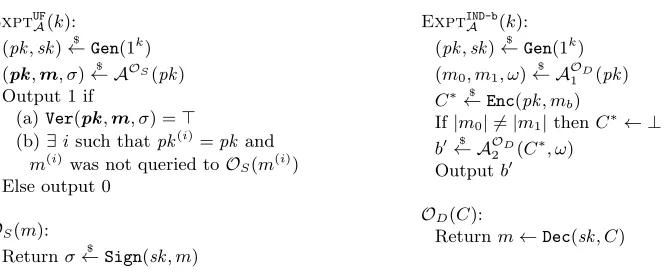
← Aggregate(pk,σ), then Ver(pk,m, σ) =>. We also assume that ifσ←$ Sign(sk, m) thenAggregate(pk, σ) =σ and so the verification algorithm works correctly on individual signatures as well as aggregate signatures. The security notion for an aggregate signature scheme was given by Bonehet al. [11] and in-volves the game shown in Figure 1. An attackerAhas advantage Pr[ExptUF
A(k) = 1]. An aggregate
signature scheme is UF-CMA secure if every PPT attackerAhas negligible advantage.
ExptUFA(k):
(pk,sk)←$ Gen(1k) (pk,m, σ)← A$ OS(pk)
Output 1 if
(a)Ver(pk,m, σ) =>
(b)∃isuch thatpk(i)=pk and m(i)was not queried toOS(m(i)) Else output 0
OS(m):
Returnσ←$ Sign(sk, m)
ExptIND-bA (k):
(pk,sk)←$ Gen(1k) (m0, m1, ω)
$
← AOD
1 (pk)
C∗←$ Enc(pk, mb)
If|m0| 6=|m1|thenC∗← ⊥
b0← A$ OD
2 (C
∗
, ω) Outputb0 OD(C):
Returnm←Dec(sk, C)
Fig. 1.The UF-CMA security model for aggregate signatures (LHS) and the IND-CCA2 security model for public-key encryption (RHS). In the IND-CCA2 model,A2 is not allowed to submit aOD(C∗) query.
2.3 Public-Key Encryption
Since signcryption is often compared to public-key encryption, it is also useful to introduce that notion here too. A public-key encryption scheme is a triple of PPT algorithms (Gen,Enc,Dec).
– The key-generation algorithm generates a public/private key pair (pk,sk) ←$ Gen(1k). The public key defines a (polynomial-time recognisable) message spaceMand a (polynomial-time recognisable) ciphertext spaceC.
– The encryption algorithm takes a public keypk and a messagem∈ Mas input, and outputs a ciphertext C←$ Enc(pk, m).
– The decryption algorithm takes a private keysk and a ciphertextC∈ C, and outputs a either a messagem←Dec(sk, C) or an invalid symbol⊥.
We require that ifC←$ Enc(pk, m) thenDec(sk, C) =m.
The security model for public-key encryption was given in a series of papers [18, 25, 26]. It is defined by the game shown in Figure 1. An attackerA= (A1,A2) has advantage
AdvIND
A (k) =|Pr[ExptIND-1A (k) = 1]−Pr[ExptIND-0A (k) = 1]|.
An encryption scheme is IND-CCA2 secure if every PPT attacker A has negligible advantage (whereA2may not make aOD(C∗) query). We may also define a weaker notion of security known
as IND-RCCA security [13]. It is identical to the IND-CCA2 except ifA2submits anOD(C) query
withDec(sk, C)∈ {m0, m1} then the decryption oracle returnstest. This notion of security has
been shown to be sufficient in situations where an attacker’s ability to replay messages is not considered a breach of security.
2.4 Symmetric Encryption
A symmetric encryption is a pair of deterministic polynomial-time algorithms (Enc,Dec). The encryption algorithm takes as input a keyK of lengthkand a messagem∈ {0,1}∗, and outputs
a ciphertextC←EncK(m). The decryption algorithm takes as input a keyK of lengthkand a
ciphertextC ∈ {0,1}∗, and outputs either a messagem←
DecK(C) or the error symbol⊥. We
require that for allK∈ {0,1}k andm∈ {0,1}∗, we have thatDec
K(EncK(m)) =m.
Exptsym-bA (k):
K← {$ 0,1}k
(m0, m1, ω) $
← A1(1k)
C∗←$ EncK(mb)
If|m0| 6=|m1|thenC∗← ⊥
b0 ← A$ 2(C∗, ω)
Outputb0 An attackerA= (A1,A2) has advantage
AdvsymA (k) =|Pr[Exptsym-1A (k) = 1]−Pr[Expt
sym-0
A (k) = 0]|
and the symmetric encryption scheme is said to be IND-CPA secure if every PPT attackerAhas negligible advantage.
2.5 Commitment Schemes
A commitment scheme is a triple of PPT algorithms (Setup,Commit,Open): – The setup algorithm outputs public parametersparam←$ Setup(1k).
– The commit algorithm takes as input the public parameters param and a message m, and outputs a commitment/decommitment pair (c, d)←$ Commit(param, m).
– The open algorithm takes as input the public parameters param, the commitmentc, and the decommitmentd; it outputs a messagem←Open(param, c, d).
We require that if (c, d)←$ Commit(param, m) thenm←Open(param, c, d).
We require two security properties from a commitment scheme [2]: hiding and relaxed binding. For the hiding game, we consider an attackerA= (A1,A2) in the game in the LHS of Figure .The
attacker’s advantage is defined to be
AdvhideA (k) =|Pr[Expthid-1A (k) = 1]−Pr[Expthid-0A (k) = 1]|
and a scheme is said to be hiding if every PPT attacker has negligible advantage.
Expthid-bA (k):
param←$ Setup(1k) (m0, m1, ω)
$
← A1(param)
(c, d)←$ Commit(param, mb) If|m0| 6=|m1|thenc← ⊥
b0← A$ 2(c, ω)
Outputb0
ExptbindA (k):
param←$ Setup(1k) (m, ω)← A$ 1(param)
(c, d)←$ Commit(param, m) d0← A$ 2(c, d, ω)
m0←Open(param, c, d0) Output 1 ifm06=m Else output 0
Fig. 2.The security models for hiding (LHS) and binding (RHS) for commitment schemes.
For the relaxed binding game, we consider an attackerA= (A1,A2) playing the game on the
RHS of Figure 2. The attacker’s advantage is defined to be Pr[Exptbind
A = 1] and a scheme is said
to be relaxed binding if every PPT attacker has negligible advantage.
3
Aggregate Signcryption
An aggregate signcryption scheme is designed to have the same security properties as a signcryp-tion scheme (i.e. confidentiality and integrity protecsigncryp-tion) but it allows for multiple signcrypsigncryp-tion ciphertexts to be combined into a single signcryption ciphertext which communicates the same information and has the same security properties, but consumes less bandwidth. Our security no-tions combine those of signcryption [2, 3] with those of aggregate signatures [7, 11]. For technical reasons, we will assume that the set of valid public keys is recognisable1 and every valid public key has exactly one corresponding private key.
Our security models are very similar to those of [28] except with the obvious changes made for the models to be applied in the public-key setting. One interesting pair of differences is that the confidentiality model of Sharmilla et al.insists that the challenge ciphertext is an aggregate and only forbids the attacker from submitting the challenge ciphertext to the decryption oracle; thus implicitly prevent the scheme from allowing aggregating two aggregate ciphertexts. Technically speaking, their model does not appear to guarantee the security of non-aggregate ciphertexts.
3.1 Syntax
In an aggregate signcryption scheme, we consider a situation where many senders wish to send a number of different messages to a single recipient. An aggregate signcryption scheme is a tuple of PPT algorithms (Setup,GenS,GenR,Signcrypt,Aggregate,Unsigncrypt):
– The setup algorithm outputs a set of public parametersparam ←$ Setup(1k). We will assume
that this is an implicit input to all other algorithms.
– The sender key generation algorithm outputs a sender key-pair (pkS,skS) $
←GenS(param).
– The receiver key generation algorithm outputs a receiver key-pair (pkR,skR) $
←GenR(param).
– The signcryption algorithm takes a sender private key, a receiver public key, and a message m, and outputs a ciphertextC←$ Signcrypt(skS,pkR, m).
– The aggregation algorithm takes a vector of sender public keyspkS, a receiver public keypkR
and a vector of ciphertexts C, and outputs a single ciphertextC←$ Aggregate(pkS,pkR,C) or the invalid symbol ⊥.
– The unsigncryption algorithm takes a vector of sender public keyspkS, a receiver private key
skR and a ciphertext C, and either a vector of messages m←Unsigncrypt(pkS,skR, C) or
the invalid symbol⊥.
We require that ifC(i)←$ Signcrypt(sk(i)S ,pkR, m(i)) for 1≤i≤nandC $
←Aggregate(pkS,pkR,C),
thenm←Unsigncrypt(pkS,pkR, C). We also assume that ifC←$ Signcrypt(skS,pkR, m) then
Aggregate(pkS,pkR, C) =C. We stress that the aggregation algorithm only uses public informa-tion to aggregate the signcrypinforma-tion ciphertexts.
3.2 Confidentiality
We will adapt the security definitions of confidentiality for a signcryption scheme [2, 3] to the aggregate signcryption setting. We wish to forbid the attacker from submitting the ciphertextC∗ to the decryption oracleor any ciphertext can be obtained through aggregation withC∗. To do this, we incorporate the ideas of [7, 16], and define the span of a ciphertextC sent fromS toRto be
hpk∗S,pk
∗
R, C∗i={(pkS,pk
∗
R,Aggregate(pkS,pk
∗
R,C)) : ∃iwithpk (i) S =pk
∗
S andC(i)=C∗}.
LetSPK(k) ={(pkS,skS)}be the set of all key pairs that could be output byGenS(1k). We define
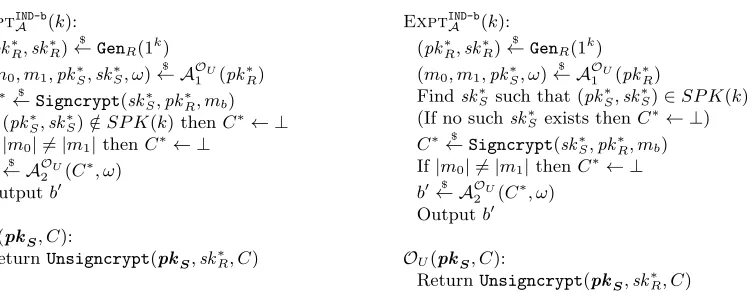
several security models for (insider) confidentiality. These are both defined in Figure 3.
1 I.e. there exists a polynomial-time algorithm which can, given a bitstringθ∈ {0,1}∗
ExptIND-bA (k):
(pk∗R,sk
∗
R)
$
←GenR(1k) (m0, m1,pk∗S,sk
∗
S, ω)
$
← AOU
1 (pk
∗
R) C∗←$ Signcrypt(sk∗S,pk
∗
R, mb) If (pk∗S,sk
∗
S)∈/SP K(k) thenC∗← ⊥ If|m0| 6=|m1|thenC∗← ⊥
b0← A$ OU
2 (C
∗
, ω) Outputb0 OU(pkS, C):
ReturnUnsigncrypt(pkS,sk ∗
R, C)
ExptIND-bA (k):
(pk∗R,sk
∗
R)
$
←GenR(1k) (m0, m1,pk∗S, ω)
$
← AOU
1 (pk
∗
R) Findsk∗S such that (pk
∗
S,sk
∗
S)∈SP K(k) (If no suchsk∗S exists thenC
∗
← ⊥) C∗←$ Signcrypt(sk∗S,pk
∗
R, mb) If|m0| 6=|m1|thenC∗← ⊥
b0← A$ OU
2 (C
∗
, ω) Outputb0 OU(pkS, C):
ReturnUnsigncrypt(pkS,sk ∗
R, C)
Fig. 3.The IND-CCA2 security model for confidentiality (LHS) and the SKI-IND-CCA2 security model for confidentiality (RHS). In both cases, A2 is forbidden from submitting a OU query (pkS, C) where
(pkS,pk ∗
R, C)∈ hpk
∗
S,pk
∗
R, C
∗i.
The difference between the IND-CCA2 security game and the secret-key ignorant SKI-IND-CCA2 game is whether the attacker is required to output a complete sender key-pair, rather than just the sender public key. The IND-CCA2 game models situations in which the process of registering a public key requires the sender to prove knowledge of the private key; the SKI-IND-CCA2 game models situations in which a sender can register any public key [14]. An attacker’s advantage is defined to be
AdvINDA (k) =|Pr[ExptIND-1A (k) = 1]−Pr[ExptIND-0A (k) = 1]|
and a signcryption scheme is said to be (SKI-)IND-CCA2 secure if every PPT attacker has negli-gible advantage. Outsider security models can be developed in a similar way.
We may define weaker notions of confidentiality for signcryption schemes similar to the IND-RCCA security notion for public-key encryption [13]. These (SKI-)IND-IND-RCCA notions are defined as above except that theOU oracle returnstestwheneverA2submits a query (pkS, C) for which
there exists i with pk(i)S =pk∗S and m(i) ∈ {m
0, m1} for m ←Unsigncrypt(pkS,sk
∗
R, C). This
models situations in which the ability to replay a message is not considered a threat to security.
3.3 Integrity
Integrity for aggregate signcryption can be extended from the notions of integrity protection for aggregate signatures. LetRPK(k) ={(pkR,skR)} be the set of all key pairs that could be output
byGenR(1k). We define two security models for integrity in Figure 4. In both cases, the advantage
of an attackerAis given by Pr[ExptUFA(k) = 1] and a scheme is said to be (SKI-)UF-CMA secure if every PPT attackerAhas negligible advantage.
We note that there are some dangers about using a scheme proven secure in the UF-CMA security model: it may still have the property that an attacker can produce a ciphertext which is a forgery from some senderS to some receiverR(but cannot computeR’s private decryption key). The existence of such a ciphertext appears to imply thatSsent some message toR, although the exact nature of the message is unknown, which may be damaging toR’s reputation.
It is possible to describe a “strong” unforgeability model for aggregate signcryption by insisting that the attacker forge an output (pkS,pk∗R, C∗) where (pkS,pk∗R, C∗)∈ h/ (pk∗S,pk∗R, C)ifor every response C returned by anOU(pk∗R, m) query. It is unclear as to whether this definition has a
practical application and so we will not pursue it further in this work.
3.4 Denial of Decryption
ci-ExptUFA(k):
(pk∗S,sk
∗
S)
$
←GenS(1k) (pkS,pk∗R,sk∗R, C
∗
)← A$ OS(pk∗
S) If (pk∗R,sk
∗
R)∈/RPK(k) then output 0 m←Unsigncrypt(pkS,sk∗R, C
∗
) Ifm=⊥then output 0
If∃isuch thatpk(Si)=pk∗S and (pk∗R, m(i))
was not queried toOSthen output 1 Else output 0
OS(pkR, m):
ReturnSigncrypt(sk∗S,pkR, m)
ExptUFA(k):
(pk∗S,sk
∗
S)
$
←GenS(1k) (pkS,pk∗R, C∗)← A$ OS(pk∗
S) Findsk∗R such that (pk
∗
R,sk
∗
R)∈RPK(k) (If no suchsk∗R exists then output 0) m←Unsigncrypt(pkS,sk
∗
R, C
∗
) Ifm=⊥then output 0
If∃isuch thatpk(Si)=pk∗Sand (pk
∗
R, m
(i)
) was not queried toOS then output 1 Else output 0
OS(pkR, m):
ReturnSigncrypt(sk∗S,pkR, m)
Fig. 4. The UF-CMA security model for aggregate signcryption (LHS) and the SKI-UF-CMA security model for aggregate signcryption (RHS).
phertexts which are intended for different receivers or which are invalid. An attacker may inject a false ciphertext into a batch of legitimate ciphertexts and cause the aggregation algorithm to output an invalid aggregate ciphertext. This will prevent the receiver from receiving legitimate messages. We term this adenial of decryption (DoD) attack after the similar effect that can occur in certificateless cryptosystems [23]. To prevent DoD attacks, we may insist that the aggregation algorithm refuse to aggregate invalid signcryption ciphertexts. Note that this attack can easily be prevented in aggregate signature schemes by insisting that the aggregation algorithm check that validity of all the individual signatures before computing the aggregate signature; however, most signcryption schemes do not allow a third-party to check the validity of a signcryption ciphertext2.
In defining DoD security, we note that the aim of the attack is to prevent a legitimate receiver from unsigncrypting an aggregate of signcryption ciphertexts. Hence, it is reasonable to assume that the receiver is an uncorrupted entity; however, it is possible that the attacker is a legitimate sender who wishes to interfere with the communication between other senders and the (honest) receiver by injecting malicious ciphertexts into the aggregation process. Thus, we obtain the se-curity model in Figure 5. An attacker A has advantage Pr[ExptDoDA (k) = 1] and an aggregate signcryption scheme is DoD-secure if every PPT attacker has negligible advantage.
ExptDoDA (k):
(pk∗R,sk∗R)
$
←GenR(1k) (pkS,C)
$
← AOU(pk∗
R) Fori= 1, . . . , n:
m(i)←Unsigncrypt(pk(Si),sk∗R, C
(i)
) ˆ
C←$ Aggregate(pkS,pkR,C) If ˆC=⊥then output 0
ˆ
m←Unsigncrypt(pkS,sk ∗
R,C)ˆ Ifm=mˆ then output 0 Else output 1
OU(pkS, C):
ReturnUnsigncrypt(pkS,sk ∗
R, C)
Fig. 5.The denial of decryption security model for aggregate signcryption.
Essentially, DoD-security states that if the aggregation algorithm does not output⊥then each signcryption ciphertext is valid and that the unsigncryption of the aggregate ciphertext is the same as the unsigncryption of the individual ciphertexts. One “simple” way to convert an aggregate
2
signcryption scheme without DoD-security into a scheme with DoD-security is to append a NIZK proof that the signcryption operation has been performed correctly using the public keypk∗Rto the ciphertext. This can always be achieved as NIZK proofs exist for all NP languages [17]; however, in practice, these NIZK schemes are unusable and so it remains a challenge to construct practical aggregate signcryption schemes with DoD security.
4
Generic Constructions
Of the four methods to generically combine public-key encryption and digital signatures, only two are candidates for constructing secure aggregate signcryption schemes: encrypt-then-sign (EtS) and commit-then-encrypt-and-sign (CtE&S)3. These constructions were first analysed for non-aggregate signcryption schemes in the work of An, Dodis and Rabin [2]. In this section, we present theEtS scheme. TheCtE&S construction is discussed in Appendix A.
If (SigGen,Sign,SigAgg,Ver) is an aggregate signature scheme and (EncGen,Enc,Dec) is a public key encryption scheme, then we may construct an EtS aggregate signcryption scheme is given in Figure 6. This scheme does not make use of aSetupalgorithm. Throughout this section, we will assume that an entityX has a unique identityIDX and that there exists a mechanism to
link the public key ofX to their identityIDX. This mechanism can be provided by a certificate
authority or may be implicit (e.g. ifIDX=pkX).
GenS(1k): (pkS,skS)
$
←SigGen(1k) Output (pkS,skS)
GenR(1k): (pkR,skR)
$
←EncGen(1k) Output (pkR,skR)
Signcrypt(skS,pkR, m): m0←(IDS, m) χ←$ Enc(pkR, m0) m00←(IDR, χ) σ←$ Sign(skS, m00) OutputC←(χ, σ)
Aggregate(pkR,C):
ParseCas ((χ(1), σ(1)), . . . ,(χ(n), σ(n))) σ←$ SigAgg(pkS,σ)
Output (χ, σ)
Unsigncrypt(pkS,skR, C): ParseCas (χ, σ)
m00←((IDR, χ(1)), . . . ,(IDR, χ(n))) IfVer(pkS,m
00
, σ) =⊥then output⊥ For 1≤i≤n:
m0(i)←Dec(skR, χ(i)) Parsem0(i)as (ID(i)
S , m
(i))
Ifpk(Si) is not the public key ofID(Si) then output⊥ Outputm
Fig. 6.The Encrypt-then-Sign Construction
Theorem 1. The following results hold:
1. If A is a PPT attacker against the insider SKI-UF-CMA unforgeability of the signcryption
scheme, then there exists a PPT attackerBagainst the UF-CMA unforgeability of the signature scheme such that AdvUFA(k)≤AdvUFB(k).
2. If A is a PPT attacker against the IND-RCCA security of the signcryption scheme and the
set SKP(k) is polynomial-time recognisable, then there exists a PPT attacker B against the IND-RCCA security of the encryption scheme such that AdvRCCAA (k)≤AdvRCCAB (k).
Surprisingly, despite the publicly verifiable signature, the construction does not provide any defence against denial of decryption attacks. Even if the aggregation algorithm checks the validity of the signature in each of the ciphertexts C(i), it will not necessarily be able to detect whether
3 Of the remaining two constructions, encrypt-and-sign (E&S) is insecure and sign-then-encrypt (StE) is
each public-key ciphertext χ(i) is valid or whether the decryption contains the correct identity ID(i)S . The construction does have the advantage that if the aggregation algorithm does check the individual signatures, then the unsigncryption algorithm will only fail to unsigncrypt the messages associated with invalid encryption ciphertexts. The receiver can still recover legitimate messages. Thus, the attacker cannot deny the receiver information, but can artificially inflate the size of aggregated ciphertext.
5
Direct Construction
One method for constructing a secure encryption scheme is to apply the CHK construction to an identity-based encryption scheme [9, 20]. To fully encrypt a message, a signature key-pair (pk,sk) is created for each ciphertext, the message is encrypted using the identity-based encryption scheme with the signature public keypkas the identity. A signcryption scheme can be produced using an EtS construction if the resulting encryption ciphertext is signed. It is clear that the bandwidth of theEtS construction can be reduced if an aggregate signature scheme is used in both the CHK construction and as the signature scheme. Furthermore, if the signature scheme allows for the aggregation of aggregate signatures, then the result is an aggregate signcryption scheme.
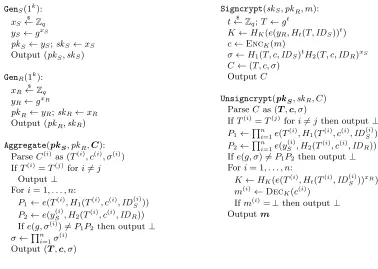
We aim to improve efficiency by applying this methodology to the Boneh-Franklin identity-based encryption scheme [10] and the BGLS aggregate signature scheme [11]. We are able to improve efficiency by re-using an element generated as part of the identity-based encryption scheme as the ephemeral signature public key in the CHK construction. The resulting scheme makes use of a group Ggenerated by an element g and a non-degenerate, bilinear map e :G2 →
GT. The
scheme is given in Figure 7. The proof relies on the random oracle methodology.
GenS(1k): xS
$
←Zq yS←gxS
pkS←yS;skS←xS Output (pkS,skS)
GenR(1k): xR
$
←Zq yR←gxR
pkR←yR;skR←xR Output (pkR,skR)
Aggregate(pkS,pkR,C): ParseC(i) as (T(i), c(i), σ(i)) IfT(i)=T(j) fori6=j
Output⊥ Fori= 1, . . . , n:
P1←e(T(i), H1(T(i), c(i),ID(Si))) P2←e(y
(i)
S , H2(T(i), c(i),IDR)) Ife(g, σ(i))6=P
1P2 then output⊥
σ←Qn i=1σ
(i)
Output (T,c, σ)
Signcrypt(skS,pkR, m): t←$ Zq;T ←gt
K←HK(e(yR, Ht(T,IDS))t) c←EncK(m)
σ←H1(T, c,IDS)tH2(T, c,IDR)xS C←(T, c, σ)
OutputC
Unsigncrypt(pkS,skR, C) ParseCas (T,c, σ)
IfT(i)=T(j) fori6=jthen output⊥
P1←Qni=1e(T(i), H1(T(i), c(i),ID(Si)))
P2←Qni=1e(yS(i), H2(T(i), c(i),IDR)) Ife(g, σ)6=P1P2 then output⊥
Fori= 1, . . . , n:
K←HK(e(T(i), Ht(T(i),ID(Si)))xR) m(i)←DecK(c(i))
Ifm(i)=⊥then output⊥
Outputm
Fig. 7.The Direct Construction
advantages are negligible for every PPT attackerA:
AdvCDH
A (k) = Pr
h
A(ga, gb) =gab : a, b $
←Zq i
AdvBDHA (k) = PrhA(ga, gb, gc) =e(g, g)abc : a, b, c $
←Zq i
This construction is DoD secure (under reasonable assumptions about the action of the IND-CPA symmetric encryption scheme). The only way that a ciphertext would fail to decrypt is if σdoes not satisfy the appropriate algebraic relation; however, this is publicly checkable and will be checked by the aggregation algorithm. Therefore, the aggregation algorithm will refuse to form aggregated ciphertexts which do not decrypt successfully. The scheme has the added advantage that the aggregation algorithm can easily detect ciphertexts which will not aggregate correctly – these are the invalid ciphertext (which can be publicly checked) and the ciphertexts which share a common value of T. In the latter case, the entity performing aggregation can solve the problem simply by forming multiple aggregate ciphertexts (ensuring that all aggregate ciphertexts are constructed from ciphertext with differentT values).
Theorem 2. Suppose the symmetric encryption scheme (Enc,Dec) has the property that for all
K∈ {0,1}k andC∈ {0,1}∗, we have thatDec
K(C)6=⊥. Then the aggregate signcryption scheme has perfect DoD security. In other words, for any (unbounded) attackerAagainst the DoD security of the aggregate signcryption scheme, we have that Pr[ExptDoDA = 1] = 0.
Proof: Let (pkS,C) be such that ˆC←Aggregate(pkS,pkR∗,C) satisfies ˆC6=⊥. Since ˆC6=⊥we must have that everyC(i)is computed using a different value ofT(i) and that
e(g, σ(i)) =e(T(i), H1(T(i), c(i),ID (i) S ))·e(y
(i)
S , H2(T(i), c(i),IDR)).
Thus, if we parse ˆC as (T,c,ˆσ), we have that
e(g,σˆ) =
n Y
i=1
e(T(i), H1(T(i), c(i),ID (i) S ))·e(y
(i)
S , H2(T(i), c(i),IDR)).
Consider the message vectorsUnsigncrypt(pkS,sk∗R,Cˆ) andUnsigncrypt(pkS,sk∗R,C) (where the latter message vector is computed component-wise). In neither case will the unsigncryption algorithm output ⊥. However, an inspection of the unsigncryption algorithm will show that all later operations depends only onT,c,pkS and sk∗R. These values are identical in (pkS,C) and (pkS,Cˆ); hence, Unsigncrypt(pkS,sk∗R,Cˆ) =Unsigncrypt(pkS,sk∗R,C) and so there exist no (pkS,C) which could cause the attacker to win the DoD game. ut
The confidentiality/integrity security proof is more familiar.
Theorem 3. Let A be an attacker which makes at most qX queries to the hash oracle HX (for
X ∈ {1,2, t, K}),qS queries to a signcryption oracle, andqU queries to the unsigncryption oracle. SupposeG has prime order q. In the SKI-IND-CCA2 confidentiality model, there exists an
algo-rithm B to solve the CDH problem, an algorithm B0 to solve the BDH problem, and an attacker
B00 against the IND-CPA security of the symmetric encryption scheme such that
AdvINDA (k)≤2AdvCDHB (k) + 2(qK+qU)AdvBDHB0 (k) +AdvsymB00(k) +
2(q1+q2+qt+qU)
q .
In the SKI-UF-CMA unforgeability model, there exists an algorithm Bto solve the CDH problem
such that
AdvUFA(k)≤q2AdvCDHB (k) +
qS(qS+q2) + 1
q .
Lemma 1. SupposeC∗ = (T∗, c∗, σ∗) is a ciphertext computed using sender key pair (pk∗
S,sk
∗
S) and receiver key pair (pk∗R,sk∗R). If (pkS,pkR∗, C) satisfies Unsigncrypt(pkS,sk∗R, C) 6=⊥ and there existsj such that(pk(j)S , T(j), c(j)) = (pk∗
S, T∗, c∗), then(pkS,pk
∗
R, C)∈ hpk
∗
S,pk
∗
R, C∗i.
Proof: Since Unsigncrypt(pkS,pk∗R, C)6=⊥, we must have
e(g, σ) =
n Y
i=1
e(g, σ(i))
where
e(g, σ(i)) =e(T(i), H1(T(i), c(i),ID (i)
S )) · e(pk (i)
S , H2(T(i), c(i),ID∗R)).
So if we defineC(i) = (T(i), c(i), σ(i)) then C = Aggregate(pkS,pk∗R,C). However, since e is a bilinear map between prime order groups, there exists a unique valueσ(j) such that
e(g, σ(j)) =e(T∗, H1(T∗, c∗,ID∗S))·e(pk
∗
S, H2(T∗, c∗,ID∗R))
and so we must have thatσ(j)=σ∗. Therefore, (pk
S,pk
∗
R, C)∈ hpk
∗
S,pk
∗
R, C∗i. ut
Proof of Confidentiality: Let A = (A1,A2) be an attacker against the insider IND-CCA2
security of the signcryption scheme. We assume that starred variables are variables computed during the creation of the challenge ciphertext. LetSib be the event that gameGbi outputs 1. Let gameGb1be the ExptIND-bA (k) game. We prove our result through game hopping [5, 29].
Let Gb2 be identical to Gb1 except that the game outputs 0 if A1 queries the H1, H2, Ht or
unsigncryption oracle withT∗as one of the inputs. Since the attacker does not gain any information
aboutT∗until the challenge phase, the probability that this occurs is bounded byq1+q2+qt+qU/q.
Thus,|Pr[Sb
2]−Pr[Sb1]| ≤(q1+q2+qt+qU)/q.
LetGb
3be the game in which the unsigncryption oracle returns⊥ifA2queries the
unsigncryp-tion oracle on a public-key vectoryS and a ciphertext (T,c, σ) for which there existsisuch that
T(i)=T∗and (y(i) S , c
(i))6= (y∗
S, c∗). Suppose that the unsigncryption oracle onGb3returns⊥when
Gb
2would have returned some message vectorm6=⊥. Intuitively, this means that there has been
a forgery on the signature used in the CHK construction. We define an attacker B against the CDH problem which breaks the scheme ifAmakes such a query. The attacker runs as in Figure 8 (where the hash oracles which are not directly defined return a random result when queried on a new value and the attacker is assumed never to query the same hash value twice).
The crux of the proof is in the way in which the attackerBsimulates the H1 andH2 oracles.
AllH1 oracle queries that do not involveT∗ are answered with a random group elementgα. The
H1 query on (T∗, c∗,ID∗S) is handled in the same way and this allowsBto compute the challenge
ciphertext without knowingsk∗S. AllH1 queries involvingT∗ are answered with a random group
element U∗α. AllH
2 oracle queries are answered with a random group element gβ. This allows
the simulation to answer all queries (pkS, C) for which T(i)6=T∗ for alli. If there exists iwith
(T(i),pk(i) S , c
(i)) = (T∗,pk∗
S, c∗) then (pkS,pk
∗
R, C) ∈ hpk
∗
S,pk
∗
R, C∗i by Lemma 1 which is an
illegal query.
If Asubmits a valid query (pkS, C) to the unsigncryption oracle for which there exists some isuch thatT(i)=T∗ but (pk(i)
S , c(i))6= (pk
∗
S, c∗) then this must be the only only value for which
T(i)=T∗ (as otherwise the unsigncryption algorithm would return ⊥). Moreover, we must have that
e(g, σ) =
n Y
j=1
e(T(j), H1(T(j), c(j),ID (j) S ))·e(y
(j)
S , H2(T(j), c(j),ID∗R))
which means, by the definition of theH1andH2 oracle, that
σ=Zαiy(i)βi
S n Y
j=1,j6=i
T(j)αjy(j)βj
B(T∗
, U∗): x∗R
$
←Zq;yR∗ ←gx
∗
R
Initiate listsH1-ListandH2-List (m0, m1, y∗S, ω)
$
← AOU
1 (y
∗
R) IfA1queriesOU(pkS, C)
m←$ Unsigncrypt(yS, x∗R, C) If∃(unique)isuch thatT(i)=T∗
Output⊥and halt Returnm
IfA1queriesOH1(T, c,IDS)
IfT =T∗then output⊥and halt α←$ Zq
Add (T, c,IDS, α) toH1-List
Returngα
IfA1queriesOH2(T, c,IDR) IfT =T∗then output⊥and halt β←$ Zq
Add (T, c,IDR, β) toH2-List Returngβ
K∗←HK(e(T∗, Ht(T∗,IDS))x
∗
R)
c∗←EncK∗(mb)
α∗←$ Zq
Add (T∗, c∗,ID∗S, α
∗
) toH1-List ComputeH2(T∗, c∗,ID∗R) Find (T∗, c∗,ID∗R, β
∗
) onH2-List σ∗←T∗α∗y∗β∗
S C∗←(T∗, c∗, σ∗)
(continued in next column)
b0← A$ OU
2 (C
∗
, ω)
IfA1 queriesOU(yS, C)
m←Unsigncrypt(yS, x∗R, C) Ifm=⊥then return⊥ ParseC as (T,c, σ) If∀iwe haveT(i)6=T∗
Returnm
Else∃uniqueiwithT(i)=T∗
Z← {σ/y(i)βi
S Qn
j=1,j6=iT
(j)αjy(j)βj
S }
1/αi where
(T(j), c(j),ID(j)
S , αj)∈H1-List (T(j), c(j),ID∗R, βj)∈H2-List OutputZ and halt
IfA1 queriesOH1(T, c,IDS)
IfT6=T∗ α←$ Zq
Add (T, c,IDS, α) toH1-List Returngα
Else α←$ Zq
Add (T∗, c,IDS, α) toH1-List ReturnU∗α
IfA1 queriesOH2(T, c,IDR)
β←$ Zq
Add (T, c,IDR, β) toH2-List Returngβ
Output⊥
where Z is the solution to the CDH problem for (T∗, U∗). Hence,B can solve the CDH problem
and so|Pr[Sb
3]−Pr[S2b]| ≤AdvCDHB (k).
Let Gb
4 be the game in which outputs ⊥ if the attacker A makes a HK query on the value
e(yR∗, Ht(T∗, IDS∗))t ∗
or if A makes an unsigncryption oracle query that would evaluate HK on
this value. We give an attackerB0 which solves the BDH problem with non-negligible probability
ifAmakes such a query. The attacker runs as in Figure 9. Note the important role being played by the IND-CCA2 model here – the unsigncryption oracle can only correctly compute the keyK on ciphertexts which compute Ht(T(i),ID
(i)
S ) asgγ. However, if the ciphertext forces the
unsign-cryption oracle to computeHt(T∗,ID∗S) = U∗ then the unsigncryption oracle will fail. However,
this will only occur if there exists j such that (T(j),IDS(j)) = (T∗,ID∗S) and by the conditions
imposed inGb3this cannot occur.
If an attacker queries a “forbidden”HK query (or causes the unsigncryption oracle to do so)
then the HK oracle will add an entry (X, K) to HK-List where X is the solution to the BDH
problem on (T∗, U∗, Y∗). The simulation may break down at this point, but this does not matter since the solution to the problem we require is on HK-List at this point. Thus, if such a query
occurs, thenB0 outputs the solution to the BDH problem with probability at least 1/(q
U+qK).
Hence,|Pr[Sb
3]−Pr[S4b]| ≤(qU+qK)AdvBDHB0 (k).
B0
(T∗, U∗, Y∗): yR∗ ←Y
∗
Initialise hash oracle lists (m0, m1, y∗S, ω)
$
← A1(yR∗) K∗← {0,$ 1}k
c∗←EncK∗(mb)
α∗, β∗←$ Zq Add (T∗, c∗,ID∗S, α
∗
) toH1-List Add (T∗, c∗,ID∗R, β
∗
) toH2-List σ∗←T∗α∗yS∗β∗
C∗←(T∗, c∗, σ∗) b0← A$ OU
2 (C
∗
, ω)
Randomly choose an entry (X, K)∈HK-List OutputX
H1(T, c,ID):
α←$ Zq
Add (T, c,ID, α) toH1-List
Returngα H2(T, c,ID):
β←$ Zq
Add (T, c,ID, β) toH2-List Returngβ
Ht(T,ID):
If (T,ID) = (T∗,ID∗S) then returnU
∗
Else γ←$ Zq
Add (T,ID, γ) toHt-List Return gγ
HK(X): K← {0,$ 1}k
Add (X, K) toHK-List ReturnK
Unsigncrypt(yS, C):
ParseCas (T,c, σ)
If∃isuch thatT(i)=T∗then return⊥ IfT(i)=T(j) for somei6=jthen return⊥ P1←Qni=1e(T(i), H1(T(i), c(i),ID(Si))) P2←Qni=1e(y
(i)
S , H2(T(i), c(i),ID∗R)) Ife(g, σ)6=P1·P2 then return⊥
Fori= 1, . . . , n:
ComputeHt(T(i),ID(Si)) Find (T(i),ID(Si), γ) onHt-List K←HK(e(y∗R, T(i))γ)
m(i)←DecK(c(i))
Ifm(i)=⊥then output⊥ Returnm
Fig. 9. The attacker B0
against the BDH problem. It is assumed that any oracle query made by the attacker is answered by the appropriate given simulator. It is also assumed that the first stage attacker A1does not query theH1,H2,Ht orUnsigncryptoracle on any value involvingT∗and that the attacker never queries an oracle on the same value twice.
However, this means that the key that is used to compute the challenge ciphertext isn’t used for any other purpose in the gameGb
breaking the symmetric encryption scheme. We give an attackerB00against the IND-CPA security
of the symmetric scheme in Figure 10. We have that|Pr[S0
4]−Pr[S41]| ≤Adv
sym
B00(k).
B001(1k):
x∗R
$
←Zq;yR∗
$
←Zq (m0, m1, y∗S, ω)
$
← A1(yR∗) Output (m0, m1)
B00
2(c
∗
):
t∗←$ Zq;T∗←gt
∗
σ∗←H1(T∗, c∗,ID∗S) t∗
H2(T∗, c,ID∗R) x∗S
C∗←(T∗, c∗, σ∗) b0← A$ 2(C∗, ω)
Outputb0
Fig. 10. The attacker B00 against the IND-CPA security of the symmetric encryption scheme. If the attacker queries any oracle, then the response is computed using an oracle with the correct distribution. We assume thatA1never makes aH1,H2,HtorUnsigncryptquery involvingT∗(from Game 1), thatA2
never makes a validUnsigncryptquery involvingT∗(from Game 2) and thatAnever makes aHK query on the valuee(yR∗, Ht(T∗,ID∗S))t
∗
or makes anUnsigncryptquery that forces this query to be made.
Therefore, putting all the elements together we have that
AdvIND
A (k)≤
2(q1+q2+qt+qU)
q + 2Adv CDH
B (k) + 2(qK+qU)AdvBDHB0 +AdvsymB00(k).
This proves the aggregate signcryption scheme is confidential. ut
Proof of Unforgeability: The proof of insider unforgeability is much simpler. It essentially relies on the fact that this is an encrypt-then-sign construction, albeit with certain components aggregated. Suppose A is an SKI-UF-CMA attacker against the unforgeability of the aggregate signcryption scheme. We describe an attackerBagainst the CDH problem in Figure 11.
B perfectly simulates the oracles forAunless the signcryption oracle fails (which causesBto output⊥and halt). This will only occur ifH2is defined on a query involvingT
$
←G. This occurs with probability at mostqS(qS+q2)/q. If the simulation is correct andAoutputs a valid forgery,
thenBmay output ⊥ifH1(T(i), c(i),ID (i)
S ) or H2(T
(i), c(i),ID∗
R) is not defined. However, in this
case, the probability thatCis a valid forgery is at most 1/qsince with probability 1−1/q we will have thatσis incorrect.
If these two events do not occur, andB outputs a valid forgery, then there must existj0 such thatpk(jS0)=yS∗ and (y∗R, m(j0)) was never queried to the unsigncryption oracle. Furthermore, we
must have thatH2(T(i), c(i),ID∗R) is defined. This cannot have been defined through a signcryption
query, as otherwise we would have that B has not output a valid forgery. Hence, we have that (T(j0), c(j0),ID∗
R) was thej-th query to theH2 oracle with probability at least 1/q2. If this is the
case, thenBsolves the CDH problem. Therefore we have that
AdvUF
A(k)≤q2AdvCDHB (k) +
qS(qS+q2) + 1
q .
This proves that the aggregate signcryption scheme is unforgeable. ut
6
Signcryption in DDFD Systems
B(Y∗
, U∗): yS∗←Y
∗
j← {1, . . . , q$ 2}
(yS, y∗R, C∗)
$
← AOS(y∗
S) IfAqueriesOU(yR, m)
t←$ Zq;T ←gt
K←HK(e(yR, Ht(T,IDS))t) c←EncK(m)
IfH2(T, c,IDR) is defined Output⊥and halt β←$ Zq
Add (T, c,IDR,⊥, β) toH2-List σ←H1(T, c,ID∗S)ty
∗β S Return (T, c, σ) IfAqueriesH1(T, c,ID)
α←$ Zq
Add (T, c,ID, α) toH1-List Returngα
IfAqueriesH2(T, c,ID)
If this is not thej-th query β←$ Zq
Add (T, c,ID, β) toH2-List Return gβ
Else Return U∗
IfAqueriesHt(T,ID) γ←$ Zq
Add (T,ID, γ) toHt-List Returngγ
(continued in next column)
ParseC as (T,c, σ)
IfT(i)=T(j)for somei6=jthen output⊥and halt If∃isuch thatH1(T(i), c(i),ID
(i)
S ) orH2(T(i), c(i),ID∗R) is not defined then output⊥and halt
P1←Qni=1e(T(i), H1(T(i), c(i),ID(Si))) P2←Qni=1e(y
(i)
S , H2(T(i), c(i),ID∗R)) Ife(g, σ)6=P1P2then output⊥
Fori= 1, . . . , n
ComputeHt(T(i),ID(Si)) Find (T(i),ID(Si), γ)∈Ht-List K←HK(e(T(i), y∗R)γ) m(i)←DecK(c(i))
Ifm(i)=⊥then output⊥and halt Findj0 such thatpk(Sj0)=yS∗ and (y
∗
R, m
(j0)
) was not queried toOS. If no such query exists then output⊥
If (T(j0), c(j0),ID∗
R) not thej-th query toH2 oracle
Output⊥and halt Fori= 1, . . . , n
Find (T(i), c(i),IDS(i), αi)∈H1-List Fori= 1, . . . , nandi6=j
Find (T(i), c(i),ID∗
R), βi)∈H2-List Z1←Qni=1T(i)αi
Z2←Qni=1,i6=jy
(i)βi
S Outputσ/Z1Z2
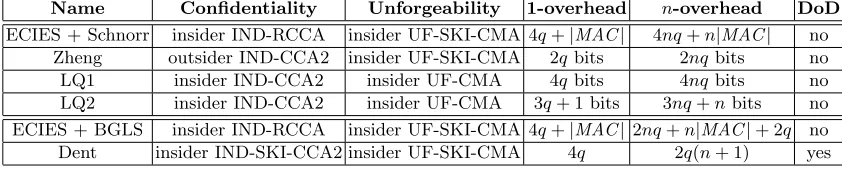
Table 1.Comparison of Bandwidth Use by Aggregate Signcryption Solutions
Name Confidentiality Unforgeability 1-overhead n-overhead DoD ECIES + Schnorr insider IND-RCCA insider UF-SKI-CMA 4q+|MAC| 4nq+n|MAC| no
Zheng outsider IND-CCA2 insider UF-SKI-CMA 2qbits 2nqbits no LQ1 insider IND-CCA2 insider UF-CMA 4qbits 4nqbits no LQ2 insider IND-CCA2 insider UF-CMA 3q+ 1 bits 3nq+nbits no ECIES + BGLS insider IND-RCCA insider UF-SKI-CMA 4q+|MAC|2nq+n|MAC|+ 2q no Dent insider IND-SKI-CCA2 insider UF-SKI-CMA 4q 2q(n+ 1) yes The term “n-overhead” refers to the amount of extra data that needs to be transmitted in an aggregate of nsigncryption ciphertexts. In other words, it is the length of the aggregate signcryption ciphertextminus the lengths of the individual messages. The first “block” of the table consists of signcryption schemes which “aggregate” their ciphertexts simply by presenting all the original ciphertexts as a sequence. The second “block” of the table consists of “pure” aggregate signcryption schemes. For Diffie-Hellman-based schemes we assume the scheme is implemented on a groupGof orderq in which group elements can be
represented using 2q bits (as is the case for elliptic curve groups). A typical value for q is 160-bits. We assume that IND-CPA symmetric encryption does not incur any overhead. We assume a MAC algorithm that produces MAC tags of size|MAC| (e.g. |MAC|= 80). The ECIES+Schnorr scheme is the trivial signcryption scheme formed by combining the ECIES encryption scheme [1] and the Schnorr signature scheme [27]. Zheng’s signcryption scheme is given in [30]. The LQ1 and LQ2 signcryption schemes were given by Libert and Quisquater and are described in [21] and [22] respectively. The ECIES+BGLS scheme is the aggregate signcryption scheme formed by combining the ECIES encryption scheme [1] and the BGLS aggregate signature scheme [11] using the method in Section 4. The Dent aggregate signcryption scheme is the direct construction given in Section 5. All schemes are proven secure in the random oracle model.
Table 2.Comparison of Efficiency of Aggregate Signcryption Schemes
Name Signcryption(n, m)-Aggregationn-Unsigncryption (Operations) (Operations) (Operations)
ECIES + Schnorr 3 exp trivial 3nexp∗
Zheng 1 exp trivial 3n exp∗
LQ1 3 exp trivial nexp/2npair
LQ2 2 exp trivial 2nexp/2npair
ECIES + BGLS 3 exp † nexp/n+ 1 pair
Dent 4 exp/1 pair 3npair nexp/n+ 3 pair
a comparison with a number of traditional signcryption schemes where “aggregation” occurs by trivially combining all the ciphertexts into one sequence).
It is interesting to note that the optimal choice of aggregate signcryption scheme depends on the security needs of the application. If the application only requires outsider confidentiality, then a na¨ıve use of Zheng’s signcryption scheme is the most efficient (where “aggregation” occurs by concatenating the individual ciphertexts without any attempt to combine them). If insider confidentiality is required and the majority of communication is not likely to require aggregation, then the LQ2 scheme (with na¨ıve aggregation) is most efficient. However, the Dent scheme of Section 5 becomes more efficient in any situation where two or more ciphertexts need to be aggregated.
To illustrate this point more fully, we give an example of an implementation of aggregate sign-cryption securing communication in a dynamic, distributed, federated database (DDFD) system. We use the Gaian database [6] as our example as this system requires a large number of secure connectionless communications.
6.1 The Gaian Database System
The Gaian database is a distributed database in which data is held by nodes in a “logical graph” [6]. The system is federated in the sense that it uses a store-local-query-anywhere (SLQA) structure which allows requests for data not held in the local database to be obtained from remote nodes. The physical network on which the database graph is implemented is assumed to be dynamic and lacking any pre-specified structure. Since the structure of the logical and physical graphs cannot be assumed, a database node in the logical graph performs a query operation by flooding the network with requests for data and collating the results. All database nodes are required to respond to requests for information even if the database does not hold any relevant data.
The novel approach of the Gaian database system is in how the logical graph “grows” with the addition of new nodes. The system uses a preferential attachment system whereby a new node is linked tomexisting nodes in the graph through the use of a preferential attachment rule that is designed to give rise to a logical graph that shares similar properties to a scale-free graph [8]; most notably the small diameter that is associated with scale free graphs. A small diameter implies that the “query flood” operation is relatively efficient. The basic operation of the preferential attachment system means that a new database node u links to the first m nodes that return a “connection message”. Each existing node v with degree less than vmax sends a connection message after a delay of t seconds where t is randomly chosen in the range [0, t0F(v)], t0 is an
implementation-defined constant andFis the “fitness function”. Proposed fitness functions include F(v) = 1/deg(v) [6] and F(v) =d(u, v)/deg(v) where d(u, v) is the distance (in hops) between u andvin thephysicalnetwork [12]. The constantvmaxis meant to stop the logical graph containing nodes which are “too critical” and which could be the target for denial of service attacks.
6.2 Security Requirements
The Gaian system is designed to be used in situations which include data retrieval by palm-top devices through wireless communication in active military conflict scenarios; hence, communication between nodes may be subject to eavesdropping and data manipulation attacks4. Furthermore, one
must consider the possibility that these devices will fall into malicious hands, which corresponds to the existence of malicious nodes in the logical graph. With regards to efficiency, it is generally accepted that processing power and storage capacity is increasing faster than communications capacity in these scenarios and that communication solutions should concentrate on achieving high bandwidth efficiency [19].
We believe that aggregate signcryption is a natural candidate for fulfilling these security re-quirements:
4 Jamming attacks are also a distinct possibility; however, the provision of an availability service is not
– Structure-free: The aggregate signcryption scheme only assumes that nodes have asymmetric key-pairs and authentic copies of the public keys of other nodes. This can easily be guaranteed at the point of manufacture or service. No implicit network structure has to be assumed. – Confidentiality: Aggregate signcryption provides confidential message transmission. Owing
to the possibility of device compromise and the strong confidentiality requirements that may exist for the data, forward secrecy is an important requirement for the signcryption scheme and hence the use of an insider-secure IND-CCA2 signcryption scheme is recommended. – Integrity Protection/Origin Authentication: Aggregate signcryption provides data
ori-gin authentication and integrity protection. Again, owing to the possibility of device compro-mise, insider UF-CMA security would be recommended. Of course, aggregate signcryption does not automatically provide freshness guarantees; however, these could be built into the query request/response protocol through the use of nonces – see (e.g.) key establishment protocols from signcryption schemes [14].
– DoD Security: While not explicitly a requirement for the communication system, DoD se-curity may provide a useful service. The DoD sese-curity guarantee ensures that a compromised node cannot create a signcryption ciphertext that will be correctly aggregated, but will corrupt the data provided by other nodes. In other words, compromising a node allows an attacker to send malicious data from that node, but does not give the attacker the ability to prevent the legitimate data from other nodes from being received5.
Moreover, aggregate signcryption aims to provide these services whilst consuming the minimum amount of bandwidth.
6.3 Efficiency Comparison
Aggregate signcryption has the potential to improve bandwidth efficiency for nodes who are re-sponding to “flood” requests for data. The requests themselves cannot be compressed as they are intended for different recipients. The most obvious candidates for securing the messaging func-tion in the Gaian database are the LQ2 signcrypfunc-tion scheme and the Dent aggregate signcrypfunc-tion scheme. (Zheng’s signcryption scheme only provides outsider security and so does not meet the security requirements of the application.)
We modelled the communication requirements for the data responses using a computer sim-ulation. The simulation generated 1000 Gaian logical networks6 each consisting ofn nodes and
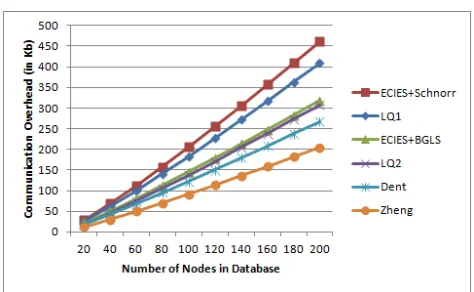
computed the communication overhead for each node to receive data from every other nodes in the network using each of the different aggregate signcryption schemes in Table 1. Nodes were numerically labelled in the order in which they joined the network and if two equal-length paths existed to transmit the data, then the data was passed to nodes with lower node labels in prefer-ence to nodes with higher node labels. Each new node formedm= 2 attachments using the fitness functionF(u) = 1/deg(u) and no “cap”vmax was placed on the number of attachments a node could make.
The average communication overhead for each communication type is shown in Figure 12 with number of nodes along the x-axis and communication overhead in bits along the y-axis. With the exception of the Zheng signcryption scheme (which does not have sufficient security for this application) the direct construction of Section 5 achieves clear bandwidth savings of up to 43% against a naive combination of ECIES encryption and Schnorr signatures and of 14% against the next best scheme (the LQ2 algorithm).
Although it is not obvious from the graph, there is an interesting interplay between efficiency of the Dent construction and the LQ2 scheme. For networks with fewer nodes, the LQ2 scheme is more efficient. The new scheme becomes more efficient in networks with more than 60 nodes. This is because networks with fewer nodes are likely to form simple networks with lots of nodes that
5
This guarantee, of course, only applies at an algorithmic level. The compromised node may still prevent legitimate data from being received by, for example, blocking the communication channel.
6 Since the logical network must be embedded in the physical network, it serves as a “minimum”
Fig. 12.Communication Overhead of Signcryption Schemes in the Gaian Database
are only one edge away from each other. This means that there will be a lot of ciphertexts which only contain a single message and the LQ2 scheme is more efficient in this situation.
This also explains the LQ2 scheme is more bandwidth efficient than the new scheme when considering the overhead required to send data to the “best” node in the graph (i.e. the node that requires the least overhead). This node is likely to be central in the graph and the graph is likely to resemble a “star” network. The LQ2 scheme is likely to be more efficient in this case. In contrast, the new scheme is significantly more efficient when we consider the overhead required to send data to the “worst” node in the graph (i.e. the node that requires the most overhead).
Lastly, we recall that we have only considered the bandwidth cost for a node to receive data. It may be thought that the advantages of using the new scheme disappear when considering the need to both send requests for data and receive responses, since no aggregation can occur when sending requests for data. However, we note that bandwidth savings may still be achieved and (as a worst-case solution) we may use different algorithms to send requests and to receive responses. For example, we may use LQ2 to send requests for data and the new scheme to receive responses. The “code cost” of using two algorithms may be reasonable if the bandwidth saving is sufficiently large.
7
Acknowledgements
I would like to acknowledge and thank Greg Neven for some initial discussions about the feasibility of aggregate signcryption. This paper has been the product of lethargic work for a period of at least four years and I would like to acknowledge the various institutions with whom I have worked during this time. I would like to thank the Information Security Group at Royal Holloway for giving my a position in the department for ten years and I would like to thank the Computer Science Department at City University of New York for allowing me to visit on numerous occasions.
References
1. M. Abdalla, M. Bellare, and P. Rogaway. The oracle Diffie-Hellman assumption and an analysis of DHIES. In D. Naccache, editor,Topics in Cryptology – CT-RSA 2001, volume 2020 ofLecture Notes in Computer Science, pages 143–158. Springer-Verlag, 2001.
2. J. H. An, Y. Dodis, and T. Rabin. On the security of joint signature and encryption. In L. Knudsen, editor,Advance in Cryptology – Eurocrypt 2002, volume 2332 ofLecture Notes in Computer Science, pages 83–107. Springer-Verlag, 2002.
3. J. Baek, R. Steinfeld, and Y. Zheng. Formal proofs for the security of signcryption. Journal of Cryptology, 20(2):203–235, 2007.
5. M. Bellare and A. Palacio. The knowledge-of-exponent assumptions and 3-round zero-knowledge protocols. In M. Franklin, editor, Advances in Cryptology – Crypto 2004, volume 3152 of Lecture Notes in Computer Science, pages 273–289. Springer-Verlag, 2004.
6. G. Bent, P. Dantressangle, D. Vyvyan, A. Mowshowitz, and V. Mitsou. A dynamic distributed federtaed database. InProc. Second Annual Conference of the ITA, 2008.
7. A. Boldyreva, C. Gentry, A. O’Neill, and D. H. Yum. Ordered multisignatures and identity-based sequential aggregate signatures, with applications to secure routing. InACM Conference on Computer and Communications Security – ACM CCS ’07, pages 276–285. ACM Press, 2007.
8. B. Bollobas and O. Riordan. The diameter of a scale free random graph. Combinatorika, 24(1):5–34, 2004.
9. D. Boneh, R. Canetti, S. Halevi, and J. Katz. Chosen-ciphertext security from identity-based encryp-tion. SIAM Journal on Computing, 36(5):1301–1328, 2007.
10. D. Boneh and M. Franklin. Identity-based encryption from the Weil pairing. In J. Kilian, editor, Advances in Cryptology – Crypto 2001, volume 2139 of Lecture Notes in Computer Science, pages 213–229. Springer-Verlag, 2001.
11. D. Boneh, C. Gentry, B. Lynn, and H. Shacham. Aggregate and verifiably encrypted signatures from bilinear maps. In E. Biham, editor,Advances in Cryptology – Eurocrypt 2003, volume 2656 ofLecture Notes in Computer Science, pages 416–432. Springer-Verlag, 2003.
12. E. Bulut and B. K. Szymanski. On alignment of physical and logical network in GaianDB network. Rensselaer Polytechnic Institute, Dept. of Computer Science, Report CS-11-10, 2010.
13. R. Canetti, H. Krawczyk, and J. B. Nielsen. Relaxing chosen-ciphertext security. In D. Boneh, editor, Advances in Cryptology – Crypto 2003, volume 2729 of Lecture Notes in Computer Science, pages 565–582. Springer-Verlag, 2003.
14. A. W. Dent and Y. Zheng, editors. Practical Signcryption. Springer-Verlag, 2010.
15. W. Diffie and M. Hellman. New directions in cryptography. IEEE Transactions on Information Theory, 22:644–654, 1976.
16. O. Eikemeier, M. Fischlin, J.-F. G¨otzmann, A. Lehmann, D. Schr¨oder, P. Schr¨oder, and D. Wagner. History-free aggregate message authentication codes. In J. Garay and R. De Prisco, editors,Security in Communication Networks – SCN 2010, volume 6280 ofLecture Notes in Computer Science, pages 309–328. Springer-Verlag, 2010.
17. U. Feige, D. Lapidot, and A. Shamir. Multiple noninteractive zero knowledge proofs under general assumptions. SAIM Journal on Computing, 29(1):1–28, 1999.
18. S. Goldwasser and S. Micali. Probabilistic encryption. Journal of Computer and System Science, 28:270–299, 1984.
19. International Technical Alliance (ITA). BPP11 Technical Areas. 2010.
20. E. Kiltz. Chosen-ciphertext security from tag-based encryption. In S. Halevi and T. Rabin, editors, Theory of Cryptography – TCC 2006, volume 3876 of Lecture Notes in Computer Science, pages 581–600. Springer-Verlag, 2006.
21. B. Libert and J.-J. Quisquater. Efficient signcryption with key privacy from gap Diffie-Hellman groups. In F. Bao, editor,Public Key Cryptography – PKC 2004, volume 2947 ofLecture Notes in Computer Science, pages 187–200. Springer-Verlag, 2004.
22. B. Libert and J.-J. Quisquater. Improved signcryption fromq-Diffe-Hellman problems. In C. Blundo and S. Cimato, editors, Security in Communication Networks – SCN 2004, volume 3352 of Lecture Notes in Computer Science, pages 220–234. Springer-Verlag, 2004.
23. J. K. Liu, M. H. Au, and W. Susilo. Self-generated-certificate public key cryptography and certificate-less signature/encryption scheme in the standard model. InProc. ACM Symposium on Information, Computer and Communications Security. ACM Press, 2007.
24. H. Lu and Q. Xie. An efficient certificaless aggregate signcryption scheme. InInternational Conference on Electronics, Communications and Control, pages 132–135. IEEE Press, 2011.
25. M. Naor and M. Yung. Public-key cryptosystems provably secure against chosen ciphertext attacks. InProc. 22nd ACM Symposium on the Theory of Computing – STOC ’90, pages 427–437. ACM Press, 1990.
26. C. Rackoff and D. Simon. Non-interactive zero-knowledge proof of knowledge and chosen ciphertext attack. In J. Feigenbaum, editor,Advances in Cryptology – Crypto ’91, volume 576 ofLecture Notes in Computer Science, pages 434–444. Springer-Verlag, 1991.
27. C. P. Schnorr. Efficient signature generation for smart cards. Journal of Cryptology, 4(3):161–174, 1991.
Indocrypt 2009, volume 5922 ofLecture Notes in Computer Science, pages 378–397. Springer-Verlag, 2009.
29. V. Shoup. Sequences of games: A tool for taming complexity in security proofs. Available from
http://eprint.iacr.org/2004/332/, 2004.
30. Y. Zheng. Digital signcryption or how to achieve cost(signature & encryption)cost(signature) + cost(encryption). In B. Kaliski, editor,Advances in Cryptology – Crypto ’97, volume 1294 ofLecture Notes in Computer Science, pages 165–179. Springer-Verlag, 1997.
A
Commit-then-Encrypt-and-Sign
If (ComSetup,Commit,Open) is a commitment scheme, (SigGen,Sign,Aggregate,Ver) is an aggre-gate signature scheme, and (EncGen,Enc,Dec) is a public-key encryption scheme, then we may construct aCtE&Saggregate signcryption scheme as in Figure 13. This scheme is attractive since the encryption and signature algorithms can be run in parallel in both signcryption and unsign-cryption.
Setup(1k):
param←$ ComSetup(1k) Outputparam
GenS(1k): (pkS,skS)
$
←SigGen(1k) Output (pkS,skS)
GenR(1k): (pkR,skR)
$
←EncGen(1k) Output (pkR,skR)
Aggregate(pkS,pkR,C):
ParseC as ((c(1), χ(1), σ(1)), . . . ,(c(n), χ(n), σ(n)))
σ←$ SigAgg(pkS,σ) Output (c,χ, σ)
Signcrypt(skS,pkR, m): (c, d)←$ Commit(param, m) m0←(IDS, d)
χ←Enc(pkR, m0) m00←(IDR, c) σ←$ Sign(skS, m00) OutputC←(c, χ, σ)
Unsigncrypt(pkS,skR, C): ParseCas (c,χ, σ)
m00←((IDR, c(1)), . . . ,(IDR, c(n))) IfVer(pkS,m
00
, σ) =⊥then output⊥ For 1≤i≤n:
m0(i)←Dec(skR, χ(i)) Parsem0(i)as (ID(i)
S , d
(i))
Ifpk(Si) is not the public key ofID(Si) then output⊥ m(i)←Open(param, c(i), d(i))
Ifm(i)=⊥then output⊥
Outputm
Fig. 13.The Commit-then-Encrypt-and-Sign Construction
Theorem 4. The following results hold:
1. If A is a PPT attacker against the UF-CMA unforgeability of the signcryption scheme that
makes at mostqsqueries to the signcryption oracle, then there exists a PPT attackerBagainst the UF-CMA unforgeability of the signature scheme and a PPT attackerB0 against the relaxed
binding property of the commitment scheme such that AdvUF
A(k)≤AdvUFB(k) +qsAdvBindB0 (k).
2. If A is a PPT attacker against the IND-RCCA security of the signcryption scheme and the
set SPK(k) is polynomial-time recognisable, then there exists a PPT attacker B against the
IND-CCA2 security of the public-key encryption scheme and a PPT attacker B0 against the
hiding property of the commitment scheme such that AdvRCCAA (k)≤2AdvCCAB (k) +AdvHideB0 (k).
B
Security Proofs for Generic Constructions
B.1 Encrypt-then-Sign
Let us re-cap the definition of theEtS construction. If (SigGen,Sign,SigAgg,Ver) is an aggregate signature scheme and (EncGen,Enc,Dec) is a public key encryption scheme, then we may construct anEtS aggregate signcryption scheme is given below. This scheme does not make use of aSetup algorithm.
GenS(1k): (pkS,skS)
$
←SigGen(1k) Output (pkS,skS)
GenR(1k): (pkR,skR)
$
←EncGen(1k) Output (pkR,skR)
Signcrypt(skS,pkR, m): m0←(IDS, m) χ←$ Enc(pkR, m0) m00←(IDR, χ) σ←$ Sign(skS, m00) OutputC←(χ, σ)
Aggregate(pkR,C):
ParseC as ((χ(1), σ(1)), . . . ,(χ(n), σ(n))) σ←$ SigAgg(pkS,σ)
Output (χ, σ)
Unsigncrypt(pkS,skR, C): ParseCas (χ, σ)
m00←((IDR, χ(1)), . . . ,(IDR, χ(n))) IfVer(pkS,m
00
, σ) =⊥then output⊥ For 1≤i≤n:
m0(i)←Dec(skR, χ(i)) Parsem0(i) as (ID(i)
S , m
(i))
Ifpk(Si) is not the public key ofID(Si) then output⊥ Outputm
Theorem 1. The following results hold:
1. If A is a PPT attacker against the insider SKI-UF-CMA unforgeability of the signcryption
scheme, then there exists a PPT attackerBagainst the UF-CMA unforgeability of the signature scheme such that AdvUFA(k)≤AdvUFB(k).
2. If A is a PPT attacker against the IND-RCCA security of the signcryption scheme and the
set SKP(k) is polynomial-time recognisable, then there exists a PPT attacker B against the IND-RCCA security of the encryption scheme such that AdvRCCAA (k)≤AdvRCCAB (k).
Proof We begin with the unforgeability game and directly describe the attackerB. We assume that ID∗S is the identity of the entity with public key pk∗S (and similar for ID∗R and pk∗R)). B proceeds as follows:
BO0
S(pk∗): .O0
S is the aggregate signature oracle pk∗S ←pk∗
(pkS,pk∗R, C∗)← A$ OS(pk∗
S) .OS is the aggregate signcryption oracle
IfAqueriesOS(pkR, m)
m0←(ID∗S, m) c←$ Enc(pkR, m0) m00←(IDR, c)
Queryσ← O0
S(m00)
Return (c, σ) ParseC∗ as (c, σ∗)
m∗←((ID∗R, c(1)), . . . ,(ID∗
R, c(n)))
Output (pkS,m∗, σ∗)
IfAwins the insider unforgeability game, then we have that (1)pk∗Ris a valid receiver key pair
(with corresponding private keysk∗R); (2)Ver(pkS,m∗, σ∗) =>; (3)Dec(sk∗R, c(i)) = (ID(i) S , m
(i))
for somem(i) and all 1 ≤i≤n; and (4) there existsi∗ such thatpk(i∗) S =pk
∗ and (pk∗
R, m(i ∗)
) was never queried to the signcryption oracle.