A preliminary version of this paper appears in ASIACRYPT 2014. This is the full version appearing as IACR ePrint Archive Report 2013/873.
Poly-Many Hardcore Bits for Any One-Way Function
and a Framework for Differing-Inputs Obfuscation
Mihir Bellare1 Igors Stepanovs2 Stefano Tessaro3
September 2014
Abstract
We show how to extract an arbitrary polynomial number of simultaneously hardcore bits from any one-way function. In the case the one-one-way function is injective or has polynomially-bounded pre-image size, we assume the existence of indistinguishability obfuscation (iO). In the general case, we assume the existence of differing-input obfuscation (diO), but of a form weaker than full auxiliary-input diO. Our construction for injective one-way functions extends to extract hardcore bits on multiple, correlated inputs, yielding new D-PKE schemes. Of independent interest is a definitional framework for differing-inputs obfuscation in which security is parameterized by circuit-sampler classes.
1 Department of Computer Science & Engineering, University of California San Diego, 9500 Gilman Drive, La Jolla,
California 92093, USA. Email: [email protected]. URL: http://cseweb.ucsd.edu/~mihir/. Supported in part by NSF grants CNS-1116800 and CNS-1228890.
2
Department of Computer Science & Engineering, University of California San Diego, 9500 Gilman Drive, La Jolla, California 92093, USA. Email: [email protected]. Supported in part by NSF grants CNS-1116800 and CNS-1228890.
3
Department of Computer Science, University of California Santa Barbara, Santa Barbara, California 93106, USA. Email:
Contents
1 Introduction 3
2 Preliminaries 7
3 Parameterized diO framework 8
4 Poly-many hardcore bits for injective OWFs 9
5 Poly-many hardcore bits for any OWF 12
6 Hardcore functions for correlated inputs 14
7 Application to D-PKE 15
1
Introduction
When RSA was invented [51], the understanding was that public-key encryption (PKE) would consist of applying the RSA one-way functionf directly to the message. In advancing semantic security (unachieved by this plain RSA scheme) as the appropriate target for PKE, Goldwasser and Micali [36] created a new challenge. Even given RSA, how was one to achieve semantic security?
The answer was hardcore functions [16, 57, 36]. Let f be a one-way function, andh a function that has the same domain asf and returns strings of some lengths. We say thathis hardcore forf if the distributions (f, h, f(x), h(x)) and (f, h, f(x), r) are computationally indistinguishable when x is chosen at random from the domain of f and r is a random s-bit string.1 We will refer to the output length s of h, which is the number of (simultaneously) hardcore bits produced byh, as thespan ofh, and say thatf achieves a certain span if there exists a hardcore functionhforf with the span in question. Hardcore predicates are hardcore functions with span one. Semantically-secure PKE can now be easily achieved: encrypts-bit message m as (f(x), h(x)⊕m) for randomxwhere trapdoor, injective one-way functionf together with hardcore function h constitute the public key. The span s determines the number of message bits that can be encrypted, so the larger it is, the better.
The quest for semantic security turned into a quest for hardcore functions [16, 57, 36, 53, 14, 41, 3, 47, 38, 55, 45, 34, 39]. It became quickly evident that finding hardcore predicates, let alone hardcore functions of span larger than one, was very challenging, and many sophisticated techniques were invented. With time, encryption methods avoiding hardcore functions did emerge [25]. But hardcore functions have never lost their position as a fundamental cryptographic primitive, as new usages, applications and constructions have arisen [27, 24, 1, 2, 26]. Hardcore functions have been particularly important in developing new forms of encryption, including lossy-TDF based encryption [50] and deterministic encryption [6, 8, 29].
Generic constructions. Across all this work and applications, something that stands out is the value and appeal of generic constructions, the representative result being that of Goldreich and Levin (GL) [34]. Prior to this, hardcore functions were obtained by dedicated and involved analyses that exploited the algebra underlying the one-way function itself. GL [34] showed that the inner product of x with a random string (the latter is part of the description ofh) results in a hardcore predicate for any OWF. This result has had an enormous impact, as evidenced by over 900 citations to the paper to date. A generic construction such as that of GL allows theoreticians to develop constructions and proofs independently of specific algebraic assumptions. Furthermore, it allows us to immediately obtain hardcore functions, and thus encryption, from new, candidate one-way functions.
Questions and answers. The GL construction however only provided a hardcore predicate, meaning span one, and by extension logarithmic span. The most desired goal was polynomial span.2 Significant effort was been invested towards this goal, allowing it to be reached for specific algebraic OWFs [39, 24, 46, 49, 2] or ones satisfying extra properties [50]. But a generic construction providing polynomial span seemed out of reach.
This is the question resolved by our work. We present generic constructions of hardcore functions with polynomial span for both injective and non-injective one-way functions. The tools we use are indistinguisha-bility obfuscation (iO) [5, 30] and differing-inputs obfuscation (diO) [5, 19, 4]. See Fig. 1 for a summary of our results.
Prior work. In more detail, early results gave hardcore predicates (ie. span one) for specific one-way functions including discrete exponentiation modulo a prime, RSA and Rabin [16, 57, 53, 14, 41, 3, 47, 38, 27]. Eventually, as noted above, the impactful and influential work of Goldreich and Levin [34] gave a generic hardcore predicate for any one-way function. Extensions of these results are able to achieve logarithmic span [55, 45, 34, 1, 26].
1
In the formal definitions in Section 2, both one-way functions and hardcore functions are families. Think here of f, has instances chosen at random from the respective families, their descriptions public.
2
OWF Span Assumption Construction See
injective poly iO HC1 Corollary 4.2 of Theorem 4.1
poly pre-image size poly iO HC2 Corollary 5.3 of Theorem 5.1
any poly diO− HC2 Corollary 5.2 of Theorem 5.1
Figure 1: Our results: We indicate the assumptions we make in order to construct hardcore functions with polynomial span. By diO− we mean a weakening of diO that we define.
Hardcore functions with polynomial span have been provided for specific, algebraic functions, usually under a stronger assumption than one-wayness of the function itself. These include the works by H˚astad, Schrift and Shamir [39] for discrete exponentiation modulo a composite, by Patel and Sundaram [49] for discrete exponentiation modulo a safe prime, by Catalano, Gennaro and Howgrave-Graham [24] for the Paillier function [48], and by Akavia, Goldwasser and Vaikuntanathan [2] for certain LWE-based functions. Moreover, polynomial-span hardcore functions for RSA [44, 54] and the Rabin trapdoor function [54] have been given under different assumptions. Peikert and Waters showed that lossy trapdoor functions [50] achieve polynomial span, yielding further examples of specific one-way functions with polynomial span [50, 28].
The basic question that remains open was whether polynomial span is achievable for an arbitrary, given OWF, meaning whether there is a generic hardcore function with polynomial span. One answer was provided by [9], who showed that UCE-security (specifically, relative to split, computationally-unpredictable sources) of a function h with polynomial span suffices for h to be hardcore for any one-way function, but the assumption made is arguably close to the desired conclusion.
Our results. Injective one-way functions are the most important case for aplications. (Most applications are related to some form of encryption.) Accordingly we begin by focusing on the case wheref is injective. We give a construction of a hardcore function calledHC1 that provides polynomial span forany injective OWFf. Beyond one-wayness off we assume iO [5, 52].
We then provide theHC2construction of a hardcore function with polynomial span for any, even non-injective OWFf. In the case f has polynomially-bounded pre-image size, the extra assumption remains iO. In the general case, it is diO, but of a form that is weaker than full auxiliary-input diO as defined in [19, 4]. As direct corollaries, we obtain hardcore functions of polynomial span for many specific OWFsf, in some cases providing the first hardcore function with polynomial span for thisf, in others providing a construction under different and new assumptions compared to prior ones. Thus for the basic discrete exponentiation OWF over the integers modulo a prime or an elliptic curve group, we provide the first construction with polynomial span. (Results were known when exponents are short [32, 49] and for discrete exponentiation modulo composites [39, 35].)
Our results have the above-noted benefits of generic constructions. They yield conceptual simplifications for the development of theoretical cryptography, and also provide automatic ways to get hardcore functions for new, candidate one-way functions. We view our work as also been interesting from the point of view of showing the power and applicability of iO, in the wake of Sahai-Waters [52].
Technical approach. We now take a closer look at our constructions and proofs to highlight the technical approach and novelties. Recall that the guarantee of iO [5, 52] is that the obfuscations of two circuits are indistinguishable if the circuits themselves are equivalent, meaning return the same output on all inputs. Differing-inputs obfuscation (diO) [5, 19, 4] relaxes the equivalence condition, asking instead that it only be hard, given the (unobfuscated) circuits, to find an input where they differ. See Section 3 for formal definitions.
Our HC1construction is a natural one, namely to let h be an obfuscation of the circuit G(gk,·) where
adversaryHprovided withf, h, f(x∗), r∗ (wheref is injective) and we want to move from the real game, in whichr∗ =G(gk, x∗), to the random game, in whichr∗ is random. We begin by using the SW technique [52] to move to a game in which r∗ is random and h is an obfuscation of the circuit C1 that embeds the target input x∗, a punctured PRF key, and a random point r∗, returning the latter when called on x =x∗ (the trigger) and otherwise returning G(gk, x), computed via the punctured key. (This move relies on iO and punctured PRF security.) While this has made r∗ random as desired, h is not what it should be in the random game, where it is in fact an obfuscation of the real circuitG(gk,·). The difficulty is to moveh back to an obfuscation of this real circuit while leavingr∗ random. We realize that such a move must exploit the one-wayness off, which has not so far been used. A one-wayness adversary, givenf(x∗) and aiming to find x∗, needs to runH. The problem is thatHneeds an obfuscation of the above-described circuitC1 as input, and construction ofC1 requires knowing the very point x∗ that the one-wayness adversary is trying to find. The difficulty is inherent rather than merely one of proof, for the forms of obfuscation being used give no guarantee that an obfuscation ofC1 does not revealx∗. We get around this by changing the trigger check fromx=x∗ tof(x) =f(x∗), so that now the circuit can embedf(x∗) rather thanx∗, a quantity there is no harm in revealing. This is reminescent of the technique in the security proof of the short signature scheme of Sahai and Waters [52]. The new check is equivalent to the old if f is injective, which is where we use this assumption. But we have still not arrived at the random game. We note that our modified circuitC2 and the target circuitG(gk,·) of the random game are inherently non-equivalent, and iO would not apply. However, these circuits differ only at inputx∗. We exploit the one-wayness of f to prove that it is hard to find this input even given the two circuits. The assumed diO-security of the obfuscator now implies that the obfuscations of these circuits are indistinguishable, allowing us to conclude. Finally, since we exploit diO only for circuits that differ at one (hard to find) point, BCP [19] says that iO in fact suffices, making iO the only assumption needed for the result beyond the necessary one-wayness off.
The above argument makes crucial use of the assumption thatf is injective. To handle an arbitrary one-way function, ourHC2construction modifies the above so thathis an obfuscation of the circuit G(gk, f(·)) wheregk is a random key for punctured PRF G. Thus, h(x) =G(gk, f(x)). We refer to Section 5 for the proof but note that BCP [19] implies that iO suffices for our proof when the number of preimages of any output of f is polynomial, but in general it could be exponential. In this case, diO suffices, but in fact a weaker version of it, that we define, does as well.
In summary, in the important case of injective one-way functions, and even for one-way functions with polynomial pre-image size, we provide a hardcore function with polynomial span assuming only iO. For one-way functions with super-polynomial pre-image size, we provide a hardcore function with polynomial span assuming a weak form of diO that we denote by diO− in Fig. 1.
Extensions and applications. We show that ourHC1hardcore function construction is able to extract random, independent bits even on inputs that are arbitrarily correlated, which is not true of most prior constructions and, combined with the fact that we get polynomially-many output bits for each input, yields new applications. In more detail, an injective function f is said to be one-way on a distribution I over vectorsx if, given the result f(x) of applying f to xcomponent-wise, it is hard to recover any component ofx. We want a hardcore function such that the components ofh(x) look not only random but independent even givenf(x). If the components ofxare independent, this is true for any hardcore function meeting the standard definition, and thus for ours, but if the components are correlated, standard hardcore functions give no such guarantee and may fail. As an example, many existing hardcore functions [16, 57, 53, 14, 41, 3, 47, 38, 27, 55, 45, 34, 1, 26, 39, 24, 48, 2] return certain specific bits of their input and will thus fail to be hardcore relative to the distribution in whichx[2] is the bitwise complement of x[1], even iff is one-way on this distribution. We show however that HC1 remains hardcore for f on any efficiently sampleable distributionI over which f is one-way, even when the entries of the vectors produced by I are arbitrarily correlated. This answers open questions from [37, 29].
PRIV-security over an input samplerI, the latter returning vectors ofarbitrarily correlated messages to be encrypted. We restrict attention to distributions that are admissible, meaning that there exists a family of injective, trapdoor functions that is one-way relative to I. The basic question that emerges is, for which admissible distributionsI does there exist a D-PKE scheme that is PRIV-secure overI? We show that this is true for all admissible distributions that are efficiently sampleable, assuming only the existence of iO. We obtain this result using the security ofHC1on correlated inputs and techniques from [29]. Previously, this was known only in the ROM [6], under the assumption that UCE-secure functions exist [9], for distributions with limited correlation between messages [8, 17] or assuming lossy trapdoor functions [29]. See Appendix 7 for definitions, a precise statement of the result, and proofs.
Parameterized diO.Of independent interest, we provide a definitional framework for diO in which security is parameterized by a class of circuit samplers. This allows us to unify and capture variant notions of iO and diO in the literature [5, 52, 19, 4]. The framework makes it easy to define further variants that are weaker than full diO, yielding a language in which one can state assumptions that are closer to those actually used in the proof rather than being overkill, particularly with regard to the type of auxiliary inputs used [12, 21, 31]. This is useful in the light of work like [31] which indicates that diO with arbitrary auxiliary inputs may be implausible. The weaker notion of diO noted above and denoted diO− in Fig. 1 is formally defined in our framework as diO security for “short” auxiliary inputs, which evades the negative results of [31]. See Section 3.
Discussion and related work. Random oracles (ROs) are “ideal” hardcore functions, able to provide polynomial span for any one-way function [10]. Our results, akin to [43, 9, 40], can thus be seen as instan-tiating the RO in a natural ROM construction, in particular showing hardcore functions in the standard model that are just as good as those in the ROM. As a consequence, we are able to instantiate the RO in the BR93 PKE scheme [10] to obtain a standard-model IND-CPA scheme.
The hardcore function in our second construction is the reverse of the hash function used to instantiate FDH in HSW [40]: in our case, the circuit being obfuscated first applies a one-way function and then a punctured PRF, while in their case it first applies a punctured PRF and then a one-way function.
Our work adopts the standard definition of a one-way function in which any polynomial-time adversary must have negligible inversion advantage. Polynomial span is known to be achievable for any exponentially hard to invert function [34, 26].
Given a one-way permutationf and a polynomialnit is possible to construct another one-way permuta-tiongthat hasnhardcore bits. Namely letg(x) =fn(x) and let the hardcore function onx be the result of the Blum-Micali-Yao PRG [16, 57] on seedx. A similar transform is provided in [15]. We provide hardcore functions directly for any given one-way function rather than for another function built from it.
GGHW [31] show that if what they call “special purpose” obfuscation is possible then full diO (diO for all circuits relative to arbitrary auxiliary inputs) is not possible. (Their result constructs a pathological auxiliary input that is itself a special-purpose obfuscated circuit.) Their result does not rule out the assumptions we use, namely iO or diO−. GGHW go on to show that if a special-purpose obfuscation of Turing Machines is possible then there is an artificial one-way function with exponential pre-image size (in particular it is not injective) for which there is no hardcore predicate that is output-dependent. (That is,f(x1) =f(x2) implies h(x1) =h(x2), a property possessed by our second construction.)
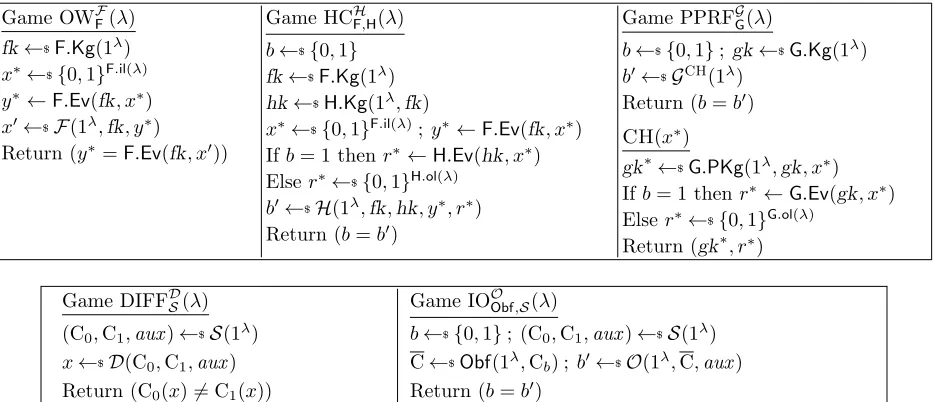
Game OWFF(λ)
fk←$F.Kg(1λ)
x∗←${0,1}F.il(λ) y∗←F.Ev(fk, x∗)
x0←$F(1λ,fk, y∗)
Return (y∗=F.Ev(fk, x0))
Game HCHF,H(λ)
b←${0,1}
fk←$F.Kg(1λ)
hk←$H.Kg(1λ,fk)
x∗←${0,1}F.il(λ); y∗←F.Ev(fk, x∗) Ifb= 1 thenr∗←H.Ev(hk, x∗) Elser∗←${0,1}H.ol(λ)
b0←$H(1λ,fk,hk, y∗, r∗) Return (b=b0)
Game PPRFGG(λ)
b←${0,1}; gk←$G.Kg(1λ)
b0←$GCH(1λ) Return (b=b0)
CH(x∗)
gk∗←$G.PKg(1λ,gk, x∗) Ifb= 1 thenr∗←G.Ev(gk, x∗) Elser∗←${0,1}G.ol(λ)
Return (gk∗, r∗)
Game DIFFDS(λ)
(C0,C1,aux)←$S(1λ)
x←$D(C0,C1,aux) Return (C0(x)6= C1(x))
Game IOOObf,S(λ)
b←${0,1}; (C0,C1,aux)←$S(1λ) C←$Obf(1λ,Cb) ; b0←$O(1λ,C,aux) Return (b=b0)
Figure 2: Games defining one-wayness ofF, security ofHas a hardcore function forF,
punctured-PRF security of G, difference-security of circuit sampler S and iO-security of obfuscator Obf
relative to circuit sampler S.
2
Preliminaries
We recall definitions for one-way functions, hardcore predicates and punctured PRFs.
Notation. We denote byλ∈Nthe security parameter and by 1λ its unary representation. We denote the
size of a finite setX by|X|, and the length of a stringx∈ {0,1}∗ by|x|. We letεdenote the empty string. If C is a circuit then|C|denotes its size, and if sis an integer thenPads(C) denotes C padded to have size s. If X is a finite set, we let x←$X denote picking an element of X uniformly at random and assigning it tox. Algorithms may be randomized unless otherwise indicated. Running time is worst case. “PT” stands for “polynomial-time,” whether for randomized algorithms or deterministic ones. IfA is an algorithm, we lety←A(x1, . . .;r) denote runningA with random coins r on inputsx1, . . .and assigning the output toy. We lety←$A(x1, . . .) be the result of pickingr at random and letting y←A(x1, . . .;r). We let [A(x1, . . .)] denote the set of all possible outputs of A when invoked with inputs x1, . . .. We say that f : N → R is
negligible if for every positive polynomial p, there exists np ∈ N such that f(n) < 1/p(n) for all n > np. We use the code based game playing framework of [11]. (See Fig. 2 for examples of games.) By GA(λ) we denote the event that the execution of game G with adversary A and security parameter λ results in the game returningtrue.
Function families. A family of functionsFspecifies the following. PT key generation algorithmF.Kgtakes 1λ and possibly another input to return a keyfk ∈ {0,1}F.kl(λ), whereF.kl:
N→Nis the key length function
associated toF. Deterministic, PT evaluation algorithm F.Ev takes key fk and an inputx ∈ {0,1}F.il(λ) to return an outputF.Ev(fk, x)∈ {0,1}F.ol(λ), whereF.il,F.ol:
N→Nare the input and output length functions
associated to F, respectively. The pre-image size ofF is the functionPreImgF defined for λ∈Nby
PreImgF(λ) = max fk,x∗
{x∈ {0,1}
F.il(λ) : F.Ev(fk, x) =F.Ev(fk, x∗)}
where the maximum is over all x∗ ∈ {0,1}F.il(λ) and all fk ∈ [F.Kg(1λ)]. We say that F is injective if PreImgF(λ) = 1 for all λ ∈ N, meaning F.Ev(fk, x1) 6= F.Ev(fk, x2) for all distinct x1, x2 ∈ {0,1}F.il(λ), all fk and all λ ∈ N. We say that F has polynomial pre-image size if there is a polynomial p such that PreImgF(·)≤p(·).
One-wayness and hardcore functions. Function family F is one-way if AdvowF,F(·) is negligible for all
family of functions with H.il = F.il. We say that His hardcore for F if AdvhcF,H,H(·) is negligible for all PT
adversaries H, where AdvhcF,H,H(λ) = 2 Pr[HCHF,H(λ)]−1 and game HCHF,H(λ) is defined in Fig. 2.
Punctured PRFs. A punctured function familyG specifies (beyond the usual algorithms) additional PT algorithmsG.PKg,G.PEv. On inputs 1λ, a keygk∈[G.Kg(1λ)] and target input x∗ ∈ {0,1}G.il(λ), algorithm
G.PKg returns a “punctured” key gk∗ such that G.PEv(gk∗, x) = G.Ev(gk, x) for allx ∈ {0,1}G.il(λ)\ {x∗}.
We say that G is a punctured PRF if AdvpprfG,G(·) is negligible for all PT adversaries G, where AdvpprfG,G(λ) = 2 Pr[PPRFGG(λ)]−1 and game PPRFGG(λ) is defined in Fig. 2. Here G must make exactly one oracle query where it picks a target pointx∗ and gets back the corresponding punctured key together with a challenge for the value ofG.Ev on the target point.
The concept of punctured PRFs is due to [18, 42, 20] who note that they can be built via the GGM construction [33]. This however yields a family G with G.il = G.ol. For our purposes, we need a stronger result, namely a punctured PRF with arbitrary polynomial output length:
Proposition 2.1 Let ι, ` be polynomials and assume one-way functions exist. Then there is a punctured PRFG withG.il=ιand G.ol=`.
The claimed punctured PRF G can be obtained by starting from a GGM-based punctured PRF G with
G.il=G.ol=ιand lettingG.Ev(gk, x) =S.Ev(G.Ev(gk, x)) whereSis a PRG with input lengthιand output length`. We omit the details.
3
Parameterized diO framework
We present a definitional framework for diO where security is parameterized by a class of circuit samplers. This is of conceptual value in enabling us to capture and unify existing forms of iO and diO. Further, it allows one to easily define new forms of diO that areweaker than the full auxiliary-input diO of [19, 4] and thus obtain results under weaker assumptions. Our parameterized language leads to sharper and more fine-grained security claims in which we can state assumptions that are closer to what is actually used by the proof rather than being overkill, in particular with regard to what types of auxiliary input are used [12, 21, 31]. This allows us to circumvent the negative results of [31] which apply to diO with arbitrary auxiliary input. We note that previous definitions did parameterize the definition by a class of circuits but this is different and in particular will not capture differences related to auxiliary inputs.
Circuit samplers. A circuit sampler is a PT algorithmS that on input 1λ returns a triple (C0,C1,aux) where C0,C1 are circuits which have the same size, number of inputs and number of outputs, andaux is a string. We say that a circuit samplerS is difference secure ifAdvdiffS,D(·) is negligible for every PT adversary
D, where AdvdiffS,D(λ) = Pr[DIFFDS(λ)] and game DIFFDS(λ) is defined in Fig. 2. Difference security of S
means that given C0,C1,aux it is hard to find an input on which the circuits differ.
iO-security. An obfuscator is a PT algorithm Obf that on input 1λ and a circuit C returns a circuit C such that C(x) = C(x) for all x. If S is a circuit sampler and O is an adversary, we let AdvioObf,S,O(λ) = 2 Pr[IOOObf,S(λ)]−1 where game IOOObf,S(λ) is defined in Fig. 2. Now letS be a class (set) of circuit samplers. We say thatObf isS-secure if AdvioObf,S,O(·) is negligible for every PT adversaryOand every circuit sampler
S ∈S. This is our parameterized notion of security. The following obvious fact will often be useful:
Proposition 3.1 Let S1,S2 be classes of circuit samplers and Obf an obfuscator. Suppose S1 ⊆S2. Then ifObf is S2-secure it is also S1-secure.
Capturing known notions. Different types of iO security in the literature can now be captured and unified by considering different classes of circuit samplers, as follows.
Let Saux be the class of circuit samplers S that do not have auxiliary inputs, meaning aux = εfor all λ∈ N and all (C0,C1,aux) ∈ [S(1λ)]. Let Sauxdiff = Sdiff ∩Saux ⊆Sdiff be the class of all difference-secure circuit samplers that do not have auxiliary inputs. ThenObfbeingSdiffaux-secure means it is a differing-inputs obfuscator as per [5].
We say that circuits C0,C1 are equivalent, written C0 ≡ C1, if they agree on all inputs. We say that circuit sampler S produces equivalent circuits if C0 ≡ C1 for all λ ∈ N and all (C0,C1,aux) ∈ [S(1λ)]. Let Seq be the class of all circuit samplers that produce equivalent circuits. Then Obf being Seq-secure means it is an indistinguishability obfuscator as per [52]. Let Seqaux = Seq∩Saux be the class of circuit samplers without auxiliary inputs that produce equivalent circuits. ThenObf beingSaux
eq -secure means it is an indistinguishability obfuscator as per [5].
If S produces equivalent circuits it is certainly difference-secure. This means that Seq ⊆ Sdiff and
Seqaux⊆Sdiffaux. Hence Proposition 3.1 says that anySdiff-secure obfuscator is aSeq-secure obfuscator and any
Sdiffaux-secure obfuscator is aSeqaux-secure obfuscator. That is, diO implies iO, both for the case with auxiliary input and the case without, a fact we will often use.
We say that circuit sampler S produces d-differing circuits, where d: N→ N, if C0 and C1 differ on at
mostd(λ) inputs for allλ∈Nand all (C0,C1,aux)∈[S(1λ)]. LetSdiff(d) be the class of all difference-secure circuit samplers that produced-differing circuits, so thatSeq⊆Sdiff(d)⊆Sdiff. The interest of this definition is the following result of BCP [19]:
Proposition 3.2 If dis a polynomial then any Seq-secure obfuscator is also a Sdiff(d)-secure obfuscator. We will exploit this to reduce our assumptions from Sdiff-secure obfuscation to Seq-secure obfuscation in some cases.
New classes. Above, we have used our framework to express and capture existing variants of iO and diO. We now define a new variant, via a new class of samplers. Following the definition we will explain the motivation. We say that a circuit samplerS has short auxiliary inputs if |aux|<|Cb|for all b∈ {0,1}, all λ∈Nand all (C0,C1,aux)∈[S(1λ)]. We letSshbe the class of all circuit samplers that have short auxiliary inputs. The assumption made in Theorem 5.1 is a S-secure obfuscator for a particular S ⊆ Sdiff ∩Ssh, meaning diO is only required relative to circuits samplers with short auxiliary inputs. This is a potentially weaker assumption than aSdiff-secure obfuscator.
4
Poly-many hardcore bits for injective OWFs
In this section we consider the natural construction of a hardcore function with arbitrary span, namely an obfuscated PRF. We show that this works assuming the one-way function is injective and the obfuscation is diO-secure, yielding our first result, namely a hardcore function with arbitrary polynomial span for any injective one-way function.
Construction. Let G be a function family. Let Obf be an obfuscator and let s: N → N. We define
function familyH=HC1[G,Obf, s] as follows, with H.il=G.iland H.ol=G.ol:
H.Kg(1λ,fk)
gk←$G.Kg(1λ) ; C←Pads(λ)(G.Ev(gk,·)) ; C←$Obf(1λ,C)
hk←C ; Return hk
H.Ev(hk, x)
C←hk; r←C(x) Return r
We giveH.Kgtwo inputs because this is required by the syntax, but the second is ignored. HereG.Ev(gk,·) represents the circuit that givenxreturnsG.Ev(gk, x), and C is obtained by padding G.Ev(gk,·) to sizes(λ). The padding length functionsis a parameter of the construction that will depend on the one-way function
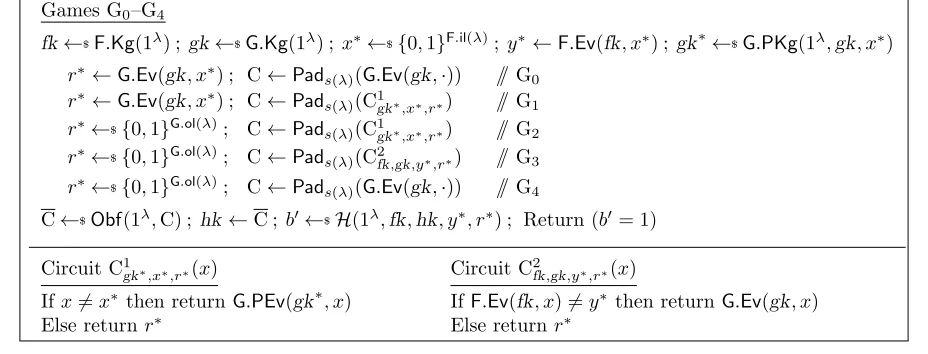
Games G0–G4
fk←$F.Kg(1λ) ; gk←$G.Kg(1λ) ; x∗←${0,1}F.il(λ); y∗←F.Ev(fk, x∗) ; gk∗←$G.PKg(1λ,gk, x∗)
r∗←G.Ev(gk, x∗) ; C←Pad
s(λ)(G.Ev(gk,·)) // G0 r∗←G.Ev(gk, x∗) ; C←Pads(λ)(C1gk∗,x∗,r∗) // G1 r∗←${0,1}G.ol(λ); C←Pads(λ)(C1gk∗,x∗,r∗) // G2 r∗←${0,1}G.ol(λ); C←Pads(λ)(C2fk,gk,y∗,r∗) // G3 r∗←${0,1}G.ol(λ); C←Pad
s(λ)(G.Ev(gk,·)) // G4
C←$Obf(1λ,C) ; hk←C ; b0←$H(1λ,fk,hk, y∗, r∗) ; Return (b0= 1)
Circuit C1
gk∗,x∗,r∗(x)
Ifx6=x∗then returnG.PEv(gk∗, x) Else returnr∗
Circuit C2
fk,gk,y∗,r∗(x)
IfF.Ev(fk, x)6=y∗ then returnG.Ev(gk, x) Else returnr∗
Figure 3: Games for proof of Theorem 4.1.
Results. Recall that aSdiff(1)-secure obfuscator is weaker than a fullSdiff-secure obfuscator (see Section 3 for definitions) since it is only required to work on circuits that differ on at most one (hard to find) input. We have:
Theorem 4.1 Let F be an injective one-way function family. Let G be a punctured PRF with G.il = F.il. Then there is a polynomialssuch that the following is true. Let Obfbe any Sdiff(1)-secure obfuscator. Then the function family H=HC1[G,Obf, s] defined above is hardcore for F.
Proposition 2.1 yields punctured PRFs with as long an output as desired, so that the above allows extraction of an arbitrary polynomial number of hardcore bits. The one-way function assumption made in Proposi-tion 2.1 is already implied by the assumpProposi-tion that F is one way. Theorem 4.1 assumes a differing-inputs obfuscator only for circuits that differ on at most one input, which by Proposition 3.2 can be obtained from an indistinguishability obfuscator, making the latter the only assumption beyond one-wayness ofF needed to extract polynomially-many hardcore bits. Formally, we have:
Corollary 4.2 Let`be any polynomial. LetFbe any injective one-way function. If there exists aSeq-secure obfuscator then there exists a hardcore function Hfor F withH.ol=`.
Proof of Theorem 4.1: We define s as follows: For any λ∈ N let s(λ) be a polynomial upper bound
on max(|G.Ev(gk,·)|,|C1gk∗,x∗,r∗|,|Cfk2,gk,y∗,r∗|) where the last two circuits are in Fig. 3 and the maximum is over all gk ∈ [G.Kg(1λ)], x∗ ∈ {0,1}G.il(λ), gk∗ ∈[G.PKg(1λ,gk, x∗)], fk ∈[F.Kg(1λ)], y∗ ∈ {0,1}F.ol(λ) and r∗ ∈ {0,1}G.ol(λ). Now letHbe a PT adversary. Consider the games and associated circuits of Fig. 3. Lines not annotated with comments are common to all five games. The games begin by picking keys fk,gk for the one-way functionF and the punctured-PRFG, respectively. They pick the challenge inputx∗ and then create a punctured PRF keygk∗ for it. Then the games differ in how they definer∗ and the circuit C to be obuscated. These defined, the games re-unite to obfuscate the circuit and runH.
Game G0 does not use the punctured keys, and is equivalent to the b = 1 case of HCHF,H(λ) while G4, similarly, is itsb= 0 case, so
AdvhcF,H,H(λ) = Pr[G0]−Pr[G4]. (1) We now show that Pr[Gi−1]−Pr[Gi] is negligible for i = 1,2,3,4, which by Equation (1) implies that
punctured-PRF, based on which G2 replaces r∗ with a random value. These steps are direct applications of the Sahai-Waters technique [52], but now things get more difficult. Having mader∗ random is not enough because we must now revert the circuit being obfuscated back to G.Ev(gk,·). We also realize that we have not yet used the one-wayness of F, so this reversion must rely on it. But the circuit in G2 embeds x∗, the point a one-wayness adversary would be trying to find, and it is not clear how we can simulate the construction of this circuit in the design of an adversary violating one-wayness. To address this, instead of testing whether x equals x∗, the circuit in G3 tests whether the values of F.Ev(fk,·) on these points agree, which can be done given onlyy∗ =F.Ev(fk, x∗) and avoids puttingx∗ in the circuit. But we need this to not alter the functionality of the circuit. This is where we make crucial use of the assumption thatF.Ev(gk,·) is injective. Finally, in game G4 we revert the circuit back toG.Ev(gk,·). But the circuits in G3,G4 are now manifestedlynot equivalent. However, the input on which they differ is x∗. We show that the one-wayness of F implies that this point is hard to find, whence diO (here iO is not enough) allows us to conclude. We now proceed to the details.
Below, on the left we (simultaneously) define three circuit samplers that differ at the commented lines and have the uncommented lines in common. On the right, we define an iO-adversary:
Circuit SamplersS1(1λ),S3(1λ),S4(1λ)
fk←$F.Kg(1λ) ; gk←$G.Kg(1λ)
x∗←${0,1}F.il(λ); y∗←F.Ev(fk, x∗) ; gk∗←$G.PKg(1λ,gk, x∗)
r∗←G.Ev(gk, x∗) ; C1←Pads(λ)(G.Ev(gk,·)) ; C0←Pads(λ)(C1gk∗,x∗,r∗) //S1 r∗←${0,1}G.ol(λ); C
1←Pads(λ)(Cgk1 ∗,x∗,r∗) ; C0←Pads(λ)(C2fk,gk,y∗,r∗) //S3 r∗←${0,1}G.ol(λ); C1←Pads(λ)(C2fk,gk,y∗,r∗) ; C0←Pads(λ)(G.Ev(gk,·)) //S4
aux ←(fk, y∗, r∗) ; Return (C0,C1,aux)
AdversaryO(1λ,C,aux)
(fk, y∗, r∗)←aux hk ←C
b0←$H(1λ,fk,hk, y∗, r∗) Returnb0
Now we have
Pr[Gi−1]−Pr[Gi] =AdvioObf,Si,O(λ) fori∈ {1,3,4}. (2) We now make three claims: (1) S1 ∈ Seq (2) S3 ∈ Seq (3) S4 ∈ Sdiff(1). Since Seq ⊆ Sdiff(1) and Obf is assumedSdiff(1)-secure, the RHS of Equation (2) is negligible in all three cases.
We now establish claim (1). If x 6= x∗ then C1gk∗,x∗,r∗(x) = G.PEv(gk∗, x) = G.Ev(gk, x). If x = x∗ then C1gk∗,x∗,r∗(x) = r∗, but S1 sets r∗ = G.Ev(gk, x∗). This means that S1 produces equivalent circuits, and henceS1 ∈Seq.
Next we establish claim (2). The assumed injectivity ofF implies that circuits C1gk∗,x∗,r∗ and C2fk,gk,y∗,r∗ are equivalent wheny∗=F.Ev(fk, x∗), and henceS3 ∈Seq.
To establish claim (3), given any PT difference adversaryD forS4, we build one-wayness adversaryF via AdversaryF(1λ,fk, y∗)
gk←$G.Kg(1λ) ; r∗←${0,1}G.ol(λ); C1←Pads(λ)(C2
fk,gk,y∗,r∗) ; C0 ←Pads(λ)(G.Ev(gk,·))
aux ←(fk, y∗, r∗) ; x←$D(C0,C1,aux) ; Returnx
If C1(x) 6= C0(x) then it must be that F.Ev(fk, x) =y∗. Thus AdvdiffS4,D(·) ≤ AdvowF,F(·). The assumed
one-wayness ofF thus means thatS4 is difference-secure. But we also observe that, due to the injectivity of F, circuits C0,C1 differ on only one input, namely x∗. So S4 ∈Sdiff(1).
One transition remains, namely that from G1 to G2. Here we have
Pr[G1]−Pr[G2] =AdvpprfG,G(λ) (3)
where adversaryG is defined via AdversaryGCH(1λ)
fk←$F.Kg(1λ) ; x∗←${0,1}F.il(λ); y∗ ←F.Ev(fk, x∗) ; (gk∗, r∗)←$CH(x∗) C←Pads(λ)(C1
The RHS of Equation (3) is negligible by the assumption that G is a punctured PRF. This concludes the proof.
5
Poly-many hardcore bits for any OWF
The proof of Theorem 4.1 makes crucial use of the assumed injectivity ofF. To remove this assumption, we modify the construction so that the obfuscated PRF is applied, not to x, but to the result of the one-way function onx.
Construction. LetF,Gbe function families withG.il=F.ol. LetObfbe an obfuscator and lets: N→N.
We define function familyH=HC2[F,G,Obf, s] as follows, with H.il=F.il and H.ol=G.ol:
H.Kg(1λ,fk)
gk←$G.Kg(1λ) ; C←Pads(λ)(G.Ev(gk,F.Ev(fk,·))) ; C←$Obf(1λ,C)
hk←C ; Return hk
H.Ev(hk, x)
C←hk; r←C(x) Return r
This time the result of the hardcore function output on inputx is G.Ev(gk, y) wherey=F.Ev(fk, x). Results. The following says that Sdiff-security of the obfuscator suffices for the security of the above hardcore function, but that in fact the assumption is weaker, the circuit samplers for which security is required being further restricted to have short auxiliary input as captured and to produce circuits that differ at a number of points bounded by the pre-image size d of the one-way function, formally (Sdiff(d)∩Ssh )-security, where the classes were defined in Section 3:
Theorem 5.1 Let F be a one-way function family. Let G be a punctured PRF with G.il = F.ol. Let d=PreImgF. Then there is a polynomial ssuch that the following is true. Let S =Sdiff(d)∩Ssh. Let Obf be anyS-secure obfuscator. Then the function familyH=HC2[F,G,Obf, s]defined above is hardcore for F. This means that in the most general case we have:
Corollary 5.2 Let`be any polynomial. Let Fbe any one-way function. If there exists a(Sdiff∩Ssh)-secure obfuscator then there exists a hardcore function Hfor F withH.ol=`.
When the pre-image size of F is polynomial, however, we can again exploit Proposition 3.2 to obtain our conclusion assuming nothing beyond iO:
Corollary 5.3 Let`be any polynomial. LetFbe any one-way function with polynomially-bounded pre-image size. If there exists aSeq-secure obfuscator then there exists a hardcore function Hfor F withH.ol=`.
Proof of Theorem 5.1: We define s as follows: For any λ∈ N let s(λ) be a polynomial upper bound
on max(|G.Ev(gk,F.Ev(fk,·))|,|C1
fk,gk∗,y∗,r∗|) where the second circuit is in Fig. 4 and the maximum is over all gk ∈ [G.Kg(1λ)], x∗ ∈ {0,1}F.il(λ), y∗ ∈ {0,1}F.ol(λ), gk∗ ∈
[G.PKg(1λ,gk, y∗)], fk ∈ [F.Kg(1λ)] and r∗ ∈ {0,1}G.ol(λ). Now letHbe a PT adversary. Consider the games and associated circuits of Fig. 4. Game G0 does not use the punctured keys, and is equivalent to the b= 1 case of HCHF,H(λ) while G3, similarly, is itsb= 0 case, so
AdvhcF,H,H(λ) = Pr[G0]−Pr[G3]. (4)
We now show that Pr[Gi−1]−Pr[Gi] is negligible fori= 1,2,3, which by Equation (4) implies thatAdvhcF,H,H(·)
is negligible and proves the theorem.
Games G0–G3
fk←$F.Kg(1λ) ; gk←$G.Kg(1λ) ; x∗←${0,1}F.il(λ); y∗←F.Ev(fk, x∗) ; gk∗←$G.PKg(1λ,gk, y∗)
r∗←G.Ev(gk, y∗) ; C←Pad
s(λ)(G.Ev(gk,F.Ev(fk,·))) // G0 r∗←G.Ev(gk, y∗) ; C←Pads(λ)(C1fk,gk∗,y∗,r∗) // G1 r∗←${0,1}G.ol(λ); C←Pads(λ)(C1fk,gk∗,y∗,r∗) // G2 r∗←${0,1}G.ol(λ); C←Pads(λ)(G.Ev(gk,F.Ev(fk,·))) // G3 C←$Obf(1λ,C) ; hk←C ; b0←$H(1λ,fk,hk, y∗, r∗) ; Return (b0= 1)
Circuit C1
fk,gk∗,y∗,r∗(x)
y←F.Ev(fk, x)
Ify6=y∗ then returnG.PEv(gk∗, y) else returnr∗
Figure 4: Games for proof of Theorem 5.1.
Circuit SamplersS1(1λ),S3(1λ)
fk←$F.Kg(1λ) ; gk←$G.Kg(1λ)
x∗←${0,1}F.il(λ); y∗←F.Ev(fk, x∗) ; gk∗←$G.PKg(1λ,gk, y∗)
r∗←G.Ev(gk, y∗) ; C1←Pads(λ)(G.Ev(gk,F.Ev(fk,·))) ; C0←Pads(λ)(C1fk,gk∗,y∗,r∗) //S1 r∗←${0,1}G.ol(λ); C0←Pads(λ)(G.Ev(gk,F.Ev(fk,·))) ; C1←Pads(λ)(C1fk,gk∗,y∗,r∗) //S3
aux←(fk, y∗, r∗) ; Return (C
0,C1,aux)
AdversaryO(1λ,C,aux)
(fk, y∗, r∗)←aux hk←C
b0←$H(1λ,fk,hk, y∗, r∗) Returnb0
Now we have
Pr[Gi−1]−Pr[Gi] =AdvioObf,Si,O(λ) fori∈ {1,3}. (5) We now make two claims: (1)S1∈Seq∩Ssh (2)S3 ∈Sdiff(d)∩Ssh. ButSeq ⊆Sdiff(d). By Proposition 3.1 and the assumption thatObf is (Sdiff(d)∩Ssh)-secure, the RHS of Equation (5) is negligible in both cases. We now establish claim (1). If F.Ev(fk, x) =6 y∗ then C1fk,gk∗,y∗,r∗(x) = G.PEv(gk∗, y) = G.Ev(gk, y) where y = F.Ev(fk, x). If F.Ev(fk, x) = y∗ then C1fk,gk∗,y∗,r∗(x) = r∗, but S1 sets r∗ = G.Ev(gk, y∗). This means that S1 produces equivalent circuits, and hence S1 ∈ Seq. Since fk, y∗, r∗ are (explicitly, by construction) hardwired into C0 = C1fk,gk∗,y∗,r∗, the size of this circuit is certainly larger than the length ofaux = (fk, y∗, r∗). Since the two circuits output by the sampler are padded to the same size, the same is true for C1. Thus
S1∈Ssh.
To establish claim (2), given any PT difference adversaryD forS3 we build one-wayness adversaryF that on input 1λ,fk, y∗ does the following:
gk←$G.Kg(1λ) ; gk∗←$G.PKg(1λ,gk, y∗) ;r∗←${0,1}G.ol(λ); C1 ←Pads(λ)(C1
fk,gk∗,y∗,r∗) C0 ←Pads(λ)(G.Ev(gk,F.Ev(fk,·))) ; aux ←(fk, y∗, r∗) ; x←$D(C0,C1,aux) ; Returnx
If C1(x) 6= C0(x) then it must be that F.Ev(fk, x) =y∗. Thus AdvdiffS3,D(·) ≤ AdvowF,F(·). The assumed
one-wayness ofF thus means thatS3 is difference-secure. But we also observe that circuits C0,C1 differ exactly on pre-images ofy∗ underF.Ev(fk,·), soS4 ∈Sdiff(d). AlsoS3 ∈Ssh for the same reason as above.
One transition remains, namely that from G1 to G2. Here we have Pr[G1]−Pr[G2] = AdvpprfG,G(λ) where adversaryG, on input 1λ and with access to oracle CH, returnsb0 computed via:
Game OWFF,I(λ)
fk←$F.Kg(1λ) x∗←$I(1λ) y∗←F.Ev(fk,x∗)
x0←$F(1λ,fk,y∗) Return (F.Ev(fk, x0)∈y∗)
Game HCHF,H,I(λ)
b←${0,1}
fk←$F.Kg(1λ) ; hk←$H.Kg(1λ,fk) x∗←$I(1λ) ; y∗←F.Ev(fk,x∗) Ifb= 1 thenr∗←H.Ev(hk,x∗) Elser∗←$Rnd(x∗,H.ol(λ))
b0←$H(1λ,fk,hk,y∗,r∗) Return (b=b0)
Game PPRFGG(λ)
b←${0,1}; gk←$G.Kg(1λ)
b0←$GCH(1λ) ; Return (b=b0)
CH(x∗)
gk∗←$G.PKg(1λ,gk,x∗) Ifb= 1 then r∗←G.Ev(gk,x∗) Elser∗←$Rnd(x∗,G.ol(λ)) Return (gk∗,r∗)
Figure 5: Games defining one-wayness of F with respect to an input sampler I, security of H
as a hardcore function for F with respect to I and punctured-PRF security of G on multiple
inputs.
6
Hardcore functions for correlated inputs
We show that our hardcore functions are able to extract random bits even on sequences of inputs that are ar-bitrarily correlated. Somewhat more precisely, draw a vectorxfrom an arbitrary distribution, in particuclar allowing its components to be arbitrarily correlated. Then applying our hardcore function componentwise tox results in a vector whose components look randomand independent even given the result of applying f componentwise to x, making only the necessary assumption that f remains one-way on the distribution from which x was selected. This is an unusual property, not possessed by all constructions of hardcore functions. The ability to extract polynomially-many bits on correlated inputs leads to new constructions of deterministic PKE schemes.
Notation. We denote vectors by boldface lowercase letters, for example x. Ifxis a vector then|x|denotes the number of components of x and x[i] denotes the i-th component of x, for any 1 ≤ i ≤ |x|. We write x ∈ x to mean that x = x[i] for some 1 ≤ i ≤ |x|. If F is a family of functions, x is a vector over
{0,1}F.il(λ) and fk ∈ {0,1}F.kl(λ), then we let F.Ev(fk,x) = (F.Ev(fk,x[1]), . . . ,F.Ev(fk,x[|x|])). Let Rnd denote the algorithm that on input a vectorx and an integer ` returns a vector rof the same length as x whose entries are random `-bit strings except that if two entries of xare the same, the same is true of the corresponding entries ofr. In detail, Rnd(x, `) creates tableT via: Fori= 1, . . . ,|x|do: If not T[x[i]] then T[x[i]]←${0,1}`. Then it sets r[i]←T[x[i]] fori= 1, . . . ,|x|and returns the vectorr.
Definitions. An input sampler is an algorithm I that on input 1λ returns a I.vl(λ)-vector of strings over {0,1}I.il(λ), where the vector-length I.vl:
N → N and the input length I.il: N → N are polynomials
associated to I. We say that a function family F is one-way with respect to input sampler I if F.il= I.il
and AdvowF,I,F(·) is negligible for all PT adversaries F, where AdvowF,I,F(λ) = Pr[OWFF,I(λ) = 1] and game
OWFF,I(λ) is defined in Fig. 5. We stress that for F to win in this game it needs to find the inverse under
F.Ev(fk,·) of some component of y∗, not all components. Let H be a family of functions with H.il = F.il. We say that H is hardcore for F with respect to input sampler I if AdvFhc,H,I,H(·) is negligible for all PT adversaries H, where AdvhcF,H,I,H(λ) = 2 Pr[HCFH,H,I(λ)]−1 and game HCHF,H,I(λ) is defined in Fig. 5.
We extend punctured PRFs as defined in Section 2 to allow puncturing at multiple points. In a punctured function family G, algorithm G.PKg now takes 1λ, a key gk ∈ [G.Kg(1λ)] and a vector x∗ over {0,1}G.il(λ) (the target inputs) to return a “punctured” key gk∗ such that G.PEv(gk∗, x) = G.Ev(gk, x) for all x ∈ {0,1}G.il(λ) such thatx6∈x∗. Gis a punctured PRF ifAdvpprf
G,G(·) is negligible for all PT adversariesG, where
proof is in Appendix A:
Theorem 6.1 Let F be an injective function family. Let G be a punctured PRF with G.il = F.il. Let d: N→N be a polynomial. Then there is a polynomial s such that the following is true. Let I be any PT
input sampler withI.vl=dand I.il=F.il. Let Obf be any Sdiff(d)-secure obfuscator. Assume F is one-way with respect to I. Then the function family H=HC1[G,Obf, s] defined in Section 4 is hardcore forF with respect to I.
A subtle point here is thatsdepends on d=I.vl in addition toF and G, which means that the size of the keyhkdescribing the hardcore function grows with the number of correlated inputsdon which we want the function to be hardcore. This is expected and due to [56] may not be avoidable under falsifiable assumptions. Importantly for our applications,Hdoes not depend on I beyond depending on d=I.vland F.il=I.il.
Sincedin Theorem 6.1 is a polynomial, we may apply Proposition 3.2 to obtain the analog of Corollary 4.2 for correlated inputs, namely that, assuming only a Seq-secure obfuscator (i.e. iO), there exists, for any injectiveF and any input samplerI, a function family that returns polynomially-many bits and is hardcore for F with respect to I. In Appendix 7 we discuss the application of Theorem 6.1 to the design of new D-PKE schemes that are PRIV-secure for arbitrarily correlated messages.
7
Application to D-PKE
A PKE scheme is deterministic if its encryption function is deterministic. Deterministic public-key encryp-tion (D-PKE) is useful for many applicaencryp-tions. However, it cannot provide IND-CPA security. BBO [6] define what it means for a D-PKE scheme to provide PRIV-security over an input samplerI, the latter returning vectors of arbitrarily correlated messages to be encrypted. We restrict attention to distributions that are admissible, meaning that there exists a family of injective, trapdoor functions that is one-way relative toI. The basic question that emerges is, for which admissible distributionsI does there exist a D-PKE scheme that is PRIV-secure over I? We show that this is true for all admissible distributions that are efficiently sampleable, assuming only the existence of iO. We obtain this result by combining Theorem 6.1 with tech-niques from [29]. Previously, this was known only in the ROM [6], under the assumption that UCE-secure functions exist [9], for distributions with limited correlation between messages [8, 17] or assuming lossy trapdoor functions [29].
Construction and result. We extend our definition of a family of functions from Section 2 to allow trapdoors by allowingF.Kgto return not justfk but also a trapdoorfk−1 that, via a PT algorithmF.Ev−1, defines a function F.Ev−1(fk−1,·) that is the inverse of F.Ev(fk,·). We refer to prior work [6, 8, 29] for definitions of D-PKE and the notion of a D-PKE scheme being PRIV-secure over an input samplerI.
Generalizing prior constructions from [8, 6], Fuller, O’Neill and Reyzin [29] proposed a construction of a D-PKE scheme from an IND-CPA PKE schemePKEand a family of injective, trapdoor one-way functions
F. It uses a keyless hardcore function forF. We adapt it to allow a family of hardcore functionsHforFthat, as per our syntax and constructions, is keyed. The resulting D-PKE schemeD-PKE=EwHCore[PKE,F,H] associated to PKE,F,His defined as follows:
D-PKE.Kg(1λ)
(pk, sk)←$PKE.Kg(1λ) (fk,fk−1)←$F.Kg(1λ)
hk←$H.Kg(1λ,fk)
Return ((pk,fk,hk),(sk,fk−1))
D-PKE.Enc((pk,fk,hk), x) y←F.Ev(fk, x)
r←H.Ev(hk, x) c←PKE.Enc(pk, y;r) Return c
D-PKE.Dec((sk,fk−1), c) y←PKE.Dec(sk, c) x←F.Ev−1(fk−1, y) Returnx
We note that it is central for this construction that the hardcore function outputs polynomially many bits, since these bits are used as the coins for the PKE scheme. The following says that for any admissible PTI
Theorem 7.1 LetPKEbe an IND-CPA secure PKE scheme. Let Fbe an injective trapdoor function family that is one-way with respect to PT input samplerI. If there exists a Seq-secure obfuscator then there exists a function familyHsuch that D-PKE=EwHCore[PKE,F,H] is PRIV-secure onI.
Proof. The rest of this section is devoted to a proof of Theorem 7.1. We will show that our constructions of hardcore functions meet the notion of a robust hardcore function from [29] and then apply results from the latter to obtain Theorem 7.1.
We now define robustness. LetI,I∗be input samplers such that (I.vl,I.il) = (I∗.vl,I∗.il) and also [I∗(1λ)]⊆
[I(1λ)] for allλ∈N. For λ∈Nlet
PI∗,I(λ) = Pr h
x∈[I∗(1λ)] : x←$I(1λ) i
be the probability of the support ofI∗ under the distribution induced byI. Forα∈
Nwe say thatI∗ is an
α-induced input sampler of I if the following are true. First, Prhx=x∗ : x←$I∗(1λ)
i = Pr
x=x∗ : x←$I(1λ) PI∗,I(λ)
for everyx∗∈[I∗(1λ)] and every λ∈
N. Second, PI∗,I(λ)≥2−α for all λ∈N.
Let F be a function family that is one-way with respect to input sampler I. Let α ∈N. We say that F is α-one-way with respect to I if for any α-induced input sampler I∗ of I, family F is one-way with respect
toI∗. Let Hbe a function family that is hardcore for F with respect to I. We say that His α-robust for
F with respect to I if, for anyα-induced input samplerI∗ of I, family His hardcore for F with respect to
I∗. The following says that in the above construction D-PKE= EwHCore[PKE,F,H] of a D-PKE scheme,
2-robustness of the hardcore function familyHforF with respect to I suffices for PRIV-security of D-PKE
overI:
Lemma 7.2 ([29]) Let PKE be an IND-CPA secure PKE scheme. Let F be an injective trapdoor function
family that is one-way with respect to PT input samplerI. Let Hbe a function family that is 2-robust forF
with respect toI. Then D-PKE=EwHCore[PKE,F,H]is PRIV-secure on I.
To prove Theorem 7.1, it thus suffices to show that, under the conditions of the theorem, there exists a function family H that is 2-robust for F with respect to I. The following says that our construction of Section 4 has the desired property, and is of independent interest:
Theorem 7.3 Let F be an injective function family. Let G be a punctured PRF with G.il = F.il. Let d: N→N be a polynomial. Then there is a polynomial s such that the following is true. Let I be any PT
input sampler withI.vl=dand I.il=F.il. Let Obf be any Sdiff(d)-secure obfuscator. Assume F is one-way with respect toI. Let α∈N. Then the function family H=HC1[G,Obf, s]defined in Section 4 is α-robust for F with respect toI.
Combining Theorem 7.3 with Lemma 7.2 proves Theorem 7.1. We now proceed to prove Theorem 7.3. Fuller, O’Neill and Reyzin [29] generalize a lemma in [8] to show the following:
Lemma 7.4 ([29]) Suppose function family F is one-way with respect to any input sampler I. Suppose α∈N. Then F is also α-one-way with respect to I.
Proof of Theorem 7.3: The crucial point is that in Theorem 6.1, the polynomial s, and thusH, do not depend on anything about I beyond I.vl = d and I.il = F.il. Thus, the same family H is hardcore for F
relative toany input samplerI relative to whichFis one-way. But according to Lemma 7.4, Fcontinues to be one way relative to anyα-induced input samplerI∗ of I, soHwill be hardcore for F relative toI∗. In more detail, suppose I∗ is an α-induced input sampler of I. We need to show that H is hardcore for F
with respect to I∗. By Lemma 7.4, F is one-way with respect to I∗. Now we simply apply Theorem 6.1
withI set to I∗. This says that His hardcore forF with respect to I∗ as desired.
Acknowledgments
We thank Daniel Wichs and Elette Boyle for comments and discussions.
References
[1] A. Akavia, S. Goldwasser, and S. Safra. Proving hard-core predicates using list decoding. In 44th FOCS, pages 146–159. IEEE Computer Society Press, Oct. 2003. 3, 5
[2] A. Akavia, S. Goldwasser, and V. Vaikuntanathan. Simultaneous hardcore bits and cryptography against memory attacks. In O. Reingold, editor,TCC 2009, volume 5444 ofLNCS, pages 474–495. Springer, Mar. 2009. 3, 4, 5
[3] W. Alexi, B. Chor, O. Goldreich, and C. P. Schnorr. RSA and Rabin functions: Certain parts are as hard as the whole. SIAM Journal on Computing, 17(2):194–209, 1988. 3, 5
[4] P. Ananth, D. Boneh, S. Garg, A. Sahai, and M. Zhandry. Differing-inputs obfuscation and applications. Cryp-tology ePrint Archive, Report 2013/689, Version 20131031:060024, October 31, 2013. 3, 4, 6, 8
[5] B. Barak, O. Goldreich, R. Impagliazzo, S. Rudich, A. Sahai, S. P. Vadhan, and K. Yang. On the (im)possibility of obfuscating programs. In J. Kilian, editor,CRYPTO 2001, volume 2139 of LNCS, pages 1–18. Springer, Aug. 2001. 3, 4, 6, 9
[6] M. Bellare, A. Boldyreva, and A. O’Neill. Deterministic and efficiently searchable encryption. In A. Menezes, editor,CRYPTO 2007, volume 4622 ofLNCS, pages 535–552. Springer, Aug. 2007. 3, 5, 6, 15
[7] M. Bellare, Z. Brakerski, M. Naor, T. Ristenpart, G. Segev, H. Shacham, and S. Yilek. Hedged public-key encryption: How to protect against bad randomness. In M. Matsui, editor, ASIACRYPT 2009, volume 5912 of LNCS, pages 232–249. Springer, Dec. 2009. 5
[8] M. Bellare, M. Fischlin, A. O’Neill, and T. Ristenpart. Deterministic encryption: Definitional equivalences and constructions without random oracles. In D. Wagner, editor, CRYPTO 2008, volume 5157 of LNCS, pages 360–378. Springer, Aug. 2008. 3, 6, 15, 16
[9] M. Bellare, V. T. Hoang, and S. Keelveedhi. Instantiating random oracles via UCEs. Cryptology ePrint Archive, Report 2013/424, 2013. Preliminary version in CRYPTO 2013. 4, 6, 15
[10] M. Bellare and P. Rogaway. Random oracles are practical: A paradigm for designing efficient protocols. In V. Ashby, editor,ACM CCS 93, pages 62–73. ACM Press, Nov. 1993. 6
[11] M. Bellare and P. Rogaway. The security of triple encryption and a framework for code-based game-playing proofs. In S. Vaudenay, editor,EUROCRYPT 2006, volume 4004 ofLNCS, pages 409–426. Springer, May / June 2006. 7
[12] N. Bitansky, R. Canetti, O. Paneth, and A. Rosen. On the existence of extractable one-way functions. In D. B. Shmoys, editor,46th ACM STOC, pages 505–514. ACM Press, May / June 2014. 6, 8
[13] N. Bitansky and O. Paneth. Point obfuscation and 3-round zero-knowledge. In R. Cramer, editor, TCC 2012, volume 7194 ofLNCS, pages 190–208. Springer, Mar. 2012. 6
[15] M. Blum and S. Goldwasser. An efficient probabilistic public-key encryption scheme which hides all partial information. In G. R. Blakley and D. Chaum, editors, CRYPTO’84, volume 196 of LNCS, pages 289–302. Springer, Aug. 1984. 6
[16] M. Blum and S. Micali. How to generate cryptographically strong sequences of pseudorandom bits.SIAM journal on Computing, 13(4):850–864, 1984. 3, 5, 6
[17] A. Boldyreva, S. Fehr, and A. O’Neill. On notions of security for deterministic encryption, and efficient con-structions without random oracles. In D. Wagner, editor,CRYPTO 2008, volume 5157 ofLNCS, pages 335–359. Springer, Aug. 2008. 6, 15
[18] D. Boneh and B. Waters. Constrained pseudorandom functions and their applications. In K. Sako and P. Sarkar, editors,ASIACRYPT 2013, Part II, volume 8270 ofLNCS, pages 280–300. Springer, Dec. 2013. 4, 8
[19] E. Boyle, K.-M. Chung, and R. Pass. On extractability obfuscation. In Y. Lindell, editor, TCC 2014, volume 8349 ofLNCS, pages 52–73. Springer, Feb. 2014. 3, 4, 5, 6, 8, 9
[20] E. Boyle, S. Goldwasser, and I. Ivan. Functional signatures and pseudorandom functions. In H. Krawczyk, editor, PKC 2014, volume 8383 ofLNCS, pages 501–519. Springer, Mar. 2014. 4, 8
[21] E. Boyle and R. Pass. Limits of extractability assumptions with distributional auxiliary input. Cryptology ePrint Archive, Report 2013/703, 2013. 6, 8
[22] C. Brzuska and A. Mittelbach. Using indistinguishability obfuscation via UCEs. Cryptology ePrint Archive, Report 2014/381, 2014. http://eprint.iacr.org/2014/381. 6
[23] R. Canetti. Towards realizing random oracles: Hash functions that hide all partial information. In B. S. Kaliski Jr., editor,CRYPTO’97, volume 1294 ofLNCS, pages 455–469. Springer, Aug. 1997. 6
[24] D. Catalano, R. Gennaro, and N. Howgrave-Graham. The bit security of Paillier’s encryption scheme and its applications. In B. Pfitzmann, editor,EUROCRYPT 2001, volume 2045 ofLNCS, pages 229–243. Springer, May 2001. 3, 4, 5
[25] R. Cramer and V. Shoup. A practical public key cryptosystem provably secure against adaptive chosen ciphertext attack. In H. Krawczyk, editor,CRYPTO’98, volume 1462 ofLNCS, pages 13–25. Springer, Aug. 1998. 3
[26] Y. Dodis, S. Goldwasser, Y. T. Kalai, C. Peikert, and V. Vaikuntanathan. Public-key encryption schemes with auxiliary inputs. In D. Micciancio, editor,TCC 2010, volume 5978 ofLNCS, pages 361–381. Springer, Feb. 2010. 3, 5, 6
[27] R. Fischlin and C.-P. Schnorr. Stronger security proofs for RSA and Rabin bits.Journal of Cryptology, 13(2):221– 244, 2000. 3, 5
[28] D. M. Freeman, O. Goldreich, E. Kiltz, A. Rosen, and G. Segev. More constructions of lossy and correlation-secure trapdoor functions. Journal of Cryptology, 26(1):39–74, Jan. 2013. 4
[29] B. Fuller, A. O’Neill, and L. Reyzin. A unified approach to deterministic encryption: New constructions and a connection to computational entropy. In R. Cramer, editor, TCC 2012, volume 7194 of LNCS, pages 582–599. Springer, Mar. 2012. 3, 5, 6, 15, 16
[30] S. Garg, C. Gentry, S. Halevi, M. Raykova, A. Sahai, and B. Waters. Candidate indistinguishability obfuscation and functional encryption for all circuits. In54th FOCS, pages 40–49. IEEE Computer Society Press, Oct. 2013. 3
[31] S. Garg, C. Gentry, S. Halevi, and D. Wichs. On the implausibility of differing-inputs obfuscation and extractable witness encryption with auxiliary input. In J. A. Garay and R. Gennaro, editors,CRYPTO 2014, Part I, volume 8616 ofLNCS, pages 518–535. Springer, Aug. 2014. 6, 8
[32] R. Gennaro. An improved pseudo-random generator based on the discrete logarithm problem. Journal of Cryp-tology, 18(2):91–110, Apr. 2005. 4
[33] O. Goldreich, S. Goldwasser, and S. Micali. How to construct random functions.Journal of the ACM, 33:792–807, 1986. 4, 8
[35] O. Goldreich and V. Rosen. On the security of modular exponentiation with application to the construction of pseudorandom generators. Journal of Cryptology, 16(2):71–93, Mar. 2003. 4
[36] S. Goldwasser and S. Micali. Probabilistic encryption.Journal of Computer and System Sciences, 28(2):270–299, 1984. 3
[37] V. Goyal, A. O’Neill, and V. Rao. Correlated-input secure hash functions. In Y. Ishai, editor,TCC 2011, volume 6597 ofLNCS, pages 182–200. Springer, Mar. 2011. 5
[38] J. H˚astad and M. N¨aslund. The security of individual RSA bits. In39th FOCS, pages 510–521. IEEE Computer Society Press, Nov. 1998. 3, 5
[39] J. H˚astad, A. Schrift, and A. Shamir. The discrete logarithm modulo a composite hidesO(n) bits. Journal of Computer and System Sciences, 47(3):376–404, 1993. 3, 4, 5
[40] S. Hohenberger, A. Sahai, and B. Waters. Replacing a random oracle: Full domain hash from indistinguishability obfuscation. In P. Q. Nguyen and E. Oswald, editors,EUROCRYPT 2014, volume 8441 ofLNCS, pages 201–220. Springer, May 2014. 6
[41] B. S. Kaliski Jr. A pseudo-random bit generator based on elliptic logarithms. In A. M. Odlyzko, editor, CRYPTO’86, volume 263 ofLNCS, pages 84–103. Springer, Aug. 1986. 3, 5
[42] A. Kiayias, S. Papadopoulos, N. Triandopoulos, and T. Zacharias. Delegatable pseudorandom functions and applications. In A.-R. Sadeghi, V. D. Gligor, and M. Yung, editors,ACM CCS 13, pages 669–684. ACM Press, Nov. 2013. 4, 8
[43] E. Kiltz, A. O’Neill, and A. Smith. Instantiability of RSA-OAEP under chosen-plaintext attack. In T. Rabin, editor,CRYPTO 2010, volume 6223 ofLNCS, pages 295–313. Springer, Aug. 2010. 6
[44] M. Lewko, A. O’Neill, and A. Smith. Regularity of lossy RSA on subdomains and its applications. In T. Johansson and P. Q. Nguyen, editors,EUROCRYPT 2013, volume 7881 ofLNCS, pages 55–75. Springer, May 2013. 4
[45] D. L. Long and A. Wigderson. The discrete logarithm hidesO(logn) bits.SIAM journal on Computing, 17(2):363– 372, 1988. 3, 5
[46] P. D. MacKenzie and S. Patel. Hard bits of the discrete log with applications to password authentication. In A. Menezes, editor,CT-RSA 2005, volume 3376 ofLNCS, pages 209–226. Springer, Feb. 2005. 3
[47] M. N¨aslund. All bits ofax+bmodpare hard. In N. Koblitz, editor,CRYPTO’96, volume 1109 ofLNCS, pages 114–128. Springer, Aug. 1996. 3, 5
[48] P. Paillier. Public-key cryptosystems based on composite degree residuosity classes. In J. Stern, editor, EURO-CRYPT’99, volume 1592 ofLNCS, pages 223–238. Springer, May 1999. 4, 5
[49] S. Patel and G. S. Sundaram. An efficient discrete log pseudo random generator. In H. Krawczyk, editor, CRYPTO’98, volume 1462 ofLNCS, pages 304–317. Springer, Aug. 1998. 3, 4
[50] C. Peikert and B. Waters. Lossy trapdoor functions and their applications. In R. E. Ladner and C. Dwork, editors,40th ACM STOC, pages 187–196. ACM Press, May 2008. 3, 4
[51] R. L. Rivest, A. Shamir, and L. M. Adleman. A method for obtaining digital signature and public-key cryptosys-tems. Communications of the Association for Computing Machinery, 21(2):120–126, 1978. 3
[52] A. Sahai and B. Waters. How to use indistinguishability obfuscation: deniable encryption, and more. In D. B. Shmoys, editor,46th ACM STOC, pages 475–484. ACM Press, May / June 2014. 4, 5, 6, 9, 11
[53] C.-P. Schnorr and W. Alexi. RSA-bits are 0.5 + epsilon secure. In T. Beth, N. Cot, and I. Ingemarsson, editors, EUROCRYPT’84, volume 209 of LNCS, pages 113–126. Springer, Apr. 1984. 3, 5
[54] R. Steinfeld, J. Pieprzyk, and H. Wang. On the provable security of an efficient RSA-based pseudorandom generator. In X. Lai and K. Chen, editors,ASIACRYPT 2006, volume 4284 of LNCS, pages 194–209. Springer, Dec. 2006. 4
[55] U. V. Vazirani and V. V. Vazirani. Efficient and secure pseudo-random number generation. In G. R. Blakley and D. Chaum, editors,CRYPTO’84, volume 196 ofLNCS, pages 193–202. Springer, Aug. 1984. 3, 5
Games G0–G4
fk←$F.Kg(1λ) ; gk←$G.Kg(1λ) ; x∗←$I(1λ) ; y∗←F.Ev(fk,x∗) ; gk∗←$G.PKg(1λ,gk,x∗) r∗←G.Ev(gk,x∗) ; C←Pads(λ)(G.Ev(gk,·)) // G0
r∗←G.Ev(gk,x∗) ; C←Pads(λ)(C1gk∗,x∗,r∗) // G1
r∗←$Rnd(x∗,G.ol(λ)) ; C←Pads(λ)(C1gk∗,x∗,r∗) // G2
r∗←$Rnd(x∗,G.ol(λ)) ; C←Pads(λ)(C2fk,gk,y∗,r∗) // G3
r∗←$Rnd(x∗,G.ol(λ)) ; C←Pads(λ)(G.Ev(gk,·)) // G4 C←$Obf(1λ,C) ; hk←C ; b0←$H(1λ,fk,hk,y∗,r∗) ; Return (b0= 1) Circuit C1gk∗,x∗,r∗(x)
If∃i:x=x∗[i] then returnr∗[i] Else returnG.PEv(gk∗, x)
Circuit C2fk,gk,y∗,r∗(x)
If∃i: F.Ev(fk, x) =y∗[i] then returnr∗[i] Else returnG.Ev(gk, x)
Figure 6: Games for proof of Theorem 6.1.
[57] A. C.-C. Yao. Theory and applications of trapdoor functions (extended abstract). In23rd FOCS, pages 80–91. IEEE Computer Society Press, Nov. 1982. 3, 5, 6
[58] M. Zhandry. How to avoid obfuscation using witness PRFs. Cryptology ePrint Archive, Report 2014/301, 2014.
http://eprint.iacr.org/2014/301. 6
A
Proof of Theorem 6.1
Proof of Theorem 6.1: Theorem 4.1 is the special case of this theorem for the input sampler I with
I.vl(λ) = 1 that outputs a uniformly random string in {0,1}F.il(λ). The proof of Theorem 4.1 extends to this general case, but some care must be taken due to the fact that we are making no assumption on the sampler, and in particular some components of a sampledx∗←$I(1λ) may collide. A complete description of the games and associated circuits for the proof are defined in Fig. 6.
In the following, recall that d = I.vl. We define s as follows: For any λ ∈ N let s(λ) be a polynomial upper bound on max(|G.Ev(gk,·)|,|C1gk∗,x∗,r∗|,|C2fk,gk,y∗,r∗|) where the last two circuits are in Fig. 6 and the maximum is over all gk ∈ [G.Kg(1λ)], all d-vectors x∗ over {0,1}G.il(λ), gk∗ ∈ [G.PKg(1λ,gk,x∗)], fk∈[F.Kg(1λ)], as well as alld-vectorsy∗ and r∗ over{0,1}F.ol(λ) and {0,1}G.ol(λ), respectively.
Now letHbe a PT adversary. We consider the games and associated circuits of Fig. 6. (As usual, lines not annotated with comments are common to all five games.) The games are very similar to those in the proof of Theorem 4.1, with the exception that we now samplex∗ using the input samplerI instead of sampling from
{0,1}F.il(1λ)
, and then use the corresponding vector notation for defining circuits. Even more importantly, while the proof of Theorem 4.1 used a single-point punctured PRF and aSdiff(1)-secure obfuscator, now we require to use a punctured PRF withI.vl(λ) simultaneously punctured target points (required for transition from G1 to G2) and aSdiff(d)-secure obfuscator ford=I.vl(required for the circuit samplerS4 used below). We now discuss the game transitions. Game G0 does not use the punctured keys, and is equivalent to the b= 1 case of HCHF,H,I(λ) while G4 corresponds to theb= 0 case, so
AdvhcF,H,I,H(λ) = Pr[G0]−Pr[G4]. (6)
We now show that Pr[Gi−1]−Pr[Gi] is negligible for i = 1,2,3,4, which by Equation (6) implies that
AdvhcF,H,I,H(·) is negligible and proves the theorem.