The M3dcrypt Password Hashing Function
Isaiah Makwakwa
[email protected]
Abstract
M3dcrypt is a password hashing function built around the Advanced Encryption Standard (AES) algorithm and the arcfour pseudorandom function. It uses up to 256-bit pseudorandom salt values and supports 48-byte passwords.
1
Introduction
1.1
Properties of the Password Space
A password is an authentication token generated by some rule(s) as a sentential form over a finite alphabet. Therefore, given an access control system A, the password spacePA⊆Σ∗ forAis the set
PA={x∈Σ∗:RA(x) =ACCEP T},
whereRA: Σ∗→ {ACCEP T, REJ ECT}validates conformity to a finite set of password rules [based on the prevailing security policy] and Σ is the password alphabet.
Since Σ∗ contains infinite length strings, one expects that in practice,
PA⊆ [
M INp≤i≤M AXp
Σi(Σ∗
for someM AXp ∈Nless than or equal to the maximum string length onAand M INp=min{|x|:x∈Σ∗, RA(x) =ACCEP T}.
Therefore,PAis clearly finite. Alternatively, for anyi≥1, lettrunci: Σ∗→
S
1≤j≤iΣ
j be the string truncating function defined by
trunci(x) =
x0 =x0x1x2· · ·xi−1 if |x|> i,
x otherwise,
wherexi∈Σ, for all 0≤i≤ |x| −1. Let'i denote the equivalence relation on Σ∗ defined by
for anyu, v∈Σ∗. Define
PA0 =
[x]∈Σ∗/'M AXp:x∈
[
M INp≤i≤M AXp
Σi, RA(x) =ACCEP T
,
where Σ∗/ 'M AXp is the set of all equivalence classes in Σ
∗ under '
M AXp.
Then, clearly, there is a bijection between PA and PA0. Most importantly, in relation to RA [and thus the security policy], all y ∈ [x] provide equivalent security. Thus, we could definePAover infinite length strings as follows
PA=
x∈Σ∗:RA(truncM AXp(x)) =ACCEP T .
Since the password space membership problem is decidable in polynomial time (otherwise, proactive password checking may not admit any password in the system’s lifetime and inadmissible passwords may be indefinately acceptable
inpassive password checking[24, 23]), anefficientalgorithm forRA must exist.
That is, there exists a Turing MachineMA(implementingRA) and a polynomial QA such that for allx∈Σ∗
(i) x∈PA iffMA(x) accepts.
(ii) MA halts after at mostQA(|x|) steps [9]. This implies thatPA is at most a type-2 language[10].
Example 1.1. Let PA be the language rejected by thekth-order Markov model
[m,A,T,k] in the Davies-Ganesan proactive checker [7] where m is the number
of states in the Markov model,Ais the state space,T is the matrix of transition
probabilities and k ≥ 1 is the order of the model. Then PA is a context-free
(type-2) language.
Proof. We prove by constructing a Pushdown Automata (PDA) MAwhich
ac-ceptsPAby empty stack as follows.
We assume that the password alphabet Σ ={a0, a1, a2,· · ·, an} is finite or the Markov model is unworkable (for example, no polynomial time algorithm can computeT [7] and no group of earthlings can realistically remember all the available symbols).
For the stack alphabet we consider the following. Let Γ0 = [
2≤i≤k+1
Σi
and Γ00 be the set obtained by relabeling the elements of Γ0 using some lexico-graphical ordering on Σ i.e.
Γ00=nα0, α1, α2,· · · , α|Γ0|−1
whereαi < αi+1∈Γ 0
for all 0≤i≤Γ0−2. Then the stack alphabet, Γ, is the set
Γ =nA0, A1, A2,· · ·, A|Γ00|−1
o
∪Σ∪ {Z0},
where Z0 is the initial stack symbol. Therefore, Γ is finite (since Σ is finite).
Further, let ϕ : Γ → Γ00∪Σ∪ {Z0} denote the symbol conversion function
defined by
ϕ(x) =
αi if x=Ai∈Γ\(Σ∪ {Z0}),
x otherwise.
LetT0 : Γ→[0,1]∪ {−1} denote the map defined by
T0(x) =
T(ϕ(x)) if ϕ(x)∈Σk+1,
−1 otherwise, and define
QT =nqT0(x):x∈Γ
o .
Let
Q⊆ [
0≤i≤∞
q−1QiT
denote the set of all possible states inMA. Consider the mapρ:QT →[0,1]∪
{−1} defined byρ(qy) =y for anyqy∈QT.
Clearly,ρallows recovery of all the probabilities associated with each state in Q(in relation to the transition probabilities of then-grams in Γ). For example, ρinduces the natural extension ˆρ:Q→[−1,1] defined by
ˆ
ρ(p) =ρ(p0)ρ(p1)ρ(p2)· · ·ρ(pn)
for anyp=p0p1p2· · ·pn ∈Q, pi ∈QT for all i. Thus, states associated with
elements of Γ\Γk+1,q−1, only contribute the sign.
Further, since we intend to accept by empty stack, we can setF =∅. For state transitions,δ:Q×(Σ∪ {})×Γ→ Pf in(Q×Γ∗), wherePf in(B) denotes the set of all finite subsets ofB, seeTable 1below.
enters into a non-terminating loop. Therefore, we expect the maximal length of any representation of a state inMA to be exactlyM AXp (including the initial stateq−1).
Transition Possible Moves Conditions
δ(q−1, , Z0) {(q−1, AkZ0)} Ak ∈Γ\(Σ∪ {} ∪ {Z0}).
δ(q, ai, Aj) (qqT0(A
j), aiAk) k≥2,T
0
(Aj)6=−1, ϕ(Aj) =aia01a
0 2· · ·a
0
k,
ϕ(Ak) =a01a02· · ·a0kal, al∈(Σ∪ {}), ai, a
0
m∈Σ,1≤m≤k. δ(q, ai, Aj) (qqT0(A
j), aiAk) k= 1,T
0
(Aj)6=−1, ϕ(Aj) =aia
0 1,
ϕ(Ak) =a01al, ai, a01, al∈Σ. δ(q, ai, Aj) (qqT0(A
j), aial) k= 1,T
0
(Aj)6=−1, ϕ(Aj) =aial,ai, al∈Σ. δ(q, ai, Aj)
(qqT0(Aj), aiAk) T 0
(Aj) =−1, ϕ(Aj)∈/ Σ2,
ϕ(Aj) =aia01a02· · ·a0|ϕ(A
j)|−1,
ϕ(Ak) =a01a 0 2· · ·a
0
|ϕ(Aj)|−1,
ai, a
0
m∈Σ,1≤m≤ |ϕ(Aj)| −1. δ(q, ai, Aj) (qqT0(A
j), aial) T
0
(Aj) =−1, ϕ(Aj)∈Σ2, ϕ(Aj) =aial,ai, al∈Σ. δ(q, ai, ai) {(q, )} ai∈Σ
δ(q, , Z0) {(q, )}
ln(−ρˆ(q))
|q|−1 −µ
σ ≤ −2.6. δ(q, , Z0) {(q, Z0)}
ln(−ρˆ(q))
|q|−1 −µ
σ >−2.6. Table 1: Table forMA’s Transition Function δ.
We can thus write
Q= [
0≤i≤M AXp−1
q−1QiT.
Therefore, Q is finite and the PDA MA = (Q,Σ,Γ, δ, q−1, Z0, F) accepts any
x∈ PA by empty stack in at most QA(|x|) steps for some polynomial QA as required andPA=N(MA) [8, 10].
1.2
User Induced Distribution on
P
AIt is known that the user induced probability distributionDonPAhas low en-tropy. Therefore, everypassword hashing functionF overPAadmits an attacker ADcalled thedictionary attacker, whose main tool is a setUPA(PA such that
for some fraction 0≤ <1.
Secondly, D potentially increases F’s vulnerability to brute force attacks since the effective password space is strictly lower than |PA| i.e. H(D) < log2|PA|whereH is the Shannon entropy function [21, 17, 7, 26].
Let PA be the password space for an access control system A, and χS :
Pf in(PA)→[0,1] denote the probability function,
χS(UPA) = X p∈UPA
D(p),
that assigns probabilities to finite subsets of PA according to the probability distributionD. Then, fort≥1, letχD(t) be defined by
χD(t) = max{χS(UPA) :UPA∈ Pf in(PA), |UPA| ≤t}.
Therefore, χD(t) is the success probability for an optimal dictionary attack using a dictionary of size at mostt. Thus, any password hashing function for the distributionD, is at most a (t, χD(t))-secure function. This represents ideal security against password guessing attacks [26].
However, in practice, this creates insurmountable problems for the designer of password hashing functions since it is impossible to obtainapriori informa-tion about the probability distribuinforma-tionD and thus about χD(t) for anyt≥1. Fortunately, the following result - Theorem 4 of [26] - shows that one only needs prove security for the uniform distribution.
Theorem 1.2. Let f be a password hashing function that is (t, )-secure for
uniformly distributed inputs. Then, for every distribution D on PA, f is a
(t, χD(|PA|))-secure password hashing function forD.
Therefore, since χD(t) is a monotonically increasing function of t, we have that
χD(|PA|)≤ |PA|
t χD(t).
Thus, any password hashing function which is (t, )-secure for the uniform dis-tribution does not have ideal security against password guessing attacks by a factor of at most |PA|
t . In short, secure password hashing functions are those withas close to |Pt
A| as possible.
Therefore, secure password schemes involve either of the following.
[RQ1a] randomly generated passwords of sufficient length (depending on some threat model) [21].
[RQ1b] some combination of
(i) user and/or computer generated passwords
(iii) some elements of key stretching to increase the time com-plexity for both exhaustive and dictionary attacks [13]. Requirement [RQ1a] represents the fact that under the uniform distribution, χD(t) = |Pt
A|. Thus,χD(|PA|) = i.e. the dictionary attacker does no better
than a randomised inversion algorithm.
On the other hand, [RQ1b](ii) ensures that, to the extent possible, user and/or computer generated passwords model some distribution with higher en-tropy and thus thatχD(t) is small for all reasonably sized password dictionaries t≥1.
Finally, [RQ1b](iii) ensures that for fixedt the attack probabilityχD(t) is quantifiably reduced thus ensuring a significant reduction in the resource enve-lope available to the dictionary [and/or brute force] attacker. This is particu-larly true if one views tas the amount of time for tcomplete iterations of the password hashing function.
Clearly, the above is sufficient. For example, hosts with tamper resistant password modules that act as access control oracles [i.e. authentication requests are treated as oracle queries to which the module only responds to indicate success or failure] require no transformation on stored password values - a design similar to the IBM’sSecret-Key Management Protocol [23].
1.3
Password Hashing Functions
Presently, however, such access control systems are unavailable on all but a few systems. Therefore, in general, the following requirement on password schemes as postulated in [17, 9, 26] is necessary:
[RQ2] storage of a strong one-way transform of the user password
which requires the use of a strong one-way functionF :PA→Ran(F), called the password hashing function, whereRan(F) denotes the range ofF.
However, initial analysis in [17] and further analyses in [15, 24, 21] show that the user induced probability distributionD onPA allows precomputation of tables of password dictionaries which act as inversion oracles (return either
theuser passwordorfailureto each query) once password files become available.
This leads to the further postulate
[RQ3] the password hashing function F must non-trivially depend on a random auxiliary input, calledsalt, of sufficient length to pre-clude any precomputation of password dictionaries [17, 21]. However, on the other hand, any strong one-way functionf :I×P rim(f)→
Ran(f) (whereP rim(f) is the primary non-auxiliary input) that non-trivially depends on auxiliary input from some nonempty set I spawns a collection of
strong one-way functions fc = {fi : P rim(f) → Ran(f)}i∈I, where for any
Note that it is quite possible thatf is easy to invert on a few instancesfj, j ∈ E (for some subsetE (I). However, we require that those instances be such that ||EI|×||×|P rimP rim((ff))||= ||EI||≤νA(log2|P rim(f)|) for some negligible function
νA. Otherwise, f is not a strong one-way function. Formally, we have the following [9].
Definition 1.3. Let I be a set of indices and for anyi ∈I, let Di andRi be
finite. A collection of strong one-way functions is a setf ={fi :Di →Ri}i∈I
satisfying the following conditions.
(1) There exists a Probabilistic Polynomial Time (PPT) algorithm S1 which
on input1k outputsi∈ {0,1}k∩I.
(2) There exists a PPT algorithmS2 which on input i∈I outputs x∈Di.
(3) There exists a PPTA1 such that for i∈I andx∈Di,A1(i, x) =fi(x).
(4) For every PPT algorithmAthere exists a negligible functionνAsuch that
∀k large enough
P rhfi(z) =y:i←−$ I;x←−$ Di;y←fi(x);z←A(i, y)i≤νA(k)
where the probability is taken over choices ofi andx and the coin tosses
of A.
Clearly, since P ⊆ BPP PPT algorithms S1, S2 and A1 may require some
coin tosses. Furthermore, 1k represents the input length (i.e. k) in unitary form and, therefore,νA is a function of input rather than output length.
In essence, Definition 1.3 claims that [a collection of] strong one-way func-tions exist ifBPP 6= N P, specifically that there are languages inN P not in
BPP [9].
However, the above definition requires some qualification. In particular, certain security models allow the possibility of stronger adversaries capable of making multiple queries under some parameter modifying function e.g. the related-key attack in symmetric key ciphers [23, 13] and the parameter modify-ing attacks of [27]. Therefore, a collection of strong one-way functions suitable for such models require proof of security against parameter modifying adver-saries (i.e. related-I attacks). This is analogous to the notion ofStrongly Secure
Key Derivation Functionspostulated in [27].
Claim 1.1, for example, shows that there exists a set of strong one-way functionsfc∗={fi:Dom(fi)→Ran(fi)}i∈I (whereDom(fi) is the domain of fi) such that fi non-trivially depends on i∈I, I a nonempty set, which does not consist a collection of strong one-way functions under related-I attacks. Claim 1.1. There exists a set of strong one-way functionsfc∗ ={fi:Dom(fi)→
Ran(fi)}i∈I such thatfinon-trivially depends oni∈I,Ia nonempty set, which
Proof. We prove by counter example. Suppose the contrapositive holds. LetI =Z482 and for each i∈I (calledsalt for brevity), letgi be the Data
Encryption Standard (DES) algorithm variant (note that for simplicity we follow the standard cryptanalytic practice of ignoring the initial and final permutations IP andIP−1 respectively since they are of no cryptographic value) defined by
gi,k = πi16◦ 15
j=0πj
= πi16◦σ◦DESk
wherek∈Z562 is the DES master key,πj is the (j+ 1)th DES round function,
DESk is the DES encryption algorithm with master key k and σ swaps the 32-bit halves of its argument.
Further, letπi
16:Z642 →Z642 denote the permutation on 64-bits defined by
πi16(xL, xR) = (xL⊕(P◦γ◦ϑi◦ψ16◦E(xR)), xR)
for all (xL, xR)∈ Z322
2
≡Z642 ,E:Z322 →Z482 theDES Expansion Permutation
function,P :Z322 →Z322 the DES round Permutationfunction, γ: Z482 → Z322
an array of 8 6×4 DES round S-boxes, ϑi : Z482 → Z482 the ith salt addition
function defined by ϑi(x) = x⊕i and ψ16 : Z482 → Z482 the 17th round key
addition function defined byψ16(x) =x⊕k16 for allx∈Z482 .
Let the key schedulekj,0≤j≤16,forgi,k be defined by
kj = (j+ 1)thround DES subkey for master keyk,0≤j≤15 k16 = P C2 (rROT2(C15)||rROT2(D15))
whereP C2 is the DES key schedulePermuted Choice Twofunction,rROT2right
circular shiftsits argument by 2 bits,||is the string concatenation function,C15
andD15are the 28-bit outputs of the 16thround DES key schedule master key
transformation (round dependent left circular shifts) [24, 23]. It is clear that for any fixedi∈I, the functionfi:Z562 → Z642
4
defined by fi(k) = (gi,k(0), gi,k(1), gi,k(2), gi,k(3))
is a strong one-way function sincegiis essentially a DES wrapper function and ϑi is a linear permutation (for example see [9, 26, 23]) - that is, discounting hardware changes since the year 2000.
For clarity, we adopt some notation from the differential attacks in [3] as follows. Let
S`: denote the`thDES round function S-box, 0≤`≤7
S`Er: denote the `th six-bit word after the E expansion permutation of therthround, 0≤r≤16, 0≤`≤7
S`S16: denote the `thsix-bit word of the salt value j for each function
gj, j∈Z482 , 0≤`≤7
S`Or: denote the four-bit output of the `th S-box of the rth round, 0≤r≤16, 0≤`≤7.
Thus, for example, S1E16 = c31c0c1c2c3c4, where c = c0c1c3· · ·c63 is the
DESk output (without the initial and final permutations). Further, for any i6=j ∈Z482 and fixed k∈Z562 ,gi,k(x) andgj,k(x) are such that S`
i,x EX =S`
j,x EX for allx∈Z482 , 0 ≤X ≤16 and 0 ≤`≤7, where S`
q,x
EX is the value ofS`EX forgq,k(x) andq∈Z482 .
On the other hand, letx6=y∈Z64
2 and`be fixed. We claim that
2−6≤P rk[S`i,xE16=S`i,yE16]<2−5
where the probability is taken over all keysk∈Z562 and x6=y∈Z642 .
LetAbe a PRF adversary that attempts to distinguish the DES algorithm from a random function from 64 bits to 64 bits by checking whetherS`i,xE16 = S`i,yE16 for some fixed`∈ {0, ..,7}. Then we have that
AdvprfDES(A) =P rk[S`i,xE16=S`i,yE16]−2−6,
whereAruns in timet=
o
(56 + 64 + 64 +TDES) -TDES being the time for a single execution of the DES encryption function - and makes 2 oracle queries.It is clear that P rk[S`i,xE16 = S`i,yE16] ≥ 2−6 (since |S`EX| = 6). For the second inequality, we use the fact that
AdvDESprf (A) ≤ AdvDESprf (2, t)
≤ c1.
t/TDES 255 +c2.
2 240 +
2 265
< 2−6
where c1, c2 ∈ {0,1} (i.e. using the fact that non-key-recovery PRF
distin-guishers for the DES with better advantage are not yet known and that the best known key recovery attacks against the DES are either exhaustive search or linear cryptanalysis - the last term is due to the birthday paradox) and AdvprfDES(2, t) is the PRF advantage for the adversary of maximal PRF advan-tage that runs in time at mosttand makes at most 2 oracle queries [9].
Therefore,
2−6≤P rk[S` i,x E16=S`
i,y E16]<2
−5
as required [1, 9].
Thus, it is clear (since the DES S-box allows transitions from non-zero input XOR to zero output XOR) that for any randomi6=j ∈Iand fixed k∈Z562
P r[fi(k) =fj(k)] ≤
8
X
`=1
P r[wt6(i⊕j) =`]p`
≤
8
X
`=1
8 `
(26−1)` 248 p
`
wherewt6(x) is the six-bit weight ofx∈Z482 ,
p = (1−2−5)6·2−8+ 12·(1−2−5)3·2−5·2−6+ 12·(1−2−5)·2−5×2·2−4 +12·(1−2−5)2·2−5×2·2−4+ 2−5×3·2−2.
Therefore,finon-trivially depends oni. Further, for any two random salt values i, j∈Z482 ,
P r[wt6(i⊕j) = 8] = P r[i⊕j=Y, wt6(Y) = 8]
= (2
6−1)8
248
≥ 2−0.2.
Thus, it is highly likely that any two random valuesi, j∈Z482 will have a
six-bit weight of 8. Therefore, given azero key XOR difference, a related-key attack involving any two function instancesfi and fj will with very high probability have eight active S-boxes in the final round of each pair (gi,k(x), gj,k(x)),x∈ {0,1,2,3} ⊂Z642 .
Moreover, we expect that for fixedi∈Z482 ,`∈ {0,1,2,· · · ,7} and keyk∈
Z562 , with probability at most (1−2−5)6∗8= (1−2−5)48the six-bit wordsS`
i,0
E16,
S`i,E116,S`Ei,216andS`i,E316will be pair wise distinct. Further, the probability that the probability 1 one round differential (∆S`S16,∆S`O16) holds for any 6-bit
candidate key over 4 distinct pairs is at most 2−8[3]. Thus, with probability at
least 1−(26−1)∗2−8= (1−2−2+ 2−8) = 0.75390625, no random six-bit key
(other thanS`K16) matches all the pairs.
Therefore, we expect that with probability at least 0.75390625, 1 pair of six-bit candidate keys of the form (S`K16, S`K16⊕∆S`S16) will be suggested
per S-box (these may not be distinguishable since a constant input XOR value is used). Thus, with probability at least 0.753906258, we remain with 16 bits of entropy which we can easily recover by exhaustive search [3].
Hence, there exists a related-key PPT algorithmAsuch that
P rhfi(z) =y:i←−$ Z482 , j $
←−Z482 ;x $
←−Z562 ;y←fi(x),
y0←fj(x);z←A(i, j, y, y0)i > p·0.753906258·q
≥ 2−5.7
wherep=P r[W t6(i⊕j) = 8],q = (1−2−5)48 and some coin tosses ofA. In
particular, the probability is taken overi∈Z48
2 ,x∈Z562 and some coin tosses of
A. Therefore,fc∗, is not a collection of strong one-way functions under related-I attacks which contradicts our initial hypothesis.
hashing function as one which is”as good as the passwords users choose”. There-fore, the user responsibility is limited to choosing and storing secure passwords. However, on the other hand, implementations that generate new salt values at each password change (e.g. the Ubuntu 12.04 LTS desktop) create, with high probability, pairs of salt values with the same password. This is more so with security policies enforcing mandatory periodic password changes which forces [many] users to keep a small set of interchangeable passwords to choose from at each mandatory expiry period (or risk - with time - generating hard to remember passwords).
Furthermore, many cross subscribing users practice cross site password reuse especially for systems with similar functionality e.g. social networking sites, web based email services, online gaming sites etc [21]. An adversary, with access to multiple password files from a collection of systems with similar functionality invertsfc∗with high probability for each cross subscribing user regardless of the strength of the password used.
In particular, whereas password ageing [7] may ameliorate the impact of the first, the second can only be mitigated by user education with no realistic enforcement mechanism or assurance of compliance. Thus, contradicting our hypothesis on the security of the password hashing function. Therefore, fc∗ is not a secure password hashing function under this security model.
Finally, hardware and/or software optimisation on a sliding time scale (e.g. every 18 months for hardware optimisation) may account for a dramatic reduc-tion in the adversarial inversion probability. For example, by Moore’s law, the availability of faster, cheaper and smaller hardware every 18 months halves the area-time cost for inversion circuits. This results in a significant reduction in the cost of building special purpose brute force machines and/or significant in-crement in the amount of computational power available to parallel computing [9, 23, 21, 20].
Therefore, we require the following final postulate [21, 13, 20]
[RQ4a] the password hashing functionF must depend on a configurable
timeparameter based on some elements of key stretching to en-sure the adversarial inversion probability remains constant with increasing computational power and/or algorithm optimisation. [RQ4b] the password hashing function F must include hardware frus-trating techniques such as memory and/or expensive operations for imposing cost constraints on custom circuits while ensuring efficiency of computation on general purpose processors. This leads to the following characterisation of password hashing functions. Claim 1.2. Any password hashing function is a collection of strong one-way functions.
Proof. Let F be a password hashing function, then [RQ1a], [RQ1b], [RQ2],
form
F :N×T×S×PA→Ran(F)
whereS is the salt space,T ⊆Nis the set of time parameters andNthe set of natural numbers is the set of password length parameters.
The definition of F over all possible password lengths N reflects the stan-dard practice for defining strong one-way functions where security is claimed asymptotically - ask ∈ Nbecomes larger (i.e. k ≥M INp) and the fact that F may include instructions for padding and/or truncatinginputs (i.e. F uses equivalence classes in Σ∗/'M AXp). Note that in practice, password lengths are
often encoded within the password string itself (e.g. using null termination of strings etc.) we only write it explicitly for clarity.
Therefore,F is a four dimensional array indexed by a password length pa-rameter, a time papa-rameter, a salt value and a password value [9]. LetS1be an
injection of the form
S1:N×T×S→N, and defineF0 :N×PA→Ran(F) by
F0(i, p) =
F(n, t, s, p) if S−11(i) = (n, t, s)∈N×T×S 0 otherwise.
Let
I=
i∈N:S1−1(i) = (n, t, s)∈N×T×S ,
thenS1 induces a bijection betweenF andF 00
:I×PA→Ran(F) defined by F00(i, p) =F(S1−1(i), p)
for alli∈I, p∈PA, n∈N, t∈T ands∈S.
It is clear that the passwordpmay need some extra transformation depend-ing onn∈Nands∈S such as padding, truncation etc. Thus, we may write
F000(i, S2(i, p)) =F 00
(i, p) =F(S1−1(i), p) for some F000 such thatF00 =F000◦(P2
1, S2) :I×PA →Ran(F) where P12 is
the projective map and the parameteri∈IforS2 serves to encode information
about (n, t, s)∈N×T×S (throughS1−1) [8]. Note thatF00 andF000 only differ by the initial password transformation code in S2. For example, in addition
to padding and/or truncation, if the underlying cryptographic primitive is a symmetric key cipher, this may include length based key scheduling instructions i.e. the output of S2 may simply be the key schedule for some symmetric key
cipher implemented inF000.
Clearly,S1 and S2 are PPT algorithms taking on coin tosses (t, s)∈T×S
Therefore,F000 is a collection of strong one-way functions.
In this paper, a new password hashing function, M3dcrypt is proposed. The rest of the paper is organised as follows. Section 2 discusses various background and preliminary material, Section 3 provides a detailed specification of the func-tion, Section 4 analyses the security of the function and Section 5 explores some implementation issues.
2
Preliminaries
2.1
Notation and Other Issues
The M3dcrypt password hashing function assumes little endian byte ordering. However, big endian byte ordering can also be used so long consistency is ensured for all functions and constants [22].
Further, the M3dcrypt password hashing function assumes the natural bi-jection between vector spaces (Zn2)
m
and Znm2 , where Zq is the set of
inte-gers modulo q ∈ N. Therefore, for brevity, references to these spaces are used interchangeably. In particular, the reader will find references to elements (α0, α1, α2· · ·, αm−1)∈ Z2nm, αj ∈Zn2 for all 0 ≤j ≤m−1, rather than the
cannonical representation (α0, α1, α2,· · ·, αm−1)∈(Zn2)
m .
2.2
The M3dcrypt Key Schedule
The M3dcrypt password hashing function is based on the Advanced Encryption Standard (AES) algorithm [18, 6]. In particular, M3dcrypt implements a set of AES-like permutations
EN r:Z128(2 N r+1)×Z 128
2 →Z
128 2
defined by
EN r(Y, x) = σN r◦τ◦γ◦ iN r=1−1σi◦θ◦τ◦γ◦σ0(x)
= EN r,Y(x) for all Y ∈ Z128(2 N r+1) and x ∈ Z128
2 , where θ(state) = M ixColumn(state),
σk(state) =AddRoundKey(state, Yk),γ(state) =ByteSub(state) andτ(state) = Shif tRow(state) [6, 25].
We require the following.
Let g : Z1282 → Z1282 be a fixed permutation, define the domain extension,
ˆ gm:
Z1282 m→Z1282 m, by
ˆ
wherex= (x0, x1,· · ·, xm−1)∈Z1282 mand each
gi(x) =g(gi−1(x)⊕xi) is recursively defined by settingg−1(z) = 0,∀z∈Z1282 m.
The domain extension ˜fm : Z1282 m → Z1282 m for some fixed permutation
f :Z1282 →Z1282 is similarly defined
˜
fm(x) = (f0(x), f1(x), f2(x),· · · , fm−1(x))
where each
fi(x) =f(fi+1(x)⊕xi)
is recursively defined by settingfm(z) = 0,∀z∈Z1282 m.
Claim 2.1. The domain extensiongˆm:
Z1282 m→Z1282 m is a permutation.
Proof. We prove by contradiction.
Let x = (x0, x1,· · ·, xm−1), y = (y0, y1,· · ·, ym−1) ∈ Z1282 m be such that
x 6= y and ˆgm(x) = ˆgm(y). Then, since g is a permutation, we must have iteratively
gi(x) =gi(y) =⇒ xi=yi, 0≤i≤m−1
contradictingx6=y. Therefore, by the size of the co-domain, ˆgmis a permuta-tion.
Claim 2.2. The domain extensionf˜m:
Z1282 m→Z1282 m is a permutation.
Proof. Similar to Claim 2.1.
Let ϑN r : Z1282 → Z
128(N r+1)
2 denote the N r round AES128 key schedule
and
Ψ =θ◦τ◦γ denote the unkeyed AES round function.
Letπi:Z1282 m→Z 128m
2 be defined by
πi(x) =
ˆgm(x) if i∈ {0,2,4,· · ·,}, ˜
fm(x) if i∈ {1,3,5,· · ·,},
for allx∈Z1282 m and letπm:Z1282 m→Z1282 m denote the permutation defined
by
Then, the M3dcrypt key schedulekey initialisation function
Imf :Z1282 m→Z128(22 m), is defined byAlgorithm 1below.
Algorithm 1: Key Initialisation Function,
I
f mRequire: key∈Z1282 m.
Imf(key):
(k0, k1,· · ·, km−1) := (πm(key)⊕key)
(km, km+1,· · · , k2m−1) :=πm(key)
fori:= 0 to m−1 do ki:= Ψ(ki)
end for
Return(k0, k1,· · ·, km−1, km, km+1,· · ·, k2m−1)
The M3dcrypt key schedulekey extraction function
fmX:Z1282 m→Z128(Nr−2m+1)
2
is defined byAlgorithm 2below.
Algorithm 2: Key Extraction Function,
f
X mRequire: (k0, k1,· · · , km−1)∈Z1282 m
fX
m(k0, k1,· · ·, km−1):
p:= 0;ω−1:= 0;φ−1:= 0
while p <(N r−2m+ 1) do ωp:= Ψωp−1⊕(p+ 1)⊕
Lp+m−1 i=p ki
kp+m:= Ψ(φp−1⊕ωp) φp:= Ψ(φp−1⊕kp+m)
p:=p+ 1 end while
Return(km, km+1, km+2,· · · , kN r−m)
Finally, form >1, defineϕm
N r :Z1282 m→Z
128(N r+1)
2 theN r-round M3dcrypt
key schedule for 128m-bit master keys by
ϕmN r(key) = rROT128m Imf(key), f X m(π
2.3
The M3dcrypt Constants
The M3dcrypt constants are based on the AES128 key schedule for master key 0,ϑN r(0), where N ris the number of AES128 rounds. Therefore, for example, C=ϑ3(0) is defined by
C0 = {0x00000000,0x00000000,0x00000000,0x00000000},
C1 = {0x63636362,0x63636362,0x63636362,0x63636362},
C2 = {0xc998989b,0xaafbfbf9,0xc998989b,0xaafbfbf9},
C3 = {0x50349790,0xfacf6c69,0x3357f4f2,0x99ac0f0b},
in hexadecimal.
2.4
Properties of the M3dcrypt Key Schedule
Claim 2.3. ForN r≥3m(m >1), pairs of equivalent keys inϕmN r are unlikely.
Proof. Pairs of equivalent keys are a certainty if there exist pairs of keyskey06=
key1∈Z1282 msuch thatϕN rm (key0) =ϕmN r(key1).
Sinceπm(key
0)6=πm(key1) is part of the subkey sequence wheneverN r ≥
3m,ϕm
N r(key0)6=ϕmN r(key1) for all key06=key1∈Z1282 mandN r≥3m.
Claim 2.4. ForN r≥3m (m >1), related-key differential attacks in ϕm N r are
unlikely.
Proof. Related-key attacks exist in ciphers in which an adversary is able to
simultaneously transition non-trivial differences through both the key schedule and the cipher inner state.
Since, on average, a brute force attack requires 2n−1 rekeyings [24, 22], any n-bit key schedule in which transitioning non-trivial differences has maximum probability 21−nis resilient against the attack, otherwise
o
(2n−1) is polynomial. However, in effect, this merely re-states the requirement for key schedule resilience against differential attacks [14, 5].On the other hand, bearing in mind the arguments of [19, 3], we note that πm has differential propagation ratio at most 2−120(2m+1). Hence, resistance
against related-key attacks holds whenever the following inequality holds 240m+ 120 > 128m−1
and thus wheneverm >1 (being our base assumption).
3
The M3dcrypt Password Hashing Algorithm
LetS=Z256
2 be the salt space,PA⊆Z3842 be the password space (depending on
the prevailing security policy) andT =T0×T1⊂Z232×Z232 be the set of time
time parameter (t0, t1) ∈ T, the time complexity for the M3dcrypt password
hashing functionF is some function δ(t0, t1) of botht0 ∈T0 andt1∈T1 while
its space (memory) complexity is a function oft0∈T0.
Then, the M3dcrypt password hashing function,F is the collection of func-tions defined as follows [9].
LetS1:Z49×T×S→Z2326 denote the injection defined by
S1(n, t, s) = 2320n+ 2288t1+ 2256t0+s,
wheret= (t0, t1)∈T,nis the password length in bytes ands∈S, define
I={2320n+ 2288t1+ 2256t0+s: n∈Z49, (t0, t1)∈T, s∈S}.
For anyt= (t0, t1)∈T, define
tcost=t0
8, lm= log2(tcost),skey= (0xd09788fd %tcost),
then, for anylm∈ {j+ 17 :j∈Z15} defineζlm by
lm ζlm lm ζlm lm ζlm
17 29
18 7
19 21
20 7
21 17
22 15
23 11
24 43
25 35
26 15
27 29
28 3
29 11
30 3
31 15
Letλ:Ztcost→Zt0 be the injection defined by
λ(x) = (l◦ψ◦υ(x))<<3, where
υ(x) = ((0xfc6564bd +x)∗ζlm) %tcost, ψ(y) = rROT3(y)⊕skey,
l(z) = rROT1(z)⊕lROT8(z)⊕lROT15(z),
x, y, z∈Ztcost,rROTjandlROTjare the right and left cyclic shifts of anlm-bit input byj bits respectively.
Finally, letS2 :I×PA→Z3842 denote the function defined byAlgorithm
3below and A1:I×Z3842 →Z5122 be defined by
A1(i, x) = fi(x) = E20,ϕ3
20(x)(C0),E20,ϕ320(x)(C1),E20,ϕ320(x)(C2),E20,ϕ320(x)(C3)
,
for alli∈Iandx∈Z3842 .
Then, the M3dcrypt password hashing functionF is the collection of func-tions
Algorithm 3:
S
2:
I
×
PA
→
Z
3842Require: i∈I,p∈PA⊆Z384 2
S2(i, p):
t0 := (i >>256) & 0xffff, t1 := (i >>288) & 0xffff,
n := (i >>320) & 0x3f, tcost := t0
8,
s := i& (2256−1), key := (p||0384−8n), v := (0,0,0)∈Z3842 , u := (0
64||t 0||t1)
forz:= 0 to 3 do Xz:=E4,ϑ4(0)
z⊕ E20,ϕ3 20(key)
E20,ϕ2
20(s)(Cz⊕u)
end for
forz:= 4 to t0−1 do
Xz:=E4(ϑ4(0), Xz−1⊕Xz−4⊕z)
end for
tkey0:= (Xt0−8, Xt0−7, Xt0−6,· · · , Xt0−1)
tkey1:= (X0, X1, X2)
v:= ˜E3 20,ϕ3
20(tkey1)
ˆ
E3
7,tkey0(v)
forj:= 0tot1−1do
ts:= 0, tkey:= (0,0,0,0,0,0,0,0) forz:= 0 totcost−1do
q:=λ(z)
tkey:= (Xq, Xq+1, Xq+2,· · · , Xq+7)
ts:=z% 6 ifts <3then
ifts= 0then
v0:=E7(tkey, v0⊕j)
else
vts:=E7(tkey, vts⊕vts−1)
end if else
ifts= 3then
v2:=E7(tkey, v2⊕j)
else
v5−ts:=E7(tkey, v5−ts⊕v6−ts)
end if end if end for
do finish(v, tkey, ts, tcost)
end for v:= ˆE3
20,ϕ3 20(key)
(v)
where the functiondo finish is given byAlgorithm 4below.
Algorithm 4:
do finish
( )
Require: v∈Z3842 ,tkey∈Z21024,ts∈Z6,tcost= t80
do finish(v, tkey, ts, tcost): ifts <3then
if(tcost% 3) = 2 then v2:=E7(tkey, v2⊕v1)
else
v1:=E7(tkey, v1⊕v0)
v2:=E7(tkey, v2⊕v1)
end if else
if(tcost% 3) = 2 then v0:=E7(tkey, v0⊕v1)
else
v1:=E7(tkey, v1⊕v2)
v0:=E7(tkey, v0⊕v1)
end if end if
4
Security Analysis
For this section, we require the following property (Claim 4.1) of [pseudo]random permutations.
Claim 4.1. For any two distinct permutations ρ0, ρ1 :Zn2 →Zn2 and any two
elementsx, y∈Zn2,
P r[ρ0(x) =ρ1(y)] =
2−n if ρ06=ρ1
1 if ρ0=ρ1and x=y
0 if ρ0=ρ1and x6=y
Proof. Since the second and last cases are clear, we consider the case ρ06=ρ1.
We have,
P r[ρ0(x) =ρ1(y)] =
X
z∈Zn2
P r[ρ0(x) =z|ρ1(y) =z]·P r[ρ1(y) =z]
= 2n· 1
4.1
Properties of the
X
Array
Claim 4.2. For any fixed random password andi∈I, any set of six consecutive
elements of theX array has at least two distinct elements.
Proof. We prove by contradiction.
LetXz−4=Xz−3=Xz−2=· · ·=Xz=Xz+1, (4≤z≤t0−2) be a set of
6 consecutive elements of theX array for a fixed random password andi∈I. Then we must have
E4(ϑ4(0), Xz−4⊕Xz−1⊕z) = Xz
= Xz+1
= E4(ϑ4(0), Xz−3⊕Xz⊕(z+ 1)).
SinceXz−4=Xz−1 andXz−3=Xz, we have a contradiction.
Claim 4.3. For any fixed random password and i ∈ I, there are with high
probability at least two distinct128-bit elements in every set of five elements of
theX array.
Proof. For brevity, we abuse notation as follows.
Let p ∈ PA, s ∈ S, (t0, t1) ∈ T be fixed, let key = (p||0384−|p|) ∈ Z3842
and u= (064||t
0||t1), set Xz−4 = E20,ϕ3 20(key)
E20,ϕ2
20(s)(Cz⊕u)
, 0≤ z ≤ 3. Further, for 0≤k≤t0−1 define
Xk∗−1 =
0 if 0≤k≤3 Xk−1 if 4≤k≤t0−1.
Therefore, for any 0≤z6=j≤t0−1
E4 ϑ4(0), Xz∗−1⊕Xz−4⊕z = Xz
= Xj
= E4 ϑ4(0), Xj∗−1⊕Xj−4⊕j
implies (Xz∗−1⊕Xz−4)⊕(Xj∗−1⊕Xj−4) =z⊕j.
Sincez andj are fixed integers, we have
P r(Xz∗−1⊕Xz−4)⊕(Xj∗−1⊕Xj−4) =z⊕j
= 2−128.
Therefore, all elements of any 5 element set of the X array are equal with probability at most
231
5
2−128·(52) < 2155−1280
Therefore, with probability at least 1−2−1125there are at least two distinct 128-bit elements in any set of five elements from theX array.
In a way the above proof carries inherent risk in assuming thatE4,ϑ4(0)acts
randomly on its inputs (which may be a far stronger assumption in reality). However, all that is required for the proof is that elements of theX-array are not designed for particular relationships to hold with high probability.
In particular, it is clear that the output of E4,ϑ4(0) at any single point i
is independent of that at any other point j 6= i (for any two fixed integers 0≤i6=j ≤t0−1) which ensures that the above probabilities hold regardless
of our assumptions onE4,ϑ4(0).
Note that the idea of including iteration count j in the computation of the jthoutput of an iteratively computed value so as to increase the resultant en-tropy is well known, for example see [16, 27, 11].
Claim 4.4. For any fixed random password and i ∈ I, the X array is not composed of a single repeating cycle of length greater than four.
Proof. We prove by contradiction.
By definition X has a cycle if we can find`, 0≤`≤t0−µ−1 andµ >1
such that there exists a leading sequenceX0, X1,· · · , X`−1 called a leaderand
acycleX`, X`+1,· · · , X`+µ−1of lengthµsuch thatX`=X`+µ [12].
Suppose X = {X0, X1,· · ·, Xµ−1, X0, X1,· · ·, Xµ−1,· · · } for some µ > 1.
Consider any two points z and j in distinct cycles such that Xz+k = Xj+k, 0≤k≤4, 0≤z6=j≤t0−1. We must have
E4(ϑ4(0), Xz+3⊕Xz⊕(z+ 4)) = Xz+4
= Xj+4
= E4(ϑ4(0), Xj+3⊕Xj⊕(j+ 4))
SinceXz+3=Xj+3 andXz=Xj we have a contradiction forE4,ϑ4(0).
Therefore, we must haveµ≤4.
In effect, Claim 4.4 proves a stronger result i.e. thatX does not containany
repeated sequence of length more than 4. This leads to Claim 4.5.
Claim 4.5. For any fixed random password and i ∈ I, the X array is not composed of any single repeating cycle.
Proof. We prove by contradiction.
SupposeX ={X0, X1,· · · , Xµ−1, X0, X1,· · · , Xµ−1,· · · }for someµ∈ {2,3,4}
Then, ifµ= 2, we must haveXz=Xz−2for all 2≤z≤t0−1 and therefore,
E4(ϑ4(0), Xz+3⊕Xz⊕(z+ 4)) = Xz+4
= Xz+6
= E4(ϑ4(0), Xz+5⊕Xz+2⊕(z+ 6))
= E4(ϑ4(0), Xz+3⊕Xz⊕(z+ 6)),
a contradiction.
On the other hand, ifµ = 3,Xz =Xz−3 must hold for all 3≤z ≤t0−1
and therefore,
E4(ϑ4(0), Xz+4⊕Xz+1⊕(z+ 5)) = Xz+5
= Xz+8
= E4(ϑ4(0), Xz+7⊕Xz+4⊕(z+ 8))
= E4(ϑ4(0), Xz+4⊕Xz+1⊕(z+ 8)),
a contradiction.
Finally, if µ = 4, we must have Xz = Xz−4 for all 4 ≤ z ≤ t0−1 and
therefore,
E4(ϑ4(0), Xz+3⊕Xz⊕(z+ 4)) = Xz+4
= Xz+8
= E4(ϑ4(0), Xz+7⊕Xz+4⊕(z+ 8))
= E4(ϑ4(0), Xz+3⊕Xz⊕(z+ 8)),
a contradiction.
As it turns out, we can prove a stronger result.
Claim 4.6. For any fixed random password andi ∈I, the probability that X
has n distinct non-overlapping pairs of repeated sequences of length ` ≥ 2 is
bounded by2(62−128`)n.
Proof. First, we adopt notation from Claim 4.3 as follows. For any 0≤k≤t0−1
define
Xk∗−1 =
0 if 0≤k≤3 Xk−1 if 4≤k≤t0−1.
Then for any repeated sequence,
{Xz, Xz+1,· · ·, Xz+`−1}={Xj, Xj+1,· · · , Xj+`−1} ⊂X,
0≤z6=j≤t0−`and 2≤`≤4, we have that
E4,ϑ4(0) X
∗
z−1+µ⊕Xz−4+µ⊕(z+µ) = Xz+µ = Xj+µ = E4,ϑ4(0) X
∗
for all 0 ≤ µ ≤ `−1 implies (Xz∗−1+µ ⊕Xz−4+µ)⊕(Xj∗−1+µ⊕Xj−4+µ) =
(z+µ)⊕(j+µ) for all 0≤µ≤`−1.
Since i, z and µ are fixed integers and assumingE4,ϑ4(0) acts randomly on
its inputs, any such repeated sequence occurs with probability P r[(Xz−1+µ⊕Xz−4+µ)⊕(Xj−1+µ⊕Xj−4+µ) = (z+µ)⊕(j+µ)]
`
= 2−128`. Therefore, the probability that any givenndistinct pairs ofX-array indices represent starting points ofndistinct pairs of repeated sequences of length`is
2−128`n.
However, theX array is not demarcated using ` length vectors of 128-bit el-ements. Therefore, any 0 ≤ z ≤ t0−` is a possible sequence starting point.
Hence, there are at most
231
2n
<262n
possible (overlapping) n distinct pairs of sequences of length ` which is the maximum number of possible ways of choosing 2n distinct starting points for distinct sequences ofX indices.
Therefore, the probability that X has n distinct non-overlapping pairs of repeated sequences of length`is bounded by 262n·2−128`n = 2(62−128`)n.
Table 2below gives a list of probabilities for various possible (or combina-tions of) number (n) of repeated pairs of sequences for fixed `, 2≤`≤4, inX assuming 384-bit passwords and|I|= 2298.
`/n 2 3 4
1 0 0
0 1 0
0 0 1
2 0 0
0 2 0
3 0 0
1 1 0
1 0 1
Maximum Probability 2−194
2−322
2−450
2−388
2−644
2−582
2−516
2−644
Table 2: Probabilities [of combinations] of repeated sequences inX.
Therefore, more than three pairs of distinct repeated sequences are unlikely in X. This implies that the adversary acquires no non-trivial complexity gain by exploiting regularities in theX array.
Claim 4.7. Any set of 4 consecutive elements of the X array for any two
Proof. We prove by contradiction.
Suppose there exist two distinct passwords x 6=y ∈ PA and a fixed i ∈I such that
{Xzx, X x z+1, X
x z+2, X
x
z+3}={X
y z, X
y z+1, X
y z+2, X
y z+3}
whereXv is the [ordered]X array for the passwordv∈P
A andz≥0. Then, we must have that
E4 ϑ4(0), Xzx+2⊕X
x
z−1⊕(z+ 3)
= Xzx+3 = Xzy+3
= E4 ϑ4(0), Xzy+2⊕X
y
z−1⊕(z+ 3)
implies Xx
z−1 = X
y
z−1. Similarly, we have Xzx−2 = X
y
z−2, Xzx−3 = X
y z−3 and
Xx z−4=X
y z−4.
Applying this iteratively, we arrive at X0x =X0y, X1x =X1y, X2x = X2y and X3x =X3y. However, this can only happen with probability 2−512 which is un-likely for 384-bit passwords.
Claim 4.8. Any set of 4 consecutive elements of the X array for any two
distinct salt values, fixed password andT values are distinct.
Proof. Similar to Claim 4.7.
4.2
Properties of
S
2Claims 4.2 - 4.6 show that the risk of adversarial complexity gain in computing X values through exploiting regularities in the array are minimal. However, the rest ofS2 especially the final twofor loopsinvolve the iterative application of
[a composition of] two primitives defined below.
Therefore, we need to assess possibilities for adversarial complexity gain through exploiting cycles induced by the action of the composite primitive for fixedi∈I andp∈PA [13, 27, 12]. We require the following.
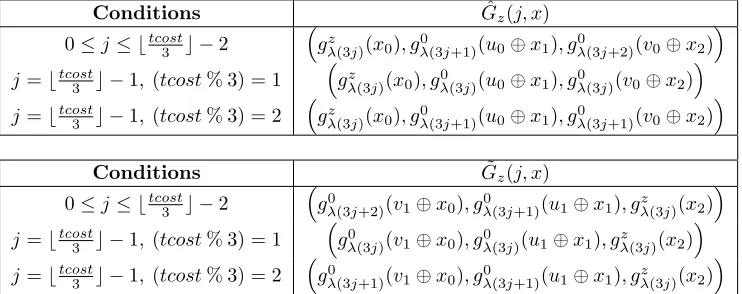
For each j∈J ={j: 0≤j≤ btcost
3 c −1} andz∈Zt1, define
Gz,j = gz
λ(3j), g 0
λ(3j+1), g 0
λ(3j+2)
if 0≤j≤ btcost
3 c −2,
gz
λ(3j), g 0
λ(3j), g 0
λ(3j)
if j=btcost
3 c −1 and (tcost% 3) = 1,
gz
λ(3j), g 0
λ(3j+1), g 0
λ(3j+1)
if j=btcost
3 c −1 and (tcost% 3) = 2.
wheregz
` =E7,(X`⊕z,X`+1,X`+2,···,X`+7), for all 0≤`≤t0−8.
Further, for fixedz∈Zt1, let ˆGz,Gz˜ :J×Z
384
2 →Z3842 denote the
Conditions Gz(j, x)ˆ 0≤j≤ btcost
3 c −2
gz
λ(3j)(x0), gλ0(3j+1)(u0⊕x1), gλ0(3j+2)(v0⊕x2)
j=btcost
3 c −1, (tcost% 3) = 1
gz
λ(3j)(x0), g 0
λ(3j)(u0⊕x1), g 0
λ(3j)(v0⊕x2)
j=btcost
3 c −1, (tcost% 3) = 2
gz
λ(3j)(x0), g 0
λ(3j+1)(u0⊕x1), g 0
λ(3j+1)(v0⊕x2)
Conditions Gz(j, x)˜ 0≤j≤ btcost
3 c −2
g0
λ(3j+2)(v1⊕x0), g 0
λ(3j+1)(u1⊕x1), g
z λ(3j)(x2)
j=btcost
3 c −1, (tcost% 3) = 1
gλ0(3j)(v1⊕x0), g0λ(3j)(u1⊕x1), gzλ(3j)(x2)
j=btcost
3 c −1, (tcost% 3) = 2
gλ0(3j+1)(v1⊕x0), g0λ(3j+1)(u1⊕x1), gzλ(3j)(x2)
Table 3: Values forGz(j, x) = ˆˆ Gz,j(x)andGz(j, x) = ˜˜ Gz,j(x)for allx∈Z3842
wherex= (x0, x1, x2)∈Z3842 ,u0=gλz(3j)(x0),u1=gzλ(3j)(x2),
v0=
(
g0λ(3j)(u0⊕x1) if j =btcost3 c −1 and (tcost% 3) = 1,
g0λ(3j+1)(u0⊕x1) otherwise,
and
v1=
( g0
λ(3j)(u1⊕x1) if j =b
tcost
3 c −1 and (tcost% 3) = 1,
g0
λ(3j+1)(u1⊕x1) otherwise.
Finally, forz∈Zt1, defineG
X
z :J ×Z3842 →Z3842 by
GXz(j, x) =
ˆ
Gz,j(x) if j ∈ {0,2,4,6,· · · }, ˜
Gz,j(x) if j ∈ {1,3,5,7,· · · }, = GXz,j(x),
for allj∈J andx∈Z384 2 .
Then, for anyz∈Zt1, the last (or inner) for loopofS2can be written as btcost3 c−1
j=0 G
X z,j.
Claim 4.9. The transformations Gz,j,ˆ Gz,j˜ :Z3842 →Z 384
2 for fixed j ∈J and
z∈Zt1 are permutations.
Proof. We prove by contradiction.
Suppose there exists x = (x0, x1, x2) 6= y = (y0, y1, y2) ∈ Z3842 such that
ˆ
Gz,j(x) = ˆGz,j(y), 0≤j≤ btcost
3 c −2. Then we must have that
gλz(3j)(x0) = gzλ(3j)(y0),
g0λ(3j+1)(u0⊕x1) = g0λ(3j+1)(u0⊕y1),
which impliesx0=y0,x1=y1 andx2=y2, a contradiction.
Similar analysis for the case j =btcost
3 c −1 shows that ˆGz,j(x) 6= ˆGz,j(y)
wheneverx6=y ∈Z3842 and the result follows from the size of the co-domain.
The proof for ˜Gz,j is similar.
Therefore, the final twofor loopsare clearly a permutation onZ384 2 .
Claim 4.10. Repeated cycles in the last two for loopsofS2 are unlikely.
Proof. From the above discussion, the last twofor loopsofS2can be written as
t1−1
z=0
btcost3 c−1
j=0 G
X z,j
.
There are two options. Either the adversary takes advantage of repeated cycles withinbtcost3 c−1
j=0 G
X z,j
for fixedz which allows it to iteratively apply the cycles through allz∈Zt1. Alternatively, the adversary might target a cycle
over multiplez∈Zt1 i.e. over some position(s) (j, j
0
) (not necessarily distinct) in different iteration rounds say (z, z0), z 6= z0, which allows it to iterate the sequence through allz∈Zt1 (or just a substantial part thereof).
For brevity, the first option requires at least one complete cycle to occur before the last run ofGXz or the adversary acquires trivial complexity gain.
Clearly, each ˆGz,j and ˜Gz,j, 0≤j ≤ btcost
3 c −2, is based on three distinct
permutations on 128 bits (i.e. the three component functions ofGz,j) by Claim 4.4. Further, each permutationgz`, z∈Zt1, 0≤`≤t0−8, has a key space of
size at least
2128·(2128−1)·(2128−2)· · ·(2128−7) = 2
128!
(2128−8)!
by Claim 4.2 and Claim 4.3 (for example, one should consider the effect of moving the salt value through the entire salt space - 2256elements - for fixedT
[and fixed password] and applying Claim 4.8).
Therefore, we expect each ˜Gz,j+1◦Gˆz,j or ˆGz,j+1◦G˜z,j, 0≤j≤ btcost3 c −2, to have a key space of at least
2128·(2128−1)·(2128−2)· · ·(2128−47) =
2128!
(2128−48)!
,
since ˆGz,j+µ and ˜Gz,j+µ, µ ∈ {0,1} are distinct permutations for all 0 ≤j ≤
btcost
3 c −2 andz∈Zt1.
Thus, for fixedz∈Zt1, if either
˜ GGˆ=
˜
Gz,j+1◦Gˆz,j: 0≤j≤ b tcost
3 c −2
,
or
ˆ GG˜=
ˆ
Gz,j+1◦Gz,j˜ : 0≤j≤ b
tcost 3 c −2
(depending on the adversary’s plan of attack) were a group or subgroup of an even larger group it would have size at least(21282128−48)!!
, sincezsimply permutes the key space. Hence, one expects a cycle to occur with high probability after
2192= min (
2·
2128!
(2128−48)!
12
,23842
)
successive iterations ofGX z [12].
However, the maximum number of iterations of GX
z for fixed z∈Zt1 inS2
is only
dtcost
3 e < 2
27.
In particular, assumingGX
z (for fixedz) is a random function of its inputs, the probability of a collision in thev values is at most
227·2 2385 = 2
−331.
However, after any such collisions, each successiveGz,jthe repeatedv value encounters is component wise distinct by Claim 4.4, hence each repeat of pre-vious values occurs with probability 2−384 by Claim 4.1. Therefore, even very
short repeated sequences are unlikely using this method.
On the other hand, an adversary that targets cycles across multiplez∈Zt1,
requires a collision across those z ∈ Zt1 which leads into a repeated sequence
over allt1iterations or just a majority of them.
However, we note that for 0≤j≤ btcost
3 c −2,
ˆ
Gz(j, x) =
gλz(3j)(x0), gλ0(3j+1)(u0⊕x1), gλ0(3j+2)(v0⊕x2)
,
= gλ0(3j)(x0⊕z), gλ0(3j+1)(u0⊕x1), gλ0(3j+2)(v0⊕x2)
,
= Gˆ0(j, x⊕vz),
wherevz= (z,0,0)∈Z3842 . Similarly, ˆGz(j, x) = ˆG0(j, x⊕vz) forj=btcost3 c−1.
Therefore, ˆGz,j(x) = ˆG0,j(x⊕vz) for all z ∈Zt1, 0≤j ≤ b
tcost
3 c −1 and
x ∈ Z384
2 . Similar analysis leads to ˜Gz(j, x) = ˜G0(j, x⊕uz) for all 0 ≤ j ≤
btcost
3 c −1 wherex, uz= (0,0, z)∈Z3842 andz∈Zt1.
Thus by [9], for allz6=z0,
P rhGˆz(j, x) = ˆGz0(j, x) i
=P rhG˜z(j, x) = ˜Gz0(j, x) i
= 0,
Therefore, even very short repeated sequences are unlikely using this method.
However, this is merely an instance of the more general problem of exploiting repeating sequences in keyed functions with a non-repeating key stream - the ad-versary has noaprioriknowledge or control of collisions forcing re-computation of repeating values. In short, if the key stream does not repeat, the adversary must re-compute every successive element of the sequence (including those it observes to be repeating) which eliminates any realistic complexity gain.
Clearly, by the arguments of Claim 4.10, one can viewt1−1
z=0
btcost3 c−1
j=0 GXz,j
as a composition of t1× btcost3 c distinct permutations. Therefore, non-trivial
adversarial complexity gain through exploiting cycles inF is unlikely for fixed i∈I andp∈PA.
4.3
Properties of
F
Lemma 4.1. For any fixed i ∈ I, fi◦S2,i : PA → Z5122 is a strong one-way
function, whereS2,i(p) =S2(i, p)∈Z3842 for allp∈PA.
Proof. LetEi
20:PA×Z1282 →Z1282 for fixedi∈I be the permutation (for fixed
p∈PA) onZ1282 defined by
Ei
20(p, x) =E20◦ ϕ320◦S2,i◦P12, P 2 2
(p, x) where P2
j is the projective map on 2 elements, j ∈ {1,2}, (p, x)∈ PA×Z1282
andE20is the AES-like permutation defined in Section 2.2.
Clearly, for fixedi∈I, one can model the success probability for single key attacks againstEi
20 on those from the AES algorithm over 20 rounds. For the
key schedule specific attacks, we have the following.
First, we claim that (for fixed i) pairs of equivalent passwords in Ei
20 are
unlikely. In short, sinceϕ3N r admits no equivalent keys for allN r≥9 by Claim 2.3, we need to show that for all x6=y ∈PA there exists a negligible function ν such that
P r[S2(i, x) =S2(i, y)]≤ν(log2|PA|).
By Claim 2.1, Claim 2.2, Claim 4.1, and Claim 4.8, we have that P r[S2(i, x) =S2(i, y)] = P r[V(i, x) =V(i, y)]
= 2−384, where for anyw∈PA,
V(i, w) = Eˆ3 20,ϕ3
20(keyw)◦
t1−1
z=0
btcost3 c−1
j=0 G
Xw
z,j
◦ U(v),
U = E˜3 20,ϕ3
20(X0w,X1w,X2w)◦
ˆ
E3 7,(Xw
Xwis theX-array forw,v= (0,0,0)∈Z3842 andkeyw=w||0
384−|w|. Therefore,
pairs of equivalent passwords are unlikely.
Second, we claim that for fixedi, related-password attacks are unlikely. This follows from Claim 2.4 and Claim 4.7. Finally, we claim that for fixed i, the Biclique attack on Ei
20 is unlikely. This follows from the high diffusion and
nonlinearity inϕ3
20 plus some element of one-wayness in ϕ320 for the necessary
few roundsover which propagation of detectable differences is likely [4].
Moreover, the use of round constants ensures that the symmetry of the round function is eliminated. Therefore, high probability key schedule attacks against
Ei
20for fixediare unlikely.
For brevity, letg=fi◦S2,iandi∈Ibe fixed. Then, for anyx6=y∈PA, P r[g(x) =g(y)] = P r[g(x) =g(y)|S2(i, x) =S2(i, y)]·P r[S2(i, x) =S2(i, y)]
+P r[g(x) =g(y)|S2(i, x)6=S2(i, y)]·P r[S2(i, x)6=S2(i, y)]
whence,
P r[fi◦S2,i(x) =fi◦S2,i(y)] = 2−384+ 2−512·(1−2−384)
≤ 2−384(1 + 2−128).
Therefore, for any randomy∈PA, we must have that (on average)
|{x∈PA:x6=y, fi◦S2,i(x) =fi◦S2,i(y)}|
|PA| −1
≤2−384(1 + 2−128).
Hence,
|{x∈PA:x6=y, fi◦S2,i(x) =fi◦S2,i(y)}| ≤(|PA| −1)· 2−384(1 + 2−128)
.
Therefore, we claim that for fixedi
AdvprfEi
20
(At0,4) ≤ c1
t0/Tfi◦S2,i · (|PA| −1)·2
−384(1 + 2−128) + 1
|PA| +
12 2129
≤ c1
t0/Tfi◦S2,i ·
(1− 1
|PA|)·(1 + 2
−128) + 1
2384 +
12 2129
for any PRF adversaryAthat makes at most 4 oracle queries and runs in time at mostt0 =
o
log2(|PA|) + 128 + 128 +Tfi◦S2,i
, whereTfi◦S2,i is the time for
a single execution of fi◦S2,i (about 4 encryption runs of E20 plus one run of
the key schedule,ϕ3
20◦S2,i) andc1∈ {0,1}[9].
On the other hand, for any inverterhforfi◦S2,i, define
Advowff
i◦S2,i,h(t) =P r
h
fi◦S2(i, k 0
) =y; k←−$ PA; y=fi◦S2(i, k); k 0
=h(y)i
Clearly, for any inverterhof fi◦S2,i, we can construct a prf-adversary A for
Ei
20as follows.
AdversaryAf
Computey= (f(C0), f(C1), f(C2), f(C3))
Runhto obtaink0 =h(y) Iffi◦S2,i(k
0
) =ythen Return 1
else
Return 0
SinceAhas oracle access to the function instancefof eitherEi
20or Rand 128→128
it can computey =f(x) for any x∈Z128
2 . Therefore, it can run has a
sub-routine which recovers the key with probabilityAdvowff
i◦S2,i,h(t) wheneverf is an
instance ofEi
20and where tis the maximum running time forh.
Moreover, sincefi◦S2,iis a public function,Acan computefi◦S2,i(k 0
) to confirm the result [1].
Therefore,
P r[f ←− E$ i
20:A
f= 1] = Advowf fi◦S2,i,h(t)
P r[f ←−$ Rand128→128:Af= 1] = 1 2512
Thus, we must have,
Advprf
Ei
20
(A) = P r[f ←− E$ 20i :A
f = 1]
−P r[f ←−$ Rand128→128:Af = 1] = Advfowf
i◦S2,i,h(t)−
1 2512.
Therefore,
Advprf
Ei
20
(4, t0) + 1
2512 ≥ maxh {Adv
owf
fi◦S2,i,h(t)}
= Advowff
Hence, by Proposition 2.5 of [1],
Advowff
i◦S2,i(t) ≤
t0/Tfi◦S2,i· (|PA| −1)·2
−384(1 + 2−128) + 1
|PA|
+ 12 2129 +
1 2512
≤ t
0
/Tfi◦S2,i· (|PA| −1)·2
−384(1 + 2−128) + 1
|PA|
+ 13 2129
= t/Tfi◦S2,i· (|PA| −1)·2
−384(1 + 2−128) + 1
|PA|
+ 13 2129
+Q/Tfi◦S2,i· (|PA| −1)·2
−384(1 + 2−128) + 1
|PA|
≤ t/Tfi◦S2,i· (|PA| −1)·2
−384(1 + 2−128) + 1
|PA| +ε
wheret0 =t+Q,Q=
o
log2(|PA|) + 128 + 128 +Tfi◦S2,i
andεis some fixed constant [1, 9].
Therefore,fi◦S2,iis a strong one-way function i.e. for log2|PA|large enough,
Advowff
i◦S2,i(t) is a negligible function oftand log2|PA|(ε, for example, becomes
asmall constant).
In short, we are claiming that no PRF adversary forEi
20 using 4 plaintexts
apart from the birthday paradox exists i.e. according to current literature on attacks against the AES [4, 5].
Proposition 4.2. The collection of functionsF ={fi:Z3842 →Z 512
2 }i∈I, with
S1 and S2 as defined above is a collection of strong one-way functions under
non-parameter modifying adversaries.
Proof. Follows from Lemma 4.1.
Proposition 4.3. The collection of functionsF ={fi:Z2384→Z5122 }i∈I, with
S1 and S2 as defined above is a collection of strong one-way functions under
parameter modifying adversaries.
Proof. First, we consider related-salt attacks.
Clearly, by Claim 2.4 such attacks are unlikely since the attacker is unlikely to transition non-trivial salt differences throughϕ2
20. Further, by Claim 4.8 and
the differential propagation ratio of E4,ϑ4(0) a related-salt attack against F is
unlikely.
For related-T attacks, it is clear that
t1−1
z=0
btcost3 c−1
j=0 G
X z,j
6
=t
0
1−1
z=0
btcost
0
3 c−1
j=0 G
X0 z,j
for any distinct pairs of time parameters, (t0, t1) and (t 0 0, t
0
1). Therefore, in
gen-eral, related-T attacks present two inequivalent permutations to the adversary which by Claim 4.1 and Claim 4.10 ensures the results are only related by some probability function - since the output ofS2 does not interact directly with the
plaintexts and, thus, with the output ofF. However, we need to assess the ad-versarial complexity gain through computation of fixed password and salt values under distinct time parameters [27].
Clearly, assuming fixed salt and password values, each (t0, t1)∈T changes
each of the first four entries of theX-array. Therefore, by arguments of Claim 4.7, every set of four consecutive entries of the X-array for any two distinct T values will be distinct which ensures all theGz,j values are component wise distinct between the pairs. On the other hand,E4,ϑ4(0) ensures that such
differ-ences have very high propagation ratio over the entiret0≥220 elements of the
X-array.
Therefore, by the arguments in and after Claim 4.10, the adversary needs to re-compute the final twofor loopsofS2 for each element in the pair.
Combined attacks encounter similar problems as the adversary needs to suc-cessfully mount a high probability related key attack againstE20 with salt
dif-ferences as key difdif-ferences andT XOR differences as plaintext differences before finally navigating through the changing last two for loopsenvironment. How-ever, this is unlikely by Claim 2.4.
Therefore, related-I attacks are unlikely.
Lemma 4.4. The M3dcrypt password hashing function F achieves near ideal
security for any non-uniform password distributionD.
Proof. We need to show thatFis a (t, )-secure password hashing function where
is as close to |Pt
A| as possible under the uniform distribution (see Theorem 1.2
in Section 1.2).
By Lemma 4.1, F is a (t, )-secure password hashing function under the uniform distribution, where
= t· (|PA| −1)·2
−384(1 + 2−128) + 1
|PA|
≤ t·(2 + 10
−38)
|PA| .
5
Implementation Issues
5.1
Software Implementation
The M3dcrypt password scheme is designed to exploit the high efficiency Ad-vanced Encryption Standard New Instructions (AES-NI) through a design that makes extensive use of the AES encryption round function (AESENC).
Therefore, M3dcrypt admits efficient implementation on all platforms in-cluding those with modern features such as Single Instruction Multiple Data (SIMD) and multicore CPUs [6, 2].
For completion, an example non-AES-NI implementation on a 1.6 GHZ Intel Core 2 Duo Processor running the GCC compiler completes 4.742 evaluations of M3dcrypt per second (using minimum parameters i.e. t= (220,1) ∈T). In comparison, at creation in 1977 [21],cryptcould be evaluated about 3.6 times per second on a VAX-11/780.
5.2
Hardware Implementation
The availability of large random access memory (RAM) on general purpose mi-croprocessors shifts the implementation bottleneck from random access memory (RAM) to optimal implementation of the cryptographic primitive.
On the contrary, we can assume that efficient hardware for primitives in wide spread use exist (e.g. standardised algorithms such as the AES). Possi-bilities for further optimisation (e.g. external pipelining and/or other extensive parallelism) are contingent on the availability and cost of RAM.
However, by Claims 4.2, 4.3 and 4.6, the high entropyX array ensures that extensive time/memory trade-offs increase the number of auxiliary computa-tions required to process furtherXk values, 0≤k≤t0−1, in the computation
ofv= (v0, v1, v2)∈Z3842 .
Therefore, assuming large memory requirement forX, massively parallel key search machines may be [area-time] costly [20, 13].
6
Dedication
To one in whom all things are at once both meaningful and meaningless, all labours both futile and glorious; and to another of whom I presumed to know
much, yet perceived little until the pulling down of this tent.
7
Conclusion
We have described a new password hashing function which is secure as long as
E20◦ ϕ320◦S2,i◦P12, P22
:PA×Z128
2 →Z1282 is a secure PRF for all adversaries
References
[1] M. Bellare, J. Killian and P. Rogaway, The Security of the Cipher Block Chaining Message Authentication Code, Journal of Computer and System Sciences, Vol. 61 No. 3, pp. 362-399, 2000.
[2] R. Benadjila,Use of the AES Instruction Set, ECRYPT II AES Day, Oc-tober 2012.
[3] E. Biham and A. Shamir,Differential cryptanalysis of DES-like cryptosys-tems, Journal of Cryptology, 4, 1, pp. 372, 1991.
[4] A. Bogdanov, D. Khovratovich and C. Rechberger,Biclique Cryptanalysis of the Full AES, ASIACRYPT 2011, LNCS 7073, pp. 344-371, 2011. [5] J. Daemen and V. Rijmen,On the Related-key Attacks Against AES,
Pro-ceedings of the Romanian Academy, Series A, Volume 13, Number 4/2012, pp. 395400, 2012.
[6] J. Daemen and V. Rijmen, AES Proposal: Rijndael, AES Submission, http://www.nist.org/aes, 1999.
[7] C. Davis and R. Ganesan,BApasswd: A New Proactive Password Checker, 16th National Computer Security Conference, September 1993.
[8] J. Gallier and A. Hicks, The Theory of Languages and Computation, Lecture Notes, University of Pennsylvania, http://www.cis.upenn.edu/ jean/gbooks/toc.pdf, Accessed December 2014.
[9] S. Goldwasser and M. Bellare,Lecture Notes on Cryptography, July 2008. [10] T. Jiang et al, Formal Grammars and Languages, http://www.cs.ucr.edu/ jiang/cs215/tao-new.pdf, Accessed December 2014.
[11] B. Kaliski,PKCS #5: Password-Based Cryptography Specication Version 2.0, RFC 2898, 2000.
[12] B. Kaliski et al, Is the Data Encryption Standard a Group? (Results of Cycling Experiments on DES), International Association for Cryptologic Research, Journal of Cryptology, Vol. 1, pp. 3-36, 1988.
[13] J. Kelsey, B. Schneier, C. Hall and D. Wagner,Secure Applications of Low-Entropy Keys, Proceedings of the First International Workshop ISW 97, Springer-Verlag, 1998.
[15] D. Klein.Foiling the Cracker: A Survey of and Improvements to Password Security, Proceedings, UNIX Security Workshop II, August 1990.
[16] H. Krawczyk,Cryptographic Extraction and Key Derivation: The HKDF Scheme, Crypto’2010, LNCS 6223, 2010.
[17] R. Morris and K. Thomson,Password Security: A Case History, Commu-nications of the ACM, Vol. 22 No. 11, November 1979.
[18] NIST, FIPS-197: Advanced Encryption Standard, Na-tional Institute of Standards and Technology (NIST), http://csrc.nist.gov/publications/fips/fips197/fips-197.pdf, November 2001.
[19] S. Park, S. H. Sang, S. Lee, and J. Lim, Improving the Upper Bound on the Maximum Differential and the Maximum Linear Hull Probability for SPN Structures and AES, Fast Software Encryption 2003, LNCS 2887, pp. 247-260, Springer-Verlag, 2003.
[20] C. Percival and S. Josefsson,The Scrypt Password-Based Key Derivation Function, IETF Internet Draft, 2012.
[21] N. Provos and D. Mazieres. A Future-Adaptable Password Scheme, USENIX Annual Technical Conference, USENIX 99, The Advanced Com-puting Systems Association, 1999.
[22] V. Rijmen and P. Barreto. The Anubis Block Cipher, Submission to the NESSIE Project, March 2000.
[23] B. Schneier. Applied Cryptography: Protocols, Algorithms, and Source Code in C, John Wiley & Sons, Second Edition, 1996.
[24] W. Stallings.Cryptography and Network Security: Principles and Practice, Prentice Hall, Second Edition, 1998.
[25] D. R. Stinson,Cryptography: Theory and Practice, Second Edition, Chap-man & Hall, 2002.
[26] D. Wagner and I. Goldberg, Proofs of Security For The UNIX Password Hashing Algorithm, In Advances in Cryptology - Asiacrypt 00, Springer-Verlag, 2000.
![Table 2: Probabilities [of combinations] of repeated sequences in X.](https://thumb-us.123doks.com/thumbv2/123dok_us/7910288.1313428/23.612.163.447.459.569/table-probabilities-combinations-repeated-sequences-x.webp)