Partial Garbling Schemes and Their Applications
Yuval Ishai⋆and Hoeteck Wee⋆⋆
1 Technion, Haifa, Israel 2 ENS, Paris, France
Abstract. Garbling schemes (aka randomized encodings of functions) represent a functionF by a “simpler” randomized function ˆF such that ˆF(x) revealsF(x) and no additional information aboutx. Garbling schemes have found applications in many areas of cryptography. Motivated by the goal of improving the efficiency of garbling schemes, we make the following contributions:
– We suggest a general new notion ofpartial garbling which unifies several previous notions from the literature, including standard garbling schemes, secret sharing schemes, and “conditional disclosure of secrets”. This notion considers garbling schemes in which part of the input is public, in the sense that it can be leaked by ˆF.
– We present constructions of partial garbling schemes for (boolean and arithmetic) formulas and branching programs which take advantage of the public input to gain better efficiency.
– We demonstrate the usefulness of the new notion by presenting applications to efficient attribute-based encryption, delegation, and secure computation. In each of these applications, we obtain either new schemes for larger classes of functions or efficiency improvements from quadratic to linear. In particular, we obtain the first ABE scheme in bilinear groups for arithmetic formulas, as well as more efficient delegation schemes for boolean and arithmetic branching programs.
1 Introduction
There are many situations in cryptography where one is interested in computing some functionF of a sensitive inputxbut the computational model is restricted so that only “simple” functionsF can be directly computed. For instance, the entries of x may be encrypted so that onlyaffine functions can be computed, or they may be distributed between multiple non-interacting parties so that onlylocal
functions can be computed.
A common approach for handling more complex functionsFin such situations is to relax the usual notion of computation. This is done by: (1) settling for computing some function ˆFwhose outputencodes
the output ofF (and reveals nothing else about the input), and (2) allowing the latter encoding to be
randomized. That is, the randomized function ˆF(x) should satisfy the simplicity constraint (e.g., being affine) for every fixed choice of the randomness,3 and moreover its output distribution on an input
x should revealF(x) and no additional information aboutx. The function ˆF is often referred to as a
randomized encodingor agarbling schemeforF.
To give a simple example, letF(a,b)=abwhereaandbare elements of a finite field. Then an affine garbling scheme forFcan be defined by ˆF(a,b)=((a−ra), (b−rb),arb+bra−rarb), whereraandrbare ⋆[email protected]. Research received funding from the European Union’s Tenth Framework Programme (FP10/2010-2016) under grant agreement no. 259426 ERC-CaC. Also supported by ISF grant 1361/10 and BSF grant 2012378. ⋆⋆[email protected]. CNRS (UMR 8548) and INRIA. Supported in part by the French ANR-12-INSE-0014 SIMPATIC Project and NSF Awards CNS-1237429 and CNS-1319021. Part of this work was done while visiting the Technion, supported by ERC-CaC. 3Some applications require that ˆFbe “simple” even as a function of bothxand the randomness; however, in this work we will
random and independent field elements. Note that ˆF is an affine function of the input (a,b) for every fixed choice ofra,rb. Moreover,F(a,b) can be recovered from the output (c,d,e) of ˆF(a,b) by computing cd+e. Finally, the output (c,d,e) of ˆF is distributed uniformly subject to the constraint thatcd+e=ab
and hence it reveals no additional information about (a,b) other thanab.
Garbling schemes have found applications in many areas of cryptography and elsewhere (see [38, 16, 25, 3, 2, 7, 33] and references therein). Starting with Yao’s celebrated garbled circuit construction, different constructions of garbling schemes have been proposed for circuits and other representation models. However, these constructions still have theoretical and practical limitations. In particular, they do not efficiently generalize to arithmetic computations (despite progress in [5]) and even in the boolean case their asymptotic and concrete efficiency leave much to be desired. Furthermore, some of the best garbling schemes do not satisfy all of the structural properties that are needed by applications.
1.1 New notion: Partial garbling
This work is motivated by the observations that (1) in many applications of garbling schemes, most of the input is already known to the designated receiver of the encoded output, and (2) known constructions do not take advantage of this fact for improving efficiency.
We suggest a general new notion of partial garbling which relaxes standard garbling by allowing part of the input to be public. This notion can be viewed as unifying several previous notions from the literature, including standard garbling schemes, secret sharing schemes [35, 27], and conditional disclosure of secrets [20].
Consider for instance the case of secret sharing. Here, we want to disclose a secret if and only if the attributes of the parties satisfy a given predicate referred to as the access structure; however, it is okay to leak information about the individual attributes, which we think of as being “public”. Note that “public” does not mean “known to everyone” or “must be revealed by the garbling” but rather “okay to leak by the garbling” and known to the reconstruction algorithm. For this reason, partial garbling cannot be viewed as a special case of standard garbling.
As another example, consider a client who has her data x distributed between several servers. Suppose that the servers wish to disclose a secretsto the client only ifP(x)=1 for some publicly known predicateP. That is, they would like to reveal to the client the functionF(x,s)=P(x)·s. Note that from the client’s point of view,xis public input forFwhereassis a secret input. Now, suppose we are given alocal
partial garbling scheme ˆF(x,s) forF, namely one where each output depends only on the view of a single server. The partial garbling ˆFcan be used by the servers to conditionally disclosesto the client by each sending her a single message. This “conditional disclosure” primitive serves as a useful building block in both two-party and multi-party cryptographic protocols, where it can often serve as a light-weight, non-interactive substitute for zero-knowledge proofs [20, 1, 37, 15, 11, 12].
Typical applications of garbling schemes, including those illustrated above, require that the garbling be “affine” and/or “local” with respect to the public inputs. This additional requirement rules out the trivial solution of garbling a restriction ofFto the private inputs.
In cases where the private input is small, as is the case for essentially all of our motivating applica-tions, we improve the size of the garbling from quadratic to linear in the size of the formula or branching program; we also obtain a corresponding efficiency improvement in the applications. Boolean and arithmetic formulas and branching programs capture many functions of interest, including arithmetic computations like sparse polynomials, mean, and variance, as well as combinatorial computations like string-matching, finite automata and decision trees.
Our partial garbling schemes are “affine” and “local” with respect to the public inputs; indeed, all of our applications exploit this property. As mentioned earlier, this means that we cannot simply garble the original function hardwired with the private inputs. Instead, we start with the randomized encoding scheme for ABPs in [26]. Roughly speaking, this prior construction works by multiplying the adjacency matrix for the branching program by random upper triangular matrices on both the left and the right. Our construction uses a subgroup of upper triangular matrices with fewer non-zero entries (corresponding to the private inputs). This means that the size of the garbling is roughly the number of private inputs times the size of the branching program. Therefore, when the number of private inputs is constant (or “local”), the size of the garbling improves from quadratic to linear. In particular, we achieve linear-size garbling for functions of the formF(x,s)=P(x)·sandF(x, (s1,s2))=s1P(x)+s2wherePis an ABP acting
on a public inputx; these are precisely the functions we consider for several of our applications.
Comparison with standard garbling techniques.We note that standard garbling is a special case of partial garbling where all input is private. In the other direction, there is a general reduction from partially garblingF(x,z) wherex is public and z is private to garblingF′(x,z) :=(x,F(x,z)). However, the cost of the reduction can be significant. Take the example whereF is identically 0. Then, a partial garbling scheme can output nothing whereas a standard garbling ofF′must revealx.
Unlike Yao’s garbling technique and its variants, our constructions cannot handle general circuits and are restricted to weaker computational models. However, they do offer a number of significant advantages: (i) they do not rely on computational assumptions and can be used in the context of information-theoretic cryptography; (ii) they work in an arithmetic model of computation, where the number of field operations is independent of the field size; (iii) they satisfy the “linear reconstruction” property required by several applications below; (iv) they have better concrete efficiency for natural functionsFthat admit compact representations by formulas and branching programs.
1.2 Applications
We demonstrate the usefulness of our new notion and constructions by presenting applications to efficient attribute-based encryption (ABE) [34, 23], delegation [21, 19], and secure computation [24, 20]in Sections 5, 6, 7. More broadly, partial garbling can be applicable in many cryptographic settings in which there are computations that mix public inputs with private inputs. In each of the applications we consider, we obtain either new schemes for larger classes of functions or efficiency improvements from quadratic to linear:
– For ABE, we extend prior pairing-based schemes for boolean formulas and branching programs [23, 22] to arithmetic branching programs.
We proceed with an overview of the applications to delegation and ABE.
Delegation and verifiable computation.In verifiable computation (VC), a computationally weak client with inputxwishes to delegate a complex computationf to an untrusted server, with the assurance that the server cannot convince the client to accept an incorrect computation [21, 19, 4, 9]. We focus on the online/offline setting, where the protocol proceeds in two phases. In the offline phase, the client sends to the server a possibly long message that may be expensive to compute. Later on, in the online phase (when the inputxarrives), the client sends a short message to the server, and receives the result of the computation together with a certificate for correctness. We are interested in protocols where the client’s communication and computational complexity in the online phase depend only on the input and output lengths and is independent of the complexity off.
Our VC schemes build upon the garble+MAC paradigm in [4], which derives a VC protocol by garbling the function obtained by composing f with a one-time MAC. Our key observation is that it suffices to use a partial garbling scheme where the public input isxand the private input is the MAC key. Using our partial garbling schemes, we then derive more efficient online/offline VC protocols for arithmetic branching programs (ABPs), reducing the complexity of previous protocols from quadratic to linear in the size of the program. We note that ABPs simultaneously capture several classes of functions considered in the literature on delegation, including boolean formulas in [19, 32] and sparse arithmetic polynomials in [9].
Theorem 1 (informal).Assuming the existence of a PRG, there is an online/offline VC protocol for arithmetic branching programs with the following efficiency features. The complexity of the server and the client’s offline phase is s·poly(λ)and that of the client’s online phase is n·poly(λ), where n is the input length, s is the size of the ABP, andλis the security parameter.
In [4], the complexity of the server and the client’s offline phase iss2·poly(λ). We also obtain a smaller improvement for boolean formulas; see Section 6 for details.
Attribute-based encryption. Attribute-based encryption (ABE) [34, 23] is a new paradigm for public-key encryption that enables fine-grained access control for encrypted data. In ABE, ciphertexts are associated with descriptive valuesxin addition to a plaintext, secret keys are associated with predicates
P, and a secret key decrypts the ciphertext if and only ifP(x)=1. Here, P may express an arbitrarily complex access policy, which is in stark contrast to traditional public-key encryption, where access is all or nothing. The security requirement for ABE enforces resilience to collusion attacks, namely any group of users holding secret keys for different functions learns nothing about the plaintext if none of them is individually authorized to decrypt the ciphertext.
We present the first ABE that directly handles a large class of predicates over arithmetic domains as described by arithmetic branching programs. This is particularly useful in settings where identities or attributes come from a universe of exponential size, since we can avoid the overhead from using bit encodings, as with the case for the Boneh-Boyen identity-based encryption [13].
Theorem 2 (informal).Suppose the decisional bilinear Diffie-Hellman assumption holds. Then, there exists a (selectively secure) ABE scheme for the class of arithmetic branching programs.
well as (public-index) inner product and non-zero inner product predicates [29, 6]. Prior to this work, we do not know any ABE schemes in bilinear groups supporting the class of ABPs. We could of course appeal to lattice-based ABE for general circuits [22, 17], though simulating an ABP using a boolean circuit incurs a substantial overhead in concrete efficiency.
At a high level, our construction follows the approach of Goyal et al. [23] for building ABE for monotone Boolean formula from linear secret-sharing schemes. The difficulty with extending this approach to arithmetic branching programs is that there is no natural analogue of LSSS for arithmetic functionalities. Instead, we observe that it suffices to use partial garbling with linear reconstruction, which we do obtain for arithmetic branching programs. Intuitively, the descriptive value x on the ABE ciphertext corresponds to the public input in partial garbling, and the plaintext/master secret key corresponds to the private input.
The running time of the encryption algorithm depends only on the input length to the ABP and not the size of the ABP. As such, exploiting the connection between ABE and delegation in [32] and using the fact that we handle both Z-ABP and N-ABP, we obtain a publicly verifiable delegation scheme for ABPs. This scheme requires a stronger assumption than the offline/online VC in Theorem 1, but achieves a stronger soundness requirement with reusability.
Finally, our construction yields an unconditionally secure witness encryption scheme [18] for algebraic languages corresponding to vectors of group elementsgwsuch thatP(w)=0 for a fixed ABPP. For instance, this captures ElGamal public key and ciphertext pair (pk,C) such thatCis an encryption of 0 or 1; see [12, 8, 10] for additional examples of such languages. The construction follows essentially from conditional disclosure of secrets schemes for the same predicate, along with the fact that reconstruction is linear.
Related work.In an independent work, Boneh et al. [14] constructed ABE for arithmetic circuits under the LWE assumption; they only handle the “is zero” predicate (i.e., decryption is possible exactly when the output of the circuit is zero), whereas our construction also handles the “is non-zero” predicate. Handling a class that is closed under complement is useful for applications such as publicly verifiable delegation [32], as noted in the preceding paragraph.
2 Preliminaries
Notation.We denote bys←RS the fact thatsis picked uniformly at random from a finite setSand by x,y,z←RSthat allx,y,zare picked independently and uniformly at random fromS. By PPT, we denote a probabilistic polynomial-time algorithm. Throughout, we use 1λas the security parameter.
Arithmetic branching programs.Abranching programis defined by a directed acyclic graph (V,E), two special verticesv0,v1∈V and a labeling functionϕ. Anarithmetic branching program(ABP)4over a finite
fieldFq computes a function f :Fqn→Fq. Here,ϕassigns to each edge inE an affine function in some
input variable or a constant, andf(x) is the sum over allv0-v1paths of the product of all the values along
the path. We refer to|V|+|E|as thesizeof the ABP. Ishai and Kushilevitz [24, 26] showed how to relate an ABP computation to that of computing the determinant of a matrix (see Figure 1 for an example).
Lemma 1 ([26, Lemma 1]).Given an ABPΓ=(V,E,v0,v1,ϕ)computing f :Fnq →Fq, we can efficiently (and deterministically) compute a function L(x)mapping an input x∈Fnq to a(|V| −1)×(|V| −1)matrix overFq, such that:
– det(L(x))=f(x);
– each entry of L(x)is a degree one polynomial in a single variable xi;
– L(x)contains only−1’s in the second diagonal (the diagonal below the main diagonal) and0’s below the second diagonal.
Specifically, L is obtained by removing the column corresponding to v0and the row corresponding to v1in the matrixA−I, whereAis the adjacency matrix forΓ.
We note that there is a linear-time algorithm that converts any boolean formula, boolean branching program or arithmetic formula to an arithmetic branching program with a constant blow-up in the representation size. Thus, ABPs can be viewed as a stronger computational model than all of the above.
3 Partial Garbling Schemes (PGS)
We consider garbling schemes (aka randomized encodings of functions) [38, 16, 25, 3, 7] in which part of the input is public; we refer to this aspartial garbling. Take a functionFwhere the input (x,z) comprises a public valuexand a private valuez. In a standard garbling ˆFofF, the function ˆFis randomized and the output distribution ˆF(x,z) “encodes”F(x,z) and leaks no additional information about the input (x,z). In a partial garbling ˆFofF, the valuexis public, and the privacy requirement only applies toz. Again, we require that ˆF(x,z) “encodes”F(x,z), and that it leaks no additional information about the private inputzbeyond what is revealed byxandF(x,z). More formally, we require that there be two efficiently computable mapsSimandRecwhereSimis randomized andRecis deterministic such that
– the distributionsSim(x,F(x,z)) and ˆF(x,z) are identical;
– Rec(x, ˆF(x,z;r))=F(x,z) for all inputs (x,z) and randomnessr.
We want constructions where ˆF is a “simple” function of (x,z). We are also particularly interested in constructions where the reconstruction algorithm Rec(x,·) is a “simple” function of ˆF(x,z), e.g. a function of total degree 1 whose coefficients may depend arbitrarily onx.
Definition 1 ((affine) partial garbling scheme). Let F : Fnq×Fnq′ → Fq be a function. We say that a randomized functionFˆ:Fnq×Fqn′ →Fmq is apartial garbling scheme (PGS)of F if it satisfies the following properties:
– (correctness) There exists a deterministic reconstruction algorithmRecsuch that for all(x,z)∈Fnq×Fnq′,
Pr[Rec(x, ˆF(x,z))=F(x,z)]=1(where the probability is taken over the coin tosses ofF ).ˆ
– (privacy) There exists a randomized algorithmSim, called a simulator, such that for all(x,z)∈Fnq×Fnq′,
Sim(x,F(x,z))andFˆ(x,z)are identically distributed.
We will also say that the garbling scheme isx-affine if each ˆF(x,z)j is an affine function of the form ajxi+bj where the coefficientsaj,bj ∈Fq depend only onzand the randomness of ˆF. We may define z-affineanalogously. Note that an affine garbling scheme is bothx-affine andz-affine.
We note that the above definition extends naturally to functions F with longer outputs. When considering an infinite family of F, we also require that there is an efficient deterministic garbling algorithm for computing the description of ˆF,RecandSimfrom that ofF.
Examples. As a warm-up, we describe several partial garbling schemes for functions withn′=1 and
n′=2, some of which were implicit in prior works. All of these schemes are captured by our more general construction in Section 4.
Example 1 (non-zero product).Consider the function
F((x1,x2,x3),z)=x1x2x3z.
This corresponds to disclosing a secretzsubject to the conditionx1,x2,x3are all non-zero. Consider the
affine garbling scheme:
ˆ
F((x1,x2,x3),z;r1,r2,r3)=(r1x1,r1−r2x2,r2−r3x3,r3−z))
Reconstruction has degree 1 and is given by a dot product with the vector
(−1,x1,x1x2,x1x2x3).
Example 2 (sum is zero).Consider the functionF:Fnq×F2q→Fq given by
F((x1, . . . ,xn), (z,z′))=z′·(x1+ ··· +xn)+z.
This corresponds to disclosing a secretzsubject to the conditionx1+. . .+xn=0; forn=2, this captures
“disclosezifx1,x2are equal”. Consider thex-affine encoding:
ˆ
F((x1, . . . ,xn), (z,z′);r1, . . . ,rn)=(z′x1−r1, . . . ,z′xn−rn,r1+ ··· +rn+z)
Reconstruction has degree 1 and is given by summing the values in the encoding. This is essentially the scheme given in [20, Lemma 2].
Example 3 (non-zero inner product).Consider the functionFy1,...,yn:F
n
q×Fq→Fqgiven by
Fy1,...,yn(x1, . . . ,xn,z)=(x1y1+ ··· +xnyn)z
This corresponds to disclosing a secretzsubject to the conditionx1y1+ ··· +xnyn̸=0, that is, the inner
product is non-zero. Consider thez-affine encoding: ˆ
Fy1,...,yn(x1, . . . ,xn,z;w1, . . . ,wn)=(y1z−w1, . . . ,ynz−wn,x1w1+ ··· +xnwn)
Reconstruction is given by a dot product with the vector (x1y1+···+xnyn)−1(x1, . . . ,xn, 1). This encoding
4 Partially Garbling Arithmetic Branching Programs
In this section, we present partial garbling schemes for arithmetic branching programs, with a restriction on where the private inputs are used in the computation. Specifically, we consider functionsF:Fnq×Fnq′→
Fq that are computed by an ABP such that the variables in the private inputzappear only on the edges
leading into the last vertexv1(or more generally, into the lastt vertices inV). For instance, this class
captures read-once branching programs onn+n′inputs where the firstninputs are public and the last
n′inputs are private. Figure 1 shows that this class also captures the first two examples in Section 3.
. . a . b . c . v0 . v1 . x1 . x2 . x3 . z .
F(x1,x2,x3,z)=x1x2x3z
.
L(x1,x2,x3,z)=
x1 0 0 0
−1 x2 0 0
0 −1 x3 0
0 0 −1 z . a . b . c .
v..0 d
v1 . 3 . 1 . 2 . x1
. x2
. x3 . z′ . z .
F((x1,x2,x3), (z,z′)=z′(3x1+x2+2x3)+z
Fig. 1.ABPs for examples in Section 3 witht=1
4.1 Statement of results
We now formally state our results on partial garbling.
Theorem 3 (partially garbling ABP).Consider a function F:Fnq×Fnq′→Fqwhich is computed by an ABP Γ=(V,E,v0,v1,ϕ)taking as input(x,z), where the variables in the private input z appear only on the edges leading into the last t vertices in V . Then, there is a partial garbling schemeF of F with the followingˆ properties:
– the output length ofF is tˆ ·(|V| −1);
– each entry ofF is a polynomial of total degree one in the variables x and z;ˆ
– each entry ofF is a polynomial of total degree one in the randomness for tˆ =1, and total degree two in the randomness in the general case.
– the reconstruction algorithmRec(x,·)has degree t in the output ofF .ˆ
Affine partial garbling. Combined with the locality lemma in [3, Lemma 4.17], we obtain an affine PGS for arithmetic branching programs:
Corollary 1 (affine PGS for ABP).Consider a function F :Fnq×Fnq′ →Fq which is computed by an ABP Γ=(V,E,v0,v1,ϕ)taking as input (x,z)where the variables in the private input z appear only on the edges leading into the last t vertices in V . Then, there is an affine partial garbling schemeF of F with theˆ following properties:
– F has the output length tˆ 2· |E|;
– the reconstruction algorithmRec(x,·)has degree t .
The locality lemma tells us that we can garble a polynomial ofd variables of total degree one usingd
affine functions of a single variable (e.g. we garblex1+2x2+x3using (x1−r1, 2x2−r2,x3+r1+r2)), while
increasing the randomness complexity byd−1 and without affecting the degree of the reconstruction algorithm. That is, we will replace each polynomial ind variables in ˆF withd affine functions in one variable. This increases the output length of ˆFfromt·(|V| −1) tot2· |E|.
4.2 Our construction
Following prior garbling schemes for ABP due to Ishai and Kushilevitz in [25, 26], the starting point of our construction is the matrix representationL(x,z) of the ABP in Lemma 1. Since the variables inz
appear only on the edges leading into the lasttvertices inV, this means that they only appear in the last
t columns of the matrixL(x,z). Garbling proceeds similarly to that in [26, Section 4] by randomizing the lasttcolumns of this matrix while preserving its determinant – we achieve this by multiplyingL(x,z) on the left and on the right by random matrices with a prescribed structure. The efficiency improvement over the prior construction comes from using matrices with fewer random entries; in particular, only the lasttcolumns of the randomizing matrices contain random entries.
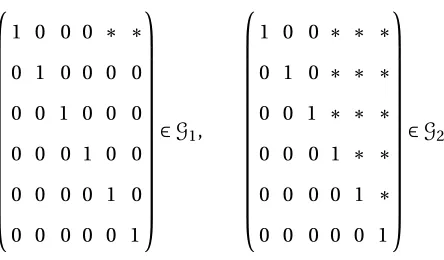
A digression into matrices.We consider a set H of matrices which containsL(x,z), along with two groups of matricesG1,G2(see examples in Figure 2) which would be used to randomizeL(x,z) as outlined
above.
Definition 2. LetHdenote the set ofℓ×ℓmatrices overFq containing only−1’s in their second diagonal (the diagonal below the main diagonal), and0’s below the second diagonal. For a fixed parameter t , define two matrix groupsG1andG2as follows:
– G1is the subset ofℓ×ℓmatrices overFq with1’s on the main diagonal and0’s in all of the remaining entries except the right-most t−1entries in the top row;
– G2is the subset ofℓ×ℓmatrices overFq with1’s on the main diagonal and0’s in all of the remaining entries except for those above the main diagonal in the t right-most columns.
It is straight-forward to verify thatG1,G2are both closed under multiplication and inverse; that is, bothG1
andG2are subgroups of the multiplicative group of invertibleℓ×ℓmatrices. Next, we establish additional
properties ofH,G1,G2which would be used to establish correctness and privacy respectively:
Lemma 2. For any H∈H,G1∈G1,G2∈G2, the firstℓ−t columns in G1HG2are the same as those in H .
1 0 0 0 ∗ ∗
0 1 0 0 0 0
0 0 1 0 0 0
0 0 0 1 0 0
0 0 0 0 1 0
0 0 0 0 0 1
∈G1,
1 0 0 ∗ ∗ ∗
0 1 0 ∗ ∗ ∗
0 0 1 ∗ ∗ ∗
0 0 0 1 ∗ ∗
0 0 0 0 1 ∗
0 0 0 0 0 1
∈G2
Fig. 2.Examples forG1,G2withℓ=6,t=3
(a) Add to the top row some linear combination of the bottomt−1 rows, as given by left-multiplication by a matrix fromG1;
(b) Add to thej’th column wherej>ℓ−t some linear combination of the firstj−1 columns, as given by right-multiplication by a matrix fromG2;
Clearly, (b) operations leave the firstℓ−t columns inH unchanged. In each of the bottomt−1 rows ofH, the firstℓ−t entries are all 0’s and therefore (a) operations also leave the firstℓ−tcolumns inH
unchanged. ⊓⊔
The following lemma (generalizing [26, Lemma 3]) shows that a matrixH fromHcan be brought into a canonical form, uniquely defined by its firstℓ−tcolumns and its determinant, by multiplying it from the left by someG1∈G1and from the right by someG2∈G2.
Lemma 3. For any H ∈ H, there exists G1 ∈G1 and G2 ∈ G2 such that G1HG2 satisfies the following properties (that is, the “canonical form”):
– the entries in the firstℓ−t columns of G1HG2are the same as those in H ; – G1HG2contains−1’s in its second diagonal;
– it contains0’s elsewhere except the valuedet(H)in the top-right entry.
Note that the canonical form forHis unique and is completely determined by the firstℓ−t columns of
Hand det(H).
Proof. Again, consider the matrix operations as described in the proof of Lemma 2. As illustrated in Figure 3, a matrix H∈H can be transformed, using a sequence of (a) and (b) operations, to a matrix
H′satisfying the properties in the Lemma. In particular, we modify the top row in the lasttcolumns of
Husing (a) operations, and the remaining rows in the lasttcolumns ofHusing (b) operations. Note that matrices inG1andG2have determinant 1 and therefore det(H′)=det(H). Finally, a simple calculation
says that det(H′) is equal to its top-right entry. ⊓⊔
∗ ∗ ∗ ∗ ∗ ∗ −1 ∗ ∗ ∗ ∗ ∗
0 −1 ∗ ∗ ∗ ∗
0 0 −1 ∗ ∗ ∗
0 0 0 −1 ∗ ∗
0 0 0 0 −1 ∗
(a) =⇒
∗ ∗ ∗ 0 0 ∗
−1 ∗ ∗ ∗ ∗ ∗
0 −1 ∗ ∗ ∗ ∗
0 0 −1 ∗ ∗ ∗
0 0 0 −1 ∗ ∗
0 0 0 0 −1 ∗
(b) =⇒
∗ ∗ ∗ 0 0 ∗
−1 ∗ ∗ 0 0 0
0 −1 ∗ 0 0 0
0 0 −1 0 0 0
0 0 0 −1 0 0
0 0 0 0 −1 0
Fig. 3.Bringing a matrixHto canonical form withℓ=6,t=3
– (correctness) Reconstruction proceeds as follows: Given x and the last t columns of R1L(x,z)R2,
we may recover the entire matrixR1L(x,z)R2, since the firstℓ−t columns are the same as those
in L(x,z) (cf. Lemma 2) and depend only on x. Then, we compute det(R1L(x,z)R2), which is a
degreetcomputation over the output of ˆF. Correctness follows from the fact that det(R1L(x,z)R2)=
det(L(x,z))=F(x,z) since det(R1)=det(R2)=1.
– (privacy) GivenxandF(x,z), we can compute the canonical formH′of the matrixL(x,z) as defined in Lemma 3, namelyH′=G1L(x,z)G2for someG1∈G1,G2∈G2(we do not need to computeG1,G2).
SinceG1andG2are both matrix groups, it follows that
R1L(x,z)R2 and R1′H′R′2,
whereR1,R′1←RG1,R2,R2′ ←RG2, are identically distributed. Simulation proceeds by outputting the
lasttcolumns ofR′1H′R2′.
Theorem 3 then follows readily.
5 Applications to Secure Computation
5.1 Conditional disclosure of secrets
We describe an application to conditional disclosure of secrets (CDS), already outlined in the introduc-tion, and an implication for secure multiparty computation.
Relation to CDS and secret-sharing. Conditional disclosure of secrets (CDS) [20] allows a set ofnplayers
P1, . . . ,Pnto disclose a secretz∈Fq to an external party Carol, subject to a given condition on their joint
Now, consider the scenario where partyPiholdsxi∈Fq and the parties want to disclose the secretz
subject to the conditionf(x1, . . . ,xn)̸=0, wheref :Fnq→Fq. LetF:Fnq×Fq→Fqdenote the function
F((x1, . . . ,xn),z)=f(x1, . . . ,xn)·z
and let ˆFbe anx-affine PGS forF. We can then derive a CDS protocol as follows:
– the shared random string is the randomness used for ˆF;
– for eachj∈[m], if ˆF(x,z)jis of the formajxi+bj, then partyicomputes and sendsajxi+bjto Carol.
Supposef(x1, . . . ,xn)̸=0. Then, upon receiving the messages, Carol can then recoverf(x1, . . . ,xn)·zand
thus z usingRec since she knowsx1, . . . ,xn. On the other hand, if f(x1, . . . ,xn)=0, then PGS privacy
guarantees that Carol learns nothing about the secret. We note that the above construction generalizes non-monotonic secret sharing: playeri holds the share ˆF(x,z)j =ajxi+bj. In the casexi∈{0, 1}, then
the 0-share isbjand the 1-share isaj+bj.
Improved CDS protocols. First, we obtain the first CDS protocols for arithmetic branching programs where the communication complexity is linear in the branching program size. The prior constructions in [20] achieve linear communication complexity for boolean branching programs, and quadratic complexity for arithmetic branching programs. Furthermore, our protocols only make a black-box use of the underlying field.
Non-zero ABP. Consider the scenario as before where partyPi holdsxi ∈Fq and the parties want to
disclose the secret subject to the condition f(x1, . . . ,xn)̸=0, where f :Fnq →Fq is computed by an ABP Γf =(V,E,v0,v1,ϕ). It suffices to construct an affine PGS for the function
F((x1, . . . ,xn),z)=f(x1, . . . ,xn)·z
Observe that we can build an ABPΓF forFfrom that for f by adding an edge labeledzconnecting the
original sinkv1to a new sink (c.f. example on the left in Fig 1). Clearly,ΓF satisfies the conditions for
Corollary 1 witht=1, and the ensuing protocol also achieves communication complexity linear in the size of the ABP forf and linear reconstruction of the secretz.
Zero ABP. We can also handle the condition f(x1, . . . ,xn)=0. Here, we want to construct an affine PGS
for the function
F′((x1, . . . ,xn), (z,z′))=f(x1, . . . ,xn)·z′+z
We can build an ABP ΓF′ for F′ from that for f by adding two edges: one labeled z′ connecting the
original sinkv1to the new sink and another labeledzconnecting the original sourcev0to the new sink
(c.f. example on the right in Fig 1). Again,ΓF′satisfies the conditions for Corollary 1 witht=1, and the
ensuing protocol also achieves communication complexity linear in the size of the ABP for f and linear reconstruction of the secretz.
Applications to secure multiparty computation. Consider a multiparty protocol in which a client interacts with multiple servers. For instance, the client may wish to make a queryq to a databaseD
using a suitable secret sharing scheme, and each server responds by applying some local computation toD and its shareqiofq. Such protocols are susceptible attacks by a malicious client, who distributes
inconsistent sharesqibetween the servers. The traditional approach of preventing such inconsistencies
is via the use of interactive protocols for verifiable secret sharing or zero-knowledge proofs. However, these protocols require additional interaction.
An alternative methodology suggested in [20] is to use CDS: make each server send only a single message to the client, such that these messages reveal the messages of the original protocol only under the condition that the client’s messagesqi are consistent with the protocol. The information-theoretic
CDS constructions given in [20] apply to Boolean formulas and do not efficiently apply in the context of arithmetic computations required for, say, verifying the consistency of the client’s messages with Shamir’s secret sharing scheme. This can be handled using our CDS protocols above for handling arithmetic predicates.
5.2 Generalized oblivious transfer
In generalized oblivious transfer (GOT) [24] (which includes priced oblivious transfer [1] as a special case), a sender holdsnpairs of secret bits (zi,0,zi,1),i=1, . . . ,nand a receiver holds inputx∈{0, 1}n. In
addition, there is some fixed boolean function f : {0, 1}n→{0, 1}. The receiver should learn the secrets indexed by x (namely z1,x1, . . . ,zn,xn) whenever f(x)=1 and nothing otherwise, whereas the sender should learn nothing aboutx. That is, the receiver learns
Fi(x, (zi,0,zi,1))=f(x)·(xizi,1+(1−xi)zi,0)
fori=1, . . . ,nandFi: {0, 1}n×{0, 1}2→{0, 1}.
Suppose f is computed by an ABPΓf =(V,E,v0,v1,ϕ) overF2of sizes. It is easy to see that we can
build an ABPΓiforFiwith|V|+3 vertices and|E|+4 edges so that the two edges labeled with the private
input (zi,0,zi,1) both lead into the sink node inΓi. This fulfills the requirements for our partial garbling
scheme, and by Corollary 1, we can construct az-affine PGS ˆFiforFiwhose output length isO(s). This
allows us to realize GOT for branching programs usingO(ns) parallel invocations of standard bit OT in the semi-honest setting. This improves upon the prior construction in [24] which requiresO(ns2) parallel invocations.
6 Verifiable Computation
We consider the online/offline verifiable computation (VC) where the client wants to delegate the computation of a function f :Fnq →Fq on an inputx ∈Fnq, where f is computed by an ABPΓ of size s. For simplicity, we restrict the client’s input to be binary, that is,x∈{0, 1}n⊆Fnq; we show later how to remove this assumption with anO(logq) multiplicative overhead. In addition, we may assume that logq
is larger than the statistical security parameter, by taking a sufficiently large field extension ofFq.
The basic construction. Our construction follows the garble+MAC paradigm in [4]. We begin with the functionF:Fnq×F2q→Fq:
That is, we apply the standard pairwise-independent MAC to authenticate the valuef(x) under the key (z1,z2). Next, we want to partially garble the functionF. We observe that for the security proof in [4], it
suffices to keepz1,z2private and there is no need to hidex. As with the CDS protocols in Section 5.1,
we can apply Corollary 1 to obtain anx-affine PGS ˆF forF where ˆF has output lengthO(s). Indeed, if we want to fully garble the ABP forF, the overhead will be quadratic ins(c.f. [26]). Since ˆF isx-affine, we may think of ˆF as definingn pairs of vectors (ai,bi) overFq and the output ˆF(x) is determined by
(xiai+bi),i=1, . . . ,n. The VC protocol for delegating the computation off onxthen proceeds as follows:
– In the offline phase, the client picksz1,z2←RFq and computes thenvectors (ai,bi). In addition, it
selectsnpairs of seeds (σi,0,σi,1) for a PRGG, and sends the servernpairs of values
G(σi,0)⊕bi,G(σi,1)⊕(ai+bi),i=1, . . . ,n
The client only needs to storez1,z2and thenpairs of seeds for the next phase.
– In the online phase, upon receivingx∈{0, 1}n, the client sends the serverx, along with thenseeds
σi,xi,i=1, . . . ,n
The server can then computexiai+bi and thus both ˆF(x, (z1,z2)) andF(x, (z1,z2). It sends (y,τ)=
(f(x),F(x, (z1,z2))) back to the client. The client accepts ifτ=z1y+z2and rejects otherwise.
The intuition for soundness is as follows. Fix an ABPf and an inputx∈{0, 1}nand we want to bound the probability that a cheating serverS∗convinces an honest client to accepty̸=f(x). First, by the security of the PRG, at the end of the online phase,S∗only learns ˆF(x, (z1,z2)) and nothing else aboutai,bi. Then,
by the privacy of PGS,S∗only learnsz1f(x)+z2and nothing else about (z1,z2). This means that by the
one-time security of the pairwise-independent MAC, the client accepts a tag ony̸=f(x) with probability at most 1/q. Following [4, Lemma 1], we can indeed show that the ensuing VC protocol has soundness error at most 1/q+negl(λ).
Removing the binary restriction. It is easy to see that we can transform any f :Fnq →Fq into another
functionf′:Fn⌈logq⌉q →Fqso that:
– for allx∈Fnq,f′( ¯x)=f(x), where ¯x∈{0, 1}n⌈logq⌉denote the binary decomposition ofx;
– iff is computed by an ABPΓof sizes, thenf′is computed by an ABPΓ′of sizeO(slogq), obtained by replacing each edge inΓwithO(logq) edges which recovers a variable from its binary decomposition.
Now, we just apply the preceding construction to the ABP f′, with ¯x as the client’s input in the online phase.
7 Attribute-Based Encryption for ABPs
In this section, we present our ABE schemes for ABPs. Here, ciphertexts are associated withx∈Fnq, and secret keys are associated with an ABP f :Fnq →Fq. In Z-ABP, decryption is possible iff f(x)=0, and in
N-ABP, decryption is possible ifff(x)̸=0. Roughly speaking, instead of using secret-sharing schemes as in the literature on ABE for boolean formula [23, 30], we will use CDS for ABP given in Section 5.1, which support linear reconstruction. The latter is important since we need to reconstruct the secret “in the exponent”. As with ABE for boolean formula, it is more convenient to work with span programs [28] for the proof of security; a side-benefit is that we can simultaneously capture both Z-ABP and N-ABP.
7.1 Arithmetic span programs
We define arithmetic span programs, a generalization of (boolean) span programs [28].
Definition 3 (arithmetic span program [28]).An arithmetic span program(V,ρ)is a collection of vectors
V={(yj,zj) :j∈[m]}inFℓqandρ: [m]→[n]. We say that
x∈Fnqsatisfies(V,ρ)iffeℓ∈span〈xρ(j)yj+zj〉,
whereeℓ:=(0, 0, . . . , 0, 1)∈Fℓqand span refers to linear span of a collection of column vectors.
We relate Z-ABP and N-ABP to arithmetic span programs. That is, given an ABPΓfor f :Fnq →Fq onℓ
vertices, we construct an arithmetic span program (V,ρ) so that
– for Z-ABP:x∈Fnq satisfies (V,ρ) ifff(x)=0;
– for N-ABP:x∈Fnqsatisfies (V,ρ) ifff(x)̸=0.
In both cases, we start with an ABPΓ′ for f onℓ+1 vertices, obtained by adding an edge labeled 1 connecting the original sink inΓto a new sink inΓ′(an analogous construction appears in Section 5.1). Next, we apply the transformation in Lemma 1 toΓ′to obtain aℓ×ℓmatrixLsuch that det(L(x))=f(x), whereL(x) has the following form:
∗ ∗ ∗ ··· ∗ ∗ 0
−1 ∗ ∗ ··· ∗ ∗ 0
0 −1 ∗ ··· ∗ ∗ 0 ..
. ... ... . .. ... ... ...
0 0 0 ··· −1 ∗ 0
0 0 0 ··· 0 −1 1
Observe that the firstℓ−1 columns ofL(x) are linearly independent. We will actually need to first modify
Γ(by replacing each edgeewith a pair of edges labeledϕ(e) and 1) so that every vertex has at most one incoming edge of degree 1, so that each column ofLdepend on the same variable and can be written as
– for Z-ABP: Here,
f(x)=det(L(x))=0⇐⇒eℓlies in the column span of the firstℓ−1 columns ofL(x)
We then take (V,ρ) to describe the column span of the firstℓ−1 columns ofL(x).
– for N-ABP: Here,
f(x)=det(L(x))̸=0⇐⇒ e1lies in the column span ofL(x)
We take (V,ρ) to describe the column span ofL(x), with the first andℓ’th row switched.
7.2 Computational assumptions
We now briefly recall bilinear pairing groups and then state the decisional bilinear Diffie-Hellman (DBDH) assumption that are required in our security proof. A generatorGwhich takes as input a security parameter 1λand outputs a descriptionG:=(p,G,GT,e), wherepis a prime ofΘ(λ) bits,GandGT are
cyclic groups of orderp, ande:G×G→GT is a non-degenerate bilinear map. We require that the group
operations inGandGT as well the bilinear mapeare computable in deterministic polynomial time with
respect toλ. Furthermore, the group descriptions ofGandGTinclude generators of the respective cyclic
groups.
Assumption 1 (DBDH: Decisional Bilinear Diffie-Hellman Assumption) Given a group generatorG(1λ), we define the following distribution:
G:=(p,G,GT,g,e)←RG(1λ), a,b,s,z←RZq,
T0:=gabs,T1:=gabs+z, D:=(G;ga,gb,gs).
We assume that for any PPT algorithmA(with output in{0, 1}),
AdvDBDH
A (λ) := |Pr[A(D,T0)=1]−Pr[A(D,T1)=1]| is negligible in the security parameterλ.
7.3 Attribute-Based Encryption
We present the definitions for attribute-based encryption [34, 23].
Syntax. A attribute-based encryption (ABE) scheme for arithmetic span programs with message space Mconsists of four algorithms (Setup,Enc,KeyGen,Dec):
Setup(1λ, 1n)→(mpk,msk). The setup algorithm gets as input the security parameterλ, the length
parameter 1nand outputs the public parametermpk, and the master keymsk.
KeyGen(msk, (V,ρ))→skV,ρ. The key generation algorithm gets as input mskand an arithmetic span program (V,ρ). It outputs a secret keyskV,ρ.
Dec(skV,ρ,ctx)→m. The decryption algorithm gets as inputskV,ρandctxand outputs a messagem.
Correctness. Ifxsatisfies (V,ρ), for all messagesm∈M, we have
Pr[Dec(skV,ρ,Enc(mpk,x,m))=m]=1.
where the probability is taken over (mpk,msk)←Setup(1λ, 1n);sky←KeyGen(msk, (V,ρ)) and the coins
of all the algorithms in the expression above.
7.4 Security Model
We consider the following selective CPA security game for attribute-based encryption played between a challenger and an adversaryA.
Selective. The adversaryAsubmits the challenge attributex∗.
Setup. The challenger generates (mpk,msk)←Setup(1λ, 1n) and givesmpkto the adversaryA.
Phase 1. The adversaryA adaptively requests keys for any (V,ρ) not satisfied byx∗. The challenger responds with the corresponding secret keyskV,ρ←KeyGen(msk, (V,ρ)).
Challenge. The adversaryAsubmits two messagesm0,m1of equal length. The challenger picksβ←R {0, 1} and sendsAthe ciphertextct∗←Enc(mpk,x,mβ).
Phase 2. Acontinues to request keys for any (V,ρ) of its choice, subject to the same constraints as before.
Guess. The adversaryAoutputs a guessβ′forβ.
We define the advantage functionAdvABE
A (λ) to be|Pr[β′=β]−1/2|.
7.5 Construction
We present our ABE scheme for arithmetic span programs:
– Setup(1λ, 1n): generateG:=(q,G,GT,e)←RG(1λ), pickα←RZq,a←RZ∗q,v←RZnq, and output
mpk:=(G;e(g,g)α,g,ga,gv) and msk:=(α,a,v)
– Enc(mpk,x,m): picks←RZqand output
ctx:= (
C0:=gs,Ci:=g(axi+vi)s:i∈[n],C′:=e(g,g)αs·m )
– KeyGen(mpk,msk, (V,ρ)): picku←RZℓq subject to the constraint〈u,eℓ〉 =α, and compute
Output
skV,ρ:=
(
(Kj,0,Kj,1) :=(g
βj a ,gγj−
βj vρ(j)
a ) :j∈[m]
)
.
– Dec(mpk,skV,ρ,ctx): Ifeℓ∈span〈xρ(j)yj+zj〉, first computeω1, . . . ,ωm∈Zqsuch that
eℓ= m ∑
j=1ωj
(xρ(j)yj+zj)
Parse the ciphertext as (C0,C1, . . . ,Cn,C′) and output
m←C′·( m ∏
j=1 (
e(C0,Kj,1)·e(Cρ(j),Kj,0) )ωj)−1
.
Theorem 4. Under DBDH assumption (described in Section 7.2), our ABE scheme defined in Section 7.5 is selectively secure (in the sense of Definition 7.4).
Correctness. Observe that
e(C0,Kj,1)·e(Cρ(j),Kj,0)=e(g,g)s(xρ(j)βj+γj).
Correctness then follows readily from the fact that
α=∑m j=1
ωj(xρ(j)βj+γj).
7.6 Proof of ABE Security
We prove the following lemma:
Lemma 4. For any adversary Aagainst the ABE scheme, there exist an adversaryBagainst the DBDH assumption whose running time is roughly that ofAsuch that
AdvABE
A (λ)≤AdvDBDHB (λ)+1/p.
Proof. Recall thatBis given
D:=(G;g,ga,gb,gs),
along withT, whereT equalse(g,g)abs or is drawn uniformly fromGT. Here, we assume thata←RZ∗q,
which yields a 1/pnegligible difference from DBDH assumption in the advantage.Bproceeds as follows:
Setup. On input selective challengex∗, pick ˜v←RZnqand implicitly set
α:=ab and v:=˜v−ax∗.
Observe that we can computempkgiveng,ga,gbas follows:
mpk:=(G;e(ga,gb),g,ga,g˜v(ga)−x∗).
Key Queries. On input a key query (V,ρ) not satisfied byx∗, by duality, we can efficiently computeu∗
such that
In addition, we pick ˜u←RZℓq subject to the constraint〈u˜,eℓ〉 =0 and implicitly set
u:=abu∗+au˜.
It suffices to show how to simulate
(Kj,0,Kj,1)=(g
βj a,gx
∗
ρ(j)βj+γj− βjv˜ρ(j)
a )
for eachj, where
βj:=ab〈u∗,yj〉 +a〈u˜,yj〉, γj:=ab〈u∗,zj〉 +a〈u˜,zj〉
Now, observe that we can readily simulateKj,0givengb, since
Kj,0=gb〈u
∗,y j〉+〈u˜,yj〉
Next, observe that
x∗ρ(j)βj+γj=ab〈u∗,xρ∗(j)yj+zj〉 +a〈u˜,x∗ρ(j)yj+zj〉 =a〈u˜,xρ∗(j)yj+zj〉
since〈u∗,x∗ρ(j)yj+zj〉 =0. We can then simulateKj,1givenga, ˜vρ(j), since
Kj,1=(ga)〈u˜,x
∗
ρ(j)yj+zj〉·K−˜vρ(j)
j,0
Challenge Ciphertext. Upon receivingm0andm1fromA,Bpicksβ←R{0, 1} and outputs the challenge ciphertext as:
ctx∗:= (
gs, (gs)v˜,T·mβ).
Now, ifT equalse(g,g)abs, thenctx∗is indeed an encryption ofmβ. On the other hand, ifT ←RGT,
thenctx∗is an encryption of a random message inGT and thus independent ofβ.
Guess. WhenAhalts with outputβ′,Boutputs 1 ifβ=β′and 0 otherwise.
We may therefore conclude thatAdvABE
A (λ)≤AdvDBDHB (λ)+1/p. ⊓⊔
References
[1] W. Aiello, Y. Ishai, and O. Reingold. Priced oblivious transfer: How to sell digital goods. InEUROCRYPT, pages 119–135, 2001.
[2] B. Applebaum. Randomly encoding functions: A new cryptographic paradigm - (invited talk). InICITS, pages 25–31, 2011. [3] B. Applebaum, Y. Ishai, and E. Kushilevitz. Cryptography in NC0.SIAM J. Comput., 36(4):845–888, 2006.
[4] B. Applebaum, Y. Ishai, and E. Kushilevitz. From secrecy to soundness: Efficient verification via secure computation. In
ICALP (1), pages 152–163, 2010.
[5] B. Applebaum, Y. Ishai, and E. Kushilevitz. How to garble arithmetic circuits. InFOCS, pages 120–129, 2011.
[6] N. Attrapadung and B. Libert. Functional encryption for inner product: Achieving constant-size ciphertexts with adaptive security or support for negation. InPublic Key Cryptography, pages 384–402, 2010.
[7] M. Bellare, V. T. Hoang, and P. Rogaway. Foundations of garbled circuits. InACM CCS, 2012. Also Cryptology ePrint Archive, Report 2012/265.
[8] F. Ben Hamouda, O. Blazy, C. Chevalier, D. Pointcheval, and D. Vergnaud. Efficient UC-secure authenticated key-exchange for algebraic languages. InPublic Key Cryptography, pages 272–291, 2013.
[9] S. Benabbas, R. Gennaro, and Y. Vahlis. Verifiable delegation of computation over large datasets. InCRYPTO, page 110, 2011. Cryptology ePrint Archive, Report 2011/132.
[10] F. Benhamouda, O. Blazy, C. Chevalier, D. Pointcheval, and D. Vergnaud. New techniques for SPHFs and efficient one-round PAKE protocols. InCRYPTO (1), pages 449–475, 2013.
[12] O. Blazy, D. Pointcheval, and D. Vergnaud. Round-optimal privacy-preserving protocols with smooth projective hash functions. InTCC, pages 94–111, 2012.
[13] D. Boneh and X. Boyen. Efficient selective-ID secure identity-based encryption without random oracles. InEUROCRYPT, pages 223–238, 2004.
[14] D. Boneh, C. Gentry, S. Gorbunov, S. Halevi, V. Nikolaenko, G. Segev, V. Vaikuntanathan, and D. Vinayagamurthy. Fully key-homomorphic encryption, arithmetic circuit ABE and compact garbled circuits. InEUROCRYPT, 2014. To appear. [15] N. Chandran, V. Goyal, R. Ostrovsky, and A. Sahai. Covert multi-party computation. InFOCS, pages 238–248, 2007. [16] U. Feige, J. Kilian, and M. Naor. A minimal model for secure computation. InSTOC, pages 554–563, 1994.
[17] S. Garg, C. Gentry, S. Halevi, A. Sahai, and B. Waters. Attribute-based encryption for circuits from multilinear maps. In
CRYPTO (2), pages 479–499, 2013. Also, Cryptology ePrint Archive, Report 2013/128.
[18] S. Garg, C. Gentry, A. Sahai, and B. Waters. Witness encryption and its applications. InSTOC, pages 467–476, 2013. Also, Cryptology ePrint Archive, Report 2013/258.
[19] R. Gennaro, C. Gentry, and B. Parno. Non-interactive verifiable computing: Outsourcing computation to untrusted workers. InCRYPTO, pages 465–482, 2010.
[20] Y. Gertner, Y. Ishai, E. Kushilevitz, and T. Malkin. Protecting data privacy in private information retrieval schemes. J. Comput. Syst. Sci., 60(3):592–629, 2000.
[21] S. Goldwasser, Y. T. Kalai, and G. N. Rothblum. Delegating computation: interactive proofs for muggles. InSTOC, pages 113–122, 2008.
[22] S. Gorbunov, V. Vaikuntanathan, and H. Wee. Attribute-based encryption for circuits. InSTOC, pages 545–554, 2013. Also, Cryptology ePrint Archive, Report 2013/337.
[23] V. Goyal, O. Pandey, A. Sahai, and B. Waters. Attribute-based encryption for fine-grained access control of encrypted data. InACM Conference on Computer and Communications Security, pages 89–98, 2006.
[24] Y. Ishai and E. Kushilevitz. Private simultaneous messages protocols with applications. InISTCS, pages 174–184, 1997. [25] Y. Ishai and E. Kushilevitz. Randomizing polynomials: A new representation with applications to round-efficient secure
computation. InFOCS, pages 294–304, 2000.
[26] Y. Ishai and E. Kushilevitz. Perfect constant-round secure computation via perfect randomizing polynomials. InICALP, pages 244–256, 2002.
[27] M. Ito, A. Saito, and T. Nishizeki. Secret sharing schemes realizing general access structure. InGLOBECOM, pages 99–102, 1987.
[28] M. Karchmer and A. Wigderson. On span programs. InStructure in Complexity Theory Conference, pages 102–111, 1993. [29] J. Katz, A. Sahai, and B. Waters. Predicate encryption supporting disjunctions, polynomial equations, and inner products.
InEUROCRYPT, pages 146–162, 2008.
[30] A. B. Lewko, T. Okamoto, A. Sahai, K. Takashima, and B. Waters. Fully secure functional encryption: Attribute-based encryption and (hierarchical) inner product encryption. InEUROCRYPT, pages 62–91, 2010.
[31] A. B. Lewko, A. Sahai, and B. Waters. Revocation systems with very small private keys. InIEEE Symposium on Security and Privacy, pages 273–285, 2010.
[32] B. Parno, M. Raykova, and V. Vaikuntanathan. How to delegate and verify in public: Verifiable computation from attribute-based encryption. InTCC, pages 422–439, 2012.
[33] M. Prabhakaran and A. Sahai.Secure Multi-Party Computation. IOS Press, 2003.
[34] A. Sahai and B. Waters. Fuzzy identity-based encryption. InEUROCRYPT, pages 457–473, 2005. [35] A. Shamir. How to share a secret.Commun. ACM, 22(11):612–613, 1979.