Stabilization of Reusable Launch Vehicle
using Backstepping and Adaptive
Backstepping-A Comparative Study
Geetha S.1, Priya G. Nair2*, Ashima C. R.3**, S. Dasgupta4
Associate Project Director, GSLV, Vikram Sarabhai Space Centre, Trivandrum, India1 PG Student, Dept. of Electrical and Electronics, College of Engineering, Trivandrum, India2 PG Student, Dept. of Electrical and Electronics, College of Engineering, Trivandrum, India3 Professor, Dept. of Electrical and Electronics, Mohandas College of Engineering, Trivandrum, India4 Current affiliations: PhD Student, Dept. of Aerospace Engineering, Indian Institute of Technology, Bombay, India*
Asst. Professor, Dept. of EEE, Lourdes Matha College of Science & Technology, Trivandrum, India**
ABSTRACT: Now a days nonlinearities are considered as a rule not an exception. Backstepping is a Lyapunov based recursive control algorithm, which is a strong tool for a class of non-linear systems. But Backstepping procedure requires exact plant model which is not the case with Adaptive Backstepping Controller design. In this paper, both Backstepping and Adaptive Backstepping Control are analyzed in detail and are applied to the stabilization of longitudinal dynamics of a reusable launch vehicle. For Backstepping controller design, typical values of the parameters are taken but for the Adaptive Backstepping Controller design, all the parameter values are treated as unknowns and by Certainty Equivalence principle, the estimated values replaces the unknowns. From the simulation results, it is clear that Adaptive Backstepping Controller gives the best results compared to the Backstepping controller, particularly for parameter uncertainties.
KEYWORDS:Adaptive Control, Control System Design, Nonlinear Systems, System Modelling, System Simulation I. INTRODUCTION
Over the past ten to fifteen years, the focus in the area of control theory has shifted from linear to non-linear systems. Recent years have witnessed a rapid development of techniques for feedback control of non-linear systems. Backstepping is a powerful design tool, for non-linear and linear systems in the pure feedback and strict feedback forms. This is a systematic design method which can be applied to wide variety of non-linear and linear systems. Backstepping is a strong tool for a class of nonlinear dynamic systems, which is based on Lyapunov stability theory. This can solve stabilization and tracking problems under conditions less restrictive than those encountered in other methods. Comparing feedback linearization and backstepping, in the former case, all the nonlinearities are cancelled, whereas in backstepping useful nonlinearities are retained. Also, in the former case, exact plant model is required, whereas, in the latter, it is not compulsory to know the plant fully.
Backstepping control design constitutes an alternative to feedback linearization. With backstepping, system nonlinearities do not have to be cancelled in the control law. If a non-linearity acts in stabilizing, and thus in a sense is useful, it may be retained in the closed loop system. This leads to robustness to model errors and less control effort may be needed to control the system.
Apart from the traditional design methods which use Euler angles as the state variables, here side slip angle and angle
conducted on a fully non-linear 6-DOF dynamic model produced satisfactory attitude control performance in conjunction with the optimization of moment coefficients.
The idea of adaptive backstepping design procedure is used for a class of non-linear systems with unknown parameters. Recently, researchers are also interested in Robust Adaptive Backstepping controller design methods [9] which mitigate the problem of unmodeled dynamics, parameter drift and noise. Moreover the stability of a system may be severely affected by some bounded disturbances and high rate of adaptation which can be overcome by incorporating a continuous switching function in the parameter updation law.
Backstepping controller design guarantees that by employing a static feedback, the closed loop state remains bounded in the presence of bounded nonlinearities and for large parameter perturbations, the system response deteriorates. While the Adaptive Backstepping Controller design employ a form of nonlinear integral feedback and the underlying idea in the design of this dynamic part of feedback is parameter estimation.
Adaptive Backstepping Controllers are dynamic and more complex than the static controllers. An Adaptive backstepping Controller guarantees not only that the plant remains bounded, but also regulation and tracking of a reference signal even in the presence of large parameter perturbations. In this paper, Backstepping and Adaptive Backstepping Controller is designed to stabilize the longitudinal dynamics of a Reusable Launch Vehicle. Model for X-38 reusable launch vehicle is considered for the application of this technique.
This paper is organized as follows. Section II discusses the various literatures related to backstepping and adaptive backstepping. In section III the design of backstepping is explained in detail. Section IV and V deals with the Adaptive Backstepping Technique and Launch Vehicle modeling respectively. Section VI presents the Backstepping design of Reusable Launch Vehicle followed by ABC design of the same in section VII. Simulation results are incorporated in section VIII. The conclusions of the work are included in Section IX.
II. RELATEDWORK
Backstepping has been brought to spotlight to a great extent by the work of Professor Petar V. Kokotovic and his co-workers [1]. Backstepping is nowadays used in various applications, flight path angle control [2], path tracing of mobile robots and position and speed tracking dc motor and induction motor [4]. In [3] the kinematic model of four wheeled mobile robots and the desired path are described
.
It is also used in re-entry vehicles as well as in missiles [5]. Structured singular value synthesis (µ-synthesis) [15] is a multi-variable control technique that provides an effective way to guarantee robust performance in the face of plant uncertainty. Unfortunately, _-synthesis controllers are extremely difficult to gain schedule.One modern control methodology that seeks to eliminate the gain-scheduling problem is dynamic inversion [16]. But, dynamic inversion by itself cannot guarantee any level of robustness to unmodeled dynamics or other plant uncertainties.
Benaskeur and Desbiens [6] proposed an adaptive two loop cascade controller to overcome the fact that the system should be written in a triangular or pure feedback form. The inner loop uses an adaptive backstepping control technique to regulate the rod angle with regard for the cart motion and unknown rod length.
Ebrahim et .al [7] proposed the same Adaptive Backstepping Controller but treating every constant parameters in the system as unknowns such as mass of the pendulum, mass of the cart, moment of inertia, gravitational constant and adaptation is given accordingly which would be a difficult task for any linear control methods. In [8], the autopilot design for re-entry vehicle is carried out using an Adaptive Backstepping Control design technique. The attitude equations are non-linear and time dependent due to large variation of aerodynamic parameters and velocity profiles. From literature review it is found that backstepping is more advantageous compared to feedback linearization in many aspects.
III. BACKSTEPPING TECHNIQUE
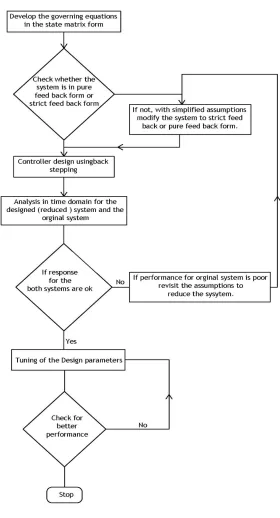
law which makes the system globally asymptotically stable can be found. Backstepping is a procedure which finds both a CLF and a control law simultaneously. Fig 1 shows the flowchart for the backstepping design procedure.
u
x
g
x
f
x
g
x
f
x
g
x
f
x
g
x
f
x
k k kk
(
,
,
,
)
(
,
,
,
)
)
,
,
(
)
,
,
(
)
,
(
)
,
(
)
(
)
(
1 1 2 3 2 1 2 2 1 2 2 2 1 1 1 1 1 1
(1)Backstepping can be applied only in pure feedback form systems or strict feedback form systems [10]. Many physical systems cannot be written in this form. Therefore, to apply backstepping some of the physical properties are neglected when modeling the system. But it is to be ensured that the neglected physical property does not affect the stability of the closed loop system.
To show how to find a CLF and a control law, a short design example is considered [11]. The system that is to be controlled is given below.
u
x
b
x
a
x
g
x
f
x
)
,
(
)
,
(
)
(
)
(
(2)Where
x
R
nand
R
are state variables andu
R
is the control input. First ξ is regarded as a control input for the -subsystem. ξ can be chosen in any way to make the -subsystem globally asymptotically stable. The choice is denoted
des(
x
)
and is called a virtual control law. For the -subsystem a control Lyapunov function, ( ), can be chosen so that with the virtual control law, the time derivative of Lyapunov function becomes negative definite.0
,
0
))
(
)
(
)
(
)(
(
)
(
1 11
x
V
x
V
x
f
x
g
x
x
x
V
x
x
des (3)A new state is introduced which represents the error variable
)
(
~
x
des
(4)The system shown in equation (2) is then written in terms of these new variables
)))
(
~
)(
(
)
(
(
)
(
))
(
~
,
(
))
(
~
,
(
~
))
(
~
)(
(
)
(
x
x
g
x
f
x
x
u
x
x
b
x
x
a
x
x
g
x
f
x
des des des des des
(5)For the system given above a control Lyapunov function is constructed from ( ) by adding a quadratic term which penalizes the error variable
~
,2 1 2
~
2
1
)
(
)
~
,
(
x
V
x
V
(6)Differentiating
V
2(
x
,
~
)
with respect to time
)))
(
~
)(
(
)
(
(
)
(
))
(
~
,
(
~
))
(
~
,
(
~
~
)
(
)
(
)
(
)
(
)
(
)
~
,
(
1 2x
x
g
x
f
x
x
u
x
x
b
x
x
a
x
g
x
x
g
x
f
x
V
x
V
des des des des des x
(7)Equation (7) can be rewritten in the following way if the variables that the functions depend on are omitted. To guarantee stability ̇ has to be negative definite. This can be achieved by choosing the control input, u in (7) as
1
(
)
(
f
g
(
~
(
x
)))
a
V
1g
k
~
x
x
b
u
des des (8)0
~
)
(
22
V
f
g
k
V
des (9)If u is not the actual control input but a virtual control law consisting of state variables, then the system can be further expanded by starting over again. Hence the backstepping design procedure is recursive.
IV.ADAPTIVE BACKSTEPPING TECHNIQUE
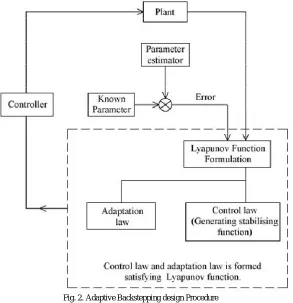
The Backstepping controller design guarantees that by employing a static feedback, the closed loop state remains bounded in the presence of uncertain bounded nonlinearities. While the Adaptive Backstepping Controller design employ a form of non-linear integral feedback and the underlying idea in the design of this dynamic part of feedback is parameter estimation. The dynamic part of the controller is designed as a parameter update law with which the static part is continuously adapted to new parameter estimates. Fig 2 shows the Adaptive Backstepping controller design procedure.
Fig. 2. Adaptive Backstepping design Procedure
Adaptive Backstepping Controllers are dynamic and therefore more complex than the static controllers. What is achieved with this complexity is that, an Adaptive Backstepping Controller guarantees not only that the plant x remains bounded, but also regulation and tracking of a reference signal. In its basic form, the ABC design employs over parameterization and this means that the dynamic part of the controller is not of minimal order. Consider
u
x
x
x
x
2
1 2
1
(
)
(10)
0
e
(11)Next we choose the Lyapunov candidate function as
2 2
1 2
2
1
2
1
)
,
(
x
ex
eV
(12)with the control law
)
,
(
)
(
1 1 11 1
2
k
x
x
x
x
(13)and the adaptation law
1 1 0
(
x
)
x
(14)the derivative of the candidate Lyapunov function becomes
0
2 1 1 1
k
x
V
(15)The deviation of from the stabilizing function is given by
)
,
(
11 2
x
x
z
(16)Augmenting the Lyapunov function by adding the error variable
2 1
1 2
2
1
)
,
(
)
,
,
(
x
z
V
x
z
V
e
e
(17)By the proper selection of u, the overall Lyapunov function becomes negative definite which implies that tends to 0, and then z also tends to zero asymptotically.
V. DYNAMIC MODEL OF A REUSABLE LAUNCH VEHICLE
The system under consideration is a Reusable Launch Vehicle (RLV) during its re-entry phase [12]. During this time, the aerodynamic forces become comparable to the gravitational forces. A conventional aircraft is usually equipped with three control surfaces viz: a rudder, an elevator, and an aileron. But, the X-38 has only two sets of control surfaces: rudders and elevons as shown in Fig 3. The X-38 vehicle has a pair of rudders on top of each of the two vertical fins, a pair of elevon on lower rear of the vehicle. Each surface can be controlled independently to obtain the required control action.
Fig. 3 Control surface deflections
The elevon angle for pitch control is given by averaging the elevon deflections.
2
eR eL e
(18)2
eR eL a
(19)Similarly, the total rudder angle for yaw control is given by taking the average of the rudder deflections.
2
rR rL r
(20)The non-linear set of equations of which describes the motion of the vehicle is as follows [13]:
)
(
1
r r a a p xxL
L
p
L
L
I
p
(21))
(
1
r r e e q yyM
M
q
M
M
I
q
(22))
(
1
r r a a p zzN
N
p
N
N
I
r
(23)q
V
Z
V
g
V
Z
t t t
sin
sin
1
(24)
t t r t p tV
g
r
V
Y
V
p
Y
V
Y
1
(25)In the above set of equations [21-25] p, q and r are the roll rate, pitch rate and yaw rate respectively. Here, α is the angle of attack, β is the side slip angle, and is the flight path angle. The equations are represented in terms of aerodynamic forces and moments, where L is called the rolling moment, M the pitching moment and N is the yawing moment. { }, { }, { } are the moment of inertia in the x, y and z directions respectively. ф is the roll angle, g is the acceleration due to gravity and is the vehicle velocity. The coefficients Y and Z in the equations represent side force and downward force respectively. The dependence of the aerodynamic forces on the angle-of-attack and the side slip angle is crucial to stability and control.
VI.SYSTEM DYNAMICS AND BACKSTEPPING CONTROLLER DESIGN
A Lyapunov based non-linear backstepping controller is designed for the reusable launch vehicle. Here the controller is designed for the longitudinal dynamics of the vehicle. The longitudinal dynamics are made out of a subsystem with the states
Tq
x
(26)and the input vector
e
u
(27)In longitudinal dynamics, angle of attack (α) and pitch rate (q) equations are considered for the design of backstepping controller. The design objective is to regulate and track the angle of attack as desired. The equations of motion for the longitudinal dynamics are as follows.
r t r e t e t t t
V
Z
V
Z
q
V
Z
V
g
V
Z
sin
sin
1
sin
sin
(28))
(
1
r r e e q yyM
M
q
M
M
I
In the above equations and are the flight path angle and Euler pitch angle respectively. Here, g is the acceleration due to gravity is the vehicle velocity and is the moment of inertia in y direction. The equations are represented in terms of aerodynamic forces and moments, where Z and M represents the downward force and pitching moment respectively.
For applying backstepping some assumptions are made and the resulting mathematical model becomes
)
(
1
1
sin
e e q yy t tM
q
M
M
I
q
q
V
Z
V
Z
(30)The Lyapunov functions are chosen as
2 1 1
2
1
x
V
(31)2 1 2
2
1
z
V
V
(32)where z is the error variable and is the virtual control law for the first subsystem.
des
x
x
z
2
2 (33)1 1 2
c
x
x
des
(34)The derivatives of control Lyapunov functions obtained as
2 1 1 1 1
1
x
sin
x
c
x
V
Z
V
t
(35)2 2 2 1 1 1 1 2 1 1 1 2 2 1 2 1 1 1 1 1 2
sin
sin
sin
sin
sin
sin
z
c
x
c
x
x
V
Z
x
c
x
c
V
Z
x
I
M
x
I
M
x
I
M
z
x
c
z
x
x
x
V
Z
V
t t y e y q y t
(36)The variables and are positive design constants and are chosen arbitrarily. By varying the values of design constants and we can make the derivative of Lyapunov function more negative definite. The desired control law to make ̇ ( ) negative definite is
1 1 2 1 1 1 2 2 1 1 1)
1
(
)
(
sin
sin
sin
c
x
c
c
x
c
c
x
V
Z
x
I
M
x
I
M
M
I
u
t y q y e y des (37)VII. ADAPTIVE BACKSTEPPING CONTROLLER DESIGN FOR LONGITUDINAL DYNAMICS OF RLV
In longitudinal dynamics, angle of attack (α) and pitch rate (q) equations are considered for the design of backstepping controller. The system considered after taking the assumption that the effect of coupling is negligible is given as
q
V
Z
t
sin
)
sin
sin
(
1
e e q yyM
q
M
M
I
q
(39)The state variables are selected as = ; = . The control variable is = . The system of equations can now be expressed as
2 1 1
sin
x
x
V
Z
x
t
(40))
sin
sin
(
1
2 12
M
x
M
x
M
u
I
x
q eyy
(41)The control law is to be designed such that the system stabilizes for whatever be the initial conditions[13]. For applying the Adaptive Backstepping Control design procedure, the system can now be expressed as
u
x
x
x
x
x
x
sin
sin
sin
4 2 3 1 2 2 2 1 1 1
(42)where ф ,ф ,ф are the unknown parameters in the system. The first error variable is defined as
sp
x
e
1
(43)where is the desired set point. Using the Lyapunov function
2 1
2
1
e
V
(44)and using the derivative of the Lyapunov function, the virtual control law can be formulated as
e
k
x
x
des2
1sin
1
sp
1 (45)where > 0 and is a design parameter which guarantees ̇ < 0. The second error variable is defined as
des
x
x
2
2
(46)By augmenting the Lyapunov function with the error variable and the unknown parameters in the system, we get
2 4 4 2 3 3 2 2 2 2 1 1 2 2 2
2
1
2
1
2
1
2
1
2
1
2
1
e e e ee
V
(47)The first derivative of the Augmented Lyapunov function becomes
40 40 4 30 30 3 20 20 2 10 10 1 2
1
1
1
1
e
e
V
(48)40 40 4 30 30 3 20 20 2 10 10 1 1 1 1 4 2 3 1 2 2
1
1
1
1
]
cos
sin
sin
[
x
x
u
x
k
e
e
e
V
sp(49)
where , , , are the parameter estimation errors of ; ; ; where: ∗ = − ∗ and * stands for
1, 2, 3, 4. The variables , , , are the parameter estimates with , , , are the adaptation gain constants. With the control law
20 1 30 2 10 1 1 21 40
cos
sin
sin
1
k
e
k
x
x
x
u
des
sp
(50)u
x
x
x
sin
sin
cos
4 40
2 3 30
1 2
20
1 1
10
(51)
The derivative of the augmented Lyapunov function becomes negative definite
0
2 2 2 1
2
k
e
k
e
V
(52)where > 0, > 0. Therefore by Laselles theorem, the system is globally asymptotically stable at the equilibrium point of the system.
VIII. SIMULATION RESULTS
The control laws are simulated in MATLAB/SIMULINK platform and the simulation results for backstepping controller are shown in figure 5 and 6. The simulations are carried out at a typical time instant in the trajectory.
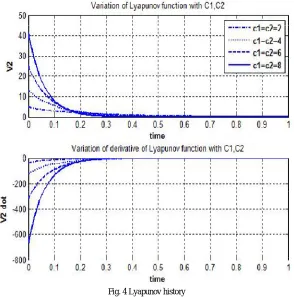
Fig. 4 Lyapunov history
The effect of controller parameters and on the derivative of Lyapunov function is shown in Fig 4. From the figures it is clear that the derivative of Lyapunov function becomes more negative definite as values of and increases. Since Lyapunov function is a representation of energy, the system response become faster. Here, ( , ) is a positive definite function and ̇( , )s negative definite. Therefore, according to Lyapunov’s Main Stability Theorem, the equilibrium states at the origin is said to be uniformly asymptotically stable.
Fig. 5. Angle of attack variation for different , Fig. 6 Stabilization of pitch rate
Fig 5 and 6 shows the variation of angle of attack and pitch rate for different values of , using backstepping controller. From the figures, it can be seen that the angle of attack and pitch rate are regulated to zero as desired. As the values of and increases the stabilization is achieved at a faster rate. Adaptive Backstepping Controller gives the following performances.
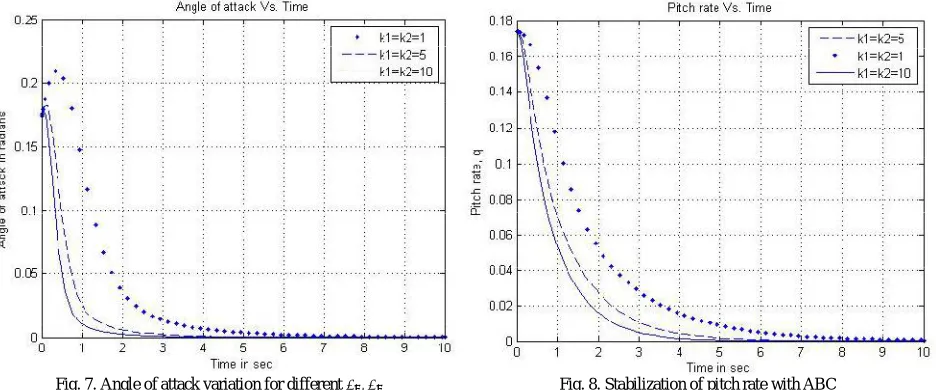
Fig. 7. Angle of attack variation for different , Fig. 8. Stabilization of pitch rate with ABC
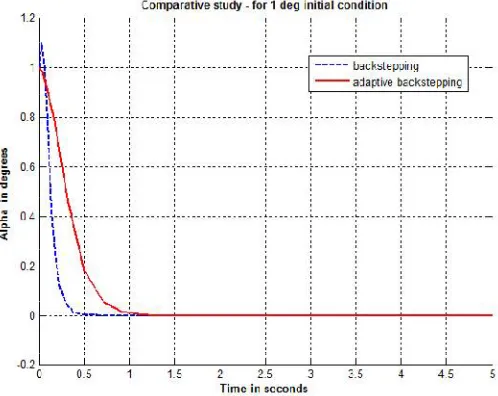
Fig. 9. Angle of attack variation for backstepping and ABC
Simulation results validate the fact that the controller stabilizes the system despite of these variations. In Fig 9 the angle of attack variation with backstepping technique and adaptive backstepping technique are plotted with an initial condition of 1 degree. The other responses like pitch rate and Lyapunov history are almost same for both backstepping controller and ABC. The advantage of adaptive backstepping is that it doesn’t require plant parameters.
IX.CONCLUSIONS
Backstepping is a recursive procedure for global stabilization by state feedback. The method benefits from naturally stabilizing nonlinearities. Even though backstepping control technique gives satisfactory results amidst nonlinearities, it requires complete knowledge of the plant model. On the other hand, ABC design procedure is independent of the constant plant parameters and hence it can overcome parameter uncertainties retaining useful nonlinearities. But both the controllers guarantees stability and satisfactory response. The one major drawback is that the system must be either in pure feedback form or strict feedback form.
The backstepping control law is computationally much simpler, and is globally stabilizing. From the results, it is quite clear that proper tuning of the constants , of the ABC gives identical performance on comparing with the backstepping controller. In addition, the simulation results have clearly illustrated that the proposed non-linear controllers are quite effective and efficient for the design of control system for the Launch Vehicle.
REFERENCES
[1] Miroslav Kristic, I. Kanellakopoulos, and P. V. Kokotovic, “Nonlinear and Adaptive Control Design”, Wiley Interscience, New York, 1995. [2] Ola Harkegard and S. Torkel Glad, “A backstepping design for flight path angle control”, IEEE Conference on Decision and Control, Sidney,
Australia, pp. 3570-3575, 2000.
[3] Umesh Kumar and Nagarajan Sukavanam, “Backstepping based trajectory tracking control of a four wheeled mobile robot”, International Journal of Advanced Robotic Systems, Vol.5, No.4, ISSN 1729-8806, pp. 403-410 , 2008.
[4] Souad Chaouch, Mohamed Said and Nait Said, “Backstepping control design for position and speed tracking of DC motors”, Asian Journal of Information technology, Vol. 5, No.12, pp. 1367-1372, 2006.
[5] Johan Dahlgren, Ola Harkegard and Henrik Jonson, “Robust non-linear control design for a missile using backstepping”, M. S. Thesis, Department of Electrical Engineering, Linkopings University, Linkoping, Sweden, 2003.
[6] A. Benaskeur and A. Desbiens, “Application of Adaptive Backstepping to the stabilization of the inverted pendulum”, IEEE Canadian Conference, Vol. 1, No. 1, pp. 113-116, 1998.
[8] Baohua Lian and Hyochoong Bang, “Adaptive Backstepping Control Based Autopilot Design for Re-entry Vehicle”, AIAA Guidance, Navigation and Control Conference, pp. 1-10, 2004.
[9] Shubhobrata Rudra and Ranjit Kumar Barai, “Robust Adaptive Backstepping Control of Inverted Pendulum on Cart System”, IEEE, International Journal of Control and Automation, Vol. 5, pp. 13-25, 2012.
[10] S. Geetha, Priya G. Nair, Dr. S. Dasgupta “Side Slip Angle Control of Reusable Launch Vehicle using Backstepping”, International Journal of Engineering Research and Technology, Vol. 4 Issue 05, ISSN: 2278-0181, pp. 1019-1023, 2015.
[11] Priya G. Nair, S. Geetha, Jisha V. R., “Backstepping Controller for the Descent Phase of Reusable Launch Vehicle”, National Conference on Technological Trends, College of Engineering, Trivandrum, 2013.
[12] Diagoro Ito, Jennifer Georgie, John Valasek and Donald T.Ward , “Re-entry vehicles fight controls design guidelines dynamic inversion”, NASA centre for aerospace information, 2002.
[13] Ashima C. R, S. Ushakumari, S. Geetha, “Application of Adaptive Backstepping for the control of a Reusable Launch Vehicle”, National Conference on Technological Trends, College of Engineering, Trivandrum, 2014.
[14] Geetha S., Ancy Joseph, “Application of Backstepping for the control of Launch Vehicle”, Journal of the Institution of Engineers (India) Series C, Vol. 88, pp. 13-19, 2007.
[15] Stein, Gunter, John C.Doyle, “Beyond Singular Values and Loop Shaping", Journal of Guidance, Vol.14, No.1, New York, American Institute of Aeronautics and Astronautics, pp.5-16, 1991.