OPTIMIZATION OF DESIGN
PARAMETERS FOR CRANE HOOK USING
TAGUCHI METHOD
Mr. A. Gopichand
1, Ms. R.V.S.Lakshmi
2, Mr. B. Maheshkrishna
3 Associate Professor, Department of Mechanical Engineering, Swarnandhra College of Engineering & Technology,Narsapur, India1
P.G. Student, Department of Mechanical Engineering, Swarnandhra College of Engineering & Technology,Narsapur, India2
Assistant professor, Department of Mechanical Engineering, Swarnandhra College of Engineering & Technology,Narsapur ,India3
Abstract: Crane hooks are one of the important components which are used to transfer materials having heavy loads,
mainly in industries. Crane hooks are liable components subjected to failure due to stress in accumulation of heavy loads. The design parameters for crane hook are area of cross section, material and radius of crane hook. In the present work optimization of design parameters is carried out using Taguchi method, total three parameters are considered with mixed levels and L16 orthogonal array is generated .The optimum combination of input parameters for minimum Von-mises stresses are determined.
Keywords: Crane hook; optimization; Taguchi method;
I. INTRODUCTION
Crane hooks are one of the important components used in industries to carry heavy loads; basically crane hooks are designed with pulley elongated by rope or a chain. In this paper mathematical calculations are done by varying cross sections triangular, trapezoidal, and rectangular with constant area of cross sections for two different materials of steel, cast-iron analysis are evaluated. PRO/E design is prepared, for different cross sections by preparing the trajectory with the parameters taken from the design data book. In this project result of mathematical calculations is compared with the ANSYS with constant area of cross section ,modifying the type of material optimization of better results were done in Taguchi Method.
II. LITERATURE SURVEY
III.ANALYTICAL METHOD FOR STRESS CALCULATION
Curved beam flexure formula is used when the curvature of the member is pronounced as in cases of hooks and rings for different cross sections mathematical analysis of stress [2]
Where M=maximum bending moment
Y=Distance between centroidal axis to neutral axis
I=Moment of inertia for different cross sections taken from design data book [5] A For a TRIANGULAR cross section:
Area of a triangle = . I= (b×h3)/36.
Y=h/3 Stress
a
IV.TAGUCHI METHOD
Taguchi is a technique which is used to predict optimal performance level based on optimal control factor level combination and conduct a confirmation experiment to verify the results product designed with this performance will deliver more consistent performance. Taguchi experimental verification is done based on orthogonal array technique is a systematic software technique is used when no of inputs of the system is relatively small and two large to allow exhaustive testing of every possible input to the system. Table 1 shows the levels of parameters considered for the optimization of design. Using Taguchi design L16 orthogonal array is generated for the mixed levels.
MODEL DESIGN
PARAMETERS LEVELS
1 2 3 4
1 AREA OF CROSS SECTION
TRIANGULAR CIRCULAR TRAPIZODIAL RECTANGULAR
2 MATERIAL TYPE
CAST IRON STRUCTURAL STEEL
3 RADIUS 150mm 200mm
Table 1: LEVELS OF PARAMETERS
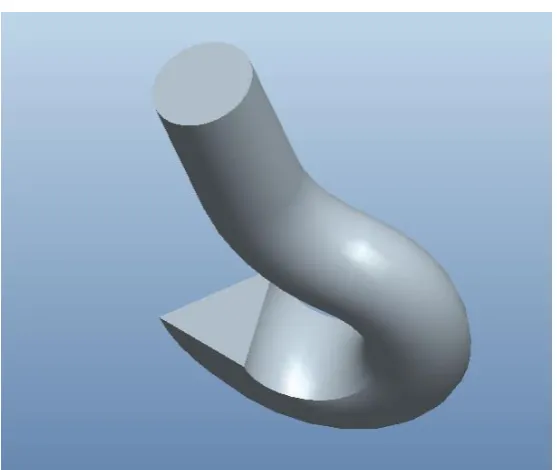
Fig 1: PRO-E Model of Crane Hook
V.ANALYSIS USING ANSYS
Vonmises Stress Analysis in Ansys: The solid model in i.g.s format is imported to ANSYS WORKBENCH a point load is applied to the model now the simulation process is done for the results. Simulation process meshing of the model is generated as shown in Fig2, for the selection of static analysis fixed support is choosen at shank end and the force is applied in y direction for selected materials of structural steel and cast iron, now the solution is let to solve and Vonmises stresses are detected for different cross sections which are of triangular, circular, rectangular and trapezoidal. For analysing the cross-section of the crane hook after and when it is designed in the PRO-E, loads are applied to check that how much load the designed crane hook with stands. The process of applying load and the results obtained in the Ansys are indicated below
VI.OPTIMIZATION OF DESIGN PARAMETERS USING TAGUCHI METHOD
Based on the orthogonal table mixed level combination with an array of L16 combination is chosen and the parameters of area of cross sections like triangular, circular, trapezoidal, rectangular along with materials of cast iron, structural steel with two different radiuses of 150mm, 200mm.
MODEL AREA OF CROSS SECTION
MATERIAL RADIUS VONMISES STRESS
1 TRI SS 150 33.986
2 TRI SS 150 33.986
3 TRI CI 200 25.176
4 CLR CI 200 25.176
5 CLR SS 150 46.324
6 CLR SS 150 46.324
7 CLR CI 200 29.465
8 CLR CI 200 29.465
9 TRPI SS 200 28.764
10 TRPI SS 200 28.764
11 TRPI CI 150 35.393
12 TRPI CI 150 35.393
13 REC SS 200 31.205
14 REC SS 200 31.205
15 REC CI 150 44.505
16 REC CI 150 44.505
Table 2: Optimization of Design Parameters
VII RESULTS AND DISCUSSIONS
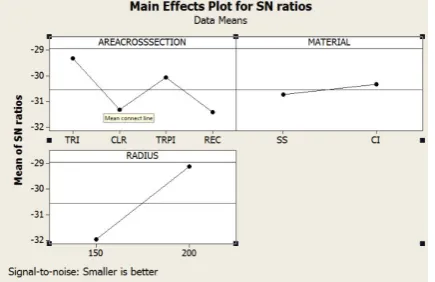
Taguchi analysis is performed on the L16 orthogonal array for minimizing Von mises stress considering the option
smaller is better .From the main effects plots from SN ratio the optimum combination of input parameters are
VIII.CONCLUSION
From the Taguchi analysis the optimum combination of input parameters for von misses stress were determined using SN ration plots, The optimum combination is TRIANGULAR cross section ,CASTIRON material and 200mmRADIUS .The first model simulation values are compared with analytical values and the error is 9.26%which is acceptable.
REFERENCES
[1] Santosh Shaun, Ritesh Dewangan, Manas Patnaik, Narendra Yadav; “ Study of Crane Hook Having Trapezoidal Section by Finite Element Method & Design of Experiments” International Journal of Modern Engineering Research Vol.2 Issue pp-2779-2781 ISSN: 2249-66454 July-Aug 2012.
[2] R.S.Khurmi,“Strength of materials” 23 rdEdition Chapter 33 (2009) .
[3] Shariff Abdulla, “Hand Book of Properties of engineering materials ans design data for machine elements” (2009)
[4] RajendraParmanik“Design Of Hoisting Arrangement Of E.O.T. Crane”Posted http://rparmanik.wordpress.com/about-me-rajendra-parmanik/
Crane”Posted on July 26, 2008.
[5] http://www.codecogs.com/reference/engineering/materials/curved_beams.php(updated last on 17-10-2011
[6] Takuma Nishimura, Takao Muromaki, KazuyukiHanahara, Yukio Tada, Shigeyuki Kuroda and Tadahisa Fukui; “Damage Factor Estimation of Crane-Hook (A Database Approach with Image, Knowledge and Simulation)” 4th International Workshop on Reliable Engineering Computing (REC 2010)
[7] Ismail Gerdemeli, Serpil Kurt, Okan Deliktas; “Finite Element Analysis of the Tower Crane” 14th International Research/Expert Conference TMT 2010, Mediterranean Cruise,18 -11September 2010.
[8] Derya Ozer, A.Burak Erdil, Ismail Gerdemeli; “Finite element approach to 3D Modeling and stress analysis of crane lifting hooks” 11th International Research/Expert Conference TMT , Hammamet, Tunisia, 05-09 September, 2007.
[9] Paleti Srinivas, K.C.Sambana, Rajeshkumar Datti; “Finite Element Analysis using ANSYS 11.0” PHI Learning Pvt. Ltd. New Delhi ISBN -978-81-203-4108.
[10] Arthur P. Boresi, Richard J. Schmidt; “ Advanced Mechanics of Materials” John Wiely & Sons Inc. ISBN 978-0-471-43881-6.